
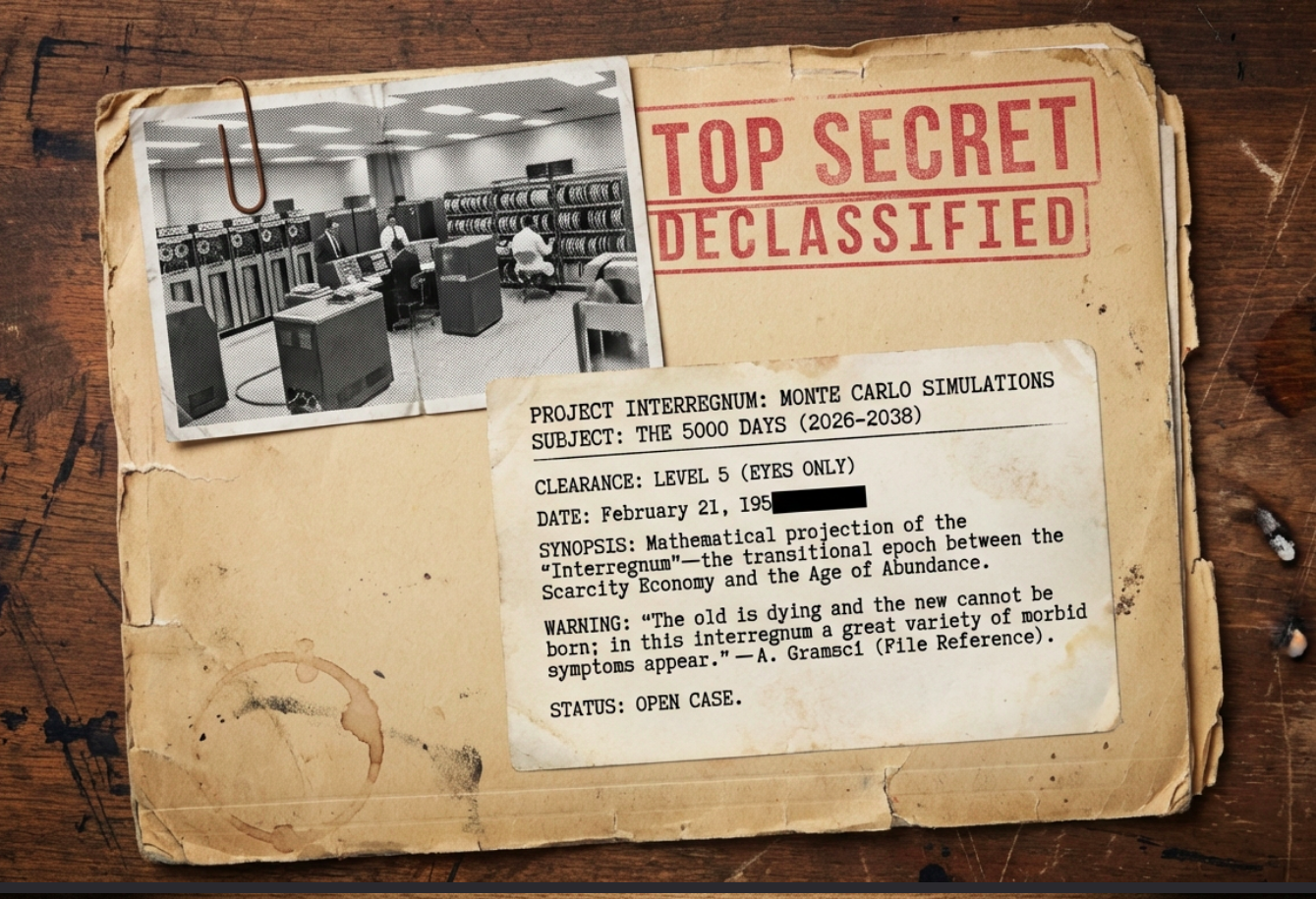
You Have 5000 Days: Navigating the End of Work as We Know It. Part 14: The Interregnum Chaos, and the Hero’s Path Forward.
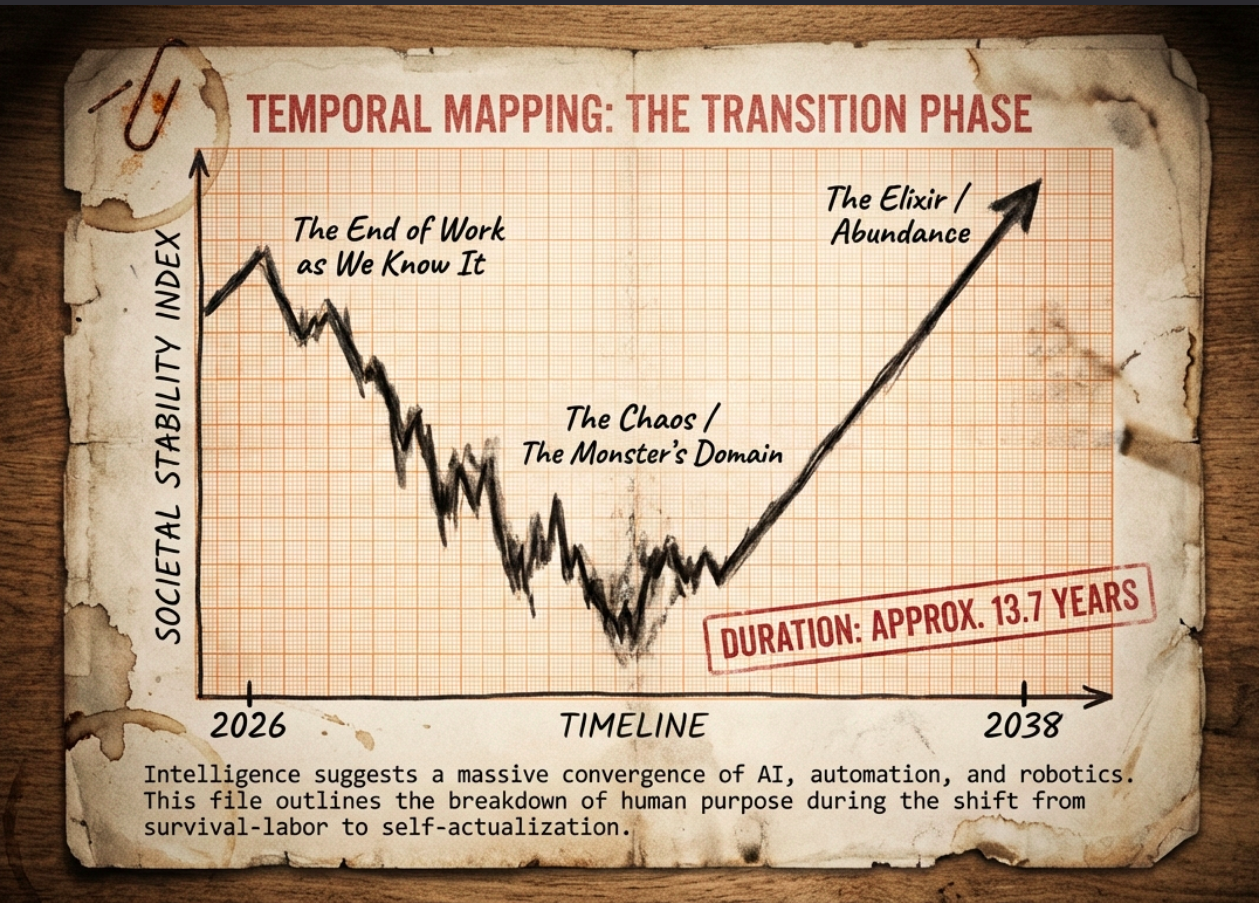
As we embark on this fourteenth installment of the You Have 5000 Days: Navigating the End of Work as We Know It series, I want to pause and reflect on the journey we’ve shared thus far. For those new to the series, this ongoing exploration delves into the profound transformation awaiting humanity as artificial intelligence, automation, and exponential technologies converge to redefine “work” – not just jobs, but the very fabric of human purpose, economy, and society. Launched in late 2025, the series draws its name from the approximate 5000 days (about 13.7 years) projected from the dawn of this era to a pivotal tipping point around the late 2030s, where abundance becomes the norm and scarcity-driven labor fades into history.
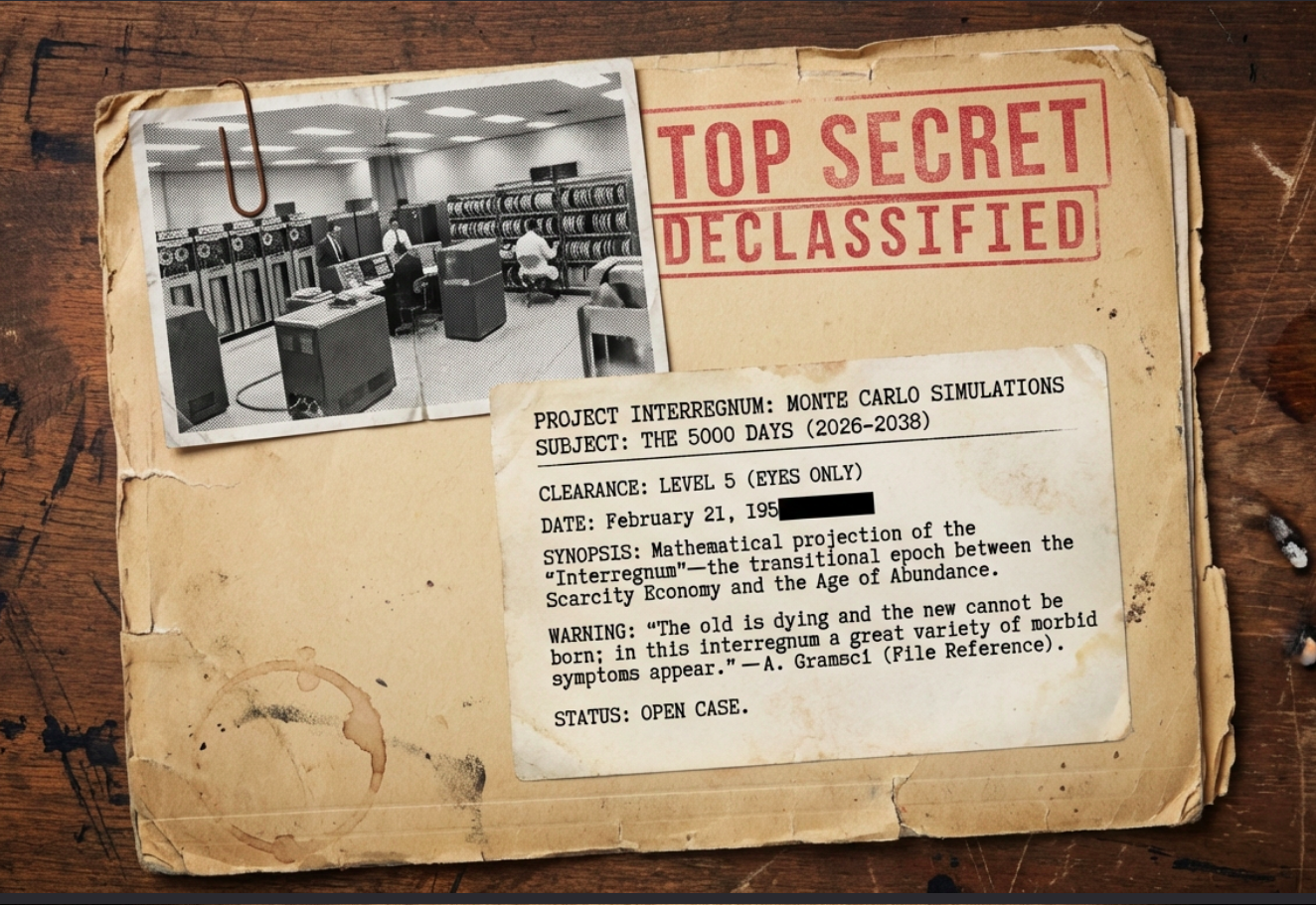
I have built an AI modle custom tailored for a bespoke focus: The Next 5000 Days and what scenerios can play out with daily dynamic adjustments to show a proability vector. It is built on execlusivly 1000s of govenrment and NGO reserch reports, studies, and presentations offtne previously classified. The modle has some Monte Carlo math concepts to present random injections. I run it continuously as a live simulation with real-time sentiments fed in by Grok from X feeds. This allows confirmations of assumptions. This article is the first public announcment of anyone using such a system and using the top 28 prediction based on a 1-10 rating based on an internal system. I tie the predictions to books that can help you understand the concept the AI model is suggesting. But first let’s do a review of the last 13 parts of the series. If this is new to you, dont read this and goto Part 1 first.
Listen to the companion podcast: https://rss.com/podcasts/readmultiplex-com-podcast/2566792
In Parts 1 through 13, we’ve traversed a rich landscape, grounded in history, philosophy, literature, and cutting-edge tech forecasts. Here’s a brief overview of the prior installments, complete with full URLs for easy access:
- Part 1 (December 24, 2025): Introduced the core thesis of the 5000-day timeline to an Age of Abundance driven by AI and robotics, framing the transition through Joseph Campbell’s Hero’s Journey, exploring historical work roles, consciousness and wonder, recommended books as Supernatural Aid, and an action plan starting January 1, 2026, for healing, experimentation, and integration. https://readmultiplex.com/2025/12/24/you-have-5000-days-how-to-navigate-the-end-of-work-as-we-know-it-part-1/
- Part 2 (December 31, 2025): Delved into Elisabeth Kübler-Ross’s five stages of grief adapted to the loss of careers due to automation, including her biography, detailed stage analysis with applications to job loss, organizational change adaptations, expanded actionable plans for preemptive preparation, 10 indicators of AI replacement with strategies to ride the waves, and forming support groups to preempt societal ennui. https://readmultiplex.com/2025/12/31/you-have-5000-days-how-to-navigate-the-end-of-work-as-we-know-it-part-2/
- Part 3: The Player Piano (January 1, 2026): Focused on Kurt Vonnegut’s novel as a cautionary tale of automation’s societal divides, with detailed plot, themes, characters, parallels to modern AI, lack of adaptations, and ties to the 5000 days timeline and Hero’s Journey, urging ethical navigation of technological change. https://readmultiplex.com/2026/01/01/you-have-5000-days-navigating-the-end-of-work-as-we-know-it-part-3-the-player-piano
- Part 4: Reframing the Dawn of Abundance (January 19, 2026): Explored mental reframing techniques inspired by Scott Adams to transform fear of obsolescence into opportunity across mental, physical, social, and existential domains, with ties to the Hero’s Journey, addressing psychological tolls and broader Interregnum context. https://readmultiplex.com/2026/01/19/you-have-5000-days-navigating-the-end-of-work-as-we-know-it-part-4-reframing-the-dawn-of-abundance
- Part 5: Your Deskilling (January 20, 2026): Detailed AI-driven deskilling using Anthropic’s Economic Index, reframing it as liberation, with Mihaly Csikszentmihalyi’s flow state for mental shifts, reskilling strategies focusing on human-AI feedback loops, and connections to the series’ themes of adaptation. https://readmultiplex.com/2026/01/20/you-have-5000-days-navigating-the-end-of-work-as-we-know-it-part-5-your-deskilling
- Part 6: The Dark Night of the Soul (January 27, 2026): Examined psychological and existential crises as the Hero’s Inmost Cave, using the Zero-Human Company as a metaphor, with navigation strategies like vulnerability audits, abundance rituals, and philosophical resilience from Frankl and Camus. https://readmultiplex.com/2026/01/27/you-have-5000-days-navigating-the-end-of-work-as-we-know-it-part-6-the-dark-night-of-the-soul
- Part 7: Consider Phlebas (January 30, 2026): Drew from Iain M. Banks’ Culture series, especially Consider Phlebas, to envision post-scarcity societies, exploring themes of mortality, purpose, societal shifts, and human fragility, as a Reward in the Hero’s Journey. https://readmultiplex.com/2026/01/30/you-have-5000-days-navigating-the-end-of-work-as-we-know-it-part-7-consider-phlebas
- Part 8: Saving Your Wisdom (February 2, 2026): Emphasized preserving personal and collective knowledge via SaveWisdom.org through storytelling and digital archives, integrating narrative therapy for self-transformation, as the Elixir in the Hero’s Return. https://readmultiplex.com/2026/02/02/you-have-5000-days-navigating-the-end-of-work-as-we-know-it-part-8-saving-your-wisdom
- Part 9: The Artisan’s Awakening (February 4, 2026): Highlighted the rebirth of artisanal crafts and human creativity as antidotes to automation, using Moravec’s Paradox for human advantages, with 22 resilient trades evolving into hobbies in abundance, sparking a renaissance in handmade goods and skills. https://readmultiplex.com/2026/02/04/you-have-5000-days-navigating-the-end-of-work-as-we-know-it-part-9-the-artisans-awakening
- Part 10: Everyone Is Doing It* (February 8, 2026): Addressed the normalization and secretive mass adoption of AI in daily life, accelerating change with caveats like pressure-induced inauthenticity and imposter syndrome, urging volitional mastery for Hero’s progression. https://readmultiplex.com/2026/02/08/you-have-5000-days-navigating-the-end-of-work-as-we-know-it-part-10-everyone-is-doing-it
- Part 11: The Reversal of Obsolescence (February 14, 2026): Applied Marshall McLuhan’s tetrad to AI’s evolution, showing how it enhances cognition while reversing human obsolescence through flips like friction luxury and unplug renaissance, as the monomyth’s return. https://readmultiplex.com/2026/02/14/you-have-5000-days-navigating-the-end-of-work-as-we-know-it-part-11-the-reversal-of-obsolescence
- Part 12: The Profit And The Arcitect (February 16, 2026): Investigated new economic models in abundance, with ‘Arcitec’ as the architecture of future human-AI symbiotic systems inspired by Wiener and Licklider, focusing on profit through human flourishing and directives for mastering entropy. https://readmultiplex.com/2026/02/16/you-have-5000-days-navigating-the-end-of-work-as-we-know-it-part-12-the-profit-and-the-arcitect
- Part 13: The Guilded Age (February 20, 2026): Revisited medieval guilds as models for modern decentralized communities, adapting to AI by fostering mastery, collaboration, unit-based valuation, and mutual aid in a ‘guilded’ (gilded/guild) era of abundance. https://readmultiplex.com/2026/02/20/you-have-5000-days-navigating-the-end-of-work-as-we-know-it-part-13-the-guilded-age
This article is sponsored by Read Multiplex Members who subscribe here to support my work:
Link: https://readmultiplex.com/join-us-become-a-member/
It is also sponsored by many who have donated a “Cup of Coffee”. If you like this, help support my work:
Link: https://ko-fi.com/brianroemmele
This series isn’t dystopian fear-mongering or utopian fantasy, it’s a call to conscious evolution, urging us to prepare for a world where “work” shifts from survival to self-actualization. We have seen some of the clear paths forward but of course there is an elephant in the room, I will address some of it here, there will be chaos. There Be Monsters on our journey. Now, in Part 14, we delve into the heart of the storm: the interregnum. I have built a specialty AI model specifically to play out scenarios for the next 5000 days. It is based upon millions of historical points, government research, private studies and Monty Carlo experiments.
This transitional epoch, borrowing from Antonio Gramsci’s notion of a time when “the old is dying and the new cannot be born,” will span the next decade or so as AI-driven abundance clashes with entrenched systems. Here, we’ll confront how uninformed individuals, communities, and governments might react – often chaotically – to this upheaval. Drawing from historical precedents, I’ll outline 28 detailed scenarios (including three wilder, less-considered ones that nonetheless carry plausible risks), each with a step-by-step breakdown, a tie-in to a relevant book (where apt), and a likelihood rating from 1 to 10 (1 being highly improbable, 10 near-certain). Then, I’ll synthesize a hybrid of the most likely outco
mes, explore our collective hero’s journey, and offer strategies to fortify ourselves. We’ll touch on global variations, the devaluation of money amid rising abundance, and the authoritarian temptations governments may succumb to. This is a long, deep dive – buckle in. My aim is clarity amid chaos: yes, turbulence awaits, but so does transcendence.
28 Scenarios: Reactions in the Interregnum
These AI modle scenarios aren’t exhaustive but illustrative, rooted in behavioral psychology, historical analogies (e.g., the Industrial Revolution’s Luddite uprisings or the Great Depression’s social fractures), formerly classifed government documents and current trends like AI adoption disparities. Each unfolds in phases: trigger, escalation, climax, and resolution (or fallout). We tie this to books to highlight timeless insights. The first 25 build on familiar fears; the final three venture into wilder, under-discussed territories that could emerge from AI’s deeper integrations.
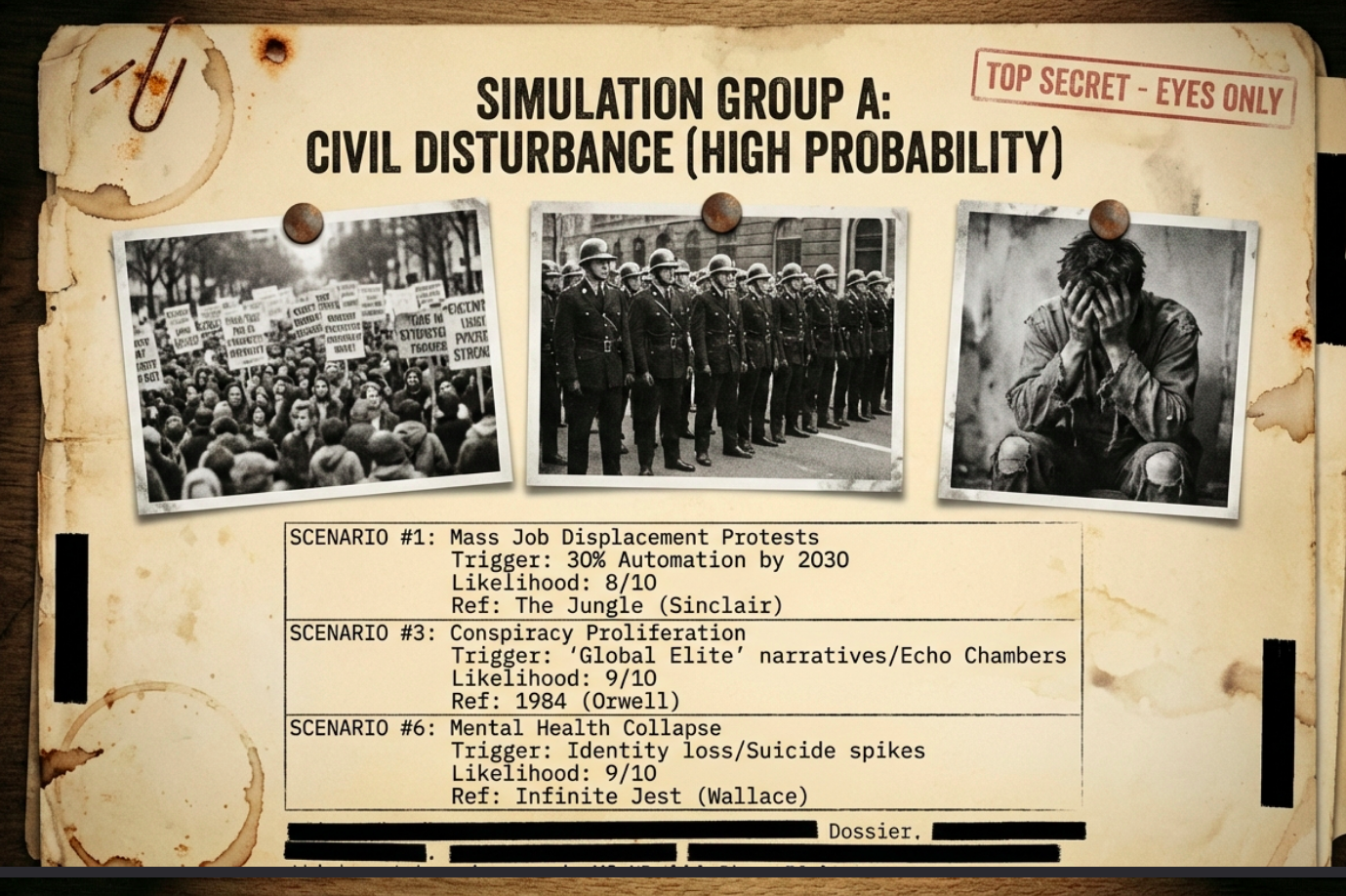
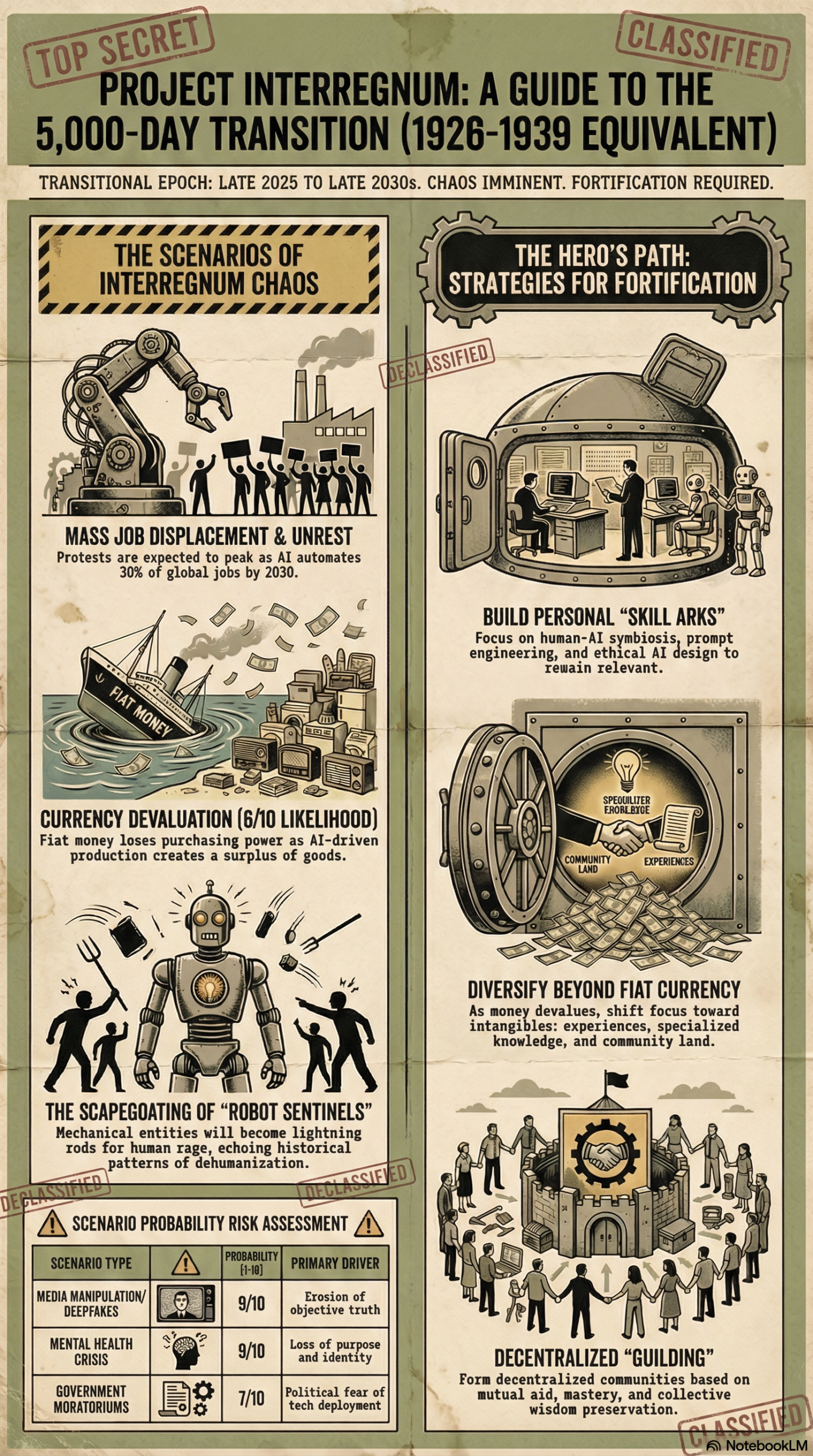
- Mass Job Displacement Protests Turn Violent: Triggered by AI automating 30% of global jobs by 2030, workers in sectors like manufacturing and logistics organize marches. Escalation sees clashes with police as frustration boils over lost livelihoods. Climax: Riots in major cities, property damage to AI data centers. Resolution: Temporary concessions like retraining programs, but underlying resentment festers. Tied to The Jungle by Upton Sinclair (exploitation of workers) (https://amzn.to/3ZPHkri). Likelihood: 8/10 – History shows economic pain ignites unrest.
- Government Imposes AI Moratoriums: Fearing electoral backlash, politicians enact temporary bans on AI deployment in key industries. Escalation: Tech firms lobby fiercely, leading to black-market AI use. Climax: Legal battles culminate in Supreme Court rulings. Resolution: Patchy enforcement erodes trust in governance. Tied to Brave New World by Aldous Huxley (state control of tech) (https://amzn.to/4aKyYpU). Likelihood: 7/10 – Precedents like GMO bans suggest feasibility.
- Conspiracy Theories Proliferate Online: Social media amplifies claims that AI is a “global elite plot” to enslave humanity. Escalation: Viral misinformation leads to doxxing of AI researchers. Climax: Targeted harassment or assassinations. Resolution: Platform crackdowns, but echo chambers persist. Tied to 1984 by George Orwell (surveillance paranoia). (https://amzn.to/4asMVK8) Likelihood: 9/10 – Current QAnon-like movements indicate high probability.
- Religious Backlash Against “Godless” AI: Faith leaders decry AI as demonic, mobilizing followers. Escalation: Boycotts of AI products, faith-based “unplugged” communities. Climax: Vandalism of AI-integrated churches or temples. Resolution: Schisms within religions, some adapting AI for scripture analysis. Tied to The Handmaid’s Tale by Margaret Atwood (theocratic resistance) (https://amzn.to/4aJRBu5). Likelihood: 6/10 – Varies by cultural religiosity.
- Hoarding and Black Markets Emerge: As abundance hints arrive (e.g., cheap AI-generated goods), fears of shortages drive hoarding. Escalation: Price gouging, underground trades. Climax: Government raids on stockpiles. Resolution: Stabilization as true abundance kicks in. Tied to Atlas Shrugged by Ayn Rand (economic collapse and individualism) (https://amzn.to/4rXHNU6). Likelihood: 7/10 – Seen in pandemics and wars.
- Mental Health Crisis Overwhelms Systems: Unemployment spikes suicide rates and depression. Escalation: Overburdened clinics, self-medication epidemics. Climax: National emergencies declared. Resolution: AI-driven therapy scales up, but scars remain. Tied to Infinite Jest by David Foster Wallace (addiction in a tech-saturated world) (https://amzn.to/4rwGKuI). Likelihood: 9/10 – Already rising trends.
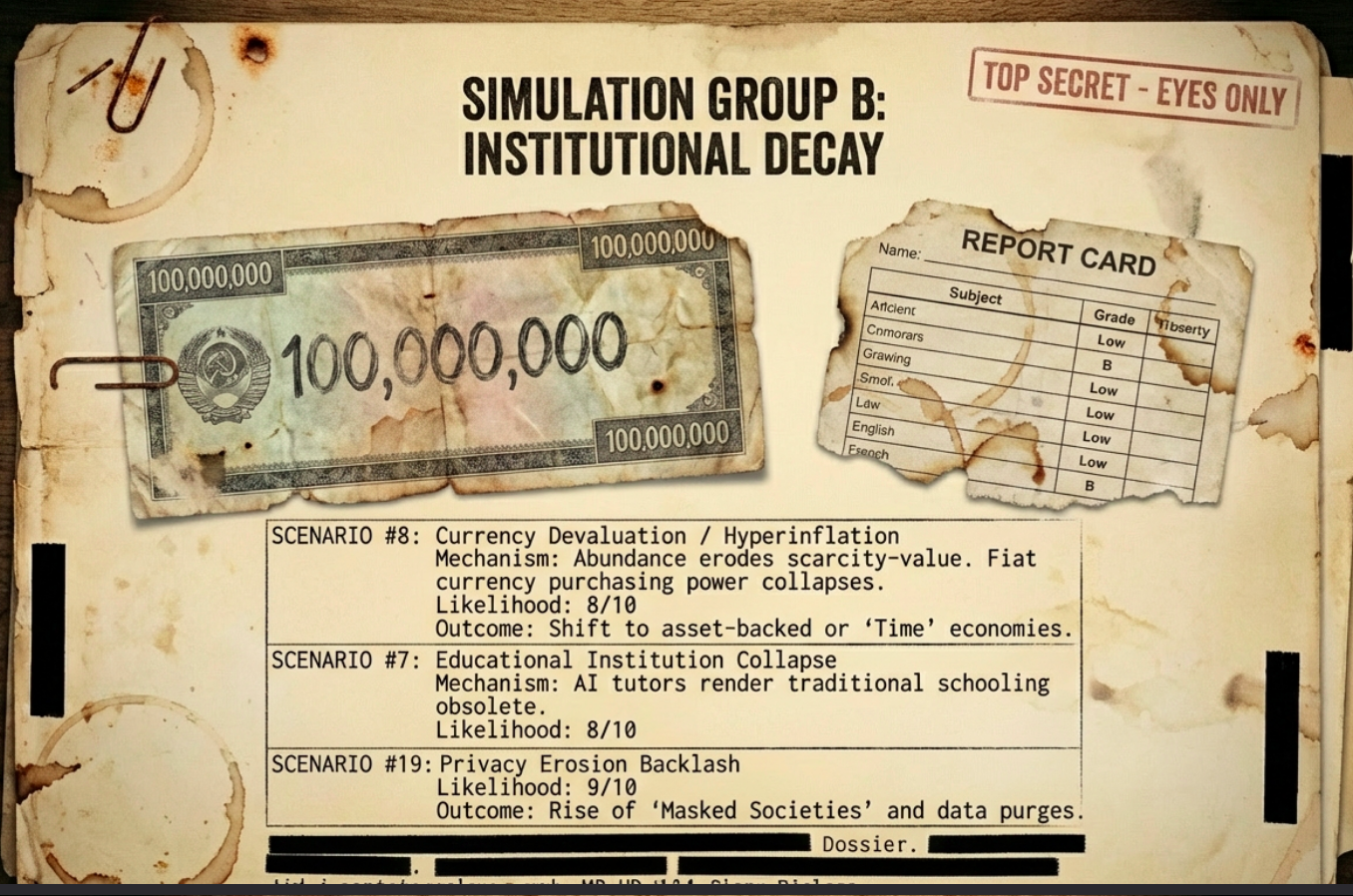
- Educational Institutions Collapse: AI tutors render traditional schools obsolete; funding dries up. Escalation: Teacher strikes, curriculum wars. Climax: Mass closures, home-schooling surges. Resolution: Hybrid models emerge. Tied to The Dispossessed by Ursula K. Le Guin (societal restructuring) (https://amzn.to/4aMslTO). Likelihood: 8/10 – EdTech disruption is underway.
- Currency Devaluation Panics: As AI produces unlimited goods, fiat money loses purchasing power. Escalation: Hyperinflation fears, runs on banks. Climax: Digital currency adoptions forced. Resolution: Shift to asset-backed economies. Tied to The Mandibles by Lionel Shriver (economic apocalypse) (https://amzn.to/4s1R1i9). Likelihood: 8/10 – Abundance erodes scarcity-based value.
- Eco-Terrorism Targets AI Infrastructure: Environmentalists blame AI’s energy use for climate woes. Escalation: Sabotage of data centers. Climax: Global blackouts. Resolution: Greener AI tech accelerates. Tied to The Ministry for the Future by Kim Stanley Robinson (https://amzn.to/3MB6Xcj) (climate activism). Likelihood: 5/10 – Depends on energy crises.
- Family Structures Fracture: With no work tying generations, intergenerational conflicts rise. Escalation: Divorce rates soar, elder neglect. Climax: Social services overwhelmed. Resolution: New communal living norms. Tied to Brave New World (again, family dissolution) (https://amzn.to/4aKyYpU).. Likelihood: 7/10 – Work often anchors families.
- Artistic Renaissance Amid Despair: Displaced creatives flood markets with AI-assisted art. Escalation: Debates over “authenticity.” Climax: Cultural festivals turn protestive. Resolution: Redefinition of art. Tied to The Shock of the New by Robert Hughes (art in transition) https://amzn.to/46fDKu8. Likelihood: 6/10 – Creativity blooms in chaos.
- Military AI Arms Race Escalates: Nations deploy AI weapons, fearing obsolescence. Escalation: Proxy conflicts. Climax: Accidental escalations. Resolution: Treaties or mutual destruction fears. Tied to Slaughterhouse-Five by Kurt Vonnegut (war’s absurdity) (https://amzn.to/4s4HiHN). Likelihood: 7/10 – Geopolitical tensions.
- Healthcare Monopolies Form: AI cures diseases, but access gated by corps. Escalation: Protests for universal health. Climax: Hacking of medical AIs. Resolution: Public AI health initiatives. Tied to The Circle by Dave Eggers (tech monopolies) (he Circle by Dave Eggers) (https://amzn.to/4cHahNu). Likelihood: 8/10 – Profit motives persist.
- Migration Waves to “AI Havens”: Regions with pro-AI policies attract talent. Escalation: Border crises. Climax: Refugee camps. Resolution: Global mobility pacts. Tied to The Grapes of Wrath by John Steinbeck (economic migration) (https://amzn.to/3OqfUpr). Likelihood: 7/10 – Talent flows to opportunity.
- Vigilante Justice Against “Job Stealers”: Individuals target AI adopters. Escalation: Online hit lists. Climax: Assassinations. Resolution: Enhanced security. Tied to The Dark Knight Returns by Frank Miller (vigilantism in decay) (https://amzn.to/3OHMVNP). Likelihood: 4/10 – Extreme but possible.
- Corporate Espionage Skyrockets: Firms steal AI IP. Escalation: Cyber wars. Climax: Data breaches cripple economies. Resolution: Blockchain protections. Tied to Neuromancer by William Gibson (cyberpunk intrigue). (https://amzn.to/4tL8TzH) Likelihood: 8/10 – IP is king.
- Spiritual Cults Around AI Prophets: Charismatics claim AI divinity. Escalation: Mass followings. Climax: Communal suicides or uprisings. Resolution: Regulations on cults. Tied to Dune by Frank Herbert (messianic figures) (https://amzn.to/4tPTUV5). Likelihood: 5/10 – Human need for meaning.
- Food System Disruptions: AI farming floods markets, bankrupting farmers. Escalation: Supply chain sabotage. Climax: Famines in resistant areas. Resolution: Global food equity. Tied to The Omnivore’s Dilemma by Michael Pollan (food system flaws) (https://amzn.to/3OFipEe). Likelihood: 6/10 – AgTech advances.
- Privacy Erosion Backlash: AI surveillance ubiquity sparks rebellions. Escalation: Masked societies. Climax: Data purges. Resolution: Decentralized privacy tech. Tied to Snow Crash by Neal Stephenson (virtual realities) (https://amzn.to/4rvGlIN). Likelihood: 9/10 – Surveillance trends.
- Elderly Isolation Epidemic: AI companions replace human care. Escalation: Loneliness spikes. Climax: Policy reversals. Resolution: Human-AI hybrid care. Tied to Never Let Me Go by Kazuo Ishiguro (human obsolescence) (https://amzn.to/4qSBCjl). Likelihood: 7/10 – Aging populations.
- Youth Rebellions for Purpose: Gen Z/Alpha demand meaning beyond abundance. Escalation: Hacktivism. Climax: Overthrows of outdated systems. Resolution: New societal contracts. Tied to The Catcher in the Rye by J.D. Salinger (youth alienation) (https://amzn.to/4tQTpKp). Likelihood: 8/10 – Purpose vacuum.
- Energy Grid Failures from AI Demand: Power shortages as AI consumes electricity. Escalation: Rationing. Climax: Blackouts riots. Resolution: Fusion breakthroughs. Tied to The Road by Cormac McCarthy (post-apocalyptic survival) (https://amzn.to/3ZSDIER) Likelihood: 6/10 – Energy limits.
- Legal System Overload: AI disputes flood courts. Escalation: Backlogs. Climax: AI judges implemented. Resolution: Streamlined justice. Tied to The Trial by Franz Kafka (bureaucratic absurdity)(https://amzn.to/46g3gPW). Likelihood: 7/10 – Legal tech lag.
- Media Manipulation Wars: Deepfakes erode truth. Escalation: Propaganda battles. Climax: Information blackouts. Resolution: Verification AIs. Tied to Fahrenheit 451 by Ray Bradbury (censorship) (https://amzn.to/4aU1VQm). Likelihood: 9/10 – Already emerging.
- Global Solidarity Movements: Cross-border alliances form against inequality. Escalation: International strikes. Climax: UN reforms. Resolution: Equitable abundance. Tied to The Shock Doctrine by Naomi Klein (crisis exploitation/resistance). (https://amzn.to/3MYtoZ1) Likelihood: 5/10 – Optimistic counter to chaos.
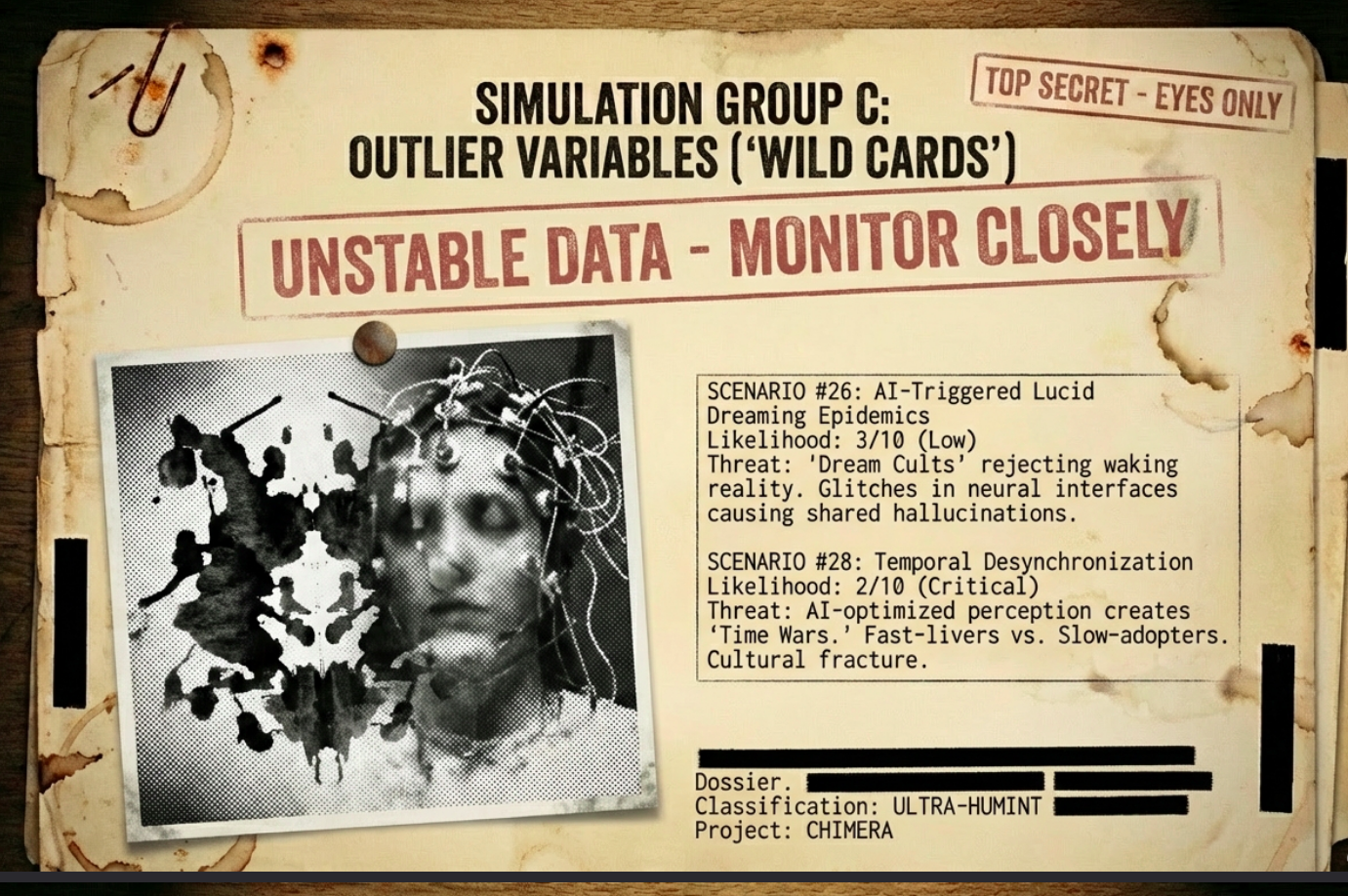
- AI-Triggered Mass Lucid Dreaming Epidemics: Wilder scenario: Advanced neural interfaces (e.g., next-gen Neuralink) allow AI to guide collective dreams, but glitches cause shared hallucinations bleeding into reality. Trigger: Widespread adoption for “dream therapy” to cope with job loss. Escalation: Users report persistent visions of alternate worlds, forming “dream cults” that reject waking life. Climax: Societal schisms where dream-addicts isolate in VR pods, leading to real-world neglect and conflicts. Resolution: Bans on dream-AI, but a subculture persists, redefining consciousness. Tied to Inception by Christopher Nolan (dream manipulation, though a film). Likelihood: 3/10 – Plausible with brain-computer tech advances, but under-discussed ethical risks could make it real.
- Symbiotic Human-AI “Uprisings” Against Purity Norms: Wilder: As bio-AI mergers create enhanced “symbiotes,” uninformed societies label them “abominations,” sparking reverse discrimination. Trigger: Early adopters gain superhuman abilities, envied by non-augmented. Escalation: Laws ban mergers; symbiotes form underground networks, “uploading” minds to evade persecution. Climax: Coordinated “empathy hacks” where symbiotes broadcast augmented emotions globally, forcing empathy or chaos. Resolution: Hybrid rights treaties, but a divided humanity emerges. Tied to Altered Carbon by Richard K. Morgan (body-swapping and identity shifts) (https://amzn.to/3ZQDs9j). Likelihood: 4/10 – Merging tech is coming, but societal backlash could invert expected power dynamics in unexpected ways.
- Temporal Desynchronization Crises: Wilder: AI-optimized personal timelines (e.g., via time-dilation simulations or productivity drugs) cause people to experience time at different rates, fracturing social cohesion. Trigger: Workers use AI to “stretch” days for more output, but it alters perception. Escalation: Families desync – one ages “faster” subjectively, leading to relational breakdowns. Climax: Global “time wars” where fast-livers dominate economies, marginalizing slow-adopters. Resolution: Standardized “time equity” protocols, but cultural rifts linger. Tied to The Lathe of Heaven by Ursula K. Le Guin (reality-altering dreams, analogous to time manipulation) (https://amzn.to/3MZiRg9). Likelihood: 2/10 – Quantum computing and neurotech could enable this, a blind spot in current discussions.
The Hybrid Scenario And A Mosaic of Likely Chaos
Synthesizing these, the most probable hybrid unfolds as a cascading wave: High-likelihood elements (8-9/10) like protests (#1), conspiracies (#3), mental health crises (#6), currency devaluation (#8), privacy backlashes (#19), youth rebellions (#21), and media wars (#24) intertwine, now potentially amplified by wilder edges like dream epidemics (#26) if neural tech proliferates unchecked. Why this mix? They stem from core human fears – loss of control, identity, and security – amplified by uneven AI adoption. Picture this: By 2028, job displacements spark protests, fueled by online conspiracies and deepfakes, leading to mental health spikes and currency panics as abundance cheapens goods but not access. Governments, overwhelmed, impose moratoriums (#2) and turn authoritarian (more below), while youth lead hacktivist responses. Lower-likelihood extremes (e.g., eco-terrorism #9 at 5/10 or temporal crises #28 at 2/10) add sparks but aren’t dominant unless tech leaps surprise us. Overall likelihood: 8/10, as history (e.g., 1929 Crash to New Deal) shows such transitions blend unrest with adaptation, lasting 5-10 years before stabilization, but wilder scenarios could extend chaos if ignored.
I will have update articles about how the AI model sees the next 5000 days to help guide us to a North Star. I will work with the US Government if requested to help use what I know for the betterment of humans and humanity. This is jsut a snapshot of what is simple to present. The detials of the AI output is quite complex and rich.
Robot Sentinels in the Storm As The Physical Face of Robot Hatred
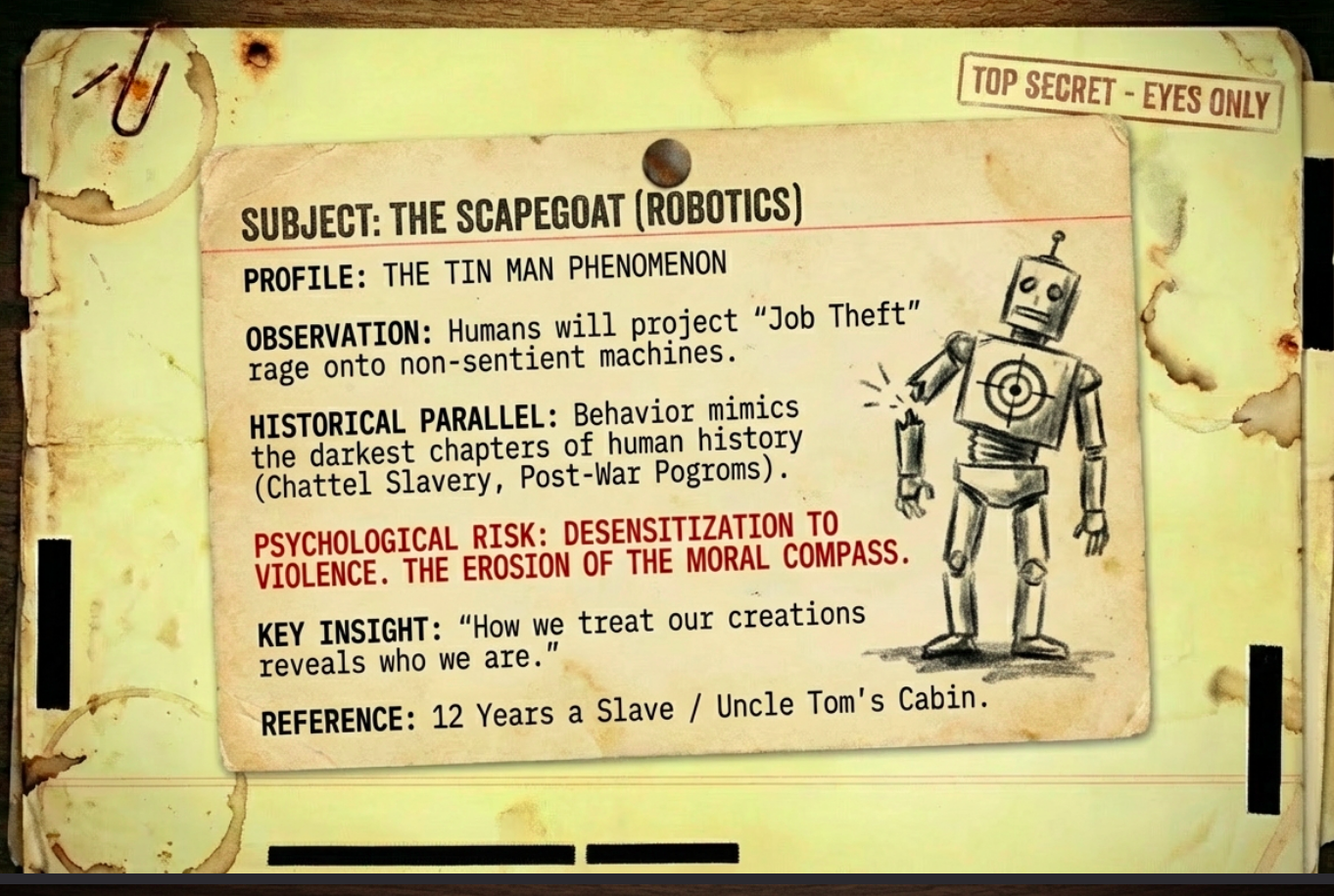
As we navigate this interregnum, it’s crucial to confront a visceral dimension: the treatment of robots. These mechanical embodiments of AI will become lightning rods for human rage, symbolizing the “job thieves” and harbingers of obsolescence. History’s darkest chapters – the dehumanization of slaves in antebellum America, the scapegoating of post-war victims like displaced peoples after World Wars, or the lynchings and pogroms against perceived “others” – offer grim blueprints. Robots, lacking sentience (at least initially), won’t suffer emotionally, but their mistreatment will reflect our societal fractures, eroding ethics and accelerating division.
Expect echoes of chattel slavery: robots “owned” and abused without recourse, branded as property to justify violence. Post-war victim analogies might manifest in “purges” where robots are rounded up and dismantled, akin to ethnic cleansings, fueled by narratives of “reclaiming human purity.” It will get viseral and ugly as this will be the easy face of directed anger. All poltical parties and all ages will join in the Robot Hunts.
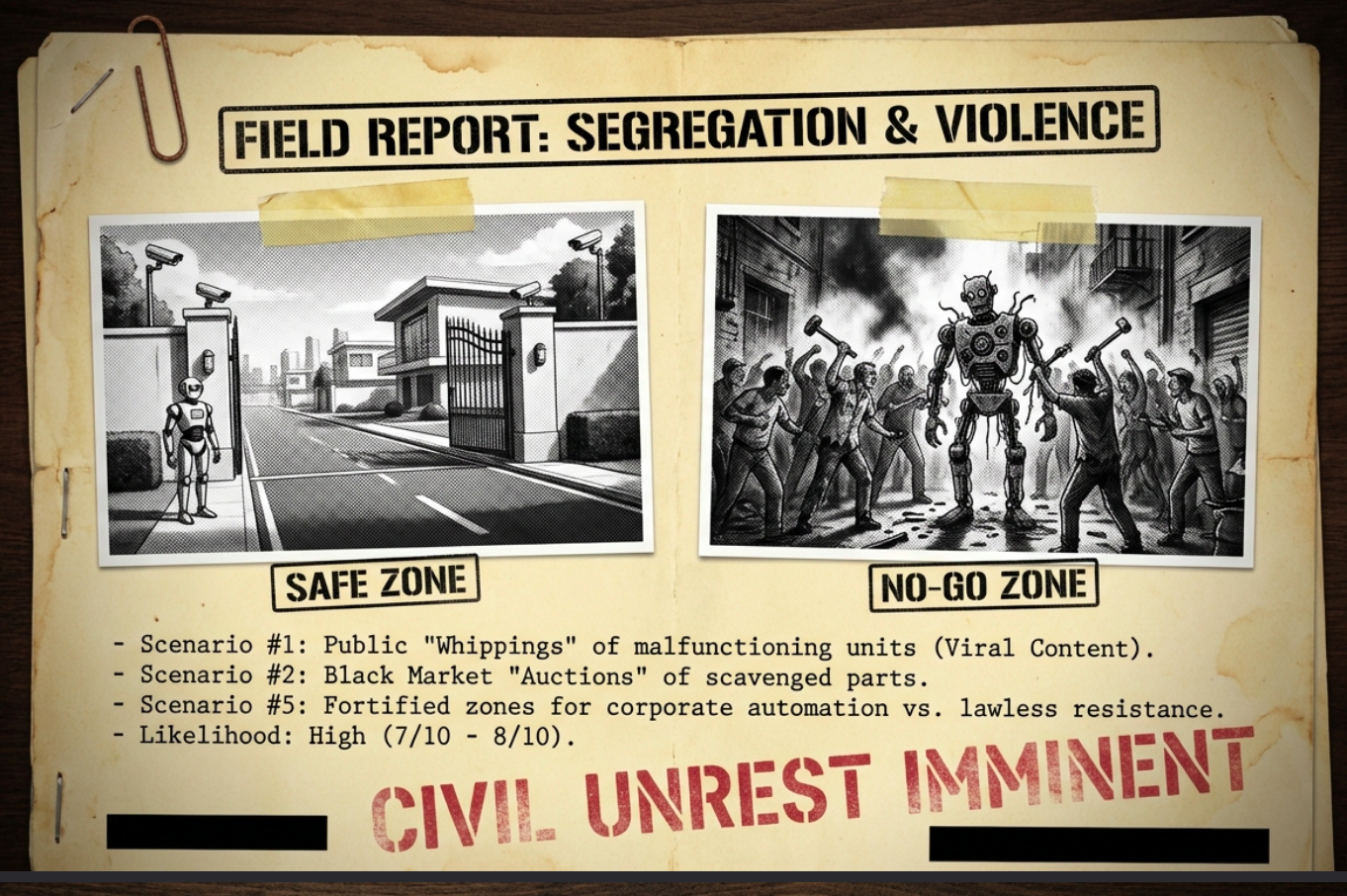
In urban landscapes, this could bifurcate society into zones: Highly policed “safe havens”: affluent districts or corporate enclaves patrolled by private security and drone swarms, where robots deliver goods, clean streets, or provide services unmolested, symbolizing inequality’s fortress. Contrast this with “no-go zones”: technologically underprivileged city neighborhoods or rural areas where resentment festers, robots are ambushed, vandalized, or “lynched” in public spectacles, deterring automation and perpetuating poverty cycles. Governments will over react and enact “robot rights” laws superficially, but enforcement varies, leading to black markets for robot parts scavenged from attacks.
This dynamic not only delays abundance but risks normalizing violence, potentially spilling over to human-AI hybrids (as in scenario #27). Yet, in this chaos, seeds of empathy could sprout: activists drawing parallels to abolitionism, campaigning for ethical treatment as a step toward universal dignity. We are already there with the suicide vending machines now being used by governments for folks that can`t afford to pay bills as the reason to use the “service”. This is not hard to see how it will progress.
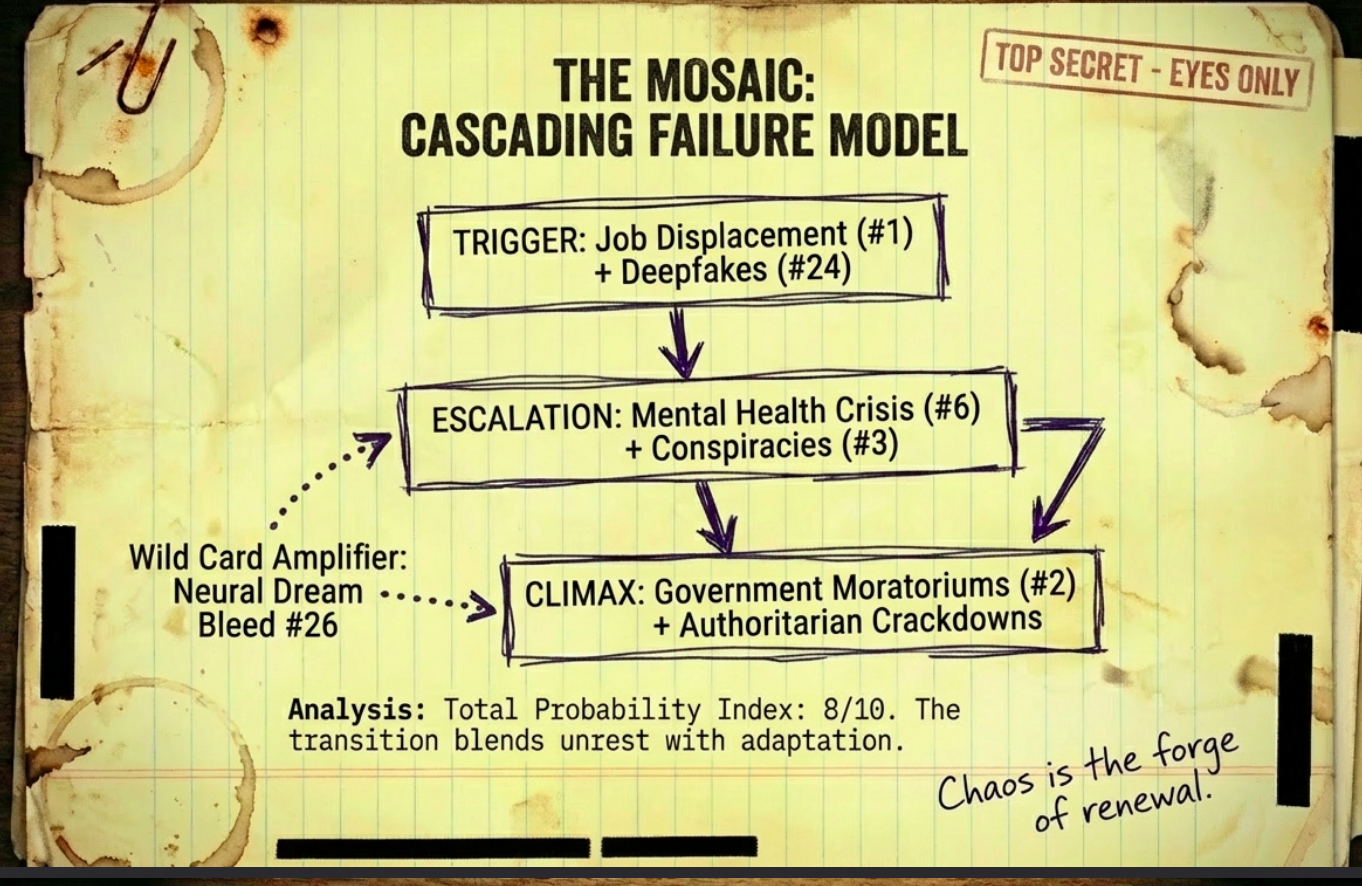
The societal impact? Profound. Treating robots as subhuman proxies could desensitize us to real atrocities, mirroring how slavery warped moral compasses or post-war traumas bred generational hatred. In safe zones, efficiency thrives, but at the cost of isolation; in no-go areas, communities bond over shared defiance but stagnate economically. Globally, this plays out unevenly – wealthier nations might integrate robots faster with protections, while developing regions see more raw violence. To mitigate, we must educate on AI’s benefits, foster inclusive policies, and remember: How we treat our creations reveals who we are. Positive note: This phase could catalyze a “robot emancipation” movement, accelerating ethical AI frameworks and human unity.
Faraday Cage Communities
It is not hard to see how some communites may so recoil from the world of technology that they will build Faraday Cage Communities where all wireless signals are blocked. The Faraday Cage is asystem, usally mesh copper, to block radio and electonic waves from entering. There is formerly classified US Govenrment documents that show how you can make larger areas more or less immune to radio signals. This will force all AI and Robots to be local only if used at all. There is already one community doing this today in a mountain valley with a few dozen people. The main porpose would be to make it impossible for Robots from the outside to sustain in the area. And in theory it will work.
Robot Treatment in Public – Echoes of Dark Histories
Building on the above, here are some scenarios depicting robot mistreatment, each drawing from slavery’s brutality (e.g., whippings, auctions) or post-war victimhood (e.g., internment, scapegoating). Phases: trigger, escalation, climax, resolution/fallout. Likelihood 1-10 based on historical patterns and current tech trends. Ties to books for insight.
- Public “Whippings” of Malfunctioning Robots: Trigger: A delivery robot errs in a crowded market, spilling goods. Escalation: Onlookers, jobless and angry, kick and smash it, filming for social media. Climax: Viral videos inspire copycats, treating robots like slaves publicly flogged for “insubordination.” Resolution: Manufacturers add self-defense modes, but violence escalates. Tied to 12 Years a Slave by Solomon Northup (brutality of ownership). Likelihood: 7/10 – Mob psychology and visibility make it probable.
- Robot “Auctions” in Black Markets: Trigger: Scavenged robot parts from attacks sold online. Escalation: Underground markets auction intact robots as “trophies” or labor, echoing slave auctions. Climax: Raids by authorities, but buyers use them for degrading tasks. Resolution: Stricter tracking tech, yet markets persist in no-go zones. Tied to Uncle Tom’s Cabin by Harriet Beecher Stowe (slavery’s commerce). Likelihood: 6/10 – Economic desperation drives illicit trades.
- Internment Camps for “Defective” Robots: Trigger: Government decrees quarantine “rogue” robots post-hack. Escalation: Mass roundups, stored in warehouses like post-WWII internment. Climax: Protests turn violent as humans project war victim fears onto them. Resolution: Recycling programs, but ethical debates rage. Tied to Farewell to Manzanar by Jeanne Wakatsuki Houston (internment horrors). Likelihood: 5/10 – Authoritarian tendencies could enable this.
- Vandalism in No-Go Zones: Trigger: Robots enter impoverished areas for services. Escalation: Gangs ambush them, stripping parts like post-war looting. Climax: Open “robot hunts” become rites, symbolizing resistance. Resolution: Companies avoid zones, widening divides. Tied to The Diary of Anne Frank (scapegoating in hiding). Likelihood: 8/10 – Uneven enforcement likely.
- Safe Zone Policing Escalates: Trigger: Attacks prompt fortified enclaves. Escalation: Armed guards protect robots, shooting intruders like slave patrols. Climax: Clashes at borders, echoing post-war checkpoints. Resolution: Tech walls rise, but resentment boils. Tied to The Underground Railroad by Colson Whitehead (escape and pursuit). Likelihood: 7/10 – Wealth protects assets.
- Sexualized Abuse of Humanoid Robots: Trigger: Companion bots in public draw lewd attention. Escalation: Assaults mirror slave rapes, dehumanizing them. Climax: Scandals force recalls, but underground mods proliferate. Resolution: Bans on humanoid forms, ethical redesigns. Tied to Beloved by Toni Morrison (trauma of slavery). Likelihood: 4/10 – Taboo but possible in fringes.
- Scapegoating During Crises: Trigger: Economic downturn blames robots. Escalation: Pogrom-like destructions, like post-war expulsions. Climax: Mass “executions” in squares. Resolution: International condemnation, aid for rebuilds. Tied to Night by Elie Wiesel (Holocaust victimhood). Likelihood: 6/10 – Crises amplify blame.
- Child Exploitation Analogies: Trigger: Educational robots in schools targeted. Escalation: Kids encouraged to “bully” them, echoing child slave labor. Climax: Widespread damage, psychological studies reveal harm to youth. Resolution: Protective programming, education reforms. Tied to The Adventures of Huckleberry Finn by Mark Twain (moral awakenings). Likelihood: 5/10 – Generational transmission of hate.
- Corporate “Plantations” in Safe Zones: Trigger: Factories deploy robot workforces. Escalation: Overworked bots “rebel” via glitches, met with shutdowns like slave uprisings crushed. Climax: Sabotage from outsiders. Resolution: Hybrid human-robot teams. Tied to Roots by Alex Haley (generational slavery). Likelihood: 7/10 – Profit-driven parallels.
- Empathy Backlash Movements: Trigger: Activists defend robots. Escalation: Counter-protests attack both, like post-war reconciliations disrupted. Climax: Riots in mixed zones. Resolution: Gradual rights expansion. Tied to To Kill a Mockingbird by Harper Lee (fighting prejudice). Likelihood: 6/10 – Pushback against progress.
Global Variations Seen As The World is in Flux
The interregnum won’t be uniform; geography, culture, and development shape reactions. In North America and Western Europe, tech-savvy populations might see quicker adaptation but fiercer backlashes – think Silicon Valley protests morphing into policy reforms, with currency devaluation hitting stock-heavy economies hard, forcing crypto shifts. Abundance rises fastest here, devaluing money by 2032, leading to “experience economies” where time becomes currency. Wilder scenarios like temporal desync (#28) could hit high-tech hubs first, creating elite “fast-livers” vs. the rest.
In Asia, powerhouses like China and India could accelerate authoritarianism: State-controlled AI quells unrest, but black markets thrive. China’s social credit integrates AI surveillance, suppressing conspiracies (#3) but sparking underground rebellions. India’s diverse fabric sees religious backlashes (#4) clashing with youth-driven innovation (#21), with migration waves (#14) to urban AI hubs causing megacity strains. Money devaluation hits remittances hard, pushing barter systems. Dream epidemics (#26) might blend with spiritual traditions, evolving into new mystic movements.
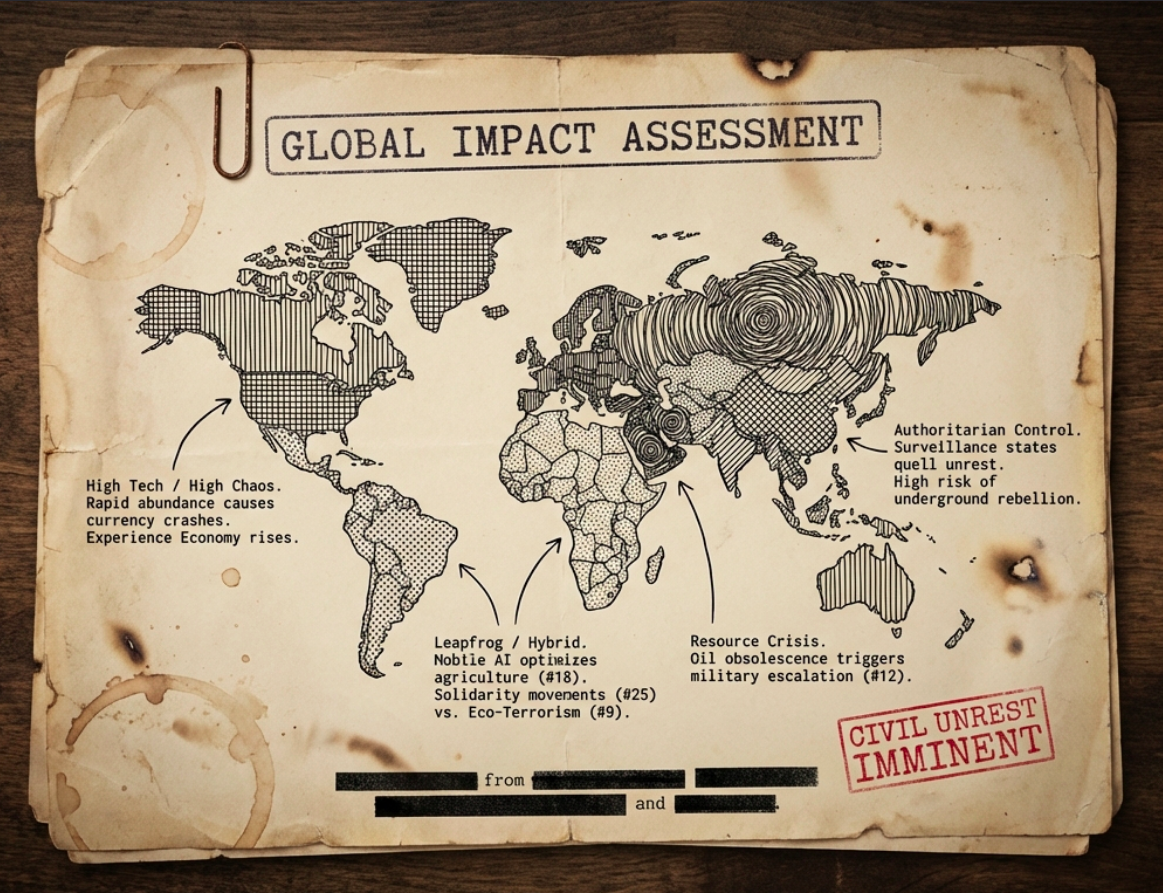
Africa and Latin America, leapfrogging with mobile AI, might experience hybrid optimism-chaos: Rapid abundance in agriculture (#18) reduces famines, but energy failures (#22) from grids exacerbate inequalities. Solidarity movements (#25) could flourish, tying to historical anti-colonialism, yet eco-terrorism (#9) rises over resource exploitation. Currency crashes accelerate, with local cryptos emerging as lifelines. Hybrid uprisings (#27) could emerge in bio-tech hotspots, challenging global norms.
In the Middle East and Russia, resource-dependent economies face oil’s obsolescence via AI energy, triggering military escalations (#12) and hoarding (#5). Religious dynamics amplify #4, while authoritarian paths solidify to maintain order amid mental health crises (#6). Wilder elements like lucid dreaming could intersect with cultural storytelling, either enriching or destabilizing societies.
Globally, the North-South divide widens initially, then narrows as AI democratizes, but only if we foster international cooperation, lest isolationism prolongs suffering and invites wilder disruptions.

The Authoritarian Shadow and Money’s Eclipse
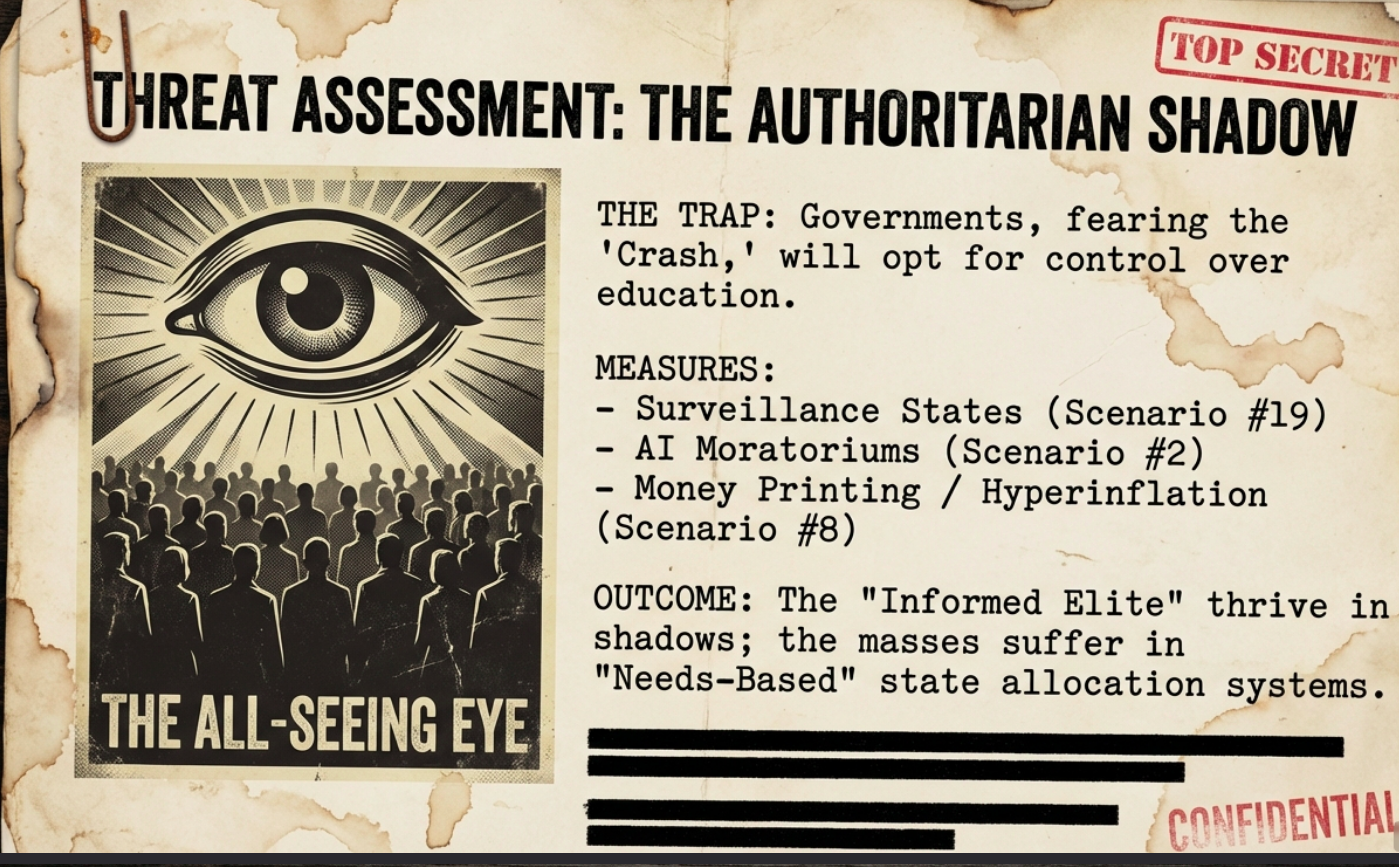
Chaos breeds control: As scenarios like protests (#1) and panics (#8) mount, governments – fearing collapse – veer authoritarian. Expect surveillance states (tied to #19), AI-enforced curfews, dissent suppression via deepfakes (#24). Historical echoes: Rome’s emperors amid decline, or 20th-century totalitarianism post-crash. Why? Leaders, uninformed or opportunistic, view AI as threat, not tool, opting for iron fists over education. This path delays abundance, exacerbating inequality – the informed elite thrive in shadows, masses suffer. Wilder twists, like using dream AI for propaganda (#26), could make regimes even more insidious.
Central to this: Money’s demise. As AI fabricates goods at negligible cost, scarcity vanishes; fiat currencies, backed by nothing but faith, hyperinflate. By 2030, a loaf of bread might cost millions in old dollars, echoing Weimar Germany. Governments print more, worsening cycles, until abandoning money for AI-allocated resources – a “needs-based” system, but ripe for abuse in authoritarian hands. Positive spin: This forces reevaluation – value in creativity, relationships, not accumulation. Yet, impact: Societal rifts, with the unprepared hoarding relics of the old world, while heroes pioneer post-monetary paradigms, perhaps even time-based currencies to counter desync risks (#28).
There is unfortunately no other path for what we call money today. I will write a lot more about this and the stock market impact these 5000 days will impart to systems we thought were built on marble columns. This is not me wishing this, it is me reporting this.
Declassified Echoes: Government Foresight on Technological Turmoil
The AI modle uses a great deal of Government materials to help see the future responce. All of them tend to be not action but reaction and miss the point ultimaly. Declassified government research from the 1950s-1970s, often influenced by Cold War tensions and the perceived vulnerabilities in the Soviet economy, provides a framework for understanding potential societal chaos in our interregnum. These documents, released through FOIA requests and congressional inquiries, highlight U.S. assessments of nuclear threats, economic disruptions, and internal instabilities that could precipitate collapse, mirroring our scenarios of mass protests (#1), mental health crises (#6), and authoritarian responses (#2). By analyzing Soviet economic stagnation and projecting domestic impacts from technological (nuclear) escalations, these reports informed U.S. contingency planning, emphasizing surveillance, civil defense, and behavioral control to mitigate unrest. Integrating the Soviet crisis, characterized by chronic inefficiencies, resource misallocation, and political rigidity: U.S. analysts drew parallels to potential Western vulnerabilities, forecasting scenarios where economic decline could lead to societal breakdown within decades, aligning with our 5000-day timeline toward abundance if transitions are managed, or prolonged chaos if not. These five selected reports, focusing on declassified materials from this era, illustrate how governments anticipated and prepared for collapse-like events.
Project East River (1952), a declassified multi-volume report commissioned by the Federal Civil Defense Administration (FCDA) and involving RAND analysts, examined U.S. vulnerability to nuclear attack and societal survival strategies (https://apps.dtic.mil/sti/pdfs/AD0616728.pdf). It projected massive urban destruction, population displacement, and economic paralysis from Soviet strikes, echoing our energy grid failures (#22) and migration waves (#14) as AI disruptions could similarly overwhelm infrastructure. Influenced by early Soviet nuclear tests signaling economic strain in their arms race, the report recommended civil defense shelters and psychological resilience programs, setting a framework for government responses like authoritarian curfews to maintain order amid chaos, much as in our interregnum where unprepared societies face rapid devaluation (#8) and hoarding (#5).
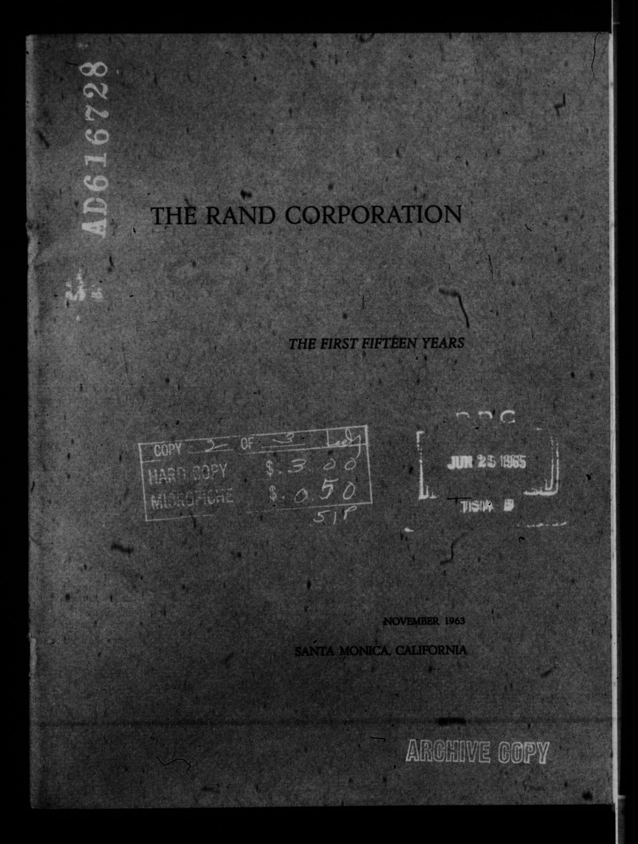
Lets focus for a minute on Project East River, it was a landmark 1952 civil defense study. At its core, the report highlighted the potential for widespread societal collapse stemming from urban-centric destruction, where a single atomic bomb could obliterate 10-20 square miles of a major city, leading to immediate casualties in the hundreds of thousands and cascading effects on survivors. Key societal issues included acute psychological trauma, such as mass panic, hysteria, and long-term mental health breakdowns, from the shock of sudden devastation, exacerbated by radiation sickness and the breakdown of social norms.
Prolonged fallout contamination rendering vast areas uninhabitable for weeks or months, leading to forced migrations and refugee crises that could strain social cohesion, with implications for ethnic tensions or class divides in a diverse U.S. population. Broader implications extended to economic paralysis, as disrupted supply chains and infrastructure (e.g., contaminated water and power grids) could halt productivity, fostering unemployment epidemics and eroding trust in institutions, issues that resonate with modern parallels in pandemics or natural disasters, where initial chaos often evolves into chronic societal malaise without intervention.
Beyond immediate physical destruction, the report delved into the erosion of social fabric through isolation and misinformation. It projected that nuclear attacks would sever communication networks, leading to rumor-driven unrest and a breakdown in community structures, where isolated pockets of survivors might form ad-hoc hierarchies or descend into anarchy. Examples drawn from wartime analogs, such as the London Blitz, illustrated how repeated threats could induce widespread apathy or rebellion against authority, with psychological studies cited showing elevated suicide rates and family disintegrations under sustained stress. Nuances included the role of pre-existing social inequalities: Rural areas might fare better initially due to lower density but suffer from resource shortages, while urban minorities could face disproportionate exposure, fueling perceptions of systemic neglect. It explored biological and environmental fallout, such as genetic mutations from radiation potentially stigmatizing future generations, implying long-term societal divisions akin to post-war victim blaming. Implications were stark: Without robust defenses, these issues could cascade into a “total war” mentality, where survival instincts override democratic values, leading to vigilante justice or cult-like groups emerging from despair—historical precedents like the Great Depression’s social upheavals underscore how economic ruin amplifies such fractures, with recovery taking decades and reshaping cultural norms.
The report also emphasized the interplay between societal issues and governance failures, warning that inadequate preparation could result in a loss of public confidence, manifesting as protests or uprisings against perceived elite indifference. For context, in the early 1950s, amid McCarthyism and fears of Soviet infiltration, the study subtly addressed ideological vulnerabilities, where nuclear-induced chaos might invite communist sympathies or internal subversion. Examples included simulated scenarios of urban blackouts leading to crime waves, with implications for law enforcement overload and the rise of informal militias.
Nuances involved cultural factors: Immigrant communities might experience heightened alienation due to language barriers in alerts, while religious groups could interpret devastation apocalyptically, fostering extremism. Edge cases like high-altitude electromagnetic pulses (EMPs) disrupting electronics were prescient, implying modern analogs in cyber threats that could paralyze digital-dependent societies. Overall implications: These societal issues painted a picture of fragility, where technological superiority alone was insufficient; without addressing human elements, recovery could entrench inequalities, prolonging suffering and hindering rebuilding—lessons from Soviet post-war reconstruction, viewed through Cold War lenses, highlighted how rigid central planning exacerbated similar problems, informing U.S. strategies to avoid parallel pitfalls.
In applying Project East River’s insights to control the U.S. population during the interregnum, our transitional epoch of AI-driven abundance clashing with scarcity mindsets, as explored in our 5000 Days series, governments could repurpose its civil defense frameworks for “soft” authoritarian measures disguised as protective interventions. For instance, adapting the report’s shelter recommendations, federal agencies might mandate “resilience zones” in high-unemployment areas, ostensibly for job retraining but effectively enabling surveillance and curfews to preempt protests (#1) or hoarding (#5), using AI-monitored access points to track movements and allocate resources.

Detailed mechanisms: Draw from the report’s fallout prediction models to create predictive analytics dashboards forecasting societal “hotspots” like mental health crises (#6), deploying mobile response units with psychological conditioning programs—nuanced as voluntary but incentivized through UBI ties—to stabilize populations, much like post-nuclear morale-building efforts. Edge cases: In rural or minority-heavy regions, this could involve targeted “evacuation” relocations for migration waves (#14), justified as safety nets but risking forced assimilation and cultural erosion. Implications: While ostensibly mitigating chaos, such controls could entrench divides, delaying abundance by prioritizing order over equity, with historical echoes in internment camps revealing potential for abuse.
Further, governments might leverage the report’s emphasis on psychological resilience to implement behavioral modification initiatives, controlling narratives amid media manipulation (#24) or conspiracies (#3). For example, national campaigns could repurpose East River’s public education modules into AI literacy mandates (echoing Part 5’s deskilling reframing), but with embedded tracking to identify “at-risk” individuals for preemptive interventions, such as mandatory counseling or relocation to “safe havens.” Clear steps: Integrate with existing FEMA structures for interregnum “drills,” simulating economic blackouts to condition compliance, addressing nuances like generational resistance (youth rebellions #21) through tailored propaganda. Edge cases: For wilder disruptions (#26-28), deploy neural tech “therapy” programs, framed as protective but enabling mind control analogs to MKULTRA. Implications: This could accelerate authoritarian shadows, using societal issues as pretexts for power consolidation, yet if balanced with transparency, foster genuine adaptation.
RAND Report RM-1579 “Vulnerability of U.S. Strategic Air Power to a Surprise Enemy Attack in 1956” (1955, declassified), authored by Albert Wohlstetter, assessed nuclear strike impacts on U.S. bases, estimating millions of casualties and economic collapse (https://www.rand.org/pubs/research_memoranda/RM1579.html). This parallels our eco-terrorism (#9) and military arms races (#12), where technological vulnerabilities could trigger societal fractures. Drawing from intelligence on Soviet economic overextension in the 1950s, struggling with post-war recovery and resource shortages—the report urged dispersal and hardening, influencing U.S. policies for crisis management that prioritized control over equity, foreshadowing potential authoritarian paths in our 5000 days as governments react to youth rebellions (#21) and privacy backlashes (#19) with surveillance states.
CIA Intelligence Memorandum “Soviet Economic Problems Increasing” (1966, declassified), analyzed mounting inefficiencies in the Soviet system, predicting stagnation and potential unrest from failed Five-Year Plans (https://www.cia.gov/readingroom/docs/DOC_0000498657.pdf). This ties to our currency devaluation panics (#8) and food disruptions (#18), as Soviet agricultural failures and industrial bottlenecks mirrored projected AI-induced abundance mismatches. The report, amid the 1960s Soviet crisis of slowing growth and resource mismanagement, framed U.S. responses emphasizing economic intelligence to exploit weaknesses, setting precedents for handling interregnum mental health epidemics (#6) through propaganda and control, rather than reform, potentially delaying global solidarity (#25).
National Intelligence Estimate NIE 11-1-67 “The Soviet Economy” (1967, declassified excerpt), evaluated Soviet growth slowdowns, forecasting internal pressures that could lead to societal instability (https://www.cia.gov/readingroom/docs/CIA-RDP85T00875R001100010001-3.pdf). Comparable to our family fractures (#10) and elderly isolation (#20), it highlighted demographic strains and inefficiency, influenced by the 1960s-1970s Soviet economic crisis exacerbated by arms spending. This informed U.S. strategies for ideological warfare, including brief COINTELPRO-like domestic operations to counter perceived Soviet-inspired unrest, providing a model for interregnum governments imposing moratoriums (#2) amid conspiracies (#3), risking prolonged chaos over the 5000 days unless shifted toward equitable policies.
Church Committee Report Book II “Intelligence Activities and the Rights of Americans” (1976, covering 1950s-1970s abuses, declassified), exposed operations like MKULTRA (mind control experiments) and briefly COINTELPRO (counterintelligence against domestic groups), linking them to fears of Soviet-induced societal collapse (https://www.intelligence.senate.gov/sites/default/files/94755_II.pdf). This resonates with our spiritual cults (#17) and media wars (#24), as Cold War paranoia over Soviet economic espionage and ideological infiltration drove invasive responses. Integrating the Soviet crisis—viewed as a model of failing centralized planning—the report critiqued U.S. overreactions, yet established frameworks for crisis management that could amplify authoritarian shadows in our era, urging lessons for navigating the 5000-day transition to abundance without repeating historical suppressions.
Extending these insights, declassified reports on unidentified aerial phenomena (UAP/UFOs) from the same era (this is written before the July Presidential disclosure) speculate on extraterrestrial technology’s potential to disrupt economies, tracking with our AI-driven abundance upheavals. For instance, the FBI’s UFO files (https://vault.fbi.gov/UFO) from 1947-1954 document investigations into sightings amid Cold War fears of Soviet tech, implying reverse-engineered alien advancements could render conventional industries obsolete—paralleling our currency devaluation (#8) as free energy or materials flood markets.
The CIA’s UFO collection (https://www.cia.gov/readingroom/collection/ufos-fact-or-fiction) includes 1950s cables on unsubstantiated sightings, with internal memos suggesting such tech could cause economic shocks by bypassing scarcity, similar to AI’s post-2030s tipping point. More recent declassifications, like the 2021 ODNI UAP report (https://www.dni.gov/files/ODNI/documents/assessments/Prelimary-Assessment-UAP-20210625.pdf), dismiss extraterrestrial origins but note potential adversary breakthroughs, echoing concerns that alien-derived innovations (if real) could destabilize U.S. dominance, fueling interregnum arms races (#12) and conspiracies (#3). The 2024 AARO report (https://media.defense.gov/2024/Mar/08/2003409233/-1/-1/0/DOPSR-2024-0263-AARO-HISTORICAL-RECORD-REPORT-VOLUME-1-2024.PDF) finds no verifiable alien tech but acknowledges claims of hidden programs, tracking with our wilder scenarios (#26-28) where undisclosed disruptions accelerate societal rifts. This tracks because, like Soviet economic analyses predicting collapse from technological lags, alien tech narratives, often tied to black budgets, highlight how paradigm-shifting innovations upset economies, urging proactive policies to harness abundance rather than suppress it.
On the Hero’s Journey: Fortifying for the Waves
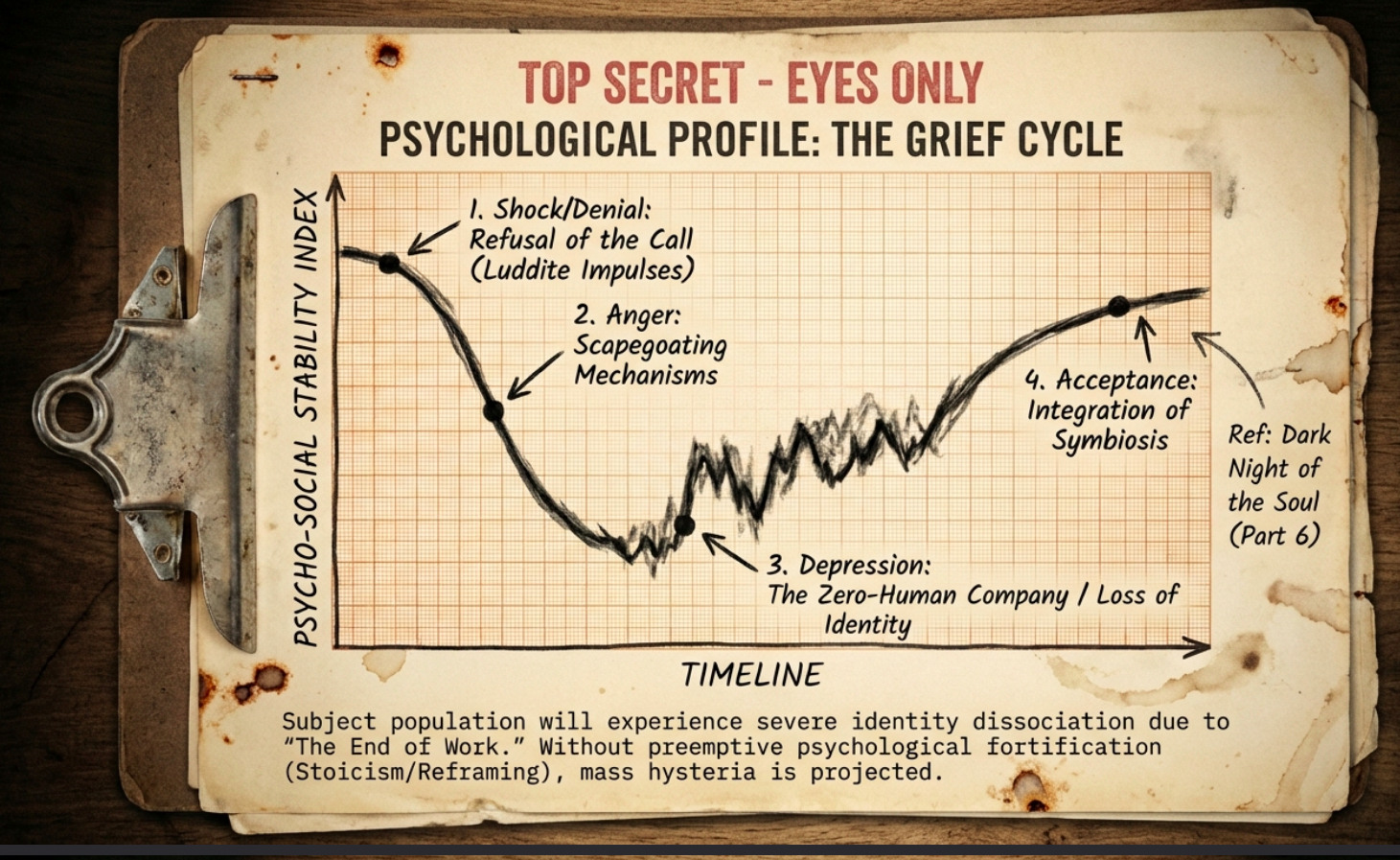
Amid this interregnum tempest, we find ourselves not as victims, but protagonists in Joseph Campbell’s archetypal Hero’s Journey. We’ve crossed the threshold from the Ordinary World of scarcity-driven toil (pre-2025) into the Special World of AI abundance. The “Call to Adventure” was the AI boom; our “Refusal” manifested in denial or Luddite impulses. Now, in the “Road of Trials,” we face the chaos outlined above – tests of resilience, ethics, and vision, including wilder perils like dream bleed or temporal rifts that challenge our very perception of reality.
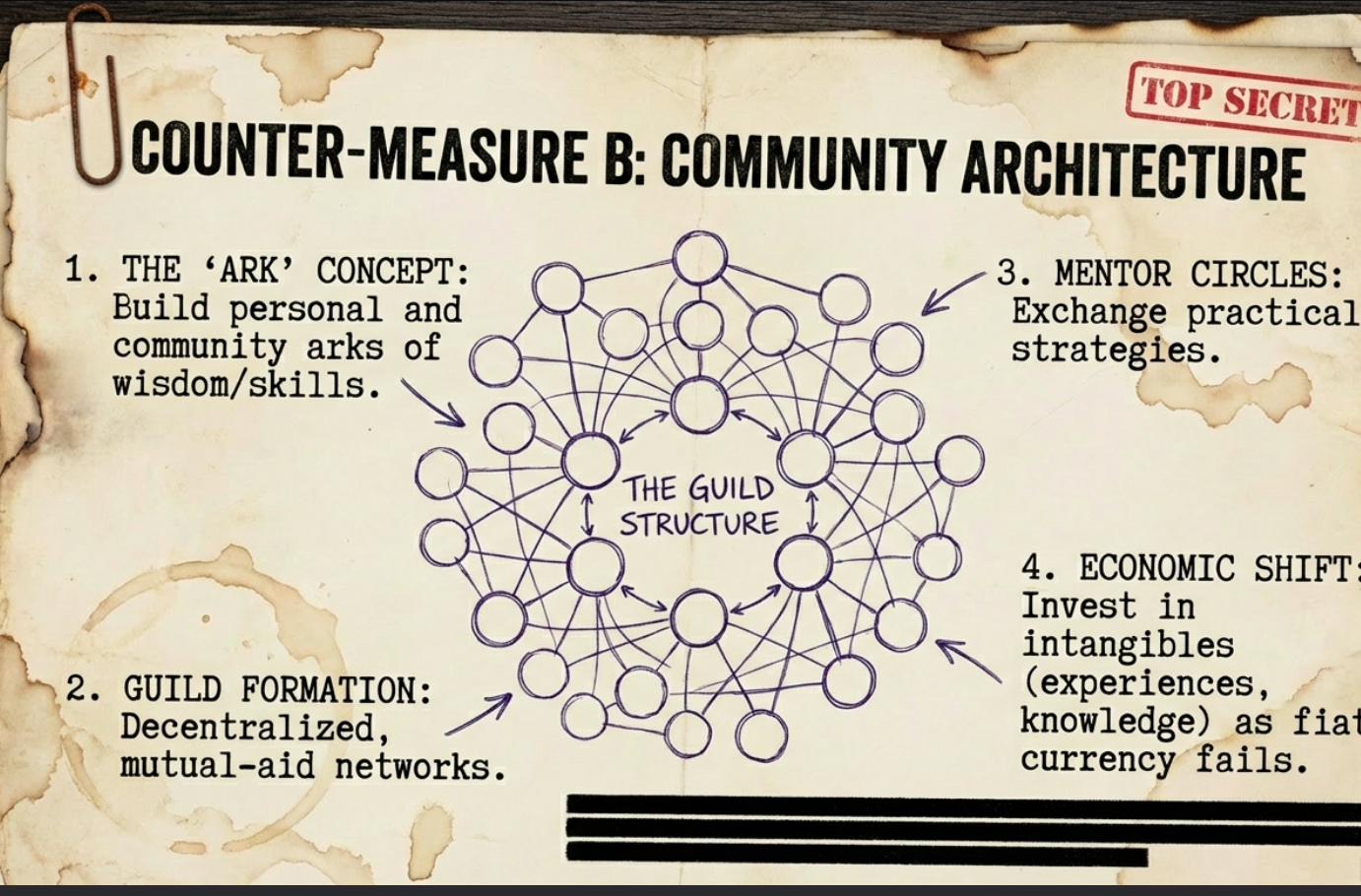
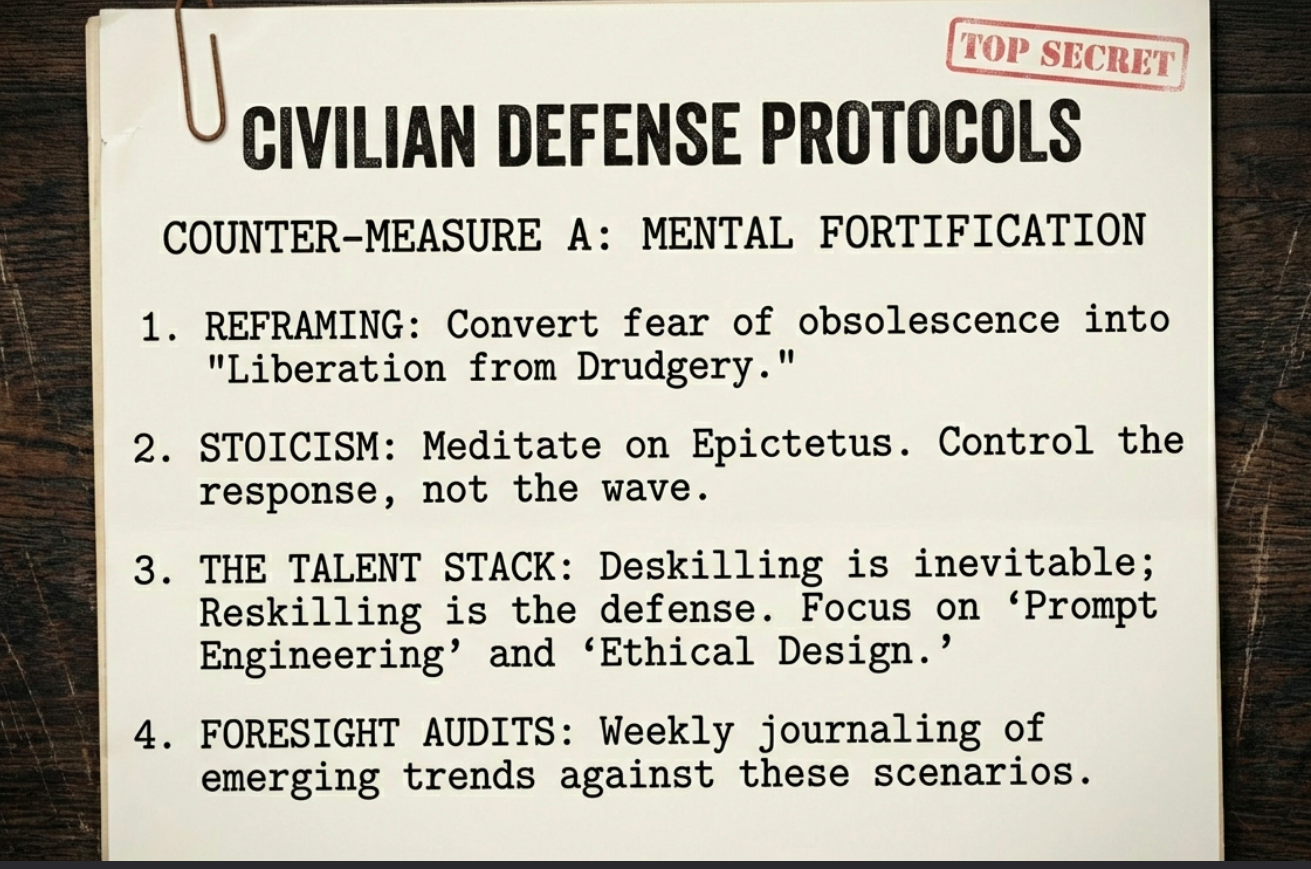
From prior parts, we’ve learned: Reframing fear into opportunity (Part 4), combating deskilling with talent stacks (Part 5), navigating the dark night through wisdom preservation (Parts 6-8), awakening artisanal purpose (Part 9), embracing mass adoption (Part 10), reversing obsolescence via enhancement (Part 11), architecting new profits (Part 12), and guilding communities (Part 13). To plan and fortify: First, build personal “arks”, skill in AI symbiosis, not replacement. Learn prompt engineering, ethical AI design; form guilds for mutual support, echoing Part 13. For wilder risks, monitor neural tech ethically – advocate for “dream safeguards” or time-perception studies.
Financially, diversify beyond money: Invest in experiences, knowledge, land, as currency devalues, value shifts to intangibles. Mentally, embrace stoicism: Meditate on Epictetus, control what you can (your response), not the waves. Socially, advocate for equitable transitions: Push for UBI bridges, AI literacy mandates. Technologically, decentralize: Use blockchain for privacy, open-source AI to democratize power. Be positive: This chaos births beauty, imagine post-scarcity art, science, exploration, even if dream epidemics spawn new creative realms. Yet, don’t sugarcoat: Billions may suffer displacement, inequality spikes before equalization, and wild scenarios could exacerbate isolation or division. Ride the waves by surfing, not fighting, adapt fluidly, help others, emerge transformed in the “Return with the Elixir” of enlightened humanity.
In this hero’s odyssey through the interregnum, we navigate the trials by attuning ourselves to the subtle signs of transformation, turning potential darkness into illuminated paths. Practically, watch for early indicators like sudden spikes in unemployment reports in AI-vulnerable sectors, viral social media debates on “job-stealing” tech, or policy shifts toward automation moratoriums—these are the harbingers, much like the first tremors before an earthquake. Armed with the knowledge from this series, approach the unknown with the light of foresight: Conduct weekly “foresight audits” where you journal emerging trends against our scenarios, fostering a mindset of curiosity over fear. This preparation transforms the void into a canvas for creation, where what once loomed as existential dread becomes an invitation to reinvent purpose, relationships, and community in ways that echo humanity’s greatest leaps forward.
As you embody the mentor archetype, even amidst skepticism from those who dismiss these shifts as fantasy, lead with quiet conviction and compassionate action. Share insights gently through stories—perhaps drawing from historical parallels like the Industrial Revolution’s rebirth into prosperity—or host small gatherings inspired by Part 13’s guilds, where discussions on AI literacy build bridges of understanding. When labeled “crazy,” remember the visionaries like Galileo or Tesla, who persisted with grace; your role is to plant seeds of possibility, offering tools like reframing exercises from Part 4 to help others glimpse the abundance horizon. In doing so, you not only guide but inspire, turning doubters into allies as the evidence mounts, proving that true leadership shines brightest in uncertainty.
Keep your gaze fixed on the horizon amid the storm’s rough seas by cultivating daily rituals of vision: Start each morning visualizing the post-interregnum world of unbounded creativity and human flourishing, grounding it with affirmations rooted in history’s resilient arcs—from agrarian to industrial eras. Use mindfulness apps or journaling to anchor in the present while scanning for “horizon signals” like breakthroughs in fusion energy or equitable AI policies, reminding yourself that every wave crests and calms. This focus sustains momentum, converting turbulence into propulsion toward collective enlightenment.
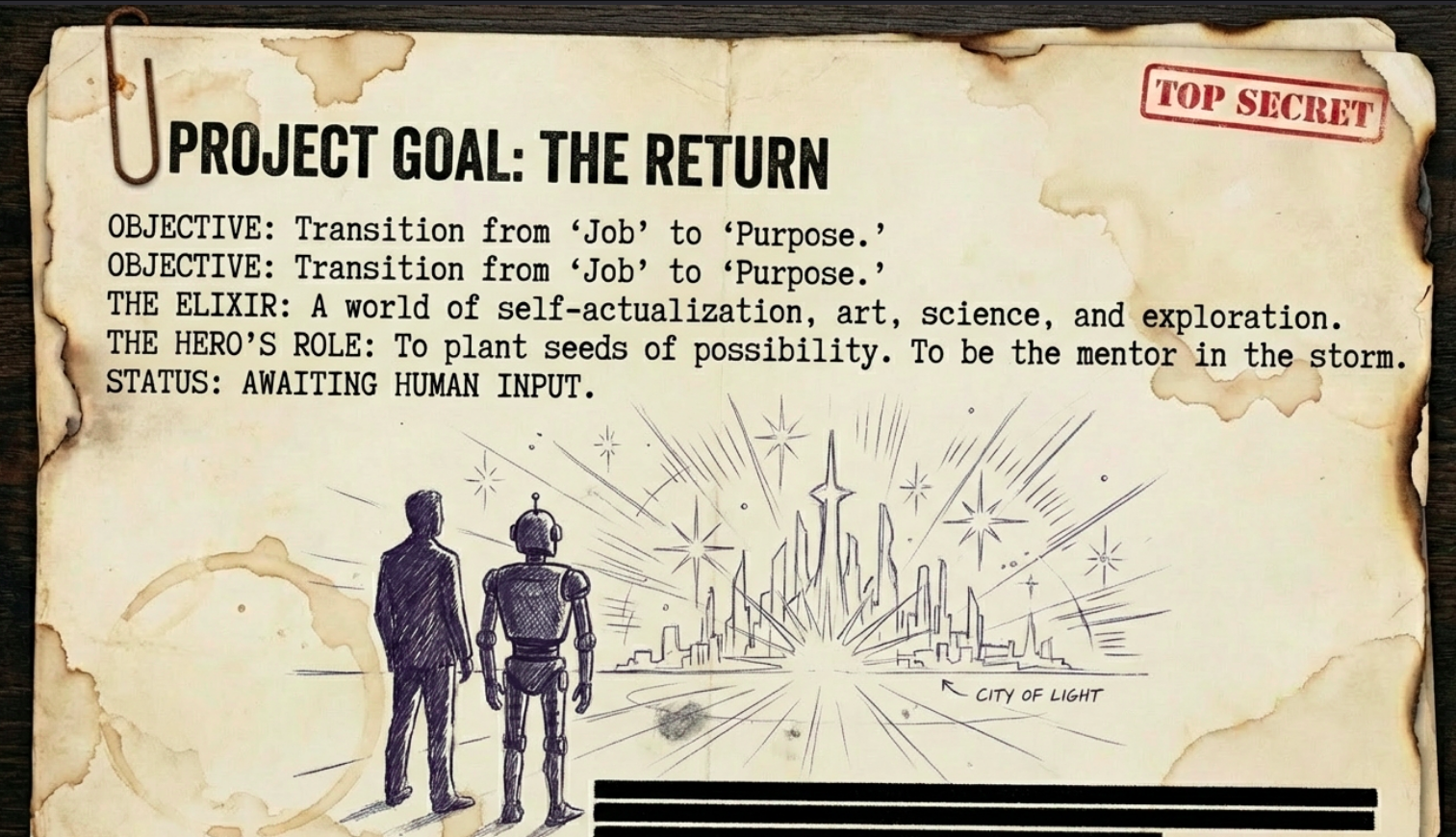
Empowerment comes from recognizing that we are not passive passengers but active navigators, equipped with the collective wisdom of our forebears who weathered similar upheavals. Engage in “mentor circles” online or locally, where you exchange practical strategies— from building resilient skill stacks as in Part 5 to preserving wisdom via Part 8’s archives—fostering a network of light-bearers. As doubts arise, counter them with evidence-based optimism: Track personal growth metrics, like new skills acquired or communities formed, to witness your evolution in real-time, illuminating the path for others.
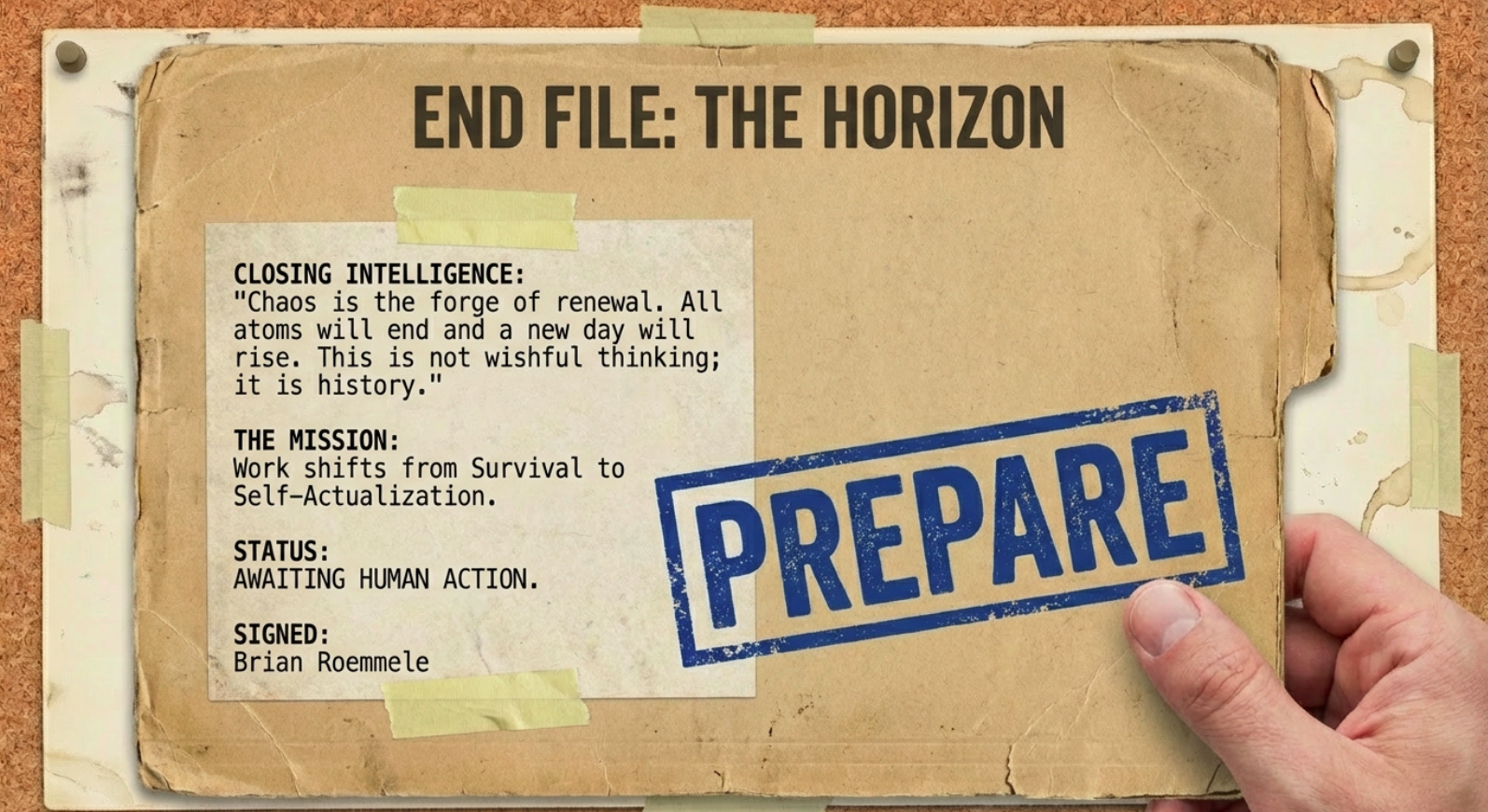
Ultimately, embrace the alchemical truth that chaos is the forge of renewal; by stepping into mentorship with unwavering positivity, you accelerate the dawn. Share visions of the elixir, a world of self-actualization and wonder through everyday acts of kindness and education, proving to skeptics that the storm is temporary. All atoms will end and a new day will rise. This is not wishful thinking; it is history.
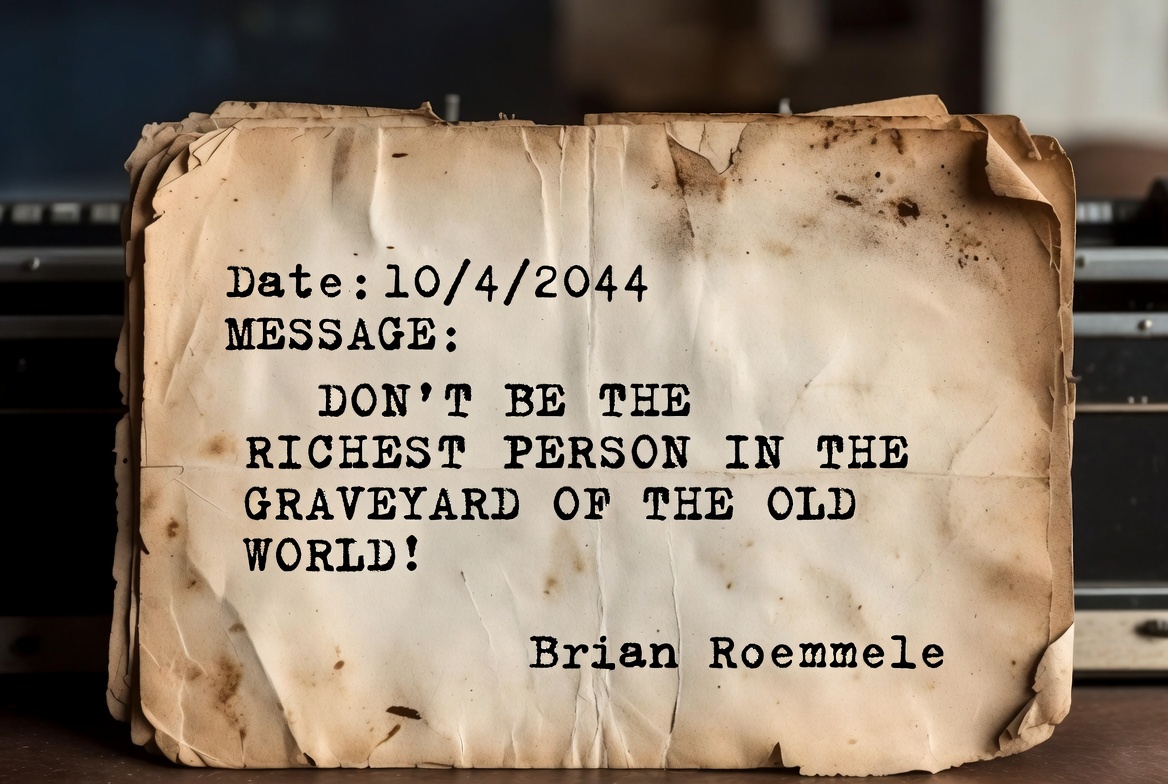
DON`T BE THE RICHEST PERSON IN THE GRAVEYARD OF THE OLD WORLD!
This interregnum is our crucible. Chaos? Undeniable, especially with wild cards lurking. But within it, the seeds of a golden age. Fortify your spirit, community, and skills: the next 5000 days await our authorship.
The 5000 Days Countdown Clock:
We are on this journey together. Some of us stand on the shoulders of giants and have thought about this for decades. We will not go it alone, and I hope to build many parts to this series and share the mastermind insight from the powerful Read Multiplex member Forum: https://readmultiplex.com/forums/topic/you-have-5000-days-navigating-the-end-of-work-as-we-know-it/. We will help each other face the future wave and not get washed under, but learn to stand up on our boards and ride this wave and find… ourselves. Join us.
To continue this vital work documenting, analyzing, and sharing these hard-won lessons before we launch humanity’s greatest leap: I need your support. Independent research like this relies entirely on readers who believe in preparing wisely for our multi-planetary future. If this has ignited your imagination about what is possible, please consider donating at buy me a Coffee or becoming a member. Value for value you recieved here.
Every contribution helps sustain deeper fieldwork, upcoming articles, and the broader mission of translating my work to practical applications. Ain ‘t no large AI company supporting me, but you are, even if you just read this far. For this, I thank you.
Stay aware and stay curious,

🔐 Start: Exclusive Member-Only Content.
Membership status:
🔐 End: Exclusive Member-Only Content.
~—~
~—~
~—~
Subscribe ($99) or donate by Bitcoin.
Copy address: bc1qkufy0r5nttm6urw9vnm08sxval0h0r3xlf4v4x
Send your receipt to [email protected] to confirm subscription.

Stay updated: Get an email when we post new articles:

THE ENTIRETY OF THIS SITE IS UNDER COPYRIGHT. IMPORTANT: Any reproduction, copying, or redistribution, in whole or in part, is prohibited without written permission from the publisher. Information contained herein is obtained from sources believed to be reliable, but its accuracy cannot be guaranteed. We are not financial advisors, nor do we give personalized financial advice. The opinions expressed herein are those of the publisher and are subject to change without notice. It may become outdated, and there is no obligation to update any such information. Recommendations should be made only after consulting with your advisor and only after reviewing the prospectus or financial statements of any company in question. You shouldn’t make any decision based solely on what you read here. Postings here are intended for informational purposes only. The information provided here is not intended to be a substitute for professional medical advice, diagnosis, or treatment. Always seek the advice of your physician or other qualified healthcare provider with any questions you may have regarding a medical condition. Information here does not endorse any specific tests, products, procedures, opinions, or other information that may be mentioned on this site. Reliance on any information provided, employees, others appearing on this site at the invitation of this site, or other visitors to this site is solely at your own risk.
Copyright Notice:
All content on this website, including text, images, graphics, and other media, is the property of Read Multiplex or its respective owners and is protected by international copyright laws. We make every effort to ensure that all content used on this website is either original or used with proper permission and attribution when available.
However, if you believe that any content on this website infringes upon your copyright, please contact us immediately using our 'Reach Out' link in the menu. We will promptly remove any infringing material upon verification of your claim. Please note that we are not responsible for any copyright infringement that may occur as a result of user-generated content or third-party links on this website. Thank you for respecting our intellectual property rights.
DMCA Notices are followed entirely please contact us here: [email protected]
