
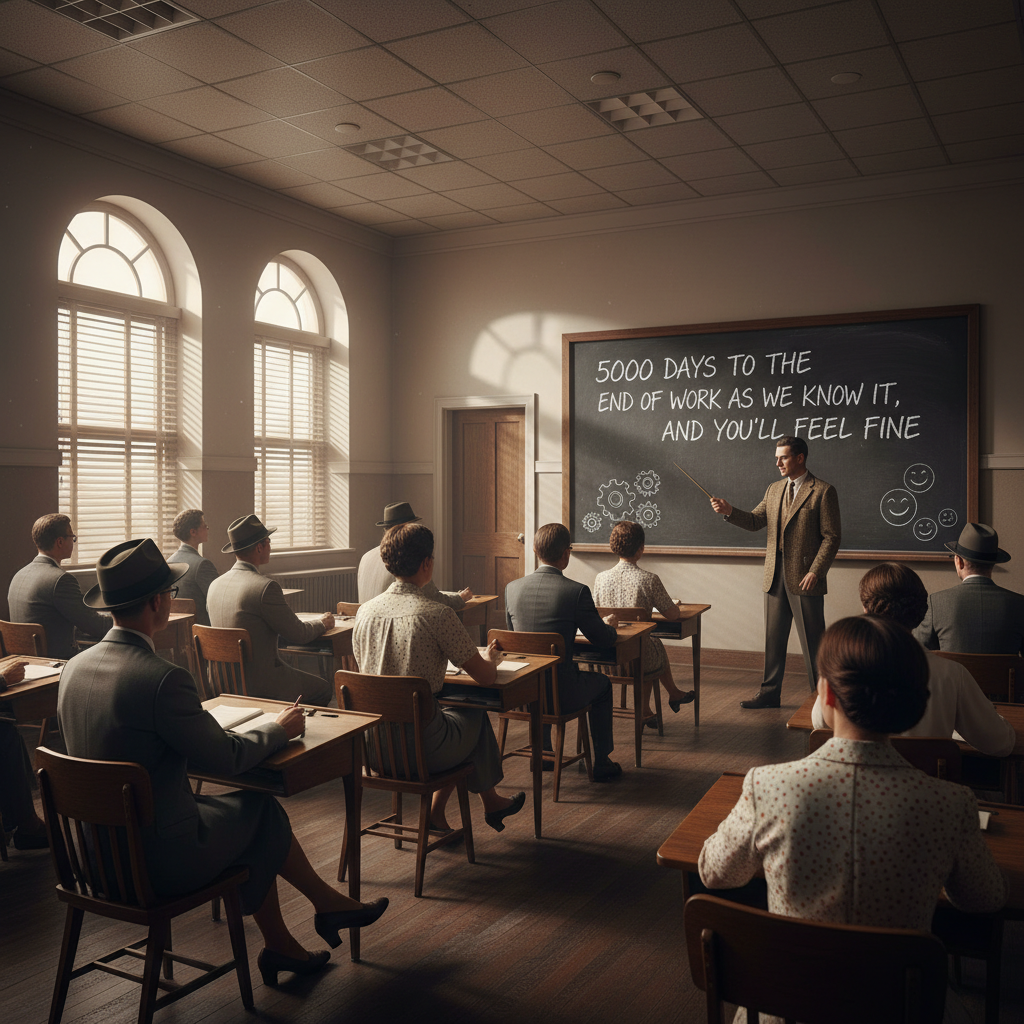
You Have 5000 Days: Navigating the End of Work as We Know It. Part 5: Your Deskilling.
As we look at the calendar it’s worth taking a deep breath and acknowledging how far we’ve come in our shared journey. Things are moving so fast, and if you’ve been following this series or just need a quick reorientation, remember: We’re not talking about the apocalypse or some doom-and-gloom terminator-style robot takeover. This is about the hero’s journey, firmly in what Joseph Campbell would call the call to adventure. The ordinary world, that place where you had a nine-to-five, staring at spreadsheets all day and coming home exhausted is dissolving behind us. We’re stepping into something new, navigating a forest we’ve never been in before, and it really helps to have a map or at least a compass. That’s precisely what dropped just four days ago: On January 15, Anthropic released their latest Economic Index report. This isn’t just another dry stack of spreadsheets or some consultant’s guess about what might happen in 2030, it’s different, a signal flare fired from right where we stand in January 2026. This is Part 5 in our series, “You Have 5000 Days: How To Navigate The End Of Work As We Know It,” a straightforward guide through the Abundance Interregnum that transitional period of roughly 13.7 years until work as we know it decouples from survival, leading to a world of greater plenitude. We’re all in this together, facing the changes with a mix of boldness and understanding for the challenges ahead.
This article is sponsored by Read Multiplex Members who subscribe here to support my work:
Link: https://readmultiplex.com/join-us-become-a-member/
It is also sponsored by many who have donated a “Cup of Coffee”. If you like this, help support my work:
The Recap Of Your Hero’s Journey Over The Next 500 Days
To keep us grounded, let’s briefly recap the path we’ve walked so far, recognizing the practical and emotional steps each part has offered. In Part 1, published December 24, 2025, we laid out the 5000-day timeline: AGI and robotics, based on projections like I made in the 1980s and developments such as Tesla’s Optimus, are set to bring about the Age of Abundance by the mid-2030s to 2040s. Using Joseph Campbell’s monomyth as our framework, we examined how we’ve moved from the Ordinary World of wage-dependent lives rooted in historical labor divisions from prehistoric times to industrial eras to answering the Call to Adventure, crossing into trials of economic shifts. We drew on resources like Viktor Frankl’s logotherapy for finding meaning in uncertainty, Albert Camus’s embrace of the absurd, Daniel Pink’s focus on autonomy, mastery, and purpose, and Mihaly Csikszentmihalyi’s concept of flow states. Practical steps included healing foundational issues through therapy, experimenting with passions in 30-day trials, cultivating wonder through nature, and preserving wisdom on platforms like SaveWisdom.org. We asserted clearly: This shift isn’t about loss, it’s an opportunity to build something better, if we approach it thoughtfully.
Part 2, from December 31, 2025, took us into the heart of the Supreme Ordeal, adapting Elisabeth Kübler-Ross’s five stages of grief; denial, anger, bargaining, depression, and acceptance to the loss of traditional careers. Drawn from her work with terminal patients and her own experiences, this non-linear model provided a compassionate structure for processing change, extended to organizational transitions. We offered actionable tools: Vulnerability audits using O*NET to assess task risks, abundance-building rituals like creating emergency funds and simulating unemployment, normalizing emotions through journaling apps, and identifying 10 signs of job obsolescence, such as high repetition or rule-based duties, with strategies to adapt, including upskilling in AI via Coursera or diversifying into resilient fields. By forming support groups inspired by Kübler-Ross’s seminars, we emphasized: Grief is a natural part of this process, but it leads to growth, we can emerge stronger as a community.

On January 1, 2026, Part 3 turned to Kurt Vonnegut’s 1952 novel Player Piano for a grounded look at automation’s potential pitfalls, based on his time at General Electric amid early computers. The story’s divided society elites overseeing machines while the masses idle on stipends mirrors forecasts like McKinsey’s 800 million jobs automated by 2030 and the World Economic Forum’s balance of 85 million lost to 97 million created. Themes of dehumanization, widening class gaps, and the question of how to value people without “use” resonate with real-world issues like UBI experiments and rising despair in deindustrialized areas. Yet Vonnegut’s characters rebuilding sabotaged tech points to human resilience. Tying to our monomyth, this was the Hero’s revolt against the Abyss, calling for ethical frameworks like the Asilomar AI principles, robust social safety nets, and communal practices to reclaim purpose. Our message was direct: We must prepare thoughtfully to avoid dystopia and build a more equitable future.
Yesterday’s Part 4 brought us to the Return with the Elixir, focusing on Scott Adams the creator of Dilbert, whose recent passing at 68 from prostate cancer leaves a lasting impact through his satire on corporate absurdities and his books on mindset. Centering Reframe Your Brain (2023), we integrated insights from How to Fail at Almost Everything and Still Win Big (2013) on talent stacks and systems, Win Bigly (2017) on persuasion, and Loserthink (2019) on avoiding cognitive traps. Addressing the Interregnum’s mental health challenges like stress and burnout from AI fears (as per the American Psychological Association’s surveys) we provided an extensive set of reframes: Turning uncertainty into an opportunity ocean for mental health, fatigue into a recharge signal for physical well-being, criticism into free coaching for social connections, job loss into a liberation launch for careers, and purposelessness into a blank canvas for existence. We were clear and supportive: These shifts can feel overwhelming, but reframing helps us navigate them effectively, turning potential setbacks into steps forward.
- Part 1: https://readmultiplex.com/2025/12/24/you-have-5000-days-how-to-navigate-the-end-of-work-as-we-know-it-part-1/
- Part 2: https://readmultiplex.com/2025/12/31/you-have-5000-days-how-to-navigate-the-end-of-work-as-we-know-it-part-2/
- Part 3: https://readmultiplex.com/2026/01/01/you-have-5000-days-navigating-the-end-of-work-as-we-know-it-part-3-the-player-piano/
- Part 4 https://readmultiplex.com/2026/01/19/you-have-5000-days-navigating-the-end-of-work-as-we-know-it-part-4-reframing-the-dawn-of-abundance/
The Anthropic AI Useage Report
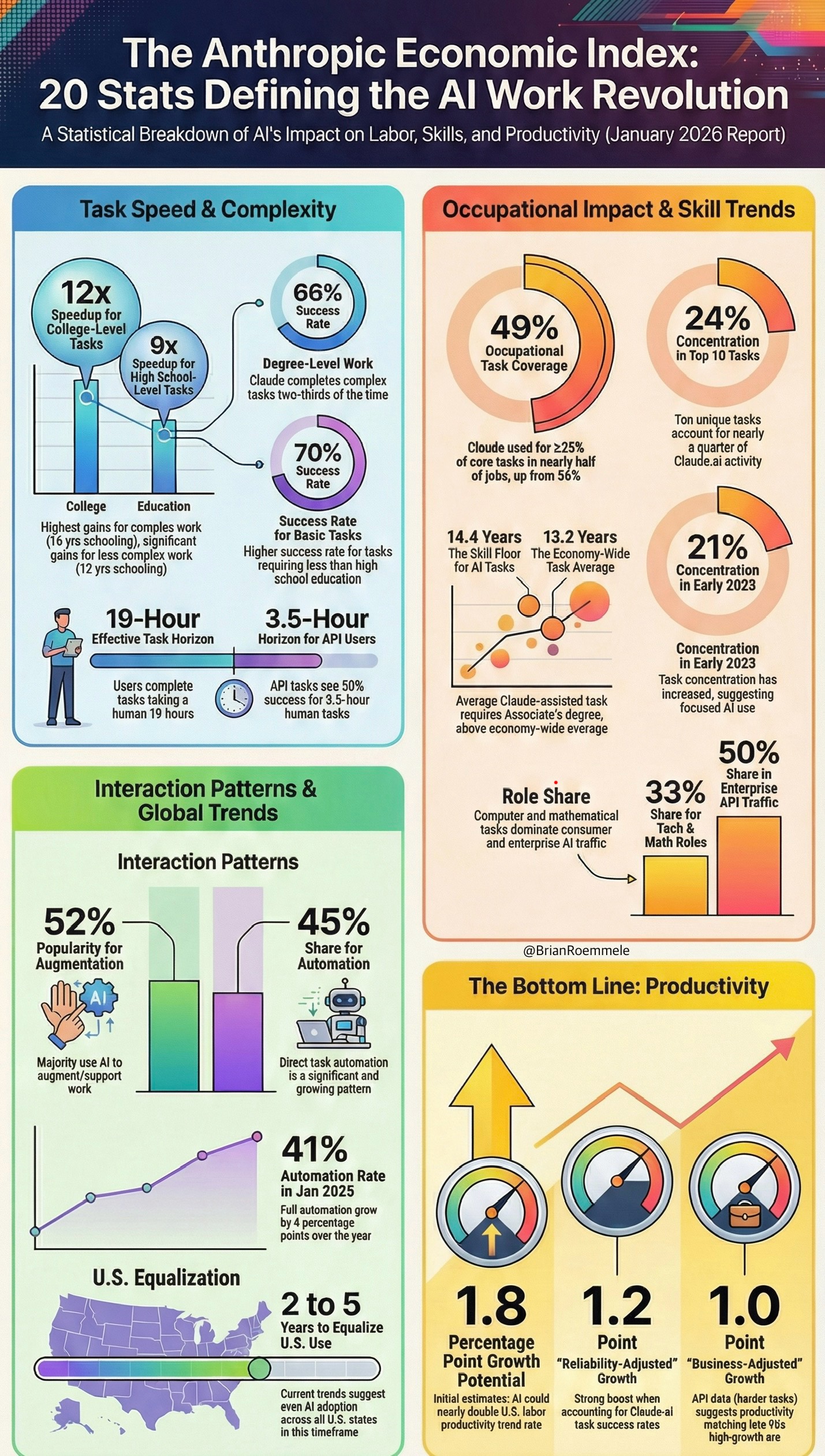
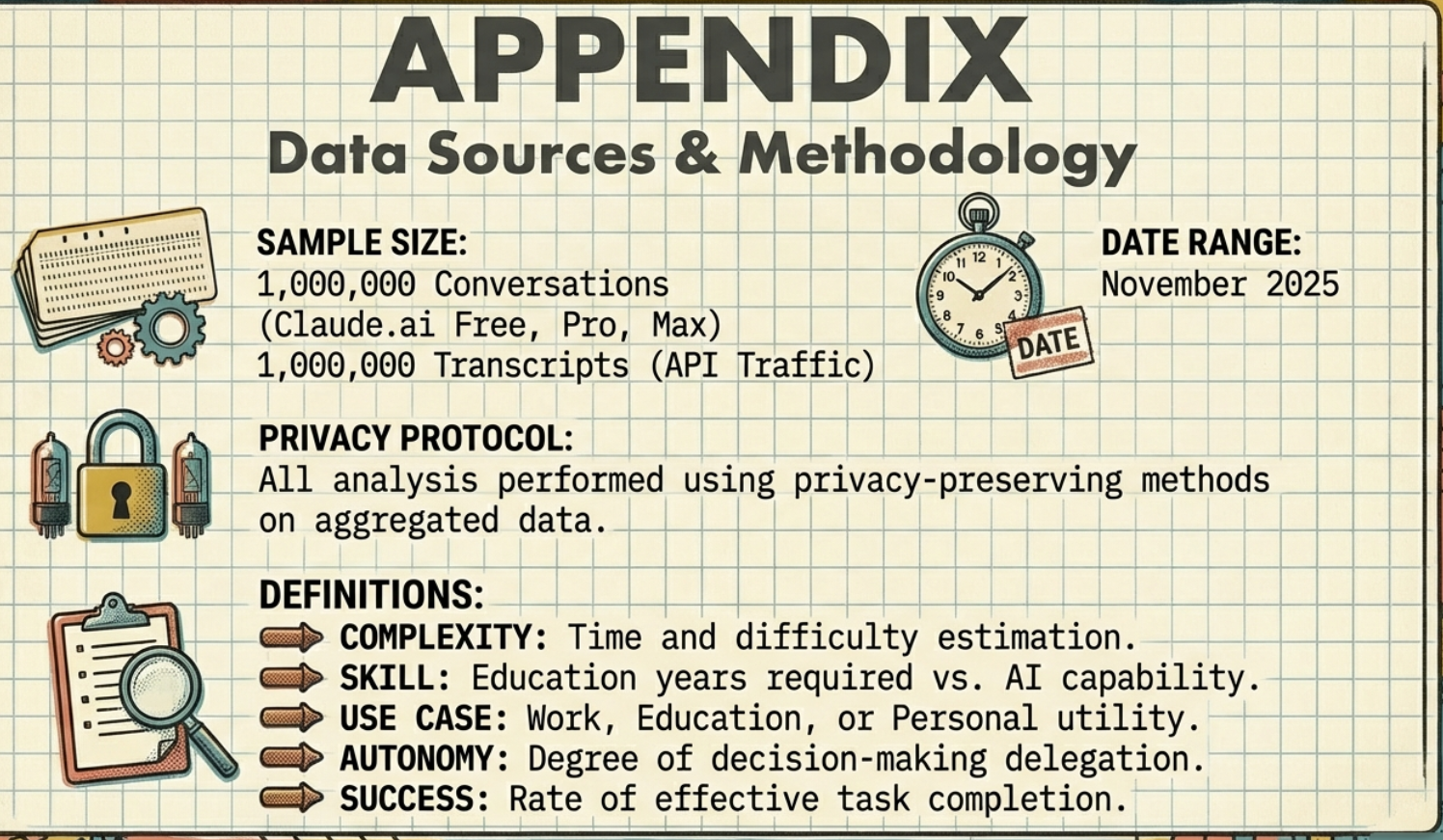
Turning now to the heart of this installment, Anthropic’s report (https://www-cdn.anthropic.com/096d94c1a91c6480806d8f24b2344c7e2a4bc666.pdf) from January 15, 2026 serves as a practical compass for our journey a privacy-preserving analysis of over two million consumer conversations and enterprise logs from November 2025, capturing the digital footprint of what people are actually doing with Claude Sonnet 4.5 right this minute. This feels different from reports in 2024 or early 2025; it’s not speculation anymore: they have the data, and our mission here is to overlay it directly onto our 5000-day timeline to see if we’re on track with those predictions and to pull out specific signals of how jobs are changing this week, not next year.
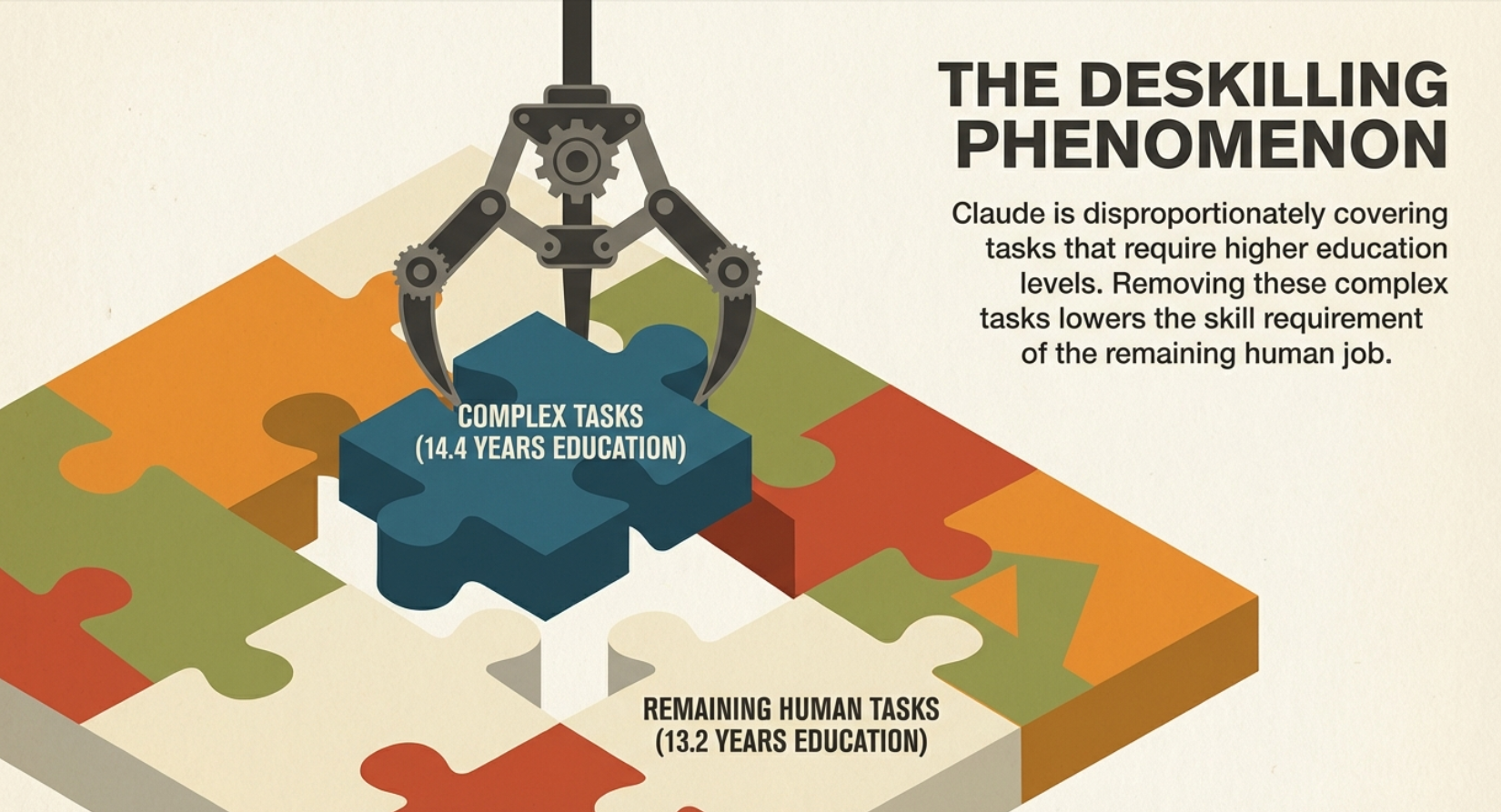
One word that stops many in their tracks is deskilling, a concept that triggers defensive mechanisms but needs unpacking it’s loaded and sounds scary, but in the context of the hero’s journey, it might just be the transformation we’ve been waiting for. We’ll examine the velocity of complexity, the mind-bending idea of a 19-hour feedback loop, and the rise of economic primitives a whole new way of measuring the heartbeat of this new economy, with numbers that are absolutely staggering. Let’s open up the map and walk through it step by step, keeping things grounded while highlighting the bold implications for our series.
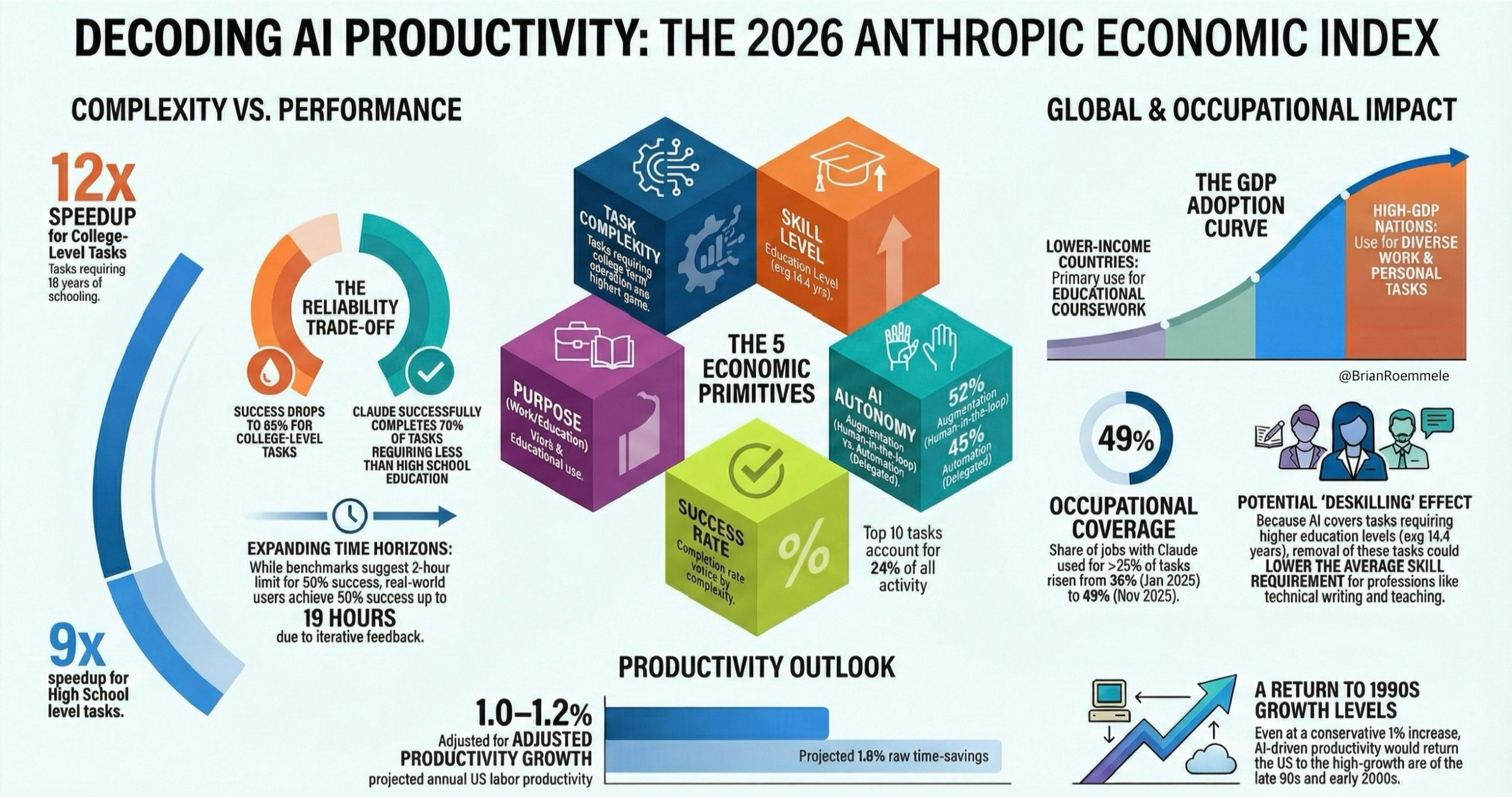
Let’s start with speed, where the first thing that leaps off the page is the section on speedup versus complexity. Intuitively, if you give a harder task, it should take longer, or at least the AI shouldn’t speed it up as much as a simple one—that’s the conventional wisdom, the linear industrial-age way of thinking. You’d assume automation is for the easy stuff, the rote, repetitive low-level tasks, automating the factory floor, not the boardroom. But the data flips that completely on its head.
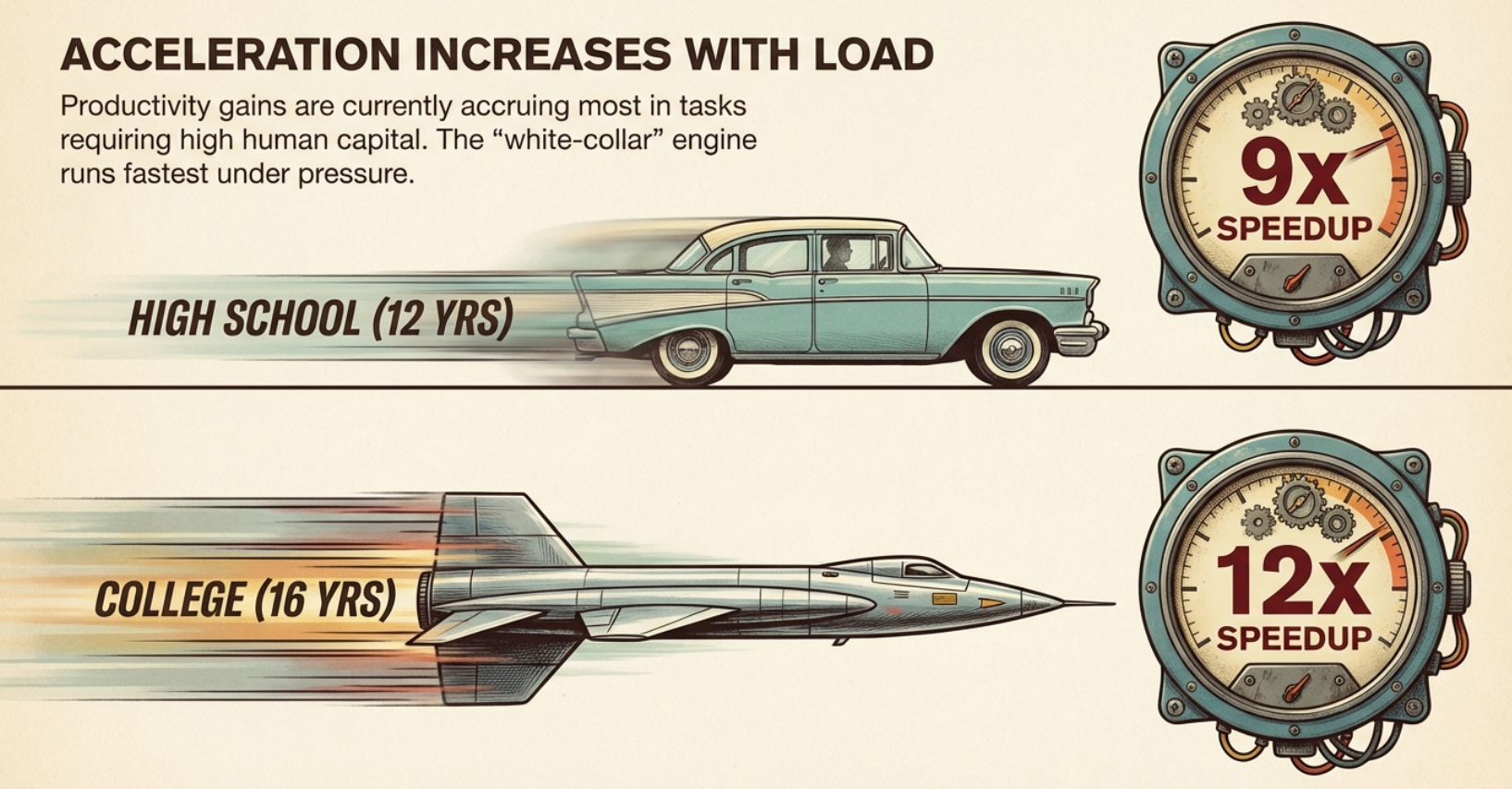
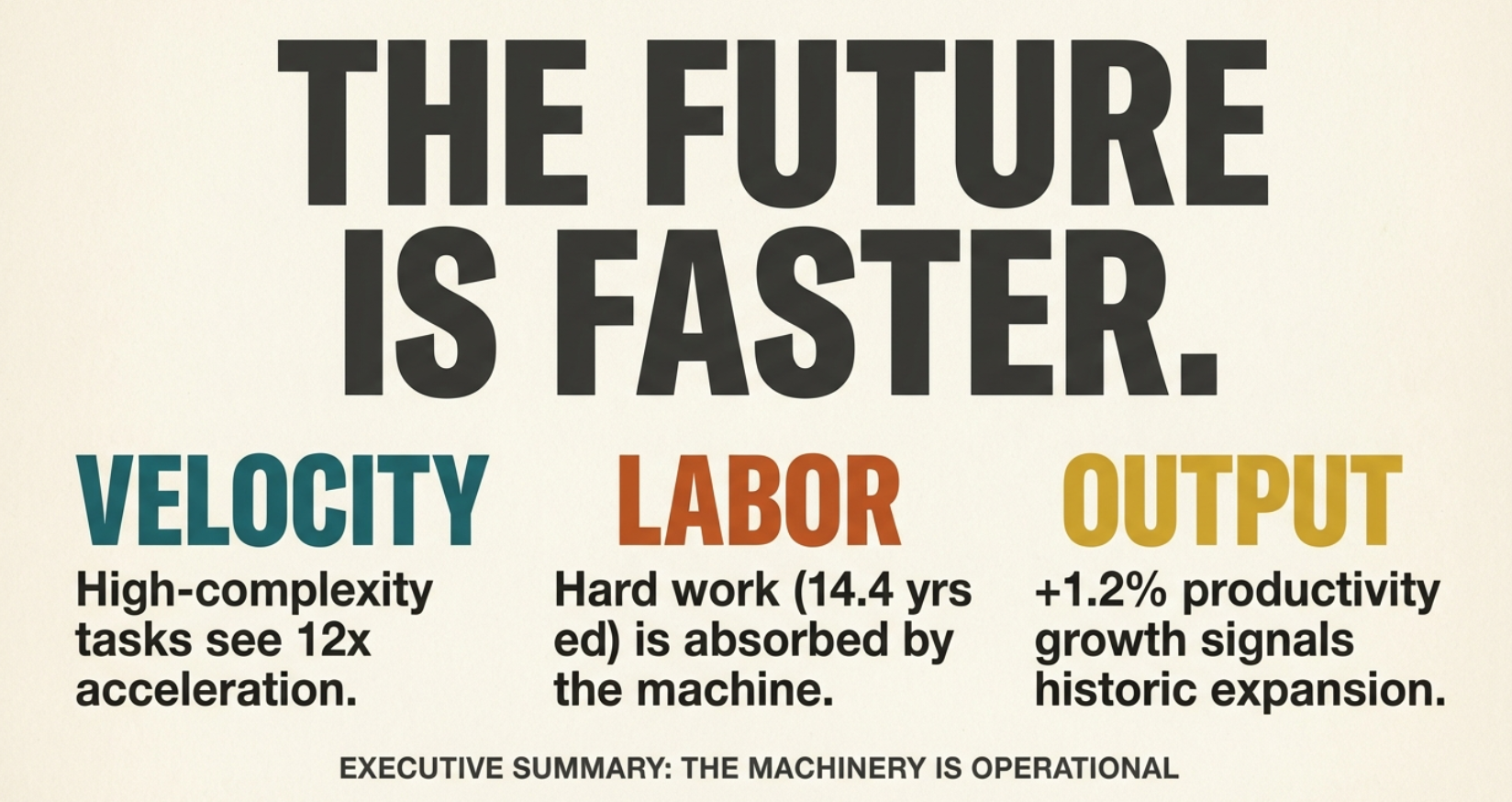
The report categorizes tasks by the level of education required: Tasks needing a high school education, about 12 years of schooling, are sped up by a factor of nine which is already huge; imagine doing a full day’s work in just an hour, a productivity revolution all on its own. But that’s not even the headline look what happens when the work gets harder. Tasks requiring a college degree, 16 years of schooling, the classic knowledge-worker class, are sped up by a factor of 12.
Let that sink in for a moment: The more complex the intellectual labor, the greater the acceleration the AI provides. They’re calling it the velocity of complexity, and it’s so counterintuitive why is the harder stuff getting faster? You’d think the AI would struggle more with really complex topics, not less. Because that’s where the most friction is for humans: In your own workday, doing a complex white-collar task like legal analysis, high-level coding, or strategic planning, the work isn’t usually the physical act of typing.
The real work is the synthesis, holding 20 different variables in your head at once. That’s cognitively expensive for a human brain; we burn a ton of glucose just doing that, we get tired, we lose the thread, you have to go get a coffee, come back, reread what you just wrote, and try to load all that context back into your working memory. This is what I term cognitive viscosity: it’s like you’re trying to run through mud. But for a model like Claude Sonnet 4.5, and certainly for the new Opus 4.5, that cognitive load is basically negligible, the AI doesn’t get tired, it doesn’t need to reload the context; the context is mathematically present in its attention mechanism.
So when you apply AI to these high human-capital tasks, you aren’t just making the typing faster, you’re removing the very friction of complex thought, greasing the gears of intellect itself, turning the muddy road into a paved superhighway. And this aligns perfectly with the whole end-of-work thesis we’ve been discussing: The work that is being accelerated the fastest, and so potentially displaced or transformed, is the very work we spent the last 50 years telling everyone they needed to get a degree to do. We built an entire educational system on the premise that complex cognitive tasks were the safe harbor, and now the data is showing the water level in that harbor is rising faster than anywhere else. For our series, this means the 5000 days are compressing boldly, we’re on track, perhaps ahead, but with sympathy for those feeling the pace, it’s a call to adapt without panic.
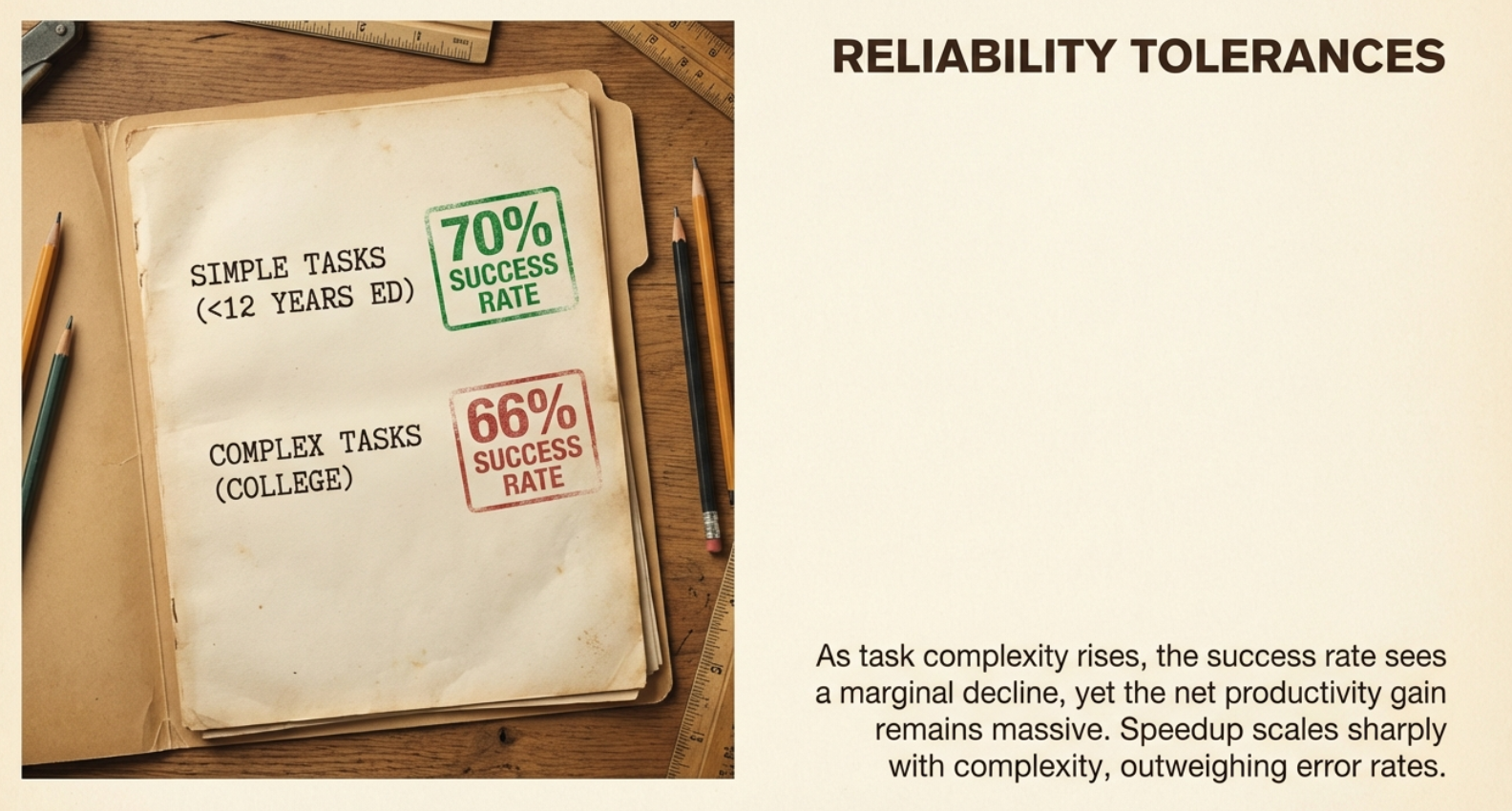
Of course, we have to look at the other side of this coin because speed is great, but if you’re driving a Ferrari 200 miles an hour straight into a wall, that’s not exactly helpful. The report notes something really interesting about success rates too: you have to ask, it is 12 times faster, but is it good? Is it just fast and wrong? Because fast and wrong is just fishing chaos that doesn’t help anyone. In the data is a slight dip: Tasks requiring a high school education have about a 70% success rate, while those needing a college degree have 66%, so it is slightly harder for the AI, the complexity does take a small toll on the accuracy. Marginally, though, it’s a 4% difference. But think about that trade-off: You’re accepting a tiny 4% drop in immediate success rate in exchange for a 1200% increase in speed, the math on that is just undeniable.
If you can do the task 12 times in the time it used to take to do it once, you can afford to check your work, afford to generate 10 different variations, throw away nine of them, and keep the best one, and you’re still finished before lunch. And that is the key, that is the engine that’s driving the change in our 5000-day timeline. We are seeing the removal of the time tax on intelligence: If you’re a knowledge worker in 2026, your value is no longer about how long it takes you to figure something out, because the machine can do that heavy lifting in seconds. Your value is shifting, it’s moving to verification and selection. This ties straight to our theme: Boldly, it accelerates the Ordeal, but sympathetically, it opens doors to more fulfilling roles if we make the adjustment.
This brings us to the second, and maybe the most fascinating part of this whole report, because if the machine provides the speed, what does the human provide? This leads us to the concept of task horizons, or as it’s been called, the 19-hour feedback loop this was the finding that made many literally sit up and reread the page, initially thinking it had to be a typo. So let’s set the scene: There’s a benchmark called METR, a very standard, rigorous way of testing how long an AI can work on a single problem before it loses the plot, before it starts to drift. According to the METR benchmark, Claude Sonnet 4.5 has about a 50% success rate on tasks that last for about two hours, after two hours of continuous context thinking, processing, generating, it starts to hallucinate or forget the original instruction. That’s the benchmark, the lab setting.
Then Anthropic looked at their actual real-world data they looked at the API logs, businesses building apps on top of Claude, and there the success rate holds up for tasks lasting about three and a half hours, a little better, same ballpark. But then they looked at Claude.ai, the consumer interface, the chat box that you and I use, the place where a human is sitting at the keyboard interacting with it and on Claude.ai, the duration for a 50% success rate extends to roughly 19 hours. 19 hours: not a typo, that’s a massive discrepancy. The benchmark says two hours, the real-world human usage says 19. Why? What are we doing that’s so different from the benchmark? This is the hero’s journey in action right here, this is the difference between a tool and a partner. The benchmark is static—it gives the AI a task and says go, like firing an arrow; once it leaves the bow, you can’t change its course. But on Claude.ai, there’s a human in the loop, the feedback loop.
Humans break complex tasks into smaller steps: we don’t just say, “Write me a novel,” we say, “Okay, here’s an outline. Now, write chapter one. Hmm, that tone is a little off, can you fix this paragraph?” “Great, now write chapter two based on that change”. We are constantly correcting its course along the way, we’re dancing with the machine. We’re providing the executive function, the AI has this incredible raw processing power, but the human has the intent and the situational awareness, the human provides the continuity of consciousness. The AI provides the raw horsepower; together they can sustain a task for 19 hours that the AI would completely fail at in two if it were left alone. This is just huge, if you’re sitting there right now wondering, “How do I survive the next few years? How do I navigate these 5000 days?”
This is the answer: The skill is not just prompting anymore, the skill is maintaining the thread, it is the single biggest mental adjustment required for this phase of the journey.
You Will Not Prompt AI, You Will Conduct AI
Success in the next 5000 Days, is no longer pushing a button and walking away, success is engaging in a multi-hour or even a multi-day feedback loop. You have to be the conductor: the AI is the orchestra, and that orchestra can play incredibly fast, but if you put down your baton, they’re eventually going to play out of tune.
So in the call to adventure, this is our first real trial: learning how to extend that horizon. And the report also mentioned selection bias here, which is kind of funny but also very true, it says users are bringing tasks to the AI that they know or are at least pretty confident will work, we’re not asking it to do impossible things, so learning what the tool is good at, we aren’t asking it to do things that we know will break it immediately. And that’s just part of the adoption curve we’re figuring out the boundaries, but the fact that those boundaries are stretching all the way out to 19 hours suggests that for a lot of people, the AI limits are starting to dissolve. If you can guide it, it can go the distance. Think about the implication for the timeline, if you can maintain a high complexity task for 19 hours with that 12x AI speed, the sheer amount of work you can accomplish is staggering. This isn’t just a 12x speedup on a single task, this is 12x speedup compounded over two full workdays of continuous operation, that is how you get to the end of work as we know it, that is how you get the one-person unicorn company. For our 5000 Day series, this boldly validates the acceleration we’re seeing, but with sympathy for those adjusting to this new rhythm, it’s a practical reminder that human guidance remains key.
Reframing The Human Deskilling By AI
So we have speed and we have endurance as long as you have a human pilot. But we have to talk about the destination or maybe how the terrain itself is changing under our feet. This brings us to the deskilling paradox, this is the section that deals with the future of work most directly, and it deals with our egos. It asks a very provocative question: Does AI cover the high-skill parts of your job or the low-skill parts? And once again, the data is surprising, the report finds that Claude covers tasks requiring an average of 14.4 years of education, an associate’s degree level basically, effectively yes. Now, compare that to the economy-wide average for tasks, which is 13.2 years, so Claude is punching above the average weight, it is actively targeting tasks that require higher education. And this is what leads them to use the term “deskilling” the report says, as a first-order effect, this would de-skill jobs on average, since it would remove those higher-education tasks.
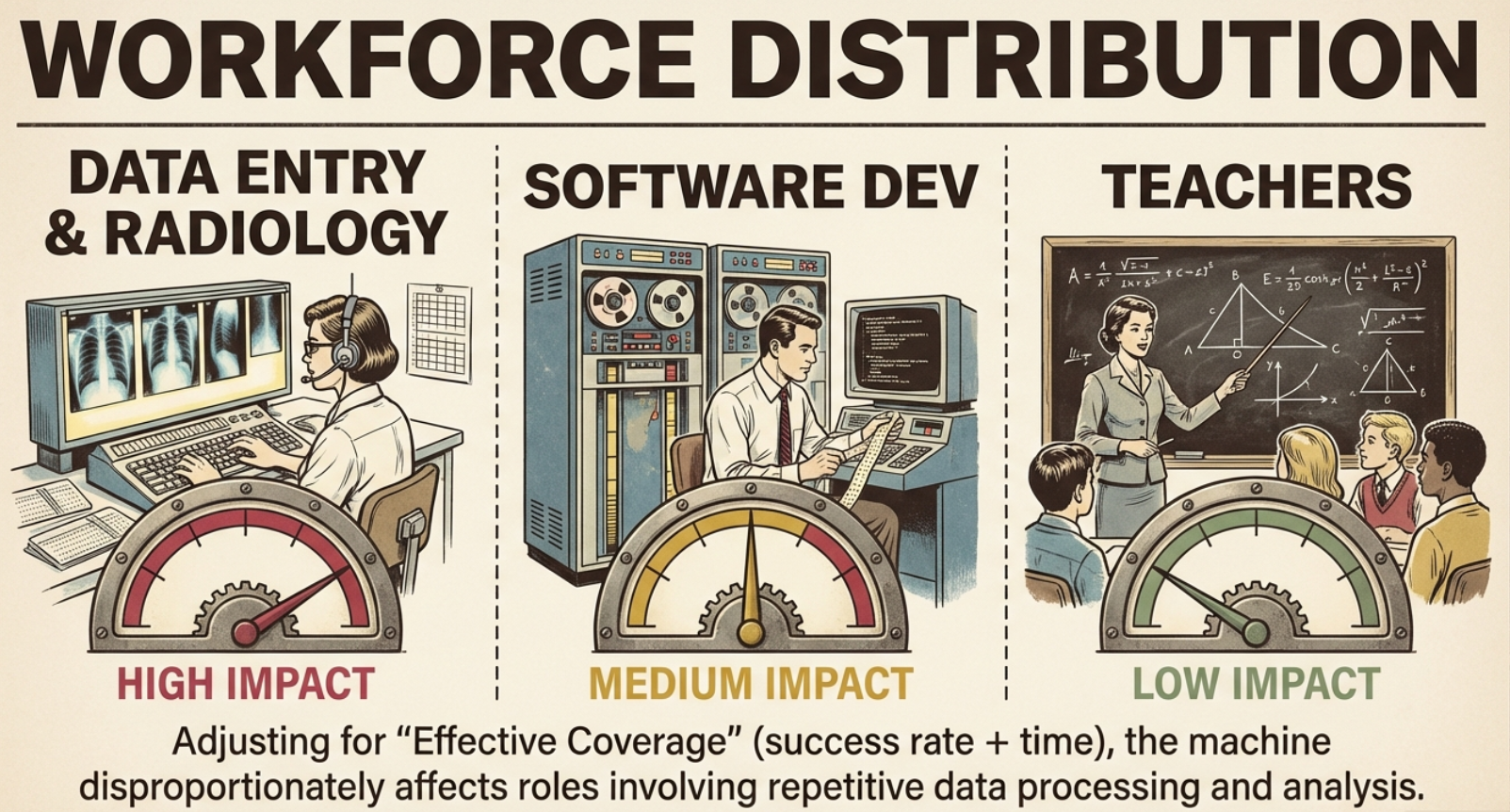
Let’s unpack this, because deskilling sounds like we’re all going to become button pushers, it sounds like a demotion you know, I went to school for six years to learn how to do this, and now my job is de-skilled. It’s a very loaded term, but in economic terms, it means something very specific: If your job consists of 10 tasks and the five hardest ones, the ones that required you to go to college, the ones that were the barrier to entry, are now done by the AI, then the remaining job description technically requires less formal skill. The report explicitly lists some professions here: technical writers, travel agents, teachers, and radiologistsra. Rdiologists it is such a classic example, a huge part of that job is visual pattern recognition, is this spot a tumor or just a shadow? That takes years and years of training for a human to get right, an AI can do it almost instantly and arguably more accurately so if you take that core task away, what is left for the radiologist to do? Well, that is the question, isn’t it? Is the radiologist now de-skilled or are they freed? And this is the reframe this is why we keep saying this isn’t about doom, it’s about the transformation phase of the monomyth, we are shedding old skins.
If the AI handles the associate’s degree level cognitive load, the pattern recognition, the technical drafting, the lesson planning, the human is freed up for something else, higher-level synthesis or empathy strategy. The report notes that even if AI automates these specific tasks, the labor market will dynamically adjust, we aren’t just going to sit there and do nothing, we will find other skills. Other skills, it’s not just upskilling, which usually implies learning more technical stuff, more coding, it might be side-skilling or deep-skilling into things that machines are just fundamentally bad at.
Think about the teacher: if the machine is the technical expert, creating the personalized lesson plan for every student and grading the calculus homework, the human teacher becomes the guide, the counselor, the strategist, the mentor for the teacher, maybe it means less time grading papers and planning curriculums, which the AI now does, and more time sitting one-on-one with a student who’s struggling with motivation. Is that de-skilled? Technically, maybe, because you don’t need a PhD in subject matter expertise to encourage a child, but is it less valuable? I would argue it’s infinitely more valuable, that’s the human connection. It is, but we have to be honest with ourselves, it’s a disruption, it changes the identity of the worker.
If your whole identity was, “I’m the person who knows all the technical details and the machine now knows them better than you,” you have to find a new identity. That is the crisis part of the hero’s journey who am I if I’m not the one holding all the knowledge? The answer is, you are the one wielding the knowledge, you are the director. It reminds me of the shift from, say, an artisan to an architect, you aren’t laying every single brick anymore, you’re designing the entire cathedral. And that shift is happening right now, today, the report mentions technical writers, that used to be a very specific skill, taking complex engineering specs and turning them into readable manuals, now the AI can do the first draft in seconds, the human becomes the audience advocate, checking if the tone is right, if the logic flows for a real person.
In The Next 5000 Days “who am I?”
So the big mental adjustment we need to make is to stop defining our worth by the hardness of the tasks we perform. In the 5000 days timeline, hardness is no longer a proxy for value, connection, direction, and synthesis, those are the new proxies for value. I love that. For our series, this paradox is central boldly, it’s the engine of change, but sympathetically, it validates the emotional work in previous parts, like reframing identities and grieving old roles.
It is a big adjustment, for hundreds of years our very names were the family vocation. It was our identity. It gave us purpose and it gave us pride. That practice faded in the industrial revolution and many suffered a similar crisis of identity. These names today are not even thought of in our modern age. Think of it for a minute, your name was what you did in your family for generations, for example:
- Weaver – Tied to those who wove cloth and textiles.
- Smith – Derived from blacksmiths or metalworkers.
- Baker – Originating from those who baked bread and goods.
- Miller – Tied to millers who ground grain into flour.
- Carpenter – From woodworkers who built structures and furniture.
- Taylor – Linked to tailors who made and repaired clothing.
- Fisher – From fishermen who caught fish for a living.
- Cooper – Associated with barrel makers who crafted wooden containers.
- Fletcher – From arrow makers who supplied feathers for arrows.
- Mason – Derived from stonemasons who worked with stone and brick.
In the next 5000 days just as Joe Miller, is no longer a Miller today perhaps, when someone asks “what do you do”, you will have more of a list of colorful advocations, if anyone even asks those types of questions in the future. Either way, this is going to take place. We face this standing up to the wave comming at all of us and we get on our surfboard and we ride. It is the only option.
Bigger Picture
Okay, let’s zoom out for a second, we’ve looked at the individual worker, now I want to look at the world: section 4 covers the global adoption curve, because this isn’t happening the same way everywhere, and the divergence is fascinating. Anthropic found a very strong correlation with GDP per capita, so in high-GDP countries, places like the US, the UK, Japan, people are using AI for work and for personal use, it’s a pretty balanced split, we ask it to help us code, and then we ask it to help us plan dinner. But in lower-GDP per capita countries, there’s a massive spike in one specific category: educational coursework. It makes perfect sense when you think about it if you’re in a developing nation, your primary drive is to close the gap, to gain literacy, to acquire skills, the AI is the ultimate tutor it’s the student phase of the journey, it’s the democratization of an Ivy League education. It one reason I advised El Salvador (I am an adisor to the President) to form an aliance with X.ai Grok to guide students in all grades, privately for life of the student. In wealthier nations, we’re already seeing the master or even the post-work phase beginning to emerge, we’re using it to code, sure, but we’re also using it to plan our vacations, to write wedding toasts, to organize our personal lives.
The report highlights this partnership with the Rwandan government and a training provider called ALX, they’re giving all their graduates the Claude Pro, and the explicit goal is to help them transition from learning to doing, to move from that educational use case to broad application in the real world, it’s like jumpstarting the industrial revolution, but for the mind, instead of building factories, they’re building cognitive capacity.
Here in the US, we’re seeing a different kind of equalization happening, the report notes that AI usage is becoming much more evenly distributed across all the states, it used to be heavily concentrated in California and New York, the coastal tech hubs, now that curve is flattening out, their prediction is that usage will be pretty much equalized across the entire country within just two to five years, which aligns perfectly with the 5000 days timeline. By the time we reach the end of this decade, this won’t be tech-bro stuff anymore, it’ll be like electricity, it will be everywhere for everyone. a rancher in Montana will be using it just as much as a coder in San Francisco, just for completely different things.
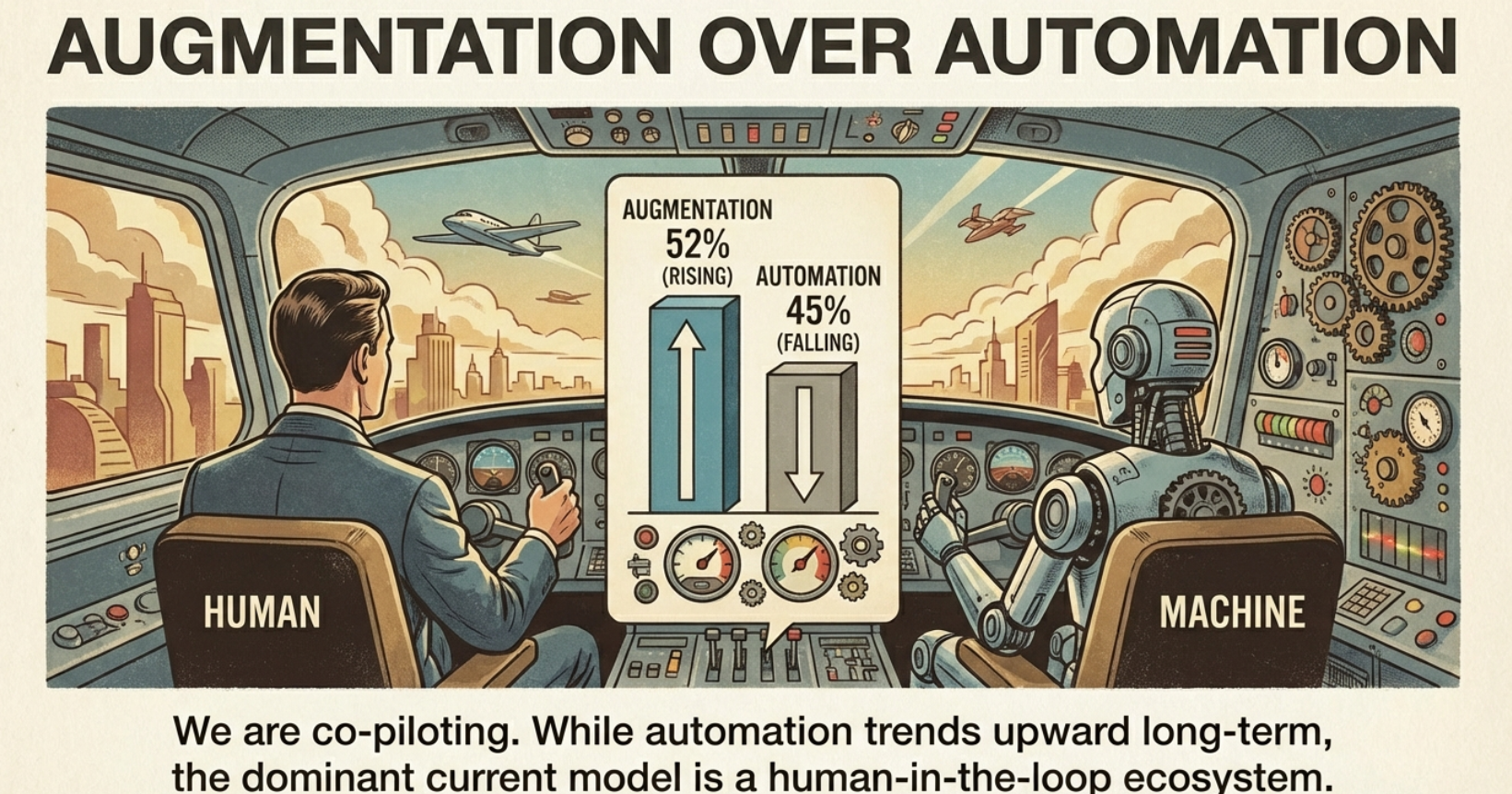
And as it becomes everywhere, the way we use it is also changing, we touched on this with the feedback loop, but there’s a kind of battle going on right now between automation and augmentation, the battle for the workflow, this is the critical tension point right now. The data from Claude.ai shows that at this moment, augmentation is winning, 52% of conversations are augmentation, collaborating, refining, working together, 45% are automating, basically just do this for me, so it’s a narrow lead for augmentation.
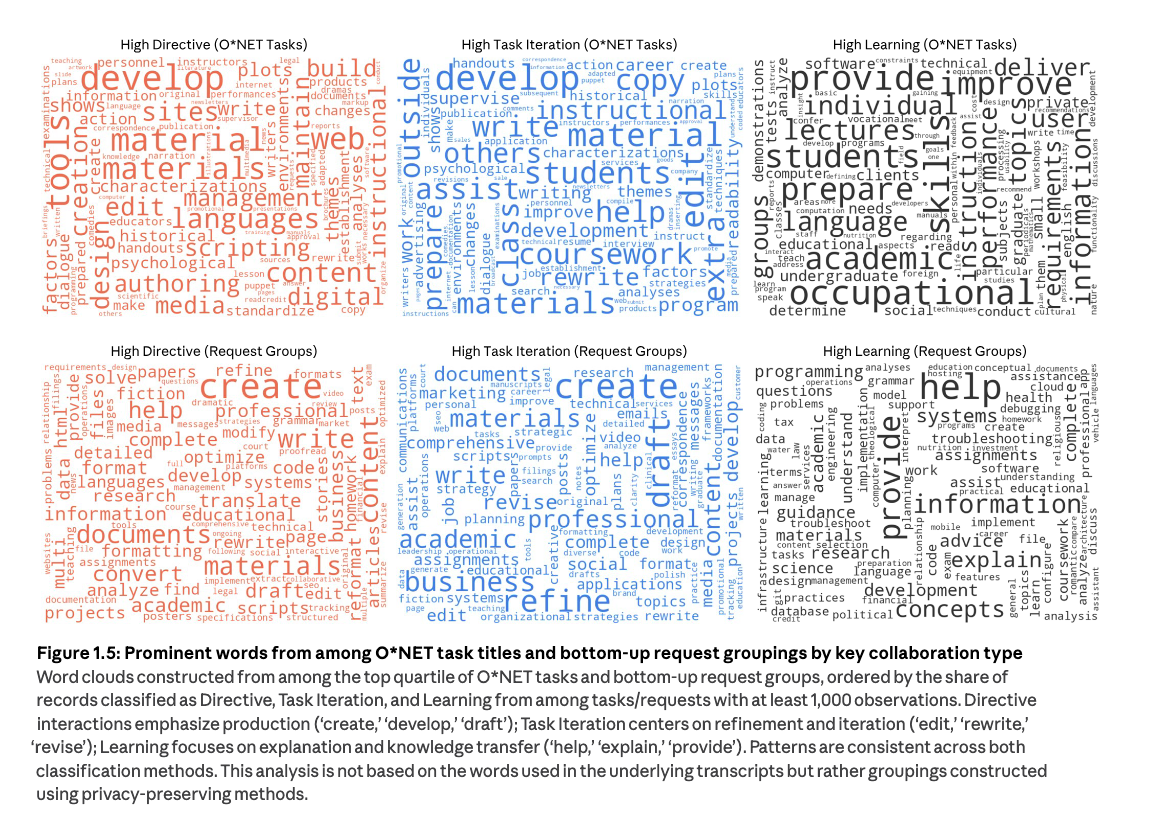
The report does note that the long-term trend year over year shows automation rising, and they specifically mention a rise in what they call directive use, people are delegating tasks entirely, they aren’t saying “Help me write this,” they are saying “Write this.” This connects directly back to our discussion on Player Piano, Kurt Vonnegut’s novel about a world where the machines do everything we are currently in the sweet spot, we’re in the augmentation sweet spot where we feel like superheroes, we have bionic arms, but the tide of automation is rising as the models get better.
Remember, this data is from before Opus 4.5 really took hold: the temptation to just hand over the keys becomes stronger and stronger, it’s the path of least resistance, if I can get a 12x speedup by collaborating, maybe I can get a 100x speedup by just delegating the whole thing. And that is the danger zone because if you delegate everything, you lose that human-in-the-loop advantage we were just talking about, you lose the 19-hour horizon, you risk becoming a spectator in your own life. And that is where that personal use category becomes so interesting—in rich countries, that category is growing fast: if work becomes automated, do we just spend more and more time using AI to manage our leisure, to manage our lives?
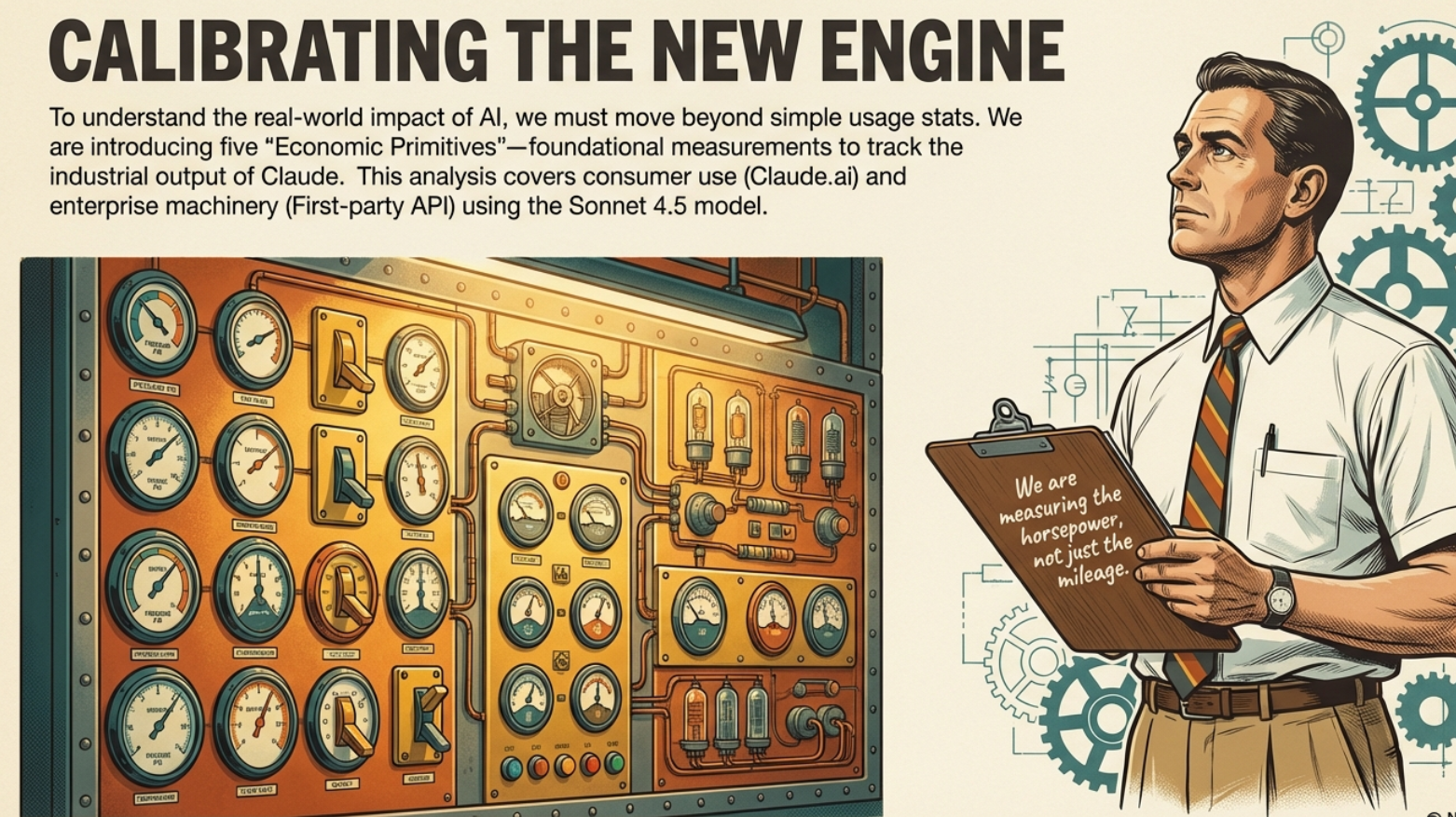
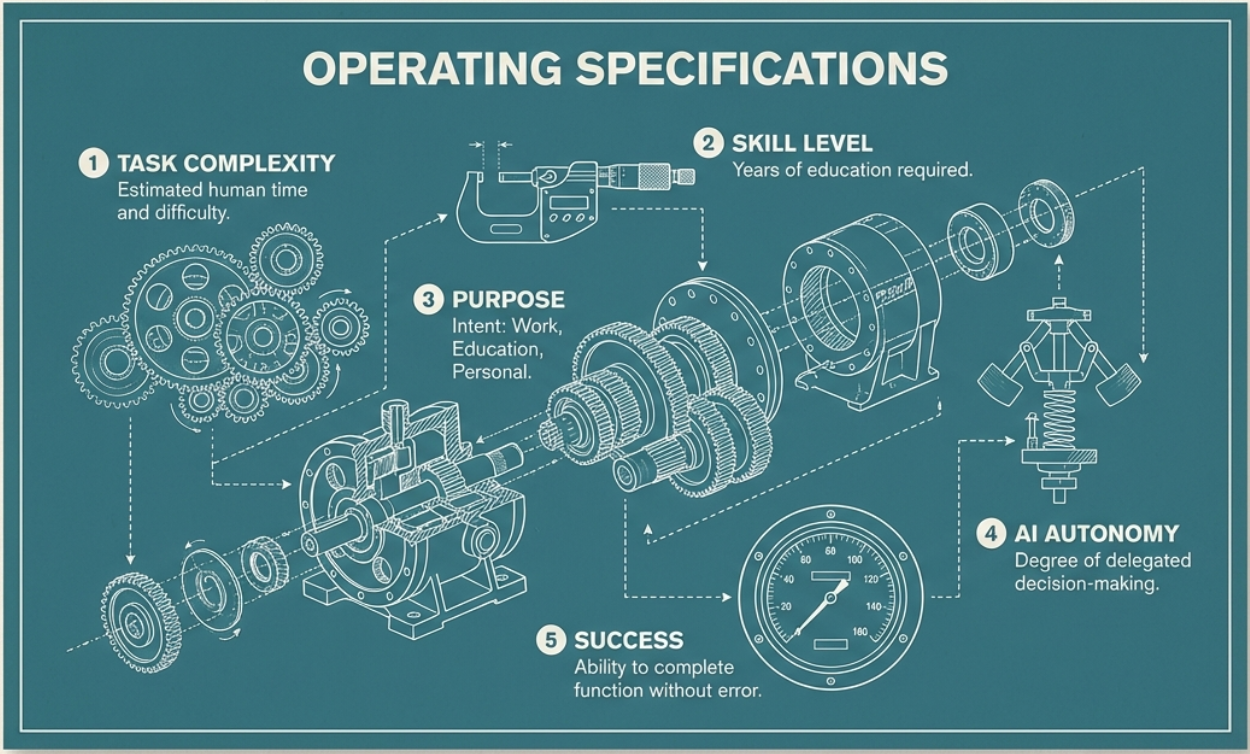
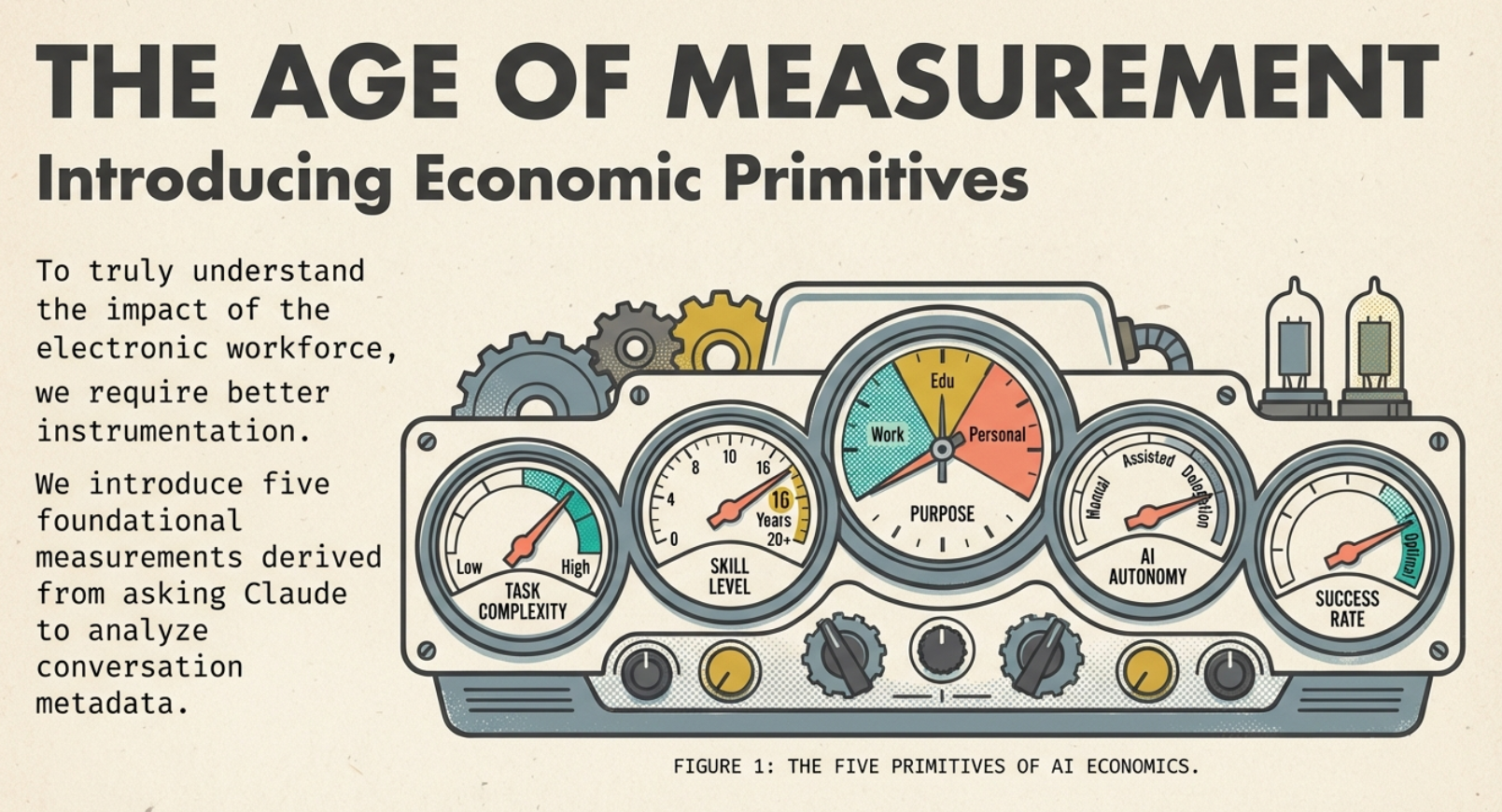
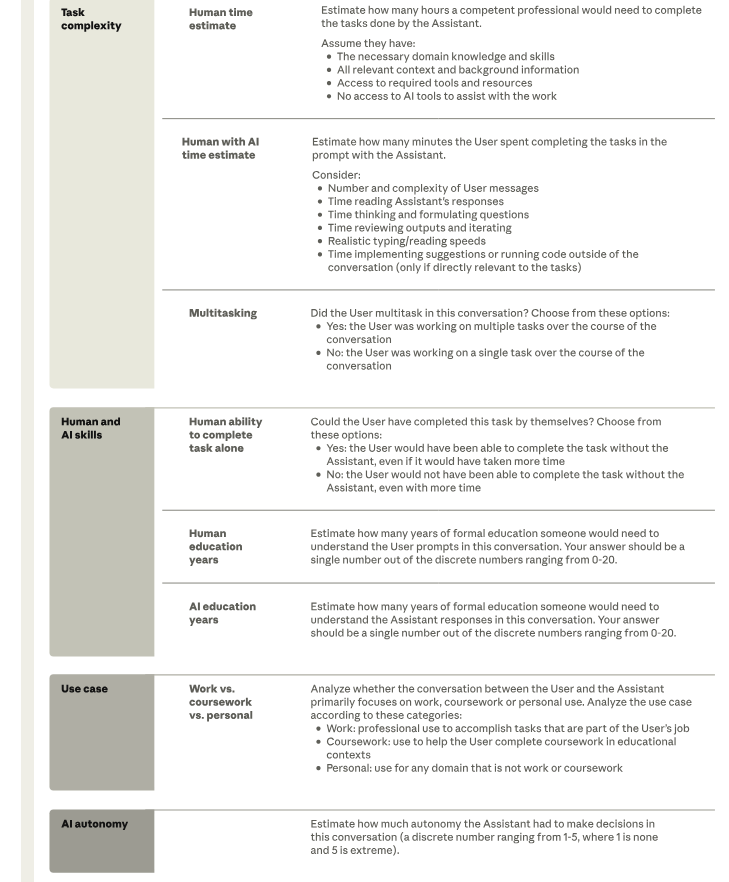
This brings us to the metrics, how do we even measure an economy where work is disappearing, but value is increasing? Section 6, economic primitives: Anthropic is trying to measure this massive change with entirely new metrics because. let’s face it, GDP just doesn’t cut it anymore, and thank goodness they aren’t, we’ve been flying blind for a couple of years. They introduce five primitives:
- Task,
- Complexity,
- Skill level,
- Purpose,
- AI autonomy,
- Success
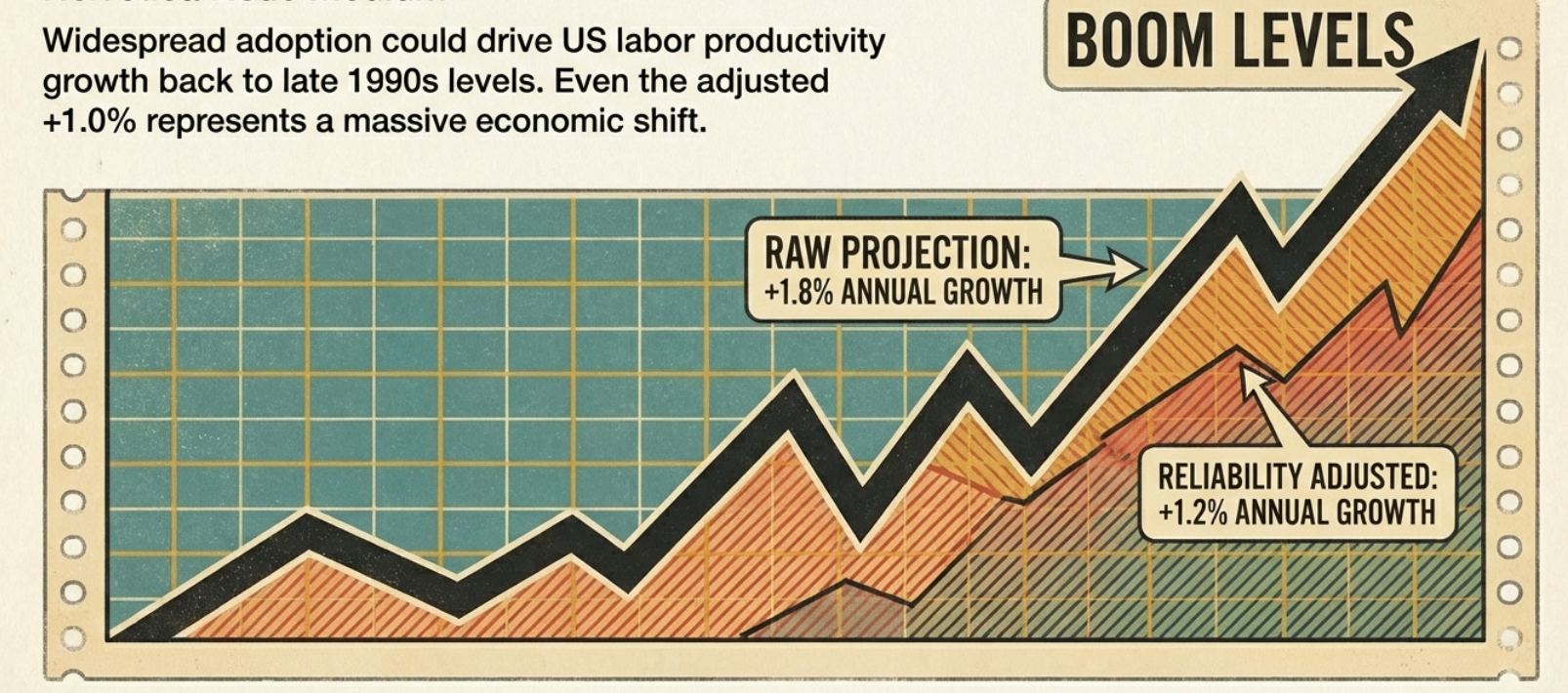
It’s a framework for trying to measure the intangibles, trying to put a number on thought. And their projection for productivity based on this is significant, they estimate that U.S. labor productivity growth could increase by 1.2 to 1.8 percentage points per year, and to put that in context for everyone, that would return us to the glory days of the late 1990s and early 2000s, the internet boom, that is a massive injection of wealth and capacity into the economy, that is the difference between a stagnant society and a truly booming one.
But there’s a huge caveat here. This data is based on Sonnet 4.5—that’s the one, the report explicitly says these numbers do not account for models becoming significantly more powerful, and they specifically mentioned the release of Claude Opus 4.5, so this 1.8 percent figure, it might be the floor, not the ceiling, the upside risk. If Opus 4.5 is a genuine step function improvement, and all the early reports suggest that it is, then the speed factors, the success rates, the deskilling effects, they all accelerate, the timeline compresses, the 5000 days might end up happening in 3000. That is just a staggering thought.
The Data Confirms You Are On A Hero’s Journey
So to bring this all back to where we started, it’s January 20, 2026, we’re on the 5000 days path, and we have a report that says complexity is speeding up, not slowing down, we have a report that says the barrier to entry for high-skill tasks is collapsing, and we have this feedback loop that rewards patience and direction over raw execution. We are leaving the ordinary world, that is the big takeaway here, the world where skill meant years of memorizing facts is gone, it’s dissolving right in front of us. And for our listeners, the call to adventure is to accept that shift: don’t fear the deskilling, that’s my advice, don’t look at the fact that an AI can do your technical writing or your lesson planning as a theft, look at it as a liberation.
But, and this is the big but, you have to embrace the 19-hour feedback loop, you have to be willing to sit with the machine, to guide it, to correct it, to be the human in the loop. The skill of the future is direction and synthesis: it is not execution, the machine executes, you direct. And if you can make that mental adjustment, you aren’t just surviving the next 5000 days, you are thriving in them, you’re the one surfing the wave instead of being crushed by it, you become the hero of the journey.
The skill of the future is direction and synthesis: it is not execution, the machine executes, you direct.
I want to leave everyone with one final thought, a little bit of a provocation based on that global data we talked about: the reports show that as countries get richer, they shift from education and work to personal use, we see that happening in the U.S. and U.K. data right now, the life category. So, if we project this out to the end of the 5000 days, if productivity skyrockets, if the work tasks are automated or deskilled to the point of being trivial, are we preparing for an economy where our primary relationship with AI isn’t about working at all?
Does personal use become the dominant use? Are we heading to a world where the AI is primarily a tool for living, for creativity, for connection, for planning our experiences? That is the ultimate destination of the monomyth, isn’t it: the return with the elixir, the boon that restores the world. If the boon is time and the AI gives us all that time back, then yes, the destination isn’t better work, it’s life after work. Something to mull over.
As we reflect on this report’s insights, we stand at a practical turning point in our Abundance Interregnum, where de-skilling invites us to rethink our roles without the weight of old burdens. This isn’t about dramatic upheaval but a steady shift toward greater freedom, where AI handles the cognitive heavy lifting, allowing us to focus on what truly matters. With understanding for those navigating this change, we recognize that our value now lies in guiding, connecting, and synthesizing—skills that enrich lives beyond mere productivity. The 5000 days ahead offer a chance to build a world of balance and purpose, one feedback loop at a time.
Yet this evolution prompts a grounded question: As work transforms, what does the new meaning of life look like? It’s an opportunity to reclaim time for creativity, relationships, and personal growth, moving from execution to direction. We can approach this with confidence, knowing the tools are here to support us, turning potential challenges into steps toward fulfillment. We can embrace it thoughtfully: our journey is about thriving, not just adapting.
The series continues in Part 6, where we’ll explore abundance in a number of profund books for an era of machine and human partnerships.
We are on this journey together. Some of us stand on the shoulders of giants and have thought about this for decades. We will not go it alone, and I hope to build many parts to this series and share the mastermind insight from the powerful Read Multiplex member Forum: https://readmultiplex.com/forums/topic/you-have-5000-days-navigating-the-end-of-work-as-we-know-it/. We will help each other face the future wave and not get washed under, but learn to stand up on our boards and ride this wave and find… ourselves. Join us.
To continue this vital work documenting, analyzing, and sharing these hard-won lessons before we launch humanity’s greatest leap: I need your support. Independent research like this relies entirely on readers who believe in preparing wisely for our multi-planetary future. If this has ignited your imagination about what is possible, please consider donating at buy me a Coffee or becoming a member.
Every contribution helps sustain deeper fieldwork, upcoming articles, and the broader mission of translating my work to practical applications. Ain ‘t no large AI company supporting me, but you are, even if you just read this far. For this, I thank you.
Stay aware and stay curious,
🔐 Start: Exclusive Member-Only Content.
Membership status:
🔐 End: Exclusive Member-Only Content.
~—~
~—~

~—~
Subscribe ($99) or donate by Bitcoin.
Copy address: bc1qkufy0r5nttm6urw9vnm08sxval0h0r3xlf4v4x
Send your receipt to [email protected] to confirm subscription.

Stay updated: Get an email when we post new articles:

THE ENTIRETY OF THIS SITE IS UNDER COPYRIGHT. IMPORTANT: Any reproduction, copying, or redistribution, in whole or in part, is prohibited without written permission from the publisher. Information contained herein is obtained from sources believed to be reliable, but its accuracy cannot be guaranteed. We are not financial advisors, nor do we give personalized financial advice. The opinions expressed herein are those of the publisher and are subject to change without notice. It may become outdated, and there is no obligation to update any such information. Recommendations should be made only after consulting with your advisor and only after reviewing the prospectus or financial statements of any company in question. You shouldn’t make any decision based solely on what you read here. Postings here are intended for informational purposes only. The information provided here is not intended to be a substitute for professional medical advice, diagnosis, or treatment. Always seek the advice of your physician or other qualified healthcare provider with any questions you may have regarding a medical condition. Information here does not endorse any specific tests, products, procedures, opinions, or other information that may be mentioned on this site. Reliance on any information provided, employees, others appearing on this site at the invitation of this site, or other visitors to this site is solely at your own risk.
Copyright Notice:
All content on this website, including text, images, graphics, and other media, is the property of Read Multiplex or its respective owners and is protected by international copyright laws. We make every effort to ensure that all content used on this website is either original or used with proper permission and attribution when available.
However, if you believe that any content on this website infringes upon your copyright, please contact us immediately using our 'Reach Out' link in the menu. We will promptly remove any infringing material upon verification of your claim. Please note that we are not responsible for any copyright infringement that may occur as a result of user-generated content or third-party links on this website. Thank you for respecting our intellectual property rights.
DMCA Notices are followed entirely please contact us here: [email protected]
