
You Have 5000 Days: Navigating the End of Work as We Know It. Part 3: The Player Piano.
We are rapidly accelerating technological change, where artificial intelligence and robotics are poised to redefine the very fabric of human existence, we continue our exploration from Part 1 https://readmultiplex.com/2025/12/24/you-have-5000-days-how-to-navigate-the-end-of-work-as-we-know-it-part-1/. There, we delved into the promise of boundless abundance amid the fading necessity of traditional labor, framing this shift as humanity’s collective Hero’s Journey, a narrative of disruption, introspection, and potential rebirth. As jobs transition from obligations to options, the question looms: What happens to our sense of purpose when machines take the wheel?
Building on that foundation, Part 2 plunged into the Ordeal’s depths, adapting Elisabeth Kubler-Ross’s five stages of grief – denial, anger, bargaining, depression, and acceptance – to the bereavement of career eclipse. Kubler-Ross’s life, from her birth as a triplet in 1926 Zurich, defying patriarchal constraints to volunteer in post-WWII refugee camps, emigrating to the US, and pioneering seminars humanizing dying patients, illuminated a model forged in mortality’s shadows. Her 1969 bestseller On Death and Dying introduced the stages from over 200 interviews, challenging death as medical failure and birthing hospice. Later works like Death: The Final Stage of Growth and On Grief and Grieving expanded to broader losses. Applied to automation’s tide, denial manifested as dismissal of AI’s reach, like workers minimizing hype; anger as rage against tech firms, echoing 1980s auto workers smashing robots; bargaining as frantic upskilling, often futile like 1920s lamplighters training for electrics; depression as eroded self-worth, with unemployment studies showing 40% clinical symptoms; and acceptance as pivots to passions, unlocking renaissance.
The Change Curve adapted this for organizations, guiding HR through transitions like COVID layoffs. An expanded pre-loss strategy included vulnerability audits scoring tasks on automation risk, abundance building with emergency funds and passive income, skill diversification via MOOCs, network expansion through webinars, and life simulations journaling emotions. Ten indicators of AI encroachment—from high repetitive tasks per McKinsey to company AI pilots, paired with tactics like automating routines or shifting to value-based contracts. Communal groups modeled after Kubler-Ross’s seminars, via forums like ReadMultiplex.com, promised collective navigation, normalizing grief and co-creating resources. Tied to the Hero’s Journey, these stages deepened the narrative of breakdown to breakthrough, complementing Frankl’s meaning-seeking with tools for the Return’s elixir, emphasizing that grief transforms into abundance’s elixir.
This article is sponsored by Read Multiplex Members who subscribe here to support my work:
Link: https://readmultiplex.com/join-us-become-a-member/
It is also sponsored by many who have donated a “Cup of Coffee”. If you like this, help support my work:
Listen to the companion podcast: https://rss.com/podcasts/readmultiplex-com-podcast/2467904
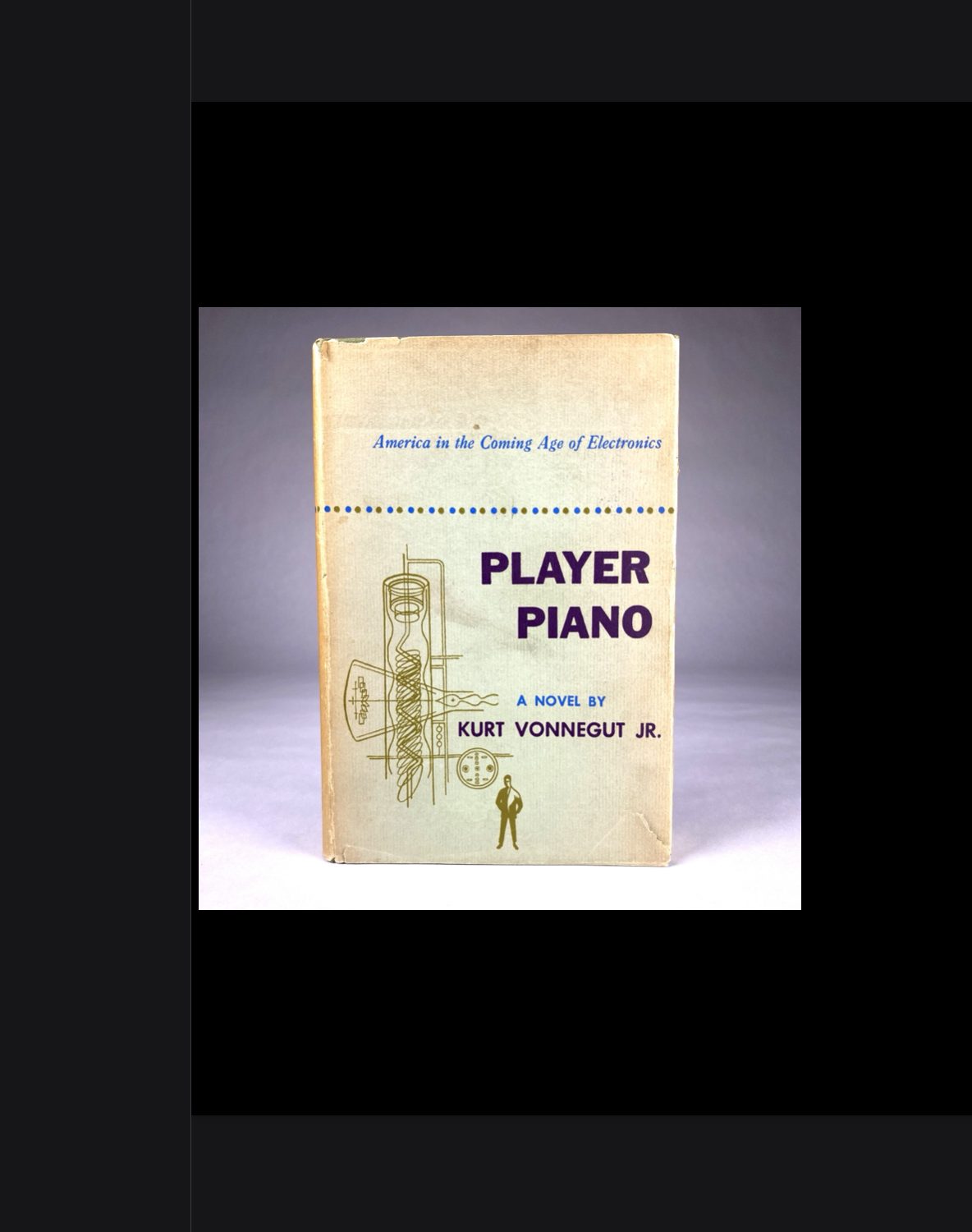
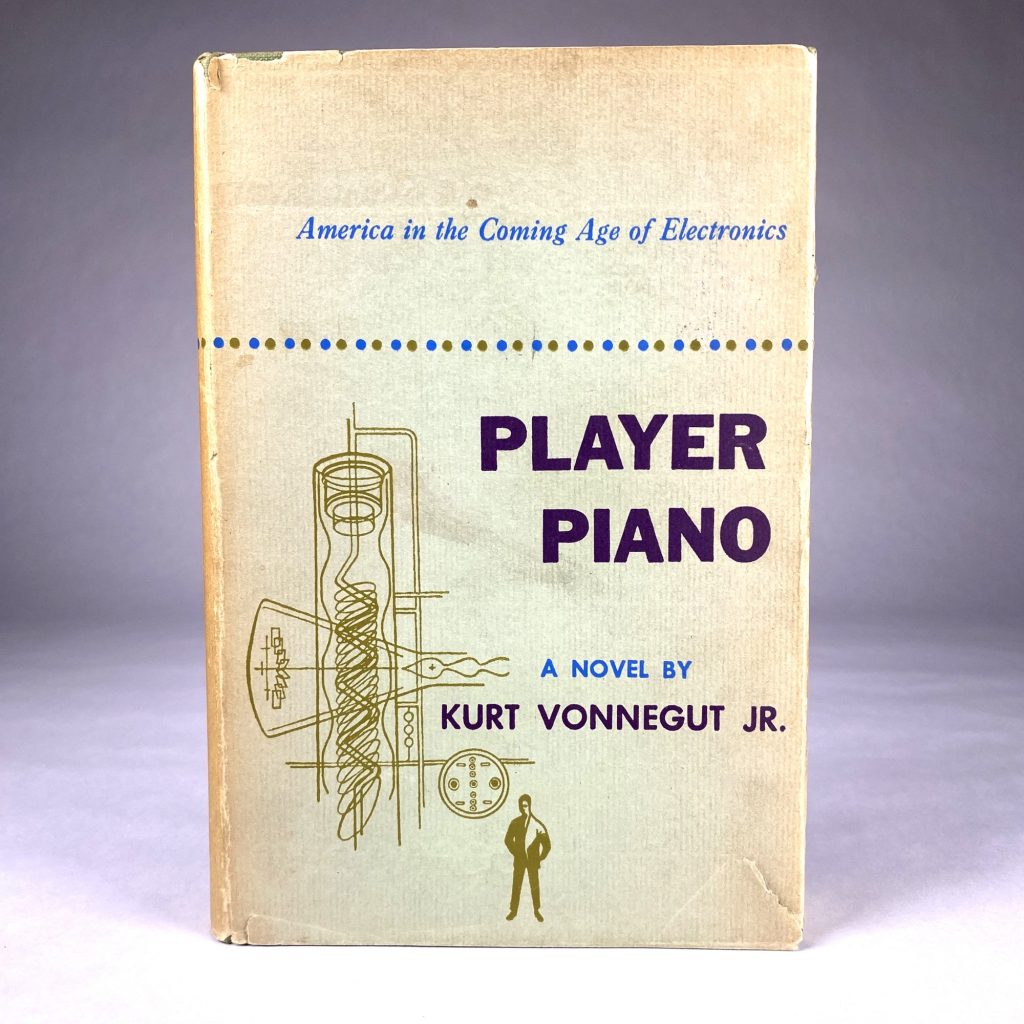
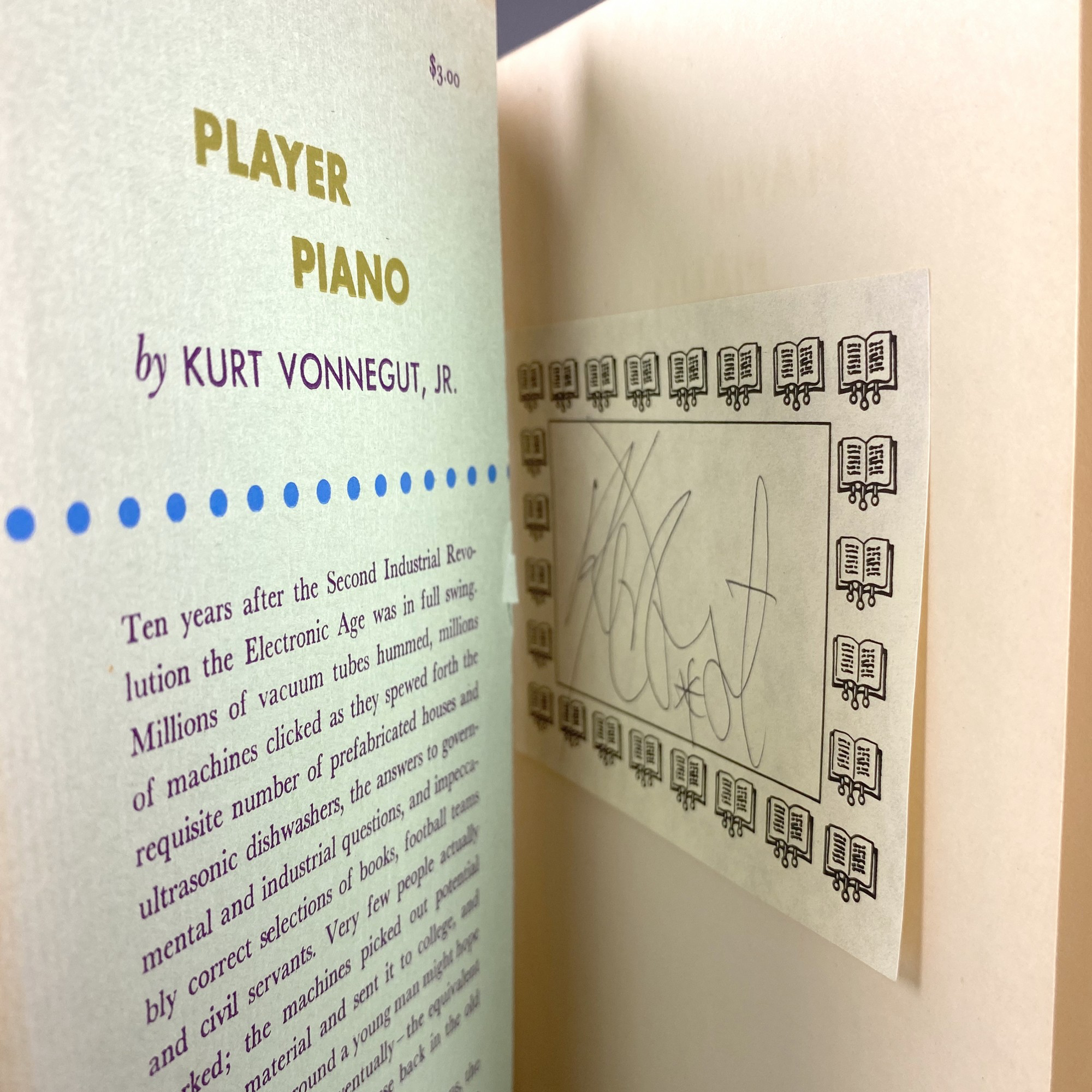
Now, in Part 3, To illuminate this path, we turn to timeless literature that has long anticipated these crossroads. In this installment, we spotlight Kurt Vonnegut’s debut novel, Player Piano (1952.) {https://amzn.to/4pqcJuM}, a prescient dystopian tale that mirrors our impending reality with uncanny precision. Drawing from Vonnegut’s own experiences in the early days of industrial automation, the book serves as a cautionary blueprint for the next 5000 days—roughly 13.7 years, propelling us into the late 2030s. We’ll dissect its plot, themes, and characters in depth, reflect on its eerie parallels to today’s AI surge, and examine how it has (or hasn’t) leaped from page to screen. Through this lens, we confront the existential upheavals ahead, urging a proactive navigation of a world where work’s end could either liberate or alienate us.
The Genesis of a Dystopian Vision: Vonnegut’s World of Machines
Kurt Vonnegut Jr., fresh from his service in World War II and a brief stint as a public relations writer for General Electric (GE), channeled his observations of nascent automation into Player Piano. Published in 1952, amid the postwar economic boom and the dawn of the computer age, the novel was inspired by Vonnegut’s time at GE’s Schenectady plant. There, he witnessed the advent of computer-controlled machines, such as those using punched cards to operate milling equipment for jet engines. This technology, rudimentary by today’s standards, foreshadowed the AI-driven robotics that I highlight in my original piece: systems capable of not just replicating but surpassing human labor.
Set in a fictionalized Ilium, New York (modeled after Schenectady), the story unfolds in a post-World War III America where automation has triumphed. The war’s demands accelerated technological advancements, leading to a society where machines handle nearly all production. This creates a stark bifurcation: on one side of the river lies the industrialized enclave of managers and engineers, who oversee the automated empire; on the other, Homestead, a drab suburb housing the displaced masses—former workers rendered obsolete, subsisting on government stipends in uniform, soul-crushing apartments.
At the heart of the narrative is Dr. Paul Proteus, a brilliant 35-year-old engineer and manager at the Ilium Works. Paul is the archetype of the privileged elite: intelligent, well-compensated, and initially complicit in the system. His life unravels when his old friend, Ed Finnerty, an eccentric engineer from Washington, D.C., quits his high-status job in disgust and returns to Ilium. Together, they cross the river to Homestead, where they encounter Reverend Lasher, an Episcopal minister with a master’s in anthropology. Lasher, a sharp critic of the mechanized order, leads the underground “Ghost Shirt Society,” named after the Native American Ghost Dance movement—a symbol of resistance against cultural erasure.
Paul’s internal conflict deepens as he grapples with the system’s inhumanity. He purchases a rundown farm, dreaming of a simpler life with his wife, Anita, who embodies the allure of status. Anita, a former secretary who married Paul for his position, scorns the Homestead “Reeks and Wrecks” (a derogatory term for the unemployed) and pushes him toward a promotion in Pittsburgh. At a corporate retreat on “The Meadows”, a lavish island getaway for executives, Paul is coerced into spying on the Ghost Shirts. Instead, he’s kidnapped by the rebels, thrust into the role of their figurehead, and ultimately captured during a raid.
The novel’s climax arrives with Paul’s public trial, broadcast nationwide, which ignites widespread riots. Homestead’s masses rise up, smashing factories in a cathartic frenzy, only for the military to quash the rebellion. In a poignant twist, the survivors—including Paul, Finnerty, and Lasher—surrender, but not before rebuilding a sabotaged machine, underscoring humanity’s ironic dependence on technology.
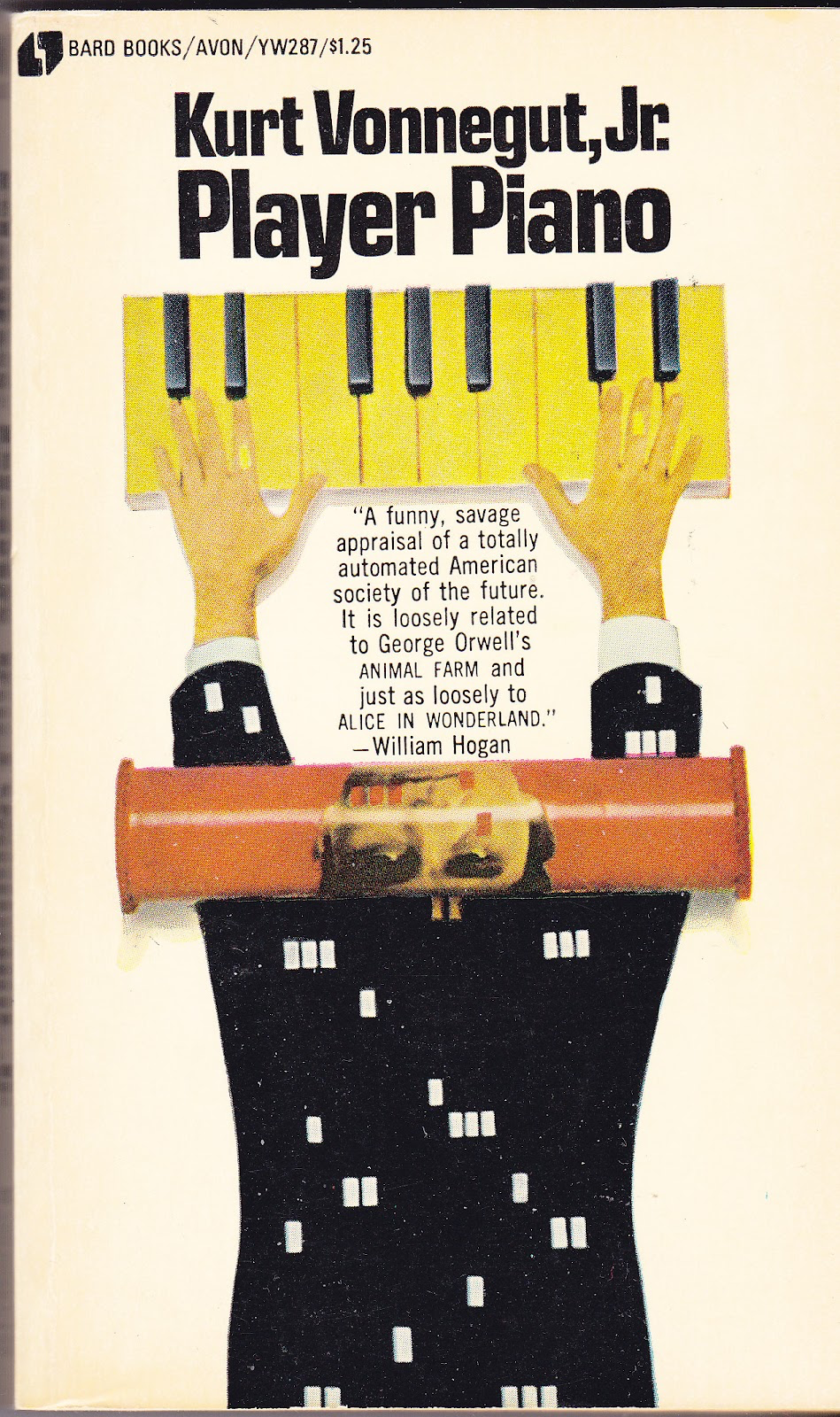
A secondary thread weaves in the Shah of Bratpuhr, a dignitary from an underdeveloped nation touring America. His outsider perspective highlights the absurdity of this “utopia”: he dubs average citizens “takaru,” or slaves, exposing the facade of progress. Vonnegut’s satire is biting, drawing from influences like Aldous Huxley’s Brave New World and Yevgeny Zamyatin’s We, while the title evokes the player piano—a self-playing instrument that renders human musicians redundant, much like the machines devouring jobs.
Critically, Player Piano was hailed in science fiction circles. Groff Conklin in Galaxy Science Fiction praised it as a “biting, vividly alive… anti-Utopia,” while Anthony Boucher and J. Francis McComas lauded its blend of psychological depth and satire. Nominated for the 1953 International Fantasy Award, it marked Vonnegut’s entry into literature, though he later distanced himself from its sci-fi label, viewing it as social commentary dismissed by mainstream critics.
Themes of Dehumanization: A Mirror to Our AI Horizon
Player Piano‘s core interrogation, “How to love people who have no use?” resonates profoundly in our era of generative AI and robotic automation. Vonnegut dissects a society where efficiency trumps empathy, creating rigid class divides: the elite, whose intellect sustains the machines, versus the masses, consigned to idleness and irrelevance. This echoes my forecast of “traditional jobs fade into optionality,” where AI could automate 80-90% of routine tasks by the 2030s, per various projections from think tanks like McKinsey and the World Economic Forum.
In the next 5000 days, as AI systems like advanced language models and robotic process automation proliferate, we risk amplifying these divides. Consider the “Ghost Shirt Society”: a metaphor for modern movements against tech dominance, from labor unions protesting AI in warehouses to ethicists warning of algorithmic bias. Paul’s journey from complacent cog to reluctant revolutionary mirrors the Hero’s Journey Roemmele invokes, a call to action for today’s knowledge workers. As jobs evaporate, will we, like Paul, seek meaning beyond productivity? Or, like Anita, cling to status symbols in a gig economy fractured by platforms like Uber and Upwork?
Vonnegut’s critique of blind faith in machines anticipates AI’s “black box” dilemmas. In Player Piano, computers classify citizens by IQ and aptitude, dictating life paths with cold precision much like today’s AI-driven hiring tools or predictive policing. By 2039, if unchecked, this could exacerbate inequality: a 2023 Brookings Institution report already notes AI widening wage gaps, with low-skill workers displaced while high-skill ones thrive. Reflections here urge preparation: universal basic income (UBI) trials, like those in Finland or proposed by Andrew Yang, could mitigate Homestead-like despair, fostering a society where abundance serves humanity, not vice versa.
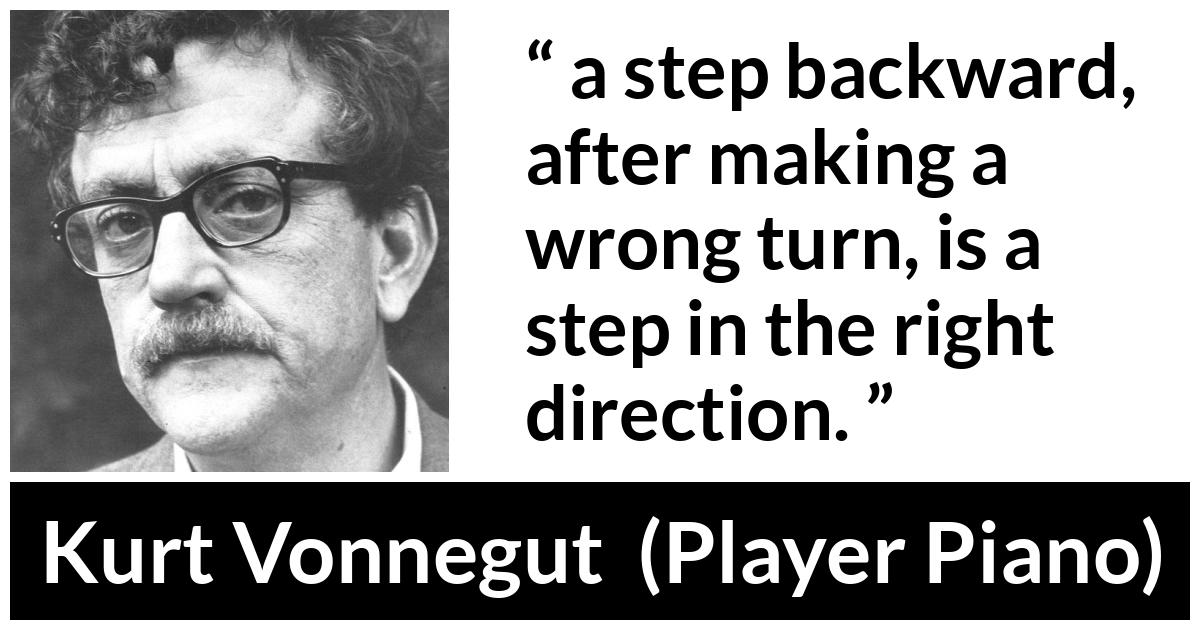
Moreover, the novel’s environmental undertones of factories polluting rivers, symbolizing tech’s hidden costs, parallel AI’s energy demands. Training models like GPT-4 consumes electricity equivalent to thousands of households, according to a 2024 study from the University of Washington. In our next 5000 days, balancing innovation with sustainability will be paramount, lest we inherit a world of “boundless abundance” poisoned by its own excess.
Vonnegut himself revisited the book’s timeliness in a 1983 interview, calling it “more relevant with each passing day.” Indeed, 2023-2025 analyses, including essays in The Atlantic and Wired, hail Player Piano as prophetic amid ChatGPT’s rise. It warns that without redefining value beyond labor, we court existential voids, depression rates among the unemployed already spike 20-30%, per WHO data. Yet, hope glimmers: the rebels’ final act of repair suggests humanity’s resilience, a nod to my optimism that this upheaval could birth creative pursuits, community bonds, and self-discovery.
From Page to Screen: The Elusive Adaptations of Player Piano
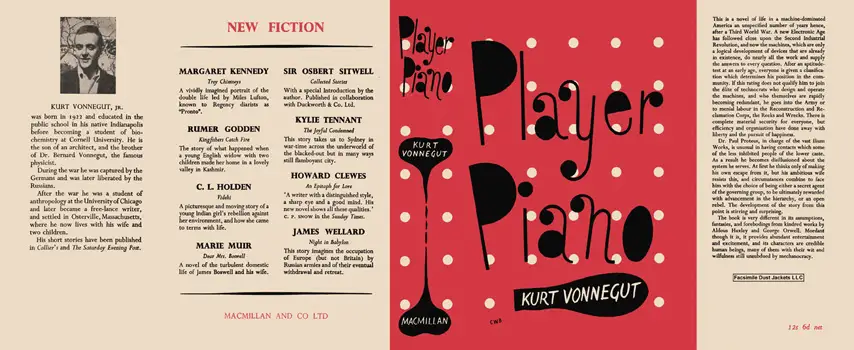
Despite its cinematic potential, a blend of satire, rebellion, and speculative tech, Player Piano has evaded full film adaptation. 4 A 1972 New York Times article teased a version starring Alan Arkin, with Vonnegut involved, but it never materialized. Elements surfaced in the 1972 TV movie Between Time and Timbuktu, a PBS special dramatizing Paul’s trial alongside bits from other Vonnegut works like Cat’s Cradle and “Harrison Bergeron.” Directed by Fred Barzyk, it starred William Hickey as the Shah and featured Vonnegut’s script contributions, but it’s more anthology than faithful retelling.
Reddit discussions lament this gap, with users in 2020 expressing surprise at the oversight, given adaptations of Vonnegut’s peers like Philip K. Dick. A 1995 made-for-TV film of “Harrison Bergeron” (from Vonnegut’s Welcome to the Monkey House) tackled similar egalitarian dystopias, but not Player Piano directly. 7 Recent homages include Francis Ford Coppola’s 2024 Megalopolis, which some fans compare thematically to Vonnegut’s societal critiques, though not a direct adaptation.
An independent production company, Player Piano Productions, takes its name from the novel and produced a 2020s film exploring technology’s societal costs, but it’s inspirational rather than adaptive. Audiobook fans can hear Christian Rummel’s 2009 narration, part of Audible’s Modern Vanguard series. In our AI era, a full adaptation could thrive. Imagine a Netflix series with Paul as a tech exec battling sentient algorithms—yet Hollywood’s hesitation underscores the book’s challenging themes: too subversive for blockbusters, too literary for sci-fi tropes.
Charting the Hero’s Journey: Reflections for the Next 5000 Days
As we hurtle toward 2039, Player Piano isn’t just fiction; it’s a roadmap. My 5000-day timeline aligns with projections from experts, who predict AI singularity by 2045, close enough to demand urgency. We must heed Vonnegut’s warnings: foster education in ethics and creativity, not just coding; redesign social safety nets for a post-work world; and cultivate communal rituals to replace job-derived identity.
Imagine a future where, like the Ghost Shirts, we reclaim agency through maker spaces, AI-assisted art, or global UBI. Or, perilously, one where divides harden, breeding unrest akin to the novel’s riots. The choice is ours: embrace the abundance as liberation, or let it echo the player piano’s hollow tune—music without soul.
In Part 4, we’ll explore more. Until then, reflect: In a world of machines, what melody will you play?

We are on this journey together. Some of us stand on the shoulders of giants and have thought about this for decades. We will not go it alone, and I hope to build many parts to this series and share the mastermind insight from the powerful Read Multiplex member Forum: https://readmultiplex.com/forums/topic/you-have-5000-days-how-to-navigate-the-end-of-work-as-we-know-it-part-1/. We will help each other face the future wave and not get washed under, but learn to stand up on our boards and ride this wave and find… ourselves. Join us.
To continue this vital work documenting, analyzing, and sharing these hard-won lessons before we launch humanity’s greatest leap: I need your support. Independent research like this relies entirely on readers who believe in preparing wisely for our multi-planetary future. If this has ignited your imagination about what is possible, please consider donating at buy me a Coffee or becoming a member.
Every contribution helps sustain deeper fieldwork, upcoming articles, and the broader mission of translating my work to practical applications. Ain ‘t no large AI company supporting me, but you are, even if you just read this far. For this, I thank you.
Stay aware and stay curious,

🔐 Start: Exclusive Member-Only Content.
Membership status:
🔐 End: Exclusive Member-Only Content.
~—~
~—~

~—~
Subscribe ($99) or donate by Bitcoin.
Copy address: bc1qkufy0r5nttm6urw9vnm08sxval0h0r3xlf4v4x
Send your receipt to [email protected] to confirm subscription.

Stay updated: Get an email when we post new articles:

THE ENTIRETY OF THIS SITE IS UNDER COPYRIGHT. IMPORTANT: Any reproduction, copying, or redistribution, in whole or in part, is prohibited without written permission from the publisher. Information contained herein is obtained from sources believed to be reliable, but its accuracy cannot be guaranteed. We are not financial advisors, nor do we give personalized financial advice. The opinions expressed herein are those of the publisher and are subject to change without notice. It may become outdated, and there is no obligation to update any such information. Recommendations should be made only after consulting with your advisor and only after reviewing the prospectus or financial statements of any company in question. You shouldn’t make any decision based solely on what you read here. Postings here are intended for informational purposes only. The information provided here is not intended to be a substitute for professional medical advice, diagnosis, or treatment. Always seek the advice of your physician or other qualified healthcare provider with any questions you may have regarding a medical condition. Information here does not endorse any specific tests, products, procedures, opinions, or other information that may be mentioned on this site. Reliance on any information provided, employees, others appearing on this site at the invitation of this site, or other visitors to this site is solely at your own risk.
Copyright Notice:
All content on this website, including text, images, graphics, and other media, is the property of Read Multiplex or its respective owners and is protected by international copyright laws. We make every effort to ensure that all content used on this website is either original or used with proper permission and attribution when available.
However, if you believe that any content on this website infringes upon your copyright, please contact us immediately using our 'Reach Out' link in the menu. We will promptly remove any infringing material upon verification of your claim. Please note that we are not responsible for any copyright infringement that may occur as a result of user-generated content or third-party links on this website. Thank you for respecting our intellectual property rights.
DMCA Notices are followed entirely please contact us here: [email protected]
