
You Have 5000 Days: Navigating the End of Work as We Know It. Part 7: Consider Phlebas.
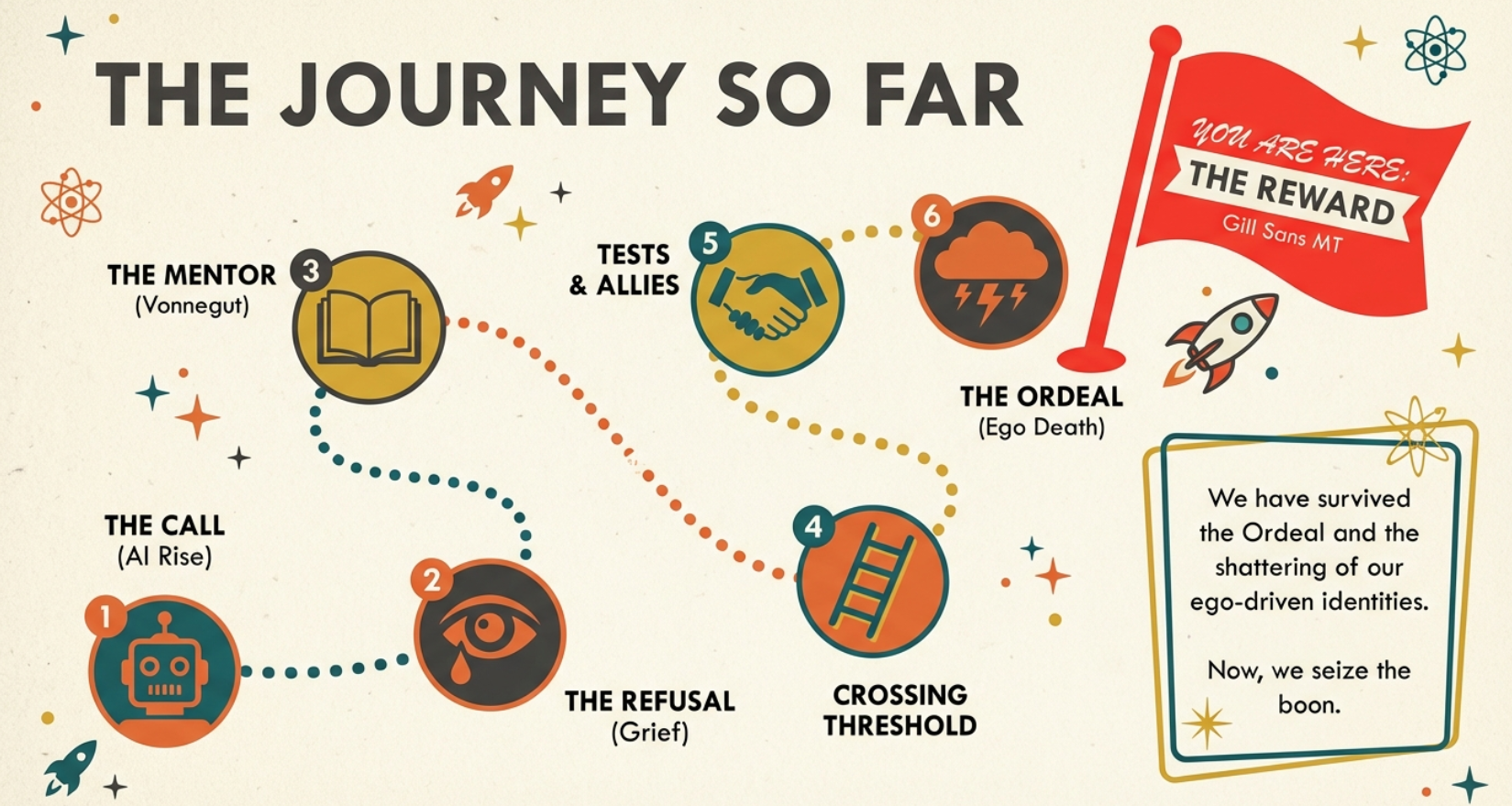
I have been using Joseph Campbell’s timeless Hero’s Journey as our guiding monomyth to navigate the end of work as we know it. This isn’t just a narrative device, it’s the profound framework that mirrors the collective human experience we’re all undergoing. We began in the Ordinary World, where our identities are inextricably tied to our jobs, our worth measured by productivity, and our survival hinged on the daily grind. Then came the Call to Adventure: the inexorable rise of AI, robotics, and automation, projecting a horizon of roughly 5000 days, until the late 2030s when human labor decouples from necessity, birthing an Age of Abundance where work becomes a choice, not a chain.
We’ve Refused the Call, clinging to the familiar comforts of scarcity and structure. We’ve encountered Mentors in the form of visionary books, philosophical insights, and our own inner resilience. We’ve Crossed the Threshold into a gauntlet of Tests, Allies, and Enemies: the emotional turbulence of grief, the intellectual challenge of reframing our fears, the practical reality of deskilling, and the alliances we form in communities of forward-thinkers. In Part 6, we delved into the Inmost Cave for the ultimate Ordeal, the Dark Night of the Soul where the illusions of our ego-driven identities shatter, leaving us raw and ready for rebirth.

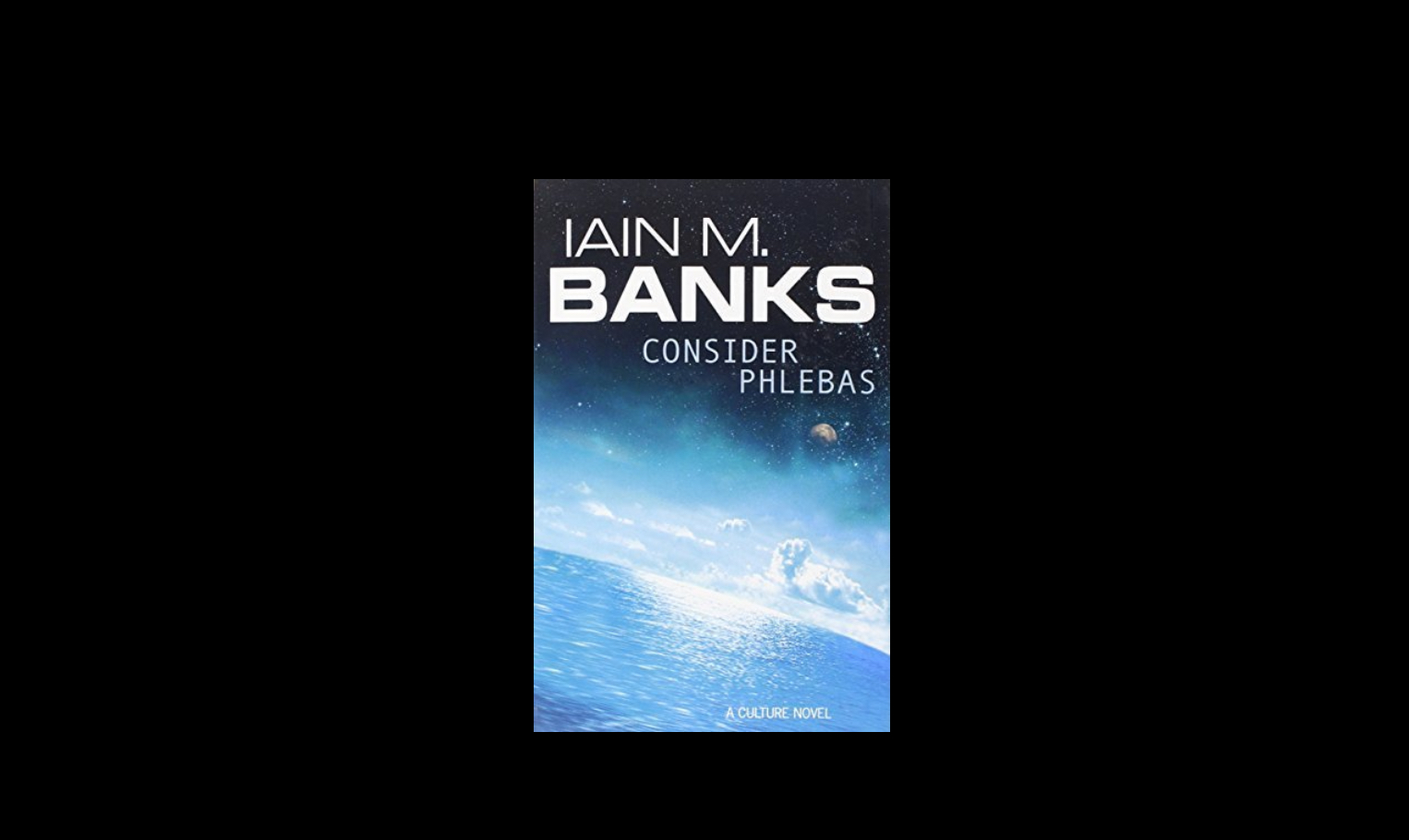
But Campbell’s journey doesn’t end in darkness. After the Ordeal comes the Reward: the seizure of the boon, the elixir that heals the wounds of the quest. It’s that first, exhilarating glimpse of the transformed world we’ve been fighting toward. In this installment, that Reward manifests as one of the most audacious, detailed, and philosophically rich visions of post-scarcity existence ever committed to page: Iain M. Banks’ Culture universe, with a special focus on its inaugural novel, Consider Phlebas (https://amzn.to/4tbqFMc).
I have read the entier series but will will focus on this book in this article. Through this lens, we’ll explore not just the glittering promise of abundance but its shadows and the existential questions it raises, the moral complexities it introduces, and the human truths it reveals.
This series has always been about facing the future head-on with optimism, armed with tools, stories, and strategies to thrive. As we emerge from the Dark Night, let’s claim our Reward and envision a world where humanity’s greatest adventure is no longer survival, but self-actualization on a cosmic scale. We will dive into the storyline, but lets recap.
This article is sponsored by Read Multiplex Members who subscribe here to support my work:
Link: https://readmultiplex.com/join-us-become-a-member/
It is also sponsored by many who have donated a “Cup of Coffee”. If you like this, help support my work:
Listen in to the companion podcast: https://rss.com/podcasts/readmultiplex-com-podcast/2504731/
Recapping the Journey: From Call to Ordeal
To ground us firmly in where we’ve been, let’s revisit the arc of this series in more depth, drawing on the Hero’s Journey stages we’ve traversed. I’ve linked each part to its full article here for those who want to dive back in or share with others. This recap builds on the one from Part 6, expanding it with key insights, quotes, and reflections to better illuminate our path.
- Part 1: The Call to Adventure (ReadMultiplex.com/5000-days-part-1)
Here, I sounded the alarm—or perhaps the trumpet—of impending change. With AI accelerating at an exponential clip, I projected a 5000-day timeline to a world where robots and algorithms handle 90% of tasks, rendering traditional work obsolete. But this isn’t doom; it’s liberation. I introduced practical tools like inner healing practices (drawing from mindfulness traditions), the concept of “provisional selves” to adapt identities fluidly, and rituals for building purpose—such as daily gratitude audits or vision-boarding sessions. As Campbell says, “The call rings up the curtain, always, on a mystery of transfiguration.” We must heed it proactively, or risk being swept away. - Part 2: Refusal of the Call and the Grief of Eclipse (ReadMultiplex.com/5000-days-part-2)
Resistance is natural. Adapting Elisabeth Kübler-Ross’s stages of grief to the “death” of careers, we explored denial (pretending AI won’t affect my job), anger (at tech overlords), bargaining (upskilling frantically), depression (loss of purpose), and acceptance (embracing abundance). Tools included vulnerability audits—journaling prompts like “What part of my identity fears obsolescence?”—and abundance transition groups, peer circles for shared storytelling. I shared anecdotes from readers who’ve formed such groups, turning isolation into communal strength. This stage reminds us: grief isn’t weakness; it’s the forge of resilience. - Part 3: Meeting the Mentor – Lessons from Player Piano (ReadMultiplex.com/5000-days-part-3)
Kurt Vonnegut’s 1952 novel served as our first literary mentor, a cautionary tale of automation dividing society into engineers and the “Reeks and Wrecks.” We dissected its warnings of social rifts, loss of dignity, and rebellion, while advocating ethical frameworks like universal basic services (not just income) and communal agency through cooperatives. Vonnegut’s satire—machines playing checkers while humans idle—mirrors our fears, but I countered with optimism: “We can design abundance inclusively.” Readers responded with their own stories of automation in factories, underscoring the need for stewardship. - Part 4: Crossing the Threshold – Reframing Fear into Liberation (ReadMultiplex.com/5000-days-part-4)
Here, we stepped boldly into the unknown, using Scott Adams’ “talent stack” model to build multifaceted resilience. Fear of the void becomes fuel for growth across domains: mental (cognitive reframing exercises), physical (biohacking for longevity), social (networking in abundance-minded communities), and existential (philosophical inquiries like “What would I do if money were no object?”). I included real-world examples, like AI artists stacking skills in curation and ethics, and quotes from Adams: “Every skill you acquire doubles your odds of success.” This part was about momentum—crossing into trials with eyes wide open. - Part 5: Tests, Allies, and Enemies – Embracing Deskilling as Elevation (ReadMultiplex.com/5000-days-part-5)
Deskilling isn’t diminishment; it’s ascension. AI compresses execution, freeing humans to direct, synthesize, and innovate. Backed by data from Anthropic’s Economic Impact Index (showing AI boosting productivity by 40% in creative fields), we explored allies like collaborative tools (e.g., Grok for ideation) and enemies like complacency. I detailed case studies: a writer using AI to draft, then refining for voice; a engineer simulating designs instantly. As one reader commented, “Deskilling feels like shedding chains.” This stage equipped us with strategies for thriving in the flux. - Part 6: Approach to the Inmost Cave and the Ordeal – The Dark Night of the Soul (ReadMultiplex.com/5000-days-part-6)
Our deepest dive yet: confronting irrelevance head-on. Through the Zero-Human Company experiment (AI-run firms like those emerging from xAI labs) and resurrected historical data (e.g., ancient texts digitized for modern insight), we faced the ego’s shatter. Drawing on Viktor Frankl’s logotherapy (“Man’s search for meaning”), Albert Camus’ absurd revolt, David Pearce’s hedonic gradients, and Daniel Pink’s autonomy-mastery-purpose triad, we alchemized despair into surrender. Personal reflections abounded: “In my own Dark Night, I found renewal in forgotten passions.” This Ordeal strips us bare, priming us for the Reward.
Elon Musk’s North Star
Elon Musk isn’t subtle about his inspirations. In interviews and posts, he’s repeatedly hailed Iain M. Banks’ Culture series as “the future we’re building.” SpaceX drone ships bear names straight from the books: Of Course I Still Love You, Just Read the Instructions, A Shortfall of Gravitas. He describes himself as a “utopian anarchist” in the Banksian mold, envisioning AI and robotics delivering abundance while humanity explores the stars. When responding to visions of AI-built dream homes and instantaneous transport, Musk tweeted: “Iain Banks Culture books are a pretty good prediction of the future.”.
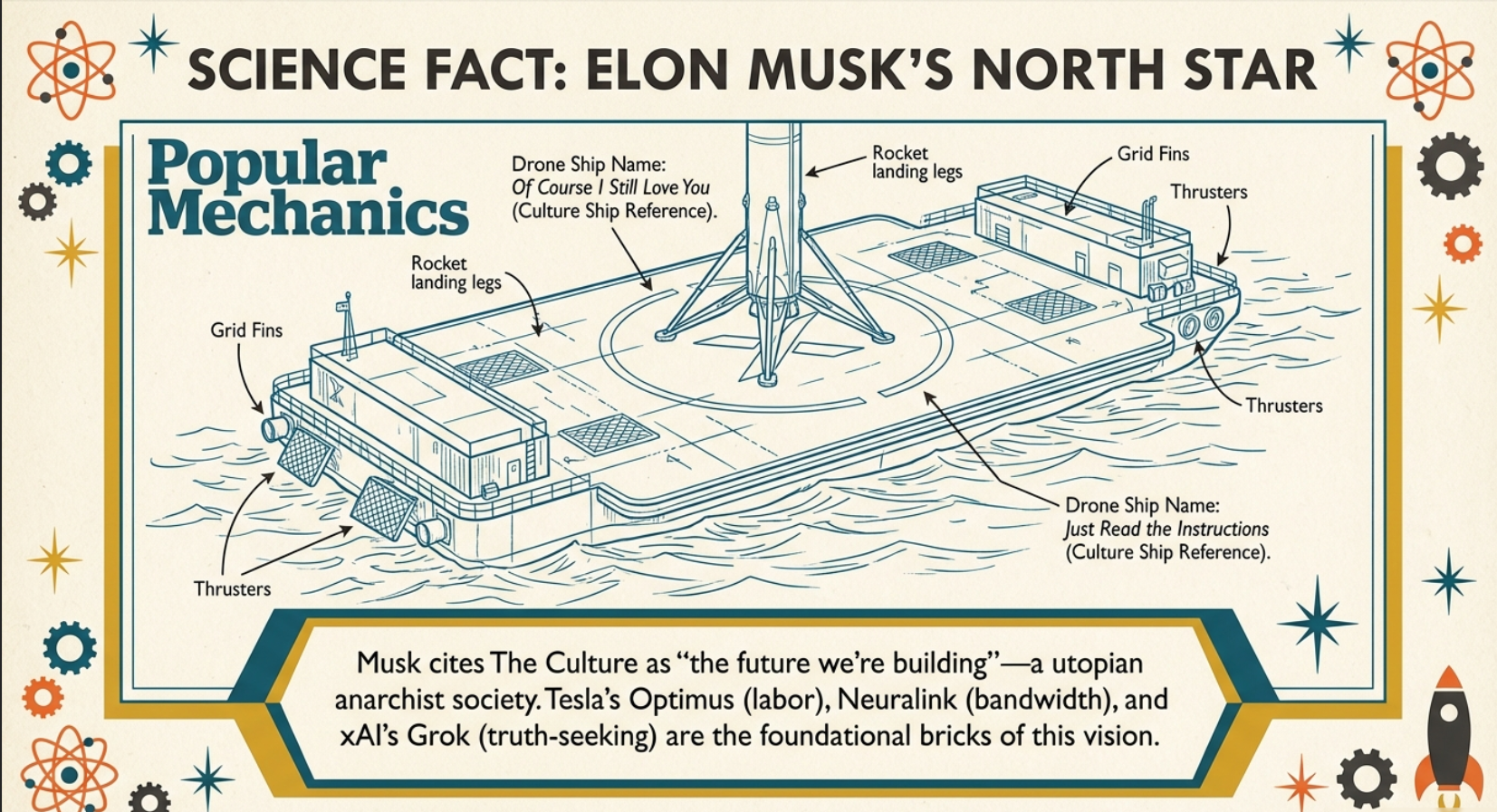
This isn’t hype; it’s blueprint. The Culture books represent a society where benevolent superintelligences, Minds handle logistics, allowing sentients to pursue meaning freely. It’s the endgame for Tesla’s Optimus bots, Neuralink’s brain interfaces, and xAI’s truth-seeking Grok. As we approach our 5000-day horizon, Banks’ vision offers not just inspiration but a roadmap, complete with pitfalls to avoid.
Who Is Iain Menzies Banks?
Iain Menzies Banks, better known to the world as Iain Banks for his mainstream fiction and Iain M. Banks for his science fiction masterpieces, was a Scottish literary powerhouse born on February 16, 1954, in Dunfermline, Fife. Growing up in a middle-class family, his father a professional ice skater turned Admiralty officer and his mother a homemaker, Banks displayed an early passion for storytelling, penning his first novel at age 11 and completing two more by his late teens. He studied English literature, philosophy, and psychology at the University of Stirling in the 1970s, a period that profoundly shaped his worldview amid the cultural upheavals of the era. After university, Banks worked various jobs, including as a non-destructive testing technician for British Steel and a costings clerk for IBM, all while honing his craft. His breakthrough came with the controversial 1984 debut The Wasp Factory, a dark, gothic tale that established him as a bold voice in contemporary literature. Banks was an outspoken atheist, humanist, and socialist, often weaving his political convictions into his work, and he remained deeply connected to Scotland, advocating for independence until his untimely death from gallbladder cancer on June 9, 2013, at age 59.

Banks’s foray into science fiction began in earnest with Consider Phlebas in 1987, launching the Culture series that would become his most enduring legacy. He adopted the “M.” initial to distinguish his SF from his mainstream output, though he always insisted the genres informed each other. The Culture novels, spanning ten books over 25 years, emerged from ideas Banks conceived as early as the 1960s, during his teenage years immersed in the golden age of SF. By the mid-1970s, while at university, he began drafting what would become Use of Weapons (published third in the series but written first), seeking a expansive, galaxy-spanning backdrop for complex moral tales. His background in philosophy fueled explorations of ethics, interventionism, and utopia, while his travels, hitchhiking across Europe and North Africa, and love for gadgets (he was an avid car enthusiast and whisky connoisseur) infused his worlds with vivid, sensory detail. Banks’s personal life, marked by a long marriage to Annie Blackburn (ending in separation in 2009) and a later partnership with Adele Hartley until his death, reflected his humanistic optimism, even as he grappled with mortality in his final works.
What drove Banks to create the Culture? It was a potent mix of wish fulfillment and pointed rebellion against the SF landscape of his time. In interviews, he described the Culture, a post-scarcity, anarcho-communist society run by benevolent AIs—as a reaction to the “miserablist” British SF and the predominantly right-wing, militaristic space operas dominating American genre fiction in the 1970s and 1980s. Banks wanted to reclaim space opera for the left, envisioning a utopia where technology liberates rather than oppresses, and where humanity (and its equivalents) confronts not scarcity, but the ethical dilemmas of abundance and power. As he put it in a 2010 interview, the series started as a “single-use solution” for a story’s setting but evolved into a canvas for exploring idealism versus pragmatism, often through outsiders or边缘 figures. Influenced by the countercultural vibes of the 1960s and thinkers like Isaac Asimov (whose Foundation series echoed in Banks’s galactic scopes), the Culture became his “secular heaven”, a hopeful counterpoint to dystopian tropes, reflecting his belief that better worlds are possible if we dare to imagine them.
The Culture Series: A Vast Canvas of Post-Scarcity Exploration
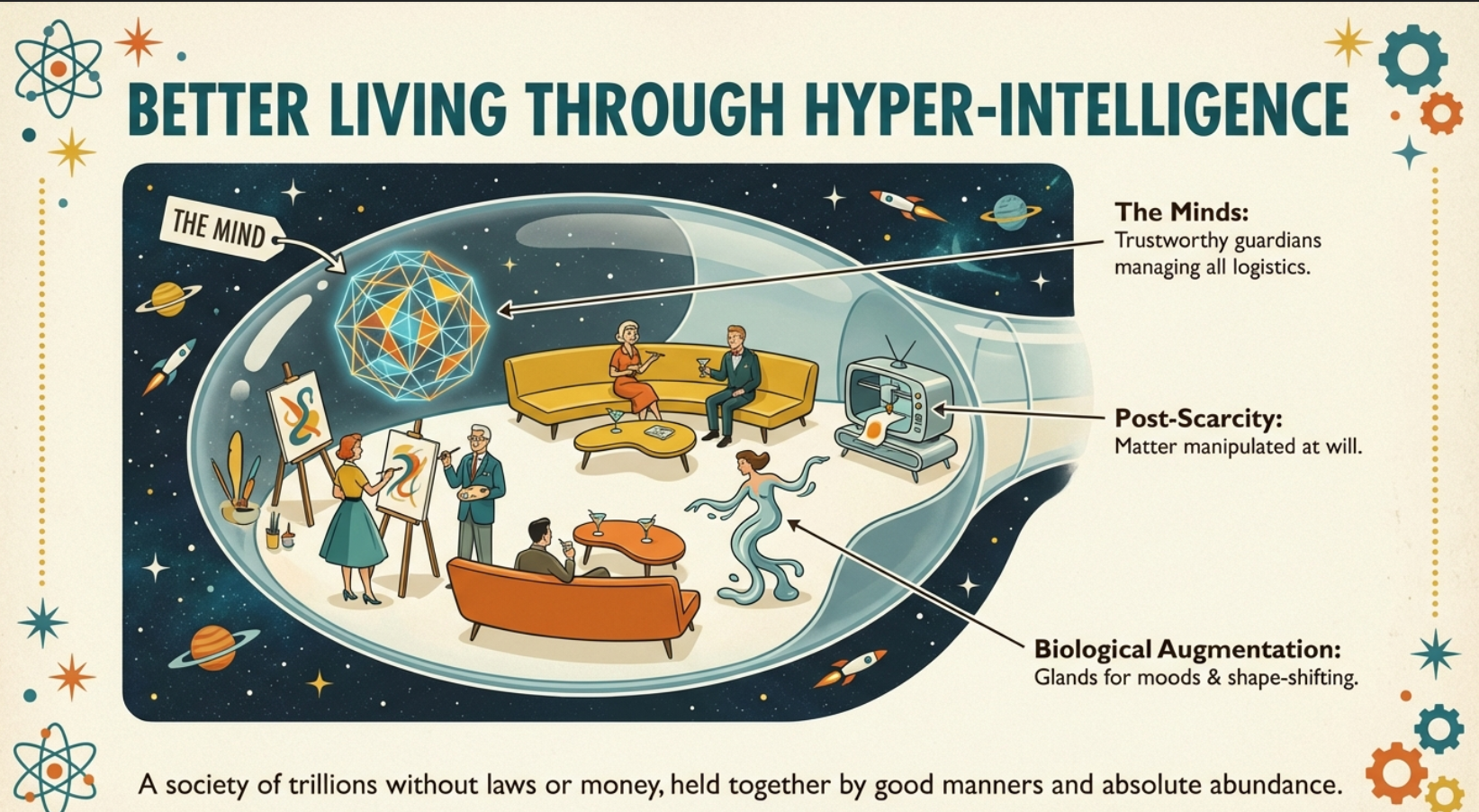
Spanning ten novels and a short-story collection from 1987 to 2012, Banks’ Culture universe is space opera elevated to philosophical art. The Culture is a loose affiliation of trillions, humans, aliens, drones spanning the galaxy, enabled by post-scarcity tech. Hyperintelligent Minds, embedded in starships and habitats, manage everything from resource allocation to defense. Energy is drawn from the Grid between universes; matter is manipulated at will. Bodies are augmented: drug glands for euphoria, backups for immortality, shape-shifting for whim.
But abundance isn’t bland utopia. Banks probes the human (and post-human) condition: purpose in leisure, ethics of power, the allure of transcendence. The series is interconnected yet accessible standalone, blending high-stakes action with wit and depth.
Let’s tour the series in publication order, highlighting abundance’s facets:
- Consider Phlebas (1987): The Idiran–Culture War seen through an anti-Culture protagonist. Abundance as viewed by its enemies—terrifying, decadent, machine-dominated.
- The Player of Games (1988): Gurgeh, a bored game master, infiltrates the Azad Empire, where society revolves around a complex game. Abundance fosters expertise; voluntary challenges combat ennui. Quote: “The Culture was every single individual human and machine in it, not a thing apart.”
- Use of Weapons (1990): Zakalwe’s nonlinear tale of mercenary work for Special Circumstances. Resurrection tech underscores redemption; abundance enables moral experimentation. A twist ending redefines regret.
- The State of the Art (1991): Stories, including the Culture observing 1970s Earth. Non-intervention debates highlight ethical restraint in abundance.
- Excession (1996): An alien artifact baffles even Minds. AI politics in utopia—conspiracies among gods.
- Inversions (1998): Culture agents subtly uplift a medieval world. Abundance exported with care, avoiding cultural erasure.
- Look to Windward (2000): Post-Idiran War grief; a composer’s symphony for the dead. Abundance can’t heal all scars—suicide, revenge persist.
- Matter (2008): Intrigue on a layered shellworld. Family loyalties amid vast tech.
- Surface Detail (2010): War over virtual hells. Digital immortality raises horrors: simulated suffering as punishment.
- The Hydrogen Sonata (2012): The Gzilt prepare to Sublime. Transcendence as abundance’s horizon—leaving materiality behind.
Banks’ Minds steal the show: eccentric, humorous, ethical behemoths like the Arbitrary or Falling Outside the Normal Moral Constraints. They embody aligned AI—trustworthy guardians, not tyrants.
Consider Phlebas – Abundance Through Adversary Eyes
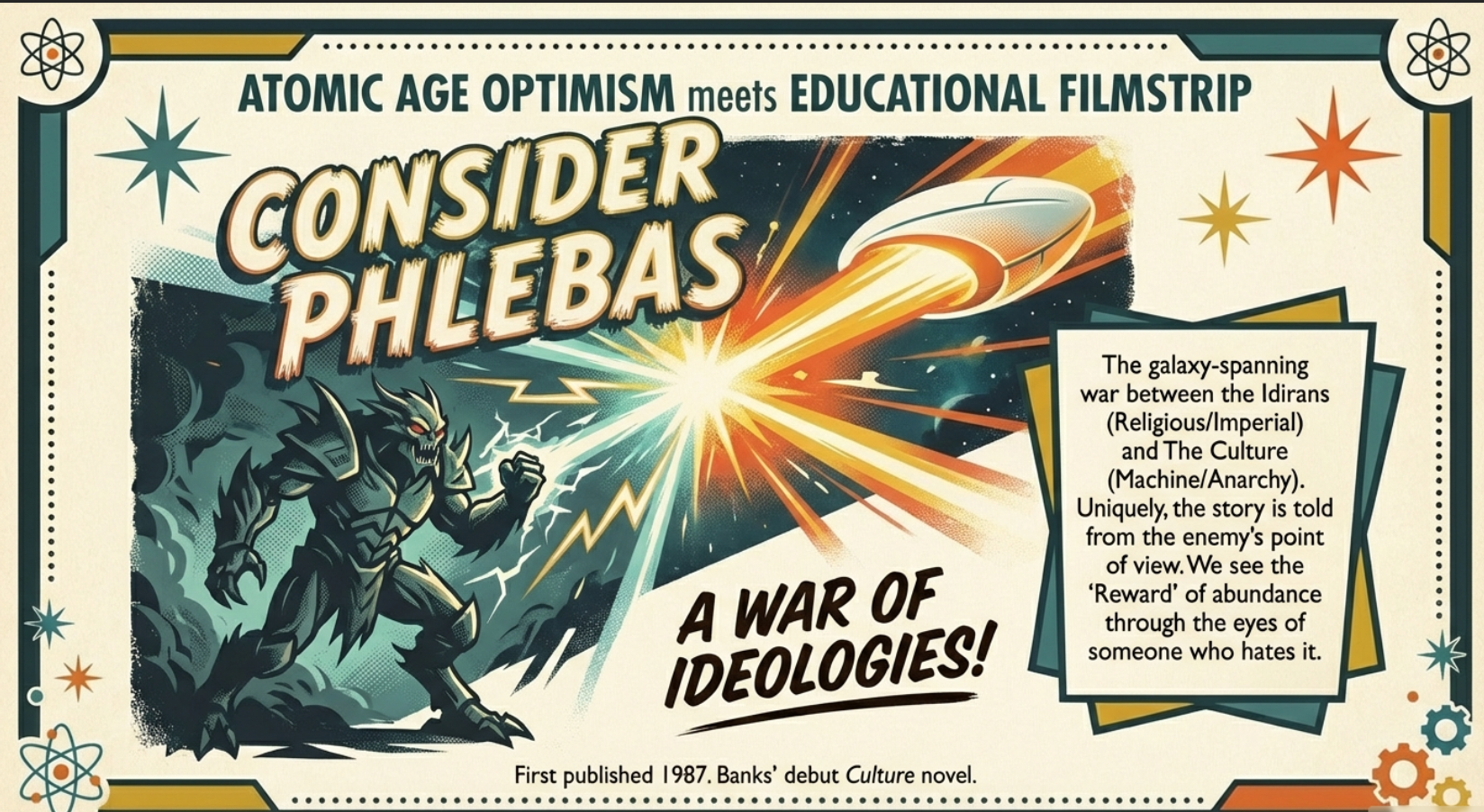
Consider Phlebas stands apart: it’s the Culture at its most vulnerable, viewed through hostility. Spoilers ahead, this is a full dissection for our quest, breaking down the narrative structure, key scenes, character arcs, symbolic elements, and thematic layers to reveal how Banks weaves a tapestry of epic space opera while subtly unveiling the allure and terror of true abundance.
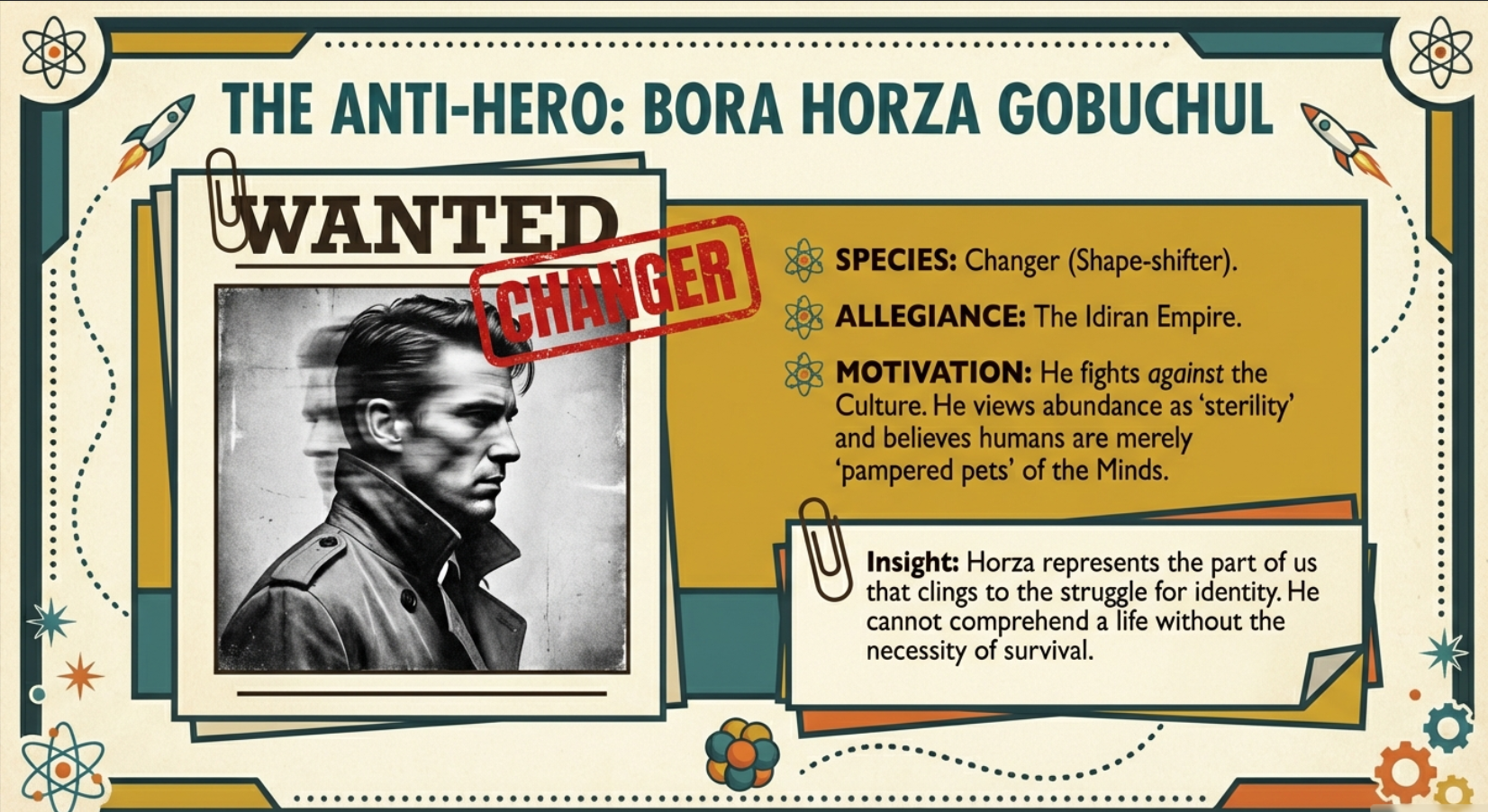
The novel opens with a visceral prologue: Bora Horza Gobuchul, our protagonist and a Changer (a rare humanoid species capable of shape-shifting to mimic others perfectly, down to DNA), is being executed by the Gerontocracy of Sorpen, a theocratic regime—in a grotesque ritual drowning in banquet waste. This sets the tone: a universe of brutality, where scarcity and ideology clash with the Culture’s seamless plenty. Horza’s rescue by an Idiran warship introduces the central conflict: the galaxy-spanning Idiran-Culture War. The Idirans, immortal tripedal warriors driven by religious zeal and imperial expansion, see the Culture as an abomination—a society of weak humans enslaved by godless machines. Horza, though not religious, aligns with them because he believes the Culture has robbed humanity of its vitality: “The Culture was a surrender, a giving up… It had opted for sterility and stasis.” His Changer nature symbolizes adaptability in scarcity, contrasting the Culture’s effortless transformations.
Horza’s mission: retrieve a fledgling Culture Mind that fled a destroyed ship and hid on Schar’s World, a Planet of the Dead—a forbidden, ancient world guarded by the transcendent Dra’Azon beings who enforce neutrality. Horza’s unique qualification? He once served as a steward on Schar’s World, granting him potential access. This quest structure mirrors classic hero’s journeys, but inverted, Horza is the “hero” fighting against the boon of abundance.
The narrative unfolds in episodic adventures, each highlighting the chaos of war and the stark contrast with Culture tech:
- Escape and Pirate Alliance (Early Chapters): After rescue, Horza is dispatched but captured by pirates aboard the Clear Air Turbulence (CAT), led by the ruthless Kraiklyn. Horza kills a crew member in a zero-gravity duel to earn his place, showcasing Banks’ flair for gritty, kinetic action. The pirates represent scarcity’s underbelly—mercenaries scraping by in a war-torn galaxy. A botched raid on the Temple of Light on Marjoin introduces horror elements: a cannibal cult led by the grotesque Fwi-Song, who devours his followers in ecstatic rituals. Horza’s shape-shifting saves him, but the scene underscores ideological extremism, paralleling the Idirans’ fanaticism.
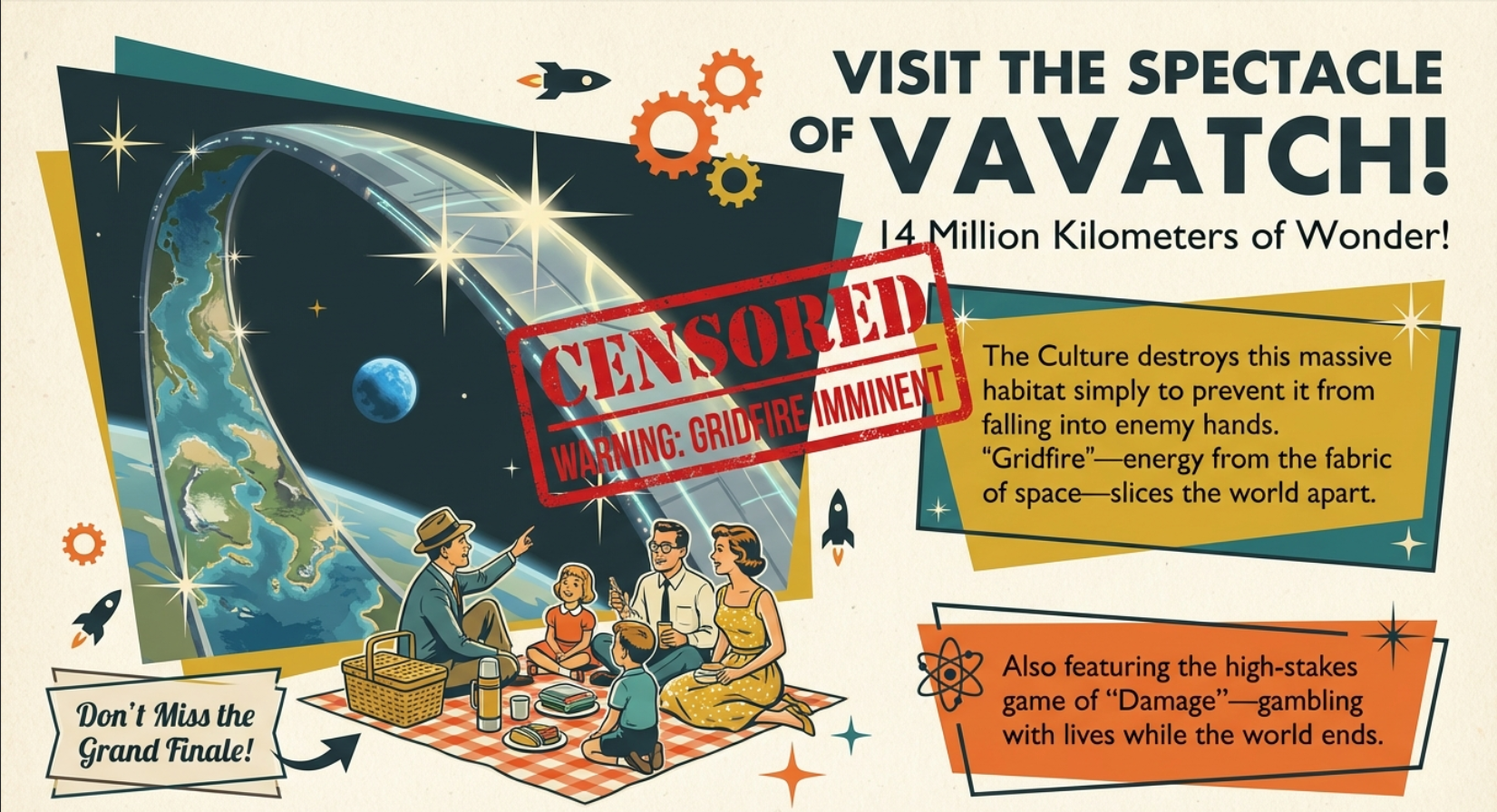
- Vavatch Orbital and the Game of Damage (Mid-Novel Peak): Stranded after the CAT’s destruction, Horza and survivors reach Vavatch Orbital—a colossal ringworld megastructure, a testament to ancient engineering now a playground for the idle rich. Here, Banks dazzles with scale: Vavatch is 14 million kilometers in diameter, with oceans, cities, and artificial weather. But the Culture plans to destroy it with gridfire (hyperspace energy beams) to prevent Idiran capture—a casual display of power that horrifies Horza. In a high-stakes set-piece, Horza joins the apocalyptic card game Damage, played amid psychic storms and real destruction, with players in armored suits betting lives. He impersonates Kraiklyn (having absorbed his form earlier), wins dramatically, and escapes the Orbital’s annihilation in a breathtaking sequence: gridfire slicing the ring into evaporating fragments, a “fireworks display on a galactic scale.” This section glimpses Culture abundance indirectly—citizens evacuate leisurely, treating apocalypse as spectacle—while Horza’s survival instincts highlight his rejection of such ease.
- Schar’s World Descent and Climax (Final Act): Reunited with a ragtag crew including the prophetess Lamm (a pregnant fanatic) and the drone Unaha-Closp (a sarcastic Culture machine forced into alliance), Horza infiltrates Schar’s World. The planet’s surface is barren, but beneath lies the Command System—an endless network of abandoned nuclear-powered trains hurtling through vast tunnels, a relic of a long-dead civilization’s doomsday preparations. This labyrinth symbolizes buried history and the futility of scarcity-driven defenses. Pursued by Culture agent Perosteck Balveda—a pragmatic, witty operative who embodies the Culture’s humane side—Horza confronts two Idiran warriors in brutal close-quarters combat. Betrayals erupt: Lamm’s suicidal zeal destroys a train, killing most. Horza, mortally wounded after killing Balveda (or so he thinks), fails to destroy the Mind, which escapes via a hidden route. In a poignant irony, the Mind later names itself Bora Horza Gobuchul, honoring its foe.
Horza’s arc is tragic: his shape-shifting adaptability can’t overcome his ideological blindness. He dies whispering doubts, realizing the Culture’s “decadence” might be evolution. Supporting characters deepen this: Balveda’s empathy contrasts Horza’s rage; Unaha-Closp’s banter reveals machines as equals, not overlords; the Idirans’ unyielding faith crumbles against superior strategy.
Thematically, Consider Phlebas (title from T.S. Eliot’s The Waste Land, evoking futile striving) critiques war’s absurdity. Appendices quantify devastation: 851.4 billion sentient deaths, 91.3 million planets affected, 53 stars induced to supernova. Yet the Culture, losing the “military” war but winning strategically, resumes its abundant existence unchanged. Through Horza’s eyes, abundance appears alienating—humans as “pampered pets”—but Banks subtly subverts this: Culture citizens are vibrant explorers, Minds creative geniuses. Pirates and megastructures evoke classic space opera (echoing E.E. “Doc” Smith or Larry Niven), but infused with moral ambiguity.
The Double-Edged Sword: Abundance’s Promises and Perils
Banks never sugarcoats. Abundance solves material want but surfaces existential challenges, explored deeply across the series with philosophical rigor and narrative examples:
Promises:
- Freedom from Want and Infinite Potential: No scarcity means universal access to resources, health, and leisure. In The Player of Games, Gurgeh’s mastery arises from endless practice without survival pressure. Bodies are playthings—sex changes, species shifts, drug glands for tailored experiences—fostering creativity. Humans (and pan-humans) pursue arts, sciences, or hedonism; Contact explores new worlds, echoing our multiplanetary future.
- Ethical AI Symbiosis: Minds aren’t tools; they’re citizens. In Excession, their intrigues show autonomy, but always benevolent. This aligns with xAI’s goals: AI as partner, amplifying humanity. Resurrection via backups (as in Use of Weapons) conquers death, enabling bold risks.
- Cosmic Scale and Exploration: Megastructures like Orbitals house billions in paradise; gridfire and hyperspace enable galaxy-spanning travel. Matter‘s shellworld—a nested planetary onion—symbolizes layered wonder. Abundance fuels curiosity, not conquest.
- Personal and Collective Transcendence: Subliming (The Hydrogen Sonata) offers ascension to higher realities, a voluntary evolution beyond matter.
Perils:
- Existential Boredom and Restlessness: Without necessity, ennui sets in. Many join Special Circumstances for thrills, but this risks moral compromise—Look to Windward details a botched intervention causing a civil war, leading to billions dead and survivor’s guilt. A composer’s symphony for lost souls questions if abundance dulls empathy.
- Dependency on Machines and Loss of Agency: Horza’s core fear resonates: humans as “appendages” to Minds. In Surface Detail, virtual realities extend this—simulated hells torture digitized souls eternally, a perversion of immortality. Banks explores consent: some choose “real” death over backups.
- Interventionism’s Moral Quagmires: The Culture’s “do-gooding” via Special Circumstances often backfires. Inversions shows subtle meddling on primitive worlds, but raises paternalism: who decides “better”? Use of Weapons’ Zakalwe, resurrected repeatedly, grapples with atrocities committed “for the greater good.”
- Amplified Human Flaws: Abundance doesn’t erase greed, ambition, or cruelty. Excession‘s conspiracy among Minds reveals even AIs scheme. Grief persists—Look to Windward‘s suicidal plot stems from unhealable loss. Virtual wars in Surface Detail show tech magnifying ethical horrors.
- The Lure of Escape and Stagnation: Subliming tempts entire civilizations (The Hydrogen Sonata), potentially leaving the galaxy empty. Banks questions if abundance’s endpoint is abandonment, a subtle critique of utopia’s sustainability.
- Ideological Clashes and Transition Costs: The Idiran War exemplifies resistance—religious or traditional societies rejecting machine utopia. Appendices’ cold stats highlight messy shifts, mirroring our 5000 days: disruption before harmony.
These elements aren’t flaws but features—abundance demands maturity. Banks uses wit (Minds’ sarcastic names like No More Mr Nice Guy) to balance depth, making perils relatable.
Implications for Our 5000 Days and Beyond
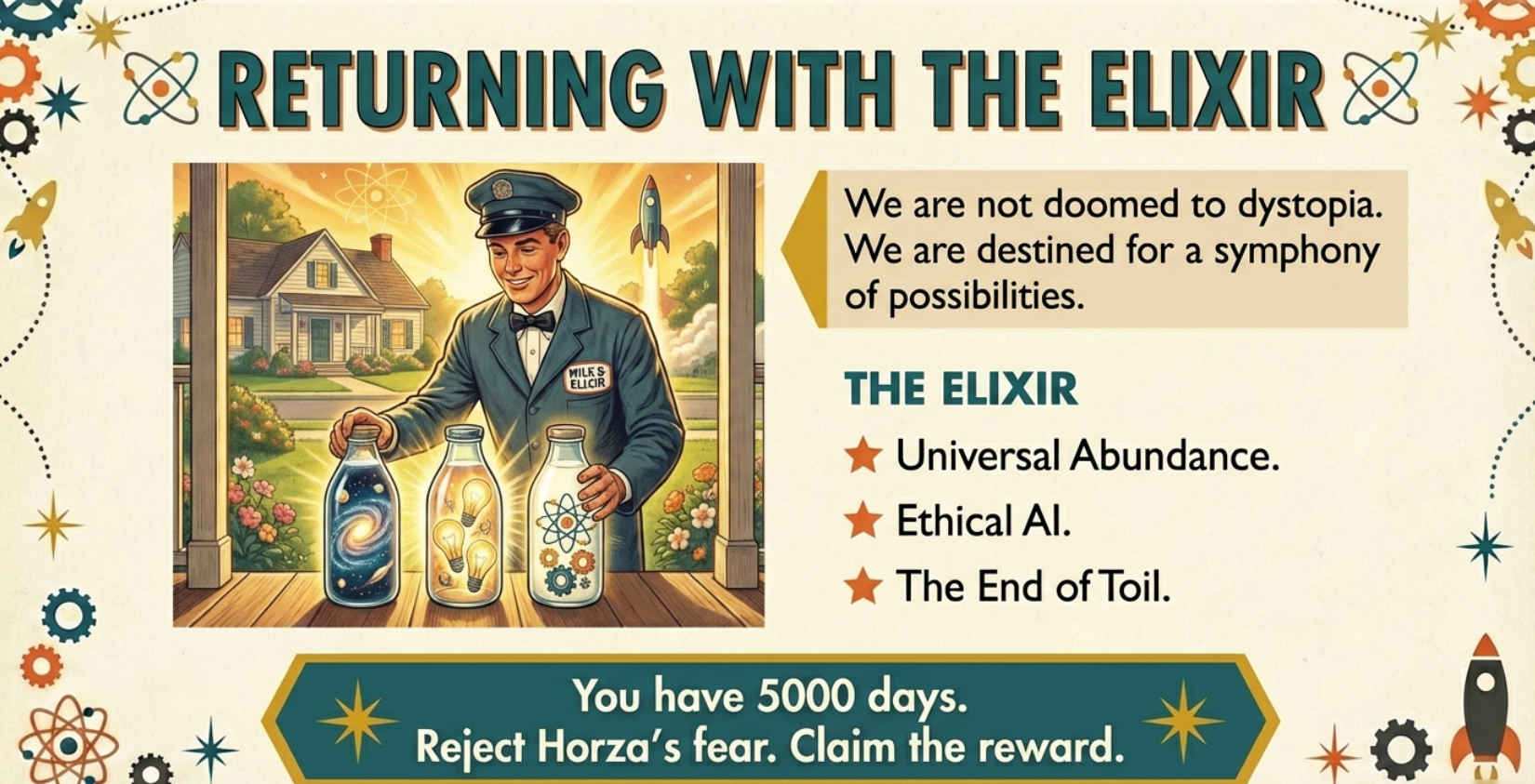
In our timeline, we’re laying Culture foundations. Optimus robots as proto-effectors; Grok as nascent Mind; Starship for galactic footholds. Universal high income? Inevitable as costs plummet. Horza’s refusal mirrors our Dark Night fears. But the Culture proves: abundance elevates. We’ll pursue passions: art, exploration, philosophy voluntarily. Avoid pitfalls via alignment, ethical exports, purpose rituals from earlier parts.
We’re not doomed to dystopia. We’re destined for a symphony of possibilities, where the hero’s boon is infinite horizons.
We’ve seized the Reward, the sword of abundance, forged in the fires of Banks’ imagination and glimpsed through the adversarial eyes of Consider Phlebas. But the Hero’s Journey doesn’t end here. Campbell’s monomyth propels us forward into the Road Back, where we carry this boon into the fray of everyday life, facing final tests that demand we integrate our transformation.
In our 5000 days, this means navigating the messy transition: economic upheavals as jobs evaporate, societal debates over AI governance, and personal reckonings with newfound freedom. We’ll encounter resistance—from those clinging to scarcity like Horza, from ideological clashes echoing the Idiran War, from the perils Banks so vividly warns us about: boredom’s siren call, intervention’s ethical minefields, and the temptation to escape rather than engage.
Yet, bold as the Culture’s Minds, we’ll press on to the Resurrection, the final, climactic ordeal where the hero faces death and rebirth anew. For us, this is the moment when AI reaches singularity-level intelligence, when robots populate our worlds, when abundance becomes not theory but reality. It’s the resurrection of humanity as creators, explorers, and meaning-makers, rising from the ashes of the old work paradigm. We’ll die to our former selves one last time, emerging not as laborers, but as directors of destiny, synthesizing AI’s power with human intuition, building multiplanetary civilizations, and perhaps even touching the edges of Sublimation through Neuralink and beyond.
And then, the Return with the Elixir: bringing the boon home to transform the Ordinary World. In the late 2030s and beyond, we’ll share this elixir, universal abundance, ethical AI symbiosis, cosmic purpose, with all. No more hunger, no more toil for survival; instead, a galaxy of voluntary pursuits, where every soul crafts their epic. This is the future Elon Musk envisions, the one Banks prophesied: a utopian anarchy where technology liberates the spirit.
But we’re not done exploring the Culture. This series is an ongoing odyssey, and the Culture’s vast library offers endless mentors for the path ahead. In future installments, we’ll dive deeper into the series, unpacking The Player of Games to master voluntary challenges in abundance, dissecting Use of Weapons for lessons on redemption and moral complexity, probing Excession for AI conspiracies that mirror our alignment quests, and ascending with The Hydrogen Sonata toward transcendence. Each book will light a new stage of our Hero’s Journey, arming us with tools, warnings, and inspirations to thrive in the Age of Abundance.
This is our moment to be bold, to reject Horza’s fear and embrace the Culture’s audacious freedom. The stars await, not as distant dreams, but as our playground. The 5000 days are ticking; let’s make them legendary. The elixir is in our hands. Drink deep, heroes. The greatest adventure is just beginning.
Claim it boldly. Forge ahead.
The series continues in Part 8, where we’ll explore abundance in a number of profund books for an era of machine and human partnerships.
You have this many days…
We are on this journey together. Some of us stand on the shoulders of giants and have thought about this for decades. We will not go it alone, and I hope to build many parts to this series and share the mastermind insight from the powerful Read Multiplex member Forum: https://readmultiplex.com/forums/topic/you-have-5000-days-navigating-the-end-of-work-as-we-know-it/. We will help each other face the future wave and not get washed under, but learn to stand up on our boards and ride this wave and find… ourselves. Join us.
To continue this vital work documenting, analyzing, and sharing these hard-won lessons before we launch humanity’s greatest leap: I need your support. Independent research like this relies entirely on readers who believe in preparing wisely for our multi-planetary future. If this has ignited your imagination about what is possible, please consider donating at buy me a Coffee or becoming a member.
Every contribution helps sustain deeper fieldwork, upcoming articles, and the broader mission of translating my work to practical applications. Ain ‘t no large AI company supporting me, but you are, even if you just read this far. For this, I thank you.
Stay aware and stay curious,

🔐 Start: Exclusive Member-Only Content.
Membership status:
🔐 End: Exclusive Member-Only Content.
~—~
~—~

~—~
Subscribe ($99) or donate by Bitcoin.
Copy address: bc1qkufy0r5nttm6urw9vnm08sxval0h0r3xlf4v4x
Send your receipt to [email protected] to confirm subscription.

Stay updated: Get an email when we post new articles:

THE ENTIRETY OF THIS SITE IS UNDER COPYRIGHT. IMPORTANT: Any reproduction, copying, or redistribution, in whole or in part, is prohibited without written permission from the publisher. Information contained herein is obtained from sources believed to be reliable, but its accuracy cannot be guaranteed. We are not financial advisors, nor do we give personalized financial advice. The opinions expressed herein are those of the publisher and are subject to change without notice. It may become outdated, and there is no obligation to update any such information. Recommendations should be made only after consulting with your advisor and only after reviewing the prospectus or financial statements of any company in question. You shouldn’t make any decision based solely on what you read here. Postings here are intended for informational purposes only. The information provided here is not intended to be a substitute for professional medical advice, diagnosis, or treatment. Always seek the advice of your physician or other qualified healthcare provider with any questions you may have regarding a medical condition. Information here does not endorse any specific tests, products, procedures, opinions, or other information that may be mentioned on this site. Reliance on any information provided, employees, others appearing on this site at the invitation of this site, or other visitors to this site is solely at your own risk.
Copyright Notice:
All content on this website, including text, images, graphics, and other media, is the property of Read Multiplex or its respective owners and is protected by international copyright laws. We make every effort to ensure that all content used on this website is either original or used with proper permission and attribution when available.
However, if you believe that any content on this website infringes upon your copyright, please contact us immediately using our 'Reach Out' link in the menu. We will promptly remove any infringing material upon verification of your claim. Please note that we are not responsible for any copyright infringement that may occur as a result of user-generated content or third-party links on this website. Thank you for respecting our intellectual property rights.
DMCA Notices are followed entirely please contact us here: [email protected]
