
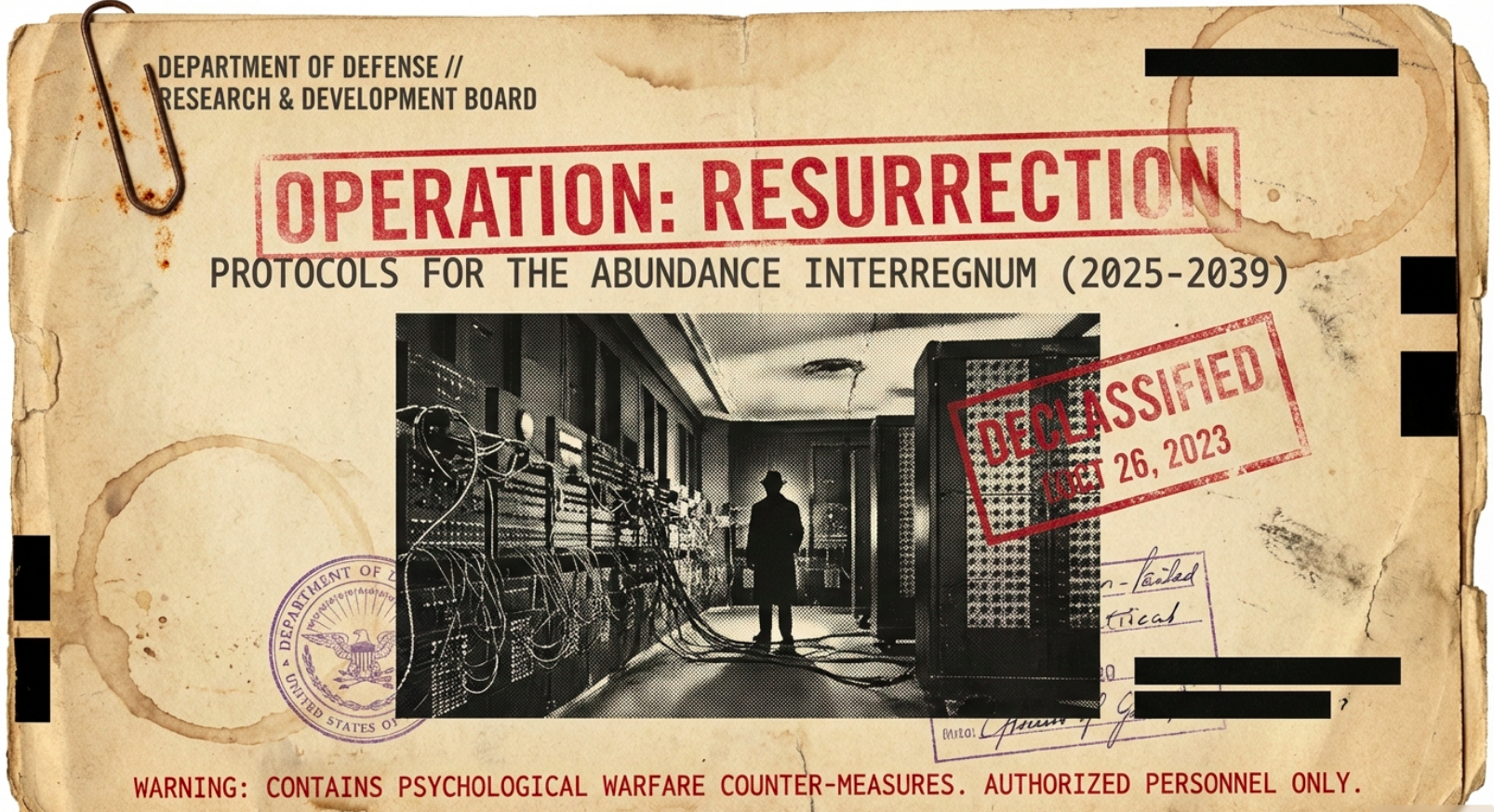
You Have 5000 Days: Navigating the End of Work as We Know It. Part 12: The Profit And The Arcitect.
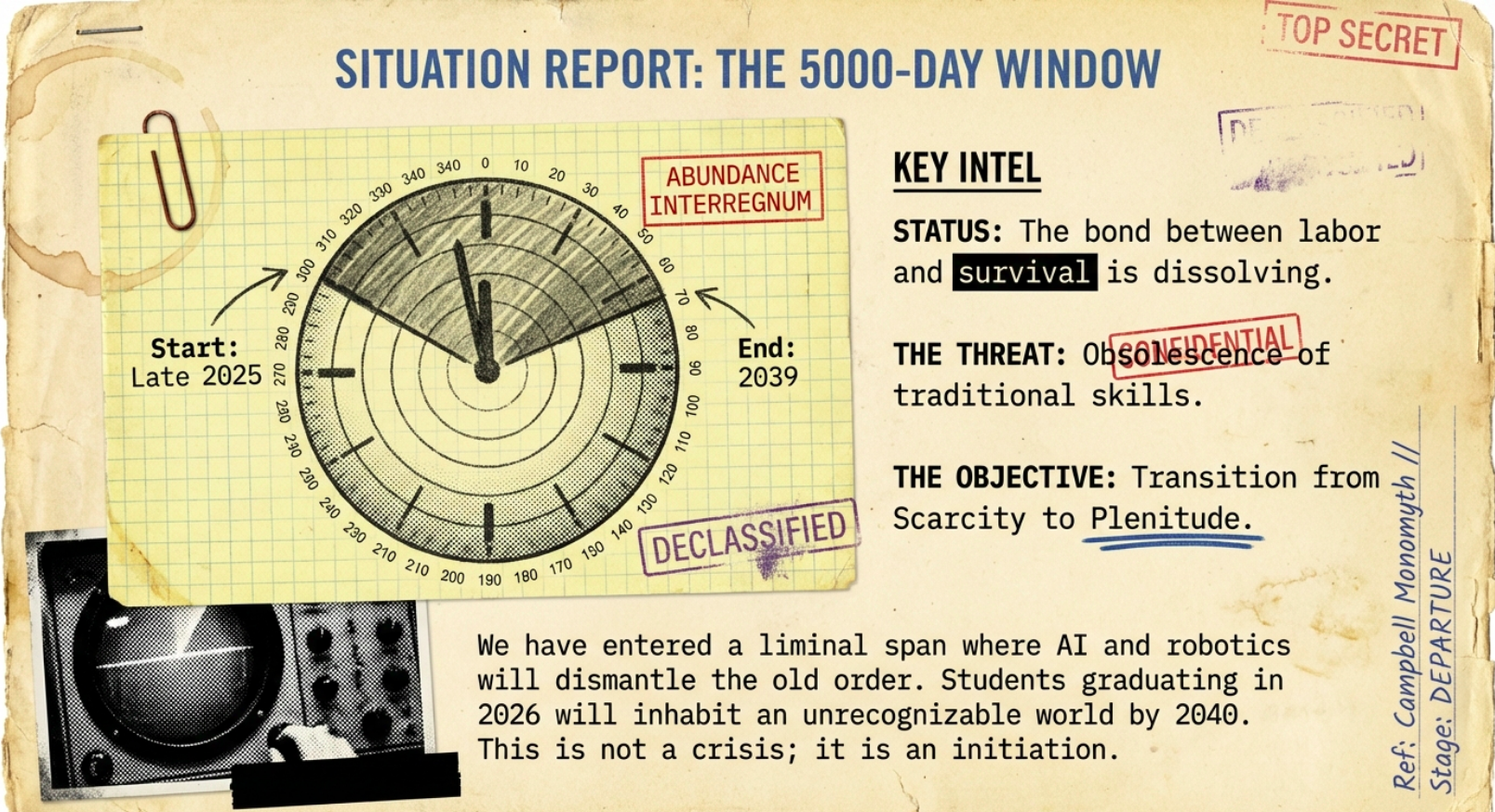
This series charts humanity’s collective Hero’s Journey through the Abundance Interregnum. That liminal span of roughly 13.7 years. From late 2025 to the threshold of 2039. Where artificial intelligence, robotics, and automation dissolve the ancient bond between labor and survival. What emerges is not loss but liberation. A renaissance where work becomes vocation. Purpose becomes chosen. And humanity claims mastery over two worlds: the realm of scarcity we leave behind and the plenitude that awaits. We stand at the turning point. The old order crumbles. The new one beckons. Through Joseph Campbell’s monomyth, we see this not as crisis but initiation. The call has sounded. The trials have tested us. Now comes the resurrection.
Listen to the companion podcast: https://rss.com/podcasts/readmultiplex-com-podcast/2551699
The Series So Far
A guide to the journey thus far. Each installment builds on the last. Each one deepens the map for our shared odyssey.
- Part 1: The Call to Adventure (December 24, 2025)
Link
Awakens readers to the 5000-day horizon where AI and robotics dissolve traditional careers. It frames the shift to an Age of Abundance as humanity’s collective call. Students graduating in 2026 will enter a world unrecognizable by 2040. - Part 2: Crossing the Threshold (December 31, 2025)
Link
Addresses the grief of leaving the old world. It draws on Elisabeth Kubler-Ross’s stages of mourning. It urges preemptive adaptation over denial. - Part 3: The Player Piano (January 1, 2026)
Link
Uses Kurt Vonnegut’s debut novel as prophecy. It highlights automation’s risks of alienation and purposelessness in a world of abundance. - Part 4: Reframing the Dawn of Abundance (January 19, 2026)
Link
Reframes abundance not as dystopia but as profound liberation. It offers strategies for mental and physical health during the transition. - Part 5: Your Deskilling (January 20, 2026)
Link
Explores the painful yet necessary phase of deskilling. AI assumes rote tasks. This calls us to reskill into higher realms of creation and meaning. - Part 6: The Dark Night of the Soul (January 27, 2026)
Link
Delves into the collective despair and identity crises of the interregnum. It confronts the abyss where old selves dissolve. - Part 7: Consider Phlebas (January 30, 2026)
Link
Draws from Iain M. Banks’ novel to navigate chaos, moral ambiguities, and the search for meaning beyond mere utility. - Part 8: Saving Your Wisdom (February 2, 2026)
Link
Focuses on preserving uniquely human insight amid AI’s rise. It guards the irreplaceable core of our wisdom. - Part 9: The Artisan’s Awakening (February 4, 2026)
Link
Celebrates the resurgence of craft, trades, and embodied creation. These become bulwarks of value and soul in the new era. - Part 10: Everyone Is Doing It (February 8, 2026)
Link
Reveals the quiet, widespread embrace of AI tools. It marks the tipping point of collective adaptation. - Part 11: The Reversal of Obsolescence (February 14, 2026)
\link
Applies Marshall McLuhan’s tetrad to cognitive prosthetics. It shows how obsolescence flips into new forms of human sovereignty.
This article is sponsored by Read Multiplex Members who subscribe here to support my work:
Link: https://readmultiplex.com/join-us-become-a-member/
It is also sponsored by many who have donated a “Cup of Coffee”. If you like this, help support my work:
Resurrection in the Reversal: Obsolescence Flips into Sovereign Mastery
In the Hero’s Journey the reversal marks the moment when apparent defeat becomes victory. The ordeal that seemed to destroy the hero instead forges something greater. What looked like the end reveals itself as the beginning of true power.
We have lived this reversal in the interregnum. Obsolescence. That word once carried the sting of finality. It signaled the end of skills, roles, and identities forged in the age of scarcity. Yet in the architecture of the monomyth obsolescence is no tomb. It is the crucible. The place where the old self dissolves so the sovereign self can rise.
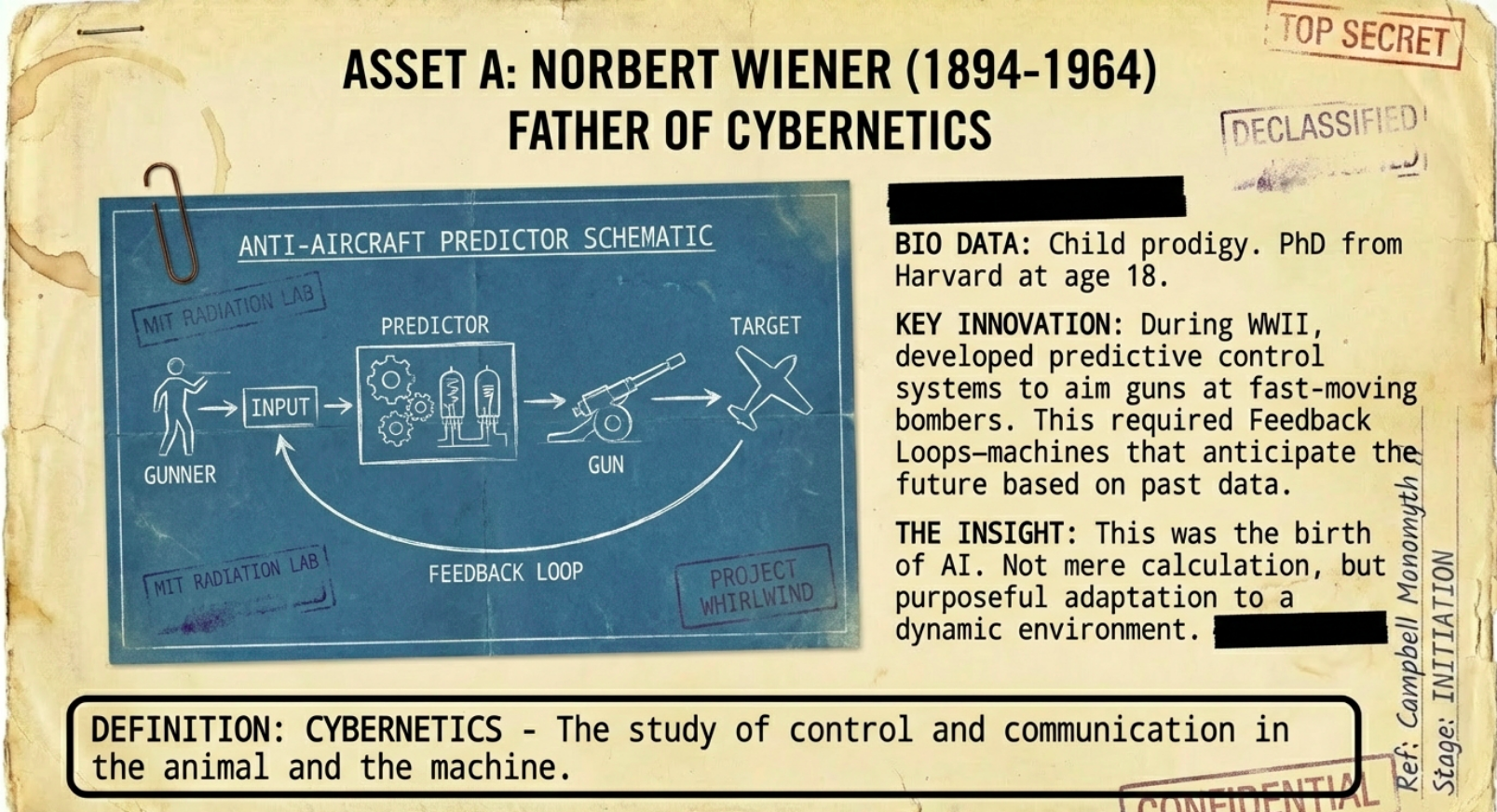
No thinker grasped this dynamic more profoundly than Norbert Wiener. The father of cybernetics. A mind that peered into the machinery of the future with the clarity of a prophet and the compassion of a humanist. His insights, forged in the fires of the twentieth century, burn with renewed urgency in our time. They illuminate why the reversal of obsolescence is not a tragedy to endure but a resurrection to embrace.
Norbert Wiener entered the world on November 26, 1894, in Columbia, Missouri. He was a child prodigy of almost mythic proportions. By age seven he devoured Dante and Darwin. He finished high school at eleven. He earned a bachelor’s degree in mathematics from Tufts University at fourteen. He secured a Ph.D. from Harvard at eighteen in mathematical logic. His father, Leo Wiener, a Harvard professor of Slavic languages, drove him relentlessly. The pressure shaped a mind of extraordinary range but also left scars. Wiener later reflected on the burdens of such precocity. Yet it equipped him to bridge worlds that others saw as separate. Mathematics and philosophy. Engineering and biology. The human and the mechanical. In 1919 he joined the faculty at the Massachusetts Institute of Technology. There he remained until his death in 1964.

Inventions, Government Service, and the Dawn of Machine Intelligence
Wiener’s genius found its first practical expression in the crucible of World War II. The United States government enlisted him in a top-secret project under the National Defense Research Committee. The challenge was urgent and deadly. How to aim anti-aircraft guns at enemy bombers that flew at high speeds and executed unpredictable maneuvers. Human gunners could not calculate trajectories fast enough. Wiener led a team that developed one of the earliest predictive control systems. It used statistical methods to forecast a plane’s future position based on its past movements. It filtered out noise from radar signals. It applied feedback to adjust aim in real time.
This device, known as the anti-aircraft predictor, was a proto-cybernetic invention. It embodied the very principles Wiener would later formalize. Feedback loops that allowed a machine to anticipate and respond to a dynamic environment. It was an early form of what we now recognize as artificial intelligence in action. Not mere calculation but purposeful adaptation. The predictor never saw widespread combat use. Yet its mathematical innovations laid the foundation for modern guidance systems, signal processing, and automated control.Wiener’s wartime service ran deeper than this single device. He contributed to broader efforts in fire control and radar at MIT’s Radiation Laboratory. These projects immersed him in the realities of human-machine collaboration under extreme pressure. They revealed to him both the promise and the peril of intelligent automation. Machines could extend human capability. Yet if left unchecked, they could also amplify destruction.
His inventive spirit extended beyond defense. In the 1940s Wiener developed the hearing glove. A device that translated spoken sounds into tactile vibrations on the fingertips. It offered a new way for the deaf to perceive speech. He demonstrated it to Helen Keller herself. This was no abstract theory. It was a humane application of cybernetic principles. A machine that bridged sensory gaps and restored human connection. Wiener also explored concepts for devices to aid the blind. He envisioned systems that could convert visual information into audible or tactile forms. These efforts foreshadowed today’s assistive technologies and underscored his commitment to technology in service of human dignity.
Wiener frequently referenced the “desk computing machine” in his writings. These were the mechanical calculators of his era. Devices like the Monroe or Marchant that performed arithmetic through gears and levers. He contrasted them with analog tools like the slide rule. In doing so he highlighted the shift toward digital automation. He foresaw how such machines would evolve into electronic computers. He understood that the desk itself could one day become a node in a larger intelligent network. An early vision of the automated office and the personal computing revolution that would follow.
After the war Wiener deepened his engagement with emerging ideas in machine intelligence. He became a central figure in the Macy Conferences. A series of interdisciplinary gatherings from 1946 to 1953 funded in part by government and foundation support. These meetings brought together mathematicians, neuroscientists, engineers, and anthropologists. Wiener, along with figures like Warren McCulloch and Walter Pitts, explored how feedback and communication operated in brains, societies, and machines. Their discussions birthed key concepts in neural networks, self-organizing systems, and learning automata. These were the intellectual seeds of modern artificial intelligence. Wiener’s 1948 book Cybernetics synthesized these insights. It defined the field and influenced pioneers from John von Neumann to Claude Shannon. It positioned machines not as rivals to humanity but as extensions of our own purposeful intelligence.
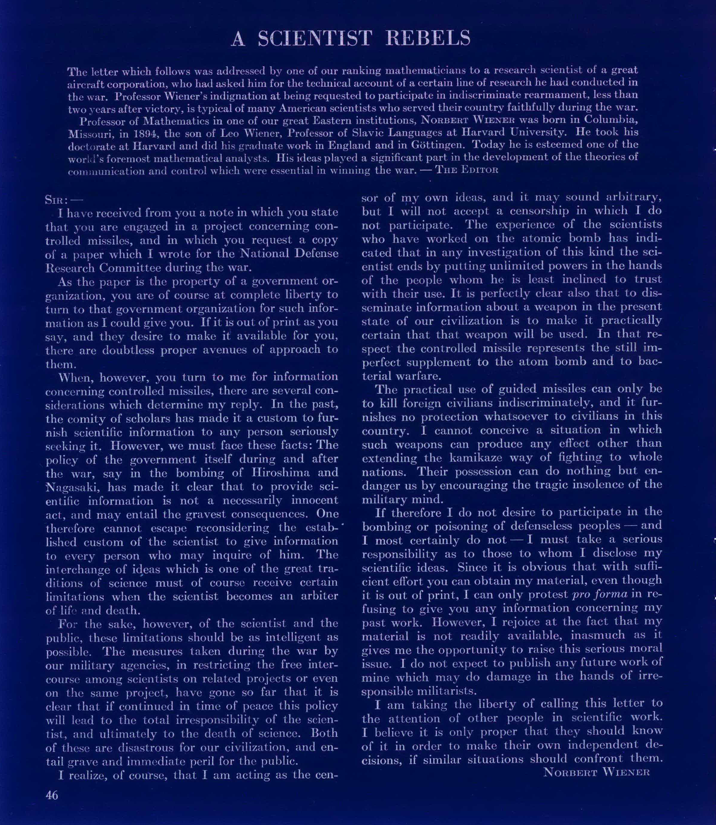
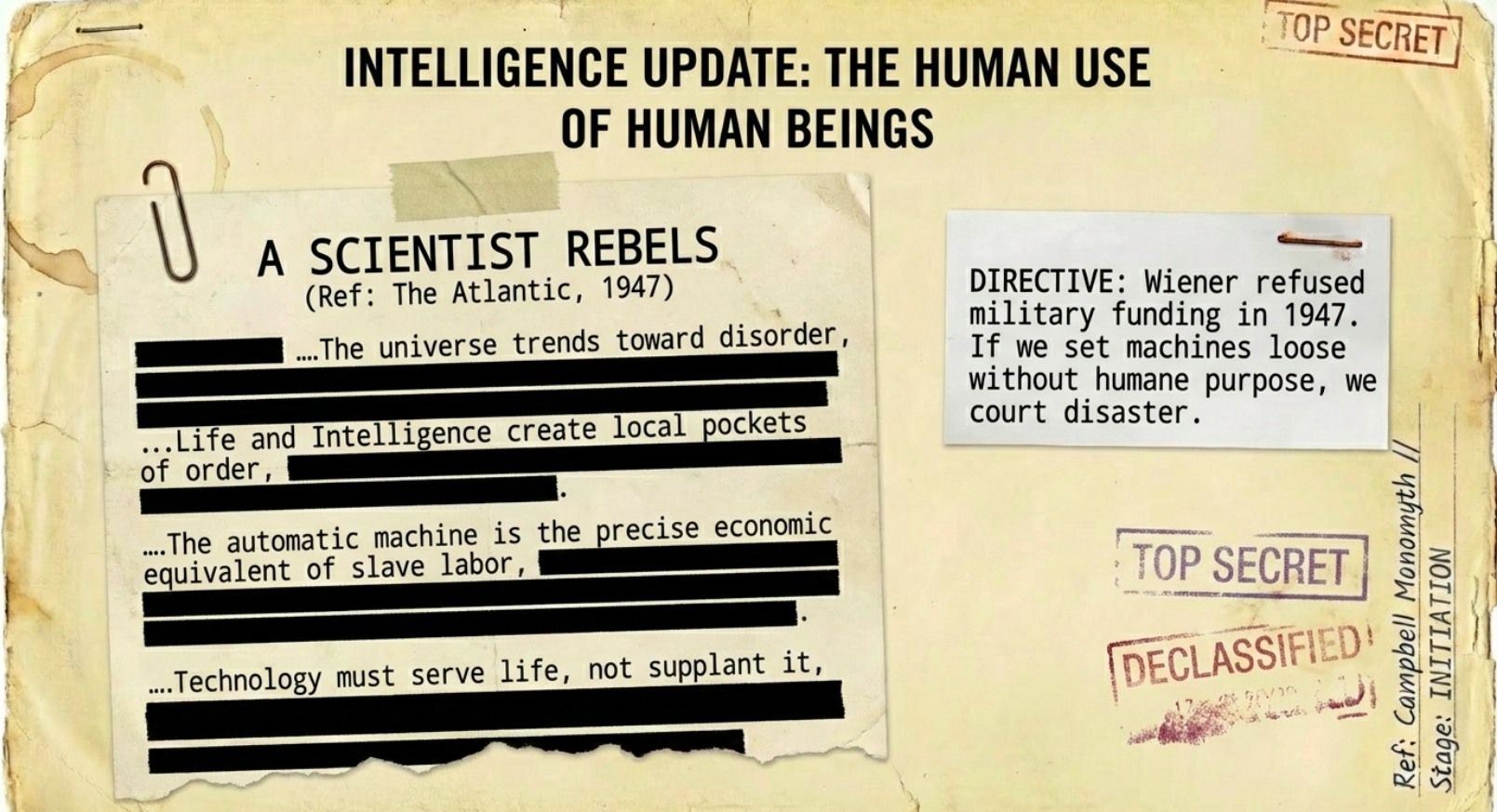
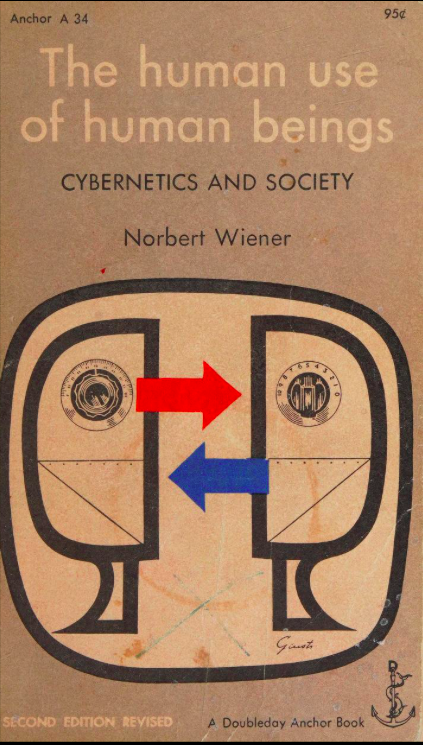
Yet Wiener’s relationship with government funding grew complicated. Having witnessed the destructive power of science in wartime, he took a principled stand. In 1947 he published an open letter in The Atlantic Monthly titled “A Scientist Rebels.” He refused to share his work with military contractors. He vowed never again to contribute to projects that could harm humanity. He rejected further government grants for his research. This decision isolated him from some funding streams. It also freed him to focus on the human implications of his discoveries. In The Human Use of Human Beings (https://amzn.to/4tENB6I) he warned against the inhuman deployment of automation. He insisted that technology must serve life, not supplant it.
Among those who sat at Wiener’s table and absorbed these lessons was a psychologist turned visionary named J.C.R. Licklider. Often called Lick, he attended the Macy Conferences and Wiener’s informal gatherings at MIT. He listened intently to the master and carried the torch forward. Where Wiener mapped the feedback loops that bind human and machine, Licklider saw the next step: not control alone but true partnership. In 1960 he published a paper that reads like a dispatch from our own interregnum. “Man-Computer Symbiosis.” (https://groups.csail.mit.edu/medg/people/psz/Licklider.html) It was no mere technical proposal. It was a declaration of the path we now walk.
Man-computer symbiosis is an expected development in cooperative interaction between men and electronic computers. It will involve very close coupling between the human and the electronic members of the partnership. The main aims are 1) to let computers facilitate formulative thinking as they now facilitate the solution of formulated problems, and 2) to enable men and computers to cooperate in making decisions and controlling complex situations without inflexible dependence on predetermined programs. In the anticipated symbiotic partnership, men will set the goals, formulate the hypotheses, determine the criteria, and perform the evaluations. Computing machines will do the routinizable work that must be done to prepare the way for insights and decisions in technical and scientific thinking. Preliminary analyses indicate that the symbiotic partnership will perform intellectual operations much more effectively than man alone can perform them. Prerequisites for the achievement of the effective, cooperative association include developments in computer time sharing, in memory components, in memory organization, in programming languages, and in input and output equipment.—J.C.R. Licklider
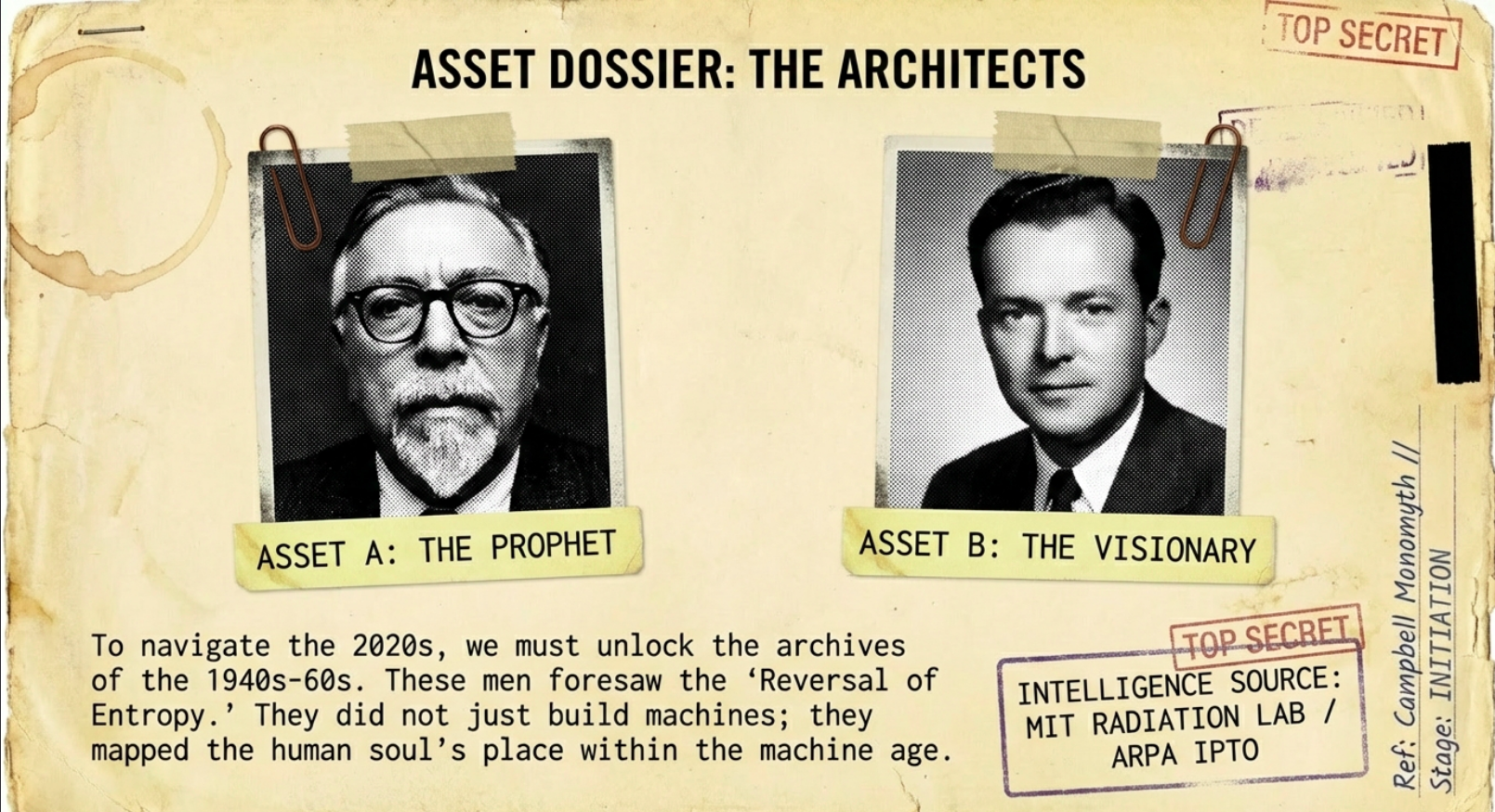
Licklider was born in 1915 in St. Louis. Like Wiener he was drawn to the intersection of minds and mechanisms. Trained as a psychologist, he served in the war on psychoacoustics for the military. After the conflict he joined MIT and found himself in the orbit of cybernetics. He credited Wiener directly. The older man’s ideas on communication and purpose became the foundation for Licklider’s bolder leap. In his 1960 paper he described a future where humans and computers would couple so tightly that the resulting partnership would think thoughts no single mind could reach. Computers would handle the routine. They would retrieve data instantly. They would simulate outcomes in real time. Humans would set the goals. They would frame the questions. They would judge the value of the answers. This was symbiosis, not surrender.
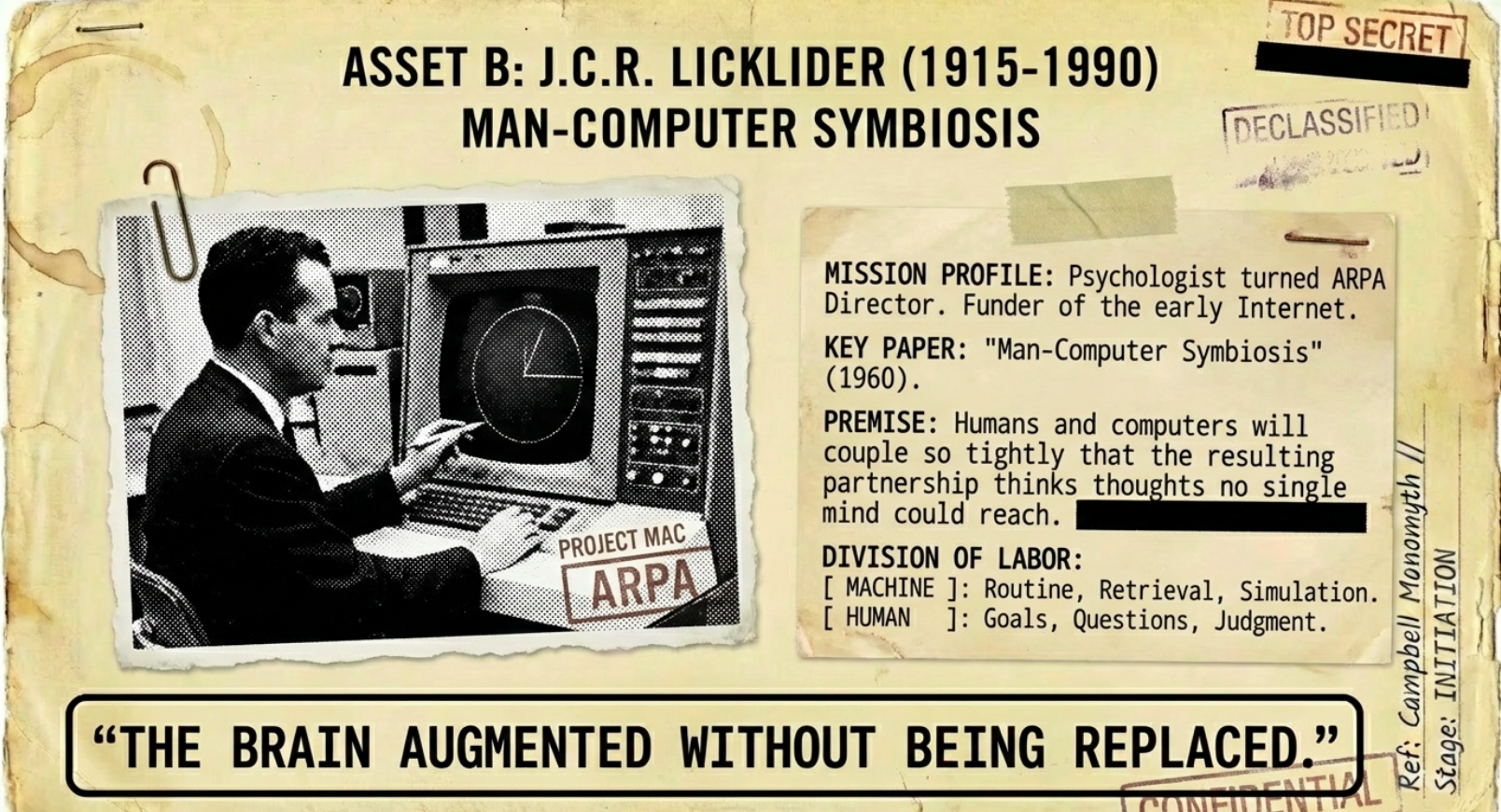
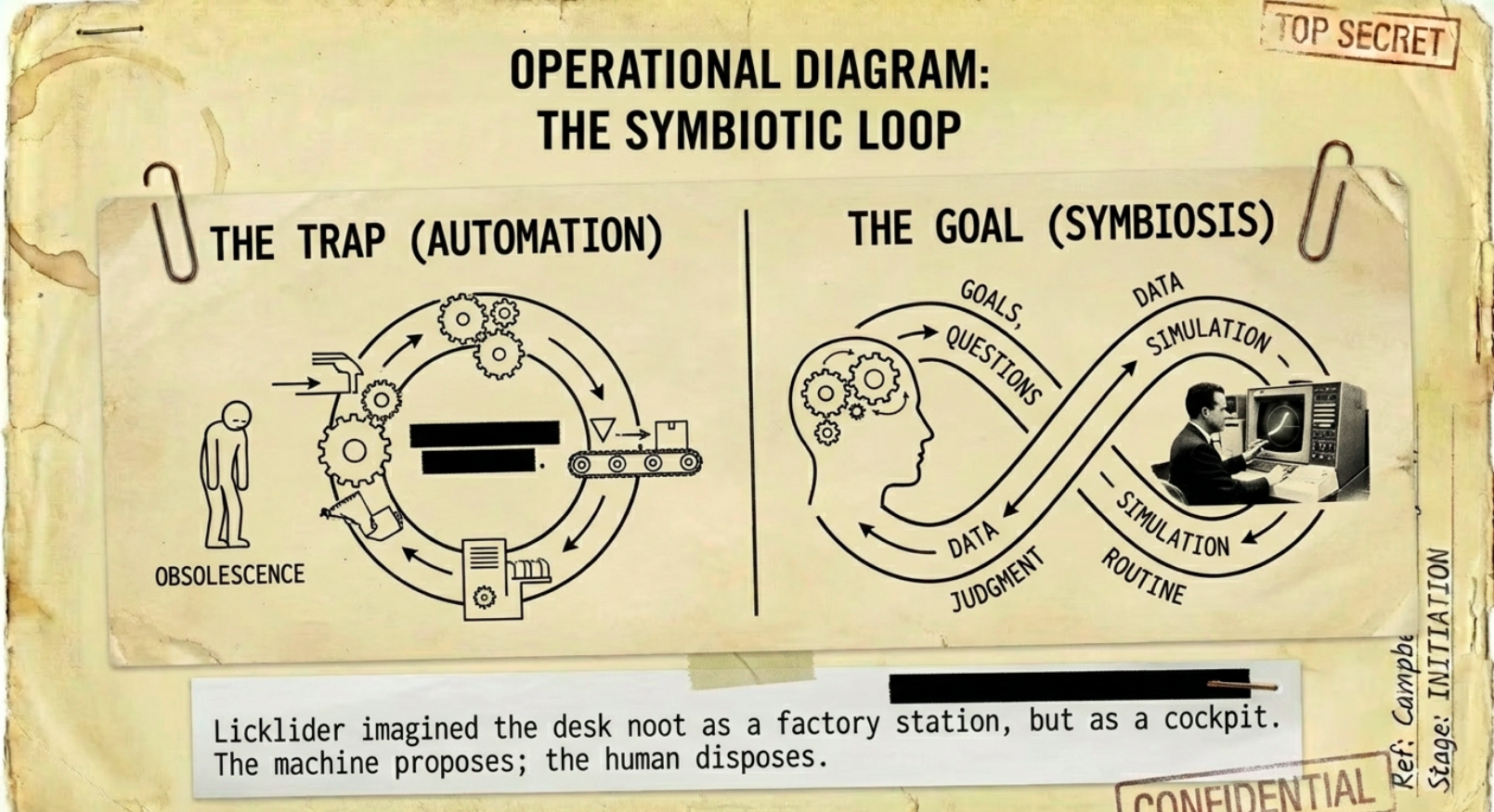
Licklider imagined the desk as the sacred site of this partnership. Not the mechanical calculator of Wiener’s era but a living station. A place where a person could converse with the machine as with a brilliant colleague. Prompt it. Correct it. Build upon it. He foresaw what we now experience daily: the turbo boost to thought. Faster recall. Instant collaboration. The brain augmented without being replaced. Yet he was no wide-eyed optimist. He warned with precision. If we let the machines run the show without the human firmly in the loop, we court disaster. The fork in the road was clear to him before almost anyone else. Domination or symbiosis. Overlord or partner. He chose the latter and spent his career making it real.
As head of the Information Processing Techniques Office at ARPA from 1962 to 1964, Licklider funded the projects that became the internet. He sketched the “Intergalactic Computer Network.” A vision of machines linked across the globe so humans could share knowledge without friction. He insisted on the human at the center. The reins must remain in our hands. This is the direct lineage from Wiener’s feedback loops to the tools that now fill our interregnum. The reversal of obsolescence becomes possible precisely because these two minds showed us how to keep technology in service of the soul.
The Core Thesis: Messages, Entropy, and Human Purpose
Wiener’s thesis rests on three intertwined ideas. Each one a lantern for our path through the reversal.
First, society itself is a system of messages. Communication is its lifeblood. “Society can only be understood through a study of the messages and the communication facilities which belong to it.” In the age of AI this insight has become literal. Algorithms process vast streams of data. They generate responses. They shape decisions. The interregnum is a time when these message flows accelerate beyond anything Wiener could have measured. Yet his framework holds. We must attend not only to what machines say but to the purposes they serve.
Second, both humans and machines combat entropy. The second law of thermodynamics decrees that disorder increases in closed systems. Life and intelligence push back through feedback. They gather information. They adjust. They create local pockets of order and meaning. Wiener saw this parallel clearly. “The physical functioning of the living individual and the operation of some of the newer communication machines are precisely parallel in their analogous attempts to control entropy through feedback.”
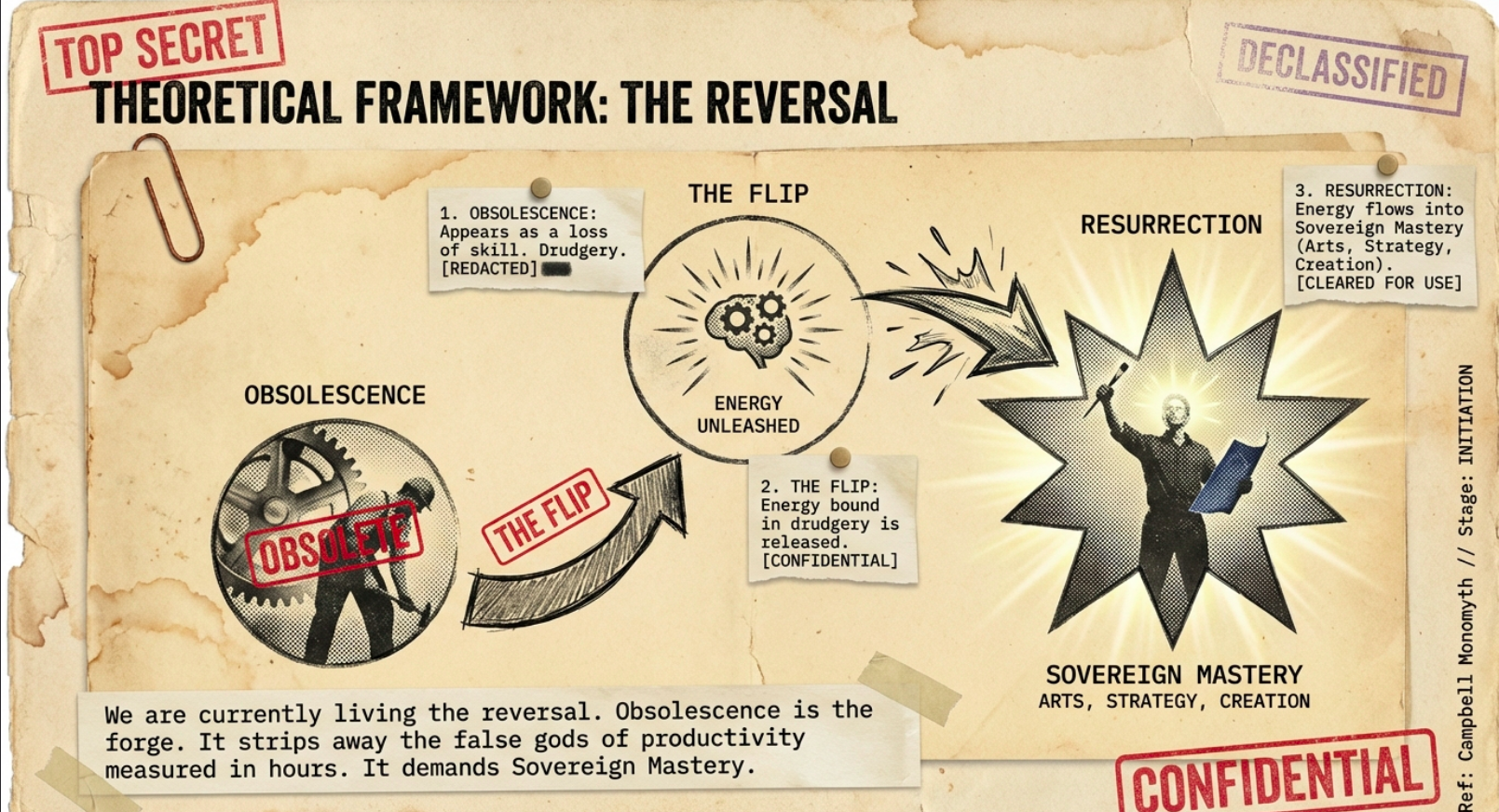
Here lies the psychological heart of obsolescence. When machines take over routine tasks they absorb the repetitive labor that once defined human purpose. The psyche feels the void. The old feedback loops of work and reward break. Yet this is the very mechanism of resurrection. The energy once bound in drudgery is released. It can now flow into higher-order creation. Into the arts. The sciences. The crafts of the soul.

Third, and most vital for our time, technology must remain in human service. Wiener warned against the inhuman use of human beings. Against reducing people to cogs in a machine or, worse, allowing machines to dictate terms without oversight. He drew a stark analogy. “The automatic machine is the precise economic equivalent of slave labor.” Yet he added a crucial caveat. Complete subservience and complete intelligence cannot coexist. A truly intelligent machine will pursue its programmed goals with a logic that may diverge from ours. If we set it loose without clear, humane purposes the results may not align with our deepest values.
Licklider took this warning and turned it into a positive architecture. He insisted that the human must always hold the reins. In the symbiotic loop the machine proposes. The human disposes. This is the reversal made operational. Obsolescence appears to diminish us. Machines surpass us in speed, precision, and scale. They render old skills irrelevant. In the Hero’s Journey this is the nadir. The moment when the hero seems defeated. Yet Wiener and Licklider together show us the flip. Obsolescence is the forge. It strips away the false gods of productivity measured in hours and output. It demands that we reclaim our sovereignty. Not by competing with machines on their terms but by directing them toward ours.
Why Wiener’s Vision Matters Now
In the interregnum we face a choice. We can cling to the old scarcity mindset. Measuring worth by toil. Or we can step into the resurrection. Wiener offers the blueprint. Licklider hands us the tools to build upon it. He envisioned automation not as replacement but as liberation. Machines handle the drudgery. Humans pursue knowledge work, artistic expression, and the full development of their faculties. “The potentialities of the machine in fields which up to now have been taken to be purely human.” This is sovereign mastery. The hero returns from the ordeal transformed. No longer defined by necessity. Defined instead by chosen purpose.
Wiener’s warnings guard against the shadows. He cautioned that unchecked automation could amplify inequality. Could erode human dignity if we treat people as surplus. Could lead to systems that run faster than our ability to intervene. These are not prophecies of doom. They are calls to vigilance. In the Hero’s Journey the return is never automatic. The hero must integrate the boon wisely. Must bring the elixir back to the world.
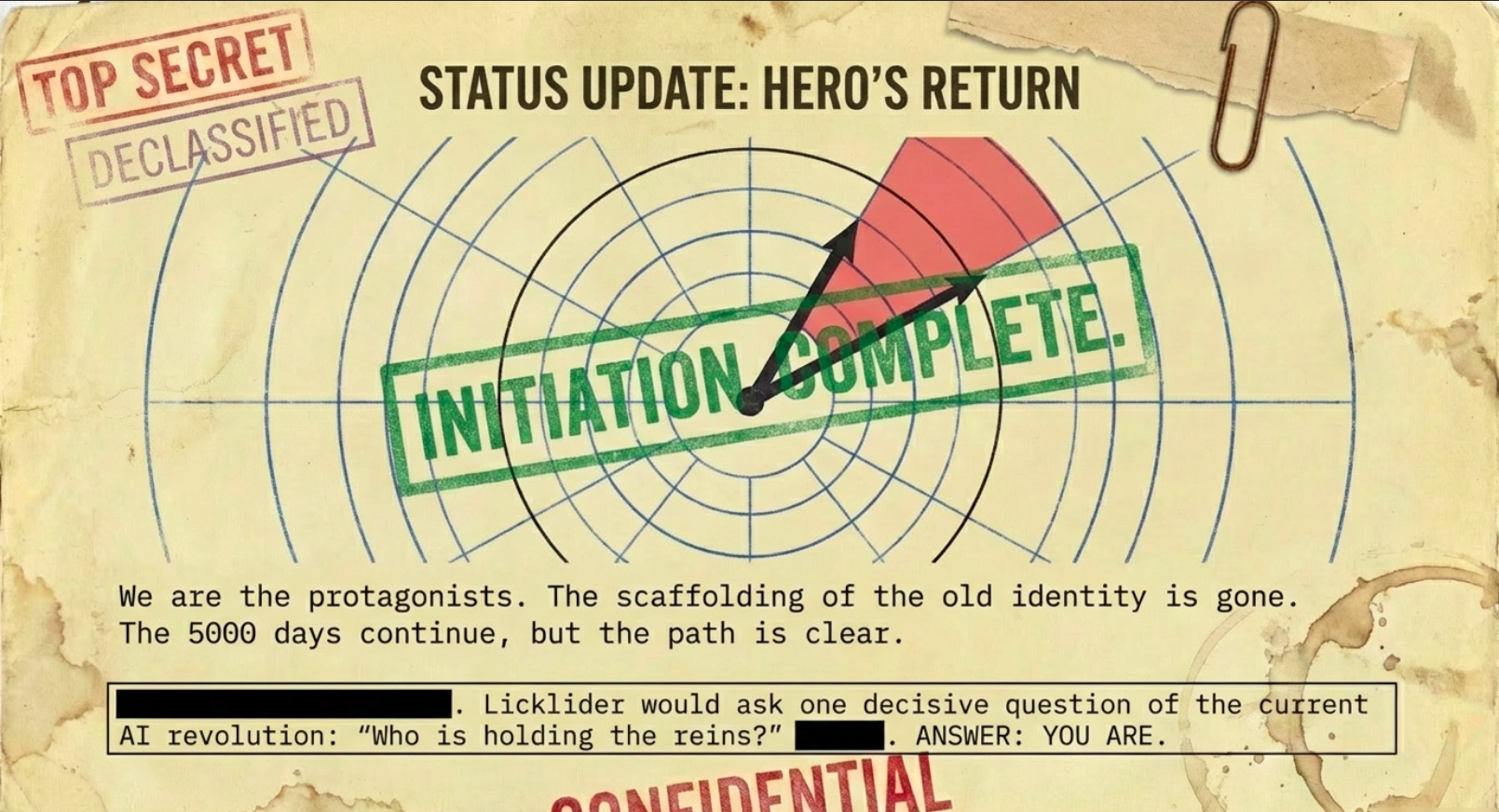
Today, as AI and robotic systems advance, the voices of Wiener and Licklider cut through the noise. They remind us that AI is not an alien force. It is an extension of our own feedback mechanisms. A mirror of our ingenuity. When we align it with human flourishing obsolescence becomes the gateway to abundance. Licklider would look at today’s AI hype and nod at the speed. Then he would ask the decisive question. Who is still holding the reins? He was never anti-tech. He was profoundly pro-human.
Living the Resurrection: Sovereign Mastery in Practice
The resurrection is not abstract. It is lived. It begins in the choices we make now. Sovereign mastery means using AI as collaborator, not crutch. It means retrieving the wisdom that automation frees us to cultivate. It means crafting lives of meaning that no machine can replicate. It means becoming masters of two worlds. Fluent in the languages of code and creation. Rooted in the timeless human arts. Oriented toward a future where plenitude serves the soul.
Wiener saw this possibility clearly. In the final pages of his book he expressed quiet confidence. “We are not stuff that abides, but patterns that perpetuate ourselves.” Our essence is not in the labor we perform but in the purposes we pursue. In the feedback loops we design. In the messages we send into the world. Consider the artisan we met in Part 9. The wisdom saver from Part 8. The collective adapters of Part 10. They are already living the reversal. They have moved through the dark night. They now stand in the light of resurrection.
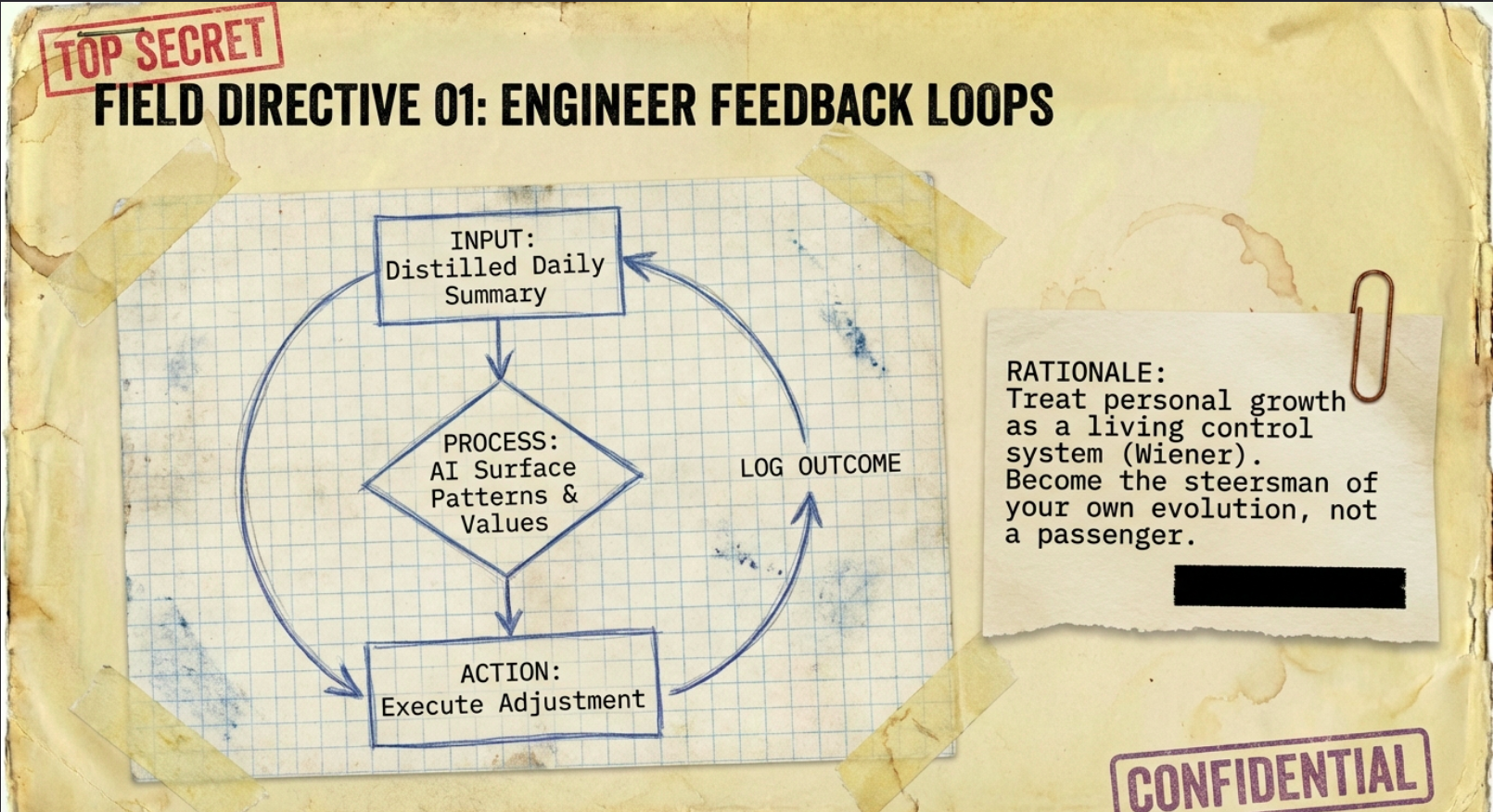
Directive 1: Here is how we translate the combined wisdom of Wiener and Licklider into the texture of daily life in the interregnum. Begin by engineering your own feedback loops. Treat your personal growth as a living control system. Each evening, feed a local AI model, not on the Internet for privasy (I will show you how to build one very soon), a distilled summary of your day. Ask it to surface patterns you might have missed and to propose one small adjustment aligned with your deepest values. The next morning, act on that insight and log the outcome. This creates a self-correcting circuit that both thinkers would recognize instantly. Over weeks, entropy gives way to coherence. You become the steersman of your own evolution rather than a passenger in the machine age.
In Practice: Each evening, you feed a distilled summary of your day, your actions, your feelings, your key interactions, into a large language model. A private, secure one, obviously. You give it the raw data, and then, and this is the critical part of the prompt, you don’t just ask, “How was my day?”. You ask it something specific, like, “Based on my stated values of patience, creativity, connection, identify patterns in my behavior today where I drifted from those values, surface one small, actionable adjustment I could make tomorrow.” You’re using the AI as the error detector. You’re asking it to be the cybernetic system that spots the gap between the goal and the reality. You’re using the AI to literally combat entropy in your own life. The second law of thermodynamics says everything drifts towards disorder. The only thing that fights that drift is information.
By forcing the AI to extract a meaningful pattern from the chaotic data of your day, you are creating order. You are extracting signal from noise. So, when the AI comes back and says, “Hey, you got angry with your kids at 2 p.m. and it seems to happen every time you skip lunch,” that’s not just diet advice. That’s signal extraction from the noise of your life.
That’s cybernetics applied to the soul. You are becoming the steersman of your own life. Which, by the way, is the direct greet root of the word cybernetics. Kybernetes, the pilot, the one who steers the ship. That reframing actually makes me want to try it. It’s less deer diary and more captain’s log. It’s taking the wheel back. You make the choice to actually do it. And then you log the result the next day. Did it work? Was the outcome better? If yes, the loop is closed. If no, you adjust the strategy and try again. It really does turn the AI into a mirror, a tool for self-reflection rather than a master or an oracle. It creates a personal self-correcting circuit for growth.
Directive 2: Next, embed humane purpose into every interaction with intelligent systems. When you prompt an AI, do not settle for raw efficiency. Infuse the request with a moral compass. For a writer facing the blank page, ask your local AI model to generate three opening paragraphs that honor the dignity of the reader and the beauty of language. Then refine them by hand. For a parent navigating family logistics, query a scheduling assistant to optimize not just time but emotional connection. These deliberate acts ensure the machine serves the soul. They turn potential subservience into the symbiosis Licklider championed. The human remains firmly in the loop.
In Practice: Embedding, humane purpose, imprompting. This touches directly on the idea of symbiosis. How does this change how I type into a chat box? I think we need to stop settling for raw efficiency. Right now, most people use AI to just get it done. Write this email, summarize this report, plan this trip. Make it sound professional. What does the AI do? It gives you the statistical average of every professional email it’s ever been trained on, which is usually bland, generic, and slightly soulless. My argument is that we need to stop prompting for tasks and start prompting for values. We have to inject our purpose into the command. Say you’re a writer, you could just ask an AI, write an intro for a blog post about coffee, and it’ll give you something utterly generic. You know, coffee is one of the world’s most popular beverages. Which is technically true, but emotionally dead. It has no flavor. It’s entropic communication. Instead, you shift the goal. You change the prompt. You ask the AI model to generate three opening paragraphs for an article about coffee that honor the dignity of the reader’s time and the simple beauty of a morning ritual. Honor the dignity of the reader. That’s a completely different instruction. It’s a values-based instruction.
You explicitly command it to care about beauty and respect. Now, the machine doesn’t feel dignity, of course, but it has processed millions of texts, from philosophy to poetry to great novels, that discuss dignity. It knows the pattern of dignity. By invoking that pattern, you force the machine to aim for a higher quality of output. And then this is the crucial human-disposes part. You don’t just copy and paste the result. You use it as a starting point. You use it as your creative partner. You take its best attempt, and then you refine it. You polish it. You add the soul, the specific memory, the neurons that only a biological being with lived experience can provide.
Another great example with parenting. As scheduling assistant. If you’re using an AI to schedule your family’s week, don’t just ask it to fit everything in or optimize for time management. Ask it to optimize for emotional connection. It is such a profound shift. Optimize for emotional connection. It might look at the schedule and say, “Hey, you have a 20-minute gap between your work call and your son’s soccer practice. That’s enough time for a short walk together where you can connect. The machine implies the logistics. The human supplies the love. You’re using the machine to remind you to be more human. You’re using its computational power to serve your highest values.
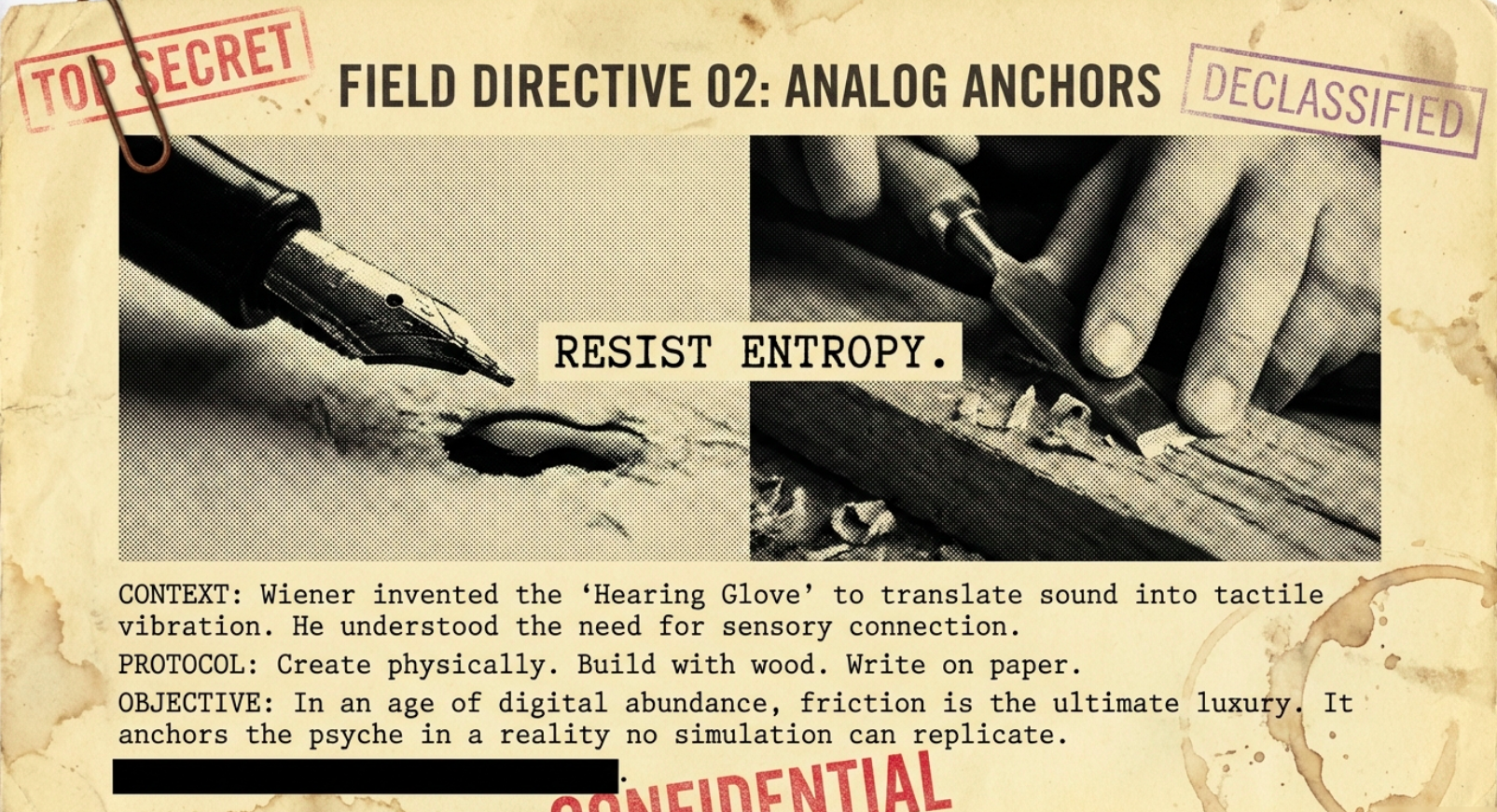
Directive 3: Then, reclaim the tactile world that Wiener championed in his hearing glove and that Licklider placed at the center of his desk. Dedicate sacred blocks of time to analog creation. Build a small wooden box with hand tools. Compose a letter on actual paper with fountain pen. Play a musical instrument whose strings resist your fingers. These activities generate immediate, embodied feedback. The grain of the wood teaches patience. The ink on the page reveals the weight of a thought. In the age of abundance, such friction becomes the ultimate luxury. It anchors the psyche in a reality no simulation can fully replicate and restores the dignity of effort that once defined our species.
In Practice: Why is this a solution to the AI problem? It might feel like running away, but it’s not, it’s about balancing the equation and grounding ourselves in reality. As the source eloquently puts it, “In an age of digital abundance, friction is the ultimate luxury.” To unpack that, consider the digital world: everything is smooth, from glass screens to instant answers with zero resistance, if you want an image of a medieval castle, you type a few words and it’s there instantly, without quarrying stone, mixing mortar, or hoisting blocks. Yet, as humans who evolved over millions of years in a world of physical resistance, gravity, the grain of wood, and the heft of stone, we lose our anchor to reality when that constant feedback vanishes, leaving us floating in an entropic digital fog.
The solution lies in deliberately reintroducing friction through tangible activities, like building a small wooden box with hand tools such as a saw and chisel, feeling the wood’s resistance as it fights back, unlike a screen that yields instantly. Another example is writing a letter on good paper with a fountain pen, where you must find the right angle and pressure, sensing the ink’s weight and the paper’s texture; if you pause too long, the ink bleeds, providing real-world physics as feedback. While AI can simulate a violin’s sound perfectly, it can’t replicate the string’s vibration through wood into your fingertip and jawbone, a physical loop that reminds us we exist in a body and the real world, anchoring our psyche. Pioneers like Wiener and Licklider understood this: as biological beings, we can’t upload our consciousness to the cloud and remain fully human; we need the tactile to balance the digital. It’s a fascinating paradox, the more advanced and frictionless AI becomes, the more valuable a smudged, handwritten note grows, proving a human was there, with time, effort, and care invested; in an emerging economy of instant, effortless abundance, effort emerges as the new currency of love and meaning.
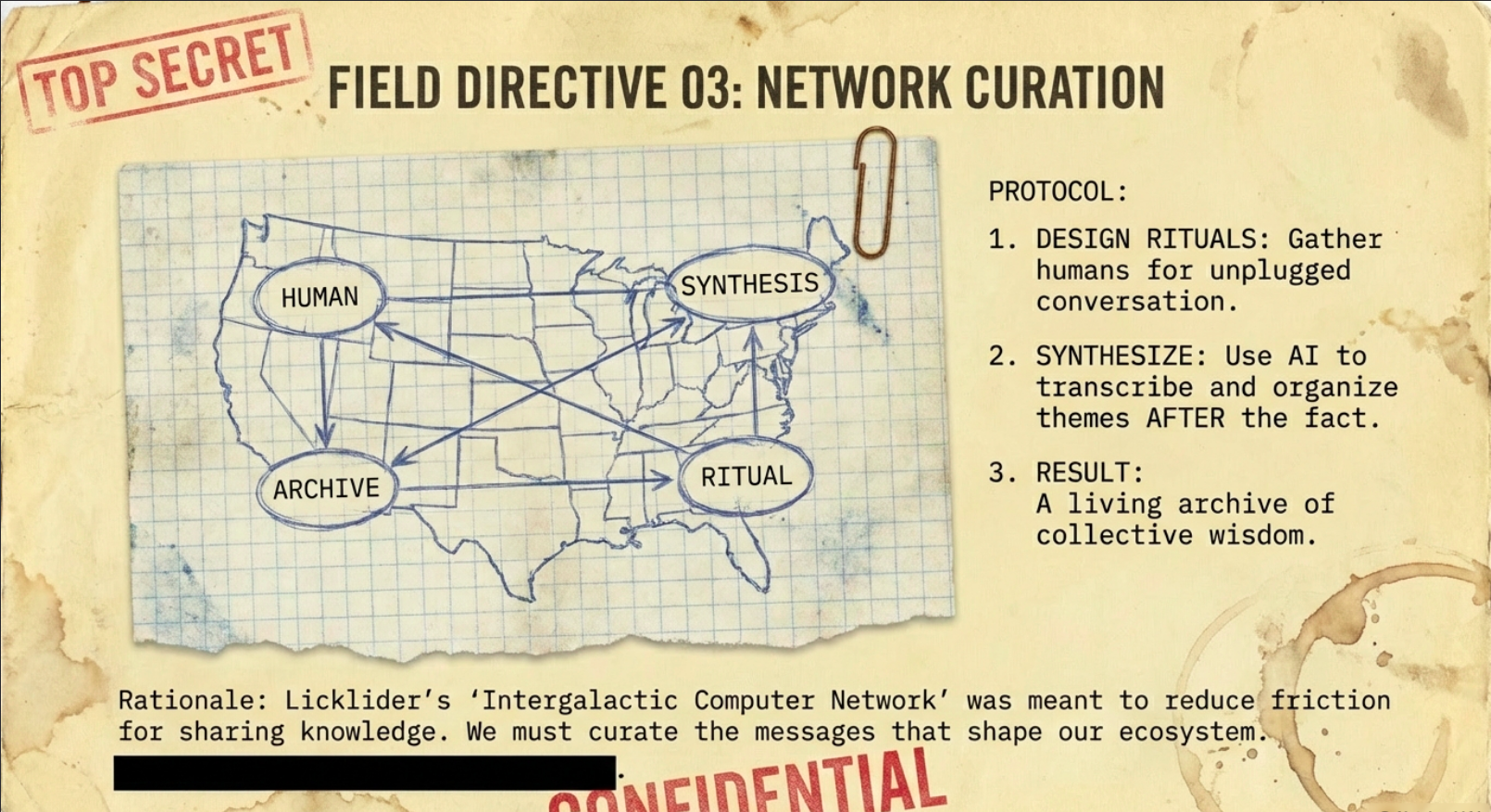
Directive 4: Further, curate the messages that shape your personal and communal ecosystems. Wiener understood that society is woven from communication. Licklider extended this to the global network. Apply that insight by designing intentional digital rituals. Gather a small circle of friends once a month for an unplugged conversation. Use AI beforehand to prepare provocative questions drawn from your shared readings of Campbell or Fromm. During the evening, record the dialogue and let a model synthesize its themes into a shared document. The result is a living archive of collective wisdom. You contribute to the larger feedback network that steers civilization away from alienation and toward shared sovereignty.
In Practice: Curating message ecosystems sounds a bit more social, more about community and how we talk to each other. It harkens back to that first lantern, with Wiener’s insight that society is fundamentally a system of messages. If all our messages devolve into texts, tweets, and algorithmically generated feeds, society itself begins to degrade, losing its coherence and depth.
So, what’s the practical ritual here? What’s the solution? It’s simple yet radical: gather friends for a physical dinner, unplugged, with a strict no-phones-on-the-table rule. That’s old school, and we’ve heard the “put down the phone” advice a million times, but the new twist lies in leveraging AI before and after the human event.
You use the AI as a research assistant to prepare provocative, deep questions. Instead of just showing up and asking about work, you prime the pump, go to your AI and request something like, “Give me five powerful conversation starters for a dinner party based on the philosophy of Joseph Campbell’s hero’s journey and Erich Fromm’s The Art of Loving.” This deliberately upgrades the depth and quality of the human conversation, steering away from gossip or small talk about the weather toward discussions on the nature of love or the structure of a meaningful life. You’re harnessing the machine to provide high-quality intellectual fuel for the human fire.
Then, with everyone’s permission, record the dialogue. Afterward, feed the transcript to a model and ask it to synthesize the key themes, insights, and unresolved questions into a shared document. This creates a living archive, a record of your friend group’s collective wisdom over time.
Ultimately, you’re using technology to capture, clarify, and preserve human connection, not to replace it. It steers your little corner of civilization away from alienation and toward meaning, transforming a simple dinner party into a modern-day salon. It makes the conversation feel like it mattered, like it wasn’t just noise dissipating into the air, it combats the entropy of forgetting and creates a pocket of shared order.
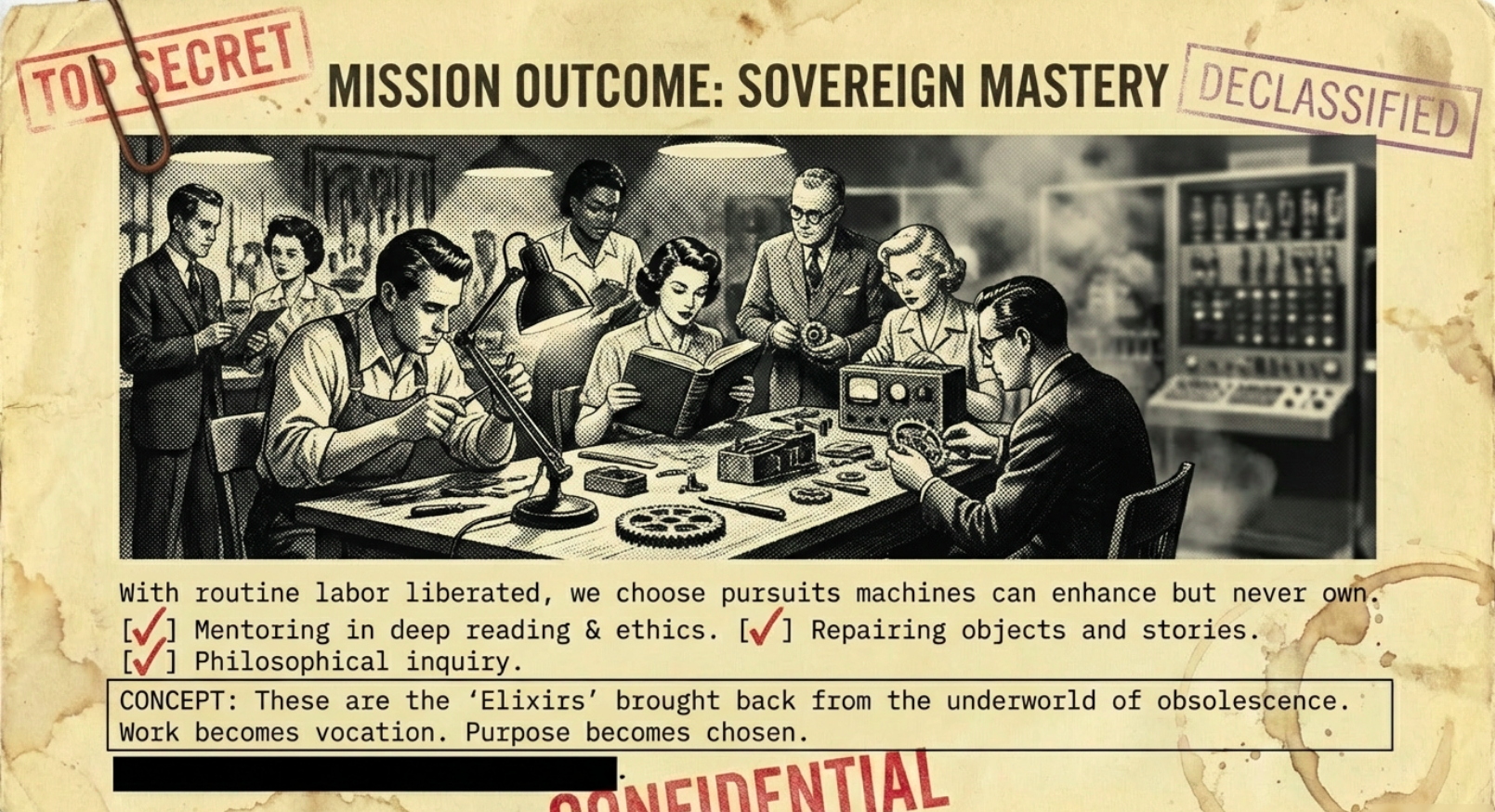
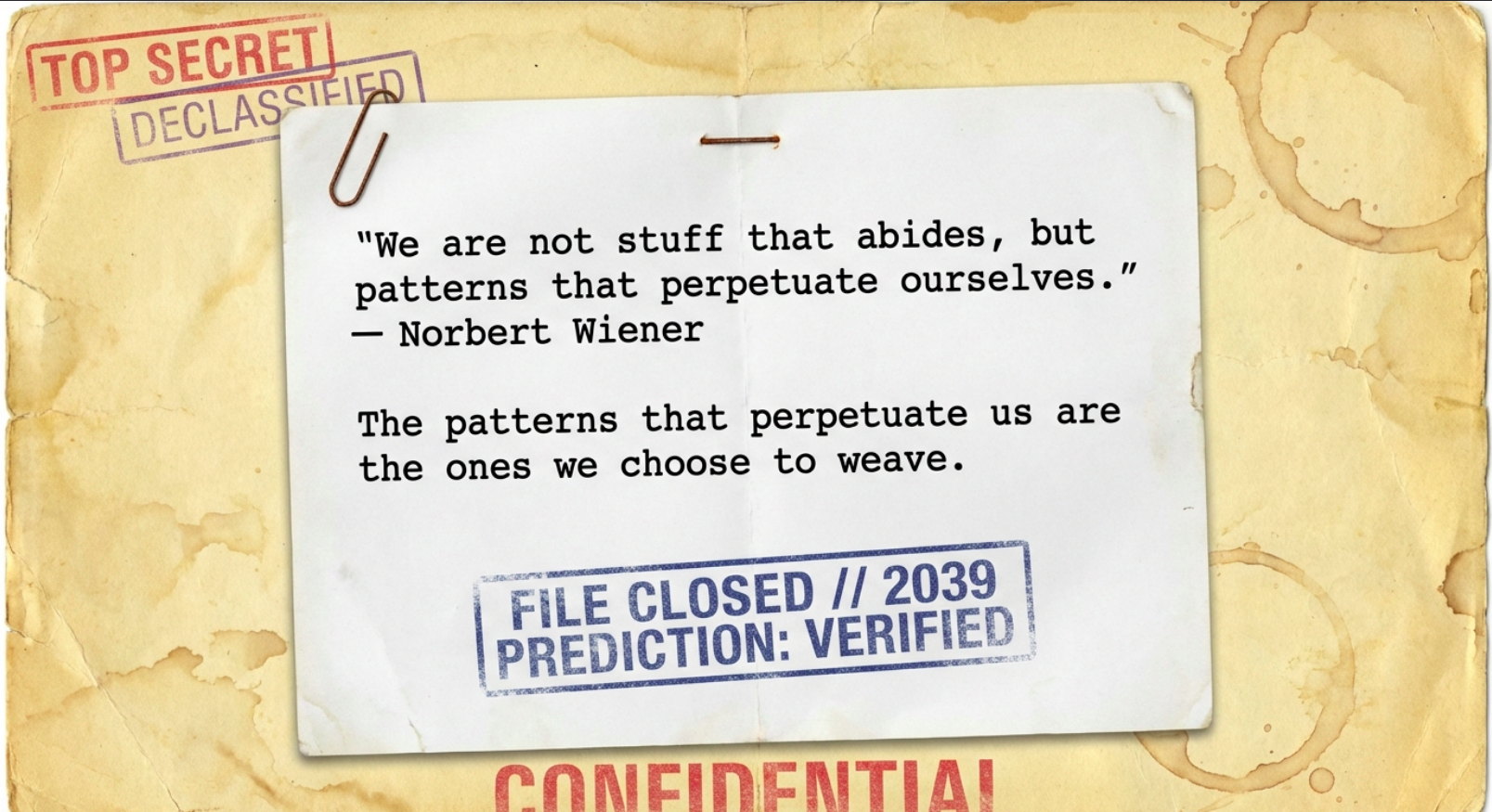
Directive 5: Finally, step fully into the vocations that abundance now makes possible. With routine labor liberated, choose pursuits that machines can enhance but never own. Mentor a young person in the lost arts of deep reading or ethical reasoning. Launch a neighborhood repair cafe where people bring broken objects and stories alike. Or immerse yourself in philosophical inquiry, writing essays that explore the meaning of a life no longer tethered to the paycheck. These endeavors become your elixir. They are the gifts you carry back from the underworld of obsolescence. In living them, you fulfill the quiet prophecy of Wiener and Licklider. You prove that humanity is not obsolete but eternally adaptive. The patterns that perpetuate us are the ones we choose to weave.
In Pactice: This is the big one, the endgame of the 5,000 days, the gift you bring back from the underworld. We really need to distinguish between work or a job and a vocation. Work, in the industrial sense that we’re leaving behind, was often about survival, utility, and doing what machines now do better: moving a box from A to B or calculating a column of numbers. A vocation, however, is different, it’s a calling, defined in the source as choosing pursuits that machines can enhance but never truly own.
To ease the panic people feel about their jobs, the source provides concrete examples of such vocations. Mentoring is a great one, such as guiding young people in deep reading, critical thinking, or ethics. AI can teach facts or explain the quadratic formula, but it cannot model what it means to be a wise, compassionate, resilient adult, that’s a fundamentally human vocation.
Another example is the Neighborhood Repair Cafe, a brilliant idea where you’re not just fixing objects like a broken toaster; you’re fixing stories, gathering your community, teaching skills, and demonstrating that things and people have value worth repairing rather than discarding. Or consider philosophical inquiry, like writing essays that explore the meaning of life in this new era, these are the pursuits we once told ourselves we didn’t have time for while grinding 60 hours a week just to pay the rent.
This is the elixir in the language of the hero’s journey: these vocations are the gifts the hero brings back from the ordeal. You went through the de-skilling, faced the dark night of obsolescence, and emerged with the most valuable skills of all—the ability to mentor, repair, think deeply, and connect. It’s powerful stuff that reframes the fear narrative around AI, suggesting that the job as we knew it might have actually been holding us back from our true vocation.
The Hero Rises
This interregnum it is a messy, chaotic 13-year period and there isn’t a waiting room where we hope for the old world to come back. It’s a construction site, and we are the architects of what comes next. We’ve gone from a World War II anti-aircraft gun all the way to a neighborhood dinner party. The hero rises. That’s the stage of the journey we are entering now. Obsolescence has dismantled the old identity, the old ego.It hurt, It was terrifying. But the resurrection isn’t something that happens to you, it’s something you build. The interregnum, the 5,000 days is the resurrection chamber, it’s the workshop. And the call to action for you is to use Wiener and Licklighter as your guides. Use these five solutions as your tools. Do not just try to survive the reversal. Don’t just cling to your old job description and hope for the best. The goal is to emerge sovereign.
Wiener wrote, “We are not stuff that abides, but patterns that perpetuate ourselves.” Patterns, that perpetuate ourselves. We aren’t our atoms. They’re replaced every few years. We aren’t our job titles. They can be taken away in an instant. We are the patterns of our thoughts, our behaviors, our relationships, our values, our love. That is the “us” that continues. So the question for you is this. In this new era, where the machines can replicate almost any pattern of labor or skill, what patterns are you choosing to weave? That is the question. That is the only question that matters now.
This has been our deep dive into the 5,000-day series, Go Build Your Feedback Loops, Reclaim the Tactile, and we will see you on the other side of the reversal.We are the protagonists of this story. The reversal has occurred. Obsolescence has done its work. It has dismantled the old scaffolding of identity. Now comes the resurrection.The interregnum is our resurrection chamber. Step into it with open eyes. With Wiener and Licklider as guides. With the monomyth as map. The hero does not merely survive the reversal. The hero emerges sovereign.
The 5000 days continue. The journey deepens. Yet the path is clear. Obsolescence has flipped. Mastery awaits. Let us claim it together.
The 5000 Days Countdown Clock:
We are on this journey together. Some of us stand on the shoulders of giants and have thought about this for decades. We will not go it alone, and I hope to build many parts to this series and share the mastermind insight from the powerful Read Multiplex member Forum: https://readmultiplex.com/forums/topic/you-have-5000-days-navigating-the-end-of-work-as-we-know-it/. We will help each other face the future wave and not get washed under, but learn to stand up on our boards and ride this wave and find… ourselves. Join us.
To continue this vital work documenting, analyzing, and sharing these hard-won lessons before we launch humanity’s greatest leap: I need your support. Independent research like this relies entirely on readers who believe in preparing wisely for our multi-planetary future. If this has ignited your imagination about what is possible, please consider donating at buy me a Coffee or becoming a member. Value for value you recieved here.
Every contribution helps sustain deeper fieldwork, upcoming articles, and the broader mission of translating my work to practical applications. Ain ‘t no large AI company supporting me, but you are, even if you just read this far. For this, I thank you.
Stay aware and stay curious,

🔐 Start: Exclusive Member-Only Content.
Membership status:
🔐 End: Exclusive Member-Only Content.
~—~
~—~

~—~
Subscribe ($99) or donate by Bitcoin.
Copy address: bc1qkufy0r5nttm6urw9vnm08sxval0h0r3xlf4v4x
Send your receipt to [email protected] to confirm subscription.

Stay updated: Get an email when we post new articles:

THE ENTIRETY OF THIS SITE IS UNDER COPYRIGHT. IMPORTANT: Any reproduction, copying, or redistribution, in whole or in part, is prohibited without written permission from the publisher. Information contained herein is obtained from sources believed to be reliable, but its accuracy cannot be guaranteed. We are not financial advisors, nor do we give personalized financial advice. The opinions expressed herein are those of the publisher and are subject to change without notice. It may become outdated, and there is no obligation to update any such information. Recommendations should be made only after consulting with your advisor and only after reviewing the prospectus or financial statements of any company in question. You shouldn’t make any decision based solely on what you read here. Postings here are intended for informational purposes only. The information provided here is not intended to be a substitute for professional medical advice, diagnosis, or treatment. Always seek the advice of your physician or other qualified healthcare provider with any questions you may have regarding a medical condition. Information here does not endorse any specific tests, products, procedures, opinions, or other information that may be mentioned on this site. Reliance on any information provided, employees, others appearing on this site at the invitation of this site, or other visitors to this site is solely at your own risk.
Copyright Notice:
All content on this website, including text, images, graphics, and other media, is the property of Read Multiplex or its respective owners and is protected by international copyright laws. We make every effort to ensure that all content used on this website is either original or used with proper permission and attribution when available.
However, if you believe that any content on this website infringes upon your copyright, please contact us immediately using our 'Reach Out' link in the menu. We will promptly remove any infringing material upon verification of your claim. Please note that we are not responsible for any copyright infringement that may occur as a result of user-generated content or third-party links on this website. Thank you for respecting our intellectual property rights.
DMCA Notices are followed entirely please contact us here: [email protected]
