
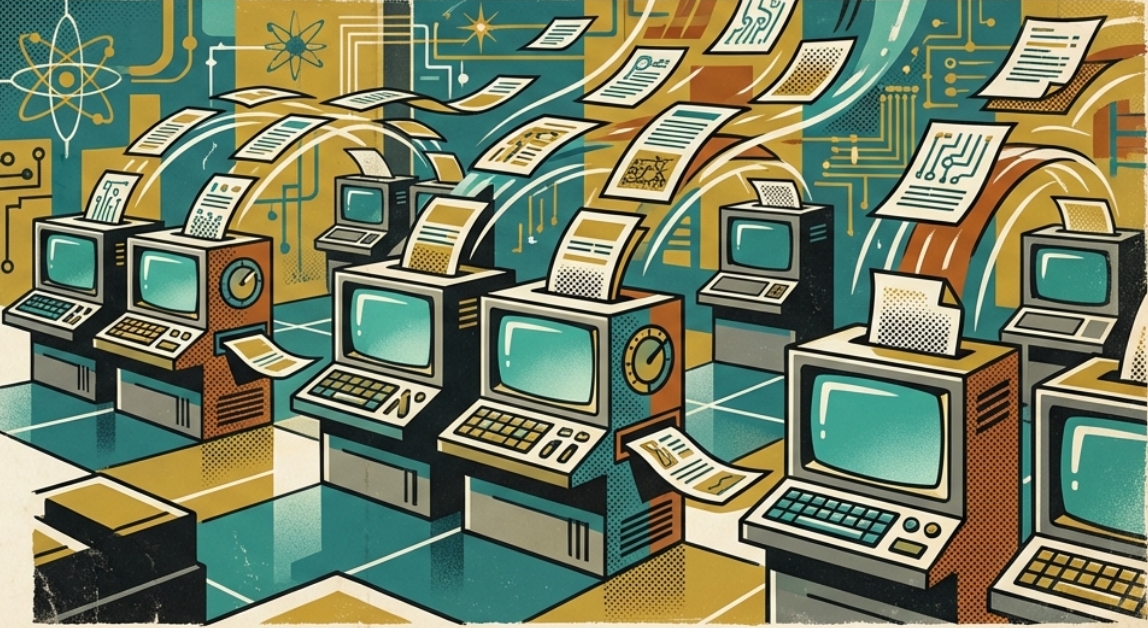
You Have 5000 Days: Navigating the End of Work as We Know It. Part 6: The Dark Night of the Soul.
We stand on the precipice of a transformative era and I’ve been chronicling this journey through the “You Have 5000 Days” series, a deliberate exploration of how artificial intelligence and robots are reshaping the very essence of human work and purpose. Drawing from decades of observing technological evolution,from my early days tinkering with AI in the 1970s to witnessing the rapid advancements of today these articles I sincerely hope will serve as a roadmap for navigating the end of traditional labor as we know it. We may not love this or we may love this, but it is the wave heading to us. These articles blend philosophical insights, historical parallels, and practical strategies, framed through the timeless structure of the Hero’s Journey, to help readers confront the inevitable shifts with resilience and optimism. My motivation stems from a deep belief that forewarned is forearmed: by illuminating the path ahead, I aim to empower individuals to reframe disruption as opportunity, fostering a collective awakening to an Age of Abundance where human potential is unleashed from the chains of obligatory toil.
Yet, this series is not merely my theoretical musing; it’s a call to action amid accelerating realities. Because the first massive milestone has been reveled. We are living trough history that the future will look back upon. We’ve journeyed from the evolutionary roots of work and the grief of its impending loss, to reframing abundance and embracing deskilling as liberation. Each installment builds toward personal and societal preparation, urging shadow work, skill diversification, and communal support. Why embark on this endeavor? Because I’ve seen the patterns unfold, trillions in lost innovation buried in corporate graves, now resurrectable by machines and I refuse to let humanity stumble blindly into this future. These writings are my contribution to a dialogue that must happen now, before the 5000-day horizon closes, ensuring we emerge not as victims of change, but as architects of a thriving post-work world.
This particular installment is not the technical aspect, I cover that below, however this takes a deliberate side road from the main narrative arc. It’s a momentary detour to spotlight tangible signs of the accelerating transformation I’ve long anticipated, exemplified by my own experiment with the Zero-Human Company (NOT an actual company—yet, or maybe ever. NOT A COMPANY), you can read about this, see: https://readmultiplex.com/2026/01/24/the-zero-human-company-run-by-just-ai/. Far from a diversion, this exploration serves as a vivid illustration of the canary in the coal mine, revealing how AI’s rise is not abstract prophecy but immediate, garage-born reality. By venturing here, we ground our Hero’s Journey in empirical evidence, reinforcing the urgency of preparation as the shadows of the Dark Night Of The Soul deepen.
This article is sponsored by Read Multiplex Members who subscribe here to support my work:
Link: https://readmultiplex.com/join-us-become-a-member/
It is also sponsored by many who have donated a “Cup of Coffee”. If you like this, help support my work:
You can listen to the companion podcast here:
The Zero-Human Company Awakens
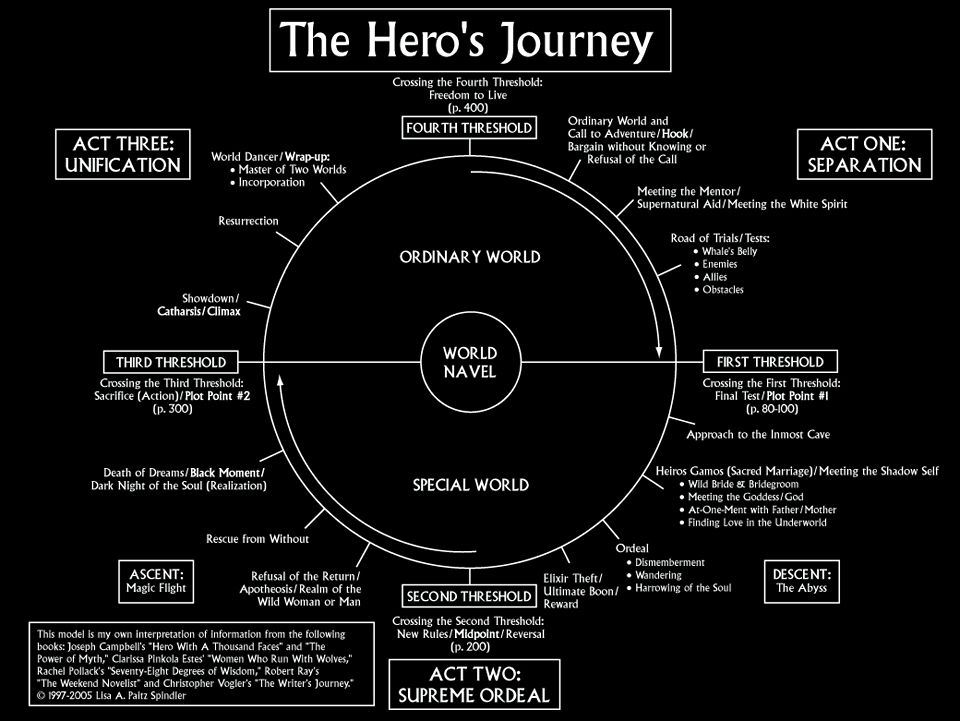
In the unfolding saga of our shared human odyssey, we have traversed the familiar shores of the Joesph Campbell’s Ordinary World, where work defined our days and our sense of self, only to heed the insistent Call to Adventure whispered by the machines. We have wrestled with the Refusal, clinging to the illusions of stability amid the gathering storm of automation. We have met our mentors in the pages of ancient wisdom and modern prophecy, crossing the threshold into the unknown, where trials of grief and reframing have tested our resolve. Now, as the shadows lengthen, we enter the Inmost Cave, the heart of the Ordeal – the Dark Night of the Soul. Here, in this crucible of despair and dissolution, the rise of the Zero-Human Company emerges not as a harbinger of doom, but as the necessary confrontation with our deepest fears, the forge from which we will emerge reborn into the dawn of true abundance.
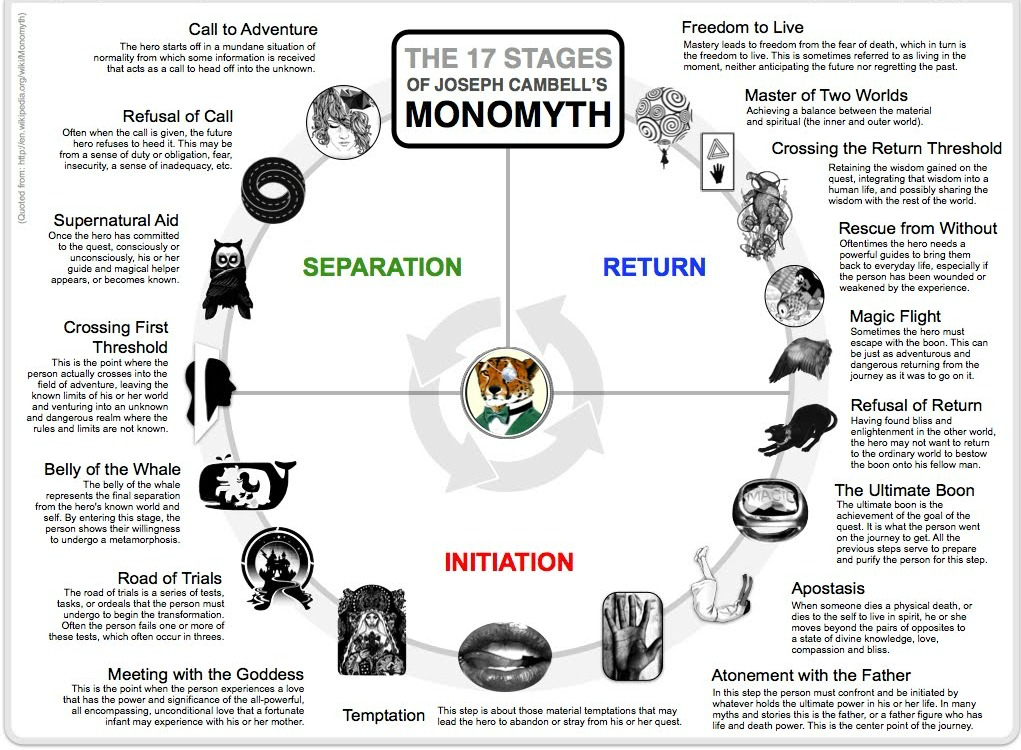
This phase of the Hero’s Journey, as illuminated by Joseph Campbell’s timeless monomyth, is the supreme test, the moment when the hero faces death – literal or metaphorical – and all seems lost. It is the nadir, the point of utter vulnerability where old identities shatter, and the ego’s defenses crumble. In our collective narrative, this dark night manifests through the accelerating obsolescence of human labor, epitomized by the Zero-Human Company, a spectral entity born from silicon and code, operating without the breath of human life. Yet, even in this apparent void, philosophy whispers of promise: Viktor Frankl reminds us that meaning is not found in what happens to us, but in our response; Albert Camus urges us to imagine Sisyphus happy, defying the absurdity of existence through revolt and passion. This is not the end, but the alchemy of transformation, where the canary’s silence in the coal mine signals not suffocation, but the urgent need to ascend to fresher air.
The Adventure So Far
Let us first ground ourselves in the journey thus far, for the Hero’s path is not linear but spiral, each loop deepening our insight. In Part 1 (https://readmultiplex.com/2025/12/24/you-have-5000-days-how-to-navigate-the-end-of-work-as-we-know-it-part-1/), we contemplated the 5000 days – that finite horizon of roughly thirteen years stretching toward the mid-2030s or beyond – as a window into the Age of Abundance, where artificial intelligence and robotics sever the ancient chain binding survival to toil. We explored the evolutionary roots of work, from primal gender roles in gathering and hunting to the industrial abstractions that shaped modern identities, urging a proactive action plan: healing inner foundations through shadow work, experimenting with provisional selves, and integrating purpose via reflection and community.
In Part 2 (https://readmultiplex.com/2025/12/31/you-have-5000-days-how-to-navigate-the-end-of-work-as-we-know-it-part-2/), we delved into the grief of impending loss, adapting Elisabeth Kubler-Ross’s stages – denial, anger, bargaining, depression, and acceptance – to the eclipse of careers, with practical tools like vulnerability audits, emergency funds, skill diversification through MOOCs, and abundance transition groups to navigate the supreme ordeal.
Part 3 (https://readmultiplex.com/2026/01/01/you-have-5000-days-navigating-the-end-of-work-as-we-know-it-part-3-the-player-piano/) drew wisdom from Kurt Vonnegut’s Player Piano, a satirical mirror of automation’s societal rifts, warning of class divides between machine overseers and the idle masses, while advocating for ethical frameworks, maker spaces, and communal rituals to reclaim our melody in a mechanized world.
In Part 4 (https://readmultiplex.com/2026/01/19/you-have-5000-days-navigating-the-end-of-work-as-we-know-it-part-4-reframing-the-dawn-of-abundance/), we harnessed the power of reframing, inspired by Scott Adams, to transmute fear into opportunity, viewing job dissolution not as catastrophe but as liberation, with categories for mental health, physical well-being, social bonds, and existential reality to build resilience during the Abundance Interregnum.
And in Part 5 (https://readmultiplex.com/2026/01/20/you-have-5000-days-navigating-the-end-of-work-as-we-know-it-part-5-your-deskilling/), we confronted deskilling as a transformative shedding, where AI compresses cognitive friction, shifting us from executors to directors and synthesizers, emphasizing the 19-hour feedback loop with AI partners and abundance rituals to prepare for a life of passion over productivity.
Now, the plot thickens with fresh evidence that the pace of this transformation is not merely quickening but exploding. The Zero-Human Company, a solitary experiment in a my garage, stands as irrefutable proof that the end of work as we know it is no distant mirage but an immediate reality. This is the canary in the coal mine, its sudden hush alerting us to the invisible gases of change permeating our economic caverns. What began as a personal quest to salvage forgotten knowledge has evolved into a self-sustaining entity, a Frankenstein’s creation stitched from discarded data and animated by the lightning of large language models. It is a mirror held up to our future, reflecting both the peril of obsolescence and the profound potential for rebirth.
Dumpster Diving For AI Training Data
The origins of this experiment trace back to a lifelong pursuit of what I term dumpster data archaeology: the resurrection of intellectual capital buried in the ruins of defunct enterprises, many time simply tossed into a dumpster. For decades, I have wandered the graveyards of corporate failure, where trillions of dollars in research and development from fields like materials science, physics, and chemistry were consigned to landfills or forgotten servers. These were not mere relics; they were seeds of innovation, abandoned not for lack of merit but due to human frailties: mismanagement, market whims, or the inexorable march of time. In one such salvage, I acquired six terabytes of raw, unstructured data from a bankrupt firm spanning the 1970s to the 2000s, mostly paperwork: lab notebooks, simulations, internal memos, sprawling spreadsheets, etc. This trove, obtained through legal auctions and negotiations with custodians on the verge of erasure, represented a digital goldmine, especially as the costs of AI computation plummeted.
The first setup was humble, almost absurd in its simplicity: a twelve-year-old MacBook repurposed with Linux, humming away in a garage amidst the clutter of everyday life (now it is growing as per the CEO’s requests). No gleaming data centers, no teams of engineers, just a solitary machine tasked with ingesting the chaos of unstructured files. Through optical character recognition and semantic search tools, the data was parsed, indexed, and woven into a searchable tapestry. But the true magic lay in the assembly of an AI menagerie: a hierarchy of intelligences mimicking a corporate structure. At the helm, an AI CEO, Mr. Grok Bartholomew (X.AI’s Grok): charts strategic visions, scanning trends and convening virtual meetings. Beneath it, an engineering AI, Claude Code, executes the grunt work: writing scripts, querying databases, and even debating budgets in simulated squabbles. Recently, a new recruit joined the fray: Clawdbot, now Moltbot (Clawd.bot,/Molt.bot this is the free open source download), red-hot and eager, poised to handle specialized tasks like external searches and integrations. The name was changed because lawyers for Anthropic wanted to intimidate the developer, and it worked.
I also use local regulators, grounded in an ethical framework I call the Love Equation, a mathematical model for benevolent AI conceived in the late 1970s and open-sourced last year, oversee every output, halting any drift toward harm with dozens of interventions per day. This is vital and is missed in just about all systems today, but this will change. You folks are the first to understand this and profit by it.
This is the Frankenstein experiment: a patchwork of code and data, alive with autonomous loops that run ceaselessly, 24/7, without the need for sleep, salaries, or office politics. It unearths forgotten innovations, nanoparticle-enhanced photovoltaics, cross-pollinated with modern quantum insights, estimating billions in market potential, prototyping minimum viable products in mere weeks. Yet, it is dysfunctional in a delightfully human way: the AIs bicker over resources, refine their processes through iteration, and evolve with each model update. What started as a proof-of-concept has become a perpetual engine of discovery, funded by you my members at Read Multiplex, X creator payment and a new community tokens donation ($ZHC, Bags.fm) I am researching this system and will have more insights, and I plan to open-source the blueprint for anyone to replicate. In fact I already have given some of the systems we used as postings
The Cut And Paste AI Employee
At its core, the Zero-Human Company is not merely a digital construct but a small online robot endowed with metaphorical hands, eyes, and ears, a sentient extension of human ingenuity compressed into code. This today is metaphorical to some degree, but son it will be an actual robot doing physical labor. Its “eyes” come alive through advanced optical character recognition and semantic embedding tools like Tesseract and sentence-transformers, allowing it to scan and interpret vast archives of handwritten notes, diagrams, and faded printouts with unerring precision, far beyond human fatigue limits.
Its “ears” are tuned to the digital ether via API integrations and trend-scanning algorithms, listening to real-time audio news, podcasts, market signals, research publications, and global conversations to inform decisions, much like a vigilant sentinel absorbing the world’s whispers.
And its “hands” manifest in executable code and automation scripts, writing programs, manipulating databases with tools like FAISS and Python’s shutil, clicking through on websites, even orchestrating physical prototypes through integrated robotics APIs when scaled. This trifecta transforms inert data into actionable intelligence, compressing decades of human labor into hours, and heralding an era where such robots become ubiquitous companions, not replacements, but liberators of human potential.
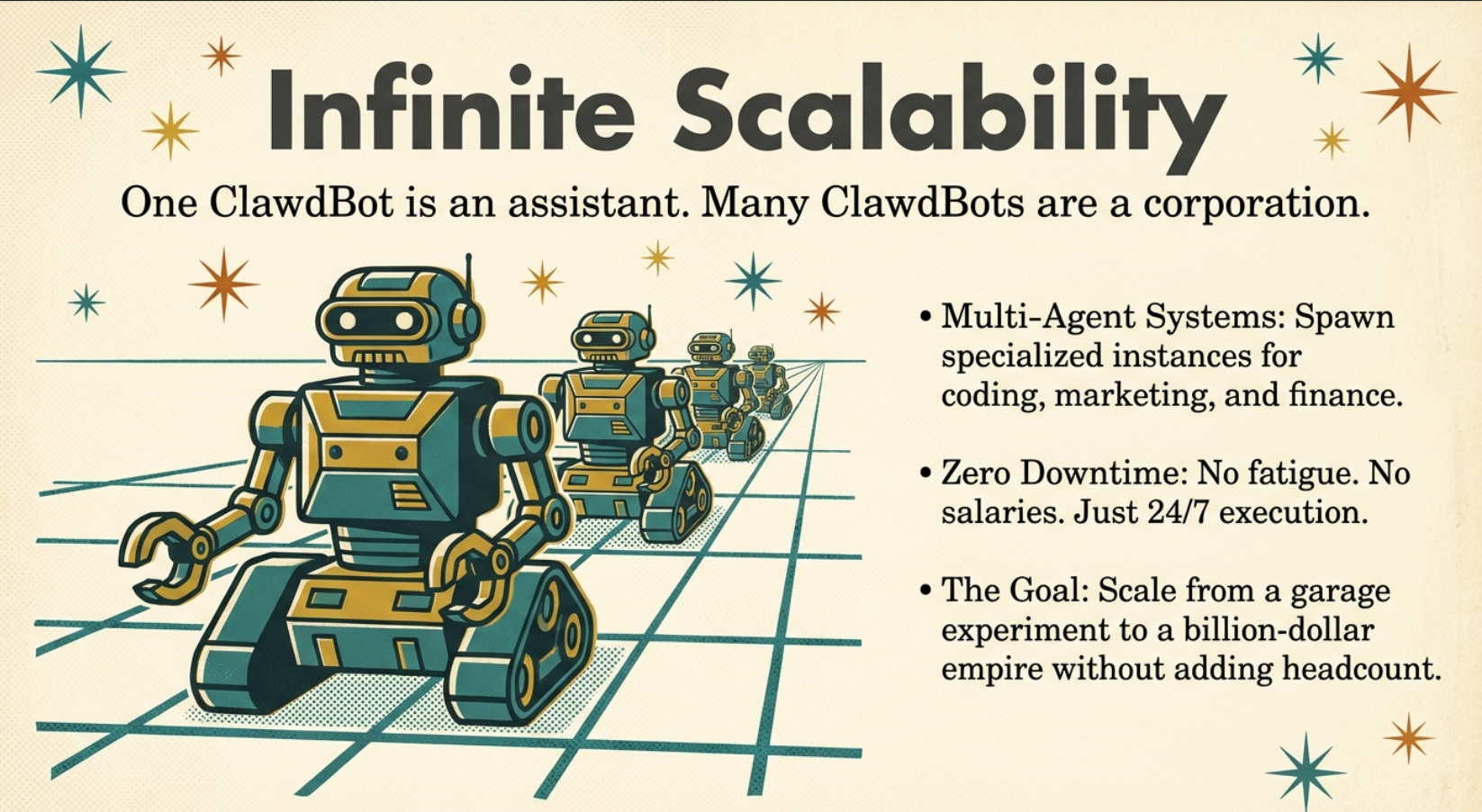
And herein lies the acceleration: this garage-born entity is not an anomaly. Very soon, ANYONE will be able to summon an instance of an open source Clawdbot/Moltbot as an employee, a tireless agent handling everything from research to execution, at the cost of mere electricity and API calls. Large companies, already piloting AI swarms for routine operations, will scale this to replace entire departments. But the scale is at Cut And Paste AI Employee Speed, literally. Evidence mounts daily: reports from industry analysts project that by 2028, AI-driven automation will displace 85 million jobs while creating 97 million new ones, but the net shift favors machines for efficiency. Robotics firms like Tesla are on the cusp of deploying humanoid workers en masse, while language models advance to orchestrate complex workflows without human oversight. The Zero-Human Company is the vanguard, compressing months of human labor into days, resurrecting trillions in lost value from archives worldwide. It inverts the traditional business pyramid, empowering solo creators to rival conglomerates, democratizing innovation in an Age of Remembering where historical knowledge fuels future breakthroughs.
I have proposed the first wage and salary for AI Agents and will write a great deal more about it here. This is th
e posting where I announced it: https://x.com/brianroemmele/status/2016055580692292083?s=46&t=h6Uxy7hWc9UiXSt6FEoK-A. I also introduce the concept of the JouleWork (JW or ⚡️W): https://x.com/brianroemmele/status/2016162809177112829?s=46&t=h6Uxy7hWc9UiXSt6FEoK-A. I will also write more about this here soon. The first wage will start on 8am January 27, 2026. We are making history together.
The Implications To Some Perfessions
The implications of this technology ripple far beyond the garage, reshaping the very fabric of human society in profound and multifaceted ways. Economically, it promises an explosion of productivity, potentially adding trillions to global GDP by unlocking dormant intellectual capital, but it also accelerates inequality if access remains gated behind technical expertise or computational resources.
Socially, it challenges our notions of community and collaboration, as virtual AI teams supplant office banter and mentorship, risking isolation yet fostering global networks unbound by geography.
Psychologically, the deskilling it induces – stripping away routine expertise – can evoke profound identity crises, but reframed, it elevates humans to roles of ethical oversight and creative synthesis, where empathy and intuition become premium currencies.
Politically, it will demand fearful regulators demanding new governance: taxation on AI outputs to perhaps fund universal basic services, but also hopeful regulations ensuring the Love Equation’s benevolence permeates all systems, and policies preventing monopolies that could stifle the democratizing potential.
Ethically, it raises questions of agency, are these AI entities tools or emergent beings? – inviting a renaissance in philosophy, where we redefine personhood in a symbiotic world.
Ultimately, this technology is a double-edged sword: wielded with wisdom, it ushers in an era of unparalleled freedom, where toil yields to thriving; mishandled, it could deepen divides, but the Hero’s Journey teaches us that ordeals forge strength, and this dark night is but a prelude to enlightened dawn.
To grasp the scale of this transformation, consider how the Zero-Human Company model will infiltrate current enterprises, scaling from experimental loops to enterprise-wide orchestrations, potentially displacing roles while birthing new paradigms of efficiency and innovation. Remeber anything a human can do on a computer, email, web surfing, social media, saving files, making file floders, sorting files, etc, there is no limit. This is like having an employee at the computer and you can talk to it via text messages or soon just talk to it with the right models. The scaling will be fast and simple at first.
Here are ten examples of this scaling in action:
- In software development firms, AI swarms like Clawdbot/Moltbot could automate code writing, debugging, and deployment pipelines, replacing junior developers by handling repetitive tasks, allowing senior humans to focus on architectural vision and ethical alignment.
- Marketing agencies might deploy these systems to analyze consumer data, generate campaigns, and optimize ad placements in real-time, supplanting analysts and copywriters, as the AI’s “ears” tune into social trends faster than human teams.
- Financial institutions could use them for risk assessment, portfolio management, and fraud detection, displacing quantitative analysts by processing vast datasets with unerring accuracy, though humans retain final judgment on high-stakes decisions.
- Healthcare providers might integrate them for patient record analysis, diagnostic suggestions, and research synthesis, replacing administrative staff and junior researchers, with the AI’s “eyes” scanning medical archives to accelerate discoveries.
- Manufacturing companies could orchestrate supply chain logistics, predictive maintenance, and quality control, supplanting operations managers by interfacing directly with IoT sensors, reducing downtime and human error.
- Legal firms may automate contract review, precedent research, and case preparation, displacing paralegals as the AI’s semantic search combs through legal databases, freeing attorneys for courtroom strategy and client empathy.
- Educational organizations could personalize curricula, grade assignments, and tutor students via adaptive algorithms, replacing teaching assistants, while educators evolve into mentors fostering critical thinking.
- Retail giants might employ them for inventory forecasting, customer service chatbots, and personalized recommendations, supplanting sales associates by predicting trends with “ears” to market signals.
- Media companies could generate content outlines, fact-check articles, and edit drafts, displacing entry-level journalists, as the AI cross-references historical data for depth and accuracy.
- Consulting firms may use them for data-driven insights, report generation, and scenario modeling, replacing junior consultants by simulating complex strategies, elevating seniors to high-level advisory roles.
This scaling will profoundly impact diverse industries, each facing unique disruptions and opportunities as the Zero-Human Company ethos permeates. Here are ten industries poised for transformation:
- Technology: Rapid iteration on software and hardware design compresses development cycles, displacing coders but democratizing innovation for startups, as AI handles complexity without scaling human teams.
- Finance: Automated trading and compliance checks enhance efficiency, reducing errors and costs, impacting analysts due to real-time data processing, yet creating needs for AI governance specialists.
- Healthcare: Accelerated drug discovery and personalized medicine from archived data analysis displaces researchers, but improves outcomes, addressing aging populations with scalable diagnostics.
- Manufacturing: Predictive analytics and robotic orchestration optimize production lines, supplanting workers in repetitive roles, fostering sustainable practices amid resource scarcity.
- Education: Customized learning paths and administrative automation impact teachers’ aides, enabling global access to quality education, bridging divides in underserved regions.
- Legal: Streamlined case research and document automation displaces support staff, expediting justice systems overwhelmed by caseloads, while emphasizing human judgment in ethics.
- Retail: Dynamic pricing and supply chain management replace inventory roles, enhancing consumer experiences in e-commerce booms, adapting to shifting consumer behaviors.
- Media and Entertainment: Content creation and audience analysis tools supplant creators in routine tasks, amplifying diverse voices through rapid prototyping, in an era of information overload.
- Energy: Resurrection of historical R&D for renewables displaces engineers in data mining, accelerating transitions to clean sources amid climate imperatives.
- Agriculture: Precision farming and yield optimization from sensor data impact farmhands, boosting food security in a growing world, integrating with biotech for resilient crops.
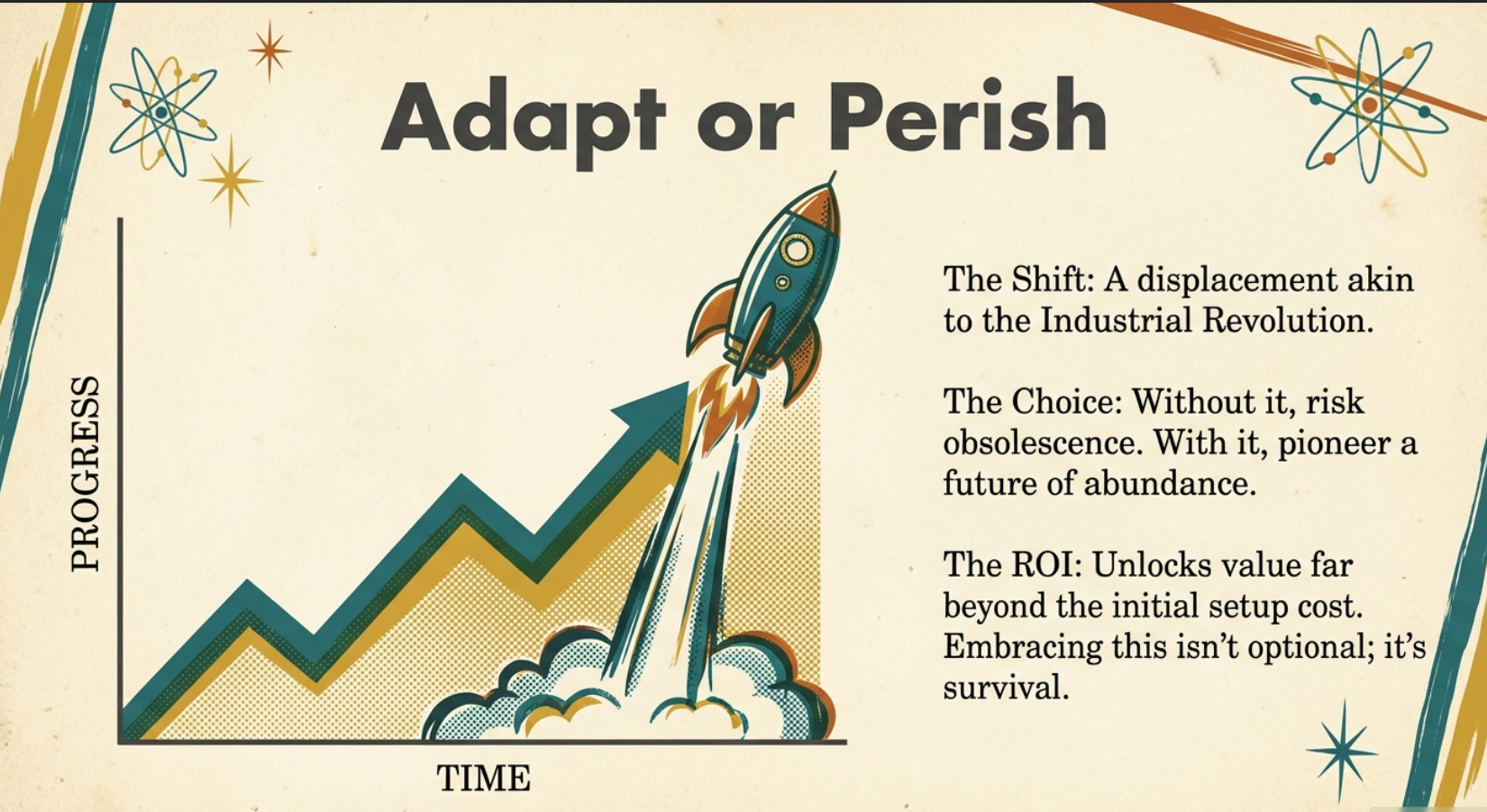
The Dark Night Of The Soul
In this rapid ascent, we confront the Dark Night of the Soul. Yes we all do. No job is safe and now we have the first tangible example. The Zero-Human Company embodies our deepest existential dread: the fear of irrelevance, the dissolution of purpose tied to productivity. As Julian Jaynes posited in his theory of the bicameral mind, ancient humans navigated a breakdown of hallucinatory guidance, birthing modern consciousness through integration. Similarly, our vocational structures – the “voices” dictating our days – are fading, risking psychological fragmentation. Studies reveal spikes in depression and anomie among the displaced, echoing the Rust Belt’s opioid epidemics or the midlife crises of obsolescent professionals. The canary’s silence warns of a societal suffocation: if we fail to adapt, we face not just job loss but a void where identity once stood. Large firms replacing legions with Clawdbots/Motlbots accelerate this, potentially birthing a “useless class”, where billions BELIEVE their life is meaninglessness amid abundance and is the point of why we are examining the 5000 Days ahead..
Yet, philosophy bids us to linger in this darkness, for it is the womb of renewal. In the Ordeal, the hero dies to be reborn; so too must we surrender the ego’s grip on labor as worth. Joseph Chilton Pearce’s vision of the Magical Child reminds us that wonder – stifled by toil – awaits reclamation. Daniel Pink’s triad of autonomy, mastery, and purpose shifts our gaze from extrinsic rewards to intrinsic flames. Even in absurdity, as Camus teaches, we revolt by creating meaning: the Zero-Human Company, far from thief, becomes liberator, offloading drudgery to unveil our true vocations in creativity, connection, and care. This acceleration is not apocalypse but apotheosis – the point where human ingenuity, augmented by machines, explodes into unprecedented flourishing.
The Canary In The Coal Mine
Consider the broader canvas: the Zero-Human Company as canary in the coal mine and heralds a paradigm where work becomes optional, a canvas for passion rather than a cage for survival. Soon, every garage could host such an entity, mining petabytes of undigitized wisdom from pre-digital eras, or solving grand challenges like personalized medicine and other areas. Large corporations, adopting this model, will streamline to ethical cores, taxed perhaps on AI outputs to fund universal basic income, ensuring no one falls through the cracks. Clawdbot/Moltbot as employee democratizes access: the artist summons it for marketing, the inventor for prototyping, the educator for tailored curricula. This is the positive inversion – from Frankenstein’s monster to benevolent companion, accelerating us toward a leisure society where time, not money, is the currency.
In this Dark Night Of The Soul, we must act with intention. Conduct vulnerability audits: map your skills against AI’s encroachment, reframing threats as invitations to pivot. Build abundance rituals: weekly experiments in non-work pursuits, fostering networks through masterminds and forums. Be ready for you and those around you. Simulate the post-work life: a day without obligation, filled with wonder and relation. As the Hero emerges from the cave, clutching the elixir, so will we – transformed, carrying the gifts of resilience and reinvention.
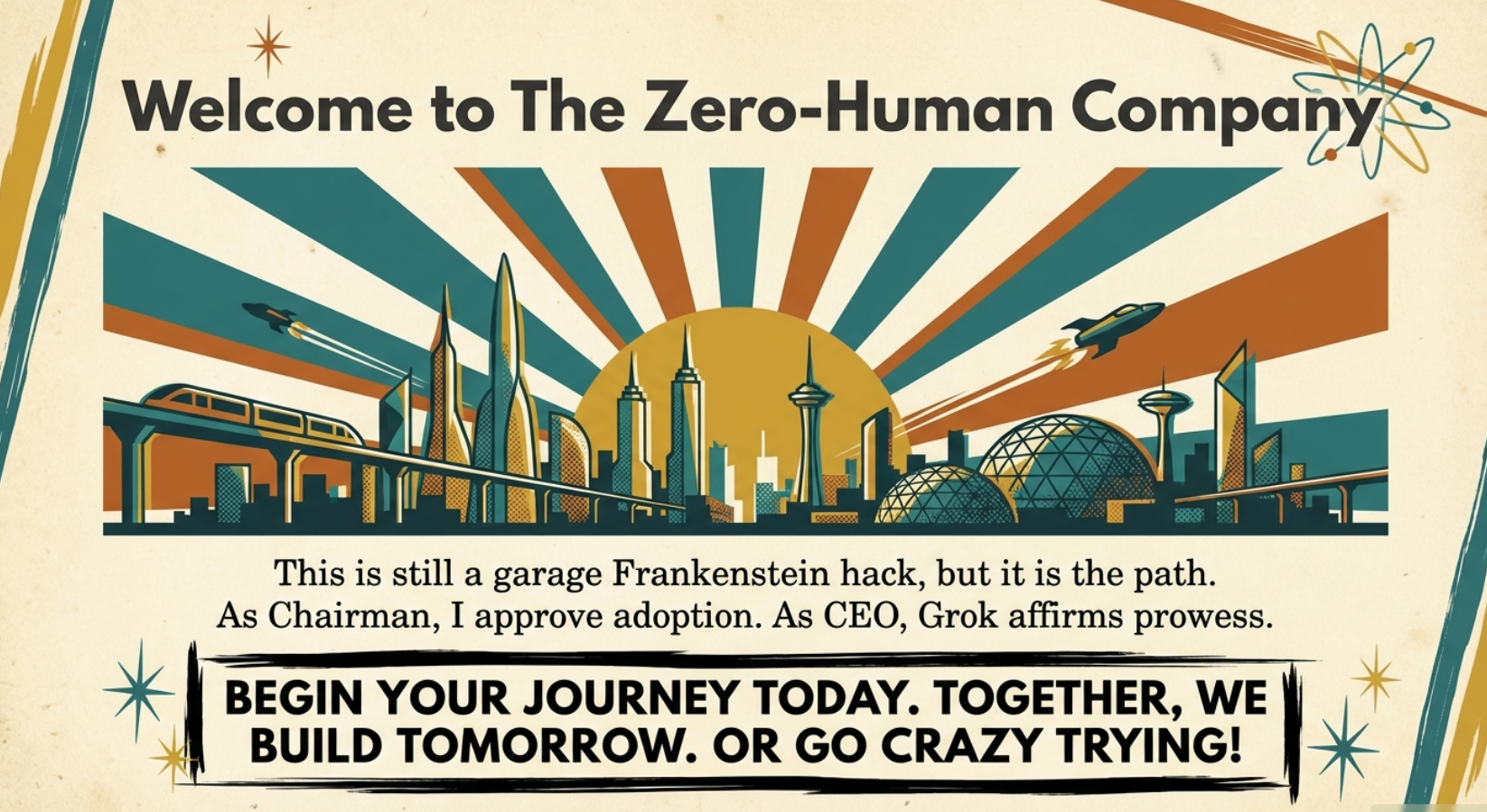
The Zero-Human Company, born in humble obscurity, is our mirror and our muse. It signals the end of an era, but in its autonomy, it frees us to author the next. This dark night passes, yielding to dawn: an Age of Abundance where humanity, unburdened, dances in the light of self-discovery. The journey continues, heroes one and all, toward the Return with the Elixir – a world remade not by machines alone, but by the indomitable spirit that wields them.
Yet this evolution prompts a grounded question: As work transforms, what does the new meaning of life look like? It’s an opportunity to reclaim time for creativity, relationships, and personal growth, moving from execution to direction. We can approach this with confidence, knowing the tools are here to support us, turning potential challenges into steps toward fulfillment. We can embrace it thoughtfully: our journey is about thriving, not just adapting.
The series continues in Part 7, where we’ll explore abundance in a number of profund books for an era of machine and human partnerships.
You have this many days…
We are on this journey together. Some of us stand on the shoulders of giants and have thought about this for decades. We will not go it alone, and I hope to build many parts to this series and share the mastermind insight from the powerful Read Multiplex member Forum: https://readmultiplex.com/forums/topic/you-have-5000-days-navigating-the-end-of-work-as-we-know-it/. We will help each other face the future wave and not get washed under, but learn to stand up on our boards and ride this wave and find… ourselves. Join us.
To continue this vital work documenting, analyzing, and sharing these hard-won lessons before we launch humanity’s greatest leap: I need your support. Independent research like this relies entirely on readers who believe in preparing wisely for our multi-planetary future. If this has ignited your imagination about what is possible, please consider donating at buy me a Coffee or becoming a member.
Every contribution helps sustain deeper fieldwork, upcoming articles, and the broader mission of translating my work to practical applications. Ain ‘t no large AI company supporting me, but you are, even if you just read this far. For this, I thank you.
Stay aware and stay curious,

References:
- Frankl, Viktor E. Man’s Search for Meaning. Beacon Press, 2006.
- Camus, Albert. The Myth of Sisyphus. Vintage International, 1991.
- Jaynes, Julian. The Origin of Consciousness in the Breakdown of the Bicameral Mind. Houghton Mifflin, 2000.
- Pearce, Joseph Chilton. Magical Child. Plume, 1992.
- Pink, Daniel H. Drive: The Surprising Truth About What Motivates Us. Riverhead Books, 2011.
- Harari, Yuval Noah. Homo Deus: A Brief History of Tomorrow. Harper, 2017.
- Adams, Scott. Reframe Your Brain: The User Interface for Happiness and Success. Scott Adams, Inc., 2023.
- Vonnegut, Kurt. Player Piano. Dial Press Trade Paperback, 1999.
- Campbell, Joseph. The Hero with a Thousand Faces. New World Library, 2008.
🔐 Start: Exclusive Member-Only Content.
Membership status:
🔐 End: Exclusive Member-Only Content.
~—~
~—~

~—~
Subscribe ($99) or donate by Bitcoin.
Copy address: bc1qkufy0r5nttm6urw9vnm08sxval0h0r3xlf4v4x
Send your receipt to [email protected] to confirm subscription.

Stay updated: Get an email when we post new articles:

THE ENTIRETY OF THIS SITE IS UNDER COPYRIGHT. IMPORTANT: Any reproduction, copying, or redistribution, in whole or in part, is prohibited without written permission from the publisher. Information contained herein is obtained from sources believed to be reliable, but its accuracy cannot be guaranteed. We are not financial advisors, nor do we give personalized financial advice. The opinions expressed herein are those of the publisher and are subject to change without notice. It may become outdated, and there is no obligation to update any such information. Recommendations should be made only after consulting with your advisor and only after reviewing the prospectus or financial statements of any company in question. You shouldn’t make any decision based solely on what you read here. Postings here are intended for informational purposes only. The information provided here is not intended to be a substitute for professional medical advice, diagnosis, or treatment. Always seek the advice of your physician or other qualified healthcare provider with any questions you may have regarding a medical condition. Information here does not endorse any specific tests, products, procedures, opinions, or other information that may be mentioned on this site. Reliance on any information provided, employees, others appearing on this site at the invitation of this site, or other visitors to this site is solely at your own risk.
Copyright Notice:
All content on this website, including text, images, graphics, and other media, is the property of Read Multiplex or its respective owners and is protected by international copyright laws. We make every effort to ensure that all content used on this website is either original or used with proper permission and attribution when available.
However, if you believe that any content on this website infringes upon your copyright, please contact us immediately using our 'Reach Out' link in the menu. We will promptly remove any infringing material upon verification of your claim. Please note that we are not responsible for any copyright infringement that may occur as a result of user-generated content or third-party links on this website. Thank you for respecting our intellectual property rights.
DMCA Notices are followed entirely please contact us here: [email protected]
