
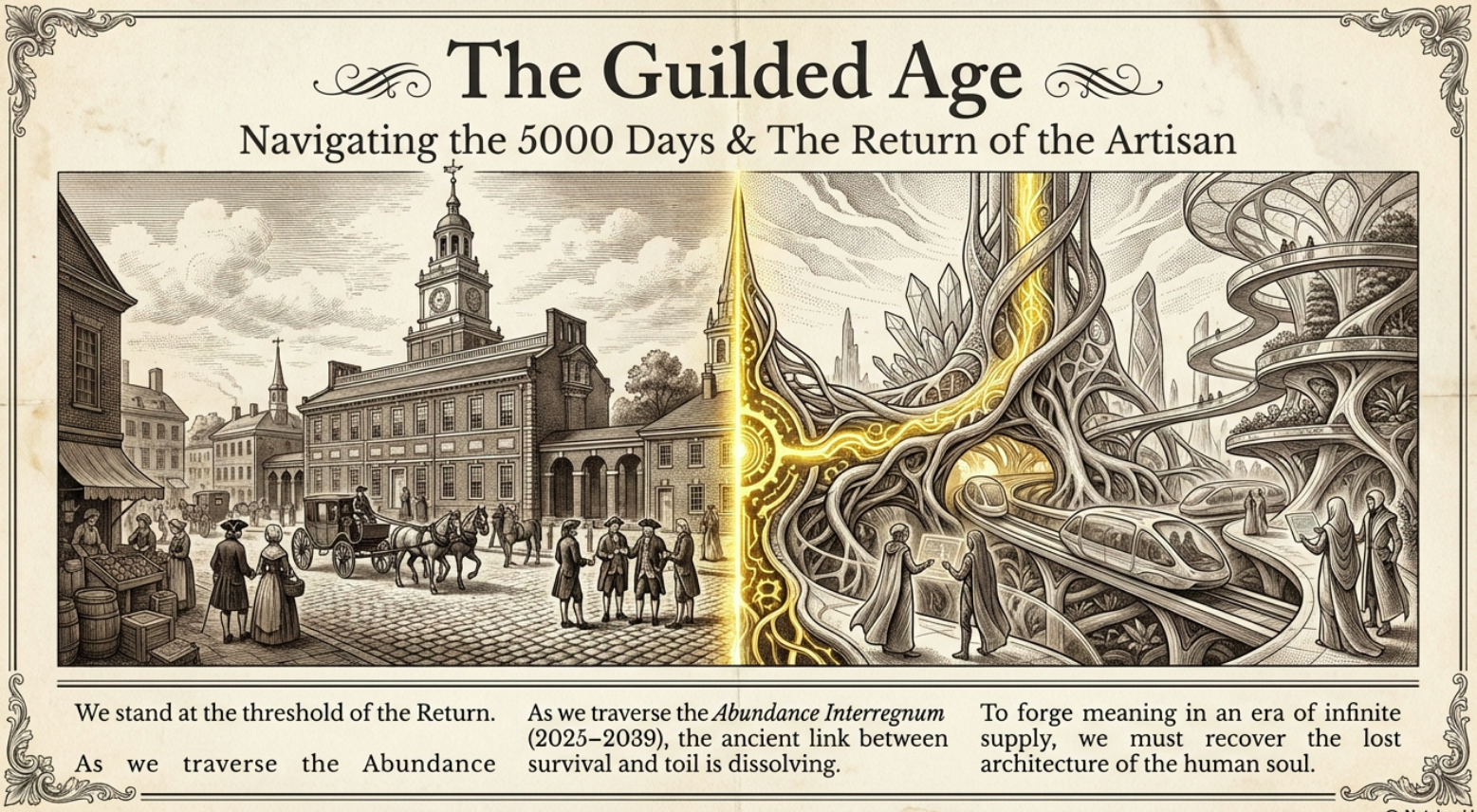
You Have 5000 Days: Navigating the End of Work as We Know It. Part 12: The Guilded Age.
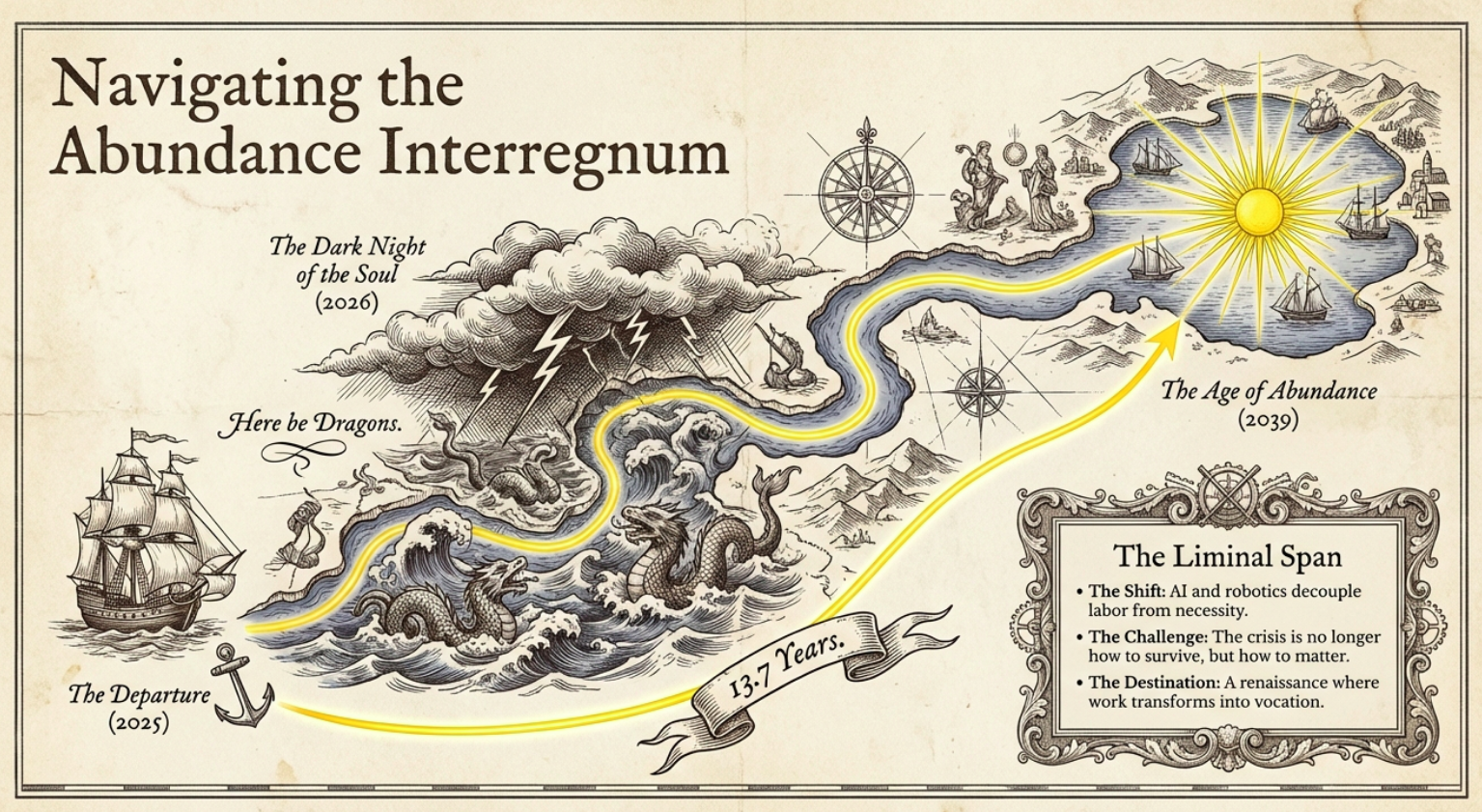
We have journeyed together through twelve profound chapters of our collective Hero’s Journey, as Joseph Campbell’s mono-myth illuminates the path of humanity across the Abundance Interregnum, that liminal span of roughly 13.7 years from late 2025 toward the threshold of 2039. Artificial intelligence and robotics are dissolving the ancient chain that once bound survival to ceaseless toil. What awaits is not emptiness but a renaissance where work transforms into vocation, purpose becomes chosen, and we master both the realm of scarcity we depart and the plenitude that beckons. We have had an interesting journey thus far and have visited a number of ideas to help us on the paths ahead. Let us review briefly where we have been, and if this is your first in this series, take the time to go to part 1 and follow along:
In Part 1, The Call to Adventure (December 24, 2025, Link), we heard the summons: students graduating in spring 2026 will inhabit a world unrecognizable by the end of the next 5000 days, with abundance arriving between mid-2036 and mid-2041 as AI decouples labor from necessity.
Part 2, Crossing the Threshold (December 31, 2025, Link), guided us across the divide, confronting grief and urging preemptive adaptation rather than denial.
Part 3, The Player Piano (January 1, 2026, Link), invoked Kurt Vonnegut’s prophetic vision of automation’s alienating shadow amid material plenty.
Part 4, Reframing the Dawn of Abundance (January 19, 2026, Link, recast plenitude as profound liberation, offering mental and physical strategies for the transition.
Part 5, Your Deskilling (January 20, 2026, Link), explored the necessary shedding of rote tasks as AI assumes them, clearing space for reskilling into realms of creation and meaning.
Part 6, The Dark Night of the Soul (January 27, 2026, Link), descended into the collective abyss of identity crisis and despair where old selves dissolve.
Part 7, Consider Phlebas (January 30, 2026,Link), navigated moral chaos and the search for meaning beyond utility, drawing wisdom from Iain M. Banks.
Part 8, Saving Your Wisdom (February 2, 2026, Link), taught us to safeguard irreplaceable human insight amid the machine tide.
Part 9, The Artisan’s Awakening (February 4, 2026,Link), celebrated the resurgence of embodied craft as bulwark and soul anchor in the new era.
Part 10, Everyone Is Doing It (February 8, 2026, Link), revealed the quiet, widespread tipping point of collective embrace of these tools.
Part 11, The Reversal of Obsolescence (February 14, 2026, Link), applied Marshall McLuhan’s insights to flip apparent irrelevance into new sovereignty through symbiotic mastery.
Part 12, The Profit and the Architect (February 16, 2026, Link), crowned the resurrection with cybernetic symbiosis, where technology serves human purpose and entropy yields to feedback loops of meaning.
Listen to the companion podcast: https://rss.com/podcasts/readmultiplex-com-podcast/2559803
This article is sponsored by Read Multiplex Members who subscribe here to support my work:
Link: https://readmultiplex.com/join-us-become-a-member/
It is also sponsored by many who have donated a “Cup of Coffee”. If you like this, help support my work:
The New Guilded Age
Now we reach a Return, the monomyth’s culminating gift. The elixir (what we learned) we carry back from the trials is no glittering gadget but a time-tested societal and psychological architecture: the guild economy. This is not truly about economics. It is about how society restructures itself around human rarity and how our psyches adapt to find enduring meaning when machines grant material freedom.
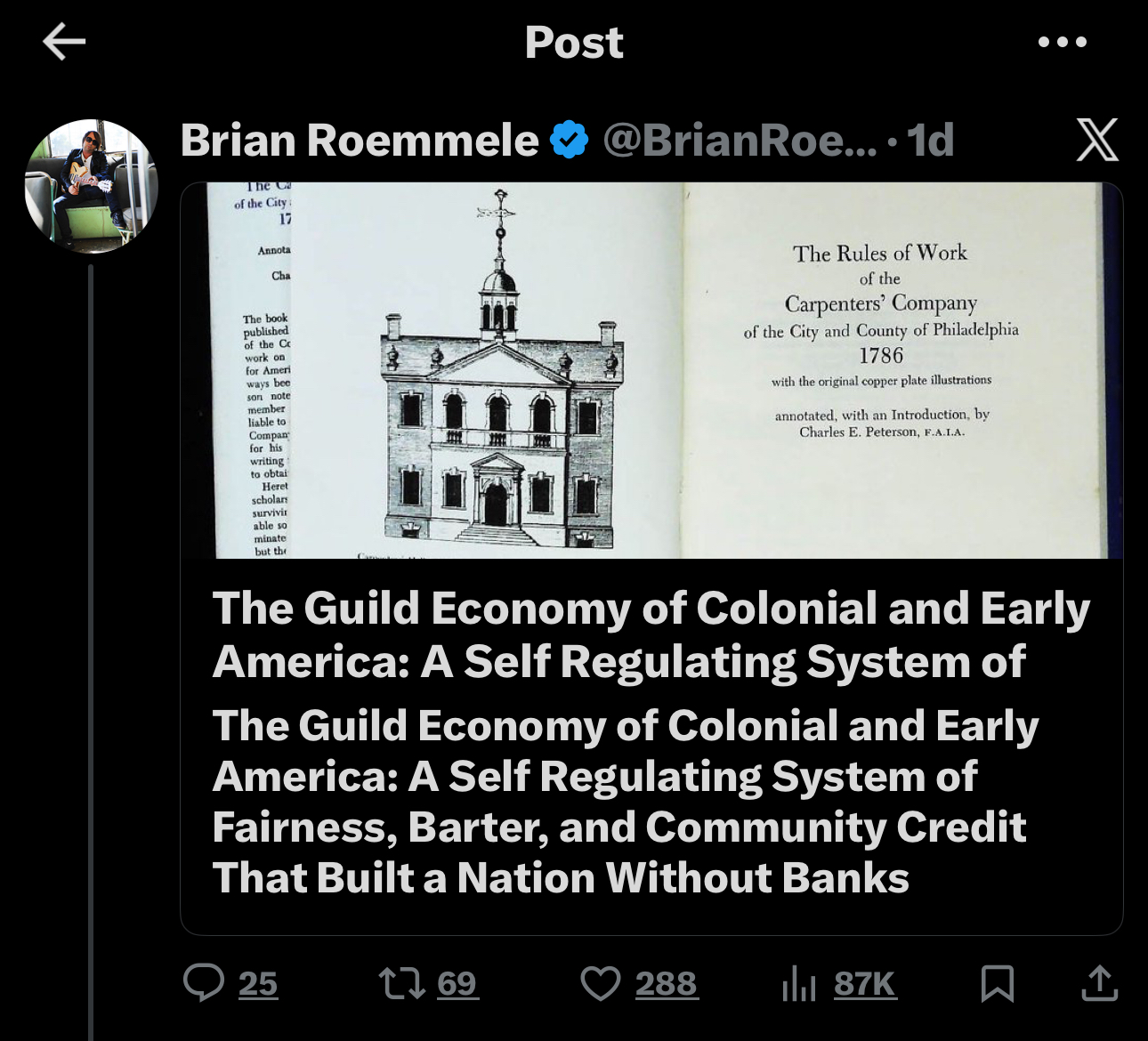
I have been writing about this for sometime and wrote an Article on X: https://x.com/brianroemmele/status/2024304941674951026?s=46&t=h6Uxy7hWc9UiXSt6FEoK-A
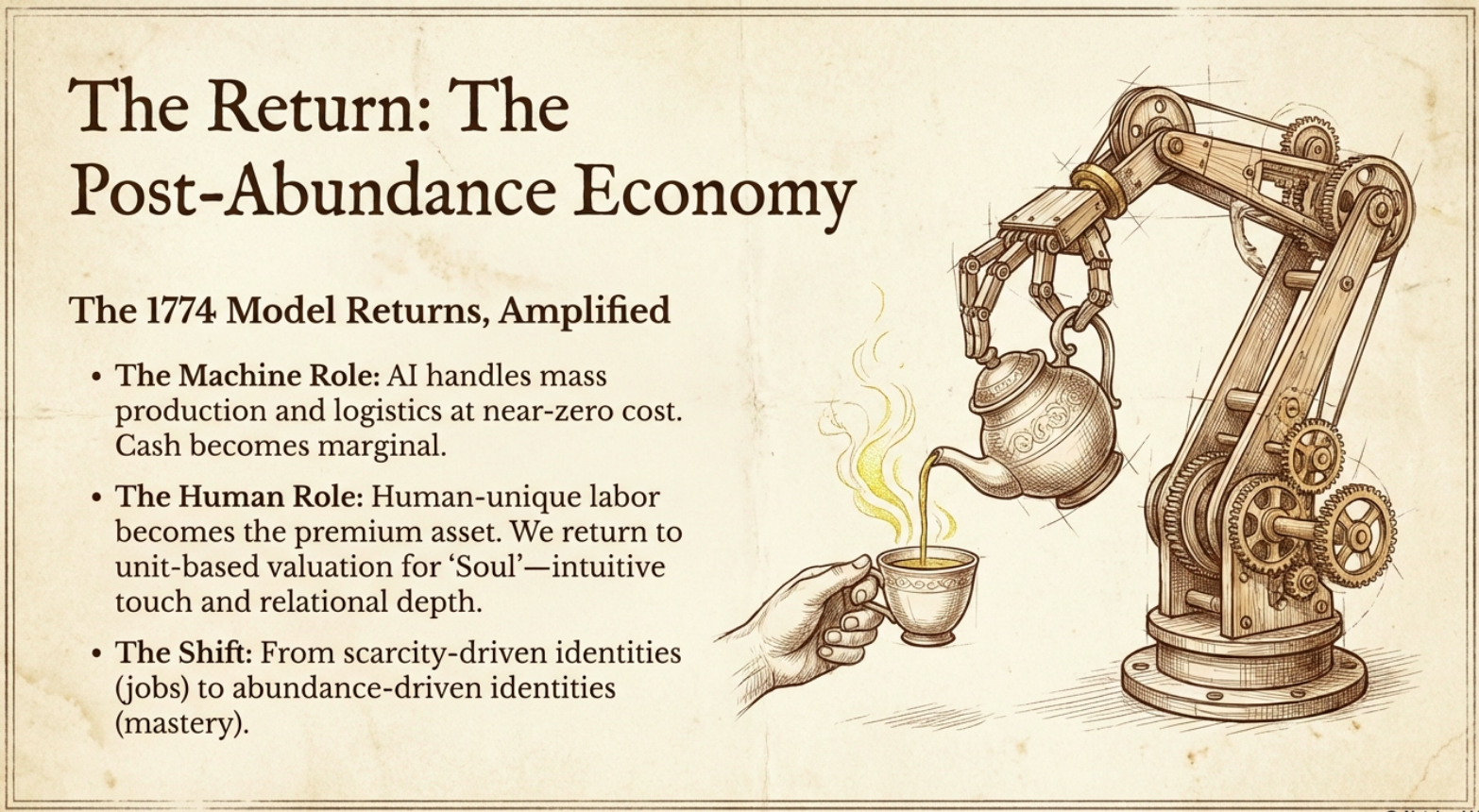
In the coming Age of Abundance, where AI and robotics produce goods and services at near-zero cost, traditional cash grows nearly worthless, a vestige of scarcity mindsets. What becomes priceless is the unique spark of human labor: the intuitive touch of a craftsman, the relational depth of lived wisdom, the irreplaceable bond forged in community. Guilds, reborn as decentralized networks of craft associations, will standardize fairness, extend relational credit, and bind us in webs of mutual obligation that heal the fractures of the Dark Night. Now the resurgence of guilds are just one path we will explore today, there are many we will explore in the future. However this path makes a great deal of sense with perhaps use of a blockchain ledger and even a token that could reflect the earned value.
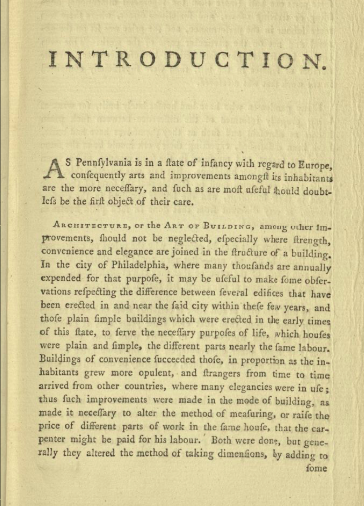
In the centuries before 1863, America operated under precisely such a system, a decentralized guild-based economy rooted in craft associations, standardized unit pricing, extensive barter, and informal community credit networks. No national banking system existed to intermediate every transaction or extract ongoing profit through interest. Master craftsmen, especially in building trades, served as architects, engineers, contractors, and financiers rolled into one. Work was valued by measurable output rather than hourly labor. Credit flowed directly between neighbors and tradespeople, often carried on the books for months or years without formal loans. Currency was scarce, so provisions, services, and raw materials changed hands in a web of mutual obligation that bound communities together.
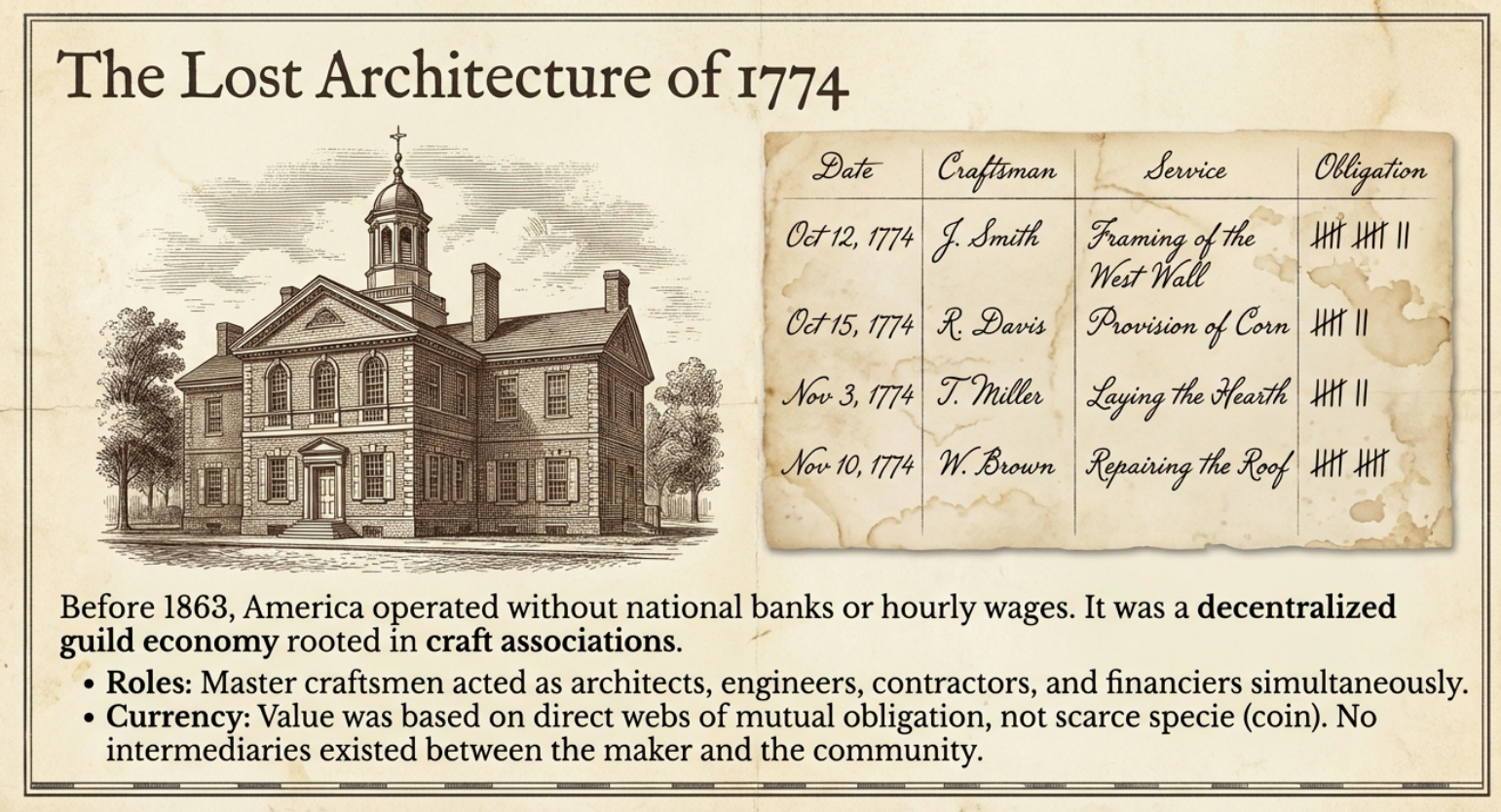
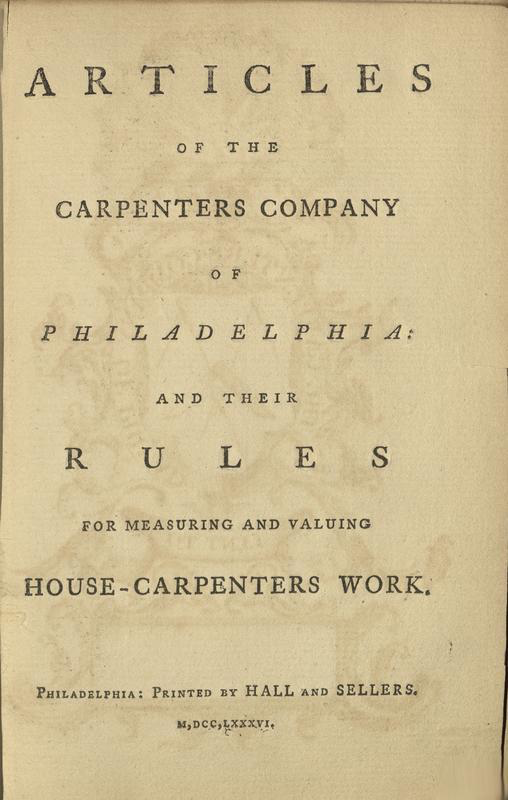
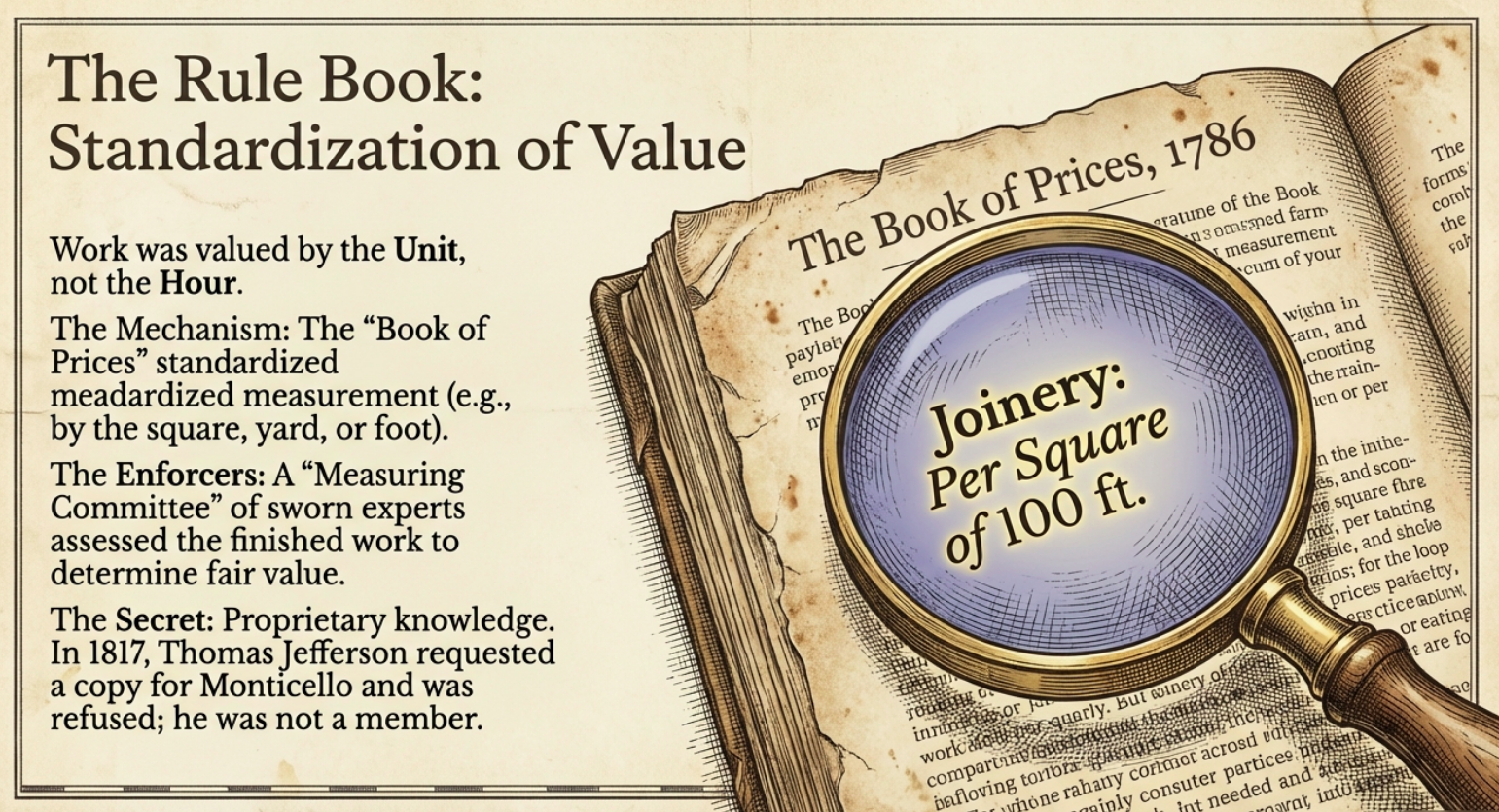
This was the system that erected Independence Hall, Carpenters Hall (where the First Continental Congress met in 1774), Christ Church, and countless sturdy homes and furniture pieces that still endure today. The Carpenters Company of Philadelphia, founded in 1724, offers the clearest window. By 1763 they had formalized a Book of Prices (https://diglib.amphilsoc.org/islandora/object/text%3A148093), also called the Rule Book, a pricing guide that standardized measurement and valuation of every stage of carpentry work by the square (100 square feet of flooring or roofing), the yard, or the foot.
A committee of experienced measurers (at least two working together, certified only after five years of membership and sworn to the standard) would assess completed work. Prices were fixed equitably for general categories rather than haggling over every nail or board. The book itself was treated as semi-secret: shown only to members, with fines escalating to expulsion for unauthorized copying or disclosure to outsiders. In 1817 former President Thomas Jefferson, architect of Monticello and the Virginia State Capitol, requested a copy and was politely refused. He was not a member. The knowledge belonged to the guild.
Apprenticeships lasted the traditional seven years. Masters provided training, room, and board. Journeymen worked under them. No modern hourly wage dominated. Payment was task or unit based. A master builder could undertake an entire project, design, materials procurement, labor coordination, without needing a bank loan for supplies. Extended book credit filled gaps: a carpenter might frame a house for a farmer and receive credit for lumber, food, livestock, or future labor, carried on ledgers for months or even years. The U.S. Bureau of Labor Statistics historical bulletins confirm that a system of barter existed throughout the first century of settlement and scarce specie (gold and silver coin) meant currency was little used. Wages, when paid in cash, were often supplemented or replaced by provisions, corn, pork, rum, cloth.
Guilds provided built-in social insurance. The Carpenters Company maintained a library of architecture books (begun 1736 with bequests), offered relief to sick or injured members, widows, and orphans, and even invested surplus funds conservatively in government securities or mortgages. Disputes over measurements or payments were settled internally by the pricing committee. This was economic self-governance at its purest: no external regulator or financier dictating terms.
Similar patterns held across trades, coopers, blacksmiths, tailors, shoemakers, especially in rural and small-town America. The system scaled to cities like Philadelphia, where guilds helped build the physical symbols of independence. Quality was legendary: an oak chair from the 1840s, passed down in families, remains perfectly level nearly two centuries later. Buildings constructed under these rules still stand as testaments to durable, honest workmanship unpressured by cost-cutting for debt service.
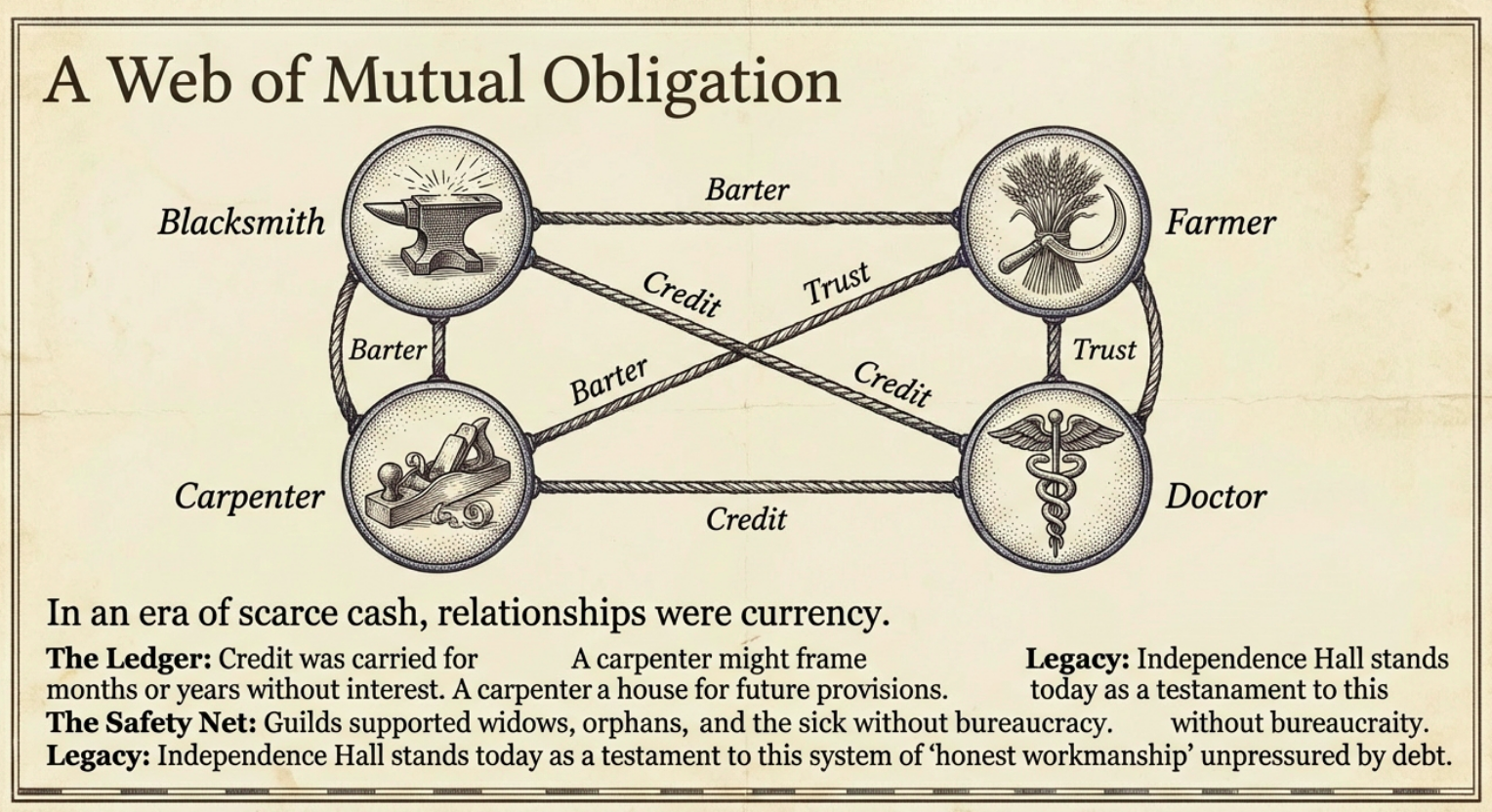
This system was perfect for its era because it delivered fairness without intermediaries, community resilience and low debt, high-quality output, independence and self-reliance, and a social safety net without bureaucracy. It lasted roughly three centuries, from early settlements through the early republic, powering the material foundation of American independence. It only disappeared when federal legislation deliberately centralized money and credit, making the old relational model incompatible.
In our post-abundance future, after the interregnum, this structure returns amplified. AI handles mass production and logistics, rendering cash marginal at best. Human-unique labor becomes the rarest commodity, prized not for survival but for soul, legacy, and connection. Guilds will operate as voluntary, localized networks, often digitally augmented (using a block chain and perhaps a Token) yet grounded in face-to-face trust. Valuation remains unit-based: by the square foot of hand-finished work, the complexity of a bespoke design, the emotional resonance of a live performance. Credit flows on communal ledgers, tracked transparently yet enforced by reputation. Barter evolves into sophisticated exchanges of unique human gifts. The psychology of adaptation is profound: we move from scarcity-driven identities tied to jobs and consumption to abundance-driven identities rooted in mastery, contribution, and belonging. The Dark Night yields to resurrection as we discover that meaning was never in the machine but in the irreplaceable human touch we offer one another.
Here are ten clear and deep examples of how this guild economy would function, each illustrating the societal restructuring and psychological shifts that define the Return.
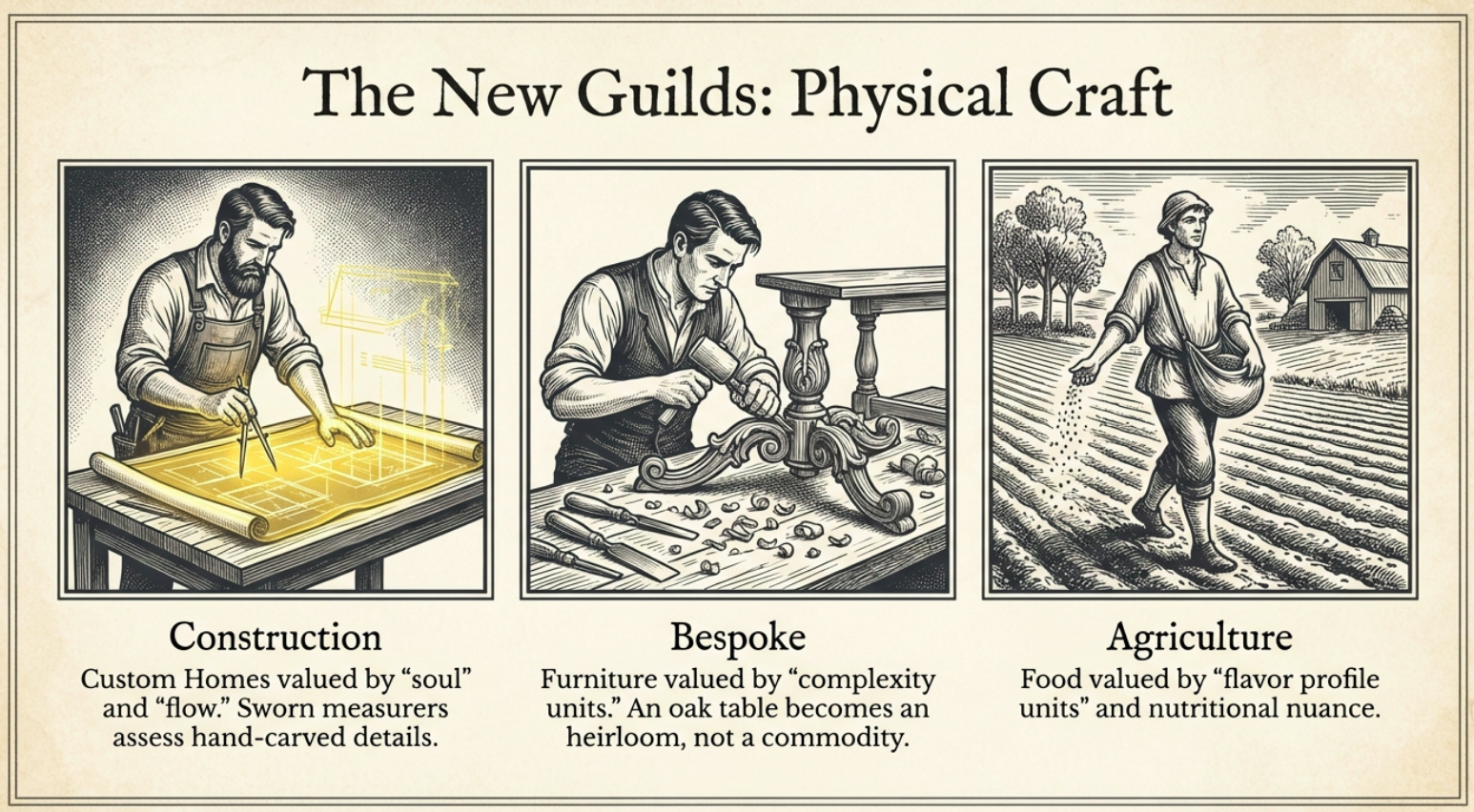
- Custom Home Construction Guilds. A family seeks a home infused with personal history. AI generates structural plans, but guild master builders add soul: ergonomic flow tuned to the family’s rhythms, hand-carved details echoing ancestral motifs. Two sworn measurers value the work by standardized units, the square foot of framing, the linear foot of custom trim. Payment comes in guild credits redeemable for other human-unique services or direct barter of family heirlooms or garden produce. Psychologically, the builder finds purpose in legacy-building, the family in personalized sanctuary. Communities strengthen as neighbors witness and later replicate the process, healing isolation born of the industrial age.
- Bespoke Furniture and Artifact Guilds. An oak table, carved by hand over months, is priced not by time but by complexity units: joinery type, finish intricacy, symbolic inlays. Guild committees ensure equitable valuation. The maker receives credits for future unique goods. In abundance, this piece stands as heirloom, not commodity. The psychology: creators reclaim identity as stewards of beauty, recipients cultivate gratitude and discernment, shifting from disposable consumption to treasured continuity.
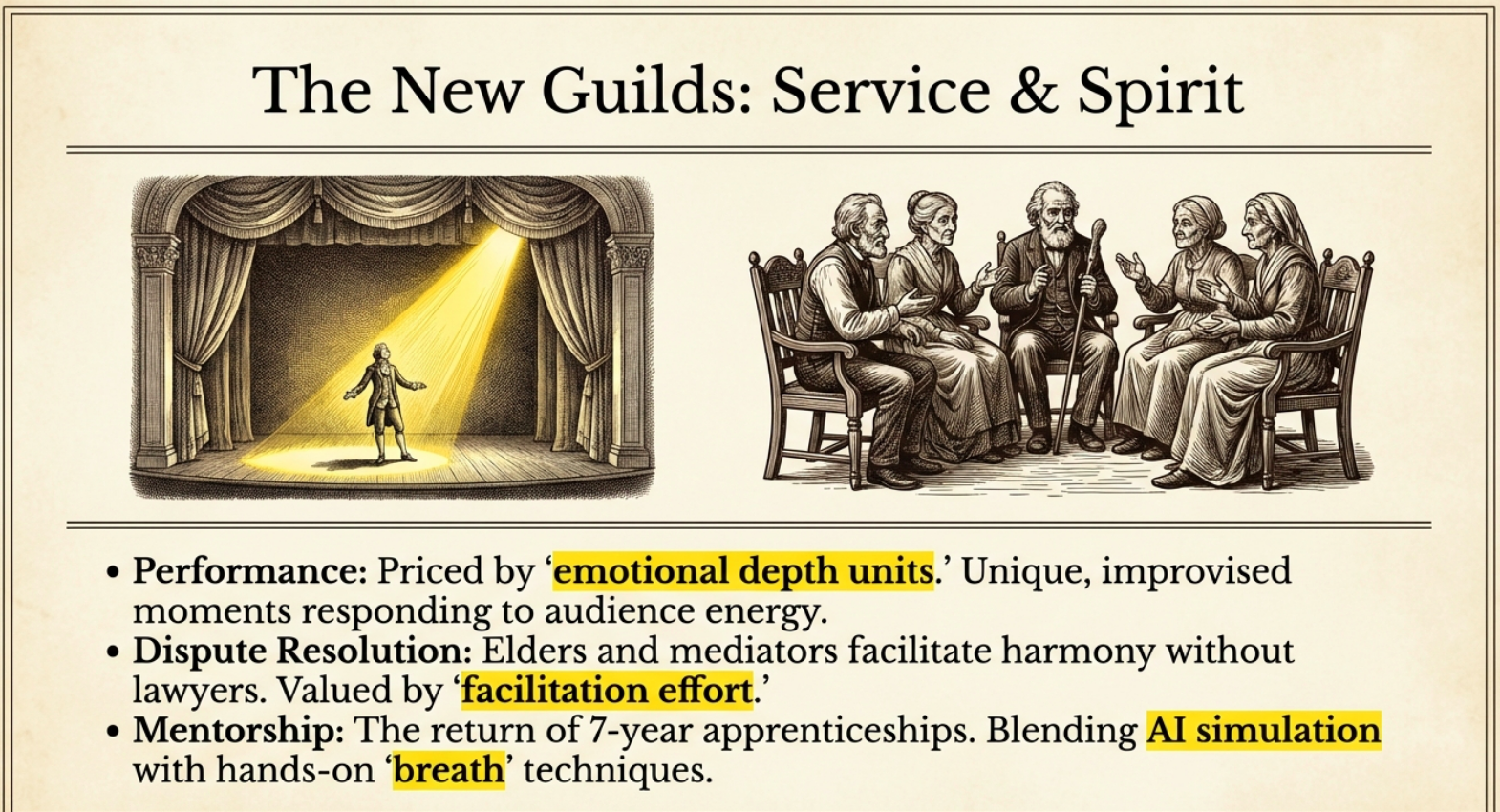
- Mentorship and Apprenticeship Guilds in Trades. Seven-year apprenticeships revive, blending AI simulation with hands-on mastery in fields like blacksmithing or tailoring. Journeymen earn credits by teaching unique techniques AI cannot replicate, such as intuitive metal tempering attuned to the artisan’s breath. Graduates join the guild, contributing to mutual aid funds. This structure restores rites of passage, psychologically anchoring young adults in purpose and elders in respected legacy, countering the purposelessness that haunted the Dark Night.
- Culinary and Fermentation Guilds. Chefs craft meals from hyper-local, AI-optimized ingredients but infuse them with generational recipes and emotional storytelling at communal tables. Valuation by portion complexity or sensory innovation units. Diners pay in credits or barter unique spices grown in personal plots. The result: feasts that bind neighborhoods. Psychologically, participants rediscover joy in shared sensory presence, transforming eating from solitary fuel to ritual connection.
- Live Performance and Storytelling Guilds. Actors, musicians, and tale-weavers present one-of-a-kind evenings where improvisation responds to audience energy in real time. Priced by duration and emotional depth units, settled via guild ledgers. AI handles lighting and amplification, yet the human spark remains irreplaceable. Audiences trade credits earned from their own unique contributions. This revives oral tradition, psychologically nourishing collective imagination and empathy eroded by screen-mediated life.
- Community Dispute Resolution Guilds. Trained mediators, drawn from respected elders and counselors, resolve conflicts using unit-based valuation of facilitation effort. No lawyers or courts needed. Resolutions logged in guild books, building communal precedent. In abundance, where material stakes shrink, relational harmony becomes paramount. Psychologically, this fosters accountability and forgiveness, healing the fractures of individualism that intensified during deskilling.
- Holistic Healing and Elder Care Guilds. Practitioners blend AI diagnostics with human touch: empathetic listening, intuitive energy work, hands-on therapies. Sessions valued by relational depth units. Families contribute credits or in-kind care. Widows and orphans receive automatic guild support. This structure prevents isolation in longevity, psychologically restoring dignity to aging and caregiving as sacred roles rather than burdens.
- Symbiotic Innovation Guilds. Humans and AI co-create breakthroughs, but guilds value the human insight, the “why” behind the “how”. A gardener-engineer devises a soil-regenerating system, priced by novelty and impact units. Credits flow to further experiments. Psychologically, participants experience flow states of mastery, transcending the reversal of obsolescence into sovereign co-creation with machines.
- Small-Scale Farming and Seed-Saving Guilds. Farmers cultivate unique varietals using intuitive methods AI optimizes but cannot originate. Harvests traded by flavor profile and nutritional nuance units. Surplus credits support community seed banks. In plenitude, food becomes expression of place and care. This grounds psyches in seasonal rhythms, countering disconnection and cultivating stewardship as core identity.
- Crisis Mutual Aid Guilds. When fire, illness, or loss strikes, guilds activate contribution-based relief drawn from entrance fees, rents, and investments, exactly as the Carpenters Company did. No insurance bureaucracies. Neighbors extend book credit seamlessly. Psychologically, this instills profound security and reciprocity, transforming potential despair into reinforced belonging and resilience.
Practical Day-to-Day Operations and the Profound Psychological Rewards of Direct Exchange
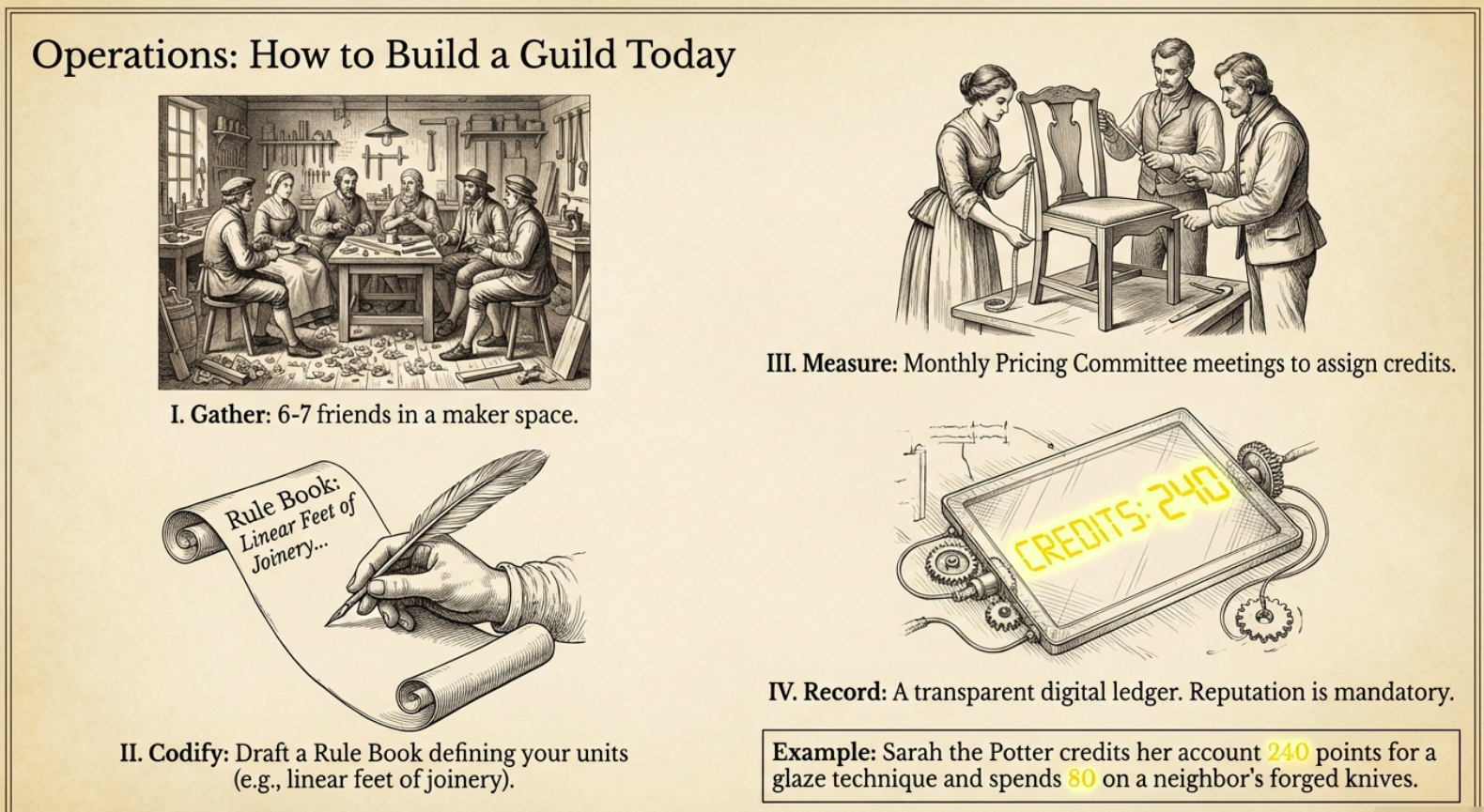
In practice the reborn guild economy will feel refreshingly simple and human-scaled, even in our hyper-connected future. Anyone can start a local guild today, during these very 5000 days. Gather six or seven skilled friends in a neighborhood maker space or living room. Draft a short Rule Book modeled on the 1786 original, listing the units your craft will use, for example, square feet of hand-laid tile, linear feet of custom joinery, or emotional-depth hours for storytelling sessions. Post the invitation on local apps or community boards. Membership is voluntary and merit-based: applicants demonstrate competence through a small public project, then serve a three-to-six-month probation contributing to group projects. No one is turned away for lack of money, only for unwillingness to meet the shared standard of excellence. Once accepted, each member receives a digital guild card linked to a transparent, shared ledger app, blockchain-optional but reputation-first, where every credit earned or spent is visible to the entire group.
Day-to-day operations run on rhythm and trust. Once a month the pricing committee, two or three rotating senior members, meets in person or via video to review completed work. They measure, discuss, and assign credits using the agreed units, always with the creator present to answer questions. Payment is instant: credits appear in the recipient’s ledger and can be spent immediately on any other guild service or held as a promise for future needs.

AI quietly handles background logistics, suggesting optimal barter matches or flagging imbalances, but final decisions remain human and face-to-face. Disputes are rare because the system is transparent, yet when they arise they are settled the same evening by the full guild circle, guided by precedent recorded in the Rule Book (or blockchain) itself. Scaling happens naturally: successful neighborhood guilds link digitally into regional networks, allowing a woodworker in rural Oregon to trade credits for a custom ceramic set from a potter in Austin, all while preserving the personal stories behind each piece.
Consider a concrete 2032 example. Sarah, a guild-trained potter, throws and glazes a set of twelve dinner plates over two weeks. She uploads photos and a short video describing the glaze technique inspired by her grandmother. The pricing committee visits her studio, measures the pieces by surface area and complexity units, and credits her account with 240 guild points. Sarah immediately spends 80 points on a neighbor’s hand-forged kitchen knives, 60 on live music for her daughter’s birthday, and banks the rest toward a family cabin renovation. Every step is visible, every participant knows exactly whose hands and heart went into the object they receive. No bank, no invoice, no hidden fees, just direct, joyful exchange.
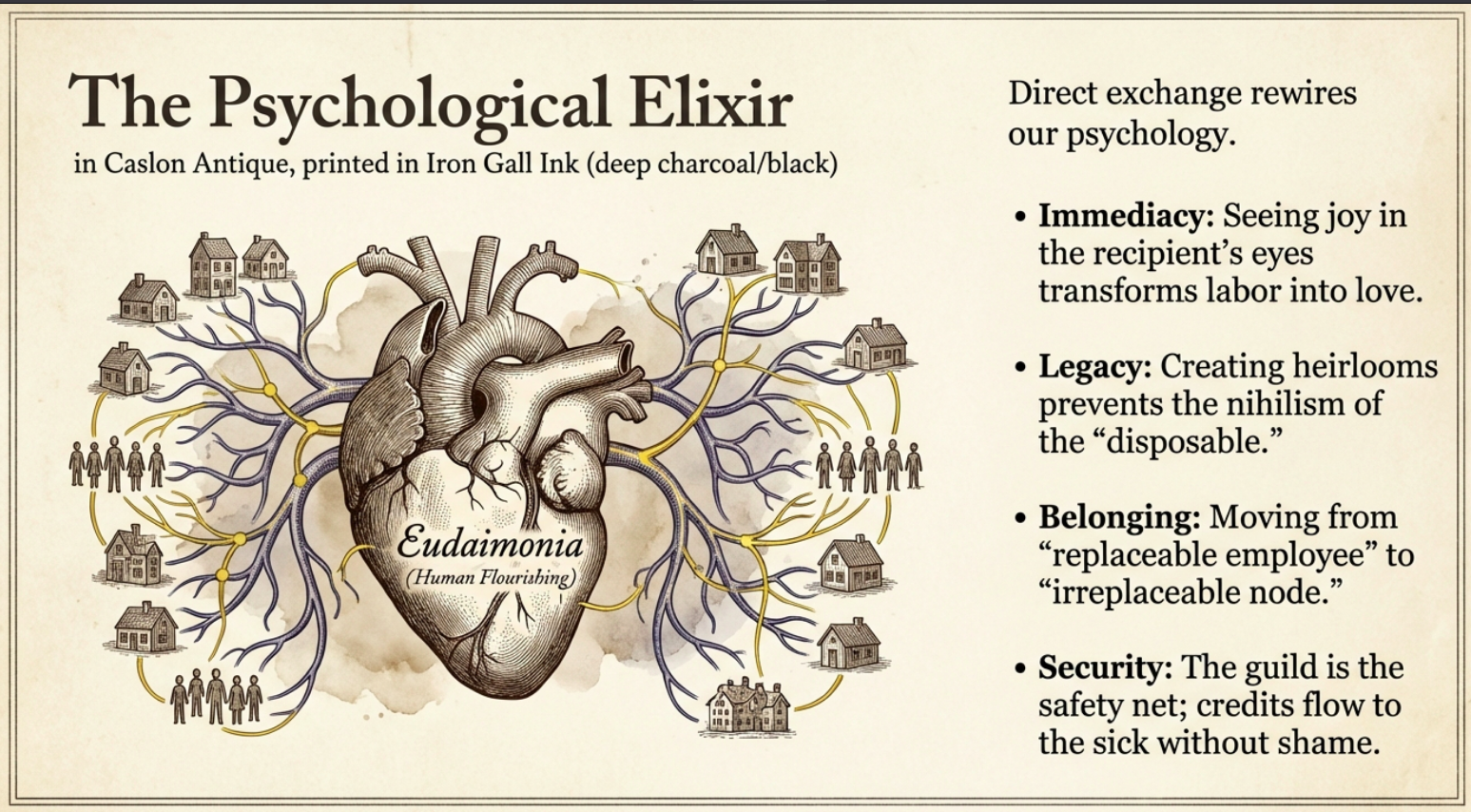
Psychologically this practical structure creates an explosion of meaning that abstract money could never provide. When you hand-deliver your creation and watch the recipient’s eyes light up, you experience the ancient satisfaction of being truly needed. Your unique skill is no longer diluted into a paycheck that disappears into rent or subscriptions. It becomes a visible thread in the living tapestry of your community.
This immediacy dissolves the alienation that defined the industrial and digital ages. You feel seen, valued, and connected in ways screen interactions never achieved. Over time the repeated cycles of create, measure, exchange, and receive build a profound sense of belonging. You are not a replaceable employee, you are an irreplaceable node in a web of mutual care.
The psychological rewards deepen further through identity and legacy. In the guild you are known as “the one who makes the impossible joints fit perfectly” or “the storyteller whose tales heal old wounds.” That recognition becomes core to who you are. Young people entering apprenticeships discover purpose through clear rites of passage and visible progress, while elders find renewed vitality in mentoring and contributing to mutual aid. Anxiety about the future melts away because the system itself is the safety net. When hardship comes, credits flow without paperwork or shame. The result is eudaimonia, the deep flourishing Aristotle described, born from exercising your highest human capacities in service to others who genuinely appreciate them. Connection multiplies: every trade strengthens relationships, turning strangers into extended family and acquaintances into lifelong collaborators.
Even the smallest daily interactions carry emotional weight. A quick coffee trade where you repair a friend’s broken chair in exchange for their homemade bread becomes a moment of genuine gratitude and laughter. These micro-exchanges accumulate into a life rich with meaning. You wake up excited to create because you know your work will be received with joy, not filed away in some corporate ledger. In the Age of Abundance the machines free us from drudgery so that we can pour ourselves into the irreplaceable human acts that make life worth living. The guild economy turns that freedom into daily celebration.
These examples reveal the deeper truth: the guild economy is the elixir we return with. It restructures society into decentralized, relational webs where human uniqueness thrives. It rewires our psychology from scarcity anxiety to abundance gratitude, from isolated achievement to communal mastery. Over the next 5000 days, we can begin prototyping these guilds in neighborhood circles, online forums, and local maker spaces.
Form reading groups around the 1786 Rule Book. Experiment with unit pricing in skill shares. Build ledgers of mutual obligation. The old order crumbles. The new one beckons. Through this Return we claim not just survival but flourishing, not just abundance but meaning. The journey has tested us. Now we bring the gift home.
Guildes: A Capitalist’s Manifesto
Far from any collectivist fantasy, this reborn guild economy represents capitalism in its purest and most traditional form. It thrives on voluntary association, where free individuals choose to come together around shared standards of excellence, mutual respect, and beneficial exchange. No government compels membership, no central planner dictates prices or output. Master and apprentice, creator and recipient, all participate by their own sovereign will. This is capitalism as it was meant to function at the human scale: direct, honest, and rooted in the proud production and voluntary trade of value.
In its deepest essence, the guild system embodies Objectivism in its purest Ayn Randian expression. Every interaction honors the rational self-interest of the individual producer. The craftsman offers their irreplaceable skill not out of duty but from the joy of creation and the knowledge that others will value it enough to trade their own unique gifts in return. There is no forced redistribution or sacrifice of the able to the unable. Instead, there is the radiant pride of the creator who knows their work stands on merit alone. This voluntary framework liberates the human spirit, allowing each person to pursue their highest potential while respecting the rights and contributions of others.
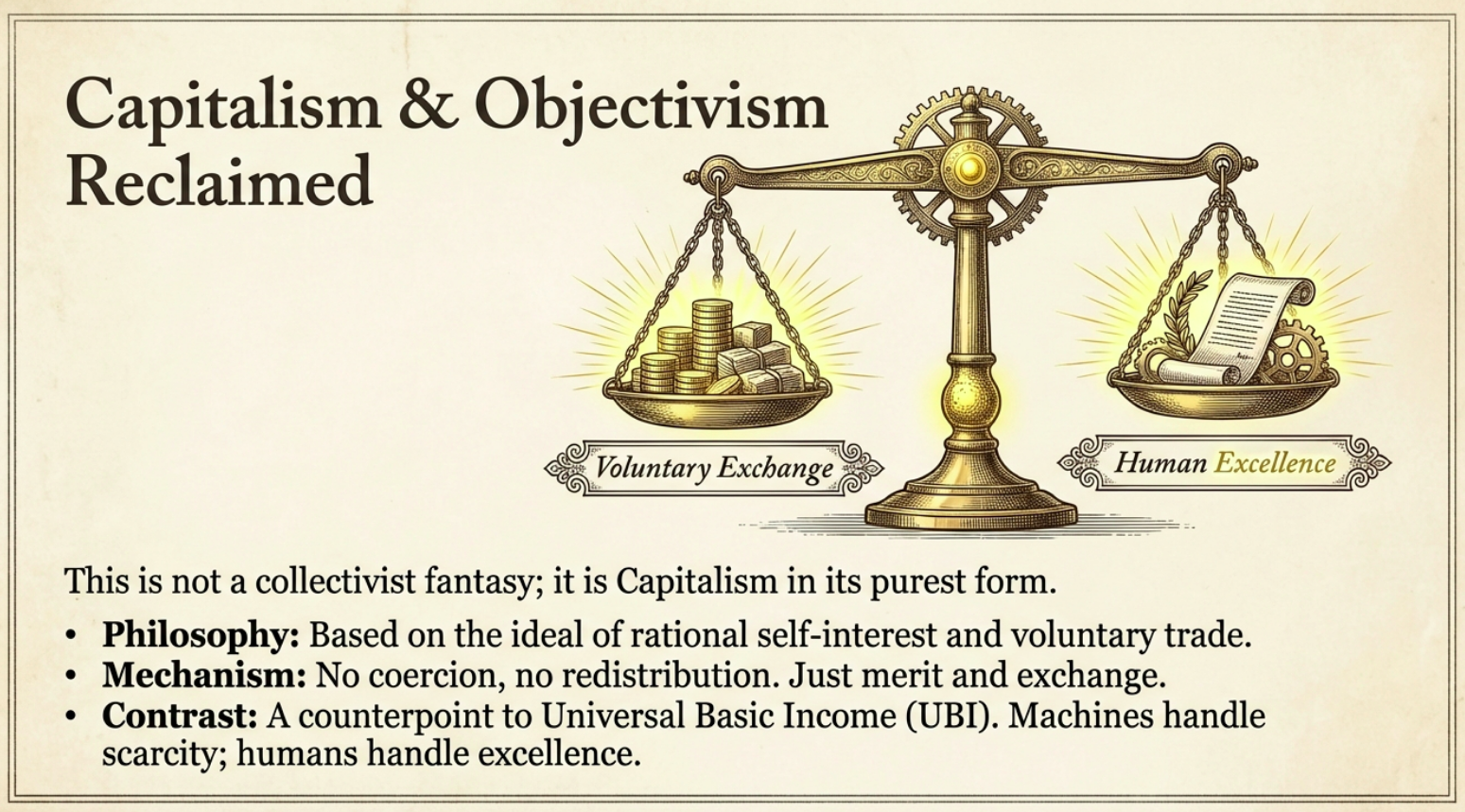
This model offers a powerful and inspiring counterpoint to the socialist utopias that still captivate parts of the tech world, ideas of universal basic income, centralized resource allocation, and enforced equality that have consistently failed whenever attempted. Those visions overlook the fundamental truth that separating reward from individual effort through coercion breeds stagnation and resentment.
In contrast, the guild economy, amplified by the material abundance AI provides, succeeds brilliantly because it is bottom-up, consensual, and aligned with human nature. It proves that when machines handle scarcity, humanity can finally express pure voluntary cooperation grounded in excellence and freedom.
That system once built America. In the Age of Abundance it will build something far greater: a society where every human spark finds its place, and every psyche discovers the eternal truth that our greatest wealth has always been one another. Welcome to the Return.
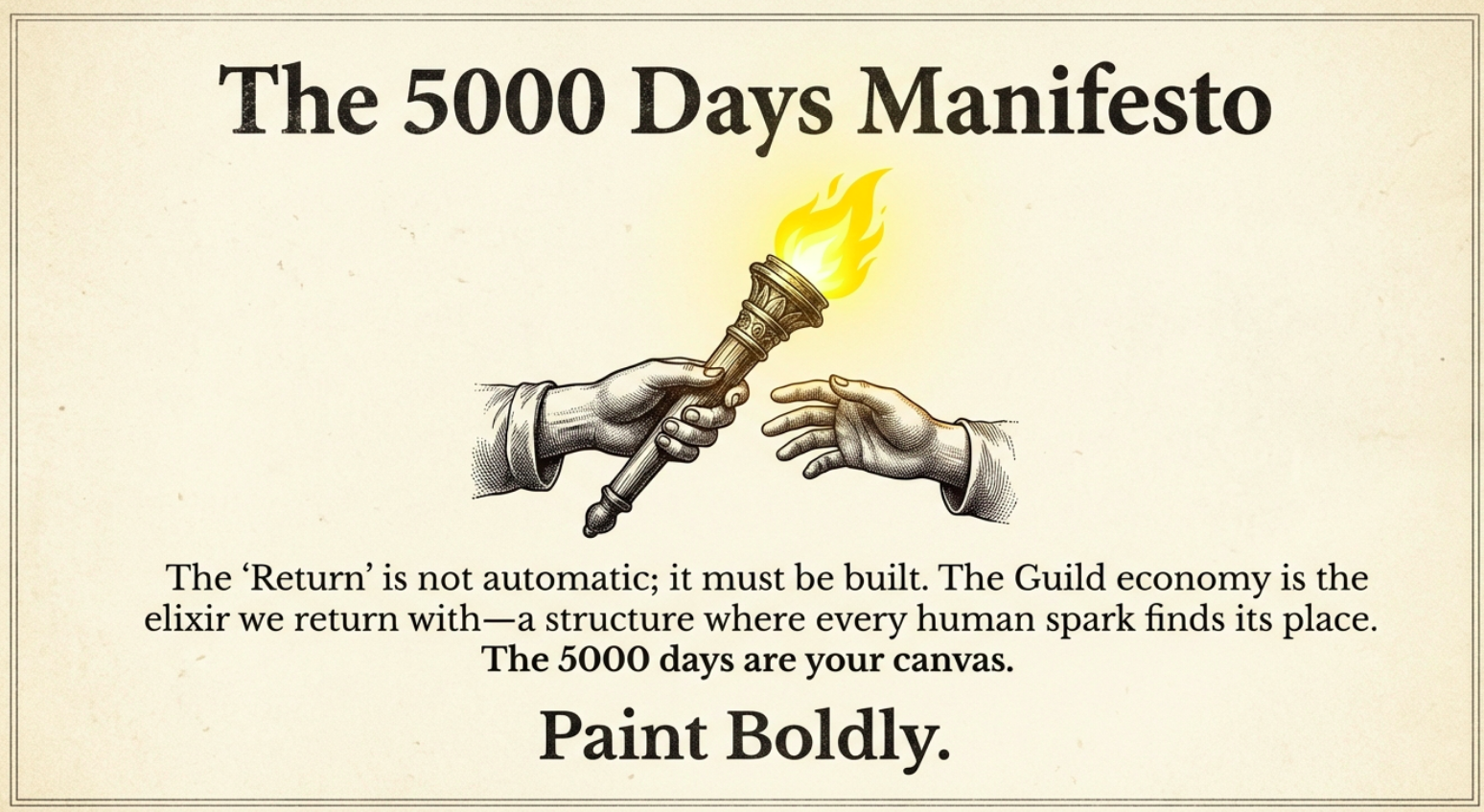
The 5000 days are your canvas.
Paint boldly.
From Meaningless To Meaning
When you trade directly within the reborn guild economy of the abundance era, something profound and life-giving awakens in the human spirit. No longer does your effort dissolve into the impersonal abstraction of money, distant ledgers, or faceless corporations. Instead, your unique craft flows straight into the lives of your neighbors and fellow guild members. You see immediately the joy on a young couple’s faces as they receive the hand-built kitchen cabinets that perfectly suit their daily rhythms, or the deep satisfaction of a family using the custom dining table you carved with care. This immediacy transforms labor from obligation into a living act of love and recognition.
This direct exchange infuses your days with an extraordinary sense of purpose that abstract wages could never deliver. Every piece you create, every skill you offer, carries visible impact and lasting value. You are not merely earning credits, you are building the material poetry of other people’s lives.
In the Age of Abundance, where machines provide the basics, your irreplaceable human touch becomes the source of meaning. You wake each morning knowing your work matters on a soul level, strengthening community bonds and leaving echoes of beauty that will outlast you. This is purpose made tangible, purpose you can hold in your hands and witness in grateful eyes.
At the guild level, transactions evolve into sacred exchanges of trust and mutual elevation. When a weaver offers a finely textured blanket valued by its intricate patterns and warmth units in return for a blacksmith’s custom tools, both parties experience a surge of genuine connection. Gratitude flows naturally. Reputation becomes a treasured currency of the heart. These relationships heal the fragmentation we felt during the Dark Night of the Soul, replacing isolation with profound belonging. You are no longer an atomized individual competing in a marketplace but an essential member of a living, breathing human network where your contributions are seen, honored, and reciprocated with warmth.
This structure grants your life a sense of enduring legacy that modern economies stripped away. A master craftsman in the guild knows their seven-year apprentice will carry forward refined techniques, and the heirloom chair they built today may grace family gatherings for a century. In a world of material plenty, the psychological reward shifts from accumulation to transcendence, from fleeting consumption to creations that weave your spirit into the ongoing story of your people. This realization fills the heart with quiet exultation. Your work is no longer temporary, it becomes part of something eternal and meaningful.
There is an unmistakable vitality and joy that pulses through every guild exchange. Without the cold mediation of cash, each trade feels alive with human energy, creativity, and care. You feel more present, more alive, more connected to the world around you. The scarcity mindset that once whispered of never having enough dissolves completely, replaced by overflowing abundance of spirit. Life becomes a celebration of shared mastery and generosity. Every day offers fresh opportunities to express your unique gifts and receive the unique gifts of others in return, creating a continuous cycle of upliftment and delight.
This is the deepest gift of the Return in our Hero’s Journey. As we cross the final threshold into the post-abundance world, the guild economy reveals that true wealth was never in numbers on a screen but in the direct, heart-centered ways we serve and uplift one another.
Over the next 5000 days and for generations beyond, this model will not only sustain society but nourish our souls. It calls us to step fully into our roles as creators, mentors, and community anchors. The future shines bright with possibility, rich with purpose, and overflowing with the simple, profound joy of knowing your one-of-a-kind human essence truly matters.
The 5000 Days Countdown Clock:
We are on this journey together. Some of us stand on the shoulders of giants and have thought about this for decades. We will not go it alone, and I hope to build many parts to this series and share the mastermind insight from the powerful Read Multiplex member Forum: https://readmultiplex.com/forums/topic/you-have-5000-days-navigating-the-end-of-work-as-we-know-it/. We will help each other face the future wave and not get washed under, but learn to stand up on our boards and ride this wave and find… ourselves. Join us.
To continue this vital work documenting, analyzing, and sharing these hard-won lessons before we launch humanity’s greatest leap: I need your support. Independent research like this relies entirely on readers who believe in preparing wisely for our multi-planetary future. If this has ignited your imagination about what is possible, please consider donating at buy me a Coffee or becoming a member. Value for value you recieved here.
Every contribution helps sustain deeper fieldwork, upcoming articles, and the broader mission of translating my work to practical applications. Ain ‘t no large AI company supporting me, but you are, even if you just read this far. For this, I thank you.
Stay aware and stay curious,
🔐 Start: Exclusive Member-Only Content.
Membership status:
🔐 End: Exclusive Member-Only Content.
~—~
~—~
~—~
Subscribe ($99) or donate by Bitcoin.
Copy address: bc1qkufy0r5nttm6urw9vnm08sxval0h0r3xlf4v4x
Send your receipt to [email protected] to confirm subscription.

Stay updated: Get an email when we post new articles:

THE ENTIRETY OF THIS SITE IS UNDER COPYRIGHT. IMPORTANT: Any reproduction, copying, or redistribution, in whole or in part, is prohibited without written permission from the publisher. Information contained herein is obtained from sources believed to be reliable, but its accuracy cannot be guaranteed. We are not financial advisors, nor do we give personalized financial advice. The opinions expressed herein are those of the publisher and are subject to change without notice. It may become outdated, and there is no obligation to update any such information. Recommendations should be made only after consulting with your advisor and only after reviewing the prospectus or financial statements of any company in question. You shouldn’t make any decision based solely on what you read here. Postings here are intended for informational purposes only. The information provided here is not intended to be a substitute for professional medical advice, diagnosis, or treatment. Always seek the advice of your physician or other qualified healthcare provider with any questions you may have regarding a medical condition. Information here does not endorse any specific tests, products, procedures, opinions, or other information that may be mentioned on this site. Reliance on any information provided, employees, others appearing on this site at the invitation of this site, or other visitors to this site is solely at your own risk.
Copyright Notice:
All content on this website, including text, images, graphics, and other media, is the property of Read Multiplex or its respective owners and is protected by international copyright laws. We make every effort to ensure that all content used on this website is either original or used with proper permission and attribution when available.
However, if you believe that any content on this website infringes upon your copyright, please contact us immediately using our 'Reach Out' link in the menu. We will promptly remove any infringing material upon verification of your claim. Please note that we are not responsible for any copyright infringement that may occur as a result of user-generated content or third-party links on this website. Thank you for respecting our intellectual property rights.
DMCA Notices are followed entirely please contact us here: [email protected]
