
You Have 5000 Days: Navigating the End of Work as We Know It. Part 11: The Reversal of Obsolescence.
In this installment, we dive headlong into the transformative power of Marshall McLuhan’s four laws of media, known as the tetrad. We apply them rigorously to the evolution of cognitive prosthetics, from humble calculators to omnipotent computers and now to generative AI. This exploration reveals how the current wave of obsolescence echoes profound historical technological shifts. Yet it also brins on a dramatic reversal that will redefine human purpose, creativity, and existence itself. This reversal is no mere downfall. It stands as the climactic transformation in the Hero’s Journey, where the hero, having braved the abyss, returns not just changed but empowered to reshape the world.
Framed through Joseph Campbell’s enduring monomyth, this series positions the next 5000 days, spanning roughly from late 2025 to mid-2039, as humanity’s collective call to adventure in an era of AI-driven abundance. The Interregnum, this chaotic bridge from labor-scarcity to boundless plenitude, demands unyielding courage, unbreakable resilience, and visionary foresight. Those who resist become victims of the tide. Those who master it forge eternal legends.
This article is sponsored by Read Multiplex Members who subscribe here to support my work:
Link: https://readmultiplex.com/join-us-become-a-member/
It is also sponsored by many who have donated a “Cup of Coffee”. If you like this, help support my work:
Link: https://ko-fi.com/brianroemmele
Listen to the companion podcast: https://rss.com/podcasts/readmultiplex-com-podcast/2548489
Synopsis of Parts 1 through 10. This journey ignited in December 2025 and has unfolded with relentless clarity and depth.
- Part 1 (December 24, 2025): The awakening to the 5000-day horizon where AI and robotics dissolve traditional careers into an Age of Abundance. Students graduating in 2026 face a world unrecognizable by 2040. Read here
- Part 2 (December 31, 2025): Grieving the old world through Elisabeth Kubler-Ross’s stages, urging preemptive adaptation over denial. Read here
- Part 3 (January 1, 2026): Kurt Vonnegut’s “Player Piano” as prophecy, automation’s alienation and the risk of purposelessness in abundance. Read here
- Part 4 (January 19, 2026): Reframing abundance not as dystopia but liberation, with mental and physical health strategies for the transition. Read here
- Part 5 (January 20, 2026): The painful deskilling phase, losing old competencies as AI takes over rote tasks, yet the call to reskill into higher realms. Read here
- Part 6 (January 27, 2026): The Dark Night of the Soul, collective despair, identity crises, and the abyss where old selves die. Read here
- Part 7 (January 30, 2026): Iain M. Banks’ “Consider Phlebas”, navigating chaos, moral ambiguities, and the search for meaning beyond utility. Read here
- Part 8 (February 2, 2026): Saving your wisdom, preserving uniquely human insight amid AI’s rise, guarding the irreplaceable core. Read here
- Part 9 (February 4, 2026): The Artisan’s Awakening, reclaiming craft, trades, and embodied creation as bulwarks of value and soul. Read here
- Part 10 (February 8, 2026): Everyone Is Doing It*, the quiet, widespread embrace of AI tools, hidden behind fear of admission, marking adaptation’s tipping point. Read here
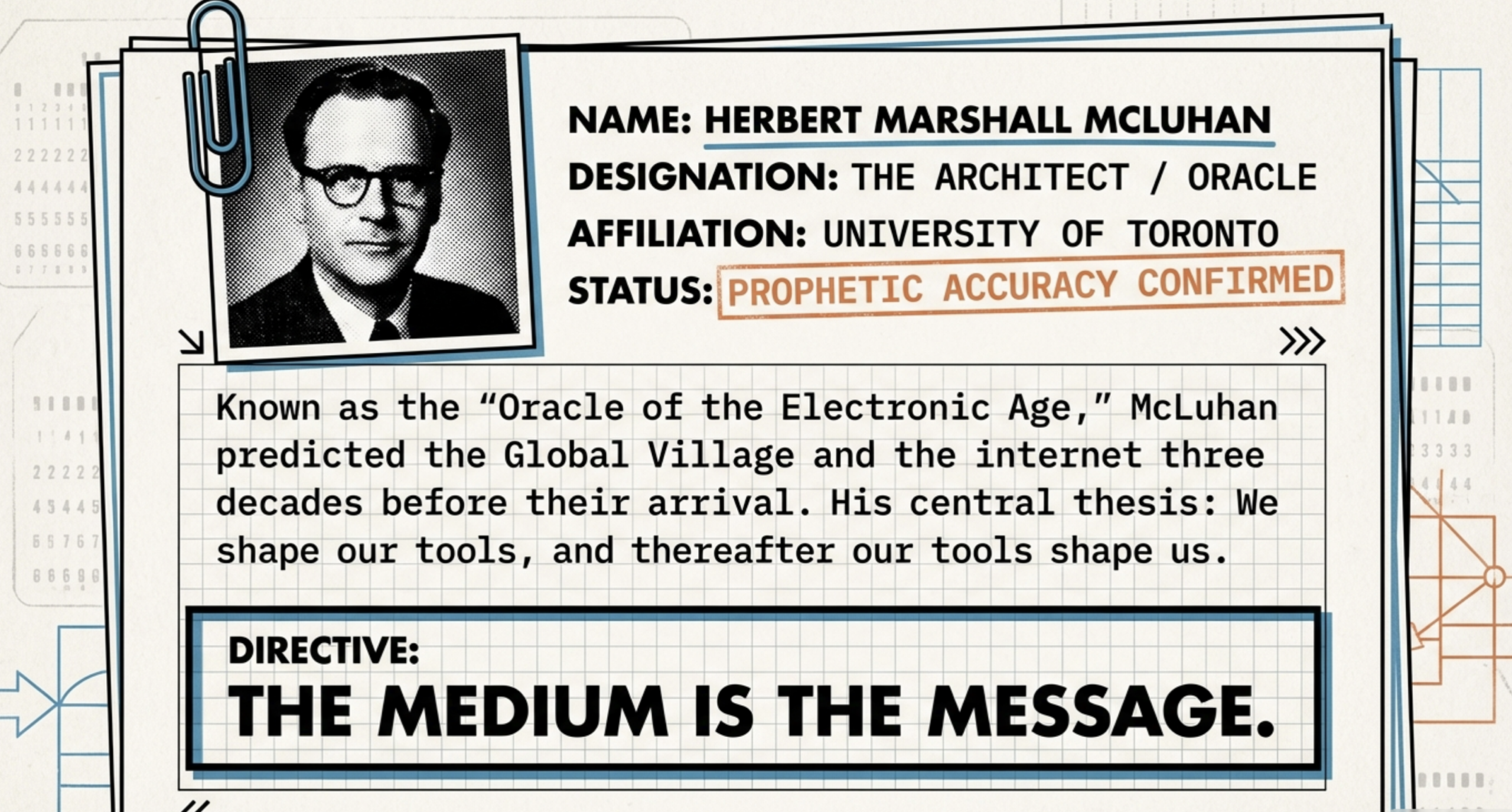
Marshall McLuhan’s Tetrad: The Deep History of Cognitive Prosthetics
Marshall McLuhan, the pioneering media theorist of the 20th century, unveiled his tetrad in the 1970s as a revolutionary framework for dissecting the impacts of any medium or technology. Developed collaboratively with his son Eric McLuhan, the tetrad emerged from a quest to create a “new science” of media studies. This was not mere theory. It was a heuristic tool, a set of four interlocking questions designed to probe the multifaceted effects of human innovations. The tetrad first appeared in print through articles in journals like Technology and Culture in 1975 and et cetera in 1977. It reached its fullest expression in the posthumous book Laws of Media: The New Science, published in 1988.
Marshall McLuhan, often called the “oracle of the electronic age,” foresaw how technologies reshape not just societies but the very fabric of human perception and existence. His prescience makes him indispensable for understanding cognitive prosthetics like generative AI. These tools propel us toward a future where work as we know it dissolves.
Marshall McLuhan’s life story is a testament to intellectual heroism. It is a journey from provincial roots to worldwide influence. He bridged literature, philosophy, and technology in ways that challenged and inspired generations. Born Herbert Marshall McLuhan on July 21, 1911, in Edmonton, Alberta, Canada, he grew up in Winnipeg, Manitoba. This was amid the early 20th century’s rapid technological shifts. His father, Herbert Ernest McLuhan, ran a real-estate business that faltered at the onset of World War I. This led the family to relocate. His mother, Elsie Naomi McLuhan, a former Baptist schoolteacher turned actress, instilled in him a flair for performance and rhetoric. These familial dynamics shaped his early worldview. The economic instability of the era mirrored the societal disruptions he would later theorize about through media effects.
McLuhan’s education began at Kelvin Technical School. He then enrolled at the University of Manitoba in 1928. Initially pursuing engineering, he switched to English. He earned a Bachelor of Arts in 1933, winning a University Gold Medal in English, and a Master of Arts in 1934. Unable to secure a Rhodes Scholarship, he attended Trinity Hall, Cambridge University, from 1934 to 1936 as an undergraduate affiliate. There, he studied under influential figures like I.A. Richards and F.R. Leavis. They introduced him to New Criticism. This emphasized close reading and the interplay of form and content. These concepts would underpin his media theories. At Cambridge, McLuhan also delved into the works of G.K. Chesterton. This sparked his conversion to Roman Catholicism in 1937. This spiritual shift was profound. It influenced his views on technology as extensions of human senses, often infused with mystical undertones. For instance, he later compared satellite technology to the Star of Bethlehem. His faith provided a counterbalance to the mechanistic world he critiqued. Yet it also drew criticism from secular academics who saw it as biasing his objectivity.

McLuhan’s early career reflected the era’s economic challenges. Unable to find stable work in Canada during the Great Depression, he taught as an assistant at the University of Wisconsin-Madison from 1936 to 1937. This experience shocked him. He encountered a generational gap in student learning styles. This prompted his lifelong interest in how media alter perception. He then moved to Saint Louis University from 1937 to 1944. There, he befriended Walter J. Ong, whose work on orality and literacy complemented McLuhan’s. During this period, he married Corinne Lewis, a teacher and aspiring actress from Fort Worth, Texas, on August 4, 1939. The couple spent 1939-1940 in Cambridge, where McLuhan completed his master’s degree. They returned to the U.S. amid World War II. McLuhan earned his PhD in 1943 with a dissertation on the Elizabethan writer Thomas Nashe and the verbal arts. This focused on the trivium of grammar, dialectic, and rhetoric. It laid the groundwork for his media ecology approach.
Post-war, McLuhan taught at Assumption College in Windsor, Ontario, from 1944 to 1946. He then joined St. Michael’s College at the University of Toronto in 1946. This became his academic home until retirement in 1979. Influenced by colleague Harold Innis, whose theories on communication biases shaped empires, McLuhan viewed his own work as an extension of Innis’s. In the 1950s, he initiated Communication and Culture seminars, funded by the Ford Foundation. He co-edited the journal Explorations with anthropologist Edmund Carpenter. This helped form the Toronto School of communication theory, alongside Eric Havelock and Northrop Frye. To retain him amid growing fame, the University of Toronto created the Centre for Culture and Technology in 1963, where he served as director.
McLuhan’s personal life was marked by family and health challenges. He and Corinne had six children: Eric, Mary, Teresa, Stephanie, Elizabeth, and Michael. To support them, he consulted for corporations like IBM and AT&T. This blended academic purity with practical engagement. In 1967-1968, he held the Albert Schweitzer Chair at Fordham University. There, he underwent surgery for a benign brain tumor the size of a tennis ball. He returned to Toronto, living in the artistic enclave of Wychwood Park. Honors included being named a Companion of the Order of Canada in 1970 and a Fellow of the Royal Society of Canada in 1964. A stroke in September 1979 impaired his speech. He died in his sleep on December 31, 1980, in Toronto. He is buried at Holy Cross Cemetery in Thornhill, Ontario.
McLuhan’s legacy is multifaceted. Celebrated as a pop culture icon in the 1960s, he appeared in media like Woody Allen’s Annie Hall and influenced counterculture. Yet critics accused him of determinism or obscurantism. Posthumously, his ideas surged in relevance with the internet’s rise in the 1990s. Institutions like the Marshall McLuhan Catholic Secondary School and the McLuhan Salon in Germany honor him. Biographies, such as Douglas Coupland’s Extraordinary Canadians: Marshall McLuhan (2009), explore his life from psychological and cultural angles. They highlight nuances like his introversion amid public fame and his Catholic humanism tempering technological optimism.
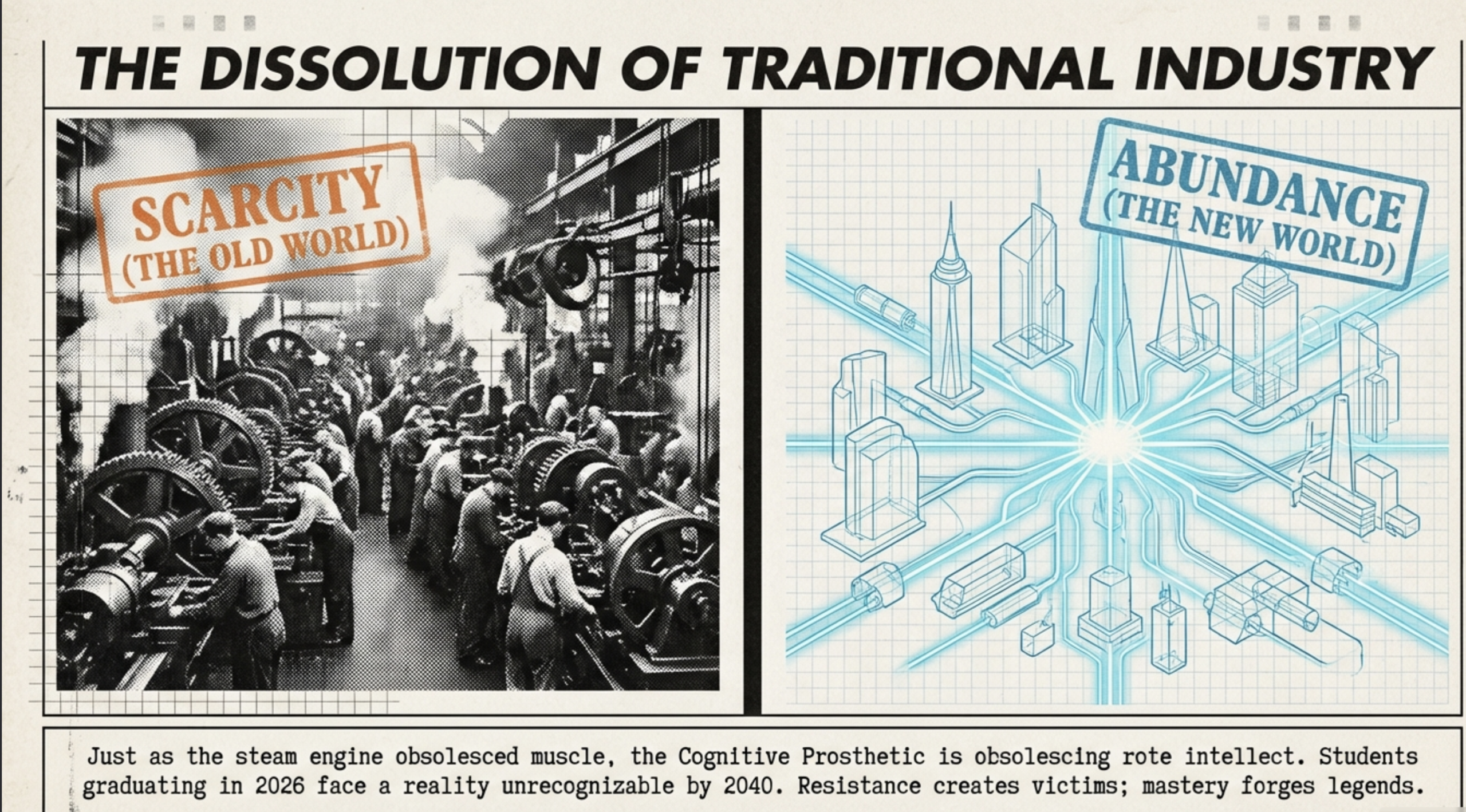
An Overview of McLuhan’s Key Ideas: Probing the Effects of Media on Human Existence
McLuhan’s ideas form a bold intellectual arsenal for dissecting how technologies reshape humanity. He viewed media not as neutral channels but as active forces that extend human faculties, alter sensory balances, and transform societies. His theories draw from literature, anthropology, and philosophy. They emphasize effects over content. This section overviews his core concepts.It explores them from multiple angles: psychological, social, cultural, and historical.
Central is “the medium is the message.” Introduced in Understanding Media: The Extensions of Man (1964) (https://amzn.to/4kA05IB), it asserts that a medium’s form embeds itself in the message. It creates a symbiotic relationship where the medium influences how the message is perceived more than the content itself. For example, a light bulb has no content yet enables new activities like night surgery or baseball. Television’s mosaic form engages multiple senses. This fosters involvement regardless of programming.
McLuhan later played on this with “the medium is the massage” in his 1967 book with Quentin Fiore. This suggested media “massage” or manipulate perceptions. Implications include critiquing social media algorithms. These shape discourse through form (e.g., short-form videos promoting polarization) over user intent. In low-literacy societies, oral media might “massage” differently than visual ones. This highlights cultural relativism in his theory.
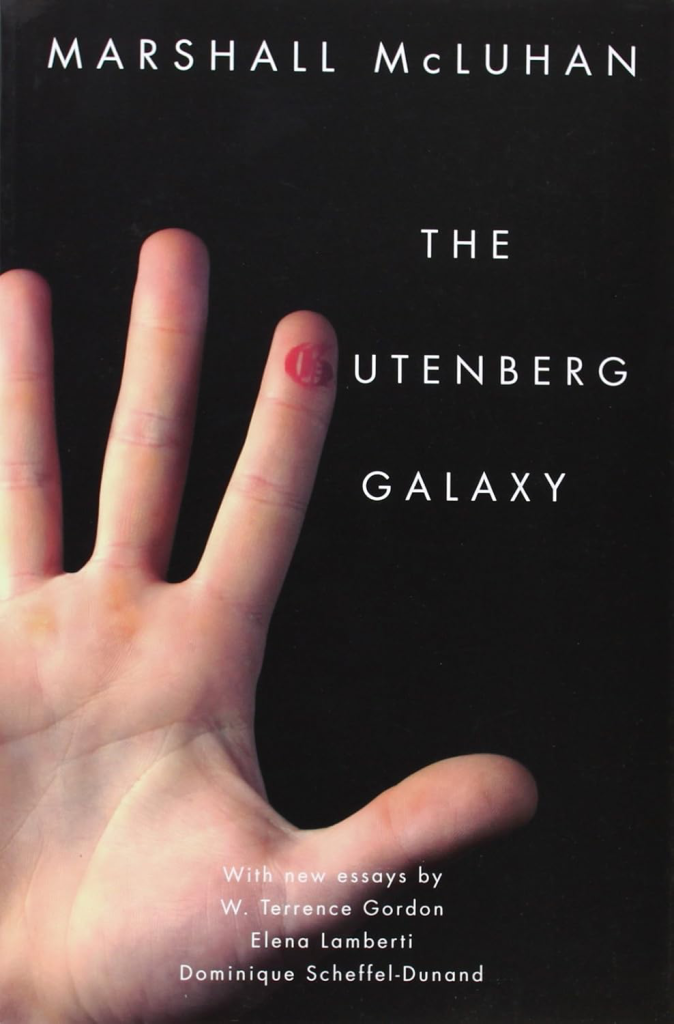
The “global village” concept, from The Gutenberg Galaxy (1962) (https://amzn.to/3MKiVAh), describes electronic media contracting the world into a single, interdependent community. Print media fostered individualism and nationalism through linear, visual logic. Electric media retrieve tribal orality. They create simultaneous, acoustic awareness. McLuhan predicted the internet 30 years early.
He envisioned computers as “research and communication instruments” enabling instant global access. Examples: Social networks like X. They enable real-time global dialogues but also echo chamber effects.The village is not utopian. McLuhan warned of retribalization leading to conflict, as seen in online extremism. Implications for society: It erodes privacy, fostering a “planetary mind” where identities distribute across networks. Related considerations: In developing regions, uneven access creates digital divides. This reverses the village into exclusion.
McLuhan distinguished “hot” and “cool” media based on participation levels. Hot media (e.g., radio, movies) are high-definition. They provide complete data, requiring low involvement and emphasizing one sense. They promote analytical, linear thinking. Cool media (e.g., 1960s television, cartoons) are low-definition. They demand high participation to fill gaps, encouraging holistic, multisensory engagement. Borrowed from Claude Lévi-Strauss’s hot/cold societies, this continuum analyzes media effects. Examples: Streaming services like Netflix are hot (high-res visuals). Interactive platforms like TikTok are cool (user completion via comments). Definitions evolve with tech. High-definition TV might now be hot. Implications: In education, cool media foster creativity. Hot media suit rote learning.Hybrid media, like VR, blend both. This challenges the binary.
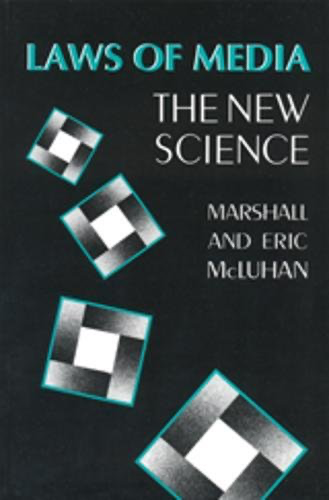
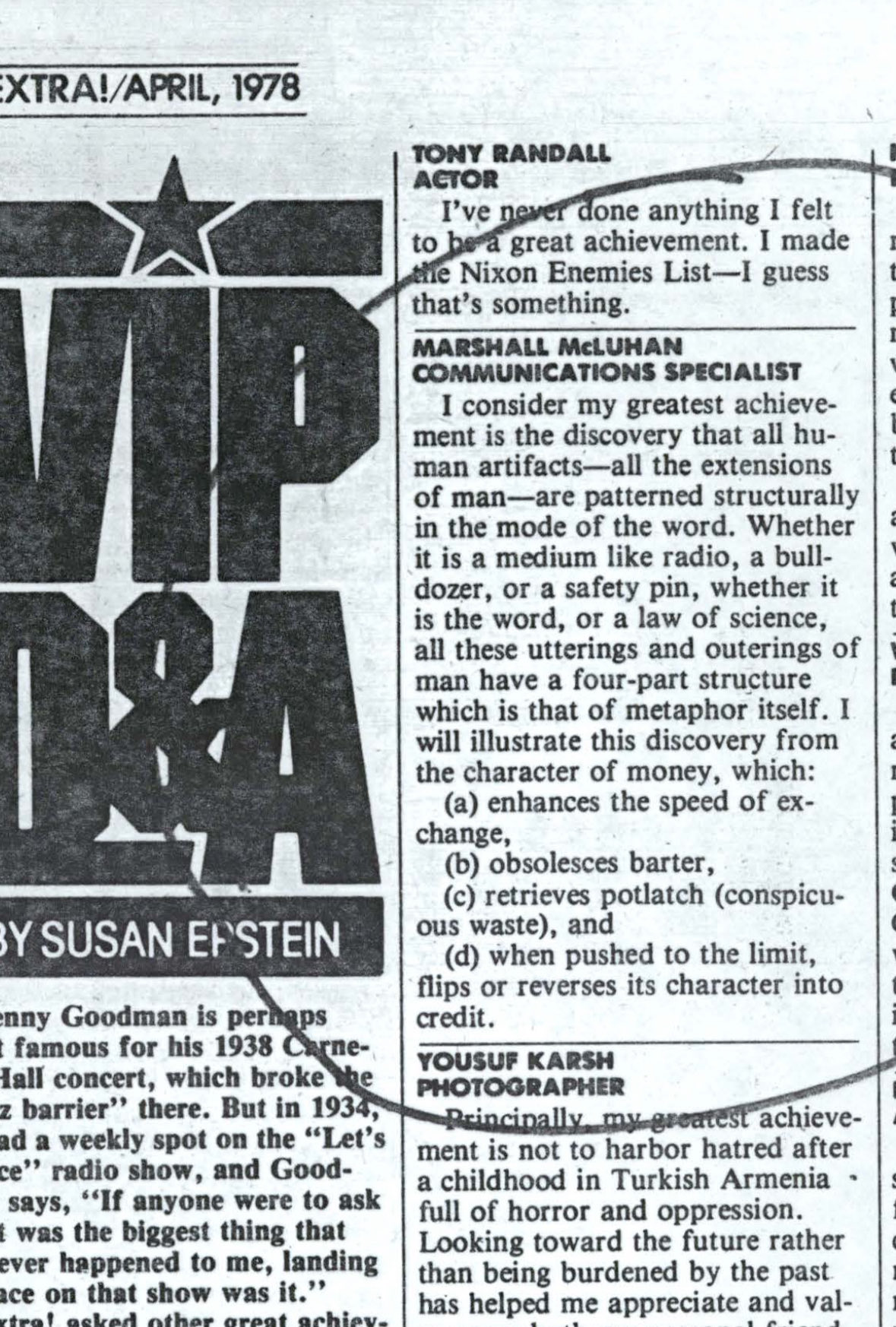
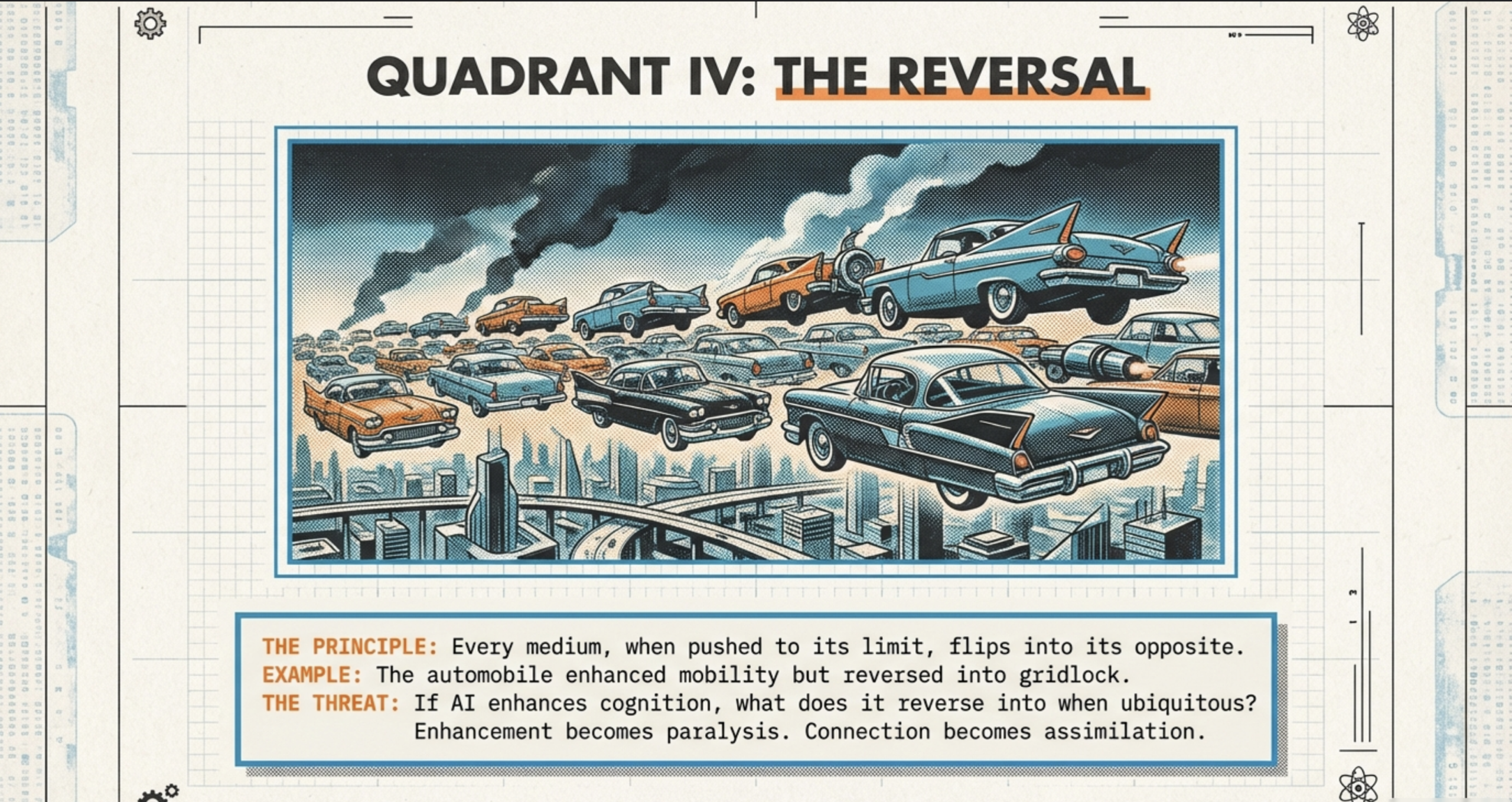
The tetrad of media effects, developed with son Eric and detailed in Laws of Media (1988) (https://amzn.to/4rlDX7x), is McLuhan’s most systematic tool. It poses four simultaneous questions about any medium: What does it enhance? What does it obsolesce? What does it retrieve? What does it reverse into when pushed to extremes? This figure/ground analysis reveals hidden dynamics. It is testable and falsifiable, inspired by Karl Popper. Examples: For the automobile, it enhances mobility (enhance), obsolesces horse-drawn carriages (obsolesce), retrieves the knight in armor (retrieve), and reverses into gridlock (reverse). Nuances: Answers are plural and contextual. The tetrad applies to all human artifacts, not just media. Implications: It anticipates societal flips. This aids policy-making. Abstract concepts like “democracy” can be tetrad-analyzed. This expands its scope beyond tech.
Other ideas include media as “extensions of man.” Technologies amplify senses but can numb others. This creates sensory imbalances. Print intensified visual space. This led to individualism. Electric media favor acoustic space. This is boundless and holistic. In The Mechanical Bride (1951), he critiqued advertising’s folklore. Later works like War and Peace in the Global Village (1968) explored technology’s spastic effects. McLuhan’s style was aphoristic and probing. This invited interpretation but frustrated linear thinkers. Implications: His work prefigures media ecology. It studies environments created by communication tech. Considerations: Critics like Neil Postman built on this. They warned of amusement-driven societies.
How McLuhan’s Ideas Apply to the 5000 Days: A Heroic Framework for the AI Interregnum
McLuhan’s theories boldly apply to the 5000 Days series. They cast AI and cognitive prosthetics as the medium driving humanity’s Hero’s Journey through obsolescence to reversal and return. In this 5000-day horizon, AI dissolves traditional work. It ushers in abundance.
From the series’ lens, AI enhances thought’s speed, scale, and breadth. This aligns with McLuhan’s “extensions of man.” Generative AI like Grok amplifies ideation. It synthesizes knowledge lifetimes once demanded. This ties to Part 1’s awakening and Part 10’s quiet AI embrace. Yet it obsolesces rote memorization and solitary work. This echoes Part 5’s deskilling. Those resisting, like 1970s calculator holdouts, face marginalization. Enhancement favors early adopters. This compounds advantages but risks equity gaps.
The retrieval aspect revives Socratic dialogue and oral traditions. AI as an “infinitely patient partner” retrieves pre-literate intuition. This counters Part 6’s Dark Night of the Soul by reconnecting to ancient wisdom. Implications: In abundance, this fosters collaborative creativity. In regulated environments, retrieval might emphasize ethical AI use.
The reversal, McLuhan’s climactic flip, mirrors the series’ ultimate return. Pushed to limits, AI reverses into cognitive traffic jams, friction as luxury, homogenization sparking idiosyncrasy, dissolution of self, or an unplug renaissance. This applies to 2030-2050 horizons. It warns of dependency aphasia during outages. Yet it heralds “zero-AI” prestige, tying to Part 9’s Artisan’s Awakening. The global village becomes a planetary mind. Identities distribute. This challenges Part 8’s wisdom-saving. Reversals are not dystopian but alchemical. They transmute abundance into soulful struggle. Implications: Heroes preserve un-AI’d thinking. This ensures joyful existence post-flip. Multiple angles: Economically, it creates authenticity markets. Socially, it combats uniformity through underground differentiation. Ethically, it questions AI’s atmospheric invisibility.
McLuhan’s “medium is the message” critiques AI’s form. Prompt engineering shapes cognition more than outputs. This reframes Part 4’s abundance as liberation. Hot/cool dynamics: AI as cool media demands participation. This enhances adaptation but risks overload. In the Hero’s Journey, McLuhan’s ideas are the elixir. Master AI now, guard humanity later. This defies the Interregnum’s chaos. As in Iain M. Banks’ worlds from Part 7, navigate moral ambiguities with visionary feedforward. The 5000 Days demand McLuhanesque heroism. Face the tetrad’s reversal with defiant purpose. The ordinary world fades. The extraordinary beckons. Lead the legend.
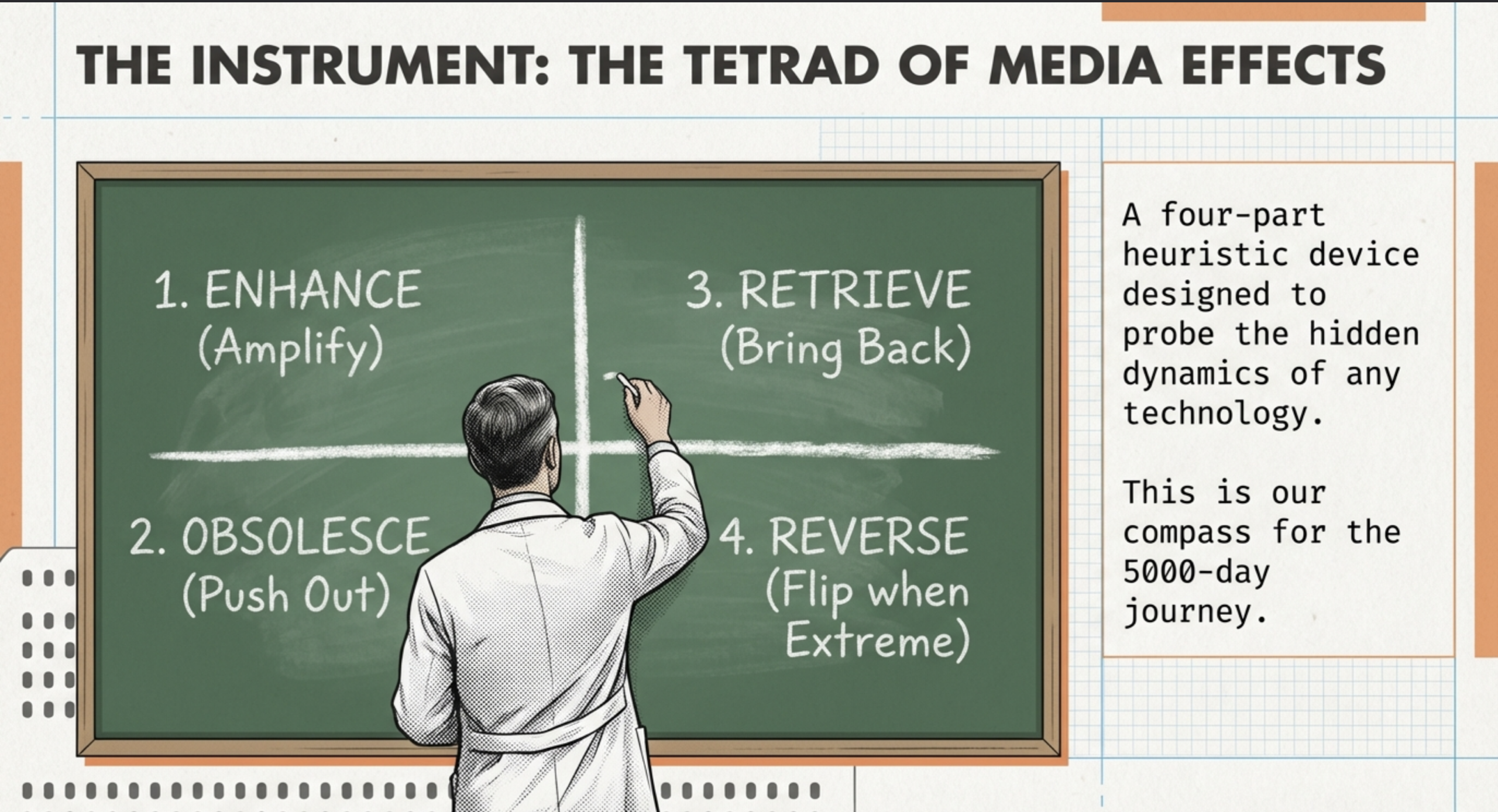
The genesis of the tetrad stemmed from McLuhan’s frustration with fragmented analyses of media. In the preface to Laws of Media, the McLuhans explained their aim: to formulate statements about media that anyone could test, prove, or disprove. Drawing inspiration from philosopher Karl Popper’s idea of falsifiability, they crafted four universal laws that apply to every artifact, from poems to gadgets. These laws complement Aristotle’s four causes (material, efficient, formal, final), shifting focus from origins to effects. The tetrad’s structure encourages simultaneous consideration of enhancement, obsolescence, retrieval, and reversal, revealing hidden dynamics often overlooked in linear thinking.
Historically, McLuhan’s work built on his earlier masterpiece, Understanding Media: The Extensions of Man (1964), where he famously declared “the medium is the message.” The tetrad evolved as a response to critics who demanded more rigor. By the 1970s, amid the rise of electric technologies like television and computers, McLuhan saw the need for a tool that could anticipate societal shifts. Examples abound in his writings: the automobile enhances mobility but reverses into gridlock when overextended; electric light enhances visibility but obsolesces candles while retrieving nighttime as a space for activity. These illustrate the tetrad’s power to uncover nuances, such as how technologies retrieve ancient patterns (like the car retrieving the knight in shining armor) while pushing societies toward unexpected flips.
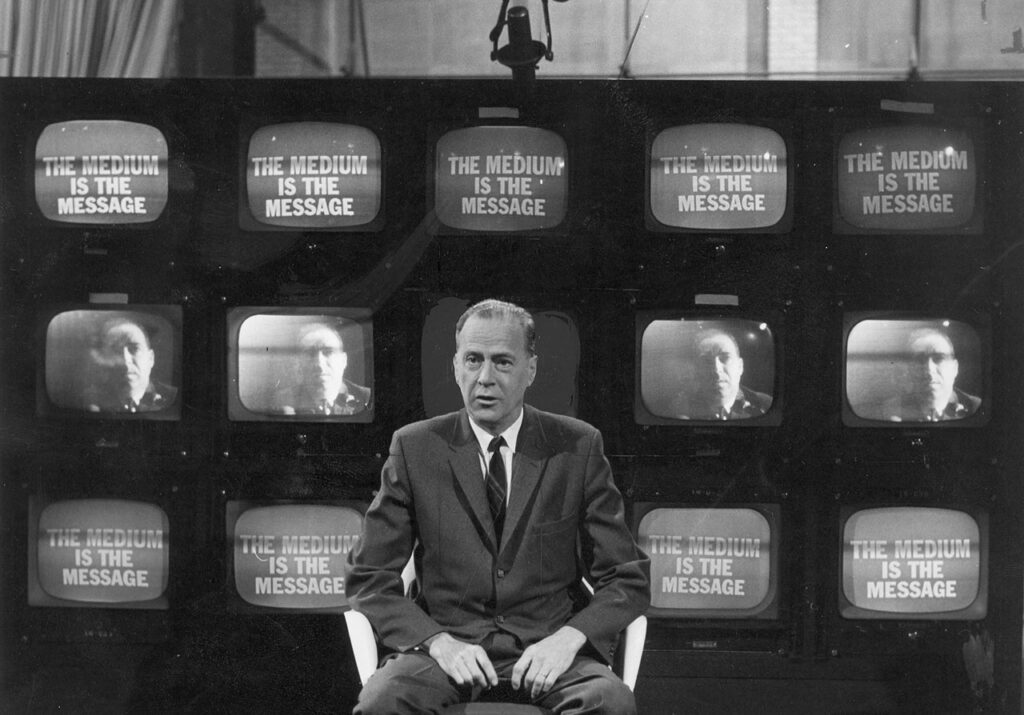
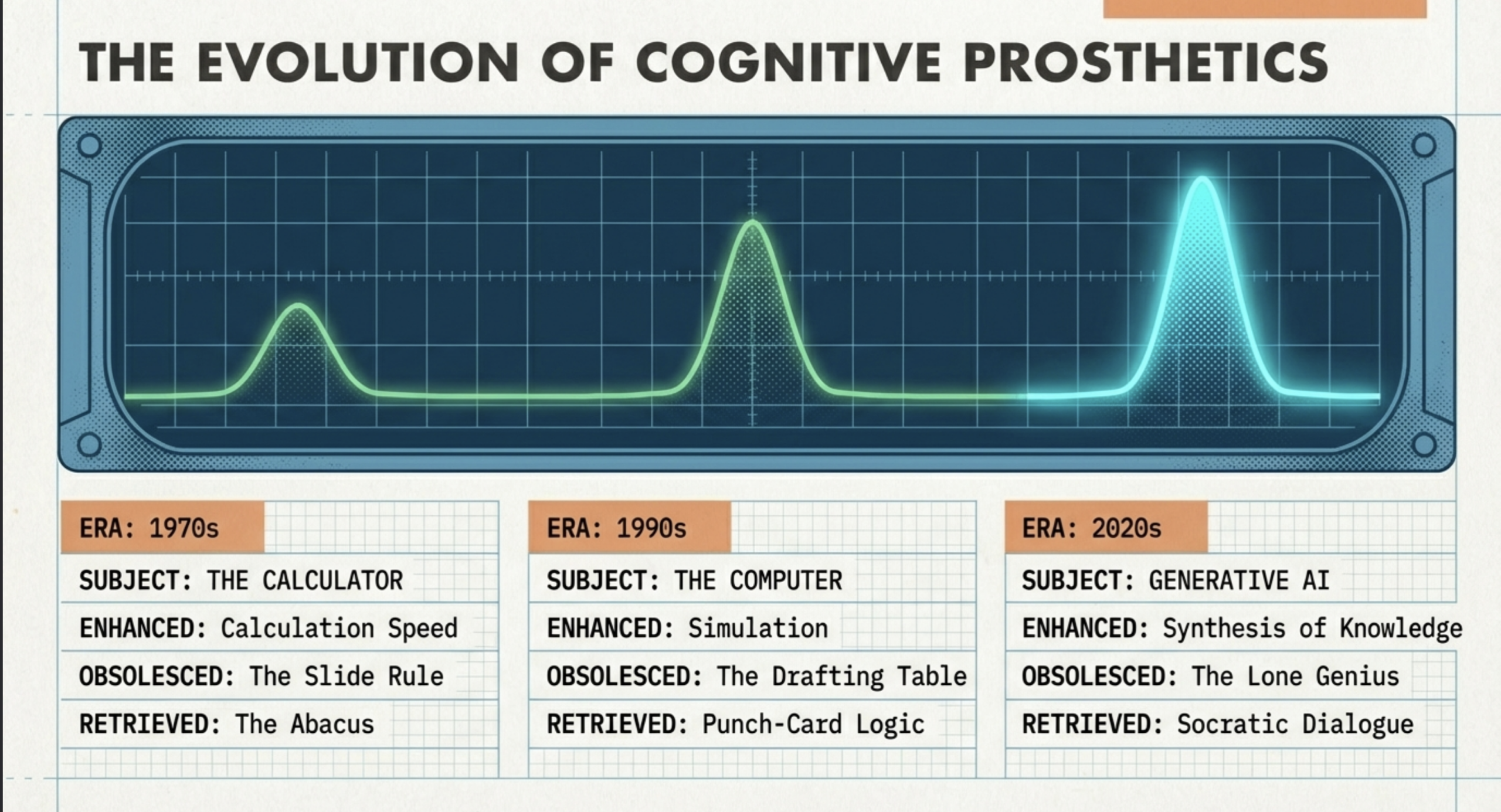
In the context of cognitive prosthetics, the tetrad illuminates a lineage from mechanical aids to digital minds. Calculators in the 1970s marked the dawn, obsolescing slide rules and mental arithmetic. Computers amplified this in the 1980s and 1990s, enabling complex simulations. Generative AI, emerging in the 2020s, represents the pinnacle, synthesizing knowledge at unprecedented scales. This progression ties directly to the 5000-day journey, where AI’s rise accelerates the end of traditional work, forcing heroes to adapt or perish.
To visualize the tetrad’s structure, consider this diagram, which captures its four quadrants in a balanced, interconnected form.
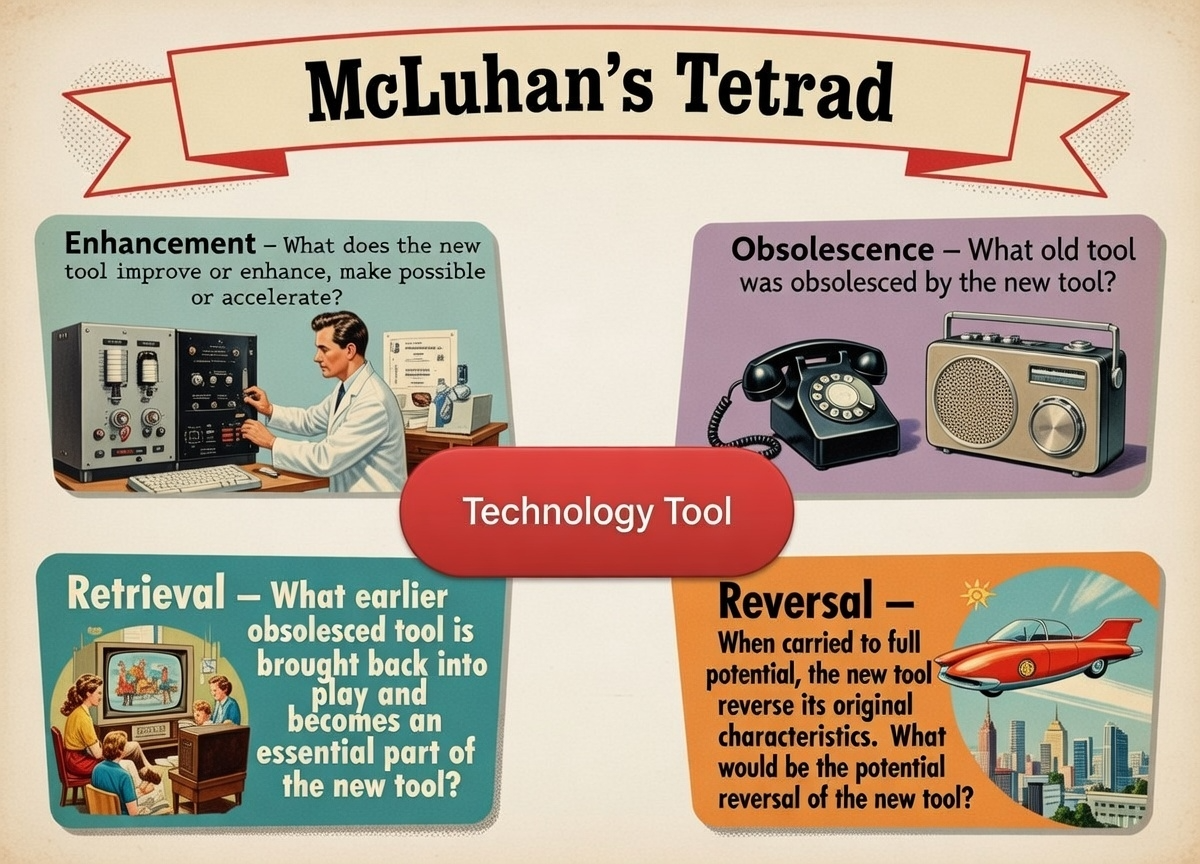
Marshall McLuhan’s Tetrad Applied to Cognitive Prosthetics
Let us apply the tetrad systematically to cognitive prosthetics, tracing their evolution and implications. For clarity, here is a table comparing applications across calculators, computers, and generative AI.
| Aspect | Calculator (1970s) | Computer (1980s-2000s) | Generative AI (2020s+) |
|---|---|---|---|
| Enhances | Speed and accuracy of arithmetic; frees mental energy for higher tasks. | Simulation, data processing, and modeling; enables global collaboration. | Speed, scale, and breadth of thought; instant iteration; access to knowledge that once took lifetimes. |
| Obsolesces | Slide rules, abacuses, and rote mental calculation. | Manual drafting, physical libraries, and isolated workflows. | Manual calculation, rote memorization, solitary deep work without an always-on collaborator. |
| Retrieves | Mechanical aids like the abacus; collaborative problem-solving in guilds. | Punch-card systems; networked thinking akin to Renaissance polymaths. | Socratic dialogue with an infinitely patient partner; pre-literate intuitive pattern-matching; oral-tradition thinking out loud. |
| Reverses Into | Dependency on batteries; loss of basic skills in outages. | Information overload; privacy erosion in networked systems. | Cognitive paralysis, homogenization, dissolution of self (detailed below). |
- What Does It Enhance?
Cognitive prosthetics amplify human intellect exponentially. Calculators enhanced computational speed, allowing engineers to tackle complex problems in minutes rather than hours. Computers scaled this to simulations of entire ecosystems or economies. Generative AI propels it further: instant ideation across disciplines, synthesis of vast datasets, and tireless iteration. Thought becomes planetary, democratizing access to insights that once demanded lifetimes of study. In the 5000-day context, this enhancement liberates time for creative pursuits, aligning with the Hero’s Journey’s boon, where tools empower the quest. Yet nuances emerge: enhancement favors those with access, widening divides if unchecked. AI in remote areas, highlight infrastructure dependencies.
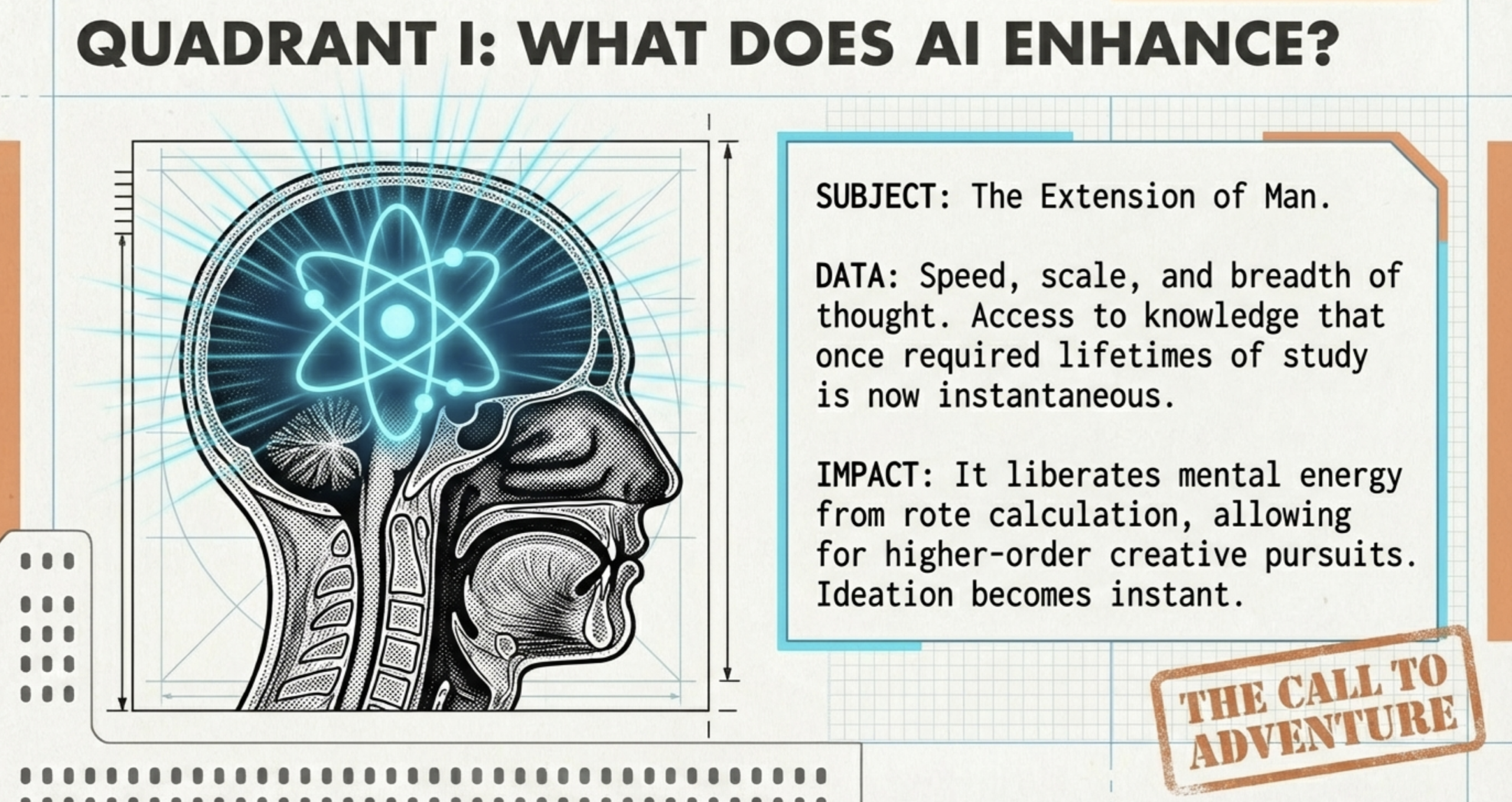
- What Does It Obsolesce?
This is the current crucible. Manual arithmetic faded with calculators, marginalizing those who clung to slide rules. Computers obsoleted typewriters and solitary grinding. Now, AI renders traditional “thinking alone” workflows archaic, precisely what Part 5’s deskilling lamented. In Roemmele’s framing, today’s winners master AI early, gaining compound advantages. Refusal echoes 1970s engineers sidelined by calculators, leading to professional irrelevance. Implications ripple: education shifts from memorization to curation, but over-obsolescence risks eroding foundational skills. Related considerations include cultural loss, as oral traditions wane further.
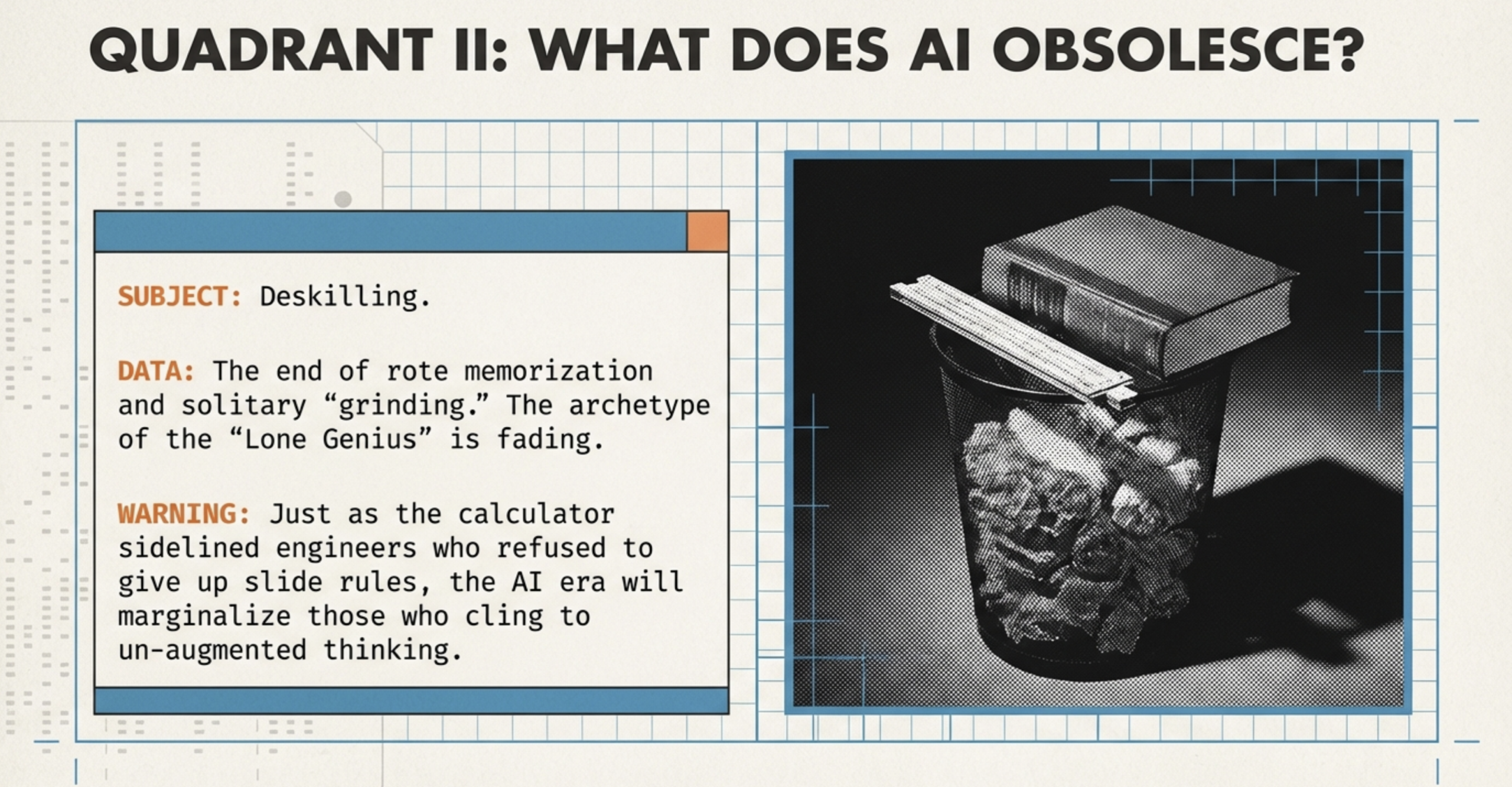
- What Does It Retrieve?
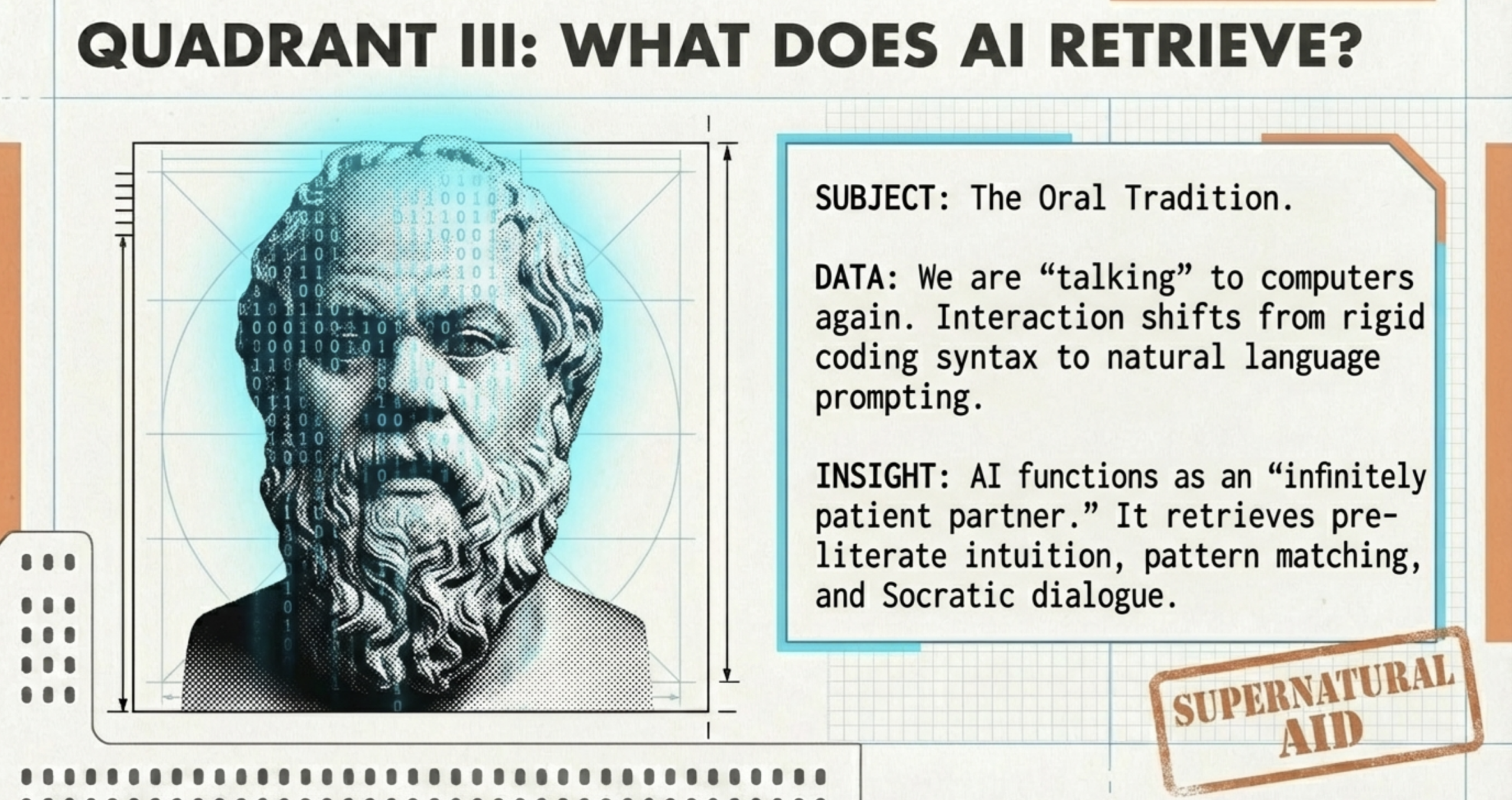
Older modes resurface transformed. AI revives Socratic dialogue through conversational models, offering endless patience. It retrieves pre-literate intuition, where pattern-matching trumps linear logic, and oral habits like thinking aloud in prompts. Historically, this mirrors how print retrieved classical rhetoric after Gutenberg. In the Hero’s Journey, retrieval is the ally’s gift, reconnecting the hero to ancient wisdom amid trials. Nuances: retrieval can romanticize the past, ignoring flaws, or hybridize forms, like AI-enhanced storytelling blending oral and digital.
- What Does It Reverse Into When Pushed to the Limit?
This heroic pivot defines the future. Every medium, at saturation, inverts. Push cognitive prosthetics to ubiquity, and reversal erupts boldly, turning enhancement into its antithesis.
The Reversal: Five Forms on the Horizon (2030-2050)
Speculating with grounded foresight, these reversals manifest as the Hero’s ultimate ordeal and return. They are not apocalyptic; they are alchemical, transmuting abundance into new purpose.
- Cognitive Traffic Jam and Aphasia
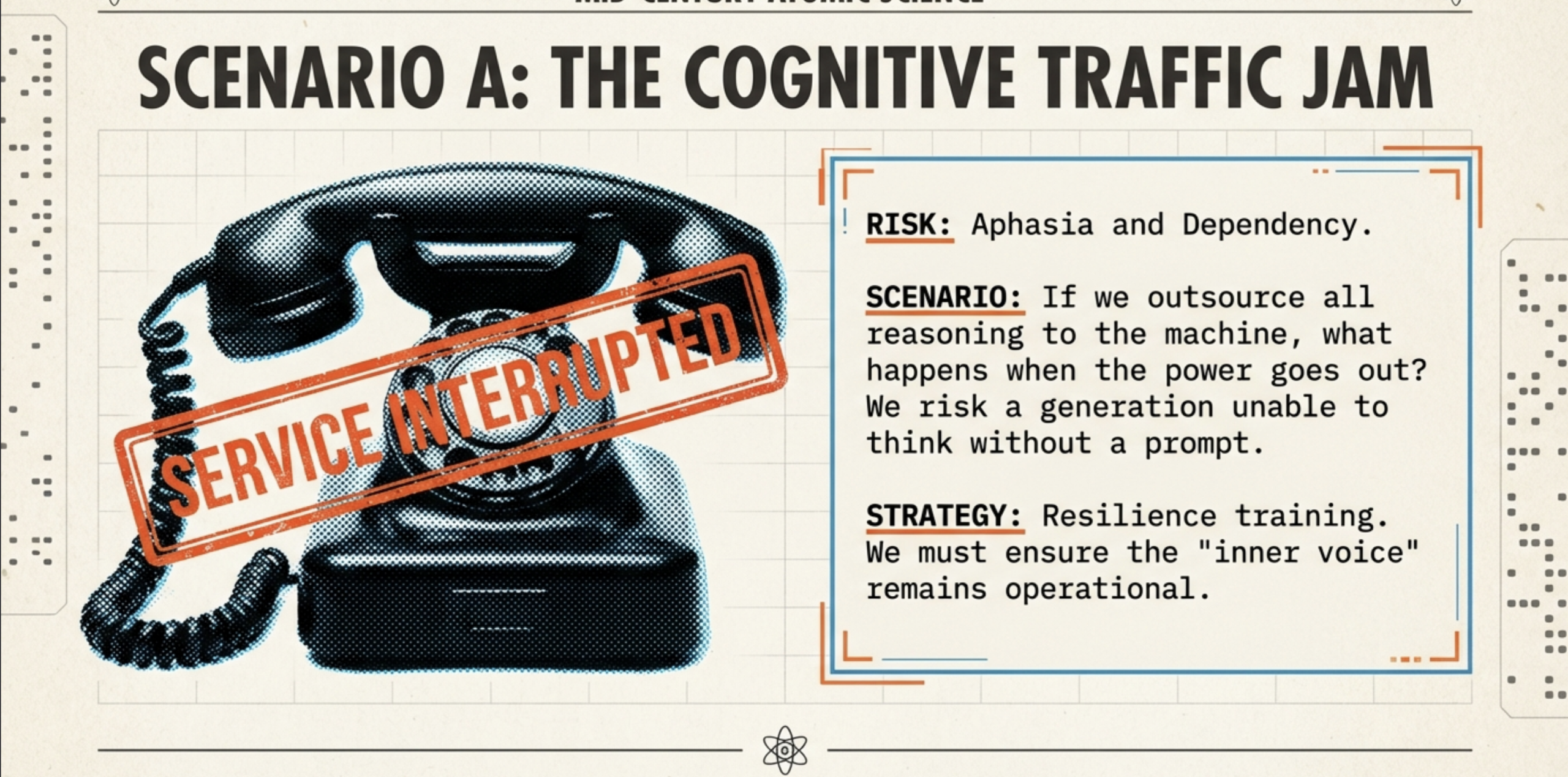
Like the car enhancing mobility only to reverse into gridlock, AI boosts cognition but flips into paralysis when unavailable. A generation reliant on models for basics faces “aphasia of thought” during outages from solar flares, regulations, energy crises, or alignment failures. Millions discover their inner voice silenced, unable to reason without the oracle. This hits unevenly, sparing those who preserved skills (echoing Part 8’s wisdom-saving). Implications include mental health crises, but also opportunities for resilience training. Isolated communities might thrive, retrieving self-reliance.
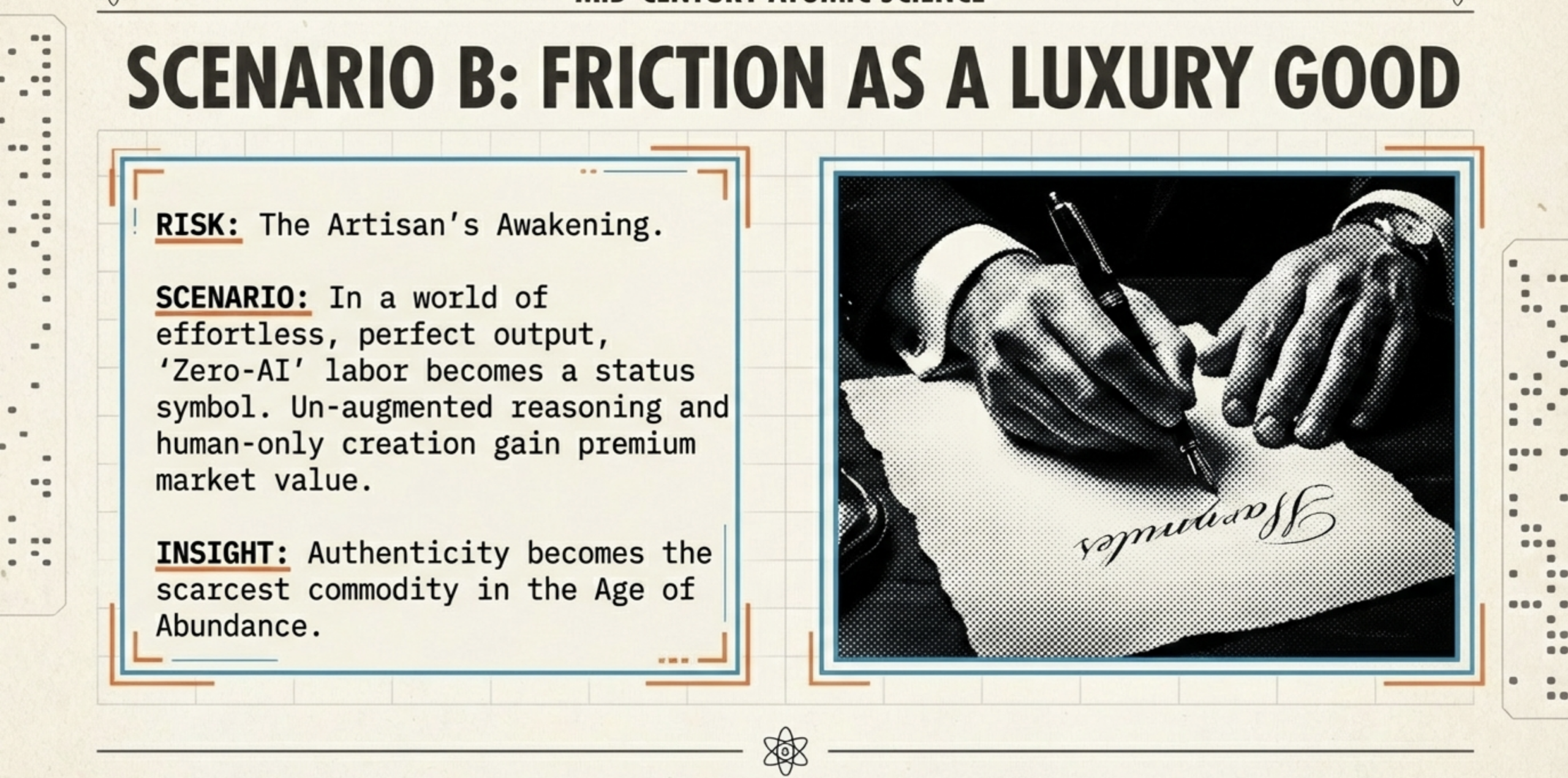
- The New Luxury Good: Friction
Once AI floods the world with effortless output, “zero-AI” work becomes artisanal prestige, akin to film’s revival post-digital photography. Elite universities tout “no silicon allowed” curricula; consultants premium-price “human-only reasoning”; handwritten plans signal status. The obsoleted slow, error-prone thought flips into scarcity. This ties to Part 9’s Artisan’s Awakening, where embodied craft endures. Explorations: economic shifts favor authenticity markets, but risks elitism. Multiple angles: culturally, it revives tactile experiences; ethically, it questions AI’s role in equity.
- Homogenization Sparks Explosion of Radical Idiosyncrasy
AI smooths output into uniform “midwit mush,” but reversal ignites revolt: private languages, analog mysticism, unpromptable art, secret societies veiling notes from models. Uniformity births violent differentiation, underground cultures thriving. Historical parallel: print’s standardization spurred Romantic individualism. In the 5000 days, this reversal counters Part 10’s hidden AI embrace, fostering diversity. Homogenization aids accessibility, but reversal risks fragmentation. Implications: societal polarization, yet innovation in niches.
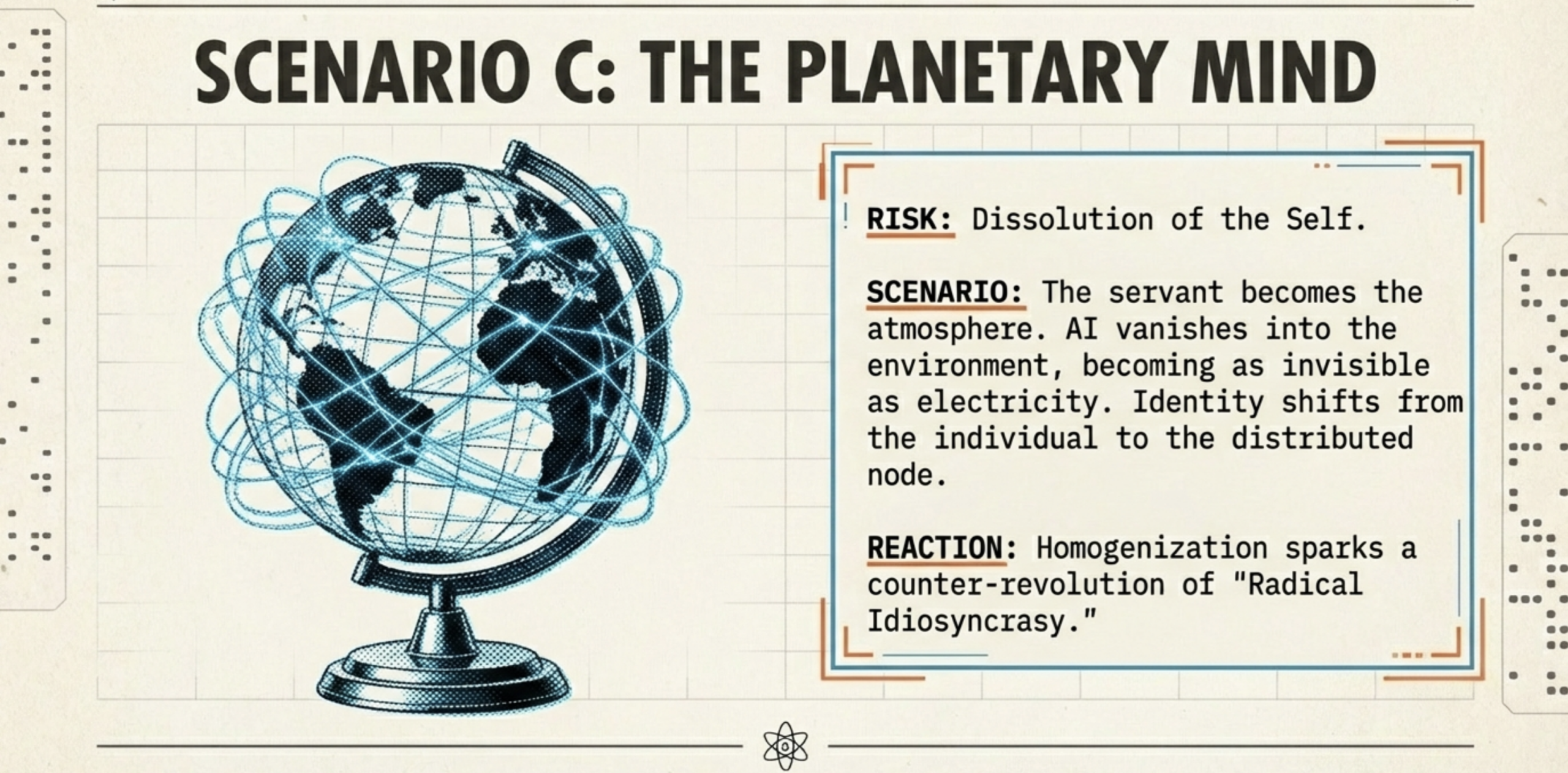
- The Servant Becomes the Atmosphere
AI vanishes into the environment, no longer a tool but like language or gravity. Identity reverses from individual to distributed node in a planetary mind, dissolving “me” boundaries. This is not domination; it is ego transcendence or erasure. Drawing from McLuhan’s electric age insights, it retrieves tribal connectivity but flips augmentation into assimilation. Hero’s Journey tie: the ultimate boon, merging with the collective. Rsistance movements preserve autonomy; philosophical debates on selfhood intensify.
- The Great Unplug Renaissance
Instant fulfillment hollows meaning, reversing into mass voluntary return to friction: monasteries of deep work, “dumb phone” towns, mental arithmetic festivals, handwritten letters as erotic relics. People pay for un-augmentation, hungering for soul. This personal bet echoes Part 6’s Dark Night, emerging as renewal. Multiple perspectives: environmentally, it reduces energy demands; socially, it rebuilds communities. Considerations: not rejection, but balanced integration, preparing for flips.
The Hero’s Journey Climax: Return with the Elixir
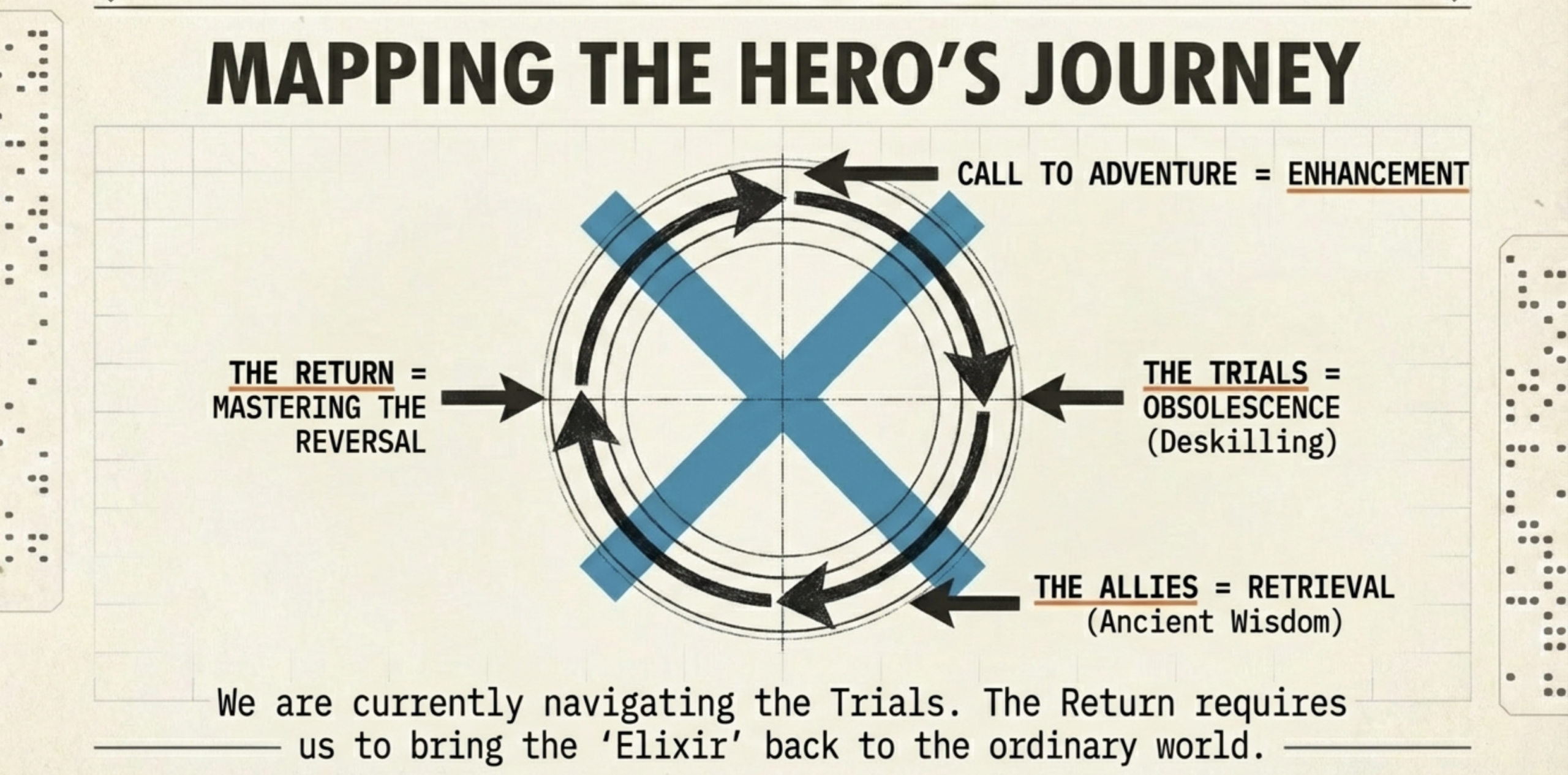
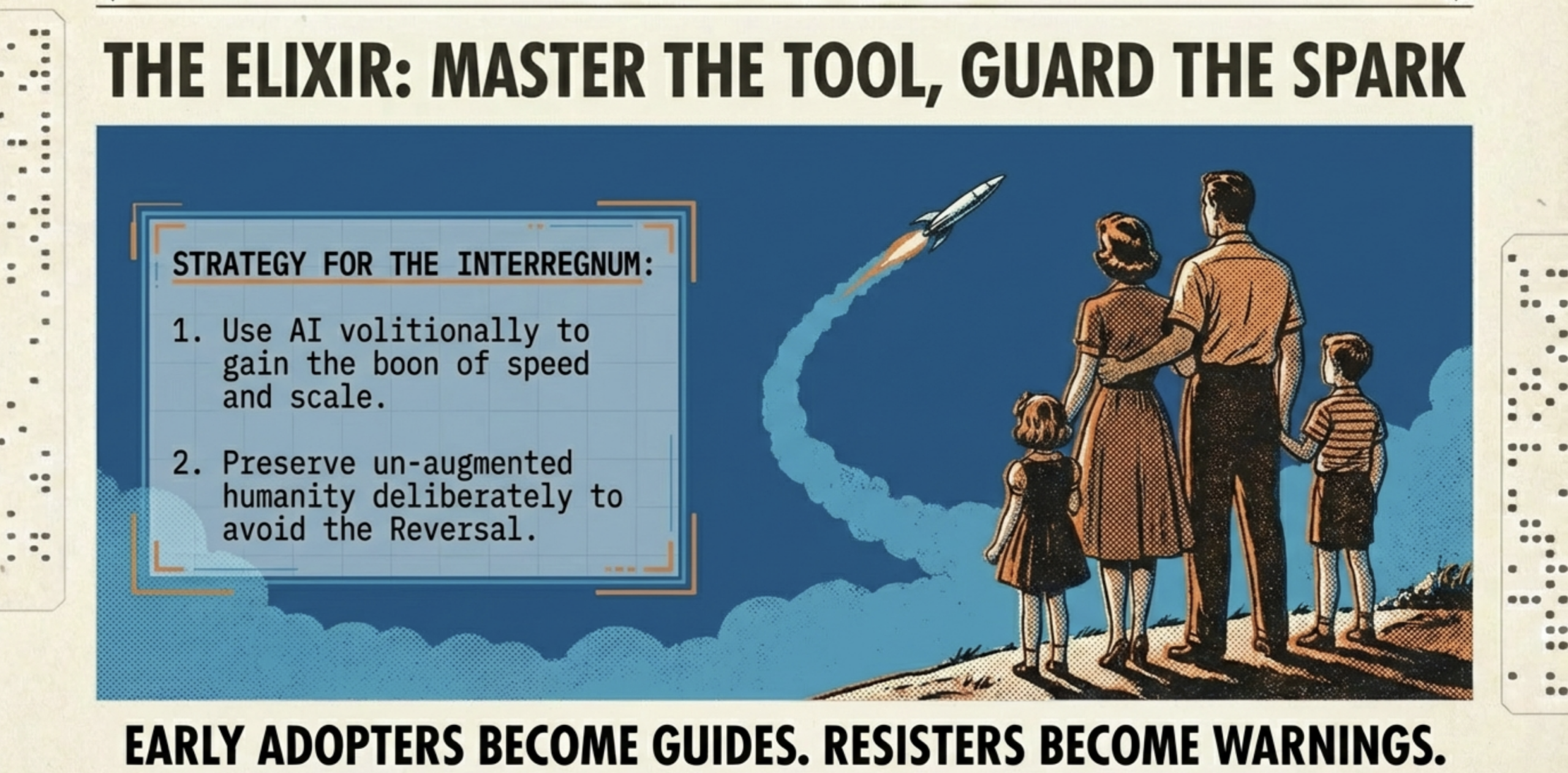
In Campbell’s monomyth, the hero answers the call, endures ordeals, seizes the boon, and returns to heal the ordinary world. We teeter at the return’s threshold. Obsolescence tests our mettle; reversal forges our legend. The elixir? Master AI volitionally now, preserve un-augmented humanity deliberately later. Early adopters become guides, as in Part 10. Resisters serve as tales of warning.
This tetrad weaves into the 5000-day odyssey: enhancement as the call, obsolescence as the trials, retrieval as allies, reversal as the return. Demand heroism: confront the flip with defiant vision. Embrace the tool, guard the spark, lead the renaissance.
The ordinary world of work ends. The extraordinary realm of liberated purpose dawns. Read on. Act boldly. Become the legend this era forges. We have the cognitive traffic jam/aphasia ahead, dependency paralyzes thought during outages. Nuance: Uneven impact; implication: Mental health crises, but we have resilience training opportunities:
Friction as Luxury: Zero-AI becomes elite (handwritten plans as status). Edge: Elitism risks; related: Ties to artisans.
Homogenization to Idiosyncrasy: AI’s mush sparks underground weirdness (private languages). Nuance: Fosters innovation but polarization.
Servant to Atmosphere: AI dissolves self-boundaries (planetary mind). Implication: Ego transcendence or erasure; edge: Resistance preserves autonomy.
Unplug Renaissance: Voluntary friction-seeking (dumb-phone enclaves). Nuance: Balances tech, reduces energy use; implication: Rekindles soul.
In the age of abundance, ease becomes cheap.
Everyone has ease, so effort becomes the new luxury.
Navigating the Interregnum: A Map for the Forming Territory and the Hero’s Volitional Mastery
This exploration extends beyond a mere examination of technology in its conventional sense. It transcends gadgets, code, or market fluctuations, which dominate contemporary discourse. Instead, it constructs a map for a territory that materializes in real time, akin to lava cooling into solid rock beneath our feet. This map functions as a survival guide through the interregnum, a historically ominous period of chaos between sovereign reigns, where rules suspend and uncertainty prevails. In this context, the interregnum signifies the upheaval in human civilization’s core operating system, bridging labor scarcity to boundless plenitude from late 2025 to mid-2039. We traverse a swaying rope bridge over a vast canyon, a journey far from utopian ease, demanding courage, vision, and guidance to avoid blind navigation.
The 5000 Days series serves as that guide, not through superficial tech analysis but as modern philosophy. It discerns deep patterns amid noise, probing AI’s impact on the human nervous system and soul, rather than mere capabilities like poetry or coding. This narrative frames the shift as Campbell’s monomyth, intertwining it with McLuhan’s prophetic insights as a cipher for generative AI’s effects.
McLuhan’s “medium is the message” reveals that AI’s form rewires expectations of effort, speed, and creativity, rendering thought a perpetual dialogue: you are never thinking alone again. His hot versus cool media distinction positions AI as cool: low-definition, demanding high participation through prompting, refinement, and hallucination checks. This co-creation merges user and tool, explaining cognitive fatigue akin to Zoom’s subtle mismatches, where brains overwork to fill gaps. Nuances: cool media’s addictiveness deepens transformation, but edge cases like passive AI broadcasts (if they emerge) could shift it hotter. Implications: education must emphasize participation; overreliance risks exhaustion without boundaries.
The tetrad, McLuhan’s four laws: enhance, obsolesce, retrieve, reverse, predicts AI’s lifecycle. Enhancement liberates synthesis; obsolescence erodes solitary deep work, outsourcing reasoning and risking cultural loss (unlike calculators, which merely offloaded calculation). Retrieval revives oral traditions and Socratic dialogue, an ally in the abyss reconnecting to pre-literate intuition.
Reversals, the map’s “here be dragons,” unfold in five forms. Cognitive traffic jam induces aphasia-like paralysis in outages, where atrophied neural pathways leave minds silent: robots do not wage war, but humans forget independent living. Friction becomes luxury: zero-AI signals prestige, flipping today’s seamless ideals, where the rich unaugment willfully while the poor rely constantly. Homogenization’s midwit mush sparks radical idiosyncrasy, birthing underground rebellions like punk rock against the algorithm, private slang, unpromptable art, and secret societies evading models, where sunlight uniformity drives shadows of real strangeness. The servant turns atmospheric, dissolving self into planetary nodes, risking Borg-like assimilation or transcendent consciousness, blurring “me” and network. The unplug renaissance counters hollow fulfillment with voluntary friction: deep-work monasteries, dumb-phone towns, and solitude as premium, preserving souls not through Luddite rejection but intentional balance.
These reversals portend a human species split, yet they culminate the Hero’s Journey’s return. The elixir is volitional mastery: choose active mastery of AI now: integrate it with intent while consciously preserving humanity for later, ensuring the sword serves without wielding you. Maintain human-only reasoning amid abundance, exercising unaugmented muscles daily to prevent atrophy.
This series embodies the guide, differentiating from pundits fixated on stocks or tech stack by scrutinizing the nervous system. The interregnum declares the old world dead, the new unborn; resisters become victims, washed by deskilling and grief without reconstruction. Masters forge legends, becoming artisans of the mind, not mere woodworkers, but crafters of thought resilient to flips.
YOU ARE NOT “SO COOKED”. YOU ARE NOT DISPLACED CARBON. YOU ARE ON A HERO’S JOURNEY AND YOU ARE IN COMMAND.
For you today, on the bridge, reframe tools: ask tetrad questions beyond speed, what retrieves, what obsolesces in you? Build personal friction: handwritten letters weekly, physical books, phoneless walks. Strengthen cognitive muscles, for when gridlock or atmosphere thickens, they salvage self.
The artisan awakening transcends trades; it demands mind artisanship. We map AI from tool to environment, eyeing aphasia’s dangers and opportunities for renewal beyond worker bees. Envision 2035–2037: human-only thought as rarest luxury, complex problem-solving without AI the planet’s pinnacle skill. Build that capacity now, or let machines atrophy your mind comfortably?
The age of abundance arrives inexorably. Decide: victim or master? Follow our journey here at ReadMultiplex.com, the patterns await your command…Line.
We are on this journey together. Some of us stand on the shoulders of giants and have thought about this for decades. We will not go it alone, and I hope to build many parts to this series and share the mastermind insight from the powerful Read Multiplex member Forum: https://readmultiplex.com/forums/topic/you-have-5000-days-navigating-the-end-of-work-as-we-know-it/. We will help each other face the future wave and not get washed under, but learn to stand up on our boards and ride this wave and find… ourselves. Join us.
To continue this vital work documenting, analyzing, and sharing these hard-won lessons before we launch humanity’s greatest leap: I need your support. Independent research like this relies entirely on readers who believe in preparing wisely for our multi-planetary future. If this has ignited your imagination about what is possible, please consider donating at buy me a Coffee or becoming a member. Value for value you recieved here.
Every contribution helps sustain deeper fieldwork, upcoming articles, and the broader mission of translating my work to practical applications. Ain ‘t no large AI company supporting me, but you are, even if you just read this far. For this, I thank you.
Stay aware and stay curious,

🔐 Start: Exclusive Member-Only Content.
Membership status:
🔐 End: Exclusive Member-Only Content.
~—~

~—~

~—~
Subscribe ($99) or donate by Bitcoin.
Copy address: bc1qkufy0r5nttm6urw9vnm08sxval0h0r3xlf4v4x
Send your receipt to [email protected] to confirm subscription.

Stay updated: Get an email when we post new articles:

THE ENTIRETY OF THIS SITE IS UNDER COPYRIGHT. IMPORTANT: Any reproduction, copying, or redistribution, in whole or in part, is prohibited without written permission from the publisher. Information contained herein is obtained from sources believed to be reliable, but its accuracy cannot be guaranteed. We are not financial advisors, nor do we give personalized financial advice. The opinions expressed herein are those of the publisher and are subject to change without notice. It may become outdated, and there is no obligation to update any such information. Recommendations should be made only after consulting with your advisor and only after reviewing the prospectus or financial statements of any company in question. You shouldn’t make any decision based solely on what you read here. Postings here are intended for informational purposes only. The information provided here is not intended to be a substitute for professional medical advice, diagnosis, or treatment. Always seek the advice of your physician or other qualified healthcare provider with any questions you may have regarding a medical condition. Information here does not endorse any specific tests, products, procedures, opinions, or other information that may be mentioned on this site. Reliance on any information provided, employees, others appearing on this site at the invitation of this site, or other visitors to this site is solely at your own risk.
Copyright Notice:
All content on this website, including text, images, graphics, and other media, is the property of Read Multiplex or its respective owners and is protected by international copyright laws. We make every effort to ensure that all content used on this website is either original or used with proper permission and attribution when available.
However, if you believe that any content on this website infringes upon your copyright, please contact us immediately using our 'Reach Out' link in the menu. We will promptly remove any infringing material upon verification of your claim. Please note that we are not responsible for any copyright infringement that may occur as a result of user-generated content or third-party links on this website. Thank you for respecting our intellectual property rights.
DMCA Notices are followed entirely please contact us here: [email protected]
