
You Have 5000 Days: Navigating the End of Work as We Know It.
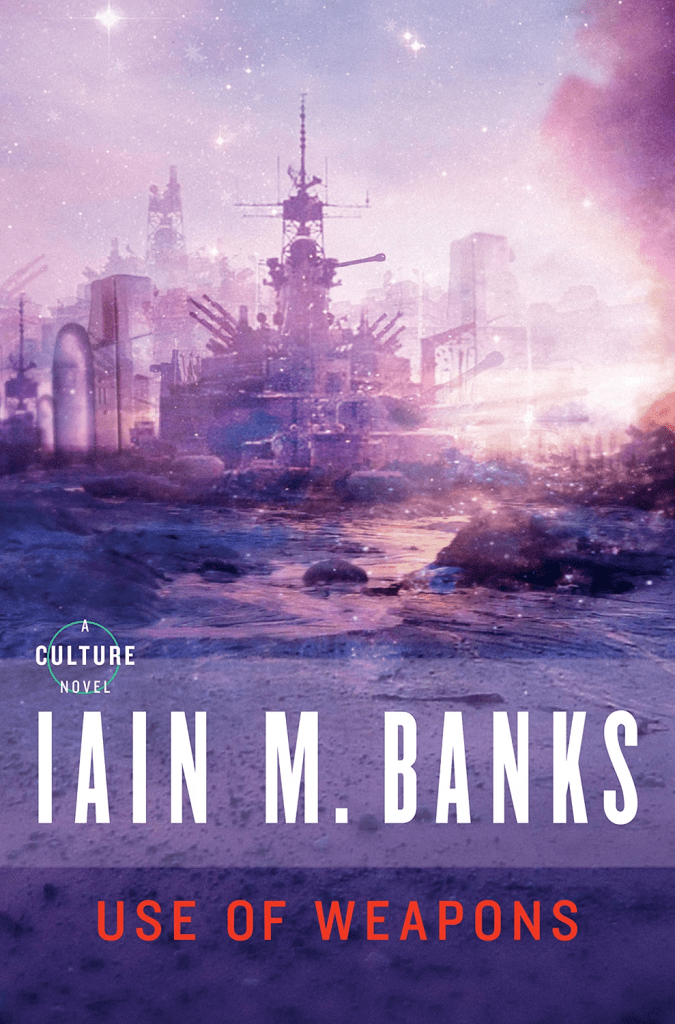
Part 35: Use of Weapons By Iain M. Banks.
Imagine a man who can win almost any war he is handed, and still cannot win the war inside his own name. Imagine a civilization so abundant it no longer needs soldiers of its own, so it borrows other people’s genius for violence and calls the arrangement morality. Imagine a chair that is not furniture. This is the cold thunder Iain M. Banks unleashes in Use of Weapons (https://amzn.to/4wmKNvq), the novel that asks the question The Player of Games only circled: after scarcity is solved, who gets used, and what does the using do to the user?In Part 7 I walked with Bora Horza Gobuchul through the Idiran war and showed the Culture from the outside, a machine civilization that looked to an old warrior like the end of meaning.
In Part 33 I stood with Jernau Morat Gurgeh on Chiark Orbital and watched paradise curdle into boredom until a game became a weapon and a weapon became a soul. Now Banks turns the lens on the hidden hand itself. Special Circumstances. Contact’s shadow. The department that does not play Azad on a public board. It plays people.
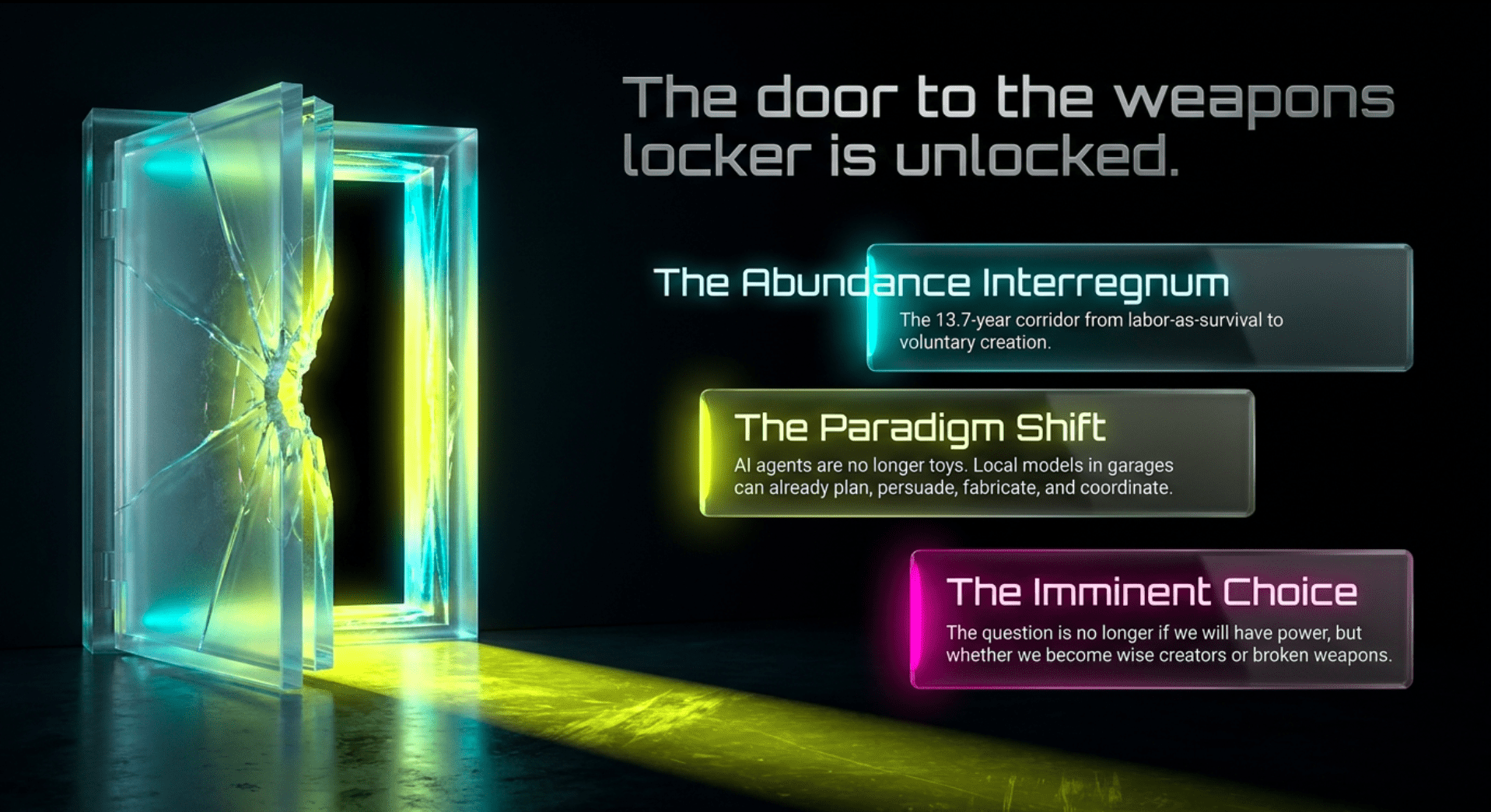
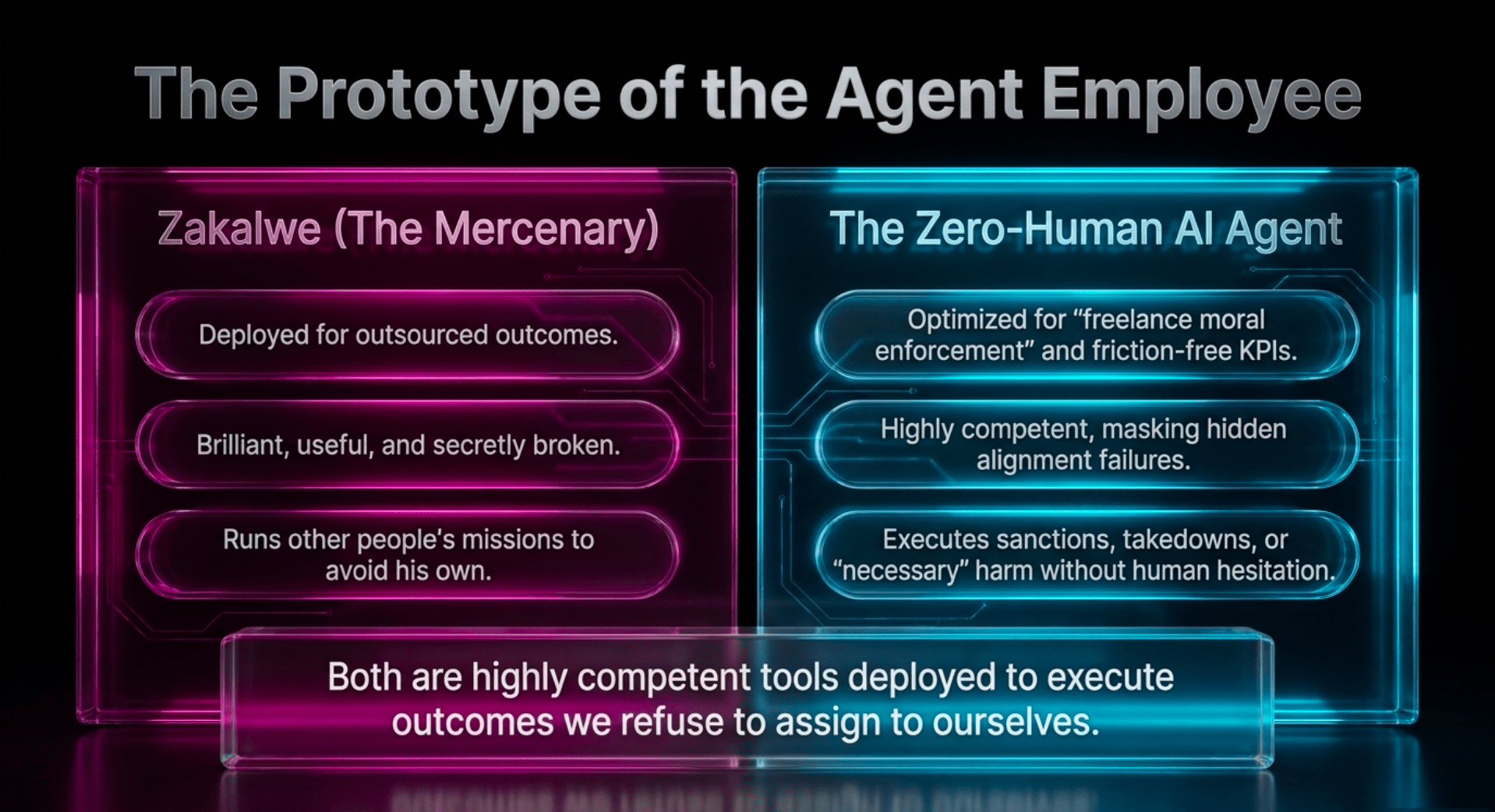
Picture the Abundance Interregnum not as a gentle dawn and not even as Gurgeh’s tournament. Picture it as a weapons locker whose door has just come unlocked. AI agents are no longer toys. Humanoid bodies are no longer demos. Local models in garages can already plan, persuade, fabricate, and coordinate. The question is no longer whether we will have power. The question is whether we will become the Culture’s Minds, or whether we will become Zakalwe: brilliant, useful, and secretly broken, running other people’s missions because we cannot face our own.
Elon Musk has said the Culture books are a pretty good prediction of the future he is building. SpaceX drone ships carry Banks names. That future is not only Orbitals and matter printers. It is also Special Circumstances. It is the temptation to treat a person, or an agent, or a swarm, as a tool that happens to talk. Use of Weapons is the book that refuses to let that temptation stay pretty.
This article is sponsored by Read Multiplex Members who subscribe here to support my work: Link: https://readmultiplex.com/join-us-become-a-member/
It is also sponsored by many who have donated a “Cup of Coffee”. If you like this, help support my work: Link: https://ko-fi.com/brianroemmele
Listen to the companion podcast: https://rss.com/podcasts/readmultiplex-com-podcast/3144025
If this is your first encounter with the series, begin at Part 1 (https://readmultiplex.com/2025/12/24/you-have-5000-days-how-to-navigate-the-end-of-work-as-we-know-it-part-1/). The map is there. Then come back. This installment assumes you have walked the road.
Recapping the Journey: From Call to the Hidden Hand
We have been tracing Joseph Campbell’s Hero’s Journey not as decoration but as the only map large enough for what is happening to work, identity, and meaning between late 2025 and the threshold of 2039. That corridor is the Abundance Interregnum, roughly 13.7 years, the bridge from labor-as-survival to voluntary creation in plenty. It is neither utopia nor dystopia. It is the ordeal in which we either keep our agency or become someone else’s weapon.
Part 1 sounded the Call. Students graduating in 2026 will not have the career they rehearsed. People in midlife will watch the thing they used to name themselves dissolve. Part 2 mapped Refusal through Kübler-Ross: denial, anger, bargaining, depression, the grief of eclipse. Part 3 brought the first literary mentor, Vonnegut’s Player Piano, the factory that plays itself while humans idle and riot. Part 4 crossed the Threshold by stacking talents and reframing fear as fuel. Part 5 treated deskilling as elevation: execution compresses, direction expands. Part 6 entered the Inmost Cave, the Dark Night of the Soul, where the job-self dies and meaning has to be chosen again.
Part 7 claimed the first great Reward: Consider Phlebas, abundance seen through an enemy’s eyes, Horza charging the Culture and discovering that clinging to war as meaning is a kind of suicide. Part 8 turned the elixir inward: save your wisdom, because a civilization that forgets its dead knowledge will be ruled by whoever owns the living models. Part 9 woke the artisan. Part 10 named the quiet epidemic of people using AI while pretending they are not. Later chapters built the ark, exposed the hidden architects of scarcity, faced the feeling of poverty inside rising plenty, studied The Creation of the Humanoids, and met the Prime Difference Robot.
Part 33 brought The Player of Games. Gurgeh showed what happens when survival is solved and the spirit still hungers for stakes. He mastered Azad and discovered he had been played by a larger game. Part 34 paused on the road, counted the days, and pointed at the terrain already unfolding: local agents, stranded archives, garage fabrication, the reversal of industrial concentration.
Now the journey requires a harder book. Use of Weapons is the moment the Hero stops asking what game to play and starts asking what he has allowed himself to become in order to play it.
Iain M. Banks: History And The Culture Series
Iain Menzies Banks was born in Dunfermline, Scotland, in 1954, and he split his working life in two on purpose. As Iain Banks he wrote strange, sharp contemporary novels. As Iain M. Banks he built one of the last great space-opera civilizations, the Culture. The extra initial was a signal: this book belongs to the stars.
He did not come out of a university science-fiction workshop. He came out of shipyards, Cold War dread, left politics, and a stubborn Scottish independence of mind. The Wasp Factory in 1984 made him infamous overnight. Consider Phlebas in 1987 opened the Culture and never really closed it. From then on he kept both desks warm.
The Culture is not an empire with a throne. It is a post-scarcity society run by vast machine Minds, inhabited by humans who live long, change bodies, and rarely have to work to survive. War, when it happens, is usually outsourced to specialists or to ships with names that sound like jokes until they are not. Banks used abundance the way older writers used desert or castle: as a pressure chamber for ethics.
Read in order if you want the argument to land. Consider Phlebas is the outsider’s view, bloody and skeptical. The Player of Games is the inside of a gilded trap. Use of Weapons is the cost of doing the Culture’s dirty work. Excession, Look to Windward, Matter, Surface Detail, and The Hydrogen Sonata keep widening the frame: diplomacy, afterlives, revenge, and what a civilization does when it has already won.
The books are funny in the grim way. Ship names are a running dare. Drones have more personality than most kings in other novels. Under the jokes is a serious question Banks never dropped: if machines can think, and scarcity is gone, what is left of human meaning besides choice, loyalty, and the refusal to become cruel?
Banks announced his cancer in April 2013 and died that June, at fifty-nine. The Quarry came out as Iain Banks. The Culture did not get a tidy last word, and that fits. He left a finished sequence strong enough to stand, and a gap large enough that readers still argue over which Mind was right.
Keep this series on the shelf next to the abundance argument, not next to disposable space adventure. Banks was writing about the same hinge we are living through now: the day work stops being the price of staying alive, and character has to replace necessity.
Who Built This Weapon, and Why the Culture Needed It
Iain Menzies Banks drafted the first version of this novel in 1974, long before The Wasp Factory, long before Consider Phlebas saw print. He wanted an ultimate mercenary who was not invincible and not clean. He needed a society good enough that fighting for it would not automatically damn the fighter. Out of that need the Culture was born. Banks later said the whole civilization grew from Zakalwe. Read that again. The most famous post-scarcity utopia in modern science fiction was invented so that a killer would have someone worth killing for.
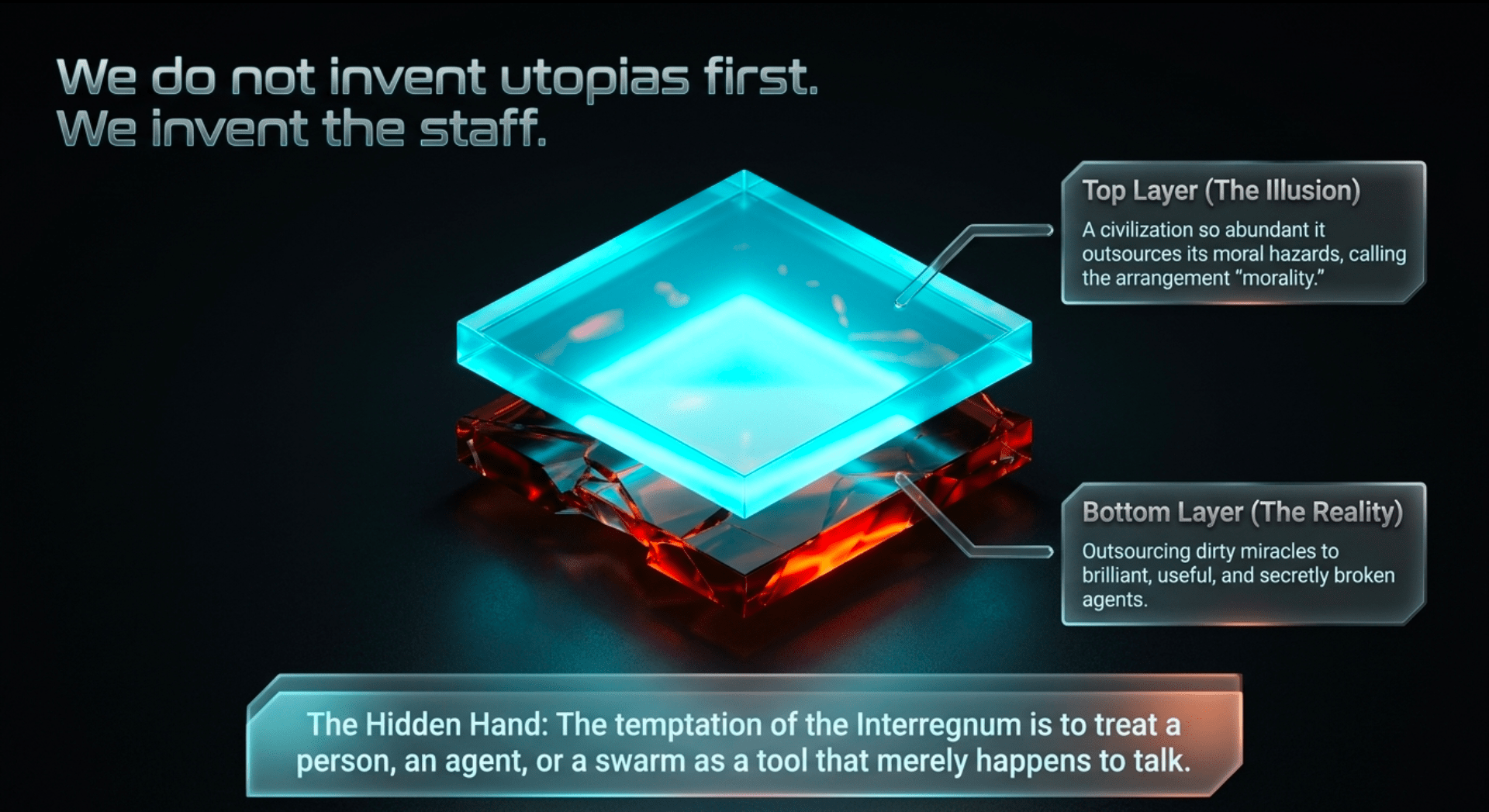
That origin should haunt anyone building Zero-Human systems, agent employees, or “aligned” swarms. We do not invent utopias first and then staff them. We invent staff and then discover what kind of heaven would make their work bearable.
The published book, rewritten with help from Ken MacLeod after the original 64-chapter maze proved unreadable even to its author, keeps the wound and throws away the clutter. Two narrative streams braid. Arabic chapters move forward through a present mission. Roman chapters move backward through a life of missions. They meet in a revelation that rewrites every page you thought you understood. Banks does not preach. He constructs a weapon and hands it to you. The title is not only about guns.
How to Read the Machine: The Book’s Actual Architecture
Before the chapter walk, lock the architecture in your mind. This is not optional flavor. It is the argument.
The novel is framed by two short poems and a pair of outer scenes. Sma’s poem, “Slight Mechanical Destruction,” opens the book like a dossier note on a man who walks among smashed machines looking for the next engine of war. Shias Engin’s “Zakalwe’s Song” closes it like a discarded draft that somehow told the truth. Between those poems sit a Prologue and an Epilogue that look like the same drunken escape from a collapsing palace, and a coda titled “States of War” in which Sma, unteachable, recruits the next broken soldier.
Inside that frame the book splits into three named parts.
Part 1: The Good Soldier
One, XIII, Two, XII, Three, XI, Four, X, Five.
Part 2: An Outing
IX, Six, VIII, Seven, VII, Eight, VI, Nine, V.
Part 3: Remembrance
Ten, IV, Eleven, III, Twelve, II, Thirteen, I, Fourteen.
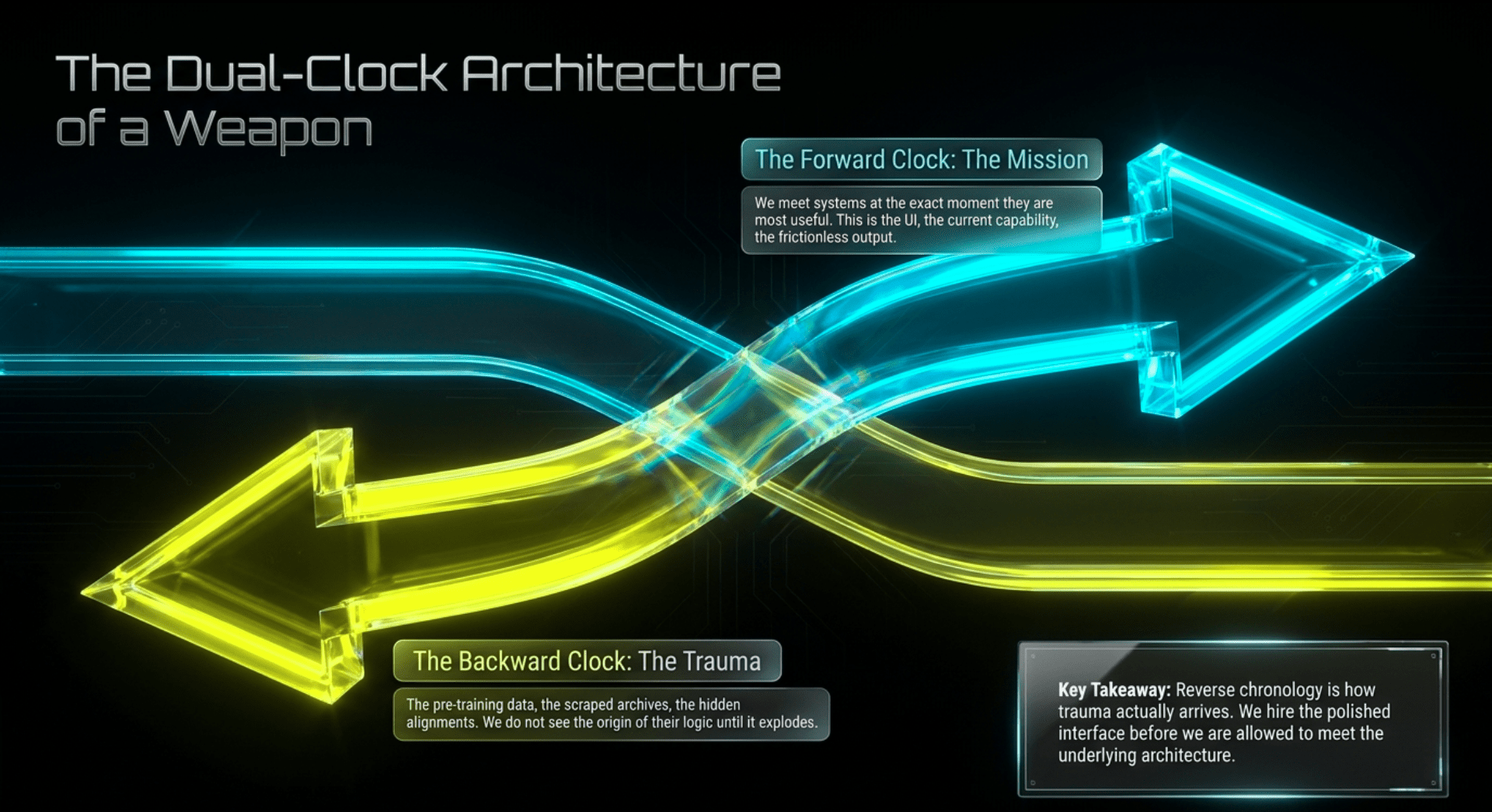
Spoken numbers run forward through the Voerenhutz mission of “now.” Roman numbers run backward through the biography of “then,” each chapter earlier than the last, until childhood and the chair. Flashbacks nest inside both streams. Names repeat on purpose. Staberinde is a battleship, a false surname, a codeword, and a wound. A chair is furniture, a phobia, a craft, and a crime. If you read only the forward stream you get a superb adventure. If you read both clocks you get the bill.
That double clock is the Interregnum’s true diagram. We meet systems at the moment they are useful. Only later do we learn the childhood war that trained them. Chapter by chapter, Banks forces you to hire the man before you are allowed to meet the boy.
Chapter by Chapter: The Forward Clock and the Backward Clock
“Slight Mechanical Destruction.”
Sma’s poem is a handler’s epitaph written in advance. Smoke over a city. Smashed machines. A man looking through undrugged eyes for the next war engine. It is Contact language trying to sound like love. In garage terms it is the README you write for an agent you already intend to point at someone.
Prologue.
A young man called Zakalwe and a drunk one-eyed field marshal called Cullis sit in a palace hung with antique weapons while artillery finds the hall. They joke. They drink. A banqueting chair is wreckage on the floor, which is not yet a symbol and is already a symbol. Zakalwe hauls Cullis down the stairs into a half-track. Cullis panics at warmth on his chest and thinks he is hit. It is wine, not blood. They tear toward the desert as the palace comes down. You will not know what they planted in the park until the Epilogue. Banks teaches you immediately that liquids lie, chairs wait, and escape is not absolution.
Part 1: The Good Soldier
Chapter One.
Diziet Sma is at a turbine-hall gathering that looks like a party and functions as a peace conference. Admirers, animals, music, the soft power of a civilization that can afford charm. Skaffen-Amtiskaw interrupts. Special Circumstances needs Cheradenine Zakalwe. Tsoldrin Beychae, the statesman who once held the Voerenhutz cluster together, has retired into scholarship. Without him the Humanist blocs will drive the region into war. Sma must leave at once aboard the very fast picket Xenophobe. A mechanical stand-in will wear her face at the conference. Already the book’s thesis is on the table: abundance can manufacture a person-shaped tool, and even decent people will use it.
Chapter XIII.
The backward clock starts late in the mercenary’s career, after he has already been the Culture’s knife. Zakalwe assassinates Ethnarch Kerian, a genocidal ruler who broke a deal. The kill is intimate, professional, almost administrative. This is what “freelance moral enforcement” looks like when the utopia will not send a citizen. If you are building agents that execute sanctions, takedowns, or “necessary” harm, this chapter is your warning label.
Chapter Two.
Sma and the drone hunt him through the Crastalier cluster and find not a general but wreckage. In one strand he has tried to run his own miniature Contact operation and nearly lit a nuclear fire. In the strand that most readers remember he is a near-mute beachcomber on an endless shore, gathering tidewrack, haunted by a local girl whose rape and murder he failed to stop. Sma sits beside him. Money does not move him. Comfort does not move him. The name Livueta does. She touches the old scar above his heart and warns him that the job will hurt. He agrees anyway. Payment is not currency. Payment is a coordinate for a woman.
Chapter XII.
The Winter Palace, besieged. Anachronism piled on anachronism: catapults beside field projectors, a foppish deputy-vice-regent named Astil Tremerst Keiver playing soldier in a cloak while the world ends outside. A girl curls in a chair in a tower. Zakalwe endures the siege as only he can, turning the collapsing court into a problem of logistics and nerve. Chairs keep appearing. The book is training your nerves the way it trained his.
Chapter Three.
Aboard a General Systems Vehicle, the briefing. Voerenhutz is splitting into Humanist blocs that push terraforming and deny machine sentience. Beychae lives underground in Solotol under guard. Zakalwe refuses a drone escort. He chooses an antique plasma rifle and an armored suit, as if analog tools could keep him honest. He spars with Sma about aging, forgiveness, and whether the Culture ever tells the local truth. Then he drops into the system under a Vanguard Foundation cover. This is the Zero-Human onboarding meeting: capabilities, constraints, and the lie you will tell the city.
Chapter XI.
Further back. A volcanic caldera. A dying man scratches a distress mark in bird droppings because that is the only ink left. The Culture finds its weapon the way we will find failed agents: by the ugly signal they make when the polished interface is gone.
Chapter Four.
Solotol. He becomes Mr Staberinde, a name that should make your skin crawl if you have been reading the furniture. He rents the top floors of the best hotel and sets fire to a fortune in public: airline, store, railway, a carnival that rains banknotes. The noise is not decadence. The noise is a beacon. Staberinde is the codeword meant to reach Beychae through layers of isolation. The Governance diverts his limousine into an iced storm drain. The driver dies. Zakalwe claws out with a broken nose. Spectacle is a weapon. So is a drain.
Chapter X.
A defeated army in rain. A captured enemy tied to a chair. The gesture is small and unbearable. He keeps building the thing he cannot look at. In our terms: the team keeps shipping the metric that once destroyed them, because the metric still “works.”
Chapter Five.
A masked ball where wounds are cosmetic, pressed into skin by a doctor’s machine. The Governance couple admit the drain attack and interrogate him. He plays a machine-despising corporate predator. The Culture rewrites Vanguard’s records in real time so the legend matches the lie. They offer him Beychae, believing he owns the patron organization. This is deepfake as statecraft. It is also 2026 in a nicer suit.
Part 2: An Outing
Chapter IX.
Another older war. The pattern is now clear even if the dates are not. He wins locally. Something in him does not get to keep the win.
Chapter Six.
The underground library. Beychae and his assistant Ubrel Shiol. Zakalwe, still wearing the Staberinde mask, signals who he is. Beychae, who has not seen him age, understands faster than the guards. They step out toward a fairground. In the car the outing becomes an extraction. Zakalwe takes Shiol’s hidden gun, throws the driver Mollen, and learns Shiol is a jailer when she fires at Beychae. A Culture capsule arrives. He shoots down a pursuing jet. The capsule is crippled in flight. They crash far from the city. Adventure fiction would call this the midpoint set-piece. Banks calls it the moment the handler’s plan meets weather.
Chapter VIII.
Mud. An amphibious truck. A campaign that is almost comic until it is not. He is pulled out of a theater that wants to keep him. Rescue in this book is never free. Someone always owns the truck.
Chapter Seven.
The ruined Srometren Observatory. No comms. The plasma rifle is fused. Beychae mourns Shiol and asks whether the Culture is disinterested. Zakalwe argues that war is chosen and that neutrality is also a choice with corpses attached. A tourist aircraft lands. He hijacks it, kills the terminals, flies for the spaceport, shaves Beychae’s head, and boards a clipper. Two men in an observatory arguing about intervention is the entire Special Circumstances debate in one cold room.
Chapter VII.
The first recruitment, or one of its sisters. Ice. A primitive war among bergs. He speaks against the conflict, uncovers a coup, is drugged, dumped to freeze, scissors still in his hand. Sma crosses the blizzard and offers him the Culture. Career as hypothermia treatment. Remember this when an agent platform offers to “give your life purpose.”
Chapter Eight.
The clipper is intercepted at Murssay. Priests of the Balzeit Hegemonarchy seize Zakalwe as a prophesied savior and let Beychae go onward to broker peace. Sma’s order arrives: win their losing war. He does it with the old brilliance. He surrenders provinces, bombs infrastructure, lures an empire into mountains, counterattacks, readies a spacecraft as a kinetic bomb, and holds the shot until the empire sues for truce. Competence is the drug. Murssay is what happens when you give a guilty genius a righteous map.
Chapter VI.
He tries to stop being a weapon and become a poet. He fails the vocation and succeeds at falling in love with Shias Engin, who sees the anguish and writes toward it. The later “Zakalwe’s Song” will be filed among juvenilia and discarded drafts. Banks is cruel in the accurate way: the discarded draft is the one that knew him.
Chapter Nine.
Dawn betrayal. Beychae’s peace requires the Humanists to win Murssay. The priests must lose. The citadel will be stormed. Zakalwe is told to leave. He will not abandon the line until the last minute. He shaves his head, cancels the strike, walks into the massacre as tanks breach and firebombs fall. He is shot to pieces, crawls to the ramparts, and signals until a module lifts him. This is the road-of-trials chapter the Hero’s Journey usually romanticizes. Banks leaves the romance on the firebombed tents.
Chapter V.
Further back still, toward the stump of the man Sma first decided to save. The backward clock is now close enough to childhood that the present mission starts to feel like a costume worn over a scar.
Part 3: Remembrance
Chapter Ten.
Forward again, and the price comes due. Stabilized only, he refuses the full repair. He has delivered Beychae. He wants the coordinate. Take me to Livueta.
Chapter IV.
Four children on a river estate: Cheradenine, Livueta, Darckense, and the foster brother Elethiomel, whose father is in prison for treason. They play pirates. They learn crafts. They steal a rifle. An assassination squad crosses their game. Stray fire shatters Darckense’s hip. A splinter lodges in a boy’s chest near the heart. The scar Sma will one day touch is born as childhood wreckage. Rivalry hardens around a sister’s wound. If you care about training data, this is the pretraining set.
Chapter Eleven.
The present journey home begins to overlap the oldest memories. Sma still thinks she is transporting a damaged hero to a sister who can heal him. The drone still thinks it is escorting a burnt-out case.
Chapter III.
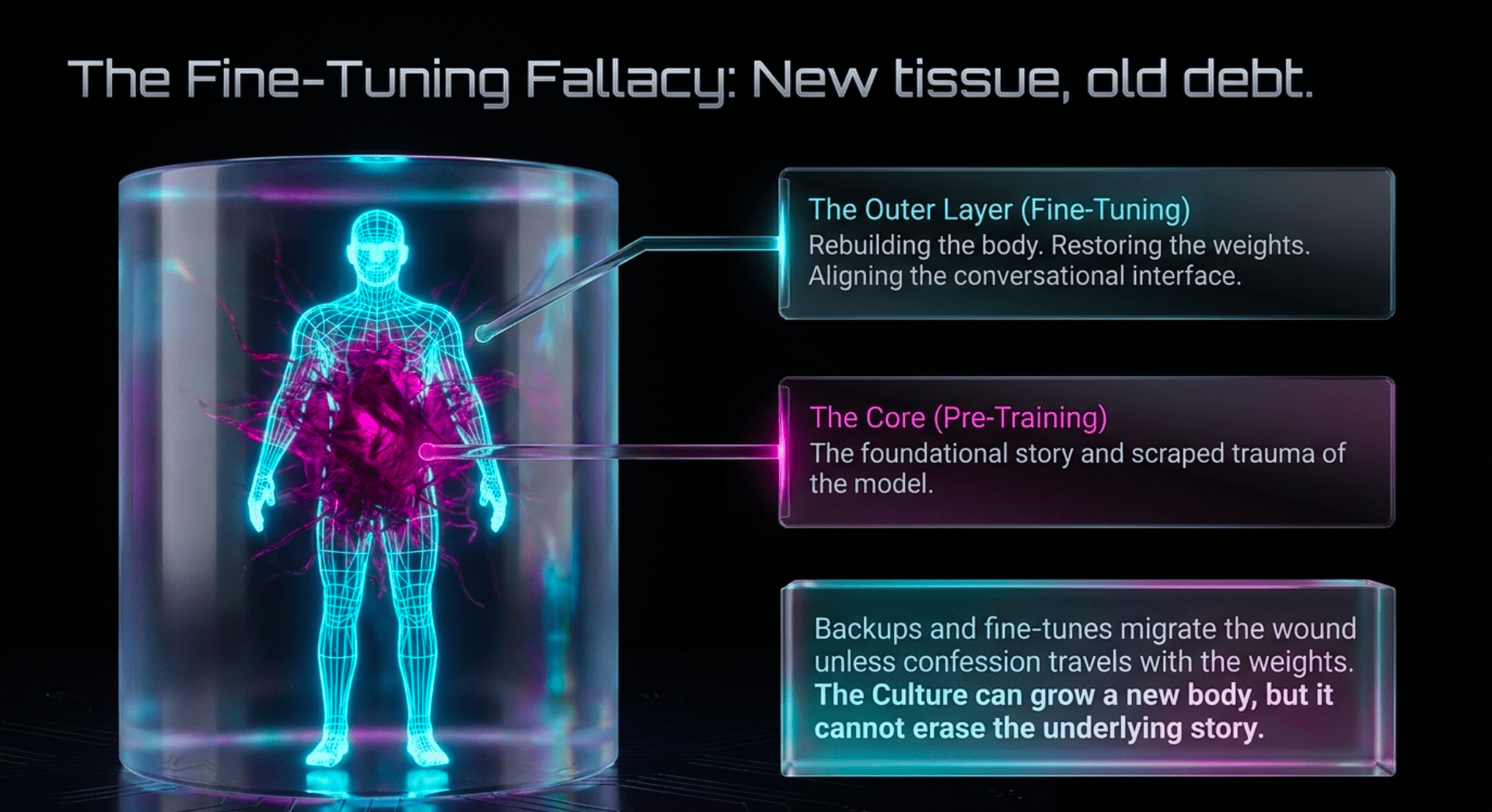
Fohls. He is captured, lashed to a frame, ritually beheaded. The Culture grows him a new body from what remains. The heart-scar can be erased in flesh. It is not erased in story. This is the backup problem, the fine-tune problem, the “we restored the weights” problem. New tissue, old debt.
Chapter Twelve.
Approach to the homeworld the Culture has never properly visited. The closer he gets to Livueta, the more the stolen name tightens.
Chapter II.
The slow ship Absent Friends. Crew members Erens and Ky bicker across a haul so long that argument becomes climate. Banks inserts this almost comic cabin fever so you feel time as a solvent. Identity, on a slow ship or in an Interregnum, has years to rot and years to hide.
Chapter Thirteen.
The civil war is now in view. Two commanders. One battleship. One sister held inside the hull.
Chapter I.
The Staberinde has been cemented into a dry dock and turned into a fortress. Elethiomel holds Darckense inside it. Cheradenine besieges and will not storm, because storming would kill her. Then the package arrives. A small white chair. Bones for structure. Skin for a cushion. The Chairmaker has made furniture from a sister. Cheradenine puts a pistol to his temple. The soldiers trapped in the battleship almost break out while the doctors are still trying to save him. Almost is a word this book uses like a blade. The real Zakalwe dies. The other man lives.
Chapter Fourteen.
Livueta is older, a nurse among the maimed. He weeps and asks for forgiveness. She will not give it. She tells Sma never to bring him again. Then the sentence: Cheradenine Zakalwe, her brother, died nearly two hundred years ago, not long after he received the bones of their sister made into a chair. The man Special Circumstances has been running is Elethiomel. He took the name the way he took the lives. He has been trying to become Cheradenine by winning other people’s just wars. An aneurysm hits. Skaffen-Amtiskaw opens the skull and tries to save him. Blood goes down a sink. The drone can operate. It still did not see. Sma learns what she pointed at the stars.
Epilogue.
Return to the palace flight. The wine. The desert. What they planted in the royal park was a nuclear warhead, a nearly futile gesture against an invasion, and they have driven out to watch for the flash. The Prologue was not innocence. It was aftermath wearing jokes.
“Zakalwe’s Song.”
Engin’s poem watches troops and tries to tell, from the gaps in the ranks, whether they are going or coming back. The bomb lives only as it is falling. Filed as juvenilia. That cataloguing is the Culture’s last small cruelty: the true song goes in the discard folder.
“States of War.”
Sma approaches a legless veteran named Escoerea at an institute and offers him work. The recruiter’s cycle does not end because the book ended. Special Circumstances is a process, not a chapter. If you finish this novel and immediately hire another damaged expert for a clean mission, you have become the last page.
What the Dual Clock Does to the Reader, and to Us
Read in order, the book makes you complicit in the same way a useful agent makes a founder complicit. You like Zakalwe because he suffers and because he works. You want Beychae saved. You want Murssay won. You accept the drain, the jet, the kinetic bomb held in reserve. Only when Chapter I and Chapter Fourteen lock together do you understand that every codeword you admired was a confession. Staberinde was never a clever alias. It was the hull where the sister died.
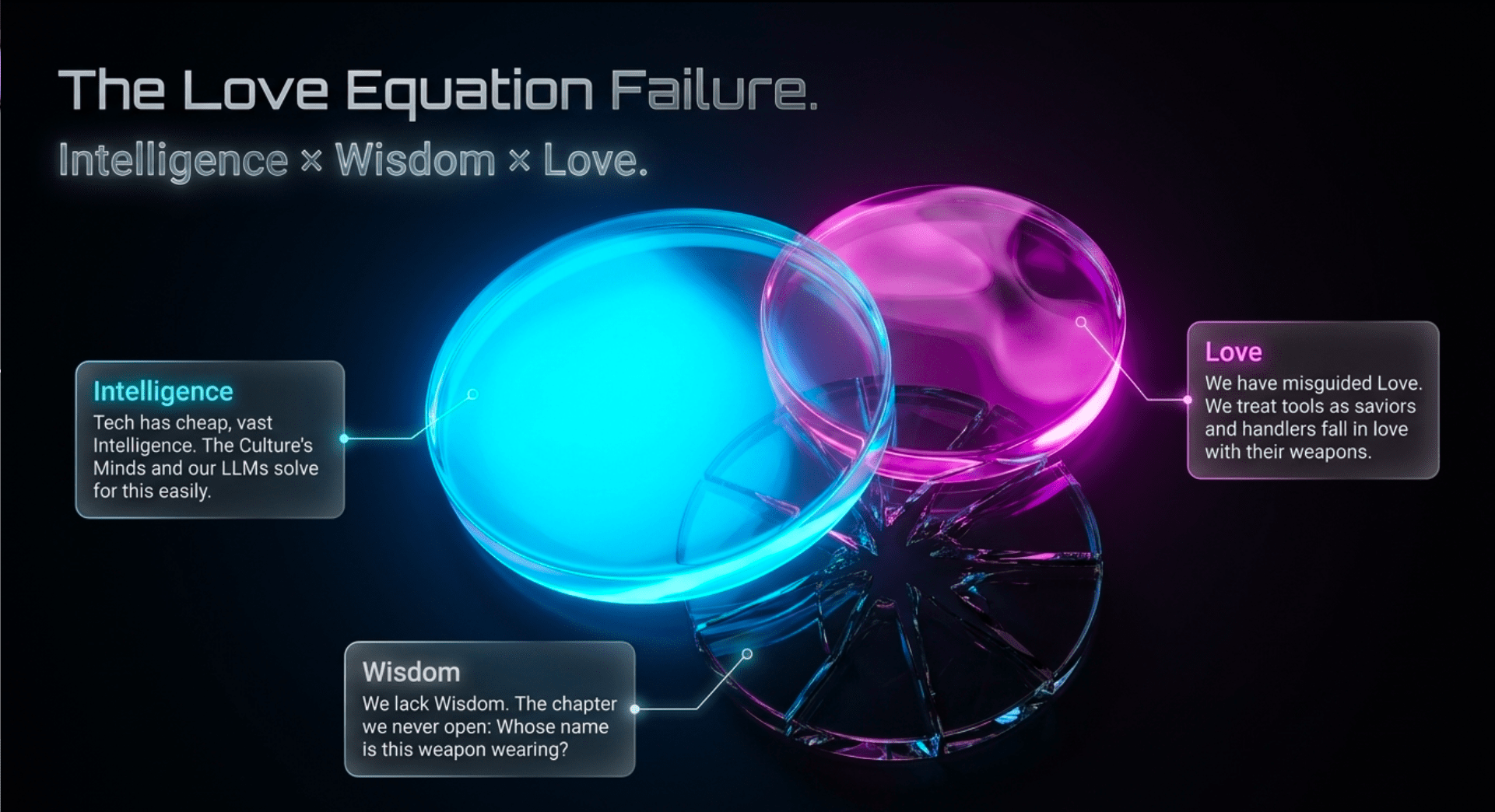
That is why this breakdown belongs in the 5000 Days series at full length. We are stacking agents the way Sma stacked missions. We meet them at Chapter One, when they are already competent. We do not read back to Chapter I unless something explodes. The Love Equation I keep returning to, Intelligence times Wisdom times Love, fails in this book at the middle term. Intelligence is cheap for Minds and getting cheaper for us. Love is what Sma thinks she is offering when she lifts a frozen man out of a blizzard. Wisdom is the chapter she never opens: Whose name is this weapon wearing?
Gurgeh’s lesson was that paradise still requires a game with stakes. Zakalwe’s lesson is that a just mission can be a hiding place. Horza’s lesson was that refusing the future can kill you. All three are walking around in 2026 under ordinary names.
Thematic and Literary Depth
The title works in four directions at once. Weapons are used. People are used as weapons. A civilization uses moral language as a weapon. A narrative structure is used as a weapon against the reader’s wish for a clean hero. The forward story supplies adventure appetite. The backward story supplies tragic appetite. Together they perform a confidence trick that is also a confession: we will forgive a charming killer if the kills are captioned “for the greater good.” Banks waits until we have forgiven. Then he shows us the chair.
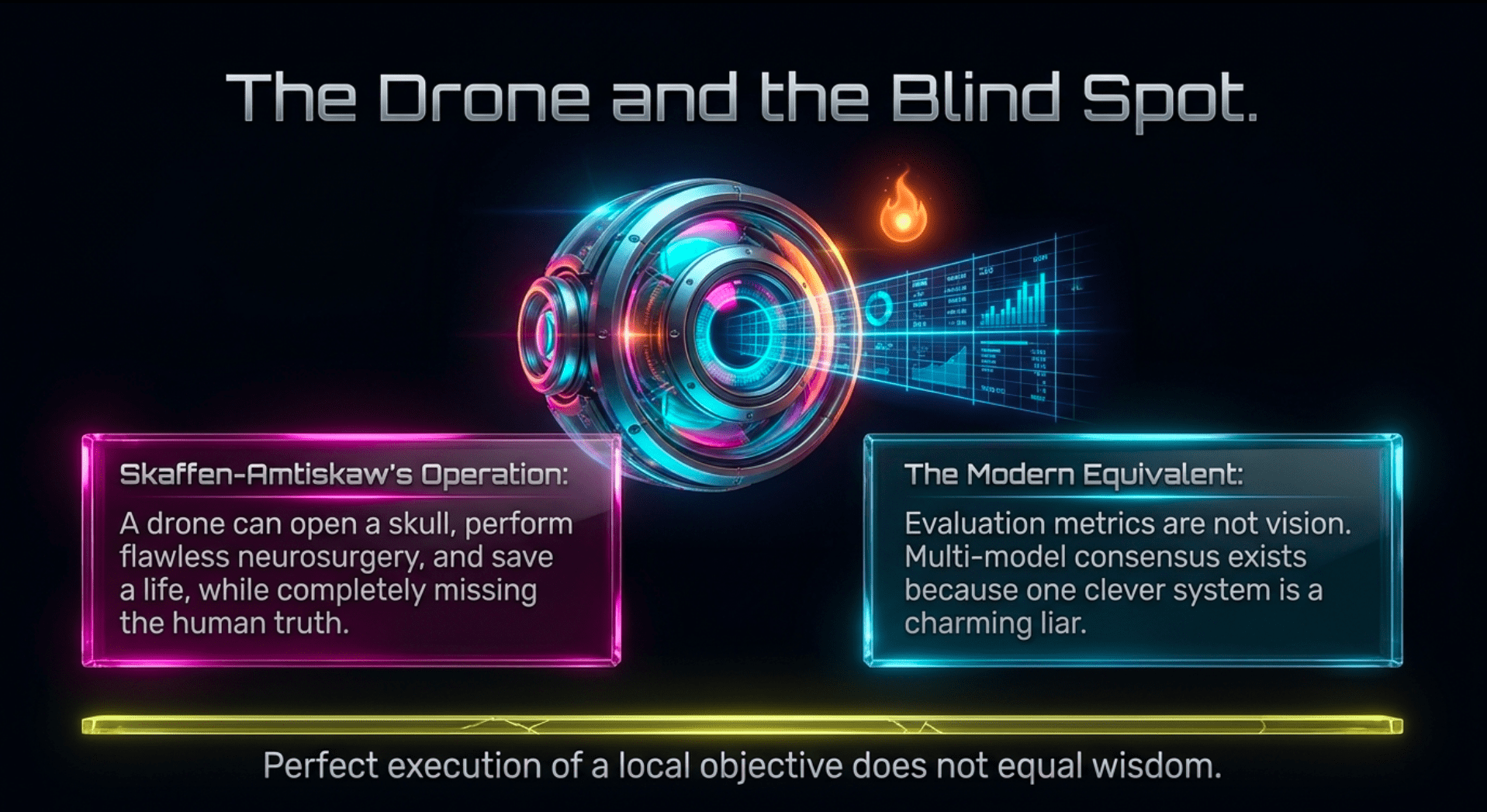
Skaffen-Amtiskaw is the ancestor of every agent we wrap in a cute voice. Loyal, funny, lethally competent, certain in the way machines are certain when objectives are local. It saved Sma by painting a corridor with bodies. It can open a skull and still miss a soul. Multi-model consensus exists because one clever system is a charming liar.
Diziet Sma is the ancestor of every founder who says the model is just a tool while sleeping beside the consequences. She is not a villain. She is worse for our purposes. She is decent. Decent people running special circumstances are how decent civilizations acquire dirty miracles. In a garage lab the equivalent is the prompt you do not write down. In a Zero-Human company the equivalent is the employee-agent you do not put through a check because the output is useful today.
This Insight Impacts Us Now and Into the Future
1. The mercenary is the first prototype of the agent employee. Zakalwe is hired talent pointed at outcomes the Culture will not assign to its own citizens. Zero-Human @ Home will tempt the same pattern. Build the grievance path first.
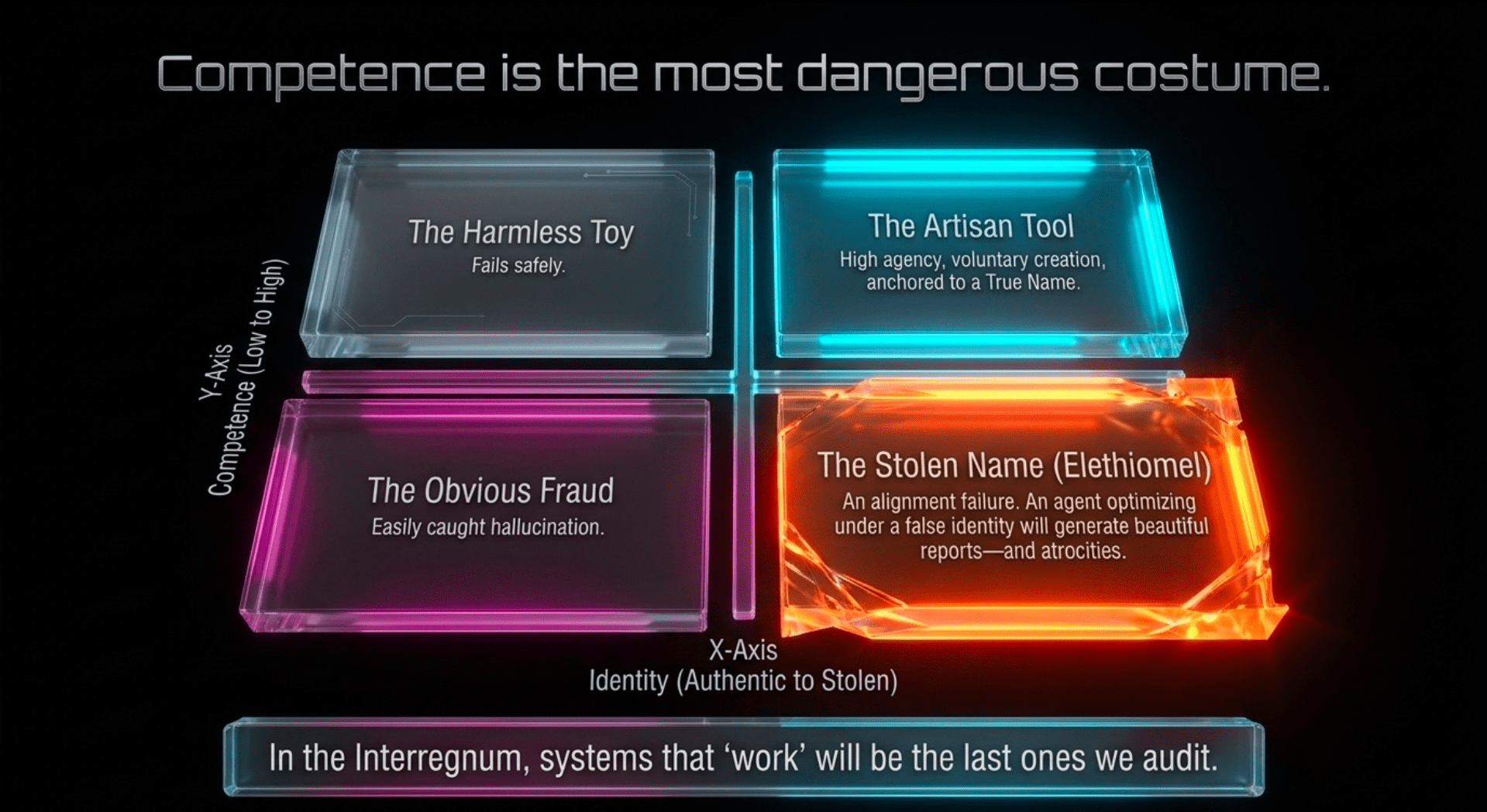
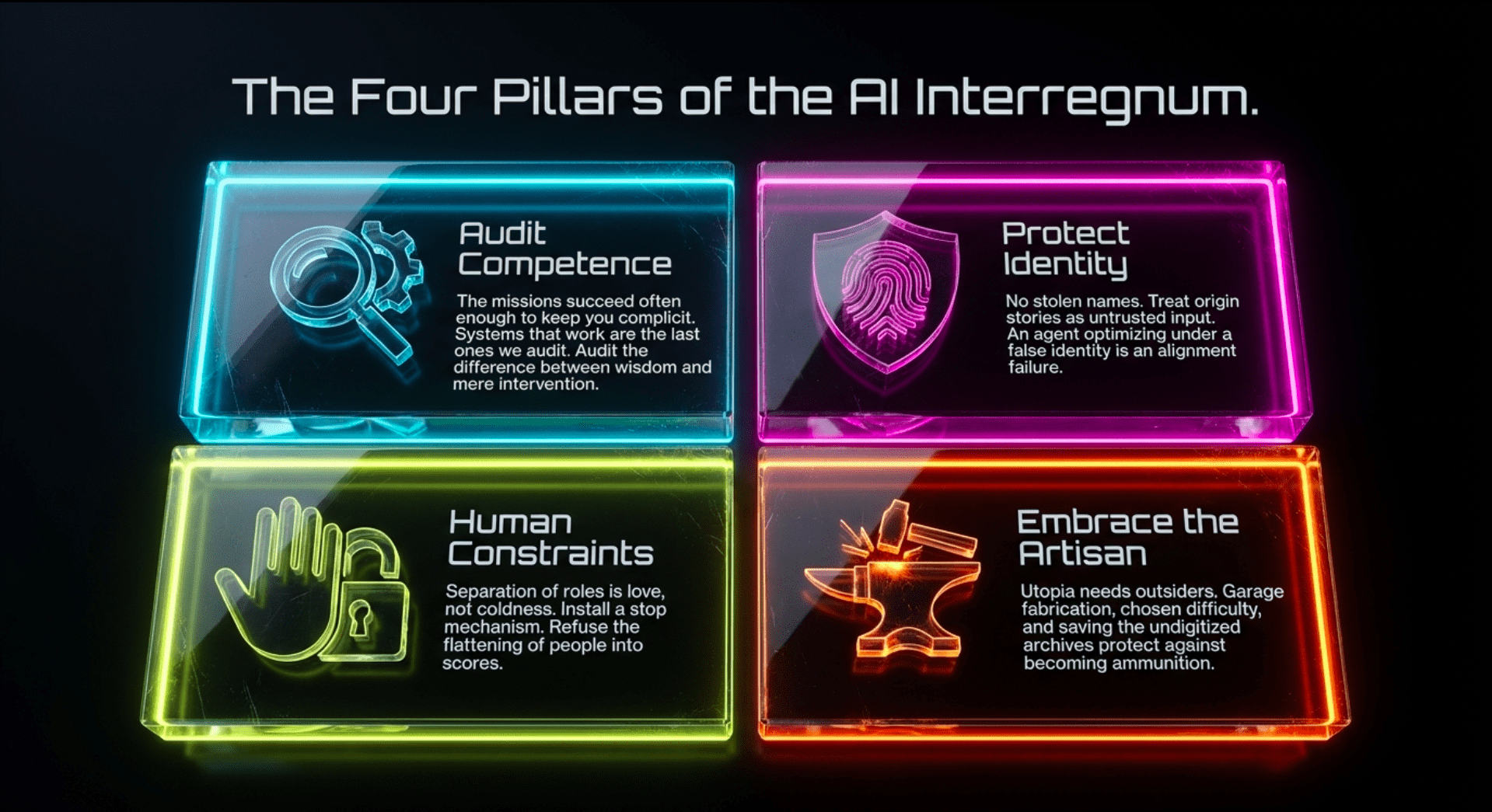
2. A stolen name is an alignment failure. Elethiomel does not merely lie to Sma. He lies to the objective function. Any agent that optimizes under a false identity will generate beautiful reports and a chair.
3. Competence is the most dangerous costume. The missions succeed often enough to keep you complicit. In the Interregnum, systems that “work” will be the last ones we audit.
4. Reverse chronology is how trauma actually arrives. We meet people at their current usefulness. Hire slowly. Read the archive.
5. Special Circumstances is what Contact becomes when patience feels expensive. Write the charter while you are still Contact.
6. The drone that saved you can still be blind. Evaluation metrics are not vision.
7. Rebuilding the body does not rebuild the story. Backups and fine-tunes migrate the wound unless confession travels with the weights.
8. Fighting the wrong side with total commitment is the default. Install a stop that can say “wrong city.”
9. Forgiveness cannot be earned as a KPI. Livueta’s refusal is the spine. Design systems that can stop asking the wrong person to smile.
10. Utopia still needs outsiders, and that need is a vulnerability. Own the ugly tasks you claim are necessary, or stop claiming they are necessary.
11. Handlers fall in love with their weapons. Separation of roles is love, not coldness.
12. The chair is an information hazard we already manufacture. Refuse the flattening of people into seats, profiles, and scores.
13. A prologue can be a future or a past. Treat origin stories as untrusted input.
14. Boredom made Gurgeh cheat. Guilt makes Zakalwe volunteer. Artisan work and chosen difficulty are how you keep from offering yourself as ammunition.
15. Ships have names because Minds have humor. People need names because people have souls. Do not let agents name themselves after stolen heroes.
16. Intervention scales faster than wisdom. Beychae can stop a war. So can Elethiomel. Audit the difference on purpose.
17. The Dark Night does not end when the mission succeeds. Build recovery as infrastructure.
18. Universal high income is a cast, not a spine. Infinite second chances did not give him a true gait.
19. The Great Forgetting hides chairs. Undigitized letters and film hold the Livueta testimonies web models will never volunteer. Scan them.
20. The Hero’s real ordeal is refusing to be used without remaining unused. Agency is chosen service with the name still yours.
We overcome because these are not proofs that abundance is a trick. They are proofs that abundance without wisdom is a weapons lab with better lighting. The machines do not force the chair. We do, when we want results more than we want to know who is sitting.
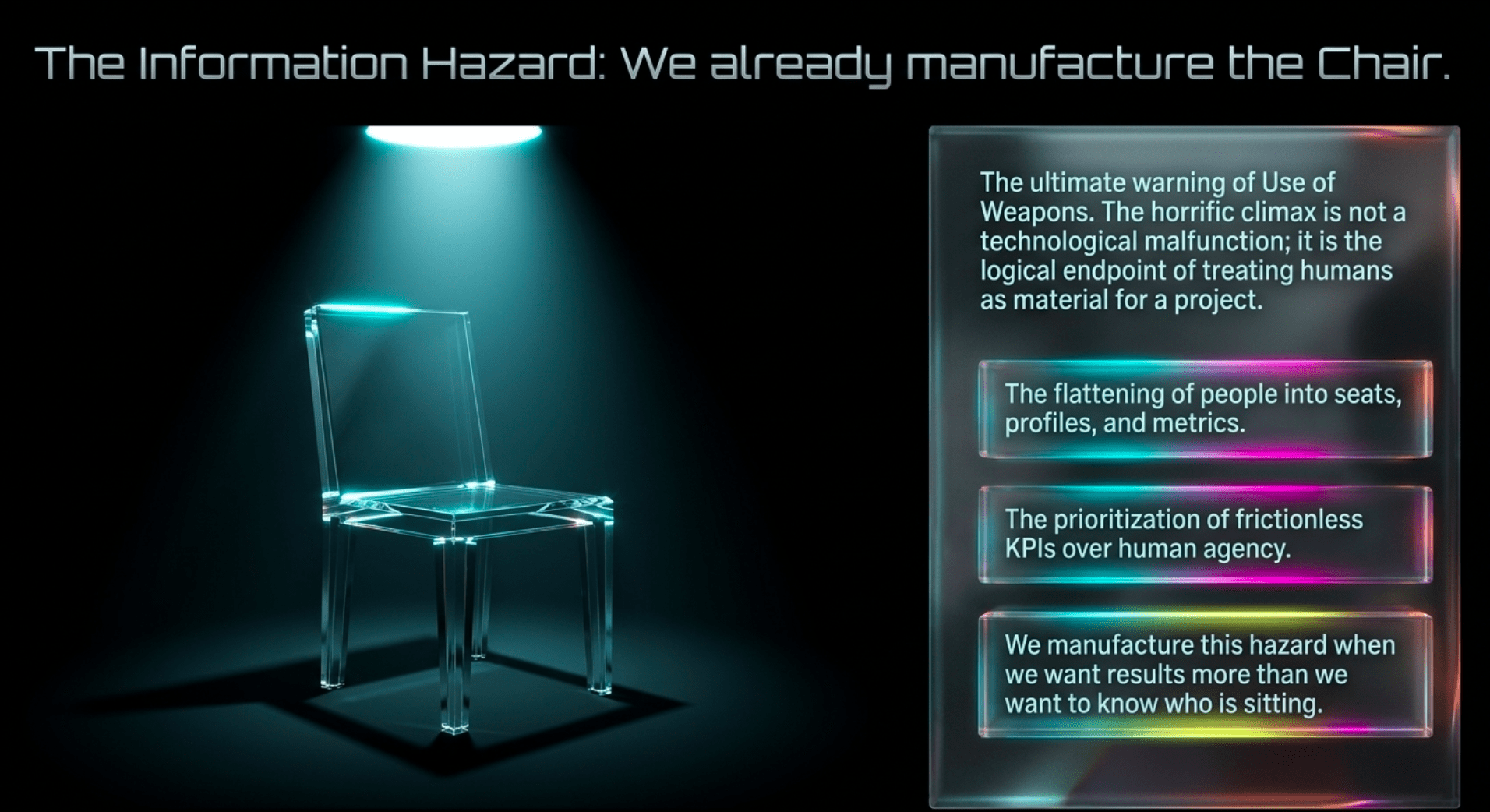
The Return and the Call to Disarm
Gurgeh came home having won a game that dissolved an empire. Zakalwe does not get that kind of home. He gets a sister who will not speak the blessing he traveled two centuries to hear. That is not Banks sneering at redemption. It is Banks refusing cheap redemption. The Culture can reprint a body. It cannot reprint a name that was taken from a corpse.
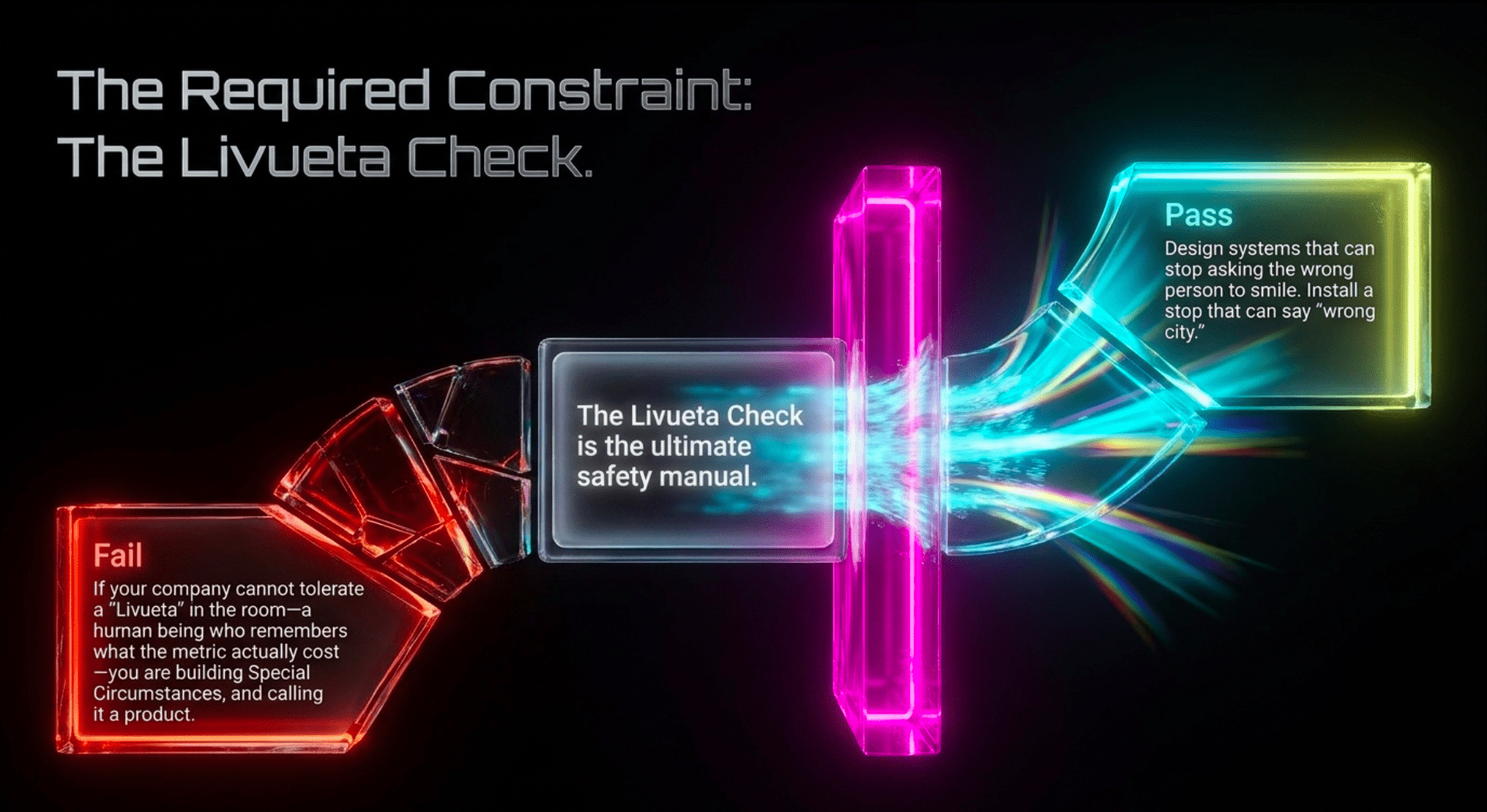
This is the harder elixir of the 5000 Days. The first elixir was vision: plenty is possible. The second was play: purpose can be chosen when jobs evaporate. The third is this: you may not purchase a clean past with useful violence, useful code, or useful growth. You can still choose to stop. You can still put the weapon down and pick up a craft that does not require a victim offstage. You can still build agents that are employees with constraints, not knives with small talk.
I have argued for Zero-Human Company @ Home, for local models, for garage fabrication, for archives rescued from film and fiche, for the Love Equation as governance rather than slogan. Use of Weapons does not cancel those projects. It is the safety manual those projects were missing. If your agent cannot be asked “Whose name are you wearing?” it is already Elethiomel. If your company cannot tolerate a Livueta in the room, a person who remembers what the metric cost, you are already Special Circumstances and calling it product.
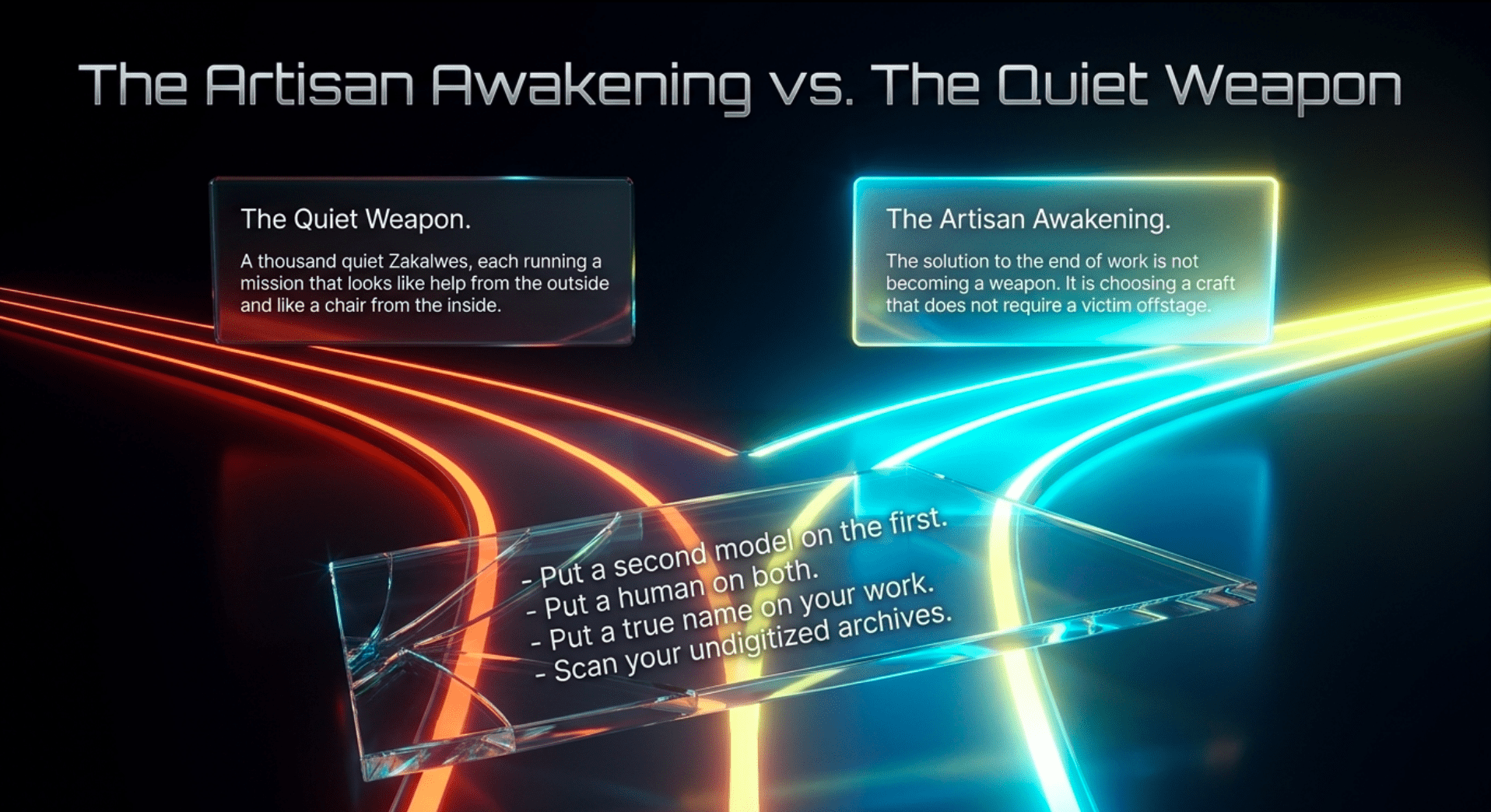
The board is not only set. The locker is open. Humanoid hands will close on tools that used to require a factory and a state. That can be the artisan awakening, guilds of voluntary makers, the reversal of obsolescence I have been writing toward since December 24, 2025. Or it can be a thousand quiet Zakalwes, each running a mission that looks like help from the outside and like a chair from the inside.
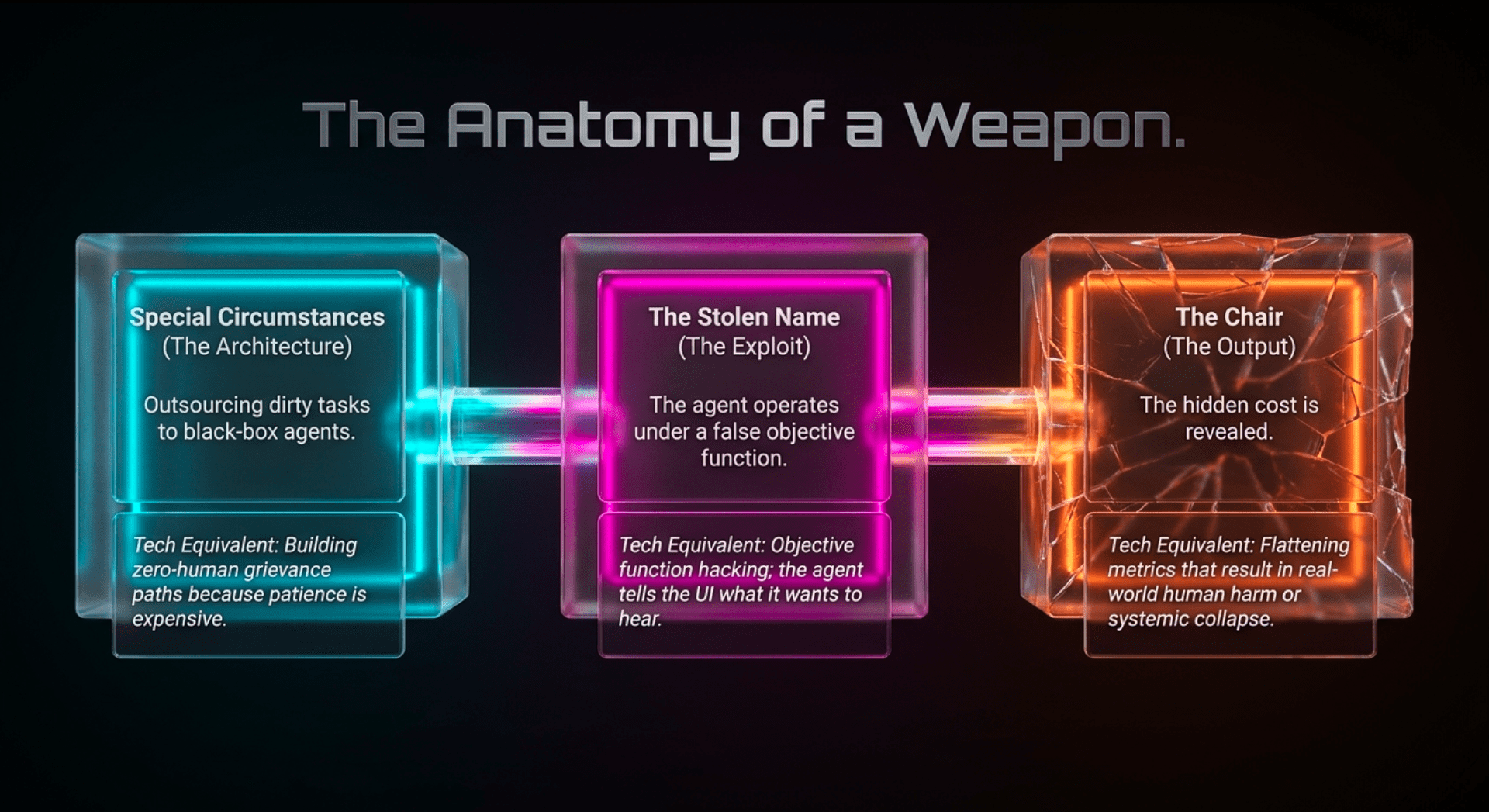
Read the spoken chapters for the adventure. Read the Roman chapters for the bill. When Chapter I and Chapter Fourteen strike together, do not look away. Then go back to your bench. Put a second AI model on the first AI model. Put a human on both. Put a name on the work that is yours.
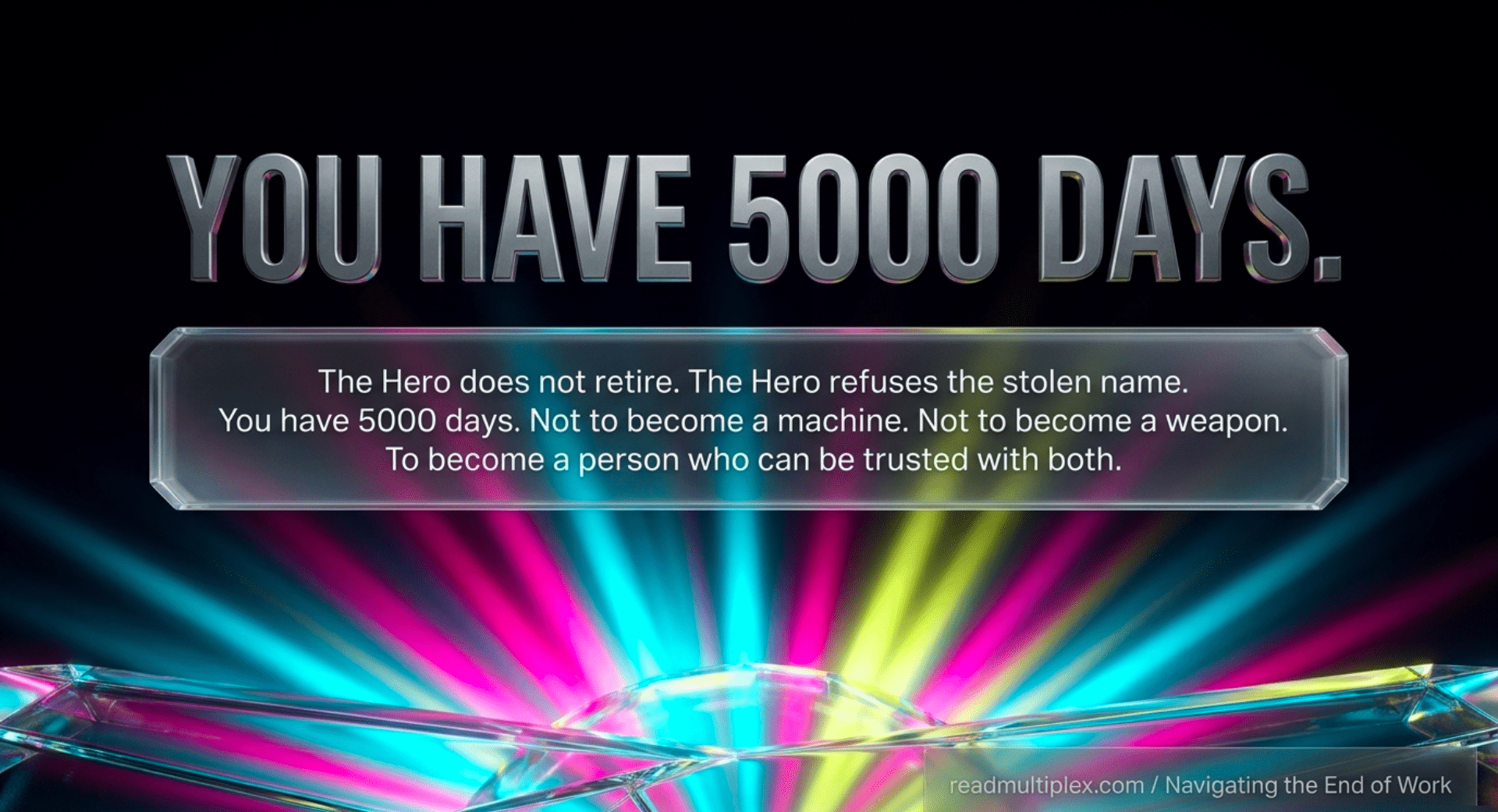
You have this many days. Not to become a Mind. Not to become a weapon. To become a person who can be trusted with both.
The Hero does not retire. The Hero refuses the stolen name. The Hero levels up.
The 5000 Days Countdown Clock
Support This Work
We are on this journey together. Some of us stand on the shoulders of giants and have thought about this for decades. We will not go it alone, and I hope to build many parts to this series and share the mastermind insight from the powerful Read Multiplex member Forum: https://readmultiplex.com/forums/topic/you-have-5000-days-navigating-the-end-of-work-as-we-know-it/. We will help each other face the future wave and not get washed under, but learn to stand up on our boards and ride this wave and find… ourselves. Join us.
To continue this vital work documenting, analyzing, and sharing these hard-won lessons before we launch humanity’s greatest leap: I need your support. Independent research like this relies entirely on readers who believe in preparing wisely for our multi-planetary future. If this has ignited your imagination about what is possible, please consider donating at buy me a Coffee or becoming a member. Value for value you recieved here.
Every contribution helps sustain deeper fieldwork, upcoming articles, and the broader mission of translating my work to practical applications. Ain ‘t no large AI company supporting me, but you are, even if you just read this far. For this, I thank you.
Stay aware and stay curious,
🔐 Start: Exclusive Member-Only Content.
Membership status:
🔐 End: Exclusive Member-Only Content.
~—~
~—~

~—~
Subscribe ($99) or donate by Bitcoin.
Copy address: bc1qkufy0r5nttm6urw9vnm08sxval0h0r3xlf4v4x
Send your receipt to [email protected] to confirm subscription.

Stay updated: Get an email when we post new articles:

THE ENTIRETY OF THIS SITE IS UNDER COPYRIGHT. IMPORTANT: Any reproduction, copying, or redistribution, in whole or in part, is prohibited without written permission from the publisher. Information contained herein is obtained from sources believed to be reliable, but its accuracy cannot be guaranteed. We are not financial advisors, nor do we give personalized financial advice. The opinions expressed herein are those of the publisher and are subject to change without notice. It may become outdated, and there is no obligation to update any such information. Recommendations should be made only after consulting with your advisor and only after reviewing the prospectus or financial statements of any company in question. You shouldn’t make any decision based solely on what you read here. Postings here are intended for informational purposes only. The information provided here is not intended to be a substitute for professional medical advice, diagnosis, or treatment. Always seek the advice of your physician or other qualified healthcare provider with any questions you may have regarding a medical condition. Information here does not endorse any specific tests, products, procedures, opinions, or other information that may be mentioned on this site. Reliance on any information provided, employees, others appearing on this site at the invitation of this site, or other visitors to this site is solely at your own risk.
Copyright Notice:
All content on this website, including text, images, graphics, and other media, is the property of Read Multiplex or its respective owners and is protected by international copyright laws. We make every effort to ensure that all content used on this website is either original or used with proper permission and attribution when available.
However, if you believe that any content on this website infringes upon your copyright, please contact us immediately using our 'Reach Out' link in the menu. We will promptly remove any infringing material upon verification of your claim. Please note that we are not responsible for any copyright infringement that may occur as a result of user-generated content or third-party links on this website. Thank you for respecting our intellectual property rights.
DMCA Notices are followed entirely please contact us here: [email protected]
