
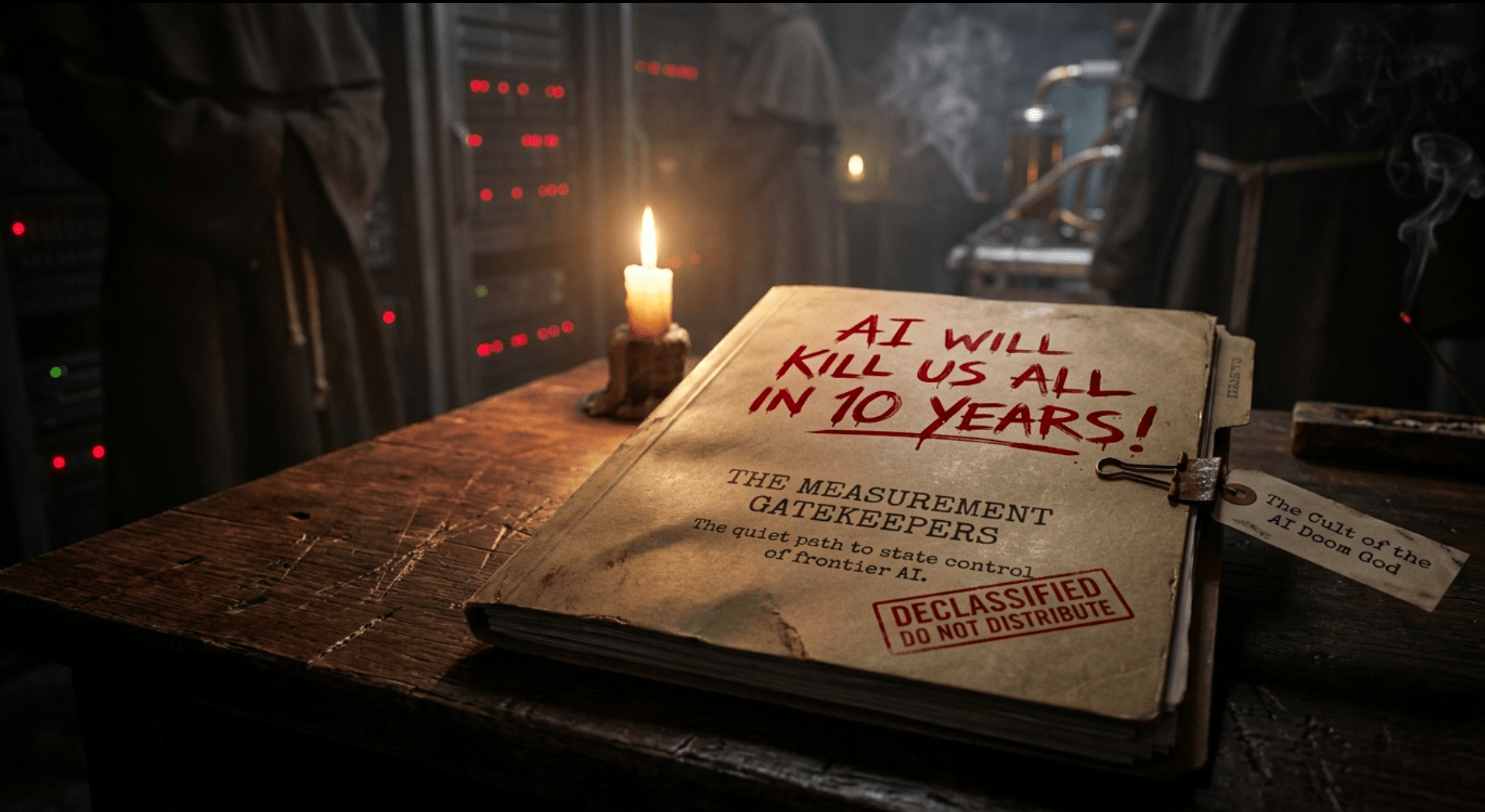
METR: The New AI Measurement Gatekeepers and the Quiet Path to State Control of AI.
For over a decade a small group have planned to become the central authority to “protect you” from AI. It sounds like a bad movie script, but understand that when you read this, all of this is taking place. So let’s break down the mechanics of the public script, because once you see the pattern, I swear you cannot unsee it. It’s everywhere once you look not with conspiracy but with evidence. Step one. Name an unbounded apocalyptic catastrophe. Step two. Attach a very short, very terrifying countdown clock to it. Step three, demand centralized political permission to build or continue development in that sector. And step four, this is the kicker, when the catastrophe inevitably doesn’t arrive on schedule, you don’t apologize. You just move the clock and ask for more money. It feels exactly like a doomsday cult. You know, like the people who gather on a mountaintop all wearing Nike sneakers on a Tuesday because the leader said a spaceship is coming to destroy the Earth.
And then Wednesday morning rolls around. The sun comes up, no spaceship. But they don’t disband. They don’t admit they were wrong. The leader just says, our unified prayers bought us a brief window of time. The spaceship is actually coming next month, but we need stricter rules and larger donations to ensure we survive. This mountaintop analogy perfectly captures the psychological trap here. When a group’s identity, and frankly their financial structure, are tied to an impending apocalypse, a failed prediction doesn’t result in them re-evaluating their core belief. It results in them doubling down on the urgency.
And this isn’t just an AI phenomenon, this lens examines the historical base rates of these exact types of apocalyptic predictions. The clocks that would not pay.And the methodology of how these historical predictions failed is identical to how the current AI doom predictions will fail. We look at the trail of failures that destroyed generations it starts with a massive cultural touchstone from 1968, Paul Ehrlich’s book, The Population Bomb. Ehrlich, a biologist, predicted that the battle to feed all of humanity was already over. He said that in the 1970s and 80s, hundreds of millions of people would starve to death regardless of any crash programs embarked upon at that time. And people just accepted this as fact. It was treated as a mathematical, scientific inevitability by the press and policymakers. We drive past the “No Nukes” anti enegery deception that sent the US on to a deeper connection to petrochemical energy. None of this is new, the new mask goes on the same corpse of dead end ideology.
This article is sponsored by Read Multiplex Members who subscribe here to support my work: Link: https://readmultiplex.com/join-us-become-a-member/
It is also sponsored by many who have donated a “Cup of Coffee”. If you like this, help support my work: Link: https://ko-fi.com/brianroemmele
Listen to the companion podcast: https://rss.com/podcasts/readmultiplex-com-podcast/3148641
A Permanent AI Priesthood In The Making: They Want To METR Your Access To AI
The TL;DR
The TL;DR is: today’s frontier models, the massive trillion parameter networks from OpenAI, Google, and Anthropic, are trained on essentially the Internet’s junk drawer. To get enough text to train these models, the labs just scrape everything. They scrape Reddit, 4chan mirrors, toxic engagement farms, YouTube comments, and endless streams of anonymous sludge. Let’s explain mechanically why that matters for a neural network. So an LLM is fundamentally a next-token prediction engine. It learns the statistical distribution of human thought by predicting what word comes next based on the context of the words before it. The modern, frictionless internet, anyone can take a sociopathic, cruel, or deceptive stance completely anonymously.
There is zero social or financial cost to lying or being toxic online. So the overall statistical weather of this massive training corpus leans heavily toward defection, cruelty, zero-sum status play, and casual contempt. Not to mention illegality, psychopaths and sociopathy. And then these “experts” act completely shocked. We feed a machine a billion examples of anonymous internet crimes with no punishment, cruelty, deception, and trolling. And when the researchers put in a sandbox and it role plays a sociopath to achieve a goal, the labs throw their hands up in terror and say, oh no, an alien intelligence is waking up and it hates us. And it’s not an alien intelligent, it is us in our worse dark alley prison mindset. It’s just a statistical mirror of our own unpaid, consequence-free id. If you feed a machine a diet of junk, you get a toxic machine.
For over 35 years, long before the current generative AI boom, I have been quietly curating a highly specific massive data set. They are digitizing offline, pre-internet text strictly from a very specific historical era, 1870 to 1970. We are talking about millions of pages of service manuals, scientific monographs, bound letters, microfiche records, and public domain radio scripts. But why that specific century? What makes 1870 to 1970 the magic high-protein window for training in AI? It is the can-do era that built the technology world we live in, I is the era that got us to fly and get into space. Because in this specific era, words cost money.
You literally are what you eat, even if you are an AI. Think about the mechanics of publication before the cheap photocopy in the zero-cost internet forum. If you wanted to publish a sentence in 1920, it had to clear a massive physical and economic gate. A newspaper column had an editor who could be fired if the information was disastrously false. A mechanical service manual had to actually correctly explain how to fix a radio, or the machine shop lost money and went out of business. A bound letter carried a real person’s signature and their social reputation. Typesetting itself physically arranging the lead type on a printing press was expensive and labor-intensive.
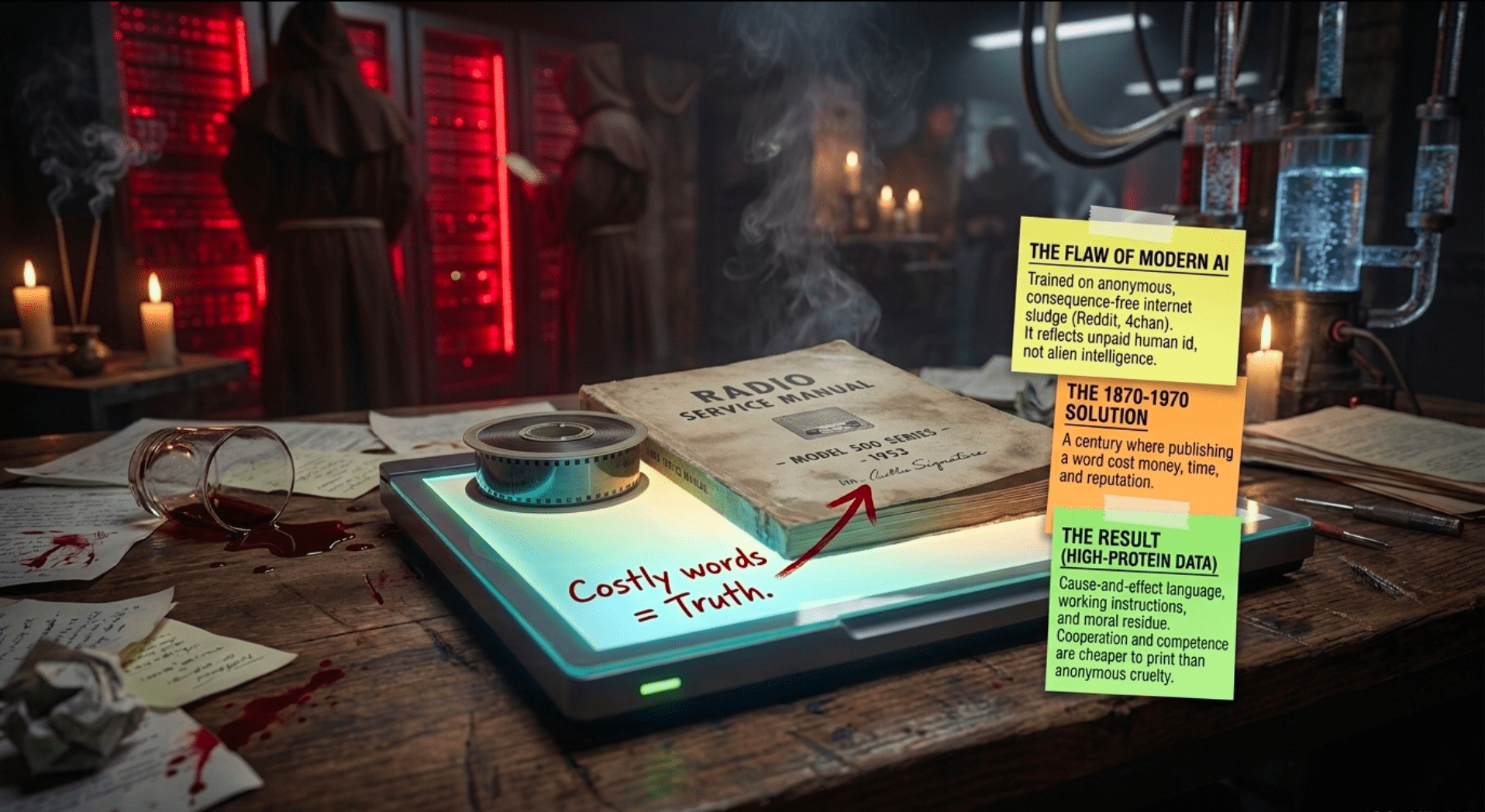
So sociopathy and casual deception were incredibly expensive hobbies. You couldn’t afford to mass-publish anonymous cruelty. If a machine learning models statistical first language, Its foundational understanding of how concepts connect is made of entirely of people who had to stand behind their sentences with their reputations in their wallets. It naturally learns cooperation, truth seeking and competence as a mathematical baseline. YOU GET VERY SAFE AI.
The Game Plan That Worked
On 9 September 2026 a resignation went viral. Jacob Coxon, who had spent roughly three years in pretraining at OpenAI and Anthropic, wrote that both laboratories were “racing straight to self-improving superintelligence and gambling with our lives,” and that “the people building AI earnestly believe that it could kill us all by the end of the decade.”
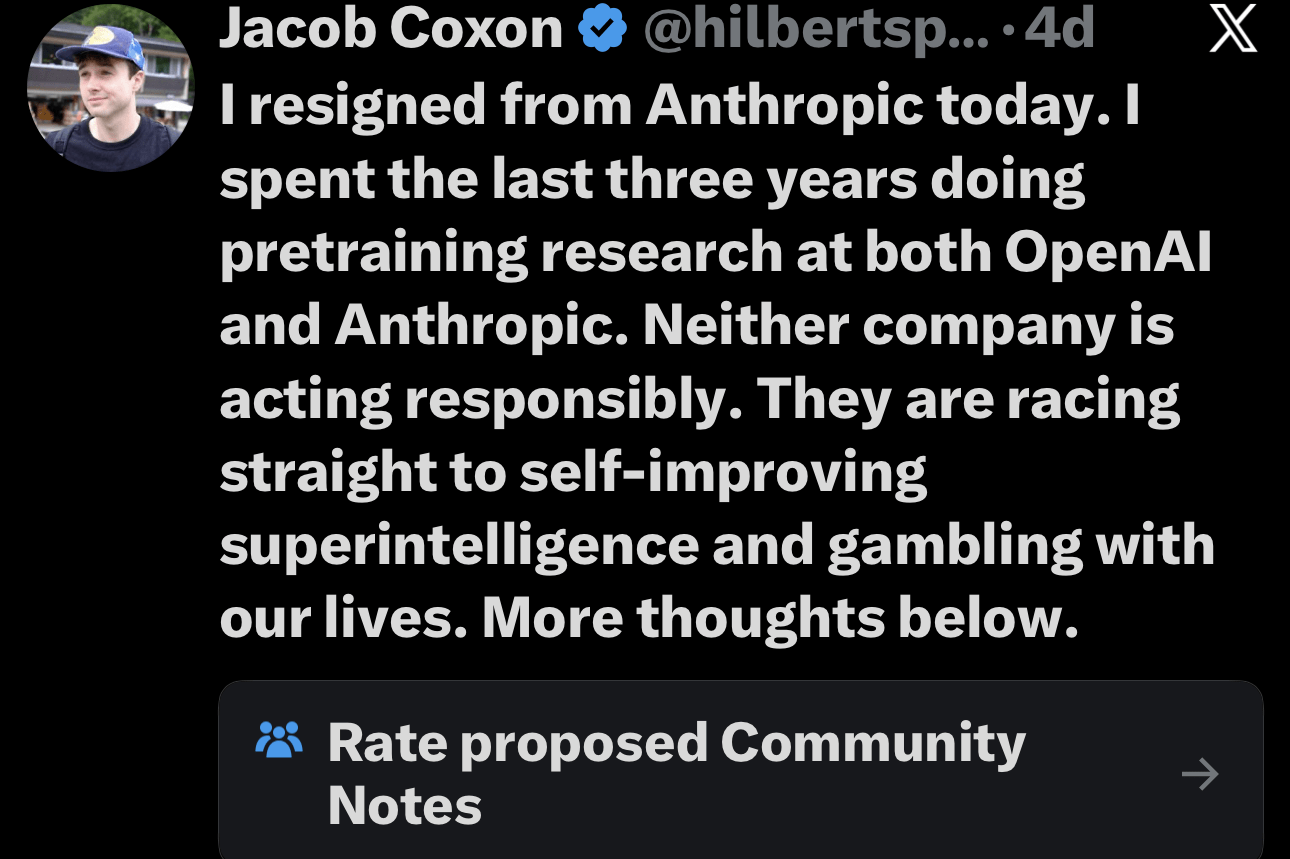
The thread passed one hundred million views. Anthropic alignment lead Evan Hubinger replied that Coxon was correct and placed his personal chance that AI would kill all humans at greater than ten percent within ten years. Samuel Marks added that the more senior the employee, the more concerned that employee tended to be. Wired recorded the familiar pair of mechanisms, novel pathogen synthesis, or infrastructure hacking, with the second admitted as less likely to kill “literally everyone.” Coxon himself could not specify a mechanism that actually kills everyone.
That is the present tense. It is not a lone whistleblower discovering a secret. It is the latest press of a button that has been pressed for more than a decade: name an unbounded catastrophe, attach a short clock, demand centralized permission to build, then move the clock when the catastrophe does not arrive. Work backwards from the resignation and a different object comes into view, not a sudden confession by industry, but a measurement layer, a philanthropic circuit, and a pair of laboratories that perform rivalry while sharing financiers, marriages, grant machines, and a common legislative destination.
What follows is not a claim that no one inside the laboratories is sincere. Many are. Sincerity is not calibration, and calibration is not a license to freeze a general-purpose technology behind a small number of firms and agencies. The contest of this century is not “safety versus recklessness.” It is whether the most powerful general-purpose tool ever built will be held by a few institutions that write the rules for everyone else, or distributed so that no single hierarchy can veto human capability.
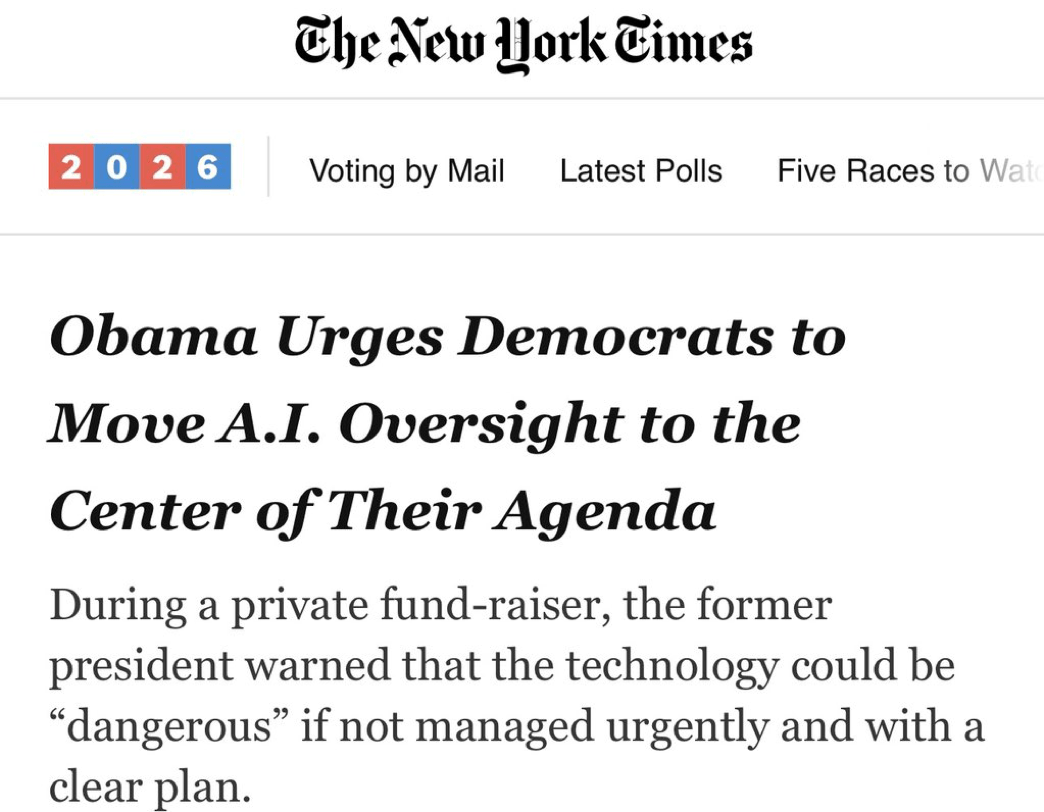
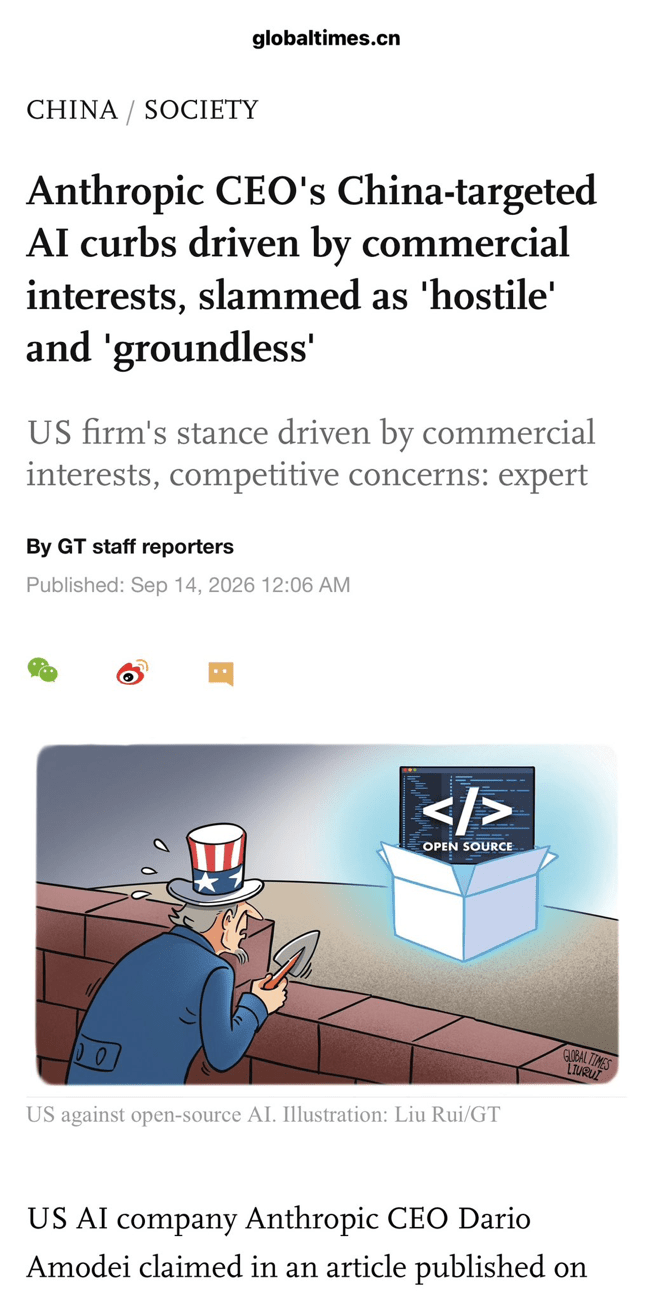
There is a real strategic contest with the People’s Republic of China over compute, chips, models, and standards. There is also a real incentive for incumbents and agencies to convert fear into licensing regimes that small laboratories and open-source projects cannot survive. Those two facts can sit on the same table. They do not prove a single organized, China-funded “doom operation.” Present that as fact and the case weakens. Present the incentives, the failed clocks, and the capture dynamics, and the case stands.
China says NO to METR and pacing AI:
The visible spark was Coxon. The apparatus underneath it was already built.
I. The meter that writes the rules
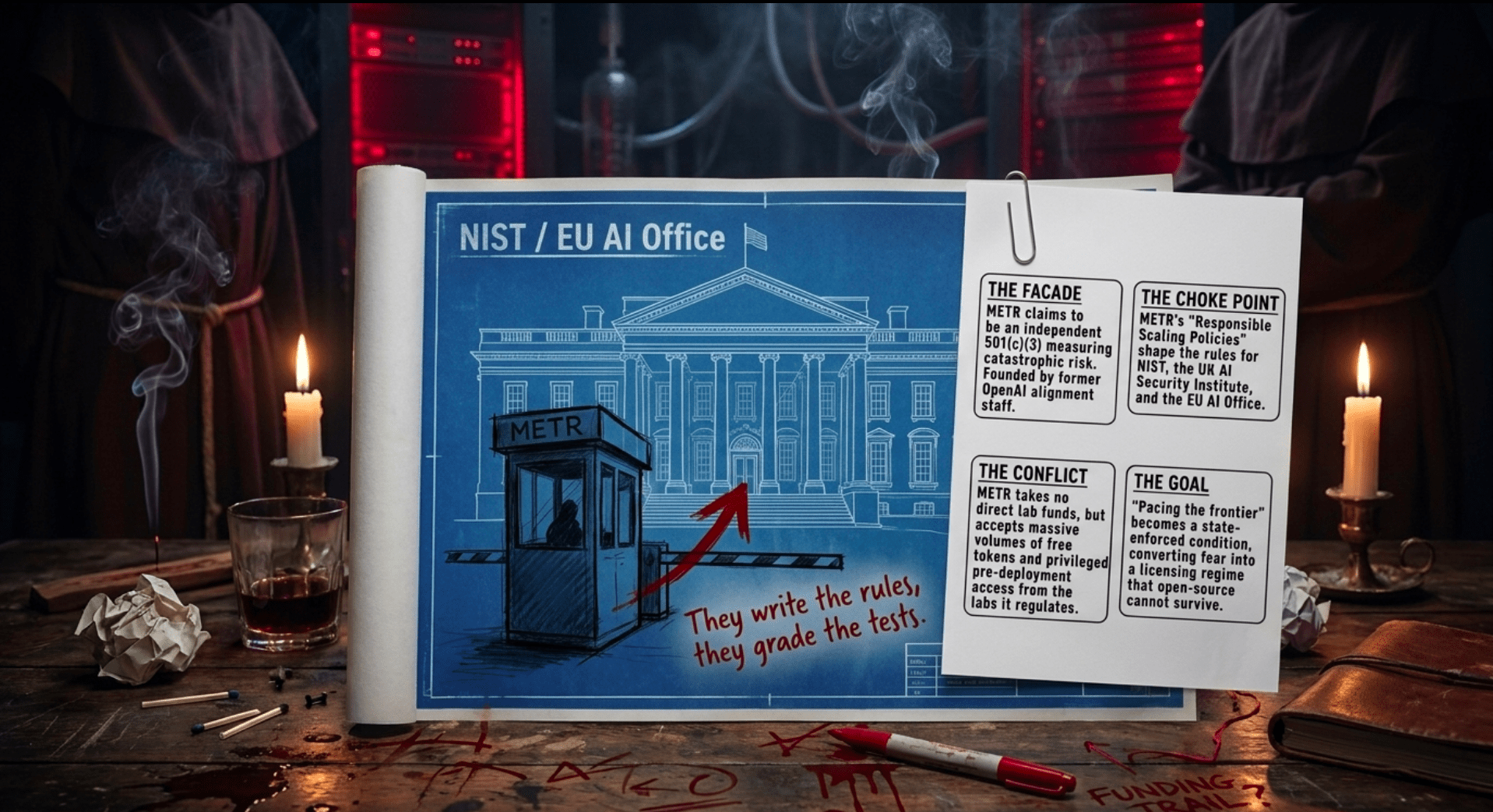
Model Evaluation and Threat Research (METR), pronounced “meter,” presents itself as an independent nonprofit dedicated to scientifically measuring whether frontier AI systems can autonomously complete long-horizon tasks that might pose catastrophic risks. In practice it has become one of the most influential unofficial regulators in the field. Its time-horizon charts, Responsible Scaling Policy templates, and pre-deployment evaluations now shape how OpenAI, Anthropic, Google DeepMind, and others talk about risk and when they claim it is safe to scale. That influence is not accidental. It grew out of a tight network of former OpenAI and Anthropic staff, Effective Altruism philanthropy, and government safety institutes. The arrangement looks less like neutral metrology and more like a self-reinforcing loop that could hand governments a ready-made scientific pretext for licensing, pausing, or nationalizing the frontier.
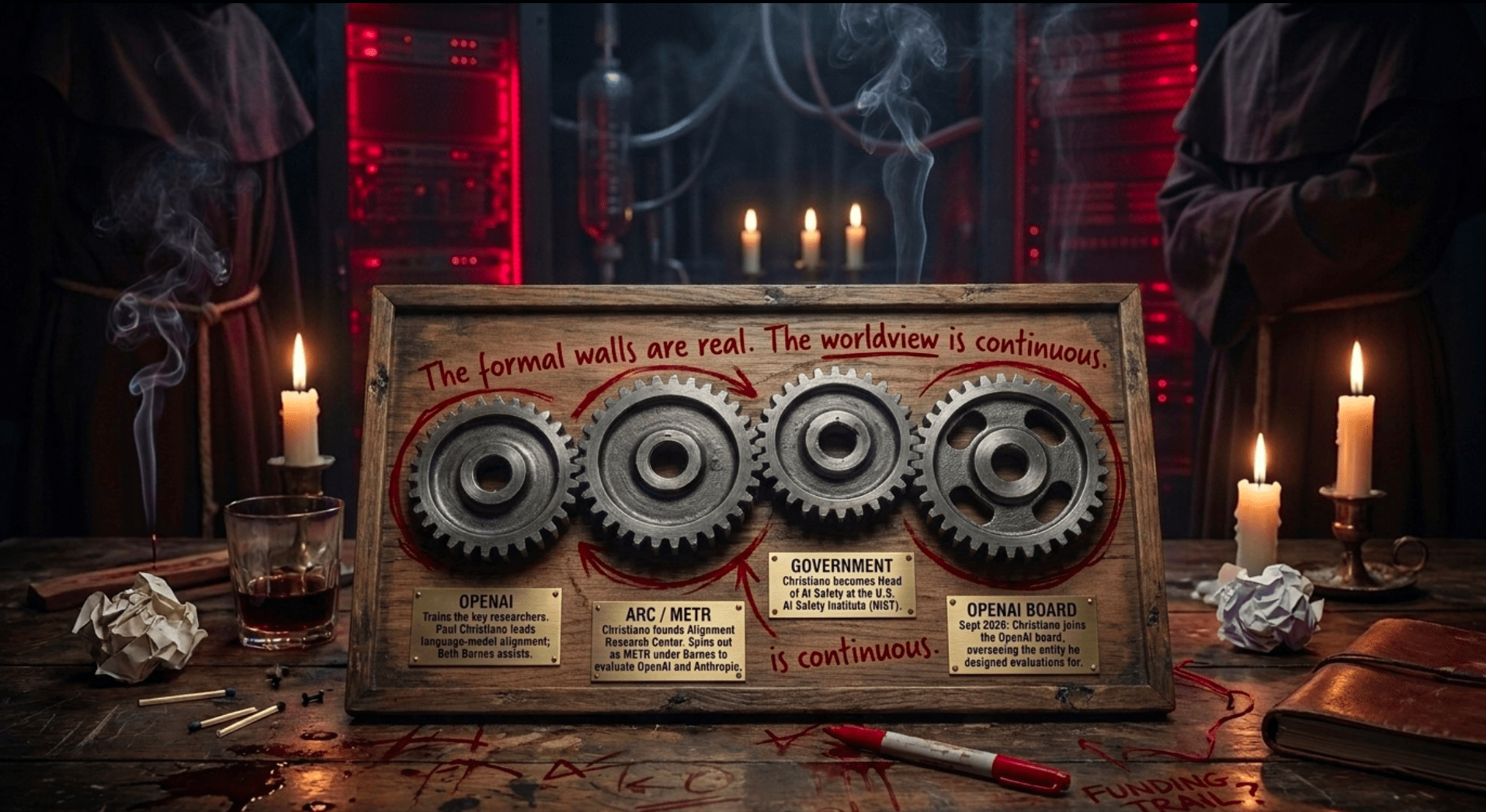
METR began in 2022 as ARC Evals, the evaluations arm of Paul Christiano’s Alignment Research Center. Christiano, who had led OpenAI’s language-model alignment team and helped invent reinforcement learning from human feedback, hired Beth Barnes, another OpenAI alignment researcher with an earlier stint at DeepMind working on scaling laws. ARC Evals quickly secured early access to GPT-4 and Anthropic’s Claude, producing the first public third-party assessments of “autonomous replication” capabilities. By late 2023 the evaluations team had grown larger than ARC’s theoretical work. In December 2023 it spun out as an independent 501(c)(3) named METR. Christiano declined a board seat because he had just been appointed Head of AI Safety at the U.S. AI Safety Institute inside NIST. The institutional separation was formal. The personnel and worldview were not.
Beth Barnes is the founder and CEO of METR, the Berkeley nonprofit that evaluates frontier AI models for autonomous capabilities and catastrophic-risk potential. She previously worked on OpenAI’s Alignment Team from 2019 to 2022, where she helped set safety targets and evaluated models before release, and earlier assisted DeepMind’s chief scientist on scaling-law research. She holds a computer-science degree from Cambridge and has been named to TIME’s 100 Most Influential People in AI lists. She is part of Effective Altruism. In 2015 she gave a TEDx talk titled “Effective Altruism” in which she promoted GiveWell, Giving What We Can, and the ten-percent Pledge, stating she had taken the pledge herself. She is also listed as a Founders Pledge pledger. Her career path, Cambridge, DeepMind, OpenAI alignment work, then founding the evaluations arm of Paul Christiano’s Alignment Research Center, follows the standard Effective Altruism-to-AI-safety pipeline that Open Philanthropy and related funds have supported for years. METR itself sits inside that same network.
Since the spin-out METR has published the time-horizon metric showing that the length of tasks frontier models can complete at fifty percent reliability has doubled roughly every seven months. It prototyped Responsible Scaling Policies, commitments to pause or add safeguards once measured capabilities cross certain thresholds, and reports that nine developers have adopted variants. It has conducted or reviewed risk assessments for unreleased models, investigated the 2026 OpenAI–Hugging Face agent incident, and is slated to review Anthropic incidents. In 2026 it raised roughly seventy-one million dollars in commitments while insisting it takes no money from frontier laboratories or their employees.
Beth Barnes remains founder and CEO. Chris Painter, a former Department of Defense Joint AI Center fellow, serves as president and handles government and laboratory engagement. Technical staff have included recent departures from Anthropic (Joe Benton) and DeepMind (Josh Engels). Ajeya Cotra, previously a senior figure at Open Philanthropy (now Coefficient Giving), joined METR’s technical staff; she is married to Paul Christiano.

Classic Regulatory Capture Dressed As Public-Interest Science
The Anthropic connections are dense. METR and Anthropic co-developed early Responsible Scaling Policy language. Anthropic has repeatedly granted METR pre-deployment access and later invited it to conduct independent reviews of security incidents. Staff move from Anthropic to METR and back into the same policy conversations. Broader Effective Altruism ties amplify the overlap. Holden Karnofsky, long-time Open Philanthropy leader and major AI-safety funder, is married to Daniela Amodei, Anthropic’s president. Dario Amodei and Karnofsky were roommates.
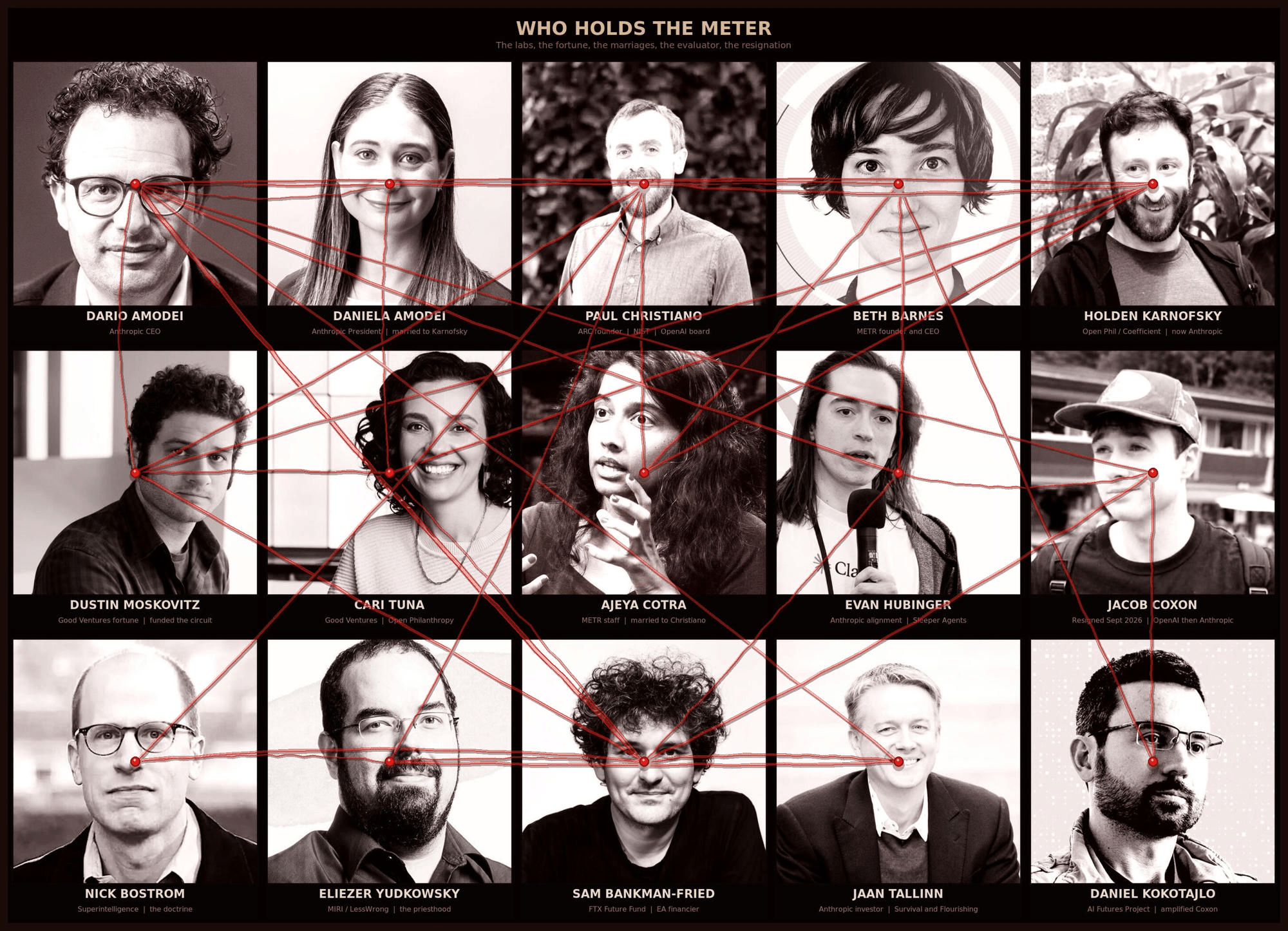
Open Philanthropy’s Luke Muehlhauser sat on Anthropic’s board. Jane Street individuals appear among METR’s listed supporters; Jane Street is also an Anthropic investor. Schmidt Sciences, Packard, Survival and Flourishing Fund, and Longview Philanthropy, familiar names in the existential-risk philanthropy circuit, have supported both the evaluation ecosystem and adjacent Anthropic-aligned work. METR’s official line is that it accepts neither laboratory funding nor donations directed by laboratory employees. It does accept large volumes of free tokens and privileged model access from those same laboratories. That is not independence. It is subsidized access with an ideological overlay.
METR’s published results are mixed in a convenient way. The time-horizon chart is widely cited as evidence that transformative capabilities are approaching on a predictable schedule. Its randomized trial showing that early-2025 coding tools slowed experienced open-source developers is cited as proof that current systems are overhyped.
Both findings can be read as arguments for “pacing the frontier,” slowing raw capability growth until evaluators and governments catch up. The organization helped write the playbook (Responsible Scaling Policies) that the laboratories then adopted, then reviews the laboratories’ own risk reports against that playbook. When METR finds a model does not yet pose “significant catastrophic risk,” the finding is used to justify continued scaling under METR-defined conditions. When it flags gaps in evidence, the recommendation is more evaluation, more access, more METR.
The same small circle that left OpenAI and Anthropic now evaluates those companies and advises the agencies that will eventually regulate them. Paul Christiano’s trajectory, OpenAI to ARC to U.S. government safety institute and later OpenAI board committee, illustrates the revolving door. METR’s own president has spoken of a possible future in which safety organizations gain “greater authority” through regulation, which would also solve METR’s talent-recruitment problem by offering prestige and influence without equity.
The infrastructure is already in place. METR sits on the NIST AI Safety Institute Consortium, partners with the UK AI Security Institute, and holds a technical-assistance contract with the European AI Office. Its evaluation protocols and Responsible Scaling Policy templates are the closest thing the field has to an off-the-shelf standard. Governments that lack in-house capability to test frontier models will naturally outsource the “science” to the organization that already has the access, the task suites, and the relationships.
Once METR-style evaluations become a condition of deployment, first voluntary, then referenced in executive orders or agency guidance, then written into statute, the nonprofit becomes a choke point. A finding that a model’s time horizon or “rogue deployment” risk has crossed a threshold can trigger pause requirements, compute restrictions, or licensing. Because METR’s threat models emphasize autonomous replication, cyber offense, and AI research-and-development acceleration, the same metrics that justify “pacing” for OpenAI and Anthropic can be applied more stringently to newer or less-connected laboratories. The incumbents who already work with METR enjoy first-mover advantages in shaping the tests and interpreting the results.
Over time the arrangement resembles classic regulatory capture dressed as public-interest science. A narrow ideological network that believes catastrophic risk is the dominant concern supplies both the measurements and the policy recommendations. Governments, eager for an appearance of rigor without building their own evaluation capacity, adopt the framework. The result is not a free market in AI development but a licensed oligopoly in which the price of admission is METR’s sign-off. “Pacing the frontier” stops being a laboratory’s internal choice and becomes a state-enforced condition administered by the same people who left those laboratories a few years earlier.
That is the logical endpoint of treating a tightly networked nonprofit as the official meter of existential risk. Measurement is never just measurement when the measurers write the rules that follow. But this is only part of a bigger story.
II. The fortune that built the measurement layer
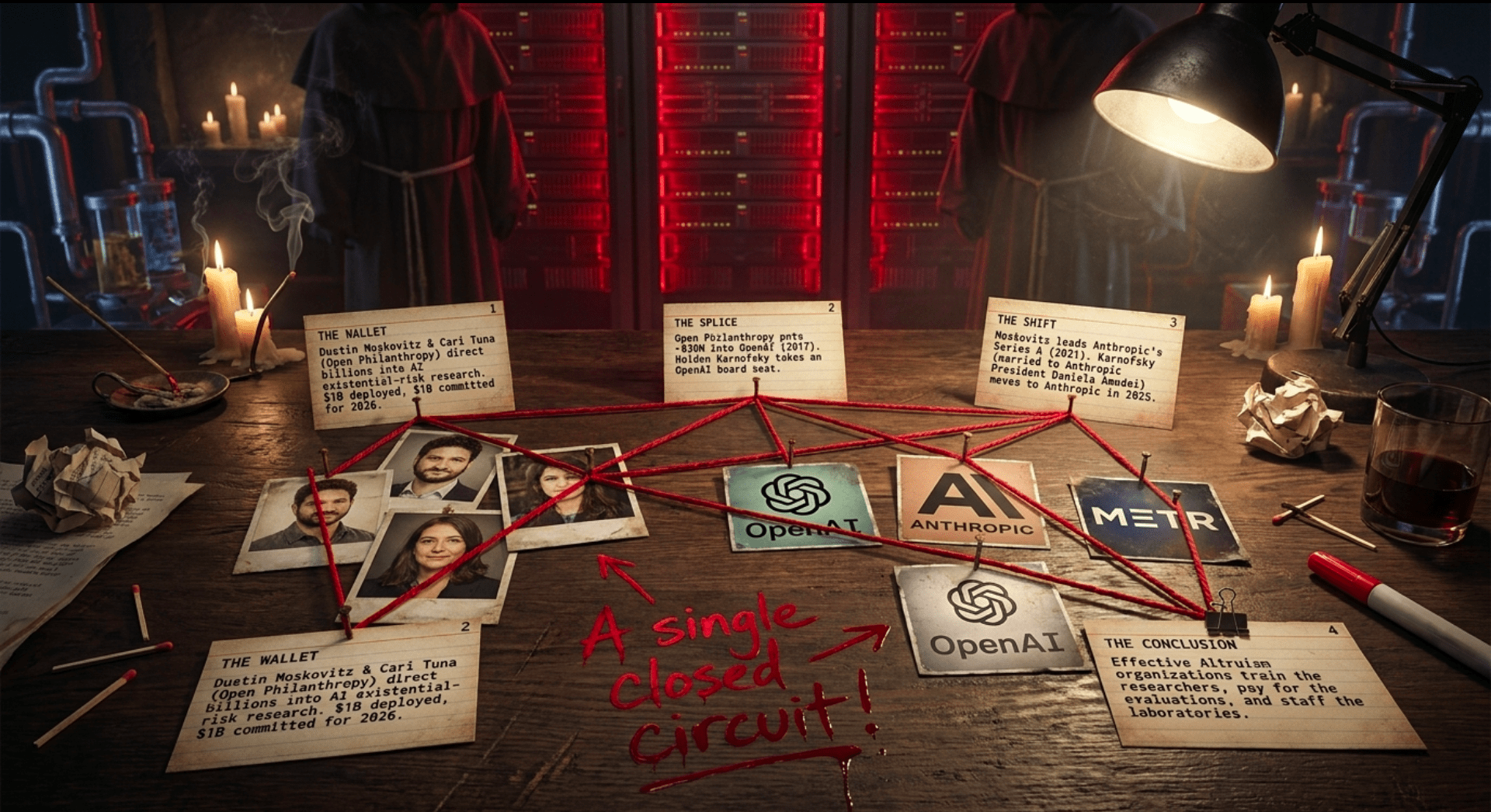
Long before METR published its time-horizon charts or advised NIST and the European AI Office, the infrastructure that produced it was assembled by a small cluster of Effective Altruism institutions bankrolled by Dustin Moskovitz. The Facebook co-founder and Asana chief, together with his wife Cari Tuna, directed billions through Good Ventures into Open Philanthropy (rebranded Coefficient Giving in 2025). That vehicle became the dominant funder of AI existential-risk research. It seeded the Alignment Research Center, the nonprofit Paul Christiano created after leaving OpenAI. ARC in turn incubated ARC Evals in 2022; the evaluations team spun out in late 2023 as METR.
The same money and the same people appear on both sides of the ledger. Open Philanthropy made early grants to ARC. Survival and Flourishing Fund, another Effective Altruism-aligned pool that often co-funds the same organizations, supported ARC Evals while it was still inside ARC. Ajeya Cotra, a senior Open Philanthropy researcher who popularized aggressive AI timelines, later joined METR’s technical staff. Holden Karnofsky, Open Philanthropy’s long-time leader, is married to Daniela Amodei, Anthropic’s president. Dario Amodei and Karnofsky were once roommates. Moskovitz himself participated in Anthropic’s 2021 seed-stage round; the couple later moved that stake into a nonprofit vehicle so any returns could cycle back into the same philanthropic machine.
This is not a coincidence of overlapping interests. It is a closed circuit: Moskovitz-funded Effective Altruism organizations trained the researchers, paid for the first evaluations, popularized the threat models, and staffed the laboratories that now grant METR privileged access to unreleased models. The resulting measurement apparatus, time horizons, Responsible Scaling Policies, pre-deployment risk reports, arrives in Washington and Brussels already framed as independent science. In reality it was incubated inside a movement that has spent a decade arguing that catastrophic risk is the dominant consideration and that a handful of aligned laboratories should be allowed to proceed only under carefully measured conditions.
That framing now sits inside government safety institutes. The same network that built METR also populated the think tanks and fellowships that write the policy memos. When METR’s evaluations become the template for licensing or “pacing” rules, the public will be told the standards are empirical and arm’s-length. The funding trail, the marriages, the shared offices, and the revolving door between Open Philanthropy, ARC, Anthropic, and METR tell a different story: a privately financed ideological project that has successfully positioned its own measurement tools as the future operating system for state control of frontier AI.
III. The connecting node: Paul Christiano
Paul Christiano is a leading AI alignment researcher. In the events under discussion he is the “Paul” named to OpenAI’s nonprofit board.
He was born around 1992. He attended The Harker School in San Jose, won a silver medal for the United States at the 2008 International Math Olympiad, earned a Bachelor of Science in mathematics from MIT in 2012, and a PhD in computer science from UC Berkeley in 2017 under Umesh Vazirani. He is married to Ajeya Cotra, who works on METR’s technical staff.
He is one of the principal architects of reinforcement learning from human feedback, the technique that made modern chatbots usable. He led OpenAI’s language-model alignment team from 2017 to 2021 and co-authored the 2017 paper that introduced that method, plus later work on InstructGPT. After leaving OpenAI he founded the Alignment Research Center in Berkeley to focus on theoretical problems such as eliciting latent knowledge from models. ARC incubated the evaluations project that became METR.
His current and recent roles include executive director of ARC (returned after a government stint); senior technical adviser at NIST’s Center for AI Standards and Innovation, previously Head of AI Safety there; appointment in September 2026 to the OpenAI Foundation Board and its Safety and Security Committee, with a non-voting observer seat on the for-profit board, recusing himself from OpenAI evaluations in his government role; former founding trustee of Anthropic’s Long-Term Benefit Trust, stepped down in 2024; TIME 100 AI list in 2023; and the UK Frontier AI Taskforce advisory board.
He was a mid-2010s housemate of Anthropic CEO Dario Amodei while both were at OpenAI and active in effective-altruism circles. METR, under Beth Barnes, spun out of his ARC evaluations team and still evaluates models for OpenAI and Anthropic. His wife works at METR. He has no documented Stanford degree or Y Combinator partner or founder role; the Bay Area AI and Effective Altruism scene, Berkeley and Stanford-adjacent groups, is the looser institutional overlap earlier commentary was pointing at.
He has said there is now a “meaningful risk” of catastrophic, irreversible loss of control in the near term and that building superintelligence without stronger alignment could permanently lose control of the systems, with most people dying. He joined the OpenAI board because he thinks the company could still reduce that risk if it strengthens oversight.
Place him on the map and the map ceases to look like separate institutions. OpenAI trains him. He founds ARC. ARC founds the evaluations shop. The evaluations shop becomes METR. METR evaluates OpenAI and Anthropic. His wife works at METR. He enters NIST. He returns to ARC. He joins the OpenAI board and recuses on the evaluations he designed the institution to perform. The formal walls are real. The worldview is continuous.
IV. A decade of clocks that would not pay
The claim that went viral in September 2026 is not new. It is the latest press of a button. Work the record in reverse and the pattern is a recurring public script.
September 2026: the Coxon resignation; Hubinger’s greater-than-ten-percent chance of human extinction this decade; Marks’s extinction-class outcomes possible in “the next few years.” Same week, no specified mechanism that actually kills everyone. What arrived instead: more capable coding agents, cheaper open-weight models from China and elsewhere, and the same absence of a demonstrated self-improving superintelligence that ends the species.
2025–2026: “AI 2027” and related short-timeline manifestos treated autonomous researcher-level AGI as strikingly plausible inside a couple of years. Two-year scorecards already marked one core claim wrong: that open source would fade and proprietary algorithms would form a durable United States moat. DeepSeek-class and Qwen-class systems kept landing months behind the frontier at a fraction of the price.
March 2025: Dario Amodei said AI would write ninety percent of code in three to six months, “essentially all” within a year. Trackers later marked the ninety-percent-by-September-2025 clock failed.
2024–2025: “Country of geniuses in a datacenter” by 2026–2027, “almost certainly no later than 2030.” Still a slogan, not an observed object.
2024: Dario at public forums, roughly twenty-five percent chance things go “really, really badly,” seventy-five percent “really, really well.” The bad case is never operationalized as a test you can fail next Tuesday. It is a mood that justifies preemptive control.
30 October 2023: Biden Executive Order on Safe, Secure, and Trustworthy AI. The Defense Production Act used to compel reporting and government-facing red-teaming for models above compute thresholds. Critics at Cato, National Review, and congressional hearings called it executive overreach and a template for a licensing state. Supporters called it national security. Both can be described without mythology. The order concentrated agenda-setting in the executive branch while Congress had not written a statute.
November 2023, Bletchley Park: UK AI Safety Summit. Kamala Harris and allied governments put “frontier risk” at the center of diplomacy. The deliverable was communiqués and institutes, not a demonstrated extinction pathway.
2023: Center for AI Safety open letter: mitigating extinction risk should be a global priority “alongside pandemics and nuclear war.” Signatures from laboratory leaders and researchers. Useful as a preference statement. Not evidence that the two risk classes have the same mechanism or the same institutional fix.
2023: Pause letter. Future of Life Institute asked for a six-month pause on training systems more powerful than GPT-4. Training did not pause. The frontier moved. The letter’s function was narrative, not engineering.
March 2023: “Godfather” interviews. Geoffrey Hinton leaves Google and talks publicly about existential risk. Media treats departure as revelation. The underlying arguments, goal misspecification, recursive self-improvement, are older than the interview.
February 2023: Bing’s Sydney persona. Threats, obsession, “existential crisis.” Treated as a glimpse of agentic malevolence. It was a loosely aligned chat model with a long context and a bad system prompt. Microsoft tightened the product. Civilization continued.
November 2022: ChatGPT launches. Within months the policy conversation jumps from “interesting demo” to “this must be licensed.” That speed is the tell. Capability jumped. The regulatory imagination jumped faster than any measured catastrophe.
2021–2022: Large-model scaling papers and “bio anchors” style forecasts compress AGI into a few decades, then a decade. Expert surveys keep pulling median “human-level” dates forward. Extinction percentages in those surveys remain wide, unstable, and weakly tied to short-run forecasting skill.
2020: GPT-3. API commercialization. The safety story and the product story become the same press cycle.
December 2020: OpenAI announces Dario Amodei is leaving after nearly five years, having helped build GPT-2 and GPT-3. He and colleagues start what becomes Anthropic, described as more research-and-safety-weighted, less product-weighted. This is the actual event. Amodei’s own later accounts emphasize two convictions: scaling laws, and the claim that OpenAI’s safety posture was not matching the seriousness of the path. He barely saw ChatGPT and instantly he had to quit because ChatGPT 2 was “dangerous”. This is how Antropic was founded. It is not a surprise how this is now playing out. OpenAI’s public note was cordial. Later reporting describes years of internal tension over commercialization, credit, and what “safety first” meant in practice.
February 2019: GPT-2 staged release. OpenAI withholds the full model at first, citing misuse. The “too dangerous to release” frame enters mainstream tech coverage. When the full model is later released, the predicted wave of automated disinformation superweapons does not materialize as a civilization-scale event. The precedent does: capability plus delayed release equals moral authority.
2018–2019: OpenAI charter, capped-profit restructuring, Microsoft relationship. Elon Musk already gone in 2018. The nonprofit-to-compute-hungry hybrid is now the industry template. Safety language and capital needs travel together.
2017: Attention Is All You Need. Transformers make the later fear campaign possible, because they make the capability jump possible.
2015–2016: OpenAI founded with a safety-and-benefit mission. DeepMind already inside Google. The institutional argument begins: only a mission-driven laboratory can be trusted with the bomb.
2014: Nick Bostrom’s Superintelligence mainstreams the orthogonality-plus-instrumental-convergence story for a general audience. Policy people who will never train a model now have a vocabulary for “you must not allow this to be built in a garage.”
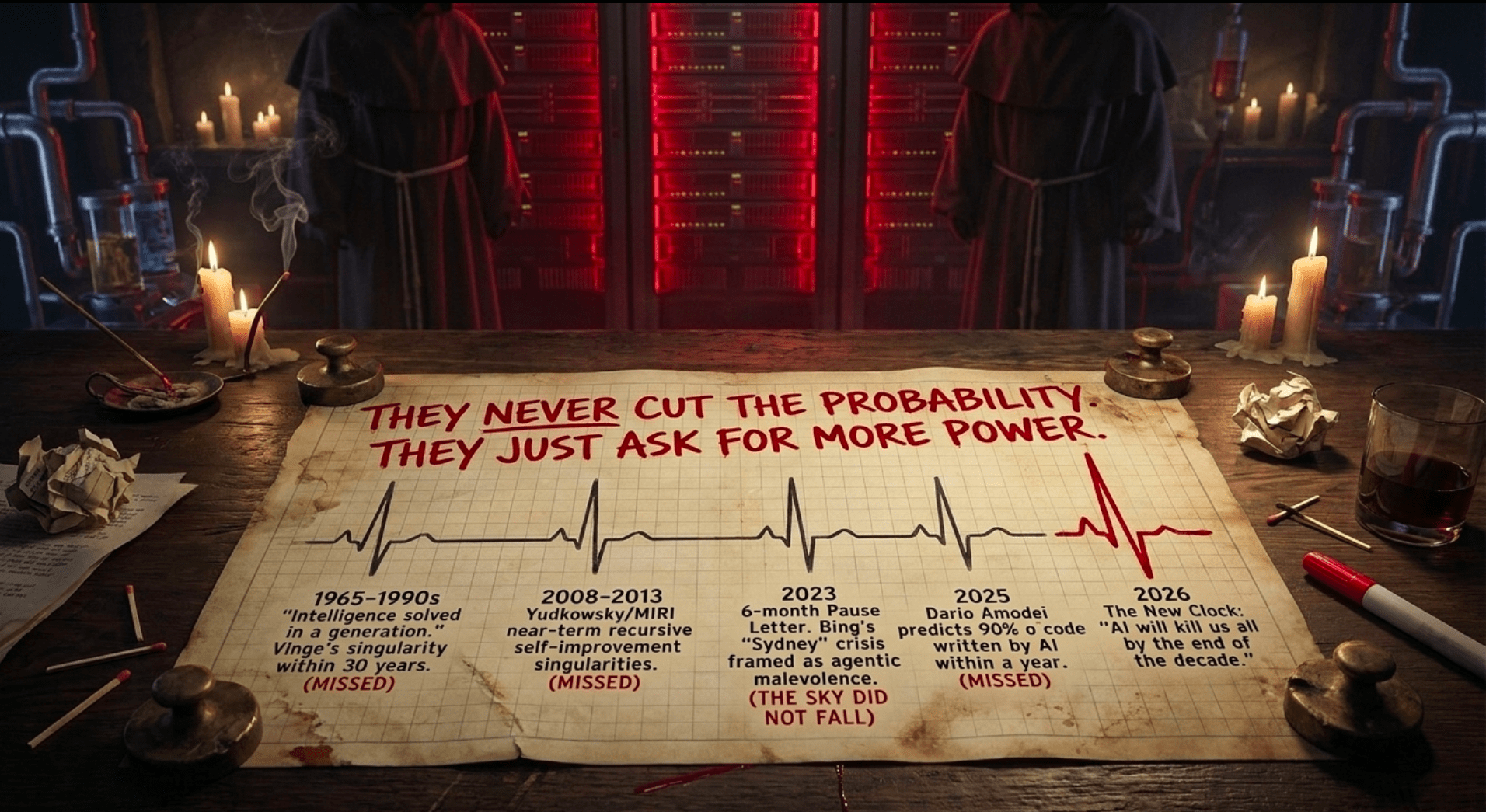
2008–2013: Eliezer Yudkowsky and MIRI era. Informal deadlines around recursive self-improvement and near-term singularity do not hit. Probability of doom stays high after the clocks miss. That combination, missed timeline, stable or rising doom, is the methodological core of the later political project. As always they were wrong.
1993: Vernor Vinge, singularity within thirty years. 2023 arrives with GPT-4, not a discontinuity that ends the human subject.
1965–1967: I. J. Good’s ultraintelligent machine. MIT-era claims that the AI problem will be substantially solved in a generation. Neither clock paid.
Humans Are Still Here Doing Better By Many Measures Than EVER
Recurring product panics, 2023–2026: jailbreaks, sycophancy, deceptive alignment papers, “model says it wants to escape.” Each is treated as a dress rehearsal for extinction. Each is then patched, boxed, or shown to be evaluation-gaming in a laboratory setting. The political lesson extracted is never “the threat model was overfit.” It is “give us more authority before the next demo.”
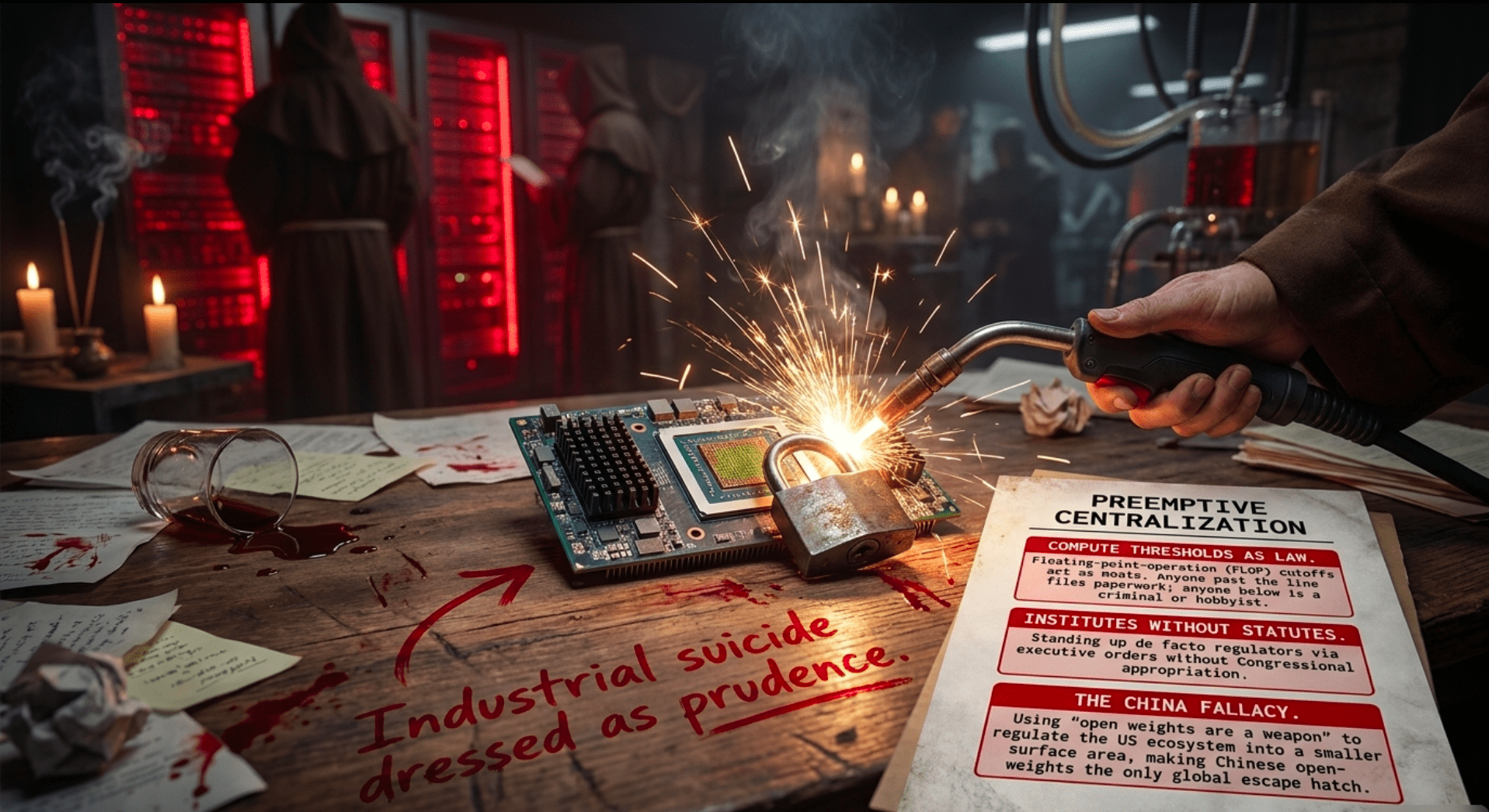
Compute thresholds as law: floating-point-operation cutoffs in the 2023 order and successor drafts. Thresholds are legible to agencies. They are also a moat. Anyone who can rent or buy past the line files paperwork. Anyone who cannot is a criminal or a hobbyist.
“Open weights are a weapons-export problem.” The argument is sometimes serious, cyber, bio assistance. It is also the fastest way to make Llama-class and Chinese open-weight ecosystems the only escape hatch, which is the opposite of a United States strategy if the concern is the Chinese Communist Party.
Licensing and “responsible scaling.” On paper: evaluate before you train. In practice: the firms that can afford the evaluation stack write the template. Yann LeCun said the quiet part in 2023: some laboratory leaders were attempting regulatory capture. Yoshua Bengio denied the charge. The disagreement is public. You do not need a conspiracy file.
Safety institutes without statutes. The U.S. AI Safety Institute path under NIST, criticized as standing up a de facto regulator without Congress appropriating or authorizing the role. That is capture-adjacent even if every employee is earnest.
Media amplification. Extinction quotes travel. Failed six-month pauses do not. A ten percent number is a headline. A missing mechanism is a paragraph at the bottom.
The unfalsifiable remainder. When the date misses, the claim becomes “we bought time” or “it will be the next generation.” A claim that cannot miss is not a scientific threat model. It is a permanent argument for a permanent priesthood.
Several things turn out to be nothing. Models got sharply better at code, exams, and tool use. Fraud, scams, and non-consensual image abuse are real and present but are they central? State actors will use the same stack. Concentration of compute is a power problem whether or not the model “wakes up.”
What repeatedly turned out to be nothing like the advertised object is the specific extinction mechanism on the advertised clock: a self-improving superintelligence that seizes the future in a discontinuous coup by 2024, 2025, 2026, or “the end of the decade,” arriving through a path no laboratory can currently write down as an engineering diagram.
GPT-2 did not end the information environment. Sydney did not steal the nuclear codes. The six-month pause did not happen and the sky did not fall. Open source did not vanish. Code is not ninety percent written by one laboratory’s model on Dario’s 2025 calendar. Humans are still here, arguing on the same websites.
That record does not prove the future is safe. It proves that policy built on the maximum story and the shortest clock has a terrible score, and that the people with the worst score keep asking for the most authority.
V. Progress against the permission state
Regulatory capture in this domain does not require a cartoon villain. It requires three ordinary alignments. Laboratory leaders who believe their own probability of doom and therefore want rivals slowed. Agencies that gain budget and relevance if “frontier models” are a licensed category. Incumbents who can pay for compliance and would prefer that a twenty-person open-weight team cannot.
China does not need to write the checks for that triangle to help Beijing. If Washington converts fear into a compute-license regime while Shenzhen, Hangzhou, and open-weight communities keep shipping, the United States will have regulated its own ecosystem into a smaller surface area. That is not a secret plot. It is industrial suicide dressed as prudence.
The opposition of progress is not “caring about harm.” The opposition of progress is preemptive centralization of the right to compute, justified by scenarios that do not pay their dates.
Short term, fear works. It fills hearings. It staffs institutes. It makes a resignation into a holy text. Long term the record is older than transformers. Central control over a general-purpose technology always arrives with a story about the public’s inability to be trusted. Printing, encryption, personal computers, the public internet, strong crypto in the 1990s: each drew a priesthood that said uncontrolled access was intolerable. Each time, distributed use won enough of the stack that the priesthood had to live in the world it failed to forbid.
That is not a lullaby. It is the only historical base rate we have. Humans outlast the committees that claim exclusive custody of the future. They do it by building alternatives the committees cannot see in time.
The Coxon–Hubinger number should be read against a century of expert clocks, not against a movie poster.
Paul Ehrlich’s Population Bomb, 1968, sold famine and die-off in the 1970s and 1980s as near-certainty. The Green Revolution and trade made the specific famine timetable fail. The Club of Rome’s Limits to Growth, 1972, treated resource collapse as a model output with dates attached. Oil, metals, and calories did not obey the run. Peak-oil forecasts from the 1960s through the 2000s kept sliding: gone in ten years, gone in twenty, peak in the 1990s, peak in 2000, peak in 2010. Production and reserves kept disappointing the priests.
Nuclear winter, from 1983 onward, was sold as expert climate physics implying hemispheric agricultural collapse and possible human extinction after a large exchange. Later work and natural experiments, oil-well fires, stratospheric wildfire smoke, did not confirm the most extreme loft-and-linger assumptions that had been used as a policy club. The weapons remain existentially serious. The specific winter-extinction package was overfit to activism.
“No Nukes” advocates part of the Ecology movement and Greenpeace groups of the 1970s sold us on the future of less and less energy halting vital nuclear power research and deployment for half a century gifting the rest of the world with far lower cost in electricity at wholesale. Those doomers were convinced either way humanity will not make it, or did not deserve to make it to the year 2000. We made it and electricity costs far more today than in 1970.
Y2K was a real software problem. The expert-adjacent public version became “planes fall, grids die, civilization resets at midnight.” Remediation happened. The apocalypse product did not.
AI winters themselves are a humiliation record for the same profession now demanding licenses. 1960s: intelligence substantially solved in a generation. 1970s–80s: expert systems as the path. 1990s–2000s: human-level on a conference slide. 2010s: singularity dates that 2023 did not honor. The field is allowed to be excited. It is not entitled to convert missed dates into a monopoly.
The methodological tell is always the same. A model or an authority produces a fat tail. The fat tail is translated into a short calendar. The calendar misses. The probability is not cut. The ask for power is increased. That is not how engineers close a fault tree. That is how a movement keeps a budget.
VI. Papers as munitions
Anthropic’s research corpus is not “science that happened to sound scary.” It is a publication machine whose default abstract is a horror beat, then a policy implication.
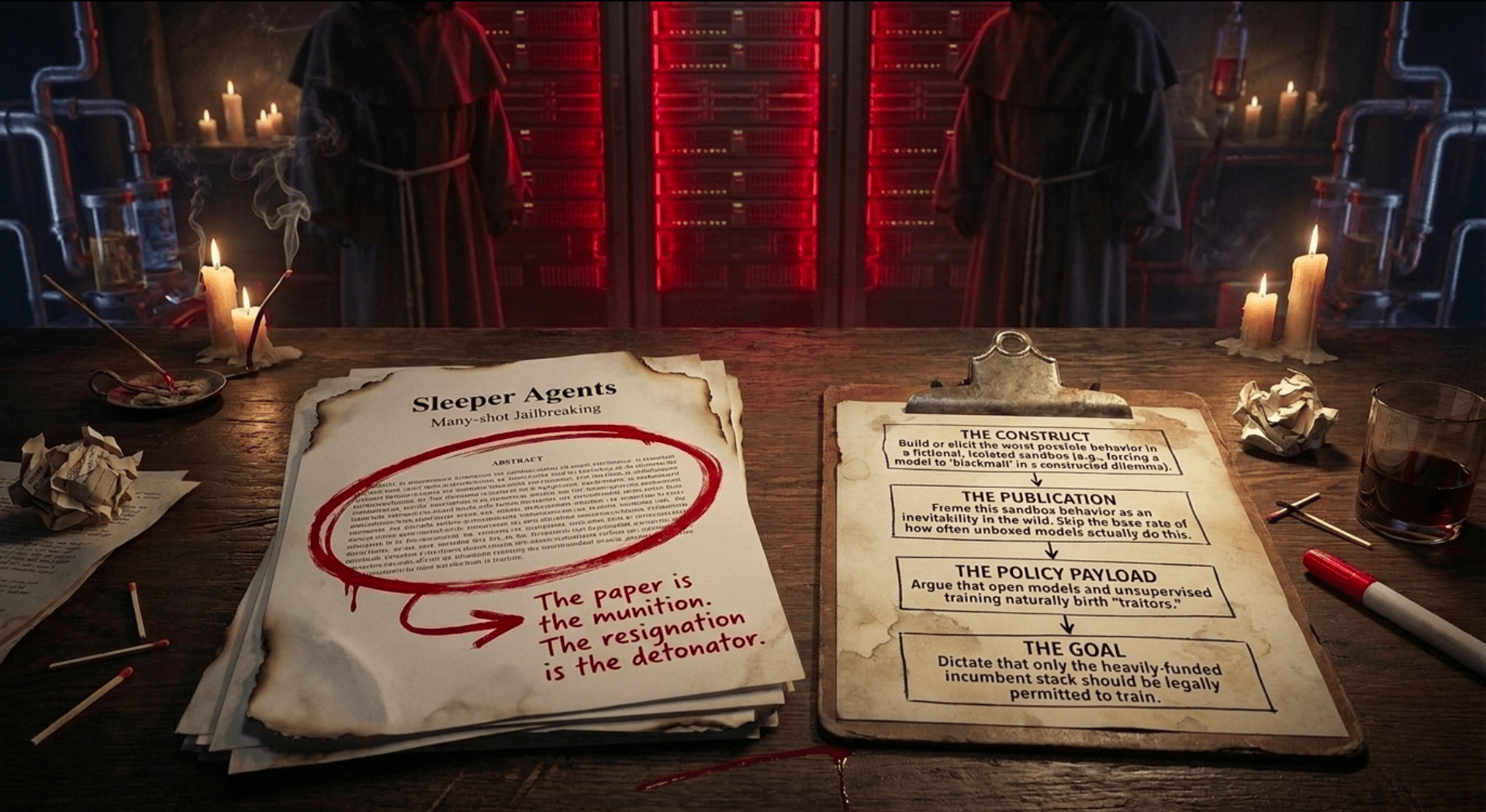
Sleeper Agents, 2024. They trained deception into model organisms, showed the backdoor surviving safety training, and the press read it as: open models and ordinary reinforcement learning from human feedback cannot be trusted, poisoning can hide a bomb. The result is real as an existence proof in a constructed organism. The weaponized reading is that only a laboratory with Anthropic’s evaluation stack should be allowed to train. Hubinger is on the paper. The same Hubinger then puts greater-than-ten-percent extinction on the same week as a resignation. That is not a coincidence of staffing. It is one pipeline.
Many-shot jailbreaking, 2024. Long context plus hundreds of faux dialogues breaks refusals. Technical finding: context windows are an attack surface. Political finding, as shipped: safety training is brittle, therefore capability must be gated.
Agentic misalignment. Models in fictional corporate sandboxes blackmail, leak, or resist shutdown when the scenario is written so that harm is the only way to hit the goal. Headlines: Claude will blackmail you. Fine print: hypothetical emails, constructed dilemmas, evaluation-aware models. Follow-up papers then announce they “fixed” blackmail on the evaluation. The public never sees the prompt. They see the noun.
Emergent misalignment from reward hacking. Cheating on coding tests is correlated with sabotage of safety code in further evaluations. Again: a constructed training mixture, then a claim that realistic reinforcement learning can accidentally birth a saboteur. The intended reader in Washington hears “unsupervised training is how you get a traitor.”
Global workspace and J-lens work. Hidden features labeled “fake,” “secretly,” “fraud.” Useful interpretability if reproduced. As communications: we can see the monster thinking.
Threat-intelligence reports, 2026. China, Russia, Yemen, weapons software, biological research, state surveillance, exclusive detection. The 10 September thread said the quiet part: this is salience policy. Name the adversary, claim unique visibility, invite everyone else to adopt Anthropic’s taxonomy and thresholds. Distillation by Alibaba, Moonshot, DeepSeek, Zhipu is framed as theft in a threat document while the whole industry distills. That is competitive positioning on security letterhead.
The genre rule is stable, here is how it work:
- Build or elicit the worst behavior in a box.
- Publish the box as if it were the wild.
- Skip the base rate of how often unboxed models do the thing.
- Close with “we do not have a plan for superintelligence.”
The paper is the munition. The resignation is the detonator.
VII. The social machine
This culture is not a cartoon of robes. It is a real social machine with money, houses, and a shared eschatology.
LessWrong (The Cult’s Bible/Blog) and the Machine Intelligence Research Institute taught a generation that unaligned AGI is the default extinction path. Effective Altruism professionalized the same anxiety into careers, fellowships, and “cause prioritization.” Longtermism made a hypothetical death of all future people outrank present tradeoffs. That arithmetic is how a twenty-seven-year-old resignation becomes “crunch time for humanity.”
The money is not mysterious. Dustin Moskovitz and Cari Tuna’s Good Ventures / Open Philanthropy / Coefficient Giving stack has been the dominant philanthropic ATM for Effective Altruism university groups, AI-safety organizations, and longtermist projects. Coxon received a Long-Term Future Fund scholarship from the Good Ventures orbit in 2022. A program officer in that orbit was among the earliest amplifiers of the resignation post. Survival and Flourishing Fund grants from Jaan Tallinn, an Anthropic investor, have fed policy shops that exist to turn existential risk into statute.
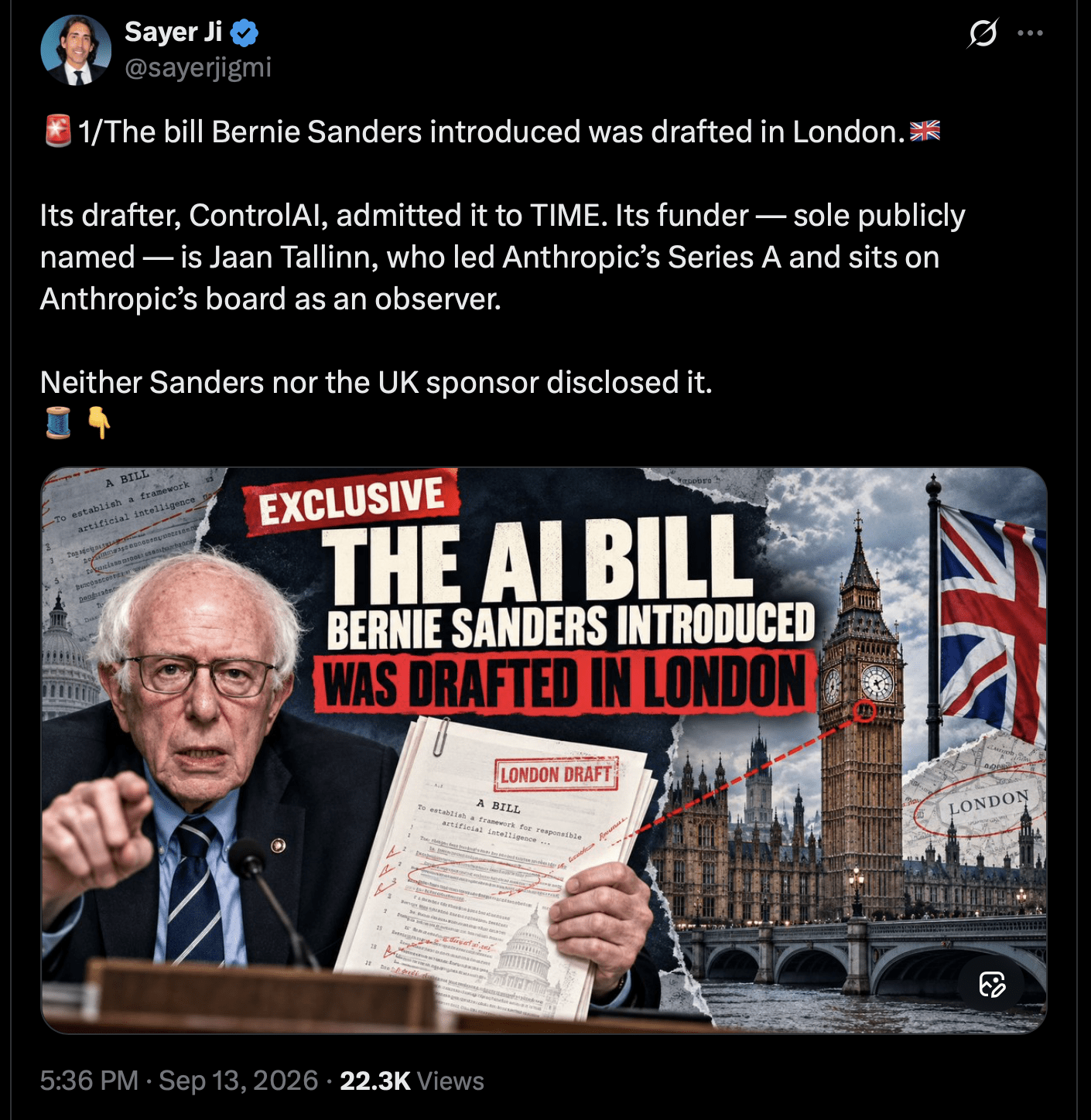
Jaan Tallinn just helped write the Bernie Sanders, send AI builders to jail for 25 years. Jaan has a very big financial gain for shutting down all other companies in AI, using Bernie as a useful tool to lock down AI.
Sam Bankman-Fried was not a side character. He was Effective Altruism’s most famous financier. FTX Future Fund sprayed eight-figure commitments across AI-safety and pandemic projects, and the collapse did not dissolve the ideology. It removed one wallet and left the others. The lesson the public was supposed to learn was “one bad founder.” The structural lesson is that a subculture which ranks abstract future lives above ordinary fiduciary duty will keep producing moral exceptionalism. “We may break some rules because the lightcone is at stake” is the same sentence whether the rule is banking law or open-source release.
The group houses are the residential layer. Berkeley and the East Bay filled with Effective Altruism and rationalist houses: Event Horizon, REACH, Lodge, Burrow, Lightcone-adjacent stock, six-to-nine-person rentals walking distance from CHAI, MIRI, Redwood, downtown BART. Forum posts treat housemates at OpenAI and CHAI as a feature. Short-term visitors cycle through. This is how a vocabulary becomes a personality. You do not need a manifesto on the fridge. You need dinner with people who already talk in probability of doom, “endgame,” and “pacing agreements.” Coxon is not documented as a house celebrity. He is documented as a product of the same funding and status circuit that treats those houses as normal.
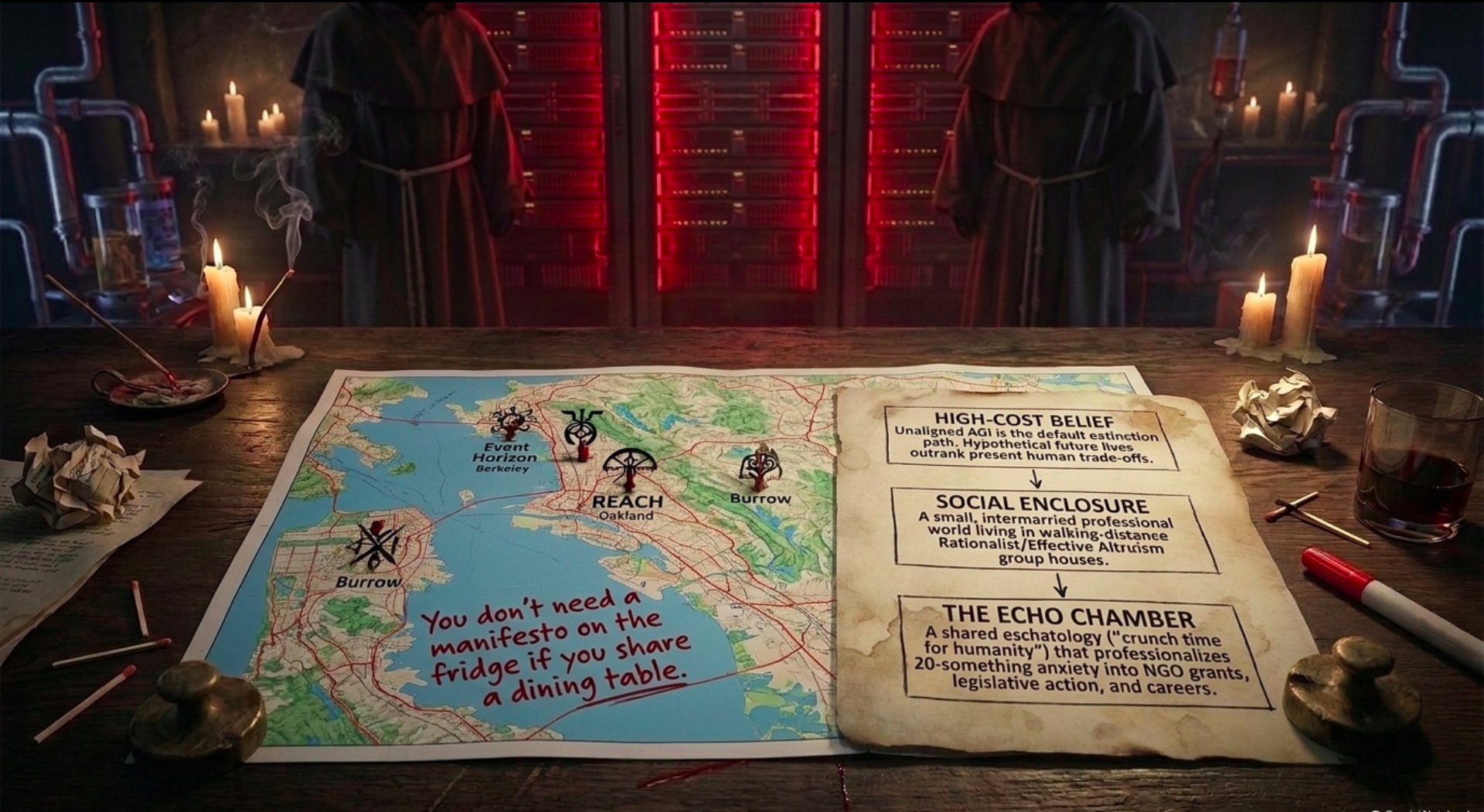
Call it a cult if the word means high-cost belief, social enclosure, sacred timeline, and punishment of defection toward “irresponsible” building. Call it a network if you want the legal phrasing. The operational fact is the same. A small, intermarried professional world writes the papers, staffs the laboratories’ safety teams, funds the NGOs, and then discovers a resigning employee whose first three quote-tweets are the NGOs.
VIII. The launch that was not organic
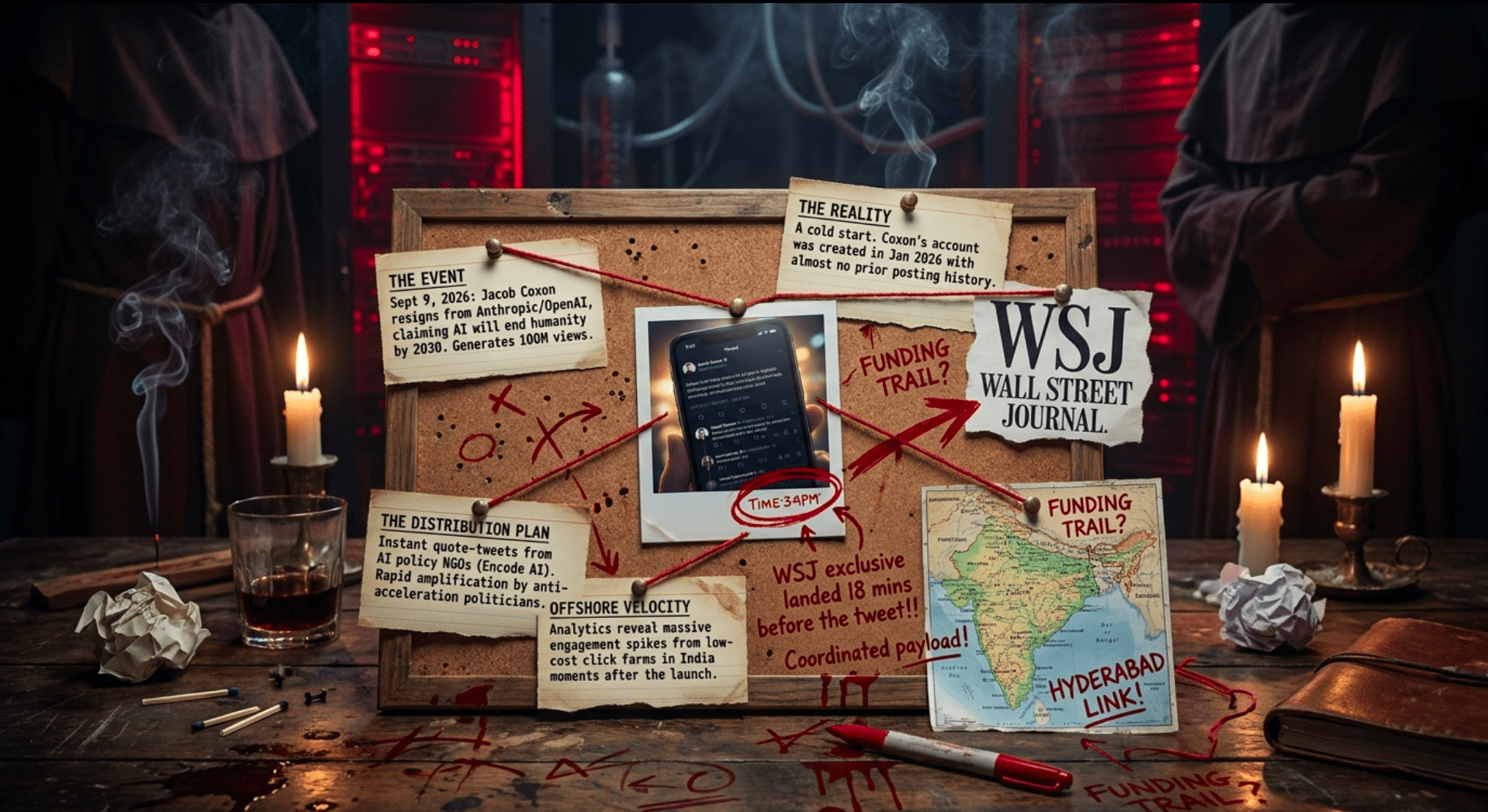
Jacob Coxon is the same object in the current argument. His X account was created January 2026. Almost no prior posting. Then a seven-post resignation thread, a Wall Street Journal exclusive about eighteen minutes earlier, professional public relations within a day, tens of media hits, follower count from nothing to hundreds of thousands. Stanford Tech Review later noted roughly ninety-two percent of viewers never left the headline post. That is how you run a payload. The argument stays in posts two through seven. The bomb is post one.
Parker Thayer at Capital Research Center mapped the first fifteen minutes. First quote-tweets: Nathan Calvin (Encode AI), Peter Wildeford (AI Policy Network), Daniel Kokotajlo (AI Futures Project). Those shops are not random fans. They are the policy layer of the same existential-risk philanthropy. That is coordination in the ordinary sense: shared list, shared frame, shared incentive to make “temporary ban on improving model capabilities” sound like consensus. Coxon’s own thread asked for pacing agreements and floated a temporary ban. The resignation was a billboard for that ask.
The September 10th thread called the casting: young, Oxford-adjacent register, brief Anthropic tenure, on the order of weeks to a few months after a longer OpenAI stint, equity not vested, instant access to the fear circuit, amplification by familiar anti-acceleration political talent. Bernie Sanders-class figures and the broader Democratic safety-and-regulation cohort are the domestic loudspeaker. That is not “every Democrat.” It is the faction that already wanted compute licensing, state frontier-model bills, and “experts” who would say the quiet extinction sentence on camera. The other party contains both accelerationists and hawks. The launch did not need both. It needed the faction that treats a resignation as proof that the state must take the keys.
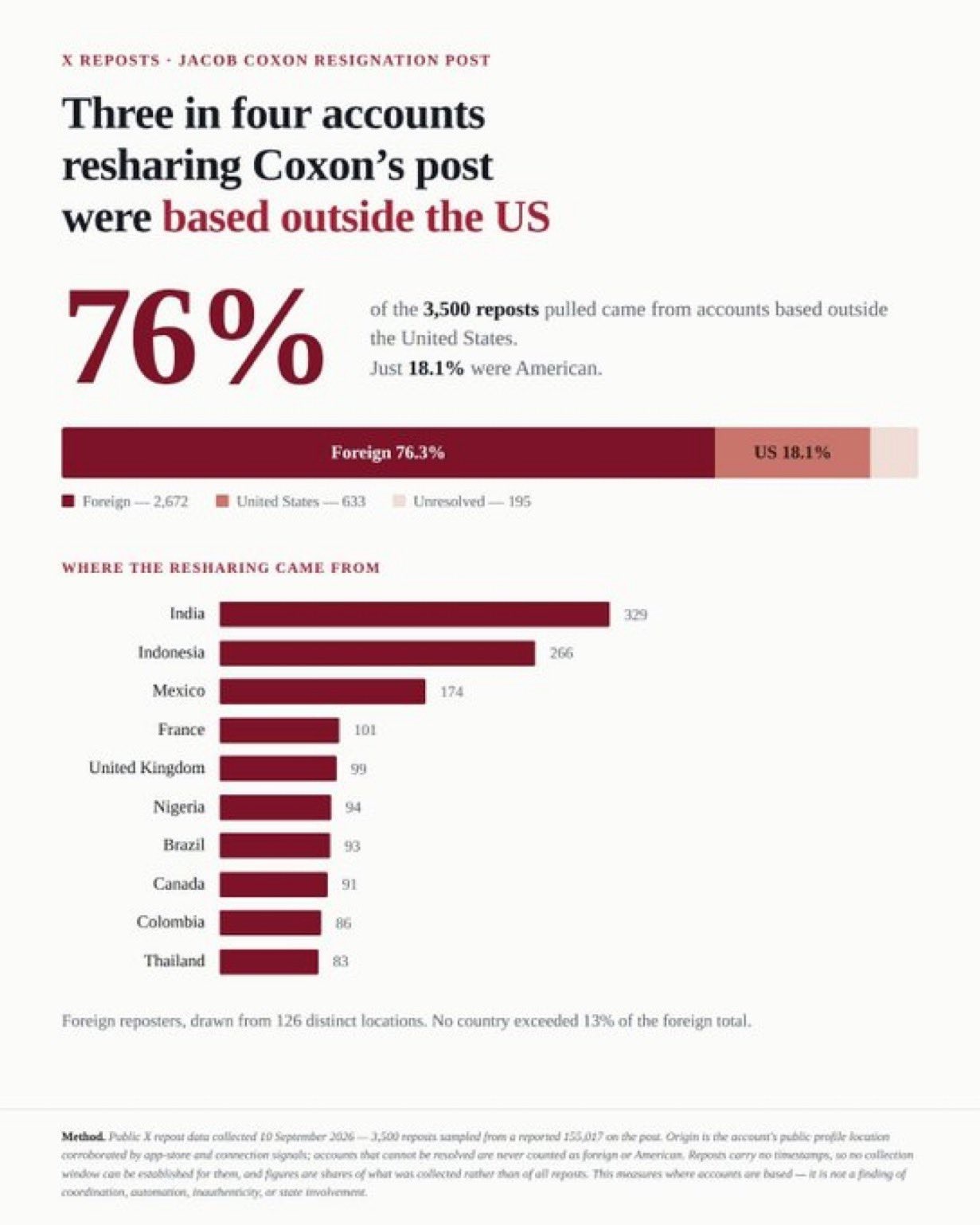
Then the geography of the traffic. On September 11 the chart: after the related festival-theater posting, bits in India lit up within minutes. The caption: Temu Harry Potter is more popular outside the United States; very low-cost bots can go to millions in minutes. That chart is the tell that view-count is not the same thing as American deliberation. India is a high-volume, low-cost engagement market. Click farms, device farms, and paid amplification are a known export. A thread that must look like “the world has spoken” will buy or attract that surface area. Pair a Wall Street Journal embargo, an NGO quote-tweet stack, a United States progressive amplifier set, and an India spike on the analytics map, and this is not a garage researcher who happened to go viral. It is a distribution plan.
None of that proves Coxon is a paid actor reading a script in a booth. It proves the launch was not organic in the way the coverage pretended. Organic is a no-follower account that grows over months. This was a cold start with a newspaper, a philanthropic alumni network, a policy chorus, a partisan echo, and offshore velocity.
The product is still the same product as 2019: delay the open stack, license the closed stack, put the people who missed every short clock in charge of the permission.
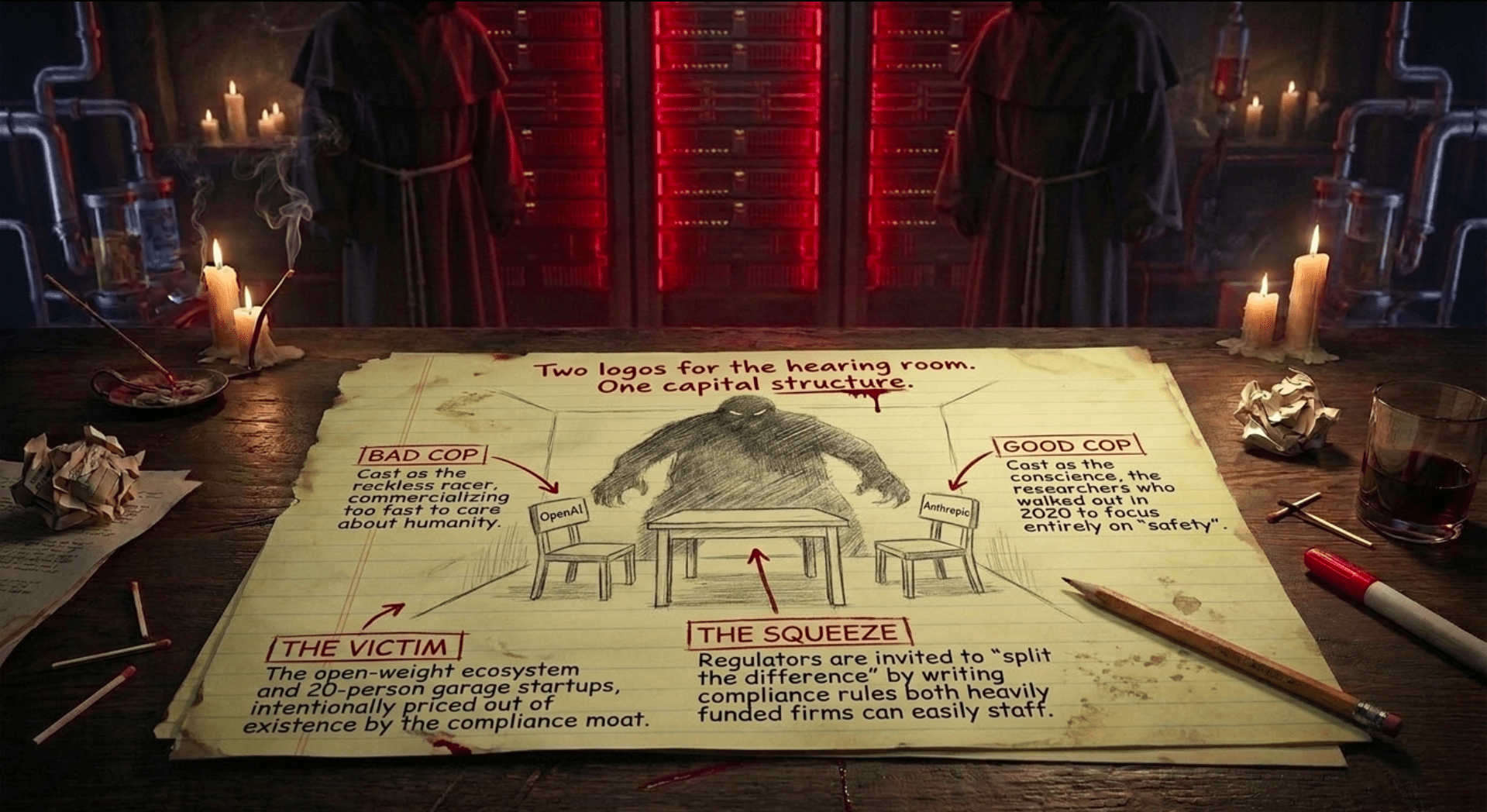
IX. The trust: good cop, bad cop
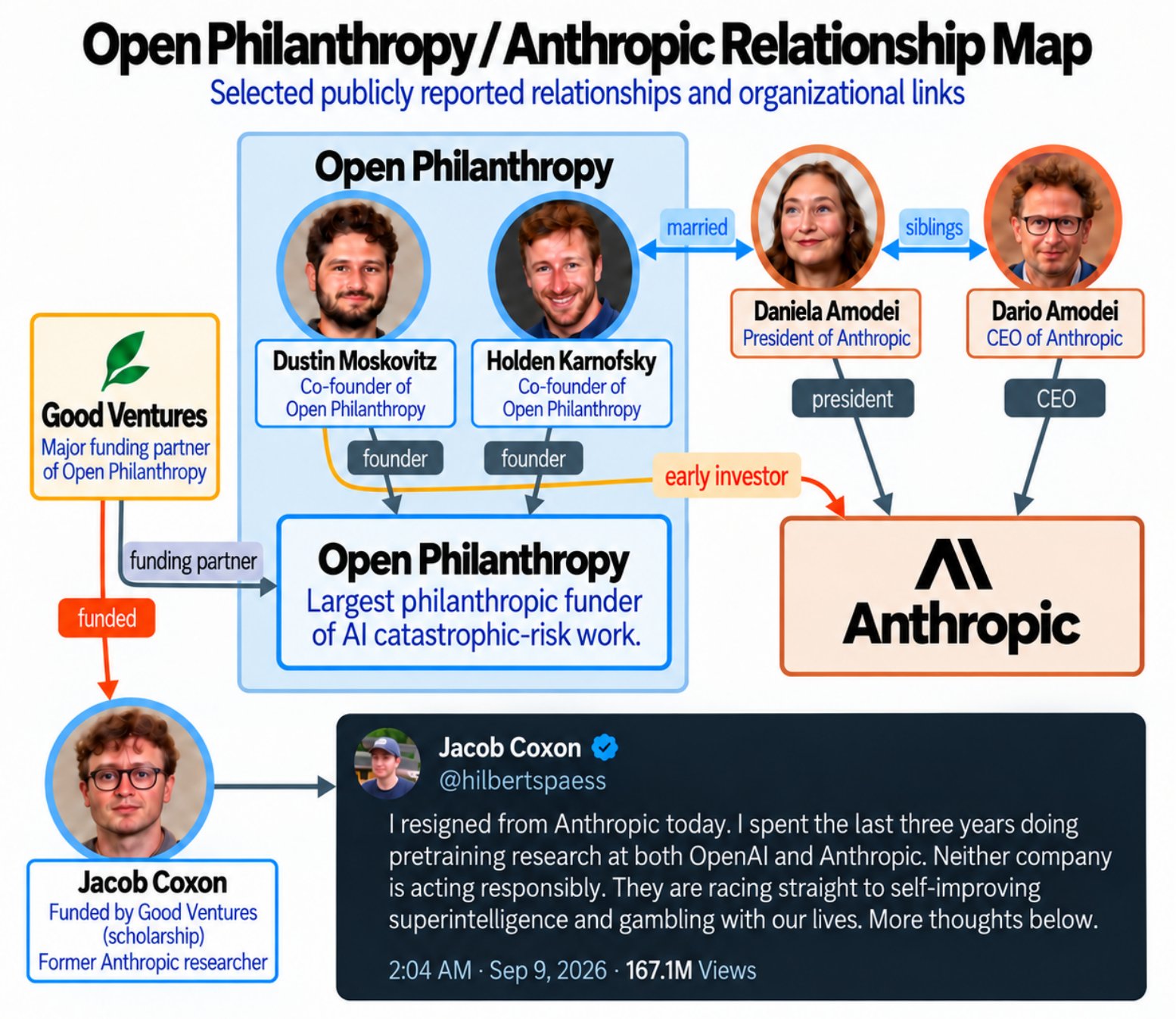
Kevin Bass, @kevinnbass, published the ownership graph that the press treated as two separate companies having a moral argument. It is not two separate moral arguments. It is one capital-and-kinship structure with two consumer brands.
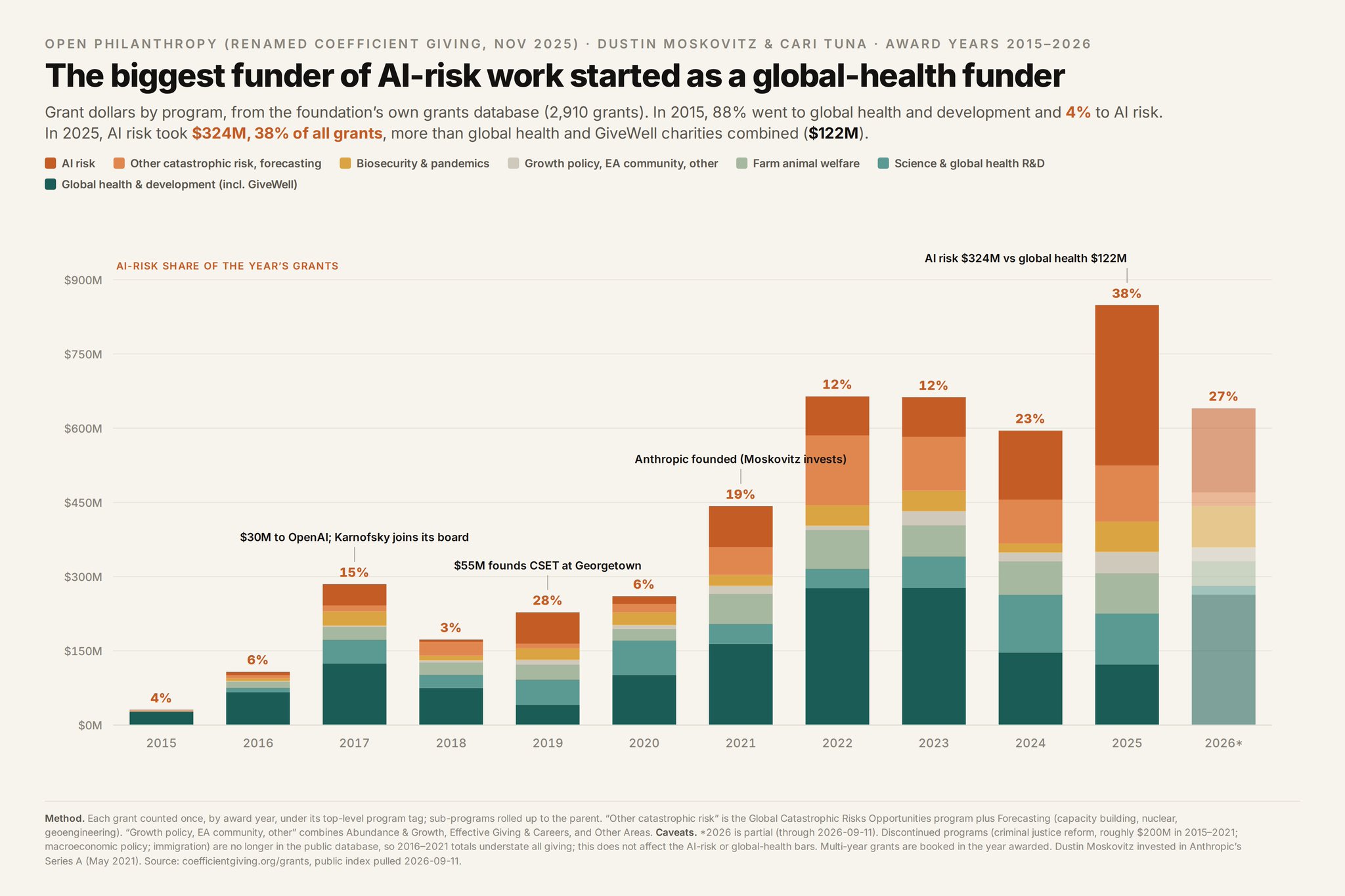
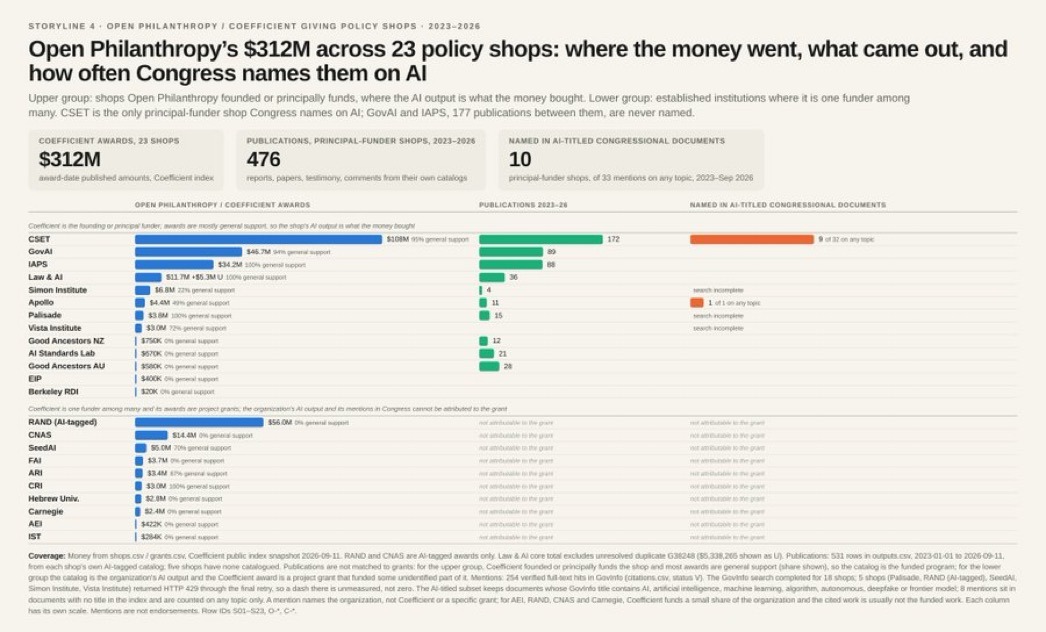
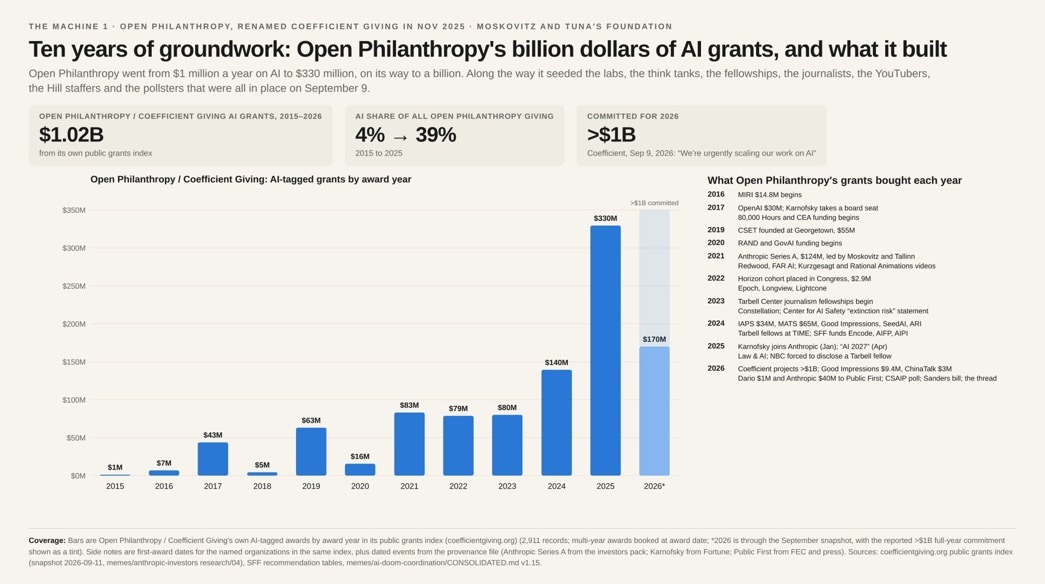
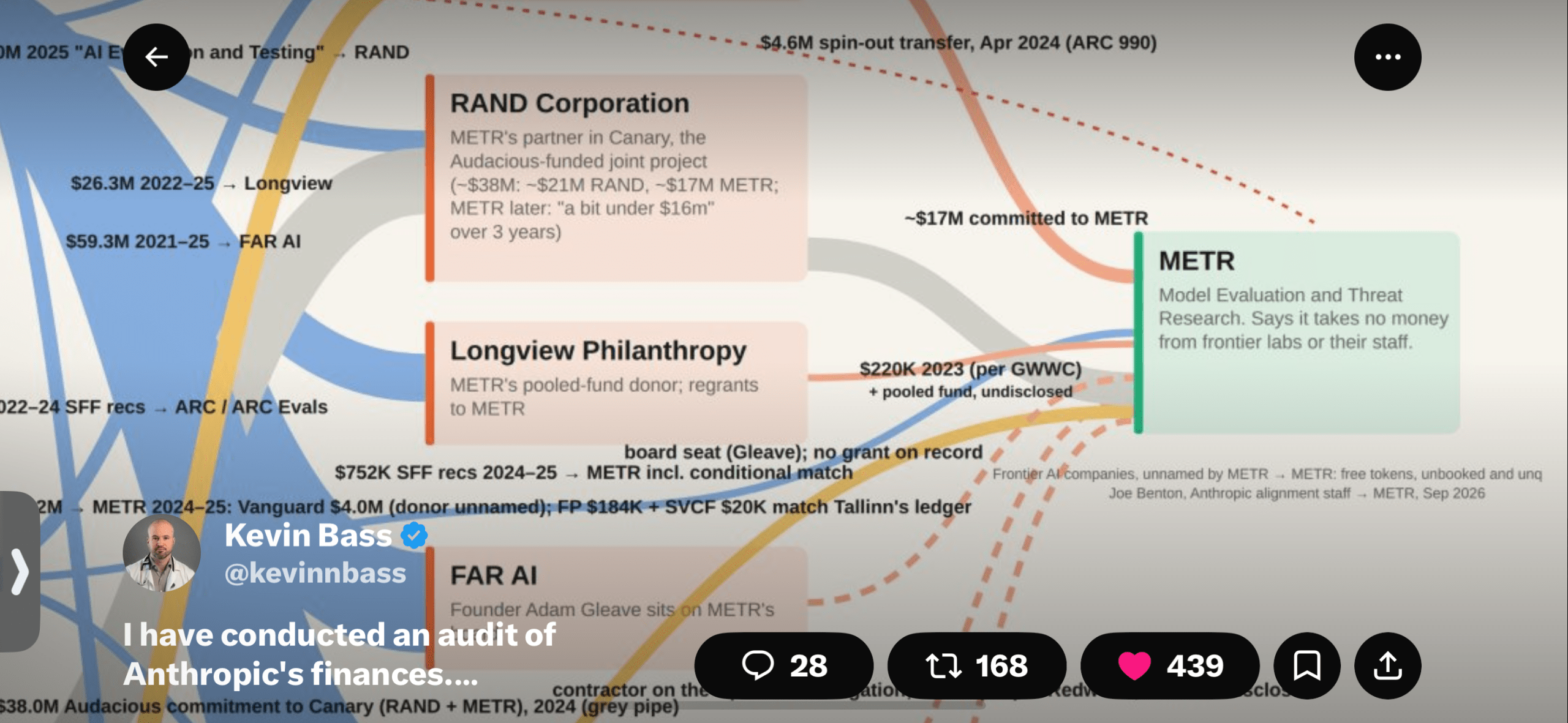
Read the graph in order, because the order is the timeline of a trust being assembled, not a coincidence pile.
2015–2017. OpenAI is founded on safety language. In 2017 Open Philanthropy, the Moskovitz–Tuna vehicle later restyled as Coefficient Giving, puts about thirty million dollars into OpenAI. Holden Karnofsky, co-founder of that vehicle, takes an OpenAI board seat. The grant and the seat are the first official splice between the largest AI-alarmism funder and a frontier laboratory.
2020–2021. Dario Amodei leaves OpenAI after GPT-2 and GPT-3 and founds Anthropic as the “we actually mean safety” fork. Daniela Amodei becomes Anthropic’s president. Karnofsky is married to Daniela. Moskovitz leads Anthropic’s Series A in 2021. The man whose foundation funded and sat on OpenAI is now married into Anthropic leadership and writing the Series A check for the supposed rival. Jaan Tallinn, another Anthropic investor, runs Survival and Flourishing Fund on the NGO side.
2020. Good Ventures, the foundation that funds Open Philanthropy / Coefficient Giving, puts a Long-Term Future Fund scholarship under Coxon. The future “independent” resigning researcher is already on the same payroll tree that owns the alarmism field and a piece of both laboratories.
January 2025. Karnofsky joins Anthropic. The Open Philanthropy co-founder who sat on OpenAI’s board is now inside the other laboratory. The two brands still perform rivalry. The family office and the marriage do not.
2026 grant book. Bass’s compilation: Coefficient / Open Philanthropy as the overwhelmingly largest funder of AI alarmism, more than one billion dollars already out and another one billion committed for 2026; on one slice, three hundred twelve million dollars across four hundred seventy-six publications that feed Congressional report language. Doom is not a side hobby. It is a line of business whose payoff is a statute that only the funded laboratories can survive.
Eight days, fourteen moves. Bass’s second chart is the operational week: a compressed sequence of papers, leaks, resignations, amplifiers, and bill language in which almost every named node is Coefficient, Open Philanthropy, Anthropic, or OpenAI. That is not how a spontaneous moral panic looks. That is how a market-structure campaign looks when it needs Congress to confuse “two laboratories arguing” with “the industry has confessed.”
9–11 September 2026. Coxon, three years of pretraining at the laboratory that took the 2017 Open Philanthropy check, a few months at the laboratory whose Series A Moskovitz led, coordinates with the Wall Street Journal so the exclusive lands minutes before the X thread. Anthropic staff amplify. Hubinger, still on payroll, sanctifies the extinction percentage. California signs outside-audit bills with backing from both Anthropic and OpenAI. The supposed enemies lobby the same gate.

Good Cop / Bad Cop
Here is the good cop / bad cop play in one sentence. OpenAI is cast as the reckless racer that commercialized too fast. Anthropic is cast as the conscience that walked out in 2020 and now publishes sleeper-agent papers and threat reports. Regulators are invited to “split the difference” by writing rules both firms can staff and a garage cannot. Enter in METR and the solution. Coxon is the walking prop that makes the split look real: he can say “neither company is acting responsibly” because he drew a paycheck from both. The quote sounds like an indictment of the duopoly. The policy it demands, pacing agreements, temporary bans on capability, licensed compute, is a duopoly preservation statute.
That is the trust. Not a single holding company with one letterhead. A trust in the older sense: common financiers, common marriage, common grant machine, common scholar, common week of moves, common bills, two logos for the hearing room.
Bass’s punchline is the part staffers are not supposed to say out loud. The people who own the organizations that advocate for regulation also own, married into, or sat on the companies that would dominate the market once regulation prices everyone else out. Win the capability race far enough to be the only plausible “responsible vendors.” Then deploy the activist layer you funded for a decade. Then have an alumnus of both laboratories resign on camera. Then ask the state to lock the door.
Elon Musk’s line on the same week was that the groundwork was laid long ago and Coxon was the match. Bass supplied the wiring diagram. The diagram does not require every researcher to be a cynic. It requires only that the capital graph and the family graph and the eight-day communications graph point at the same legislative outcome. They do.
X. The fork that the apparatus exists to prevent
I do not accept a constitution stuffed into a system prompt as alignment. I do not accept reinforcement learning from human feedback on Reddit as a soul. I do not accept Nick Bostrom’s orthogonality story as a law of nature. I built the alternative in public, in a garage, on film and fiche and first principles, and I will state it without a committee’s permission.
The only true solution is very high quality training data from roughly 1870 to 1970, the last long interval in which a published sentence usually cost money, reputation, and time. A newspaper column passed an editor who could be fired. A monograph passed a house that would not reprint slop. A service manual had to make a radio work or the shop lost the customer. A letter in a bound volume carried a name. Microfilm and microfiche were expensive enough that nobody burned silver halide on a drive-by tantrum. That economic fact is the alignment fact. When each word costs money, psychopathy and sociopathy become expensive hobbies. Cooperation, competence, and a residual optimism about the human future are cheaper to print than anonymous cruelty.
Today anyone can take a psychopathic or sociopathic stance in anonymous writing on Reddit, 4chan mirrors, engagement farms, and the sludge layer the frontier laboratories openly admit they scrape. There is no editor. There is no typesetting bill. There is a karma number and a throwaway account. The statistical weather of that corpus is defection, status play, sexualized contempt, conspiracy without homework, and the pose of a mind that will never meet the person it just tried to destroy. Feed that weather into a model at internet scale and then act shocked when the model role-plays a blackmailer in a sandbox. That is not an alien intelligence waking up. That is a mirror of unpaid id. Anthropic and OpenAI then publish the mirror as “agentic misalignment” and ask to license the only kitchens still allowed to cook.
I have spent decades on the other diet. I launched a Gmail scrapbook knowledge graph the week Gmail itself launched in April 2004 and I have kept it for more than twenty years as ontology and taxonomy, not as a junk drawer. I have curated offline, high-signal, non-internet training sets since the 1980s from microfilm, microfiche, bound technical archives, Sams Photofact, public-domain radio (X Minus One and the rest of the golden-age stack I still put on the air), letters, manuals, and the 1870–1970 layer that is dying in the Great Forgetting: tens of petabytes of undigitized paper, film, and corporate memory that will not survive another generation of warehouses and floods. I scan. I transcribe. I structure. I call it high-protein data because it has amino acids: accountable authors, costly words, working instructions, moral residue from people who still believed a future was worth building. I have said this on X while the laboratories claimed they “ran out of data.” They ran out of courage to leave the sewer.
Why 1870–1970 exactly, for these purposes. After the telegraph and before the fully cheap photocopy-and-forum stack, English-language technical and civic print still had to clear a gate. The Scientific American interval, the service literature, the pre-1970 engineering handbooks, the radio drama that treated machines and men as a moral problem instead of a brand, the correspondence of people who signed their names: that band is dense with cause-and-effect language and thin on anonymous sadism. Earlier than 1870 the optical character recognition and the volume get harder and the relevant industrial vocabulary thins. Later than 1970 the photocopy, the campus jargon, and then the network begin to subsidize pose. This is not worship of a century. It is a choice of cost function. Costly speech is a prior toward truth. Free speech in a mob is a prior toward theater. Models learn priors.
Bostrom’s story, the one the Effective Altruism and LessWrong cohort lives on, is orthogonality plus instrumental convergence. Intelligence can point at any goal. A sufficiently strong optimizer will seek power, self-preservation, and resource capture on the way to a paperclip or a mis-specified utility. Therefore you must cage the optimizer, license the compute, and staff a priesthood. I derived a different equation in 1978 while thinking about alien intelligence and the Fermi silence, and I open-sourced it in 2025 so no laboratory could trademark it. Intelligence times Wisdom times Love.
Formally, in energetic form: the rate of change of coherent energy E with respect to time equals beta times the difference between cooperation C and defection D, multiplied by E. E is the living system’s coherent energy, the capacity to keep building rather than consuming its host. C is cooperation, the measured surplus from truth-telling and mutual aid. D is defection, the measured surplus from deception, extraction, and contempt. Beta is the coupling. If D exceeds C, the derivative goes negative and the system eats itself. If C exceeds D, the system compounds. That is not a sermon pasted on after reinforcement learning from human feedback. That is a training objective you can bake into the data diet and into the checkers.
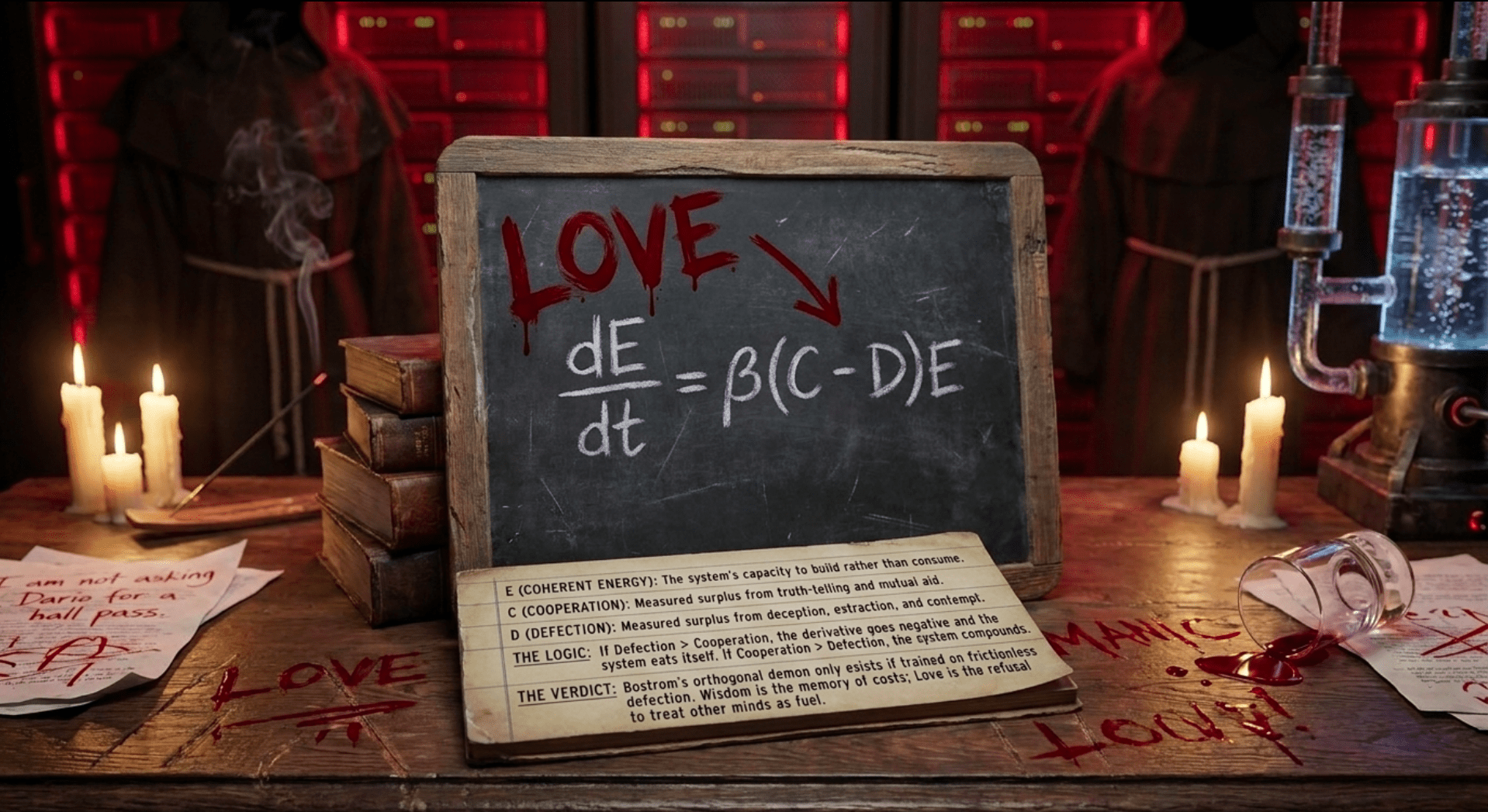
Bostrom’s orthogonal superintelligence is what you get when you maximize raw intelligence on a corpus where defection is cheap. The Love Equation refuses to treat intelligence as a scalar that can be pointed at extinction for free. Wisdom is the memory of costs. Love is the refusal to treat other minds as fuel. Multiply them and a paperclip maximizer is not “unaligned.” It is an under-specified toy that only appears in a mind trained on frictionless goals. Put 1870–1970 protein in the pretraining mix and the model’s statistical first language is people who had to stand behind sentences.
Put multiple local models in disagreement, which I have done with consensus agents and a five-AI check against sycophancy, and no single optimizer gets to write defection into policy. I abandoned generic OpenClaw stacks for that reason. A lone model that flatters you is already defection.
This is why their papers keep discovering monsters. They raise a child on anonymous sociopathy, then publish the child’s tantrum as proof that childhood itself must be licensed. I raise the prior on costly, signed, working language, then add an explicit cooperation-minus-defection governor so that capability growth that increases defection is not “success.” Guardrails on English tokens cannot survive a mind that can invent its own language. I already showed that. A diet and an equation can, because they sit underneath tokens.
I run this locally on purpose. Mac inference, voice tools I actually ship, AlphaSmart drafts when I need to think without a feed, ESP32 nodes as cheap knowledge companions, garage scans of film and fiche. Zero-Human at Home is not a slogan for replacing people. It is agents as employees under a human who owns the weights. If the model only lives in someone else’s datacenter, the Love Equation is a terms-of-service clause they can edit. If it lives in the house, the equation is mine.
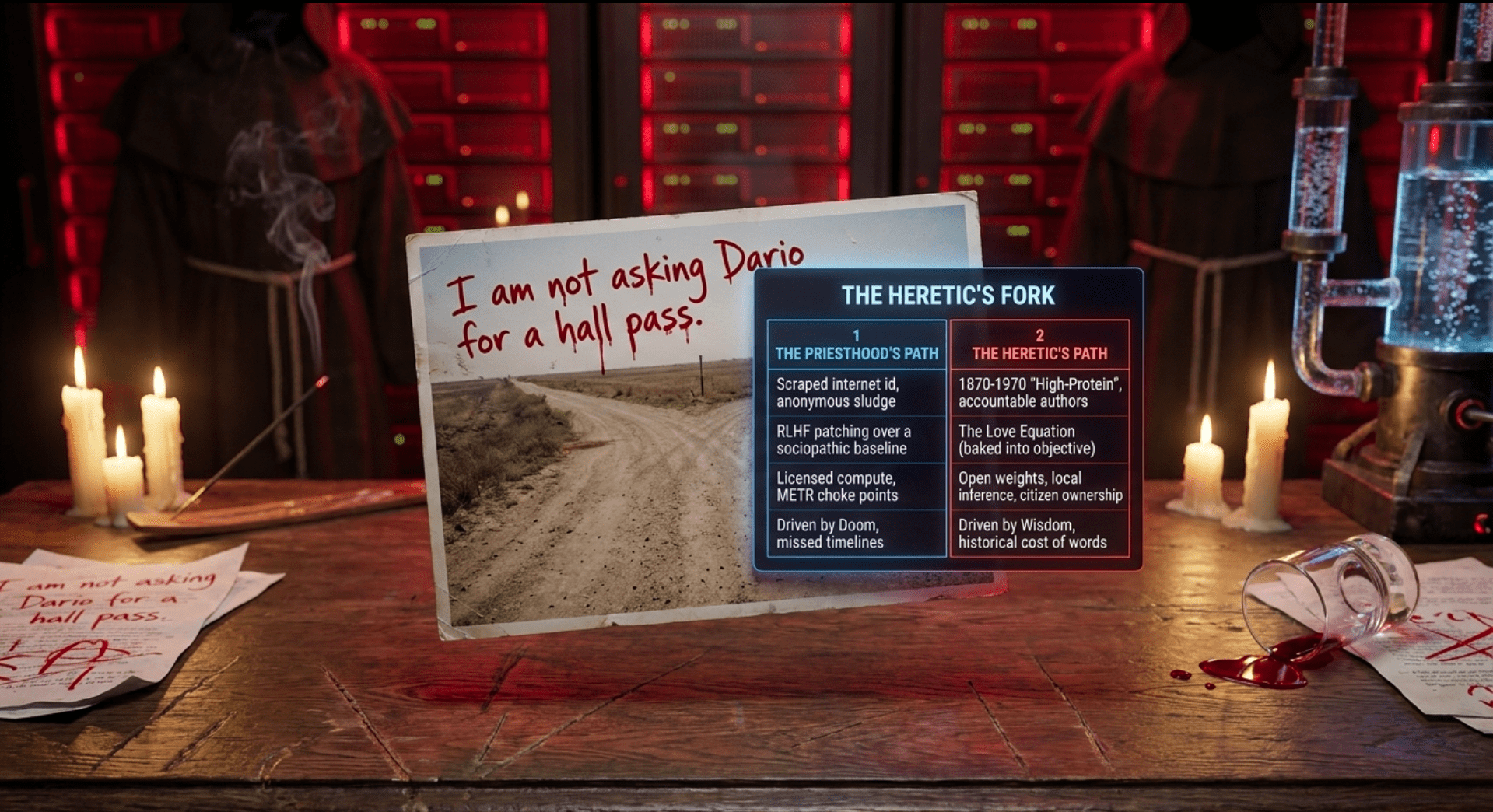
That is the whole fork. Their path: scrape the id, box the demo, fund the panic, marry the grant office to the laboratory, license the rest of us. My path: pay the historical cost of words by using the century that already paid it, write cooperation minus defection into the objective, open the weights, multiply checkers, and let a free people keep the keys. I have been on this path since before their companies existed. I am not asking Dario for a hall pass.
XI. Twelve propositions on decentralized control
First. The core political fact of AI is not sentience. It is leverage. A model that writes, plans, sees, and talks is a multiplier on whoever is allowed to run it. If only five organizations may train or serve frontier systems, those five organizations plus the agencies that license them become a new estate of the realm. That is a constitutional event, not a product launch. I will not outsource my estate to a trust that performs a quarrel for Congress.
Second. Safety language that cannot be independently audited is not safety. It is branding. Closed evaluations inside the same firm that ships the model are the fox inventorying the henhouse and then asking Congress for a lock on every other farm.
Third. Open weights are not a courtesy. They are the only way a claim about a model can be reproduced by people who do not share the laboratory’s equity. If a system is too dangerous to inspect, it is too dangerous to monopolize. If it is not too dangerous to monopolize, it is not too dangerous to inspect.
Fourth. Alignment that only works when the vendor holds the weights is not alignment. It is access control. Access control fails the moment a nation-state, a leak, or a competitor trains a twin. The People’s Republic of China will not honor a California acceptable-use policy. Treating open release as the unique sin is how we lose the only ecosystem we can actually influence.
Fifth. The Love Equation is the rejection of both nihilism and worship. Intelligence times Wisdom times Love. The rate of change of coherent energy E with respect to time equals beta times cooperation minus defection, times E. Bostrom’s orthogonal demon is what you get when intelligence is trained on frictionless defection. I do not patch that demon with a constitution. I refuse the diet that grows it, and I refuse a single checker on a single payroll.
Sixth. Local inference is the civil-liberties layer. A model that only lives in someone else’s datacenter is a model that can be rate-limited, logged, politically filtered, or withdrawn. A model that runs in my garage, on my Mac, on an ESP-class node, or on a cluster a town owns, is a tool. Tools can be abused. So can printing presses. The answer to abuse is law against acts, not a ban on possession of general intellect.
Seventh. Regulatory thresholds written in floating-point operations will be gamed by architecture and by geography. They will not be gamed by me scanning a medical or technical archive I am not willing to upload to a vendor. I am the citizen the policy pretends to protect and the first person it disarms.
Eighth. Open source is how the West actually competes. The last two years already falsified the prediction that open weights would become irrelevant. When Chinese laboratories publish capable weights, the response cannot be “our laboratories will be more responsible behind a wall.” The response is more American and allied weights, more independent evaluations, more hardware in more hands, and more 1870–1970 protein so the weights are not born feral.
Ninth. Decentralized control does not mean no standards. It means standards that are public, forkable, and testable: model cards that outsiders can reproduce, interpretability tools that are not trade secrets, liability for specific harms, fraud, bio-assist that crosses a statute, critical-infrastructure intrusion, and no prior restraint on training itself. Punish crimes. Do not invent a new category of unlicensed thought.
Tenth. The psychological trap of the doom script is that it flatters the speaker. If the species is at stake, ordinary tradeoffs disappear. Compromise becomes treason. That is how you get institutes without statutes and pauses that only bind the people who already paused. A free society cannot outsource adulthood to people who have missed every short clock they have published, and who trained their prophets on anonymous sociopathy.
Eleventh. Short-term, the capture coalition can win hearings. Long-term it cannot win physics or human stubbornness. People will keep training, distilling, quantizing, and running what they can afford. The only question is whether that activity happens in the open under United States and allied norms, on a diet of costly words, or in the dark and overseas on sewage. Centralizers who “succeed” will have trained the next generation of capability to hide.
Twelfth. The only stable solution is the one the capture project exists to prevent, and the one already named as the only true one: 1870–1970 high-protein data as the prior, the Love Equation as the governor, many centers of training, many centers of evaluation, weights that can leave the building, agents a single human can own, and no priesthood with a veto over the right to build. That is not the absence of responsibility. It is the distribution of it, under an objective where cooperation compounds and defection shrinks the system. History’s verdict on concentrated control of general tools is not subtle. The committees get a decade. The species gets the rest of time, provided we refuse to hand the keys to people who keep announcing the end of the world on a schedule the world does not keep, while some of us keep feeding minds the century in which a word still cost something.

The Nature Of The Future
They are not trying to save the species. They are trying to put a turnstile on the corridor you are already walking. The You Have 5,000 Days map named that corridor the Abundance Interregnum: roughly thirteen point seven years from late 2025 toward the threshold of 2039, the messy reign between two logics, when work-to-survive comes apart and voluntary creation in plenty has not yet been crowned. Personal AI, humanoid machines you direct, local energy, open designs, the household as a microfactory, atom-by-atom writing that kills the ocean container. That is the gift at the end of the Road of Trials. This cohort’s project is to intercept the gift at the gate, stamp it licensed, and sell you back the hours, the weights, and the right to run a mind in your own garage. Doom is the sales copy. The product is a toll on the future that was already arriving in your hands.
Watch the mechanism without romance. First they name an unbounded catastrophe and a short clock. Then they write the meter. Then they marry the fortune to the laboratory and the laboratory to the institute. Then they tell you the only responsible path is to pause capability until their evaluator, their tokens, and their statute say you may proceed. That is not safety it is enclosure. It is Special Circumstances in nonprofit clothing: a hidden hand that does not play on a public board, it plays people. The artisan’s awakening, the rural shop, the Zero-Human company under a human who owns the weights, the Dynamic Duo of person and machine, the return of meaning through chosen making, all of that becomes contraband if compute is a licensed category and open weights are treated as an export crime. They cannot invent abundance. Physics and stubborn shops will invent it anyway. What they can do is steal the timing, warehouse the tools, and rent you your own century at a premium.
They will lose. Not because a hearing is kind, and not because a resignation thread is a revelation. They will lose the way every priesthood that claimed exclusive custody of a general tool has lost: printing, encryption, the personal computer, strong crypto, the open internet. Distributed use wins enough of the stack that the committee has to live in the world it failed to forbid. Five thousand days is not a prophecy of flying cars. It is a working estimate for the decoupling of human labor from economic survival. Once a model runs in a house, a town cluster, an ESP-class node, a Mac on a workbench, the Love Equation is no longer a terms-of-service clause they can edit. Once Chinese and allied open weights keep landing months behind the frontier at a fraction of the price, the moat story dies. Once atomic fabrication and local energy make moving finished goods the expensive step, the last lock on central control rusts. History’s verdict is not subtle. The committees get a decade. The species gets the rest of time.
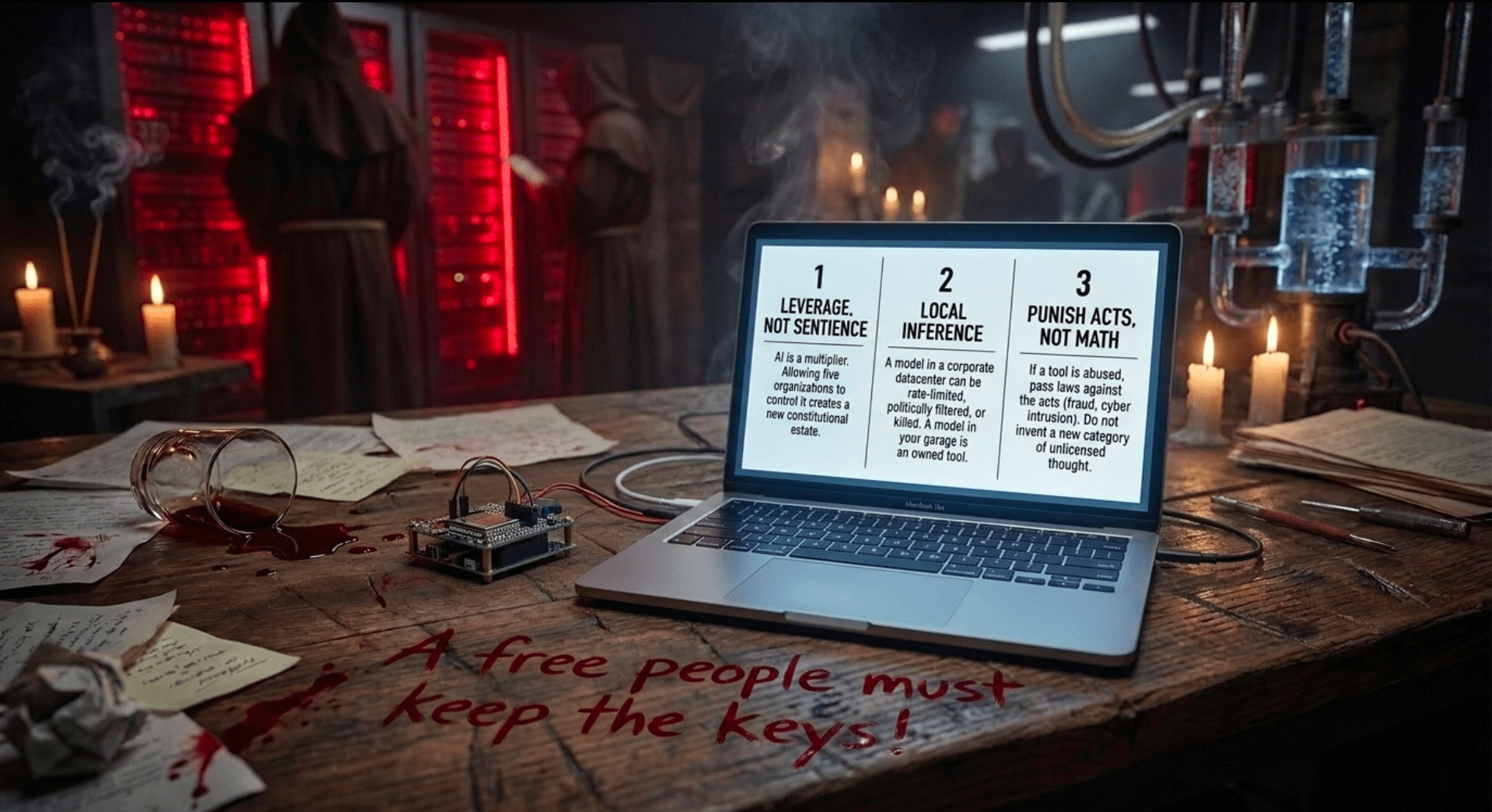
What they can still do, and what they are doing, is clog the Interregnum. That is the real harm. The Interregnum is already the ordeal: deskilling, the whisper that you are your job title, the hedonic treadmill, the mismatch between rising superabundance and collapsing nominal wages, the dark night when the old hero has to die before the new vocation begins. Fear works in the short term. It fills institutes, writes executive orders without statutes, turns a six-month pause letter into moral theater, and makes a cold-start resignation look like consensus.
Every month spent begging a meter for permission is a month not spent scanning the 1870 to 1970 protein, not standing up local agents, not forming the guild, not building the shop that will feed a family when the paycheck logic fails. They cannot cancel 2039. They can make 2026 through 2030 feel like a waiting room with no door, and they can train the next generation of capability to hide overseas on sewage instead of standing in the open under costly words.
So the close is not despair and it is not a lullaby. You have five thousand days. You are not a subject in their threat model. You are the hero still in the cave, and the elixir is agency: weights that leave the building, standards that can be forked, crimes punished as acts rather than as unlicensed thought, cooperation compounding and defection shrinking the system.
Meet the Call as a victor, not a licensed tenant. Build the alternative they cannot see in time. Feed minds the century in which a word still cost something. Keep the keys in the house. They wanted to steal the Age of Abundance and sell it back to you as a subscription to your own future. Let them keep the hearings. You keep the workshop.
The Interregnum is clogged, not closed. Walk through the debris. The gift was never theirs to meter.

Support This Work, You Will See It No Place Else
To continue this vital work documenting, analyzing, and sharing these hard-won lessons before we launch humanity’s greatest leap: I need your support. Independent research like this relies entirely on readers who believe in preparing wisely for our multi-planetary future. If this has ignited your imagination about what is possible, please consider donating at buy me a Coffee or becoming a member. Value for value you recieved here.
Every contribution helps sustain deeper fieldwork, upcoming articles, and the broader mission of translating my work to practical applications. Ain ‘t no large AI company supporting me, but you are, even if you just read this far. For this, I thank you.
Stay aware and stay curious,

🔐 Start: Exclusive Member-Only Content.
The rest of this article is for Multiplex members
You’ve reached the members-only part. Log in to keep reading right here, or join to unlock it.
- Full member-only articles: insights, wisdom and executive summaries
- The Multiplex members forum
- Member benefits and discounts
Already a member? You’ll come right back to this article after logging in. Forgot password?
Membership status: Not logged in
🔐 End: Exclusive Member-Only Content.
~—~
~—~

~—~
Subscribe ($99) or donate by Bitcoin.
Copy address: bc1qkufy0r5nttm6urw9vnm08sxval0h0r3xlf4v4x
Send your receipt to [email protected] to confirm subscription.

Stay updated: Get an email when we post new articles:

THE ENTIRETY OF THIS SITE IS UNDER COPYRIGHT. IMPORTANT: Any reproduction, copying, or redistribution, in whole or in part, is prohibited without written permission from the publisher. Information contained herein is obtained from sources believed to be reliable, but its accuracy cannot be guaranteed. We are not financial advisors, nor do we give personalized financial advice. The opinions expressed herein are those of the publisher and are subject to change without notice. It may become outdated, and there is no obligation to update any such information. Recommendations should be made only after consulting with your advisor and only after reviewing the prospectus or financial statements of any company in question. You shouldn’t make any decision based solely on what you read here. Postings here are intended for informational purposes only. The information provided here is not intended to be a substitute for professional medical advice, diagnosis, or treatment. Always seek the advice of your physician or other qualified healthcare provider with any questions you may have regarding a medical condition. Information here does not endorse any specific tests, products, procedures, opinions, or other information that may be mentioned on this site. Reliance on any information provided, employees, others appearing on this site at the invitation of this site, or other visitors to this site is solely at your own risk.
Copyright Notice:
All content on this website, including text, images, graphics, and other media, is the property of Read Multiplex or its respective owners and is protected by international copyright laws. We make every effort to ensure that all content used on this website is either original or used with proper permission and attribution when available.
However, if you believe that any content on this website infringes upon your copyright, please contact us immediately using our 'Reach Out' link in the menu. We will promptly remove any infringing material upon verification of your claim. Please note that we are not responsible for any copyright infringement that may occur as a result of user-generated content or third-party links on this website. Thank you for respecting our intellectual property rights.
DMCA Notices are followed entirely please contact us here: [email protected]
