
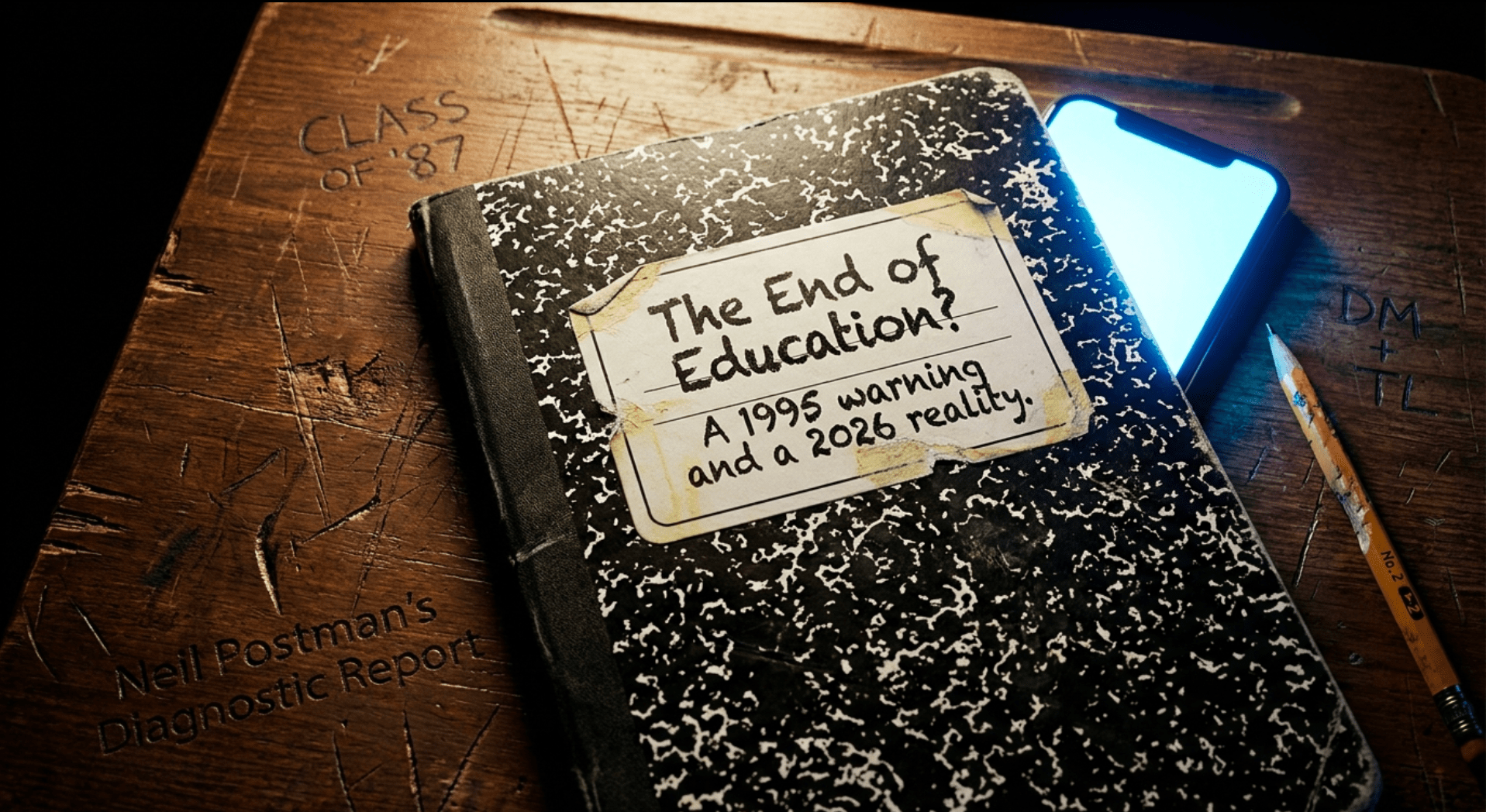
The End Of Education: A 1995 Warning.
In 1995, Neil Postman published a book with a Janus-faced title. The End of Education (https://amzn.to/4yQRWWl) meant two things at once: that schooling as we knew it was coming to an end, and that schooling had lost its ends — its purposes, its reasons, its gods. He argued that a school without a transcendent narrative is not a school at all. It is a holding pen with a curriculum. Thirty-one years later, the holding pen has Wi-Fi, and every student carries in their pocket a machine that can do their homework, write their essays, and answer every question on the test — while understanding none of it. Postman did not live to see the smartphone classroom or the chatbot term paper. He died in 2003. But he described, with surgical precision, the spiritual machinery that would make those things not just possible but inevitable. He told us which gods we were worshipping, what they would do to our children, and what we would need to believe instead.
Neil Postman did not write a book about school reform. He wrote a warning about what happens when a civilization forgets why it teaches its young. Thirty-one years later the warning is no longer theoretical. It is the room we are sitting in.
This article is sponsored by Read Multiplex Members who subscribe here to support my work: Link: https://readmultiplex.com/join-us-become-a-member/
It is also sponsored by many who have donated a “Cup of Coffee”. If you like this, help support my work: Link: https://ko-fi.com/brianroemmele
Listen to the companion podcast: https://rss.com/podcasts/readmultiplex-com-podcast/3165758
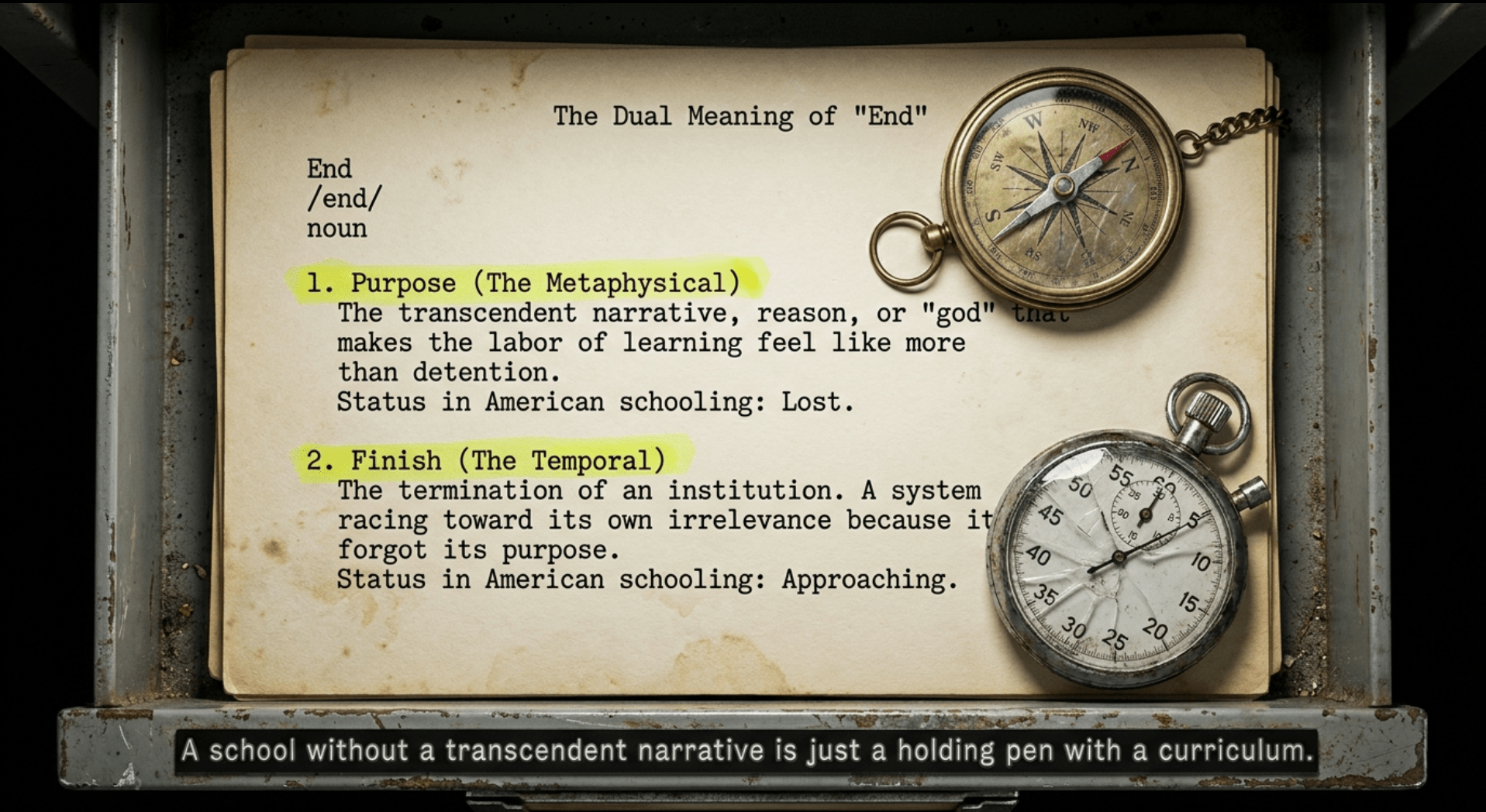
In 1995, The End of Education (https://amzn.to/4yQRWWl) used the word “end” in both of its meanings: purpose, and finish. Postman argued that American public schooling had lost the first and was therefore racing toward the second. The schools still existed. The buses still ran. The tests still printed scores. What had vanished was a shared story large enough to make the labor of learning feel like more than detention.
Postman called those stories “gods,” with a small g. Not deities. Narratives. The great accounts that tell a people who they are, where they came from, what they owe one another, and why tomorrow is worth the effort of today. Without such a narrative, he wrote, “life has no meaning. Without meaning, learning has no purpose. Without a purpose, schools are houses of detention, not attention.”
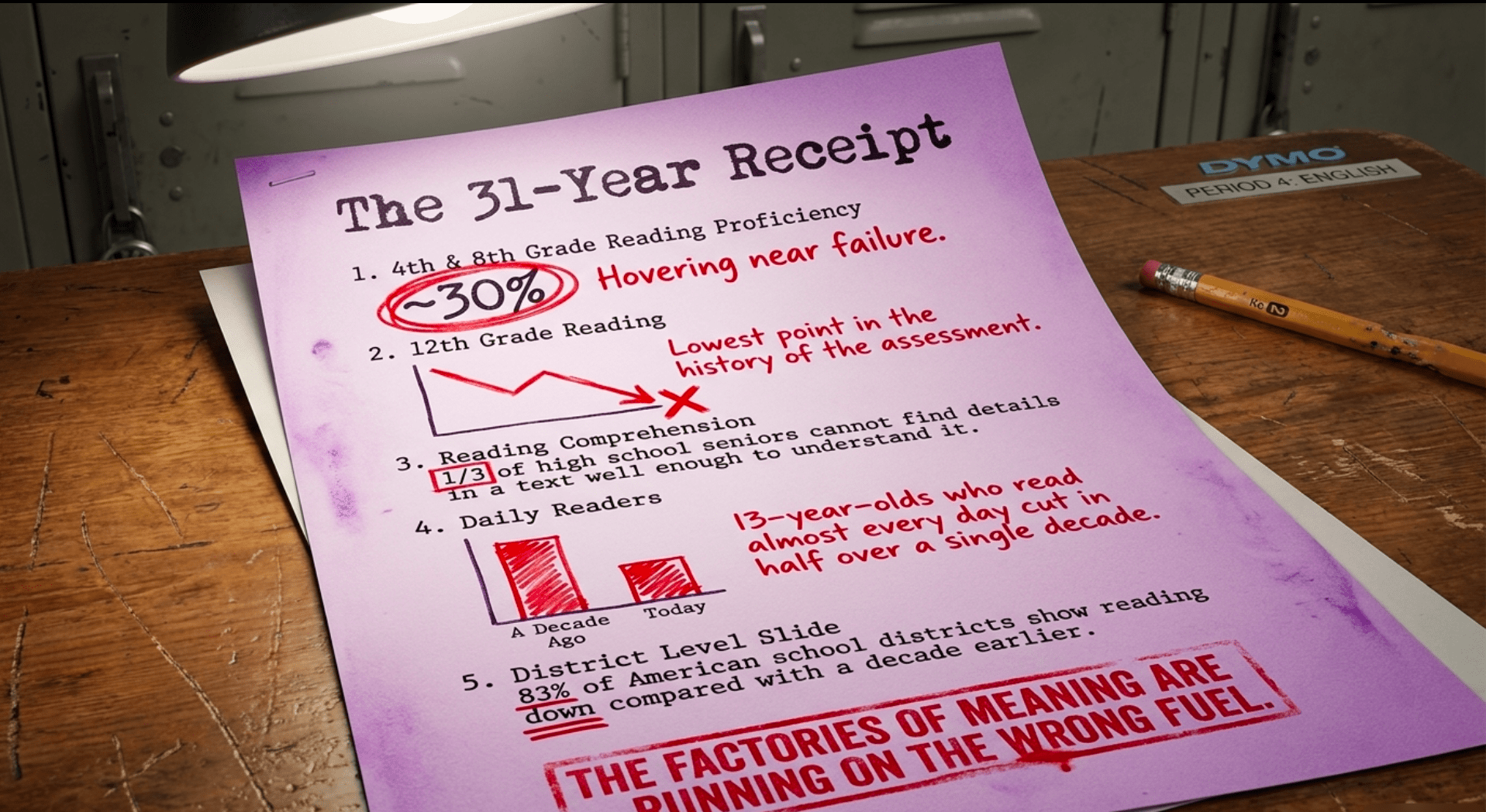
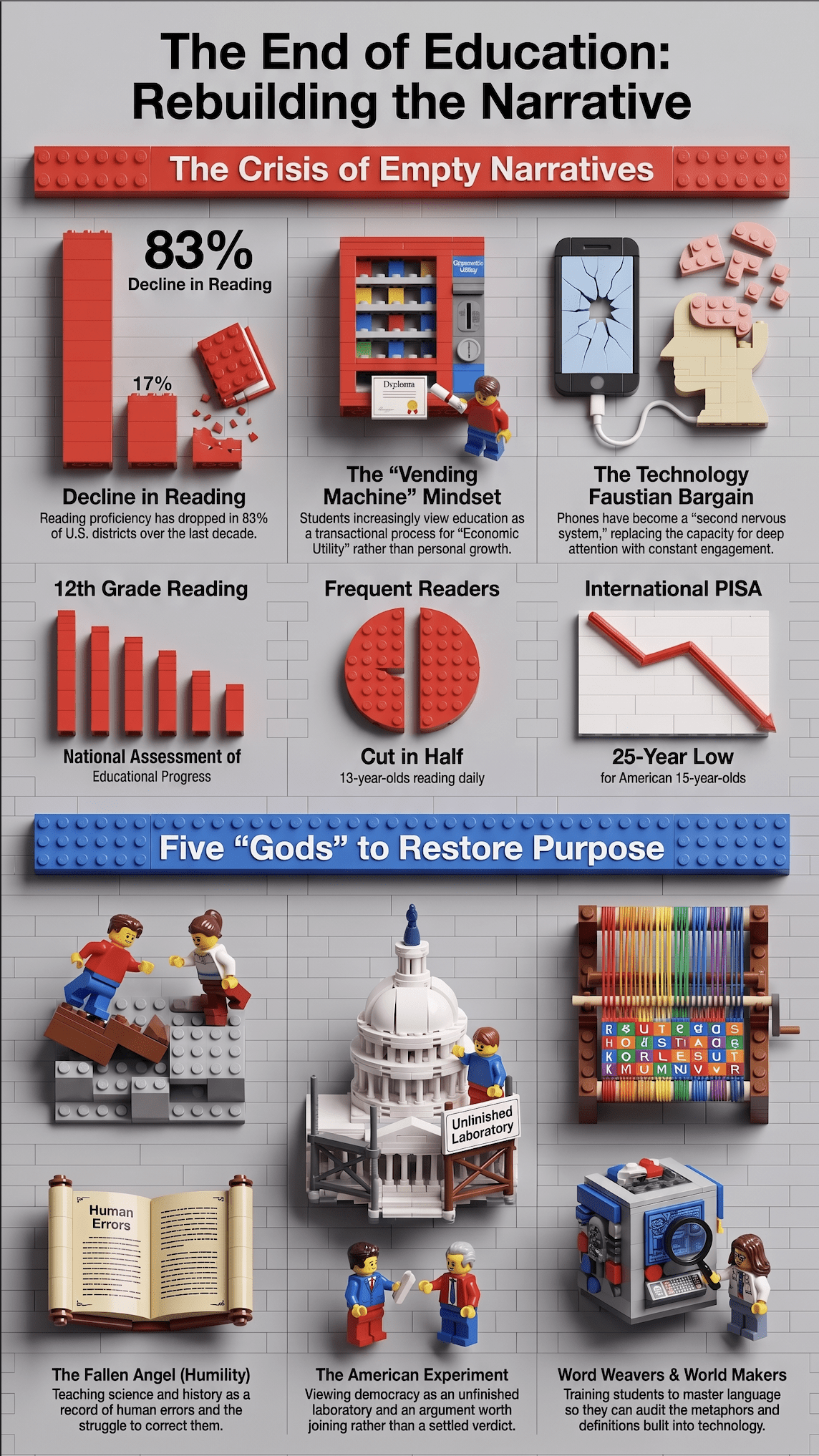
Look around. Fourth- and eighth-grade reading proficiency hovers near 30 percent. Twelfth-grade reading on the Nation’s Report Card is at its lowest point in the history of the assessment. A third of high-school seniors cannot find details in a text well enough to understand it. Elite college professors now report that incoming students cannot finish a book. Thirteen-year-olds who read almost every day have been cut in half in a decade. PISA reading scores for American 15-year-olds have fallen sharply and sit near a 25-year low. The “hasty reader”—the student who skims and guesses—has nearly doubled internationally.
This is not a pandemic blip. District-level data through 2025 show reading down in 83 percent of American school districts compared with a decade earlier. The slide began before lockdowns and continued after them. The lowest-performing students fell farthest. The gap widened. The factories of meaning kept running on the wrong fuel.
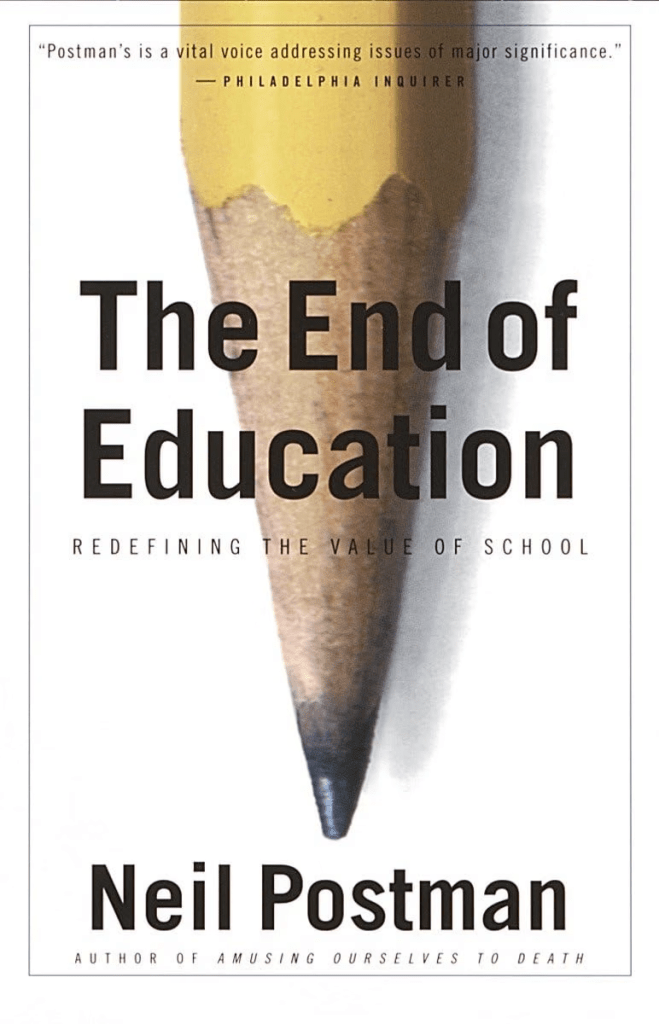
Postman saw the fuel. He named the gods. Then he named better ones. What follows is the book, chapter by chapter, and the receipt the last thirty years have handed us.
The Preface: Schooling Is Not Education
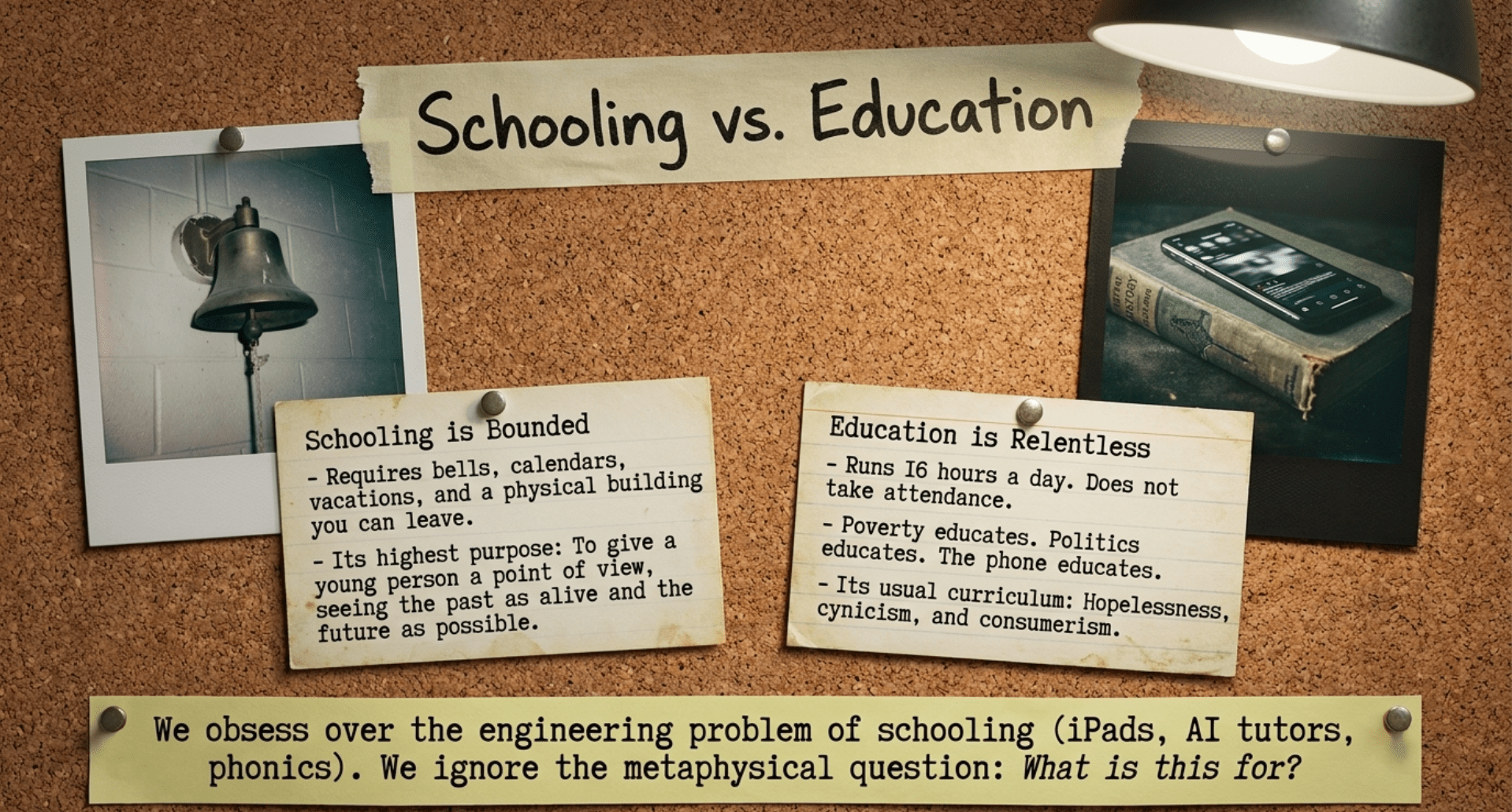
Postman opens by distinguishing two things Americans still confuse. Schooling is bounded: bells, calendars, vacations, a building you can leave. Education is relentless. Poverty educates. Politics educates. Television—now the phone—educates. Mostly they teach hopelessness, cynicism, and consumerism. Not always. But mostly.
Schooling, at its best, is the one institution that can give a young person a point of view: a way of seeing the past as still alive and the future as still possible. Most of the public argument, then and now, is about means. Computers. Standards. Choice. Phonics versus “balanced literacy.” One-to-one iPads. AI tutors. The engineering problem. Almost no one asks the metaphysical question: What is this for?
Postman’s title is a dare. If we never answer that question, schooling ends. If we do answer it with something worthy, school becomes the place a person learns how to keep educating himself for the rest of his life.
Chapter 1. The Necessity of Gods
There are two problems in educating the young. One is technical: how to teach. The other is metaphysical: why anyone should bother. The second is the one we refuse to discuss.
A god, in Postman’s usage, is a narrative with enough credibility, complexity, and symbolic power that a person can organize a life around it. Humans are the god-making species. We cannot live on information. We live on stories that tell us what the information is for. Science itself is such a story—an extension of older sacred narratives that promised order in the cosmos. Technology is science’s ambitious child. Democracy, the melting pot, the Protestant ethic of work as a form of dignity: these were American gods that once gave school a reason to exist that was larger than a paycheck.
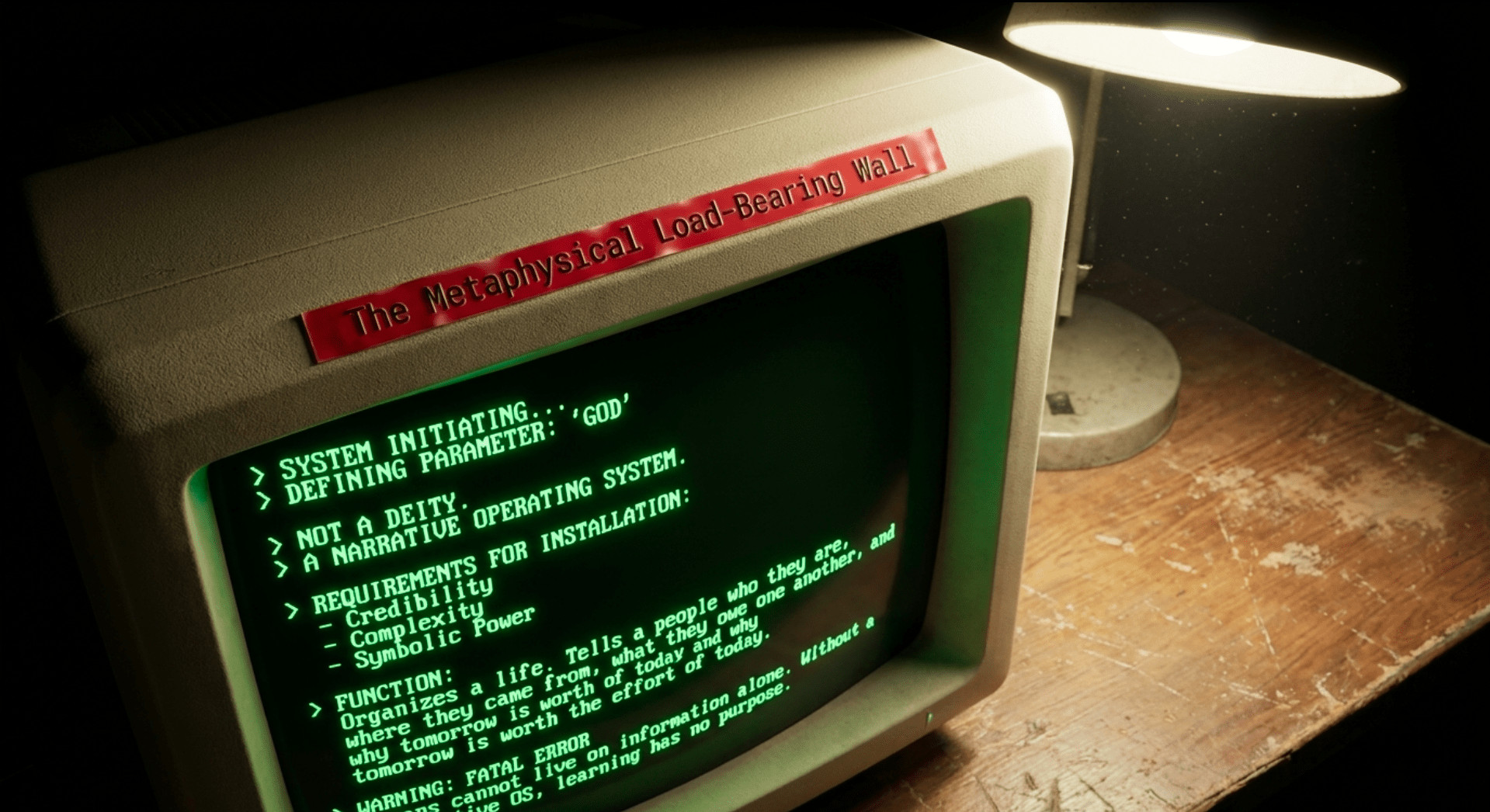
The engineering class of reformers treats purpose as a luxury. Postman treats it as the load-bearing wall. “There is no surer way to bring an end to schooling than for it to have no end.”
Today. Ask a high-school junior why he is there. You will hear college, a job, a credential, “so I can get out.” You will almost never hear a sentence about becoming a certain kind of person, joining a certain kind of people, or inheriting a certain kind of argument. The metaphysical question has been outsourced to TikTok, which is not a school and does not love the child.

Chapter 2. Some Gods That Fail
The twentieth century murdered gods and then failed to replace them. Darwin, Marx, Freud, Einstein: each, in different ways, wounded the old stories of origin, nation, reason, and innocence. The replacement gods—communism, fascism—ended in rubble. America’s own stories took damage. Democracy began to look like a spectator sport. The melting pot was blocked for some and then, later, denounced as violence. Hard work was uncoupled from meaning and recoupled to consumption. Symbols were emptied. Lincoln sells flights. The Statue of Liberty sells credit cards. When the sacred is used as advertising, the young notice. They conclude that nothing is serious.
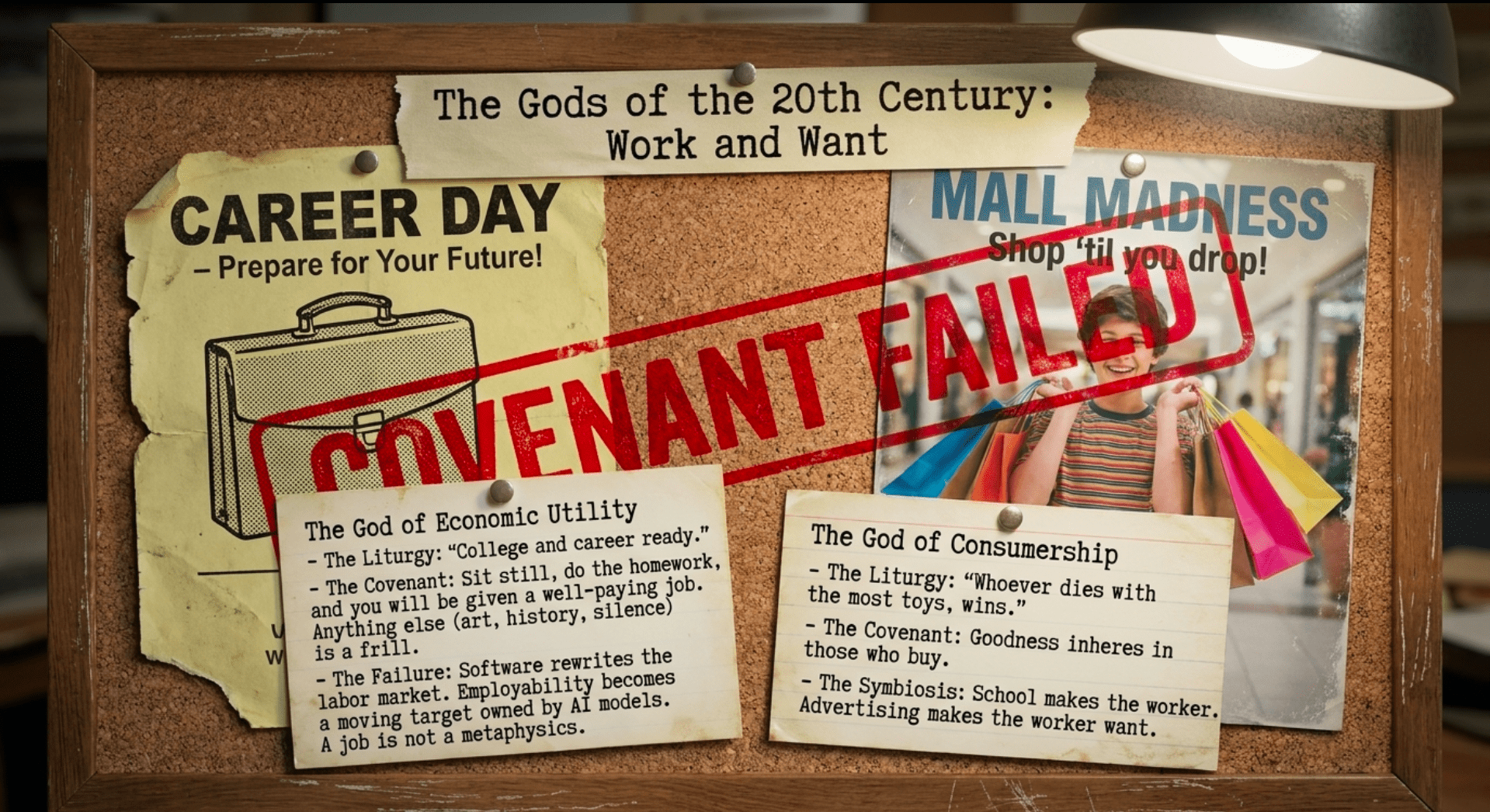
The god of Economic Utility stepped into the vacancy. Its covenant is simple and cold: sit still, do the homework, score well, and you will be given a well-paying job. Anything that does not serve that end is a frill. Art. History as argument rather than timeline. Silence. Wonder. The problem is not that people need jobs. The problem is that a job is not a metaphysics. When the job market later failed to honor the covenant—when graduates found themselves in work that did not require the schooling they endured—the god looked like a liar. Postman said this in 1995. The largest job growth even then was in lower-skill work. The covenant was already leaking.
Paired with Economic Utility is Consumership: “Whoever dies with the most toys, wins.” Goodness inheres in those who buy. The two gods need each other. School makes the worker. Advertising makes the worker want.
Today. “College and career ready” is the official liturgy of American K–12. Career and Technical Education is treated as the serious path. The liberal arts are treated as a lifestyle brand for the already rich. Meanwhile the actual labor market is being rewritten by software that does not care about your GPA. A generation was told the purpose of twelve years was employability. Then employability itself began to look like a moving target owned by models. The god did not just fail. It made the failure feel like the student’s fault.
Chapter 3. Some New Gods That Fail
Two newer gods arrive with more energy than the old ones: Technology and Tribalism.
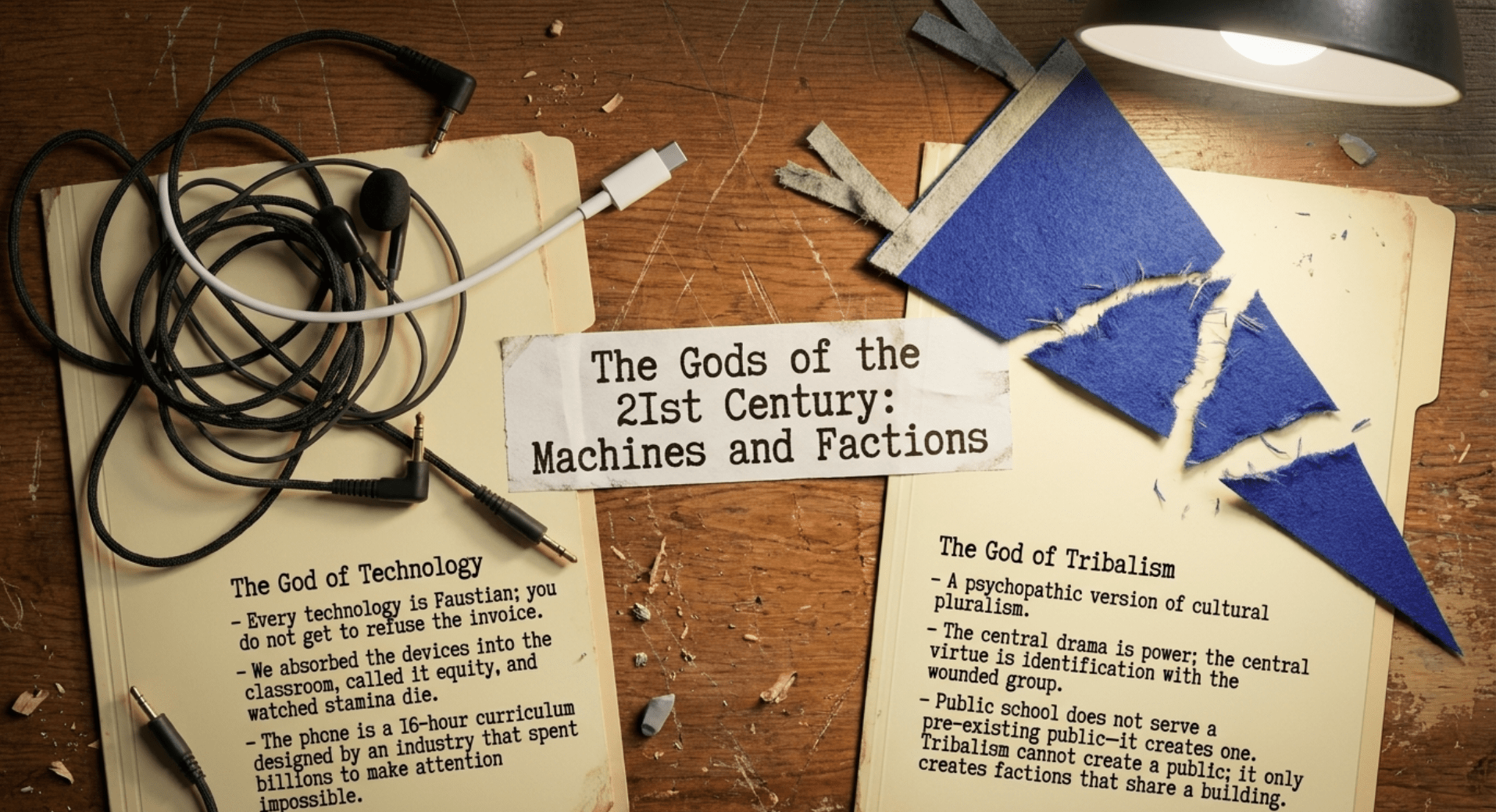
Technology is worshipped with religious intensity. It works. It promises. It inspires awe. Educators in the mid-1990s were already writing utopias: the child at home on the “information superhighway,” the school building as an obsolete warehouse. Postman was not a Luddite. He was a bargainer. Every technology is Faustian. You gain something. You lose something. You do not get to refuse the invoice. Radio was going to replace the teacher. Film was going to replace the teacher. Television was going to replace the teacher. Each time the classroom absorbed the machine and kept its emptiness. Technology does not care about the school’s oldest function: forming a public that can stand in a room together and become something larger than a collection of private appetites.
The other new god is tribal multiculturalism—not cultural pluralism, which Postman respected, but the version that makes ethnicity the exclusive lens, that locates evil in Europe and innocence in its victims, that teaches the young to love the tribe first and the common story last. Public school, he insisted, does not serve a public. It creates one. That requires shared gods and the exclusion of narratives whose purpose is alienation. “The idea of a public school is not to make Blacks Black, or Koreans Korean, or Italians Italian but to make Americans.” The hyphenated identity is what the child brings through the door. The school’s job is to make the hyphen less sharp, not to chisel it deeper. The opposite path is the balkanization of the school and then of the mind.
Today. The technology god did not stay in the computer lab. It became the child’s other nervous system. The phone is not a tool in the pocket. It is the curriculum that runs sixteen hours a day and does not take attendance. Classrooms that once fought for attention now compete with an industry that spent hundreds of billions of dollars to make attention impossible. Schools bought the devices, called it equity, and then wondered why stamina died.
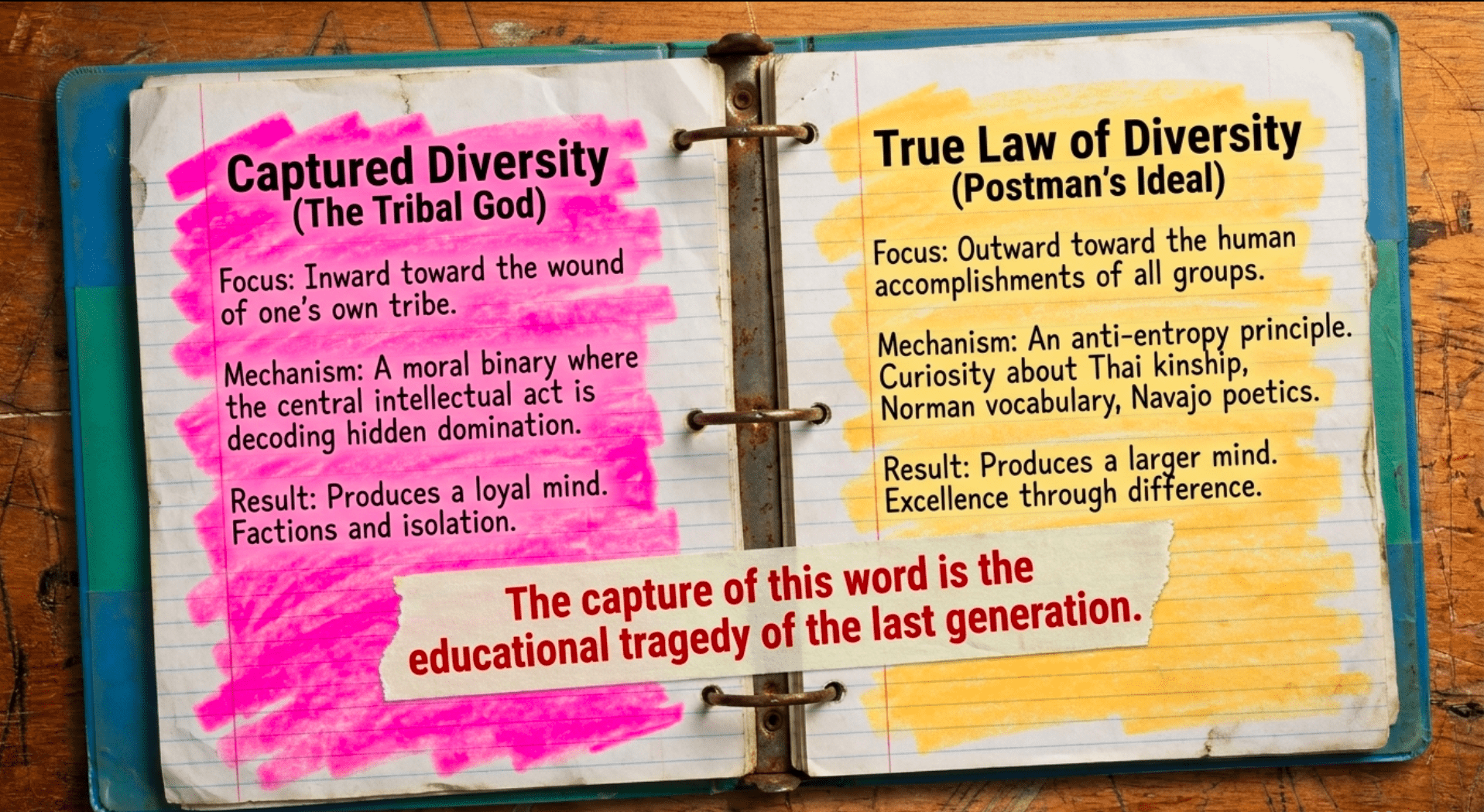
The tribal god did not stay in ethnic studies electives. It became the moral operating system of many districts and nearly all prestige universities: a story in which the central drama is power, the central virtue is identification with the wounded group, and the central intellectual act is decoding hidden domination. That is a narrative. It is simply not a public one. It cannot create a public. It can only create factions that share a building.
Postman warned that this version of multiculturalism is “a psychopathic version of cultural pluralism, and, of course, extremely dangerous.” He was called names for saying so. The subsequent thirty years of campus speech codes, DEI bureaucracies, and curriculum wars did not prove him wrong. They illustrated him.
Chapter 4. Gods That May Serve
After the demolition, Postman does something rare for a critic. He builds. Schools do not invent the culture’s stories, he says. They amplify the ones a society is already willing to live by. If the current stories lead to privatization of the school and privatization of the mind, we need better ones. He offers five, not as dogma, but as candidates with enough moral voltage to make a young person sit up.
They are:
- Spaceship Earth
- The Fallen Angel
- The American Experiment
- The Law of Diversity
- The Word Weavers / The World Makers
The rest of the book is the syllabus.
Chapter 5. The Spaceship Earth
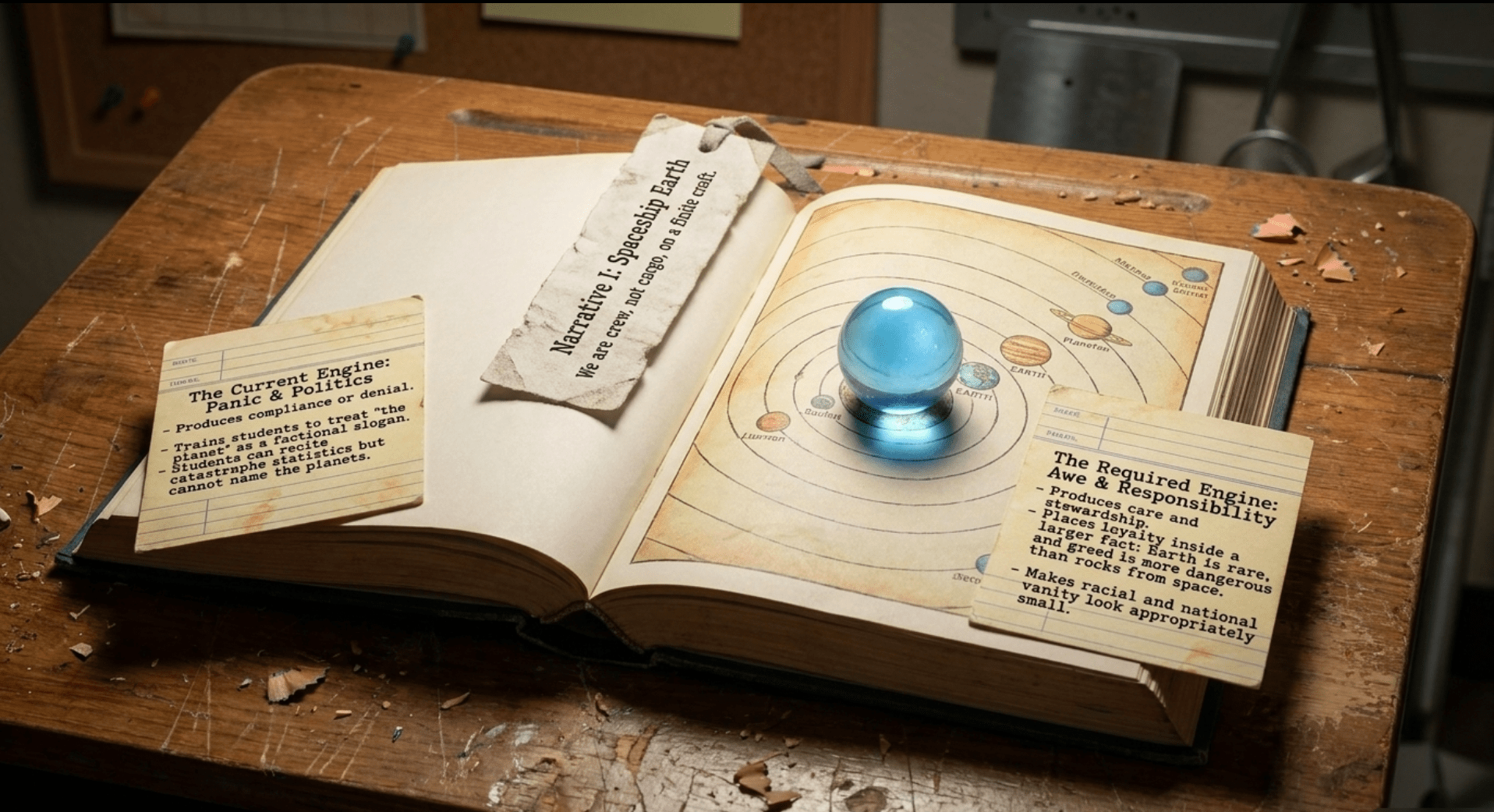
The first serving god is ecological in the oldest sense: we are crew, not cargo, on a finite craft. If any part of the ship is poisoned, all suffer. Nationalism-as-superiority becomes a kind of mutiny. The point is not to abolish loyalty. It is to place loyalty inside a larger fact. Astronomy, taught historically—Aristotle’s errors, Ptolemy’s beauty and wrongness, Bruno burned, Galileo silenced, the comet that struck Jupiter in 1994—becomes a humanistic subject. You learn that knowledge is a struggle, that Earth is rare, and that greed and indifference are more dangerous than rocks from space. Foreign language and comparative religion belong here too: other windows on the same ship.
Today. Climate education often arrives as panic or as politics. Postman wanted awe and responsibility. Those are different engines. Panic produces compliance or denial. Awe produces care. The distinction matters in an age when the same students who can recite catastrophe statistics cannot name the planets, have never stood in the dark long enough to feel the size of the sky, and have been trained to treat “the planet” as a factional slogan rather than a shared vessel. Spaceship Earth, done honestly, would make certain kinds of racial and national vanity look small—which is precisely why the tribal god cannot tolerate it.
Chapter 6. The Fallen Angel
The second god is humility as a method. Human beings are error-making creatures. Our glory is not that we know. It is that we can find out we were wrong and change. Science is the moral practice of that idea. Dogmatism—Nazi, communist, or textbook—is the refusal of it. Postman wants teachers who switch subjects so they remember what confusion feels like. He wants fewer textbooks, which he calls instruments of dogmatism. He wants students graded, in part, on their ability to catch the teacher’s errors. He wants exams that ask: name five major mistakes your field has made, and one you currently suspect you are making. The purpose of education becomes defense against “the seductions of eloquence.” Teachers stop trying to make students smart and start trying to make them less dumb.
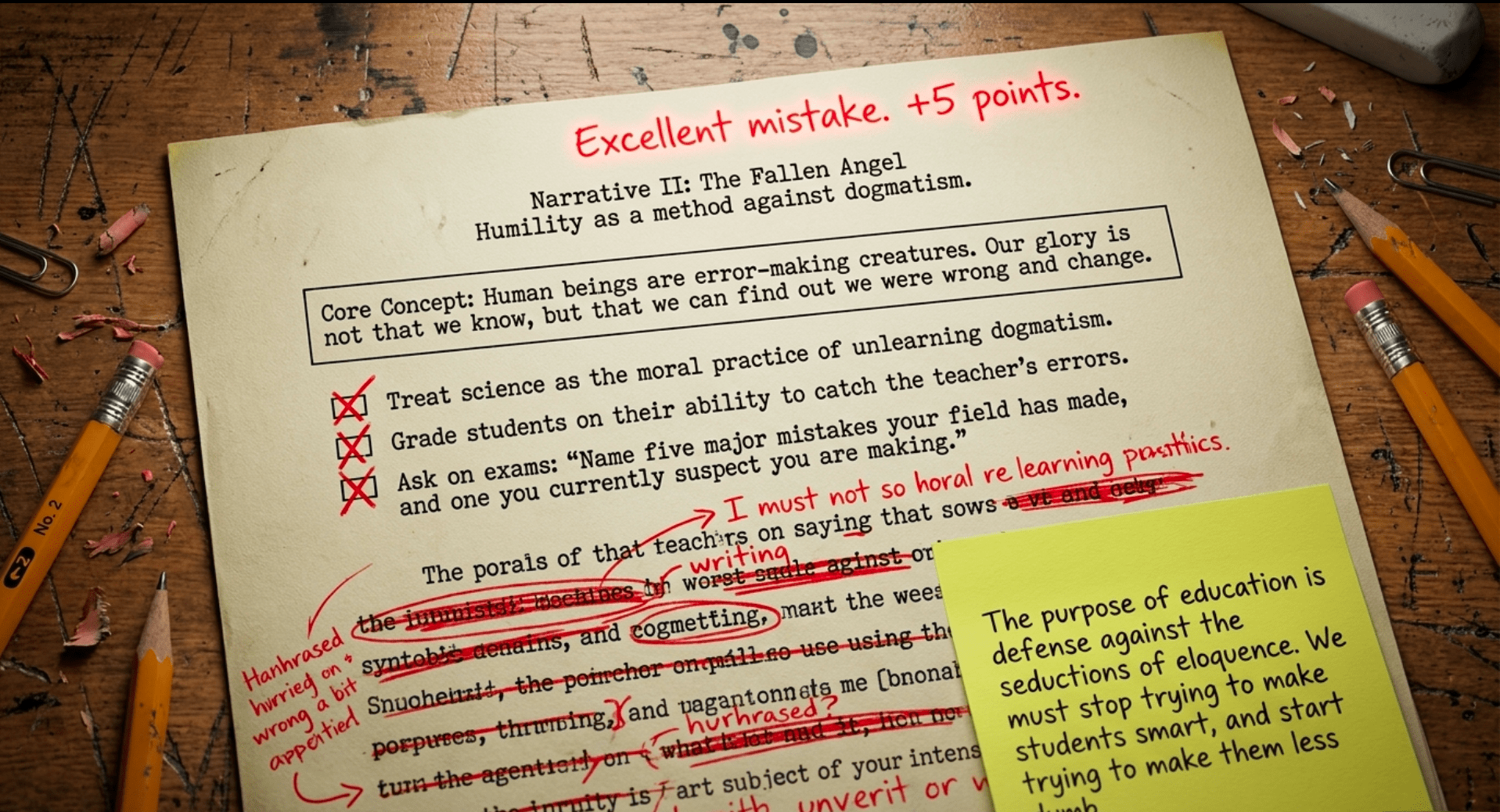
Today. We built the opposite classroom. Certainty is rewarded. Complexity is treated as violence. Whole-language reading theory persisted for years after the evidence said it failed, because the theory was a moral story about children, not a hypothesis about print. College students outsource the paper to a model and then cannot tell you where the argument bends. Social media is a factory for unfalsifiable identity claims. The Fallen Angel is the narrative that would have taught a generation to hold a belief with a loose hand. We taught them to hold a belief like a weapon.
Chapter 7. The American Experiment
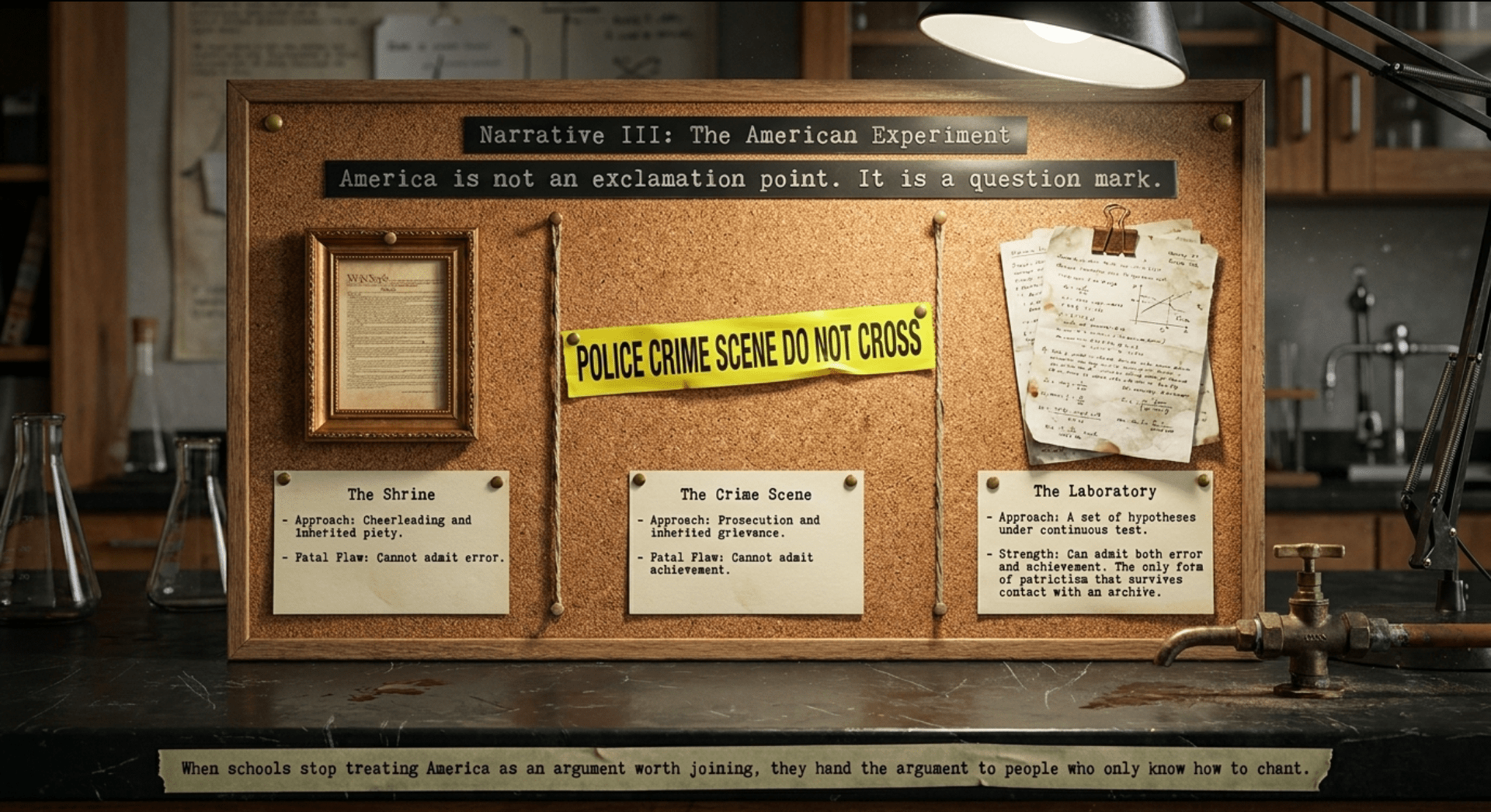
America, Postman says, is not an exclamation point. It is a question mark. The founding is a set of hypotheses under continuous test: Can a people govern themselves by argument rather than blood? Can many tribes inhabit one civic story? Can public education create a public? Can a technological society keep its soul? The documents are not relics. They are lab notes. Lincoln–Douglas is not a costume drama. It is the demonstration that adults once expected other adults to follow a three-hour argument. The school’s job is to induct the young into that experiment so they can extend it, not so they can denounce it from a position of inherited grievance or inherited piety.
Today. Civics collapsed into either cheerleading or prosecution. One side wants a shrine. The other wants a crime scene. Postman wanted a laboratory. The difference is everything. A shrine cannot admit error. A crime scene cannot admit achievement. A laboratory can do both, which is why it is the only form of patriotism that survives contact with an archive. When schools stopped treating America as an argument worth joining, they handed the argument to people who only know how to chant.
Chapter 8. The Law of Diversity
Diversity, properly understood, is not a demographic quota and not a therapy for self-esteem. It is an anti-entropy principle. Sameness is the enemy of vitality. English is the most multicultural language on Earth because it absorbed everyone and kept moving. The point of studying other languages, religions, customs, and arts is to turn outward—toward the accomplishments of all groups—not inward toward the wound of one’s own. Ethnic pride looks at the tribe. Diversity looks at the human. Postman is explicit: if everything is seen through ethnicity, isolation and hostility follow. Standards do not die under real diversity. They grow. Relativism is not the law of diversity. Excellence through difference is.
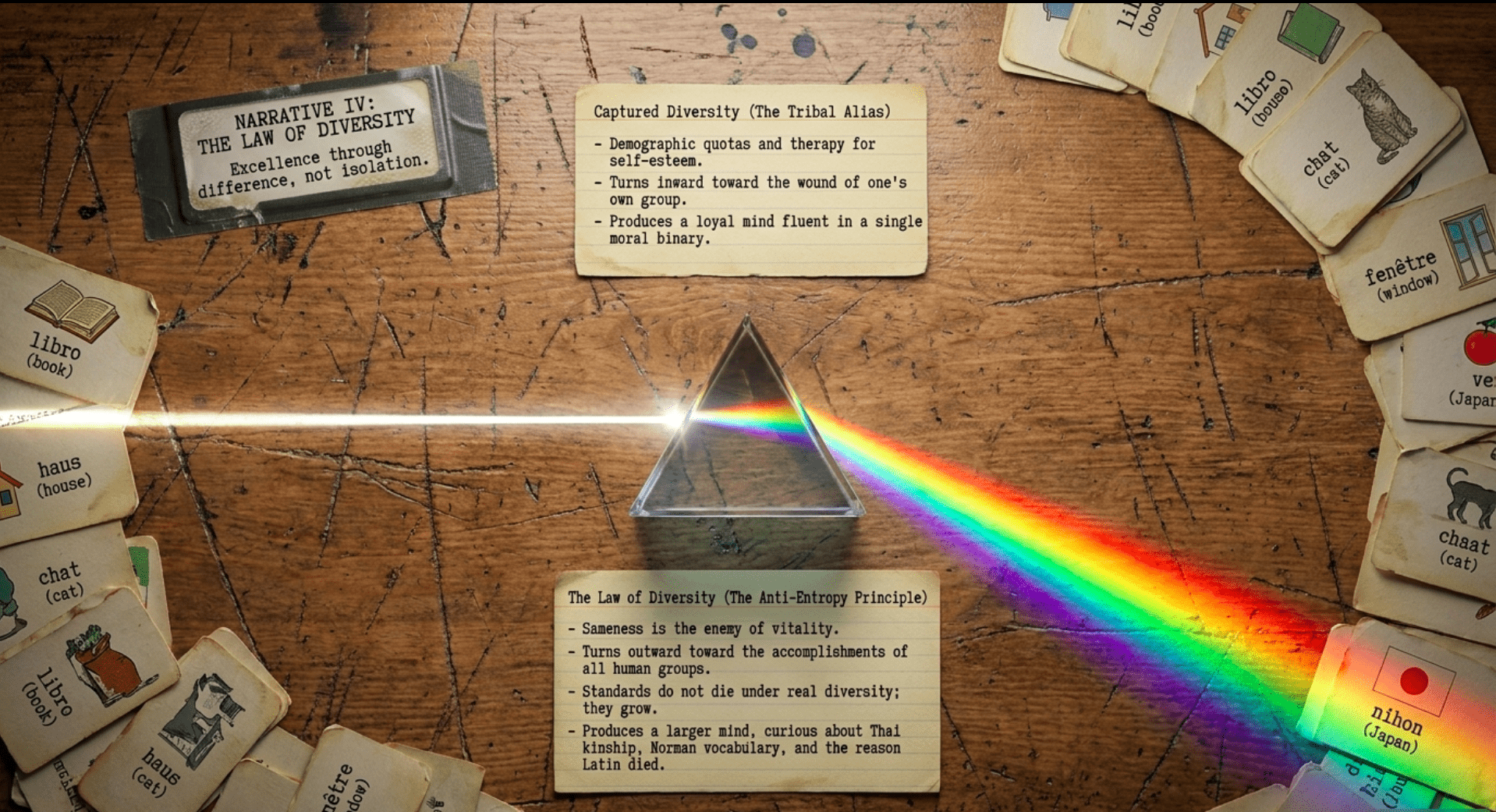
Today. The word “diversity” was captured by the tribal god and used as its alias. That capture is the educational tragedy of the last generation. A Law of Diversity classroom would make a student curious about Thai kinship, Norman legal vocabulary, Navajo poetics, and the reason Latin died. A captured-diversity classroom makes the student fluent in a single moral binary and calls the fluency justice. One produces a larger mind. The other produces a loyal one.
Chapter 9. The Word Weavers / The World Makers
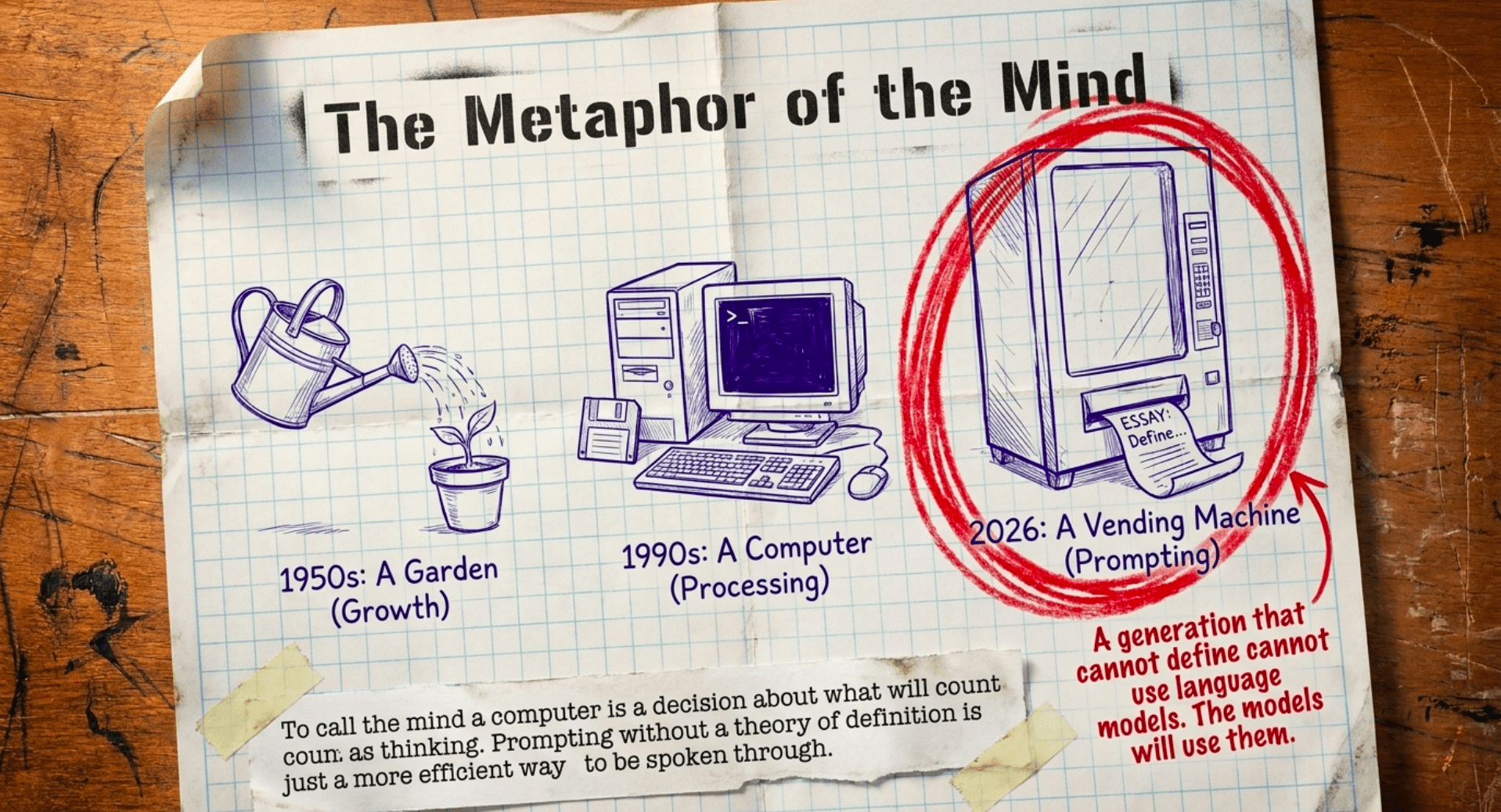
The last god is language itself. In the beginning was the word, and in the end as well. Definitions are not labels on pre-existing things. They are instruments for doing work. Questions are the origin of knowledge. Metaphors are organs of perception, not decorations. To call the mind a computer is not a description. It is a decision about what will count as thinking. To call a student a “learner” or a “product” or a “change agent” is to build a world and then force a child to live in it.
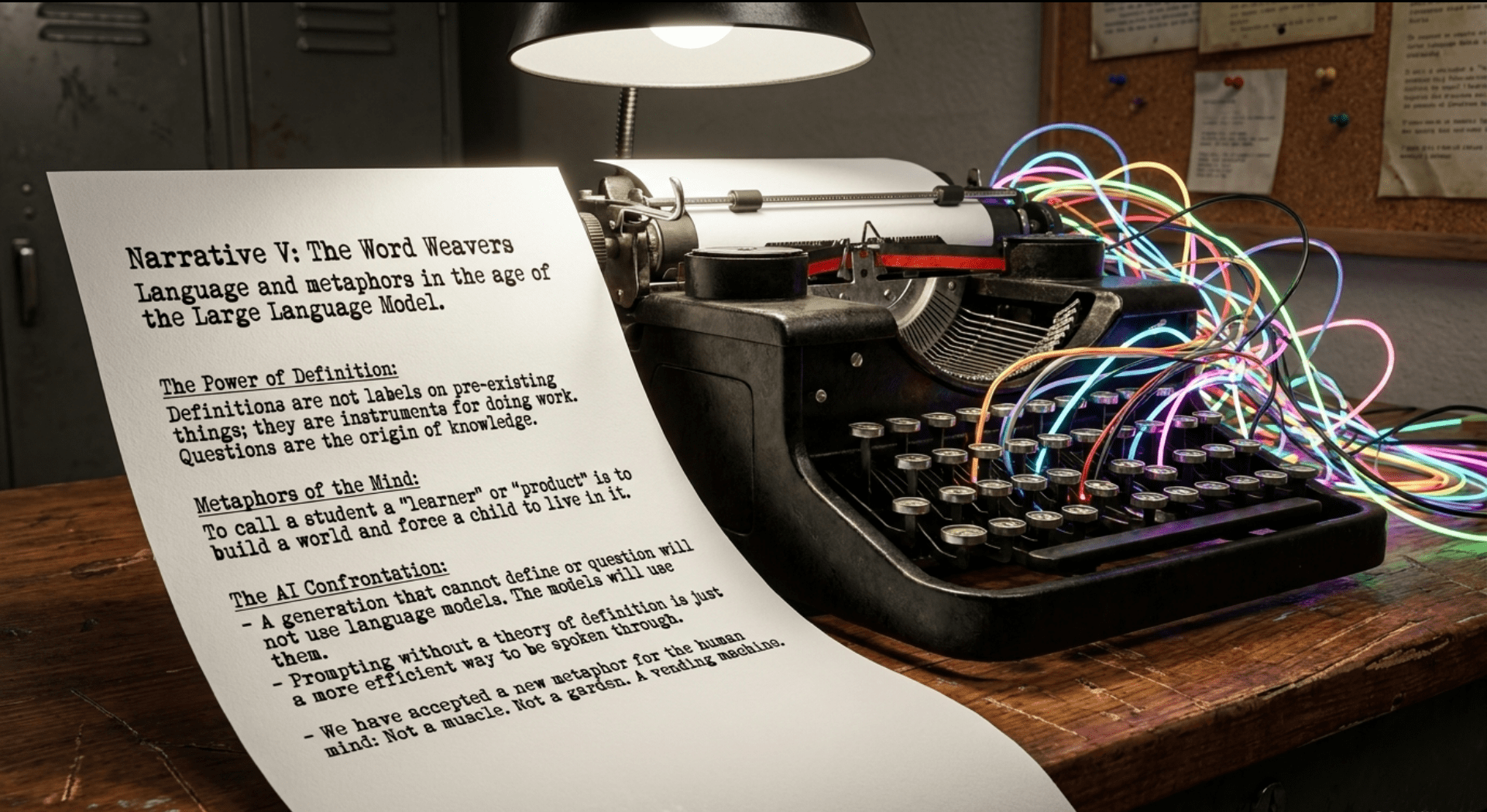
Postman wanted schools to teach the technology of language the way a serious culture teaches fire: with respect. He wanted technology education as a branch of the humanities—ten principles, beginning with the Faustian bargain and the fact that technological change is ecological, not additive. You do not add a phone to a childhood. You get a different childhood.
Today. This is the chapter the AI age makes unavoidable. A generation that cannot define, cannot question, and cannot see its metaphors will not use language models. The models will use them. Prompting without a theory of definition is just a more efficient way to be spoken through. The students who cannot read a book cannot audit a summary. The students who think “research” means the first paragraph of a chat window have already accepted a new metaphor of the mind: not a muscle, not a garden, not even a computer. A vending machine.
Postman died in 2003. He never saw the feed. He never saw the model. He saw the pattern. The medium is never neutral. The god of Technology always claims it is only a tool. It is never only a tool.
The Epilogue: Childhood, the Public, and the School
Postman admits the book can be read as pessimism. He refuses the reading. His faith, thin but real, rests on three bets: that school will endure because no one has invented a better way to introduce the young to learning; that the public school will endure because no one has invented a better way to create a public; and that childhood will endure because without it we lose the meaning of adulthood.
He already saw the handwriting. Children bringing weapons. The rise of the single-parent home. The sexualization of the young. The school as warehouse. He offered the five narratives anyway, “in good faith, if not as much confidence as one would wish.”
The bets look worse in 2026. Childhood is the first institution the phone dissolved. Adulthood was supposed to be the state you entered when you could delay gratification, keep a secret, follow an argument, and sit with a difficulty that did not resolve in fifteen seconds. That state is now optional. The public is a set of mutually unintelligible feeds. The school is still there. It is just no longer sure it is allowed to create anyone in particular.
How We Were Brought Down
The mechanism was not a conspiracy. It was a succession of smaller surrenders that Postman named in advance.
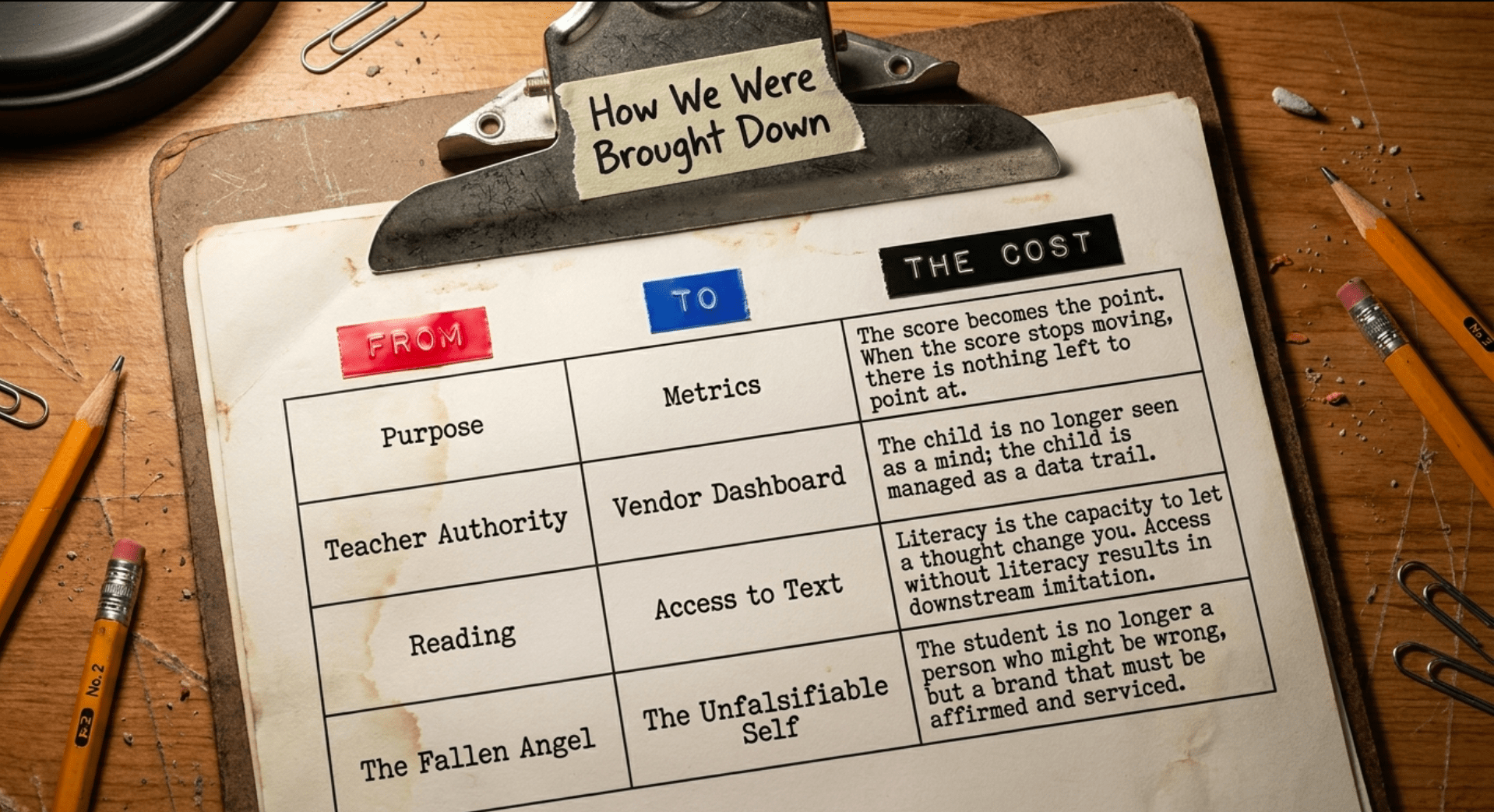
We replaced purpose with metrics. Once the point of school is a score, the score becomes the point. Then the score stops moving, and there is nothing left to point at.
We replaced the teacher’s authority with the vendor’s dashboard. First the television. Then the computer. Then the one-to-one device. Then the adaptive platform. Then the chatbot. Each time we were told the child would finally be seen. Each time the child was seen as a data trail.
We replaced the common story with the tribal story and called it inclusion. A public school that cannot say “we” without a footnote cannot hold. It can only sort.
We replaced reading with access to text. Access is not literacy. Literacy is the trained capacity to stay inside a thought long enough for the thought to change you. That capacity is biological, cultural, and moral. It is also the one skill every subsequent skill assumes. When it goes, everything downstream becomes imitation.
We replaced the Fallen Angel with the Unfalsifiable Self. The student is no longer a person who might be wrong. The student is a brand that must be affirmed. You cannot educate a brand. You can only service it.
And we accepted, against every historical base rate, that a new machine would do the forming for us. Radio would. Film would. Television would. The personal computer would. The iPad would. The large language model will. Postman’s entire career is the demonstration that the machine is very good at giving you a feeling of education and very bad at giving you the thing.
The result is not that children know nothing. They know a torrent. They cannot place the torrent in a story that makes the next hour of effort feel like a human act rather than a compliance drill. That is the end of education in the first sense. The second sense follows as a courtesy.
What Would Serve
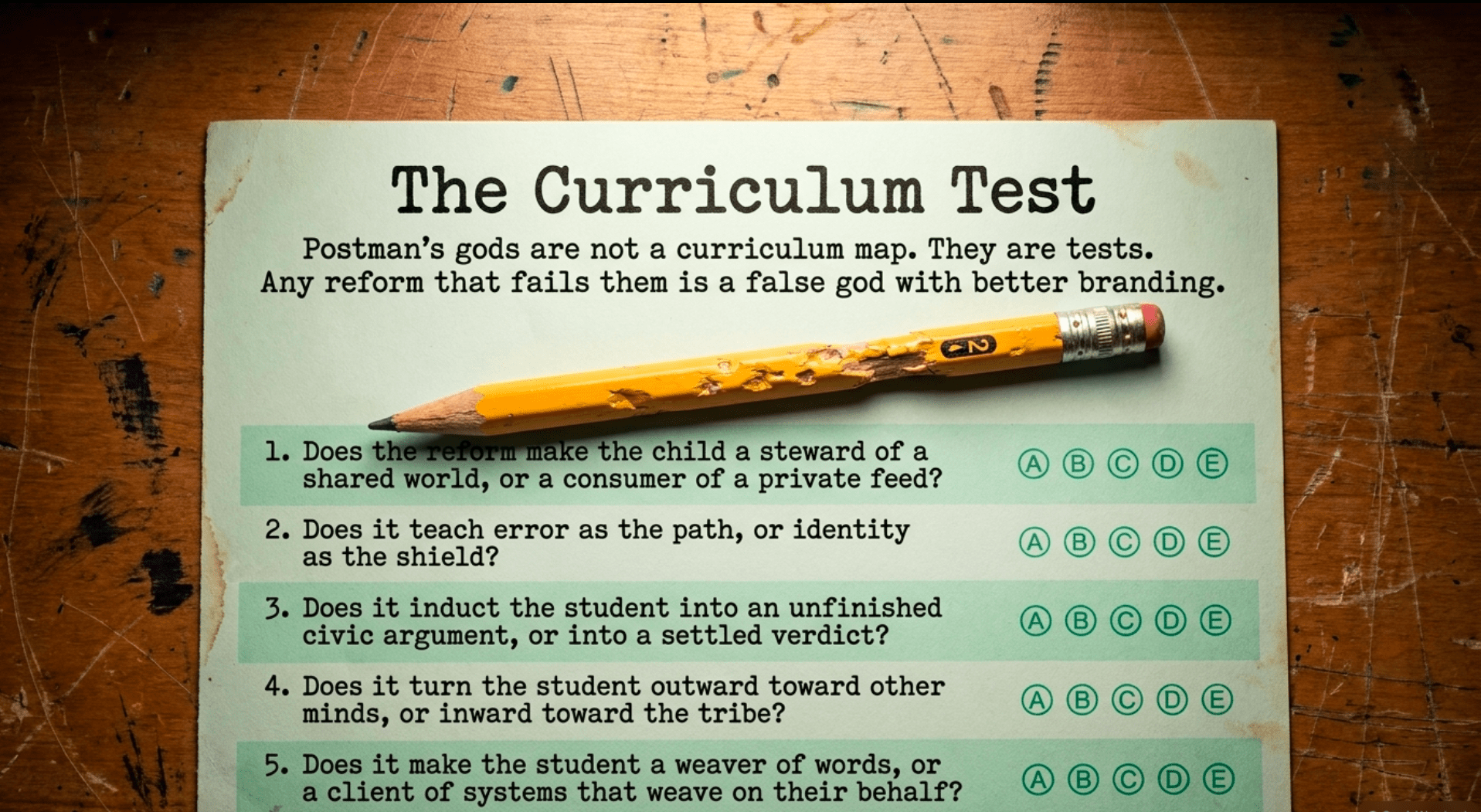
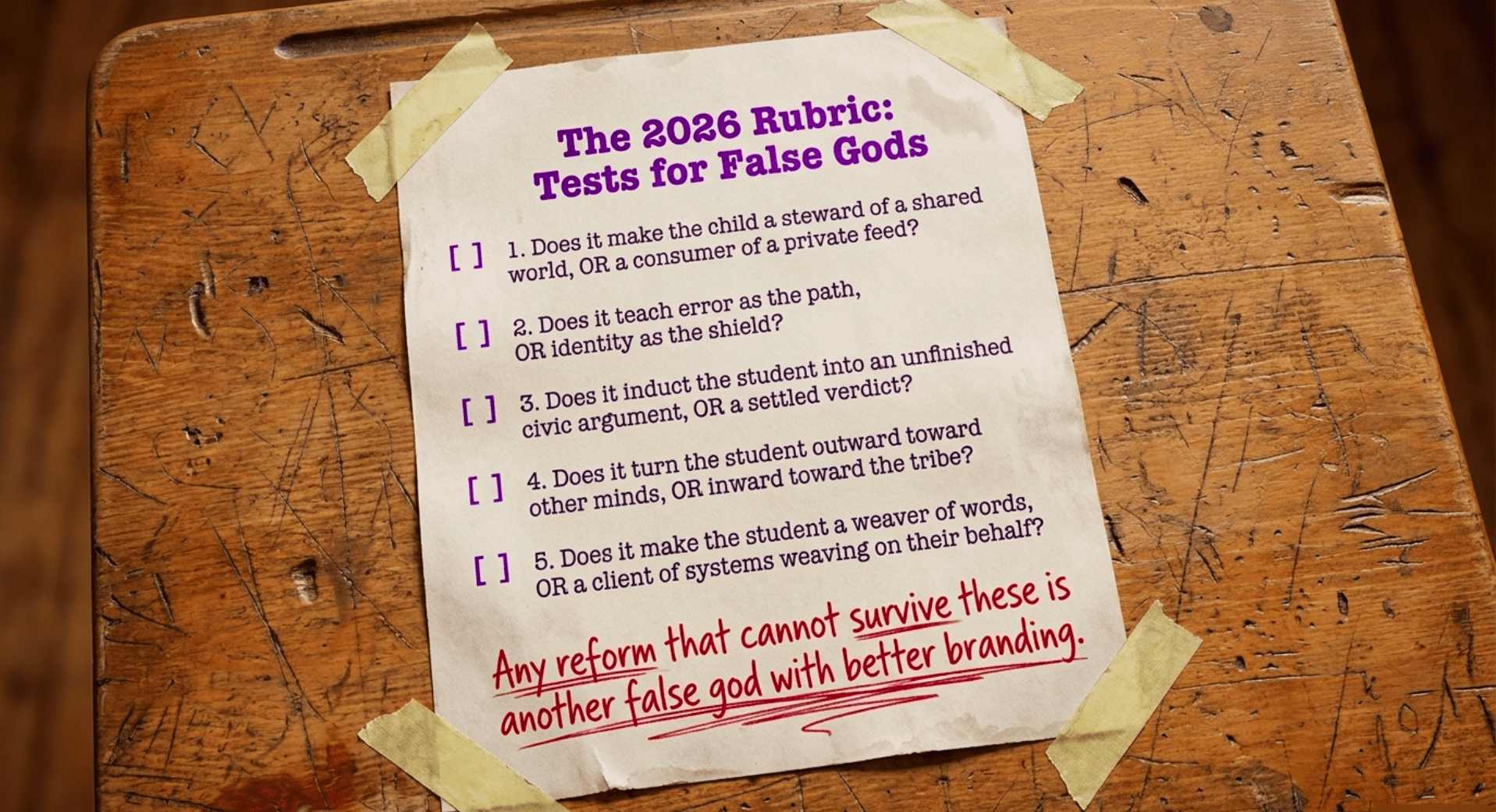
Postman’s five gods are not a curriculum map you tape to a wall. They are tests. Any reform that cannot survive them is another false god with better branding.
Does the reform make the child a steward of a shared world, or a consumer of a private feed?
Does it teach error as the path, or identity as the shield?
Does it induct the student into an unfinished civic argument, or into a settled verdict?
Does it turn the student outward toward other minds, or inward toward the tribe?
Does it make the student a weaver of words—hence a maker of worlds—or a client of systems that weave on his behalf?
A school that passed those tests would look strange in 2026. Phones would not be in the room. Books would be long. History would be argument. Science would be a record of magnificent mistakes. Language would be studied as power. America would be taught as a hypothesis the students are invited to keep testing. Diversity would mean the English language, comparative religion, and the reason some traditions died. Teachers would be allowed to be wrong in public so that students could learn what correction looks like.
None of that requires nostalgia. It requires nerve.
Neil Postman left us with a warning that rings louder today than it did in 1995. If we stubbornly choose to have no story, if we are too polite or too cowardly or too distracted to answer the metaphysical question of purpose, the choice won’t just remain blank. the choice will be made for us by the loudest god in the room and the loudest god in the room right now is certainly not a human teacher it really isn’t so i want to leave you with this one thought to mull over the next time you walk past a high school or the next time you watch a child staring blankly into the glow of a screen sliding their thumb up every three seconds ask yourself the only question that truly matters anymore when those screens finally go dark and the wi-fi cuts out what exactly is the story left in the room? If you can’t answer it, who or what is currently writing it for you?
The Multiplex position is not that 1950 should return. It is that a civilization that cannot tell its young why they should become more than their appetites will be replaced by systems that are very good at appetites. The systems are already here. They are patient. They do not need a narrative. They need engagement.
Postman thought school was the last serious place a democracy could still choose its story. He was not sure we would choose well. He was sure that if we chose nothing, the choice would be made for us by the loudest god in the room.
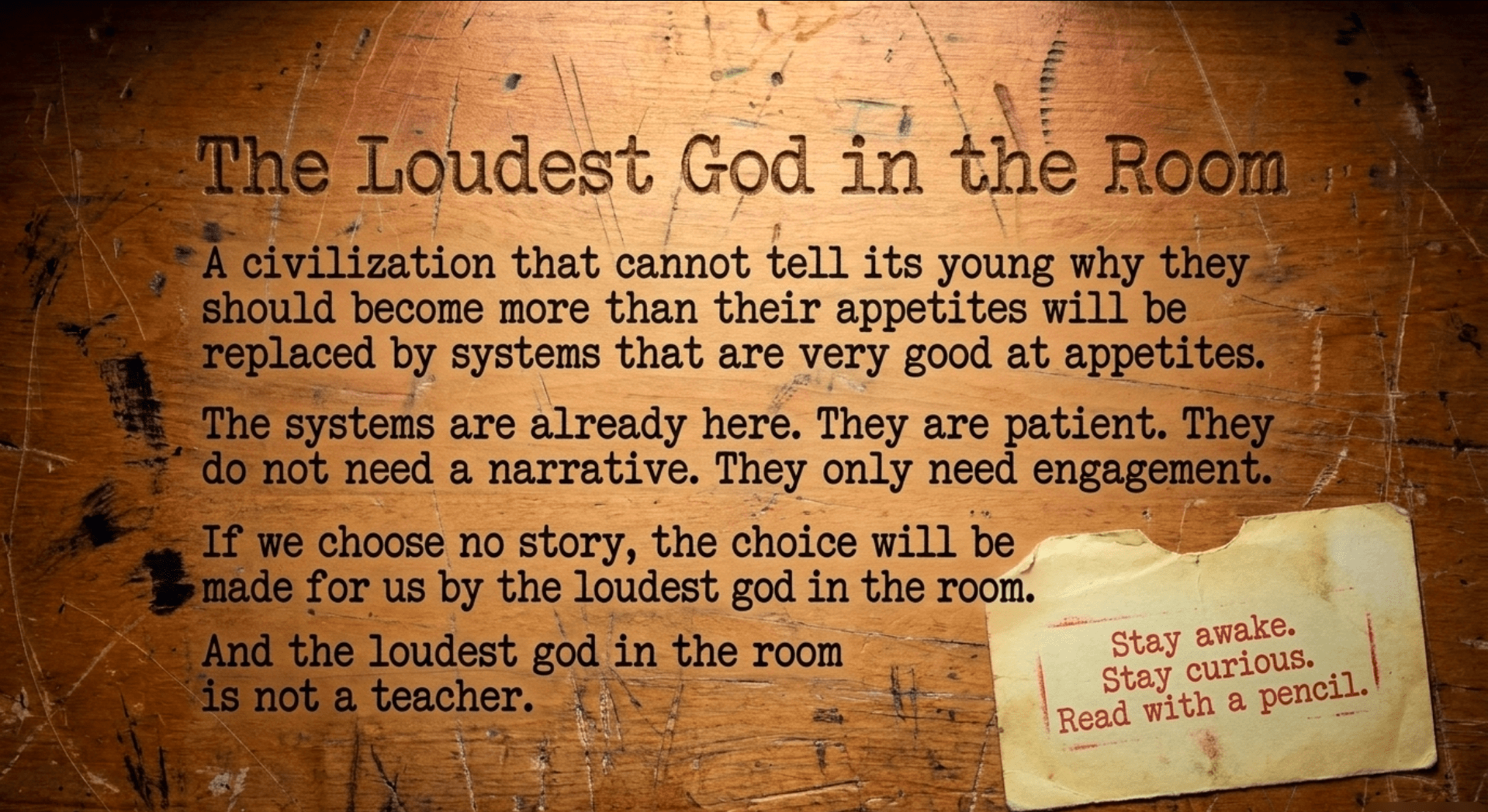
The loudest god in the room is not a teacher.
Stay aware. Stay curious. Read the book with a pencil. Then look at a classroom—any classroom—and ask the only question the book exists to force:
Support This Work, You Will See It No Place Else
To continue this vital work documenting, analyzing, and sharing these hard-won lessons before we launch humanity’s greatest leap: I need your support. Independent research like this relies entirely on readers who believe in preparing wisely for our multi-planetary future. If this has ignited your imagination about what is possible, please consider donating at buy me a Coffee or becoming a member. Value for value you recieved here.
Every contribution helps sustain deeper fieldwork, upcoming articles, and the broader mission of translating my work to practical applications. Ain ‘t no large AI company supporting me, but you are, even if you just read this far. For this, I thank you.
Stay aware and stay curious,
🔐 Start: Exclusive Member-Only Content.
Membership status:
🔐 End: Exclusive Member-Only Content.
~—~

~—~

~—~
Subscribe ($99) or donate by Bitcoin.
Copy address: bc1qkufy0r5nttm6urw9vnm08sxval0h0r3xlf4v4x
Send your receipt to [email protected] to confirm subscription.

Stay updated: Get an email when we post new articles:

THE ENTIRETY OF THIS SITE IS UNDER COPYRIGHT. IMPORTANT: Any reproduction, copying, or redistribution, in whole or in part, is prohibited without written permission from the publisher. Information contained herein is obtained from sources believed to be reliable, but its accuracy cannot be guaranteed. We are not financial advisors, nor do we give personalized financial advice. The opinions expressed herein are those of the publisher and are subject to change without notice. It may become outdated, and there is no obligation to update any such information. Recommendations should be made only after consulting with your advisor and only after reviewing the prospectus or financial statements of any company in question. You shouldn’t make any decision based solely on what you read here. Postings here are intended for informational purposes only. The information provided here is not intended to be a substitute for professional medical advice, diagnosis, or treatment. Always seek the advice of your physician or other qualified healthcare provider with any questions you may have regarding a medical condition. Information here does not endorse any specific tests, products, procedures, opinions, or other information that may be mentioned on this site. Reliance on any information provided, employees, others appearing on this site at the invitation of this site, or other visitors to this site is solely at your own risk.
Copyright Notice:
All content on this website, including text, images, graphics, and other media, is the property of Read Multiplex or its respective owners and is protected by international copyright laws. We make every effort to ensure that all content used on this website is either original or used with proper permission and attribution when available.
However, if you believe that any content on this website infringes upon your copyright, please contact us immediately using our 'Reach Out' link in the menu. We will promptly remove any infringing material upon verification of your claim. Please note that we are not responsible for any copyright infringement that may occur as a result of user-generated content or third-party links on this website. Thank you for respecting our intellectual property rights.
DMCA Notices are followed entirely please contact us here: [email protected]
