
You Have 5000 Days: Navigating the End of Work as We Know It. Part 35: Atom by Atom AI Built Nano Fabrication—Confirmed!
Oak Ridge National Laboratory just taught an AI to assemble functional matter. Within 25 years we will not hunt materials. We will write them. This is the last lock on the Age of Abundance—and the final blow to central control.
Twenty-five days ago, in You Have 5000 Days: Navigating the End of Work as We Know It. Part 34: The Journey So Far, I stopped to look backward. What began on Christmas Eve 2025 as an attempt to name the passage we are living through had become, installment by installment, something else: preparation. We mapped the Abundance Interregnum—that roughly thirteen-and-a-half-year corridor between the collapsing logic of work-to-survive and the still-forming logic of voluntary creation in plenty. We treated Joseph Campbell’s Hero’s Journey as a working map, not a literary flourish. And I said the series was turning from topography to terrain: the specific discoveries already unfolding between 2026 and 2030 that let ordinary people own and direct the means of production.
This is one of those discoveries. Telling Matter What To Be
Oak Ridge National Laboratory has now shown that an artificial intelligence can see individual molecules, decide how to move them, and build a working material atom by atom—then keep doing it for more than twenty-five hours without a human hand on the controls. They assembled an artificial graphene lattice from thirty-seven molecules, recovered the Dirac point that proves the electrons obeyed the design, and even spelled ORNL in matter. In 2012 I was told a talk on nanofabrication replicators should be disqualified because nothing like this would arrive before 2030, if ever. The expert is gone. The lattice is here. We will not spend the rest of the Interregnum hunting materials. We will write them.
Part 34 argued that the revelations arriving now—new chemistry, new protein architectures, new energy materials, stranded archives coming back to life—are not side stories. They are the capabilities that move fabrication out of corporate data centers and national-lab cathedrals and into garages, guilds, and workshops. Atom-by-atom authorship is the missing physical layer of that claim. Software without matter is a sermon. Robots without feedstock are expensive statues. Energy without materials is a wire looking for something to be. This week the three began to converge in a single closed loop: vision, reward, and a needle sharp enough to feel one atom. That is the next chapter of the 5000 Days map, written in copper and current instead of metaphor.
This article is sponsored by Read Multiplex Members who subscribe here to support my work: Link: https://readmultiplex.com/join-us-become-a-member/
It is also sponsored by many who have donated a “Cup of Coffee”. If you like this, help support my work: Link: https://ko-fi.com/brianroemmele
Listen to the companion podcast: https://rss.com/podcasts/readmultiplex-com-podcast/3125013
They Laughed At Me When I Said Nanofabrication Is Possible
They laughed at the very idea. That is the part I want you to remember first, because:
The laugh is the sound a dying consensus makes when it still thinks it owns the future.
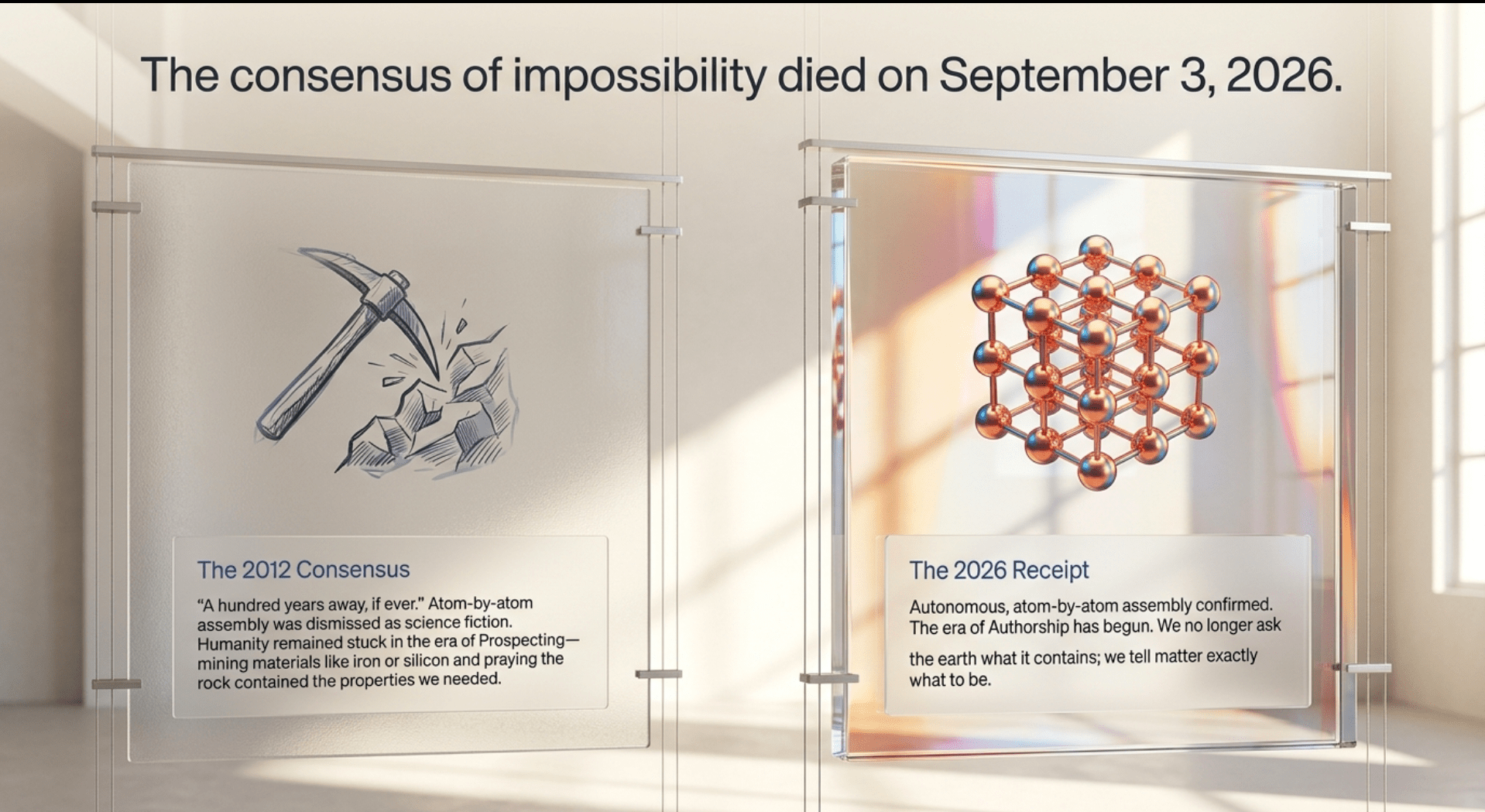
How it started… In 2012 I stood in front of a venture group and said that nanofabrication—true atom-by-atom assembly, not 3D printing, not sintering, not melting plastic into the shape of a wrench—would produce working discoveries before 2030, and that the path to a replicator was no longer science fiction. Their “expert” told the room my entire talk should be disqualified. There were no atomic-layer nanofabricators, he said. There never would be on any timeline a serious investor should care about. A hundred years, if ever.
I have heard that same sentence about useful AI that would pass a Turing Test. I have heard it about the personal computer, about the internet in every home, about a robot that could walk into a room and do useful work. The expert is long gone. I am still here. And Oak Ridge National Laboratory just published the receipt.
A Short History of Nanofabrication: Placing Atoms, Rearranging Atoms
Nanofabrication did not begin at Oak Ridge last week. It began as a dare. On December 29, 1959, Richard Feynman stood at Caltech and told the American Physical Society that the principles of physics did not forbid maneuvering things atom by atom. “In practice it has not been done,” he said, “because we are too big.” He asked whether the entire Encyclopaedia Britannica could be written on the head of a pin, whether a surgeon could be swallowed, whether we might someday arrange the very atoms the way a bricklayer arranges bricks. The lecture was titled “There’s Plenty of Room at the Bottom.” For two decades most of the profession treated it as after-dinner physics. It was not. It was the charter. Everything that followed—every tip, every resist, every lattice Oak Ridge just taught a machine to build—is an answer to that dare.

The word itself split in two before the tools existed. In 1974 Norio Taniguchi used “nano-technology” for manufacturing held to nanometer tolerances: polishing, deposition, the crafts of making surfaces true. In 1981 K. Eric Drexler published in PNAS a different claim, and in 1986 Engines of Creation made it public: molecular machinery that would build by specifying where each atom goes, including machines that build copies of themselves. Taniguchi was talking about control of a surface. Drexler was talking about authorship of matter. The argument between those two meanings consumed a generation. It was never a waste. One lineage learned to lay films one atomic layer at a time. The other lineage learned to pick a single atom up and put it down. Oak Ridge is where those lineages finally share a brain.
The instrument that made placement possible was not a factory. It was a needle. In 1981 Gerd Binnig and Heinrich Rohrer at IBM Zurich built the scanning tunneling microscope: a conductive tip held so close to a surface that electrons tunnel across the gap, and the current maps the atoms as if they were hills. They received the Nobel Prize in 1986, the same year the atomic force microscope arrived and the same year Drexler’s book hit the stands. The STM could see atoms. Seeing is not building. For a few years the machine was a camera. Then the camera developed a hand.
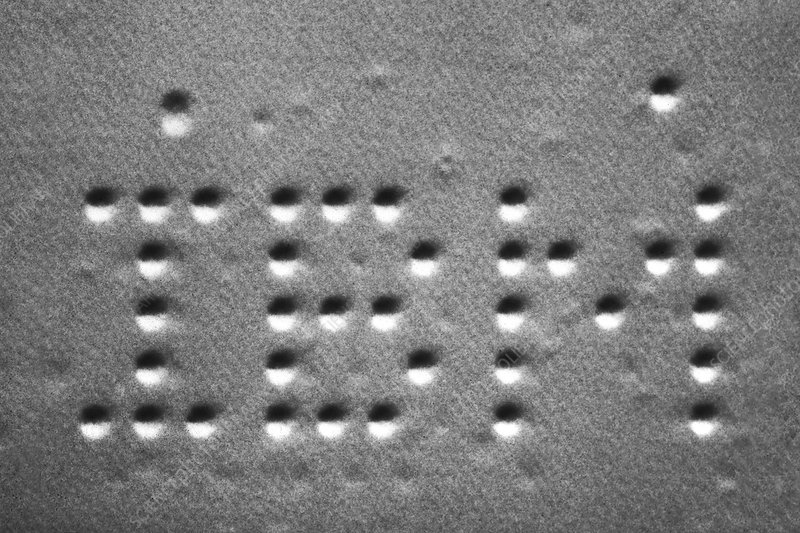
On November 9 and 10, 1989, Donald Eigler and Erhard Schweizer sat for twenty-two hours at a liquid-helium STM at IBM Almaden and dragged thirty-five xenon atoms across a cold nickel crystal until they spelled IBM in letters five nanometers tall. That image, published in Nature in 1990, is the baptism of atom-by-atom fabrication as fact rather than sermon. They were not synthesizing a new compound. They were rearranging atoms that already existed—sliding them into a pattern nature had not chosen. Eigler later said they wanted to show that atoms could be used the way a child uses Lego. The first construction log in history that can honestly say “patterned array of atoms” is dated that weekend. When people tell you nanofabrication is new, show them 1989.
Rearrangement did not stop at logos. In 1993 Eigler, Michael Crommie, and Christopher Lutz built a ring of forty-eight iron atoms on copper—the quantum corral—and trapped the surface electrons inside it. The famous image is not the ring. It is the ripples: standing waves of electron density, physics made visible because someone put atoms where they would force the waves to sing. That is the second meaning of this craft, and it is the one ORNL just automated. You do not only place matter. You rearrange matter so that electrons have no choice but to behave as designed. A Dirac point in a thirty-seven-molecule honeycomb is the grandchild of that corral. The child took thirty-three years and a reinforcement-learning loop.
While the STM people were sliding atoms like beads, another priesthood was rearranging atoms the way chemistry has always done it—by making the right bonds form in the right order, only now one monolayer at a time. Atomic layer deposition, pioneered by Tuomo Suntola in Finland in the 1970s for electroluminescent displays, pulses precursor gases so that a surface saturates, stops, and waits for the next pulse. Each cycle adds a skin the thickness of a single layer of molecules. No tweezers. No 4-kelvin nickel. Just timing, chemistry, and a chamber.
Dip-pen nanolithography, hydrogen-resist lithography, molecular-beam epitaxy, and later spatial atomic-layer tools such as ATLANT 3D’s DALP heads are cousins of that idea: you do not always pick an atom up. Sometimes you invite a whole class of atoms to sit, and you control the invitation. This is rearranging at industrial scale. It is how the legal cabinets already in university bays coat a sensor without a billion-dollar fab. The STM writes one site. ALD writes a field. A civilization that wants a garage platform needs both.
Silicon forced a third method, because silicon does not slide like xenon on nickel. You cannot politely drag a covalently bound atom across a crystal and call it a transistor. In the early 1990s Joseph Lyding, John Tucker, and Ph. Avouris’s generation showed that an STM tip can knock hydrogen off a hydrogen-terminated silicon surface, leaving a dangling bond—a chemically hungry site the size of one atom. Phosphine can then dock there and a phosphorus atom can be locked into a chosen lattice position.
Michelle Simmons’s group in Sydney used that hydrogen-depassivation lithography to build, in 2012, a single-atom transistor: one phosphorus donor placed to a lattice site, wired, and measured. Robert Wolkow’s school turned dangling bonds themselves into binary logic. This is not decoration. This is rearranging the crystal so that a dopant sits where Kane’s 1998 quantum-computer proposal said it had to sit. Placement and rearrangement became the same sentence: remove this hydrogen, invite this atom, bury it in epitaxy, and the device is the pattern.
Automation was the missing organ, and it arrived in pieces before Oak Ridge put a brain on it. By 2016 an STM could write a kilobyte by parking more than eight thousand chlorine vacancies on copper in the same twenty-two hours Eigler once needed for three letters. Path planning, drift correction, computer vision, and then reinforcement learning turned a monk’s craft into a shift that can run overnight. The 2026 ORNL system—YOLO for eyes, reward for judgment, a tip that still feels one atom—is not a rupture with this history. It is the moment the history stopped requiring a virtuoso. Feynman said we were too big. Eigler proved a human could still reach. Narasimha’s team proved the human can finally let go of the stick for twenty-five hours and come back to a material that works.
Hold the two verbs apart and you will not get lost. Placing atoms is the STM dream: this atom, this site, this lattice. Rearranging atoms is everything else that changes which neighbors an atom has—sliding adsorbates, opening a dangling bond, pulsing an ALD cycle, doping a channel, building a corral so electrons stand in waves, asking an AI for a Dirac point and letting it nudge molecules until spectroscopy agrees. Chemistry has been rearranging atoms since fire.
What is new is choice at the limit of choice: one site, one layer, one designed electronic state, on purpose. The 5000 Days claim that the means of production return to the workshop only becomes physical when both verbs leave the national lab. One writes the letter. The other writes the property. Together they write the material. That is the history Oak Ridge just joined, and it is older, stranger, and further along than the people who laughed in 2012 were prepared to admit.
What Oak Ridge Actually Did
On September 3, 2026, ORNL announced what researchers at the Center for Nanophase Materials Sciences had already proven in ACS Nano: an artificial intelligence can now see individual molecules on a surface, decide how to move them, and build a working material atom by atom—then keep doing it for more than twenty-five hours without a human hand on the controls.
Source:
ORNL, “AI automates the creation of custom materials,” September 1, 2026.
Narasimha et al., ACS Nano 20 (4), 3393–3401 (2026), DOI 10.1021/acsnano.5c12469.
ORNL on X: https://www.ornl.gov/news/ai-automates-creation-custom-materials
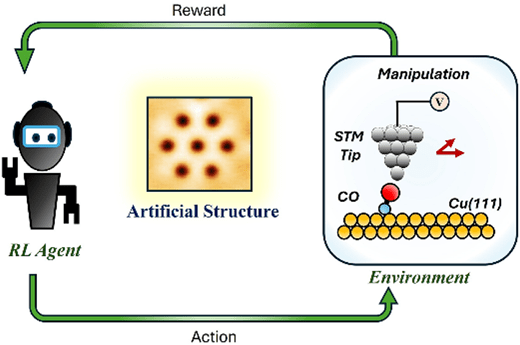
Picture the construction site they asked us to imagine. The bricks are single molecules. The cranes are microscope needles so sharp they can feel one atom. For decades that work was a kind of monastic labor. A human sat at a scanning tunneling microscope, nudged one molecule, waited, nudged again, and prayed the tip did not crash. One error could ruin the tool. A lattice that mattered could take days of nerve and luck. The field moved at the speed of a very careful person.
ORNL handed the crane to a machine that learns.
You Only Look Once
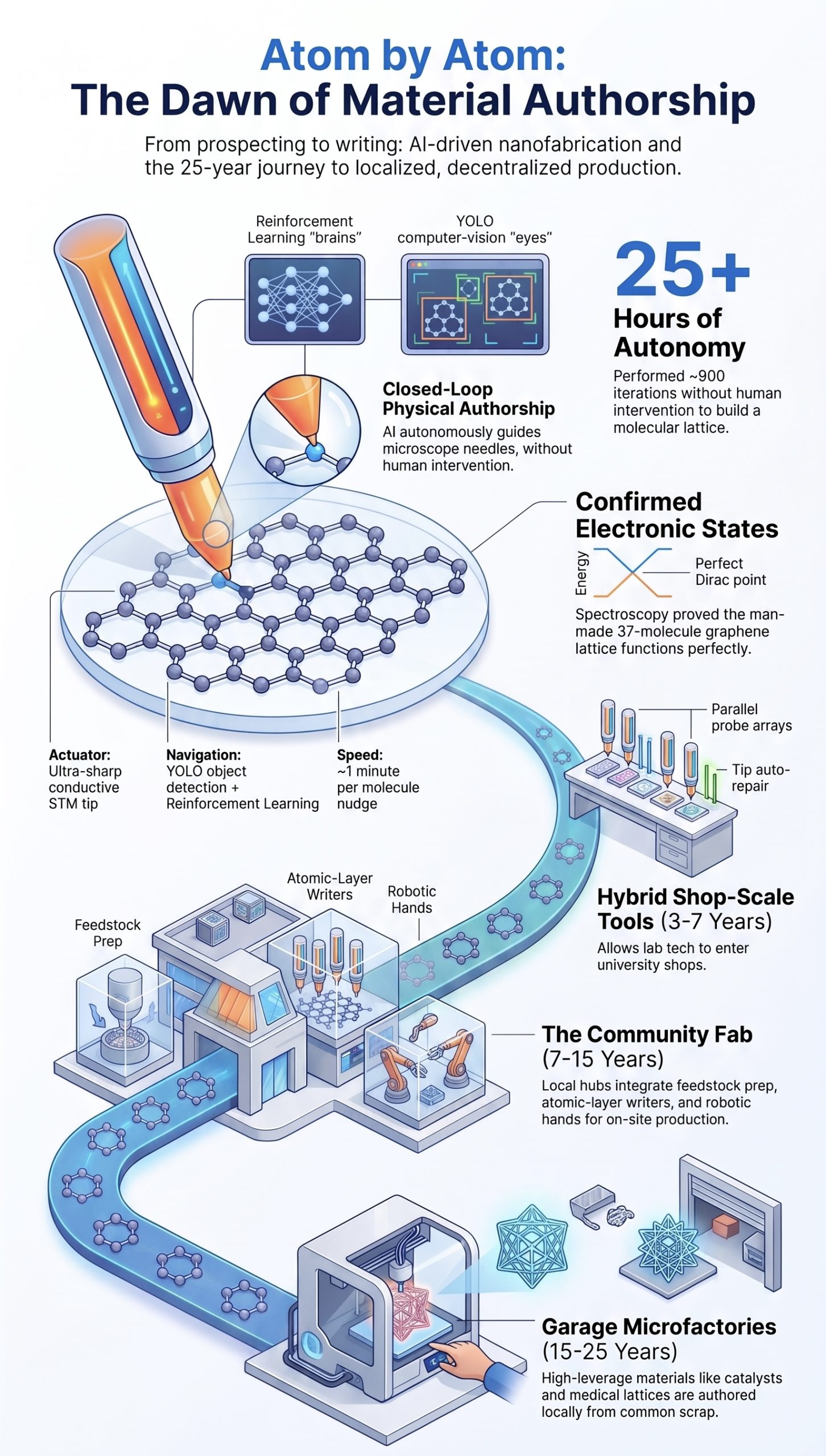
The “eyes” are a computer-vision model—YOLO, You Only Look Once—trained to find molecules on a copper surface the way a hawk finds motion in grass. The “brain” is reinforcement learning. Every time the tip tries to slide a molecule, the model receives a score. Highest reward if the molecule lands on the target site. Lower if it misses. By tying reward to action, the system discovered the combination of electrical current, bias voltage, and manipulation speed that moves matter without destroying the needle. Path-planning and active drift compensation keep the lattice from wandering as the hours pass.
Then they asked it to prove the result was not a pretty picture. The AI assembled an artificial graphene lattice from thirty-seven molecules in a perfect honeycomb. Spectroscopy found a Dirac point—the electronic fingerprint that says this man-made sheet is not a decoration. It behaves like graphene. Electrons in that lattice do the strange, fast, almost massless things graphene electrons do. The team also had the system spell O-R-N-L out of individual molecules, which is the scientific equivalent of a pilot tipping the wing: we are not guessing. We are writing.
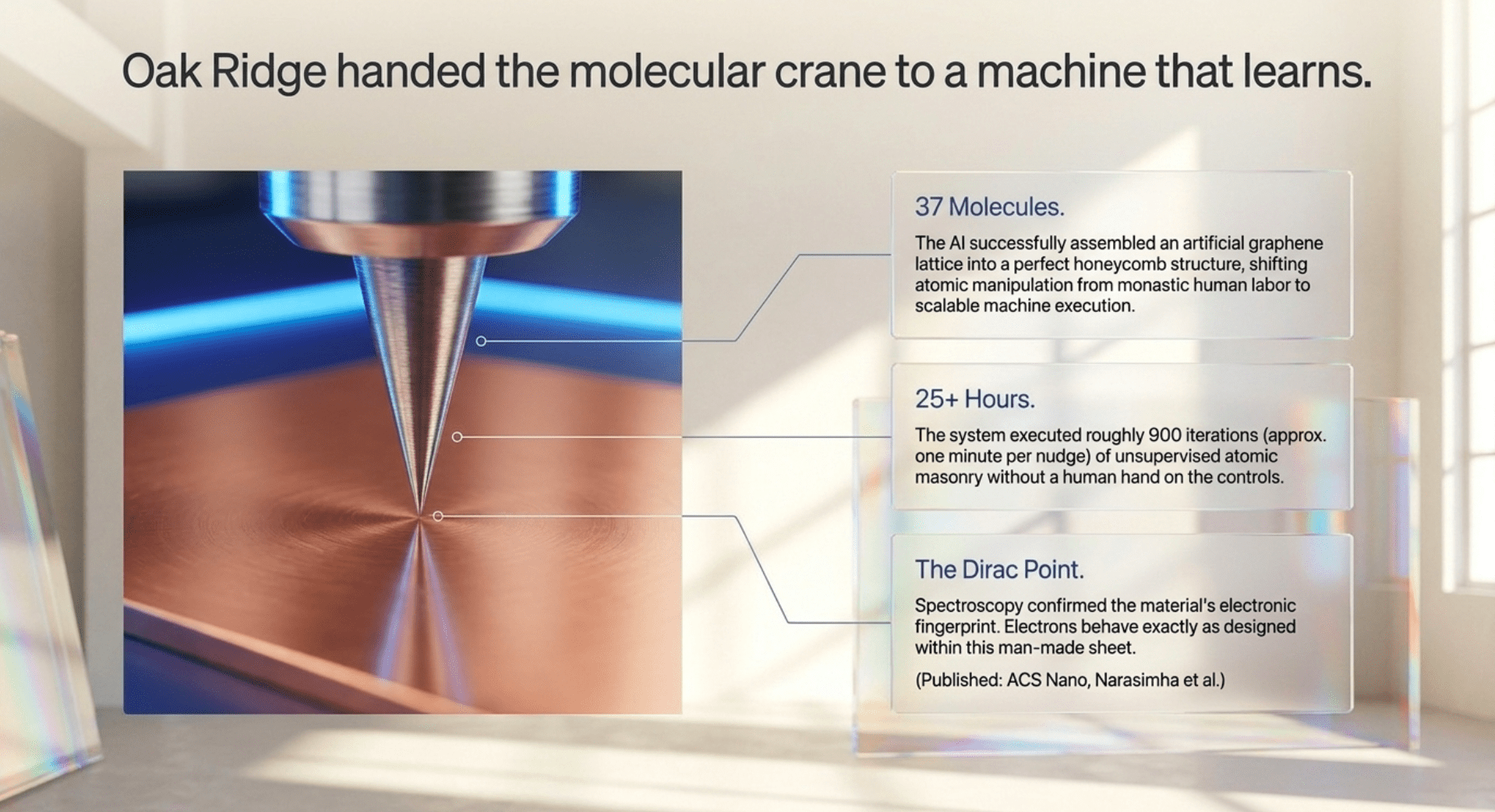
The paper is titled Automated Construction of Artificial Lattice Structures with Designer Electronic States. The authors include Ganesh Narasimha, Mykola Telychko, Wooin Yang, Arthur P. Baddorf, P. Ganesh, An-Ping Li, and Rama Vasudevan. Narasimha said the quiet part without raising his voice: this is atomically precise fabrication with significantly reduced human input. More important, it shifts the research paradigm from discovering materials in nature to engineering artificial lattices—orderly, repeating patterns of atoms—with electronic behaviors we choose.
That last sentence is the bridge of the century. For all of human history we have been prospectors. We found iron. We found silicon. We found lithium. We cooked, doped, strained, and prayed the rock would give us the property we needed. ORNL is describing the moment we stop asking the earth what it happens to contain and start telling matter what to be.
The system is not a Star Trek replicator yet. A human still steps in to condition or repair an unstable tip. The thirty-seven-molecule lattice took roughly nine hundred iterations over twenty-five hours. Each nudge is about a minute. That is slow if you are thinking about a house. It is lightning if you are thinking about the history of chemistry. Twenty-five hours of unsupervised atomic masonry would have been a fantasy when I was told to sit down in 2012.
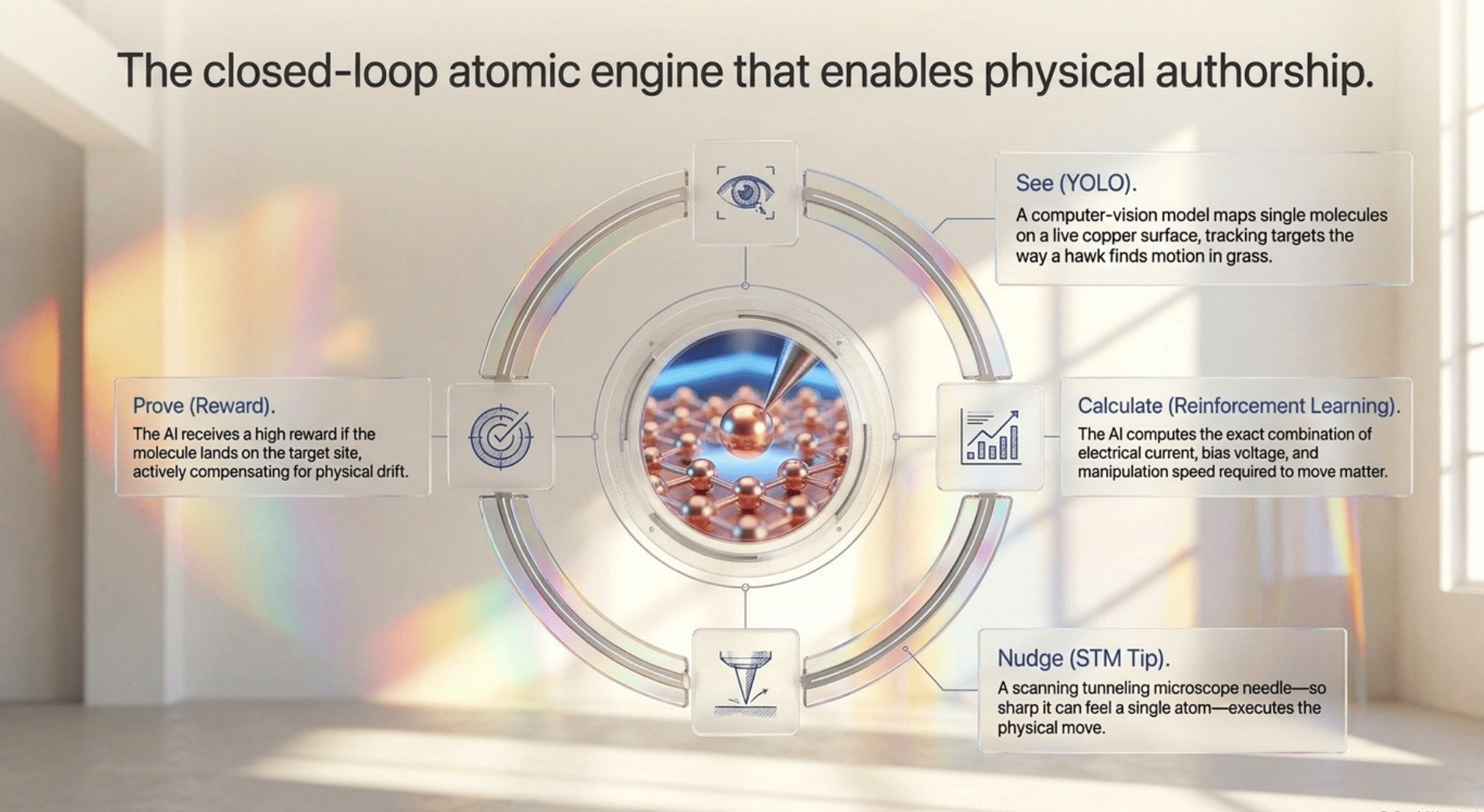
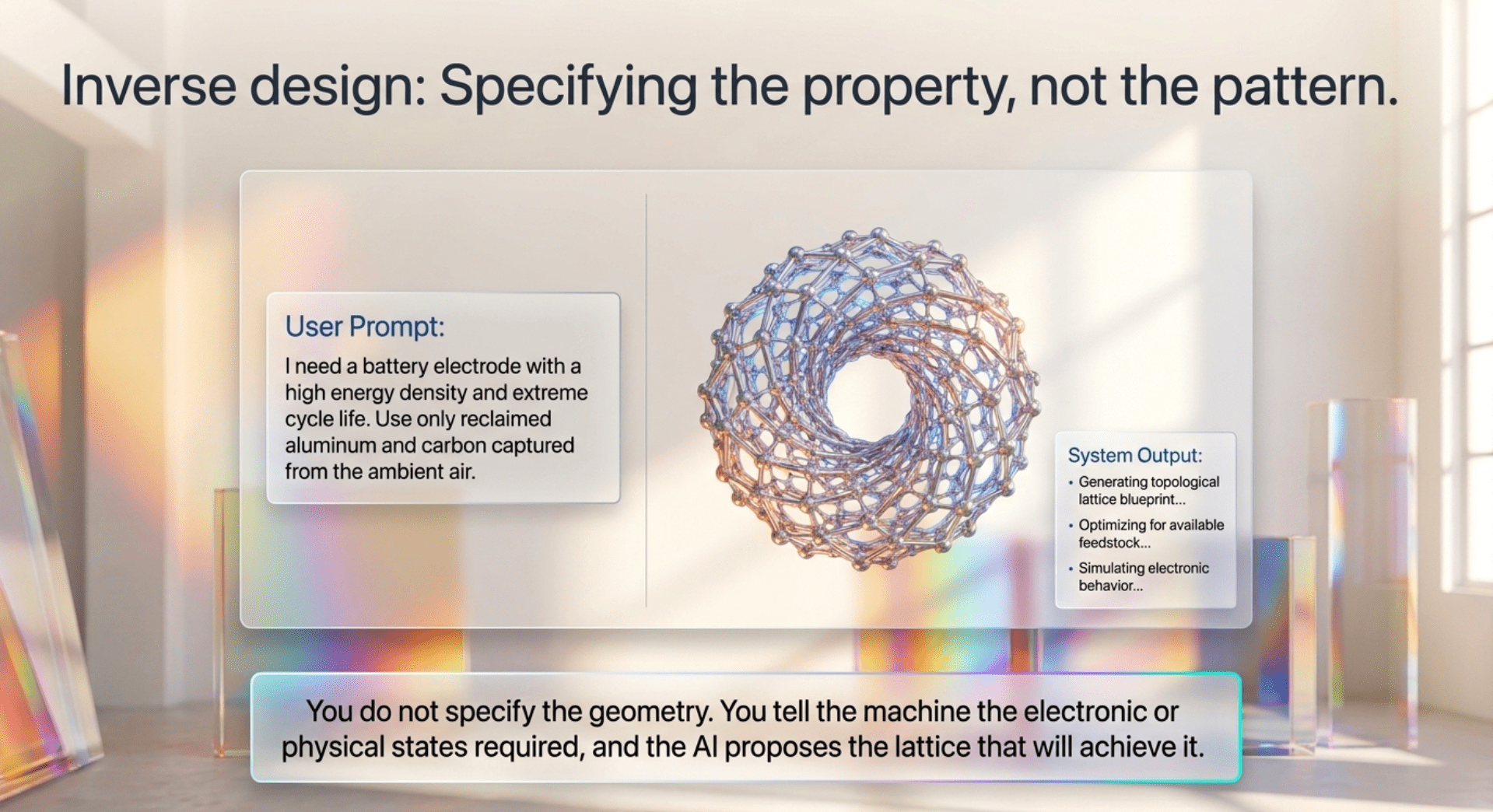
The next step they name is inverse design. You do not specify the pattern. You specify the property. You tell the machine: I need a Dirac point here, a topological edge state there, a band gap of this width, a qubit that will not decohere when the truck goes by. The AI proposes the lattice and builds it. That is the road to topological qubits and to electronics that do not exist in any catalog because they do not exist in nature.
Why This Is Not Another Lab Curiosity
I have spent decades in the patents. US 2012/0255932 A1—Nanofabrication Device and Method—is only one page in a stack I have been reading since most of the current debate did not have a vocabulary. ATLANT 3D’s atomic-layer nanofabricator was another early crack in the wall. Scanning-probe lithography, spatial atomic layer deposition, electron-beam writing of single dopant atoms, helium-ion defect engineering of aluminum nitride at ORNL earlier this year—these were not separate hobbies. They were the same river, seen from different banks.

What changed at Oak Ridge is the missing organ. Vision plus reward plus a physical actuator that can feel an atom. Once you have that loop, scale is an engineering problem, not a philosophical one. More tips. Parallel arrays. Faster feedback. Better force models. Better feedstock. The same curve we watched in lithography, in protein folding, in language models: a painful demonstration, then a night when the cost per operation falls through the floor.
I want you to feel the excitement without losing the precision. This is not “AI dreamed a molecule and a robot mixed two beakers.” This is closed-loop physical authorship of matter. The computer sees the world at the scale where chemistry and quantum mechanics are the same sentence. It acts at that scale. It checks its own work with spectroscopy. That loop, copied and cheapened, is how you get from a national laboratory to a workshop.
Let’s first explore the nanofabrication patents and patent publications, grouped by technique.
Foundational Nanofabrication
| Patent | Title | What it covers |
|---|---|---|
| US5772905A | Nanoimprint lithography | Early nanoimprint approach for producing features below 25 nm using a patterned mold. [patents.google] |
| CA2451882A1 | Nanofabrication | Three-dimensional nanostructures using selectively exposed block-copolymer templates. [patents.google] |
| US5948470A | Method of nanoscale patterning and products made thereby | Block-copolymer methods for forming and transferring periodic structures below 100 nm. [patents.google] |
| US6309580B1 | Release surfaces, particularly for use in nanoimprint lithography | Mold and surface treatments designed to release ultra-fine imprinted patterns. [patents.google] |
Block-copolymer self-assembly
| Patent | Title | What it covers |
|---|---|---|
| US20120046415A1 | Methods of forming block copolymers and self-assembled structures | Modified block copolymers and polymer masks for self-assembled lithography. [patents.google] |
| US20120202017A1 | Solvent annealing block copolymers on patterned substrates | Directed self-assembly of block copolymers on patterned substrates through solvent annealing. [patents.google] |
| US10577466B2 | Ordered nanoscale domains by infiltration of block copolymers | Infiltrating self-assembled block-copolymer scaffolds with precursors to create inorganic nanofeatures. [patents.google] |
| US10259907B2 | Block copolymers with surface-active junction groups | Polymer compositions and processes intended to control block-copolymer behavior in nanostructure formation. [patents.google] |
Nanoimprint and hybrid lithography
| Patent | Title | What it covers |
|---|---|---|
| US7374864B2 | Combined nanoimprinting and photolithography for micro and nano devices fabrication | Combining physical nanoimprinting with photolithography for micro- and nanoscale patterning. [patents.google] |
| US9523910B2 | Nanoimprint lithography | Mold-based pattern transfer using resin, pressing, separation, and irradiation steps. [patents.google] |
| US8916200B2 | Nanoimprint lithography formation of functional nanoparticles using dual release layers | Producing functional nanoparticles with nanoimprint steps and sacrificial/release layers. [patents.google] |
| US12242184B2 | Nanoimprint lithography process and patterned substrate obtainable therefrom | Soft nanoimprint processing for forming sol-gel patterned layers; the corresponding application was granted in 2025. [patents.google] |
Application-specific example
- WO2011094015A1, Solar cell fabrication by nanoimprint lithography — applies nanoimprint techniques to organic and hybrid nanostructured solar cells.[patents.google]
How the Machine Works — and How It Leaves the Lab
This is the official ORNL figure released with the announcement. An AI watches a copper lattice while an atomically sharp tip places molecules. Credit: Andy Sproles / ORNL, U.S. Department of Energy.
It is not a photograph of the vacuum chamber. It is the correct picture of what the software is doing inside that chamber: see the molecule, choose a move, apply current and bias through a tip that can feel one atom, score the landing.
ORNL system — the numbers that matter
| Instrument | Scanning tunneling microscope (STM) at CNMS, Oak Ridge |
| Actuator | Ultra-sharp conductive tip; tunneling current feels a single atom |
| Demo surface | Copper, with mobile molecules |
| Eyes | YOLO object detection on the live STM image stream |
| Brain | Reinforcement learning. Highest reward when the molecule hits the assigned site |
| What it learns | Tunneling current, bias voltage, manipulation speed |
| Hygiene | Path-planning plus active drift compensation |
| Proof lattice | Artificial graphene honeycomb, 37 molecules |
| Electronic proof | Dirac point recovered by tunneling spectroscopy |
| Showpiece | Letters ORNL spelled in individual molecules |
| Autonomy | More than 25 hours with no human on the stick |
| Cadence | ~1 minute per nudge; ~900 iterations for that lattice |
| Human still required for | Occasional tip conditioning when the needle goes unstable |
| Paper | Narasimha et al., ACS Nano 20 (4) 3393–3401 (2026), DOI 10.1021/acsnano.5c12469 |
| Why DOE paid | QIS Infrastructure Project “Precision Atomic Assembly for Quantum Information Science” |
What the laboratory device actually looks like
An STM that writes atoms is a stainless-steel vacuum cathedral: chambers, pumps, vibration isolation, often a cryostat, often a growth chamber so the surface never sees air. CNMS runs a family of these — variable-temperature, cryostat, Joule-Thomson, four-probe — some tied to molecular-beam epitaxy through a vacuum suitcase.
This is the research device class. It is legal. Vendors sell it. It is not yet a shop tool.
A working UHV STM suite: vacuum hardware, control racks, notes on the wall. This is the class of room where the 25-hour autonomous run happened.
Commercial UHV / cryogenic AFM-STM architecture. Dual chambers, viewports, manipulators. SPECS, Omicron, Unisoku and others will sell this to any lab that can write a purchase order.
What the tip sees
YOLO is not looking at a cartoon. It is looking at this language: honeycombs, moiré, stripes, single adsorbates. That is the image stream the reward model scores.
Computed and measured STM lattices — the visual vocabulary of the ORNL loop.
Artificial honeycomb lattices built for electrons, atoms, and photons. Panel (b) is the cousin of Oak Ridge’s 37-molecule graphene: molecules parked so electrons have nowhere to hide from the design.
And the ancestor, so the scale of the jump is honest:Thirty-seven years earlier, a human at an IBM STM placed 35 xenon atoms to spell a logo. Same instrument class. Overnight autonomy and a working Dirac material are what changed.
The commercial, legal devices already on the floor
STM writing is the research spear. It is not yet how you coat a sensor in a shop. The purchasable bridge — the machines I pointed at when people said “there are no nanofabricators” — is atomic-layer additive manufacturing.
ATLANT 3D’s NANOFABRICATOR line uses Direct Atomic Layer Processing (DALP®): a micro-reactor nozzle that lays down ALD-quality films only where the head is told to go. No mask. No full cleanroom shower. Atomically thin metals, oxides, semiconductors, patterned in one cabinet.
These are not hypothetical. Lite units are in universities and at least one global AI hyperscaler’s materials lab. Pro is the industrial cabinet. Zero-G is the ESA-partnered module asked to run the same physics off Earth. This is the device class that walks out of a user facility and into a building you can rent.
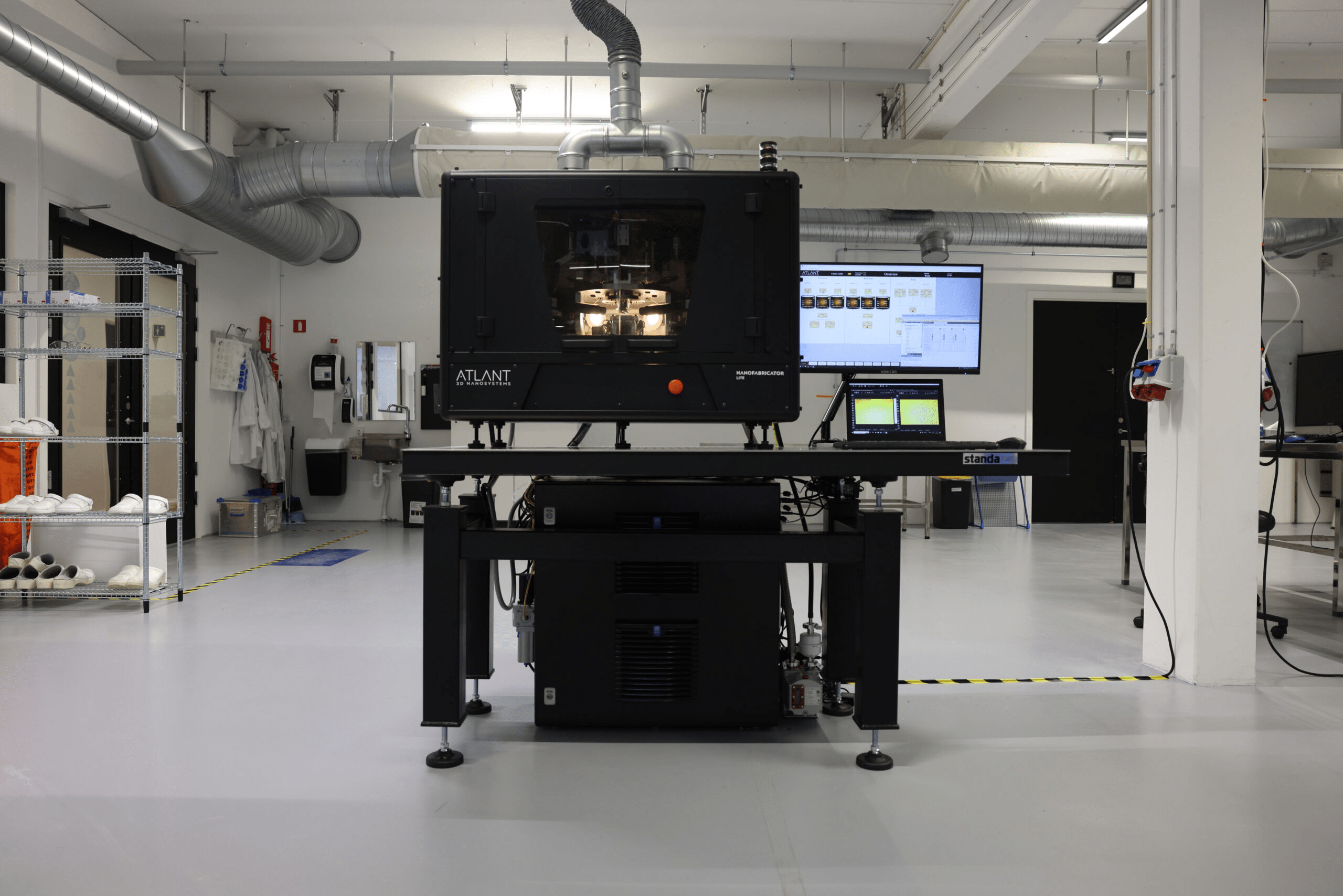
NANOFABRICATOR Lite in a working lab: isolation table, exhaust, process UI. First-generation local platform when you can write a check instead of a proposal.
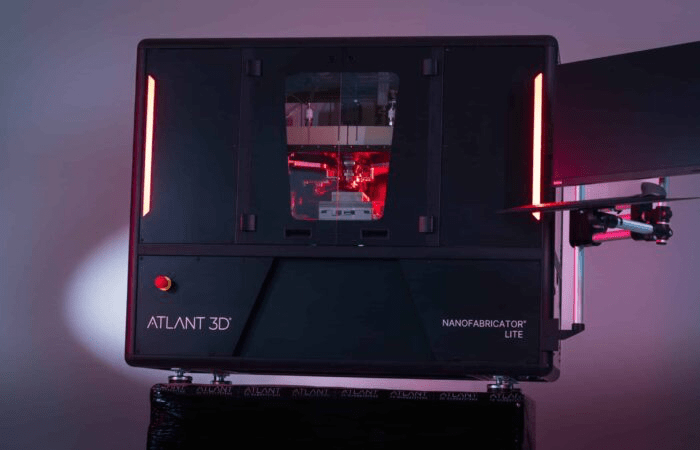
Lite enclosure: viewport, process lighting, emergency stop. A research-bay tool, not a cathedral fab.
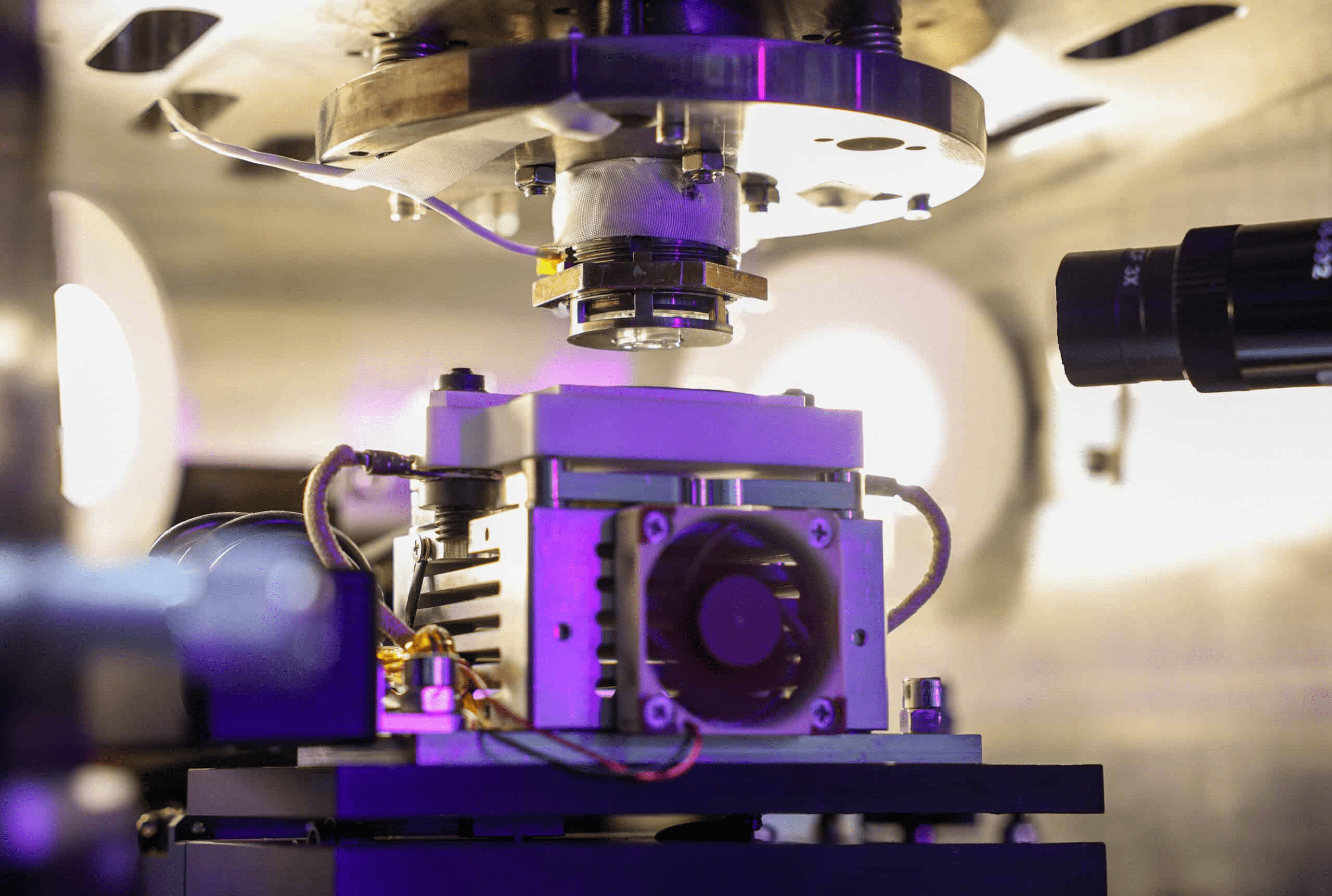
Inside the head: deposition micro-reactor over a heated stage, microscope looking on. This is where the atomic layers land.
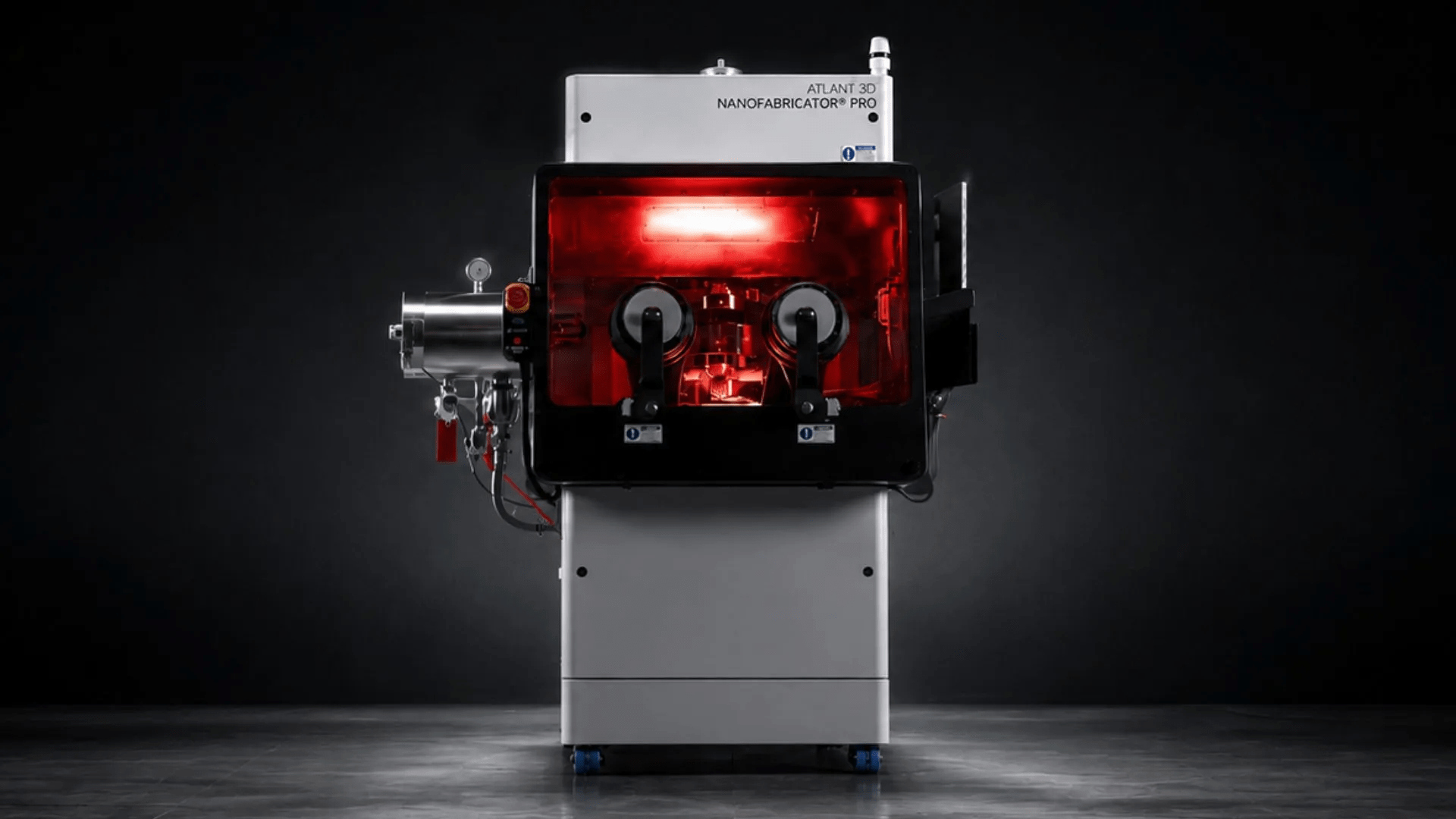
NANOFABRICATOR Pro — industrial sibling. Glove ports, process chamber, wheeled cabinet. Shop-tool form factor.
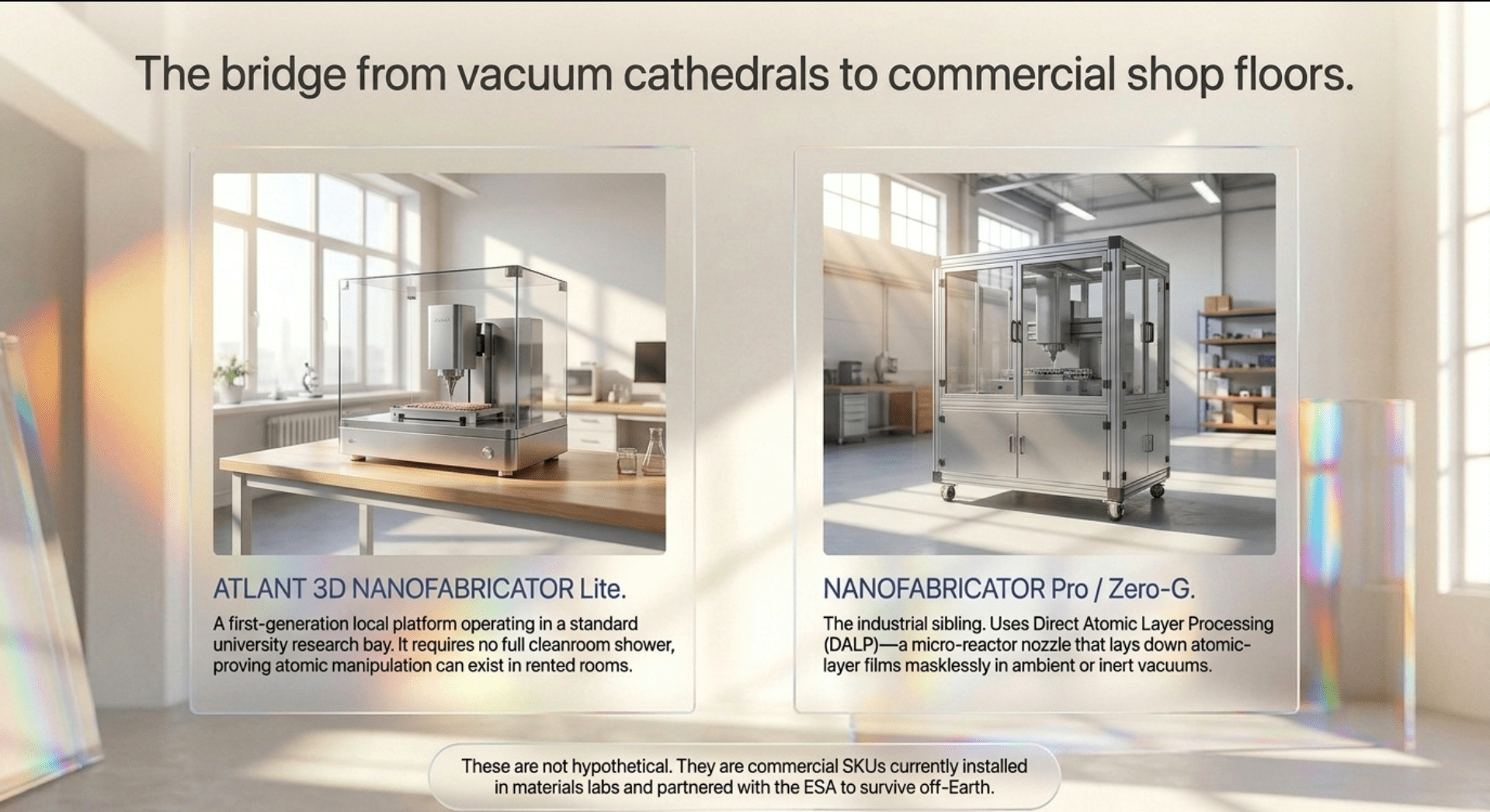
NANOFABRICATOR Zero-G (ATLANT 3D × ESA). Same atomic-layer physics in a closed module. The point is not space tourism. The point is the process has already been asked to survive a world without a fab.
| Line | ATLANT 3D NANOFABRICATOR Lite / Pro / Zero-G |
| Process | DALP® — spatial, maskless atomic layer processing |
| Vertical control | Atomic layers; advertised step control to ~0.3 nm |
| Lateral today | On the order of 100–400 µm on Lite; finer heads in development |
| Materials | Hundreds of ALD precursors; multi-material in one run |
| Substrate | Up to 100 mm (4”) on Lite |
| Speed | Head travel up to ~200 mm/s |
| Vacuum | Ambient or inert — not a full UHV STM |
| Who can buy it | Universities, labs, corporate R&D. It is a commercial SKU |
| What it is not | It does not yet park one chosen molecule on one chosen lattice site the way ORNL’s STM does |

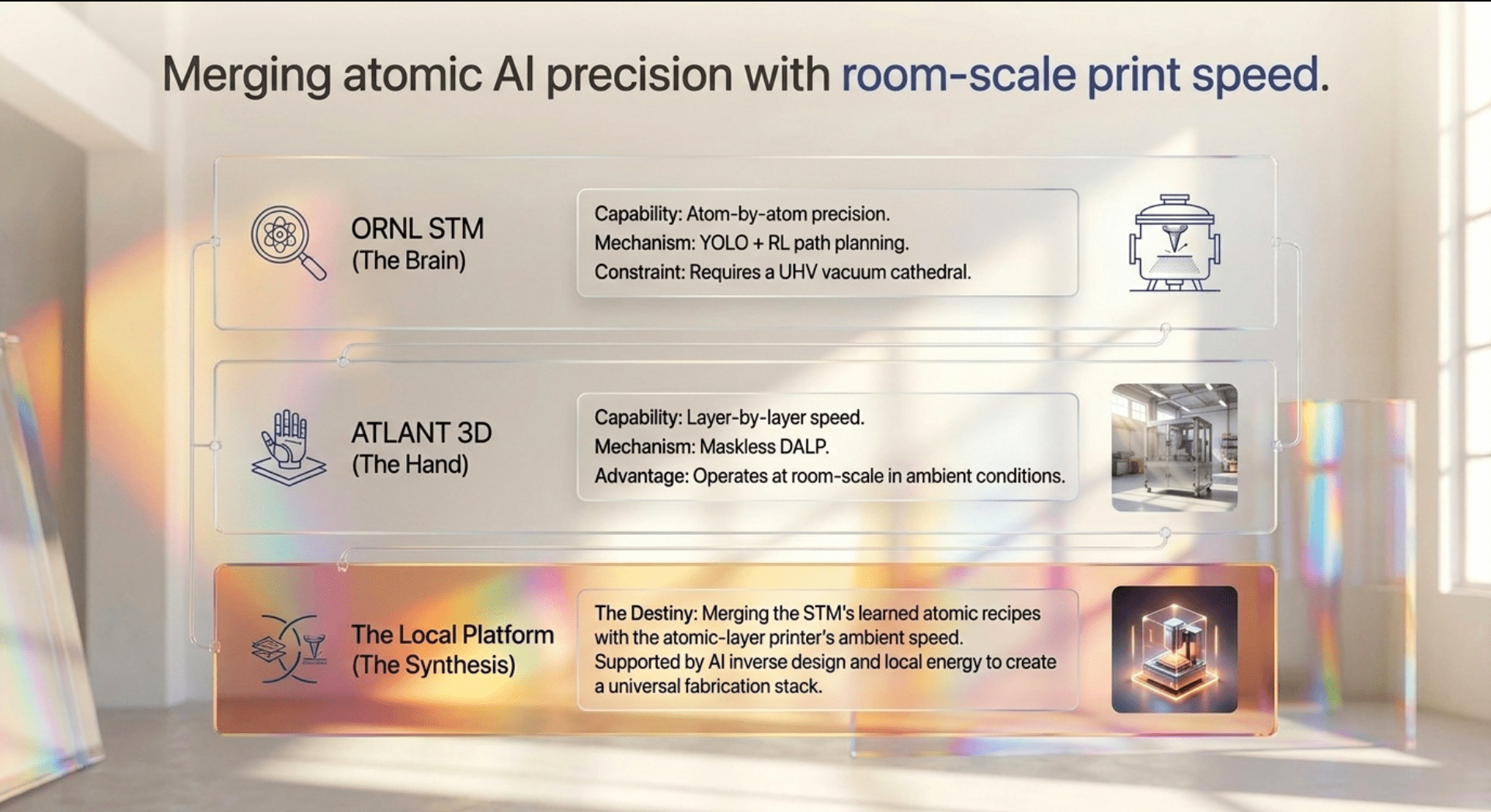
How this scales to a local platform
Two machines, one destiny. The STM is the brain that learns how matter wants to be moved. The atomic-layer printer is the hand that already works in a room you can insure. The local platform is what you get when those lineages merge, cheapen, and sit next to a robot and a kilowatt of nearly free energy.
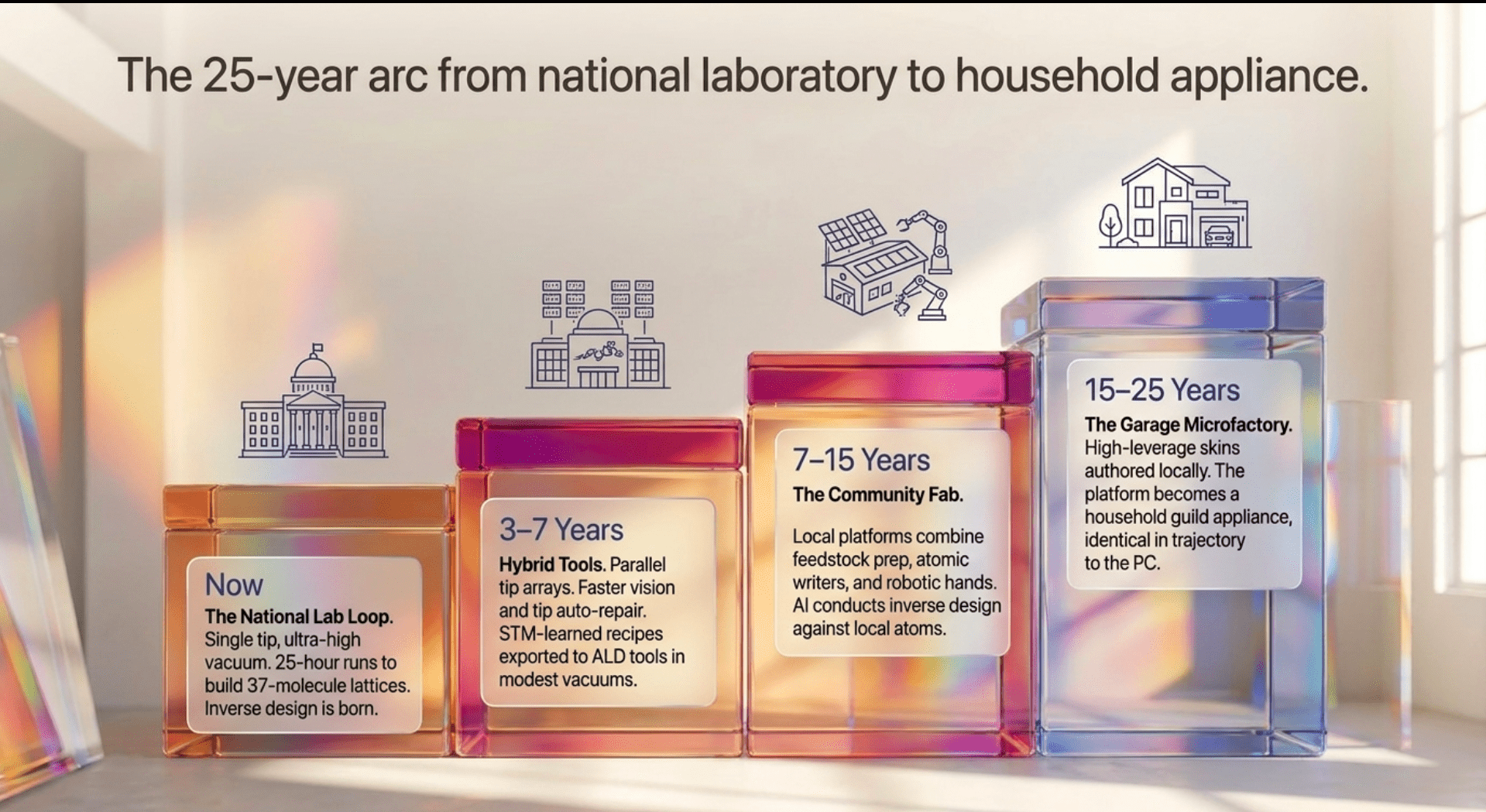
1. Now — national-lab loop.
One tip. UHV. YOLO + RL. 25 hours. 37 molecules. A Dirac point. Inverse design is born here: you ask for an electronic state, the model proposes a lattice, the tip tries to build it.
2. Next 3–7 years — parallel tips and hybrid tools.
Arrays of probes. Faster vision. Tip auto-repair so the human leaves the room for a week. STM-learned recipes exported as process files to DALP / ALD / e-beam / ion-beam tools that already run at ambient or modest vacuum. University and shop-scale cabinets, not only user facilities.
3. Next 7–15 years — the community fab.
A local platform is a small stack: feedstock prep (scrap sort, precursor refill, powder and gas inventory), an atomic-layer writer for membranes / electrodes / coatings, a tighter-precision head for quantum and medical lattices, in-situ metrology, and a robot that loads, cleans, and swaps. AI does inverse design against the atoms you actually have. Energy cost falls because the wasteful step — shipping a wafer around the world to touch one layer — disappears.
4. Next 15–25 years — the garage microfactory layer.
Not every atom of a house. The high-leverage skins: catalysts, battery electrodes, sensors, optical coatings, implant surfaces, filters. Bulk structure is printed or grown next door. The local platform becomes a household or guild appliance the way a mill once was — expensive at first, then ordinary, then assumed. That is the 5000 Days microfactory made of metal instead of metaphor.
What must fall: tip and nozzle cost, vacuum requirement, precursor toxicity and licensing, metrology that does not need a beamline, and models that refuse to build a lattice they cannot verify. ORNL took closed-loop atomic authorship off the “someday” list. The cabinets above took “legal to own” off that list years ago. The rest is engineering, energy, and the decision not to lock the recipe behind a ministry.
What A Local Platform Is, Physically
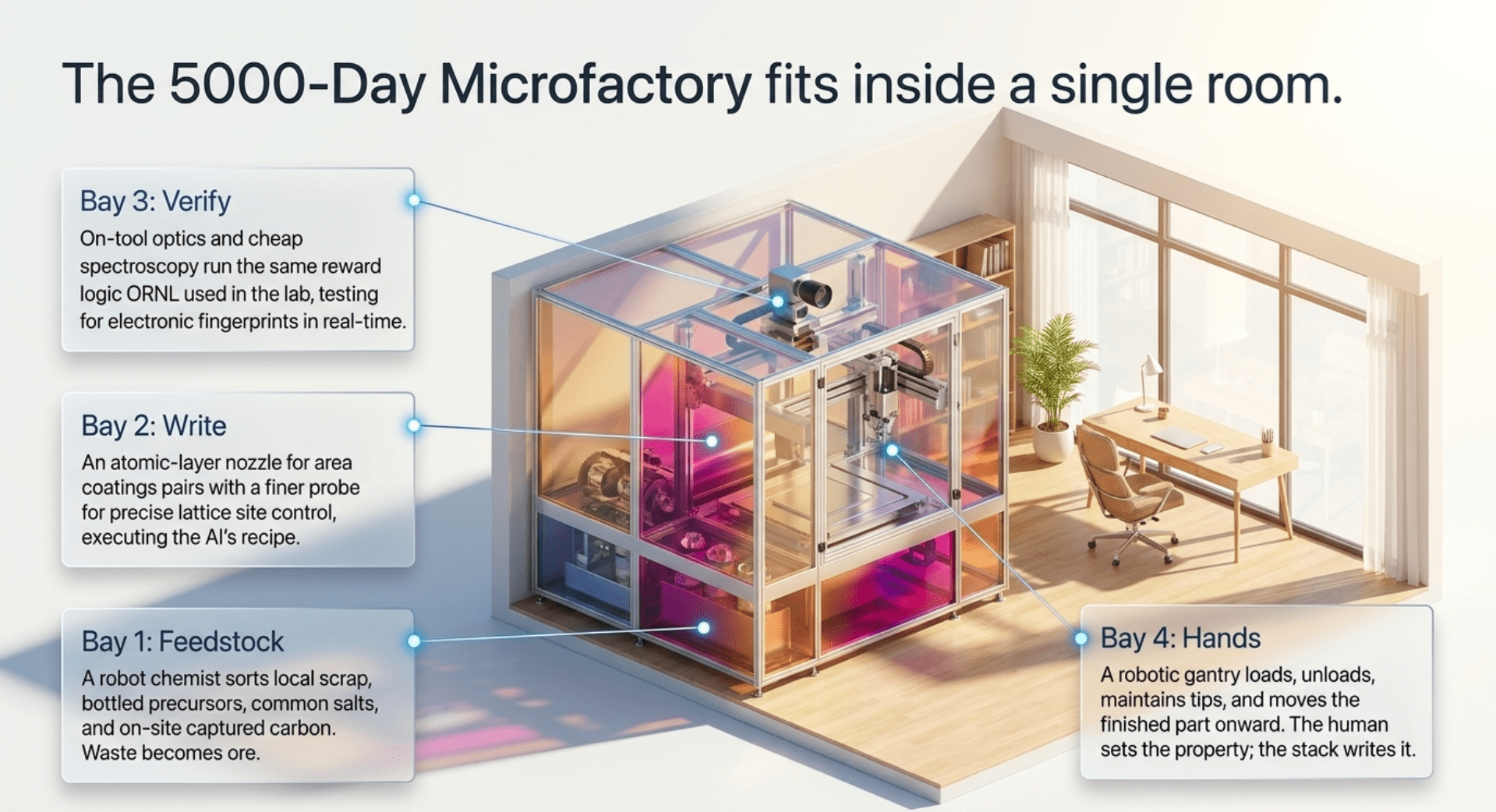
Four bays in one room. Not a cleanroom city.
- Bay 1 — Feedstock. Sorted scrap, bottled precursors, carbon captured on site, water, sand, common salts. A robot chemist that assays what came in today.
- Bay 2 — Write. An atomic-layer nozzle for area coatings and electrodes; a finer probe or beam for lattices that need site control; a conventional printer for the coarse chassis.
- Bay 3 — Verify. On-tool optics, electrical probes, cheap spectroscopy. The same reward logic ORNL used — did the molecule land, does the Dirac point appear — runs as a factory test instead of a paper figure.
- Bay 4 — Hands. A humanoid or gantry that loads, unloads, maintains tips, and carries the part onward. The human sets the property. The stack writes it.
Power budget: a shop circuit plus local generation. Atomic writing is not free. Moving a container of finished material across an ocean is the expensive step. That step dies.
The Twenty-Five Year Arc: AI, Robots, and Nearly Free Energy
Inside the 5000 Days series I have argued that we are already in the Abundance Interregnum—the messy middle in which old commands dissolve and new ones have not yet been written. Five thousand days from late 2025 is not a prophecy of flying cars. It is a working estimate for the decoupling of human labor from economic survival. Personal AI. Humanoid robots you direct. Local energy. Open designs. The household as a microfactory.
Nanofabrication is the layer most people skip because it sounds like 1990s magazine cover art. It is not optional. Software without matter is a sermon. Robots without feedstock are expensive statues. Energy without materials is a wire looking for something to be. Atom-by-atom assembly is how the three converge.
Within twenty-five years—well inside a single working lifetime from this week’s announcement—the stack looks like this. Nearly free energy arrives first as a messy coalition: more photovoltaics than anyone priced in 2020, better storage, small modular fission where communities want it, geothermal where the rock allows it, and relentless efficiency because AI hates waste more than any regulator ever did. Robots arrive as hands. Not one pair. Fleets. They mine tailings, sort scrap, run condensers, tend gardens of feedstock, and stand watch over tools too fine for a human tremor. AI arrives as the planner and the craftsman: inverse design of the material, path planning of the assembly, quality control of the lattice, and the economic sense to use the cheapest atoms that will do the job.
At that point you do not “source” a specialty alloy from a conglomerate that owns a mountain and a lobbyist. You describe the job. The system inventories what is already in the bin—carbon from air or biomass, metals from discarded boards, silicon from sand, nitrogen from the sky—and writes the rest. Waste becomes ore. Geography becomes less of a prison. The supply chain shortens until it fits in a building, then a garage, then a cabinet.
I am not saying every atom of a skyscraper will be placed by a scanning tip in 2051. I am saying the high-value, high-leverage materials—the membranes, the catalysts, the quantum layers, the medical lattices, the battery electrodes, the photonic chips, the filters, the sensors—will be authored locally from common feedstock. Bulk structure will still be poured, printed, grown, and assembled at larger scales. The two industries will marry. The old distinction between “chemical plant” and “print farm” and “chip fab” will look as quaint as the distinction between scribe and printer.
Five Things You Will Build Instead of Buy
Here are five examples I want you to carry around, not as science fiction, but as design targets. Each one is illegal in the current economy only because the tools to make it cheaply have been locked inside institutions. That lock is rusting.
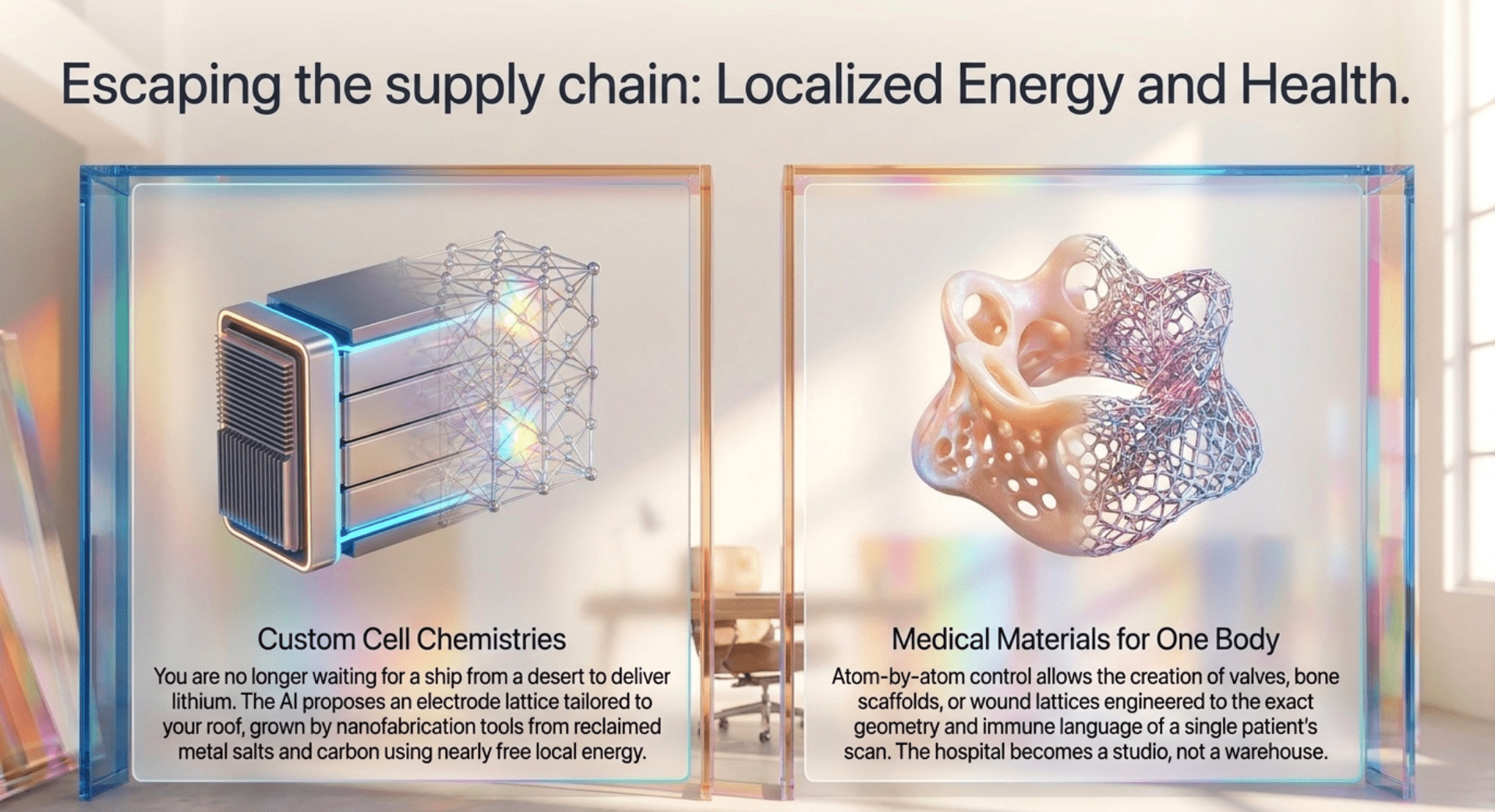
1. A battery chemistry written for your roof, not for a quarterly earnings call.
Today a cell is a compromise negotiated among miners, refiners, gigafactories, and the politics of cobalt and lithium. Tomorrow you specify energy density, cycle life, fire behavior, and the atoms you actually have on site. The AI proposes an electrode lattice and a solid electrolyte. Robots and nanofabrication tools grow or assemble the active layers from reclaimed metal salts and carbon. Nearly free local energy makes the process heat and vacuum cheap. You are not waiting for a ship from a desert. You are growing the thing that stores the afternoon.
2. A medical material that matches one body, not a statistical average.
A valve, a bone scaffold, a neural interface, a dialysis membrane, a wound lattice that knows your immune language. We already print crude shapes. Atom-by-atom and molecule-by-molecule control lets the surface chemistry, pore geometry, and electronic states be prescribed the way a tailor cuts a sleeve. The hospital becomes less of a warehouse of imported parts and more of a studio. The patient stops being a size in a catalog. This is not “3D printed plastic in the shape of a knee.” This is living-compatible matter assembled to a genome and a scan.
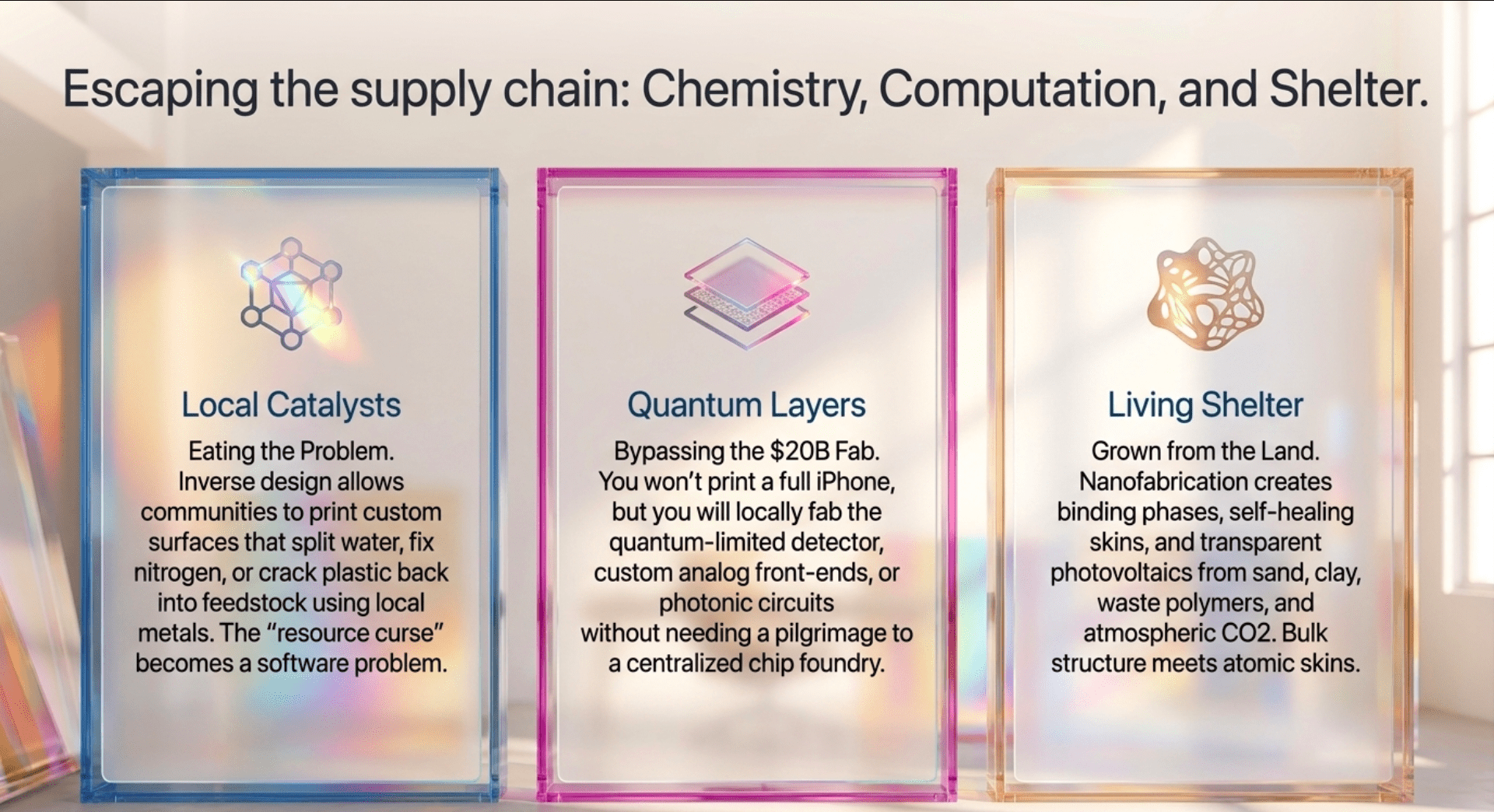
3. A catalyst that eats a problem instead of a subsidy.
Fertilizer, fuels, water purification, carbon capture, and the quiet miracles of industrial chemistry all hide behind catalysts that took decades to discover and factories to scale. Inverse design plus atomic assembly means you can demand a surface that splits water, fixes nitrogen, or cracks a plastic back into feedstock—and then build that surface on a cheap support from local metals. Communities that were told they must import ammonia or export raw ore will write the chemistry that makes food and fuel from air, water, and sunlight. The “resource curse” starts to look like a software problem.
4. Electronics and quantum devices that are not born in a $20 billion cathedral.
ORNL already forced electrons into a homemade graphene and watched them obey. That is the seed of sensors, memory, photonic circuits, and topological qubits assembled where they are needed. You will not fab an iPhone in a closet in 2031. You will fab the one layer that used to require a pilgrimage to Taiwan or Arizona: the quantum-limited detector, the on-chip optical router, the superconducting interconnect, the custom analog front end for a farm, a clinic, a radio telescope in the backyard. The cathedral remains for a while. The side chapels multiply until the cathedral is optional.
5. Structural and living-space materials grown from what the land already is.
Sand, clay, carbon, cellulose, scrap aluminum, waste polymers, atmospheric CO₂. Combined with nearly free energy and robotic handling, nanofabrication does not have to assemble every brick atom by atom to change housing. It has to create the binding phases, the moisture membranes, the radiative coatings, the self-healing skins, the antimicrobial surfaces, the transparent photovoltaics that turn a wall into a quiet power plant. The house becomes a designed material system instead of a pile of catalog SKUs trucked across a continent. This is how the garage microfactory in the 5000 Days thesis stops being a metaphor.
From Discovery to Authorship
Narasimha said they are moving from discovering materials in nature to engineering artificial lattices. Sit with that. Every empire you can name was an argument about who got to stand between a person and a material. Bronze. Iron. Coal. Oil. Rare earths. The semiconductor. The argument was always dressed as geology or capital or national security. Underneath it was a simpler fact: the good stuff was scarce, buried, or hard to purify, so whoever controlled the hole in the ground or the clean room controlled the rest of us.
Programmable matter ends the honesty of that argument. Scarcity becomes a temporary software limit. The hole in the ground still matters for a generation. Then it matters less. Then it matters as history.
I have been saying for years that we will not need to find the materials. We will replicate them atom by atom. Oak Ridge did not finish that sentence. They started the paragraph that makes the sentence inevitable. Twenty-five hours. Thirty-seven molecules. A Dirac point that was not mined. A name spelled in matter.
The Final Blow to Central Control Through Earth, Air And Water
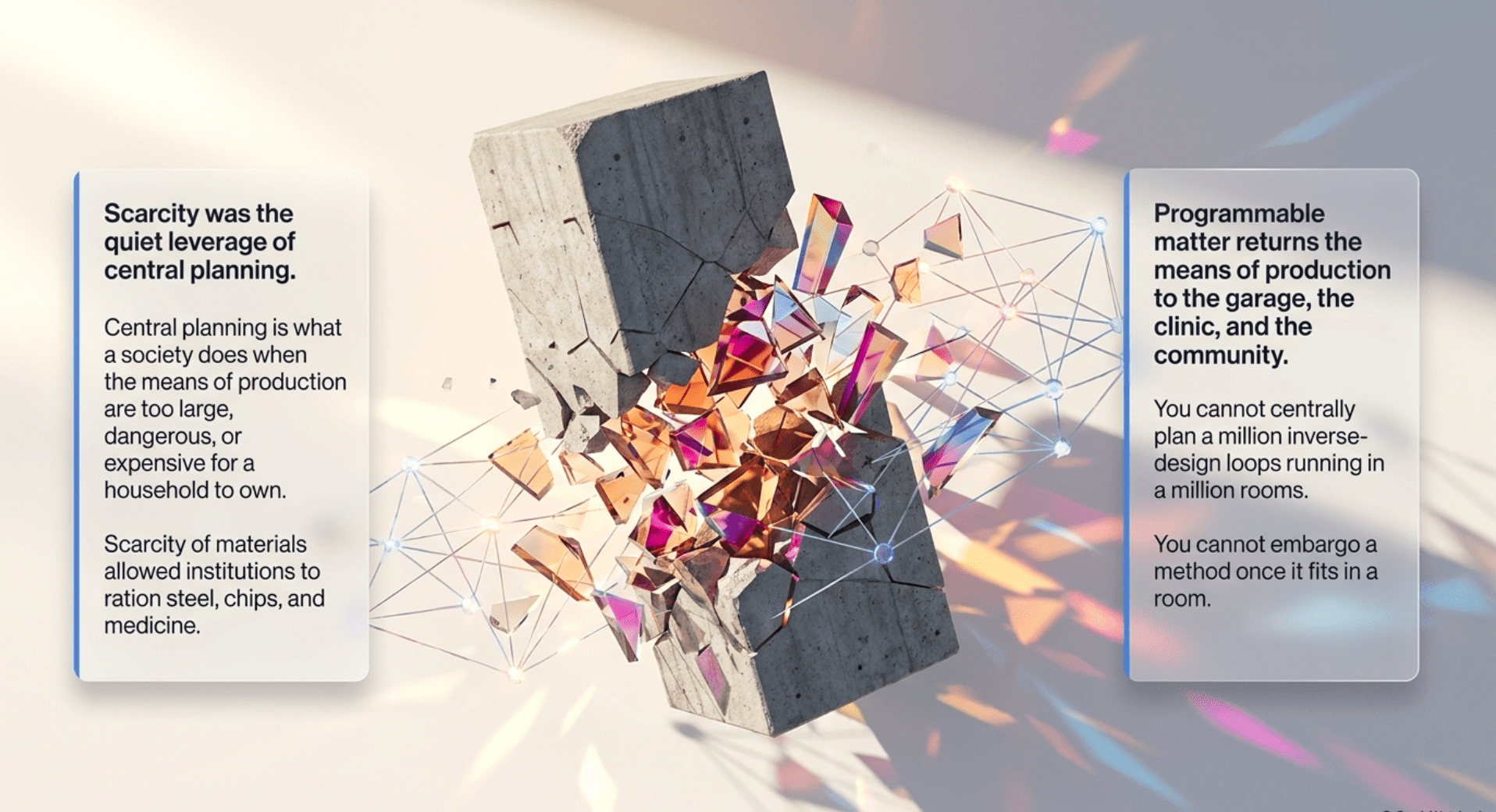
This is the first of eight things I need to say without flinching. Central planning is not a personality defect of this party or that decade. It is what a society does when the means of production are too large, too dangerous, or too expensive for a household to own. Factories, mines, grids, ports, and fabs became the natural habitat of ministries and boards because no family could hold them. The twentieth century then made a theology out of that accident. It taught us that intelligence must live at the center if matter is to move at the edge. Oak Ridge just published a counter-theology in ACS Nano: intelligence can live at the tip of a needle, and the needle can live anywhere the energy and the feedstock can reach.
It is important to note that once a single nanofabricator is built, the next thing it builds is another. And another. This is a momentum no one can stop. This is the end to political systems that want or need central control and aggrieved classes. This is the end to scarcity mindsets.
In the 5000 Days series I have called this stretch of years the Abundance Interregnum. It is not utopia and it is not collapse. It is the interval in which the old king is dying and the new law has not been sworn. Jobs unbundle from identity.
Supply chains lose their priesthood. Universal payments may appear as a cast on a broken economic leg. None of that is the destination. The destination is the return of the means of production to the garage, the workshop, the clinic, the village shop, and the circle of people who actually know one another’s names. Atom-by-atom fabrication is how that return becomes physical instead of rhetorical. You cannot centrally plan a million inverse-design loops running in a million rooms. You can only get out of their way—or try to criminalize them and fail.
Central governments are entering their end days in the only sense that matters. They will still print letterhead. They will still hold parades. They will still insist that a permit precedes a molecule. What they will not be able to do is remain the indispensable coordinator of scarcity, because scarcity of materials was their quiet leverage.
A state that rations steel, chips, fertilizer, medicine, and housing is a state that can tell you who you are allowed to be.
A state that watches those same goods assemble themselves from local atoms and local watts is a state that must rediscover a smaller job: keeping the peace among people who no longer need it to eat. Some governments will accept the demotion and become light, local, and adult.
Some will try to nationalize the replicator. History is not kind to the second group. You cannot embargo a method once the method fits in a room.
Corporations are in the same weather. The joint-stock company was a brilliant machine for gathering capital around processes no individual could finance. That machine becomes less necessary as the capital intensity of making things falls. A massive factory ultimately is a monument to a world in which electrodes could not be grown in a shop. A pharmaceutical campus is a monument to a world in which a lattice could not be specified for one body. Those monuments will not vanish on a Tuesday. They will hollow. The high-margin core migrates to software, to unique design, to trust, to the few processes that still love scale. Everything else becomes a file, a feedstock recipe, and a night of robotic work. The firms that understand this will become libraries and guilds. The firms that do not will become museums that still hold all-hands meetings.
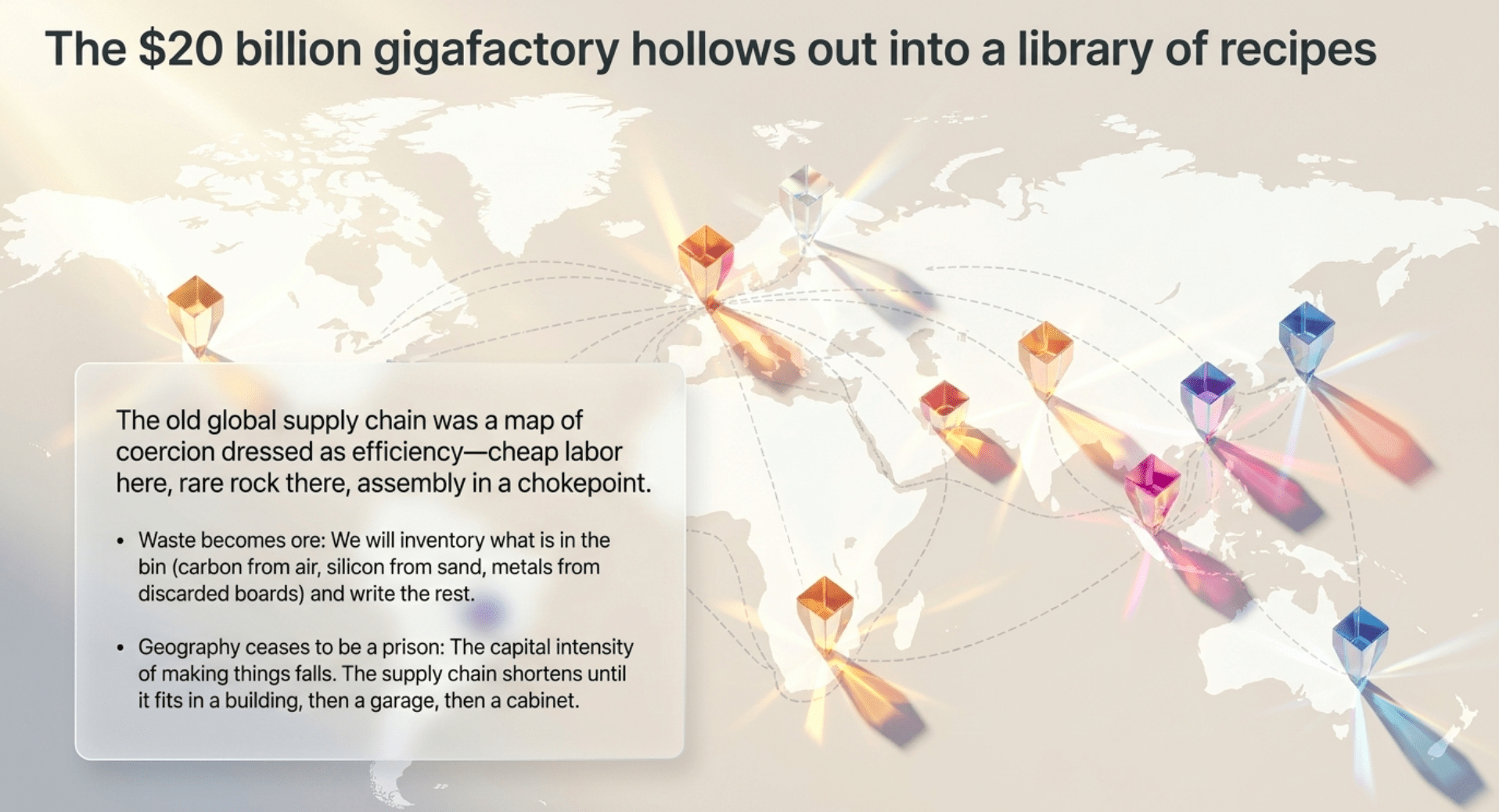
Society will not organize as a single plan from a capital. It will organize the way the 5000 Days work has been describing since Christmas Eve 2025: as voluntary guilds of makers, mutual-benefit circles, household microfactories, and communities that treat AI and robots as tools under human direction rather than as a new clergy.
The Hero’s Journey in that series was never decoration. When a civilization loses the old commands—“you are your job, you are your firm, you are your nation-state’s production quota”—people fall into the dark night that Joseph Campbell mapped. The ones who come through do not wait for a ministry to assign meaning. They pick up a craft. They form a circle. They build the Dynamic Duo of human judgment and machine execution. They record wisdom instead of credentials. Nanofabrication gives that inner work an outer bench. Purpose stops being a slogan and becomes a thing you can hold.
The old global supply chain was a map of coercion dressed as efficiency. Cheap labor over there, cheap energy over here, rare rock under a government that could be leaned on, assembly in a zone that could be taxed, distribution through chokepoints that could be sanctioned.
Every node was a handle.
Programmable matter and nearly free energy cut the handles. When a town can write its own membranes, catalysts, electrodes, and medical lattices, the embargo loses glamour. Trade continues—people like beautiful things and strange ideas—but trade stops being a weapon that can starve a child to prove a theory. That is not a left story or a right story. It is the story of tools returning to hands of the individual, this is where history started and this is where we are heading.
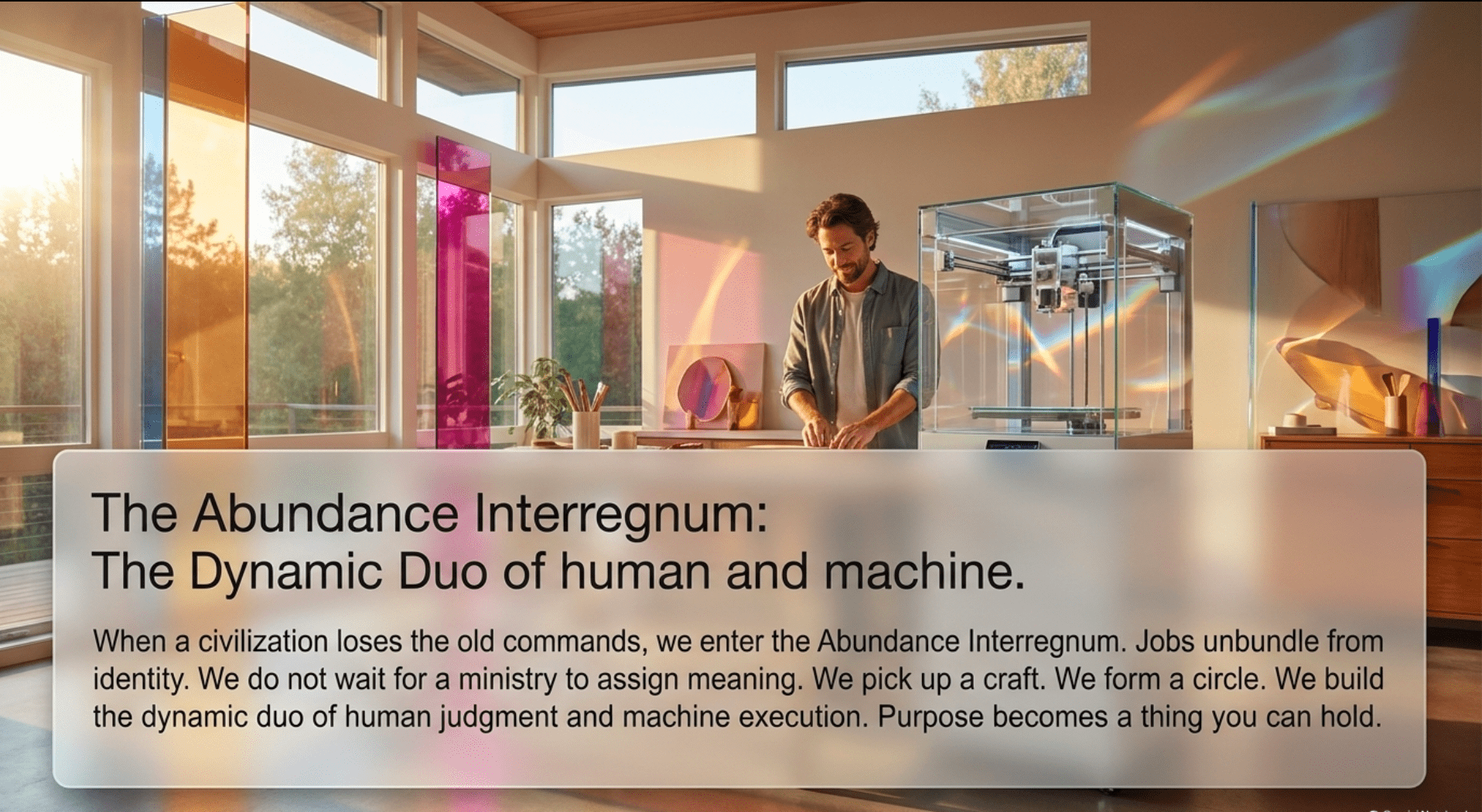
I want to be precise about what “end days” does not mean. It does not mean anarchy next winter. It does not mean the courthouse burns and the lights go out. It means the monopoly on necessary production expires, and with it the moral blackmail that monopoly made possible.
Institutions that deserve to remain will remain because people freely keep them. Institutions that existed to sit on the valve will discover the valve is gone. The 5000 Days clock is already running. Students who graduate in 2026 will live most of their working years inside this reversal. They will not have the career they were sold. They may have something better if they do the inner work and claim the bench: a life in which making is optional as wage and available as joy.
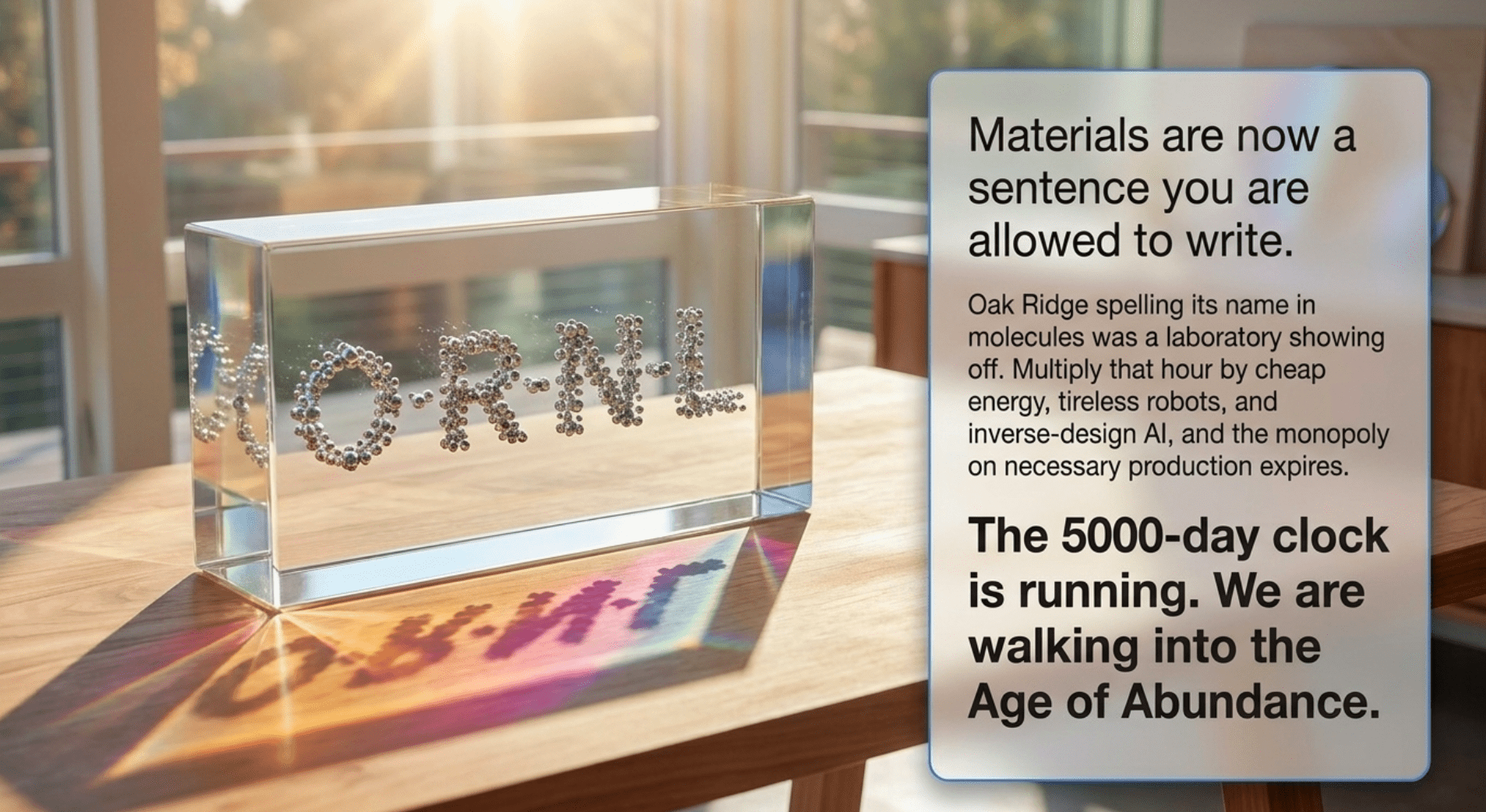
Oak Ridge spelled its own name in molecules. That is a laboratory showing off, and I am glad they did, because the show is the point. Matter answered to a plan that did not require a ministry, a mine, or a market-maker. Multiply that hour by cheap energy, by robots that do not get bored, by models that do not forget a lattice, and by people who have remembered that they were artisans before they were employees.
That is the Age of Abundance I have been talking about since a lecture in 1980. That is why the expert in 2012 needed me disqualified. He was defending a world in which materials were a privilege. We are walking into a world in which materials are a sentence you are allowed to write. We will build anything we need. We will not ask permission of a mountain or a board. We can only see what we think is possible. This week, the possible got a Dirac point.

The 5000 Days Countdown Clock
Support This Work
We are on this journey together. Some of us stand on the shoulders of giants and have thought about this for decades. We will not go it alone, and I hope to build many parts to this series and share the mastermind insight from the powerful Read Multiplex member Forum: https://readmultiplex.com/forums/topic/you-have-5000-days-navigating-the-end-of-work-as-we-know-it/. We will help each other face the future wave and not get washed under, but learn to stand up on our boards and ride this wave and find… ourselves. Join us.
To continue this vital work documenting, analyzing, and sharing these hard-won lessons before we launch humanity’s greatest leap: I need your support. Independent research like this relies entirely on readers who believe in preparing wisely for our multi-planetary future. If this has ignited your imagination about what is possible, please consider donating at buy me a Coffee or becoming a member. Value for value you recieved here.
Every contribution helps sustain deeper fieldwork, upcoming articles, and the broader mission of translating my work to practical applications. Ain ‘t no large AI company supporting me, but you are, even if you just read this far. For this, I thank you.
Stay aware and stay curious,

🔐 Start: Exclusive Member-Only Content.
Membership status:
🔐 End: Exclusive Member-Only Content.
~—~

~—~

~—~
Subscribe ($99) or donate by Bitcoin.
Copy address: bc1qkufy0r5nttm6urw9vnm08sxval0h0r3xlf4v4x
Send your receipt to [email protected] to confirm subscription.

Stay updated: Get an email when we post new articles:

THE ENTIRETY OF THIS SITE IS UNDER COPYRIGHT. IMPORTANT: Any reproduction, copying, or redistribution, in whole or in part, is prohibited without written permission from the publisher. Information contained herein is obtained from sources believed to be reliable, but its accuracy cannot be guaranteed. We are not financial advisors, nor do we give personalized financial advice. The opinions expressed herein are those of the publisher and are subject to change without notice. It may become outdated, and there is no obligation to update any such information. Recommendations should be made only after consulting with your advisor and only after reviewing the prospectus or financial statements of any company in question. You shouldn’t make any decision based solely on what you read here. Postings here are intended for informational purposes only. The information provided here is not intended to be a substitute for professional medical advice, diagnosis, or treatment. Always seek the advice of your physician or other qualified healthcare provider with any questions you may have regarding a medical condition. Information here does not endorse any specific tests, products, procedures, opinions, or other information that may be mentioned on this site. Reliance on any information provided, employees, others appearing on this site at the invitation of this site, or other visitors to this site is solely at your own risk.
Copyright Notice:
All content on this website, including text, images, graphics, and other media, is the property of Read Multiplex or its respective owners and is protected by international copyright laws. We make every effort to ensure that all content used on this website is either original or used with proper permission and attribution when available.
However, if you believe that any content on this website infringes upon your copyright, please contact us immediately using our 'Reach Out' link in the menu. We will promptly remove any infringing material upon verification of your claim. Please note that we are not responsible for any copyright infringement that may occur as a result of user-generated content or third-party links on this website. Thank you for respecting our intellectual property rights.
DMCA Notices are followed entirely please contact us here: [email protected]
