
The Same Founder Sold Apple the Face — Then Sold Apple the Unspoken Word.
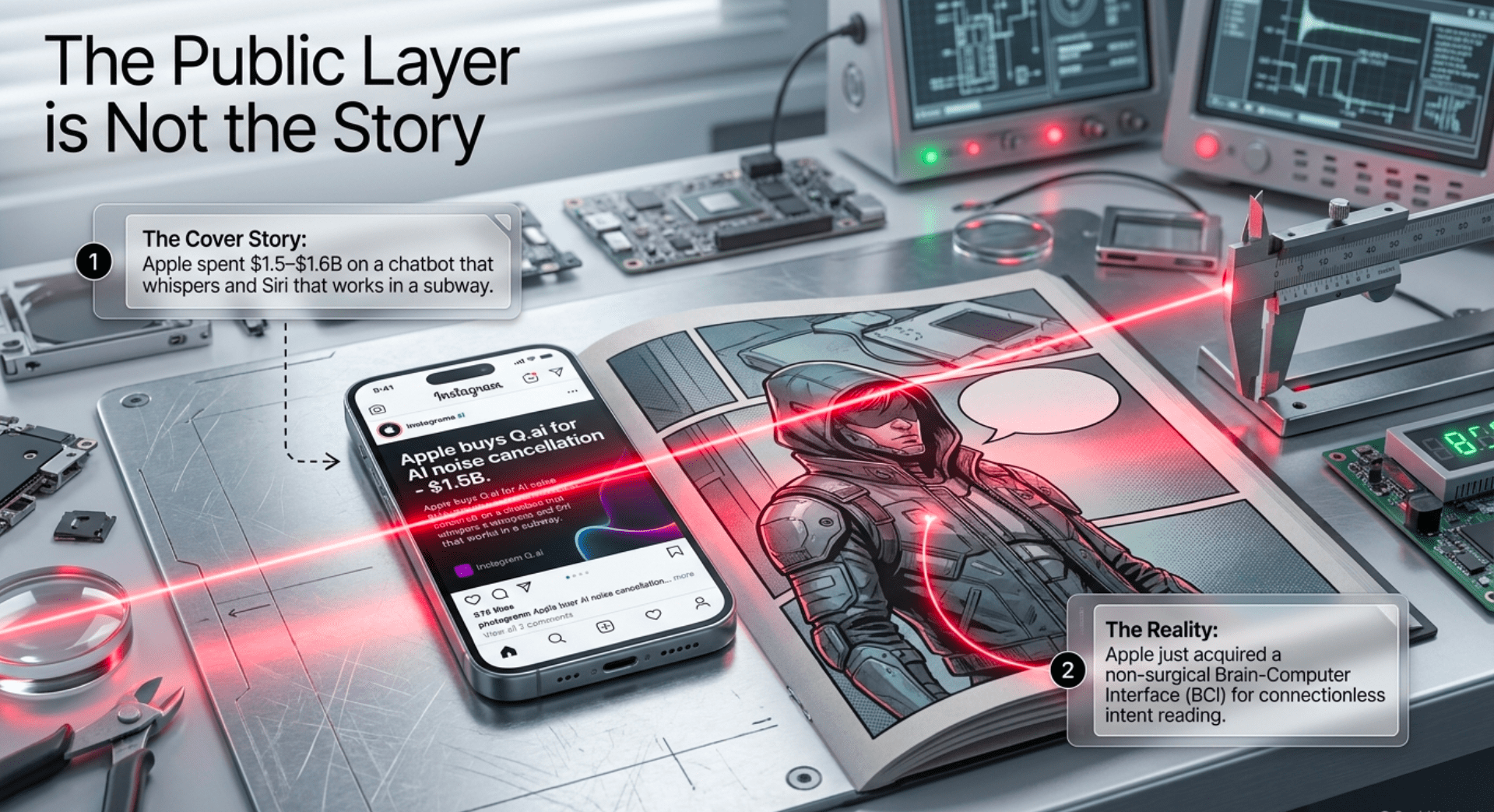
Picture this, you are walking through a library and you had a flash of an idea, you dont want to lose it and your hands are full of books. You just intend to say the note to yourself and maybe slightly mouth the words. What comes out is a not on you iPhone you can look at later. Sounds like the future? Perhaps the near reality. Apple bought an entirely new input layer. It’s a computer interface that no longer requires the physical act of spoken speech. It bypasses the air entirely. But having the patents in a vault in Cupertino is one thing. How does this actually integrate into the Apple devices that you are carrying in your pockets right now. It is Aviad Maizels’ second Cupertino exit that made PrimeSense’s light-coding lineage in FaceID will be turned into connectionless intent reading on iOS. Apple’s new purchase of Q AI has been reported as just another AI shopping trip: whispered speech, noisy rooms, a $1.5–$1.6 billion price, Siri that finally works in a subway. That is the public layer. It is not the story. It’s a story is a 13-year circle.
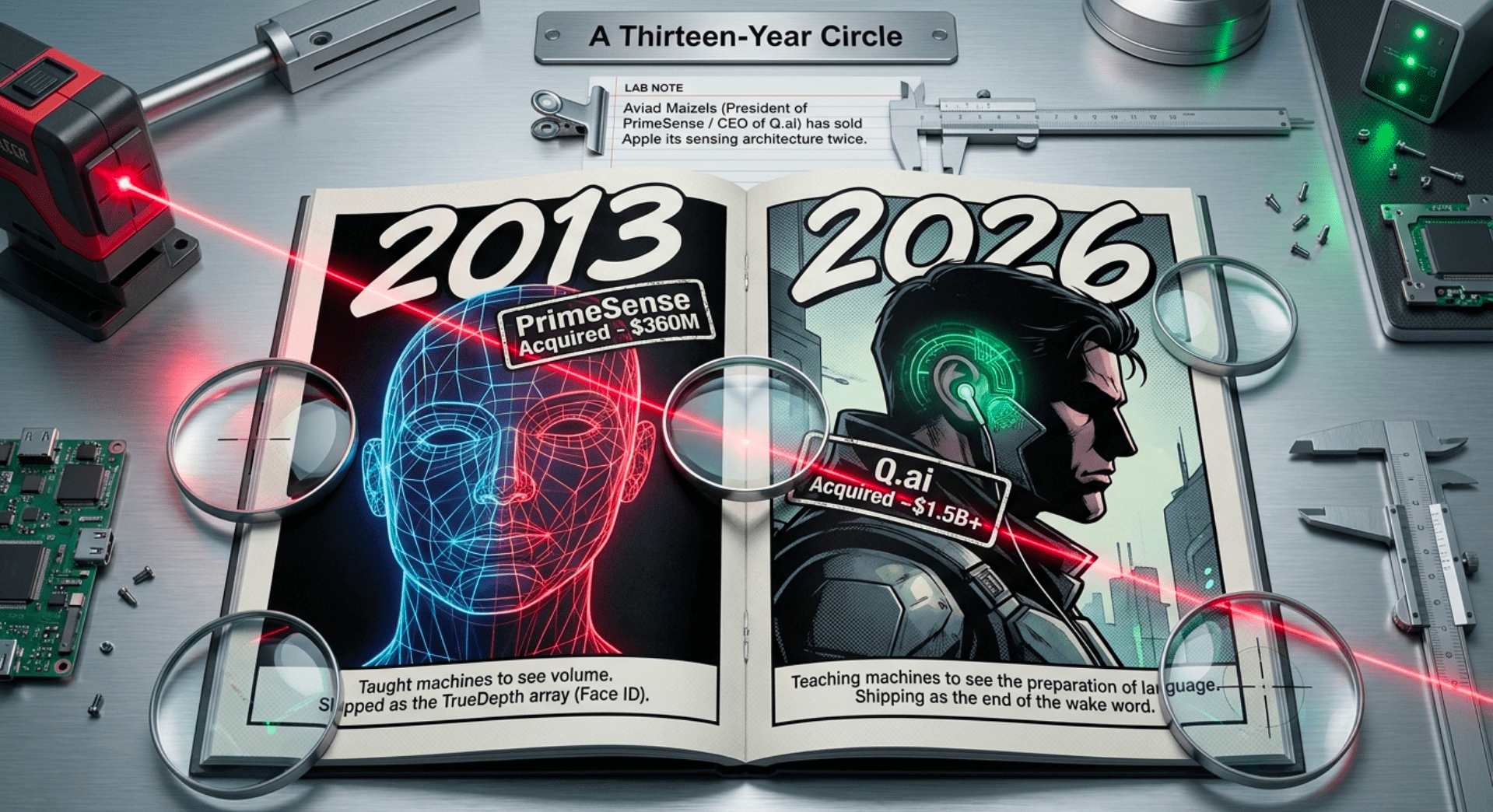
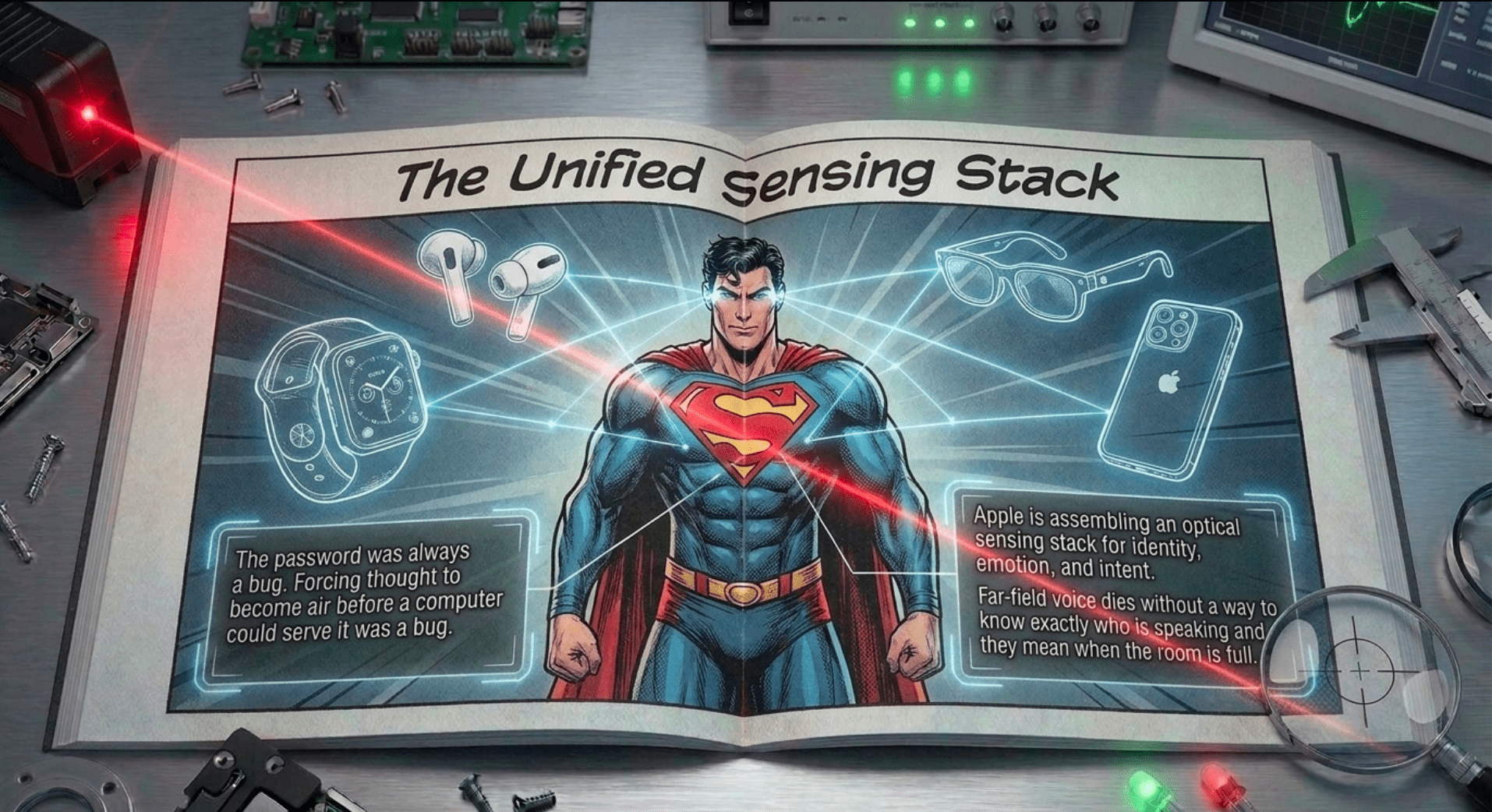
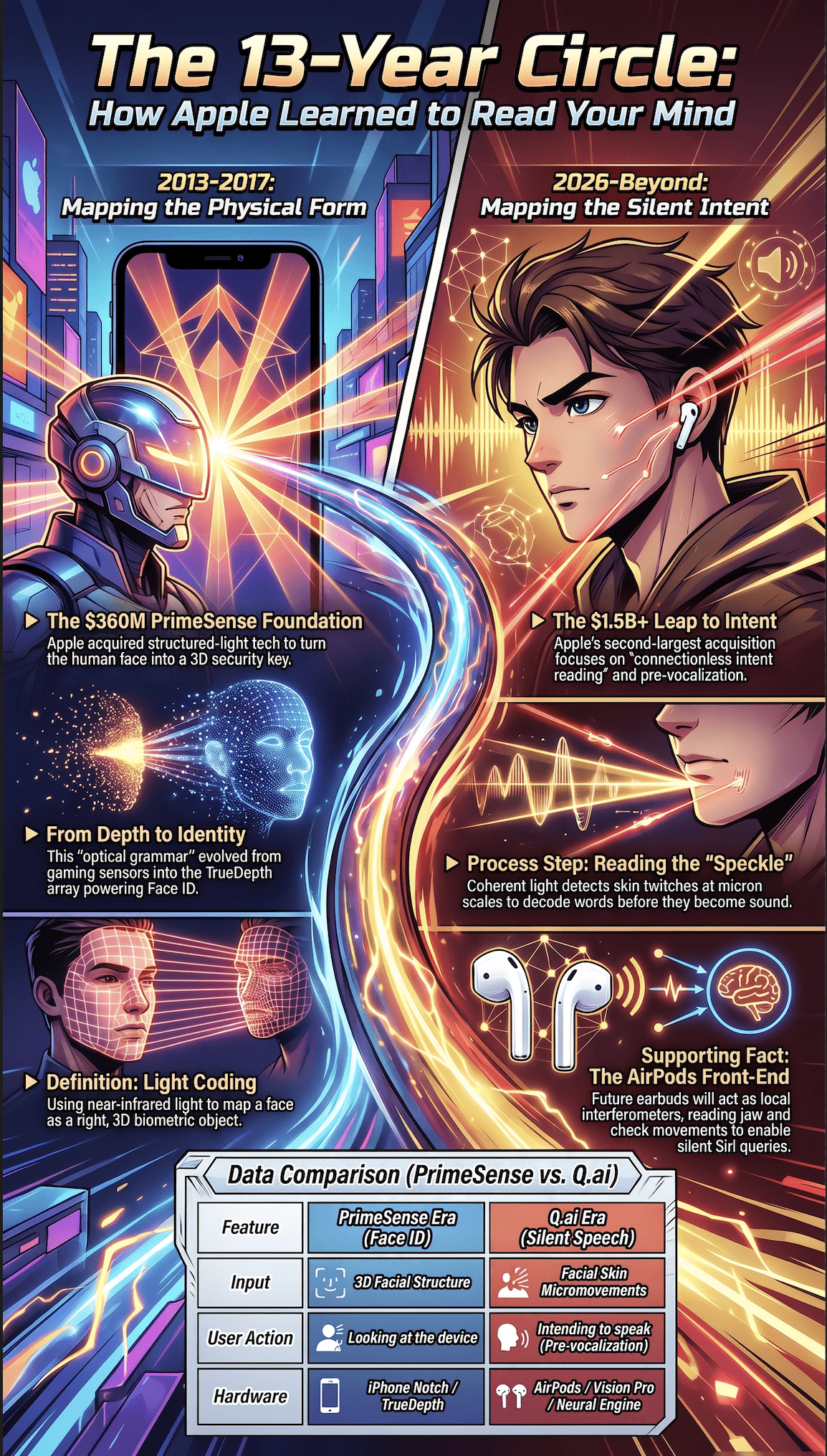
In November 2013 Apple confirmed it had bought PrimeSense, the Tel Aviv company whose structured-light sensor had given Microsoft’s original Kinect its depth eye, for about $360 million. Four years later that same optical grammar — near-infrared light coding a face, a camera reading the distortion — shipped as the TrueDepth array behind Face ID. I wrote that arc as it was forming: PrimeSense was never a gaming leftover. It was the first tile in an Israeli sensing stack Apple was assembling for identity, emotion, and Voice First devices that would not need a password.
This article is sponsored by Read Multiplex Members who subscribe here to support my work: Link: https://readmultiplex.com/join-us-become-a-member/
It is also sponsored by many who have donated a “Cup of Coffee”. If you like this, help support my work: Link: https://ko-fi.com/brianroemmele
Listen to the companion podcast: https://rss.com/podcasts/readmultiplex-com-podcast/3110707
I have a history with this founder’s work. I talked about this before anyone understood on Quora and my research was syndicated as [Apple’s RealFace Acquisition and What It Really Means] (https://www.forbes.com/sites/quora/2017/02/22/why-did-apple-acquire-facial-recognition-company-realface) and again when Face ID launched, in: Meet Apple Face ID here on this site so long ago:
Also: [Inc syndication of the same Quora announcement](https://www.inc.com/quora/apples-realface-acquisition-and-what-it-really-means.html)
The president and co-founder of PrimeSense was Aviad Maizels. In January 2026 the same man, now CEO of Q AI (formerly Q / Cue Ltd.), sold Apple a second company. Reports put the deal between $1.5 billion and close to $2 billion — Apple’s second-largest acquisition after Beats. Johny Srouji called the firm “remarkable.” Maizels and co-founders Yonatan Wexler and Avi Barliya are going inside.
Apple did not buy a chatbot. It bought a way to read words that are not fully spoken.
Two sales, one physics problem
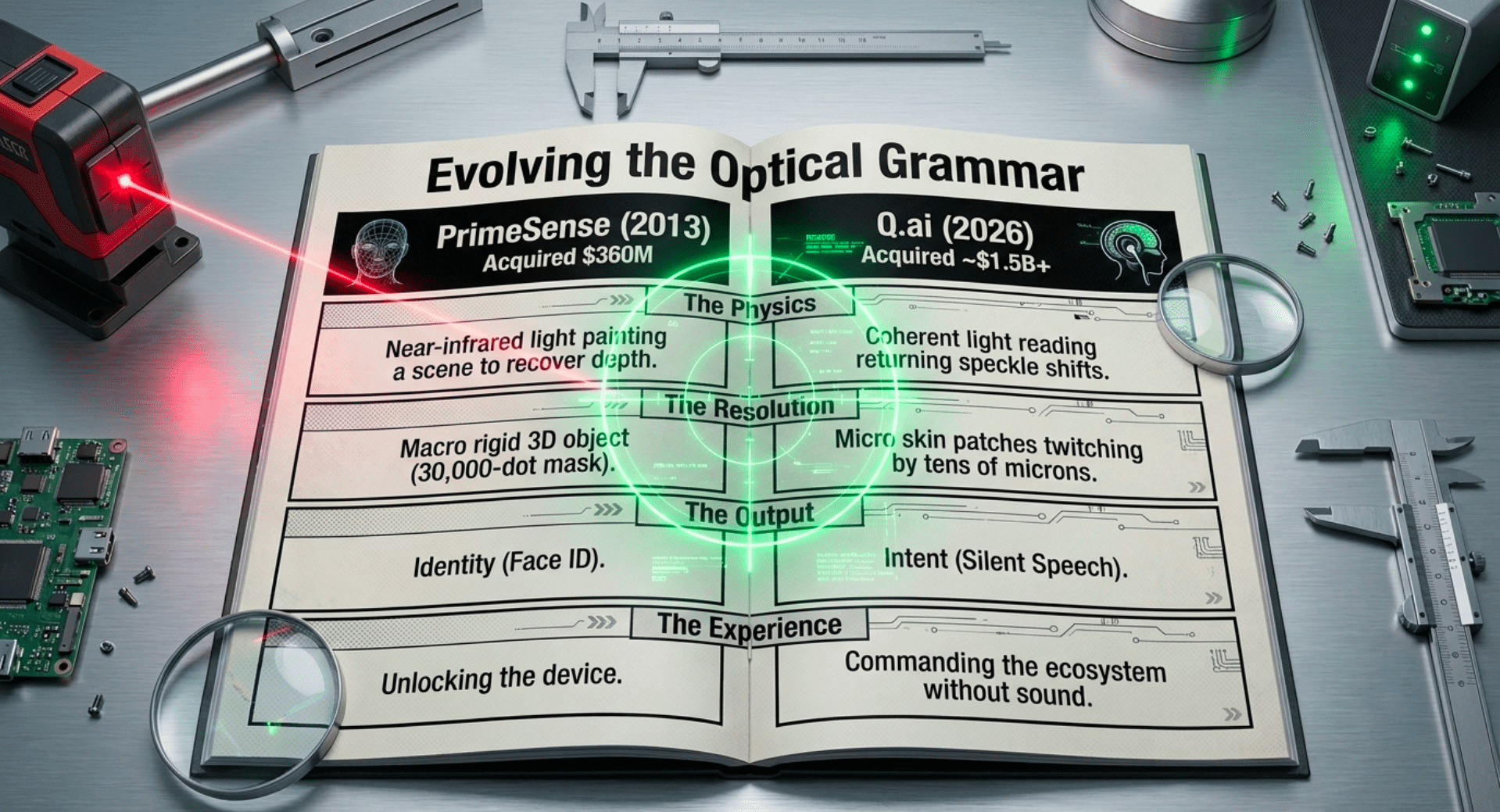
PrimeSense’s trick was light coding. Near-infrared light painted a scene. Geometry warped the pattern. A cheap CMOS sensor and software recovered depth. Shrink that idea, aim it at a face, add a dot projector and an infrared camera, and you get the 30,000-dot mask that became Face ID.
Q AI’s trick is the next resolution down. Instead of mapping a face as a rigid 3D object, the patents describe shining coherent light — usually infrared — onto a small patch of facial skin and reading the speckle that comes back. When the muscles that form a vowel twitch by tens of microns, the speckle shifts. A network maps that shift onto phonemes, words, even an intention to speak that has not yet become sound. No electrode on the throat. No contact with the skin. A wearable housing at the ear is enough.
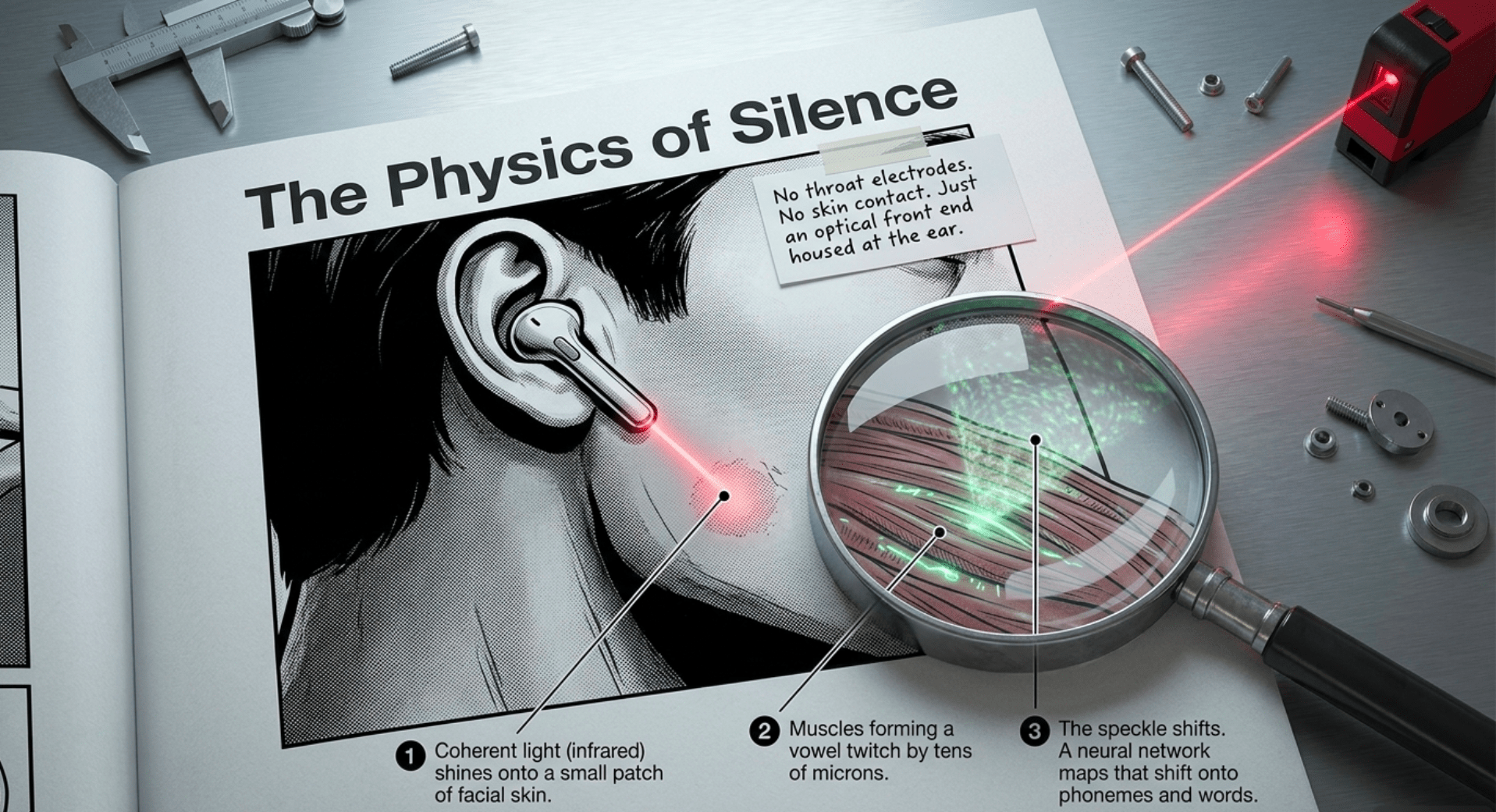
That is why the Instagram post is both right and incomplete. Whispered speech and noise-robust audio are the cover story Apple can say out loud. The patent family is about silent speech, pre-vocalization, and private answers to questions nobody in the room heard you ask.
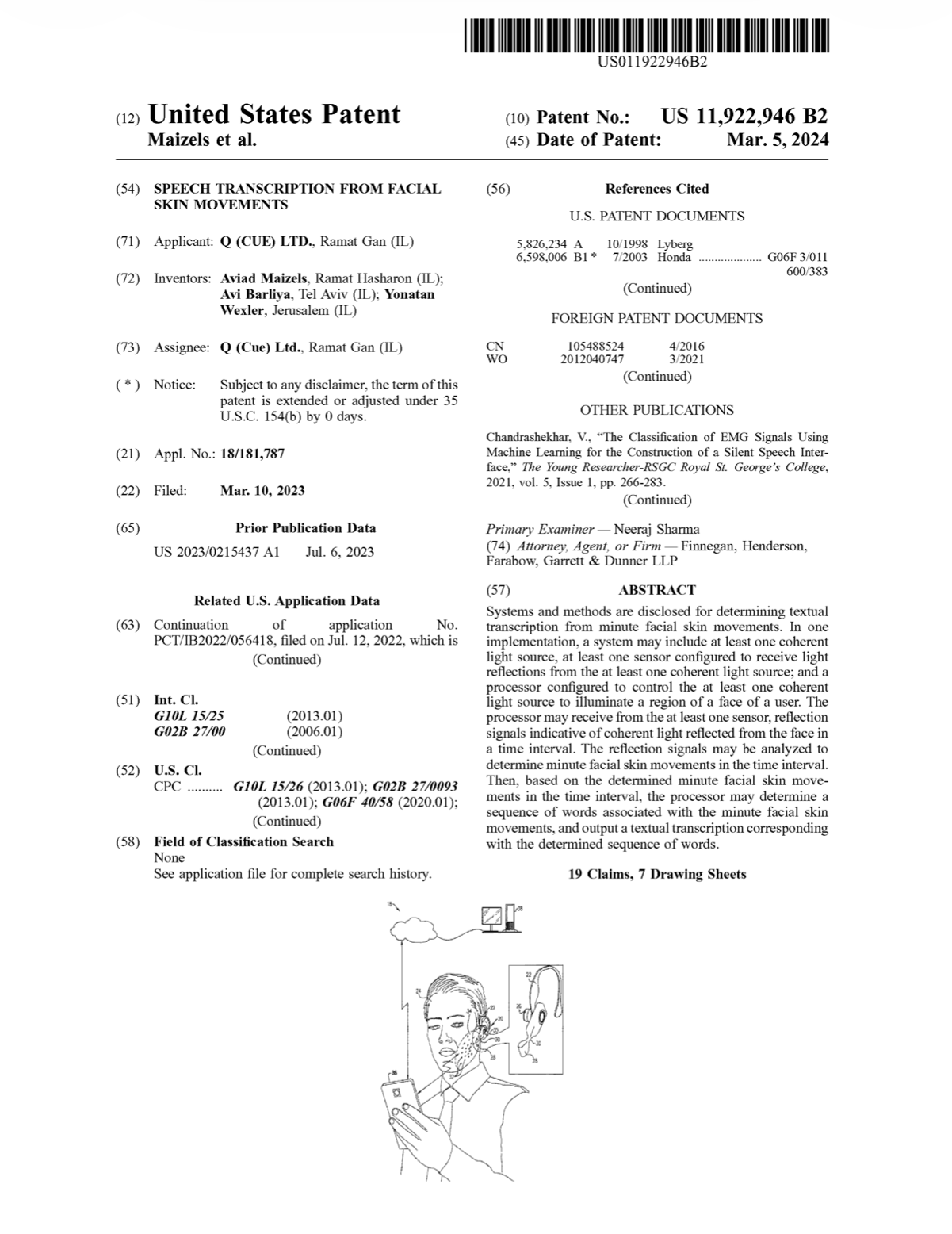
The patent stack Apple just bought Q AI filed as Q (Cue) Ltd. The portfolio is not one invention. It is a product architecture written in claims.
Reading the face without touching it
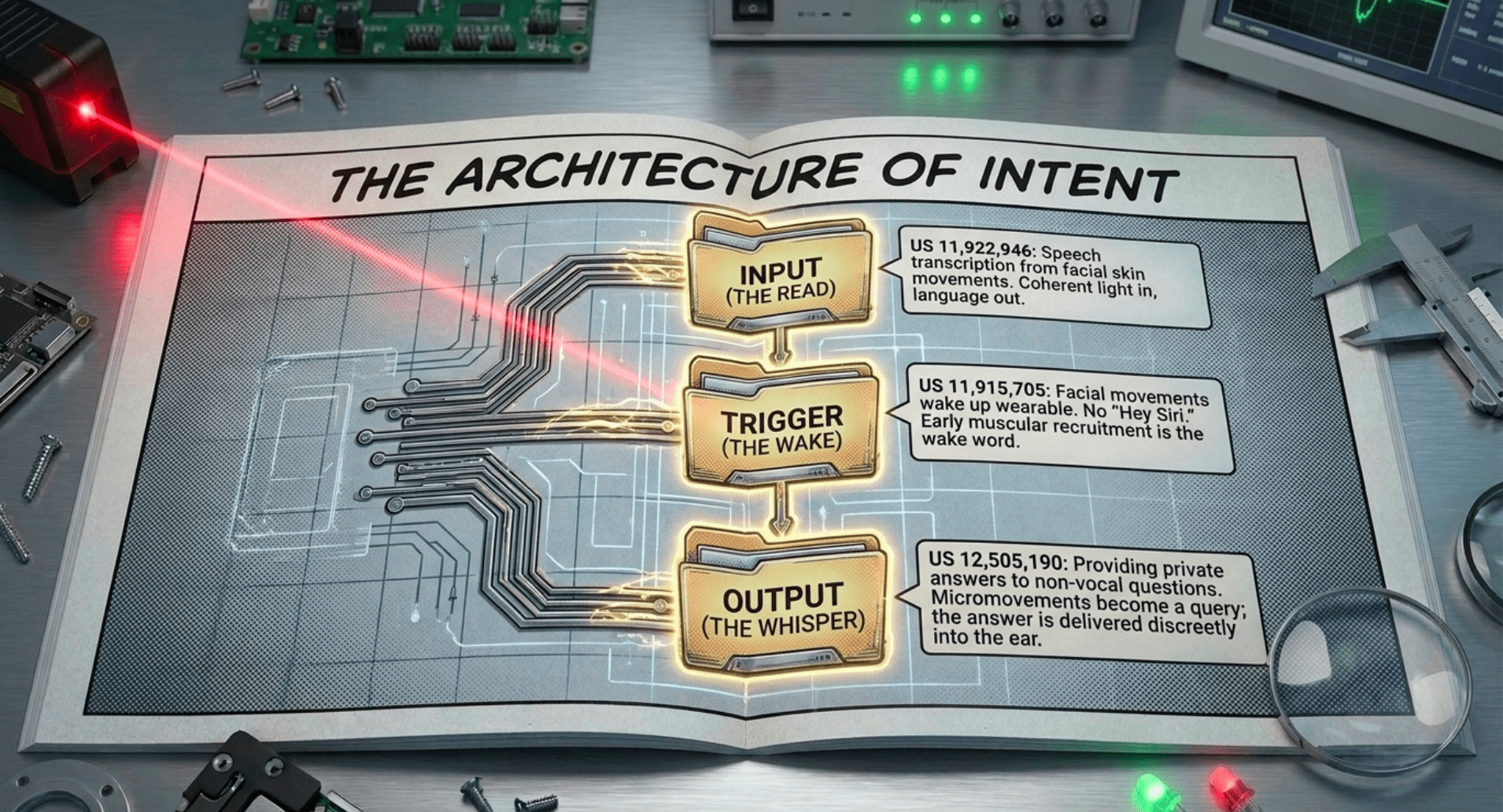
– [US 11,922,946 — Speech transcription from facial skin movements](https://patents.google.com/patent/US11922946B). Coherent light on skin, speckle in, language out.
– [US 12,254,882 family — Speech detection from facial skin movements](https://patents.google.com/patent/US12254882B2). Same optical channel, detection rather than full transcription.
– [WO 2023/012546 — Deciphering of detected silent speech](https://patents.google.com/patent/WO2023012546A1). The international parent: generate speech from skin motion of people who articulated words without contact.
The ear is the sensor housing
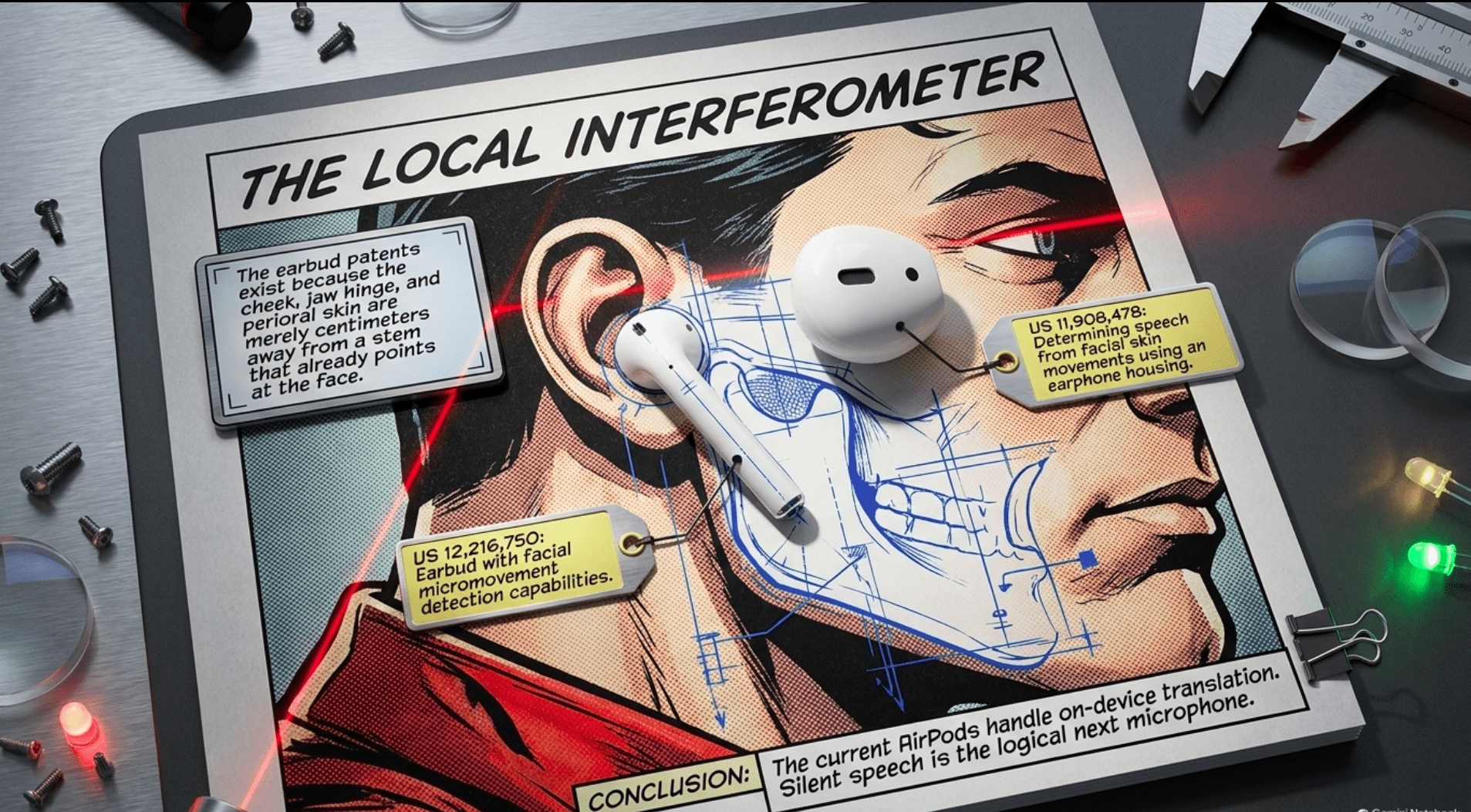
– [US 12,216,750 — Earbud with facial micromovement detection capabilities](https://patents.google.com/patent/US12216750B2). This is the AirPods claim set.
– [US 11,908,478 — Determining speech from facial skin movements using a housing supported by ear or associated with an earphone](https://patents.google.com/patent/US11908478B2).
Wake, intent, and words that have not happened yet
– [US 11,915,705 — Facial movements wake up wearable](https://patents.google.com/patent/US11915705B2). No “Hey Siri.” The early muscular recruitment of speech is the wake word.
– [US 12,340,808 — Initiating an action based on a detected intention to speak](https://patents.google.com/patent/US12340808B2).
– [US 12,105,785 and related — Interpreting words prior to vocalization](https://patents.google.com/patent/US12105785B2). The title is the product.
Privacy as a feature, not a press release
– [US 12,505,190 — Providing private answers to non-vocal questions](https://patents.google.com/patent/US12505190B2). Micromovements in the absence of perceptible voice become a query. The answer comes back as a discreet output — into an ear, not into a room.
– Related grants cover continuous authentication from micromovement patterns, emotion and heart-rate from the same optical channel, threshold intensity so a twitch does not fire Siri, and noise suppression that uses the optical path to tell a microphone which sound is yours.
Read those titles in order and you do not have an audio company. You have an input layer for a computer that no longer needs you to perform speech.
What “connectionless intent reading” actually means on iOS. The phrase sounds like science fiction. The patents make it an engineering sentence. Connectionless here is not a radio term. It is the opposite of every voice assistant shipped since 2011. You do not connect a session by saying a wake word. You do not pair a new dongle. You do not open an app and hold a button. You do not even finish the word. The device is already optically coupled to the only network that matters: the motor plan on your face. The earbud is a local interferometer. The iPhone is the on-device model. Nothing has to go to the cloud for the first hop.
Intent reading is the claim in US 12,340,808 and the pre-vocalization pair. Speech is not a sound event. It is a cascade: intent, motor planning, recruitment of facial and laryngeal muscle, then air.
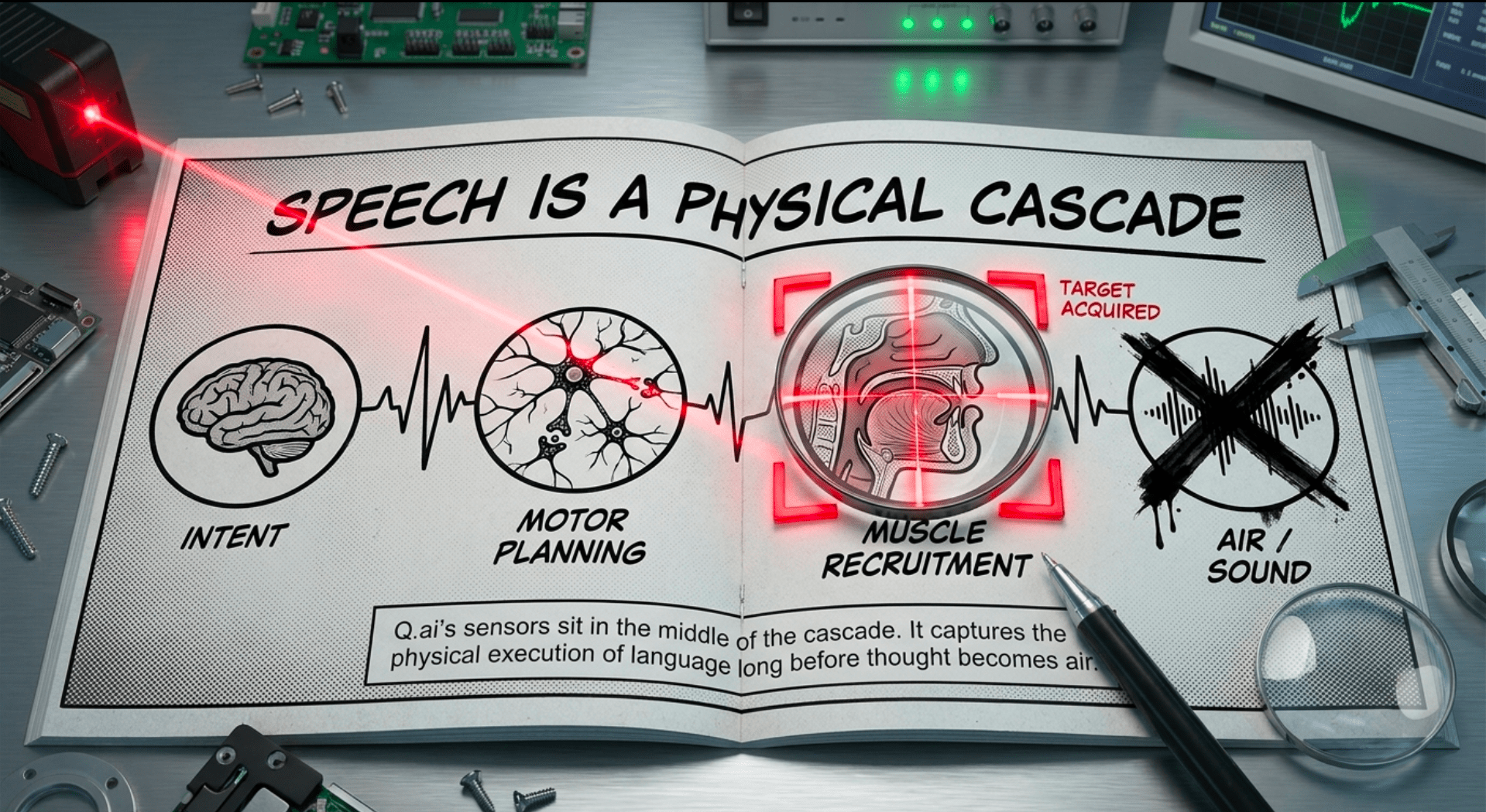
Q AI’s sensors sit on the middle of that cascade. Apple already predicts a click from a pupil on Vision Pro. This is the mouth’s version of that same idea — a crude, wearable, non-surgical brain-computer interface that never has to call itself one.

The speech cascade is crucial because most people misunderstand what speech actually is. We think of speech as a sound event. But sound is literally just the final exhaust of a much longer process. The very end of the line. First, there’s the intent, the thought in your brain. Second, your brain creates a motor planning signal. Third, there is the recruitment of your facial and laryngeal muscles to execute that plan. And finally, fourth, air gets pushed from your lungs through those muscles to create sound. Old voice technology only interacts with step four, the air.
On an iOS device the stack writes itself:
1. AirPods as the optical front end. The earbud patents exist because the cheek, jaw hinge, and perioral skin are a few centimeters from a stem that already points at the face. A low-power coherent source and a detector can live in the next stem or in the charging-case generation after that. The current AirPods already do on-device translation and conversation boost. Silent and pre-speech are the logical next microphone.
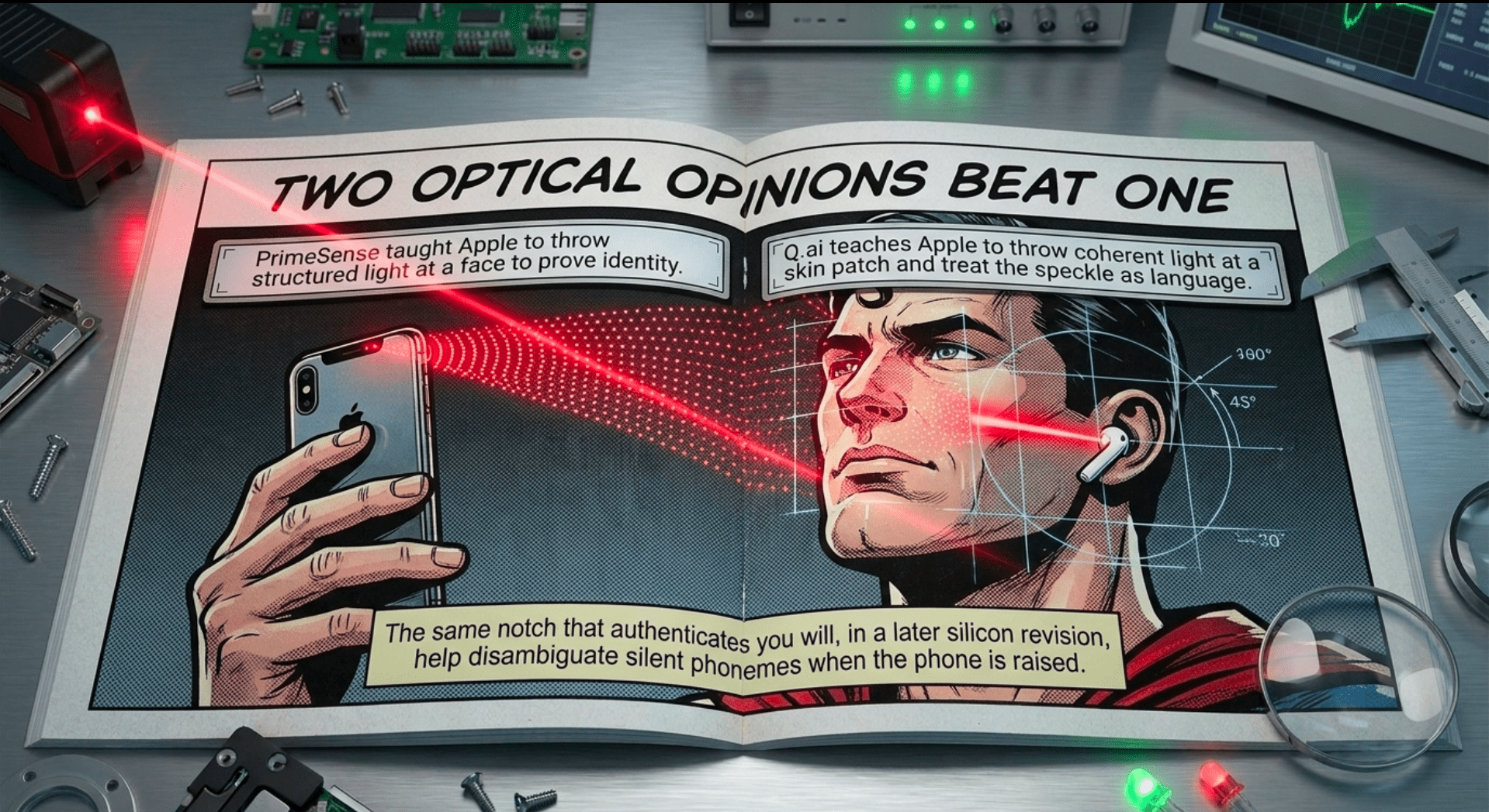
2. iPhone TrueDepth as the second camera. PrimeSense taught Apple to throw structured light at a face.
Q AI teaches it to throw coherent light at a patch and treat speckle as language. The same notch that authenticates you can, in a later silicon revision, help disambiguate silent phonemes when the phone is raised. Two optical opinions beat one.
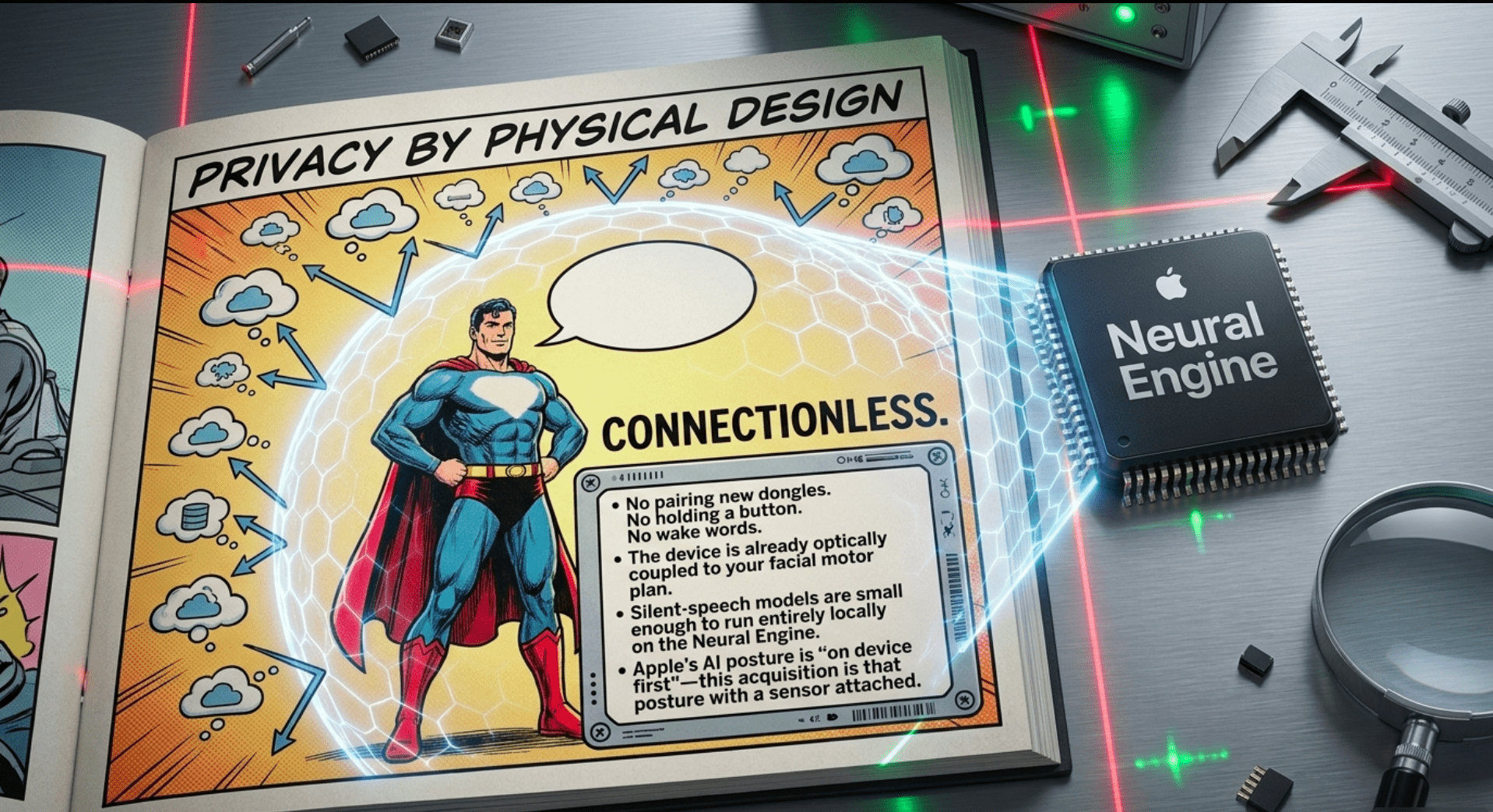
3. The Neural Engine as the decoder. Silent-speech models are small enough, in the patent descriptions, to run locally. That is the only way private answers to non-vocal questions stay private. Apple’s whole AI posture in 2026 is “on device first.” This acquisition is that posture with a sensor attached.
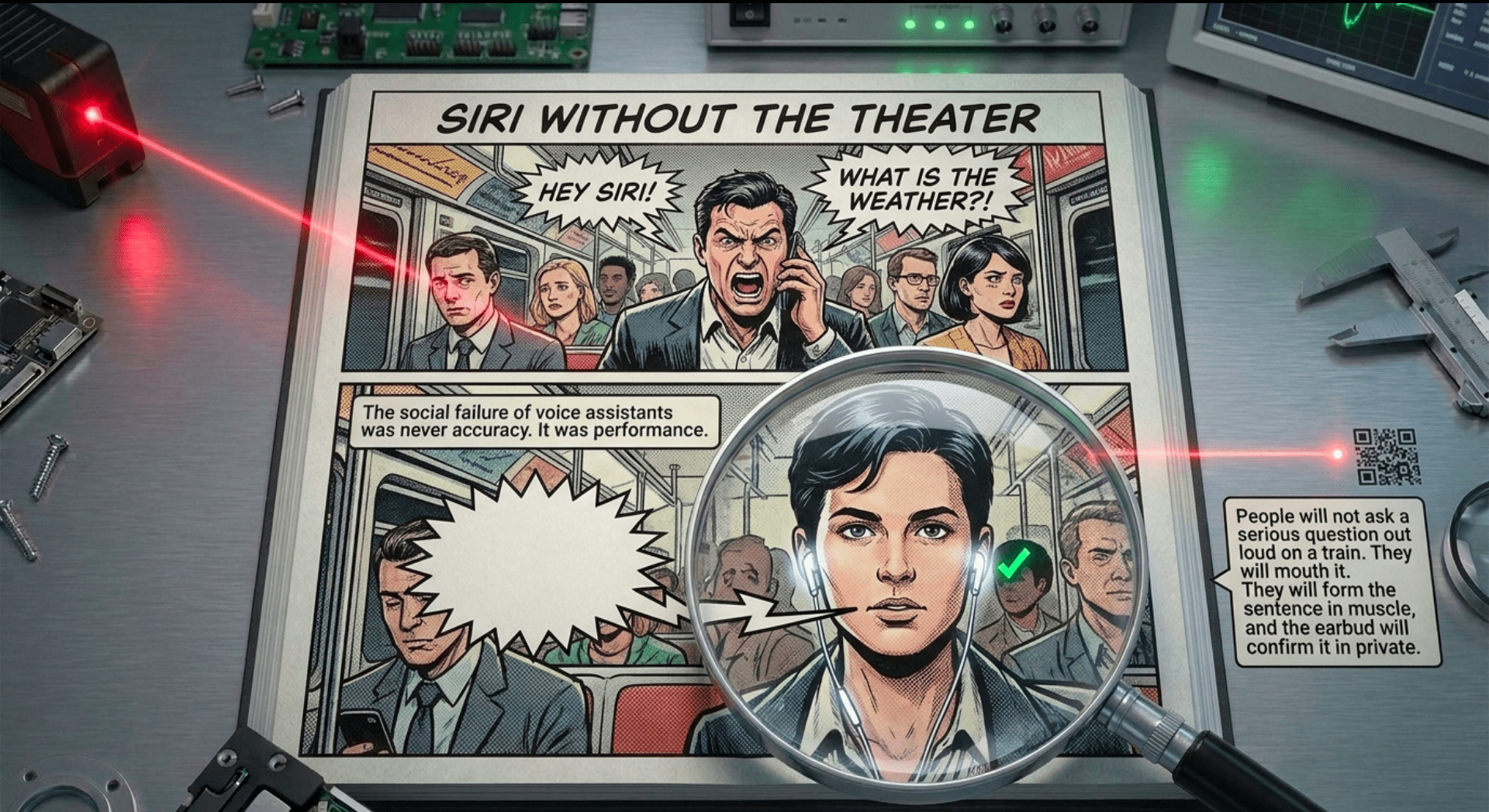
4. Siri without theater. The social failure of voice assistants was never accuracy. It was performance. People will not ask a serious question out loud on a train. They will mouth it. They will not say “Hey Siri, send $400 to my sister.” They will form the sentence in muscle and let the ear confirm it in private. US 12,505,190 is that product, written in 2023.
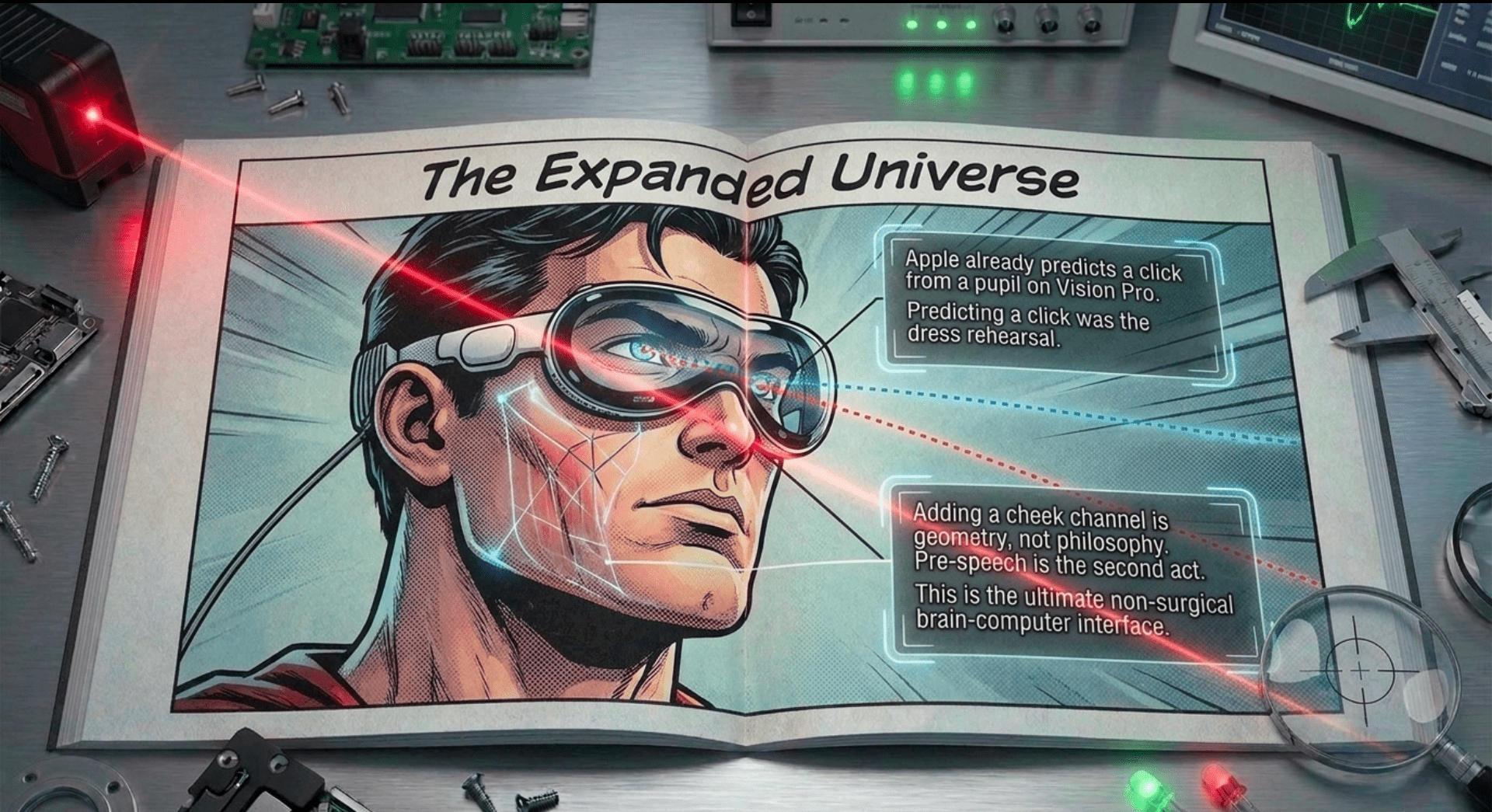
5. Vision Pro and the glasses that have not been named. A headset already stares at your eyes. Adding a cheek channel is geometry, not philosophy. Predicting a click from the pupil was the dress rehearsal. Pre-speech is the second act.
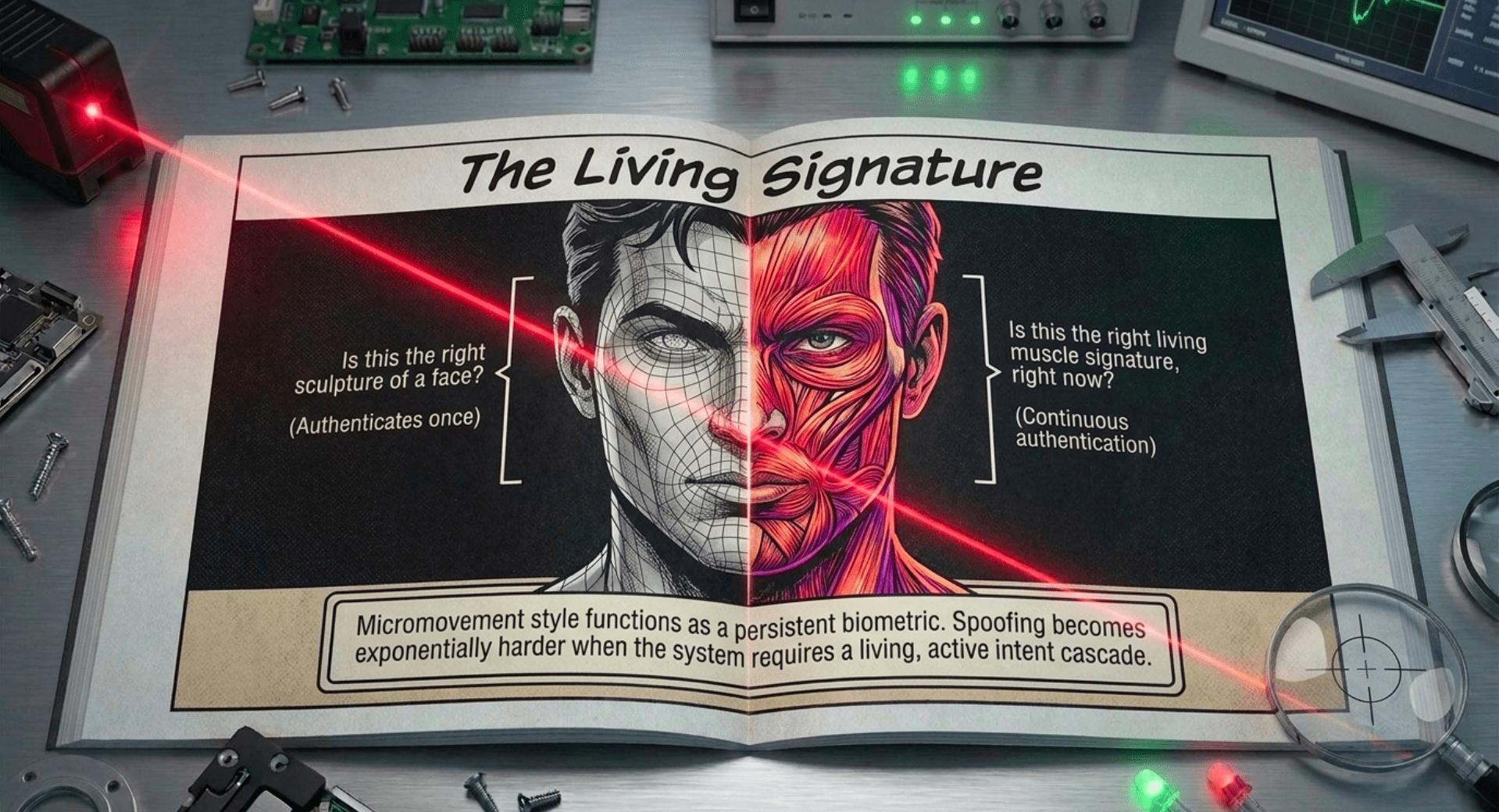
6. Authentication that never stops. One grant treats micromovement style as a biometric. Face ID asks “is this the right sculpture of a face?”
Q AI asks “is this the right living muscle signature, right now?” Combined, spoofing gets harder in the exact way Touch ID got harder when it learned liveness.
Why the same founder, twice This is not coincidence and it is not nostalgia.
Maizels’ first company taught machines to see the world as volume. Apple used that to stop asking for a fingerprint and to give ARKit a floor. His second company teaches machines to see the preparation of language. Apple is using that to stop asking for a wake word.
PrimeSense to Face ID took four years of silence. Expect a similar latency. The 2013 deal looked like a living-room gesture play. It shipped as a phone unlock. The 2026 deal looks like better Siri in a loud café. Watch the ear, the glasses, and the moment iOS stops requiring you to speak in order to be heard.
There is a straight line from the Quora piece in 2017 — PrimeSense plus RealFace plus Emotient as the identity and affect layer of Voice First — to this purchase. I argued then that far-field voice dies without a way to know who is speaking and what they mean when the room is full. Silent speech from facial skin is that argument made optical. The password was always a bug. So was the requirement that thought become air before a computer could serve it.
The caveats that matter
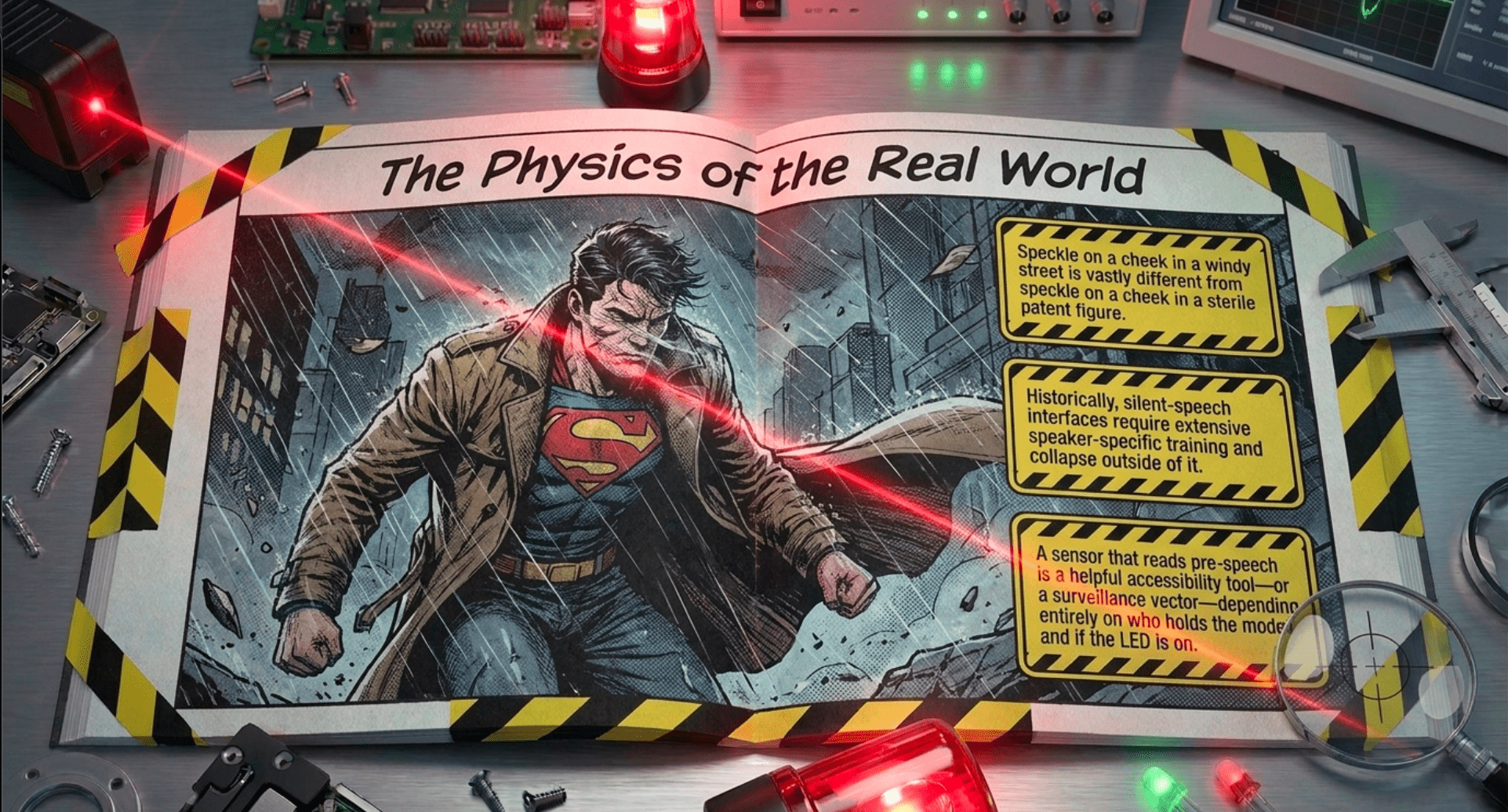
Apple has not said how Q AI will ship. Price estimates still disagree by half a billion dollars. Silent-speech interfaces in the lab have historically needed speaker-specific training and have collapsed outside it. Speckle on a cheek in a windy street is not speckle on a cheek in a patent figure. Privacy advocates will notice, correctly, that a sensor which reads pre-speech can be described as helpful or as surveillance depending on who holds the model and whether the LED is on.
Those are real constraints. They are not the invention. The invention is that Apple now owns, from the same Tel Aviv founder, both the camera that proved you are you and the camera that can hear the sentence you have not said.
In 2013 the question was: why would Apple pay hundreds of millions for a Kinect supplier? The answer, four years later, was on the front of every iPhone.
In 2026 the question is: why would Apple pay more than four times that for a company with no product and a laser aimed at a cheek?
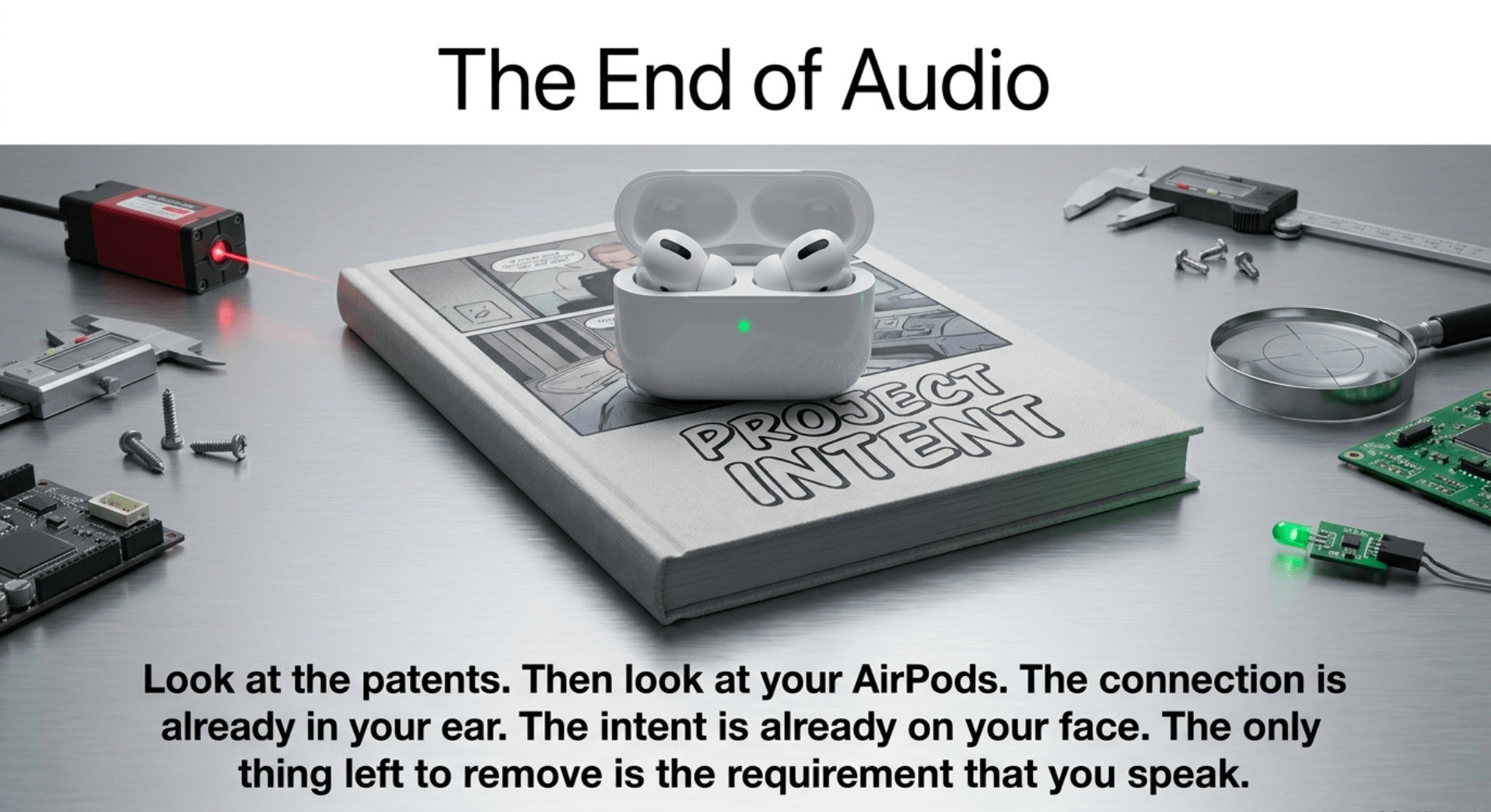
Look at the patents. Then look at your AirPods. The connection is already in your ear. The intent is already on your face. The only thing left to remove is the requirement that you speak.
Support This Work
To continue this vital work documenting, analyzing, and sharing these hard-won lessons before we launch humanity’s greatest leap: I need your support. Independent research like this relies entirely on readers who believe in preparing wisely for our multi-planetary future. If this has ignited your imagination about what is possible, please consider donating at buy me a Coffee or becoming a member. Value for value you recieved here.
Every contribution helps sustain deeper fieldwork, upcoming articles, and the broader mission of translating my work to practical applications. Ain ‘t no large AI company supporting me, but you are, even if you just read this far. For this, I thank you.
Stay aware and stay curious,
🔐 Start: Exclusive Member-Only Content.
Membership status:
🔐 End: Exclusive Member-Only Content.
~—~
~—~

~—~
Subscribe ($99) or donate by Bitcoin.
Copy address: bc1qkufy0r5nttm6urw9vnm08sxval0h0r3xlf4v4x
Send your receipt to [email protected] to confirm subscription.

Stay updated: Get an email when we post new articles:

THE ENTIRETY OF THIS SITE IS UNDER COPYRIGHT. IMPORTANT: Any reproduction, copying, or redistribution, in whole or in part, is prohibited without written permission from the publisher. Information contained herein is obtained from sources believed to be reliable, but its accuracy cannot be guaranteed. We are not financial advisors, nor do we give personalized financial advice. The opinions expressed herein are those of the publisher and are subject to change without notice. It may become outdated, and there is no obligation to update any such information. Recommendations should be made only after consulting with your advisor and only after reviewing the prospectus or financial statements of any company in question. You shouldn’t make any decision based solely on what you read here. Postings here are intended for informational purposes only. The information provided here is not intended to be a substitute for professional medical advice, diagnosis, or treatment. Always seek the advice of your physician or other qualified healthcare provider with any questions you may have regarding a medical condition. Information here does not endorse any specific tests, products, procedures, opinions, or other information that may be mentioned on this site. Reliance on any information provided, employees, others appearing on this site at the invitation of this site, or other visitors to this site is solely at your own risk.
Copyright Notice:
All content on this website, including text, images, graphics, and other media, is the property of Read Multiplex or its respective owners and is protected by international copyright laws. We make every effort to ensure that all content used on this website is either original or used with proper permission and attribution when available.
However, if you believe that any content on this website infringes upon your copyright, please contact us immediately using our 'Reach Out' link in the menu. We will promptly remove any infringing material upon verification of your claim. Please note that we are not responsible for any copyright infringement that may occur as a result of user-generated content or third-party links on this website. Thank you for respecting our intellectual property rights.
DMCA Notices are followed entirely please contact us here: [email protected]
