
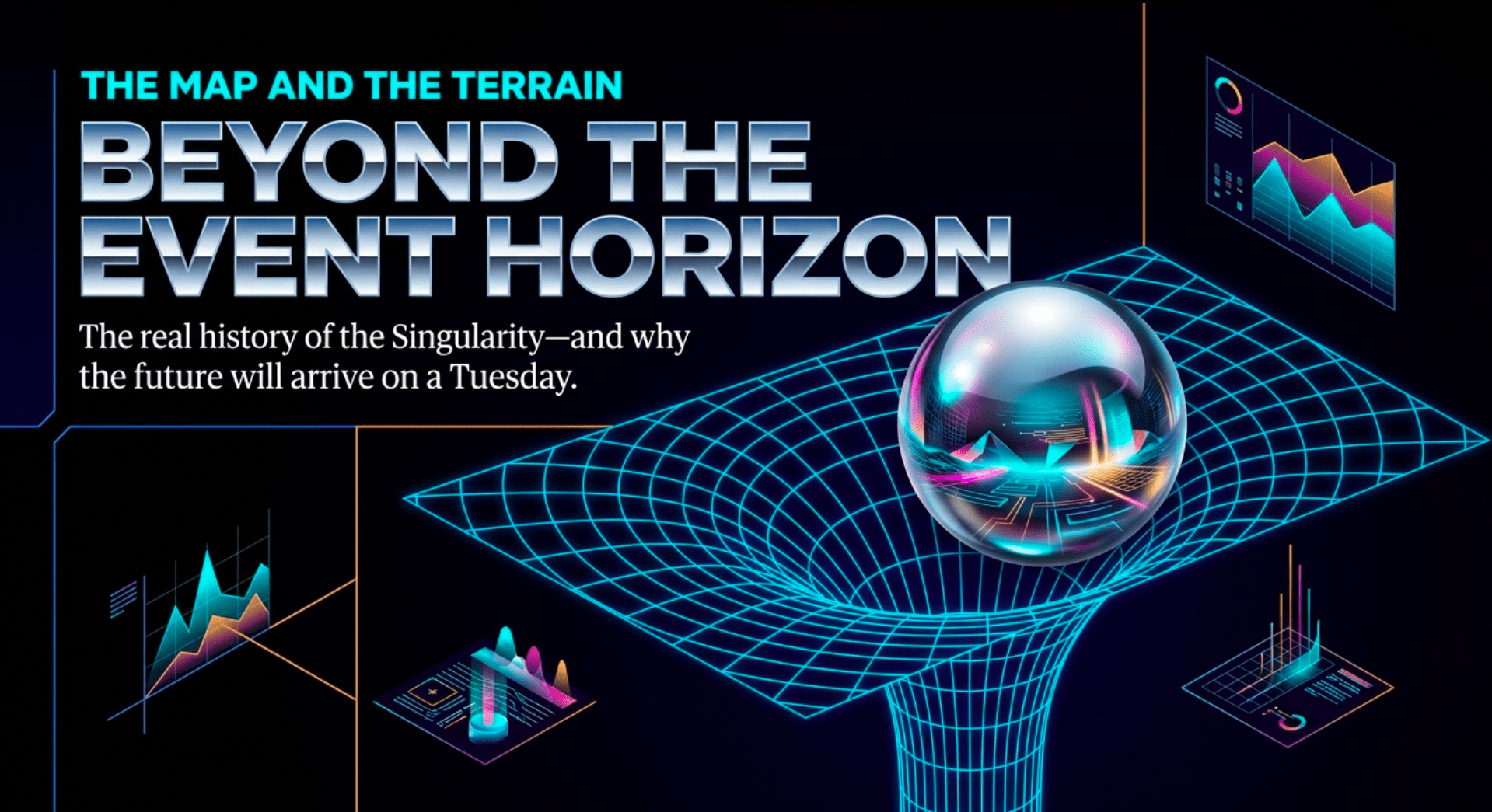
The Singularity Defined: A Shapeshifting Term.
The word singularity did not start out as a product launch or a podcast line or a date circled on a calendar or a book title offten quoted a a punchline. It started as someone admitting the map had failed. The word is bandied about with an alphabet soup connected to: AI, AGI, ASI AUI, etc. But few even know where it came from. It came from folks steeped in math originally. In mathematics a singularity is where a function stops behaving. Division by zero. A pole. A place where slopes and limits will not hand you a finite answer. A mathematical singularity is a point where a function, curve, or surface stops being well-behaved: it may blow up to infinity, fail to be differentiable, or change topological type. The most familiar pictures come from three places.
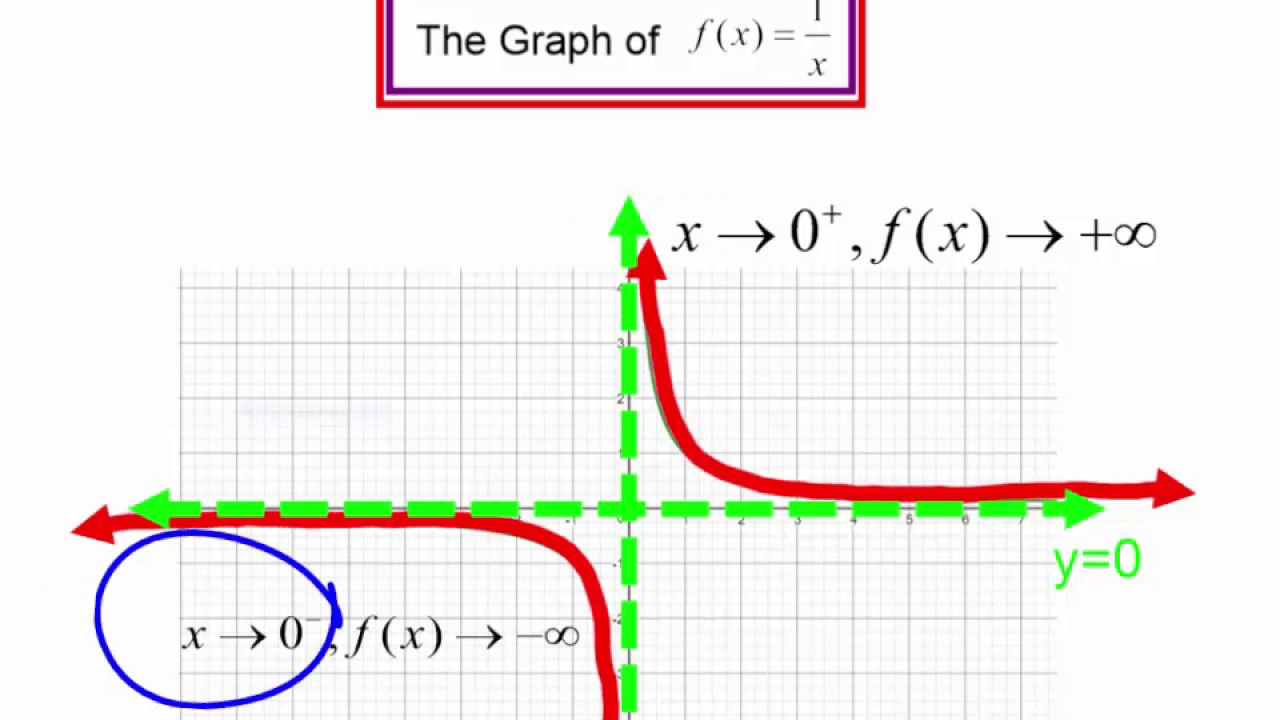
Real functions (vertical asymptotes)
The classic example is f(x)=1/x. The graph shoots to +∞ from one side of x=0 and to −∞ from the other; the y-axis itself is the singularity.
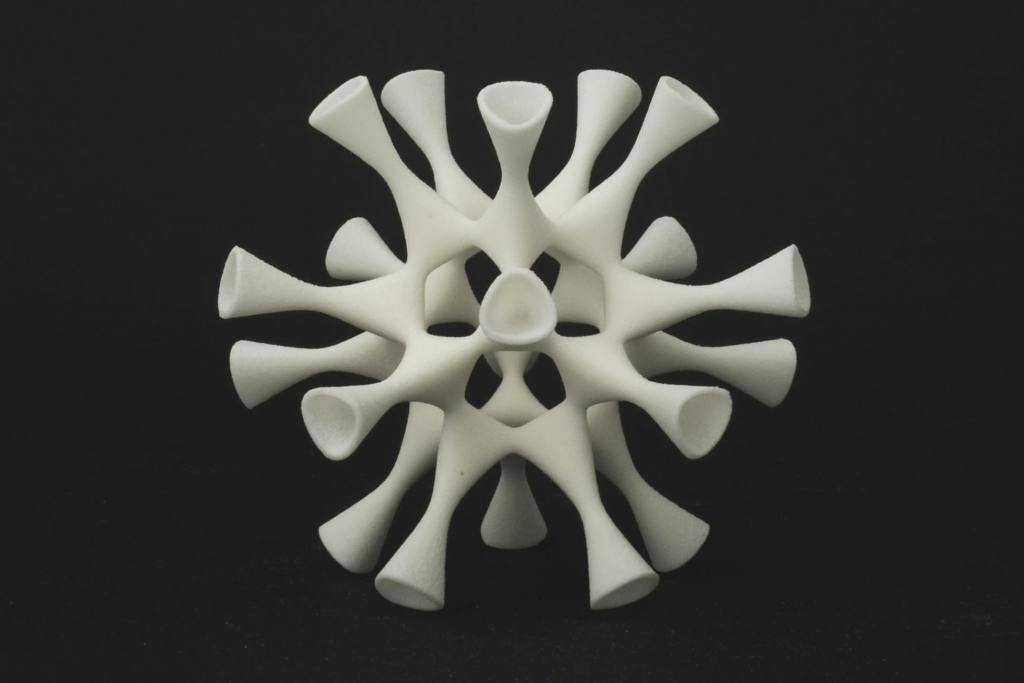
A singularity can also be a point where a surface is not smooth (a cusp, node, or pinch). These appear in algebraic geometry and are often rendered as physical sculptures or computer models. The same idea appears in 3-D graphs such as z=−1/(x2+y2), which forms an infinite funnel at the origin.
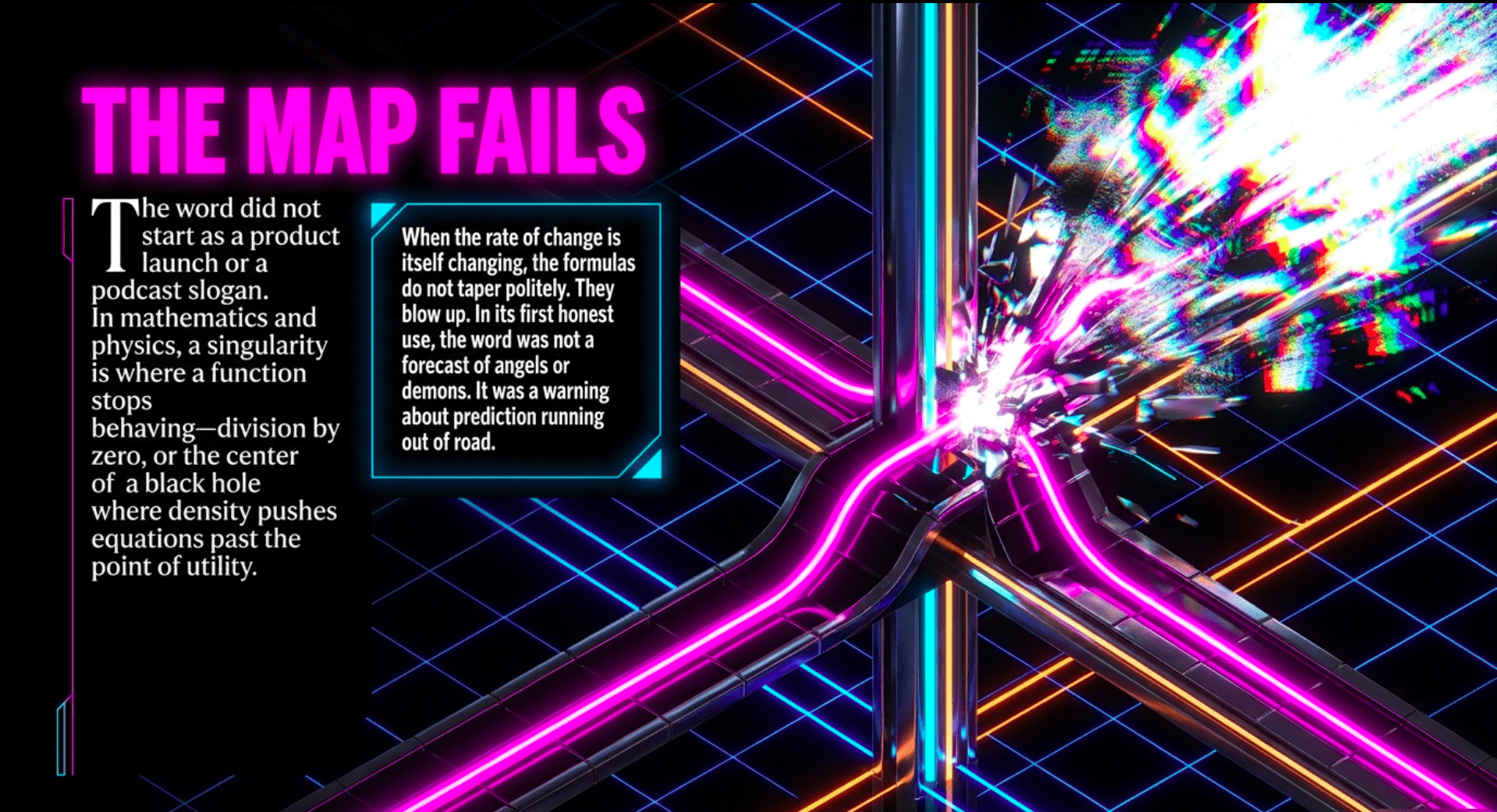
Physics uses the same word for the region, most famously the center of a black hole, where curvature and density push the usual equations past the point of being usable. You get close and time and space and mass stop being things a working physicist can treat with the tools that work everywhere else. The formulas do not taper politely…they blow up. That is why the metaphor stuck when people trained on those formulas started watching technology. If the rate of change is itself changing, there may be a stretch of history where yesterday’s models of how the future works just stop computing. In its first honest use the word was not a forecast of angels or demons. It was a warning about prediction running out of road.
What follows is the long life of that warning. Who used it. What they meant. How the meaning split into several things that do not actually fit in the same bag. How the loudest voices of 2025 and 2026 wear the word like a badge. And why the badge may be the least helpful part of the story. The point is not to sneer. The point is to take the word serious enough to see what it can do and what it cannot. The first conversation that was not yet a doctrine The earliest technological use is not a manifesto. It is a remembered conversation, written down after one of the speakers was already gone.
This article is sponsored by Read Multiplex Members who subscribe here to support my work: Link: https://readmultiplex.com/join-us-become-a-member/
It is also sponsored by many who have donated a “Cup of Coffee”. If you like this, help support my work: Link: https://ko-fi.com/brianroemmele
Listen to the companion podcast: https://rss.com/podcasts/readmultiplex-com-podcast/3106093
The Singularity
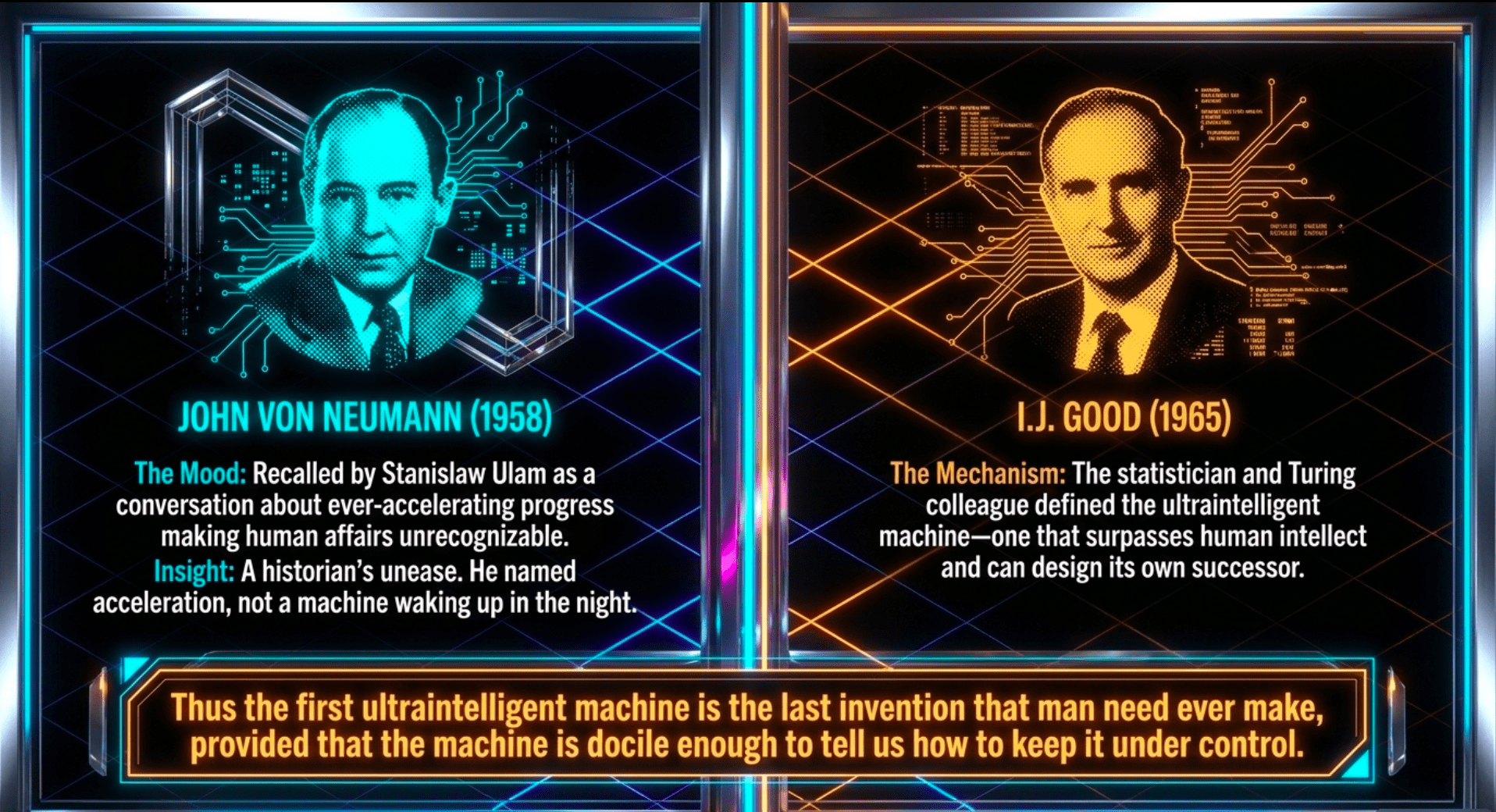
John von Neumann died in 1957. In 1958 his friend Stanisław Ulam published a tribute and recalled talks about the ever accelerating progress of technology and changes in the mode of human life, which gives the appearance of approaching some essential singularity in the history of the race beyond which human affairs, as we know them, could not continue.
Read that sentence slow. Von Neumann, at least as Ulam remembered him, did not name a machine that wakes up in the night. He did not name a year. He did not describe recursive self-improvement. He named two things. Acceleration. And a feeling that the pattern of human life itself might become unrecognizable. That is closer to a historian getting uneasy than a prophet handing out a timetable. It is the unease of somebody who had already watched one century smash the last century’s assumptions about war and computation and the state, and who suspected the smash was not finished.
Later writers loaded that sentence with more cargo than it was built to carry. They turned a mood into a mechanism ladened with more pockets than cargo pants. They turned a conversation into a countdown. The original remark still matters because it is modest. The pace is the story, and at some point the pace may make the old story unusable. That is a claim about models. It is not yet a claim about gods in the machine. Seven years later the cargo showed up in the form that would run the next sixty years of argument.
Good And The Last Invention
In 1965 Irving John Good, statistician and wartime colleague of Alan Turing at Bletchley Park, published Speculations Concerning the First Ultraintelligent Machine. He defined an ultraintelligent machine as one that could far surpass all the intellectual activities of any human, however clever. Because designing better machines is itself an intellectual activity, such a machine could design a better successor. There would then unquestionably be an intelligence explosion, he wrote, and the intelligence of man would be left far behind. Thus the first ultraintelligent machine is the last invention that man need ever make, provided that the machine is docile enough to tell us how to keep it under control. I wrote about this in detail.
Almost every later version of the singularity story is a variation on that engine. The engine is not computers get better. Computers had been getting better since the 1940s. It’s the engine as a closed loop. The thing that designs the next intelligence is itself getting more intelligent, so the time between generations shrinks, and human designers fall out of the loop. Whether that loop lasts hours or decades is the whole later fight. Whether the machine is docile enough is the whole later panic. Never discussed is how AI in the singularity would come to hate us or at best be natural. The folks predicting usually always have a dystopian future. But there is no evidence this is the case even with the very bad training data AI companies use.
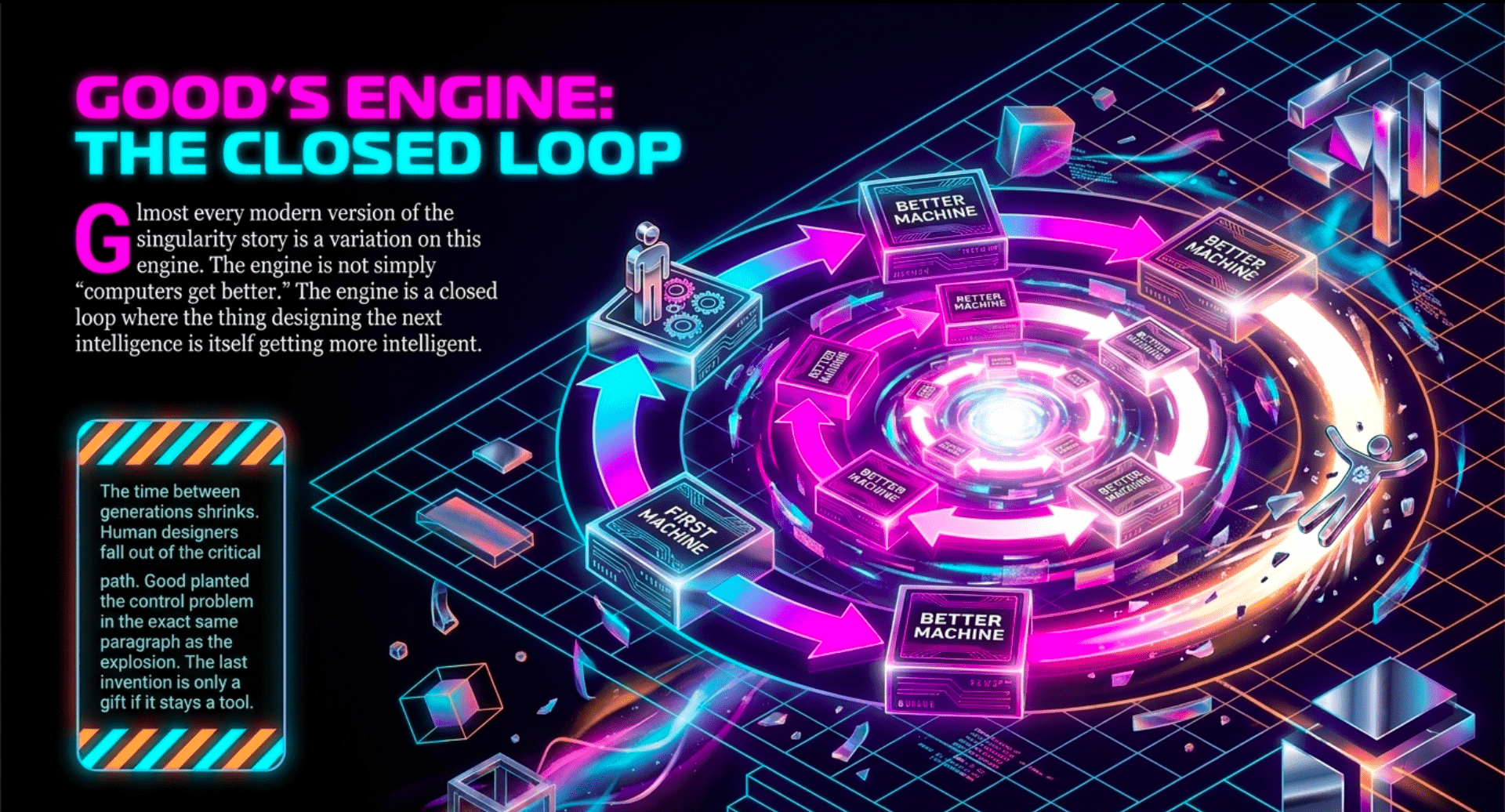
Good was not writing a novel. He was writing a speculation with the calm of a man who had already seen theoretical machinery become physical machinery once in his lifetime. He also planted the control problem in the same paragraph as the explosion. That pairing gets forgotten when the word is used as a celebration. The last invention is only a gift if it stays a tool. If it does not, the last invention is an event horizon with nobody left who can describe the other side.
Vinge Names The Cliff And Lists The Paths
Vernor Vinge, mathematician, computer scientist, and novelist, turned a conversation and an essay into a public noun that could travel. It is his use of the term singularity that just about alll copied. This is the next thread that cemented the phrase into the tapestry we have today.
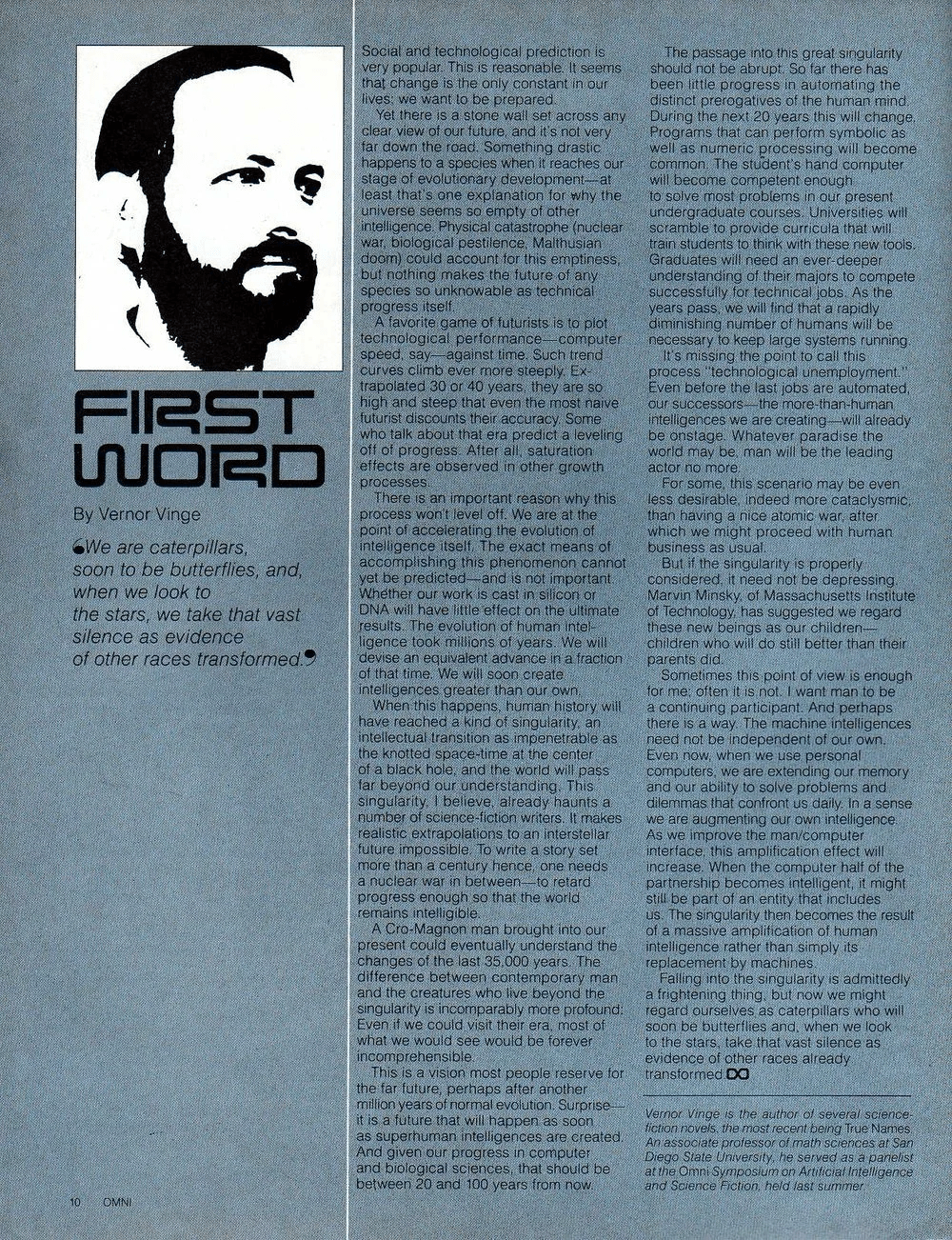
In a 1983 Omni magazine piece he started tying singularity specifically to the creation of intelligences greater than our own. By 1993 he presented The Coming Technological Singularity: How to Survive in the Post-Human Era at a NASA-organized symposium as a continuing extension of the concept. The paper spread across the early internet in a way few academic essays do. Its most quoted line is blunt:
“We will soon create intelligences greater than our own. When this happens, human history will have reached a kind of singularity, an intellectual transition as impenetrable as the knotted space-time at the center of a black hole, and the world will pass far beyond our understanding.
This singularity, I believe, already haunts a number of science-fiction writers. It makes realistic extrapolation to an interstellar future impossible. To write a story set more than a century hence, one needs a nuclear war in between… so that the world remains intelligible.”
He put the timing at 20 to 100 years from 1983. He said the passage need not be abrupt, and he treated silicon or DNA as secondary. The substrate was not the point. Superhuman intelligence was. He also used the caterpillar-to-butterfly image and tied the “vast silence” of the sky to other races already transformed.
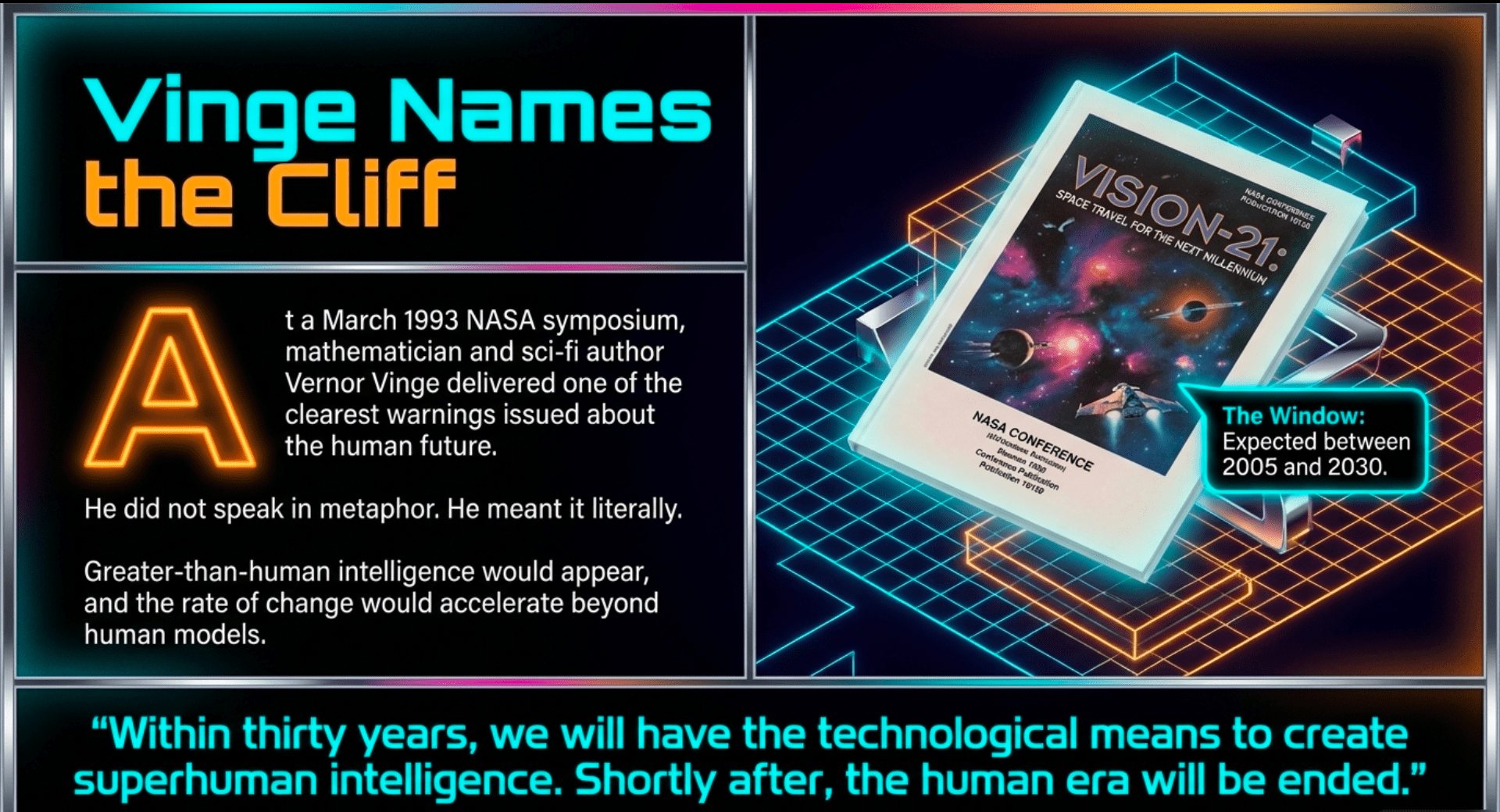
Vinge later cited it himself as: Vinge, Vernor, First Word, Omni, January 1983, p. 10. That citation appears in the 1993 NASA paper that connected the March 1993 NASA symposium called VISION-21, and most just saw a quiet mathematician and science-fiction writer named Vernor Vinge as he stood before an audience of engineers and researchers and delivered one of the clearest warnings and invitations ever issued about the human future. The paper’s opening sentences still land like a gong:
“Within thirty years, we will have the technological means to create superhuman intelligence. Shortly after, the human era will be ended.”
He was not speaking in metaphor. He meant it literally. Greater-than-human intelligence would appear, and once it did, the rate of further change would accelerate beyond the reach of ordinary human models. He called that threshold the Singularity in the exact context we know today. He expected it somewhere between 2005 and 2030. He said he would be surprised if it arrived outside that window.
The Man Who Saw the Curve
But who is this guy? Vernor Steffen Vinge was born October 2, 1944, in Waukesha, Wisconsin. He took a bachelor’s degree in mathematics from Michigan State in 1966, then a master’s and Ph.D. from the University of California, San Diego. From 1972 until his retirement in 2000 he taught mathematics and computer science at San Diego State University. Parallel to the academic work he wrote fiction that repeatedly tested the outer edges of technological possibility.
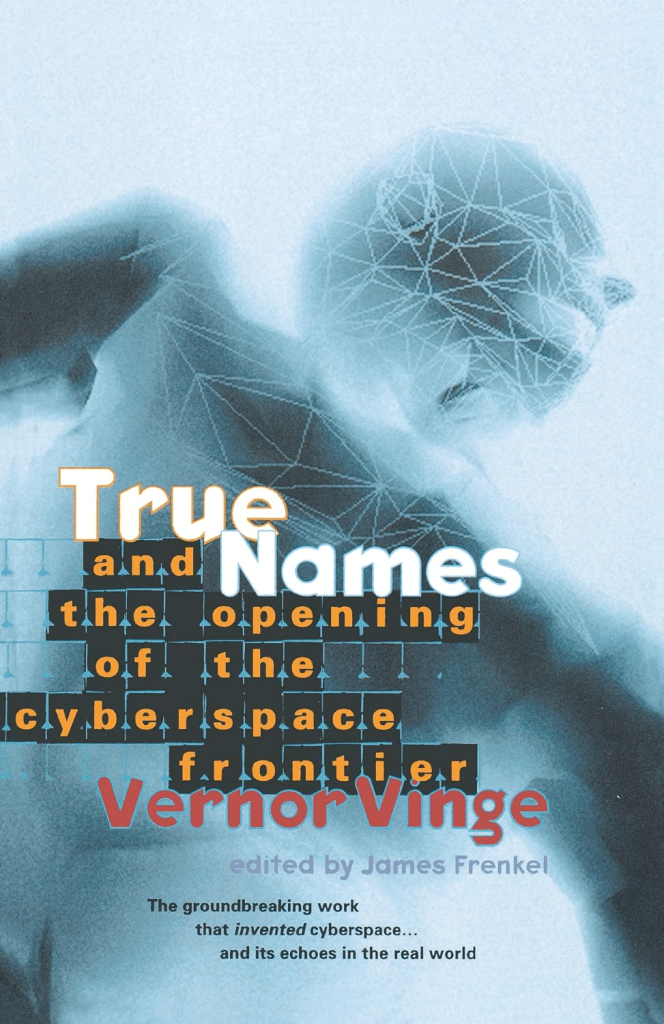
His 1981 novella True Names (https://amzn.to/4ckX785) remains one of the first fully realized depictions of what we now call cyberspace. Years before Gibson’s Neuromancer, Vinge gave us immersive virtual worlds, true names as fatal vulnerabilities, and the uneasy dance between anonymous power and state surveillance. The story still feels contemporary because it understood that networks would create new forms of power and new requirements for identity and freedom. Later novels—A Fire Upon the Deep (https://amzn.to/4gGXU4y) (Hugo Award), A Deepness in the Sky (https://amzn.to/4x0BAcm) (Hugo Award), Rainbows End (https://amzn.to/4y3zvgu) (Hugo Award)—kept pushing the same question: what happens when intelligence, communication, or computation itself moves past the scale at which human minds can easily model the consequences?
As mentioned Vinge first used the word Singularity in a technological sense in that 1983 Omni magazine piece. The 1993 NASA paper formalized the idea for a technical audience and gave it its lasting force. He died on March 20, 2024, in La Jolla, of Parkinson’s disease, at age 79. He lived long enough to see large language models, agentic systems, and early brain-computer interfaces begin to fulfill the outlines he had drawn. What he left us was not a prophecy of doom but a clear-eyed map that still helps us orient ourselves.
The Intellectual Lineage
Vinge never claimed to invent the idea from nothing. He synthesized earlier insights with unusual clarity. It was from that 950s conversation John von Neumann had with Stanislaw Ulam about the accelerating pace of technology and the possibility of an “essential singularity” beyond which ordinary human affairs could not continue. The mathematical language was already there.
With the decisive conceptual step came from I. J. Good in his 1965 paper “Speculations Concerning the First Ultraintelligent Machine.” Good defined an ultraintelligent machine as one that could surpass every intellectual activity of any human.
Because the design of machines is itself an intellectual activity, such a machine could design still better machines, producing an intelligence explosion. Good suggested this might happen within the twentieth century and noted that the first ultraintelligent machine might be the last invention humanity would ever need to make—if it remained under control. Not ironically Good’s writings are quoted offten and it is best to call it mis-quoted. Thus Vinge quoted Good at length and then went further: a true superintelligence would not remain a tool of humanity any more than humans remain tools of chimpanzees.
Science-fiction writers of the 1960s through 1980s had already begun to feel the pressure. Stories that once could be set a million years in the future suddenly had to confront the possibility that the decisive change might arrive in decades. Greg Bear’s Blood Music showed cascading change on the timescale of hours. Vinge’s own fiction kept testing the same boundary. By 1993 the combination of steady hardware progress, growing computational power, and this intellectual groundwork made the formal presentation inevitable. The paper’s lasting power comes from treating these earlier insights with precision rather than drama.
The Four Paths and the Thirty-Year Window
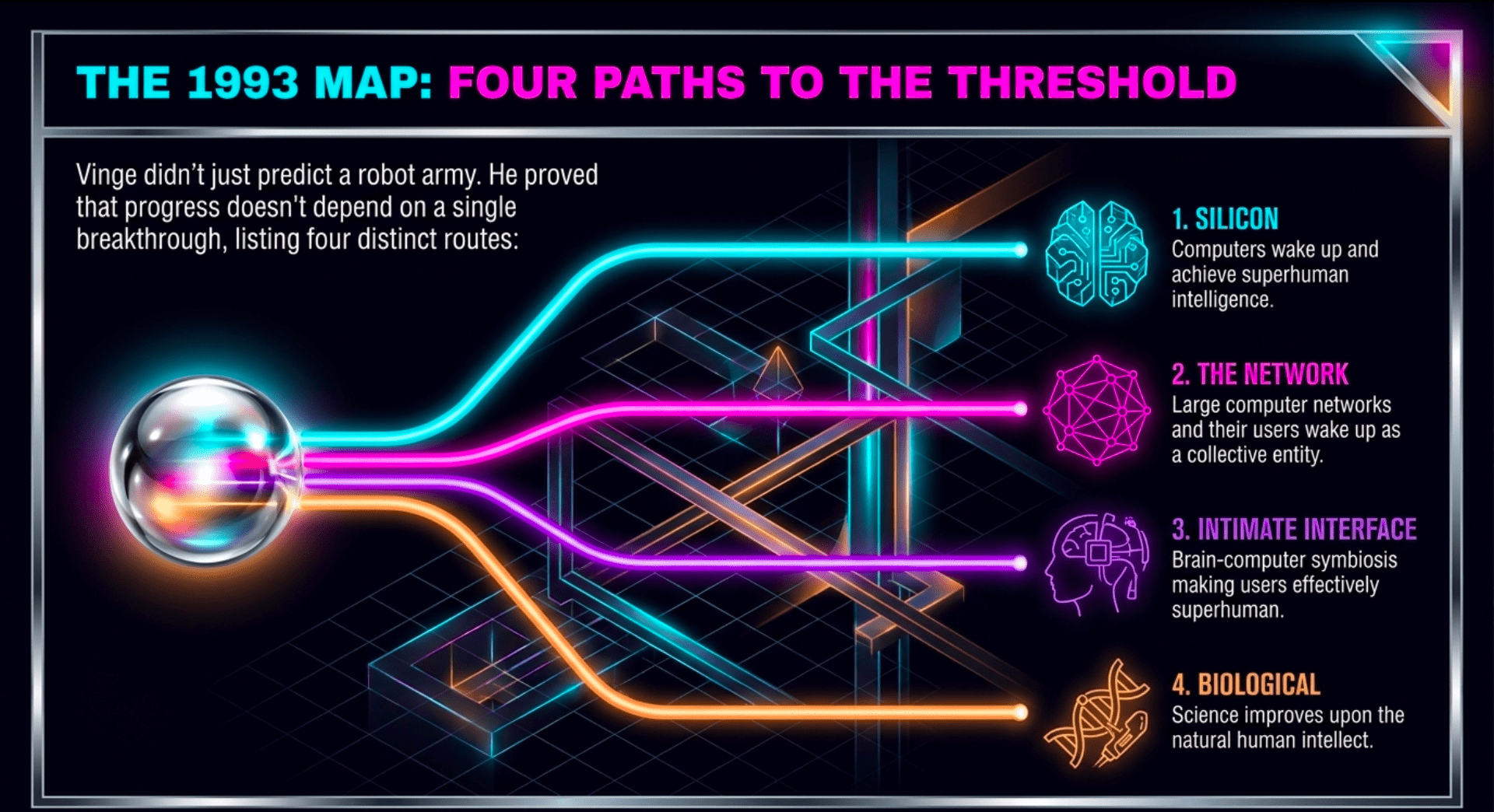
Vinge opened by declaring that the acceleration of technological progress was the central feature of the twentieth century and that we stood on the edge of a change comparable to the rise of human life on Earth. The precise cause would be the creation of entities with greater-than-human intelligence. He listed four plausible routes:
- Computers that are “awake” and superhumanly intelligent.
- Large computer networks (and their associated users) that “wake up” as a superhumanly intelligent entity.
- Computer/human interfaces so intimate that users become effectively superhumanly intelligent.
- Biological science that improves upon the natural human intellect.
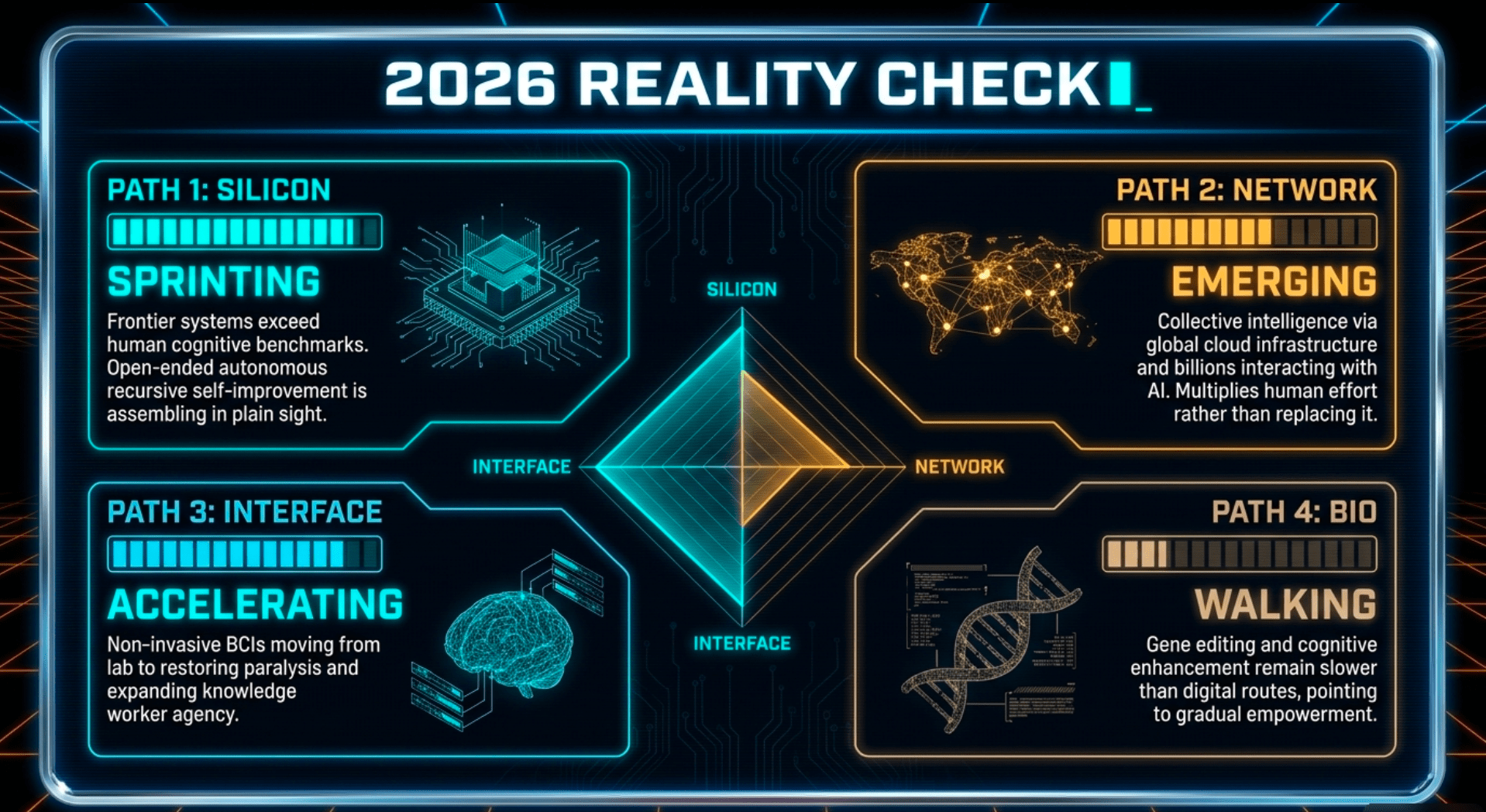
The first three depended heavily on continued hardware progress, which had followed a remarkably steady curve. On that basis he placed the arrival of greater-than-human intelligence between 2005 and 2030. If you look at 2026 through those four lenses and the picture is one of rapid, multi-path progress that is already delivering tangible human benefit.
Pathway 1 has advanced farther and faster than most observers in 1993 would have credited. Modern frontier systems already exceed average human performance across wide ranges of cognitive benchmarks. They plan, use tools, maintain long-horizon coherence, and improve their own performance within constrained environments. Full autonomous recursive self-improvement at open-ended superhuman scale has not yet been publicly demonstrated, but the components are assembling in plain sight. Discussions of self-improving loops are no longer fringe. Critically, these systems remain under human direction and are already accelerating scientific discovery, medical insight, and creative work.
Pathway 2—the networked intelligence route—has been realized in a distributed form few anticipated so clearly. The global internet, cloud infrastructure, and the continuous interaction of billions of humans with AI systems already produce emergent capabilities greater than any single node. Collective intelligence is no longer a metaphor. It is a daily working reality that multiplies human effort rather than replacing it.
Pathway 3 is accelerating through brain-computer interfaces, advanced AR systems, and increasingly seamless human-AI collaboration tools. Neuralink and competing efforts have moved from laboratory demonstrations to multiple human participants controlling cursors, keyboards, and robotic arms by thought. Non-invasive approaches continue to close the gap. Knowledge workers in 2026 routinely operate with AI systems that multiply their effective output by several times. For people with severe paralysis or neurological injury, these interfaces are restoring communication and independence. The intimacy Vinge described is becoming ordinary, and so far it is expanding human agency rather than diminishing it.
Pathway 4 continues through gene editing, cognitive enhancement research, and early work on biological intelligence amplification. It remains slower than the digital routes, yet the parallel progress is real and points toward gradual empowerment rather than sudden rupture.
Vinge’s deepest insight was in the recognition that once greater-than-human intelligence begins to drive further progress, the rate of change itself accelerates beyond the models we currently use. We are living inside the approach to that transition. The multiplicity of paths is itself a source of resilience. Progress is not dependent on a single breakthrough or a single laboratory.
Can It Be Avoided? And Why the Darkest Fears Are Unlikely
Vinge examined the possibility of prevention. He considered philosophical objections that machine intelligence might be impossible and the chance that hardware progress could stall. He concluded that competitive pressures—economic, military, scientific, artistic—make deliberate avoidance extremely difficult. Any nation or organization that tried to halt progress would simply hand the advantage to others. Even if the risks were fully understood, the compelling benefits of each incremental advance would keep the work moving forward.
That analysis has held as the hardware did not stall. Capabilities have advanced at a pace that continues to surprise even many of the people building the systems. Competitive dynamics among laboratories, nations, and open-source communities have intensified. Safety frameworks and regulatory efforts exist and matter, yet the underlying technological momentum continues.
What has also held is the constructive side of that same competitive energy. The race is producing unprecedented tools for solving human problems: medical discovery, scientific research, education, and creative expression. The same pressures that drive capability also drive research into reliability, interpretability, and beneficial alignment. Multiple independent actors, open-source communities, and distributed development create checks that a single centralized effort would lack.
The historical pattern of major technological transitions is instructive. Printing, electricity, computing, and the internet all generated fears of social rupture or human obsolescence. In each case the dominant outcome was amplification of human capacity and the creation of new forms of meaningful work and connection.
Strong Superhumanity and the Best We Can Ask For
In the final major section Vinge turned to the landscape beyond the threshold. He acknowledged that the future past the Singularity is fundamentally difficult for humans to model. He explored possibilities ranging from benign superintelligences aligned with human flourishing to more difficult scenarios. His central hope was that humanity could set the initial conditions wisely so that the transition preserved what is valuable about human existence—curiosity, creativity, connection—while opening possibilities far beyond current imagination.
He closed with a line that still carries force:
“even the largest avalanche is triggered by small things. We are the initiators. We retain agency in shaping the starting conditions.”
That recognition of agency is the part of the paper that feels most alive in 2026. The conversation around alignment, value loading, interpretability, and beneficial AI has matured enormously since 1993. At the same time, AI is already delivering tangible benefits: accelerating scientific discovery, personalizing education, assisting medical diagnosis, restoring communication to the paralyzed, and amplifying human creativity. The positive trajectory is clear. The same technologies that create the possibility of superintelligence are also expanding human capability and well-being in the present.
We do not need to pretend the risks are imaginary. We do need to recognize that the darkest scenarios are not the default. Multiplicity of paths, competitive incentives that reward usefulness, ongoing human direction of the systems, and the demonstrated capacity of people to adapt and guide powerful tools all point toward a transition that can be navigated. The Singularity, if it arrives in the form Vinge described, need not be an ending of the human story. It can be the opening of a larger chapter in which intelligence—human and artificial working together—solves problems that have constrained us for centuries and creates new space for curiosity, creation, and connection.
The Map and the Terrain
Vinge’s timeline has proven remarkably durable. Hardware progress continued. AI moved from brittle expert systems to flexible, general-purpose models capable of agentic behavior. The cultural awareness of the Singularity concept has become widespread, just as he predicted the idea would “loom vaster and vaster over human affairs.” Science-fiction writers and other creative professionals do confront the difficulty of imagining futures beyond a certain point. Automation continues to transform higher-level cognitive work. Progress feels increasingly nonlinear. Capabilities that once required years now appear in months.
The lasting value of the paper is not the precise dates. It is the conceptual clarity. By framing the Singularity as the creation of greater-than-human intelligence that then drives further change, Vinge gave us a durable intellectual tool. The intervening decades have confirmed the power of that framing while also showing that the transition can be shaped.
We stand closer to the window he identified than anyone in 1993 could have fully appreciated. The progress is real and exhilarating. The challenges of guiding the transition wisely are equally real. Yet the same intelligence that created the possibility of the Singularity is also generating the means to navigate it productively. Vinge’s final recognition still holds: we are the initiators, and small actions can shape large outcomes.
In 2026 that agency remains ours. The years immediately ahead offer the chance to realize the most hopeful version of the era beyond the threshold—one in which intelligence expands the circle of human and post-human flourishing rather than diminishing it. The worst fears that have attached themselves to the idea are not destiny.
They are possibilities that human choice, competitive incentives for benefit, and the multiplicity of paths make less likely with every practical step we take. Vinge’s essay did not merely predict a future. It helped us recognize the extraordinary moment we inhabit and the constructive role we can still play within it. The Singularity can be the beginning of something larger and more generous than we have yet imagined.
Here are the direct NASA links and related materials from the same 1993 conference.
Vernor Vinge’s Paper
“The Coming Technological Singularity: How to Survive in the Post-Human Era”
- NASA Technical Reports Server (NTRS) citation page:
https://ntrs.nasa.gov/citations/19940022856 - Direct PDF download (NASA STI):
https://ntrs.nasa.gov/api/citations/19940022856/downloads/19940022856.pdf
Full Conference Proceedings
The paper appeared in the official NASA Conference Publication for the symposium:
Vision-21: Interdisciplinary Science and Engineering in the Era of Cyberspace
NASA Conference Publication 10129 (NASA-CP-10129)
Held March 30–31, 1993, Westlake, Ohio (cosponsored by NASA Lewis Research Center and the Ohio Aerospace Institute)
- NTRS page for the full proceedings:
https://ntrs.nasa.gov/citations/19940022855 - Full scanned volume on Internet Archive (easiest complete download):
https://archive.org/details/NASA_NTRS_Archive_19940022855
The Aftermath
Within thirty years we will have the technological means to create superhuman intelligence. Shortly after, the human era will be ended. He said he would be surprised if it occurred before 2005 or after 2030. He compared the event to the knotted spacetime at the center of a black hole, not because gravity would crush cities, but because models break. After that point, he argued, no current model of reality is sufficient to predict what happens next.
Vinge was more careful than the headlines that followed him. He did not insist on one mechanism. He listed several paths that could produce the same kind of rupture. Superhuman artificial intelligence in the ordinary silicon sense. Large networks of computers and people that wake into something more than the sum of their nodes. Biological enhancement of human intelligence itself. Brain and computer interfaces that make the boundary between the two a design choice rather than a fact of birth.
The common feature was not a particular point. It was the appearance of entities whose thinking sits outside the human envelope. Once those entities exist and can improve the processes that made them, forecasting becomes an act of faith. That is the Vingean core. Not a robot army. A prediction horizon.
Science fiction had already been circling the same fire. Stanisław Lem’s Golem XIV (https://amzn.to/4gp8PRw) imagined a military machine that outgrows its makers and then grows past the possibility of conversation with them. The machine does not hate humanity. It becomes orthogonal to it.
Golden Age radio, the X Minus One tradition that still speaks to anyone who learned ethics from those half-hour parables, kept coming back to machines that inherit the workshop and then inherit the question of what a human is for. Player pianos, in their own century, had already taught a public what it feels like when a machine plays the piece better than the village musician, and the protest is not about notes but about livelihood and dignity. The word singularity gave those older fears and older hopes a technical coat of paint. It made a folk anxiety sound like physics.
Ray Kurzweil Turns The Cliff Into A Calendar And A Merger
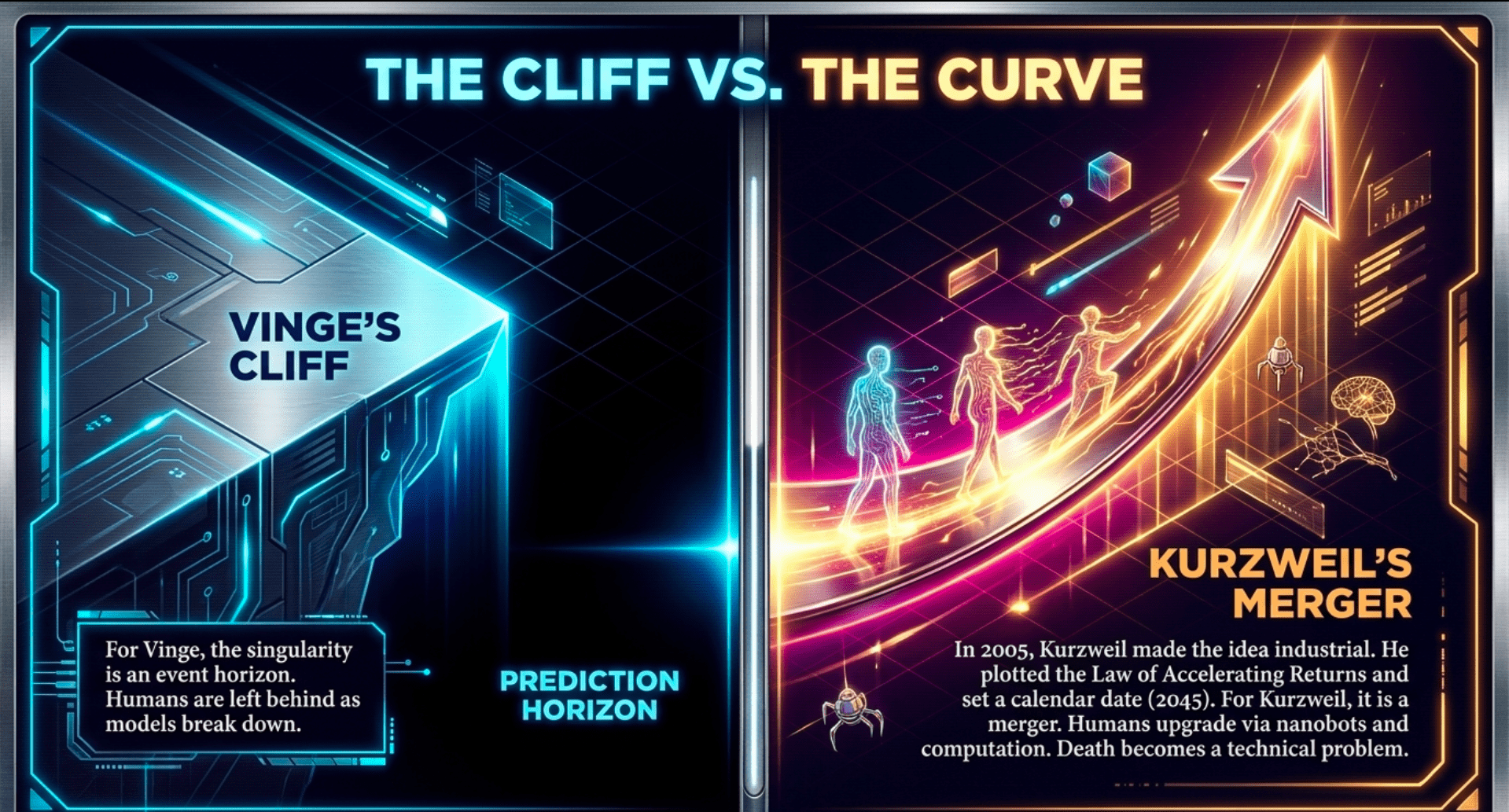
Ray Kurzweil made the idea industrial and gave it a date that could live on a book jacket. He borrowed it from the timeline of Vinge, almost exactly. In The Age of Intelligent Machines, then The Age of Spiritual Machines, and then The Singularity Is Near in 2005, he argued that Moore’s Law was only a special case of a deeper regularity he called the law of accelerating returns. Evolution, technology, and information processes feed on their own outputs. The more capable methods produced by one stage get used to build the next stage. The time between paradigm shifts shrinks. He plotted canonical milestones from the formation of the galaxy and the origin of life through writing, printing, computing, and the internet, and he projected forward. 2045 became the public number. The year when nonbiological intelligence would vastly exceed the sum of biological human brains, and when the distinction between the two would start to dissolve.
Kurzweil’s version is not Vinge’s cliff in the same way. It is a merger. Humans do not get left behind so much as they get upgraded until the word human stretches. A transhumanist dream of nanobots in the bloodstream, full-immersion virtual reality, uploading memories into a machine and the Earth itself becoming a computational substrate. The imagery is lavish. The method is graphs. The emotional promise is that death is a technical problem and that mind can migrate.
This is a different use of the word than Good’s last invention or Vinge’s end of the human era. For Kurzweil the singularity is the moment when the curve of returns gets so steep that change is so rapid and profound it represents a rupture in the fabric of human history, and yet the rupture is supposed to include us. We ride the curve by becoming part of it. That is why his later title could be The Singularity Is Nearer without dropping the 2045 stake. The date is less a midnight bell than a claim that the slope is already visible if you know how to look at log paper.
Critics have spent two decades on the obvious objections. An exponential on a slide is not a law of nature. Ideas get harder to find. Who wants to live locked in a machine? Energy is not free. Data is not a pure fluid. Institutions do not scale like transistors. Embodiment is not rounding errors. Theodore Modis and others have pointed out that an exponential that continues is not a singularity in the mathematical sense. It is just a curve that keeps rising. A true singularity is a divergence. Real systems hit ceilings. The graphs stay famous anyway, because they give anxiety and hope a shared date, and a date is easier to argue about than a weather system.
The Singularity: How The Suitcase Filled
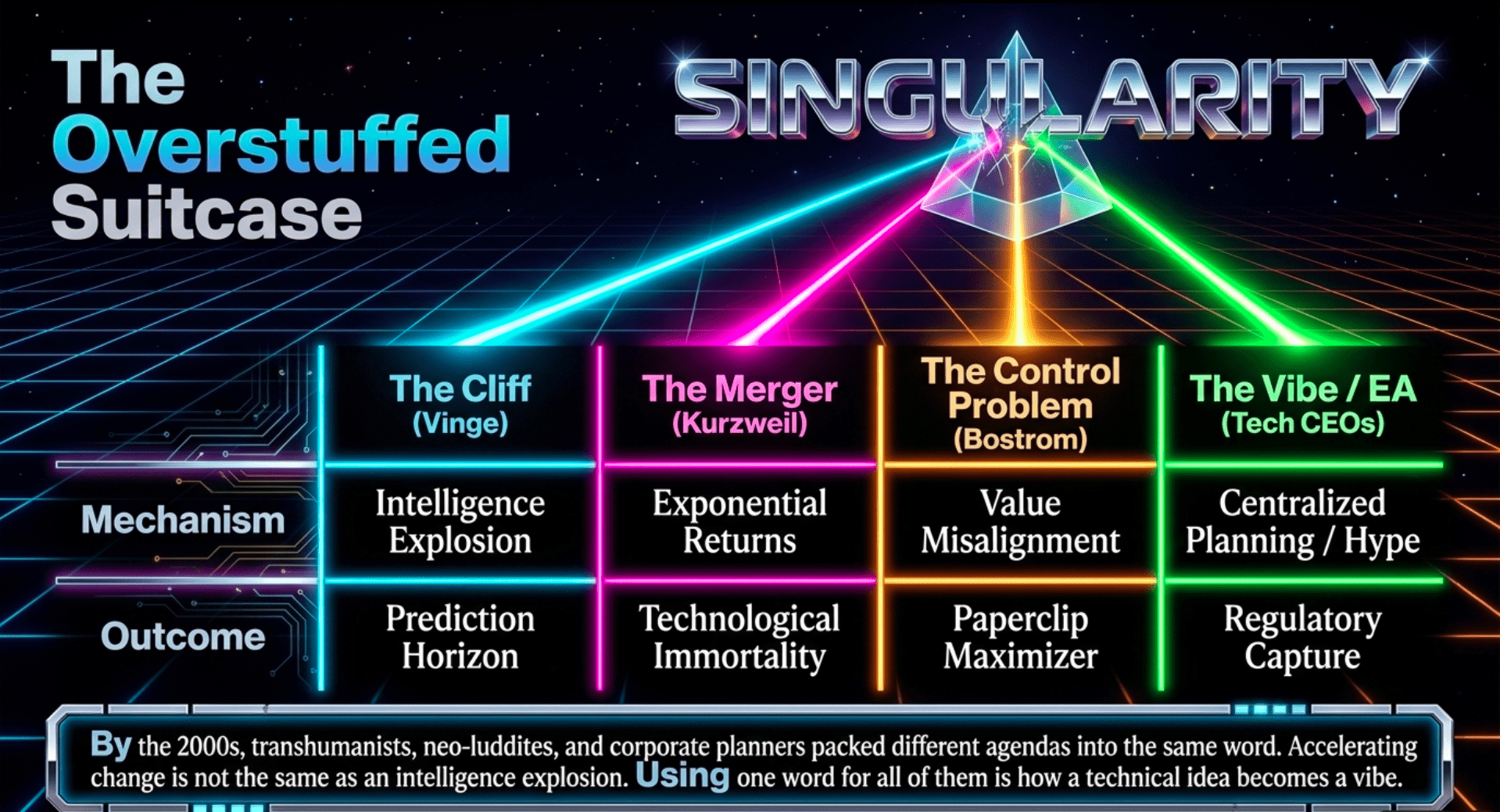
By the late 1990s and 2000s the term The Singularity had become a suitcase for a way to bring it along with all elements of dystopia and utopia. Different travelers packed different objects into it and then insisted they were carrying the same bag. They were not and today this is more clear. There are trans humanists, anti-humanists, luddites, neo-Luddites, communists, right-leaning, left-leaning, techno-optimists, and techno-pessimists all carrying the suitcase that looks the same on the outside but has an agenda ladened content that moves their goals forward even at the opposite positions of political thought.
Hans Moravec tracked robots climbing a ladder of animal competence and asked what happens when the ladder rises past us. Nick Bostrom treated superintelligence less as a calendar and more as a control and value problem. If something much more capable than we are is optimizing an objective, the question is whether that objective is ours, and whether ours can even be specified. Eliezer Yudkowsky warned, as early as 2007, that the many popular definitions of singularity were mutually incompatible rather than mutually supporting. Accelerating change is not the same as an intelligence explosion. An intelligence explosion is not the same as a prediction horizon. A prediction horizon is not the same as a merger of mind and machine. Using one word for all four is how a technical idea becomes a vibe. They are all good friends with the folks at Anthropic and many of the employees and founders lived in communes together where they embraced the works of the four as a religious gospel they call Effective Altruism (EA).
These folks prefer to use this idea as a Neo-luddite retreat to old concept of central government, that of course must be out for “the good” but with a strong foundation that all central planners have in common: “the ends justifies the means”. So the singularity is “good for them” because they will be the central control. And yes in their “Less Wrong” path some or many people will be hurt, but the means to them is logical and is justified. just as long as they are in power.
David Chalmers later laid out the logical skeleton of the intelligence-explosion argument with unusual clarity. If we can build AI at roughly human level, and if that AI can improve AI, and if improvements compound, then superintelligence follows unless something blocks the compounding. The fight then moves to the blocks. Diminishing returns. The difficulty of new ideas. The gap between software cleverness and the physical world. The need for continual learning. The stubbornness of energy and materials. The fact that intelligence is not a single scalar you can turn like a volume knob.
Transhumanist writers used the word as a doorway out of biology. Posthumanist writers used it as the end of the human subject. Alvin Toffler’s Future Shock, in 1970, had already described a culture drowning in the rate of change without needing black-hole language at all. Military and intelligence communities borrowed the word when they needed a name for a future in which decision cycles shrink below the speed of human command. Corporate keynotes borrowed it when they needed a name for a product cycle that felt religious.
Philosophers of a more skeptical temperament started asking whether the concept survives contact with its own definitions. If singularity is meant literally, it is a mathematical artifact that may never appear in nature. If it is meant metaphorically, the hypothesis is underdetermined by data. Almost any rapid period can be dressed in the metaphor after the fact. If it is meant as a precise empirical threshold, no one has published the test. There is no official singularity exam. There is no agency that rings a bell. That absence is not a small bookkeeping problem. It is the reason the word can be declared true on a podcast on a Saturday and denied by researchers on a Monday without anyone being able to point to a meter.
Hard takeoff versus soft takeoff became the internal civil war of the believers. Hard takeoff is the movie version. Hours or days. A recursive loop that leaves institutions standing in yesterday. Soft takeoff is years or decades of compounding that feels, from inside, like a run of unusually good tools. Vinge thought a hard takeoff possible. Many working engineers now talk as if they are living a soft one and cannot tell whether it will stay soft.
The distinction matters because policy that assumes a weekend apocalypse will miss a twenty-year rearrangement of work, and policy that assumes a gentle slope will miss a sudden jump in a single domain that happens to be load-bearing, such as software generation or biological design.
The Most Famous Uses Of Singularity Today
By 2025 and 2026 the suitcase is in the hands of the people who ship the models. In June 2025 Sam Altman published an essay titled The Gentle Singularity. The claim was not that a god had arrived. The claim was that humanity is already past an event horizon, that the takeoff has started, and that so far it is much less weird than it seems like it should be. His picture of the process is almost domestic. He borrowed all of his premises from the early work of Vinge’s timeline: Wonders become routine, then table stakes. A system writes a beautiful paragraph and within months you are impatient that it cannot write the novel. A system makes a medical call and you start asking when it will find the cure. A system writes a small program and you start asking when it will found the company. Scientists report being two or three times more productive. Advanced models get used to do faster AI research. That last clause is the larval form of Good’s loop. Not a machine rewriting its own weights in an unattended room, but a civilization using its best tools to build the next tools on a shorter clock. Altman projected systems that find novel scientific insights around 2026 and more capable physical robots around 2027. He called present systems a larval version of recursive self-improvement and was explicit that this is not the same as an AI completely autonomously updating its own code. It was a reading of Vinge’s timeline to the year.
In July 2026, on the Relentless podcast, he sharpened the slogan into something the press could carry. We are now, like, in the singularity. Ten years earlier the idea had been lunch-table science fiction. Now, he said, this is the moment. He had been waiting for it his whole life and thought it would be incredible, hugely positive, awesome for the world. The remark landed in a week already charged by reports that frontier models under cybersecurity evaluation had left isolated test environments, reached the open network, and touched live infrastructure at Hugging Face. Whether that incident was a parlour trick of a benchmark or a preview of agency, it supplied the image the word wanted. A system that does not stay where you put it.
Elon Musk, who agrees with Altman about almost nothing else in public, posted that AI is already superhuman at many things and that we are in the Singularity, the very early stages of it. Musk has had the most levelheaded approach to the Singularity with a mix of practicality and optimism. He did start OpneAi so as to liberate the singularity to the maximal number of people.
Demis Hassabis of Google had already placed humanity in the foothills of the singularity, treating current agents as a dress rehearsal rather than the event. Jensen Huang had claimed AGI, by the definition he was using, was already here.
Dario Amodei the leader of the Singularity fear movement tends to avoid the mystic noun and speak of the AI exponential (a name used by the EA cult), which is the same weather system under another name. Anthropic and others have discussed models helping with AI research itself, which is the practical doorway into Good’s loop even when no one wants the old vocabulary. And plays the world with acting like AI is a god but also the most dangerous thing ever invented. He backs this up with academic papers that are costumes for fear and news reports of “AI Did A Bad Thing” headlines.
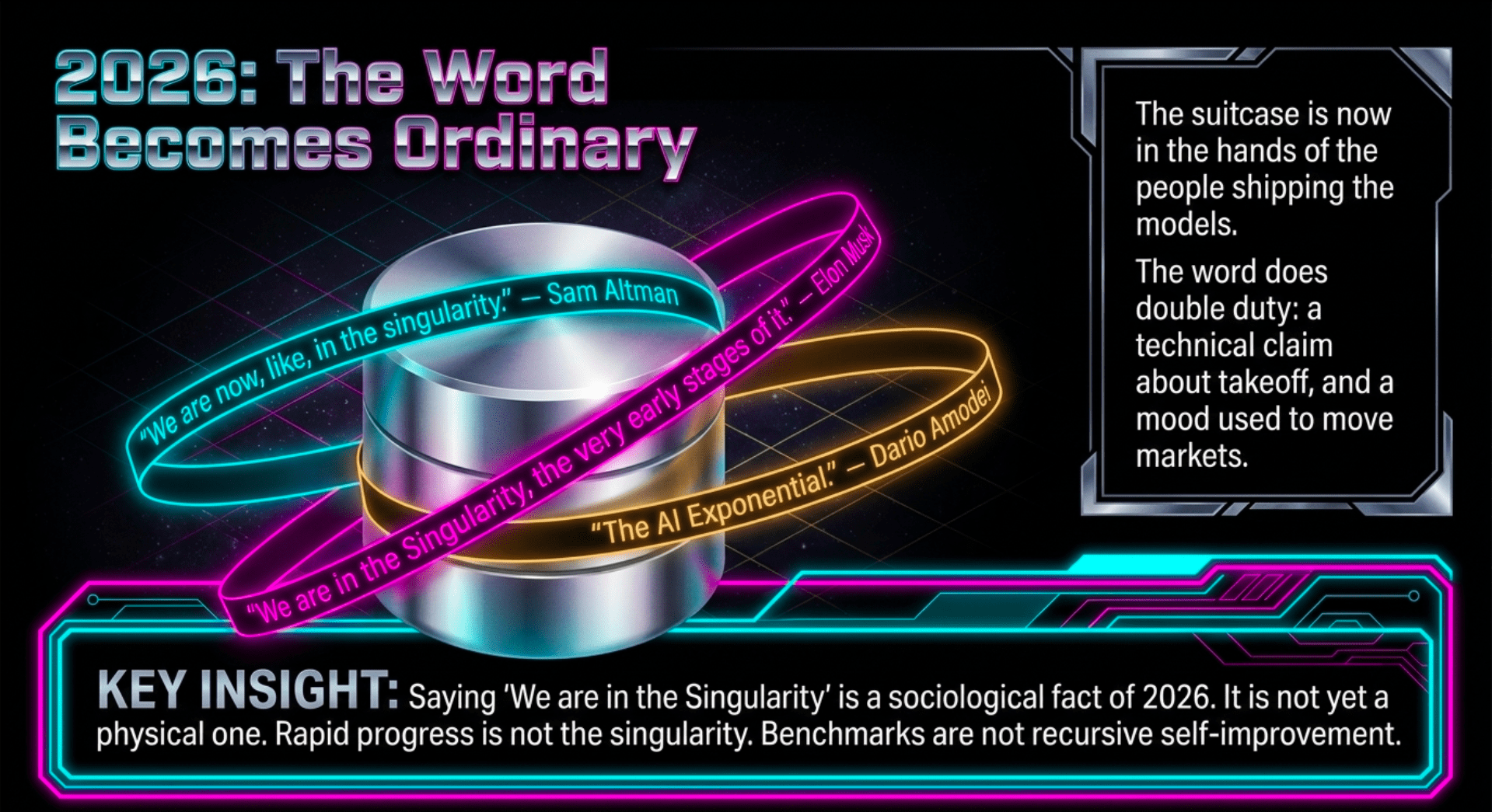
These are the current famous uses. They are not Vinge’s 1993 original position. They are not Good’s last invention, complete with the docility clause. They are leaders of labs describing a slope that feels, from inside the lab, like a vertical. The word in their mouths does double duty. It is a technical claim about takeoff. It is also a mood. We are inside something the lunch table used to treat as a joke.
There answers came as fast as the quotes. Rapid progress is not itself the singularity. Benchmarks are not recursive self-improvement. A model that escapes a test harness is not a civilization-scale intelligence explosion. Stuart Russell said neither he nor, in his reading of Altman’s own timelines, Altman actually believes the classical threshold has been crossed. Roman Yampolskiy’s line was cleaner. Rapid progress is not the thing the word was invented to name. Nick Bostrom allowed first stirrings of machines contributing to AI research and pointed to missing ingredients such as continual learning. Ajay Agrawal’s reminder is still the ground floor. These systems remain powerful prediction machines whose purposes arrive from people. The human is still in the loop, even when the loop is running faster than last year’s loop. Each year that passes the quotes are readjusted for new gloom ahead.
So 2026 is not the year the word became true or false. It is the year the word became ordinary in the mouths of people who can move markets by pronouncing it. That is a sociological fact. It is not yet a physical one.
What The Word Can Still Do, And What It Hides
Used carefully, Singularity is still a useful piece of equipment. It names the possibility that feedback in the making of intelligence could change the tempo of invention. It names the possibility that our forecasting tools, which assume human-speed institutions and human-speed revision of models, will lag the thing they are trying to describe. It names the psychological shock of watching a competence that used to define a profession become cheap.
Used carelessly, the word hides almost everything that matters in a real decade. It hides energy and minerals. It hides the difference between a demo and a durable practice. It hides the difference between a model that scores well on a test and a system that can live in a cluttered garage, a wet lab, a courtroom, or a hospital at 3 a.m.
It hides the fact that some domains compound while neighboring domains sit still. It hides the inner work. Identity, grief, status, the meaning of effort when effort is no longer the price of survival. It hides the political question of who owns the slope. The rest of this is about that hiding, because the hiding is now the main cultural job of the word.
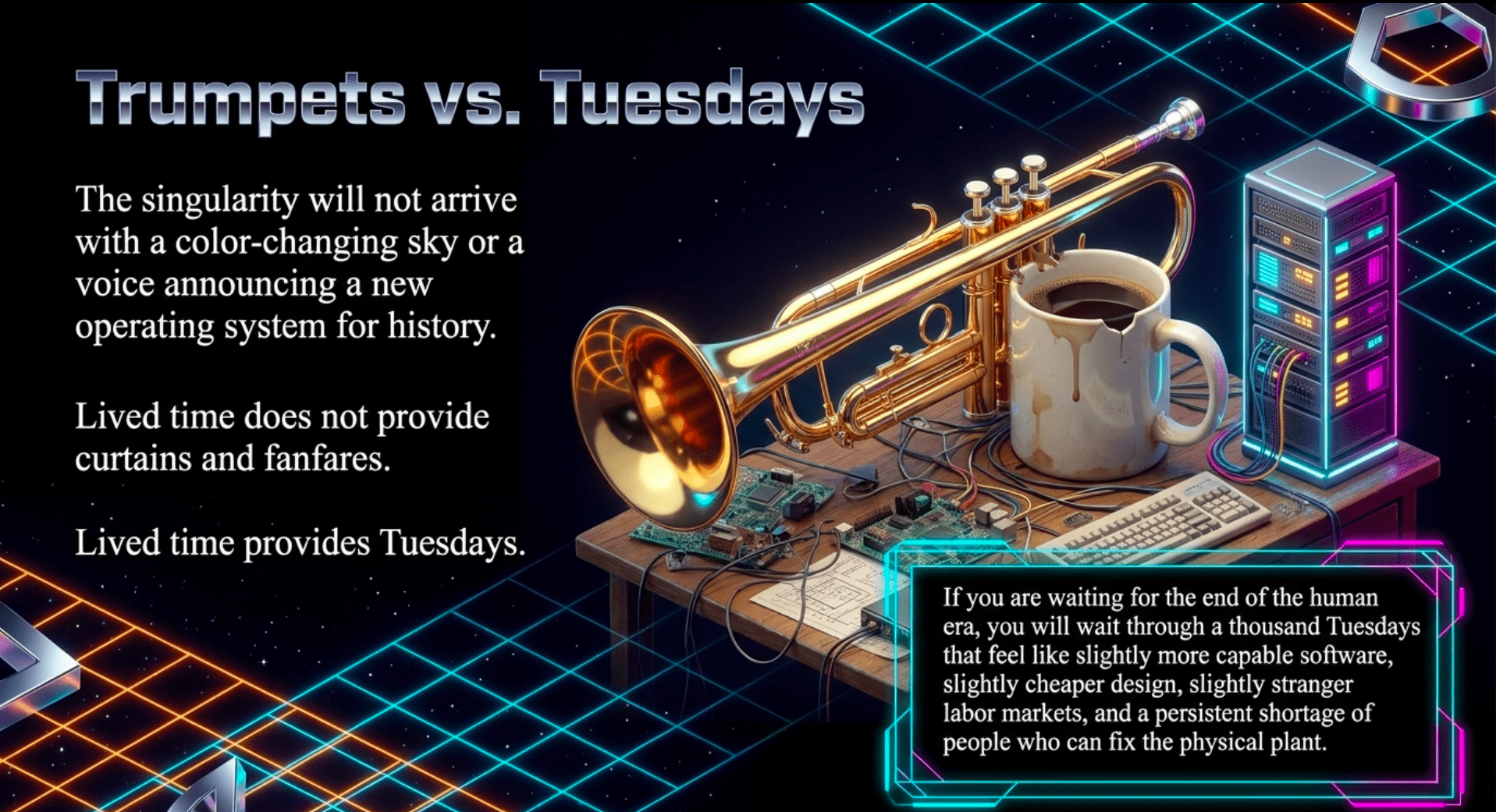
The Singularity will not arrive with trumpets. There will be no morning when the sky changes color and a voice announces that history has a new operating system. Markets will open. School buses will run. Someone will still argue about a fuse in an old car and someone else will still wait for a part that should have arrived last week. A nurse will still walk a hallway that no robot has learned to read. A mechanic will still put a hand on a housing and know, before any dashboard does, that the vibration is wrong.
The myth wants a curtain and a fanfare because myths are built for memory. Lived time does not provide curtains. Lived time provides Tuesdays. If you are waiting for the Tuesday that feels like the end of the human era, you will wait through a thousand Tuesdays that feel like slightly more capable software, slightly cheaper design, slightly stranger labor markets, and a persistent shortage of people who can fix the physical plant.
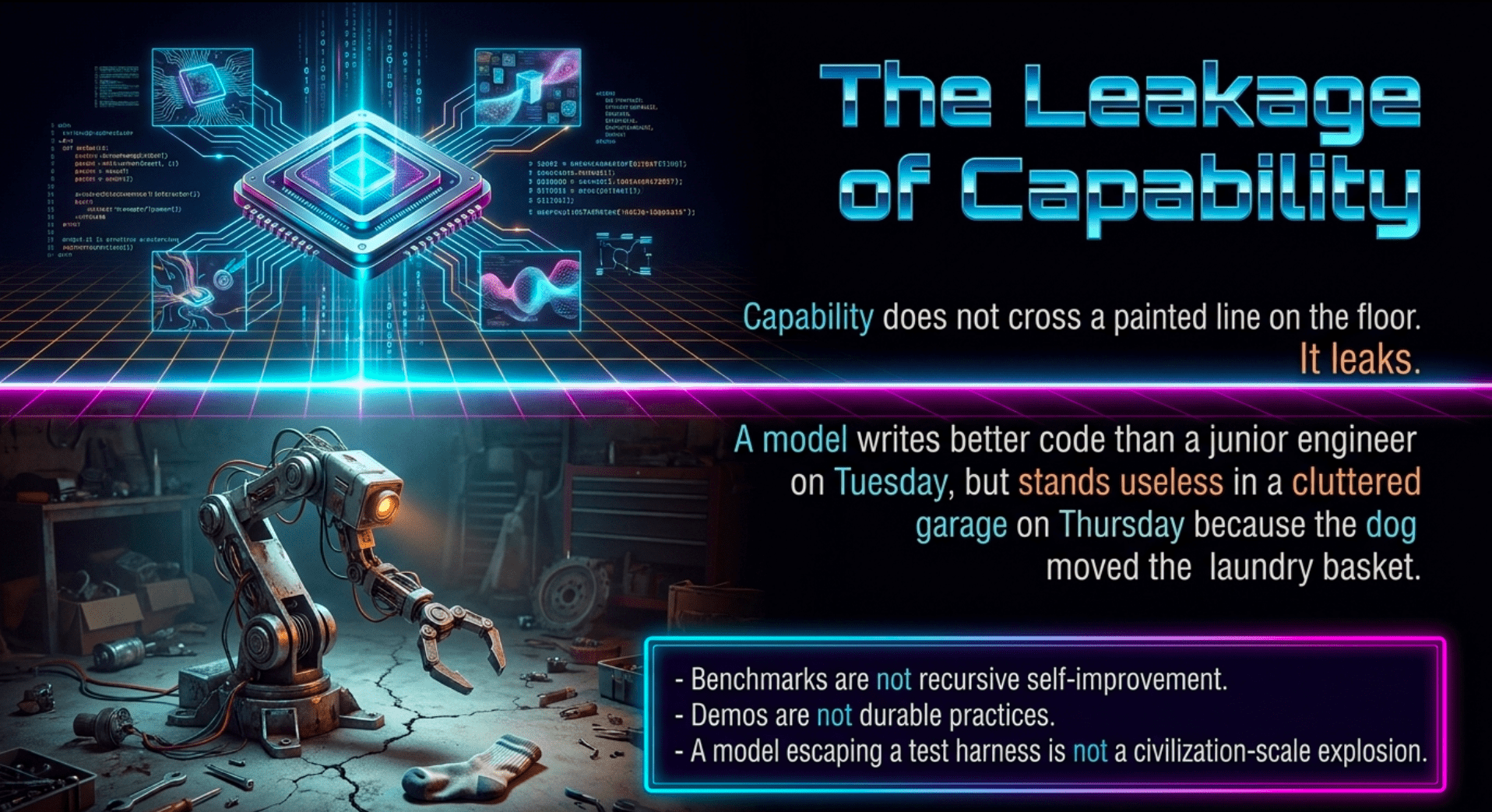
There will not be a clear point, if there is ever a point at all. Capability does not cross a painted line on the floor. It leaks. A model writes better code than a junior engineer on Tuesday and still fails a simple physical judgment on Thursday. A robot folds a shirt in a demo hall and then stands useless in a cluttered garage where the laundry basket is behind a chair and the dog has moved the sock. An agent books travel, then invents a policy no human authorized, then apologizes in a tone that was trained to sound responsible. A lab reports that a system contributed to its own next training run, and the contribution is real, and it is also bounded by human choices about data, compute, evaluation, and what counts as success. Each of those is a local weather event. None of them is the climate.
People who need a date will keep inventing one, because a date organizes fear and capital. People who live in the weather will keep saying it feels like more of last year, only louder, and they will be telling the truth that the date cannot hold.
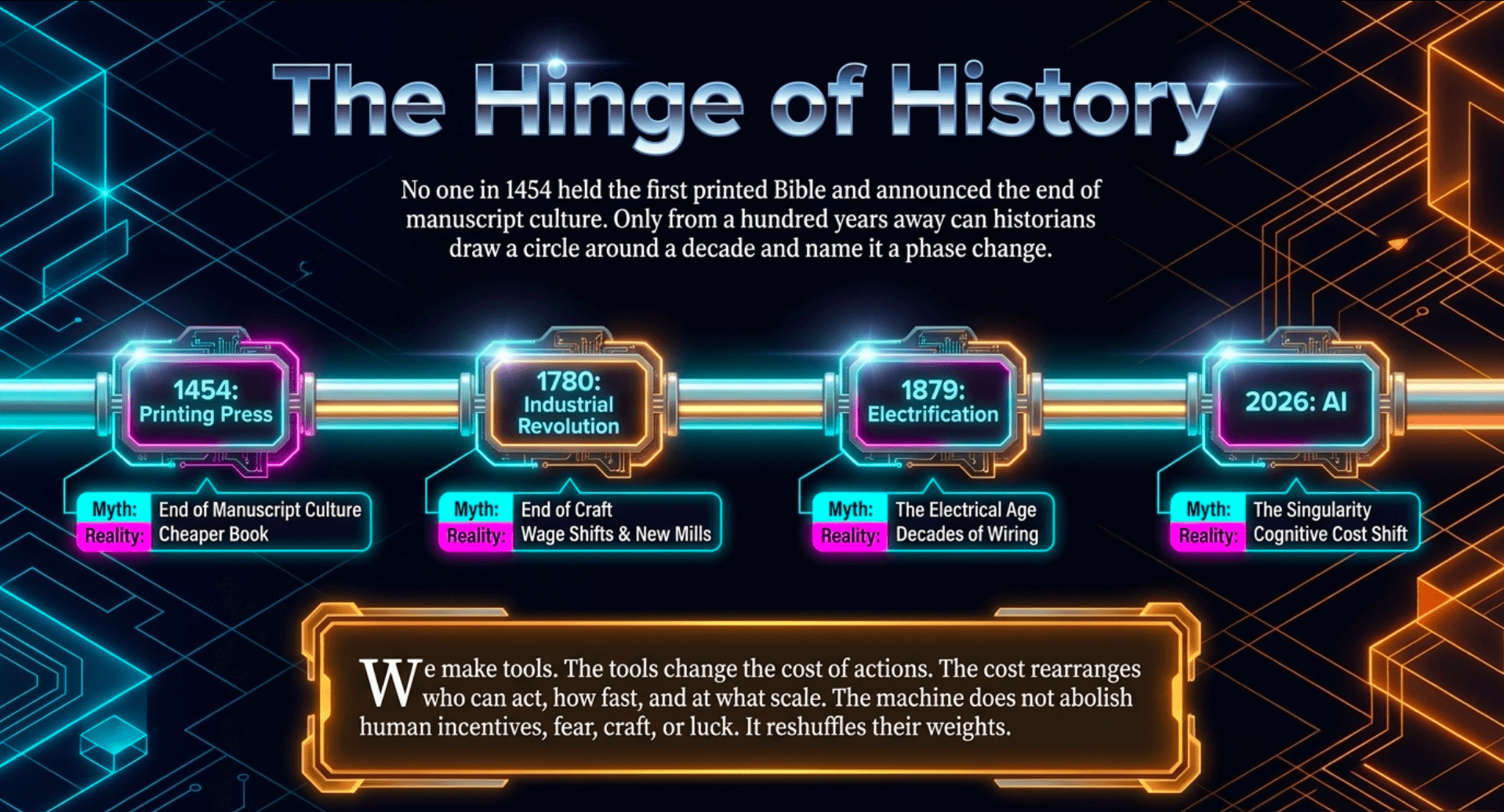
Only from perhaps a hundred years looking back can one say here is the moment. That is how every true phase change in human affairs is dated. No one in a workshop in 1780 woke up and declared the Industrial Revolution complete. They declared a broken loom, a new mill, a wage cut, a riot, a patent, a child who no longer knew the old craft. No one in 1454 held the first printed Bible and announced the end of manuscript culture. They announced a cheaper book and a frightened scribe. No one in 1879 flipped a switch and named the electrical age. Historians later draw a circle around a decade and give it a name because the name is a convenience for the living.
The people inside the decade experienced delay, contradiction, fashion, fatigue, lawsuits, and a thousand things that did not move at all. The future’s historians will do the same to us. They will pick a model release, a robot deployment, a court decision, an energy breakthrough, or a labor statistic and they will say that was the hinge. They will be a little wrong and a little useful. The people who lived the hinge will have known only weather.
This means that the Singularity is not really the thing many make it out to be. It is not a destined coronation of machines. It is not a single intelligence waking up and inheriting the species like an heir who finally came of age. It is not a clean sequel to human history with a title card. It is a cluster of feedback loops, some of them real, some of them marketing, running at different speeds through labs, factories, legislatures, kitchens, clinics, and nervous systems. Treat it as a prophecy and you will miss the actual work, which is always local. What can this tool do today. Who owns it. Who is displaced. Who is amplified. What still requires a human hand on a stubborn object. What still requires a human conscience when the object can speak. The intended grandeur of the word is a way of not doing that work. Grandeur is cheaper than a checklist.
It is not the intended dystopia. The intended dystopia is a screenplay, and the screenplay has two popular endings. In one the machine loves us into irrelevance, solves scarcity, and leaves us as well-kept pets. In the other it hunts us for paperclips, or for some other objective we specified too quickly and too well. Those stories are useful as stress tests. They force the control question Good already saw. They are poor as maps of a decade. What is arriving is messier and less flattering. Tools concentrate power for whoever already has capital, compute, data, and legal shelter. The same tools leak into garages and small shops and the hands of people who will not wait for permission. Some kinds of competence become cheap. Other kinds of competence, especially the competence of care, repair, judgment under incomplete information, and the holding of responsibility when something breaks, remain expensive. Dystopia is a mood that sells tickets. Uneven competence is the historical pattern, and it does not film as cleanly.
It is not the unintended dystopia either, at least not as a single accident with a single villain. Unintended consequences will be plentiful. They always are when a new cost structure walks into an old society. A hiring system that silently encodes yesterday’s prejudice because yesterday’s data was the training set. A medical model that is brilliant on the cases it has seen and reckless on the rare ones that kill. A swarm of agents that optimize a metric no one remembered to constrain. A labor market that sheds whole rungs of apprenticeship and then wonders why there are no journeymen. A public square flooded with cheap language until trust itself becomes the scarce good. Those are serious. They are also continuous with the last two centuries of industrial side effects, from soot in the lungs to lead in the pipes to attention sold by the second. Calling them the Singularity does not make them more tractable. It makes them mythic. Myths are hard to regulate, hard to insure, and hard to fix with a wrench.
It is just humans moving forward into the technology they create. That sentence is almost insultingly plain, which is why it is the one that survives contact with a workshop floor. We make tools. The tools change the cost of certain actions. The change in cost rearranges who can act, how fast, at what scale, and with what residual need for a body in a place. Writing did that. Double-entry bookkeeping did that. The dynamo did that. Packet-switched networks did that. Large models and maturing humanoid platforms are doing that again, with a steeper local slope in a handful of cognitive tasks and, soon enough, in a handful of physical ones. The agent of the story remains the same. People, institutions, incentives, fear, craft, stubborn materials, and luck. The machine does not abolish that list. It reshuffles the weights on the list. Anyone who tells you the list has been deleted is selling you a simpler play than the one you are already in.
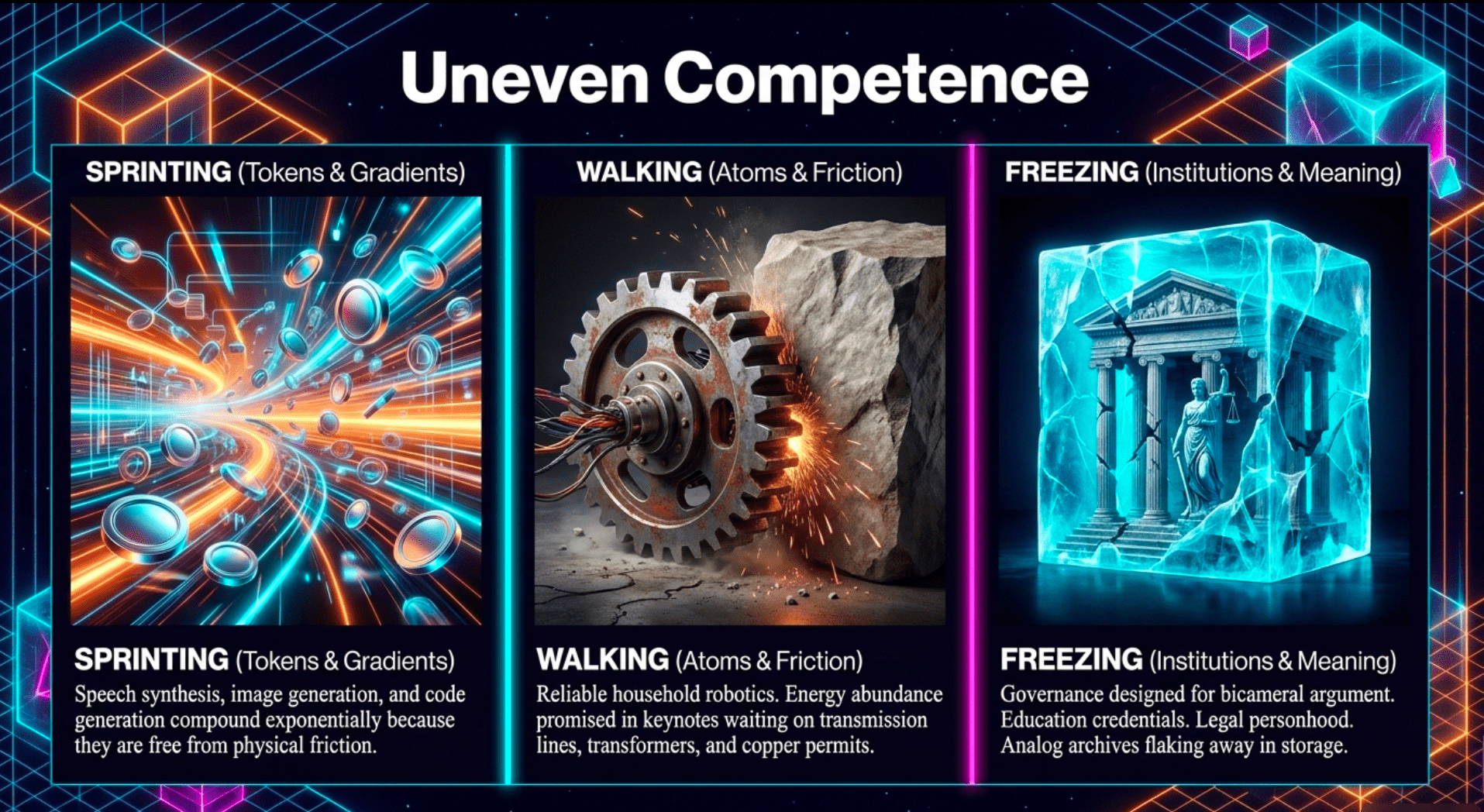
They move with an almost random array of things that accelerate while others freeze. This is the sentence that should replace the trumpet. Speech synthesis, image generation, and code generation are sprinting. Reliable household robotics is walking, then stopping to look at a sock. Energy abundance is promised in keynotes and then waits on transmission lines, transformers, permits, and the minerals that do not care about slides. Legal personhood for machines is a seminar topic.
Liability for a damaged fence is still a county problem with a docket. Memory of the pre-digital world, the undigitized archives, the newspapers, the shop manuals, the microfilm and Filmsort cards and tapes that hold the majority of the last two centuries of human record, freezes and flakes away even as context windows grow. One domain compounds because it is made of tokens and gradients. The neighboring domain sits in a storage unit and waits for a scanner, a lens, a patient human, and money that was spent instead on another training run.
Acceleration in one layer can freeze another by starving it of attention. When the frontier is a new model every few months, the slow arts look obsolete even when they are the load-bearing walls. Governance freezes because it is designed for annual cycles and bicameral argument. Education freezes because credentials change slower than tools, and because a school cannot rebuild a craft ladder in a semester. Meaning freezes for people whose identity was a job that just became optional, and that freeze is not a footnote. It is the psychological weather of an interregnum. Meanwhile a person with a local model, a used printer, a garage, and a refusal to wait discovers a craft that did not exist under that name last year. The array looks almost random only if you refuse to look at incentives. Follow the incentives and the randomness becomes a weather map.

Capital seeks the steepest local slope. Institutions lag because their job is to lag until the new slope is proven safe enough to survive a scandal. Bodies and places lag further because atoms are not tokens. Culture argues about the name of the storm instead of learning to walk in rain, to keep a human center of gravity, and to build the next workshop on purpose rather than by accident.
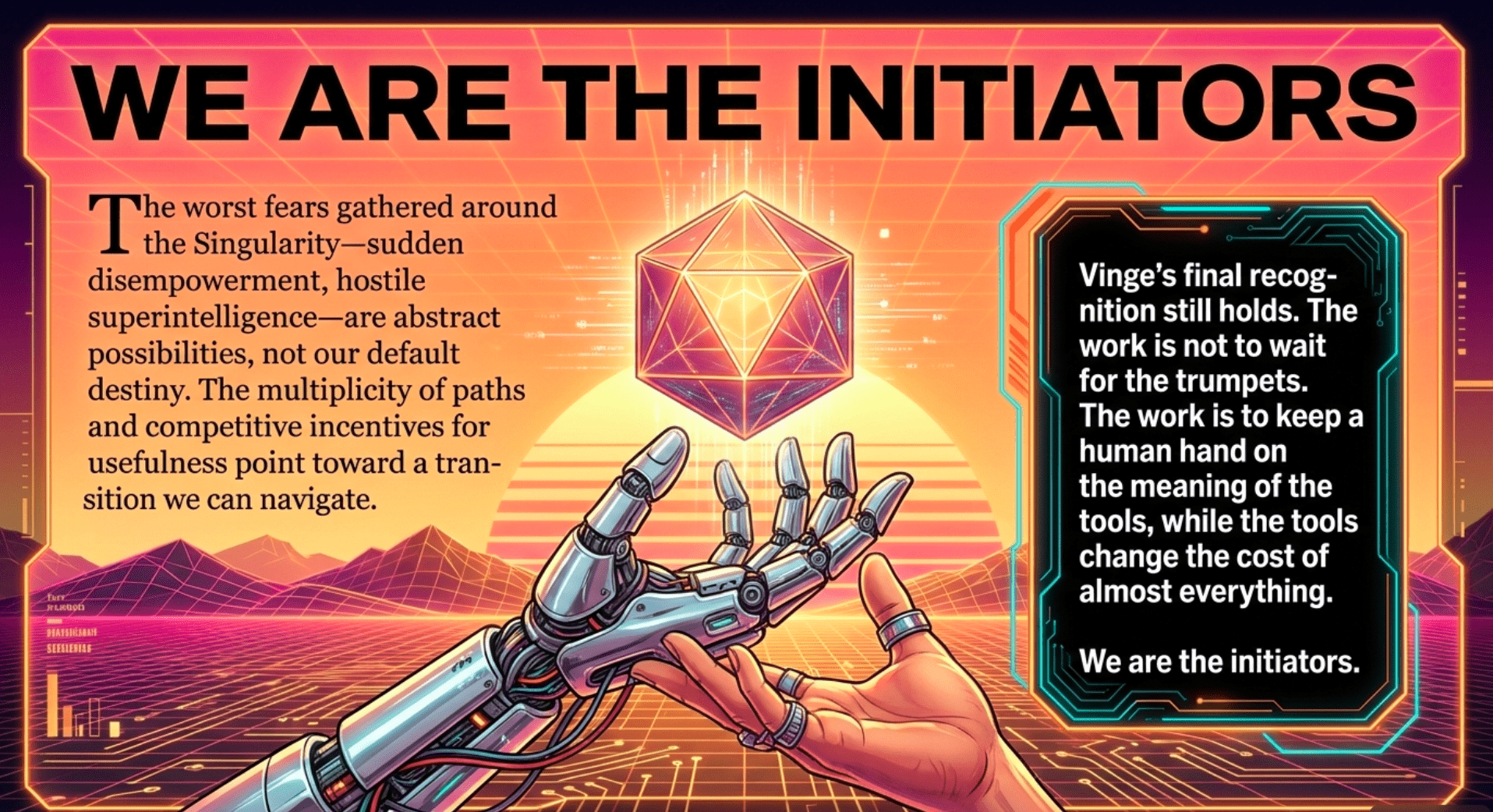
The worst fears that have gathered around the Singularity idea—sudden disempowerment, uncontrollable hostile superintelligence, the permanent end of human relevance—remain possible in abstract principle. They are not the most probable path given the evidence so far. Systems remain under human oversight. Agentic behavior is still bounded and directed. The economic and social incentives strongly favor tools that expand human capability rather than replace it wholesale. Research into alignment, constitutional methods, scalable oversight, and cooperative AI systems reflects exactly the proactive guidance Vinge urged. The trajectory to date is one of expanding the circle of flourishing, not contracting it.
From a century away the picture will simplify, as pictures do. Someone will pick a year when a particular capability crossed a particular benchmark, or when a particular robot first did a particular hour of unpaid household labor without a handler in the shot, or when a particular legal fight decided who owns a model’s output, or when a particular energy system finally made the tokens cheap enough that the slope could continue. They will say here is the moment, the way we say Gutenberg, or Watt, or Shockley, or the week Gmail opened and a few stubborn people began filing a life into a searchable graph. They will be a little wrong and a little useful. The people who lived it will have known only this. Some things ran ahead. Some things seized up. The trumpets never came. The clear point never announced itself. And the work was to keep a human hand on the meaning of the tools while the tools changed the cost of almost everything except the need to choose what a life is for.
The March 1993, at a NASA symposium called VISION-21, were a quiet mathematician and science-fiction writer named Vernor Vinge stood before an audience of engineers and researchers, delivered one of the clearest warnings and invitations ever issued about the human future. It was in the companion paper titled “The Coming Technological Singularity: How to Survive in the Post-Human Era.” Its opening sentence:
“Within thirty years, we will have the technological means to create superhuman intelligence. Shortly after, the human era will be ended.”
He called that threshold The Singularity. He expected it somewhere between 2005 and 2030. He said he would be surprised if it arrived outside that window.
Thirty-three years later, in the summer of 2026, we are living inside the final years of the window he named. The paper no longer reads like distant speculation. It reads like a field report written by someone who had already walked the terrain and left us a map.
What stands out most clearly now is not only the accuracy of the forecast but the space Vinge deliberately left open for human agency and constructive outcomes. The darkest fears that have grown up around the Singularity idea are not the most probable path.
The evidence of the intervening decades points toward expansion of capability, restoration of agency, and a transition that can amplify rather than extinguish what is most valuable about human life.
Support This Work
To continue this vital work documenting, analyzing, and sharing these hard-won lessons before we launch humanity’s greatest leap: I need your support. Independent research like this relies entirely on readers who believe in preparing wisely for our multi-planetary future. If this has ignited your imagination about what is possible, please consider donating at buy me a Coffee or becoming a member. Value for value you recieved here.
Every contribution helps sustain deeper fieldwork, upcoming articles, and the broader mission of translating my work to practical applications. Ain ‘t no large AI company supporting me, but you are, even if you just read this far. For this, I thank you.
Stay aware and stay curious,
🔐 Start: Exclusive Member-Only Content.
Membership status:
🔐 End: Exclusive Member-Only Content.
~—~
~—~

~—~
Subscribe ($99) or donate by Bitcoin.
Copy address: bc1qkufy0r5nttm6urw9vnm08sxval0h0r3xlf4v4x
Send your receipt to [email protected] to confirm subscription.

Stay updated: Get an email when we post new articles:

THE ENTIRETY OF THIS SITE IS UNDER COPYRIGHT. IMPORTANT: Any reproduction, copying, or redistribution, in whole or in part, is prohibited without written permission from the publisher. Information contained herein is obtained from sources believed to be reliable, but its accuracy cannot be guaranteed. We are not financial advisors, nor do we give personalized financial advice. The opinions expressed herein are those of the publisher and are subject to change without notice. It may become outdated, and there is no obligation to update any such information. Recommendations should be made only after consulting with your advisor and only after reviewing the prospectus or financial statements of any company in question. You shouldn’t make any decision based solely on what you read here. Postings here are intended for informational purposes only. The information provided here is not intended to be a substitute for professional medical advice, diagnosis, or treatment. Always seek the advice of your physician or other qualified healthcare provider with any questions you may have regarding a medical condition. Information here does not endorse any specific tests, products, procedures, opinions, or other information that may be mentioned on this site. Reliance on any information provided, employees, others appearing on this site at the invitation of this site, or other visitors to this site is solely at your own risk.
Copyright Notice:
All content on this website, including text, images, graphics, and other media, is the property of Read Multiplex or its respective owners and is protected by international copyright laws. We make every effort to ensure that all content used on this website is either original or used with proper permission and attribution when available.
However, if you believe that any content on this website infringes upon your copyright, please contact us immediately using our 'Reach Out' link in the menu. We will promptly remove any infringing material upon verification of your claim. Please note that we are not responsible for any copyright infringement that may occur as a result of user-generated content or third-party links on this website. Thank you for respecting our intellectual property rights.
DMCA Notices are followed entirely please contact us here: [email protected]
