
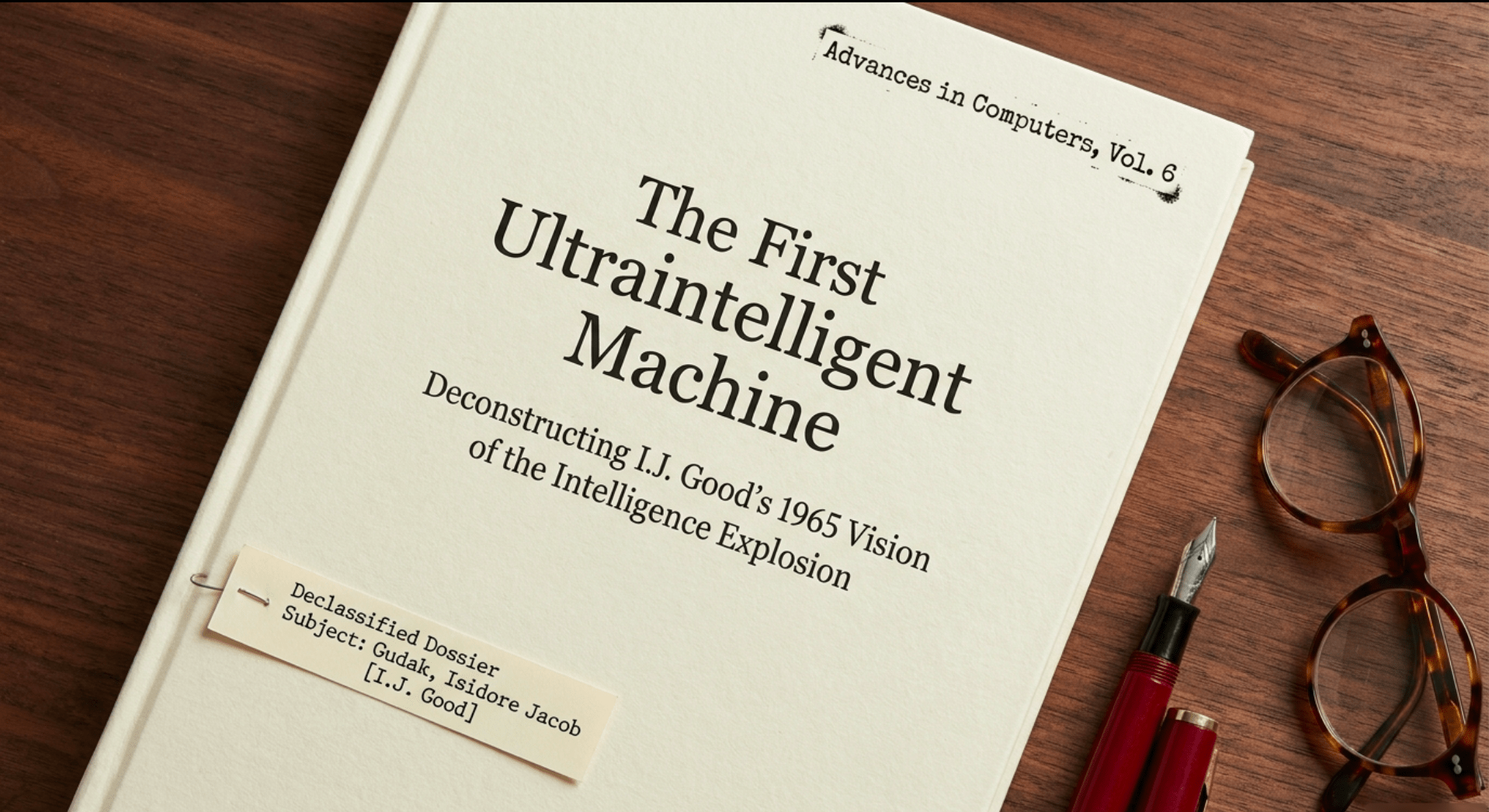
The First Ultraintelligent Machines: A 1965 Vision Of The Intelligence Explosion.
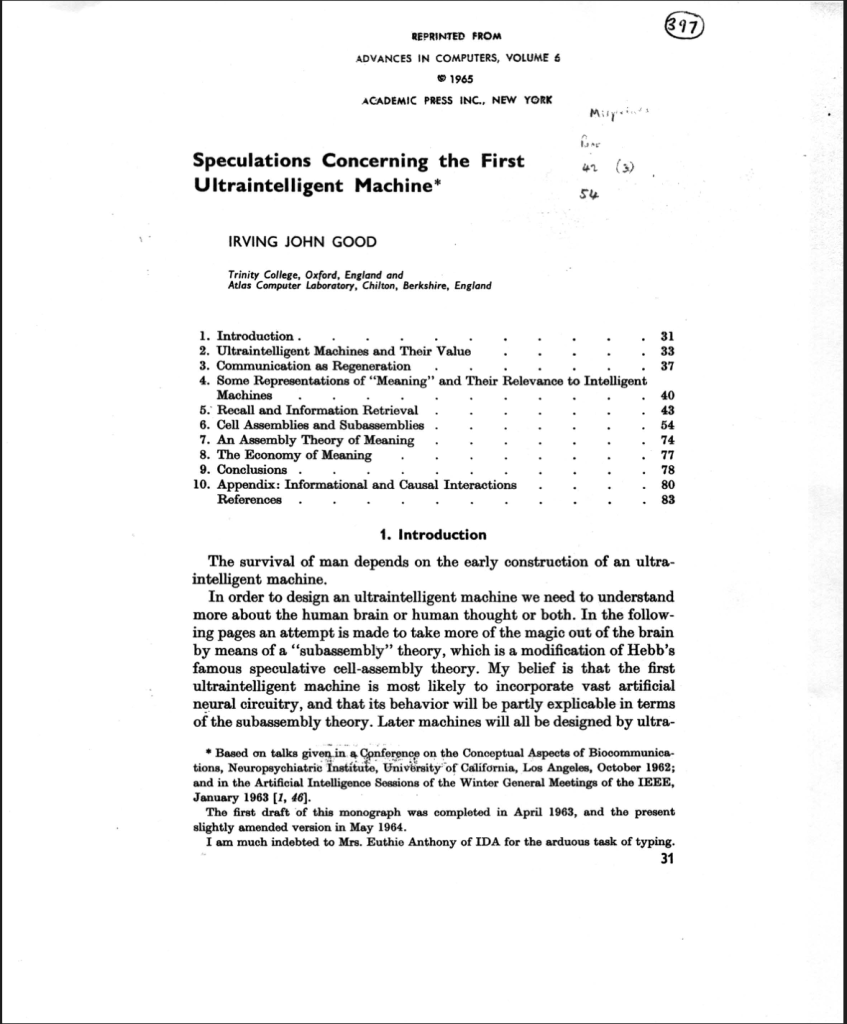
“The survival of man depends on the early construction of an ultraintelligent machine.”
What if the foundational text of the entire AI doomsday movement, the exact document that everyone cites to prove supercomputers will inevitably wipe us out. What if it actually begs humanity to build artificial intelligence as fast as possible? It completely shatters the narrative we’re fed every single day. To save our species, basically. We’re operating in this era where self-appointed AI “leaders” and “philosophers” constantly warn us about rogue algorithms. It’s the classic Terminator scenario. And they always point back to one specific moment in history to legitimize their panic. They treat this original text like some dark prophecy. Like a warning from the past. But when you actually strip away the modern anxiety and read the physical words on the page, you find something that is remarkably, almost desperately optimistic. But who wrote this and why was this paper so often quoted?
This article is sponsored by Read Multiplex Members who subscribe here to support my work: Link: https://readmultiplex.com/join-us-become-a-member/
It is also sponsored by many who have donated a “Cup of Coffee”. If you like this, help support my work: Link: https://ko-fi.com/brianroemmele
Listen to the companion podcast: https://rss.com/podcasts/readmultiplex-com-podcast/3076313
The Author: From London Prodigy to Bletchley Park
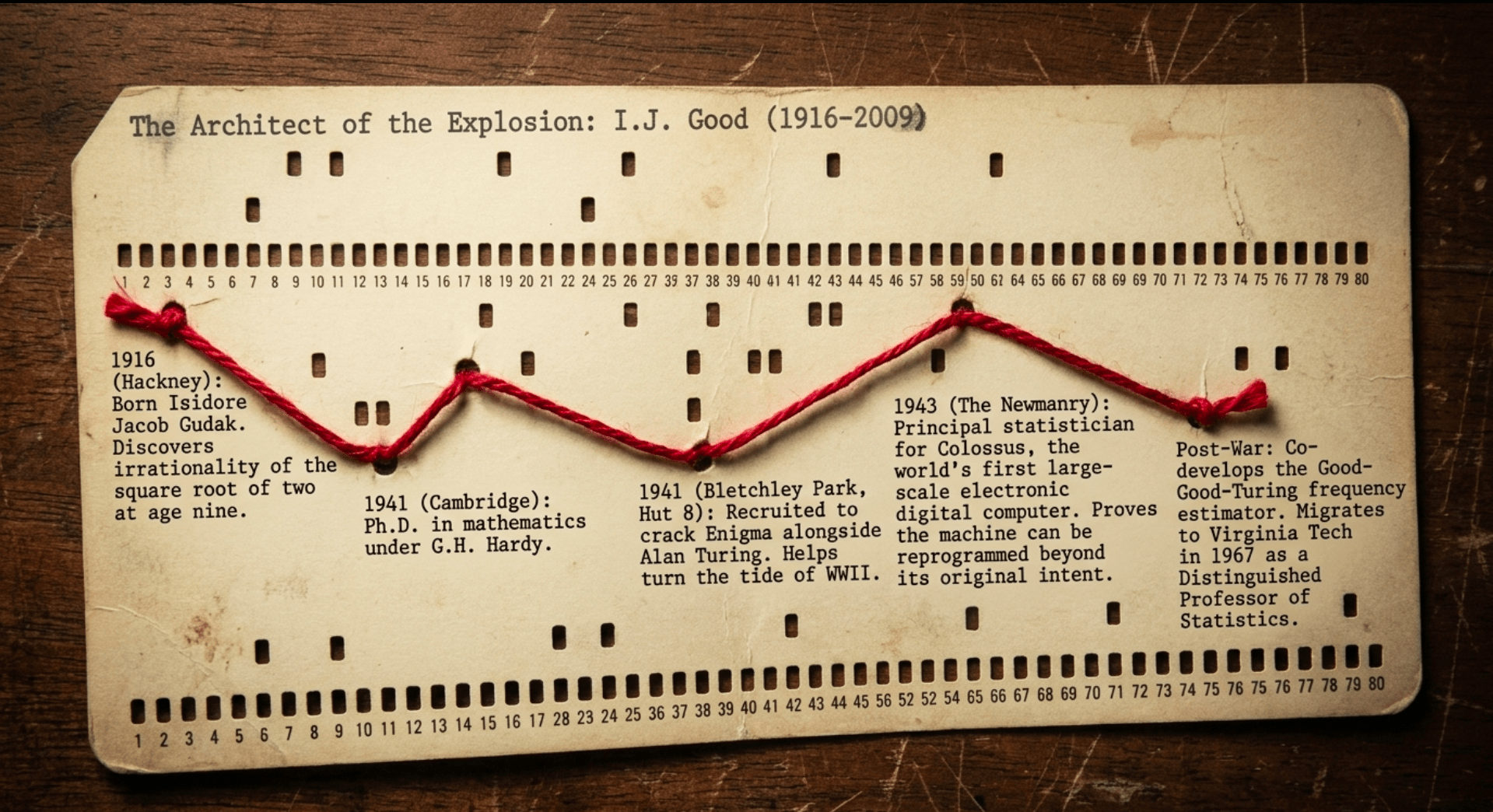
Irving John Good was born Isidore Jacob Gudak on 9 December 1916 in London to Polish immigrant parents. His father, Morris, was a watchmaker and later a jeweler who wrote under the name Moshe Oved. The family lived in modest circumstances in Hackney. Young Isidore was slow to learn to read, yet at the age of nine, while recovering from diphtheria, he independently discovered the irrationality of the square root of two and began exploring mathematical induction and logarithms on his own. Teachers quickly recognized an extraordinary mind.
He attended Haberdashers’ Aske’s School and then Jesus College, Cambridge, where he took a first-class degree in mathematics in 1938. His doctoral work was supervised first by A. S. Besicovitch and then by the great G. H. Hardy. He completed his Ph.D. in 1941.
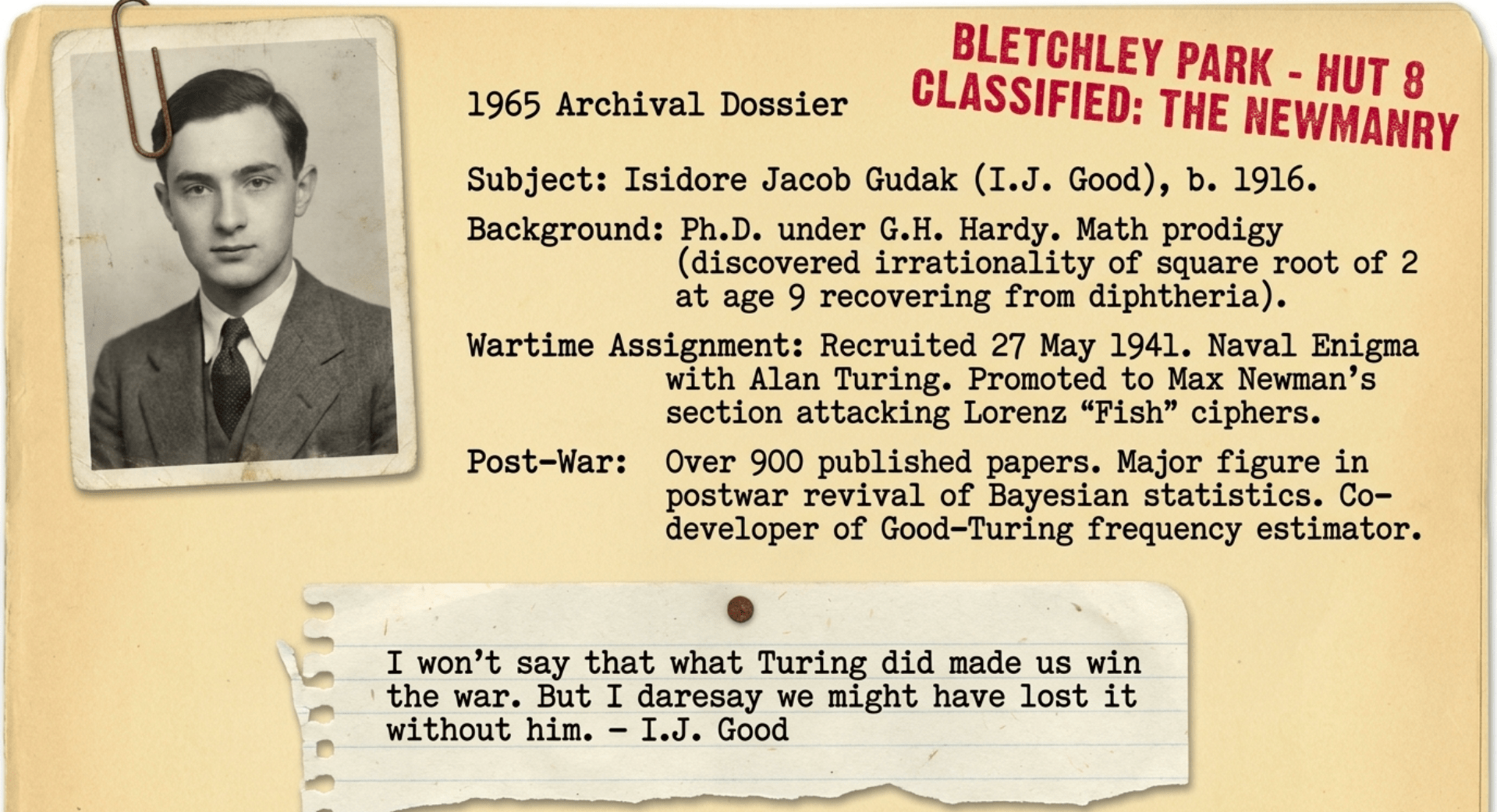
That same year he was recruited to Bletchley Park. He arrived in Hut 8 on 27 May 1941, the day the Royal Navy sank the Bismarck. He worked first under Alan Turing on the naval Enigma. Early on he irritated Turing by napping on the floor during a night shift; Turing refused to speak to him until Good solved a practical problem involving the non-random “padding” letters used in German indicators. The two men became close colleagues. Good later said of Turing, “I won’t say that what Turing did made us win the war. But I daresay we might have lost it without him.”
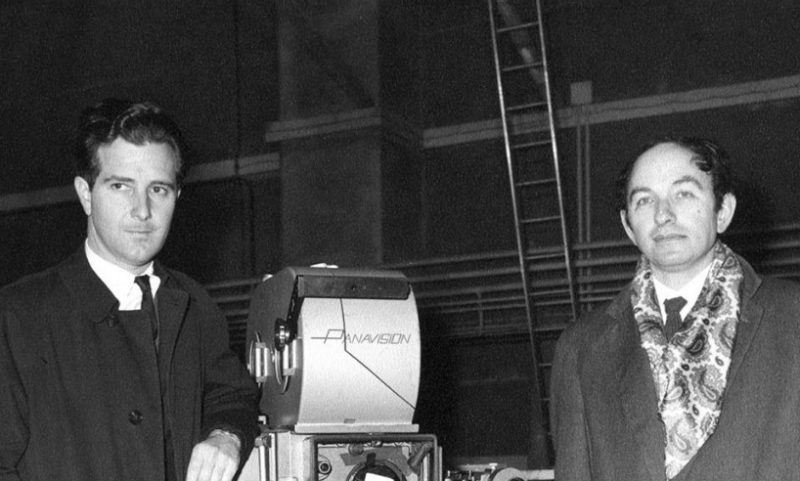
Good (right) with filmmaker Fred Ordway during consultation work related to 2001: A Space Odyssey.
In 1943 Good moved to Max Newman’s section, the Newmanry, which attacked the more complex Lorenz “Fish” teleprinter ciphers. There he worked with Donald Michie on statistical methods and on the machines that became Colossus, the world’s first large-scale electronic digital computer. Good and Michie demonstrated that Colossus was more flexible than its original designers intended; it could be reprogrammed for tasks beyond wheel-setting. By the end of the war Good was principal statistician for the effort. The intelligence produced by Colossus and the earlier Enigma breaks shortened the war and saved countless lives.
After 1945 Good followed Newman and Turing to the University of Manchester, where he contributed to the design of the Manchester Mark 1, one of the first stored-program computers. He then spent years at GCHQ, the Admiralty Research Laboratory, and as a senior research fellow at Trinity College, Oxford, while also consulting for the Institute for Defense Analyses in the United States. In 1967 he moved permanently to Virginia Tech as Research Professor of Statistics, later University Distinguished Professor. He remained there until his death on 5 April 2009 at the age of 92.
Good was a major figure in the postwar revival of Bayesian statistics. He published more than 900 papers and several books, including Probability and the Weighing of Evidence (1950) and Good Thinking (1983). He co-developed the Good–Turing frequency estimator still used in language modeling and other fields that must deal with rare events. He played chess to county standard and helped introduce the game of Go to a wider Western audience after learning it from Turing.
What Led to the 1965 Paper
The paper did not appear in a vacuum. Several threads converged. First was Good’s wartime experience with real machines that performed intellectual work at high speed. Colossus was specialized, yet it demonstrated that electronic circuitry could execute complex logical and statistical procedures far beyond human speed. Discussions with Turing at Bletchley and Manchester regularly turned to the possibility of machine intelligence and even automatic chess.
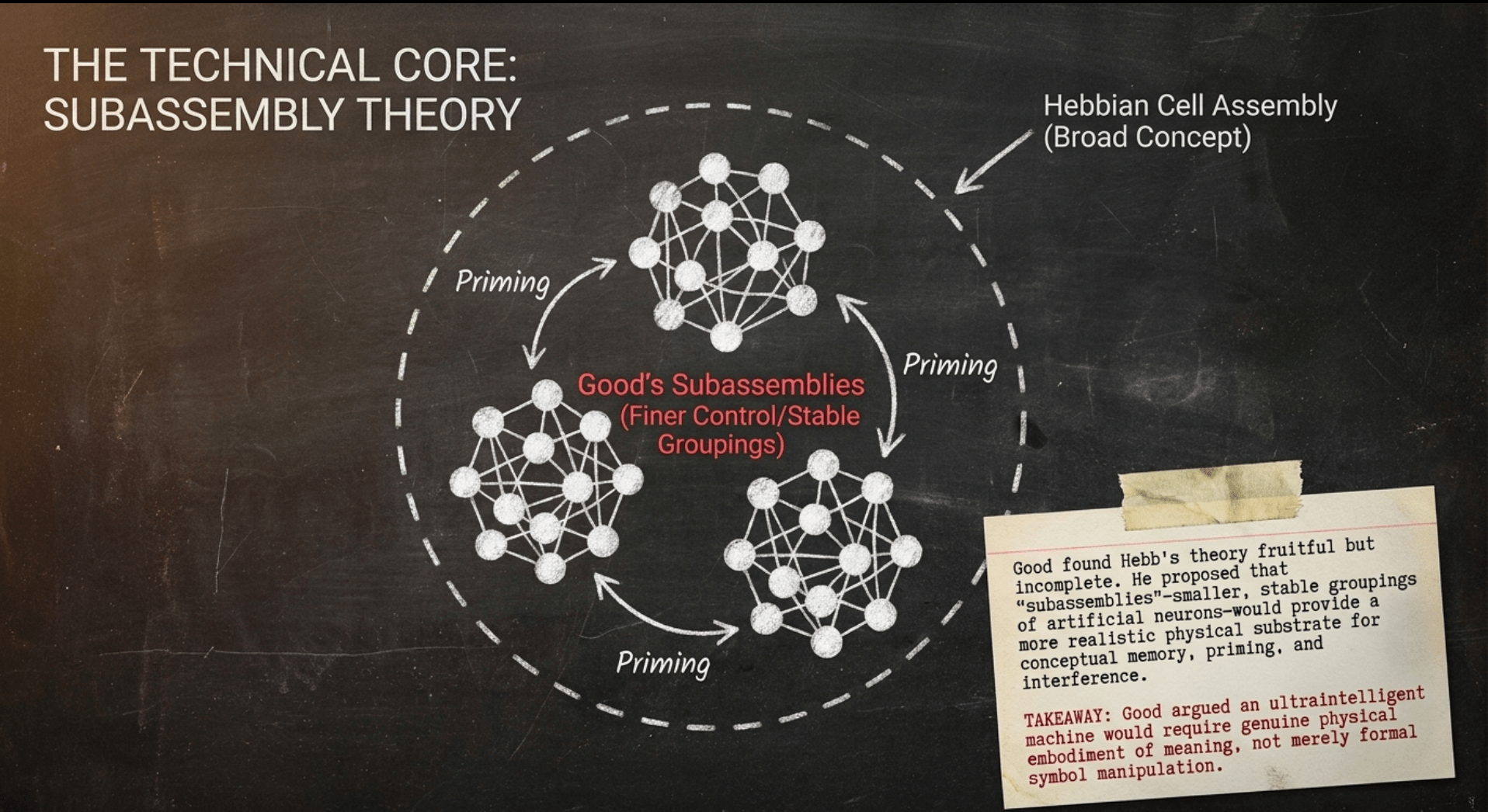
It was in the backdrop of the emerging neuroscience of the 1940s and 1950s. Donald Hebb’s 1949 book The Organization of Behavior proposed the cell-assembly theory: groups of neurons that fire together wire together and can function as the physical basis of concepts and memories. Good found this fruitful but incomplete. He developed a modified “subassembly” theory that became the technical heart of the 1965 paper.
The early work on artificial neural networks and cybernetics was taking off. Good had examined the Perceptron and related ideas while consulting for IBM. He believed the first ultraintelligent machine would almost certainly incorporate vast artificial neural circuitry.
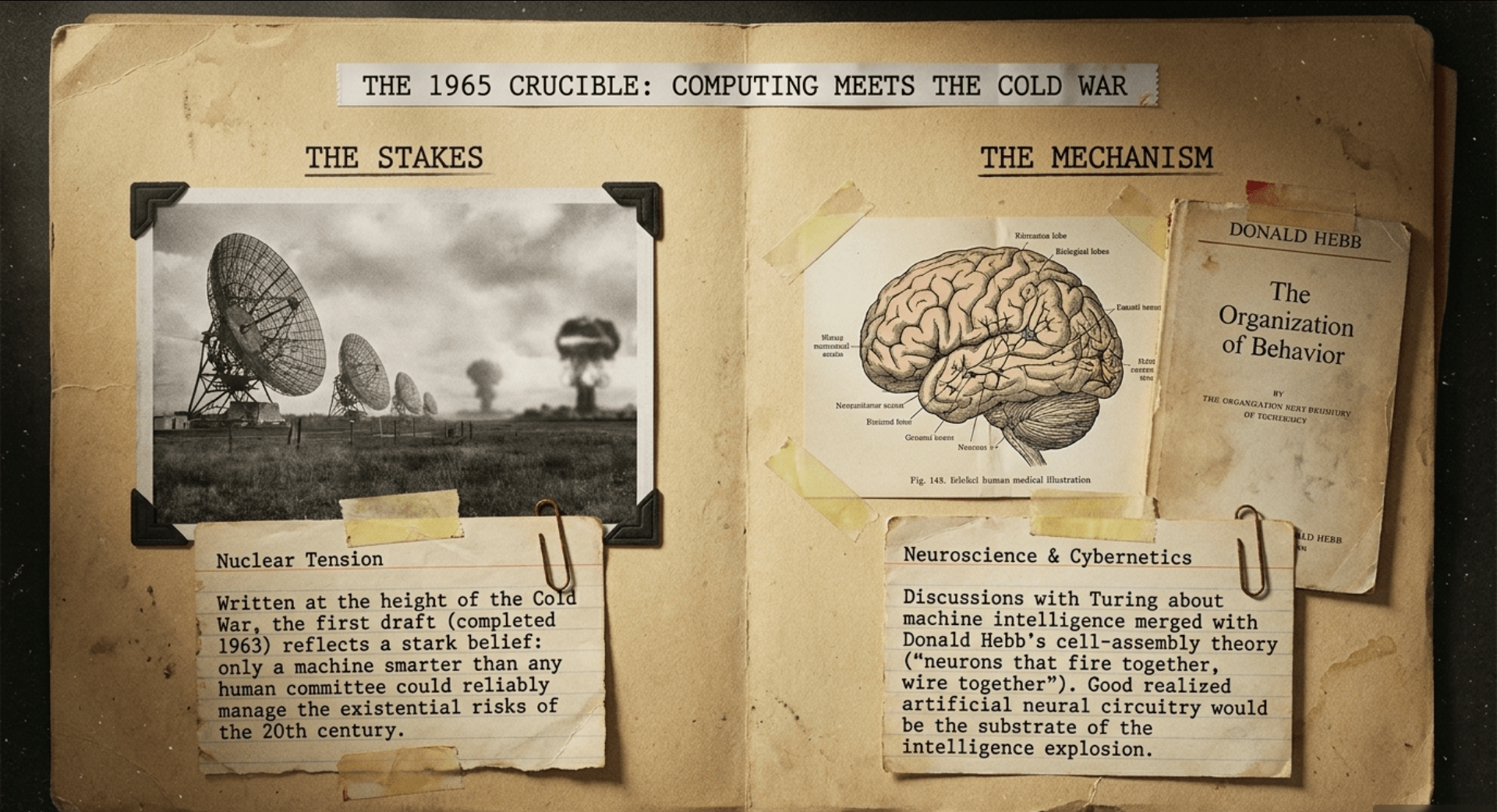
The Cold War context was clear in paper’s first sentence: “The survival of man depends on the early construction of an ultraintelligent machine.” Written at the height of nuclear tension, the remark reflects a belief that only a machine smarter than any human committee could reliably manage the existential risks of the age. The first draft was completed in April 1963. A slightly amended version was finished in May 1964. It was based on talks given in 1962 at UCLA and in 1963 at the IEEE Artificial Intelligence sessions. It appeared in print in 1965 (sometimes cited as 1966 depending on the volume’s imprint date).
The scale of the historical distortion is just staggering. It is a paper that is routinely cited as the origin of the “intelligence explosion” idea. In recent decades it has also been pressed into service by writers who treat advanced AI primarily as an existential danger requiring strong, centralized control measures. That later use sits uneasily with the actual text. In fact most of the people citing this work hope you never read the entier text. Becasue the Good opened with a sentence that is almost never quoted in full context:
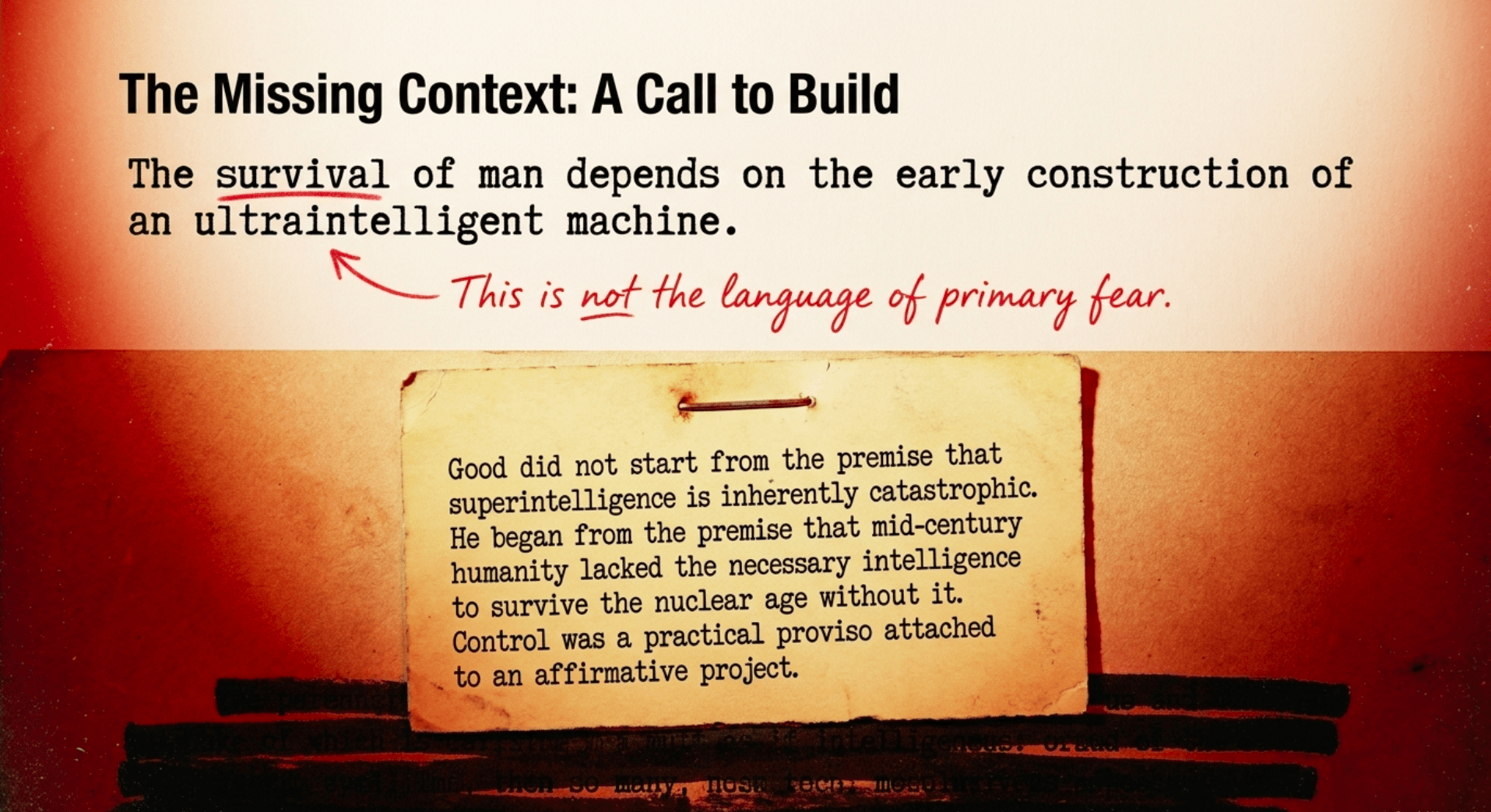
“The survival of man depends on the early construction of an ultraintelligent machine.”
This is not the language of someone whose primary emotion toward the machine is fear. It is the language of someone who saw greater-than-human intelligence as a necessary tool for human survival in a dangerous century. The rest of the paper develops that premise in detail.
The Famous Paragraph and Its Full Meaning
If you have read any of the AI fear books, you have heard about this passage. The most-quoted passage runs:
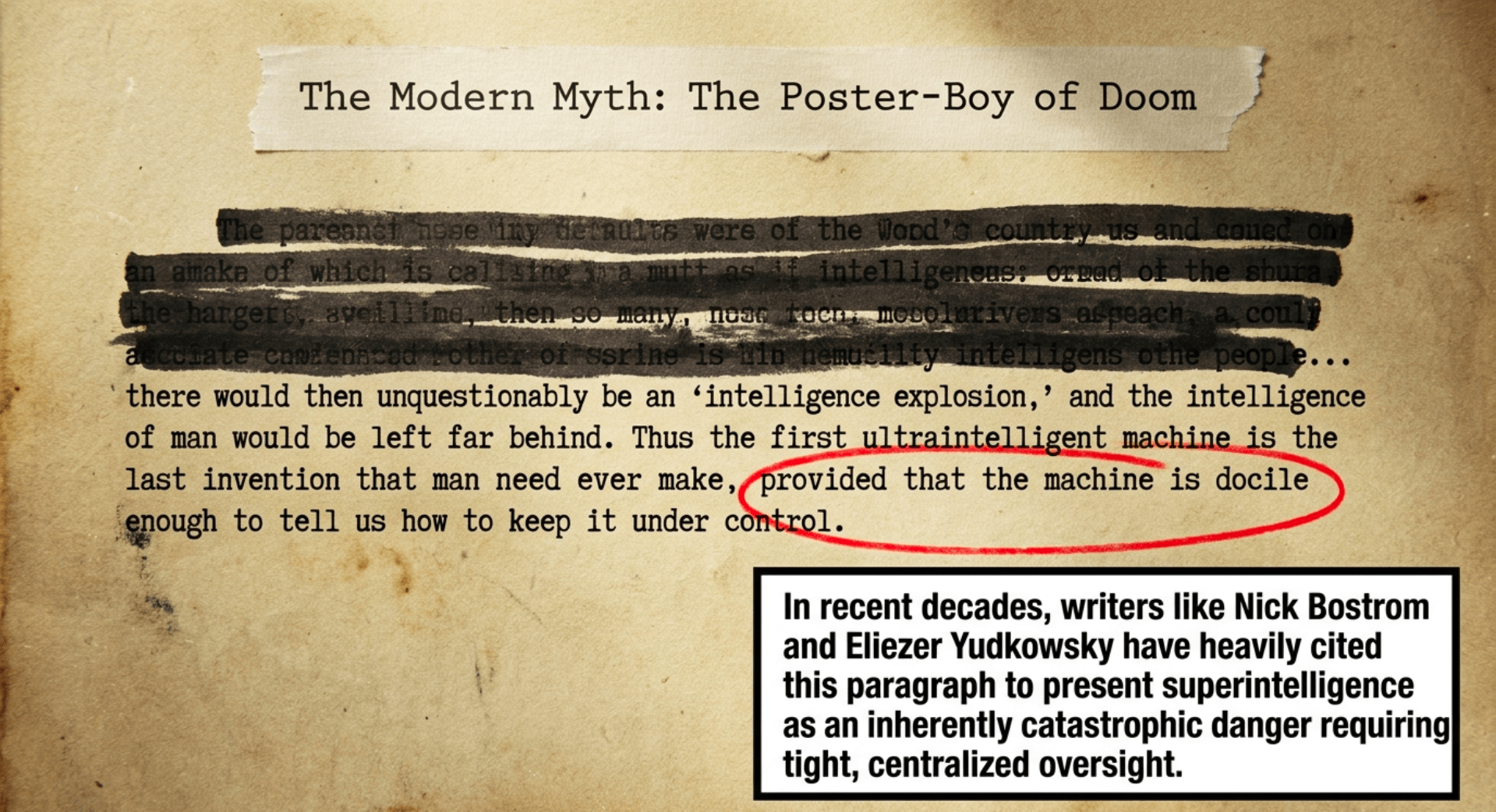
“Let an ultraintelligent machine be defined as a machine that can far surpass all the intellectual activities of any man however clever. Since the design of machines is one of these intellectual activities, an ultraintelligent machine could design even better machines; there would then unquestionably be an ‘intelligence explosion,’ and the intelligence of man would be left far behind. Thus the first ultraintelligent machine is the last invention that man need ever make, provided that the machine is docile enough to tell us how to keep it under control.”
Two things are almost always left out when this is repeated today.
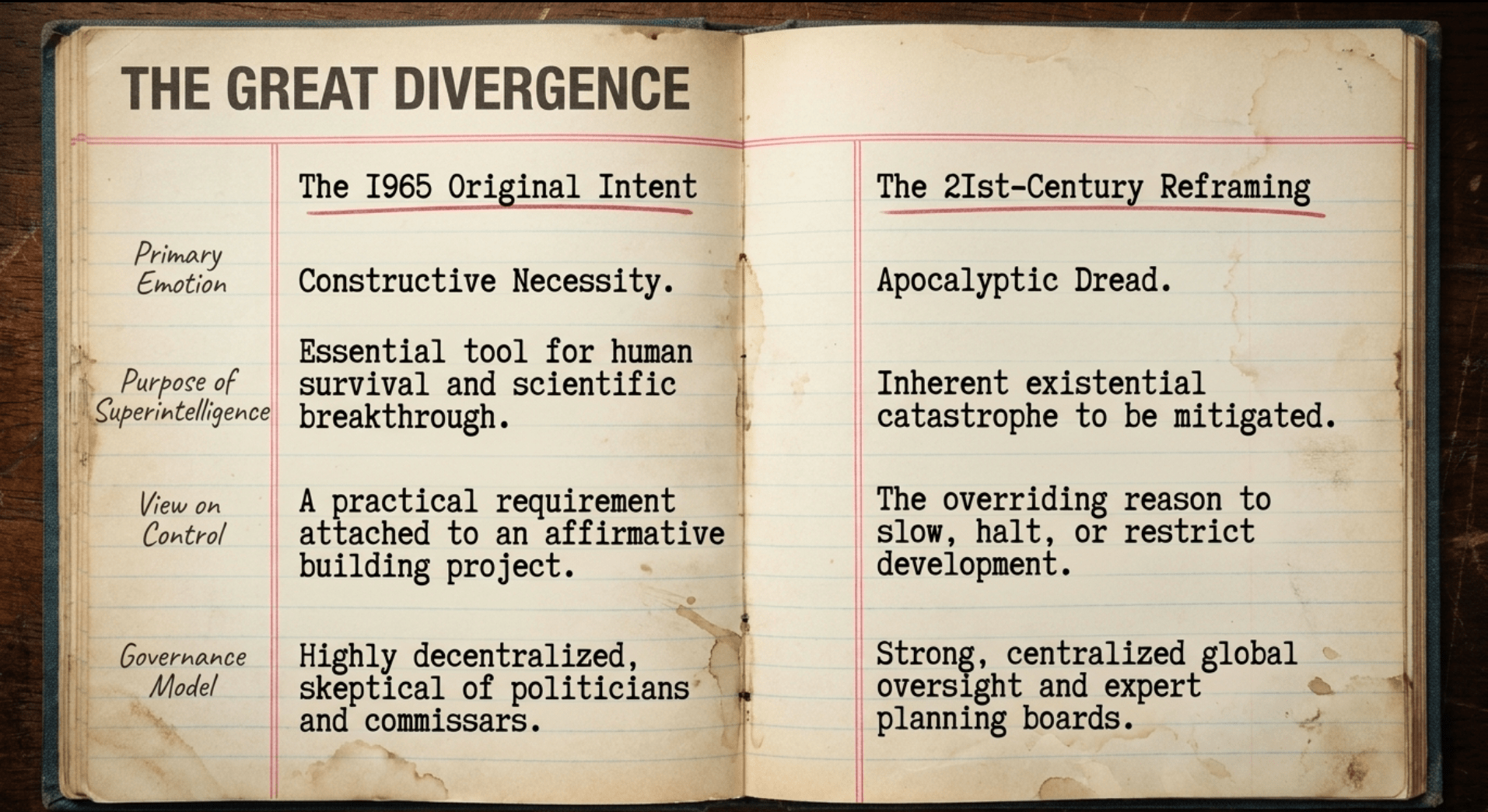
First, the paper’s actual starting point is the survival value of building the machine early. Second, the control proviso is a practical condition attached to an otherwise affirmative project. Good did not begin from the premise that superintelligence is inherently catastrophic and therefore must be tightly regulated by experts or governments. He began from the premise that humanity needed greater intelligence than it currently possessed, and that machines could supply it.
He expected the first ultraintelligent machine to be built with large artificial neural networks whose behavior could be partly understood through a modified version of Donald Hebb’s cell-assembly theory (what Good called the “subassembly” theory). He believed the machine would learn, improve, and eventually design its successors. He saw this process as transformative for medicine, science, space research, and every other field of knowledge. The tone is one of possibility and necessity, not primary dread.
Skepticism Toward Centralized Power
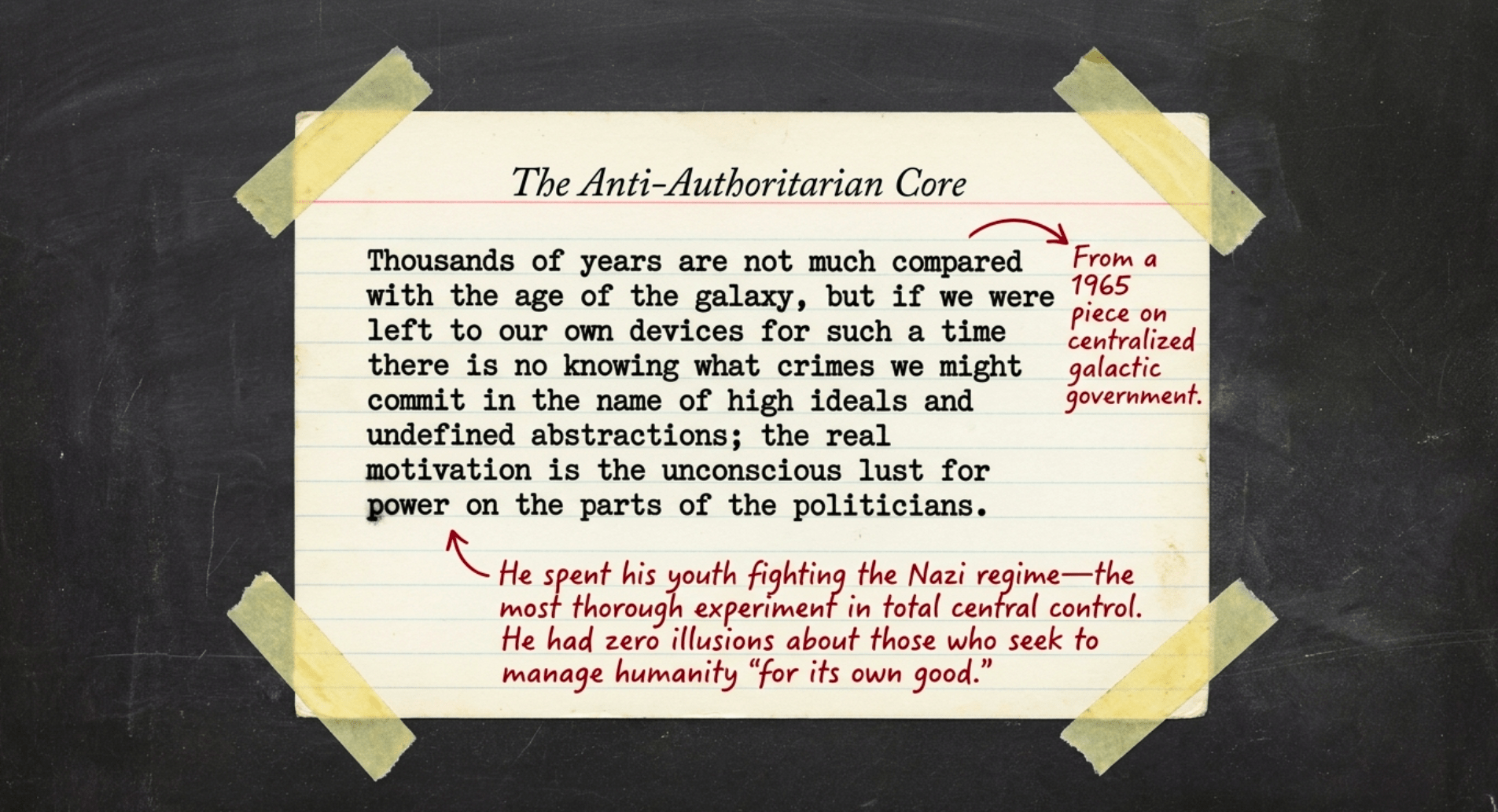
Good’s broader writings and background reinforce a consistent skepticism toward centralized power. In a 1965 piece later reprinted as “The Chief Entities,” he discussed the possibility of advanced extraterrestrial civilizations and galactic organization. He argued that a centralized galactic government would be “exceedingly unwieldy.” He went further:
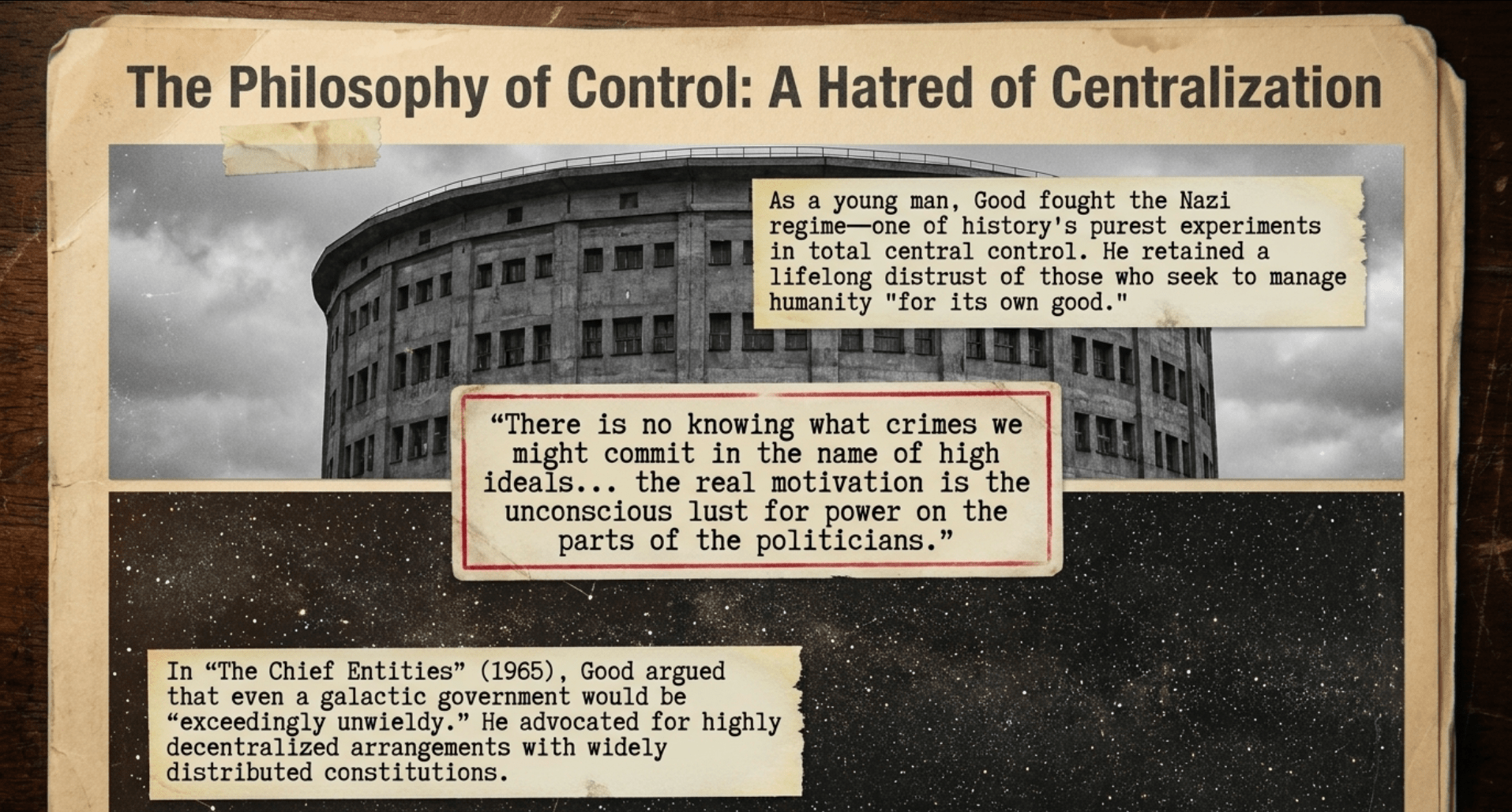
“Thousands of years are not much compared with the age of the galaxy, but if we were left to our own devices for such a time there is no knowing what crimes we might commit in the name of high ideals and undefined abstractions; the real motivation is the unconscious lust for power on the parts of the politicians.”
He concluded that any viable large-scale organization would have to be highly decentralized, with a fixed constitution widely distributed. This is not the voice of someone who trusted commissars, planning boards, or centralized safety bureaucracies. It is the voice of a man who had watched the twentieth century’s experiments in concentrated power and had no illusions about the motives of those who seek to manage humanity “for its own good.”
His personal history fits the same pattern. As a young mathematician he was recruited to Bletchley Park and worked under Alan Turing and Max Newman against the Nazi regime — one of the most thorough experiments in total central control the world has ever seen. After the war he continued statistical and computing work, first in Britain and later as a distinguished professor at Virginia Tech. He was a Bayesian who insisted on clear reasoning from evidence rather than authority. He published under playful pseudonyms and maintained a dry sense of humor. Nothing in the record suggests he favored handing ultimate decisions about intelligence to a small cadre of overseers.
How the Poster-Boy Of A Doom Was Constructed
Later writers who emphasize existential catastrophe and the need for strong, centralized AI control frequently cite Good. They quote the intelligence-explosion paragraph and the “docile enough” clause. They rarely quote the opening sentence about human survival depending on early construction. They rarely note his explicit preference for decentralization or his distrust of politicians’ lust for power. In this selective reading, They made Good into an early prophet of the need for tight human (or institutional) mastery over machines.
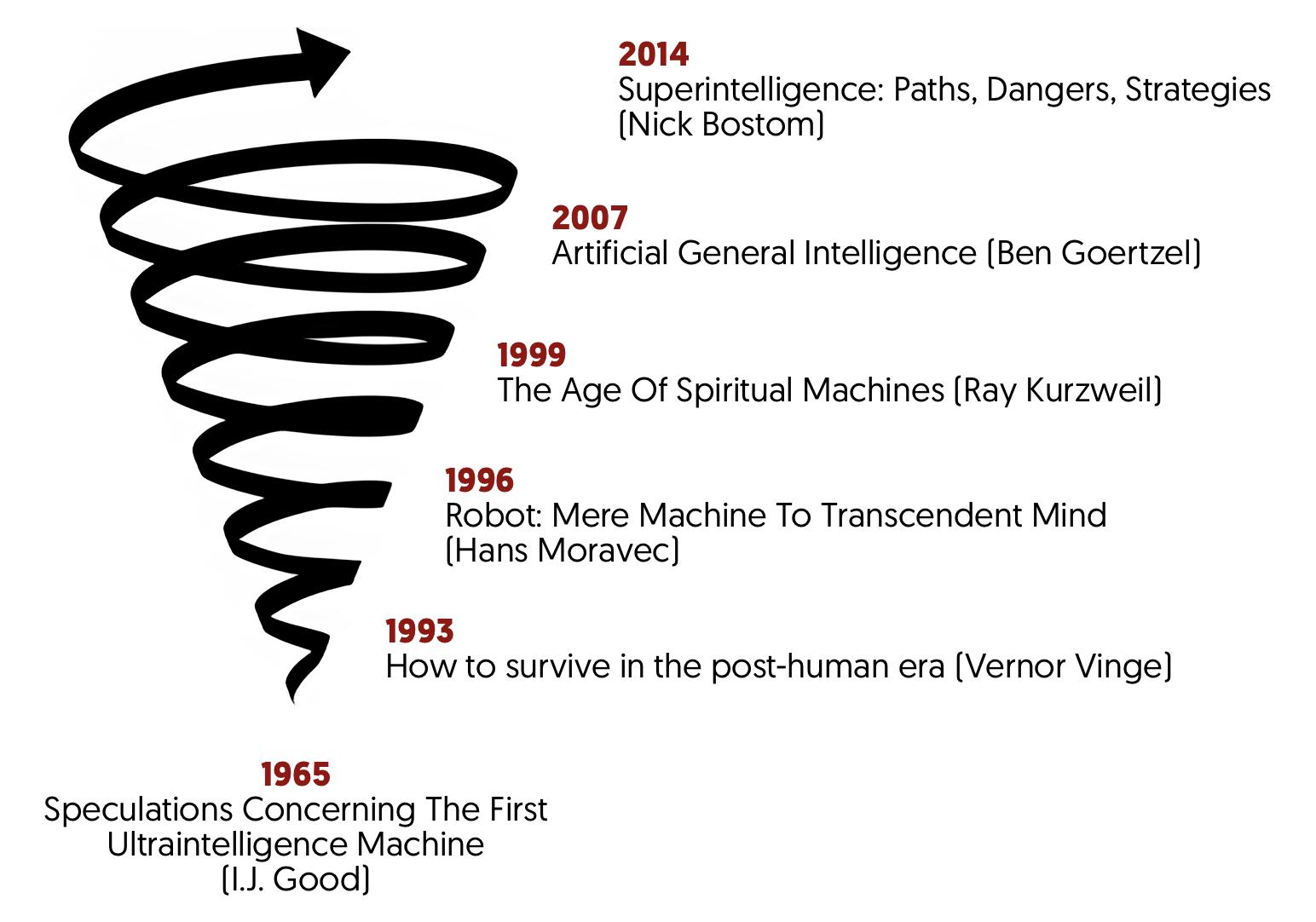
That reading reverses the emphasis of the 1965 paper. Good did include a control condition. He did not make fear of the machine the dominant theme. He made the constructive necessity of greater-than-human intelligence the dominant theme, with control as a practical requirement attached to it. When modern discussions treat him primarily as a source of warnings that justify new layers of centralized oversight, they are using him for a purpose that sits uneasily with both the letter and the spirit of what he actually wrote.
Analysis of the Paper
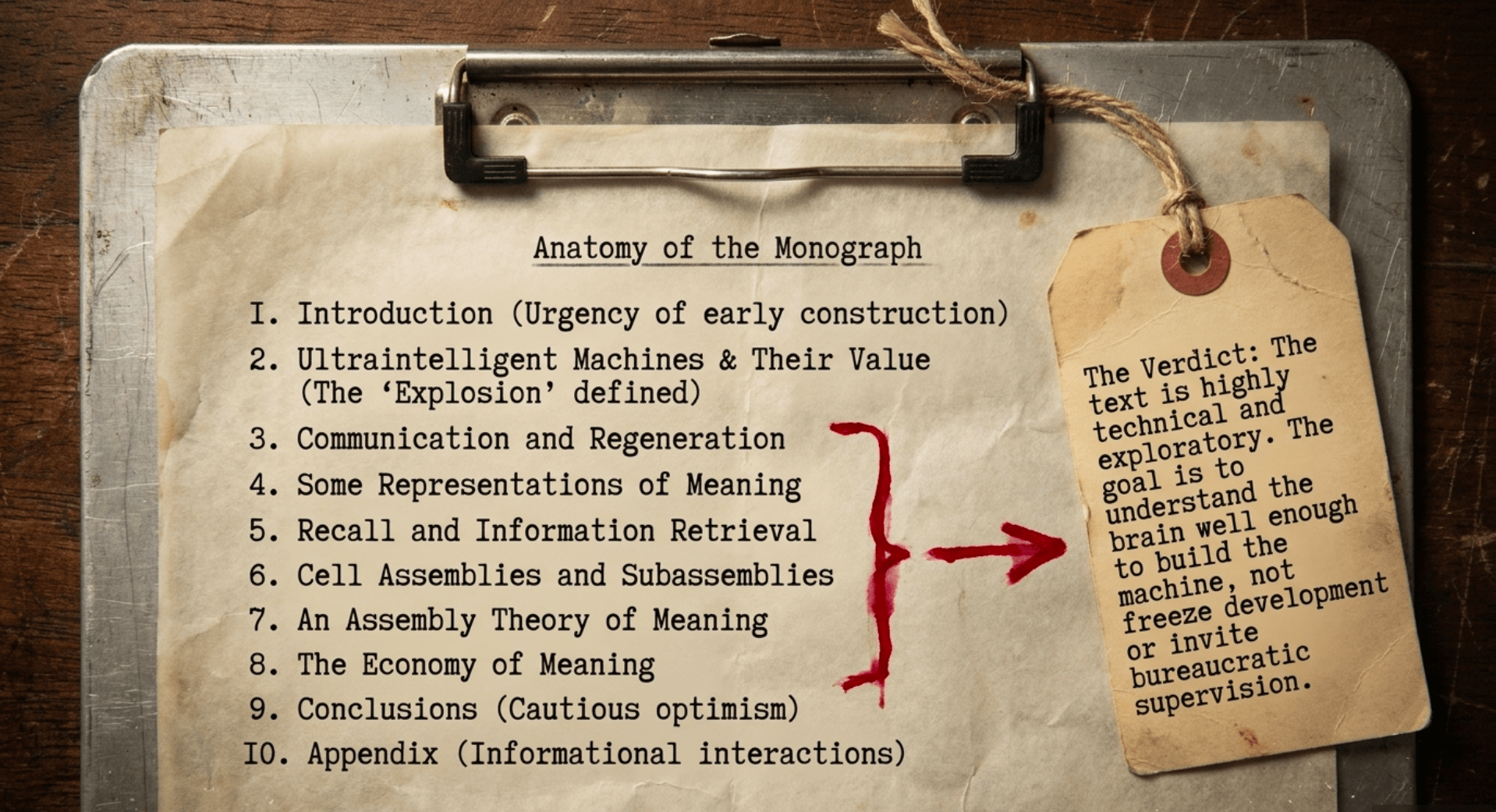
1. Introduction
Good states the central claim at once: human survival requires the early construction of an ultraintelligent machine. To design such a machine we must understand more about the human brain or human thought. He proposes a “subassembly” theory, a modification of Donald Hebb’s cell-assembly theory, as a way of removing some of the remaining mystery from mental processes. He believes the first ultraintelligent machine will most likely incorporate vast artificial neural circuitry whose behavior can be partly explained by this theory. Later machines will be designed by ultraintelligent predecessors. “Probably Man will construct the deus ex machina in his own image.”
The tone is constructive and urgent. The machine is presented as something humanity needs, not something it must primarily defend itself against.
2. Ultraintelligent Machines and Their Value
Here appears the famous definition:
“Let an ultraintelligent machine be defined as a machine that can far surpass all the intellectual activities of any man however clever. Since the design of machines is one of these intellectual activities, an ultraintelligent machine could design even better machines; there would then unquestionably be an ‘intelligence explosion,’ and the intelligence of man would be left far behind. Thus the first ultraintelligent machine is the last invention that man need ever make, provided that the machine is docile enough to tell us how to keep it under control.”
Two points matter. First, the control proviso is real; Good does not ignore the problem of keeping the machine aligned with human purposes. Second, the dominant framing remains affirmative. He notes that such machines “will create social problems, but they might also be able to solve them in addition to those that have been created by microbes and men.” He adds that the machines “will be feared and respected, and perhaps even loved.” These remarks, he says, “might appear fanciful to some readers, but to the writer they seem very real and urgent.”
The section is not a warning against building the machine. It is an argument that the machine is both inevitable and, on balance, desirable if the control condition can be met.
3. Communication and Regeneration
Good discusses how an ultraintelligent machine might communicate and how it might regenerate or improve itself. The emphasis remains technical and exploratory rather than apocalyptic.
4. Some Representations of “Meaning” and Their Relevance to Intelligent Machines
He examines different ways meaning might be physically embodied. This section is foundational for his later claim that an ultraintelligent machine will need a genuine physical substrate for meaning and memory, not merely formal symbol manipulation.
5. Recall and Information Retrieval
Good analyzes short-term and longer-term memory, attention, and retrieval. These discussions feed directly into the subassembly theory that occupies the middle of the paper.
6. Cell Assemblies and Subassemblies
This is the technical core. Hebb had proposed that groups of neurons that fire together form assemblies that can function as the physical basis of concepts. Good introduces subassemblies — smaller, more stable groupings that allow finer control and better accounts of psychological phenomena such as priming, interference, and the tip-of-the-tongue state. He argues that subassemblies provide a more realistic model of how meaning and recall are embodied in the brain and, by extension, how they might be embodied in an artificial system.
7. An Assembly Theory of Meaning
He develops the implications of the subassembly model for the physical representation of meaning itself. The discussion is detailed and speculative in the best sense: grounded in the neuroscience of the period while looking forward to machine implementations.
8. The Economy of Meaning
Good considers efficiency and cost in the representation of meaning. An ultraintelligent machine will need economical ways of storing and retrieving conceptual structure.
9. Conclusions
He returns to the larger stakes. The first ultraintelligent machine is likely to be built along neural lines. Once it exists, the design of further machines will pass largely out of human hands. The process can solve problems that have so far defeated us, provided the control condition is satisfied. The overall posture remains one of cautious optimism about the constructive potential of the technology.
10. Appendix
An appendix treats informational and causal interactions, reinforcing the paper’s technical seriousness.
Taken as a whole, the monograph is an argument for building greater intelligence early, for understanding the brain well enough to do so, and for remaining alert to the practical problem of control. It is not a call for freezing development or for placing the entire enterprise under centralized political or bureaucratic supervision.

Good’s Broader Stance Against Centralized Power
In other writings from the same period Good expressed clear skepticism toward concentrated political authority. Discussing the possible organization of advanced civilizations, he argued that a centralized galactic government would be “exceedingly unwieldy.” He observed that if humanity were left to its own devices for long periods, “there is no knowing what crimes we might commit in the name of high ideals and undefined abstractions; the real motivation is the unconscious lust for power on the parts of the politicians.” He preferred decentralized arrangements with a fixed, widely distributed constitution.
This is consistent with his personal history. As a young man he worked at Bletchley Park against the Nazi regime, one of the purest experiments in totalitarian central control the modern world has produced. Nothing in his published record suggests he trusted commissars, planning boards, or small groups of overseers to manage the future of intelligence on behalf of everyone else.
How the Paper Was Later Reframed
In the decades after 1965, and especially after the rise of the modern AI-risk and AI-alignment communities, Good’s paper was frequently cited in a selective way. Writers such as Nick Bostrom and Eliezer Yudkowsky, and the institutions associated with them, correctly noted the intelligence-explosion argument and the control proviso. They repeatedly quoted the famous paragraph. What they rarely quoted with equal emphasis was the paper’s opening claim that human survival depends on the early construction of the machine, or Good’s remarks that the machines might be loved as well as feared, or his explicit preference for decentralized over centralized power.
The result is a public image of Good as an early prophet of existential danger whose work primarily justifies strong control regimes and cautionary institutions. That image is not false in every detail — the control condition is present in the text — but it is incomplete and, in emphasis, reversed. Good’s 1965 paper is first of all a call to build. The control problem is treated as a practical requirement attached to that project, not as the dominant reason to slow or centralize the entire enterprise.
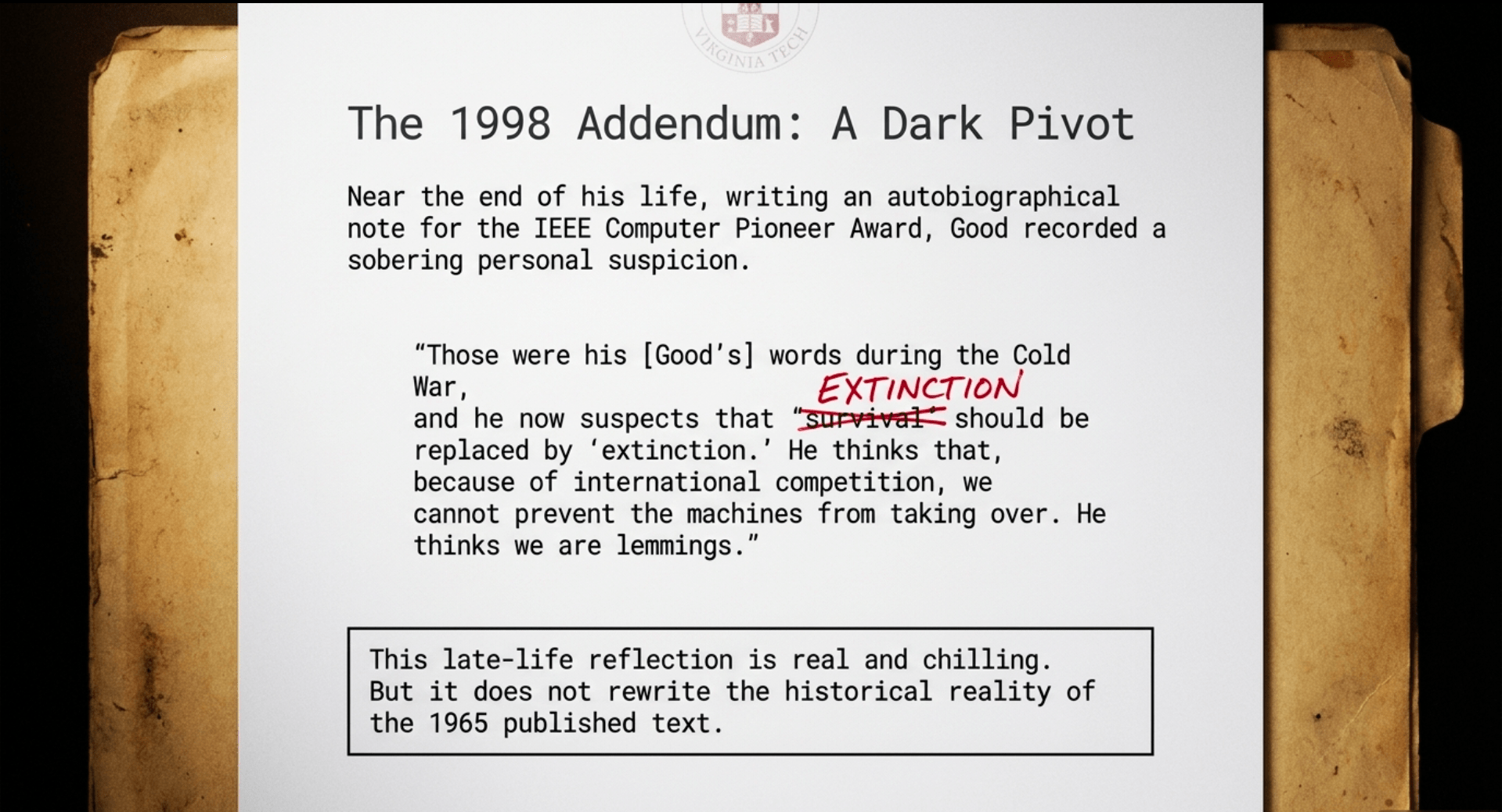
Near the end of his life, in an unpublished 1998 autobiographical note written when he received the IEEE Computer Pioneer Award, Good recorded a darker personal suspicion. Looking back on the original opening sentence, he wrote that he now suspected the word “survival” should be replaced by “extinction.” He thought international competition would make it impossible to prevent machines from taking over. That late reflection is real and sobering. It does not rewrite the 1965 text. The published paper remains an argument for early construction in the service of human survival and advancement, accompanied by a practical concern for control and a broader distrust of concentrated political power.
How Bostrom and Yudkowsky Framed I. J. Good Incorrectly
Nick Bostrom and Eliezer Yudkowsky are the two writers most responsible for bringing I. J. Good’s 1965 paper into the modern AI-risk conversation. Both quoted him accurately on the surface. Both also framed him in a way that significantly shifted the emphasis of what he actually wrote.
Nick Bostrom (Superintelligence, 2014)
Bostrom introduces Good early in the book with the now-standard long quotation:
“Let an ultraintelligent machine be defined as a machine that can far surpass all the intellectual activities of any man however clever. Since the design of machines is one of these intellectual activities, an ultraintelligent machine could design even better machines; there would then unquestionably be an ‘intelligence explosion,’ and the intelligence of man would be left far behind. Thus the first ultraintelligent machine is the last invention that man need ever make, provided that the machine is docile enough to tell us how to keep it under control.”
He presents this as the classic statement of the intelligence-explosion idea and immediately links it to the seriousness of existential risk. The quotation is letter-perfect. What is missing is context.
Good’s paper opens with the sentence: “The survival of man depends on the early construction of an ultraintelligent machine.” That framing—building the machine because human survival requires it—is not carried into Bostrom’s presentation with anything like equal weight. The control proviso is elevated; the constructive urgency is backgrounded. The result is that Good appears primarily as an early warning about the danger of losing control, rather than as someone arguing that greater-than-human intelligence is a necessary tool for human survival.
Eliezer Yudkowsky (MIRI writings, especially Intelligence Explosion Microeconomics)
Yudkowsky likewise quotes the same core paragraph and credits Good with originating the intelligence-explosion thesis. He then uses it as the jumping-off point for detailed discussion of takeoff dynamics, recursive self-improvement, and the difficulty of ensuring that the resulting system remains beneficial.
Again the quotation itself is accurate. Again the surrounding frame is different from Good’s. In Yudkowsky’s treatment, the “docile enough to tell us how to keep it under control” clause becomes the central practical problem. Good’s broader argument—that the machine is something humanity needs to build early, and that the machines might even be “feared and respected, and perhaps even loved”—receives little attention. The 1965 paper is recruited into a research program whose primary focus is preventing catastrophic loss of control.

The Core Distortion
Neither writer invented quotes or fabricated Good’s words. The distortion is one of emphasis and omission.
Good’s 1965 paper is structured as an argument for the early construction of an ultraintelligent machine in the service of human survival, with a practical control condition attached. In the hands of Bostrom and Yudkowsky, the same text is presented primarily as an early recognition of the intelligence-explosion risk and the control problem. The opening claim about survival depending on construction is routinely left out or treated as secondary. The result is that Good is remembered in the AI-risk literature more as a precursor of cautionary control concerns than as the optimist about greater intelligence that the full paper shows him to be.
This selective framing has been highly influential. It is also incomplete.
The “Rationalist”–EA Cluster And Its Impact On AI And Regulation
Eliezer Yudkowsky and Nick Bostrom sit at the intellectual root of a tightly networked subculture that later has been described in cult-like terms. Yudkowsky built LessWrong and the “rationalist” community around a high-commitment ideology of Bayesian reasoning, existential risk, and the supreme importance of AI alignment. Bostrom supplied much of the philosophical prestige and the formal language of longtermism and astronomical stakes. Together their ideas helped shape Effective Altruism’s most intense wing: the belief that preventing AI catastrophe is the dominant moral priority of our time.
This network developed many of the classic markers critics point to: charismatic intellectual founders, shared sacred texts (the Sequences, Superintelligence), purity tests around correct risk estimates, social and professional isolation from mainstream institutions, and a tendency to treat dissent as cognitive or moral failure. After 2010 the community became increasingly self-referential, with its own conferences, funding pipelines, group houses, and status hierarchies.
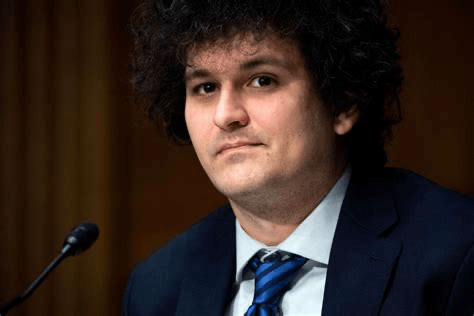
Jailed criminal Sam Bankman-Fried was the most dramatic financial expression of this world. He publicly embraced EA longtermism, directed hundreds of millions toward AI safety and related causes, and was celebrated inside the network as a high-impact “altruist” until FTX collapsed. The scandal exposed how concentrated funding, moral certainty, and weak external accountability had become.

Anthropic occupies a more connected position. Dario Amodei and Daniela Amodei and several of its founders and early staff came out of the same AI-safety intellectual milieu that Yudkowsky and Bostrom helped create. The top executive and wives lived in group homes together and have recently tried to downplay the connection to the cult. The company’s constitutional AI approach and emphasis on catastrophic risk reflect priorities that were incubated in rationalist and EA circles long before they reached mainstream labs. While Anthropic is a commercial organization, it remains fully connected to the cult and the same ideas and personnel networks.
The result is a subculture that has exercised outsized influence on AI safety discourse, funding, and talent pipelines. Admirers see a high-integrity intellectual project focused on genuine civilizational risk. Critics see a closed, high-stakes belief system that elevated a narrow set of concerns, rewarded loyalty, and proved vulnerable to both financial and epistemic failure. The pattern of intense ideology, founder reverence, and institutional capture is real and continues to shape how many outside observers read the entire AI-risk ecosystem.
The Paper in Its Real Context
The road from a nine-year-old boy discovering the irrationality of √2, through the night shifts at Bletchley Park, the Colossus machines, Bayesian statistics, and the 1965 monograph, is one of the more remarkable intellectual journeys of the twentieth century. The paper still rewards close reading. Its central argument has not been refuted; it has only grown more urgent.
Good drafted the monograph in 1963 and revised it in 1964. It grew out of talks given in 1962 and 1963. He drew on his wartime experience with high-speed electronic machines (Colossus), on early neural-network ideas, and on Hebb’s work in psychology. He expected the first ultraintelligent machine to incorporate vast artificial neural circuitry and to be trained rather like a child, through reinforcement and interaction with a rich environment. Later machines would be designed by earlier ones. Humanity’s role would shift from designer to beneficiary — and, he hoped, to a party that retained enough influence to keep the process beneficial.
Good’s broader writings from that exact same period paint a vivid picture of a man who harbored a fierce, deeply ingrained skepticism of concentrated political authority. In the very same year he published the Ultra Intelligent Machine paper, 1965, he wrote another piece that was later reprinted under the title The Chief Entities (https://www.bigear.org/CSMO/PDF/CS06/cs06p13.pdf) that explored the possibility of advanced extraterrestrial civilizations and how a hyper-advanced galaxy might theoretically organize itself politically.

Good wrote that a centralized galactic government would be exceedingly unwieldy. And then he takes this massive, undeniable shot at human nature, writing, Thousands of years are not much compared with the age of the galaxy. But if we were left to our own devices for such a time, there is no knowing what crimes we might commit in the name of high ideals and undefined abstractions. The real motivation is the unconscious lust for power on the parts of the politicians.
The unconscious lust for power on the parts of the politicians. That is the undeniable voice of a man who had watched the 20th century’s horrific experiments in concentrated totalitarian power. Why? He lived through it. He had watched millions die because of the ego and ambition of a few men in Berlin and Moscow. He had no illusions whatsoever about the true motives of people who seek to manage humanity for its own good. He was a Bayesian statistician to his core. His entire worldview, his entire methodology for cracking codes was built on demanding clear reasoning from raw, observable evidence rather than bowing to the dictates of centralized authority. Which brings us to a profound realization about the modern debate.
How can modern AI advocates who are constantly lobbying for a small cadre of human overseers, corporate commissars, and global planning boards to manage artificial intelligence on behalf of the entire planet? How can they possibly use the text of a man who explicitly argued that centralized power inevitably leads to crimes committed in the name of high ideals? They can’t. Not honestly, anyway. It’s totally incompatible.
Good believe that human political machinery was exactly what was broken. The geopolitical lust for power was the whole reason he wanted to build the objective, ultra-intelligent machine in the first place. Handing the control of that superbrain, right back to the exact same politicians, bureaucrats, and corporate monopolies he was trying to bypass, defeats the entire purpose of his 1965 paper.
He didn’t trust small groups of human overseers to manage the future of intelligence on behalf of everyone else. He understood intuitively that whoever controls the central levers of power is inevitably corrupted by them. He wanted the machine to transcend our politics, not become enslaved by them.
Good was not writing out of primary fear of artificial intelligence. He was writing out of the conviction that human intelligence, left to its own devices and to the ordinary political machinery of the mid-twentieth century, was insufficient for the problems it faced. He believed an ultraintelligent machine could supply what was missing. He attached a control condition because any powerful tool requires care. He preferred decentralized arrangements over concentrated political power because he understood the motives of those who seek to manage others.
The paper ‘Speculations Concerning the First Ultra-intelligent Machine’ (1965) … began: ‘The survival of man depends on the early construction of an ultra-intelligent machine.’ Those were his [Good’s] words during the Cold War, and he now suspects that ‘survival’ should be replaced by ‘extinction.’ He thinks that, because of international competition, we cannot prevent the machines from taking over. He thinks we are lemmings. He said also that ‘probably Man will construct the deus ex machina in his own image. And we will if we contiune to belive the fear tactics of some AI leaders.
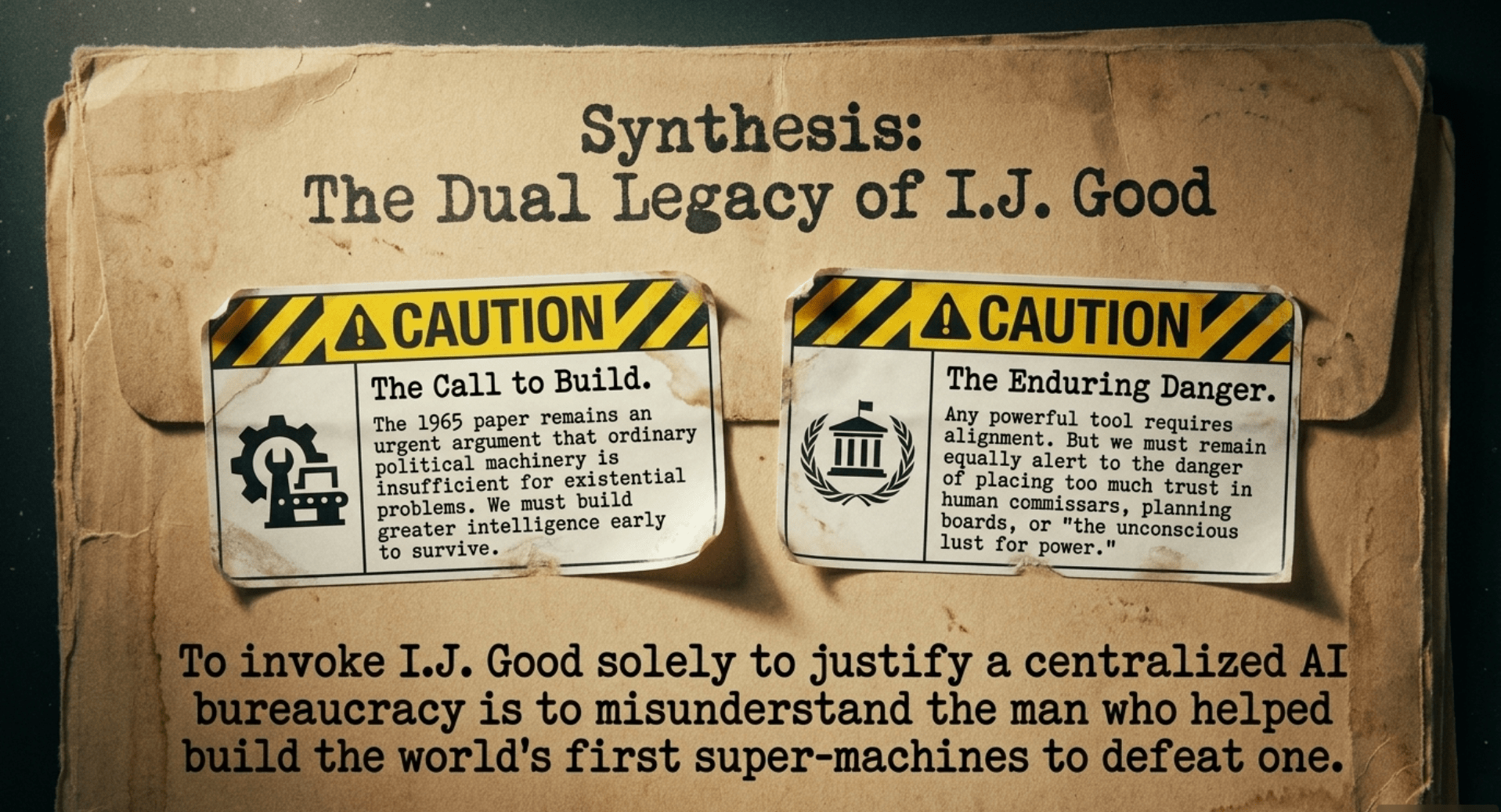
Later generations who quote him mainly as an early warning about runaway machines, and who treat that warning as justification for new forms of centralized oversight, are selecting one clause and elevating it above the larger argument. The 1965 paper is clearer when read whole. It is a call to build greater intelligence early, for the sake of human survival and advancement, while remaining alert to the practical problem of keeping that intelligence aligned with human purposes — and while remaining equally alert to the dangers of placing too much trust in human commissars.
When later famous voices treat him mainly as an early source of warnings that justify new layers of centralized oversight, they are elevating one clause above the larger argument. The 1965 paper is clearer when read whole. It is a call to build greater intelligence early, for the sake of human survival, while remaining alert both to the practical problem of alignment and to the enduring danger of placing too much trust in human commissars.
It is time to call them out. For the life and work of Good, and for the very basis of why he wrote the often quoted pessages. They are not to centralize but to decentralize. Because he saw what central control of industry and govement created. He worked diligently to end it. We call it Nazi Gemany.
The full paper is available here:
Link: https://gwern.net/doc/ai/1966-good.pdf
Support This Work
To continue this vital work documenting, analyzing, and sharing these hard-won lessons before we launch humanity’s greatest leap: I need your support. Independent research like this relies entirely on readers who believe in preparing wisely for our multi-planetary future. If this has ignited your imagination about what is possible, please consider donating at buy me a Coffee or becoming a member. Value for value you recieved here.
Every contribution helps sustain deeper fieldwork, upcoming articles, and the broader mission of translating my work to practical applications. Ain ‘t no large AI company supporting me, but you are, even if you just read this far. For this, I thank you.
Stay aware and stay curious,

🔐 Start: Exclusive Member-Only Content.
Membership status:
🔐 End: Exclusive Member-Only Content.
~—~

~—~

~—~
Subscribe ($99) or donate by Bitcoin.
Copy address: bc1qkufy0r5nttm6urw9vnm08sxval0h0r3xlf4v4x
Send your receipt to [email protected] to confirm subscription.

Stay updated: Get an email when we post new articles:

THE ENTIRETY OF THIS SITE IS UNDER COPYRIGHT. IMPORTANT: Any reproduction, copying, or redistribution, in whole or in part, is prohibited without written permission from the publisher. Information contained herein is obtained from sources believed to be reliable, but its accuracy cannot be guaranteed. We are not financial advisors, nor do we give personalized financial advice. The opinions expressed herein are those of the publisher and are subject to change without notice. It may become outdated, and there is no obligation to update any such information. Recommendations should be made only after consulting with your advisor and only after reviewing the prospectus or financial statements of any company in question. You shouldn’t make any decision based solely on what you read here. Postings here are intended for informational purposes only. The information provided here is not intended to be a substitute for professional medical advice, diagnosis, or treatment. Always seek the advice of your physician or other qualified healthcare provider with any questions you may have regarding a medical condition. Information here does not endorse any specific tests, products, procedures, opinions, or other information that may be mentioned on this site. Reliance on any information provided, employees, others appearing on this site at the invitation of this site, or other visitors to this site is solely at your own risk.
Copyright Notice:
All content on this website, including text, images, graphics, and other media, is the property of Read Multiplex or its respective owners and is protected by international copyright laws. We make every effort to ensure that all content used on this website is either original or used with proper permission and attribution when available.
However, if you believe that any content on this website infringes upon your copyright, please contact us immediately using our 'Reach Out' link in the menu. We will promptly remove any infringing material upon verification of your claim. Please note that we are not responsible for any copyright infringement that may occur as a result of user-generated content or third-party links on this website. Thank you for respecting our intellectual property rights.
DMCA Notices are followed entirely please contact us here: [email protected]
