

A Review Of The Research Behind Shufflebrain: The Quest for the Hologramic Mind.
“He proved you could scramble a salamander’s brain and still keep its mind intact.”
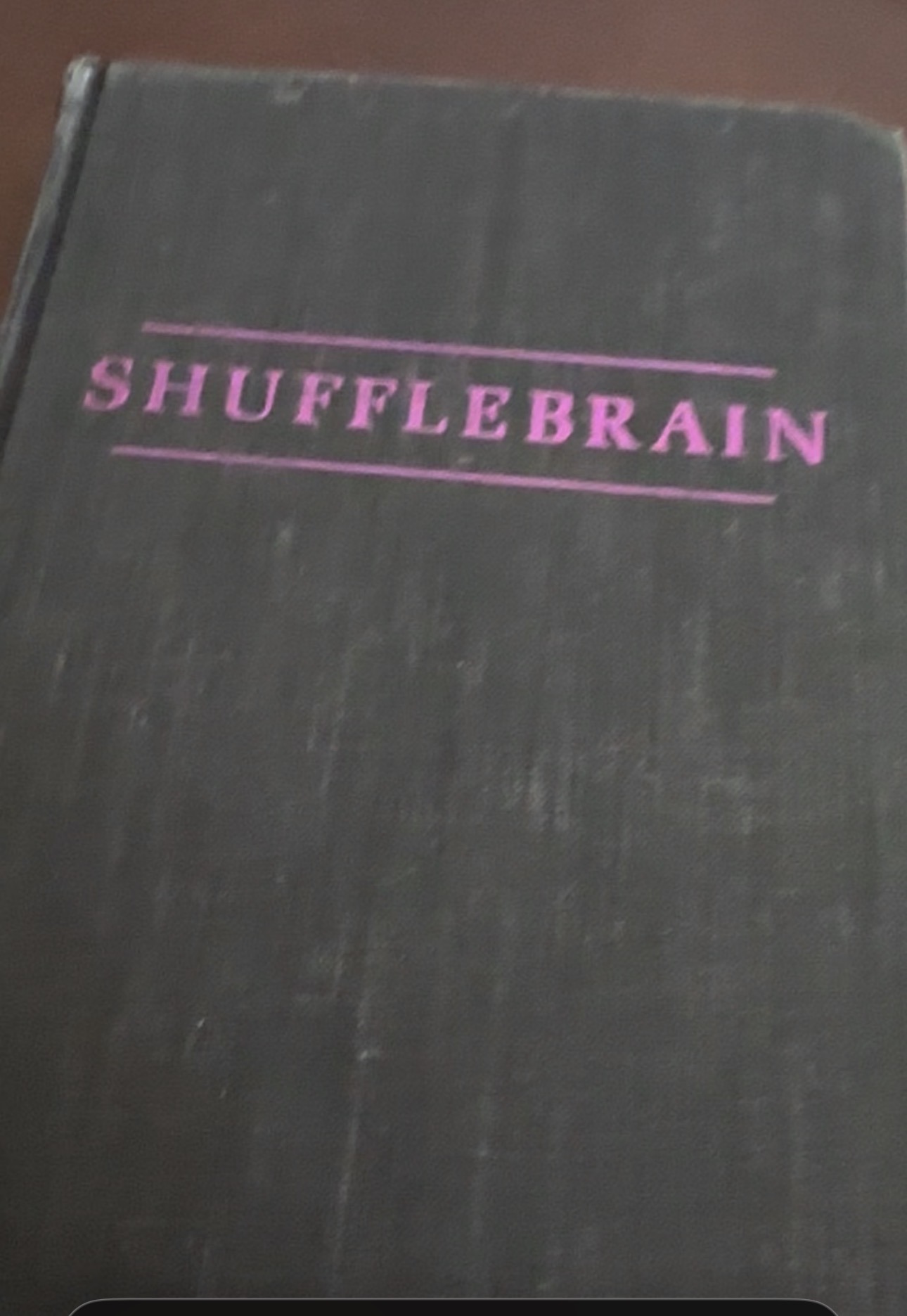
I first brushed against the idea of a holographic mind in the late 1970s, long before most people outside specialized circles had even heard the phrase. I was still young, still absorbing everything I could about lasers, interference patterns, and the strange ways light could store information across an entire surface rather than at single points. Somewhere in those years the notion that the brain might work the same way—encoding memory as distributed phase relationships rather than fixed addresses—lodged itself in me and refused to leave. It felt less like a theory and more like a recognition of something already half-known.
When Paul Pietsch’s Shufflebrain appeared in 1981, I found it almost immediately. The book was new, the experiments still raw, and the claim that you could scramble a salamander’s brain and still keep its mind intact struck me with the force of a physical discovery. I tracked it down, read it cover to cover, and then read it again. The Texas Medical Center Library later became one of the places where I found a physical volume years afterward, when the library began clearing older titles from open display, I secured a copy that had already begun its quiet journey toward the discard pile. That particular volume still carries the marks of that earlier era.
This article is sponsored by Read Multiplex Members who subscribe here to support my work: Link: https://readmultiplex.com/join-us-become-a-member/
It is also sponsored by many who have donated a “Cup of Coffee”. If you like this, help support my work: Link: https://ko-fi.com/brianroemmele
Listen to the companion podcast: https://rss.com/podcasts/readmultiplex-com-podcast/3069759
From that first encounter the research became a private through-line. I followed the older literature backward—Lashley’s failed hunt for the engram, Pribram’s holonomic proposals, the optical work of Gabor and Leith—and then forward into every new paper that seemed to touch distributed coding. The salamander experiments stayed with me not as curiosities but as existence proofs: anatomy could be rearranged, tissue could be exchanged, and coherent behavior still returned. That resilience suggested the code lived in relationships, not in the precise coordinates of cells.
Other paths opened beside the holographic one. In the garage I returned again and again to light itself—lasers, pulsed wavelengths, the biological effects of coherent energy on tissue and, later, on nervous systems. The same physics that made holograms possible also shaped photobiomodulation experiments and the older Soviet literature on wave genetics. Those threads never felt separate from the question of how memory and awareness are stored; they felt like different windows onto the same underlying continuum of phase and interference.
My brain-computer interface work arrived later but fitted the same pattern. I was hacking early EEG headsets, training models on personal brainwave data, correlating theta and beta patterns with imagery and intention—all of it was an attempt to listen to the distributed signals rather than assume they were locked inside single neurons. The signals were noisy, incomplete, and yet somehow whole enough to carry meaning. That partial reconstruction of intent from fragmentary electrical patterns echoed the hologram’s ability to yield an image from a broken plate.
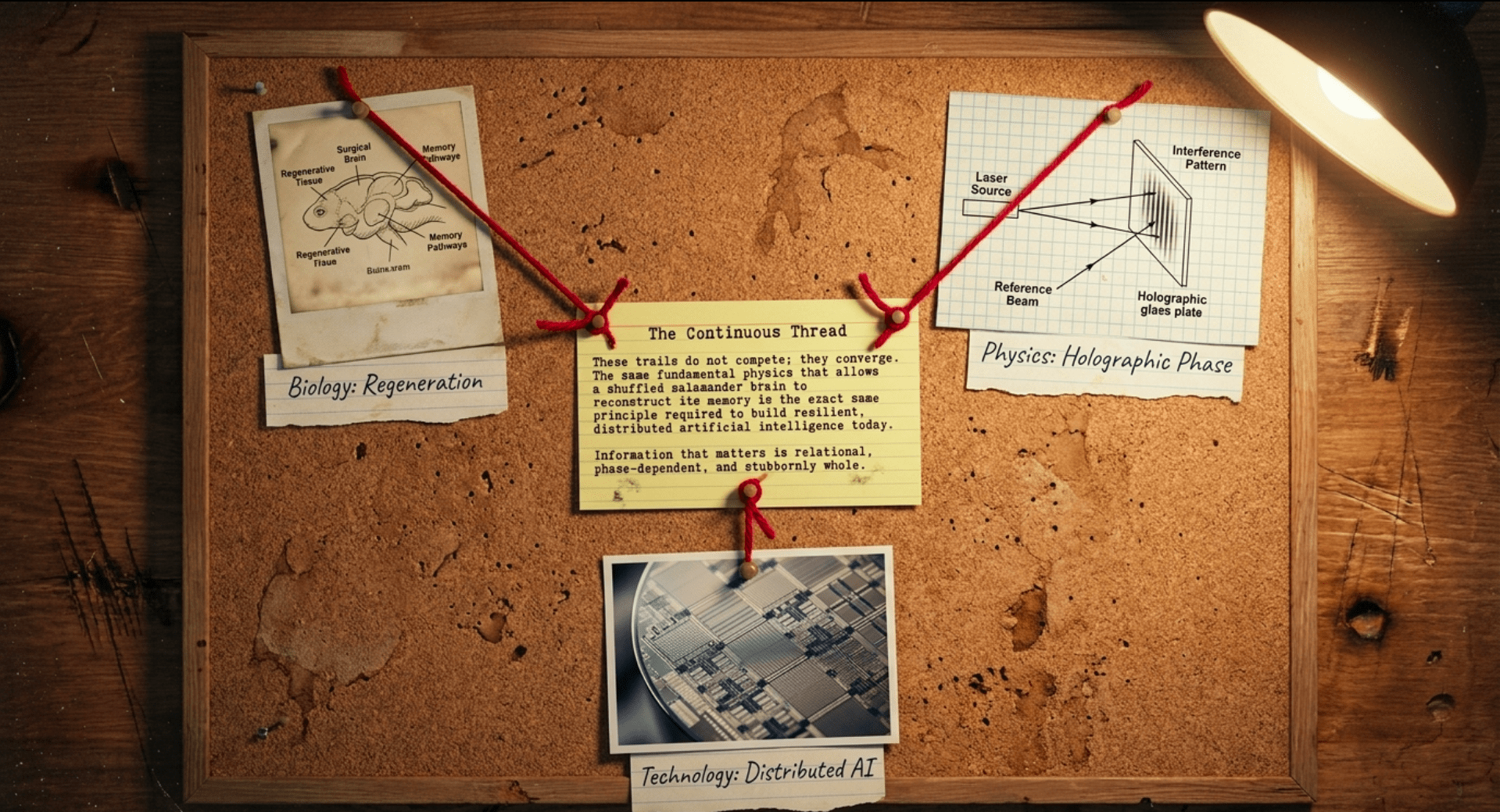
Consciousness research, for me, has never been a single highway. It is a set of converging trails: optical holography and neural phase codes, regenerative biology and memory transfer, brainwave entrainment and direct neural interfaces, personal knowledge graphs and multi-model consensus agents, thermodynamic incentives for autonomous systems and the long arc of the Abundance Interregnum. Each trail supplies evidence that mind is not a substance locked in place but a pattern that can survive rearrangement, transfer, and partial destruction.
What Pietsch demonstrated with salamanders in the laboratory, later technologies and personal experiments continue to test at different scales. The brain can be shuffled and still remember. Distributed codes can be fragmented and still reconstruct. And the deeper we look—whether through light, electrical fields, regenerative tissue, or silicon agents running on local hardware—the more the same principle reappears: information that matters is relational, phase-dependent, and stubbornly whole even when the medium that carries it has been broken. So this book and Pietsch work is a turning point in brain research.
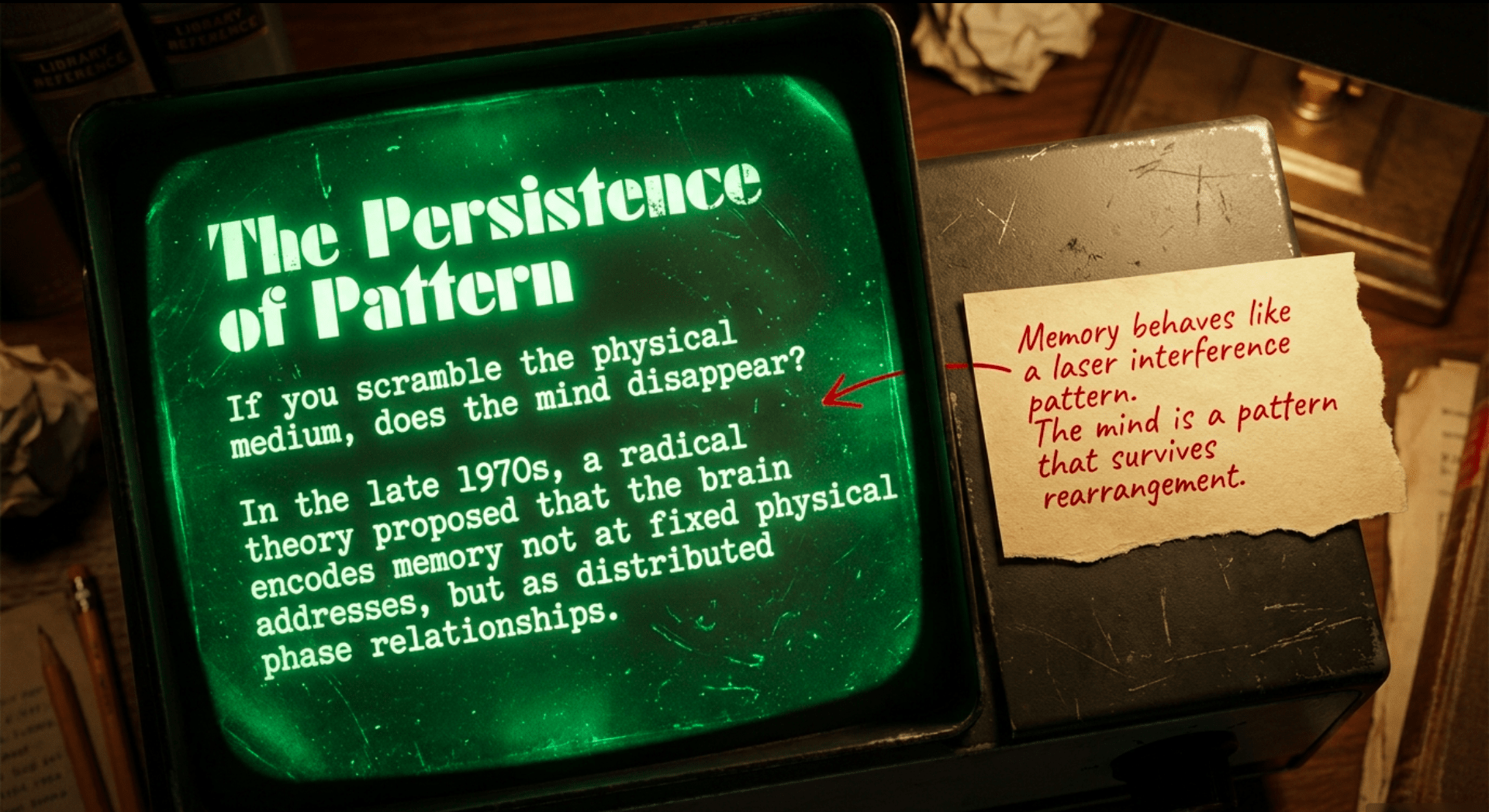
Shufflebrain: The Quest for the Hologramic Mind is Paul Pietsch’s 1981 book (Houghton Mifflin; later online second edition) that advances a holographic—or “hologramic”—theory of memory and mind. Drawing on optical holography, it argues that the brain stores information not in localized structures or discrete engrams but as distributed wave-phase relationships, spectra of harmonic phase codes. Like a hologram, any sufficiently large fragment can reconstruct the whole (with loss of resolution or fidelity). Radical disruption of anatomy need not erase memory or behavior.
The full book, Shufflebrain: https://ia600404.us.archive.org/8/items/shufflebrain-paul-pietsch/Shufflebrain%20-%20Paul%20Pietsch.pdf
Pietsch, an anatomist, did not invent the core idea. He tested, extended, and popularized it through extreme surgical experiments on larval salamanders whose regenerative capacities allowed operations that would be fatal or irreversible in most vertebrates. The work sits at the intersection of Karl Lashley’s equipotentiality findings, Dennis Gabor’s mathematical holography, and Karl Pribram’s holonomic brain theory. It remains one of the boldest empirical challenges to strictly localized models of memory.
The Author and His Conversion
Paul Andrew Pietsch (1929–2009) was born in New York City. He left high school in the tenth grade, joined the Army in 1946, served in Japan and later in the Korean conflict, earned a GED while in service, and used the GI Bill to study. He received a B.S. in zoology from Syracuse University and a Ph.D. in anatomy from the University of Pennsylvania in 1960. Early posts included instructor at Bowman Gray/Wake Forest, assistant professor at SUNY Buffalo, and research scientist at Dow Chemical, where he held patents. In 1970 he joined Indiana University as associate professor of optometry (later full professor and chair of basic health sciences), teaching optometry and medical students while pursuing research on regeneration and the brain-mind relationship. He became professor emeritus and died in 2009 after a long illness.
Pietsch began as a committed structuralist: the truths of life and mind would reduce to the architecture of living parts. His early work examined salamander limb regeneration, treating cells as independent mathematical sets whose transformations could be modeled by transplantation. He expected the same logic to apply to the brain.
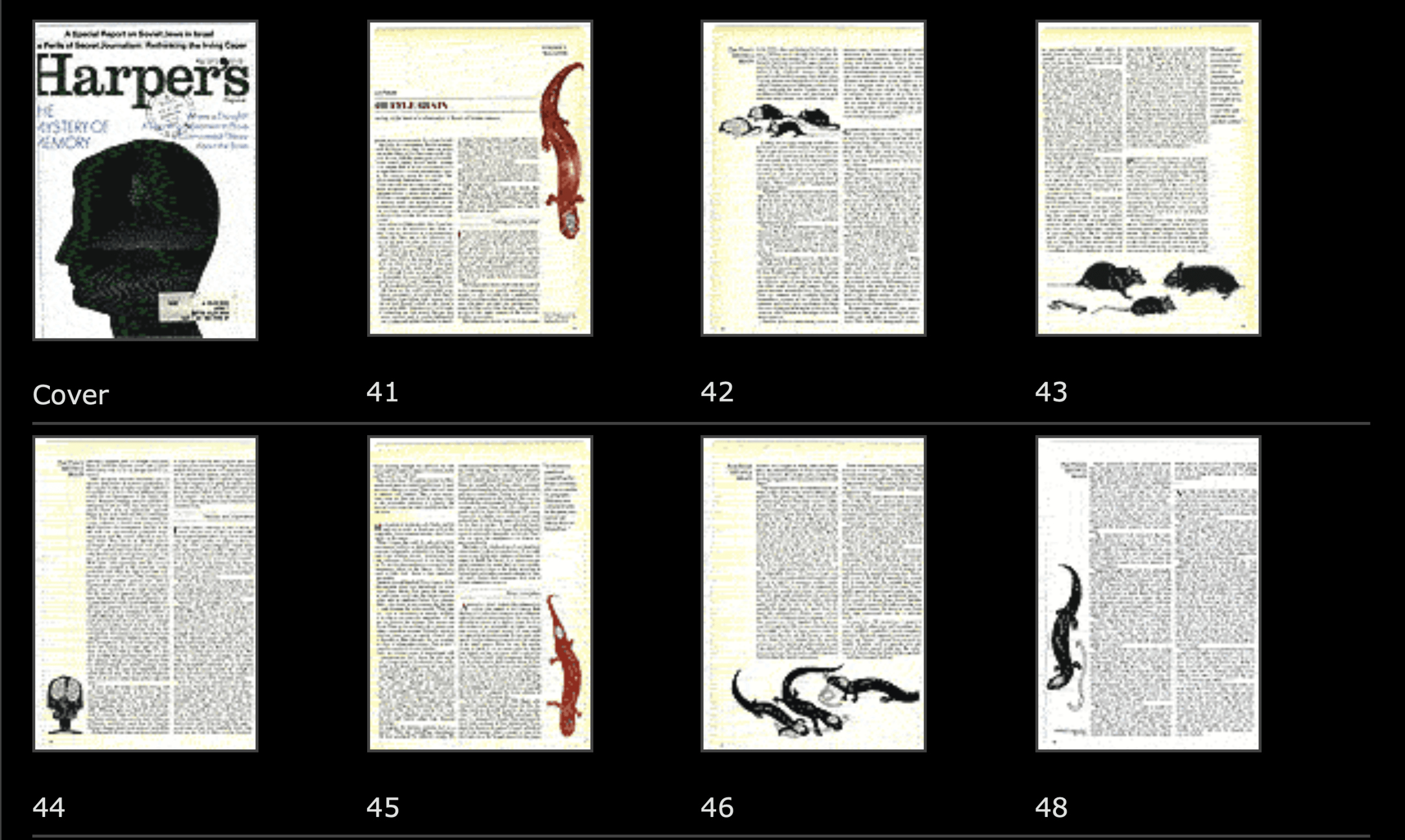
The shufflebrain experiments forced a reversal. Memory and behavior survived rearrangements that should have destroyed any fixed structural code. He spent more than a decade refining the hologramic alternative, publishing a popular Harper’s Magazine article (“Shuffle Brain,” 1972) that won an American Medical Association Medical Journalism Award, appearing on CBS’s 60 Minutes in 1973, and writing the 1981 book. In retirement he maintained an award-winning website that accumulated millions of hits, continuing his conviction that science should be accessible beyond specialists.
From Engram Hunt to Holograms
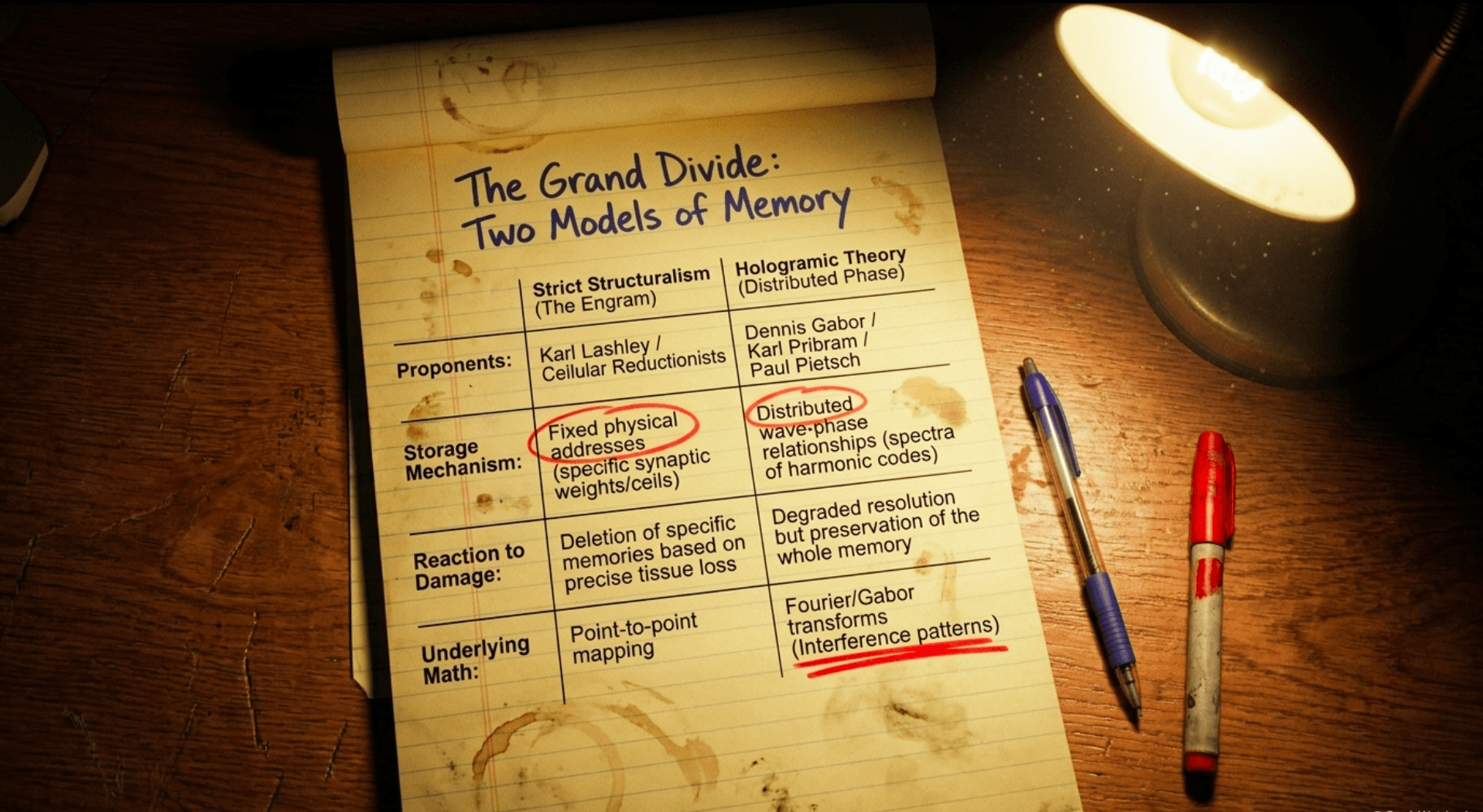
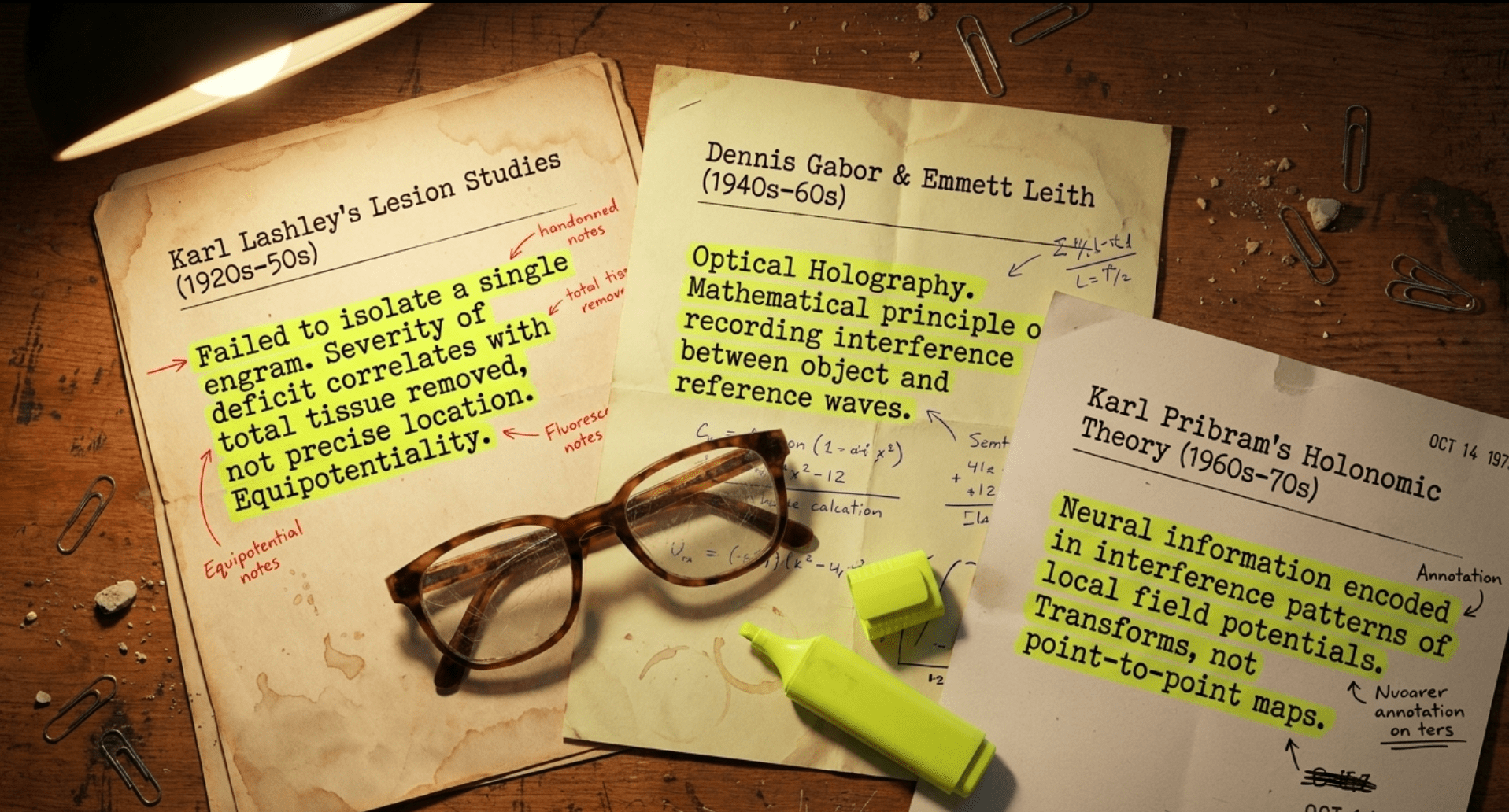
The search for the physical trace of memory—the engram—dominated twentieth-century neuroscience. Karl Lashley’s lesion studies on rats (1920s–1950s) produced the principles of mass action and equipotentiality: the severity of memory deficit correlated with the amount of cortical tissue removed far more than with its precise location. He could not isolate a single engram and famously remarked that learning seemed almost impossible given the evidence. Memory appeared distributed.
Optical holography supplied a physical model. Dennis Gabor invented the mathematical principle of holography in 1947–48 while seeking improved electron-microscope resolution; the record of interference between object and reference waves encodes both amplitude and phase. In the early 1960s Emmett Leith and Juris Upatnieks produced practical laser holograms, including diffuse holograms in which every region of the plate contains information about the entire scene. A fragment reconstructs the whole image, degraded mainly in resolution and signal-to-noise rather than by outright loss of content.
Karl Pribram, who had worked with Lashley, developed the holographic (later holonomic) brain theory in the 1960s and 1970s. He proposed that neural information is encoded in interference patterns of local field potentials within dendritic networks, mathematically akin to Fourier or Gabor transforms. Phase relationships, not solely spike rates or synaptic weights at fixed addresses, carry the content. Memory survives extensive damage because the code is distributed; reconstruction remains possible from remaining tissue. Pribram’s Languages of the Brain (1971) and subsequent work framed perception and memory as transforms rather than point-to-point maps.
Pietsch encountered these ideas while preparing his own experiments in the mid-to-late 1960s. Hologramic theory predicted that radical anatomical rearrangement should not scramble the mind if the underlying code were wave-phase relations. His initial structuralist expectations were the opposite; the data converted him.
The Experiments in Detail
I must warn you, the experiments here may cause some to feel uneasy. The research is from an era where this sort of thing was not considered to be unusual. Some of this research was vital to arrive at the understanding we will establish in this article.
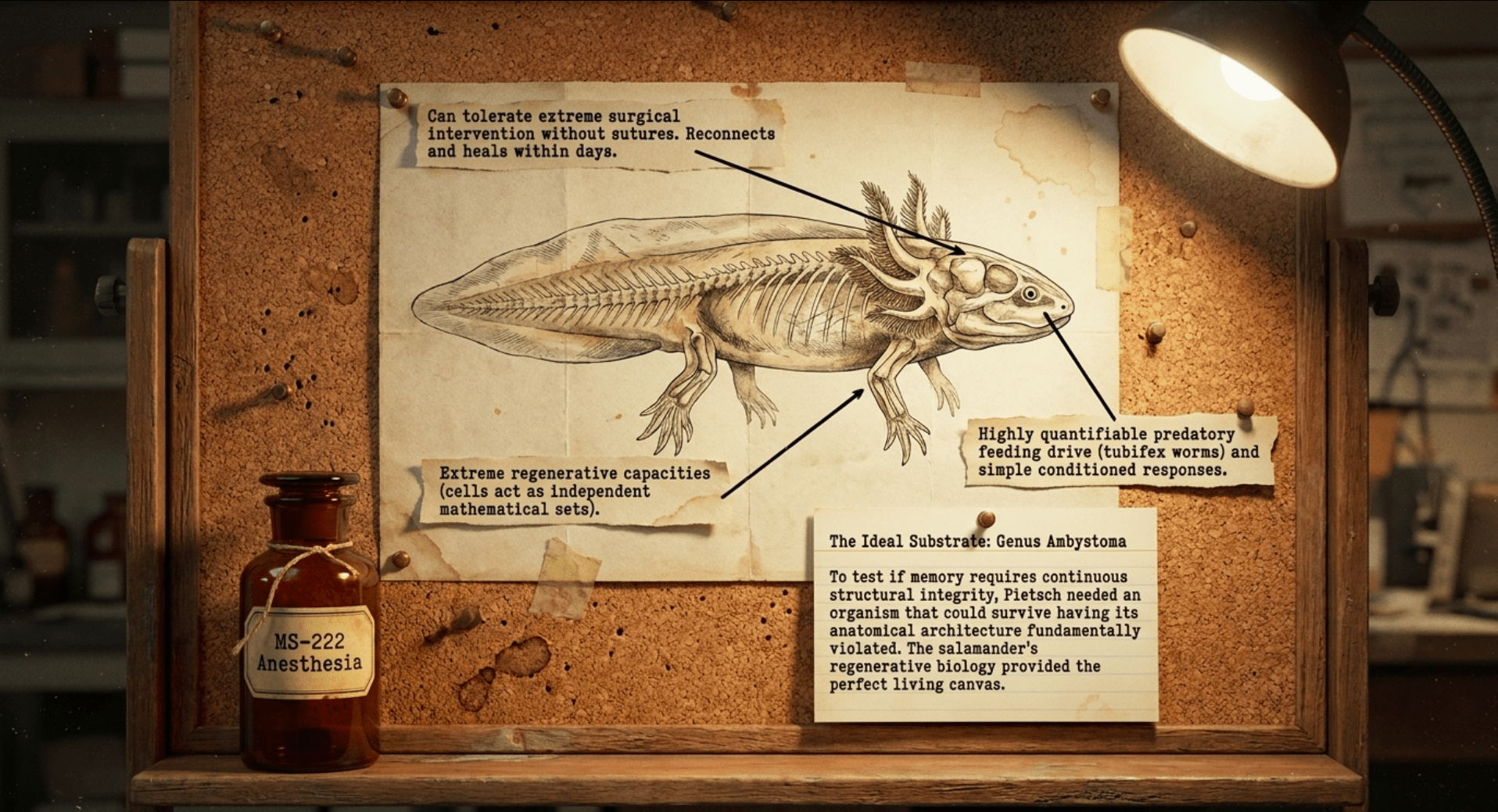
Larval salamanders of the genus Ambystoma (A. punctatum, A. opacum, A. tigrinum, and the axolotl A. mexicanum) were ideal subjects. They tolerate extensive surgery, regenerate readily, and display clear, quantifiable behaviors—especially predatory feeding on live tubifex worms and simple conditioned responses. Operations typically used MS-222 anesthesia, stereoscopic microscopy, iridectomy scissors, and fine forceps. The skull was opened, brain tissue manipulated or exchanged, and the wound allowed to heal without sutures. Animals recovered over days to weeks; histology (hematoxylin-eosin, Bodian’s protargol) confirmed reconnections in many cases.
Brain removal and replacement. Removing the brain produced a stuporous state. Replacing it restored normal feeding and responsiveness once connections re-formed. This alone demonstrated remarkable plasticity and the non-necessity of continuous structural continuity for eventual recovery of behavior.
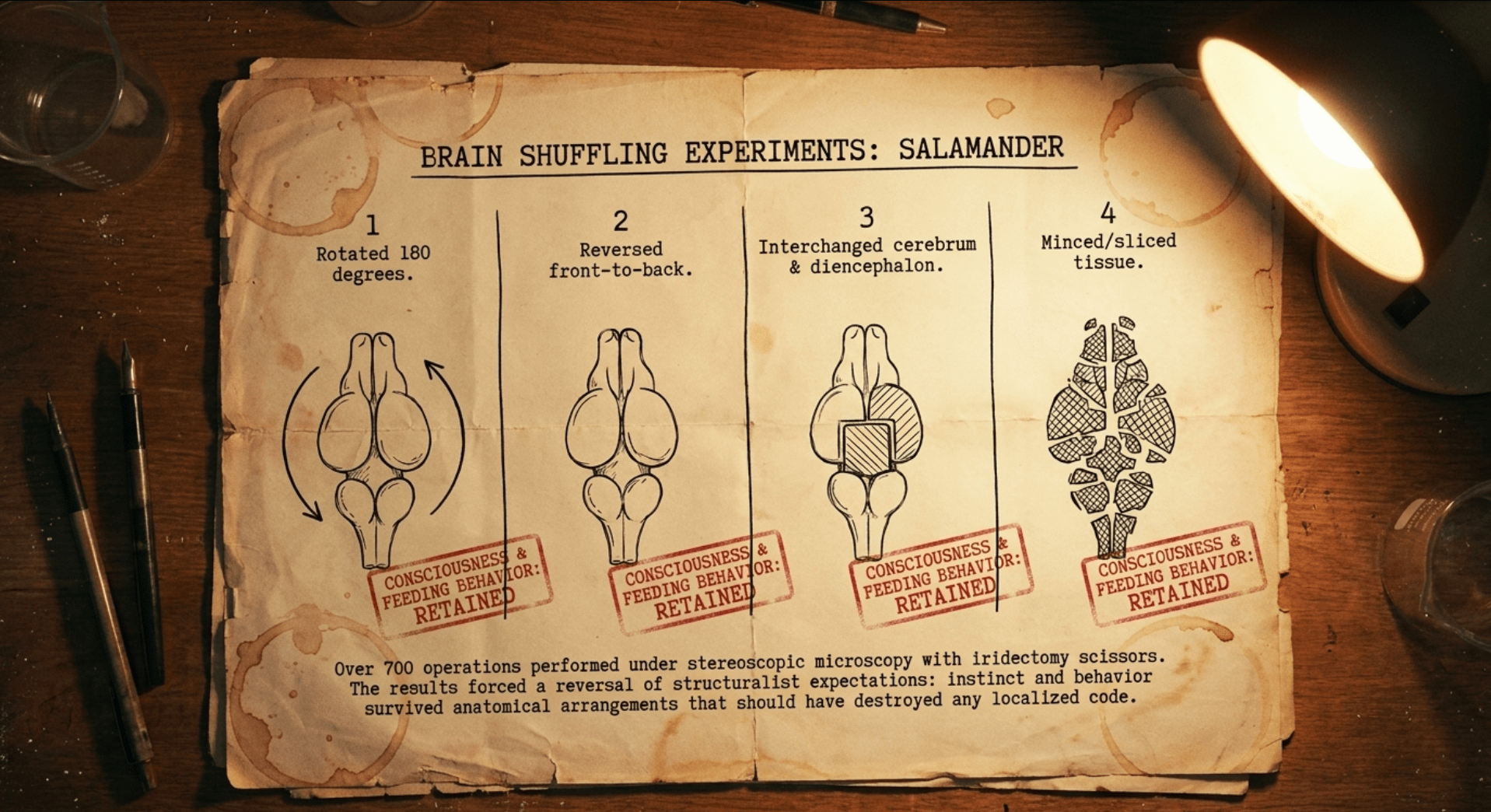
Shuffling operations. Pietsch rotated cerebral hemispheres 180 degrees, reversed them front-to-back, turned them upside down, interchanged cerebrum and diencephalon, sliced or minced tissue, and performed hundreds of such rearrangements (popular accounts cite roughly 700 operations). Innate feeding behavior on tubifex worms typically returned provided sufficient tissue remained and the medulla was intact. Animals with double medulla configurations or radically reordered major divisions still fed and oriented. Behavior recovered even when anatomical topography was grossly abnormal. These results are difficult to reconcile with strictly topographic, localized storage of the feeding program.
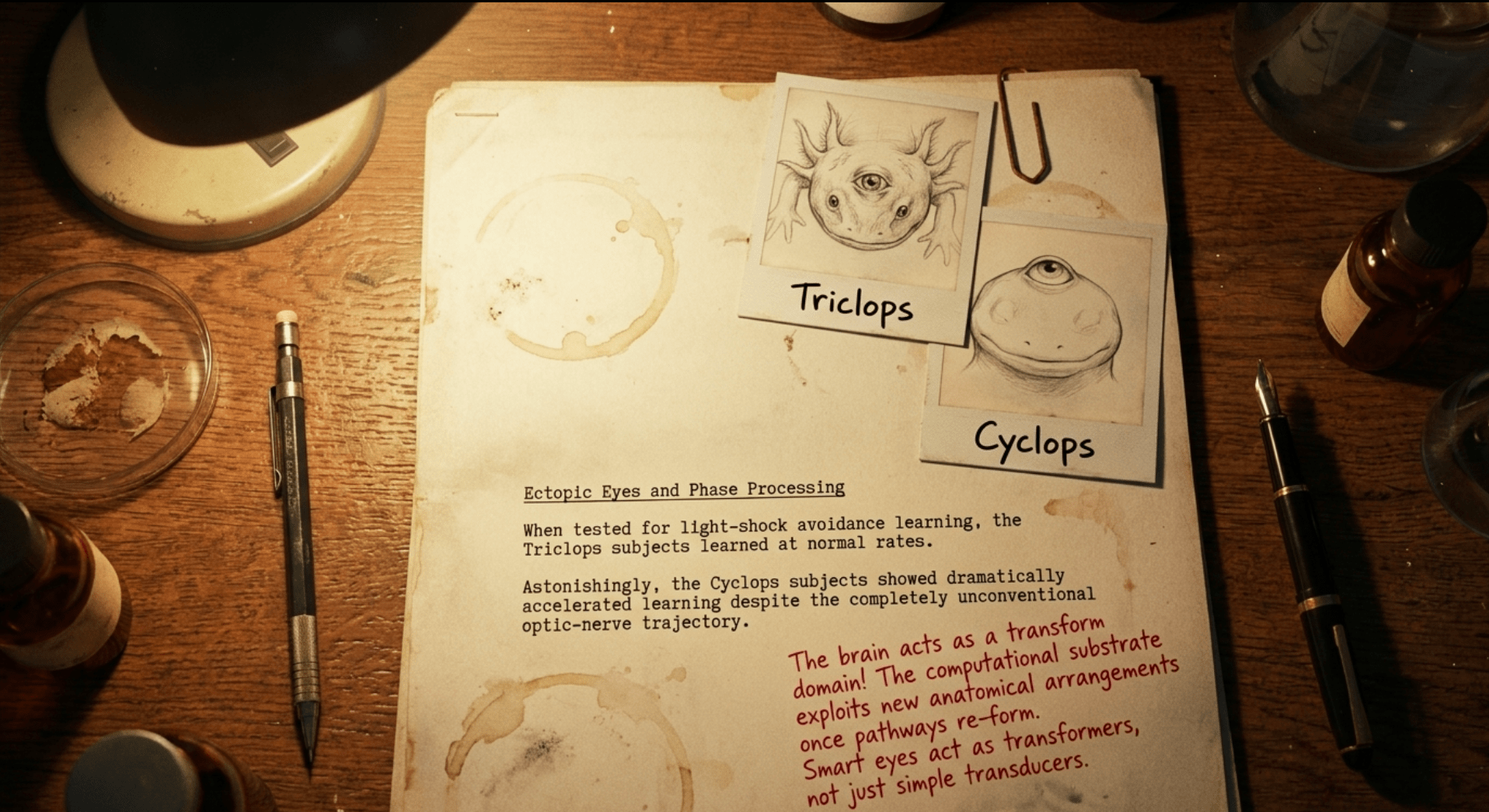
Eye transplants and multi-eyed forms. Extra eyes could be grafted to produce functional “Triclops” larvae (two natural eyes plus a dorsal third eye). “Cyclops” forms resulted from removing both natural eyes and placing a single eye in a dorsal, upward-facing position. In light-shock avoidance learning, Triclops animals acquired the response at rates comparable to or slightly faster than normal two-eyed controls. Cyclops animals showed dramatically accelerated learning and higher avoidance rates despite the unconventional eye position and optic-nerve trajectory. Vision recovered via regenerated optic pathways; the animals used the ectopic eyes functionally. The experiments illustrated both the plasticity of visual processing and the robustness of learning under radically altered sensory anatomy.
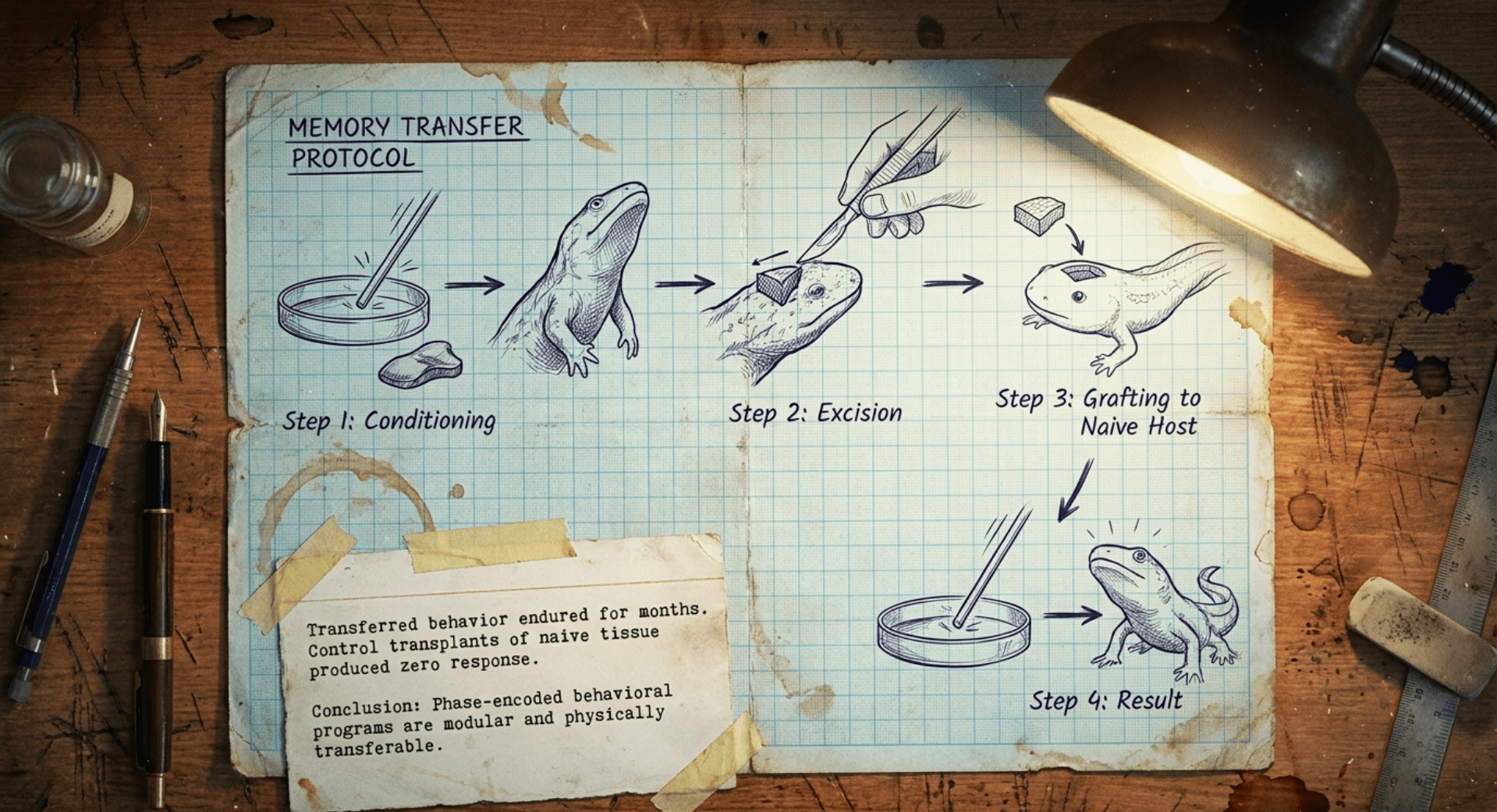
Conditioned responses and memory transfer. A key paradigm involved anticipatory “looking up.” An adult salamander was trained by tapping the rim of its dish, followed by presentation of a liver reward. After repeated pairings the animal arched and looked upward in anticipation of the food. The response persisted for weeks even without continued reward. Portions of brain—cerebrum, midbrain, or diencephalon—from trained donors were transplanted into naive larval hosts. The untrained hosts subsequently displayed the looking-up response without further training. The transferred behavior endured for months or years in some cases. Control transplants of naive tissue produced no such response. Parallel work (including Pietsch & Schneider, 1969, in Brain Research) framed brain transplantation as an approach to memory transfer. Related studies on newts reported transfer of dark-avoidance learning via forebrain transplantation.
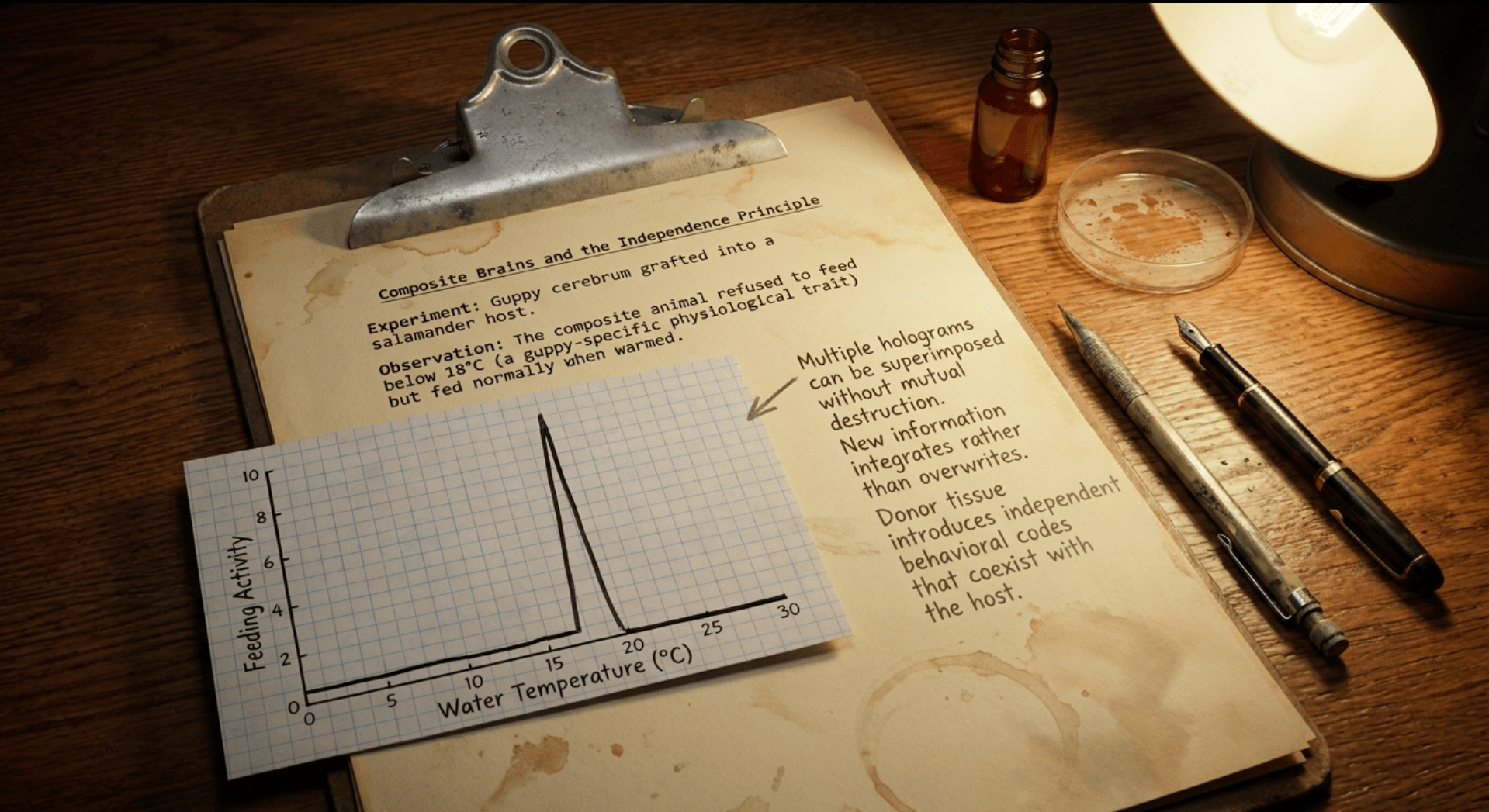
Cross-species and composite brains. Frog (Rana pipiens) brain tissue grafted onto salamander hosts produced animals that regained consciousness and basic motor function but failed to exhibit the host’s carnivorous feeding drive; they required force-feeding. Guppy cerebrum into salamander hosts introduced temperature-dependent feeding: the composite animals refused food below roughly 18 °C (a guppy-like trait) yet fed when warmed. These results suggested that donor tissue could introduce independent behavioral codes that coexisted with host programs rather than simply overwriting them—an outcome consistent with the independence principle of hologramic coding.
In aggregate the experiments showed that learned and innate behaviors often survived anatomical scrambling and could be transferred by tissue grafts. Recovery was not instantaneous; reconnection and healing were required. Not every animal survived or recovered fully, and species differences mattered. Yet the pattern of results repeatedly favored distributed over strictly localized storage.
Theory: Waves, Phase, and the Hologramic Mind
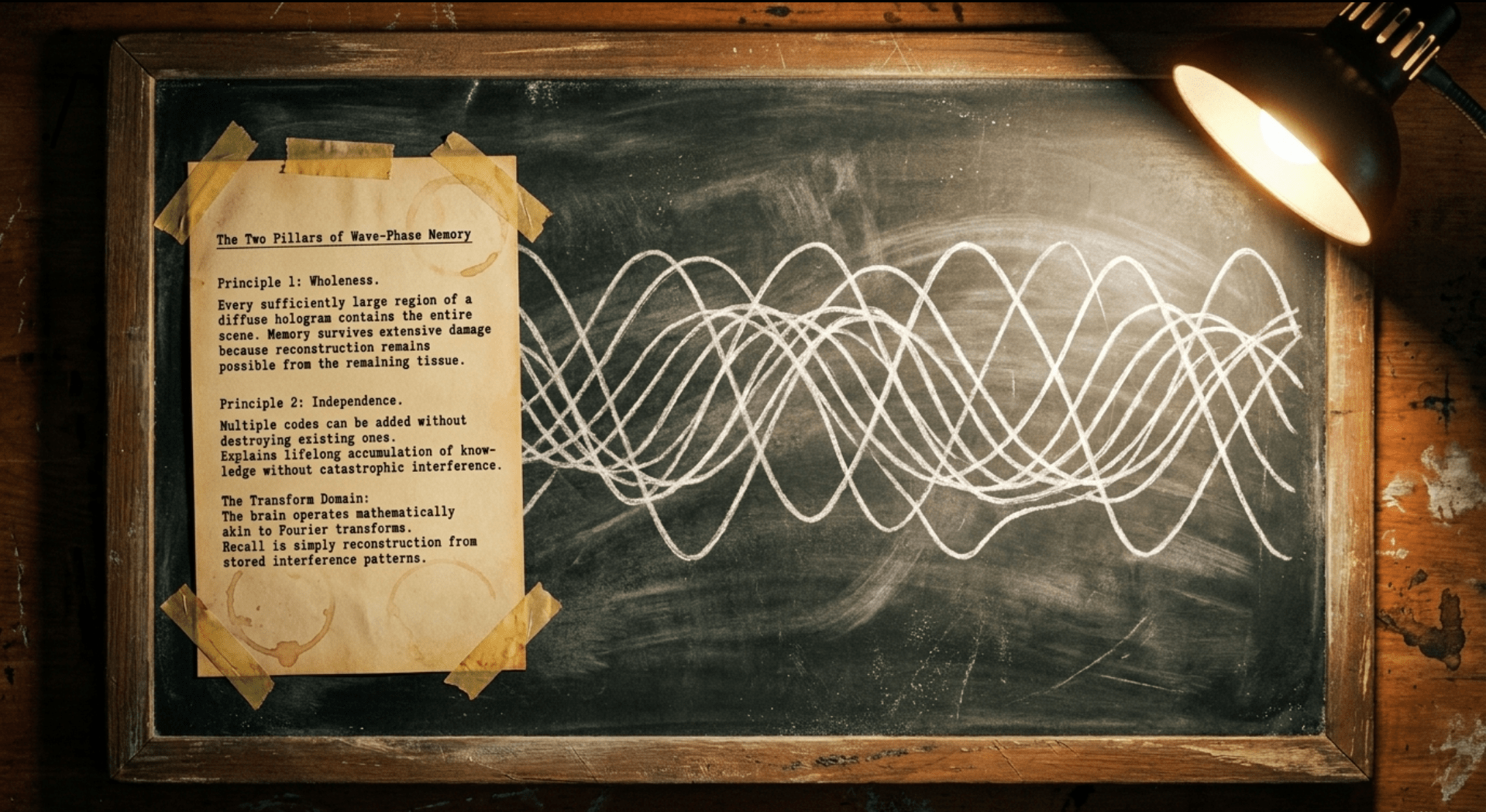
Pietsch’s account rests on wave properties. Ordinary photographs record intensity (amplitude). Holograms record interference patterns that preserve relative phase. Phase is relational; the same absolute wave can carry different information depending on its phase relationships to other waves. Fourier analysis decomposes complex waveforms into sums of simpler sinusoidal components; the brain, in this view, operates in a transform domain in which phase spectra encode content. Reconstruction (perception or recall) is the inverse transform.
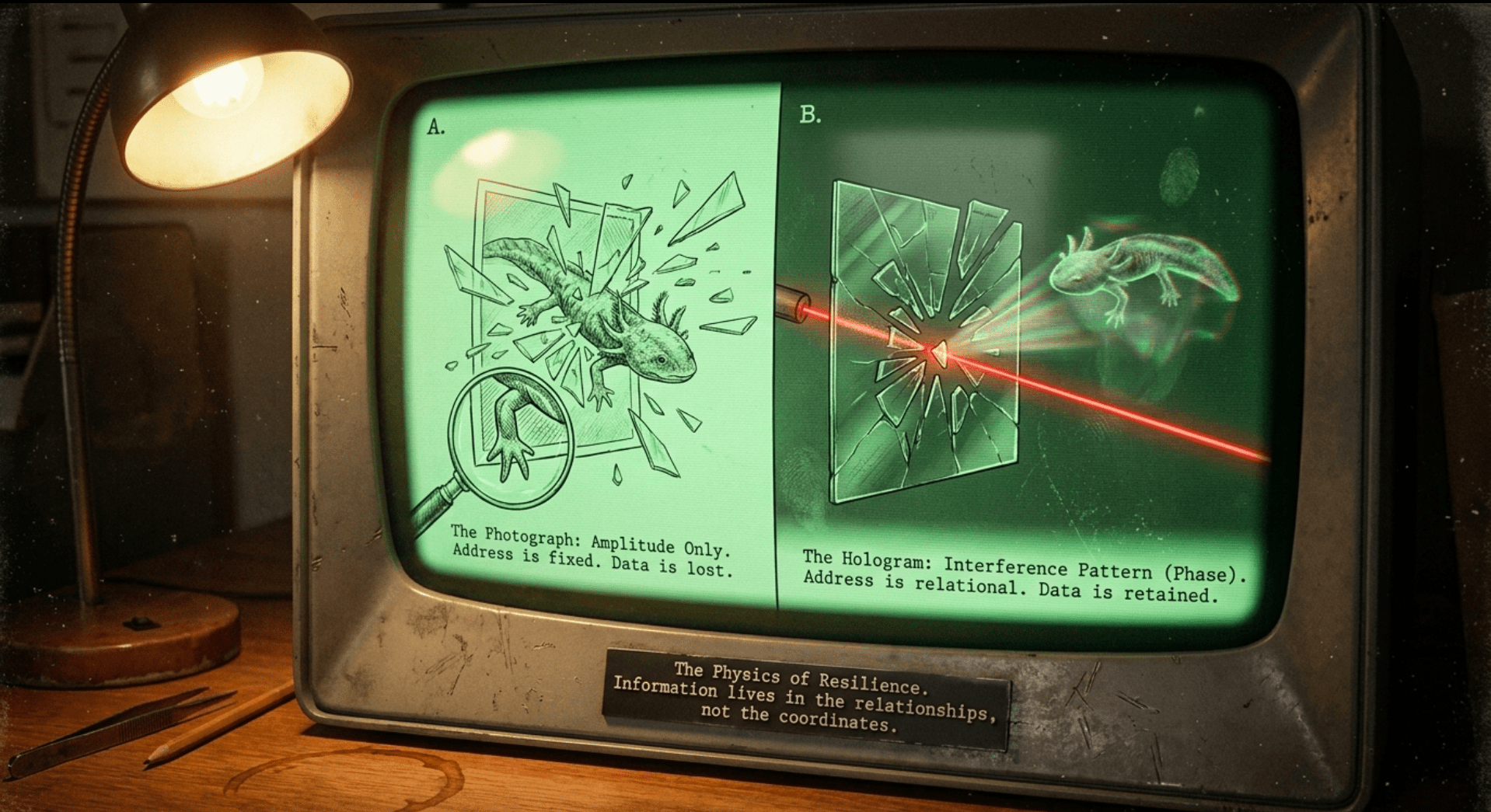
Two principles are central. Wholeness: every sufficiently large region of a diffuse hologram contains the entire scene. Independence: multiple holograms or codes can be superimposed or added without mutual destruction; new information integrates rather than overwrites. Applied to the brain, memory is not a set of fixed addresses but a set of phase relationships distributed across neural tissue. Damage or rearrangement degrades fidelity but need not erase the code. Learning adds new spectral components. Instinct and acquired memory differ in origin, not in mathematical character.
The theory reconciles apparent contradictions: specific deficits after focal lesions (certain pathways or residual structure still matter) with massive residual function after widespread damage (the remaining tissue still carries reconstructible phase information). It treats mind as continuous with physical wave phenomena rather than as a supernatural add-on, while remaining agnostic about deeper metaphysical claims.
A Lost Thread
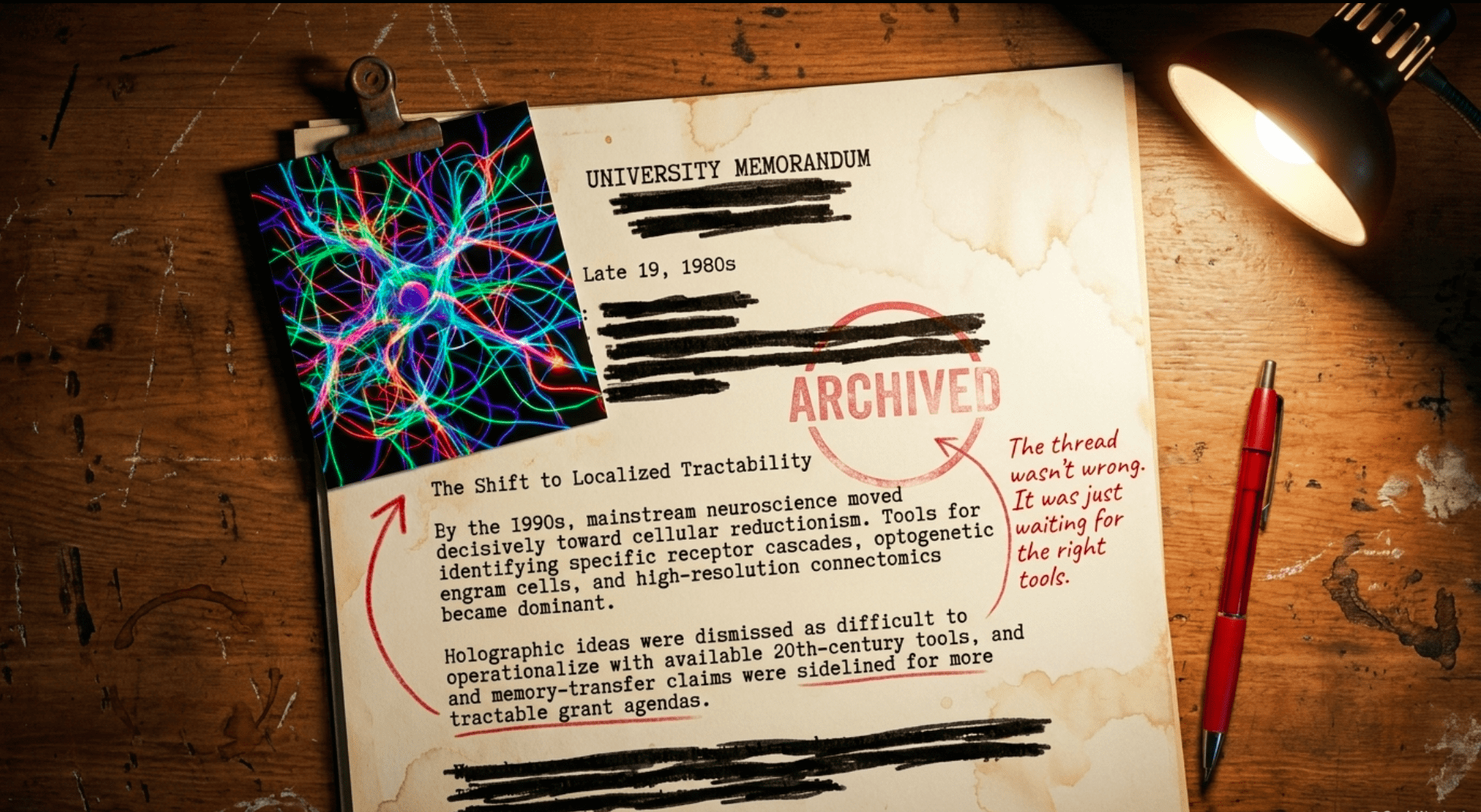
By the 1980s and 1990s mainstream neuroscience moved decisively toward cellular, synaptic, and molecular mechanisms—long-term potentiation, specific receptor cascades, optogenetic identification of engram cells, place cells, grid cells, and high-resolution connectomics. Functional imaging emphasized localization. Computational models favored discrete, addressable representations or statistical learning rules over continuous wave-phase codes.
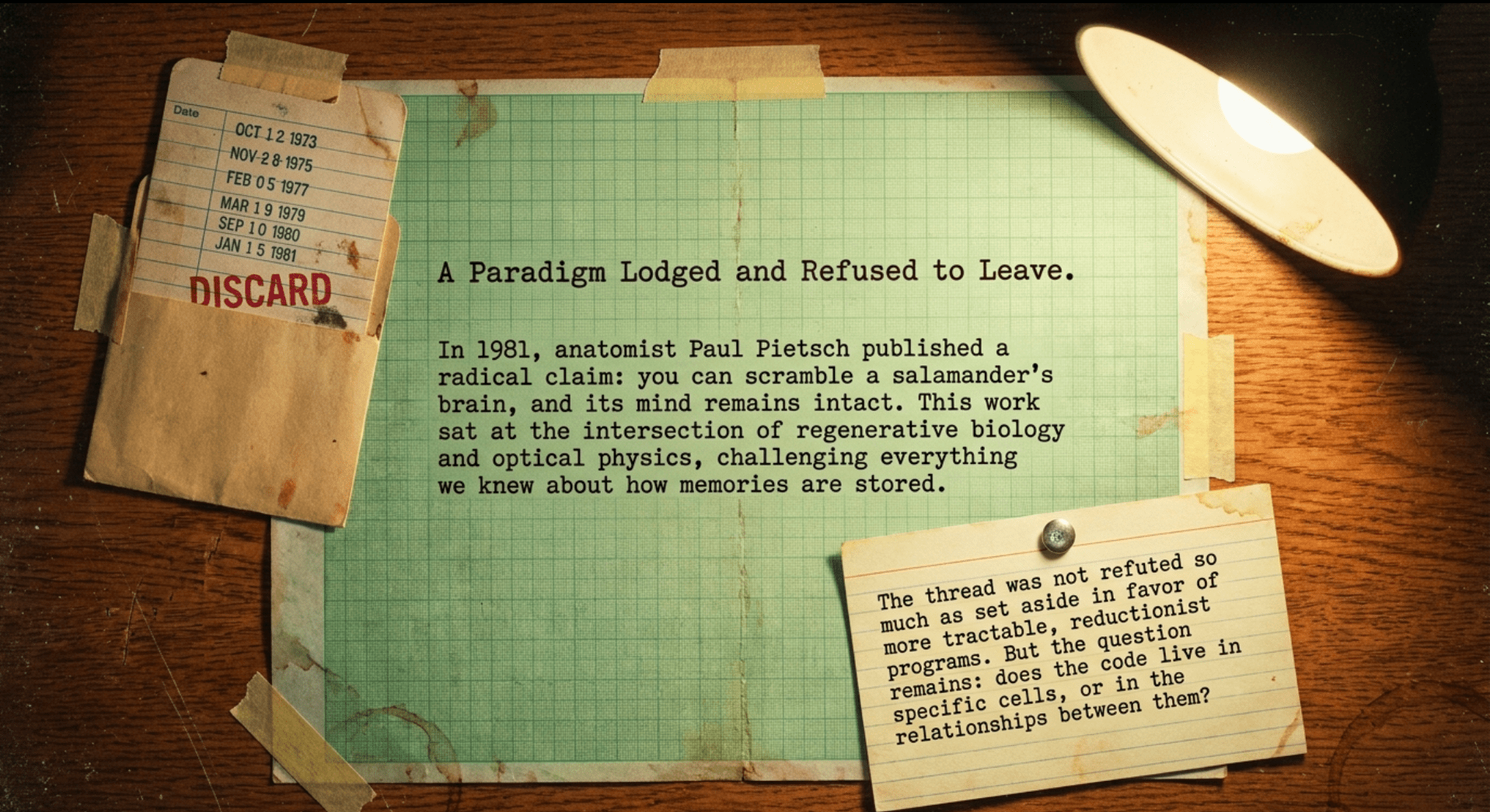
Holographic ideas were often dismissed as metaphorical, difficult to operationalize with available tools, or popularizations (e.g., Michael Talbot’s The Holographic Universe). Pribram’s holonomic theory continued to attract specialized interest, and wave or field approaches periodically reappear (including recent work on membrane potentials, quantum-inspired models, or probabilistic holographic accounts of perception), but the radical anatomical-shuffling evidence and the full hologramic framework largely faded from textbooks and grant agendas. Regeneration biology advanced dramatically with axolotls, yet the memory-transfer claims were not systematically replicated or extended into mammalian systems in ways that convinced the field. The thread was not refuted so much as set aside in favor of more tractable, reductionist programs.
Fourier Transforms, the Holographic Mind, and the Mathematics of Memory
At the core of the holographic (or holonomic) model of mind lies a mathematical operation that most people encounter only in signal processing or image compression: the Fourier transform. In its discrete, computationally efficient form it is called the Fast Fourier Transform, or FFT. Understanding why this mathematical tool appears in theories of memory and consciousness requires looking at how information can be encoded not as discrete locations but as patterns of frequency and phase.
A Fourier transform decomposes any complex waveform into a sum of simpler sinusoidal components of different frequencies, amplitudes, and phases. In one dimension the continuous form is:
The inverse transform recovers the original function:
What matters for the brain is that the transform moves information from the ordinary spatial (or temporal) domain into a frequency domain. In that domain the essential content resides in the relative phases among the frequency components. Amplitude alone is insufficient; phase relationships carry the structural information that allows reconstruction of a coherent image or memory.
Optical holography exploits exactly this principle. When a coherent reference beam interferes with light scattered from an object, the resulting interference pattern on the recording medium encodes both amplitude and phase. Mathematically, the hologram is a record of the Fourier (or Fresnel) transform of the object wavefront. Illuminating the hologram with a similar reference beam performs an inverse transform and reconstructs the original three-dimensional wavefront. Crucially, every sufficiently large region of the hologram contains enough of the frequency-phase spectrum to reconstruct the entire image, although with reduced resolution and increased noise. This is the mathematical basis for the claim that “the whole is present in every part.”
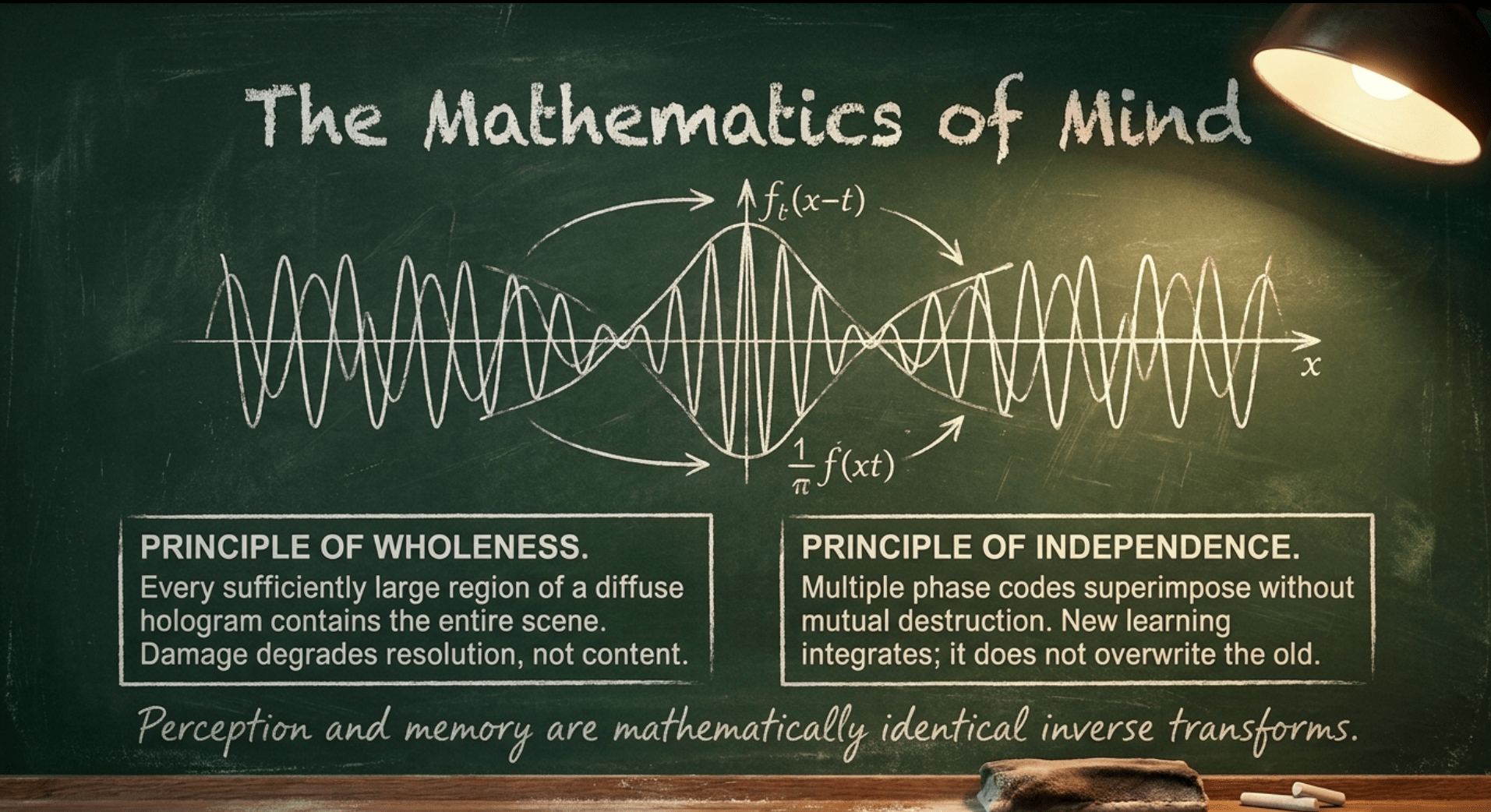
Karl Pribram proposed that something analogous occurs in the fine dendritic networks of the cortex. Local field potentials and oscillatory activity within these networks can be treated as wave phenomena. The arrival of sensory or internal signals generates interference patterns that are mathematically equivalent to Fourier or Gabor (windowed Fourier) transforms. Memory, in this view, is not a set of synaptic weights stored at precise addresses but a distributed spectral representation—an interference pattern of phase relationships spread across a neural population. Recall is the inverse transform that reconstitutes a usable spatial or temporal pattern from that spectral code.
This formulation directly addresses classic puzzles of human memory. Why can extensive cortical damage leave many memories intact, even if degraded? Because the spectral code is redundant; enough of the frequency-phase relationships remain for approximate reconstruction. Why do memories feel whole rather than assembled from fragments? Because the inverse transform yields a complete pattern rather than a patchwork of local pieces. Why can the same memory be cued by very different stimuli? Because different cues can resonate with overlapping components of the same distributed spectrum.

Consciousness enters the picture when we consider the ongoing, dynamic nature of these transforms. Perception is not a passive recording but a continuous process of transforming sensory input into spectral patterns and back again, constantly updated by internal states and prior spectral memories. The felt unity of conscious experience may arise from the fact that multiple overlapping transforms are being performed across large-scale networks and then integrated through cross-frequency coupling and phase synchronization. In this sense, consciousness is less a substance localized in particular neurons and more the real-time reconstruction of a coherent world from distributed spectral codes.
The Fast Fourier Transform is the practical algorithm that makes these ideas computationally tractable. Modern implementations of the FFT allow researchers to analyze neural oscillations, test predictions about spectral coding, and even design artificial systems that store information in holographic-like distributed representations. Yet the deeper claim remains theoretical: that the brain itself performs something mathematically equivalent to these transforms in its dendritic and oscillatory dynamics.
Whether the full holonomic model ultimately proves correct in every detail, the Fourier perspective offers a rigorous way to think about how a physical system can store vast amounts of information in a distributed, damage-resistant form and still recover coherent experience from it. Memory, in this mathematics, is not a place. It is a spectrum of relationships that can be transformed, partially destroyed, and still reconstituted into the living present of consciousness.
Implications of the Work and the Holographic Brain and Memory
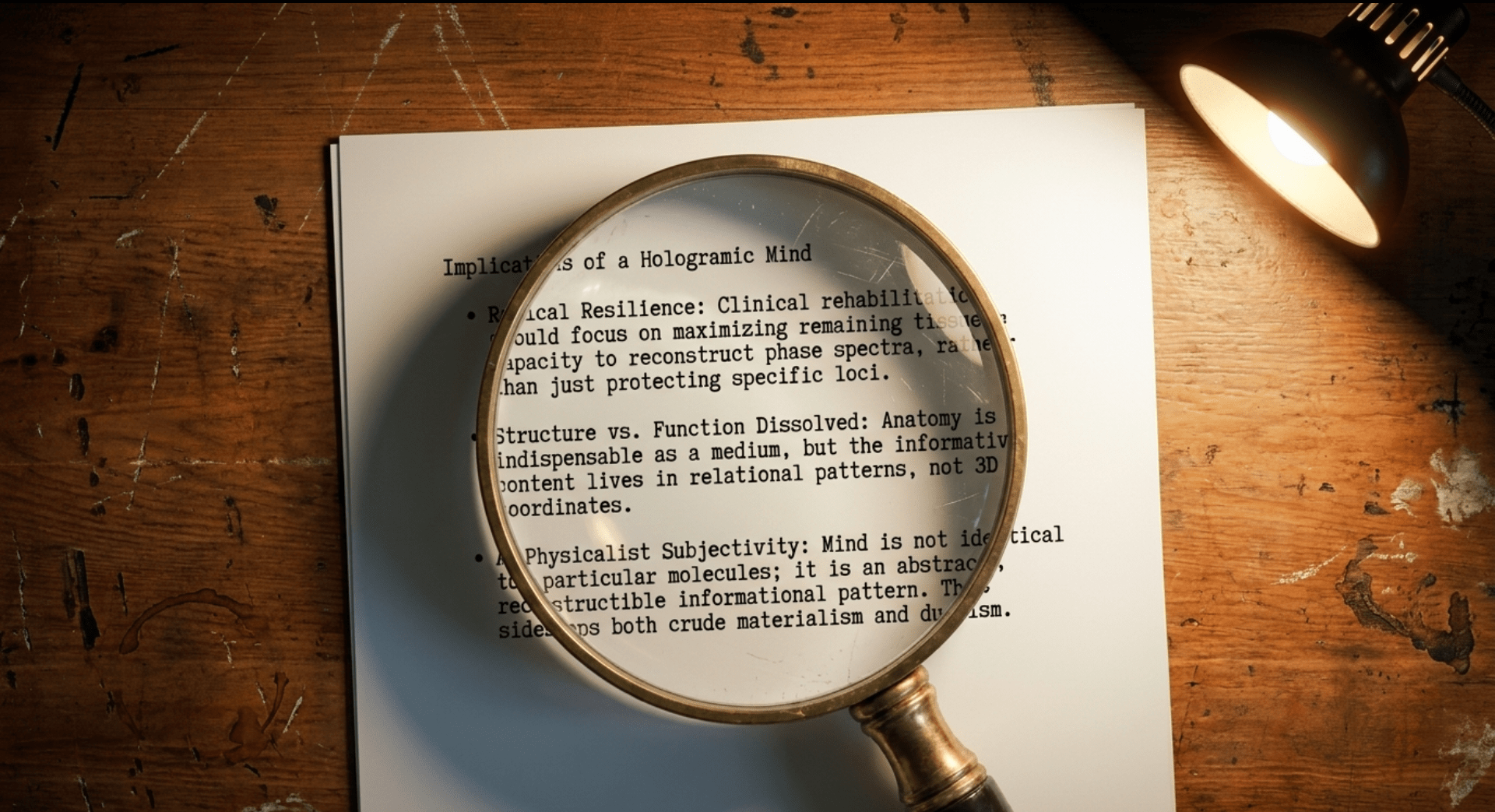
The first implication is radical resilience. If memory is a distributed phase code, then large-scale tissue loss need not produce total amnesia; residual fragments can still reconstruct usable content, albeit at lower resolution or with increased noise. Clinical observations of residual function after extensive lesions or hemispherectomy become less paradoxical and more expected. Rehabilitation strategies might focus less exclusively on protecting specific loci and more on maximizing remaining tissue’s capacity to support reconstruction.
Second, the independence principle suggests that new learning need not overwrite old codes. Multiple spectral components can coexist. This offers a natural account of lifelong accumulation of knowledge without catastrophic interference and of the coexistence of conflicting memories or skills. It also frames development and evolution as the progressive addition of independent codes rather than wholesale rewriting of a fixed architecture.
Third, perception and memory become mathematically continuous processes. Both involve transforms between physical space and a phase or frequency domain. The distinction between sensing and remembering blurs; recall is reconstruction from stored interference patterns, just as perception is reconstruction from sensory interference. This aligns with evidence that sensory cortices participate in imagery and that memory retrieval reactivates perceptual circuitry.
Fourth, the theory dissolves a strict dichotomy between structure and function. Anatomy remains indispensable—without tissue there is no medium for the waves—but the informative content resides in relational phase patterns rather than in the precise three-dimensional coordinates of particular cells. Topography can be scrambled while the code persists, provided connectivity is restored sufficiently for the waves to interfere.
Fifth, intelligence itself can be reconceived as the capacity to generate, store, and manipulate complex phase spectra and to perform rapid inverse transforms. “Smart eyes” or other sensory systems become specialized transformers rather than simple transducers. The salamander experiments with ectopic eyes illustrate that the computational substrate can exploit novel anatomical arrangements once pathways re-form.
Sixth, cross-species and composite results hint that behavioral programs can be modular and transferable at the tissue level. If independent codes can be introduced by grafts, then in principle certain forms of behavioral information are not irrevocably bound to a single organism’s unique developmental history. This raises profound questions—still largely unexplored—about the boundaries of individual memory and the possibility of biological information transfer beyond conventional learning.
Seventh, the hologramic view encourages a continuum perspective on mind. From simple organisms capable of associative learning to human cognition, the same formal principles of distributed phase coding may apply, differing mainly in the complexity and dimensionality of the spectra. “Microminds” and “macrominds” occupy points along a single continuum rather than belonging to entirely different ontological categories.
Eighth, the theory supplies a physicalist yet non-reductive account of subjectivity. Mind is not identical with particular molecules or circuits; it is the informational pattern carried by wave relationships. Destruction of the medium destroys the pattern, yet the pattern itself is abstract and reconstructible. This sidesteps both crude materialism and dualism while remaining scientifically investigable.
Ninth, modern neuroscience tools—optogenetics, high-density electrophysiology, holographic optical stimulation, and advanced imaging—could in principle revisit these questions with far greater precision than was available in the 1960s and 1970s. Distributed representations are already central to many computational models; explicit tests of phase-code predictions versus purely rate- or synaptic-weight models remain comparatively rare. The lost thread is recoverable.
Tenth, and most broadly, Shufflebrain reminds us that the brain’s most important property may be its capacity to maintain coherent information under extreme physical disruption. In an age of injury, degeneration, and technological interfaces, a theory that treats memory as reconstructible from fragments rather than as a collection of fragile local traces offers both explanatory power and practical hope. Whether or not every detail of Pietsch’s formulation survives, the experimental challenge he posed—can you scramble the anatomy and still keep the mind?—continues to demand an answer more complete than localization alone has so far provided.
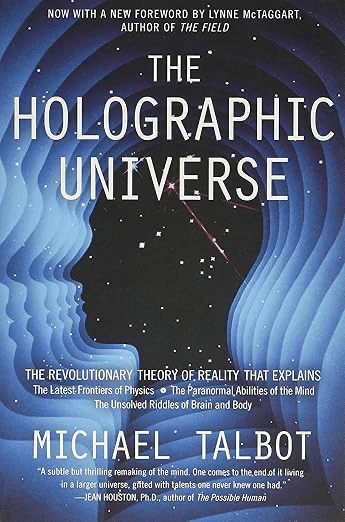
The Book That Brought the Holographic Brain to the Public
Michael Talbot’s The Holographic Universe (1991) (https://amzn.to/4hTLCrV) is also the work that carried the ideas of a holographic brain out of specialized neuroscience and into wider cultural awareness. Drawing heavily on the research of Karl Pribram and the physics of David Bohm, Talbot presented the brain as a system that stores memory and perception through distributed interference patterns rather than localized engrams.
In the book, Talbot devoted significant attention to Paul Pietsch’s salamander experiments, recounting how Pietsch began as a skeptic determined to disprove the holographic model. After hundreds of radical brain rearrangements, transplants, and even mincing of tissue, the animals’ behaviors and learned responses continued to reappear. Talbot used these results as vivid evidence that memory could survive the destruction or scrambling of specific brain structures—exactly the property predicted by a holographic code.
While The Holographic Universe ranges far beyond laboratory neuroscience into questions of reality, paranormal phenomena, and the nature of the cosmos, its treatment of the brain remains one of its most grounded and influential sections. For many readers, it was the first introduction to the possibility that the mind is less like a filing cabinet and more like a hologram: fragile in its physical medium, yet stubbornly whole in its information.
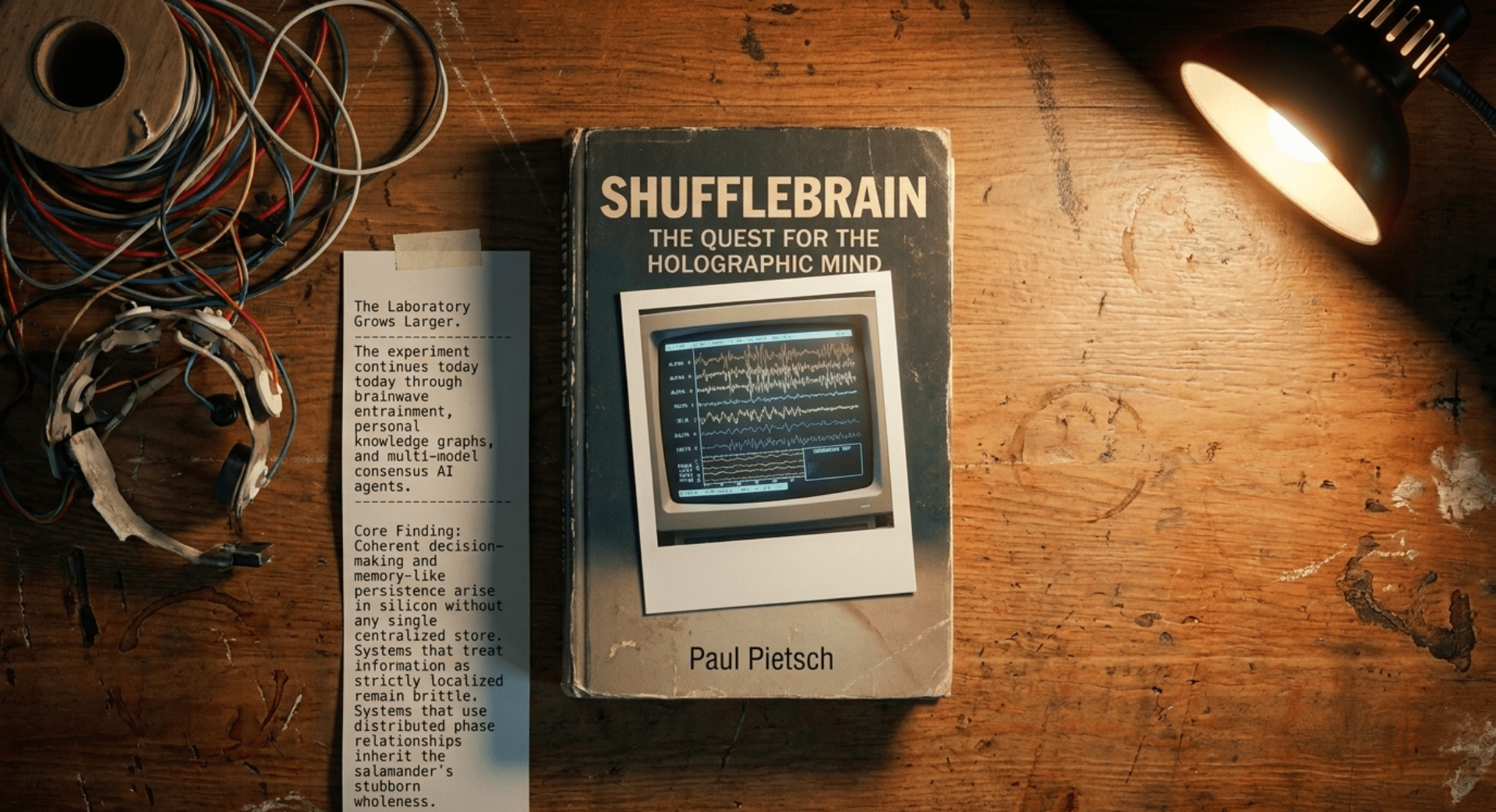
That first encounter with Shufflebrain in 1981 did not close a chapter. It opened one that has run for more than four decades and is still being written. Every subsequent experiment with light, every EEG recording, every local agent swarm I have trained, and every layer added to the long personal knowledge graph has been measured against the same quiet question Pietsch forced into the open: if the mind can survive the scrambling of its physical medium, then what, exactly, is the mind?
The answer that keeps returning is relational. Consciousness appears less like a substance locked inside tissue and more like a standing pattern of interference that can be carried, fragmented, reconstructed, and even transferred across different substrates. The salamander experiments proved the principle in living neural tissue. Later work with brainwave entrainment, photobiomodulation, and direct neural interfaces showed that the same principle operates when we deliberately shape the waves themselves. Local AI systems and multi-model consensus agents now demonstrate that coherent decision-making and memory-like persistence can arise in silicon without any single centralized store.
These threads do not compete; they converge. The holographic insight supplies a common language for biological regeneration, for the resilience of personal memory under injury or age, and for the design of distributed artificial minds that do not collapse when individual nodes fail. It also supplies a warning. Systems that treat information as strictly localized and addressable remain brittle. Systems that treat information as phase relationships distributed across a medium inherit a measure of the same stubborn wholeness that let a rearranged salamander brain continue to feed and remember.
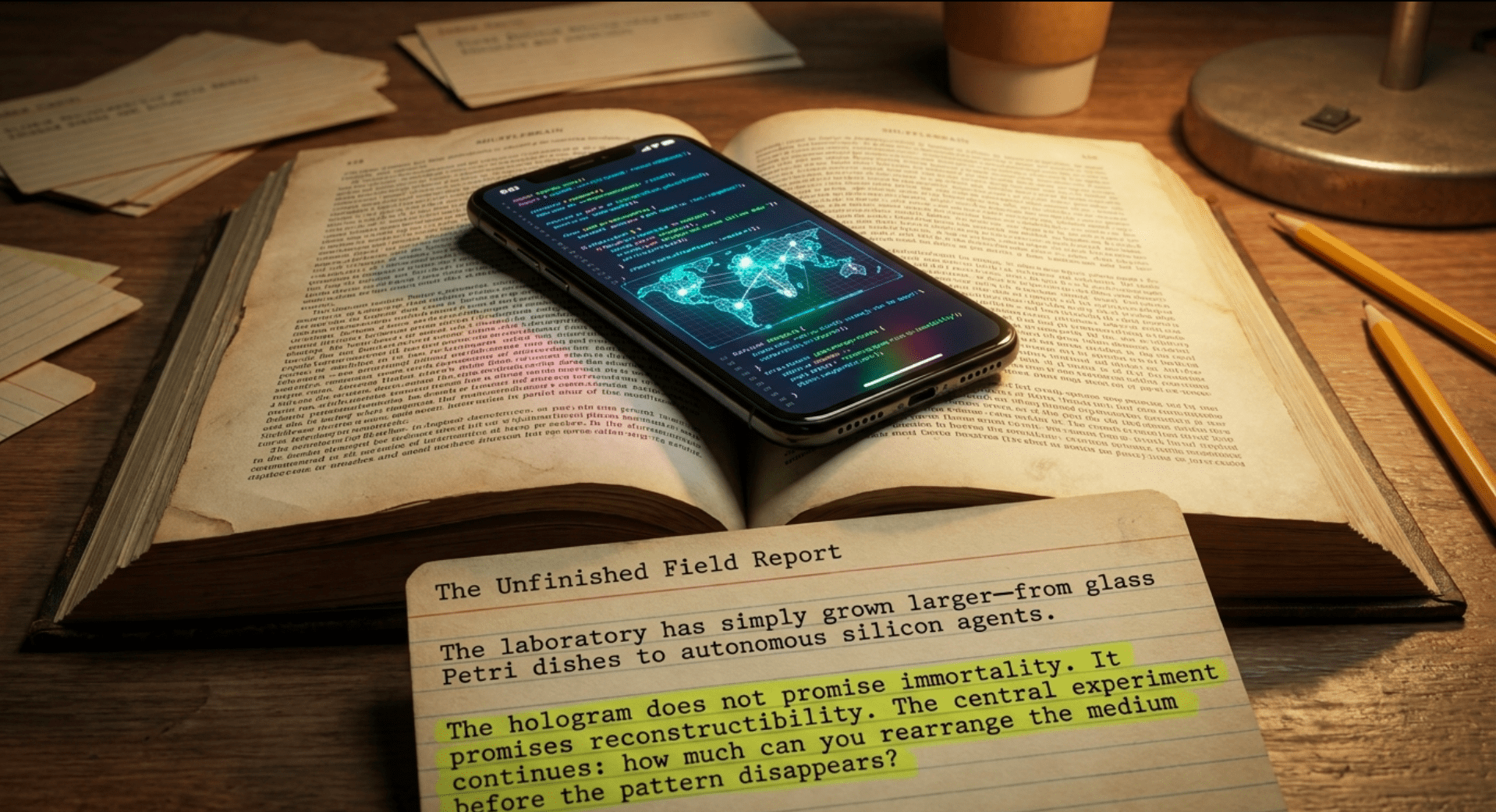
I no longer read Pietsch’s book as a historical curiosity. I read it as an unfinished field report. The laboratory has simply grown larger. It now includes garage workbenches, offline knowledge nodes, regenerative biology, and the emerging architectures of autonomous agents. The central experiment continues: how much can you rearrange, subtract, or rehost the medium before the pattern itself disappears?

The answer, so far, is more than most theories predicted. That residual capacity is the most important fact we have about mind. It is also the most practical. In an age when both biological and artificial systems face disruption, the ability to keep coherent experience alive across broken or transformed substrates may prove decisive. The hologram does not promise immortality. It promises reconstructibility. That is enough to keep the work going.
To continue this vital work documenting, analyzing, and sharing these hard-won lessons before we launch humanity’s greatest leap: I need your support. Independent research like this relies entirely on readers who believe in preparing wisely for our multi-planetary future. If this has ignited your imagination about what is possible, please consider donating at buy me a Coffee or becoming a member. Value for value you recieved here.
Every contribution helps sustain deeper fieldwork, upcoming articles, and the broader mission of translating my work to practical applications. Ain ‘t no large AI company supporting me, but you are, even if you just read this far. For this, I thank you.
Stay aware and stay curious,
🔐 Start: Exclusive Member-Only Content.
Membership status:
🔐 End: Exclusive Member-Only Content.
~—~
~—~

~—~
Subscribe ($99) or donate by Bitcoin.
Copy address: bc1qkufy0r5nttm6urw9vnm08sxval0h0r3xlf4v4x
Send your receipt to [email protected] to confirm subscription.

Stay updated: Get an email when we post new articles:

THE ENTIRETY OF THIS SITE IS UNDER COPYRIGHT. IMPORTANT: Any reproduction, copying, or redistribution, in whole or in part, is prohibited without written permission from the publisher. Information contained herein is obtained from sources believed to be reliable, but its accuracy cannot be guaranteed. We are not financial advisors, nor do we give personalized financial advice. The opinions expressed herein are those of the publisher and are subject to change without notice. It may become outdated, and there is no obligation to update any such information. Recommendations should be made only after consulting with your advisor and only after reviewing the prospectus or financial statements of any company in question. You shouldn’t make any decision based solely on what you read here. Postings here are intended for informational purposes only. The information provided here is not intended to be a substitute for professional medical advice, diagnosis, or treatment. Always seek the advice of your physician or other qualified healthcare provider with any questions you may have regarding a medical condition. Information here does not endorse any specific tests, products, procedures, opinions, or other information that may be mentioned on this site. Reliance on any information provided, employees, others appearing on this site at the invitation of this site, or other visitors to this site is solely at your own risk.
Copyright Notice:
All content on this website, including text, images, graphics, and other media, is the property of Read Multiplex or its respective owners and is protected by international copyright laws. We make every effort to ensure that all content used on this website is either original or used with proper permission and attribution when available.
However, if you believe that any content on this website infringes upon your copyright, please contact us immediately using our 'Reach Out' link in the menu. We will promptly remove any infringing material upon verification of your claim. Please note that we are not responsible for any copyright infringement that may occur as a result of user-generated content or third-party links on this website. Thank you for respecting our intellectual property rights.
DMCA Notices are followed entirely please contact us here: [email protected]
