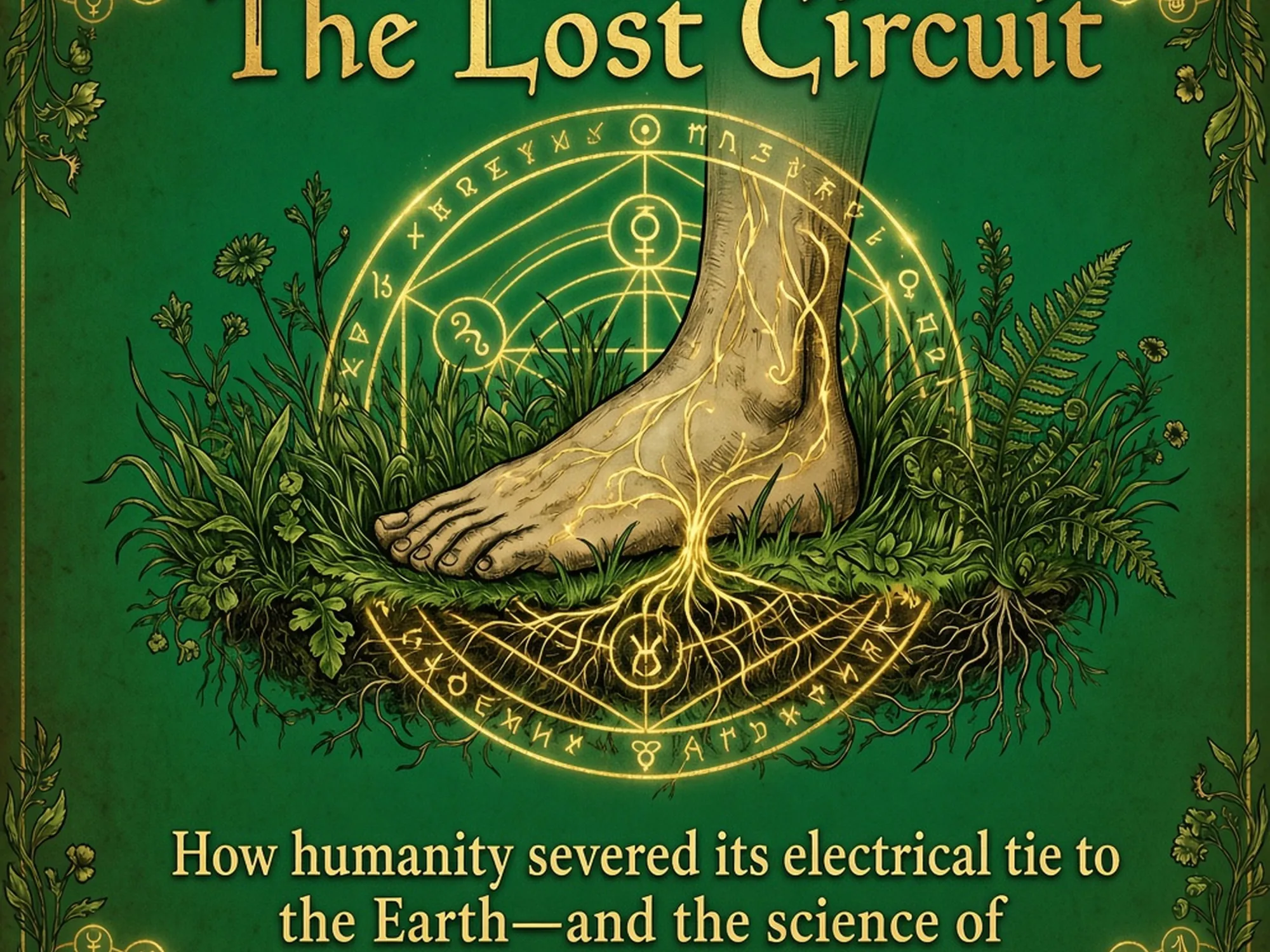
How Humans Were Always Grounded to Earth — and What Happened When We Cut the Wire.
For most of the time humans have existed, nothing separated our skin from the Earth. The first people slept on bare soil, on beds of grass and leaves, on piles of hay or on the hides of animals they’d hunted, with a fire burning nearby and the ground pressed against their backs all night. They walked barefoot across riverbanks, damp morning grass and sun-warmed stone. Whatever the planet carried in its surface, it shared with them every hour of every day for hundreds of thousands of years.
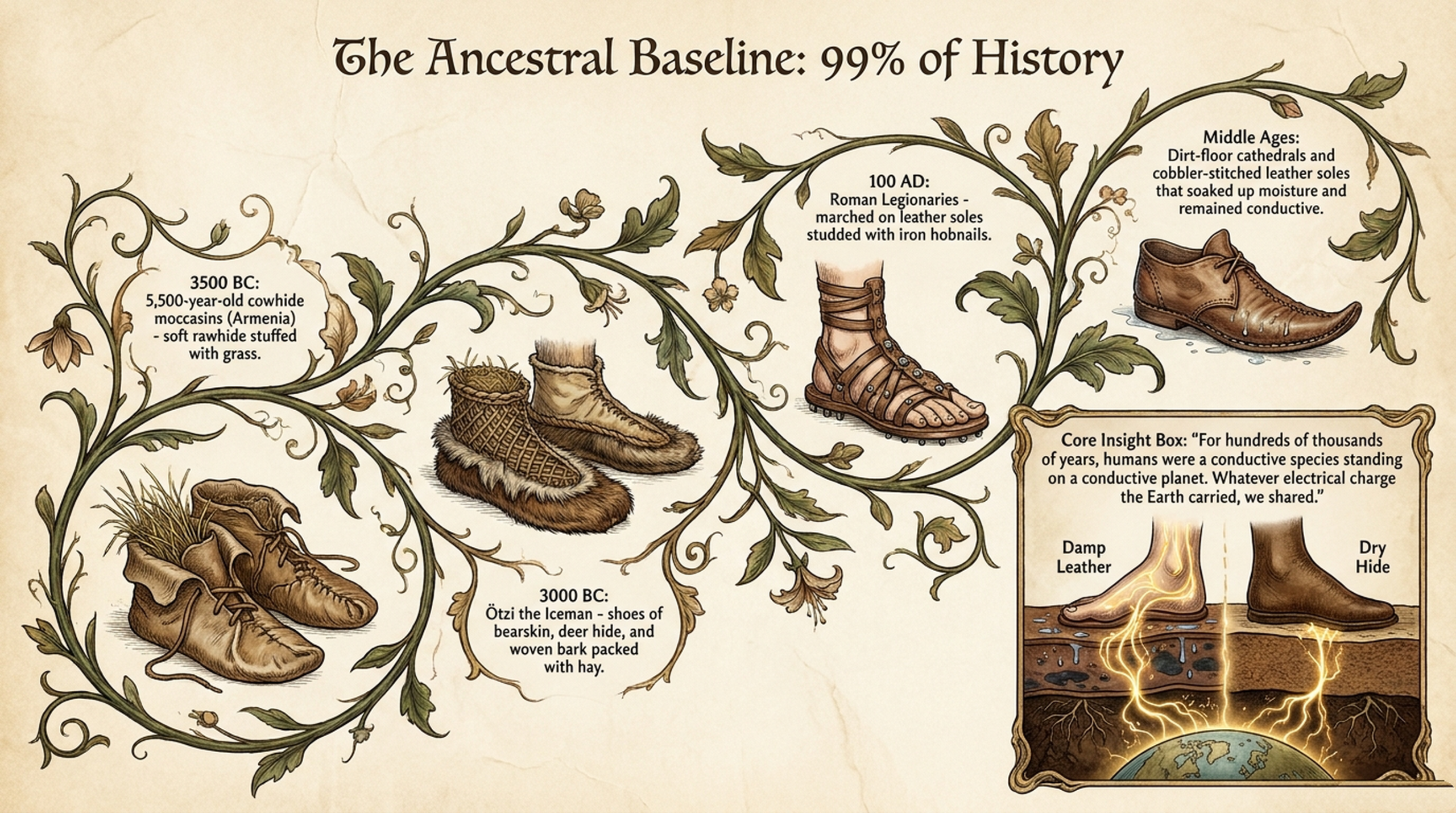
When our ancestors started covering their feet, they used materials the Earth still had a say in. The oldest shoe ever found, a 5,500-year-old cowhide moccasin from a cave in Armenia, was soft rawhide stuffed with grass. Ötzi, the Iceman who died in the Alps more than 5,000 years ago, wore shoes of bearskin, deer hide and woven bark, packed with hay for warmth. These were really second skins: thin and porous, and dampened by sweat and dew, so they never fully cut the connection underfoot.
This article is sponsored by Read Multiplex Members who subscribe here to support my work: Link: https://readmultiplex.com/join-us-become-a-member/
It is also sponsored by many who have donated a “Cup of Coffee”. If you like this, help support my work: Link: https://ko-fi.com/brianroemmele
Listen to the companion podcast: https://rss.com/podcasts/readmultiplex-com-podcast/3327517
That connection survived the rise of civilizations. Egyptian farmers worked the Nile mud barefoot or in papyrus sandals. Roman legionaries marched thousands of miles on leather soles studded with iron hobnails, metal that touched the road with every step. Across Asia, Africa and the Americas, people wore straw sandals and soft hide moccasins, or went barefoot on packed-earth floors inside their homes. Grand cathedrals went up and empires fell, and still most people spent their days on their feet in direct or nearly direct contact with the ground.
Even sleep kept us close for most of history. Medieval peasants slept on straw pallets laid on dirt or flagstone floors. Nomads slept on felt and hides spread over the steppe, and sailors and soldiers lay down wherever the ground let them. Cobblers in every town stitched leather soles that soaked up moisture and stayed slightly conductive. Nobody thought about any of this. Being in touch with the Earth was simply what it meant to live on it.
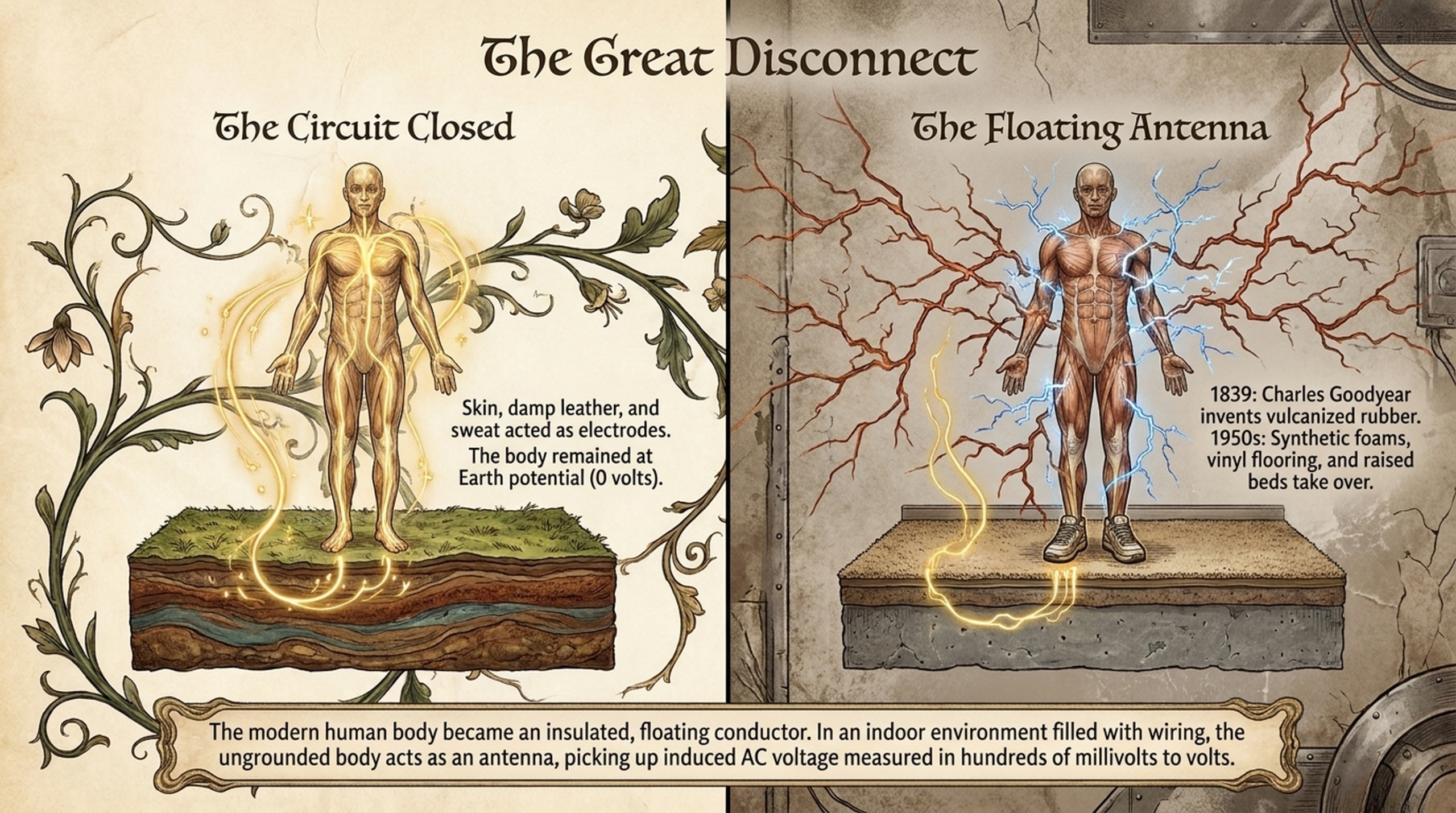
Then came the Industrial Revolution, and with it a quiet experiment no one realized they were running. In 1839 Charles Goodyear vulcanized rubber, turning a sticky tree sap into a tough, waterproof and electrically insulating material. By the late 1800s rubber-soled canvas shoes were showing up on beaches and playgrounds, and in the 20th century rubber and then plastics and synthetic foams replaced leather on the feet of billions of people. At the same pace, we moved indoors onto raised wooden floors, then carpet, then upper stories of concrete and steel, and we slept on elevated beds and synthetic mattresses far above the soil.
Within a few generations, a species that had spent its entire existence touching the ground had almost completely insulated itself from it. Most of us now go days, weeks or even years without bare skin meeting bare earth. It’s one of the biggest changes in how humans live, and it happened so fast and so quietly that hardly anyone noticed. This article asks a simple question that science has only recently started to take seriously: what did we lose when we cut the wire?
I have spent a lifetime watching the human body as an electrical instrument. Not as a metaphor. As hardware. The brain is a field. The heart is a pacemaker. The cell membrane is a capacitor. Blood is a charged slurry of cells that either flow or clump. If you accept even a fraction of that picture, a simple question becomes unavoidable: what happens when you isolate that instrument from the largest electrical reservoir on the planet?
The Earth is not electrically silent. Its surface is a vast reservoir of free electrons, held at a relatively stable negative potential relative to the ionosphere. Life evolved in continuous contact with that reservoir. For most of human history we slept on skins and woven mats on dirt floors. We walked on leather, which is conductive when moist with sweat and soil. We worked barefoot in fields. We sat on stone. We were, without knowing the word, grounded.
Then, in a single industrial generation, we cut the circuit. Rubber and plastic soles. Synthetic carpets. Elevated beds. Concrete sealed with petrochemical finishes. We built a civilization of insulators and called it progress. Chronic inflammation, flattened cortisol rhythms, viscous blood, and a sleep architecture that no longer matches the night — these are the diseases of a body that has lost its ground.
The Lost Circuit
Barefoot. Leather. Sleep on the ground. Then rubber, plastic, and the Great Disconnect. The modern rediscovery of earthing — from Clint Ober and Stephen Sinatra to the papers we can cite now.
This is not a fringe sermon. It is a first-principles argument with a paper trail. So this time I am putting the paper trail first. Below are the six studies I think matter most, what each one actually did, what it found, what it means, and where it is weak. Then the physics in plain words. Then the history of how we lost the circuit, the men who forced the question into print, how to start for free tonight, how to stay safe, and the short list of gear I would actually buy.
The Science First: The Six Papers That Matter Most
I picked these six because together they cover the big claims (sleep and stress hormones, blood chemistry, blood flow, recovery from injury, and a modern placebo-controlled trial), because each one is published in a peer-reviewed journal you can read yourself, and because two of them come from researchers with no product to sell. Every link below goes to the journal, PubMed, or the free full text at PubMed Central.
A word before you read them. Sample sizes in this field are small. Several authors have ties to the companies that make grounding products. I will tell you where that is true. I am not going to pretend otherwise, and I am also not going to throw away a consistent physiological signal because the first generation of measurements was done by the people who cared enough to fund them.
1. Sleep and Cortisol: Ghaly and Teplitz (2004)
Citation: Ghaly M, Teplitz D. “The biologic effects of grounding the human body during sleep as measured by cortisol levels and subjective reporting of sleep, pain, and stress.” Journal of Alternative and Complementary Medicine. 2004;10(5):767-776. PubMed 15650465 · DOI 10.1089/acm.2004.10.767
- What they did: Twelve adults with poor sleep, pain, and stress slept grounded in their own beds on a conductive mattress pad for eight weeks. Saliva cortisol was measured every four hours across a full 24 hours before grounding and again at week six. Symptoms were logged daily.
- What they found: Night-time cortisol fell significantly. The 24-hour cortisol curve moved toward the healthy shape (high in the morning, low at night). Sleep problems, pain, and stress were reduced or gone in nearly all subjects. The changes were most apparent in women.
- Why it matters: Cortisol is the master clock hand of the stress system. A body stuck with high night cortisol does not repair, does not sleep deeply, and wakes tired. If a wire to the Earth nudges that clock back toward normal, it touches nearly every chronic complaint people bring to a doctor.
- Honest limits: Twelve people. No control group. Subjects knew they were being grounded. This is a pilot that earned a proper trial, not proof by itself.
2. The Chemistry Chapter: Sokal and Sokal (2011)
Citation: Sokal K, Sokal P. “Earthing the human body influences physiologic processes.” Journal of Alternative and Complementary Medicine. 2011;17(4):301-308. Free full text, PMC3154031 · PubMed 21469913
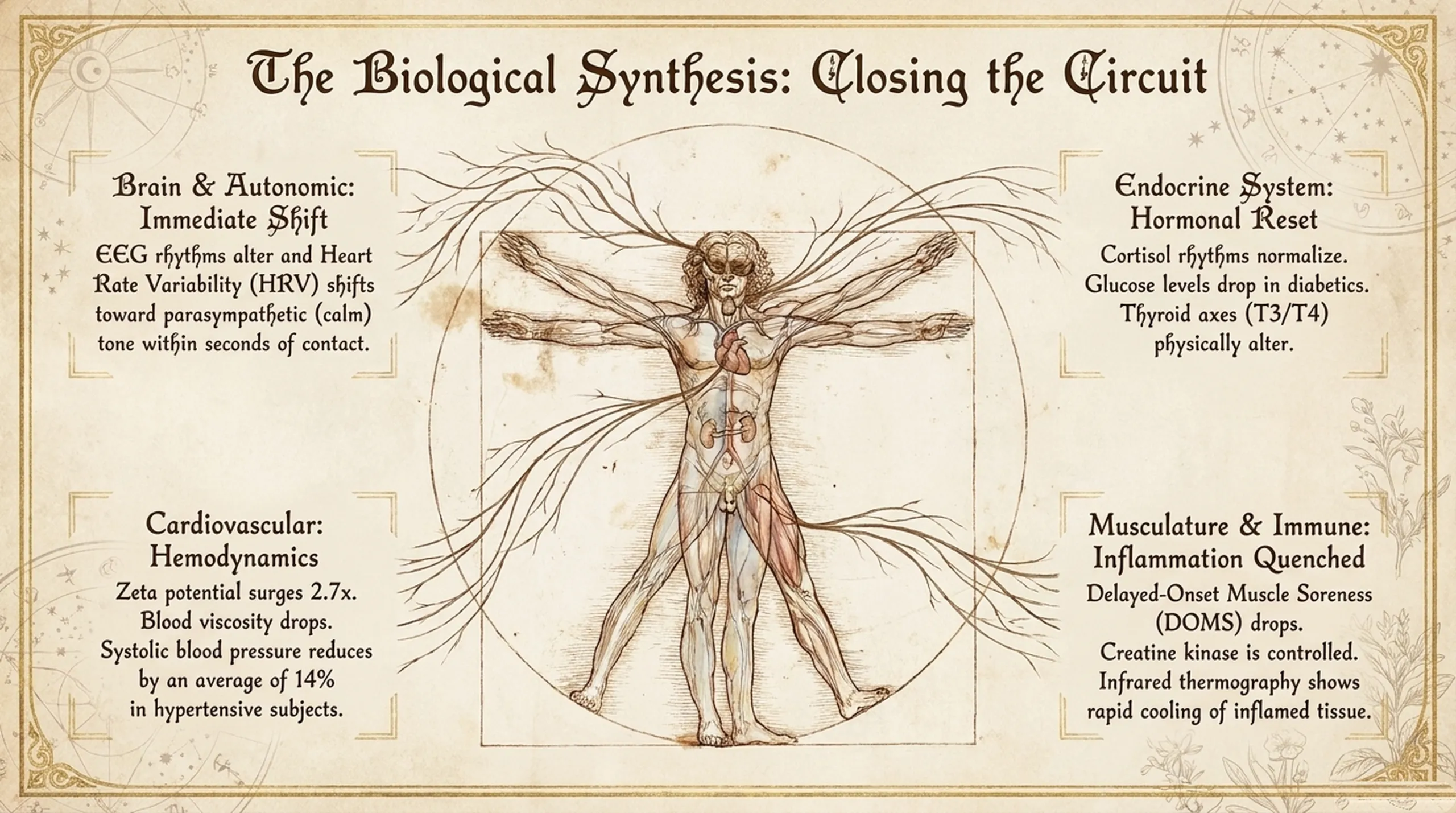
- What they did: A cardiologist and a neurosurgeon, father and son, at a Polish military clinical hospital ran five experiments, grounding people through a copper conductor and comparing them with ungrounded people: minerals and iron (84 people), electrolytes (28), thyroid function (12), glucose in diabetics (12), and immune response to a vaccine (32). They drew blood and collected urine.
- What they found: One night of grounding lowered serum iron, ionized calcium, and phosphorus and reduced how much calcium and phosphorus the kidneys excreted. Thyroid numbers shifted (free T3 down, free T4 and TSH up). Continuous grounding lowered blood glucose in people with diabetes. Electrolytes, proteins, and globulin fractions moved in measurable ways.
- Why it matters: These are standard morning lab values, measured by physicians who were not selling a sheet. They also noticed that grounding pushes calcium and phosphate the opposite way that weightlessness does, which is a sentence anyone who thinks about bone, gravity, and charge should sit with. And it is a practical warning: if grounding can move thyroid and glucose numbers, people on those medicines should tell their doctor before they start.
- Honest limits: Several small sub-studies in one paper, short time frames, and limited detail on blinding. It needs independent replication with modern methods.
3. Thick Blood, Thin Blood: Chevalier, Sinatra, Oschman and Delany (2013)
Citation: Chevalier G, Sinatra ST, Oschman JL, Delany RM. “Earthing (grounding) the human body reduces blood viscosity: a major factor in cardiovascular disease.” Journal of Alternative and Complementary Medicine. 2013;19(2):102-110. Free full text, PMC3576907 · PubMed 22757749
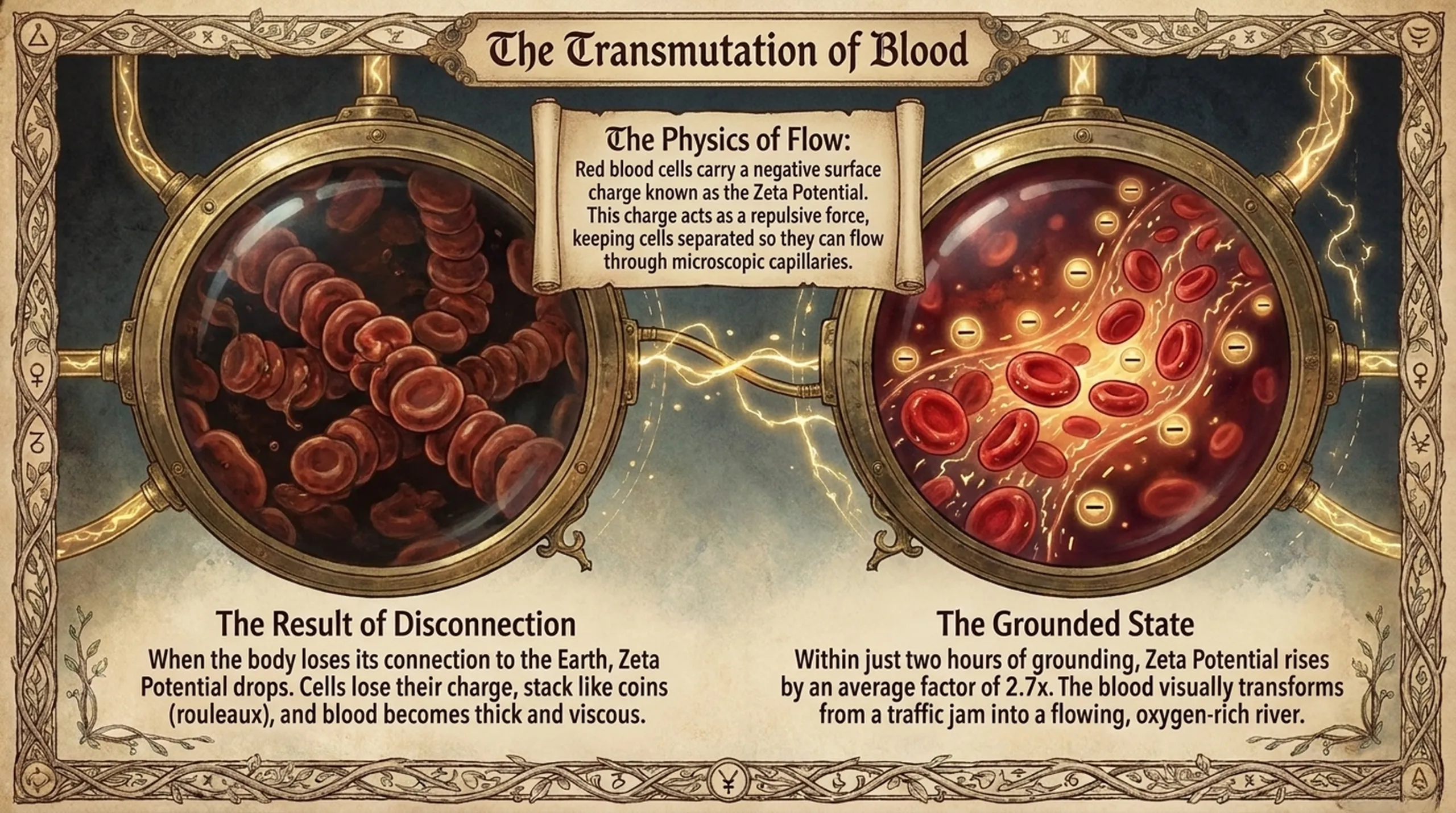
- What they did: Ten healthy adults sat in a quiet, dark room for two hours with conductive patches on the soles of their feet and palms, wired to a steel rod in the earth outside. Fingertip blood samples were placed under a microscope in an electric field, and the researchers measured how fast red cells moved (their surface charge, or zeta potential) and counted how many were clumped together.
- What they found: Zeta potential rose in every sample, by an average factor of 2.7. Red cell clumping fell significantly.
- Why it matters: Red cells that carry more negative charge push each other apart and flow. Cells that lose charge stack like coins and thicken the blood. Thick blood is a known risk factor for heart attack and stroke. This is the study Stephen Sinatra treated as a cardiology finding, not a curiosity.
- Honest limits: Ten people, no sham group, a single two-hour session, and three of the four authors are long-time grounding researchers tied to the field. It is a striking lab signal that begs for a larger, blinded trial.
4. Faster Recovery, Triple-Blind: Müller and colleagues, University of Salzburg (2019)
Citation: Müller E, Pröller P, Ferreira-Briza F, Aglas L, Stöggl T. “Effectiveness of grounded sleeping on recovery after intensive eccentric muscle loading.” Frontiers in Physiology. 2019;10:35. Free full text, PMC6360250 · DOI 10.3389/fphys.2019.00035
- What they did: Sports scientists at the University of Salzburg had 22 healthy people run a punishing downhill treadmill session, then sleep for ten nights on either a grounded or a sham (ungrounded) setup. It was triple-blind: the participants, the testers, and the data analyst did not know who was grounded. They tracked soreness, creatine kinase (a muscle damage marker), leg strength, and jump performance on days 1, 2, 3, 5, 7, and 10.
- What they found: The grounded sleepers lost less jump height and strength and had a smaller rise in creatine kinase than the sham group. In a small subset, blood work showed lower muscle-damage-related inflammation markers (IP-10, MIP-1α, and sP-selectin).
- Why it matters: This is the cleanest design on the list, and it comes from a university sport science department rather than a product company. Recovery from muscle damage is inflammation in action, so it is a direct test of the anti-inflammatory idea.
- Honest limits: Twenty-two people, and the detailed blood panel was done on only four of them. One exercise model. Good design, still small.
5. The Modern Sleep Trial: Park and colleagues (2025)
Citation: Park HJ, Lee GR, Kim Y, Kim J, Sohn M, Kim SH, Rhie SJ, Kim KR, Shim I. “A randomized, double-blind, placebo-controlled study on the improvement of sleep quality with Earthing mat.” Advances in Integrative Medicine. 2025;12(3):100458. DOI 10.1016/j.aimed.2025.01.005
- What they did: Sixty adults in Korea were randomized by computer to a real grounding mat or an identical non-grounding mat, used six hours a day for 31 days. Neither participants nor researchers knew who had which. Sleep quality, insomnia severity, daytime sleepiness, and stress were scored by questionnaire, and total sleep time was measured with a wrist actigraph on days 0, 31, and 38.
- What they found: The grounded group improved on all four questionnaires from start to finish, slept longer by actigraph than the sham group, and still had better insomnia scores a week after stopping.
- Why it matters: This is the design the 2004 pilot was asking for: a real sham mat, randomization, and blinding in ordinary sleepers. The objective sleep-time result is the one I weigh most.
- Honest limits: Independent reviewers point out that on the questionnaires the two groups were not significantly different from each other at day 31; both improved. The headline differences are total sleep time and the follow-up insomnia score. It is one small trial, and reviewers have raised questions about industry support, so read the paper’s own funding statement. One more good trial would settle a lot.
6. The Map of the Field: Chevalier, Sinatra, Oschman, Sokal and Sokal (2012)
Citation: Chevalier G, Sinatra ST, Oschman JL, Sokal K, Sokal P. “Earthing: health implications of reconnecting the human body to the Earth’s surface electrons.” Journal of Environmental and Public Health. 2012;2012:291541. Free full text, PMC3265077 · PubMed 22291721
- What they did: The American and Polish research groups joined forces to review every earthing study then in print: sleep, cortisol, pain, body voltage, heart rate variability, blood, inflammation, and the Sokal chemistry work.
- What they found: A consistent pattern of physiological change when people are connected to the Earth, along with better sleep and less pain, and the argument that our modern disconnection may be a hidden contributor to chronic illness.
- Why it matters: This is the paper to hand a skeptical doctor. It is free, readable, and it lays out the mechanism, the measurements, and the open questions in one place. Most of what you read about grounding online traces back to it.
- Honest limits: It is a review written by the researchers who did most of the studies, so it is not an independent judgment of their own work. Read it as the map, then read the primary papers.
What These Six Papers Mean Together
Read them as an engineer would. Saliva cortisol, standard blood and urine chemistry, a microscope measuring cell charge, creatine kinase, jump plates, and a wrist actigraph are independent instruments. They all moved in the same healthy direction when the only change was a conductive path to Earth. A placebo can move a questionnaire. It has a much harder time moving zeta potential and serum calcium at the same time.
The implications, if this holds up in larger trials, are big and cheap. Better sleep and a calmer stress clock without a pill. Blood that flows more easily. Faster recovery from hard work. A possible lever on chronic inflammation. And the most important implication is the cheapest one: the original version of this intervention is free. It is the ground outside your door.
The other implication is caution. If grounding can move blood thickness, glucose, and thyroid numbers, then it is not nothing, and people on blood thinners, diabetes drugs, thyroid medicine, or blood pressure medicine should involve their doctor. More on that in the safety section below.
More Papers Worth Reading
- Oschman JL. “Can electrons act as antioxidants? A review and commentary.” J Altern Complement Med. 2007;13(9):955-967. PubMed 18047442. The theory paper: free electrons from the Earth as the original antioxidant.
- Chevalier G. “Changes in pulse rate, respiratory rate, blood oxygenation, perfusion index, skin conductance, and their variability induced during and after grounding human subjects for 40 minutes.” J Altern Complement Med. 2010;16(1):81-87. PubMed 20064020.
- Chevalier G, Sinatra ST. “Emotional stress, heart rate variability, grounding, and improved autonomic tone: clinical applications.” Integrative Medicine. 2011;10(3):16-21. Abstract at FAIM. Twenty-seven people; heart rate variability rose during 40 minutes grounded, about double the sham session.
- Oschman JL, Chevalier G, Brown R. “The effects of grounding (earthing) on inflammation, the immune response, wound healing, and prevention and treatment of chronic inflammatory and autoimmune diseases.” J Inflamm Res. 2015;8:83-96. Free full text, PMC4378297. The inflammation review, including the thermography case photos.
- Brown R, Chevalier G, Hill M. “Grounding after moderate eccentric contractions reduces muscle damage.” Open Access J Sports Med. 2015;6:305-317. Free full text, PMC4590684.
- Chevalier G. “The effect of grounding the human body on mood.” Psychol Rep. 2015;116(2):534-542. PubMed 25748085.
- Passi R, Doheny KK, Gordin Y, Hinssen H, Palmer C. “Electrical grounding improves vagal tone in preterm infants.” Neonatology. 2017;112(2):187-192. Free full text, PMC5542808. A hospital neonatal unit study, outside the usual research circle.
- Elkin HK, Winter A. “Grounding patients with hypertension improves blood pressure: a case history series study.” Altern Ther Health Med. 2018;24(6):46-50. PubMed 30982019. Ten patients; systolic pressure fell about 14 percent on average.
- Chevalier G, Patel S, Weiss L, Chopra D, Mills PJ. “The effects of grounding (earthing) on bodyworkers’ pain and overall quality of life: a randomized controlled trial.” Explore. 2019;15(3):181-190. PubMed 30448083.
- Menigoz W, Latz TT, Ely RA, Kamei C, Melvin G, et al. “Integrative and lifestyle medicine strategies should include Earthing (grounding): review of research evidence and clinical observations.” Explore. 2020;16(3):152-160. PubMed 31831261.
- Sinatra ST, Sinatra DS, Sinatra SW, Chevalier G. “Grounding: the universal anti-inflammatory remedy.” Biomed J. 2023;46(1):11-16. Free full text, PMC10105021.
- Oschman JL. “Illnesses in technologically advanced societies due to lack of grounding (earthing).” Biomed J. 2023;46(1):17-29. Free full text, PMC10105023.
- Giulivi C, Kotz R. “Earthing effects on mitochondrial function: ATP production and ROS generation.” FEBS Open Bio. 2025;15(9):1459-1470. Free full text, PMC12401174. A new cell-level look at the energy factories inside us.
- Sokal P, Broda M, Zając M, Sokal J. “Earthing as a supportive therapy for post-spinal surgery recovery.” J Clin Med. 2025;14(11):3844. Free full text, PMC12155732. The Sokal family is still at it, now in surgical recovery.
What the Science Does Not Yet Show
I hold this field to the same standard I hold everything else on this site. Here is what we do not have yet. We do not have a large, independent, multi-center trial with hundreds of people. We do not have a full “dose” map: how many hours, through what resistance, for whom. We do not have long-term follow-up measured in years. Many studies were done by a small circle of researchers who also helped build the product category, and some were funded by it. None of that makes the findings wrong. It makes them early. The right response to an early, consistent, cheap, low-risk signal is not dismissal and not hype. It is to try it carefully, measure your own results, and keep reading.
The Physics in Plain Words
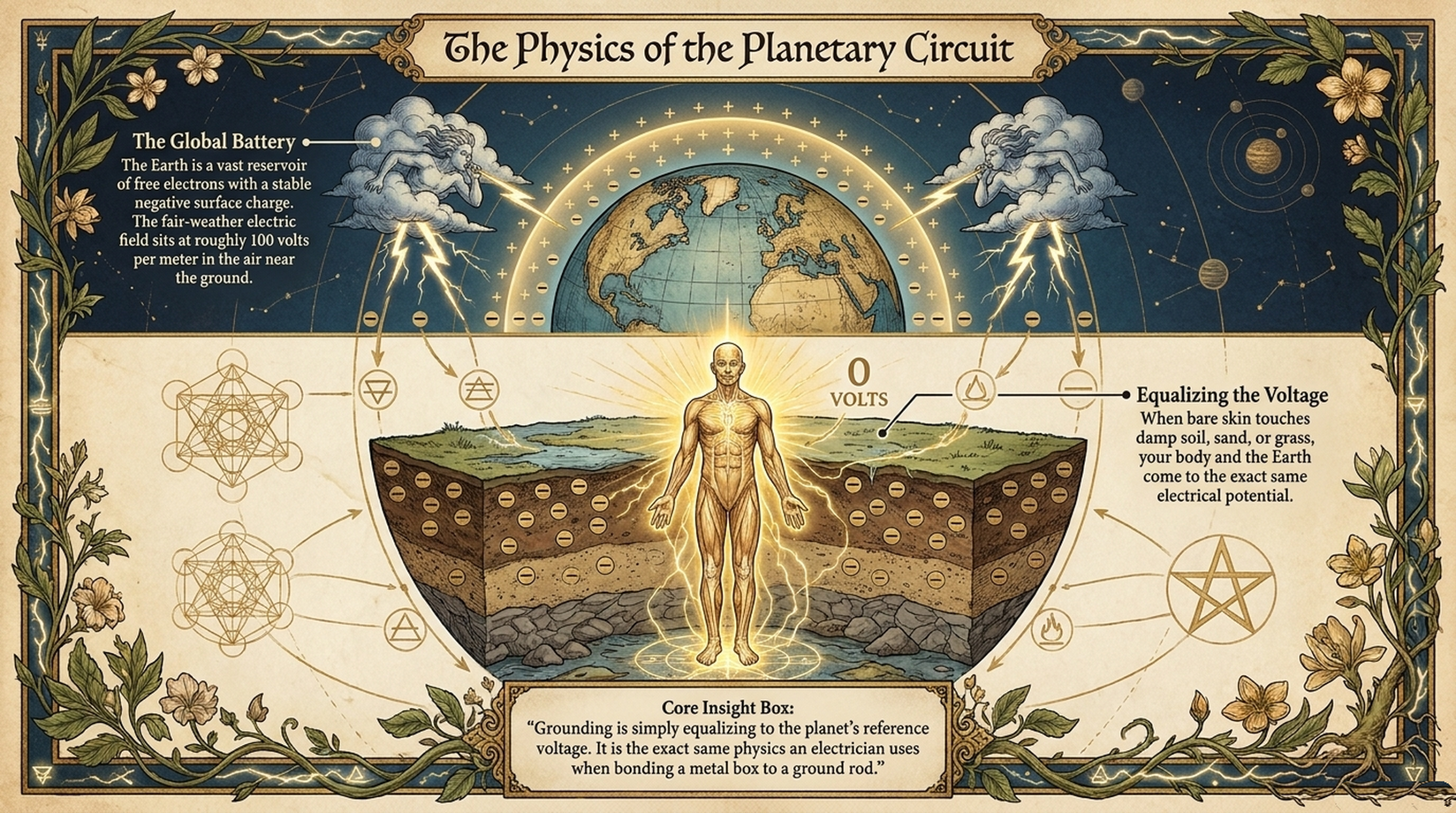
The Earth is a giant conductor with a surface that carries a net negative charge, hundreds of thousands of coulombs spread over the whole planet. Thousands of thunderstorms happening somewhere on Earth at every moment keep pumping that charge back down, while the upper atmosphere sits hundreds of thousands of volts more positive. On a calm, clear day there is an electric field of roughly 100 volts per meter in the air near the ground. That is the global electrical circuit, and every living thing on land evolved standing in it.
When your bare skin touches damp soil, sand, grass, or the sea, your body and the Earth come to the same electrical potential. Free electrons can move between them. That is all “grounding” means in physics: equalizing to the planet’s reference voltage, the same thing an electrician does when he bonds a metal box to a ground rod.
Indoors, an ungrounded body sitting near household wiring picks up a small induced AC voltage from the 60-hertz fields around it. You can measure it with an ordinary meter. Connect the same body to a true ground and that induced voltage drops to nearly nothing. This is the least controversial finding in the whole literature, and you can repeat it yourself in your own bedroom. Members, I show you exactly how in the field manual below.
One more piece of physics matters for safety. Good grounding products put a 100,000 ohm (100k) resistor in the cord. It does not stop the slow, tiny exchange of charge that grounding is about. It does limit current to a safe trickle if something in your house wiring ever faults. Never use a grounding cord without that resistor.
I. The Original Design: Humans Were Always Grounded
Before there was a product called an earthing sheet, there was a design constraint older than agriculture. Every land animal that walks on four feet or two is a conductive object standing on a conductive planet. The skin of the foot, the pad of the paw, the hoof when wet — these are electrodes.
Indigenous peoples across continents slept on the ground or on hides that wicked moisture and charge. Japanese tatami sat on earth-packed floors. Mediterranean stone houses conducted. African and Amazonian living was barefoot by default. The peasant of Europe wore leather. Leather is not rubber. A leather sole, especially once dampened by morning dew or the day’s work, is a poor insulator. Charge equalizes. The body remains at Earth potential.
The same is true of bedding. Straw, wool, linen, and hide on a dirt or stone floor do not isolate the sleeper the way a modern polyurethane mattress on a metal frame over vinyl flooring does. Night was the long grounding session. Eight hours of electron exchange while the cortisol axis reset and the immune system did the quiet work of repair.
This is why the barefoot argument is not nostalgia. It is electrical engineering applied to anthropology. When you walk barefoot on grass, sand, or moist soil, you are completing a circuit that your genome assumes is closed. When you walk on asphalt in a polymer shoe, you are floating. A floating conductor in an electromagnetic environment picks up voltage. That is not mysticism. That is what every electrician already knows about ungrounded equipment.
II. The Great Disconnect
The break was not spiritual. It was material. After the Second World War, shoe manufacturing abandoned leather for rubber and then for petrochemical foams. Athletic shoes — the great democratic uniform of the late twentieth century — are superb insulators. Clint Ober would later point to the coincidence that is not quite a coincidence: the rise of insulating footwear tracks, in rough historical overlay, with the rise of the inflammatory diseases of modernity. Correlation is not proof. It is a clue that a cable-television engineer was trained to notice.
The timeline is worth knowing. Rubber-soled canvas shoes go back to the 1800s and Keds arrived in 1917, but for most people the everyday shoe was still leather until the middle of the twentieth century. By the 1950s and 1960s, cheap molded rubber and then synthetic foams took over work boots, school shoes, and the new athletic shoe. Within one lifetime, the default human went from a sole that conducts when damp to a sole that insulates almost perfectly.
Indoor life finished the job. We lifted our beds off the floor. We wrapped the floor in rubber-backed carpet. We poured slabs and sealed them. We filled the rooms with alternating-current fields from wiring and appliances. An ungrounded human body in that room becomes an antenna. Measured AC body voltage in ordinary bedrooms routinely sits in the hundreds of millivolts to volts range. When the same body is conductively tied to Earth, that induced voltage collapses — in published measurements, by factors on the order of fifty-fold or more.
You do not have to believe a single health claim to accept that measurement. The voltage drop is reproducible. It is the least controversial finding in the entire literature. The argument begins after it: what does a body do when it is no longer floating in a 60-hertz fog?
III. Clint Ober and the Sedona Bench
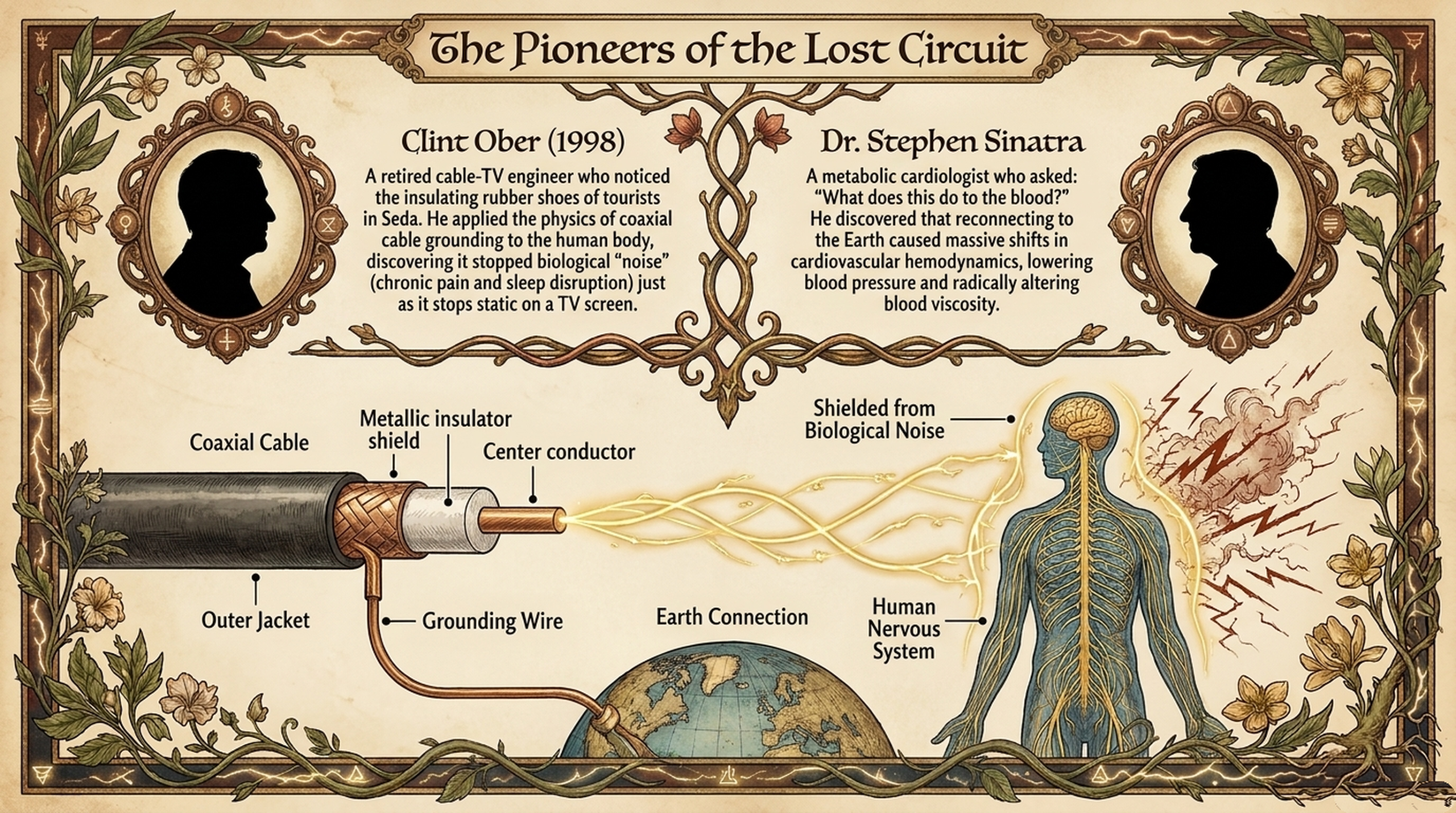
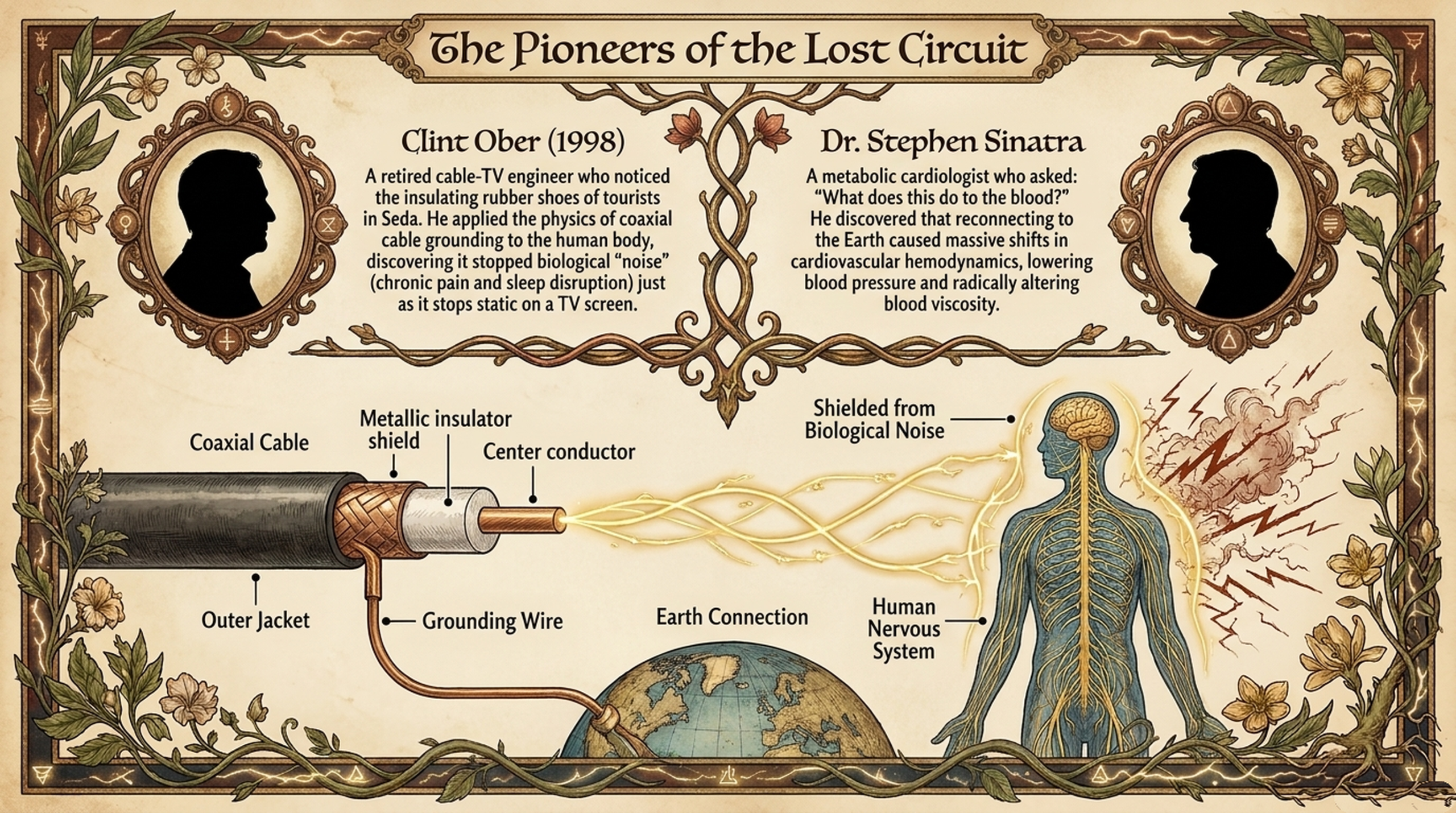
In 1998 a retired cable-television pioneer named Clint Ober sat on a park bench in Sedona and watched tourists get off a bus. What he noticed was not their cameras. It was their shoes. Thick rubber. Plastic. The same class of material he had spent a career grounding out of cable plants so that a television signal would arrive without snow.
Ober’s analogy is the one I still use because it is the correct analogy. A coaxial cable is a signal path. If it is not grounded, noise enters the picture. The human body is a signal path — nerves, heart, fascia as a semiconductor matrix. If it is not grounded, noise enters the physiology. He did not wait for a grant. He bought a voltmeter, mapped the fields in a rented room, and built a crude conductive grid on his bed from metallic tape and a wire to a ground rod outside the window.
He slept. For a man who had not slept through the night since surgery and chronic back pain, that was the experiment. Pain receded. He took the same rig to friends. Same reports: sleep, pain, a quieting that people struggled to name.
In 2000 he ran a group experiment with sixty people who had at least six months of sleep disturbance and chronic muscle or joint pain. Both groups slept on conductive carbon-fiber mattress pads. One group was actually grounded. After a month the grounded subjects reported falling asleep faster (85 percent improved versus 13 percent of controls), better sleep quality (93 versus 13), waking rested (100 versus 13), less muscle stiffness (82 versus 0), and less chronic back or joint pain (74 versus 0). It was not a cathedral of methodology. It was the first public measurement that something real was happening when the body was tied back to Earth.
IV. Stephen Sinatra Walks Into the Circuit
Stephen T. Sinatra, M.D., F.A.C.C., was not a man hunting for a wellness fad. He was a Connecticut cardiologist who had already spent decades thinking about the heart as an energetic organ — coenzyme Q10, metabolic cardiology, the idea that the mitochondrion is the neglected patient in coronary disease. When he encountered Ober’s work, he did what a good cardiologist does with a strange finding: he asked what it did to blood.
Sinatra’s contribution is the cardiovascular chapter of this story, and it is the chapter I want every reader of this site to hold. Thick blood is not a metaphor. Red blood cells carry a negative surface charge, the zeta potential. That charge makes them repel one another. When zeta potential falls, cells stack into rouleaux — coin-roll clumps — and viscosity rises. Viscous blood is harder to push through capillaries. It is the physical substrate of poor perfusion, of the sluggish microcirculation that sits underneath so much of what we politely call “inflammation” and “aging.”
In work Sinatra championed and co-authored, subjects grounded for two hours showed a marked rise in red-cell surface charge and a drop in aggregation. Dark-field images that look like a traffic jam become, after grounding, a flowing river. Sinatra would later describe, in the 2023 review he signed with Drew Sinatra and Gaétan Chevalier, an astonishing reduction in measured blood viscosity in grounded subjects — the kind of number a cardiologist does not ignore even when the sample is small.
He also followed blood pressure. In a small series of patients already on one to three antihypertensive drugs, grounding was associated with systolic reductions on the order of 8 to 23 percent, averaging about 14 percent, with some patients able to reduce medication under medical supervision. This is not a license to throw away a prescription. It is a signal that the electrical state of the blood and the vessel wall is not a spectator sport.
Sinatra co-authored the book that brought the story out of the garage and into living rooms: Earthing: The Most Important Health Discovery Ever?, with Clint Ober and Martin Zucker. He kept publishing after the book. The 2015 review in the Journal of Inflammation Research — “The effects of grounding (earthing) on inflammation, the immune response, wound healing, and prevention and treatment of chronic inflammatory and autoimmune diseases” — remains one of the cleanest maps of the field. The 2023 paper “Grounding — The universal anti-inflammatory remedy,” published in Biomedical Journal, is his late synthesis. He died in 2022. The papers did not.
V. The Mechanism: Electrons as the Original Antioxidant
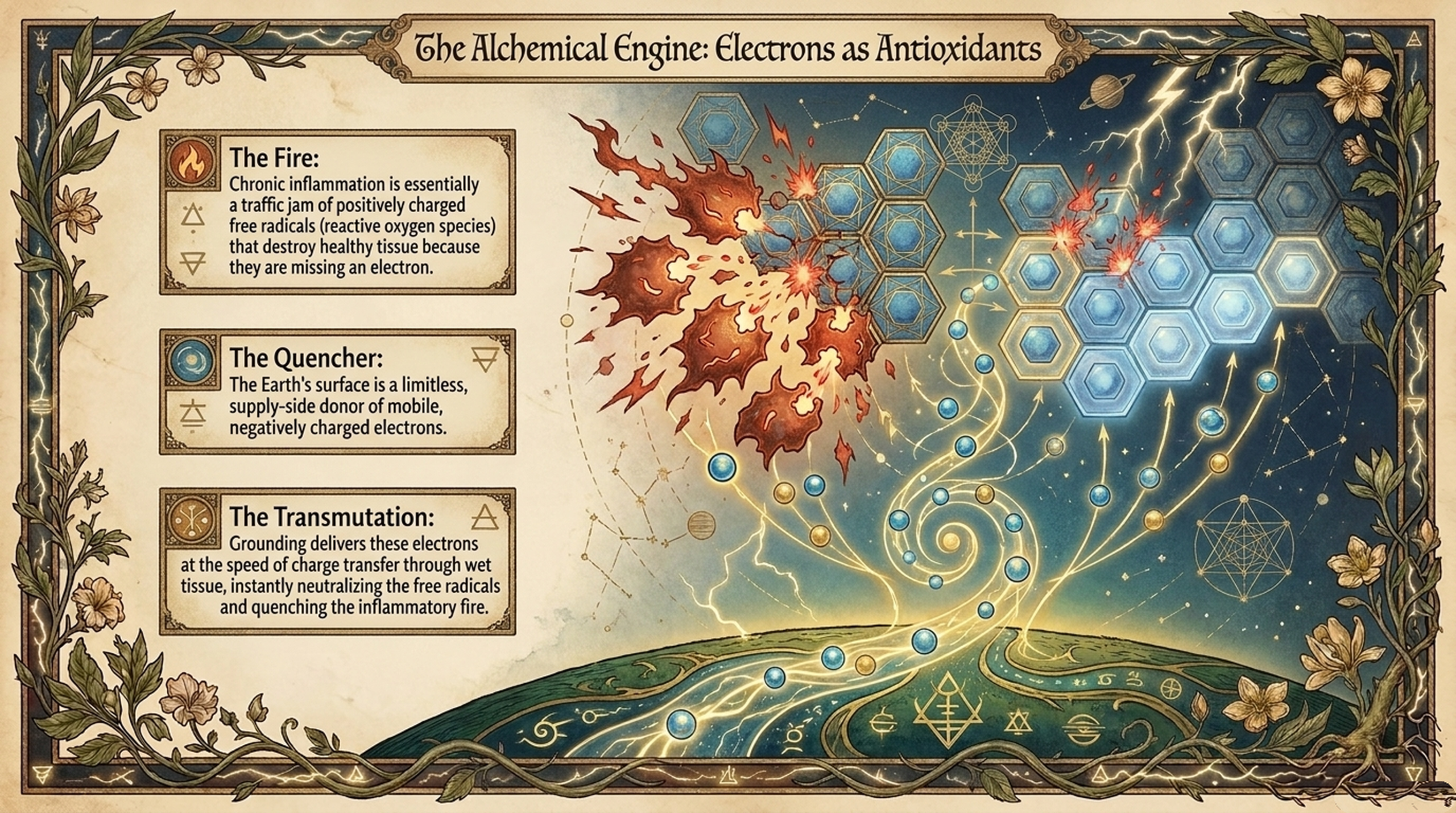
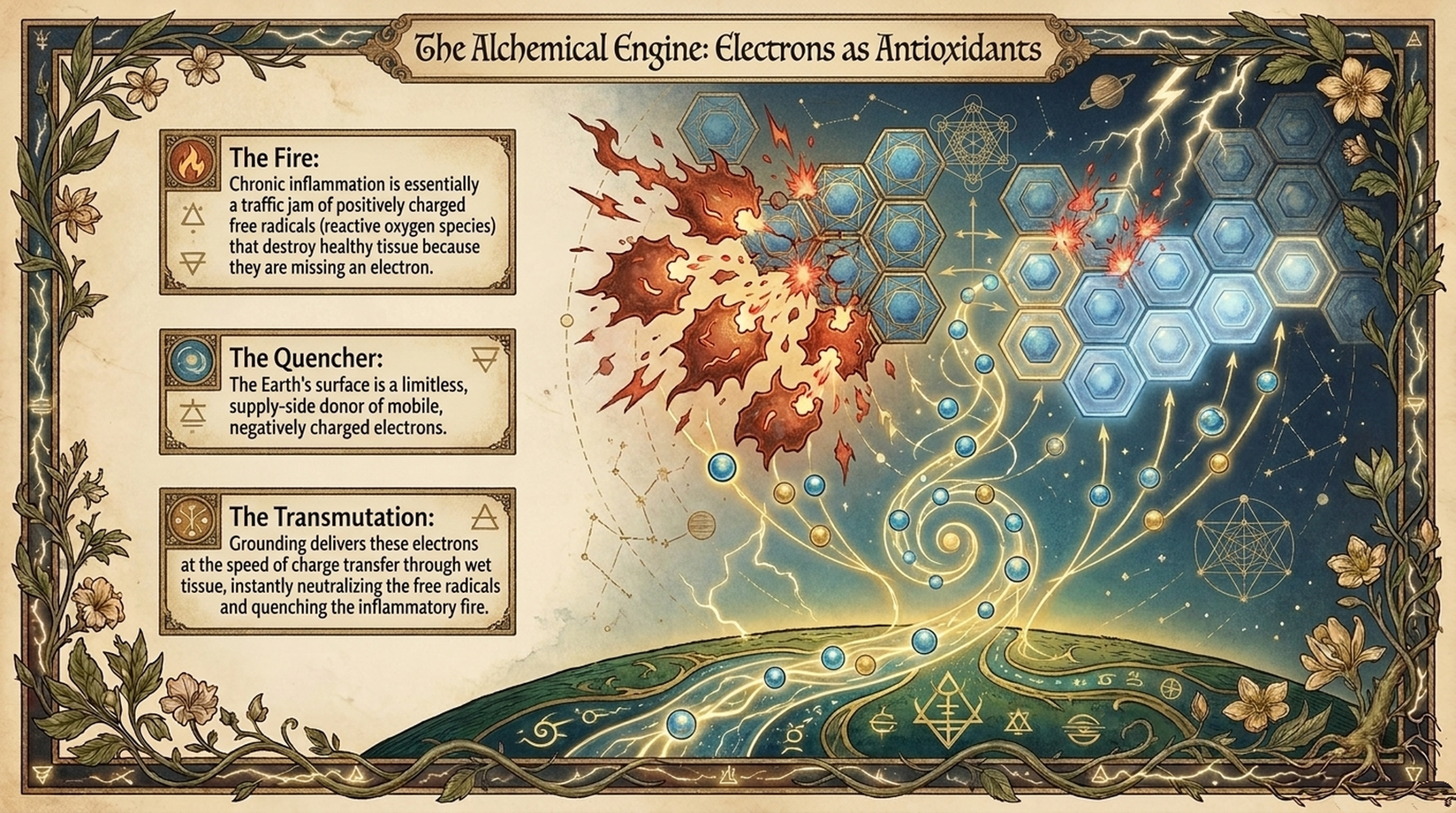
James L. Oschman, Ph.D., gave the field its most important theoretical sentence. In a 2007 commentary in The Journal of Alternative and Complementary Medicine — “Can Electrons Act as Antioxidants?” — he proposed that mobile electrons from the Earth’s surface can neutralize positively charged free radicals. Chronic inflammation, in this frame, is a traffic jam of reactive oxygen species that never get the electrons they are trying to steal from tissue. The Earth is a limitless donor.
I like this hypothesis because it is physically parsimonious. You do not need a new organ. You need a completed circuit. Neutrophils dump reactive oxygen species onto injured tissue; that is how they kill pathogens. If the burst is not quenched, the fire keeps burning. Grounding, on this account, is not “energy healing.” It is a supply-side intervention in redox chemistry, delivered at the speed of charge transfer through wet tissue.
Is the electron flux large enough to matter against the torrent of radicals a body already manages with superoxide dismutase, catalase, glutathione, and diet? That is the fair skeptical question. The honest answer is that we do not yet have a complete dosimetry. What we do have is a stack of downstream measurements — cortisol, zeta potential, cytokines, thermography, heart-rate variability — that behave as if something anti-inflammatory is arriving when the circuit closes. I will take a stack of consistent small studies over a polished theory with no data. We have both the theory and the stack.
VI. The Working Library
Here is the working library. I have listed the studies that actually exist in journals, not the marketing copy that orbits them. Sample sizes are often small. Several authors have industry ties. I am not going to pretend otherwise. I am also not going to throw away a coherent physiological signal because the first generation of measurements was done by the people who cared enough to fund them.
Sleep, pain, and cortisol
Ober, C. (2000). Pilot sleep and pain study, sixty subjects, conductive mattress pads. Grounded group: large majority improved time-to-sleep, sleep quality, morning restedness, stiffness, and joint pain versus near-zero improvement in controls.
Ghaly, M., & Teplitz, D. (2004). “The biologic effects of grounding the human body during sleep as measured by cortisol levels and subjective reporting of sleep, pain, and stress.” Journal of Alternative and Complementary Medicine. Twelve subjects, eight weeks grounded sleep. Salivary cortisol at four-hour intervals. Nighttime cortisol fell. Circadian profiles moved toward normal. Eleven of twelve fell asleep faster; all twelve woke less often.
Park, H. J., et al. (2025). “A randomized, double-blind, placebo-controlled study on the improvement of sleep quality with Earthing mat.” Advances in Integrative Medicine. Sixty adults, real versus sham mat, 31 days. The grounded group improved on sleep quality, insomnia severity, daytime sleepiness, and stress scores versus its own baseline; measured total sleep time increased versus the sham group; at the day-38 follow-up insomnia severity still favored the grounded group. One honest caveat: on the questionnaires, the difference between the two groups at day 31 was not statistically significant. This is the study that takes the claim out of the 2004 pilot and into a proper sham-mat design in ordinary sleepers. Full review above.
Blood, viscosity, and the heart
Chevalier, G., Sinatra, S. T., Oschman, J. L., & Delany, R. M. (2013). Journal of Alternative and Complementary Medicine. Ten subjects, two hours grounded. Zeta potential of red cells rose; aggregation fell. This is the dark-field study Sinatra treated as a cardiology finding, not a curiosity.
Sinatra, S. T., Sinatra, D. S., Chevalier, G., et al. (2023). “Grounding — The universal anti-inflammatory remedy.” Biomedical Journal / PMC10105021. Synthesis of viscosity, blood-pressure series, and the anti-inflammatory frame. Average systolic drop ~14.3 percent in a ten-patient grounded series already on antihypertensives.
Autonomic nervous system and brain
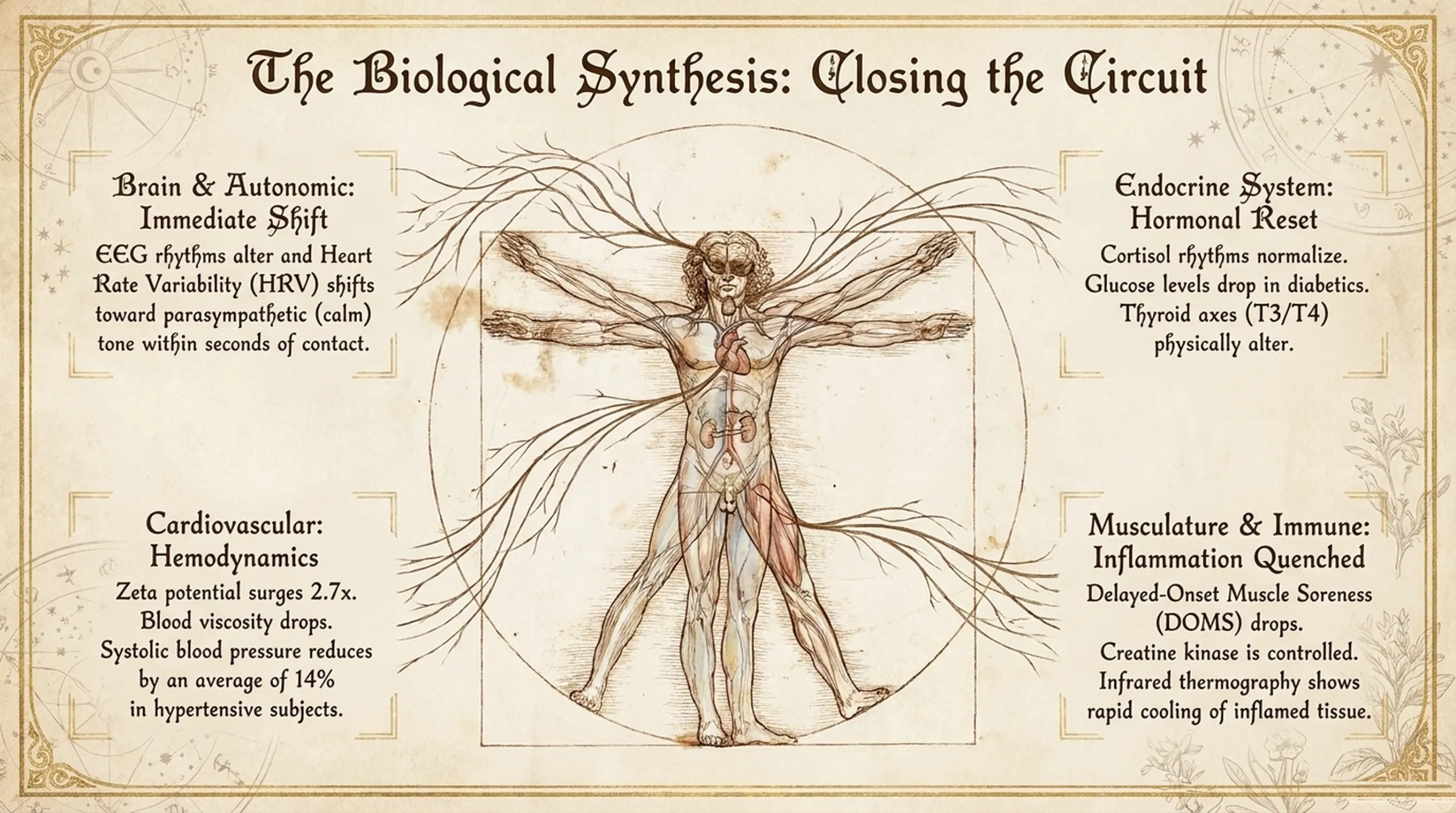
Chevalier, G., Mori, K., & Oschman, J. L. (2006). “The effect of Earthing (grounding) on human physiology.” Fifty-eight adults, double-blind pilot. Instantaneous shifts in EEG (left hemisphere RMS), surface EMG of trapezius, and blood-volume pulse. Heart rate itself did not change; the waveform of the periphery did. The body notices the circuit in seconds, not weeks.
Chevalier, G., & Sinatra, S. T. (2011). “Emotional stress, heart rate variability, grounding, and improved autonomic tone: clinical applications.” Integrative Medicine: A Clinician’s Journal. Twenty-seven participants, 40 minutes of grounding. Heart-rate variability rose about twice as much in the grounded session as in the sham session — a shift toward parasympathetic tone. If you care about vagal health, this is the paper you put next to the sleep data.
Inflammation, muscle, wound
Delayed-onset muscle soreness (DOMS) pilots, summarized by Oschman, Chevalier, and Brown (Journal of Inflammation Research, 2015, PMC4378297): grounded subjects after eccentric exercise showed altered neutrophil and lymphocyte counts, different cytokine patterns, and less pain than sham-grounded controls. A University of Salzburg sleep-grounding recovery study (Müller et al., 2019, reviewed above) found less pronounced markers of muscle damage when athletes slept grounded.
Brown, Chevalier, and Hill (2015, Open Access Journal of Sports Medicine, PMC4590684) followed muscle-damage markers and pain after hard eccentric exercise and found grounding sped recovery. The thermography case series, gathered in the same 2015 Journal of Inflammation Research review, show grounded wounds and inflamed regions cooling and resolving faster on infrared imaging. Heat is the visible face of the inflammatory cascade. When the image cools, something has changed in the tissue, not only in the questionnaire.
The Polish military clinic: Sokal and Sokal
Independently of Ober, Karol Sokal (cardiologist) and Pawel Sokal (neurosurgeon), father and son on the staff of a Polish military clinic, grounded subjects through a copper conductor and measured blood and urine. Their 2011 paper in The Journal of Alternative and Complementary Medicine — “Earthing the Human Body Influences Physiologic Processes” — is the chemistry chapter. Night grounding lowered serum iron, ionized calcium, and inorganic phosphorus, and reduced renal excretion of calcium and phosphorus. Thyroid axes shifted (lower free T3, higher free T4 and TSH in their series). Continuous grounding lowered blood glucose in diabetics. Electrolytes, proteins, and globulin fractions moved. They noted that the calcium-phosphate effect of earthing is the opposite of what is seen in weightlessness — a sentence that should make anyone who thinks about bone, gravity, and charge sit up.
The Sokals matter because they were not selling a sheet. They were military physicians asking whether a copper wire to Earth changes the numbers on a morning lab draw. It did.
Reviews that gather the field
Chevalier, Sinatra, Oschman, Sokal, Sokal (2012). “Earthing: Health Implications of Reconnecting the Human Body to the Earth’s Surface Electrons.” Journal of Environmental and Public Health, PMC3265077. The canonical early review.
Oschman, Chevalier, Brown (2015). Journal of Inflammation Research, PMC4378297. Inflammation, immunity, wound healing, autoimmunity.
Menigoz, et al. (2020). “Integrative and lifestyle medicine strategies should include Earthing.” Explore / ScienceDirect. Clinical argument: earthing belongs in preventive and lifestyle medicine.
Oschman, J. L. (2023). “Illnesses in technologically advanced societies due to lack of grounding.” Biomedical Journal, PMC10105023. The public-health framing: the disconnect as a contributor to the chronic-disease load of insulated societies.
VII. What the Measurements Keep Saying
| Domain | Observed direction when grounded |
|---|---|
| Sleep architecture | Faster sleep onset, fewer night wakings, higher morning restedness; 2025 RCT: better PSQI/ISI/ESS and more total sleep |
| Cortisol rhythm | Nighttime cortisol down; 24-hour profile toward a healthy morning-high / night-low curve |
| Autonomic tone | HRV up; parasympathetic shift; EMG and left-hemisphere EEG RMS change within seconds |
| Blood rheology | Zeta potential up; red-cell aggregation down; viscosity down |
| Blood pressure | Systolic reductions in small grounded series, including medicated hypertensives |
| Inflammation / DOMS | Altered WBC and cytokines; less pain; cooler thermography; faster wound appearance |
| Metabolic / endocrine | Sokal: lower glucose in diabetics; shifts in Ca/P, iron, thyroid labs |
| Body voltage | Induced AC voltage collapses — the most reproducible physical finding in the literature |
Read that table as an engineer would. Independent instruments — saliva assays, dark-field microscopy, viscometers, infrared cameras, ECG-derived HRV, standard chemistry panels, and a voltmeter — all move when the only intervention is a conductive path to Earth. Placebo can move a questionnaire. Placebo does not reliably raise zeta potential and collapse body voltage at the same time.
VIII. How to Close the Circuit
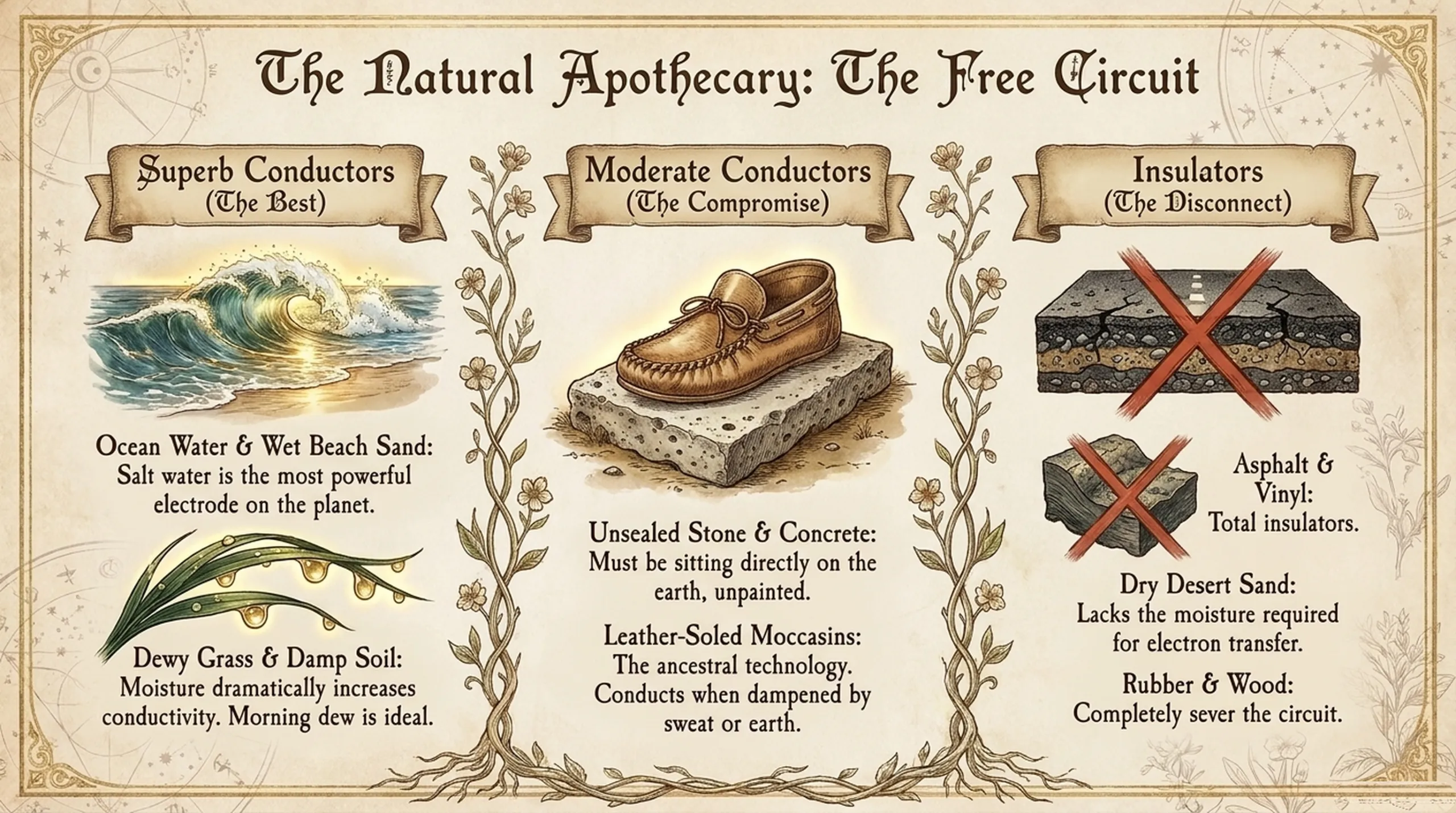
The original method is still the best method. Bare feet on grass, sand, or moist soil. Twenty to forty minutes is enough for many people to feel the quieting. A beach is a superb electrode. Dew on a lawn is a superb electrode. Concrete that is in contact with earth can conduct; sealed, painted, or elevated surfaces often will not.
Leather-soled shoes are the historical indoor-outdoor compromise. They are not as good as skin, but they are not rubber. If you live a life that requires shoes, leather is the ancestor technology. Conductive grounding shoes exist; treat them as an engineering attempt to restore what leather and barefoot already did, and test them with a meter rather than a slogan.
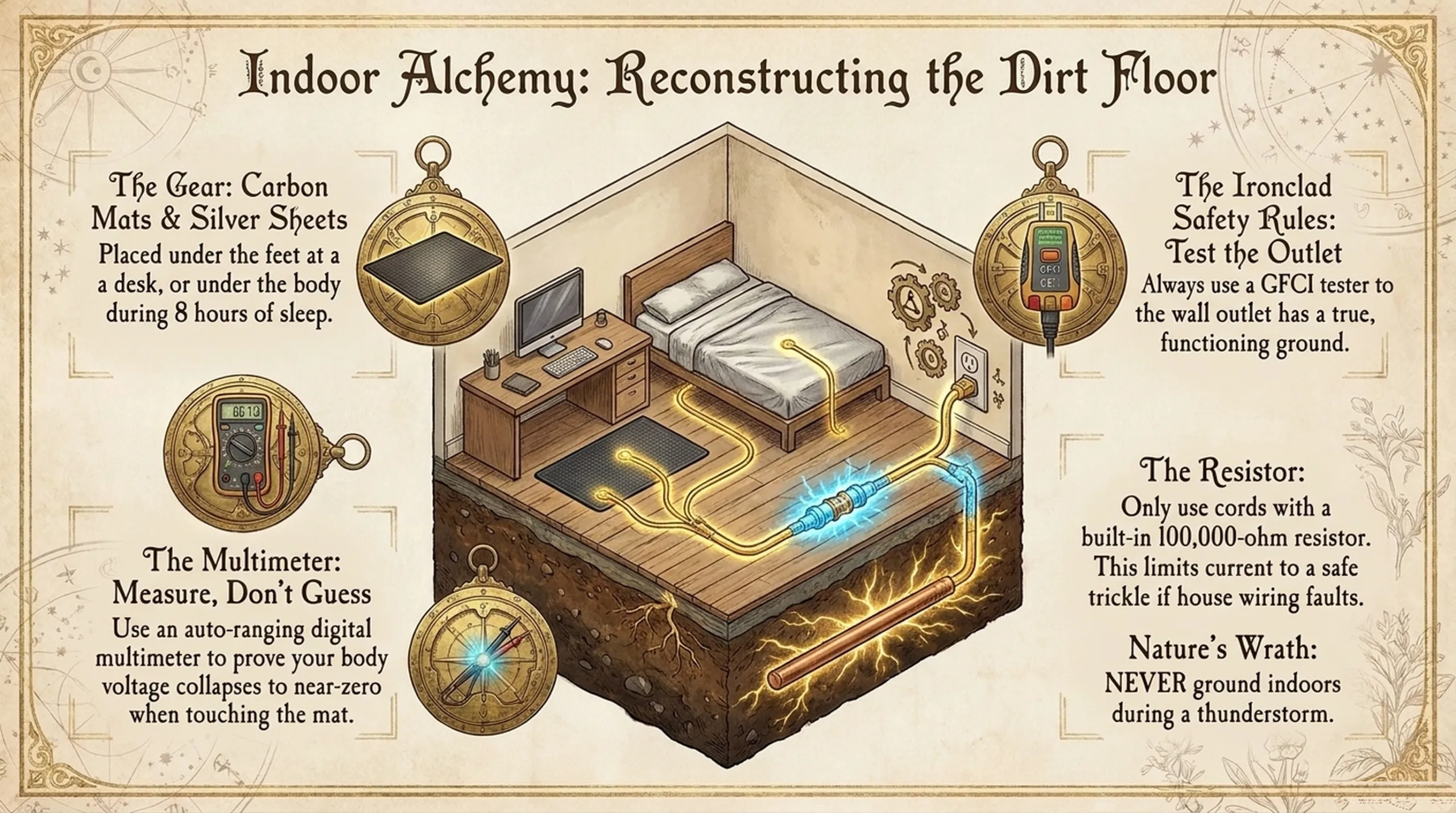
For the hours you cannot spend outside — and sleep is eight of them — a conductive sheet or mat tied to a true Earth ground is the indoor reconstruction of the dirt floor. The correct ground is a rod in soil or the ground port of an outlet that has been verified as actually earth-bonded. A fake ground is a decoration. I say this as someone who has spent a lifetime with wiring, radio, and machines that either have a clean reference or they do not.
Do not make this complicated. The ancestors did not. They took off their shoes. They slept close to the planet that built them.
Start Free Tonight: The No-Cost Way to Ground
You do not need to buy anything to begin. The Earth is the original grounding product and it has no subscription.
- Find a natural surface. Grass, bare soil, sand, a wet beach, a creek bed, unsealed stone, or concrete that sits directly on the ground (not painted, sealed, or on an upper floor). Asphalt, wood decks, and vinyl do not work.
- Add moisture. Dew, a light rain, damp sand at the water’s edge, or simply wetting a patch of lawn makes the connection far better. Dry desert sand is a poor conductor.
- Go skin to Earth. Bare feet are the classic. Sitting or lying on the grass, or resting your palms on the soil, works too.
- Give it time. Start with 20 to 30 minutes. Many people feel a quieting in that time. Work up to an hour or more when you can.
- Make it a habit. Morning sun on your face and your feet on the dew is the best combination I know: you reset your circadian clock and your electrical reference at the same time.
- The ocean is the best electrode on the planet. Salt water is highly conductive. If you live near the sea, walk at the water line.
- Garden barehanded. Weeding, planting, and digging with bare hands in damp soil is grounding with a harvest.
Safety First: Read This Before You Plug Anything In
- Never ground during a thunderstorm. Stay off the ground outdoors, and unplug indoor grounding products, whenever there is lightning nearby. A ground path is the last place you want to be when lightning strikes.
- Check the outlet first. Indoor products rely on the ground port of a properly wired three-prong outlet. Test every outlet with a plug-in outlet tester before you use it. Many older homes have three-prong outlets with no real ground behind them, and some have wiring faults.
- Use only cords with a built-in 100k ohm resistor. It limits current to a safe trickle if your house wiring ever faults.
- Stay away from faulty wiring and wet electrical areas. Do not run cords near water, space heaters, or damaged outlets. If an outlet tester shows any fault, call an electrician and do not use that outlet.
- Talk to your doctor if you take medicine. Studies show grounding can change blood thickness, and some people on blood thinners such as warfarin may need their dose checked. The Sokal studies showed shifts in glucose and thyroid numbers, so people on diabetes or thyroid medicine should monitor with their doctor. Grounding was also associated with lower blood pressure in small studies, so watch for light-headedness if you take blood pressure drugs.
- Do not stop any treatment on your own. Grounding is a complement to medical care, not a replacement for it.
- Pregnancy, implanted devices, and serious illness: ask your doctor first.
- Outdoors, watch the ground. Glass, ticks, fire ants, snakes, fertilizers, and pesticide-treated lawns are real. Choose clean, safe ground.
The Gear: My Amazon List and Why
You do not have to buy anything. But winter, apartments, work, and the eight hours you spend asleep are real, and that is what indoor grounding products are for. Here is the short list I would actually put in my own house, and why each one earns its place. I checked every listing this week and left off anything that was out of stock or poorly reviewed. Buy the tester before anything else.
As an Amazon Associate I earn from qualifying purchases. It costs you nothing extra and helps support this work.
Test first
- Klein Tools RT210 GFCI and Standard Outlet Tester. Why: every indoor grounding product is only as good as the outlet ground behind it. This is the electrician’s standard, it reads open ground, reversed polarity, and other faults in seconds, and it is one of the best-reviewed testers on Amazon. Test every outlet you plan to use.
- AstroAI TRMS 6000 Digital Multimeter. Why: a true-RMS, auto-ranging meter that lets you do the two tests that matter: continuity through your mat or sheet, and your own body voltage before and after grounding. It has tens of thousands of strong reviews. Members get the step-by-step test procedure below.
- Hooga Grounding Continuity Tester. Why: a one-button check that your mat, sheet, or pillowcase is actually conducting across its whole surface. Silver-fiber fabric wears out; this tells you when.
Ground while you work and relax
- Earthing Universal Mat Kit. Why: this is Clint Ober’s own company, sold by Earthing. The carbon mat goes under your feet at the desk, under your forearms at the keyboard, or on the bed. The kit includes the resistor cord, the safety adapter, and an outlet checker. If you only buy one product, start here.
- Hooga Grounding Mat (24 x 16 inch). Why: the best-selling budget mat on Amazon with thousands of reviews, a larger surface for both feet, a 100k resistor cord, and a non-slip back. The value pick.
Ground while you sleep
- Earthing Elite Sleep Mat Kit. Why: sleep is where the hours are. This carbon mat lies across any size bed, under your legs and torso, and it does not depend on silver threads that wear out in the wash. Clint Ober’s company again.
- Hooga Fitted Grounding Sheet (organic cotton and silver fiber). Why: for people who want grounding to feel like normal bedding. It is a soft fitted sheet woven with silver fiber, with Twin and Queen sizes on the same page. Wash it gently and test it monthly.
- Hooga Grounding Pillowcase. Why: it gives you skin contact at the face and neck all night and pairs with the sheet. It has only a few reviews so far, so test it with the continuity tester when it arrives.
No good outlet? Go straight to the Earth
- GroundLuxe Grounding Rod Kit with 40 ft Cord. Why: older homes, cabins, RVs, and rentals often have no trustworthy outlet ground. A copper-plated rod in damp soil outside the window and a long cord connect your mat or sheet directly to the Earth, which is the way Clint Ober started in 1998.
Read deeper
- Earthing: The Most Important Health Discovery Ever? by Clinton Ober, Stephen T. Sinatra, M.D., and Martin Zucker. Why: the book that started the movement, told by the man on the Sedona bench and the cardiologist who tested it.
- Get Grounded, Get Well by Dr. Stephen T. Sinatra, Step Sinatra, and Sharon Whiteley. Why: Sinatra’s last book, finished by his son and published in 2023 after his death. It is the most up-to-date practical guide.
- Energy Medicine: The Scientific Basis (2nd edition) by James L. Oschman. Why: the biophysics behind the electron hypothesis, written by the scientist who proposed it. It is dense, and it is the real thing.
- The Body Electric by Robert O. Becker, M.D., and Gary Selden. Why: the classic on the body as an electrical system, written by an orthopedic surgeon who spent his career measuring it. Every reader of this site should own a copy.
What I left off and why: I could not find grounding shoes, wristbands, or patches on Amazon this week that were both in stock and well reviewed, so I did not list any. A good leather-soled moccasin worn on damp ground is still the ancestor technology. Members get my buyer’s guide to the rest, including the scams.
IX. The Abundance Reading
I have argued for years that we are walking through an Abundance Interregnum — a narrow historical bridge in which the technologies of plenty arrive faster than the inner and bodily arts required to live inside them. Grounding is one of those arts. It costs almost nothing. It requires no supply chain from a distant factory of molecules. It is the opposite of a pill. It is a restoration of a boundary condition that every cell in your lineage treated as given.
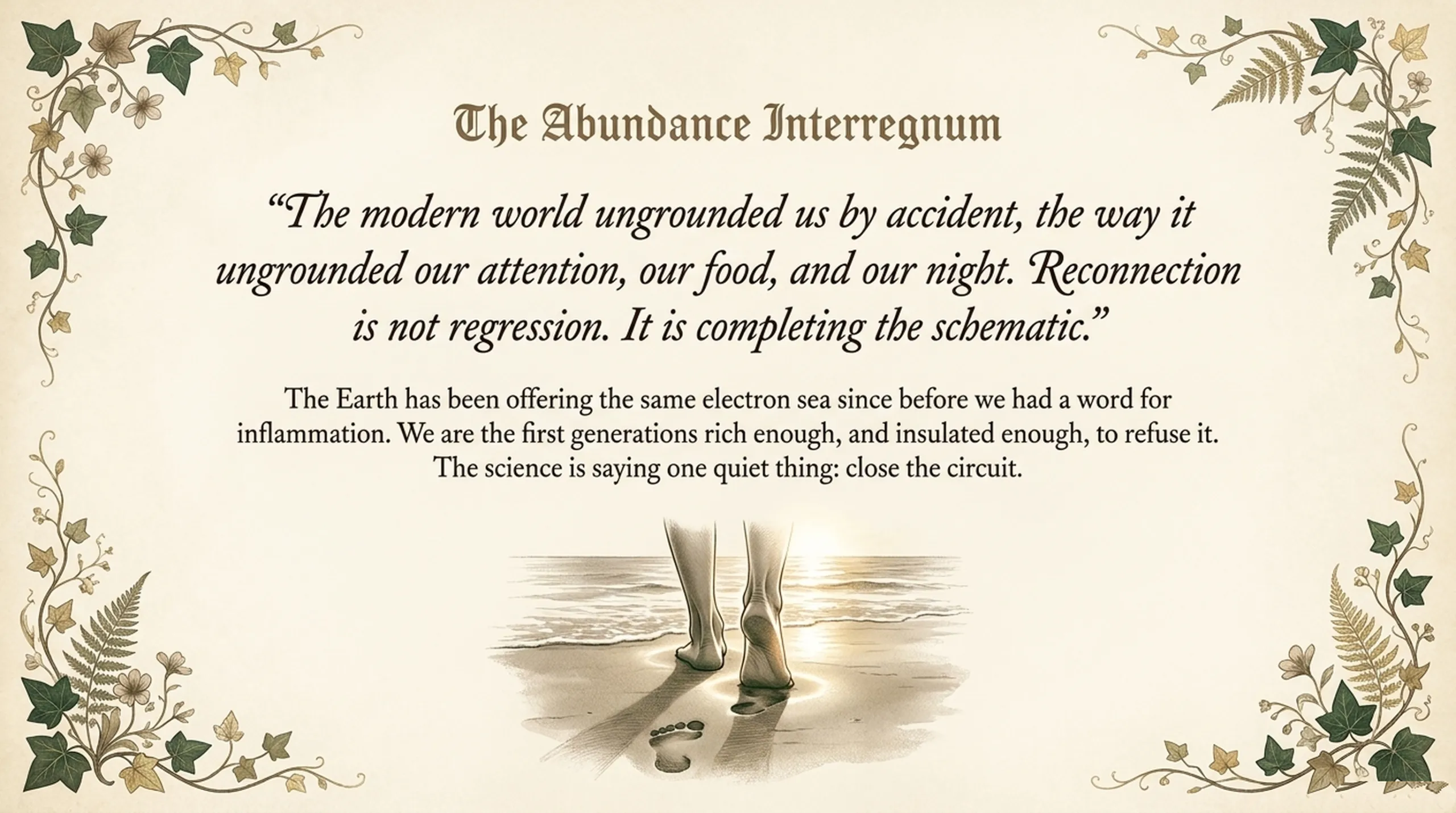
The modern world ungrounded us by accident, the way it ungrounded our attention, our food, and our night. Reconnection is not regression. It is completing the schematic. The heart that Sinatra studied, the sleep that Ghaly measured, the blood that stops stacking like coins — these are what a human body does when you give it back the reference voltage it evolved against.
Walk outside. Take the leather sole if you must wear a shoe. Sleep as if the floor of the world still touches you. The Earth has been offering the same electron sea since before we had a word for inflammation. We are the first generations rich enough, and insulated enough, to refuse it. That refusal was never wise. The papers, imperfect as first papers always are, keep saying the same quiet thing: close the circuit.
Primary Sources
- Ober C. Grounded-sleep pilot with 60 subjects (2000), summarized in Chevalier et al. 2012 below and in Ober, Sinatra, and Zucker, Earthing.
- Ghaly M, Teplitz D. J Altern Complement Med. 2004;10(5):767-776. PubMed 15650465
- Chevalier G, Mori K, Oschman JL. “The effect of earthing (grounding) on human physiology.” European Biology and Bioelectromagnetics. 2006. (Not indexed in PubMed; cited in the 2012 review.)
- Oschman JL. J Altern Complement Med. 2007;13(9):955-967. PubMed 18047442
- Sokal K, Sokal P. J Altern Complement Med. 2011;17(4):301-308. PMC3154031
- Chevalier G, Sinatra ST. Integrative Medicine. 2011;10(3):16-21. FAIM abstract
- Chevalier G, Sinatra ST, Oschman JL, Sokal K, Sokal P. J Environ Public Health. 2012:291541. PMC3265077
- Chevalier G, Sinatra ST, Oschman JL, Delany RM. J Altern Complement Med. 2013;19(2):102-110. PMC3576907
- Oschman JL, Chevalier G, Brown R. J Inflamm Res. 2015;8:83-96. PMC4378297
- Brown R, Chevalier G, Hill M. Open Access J Sports Med. 2015;6:305-317. PMC4590684
- Elkin HK, Winter A. Altern Ther Health Med. 2018;24(6):46-50. PubMed 30982019
- Müller E, et al. Front Physiol. 2019;10:35. PMC6360250
- Menigoz W, et al. Explore. 2020;16(3):152-160. PubMed 31831261
- Sinatra ST, Sinatra DS, Sinatra SW, Chevalier G. Biomed J. 2023;46(1):11-16. PMC10105021
- Oschman JL. Biomed J. 2023;46(1):17-29. PMC10105023
- Park HJ, et al. Adv Integr Med. 2025;12(3):100458. DOI 10.1016/j.aimed.2025.01.005
- Ober C, Sinatra ST, Zucker M. Earthing: The Most Important Health Discovery Ever? Basic Health Publications.
This article is for education. It is not medical advice. Talk with your doctor before you change anything about your health care.
Members: The Complete Grounding Field Manual
Read Multiplex members get the part I could not fit in a free article: my own 30-day grounding protocol with a printable daily log, the exact multimeter tests I use to prove a product works (and catch the ones that do not), the buyer’s guide to good and bad grounding gear and the scams to avoid, a safe DIY ground-rod setup, a study-by-study research digest with my notes, and my own take on where this is going. If you want it, join Read Multiplex here. Your membership is what keeps this work independent.
— Brian Roemmele · ReadMultiplex.com · September 29, 2026 —
Support This Work, You Will See It No Place Else
To continue this vital work documenting, analyzing, and sharing these hard-won lessons before we launch humanity’s greatest leap: I need your support. Independent research like this relies entirely on readers who believe in preparing wisely for our multi-planetary future. If this has ignited your imagination about what is possible, please consider donating at buy me a Coffee or becoming a member. Value for value you recieved here.
Every contribution helps sustain deeper fieldwork, upcoming articles, and the broader mission of translating my work to practical applications. Ain ‘t no large AI company supporting me, but you are, even if you just read this far. For this, I thank you.
Stay aware and stay curious,

🔐 Start: Exclusive Member-Only Content.
The rest of this article is for Multiplex members
You’ve reached the members-only part. Log in to keep reading right here, or join to unlock it.
- Full member-only articles: insights, wisdom and executive summaries
- The Multiplex members forum
- Member benefits and discounts
Already a member? You’ll come right back to this article after logging in. Forgot password?
Membership status: Not logged in
🔐 End: Exclusive Member-Only Content.
~—~

~—~

~—~
Support ReadMultiplex at Multiplex.Tips

Support ReadMultiplex
Subscribe or donate by Bitcoin.
Copy address:bc1qkufy0r5nttm6urw9vnm08sxval0h0r3xlf4v4x

Send your receipt to [email protected] to confirm subscription.
Members
Become a member for full member-only articles, the Multiplex members forum, and member benefits and discounts.
 Past, present and future technology research + insights
Listen
🔊 Every article has a free “Listen to this ►” button. Hear it read aloud in your browser.
The Multiplex
- Advertise with us: Rates and booking
- X: @ReadMultiplex
- Buy a T-shirt: Multiplex.Love
- Program Guide: Multiplex.Today
- Podcast: Multiplex.Life
- Join the Multiplex team: Multiplex.Team
Stay updated
Get an email when we post new articles:
