A Simple Way to Make Grok Bot Run Faster and Cost Less.
Running Grok Bot is living in the future. The future today still costs tokens, and the tokens run out. SpaceXAI carries energy, RAM, storage, GPU and other costs to keep Grok Bot running. Most of the tokens spent on most projects are wasteful. The same results could have been reached without calling a generative model at all. I am the test case for solving this because clients hire me to do many things, and one of those things is to save them money. Some pay me based on how much I save versus how much more productive they become. I had to find a way. I did. The savings were large enough that the same method can lower the cost for SpaceXAI as well.
This article is sponsored by Read Multiplex Members who subscribe here to support my work: Link: https://readmultiplex.com/join-us-become-a-member/
It is also sponsored by many who have donated a “Cup of Coffee”. If you like this, help support my work: Link: https://ko-fi.com/brianroemmele
Listen to the companion podcast: https://rss.com/podcasts/readmultiplex-com-podcast/3300472
How I Cut Grok Bot Costs by Moving Simple Decisions Off the Paid Model
Grok Bot and Laya: The local decision layer that removes the Paid Call. I have dozens of corporate clients, some very large companies. They all have used AI in one form or another for a number of years through my guidance. Like all new things, spending is quite high in the learning curve. However as it should be, costs become more scrutinized when it comes time to review cost of outputs. One of the hallmarks of the systems I use is to show how tokens have been applied to clear goals and outputs. Today some clients are spending millions of dollars, a month.
The costs were greatly exceeding the results. This where I began to find ways to reel in the way AI is used from the immature phase to the mature phase all companies should be in at this point. I will share one simple tool here I used to significantly reduce costs, increase speed, and get higher accuracy using AI. In this article I will focus on examples using Grok Bot by SpaceXAI for many reasons.
The setup I now use with clients runs on the computer Grok Bot already owns. It costs nothing per decision. It has already moved large volumes of work off the generative model. Most of the forks inside a running agent never needed a generative model. Laya answers them on the same computer, in one forward pass, for free.
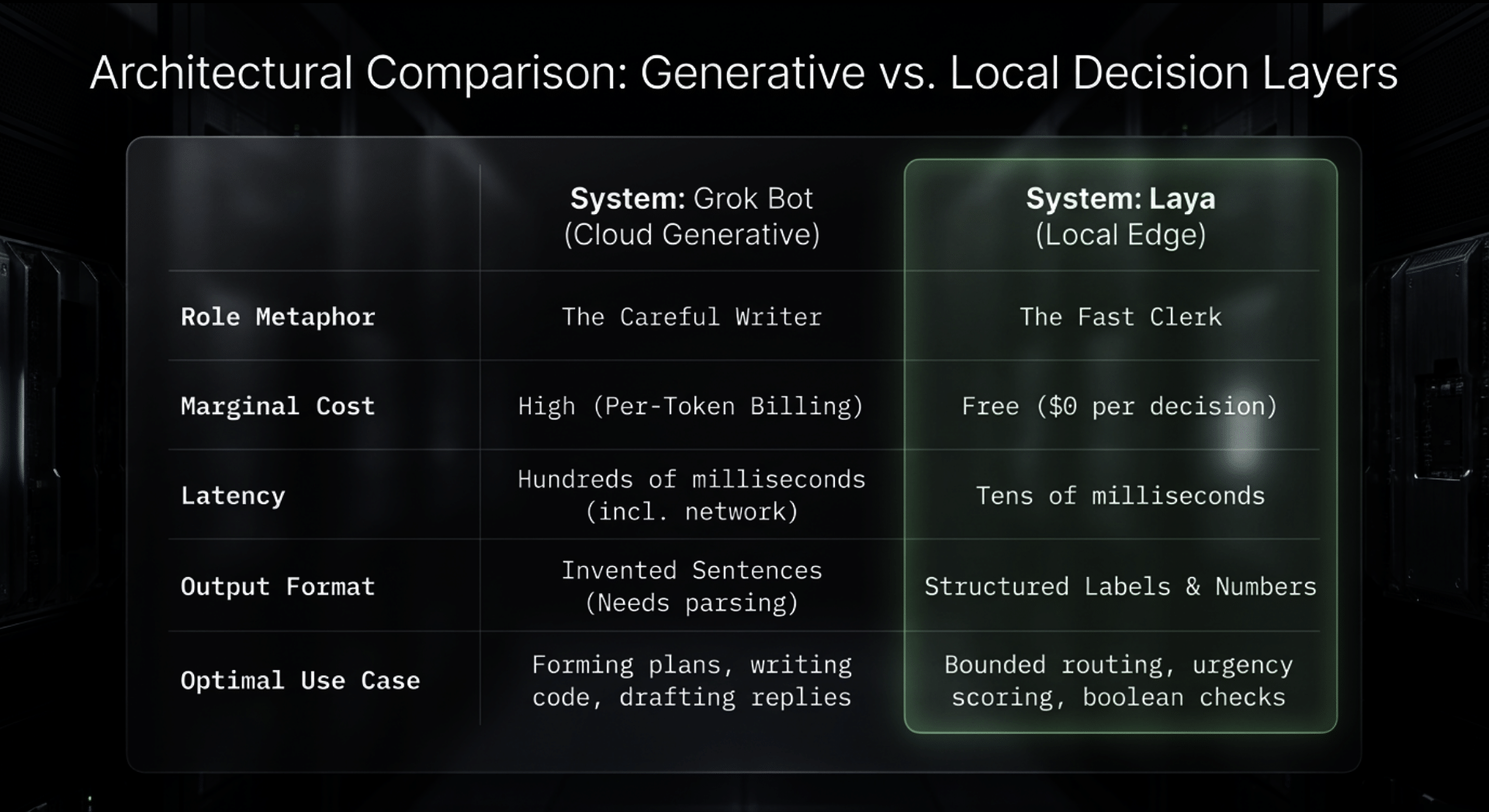
Imagine you walk into a busy office and hand a short note to two different people. The first person is a careful writer. She reads the note, thinks for a while, and hands you back a full paragraph that explains her thinking and ends with a recommendation. That paragraph is useful when you need the explanation. It is slow and costly when all you needed was a single check mark. The second person is a clerk who never writes paragraphs. You hand him the same note and a form that already has the boxes printed on it. He marks the boxes and hands the form back. The marks are numbers the next step of the program can read directly. No sentence is produced, so nothing has to be parsed and nothing extra is billed. The generative model is the careful writer. Laya is the clerk.
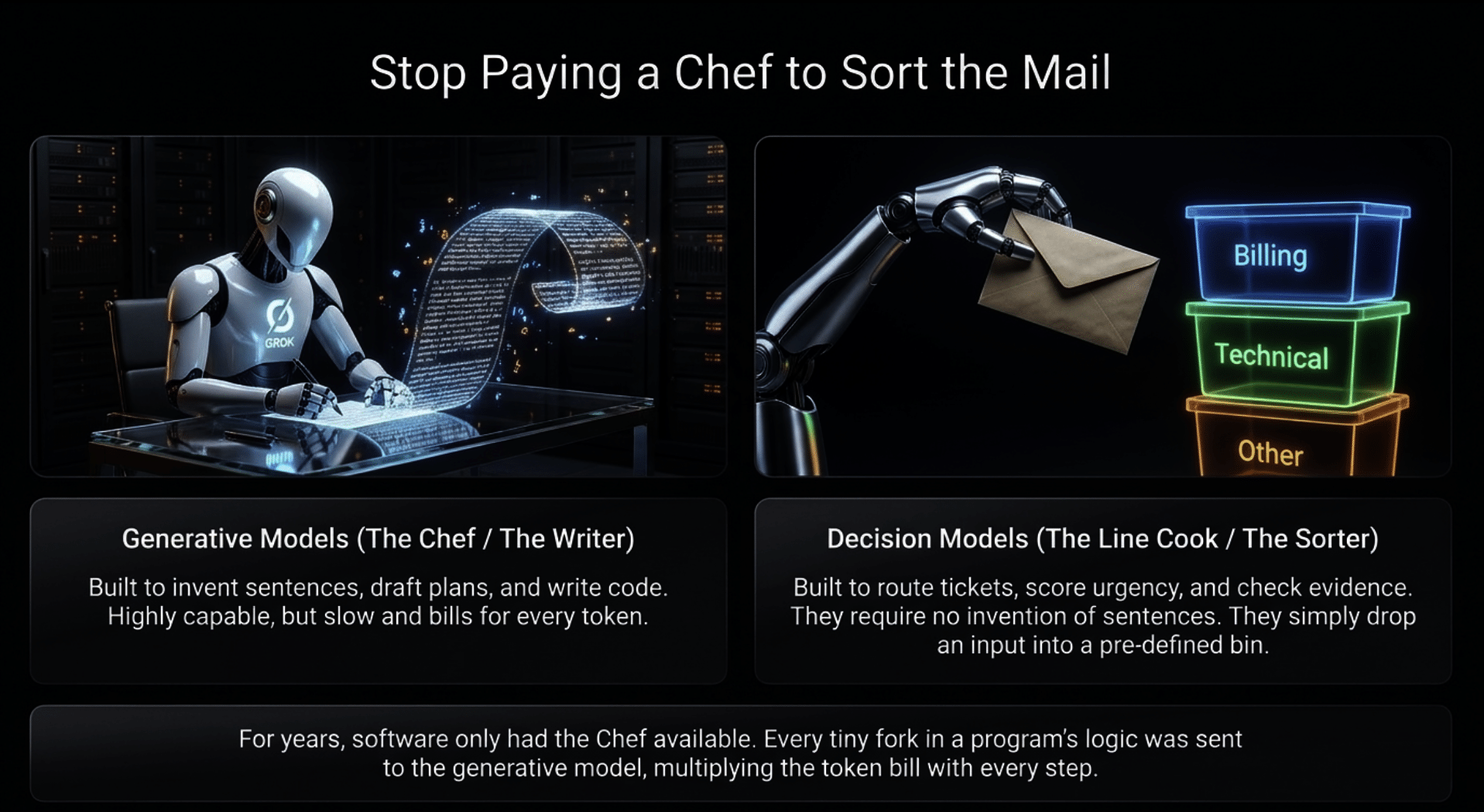
A second way to see the difference is a restaurant kitchen. The chef who invents the daily special and writes the description on the board is doing generative work. The line cook who looks at an order ticket and decides “this one is medium-rare, this one needs the sauce on the side, this one is already finished” is doing decision work. Both jobs matter. Only one of them needs the full creative pass. For years software had only the chef available, so every small decision was sent to the chef. The bill and the wait grew with every ticket. Laya puts a fast, consistent line cook on the same computer that already runs the agent.
Think of it as the difference between asking someone to write a letter and asking someone to sort the mail. Writing the letter requires invention of sentences. Sorting the mail requires only that each envelope land in one of the bins you already labeled. The generative model invents the letter. Laya drops the envelope into the bin. The bins are the options you define. The drop is a single pass through the network that returns a label and a probability the next line of code can read without further interpretation.
For years software has needed that clerk. Route this ticket. Score this urgency. Decide whether this retry is worth another try. Check whether this claim matches the evidence already collected. Generative models were pressed into the clerk’s job because they were the only tool that could read the note. They can do it, but they do it slowly, they charge for every token, and they sometimes invent structure that the code then has to clean up. The separation of the two jobs is what Laya makes practical on the machine you already have.
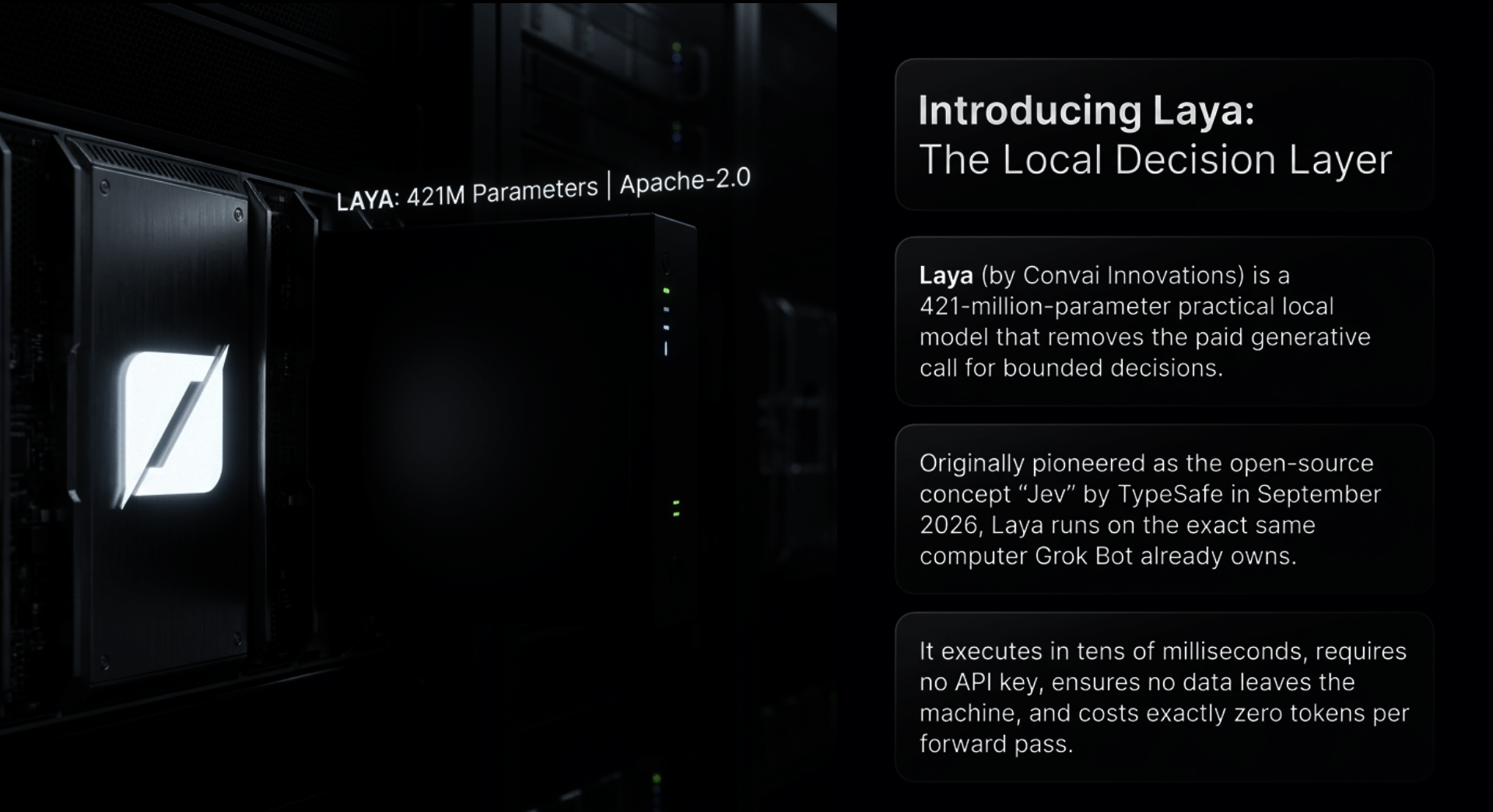
TypeSafe released the first widely discussed public version of the clerk idea in September 2026 under the name Jev. The open-source community followed within days. Laya, from Convai Innovations, is the practical local version. It is a 421-million-parameter model under the Apache-2.0 license. It loads on ordinary hardware. It answers the same three kinds of questions: pick one label from a list you define, place something on a scale you describe, or return the probability that a yes-or-no statement is true.
On a local machine a single question finishes in tens of milliseconds. There is no API key, no per-call charge, and no data leaves the computer. Independent checks show it matches or exceeds the hosted model on tasks with a modest number of clear options and falls behind when the choice set is large or the input is long. That is the trade-off, and it is visible before you commit.
Grok Bot already owns a computer that stays on after the chat window closes. That computer has a terminal, a file system, and the ability to run Python. The combination means the expensive generative steps can be reserved for the work that actually needs language, while the high-volume classification and routing steps stay local and free. In client work the pattern has already removed millions of tokens that would otherwise have been spent on intermediate decisions.
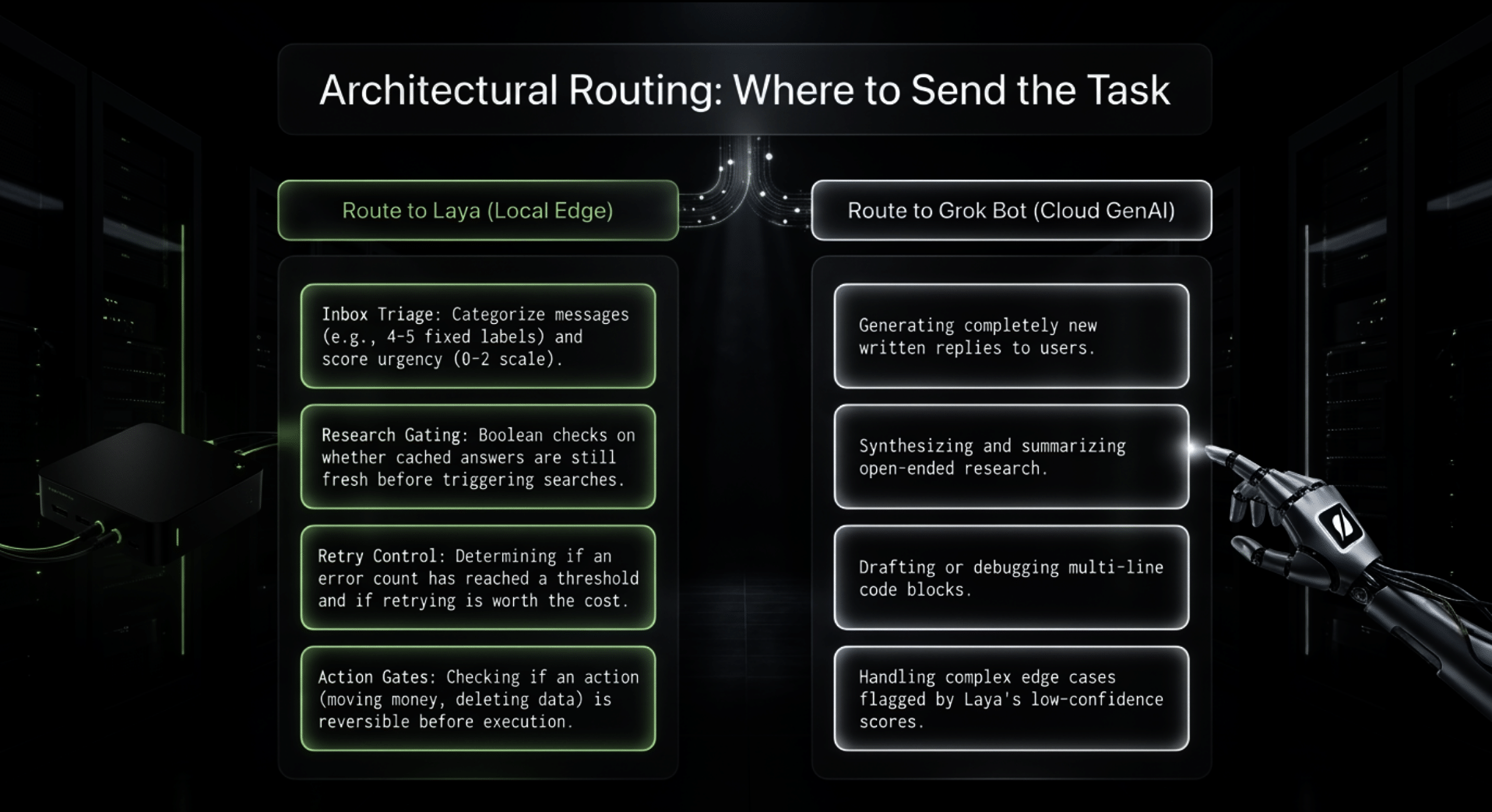
The generative model is still called when a reply must be written, a plan must be formed, or code must be produced. Everything that can be settled by a fixed set of questions moves to Laya. The clients see lower bills and faster overnight runs. The limit is the same one that has always applied: the questions must be written clearly and the thresholds must be checked against real outcomes.
How to Install Laya on the Grok Bot Cloud Computer
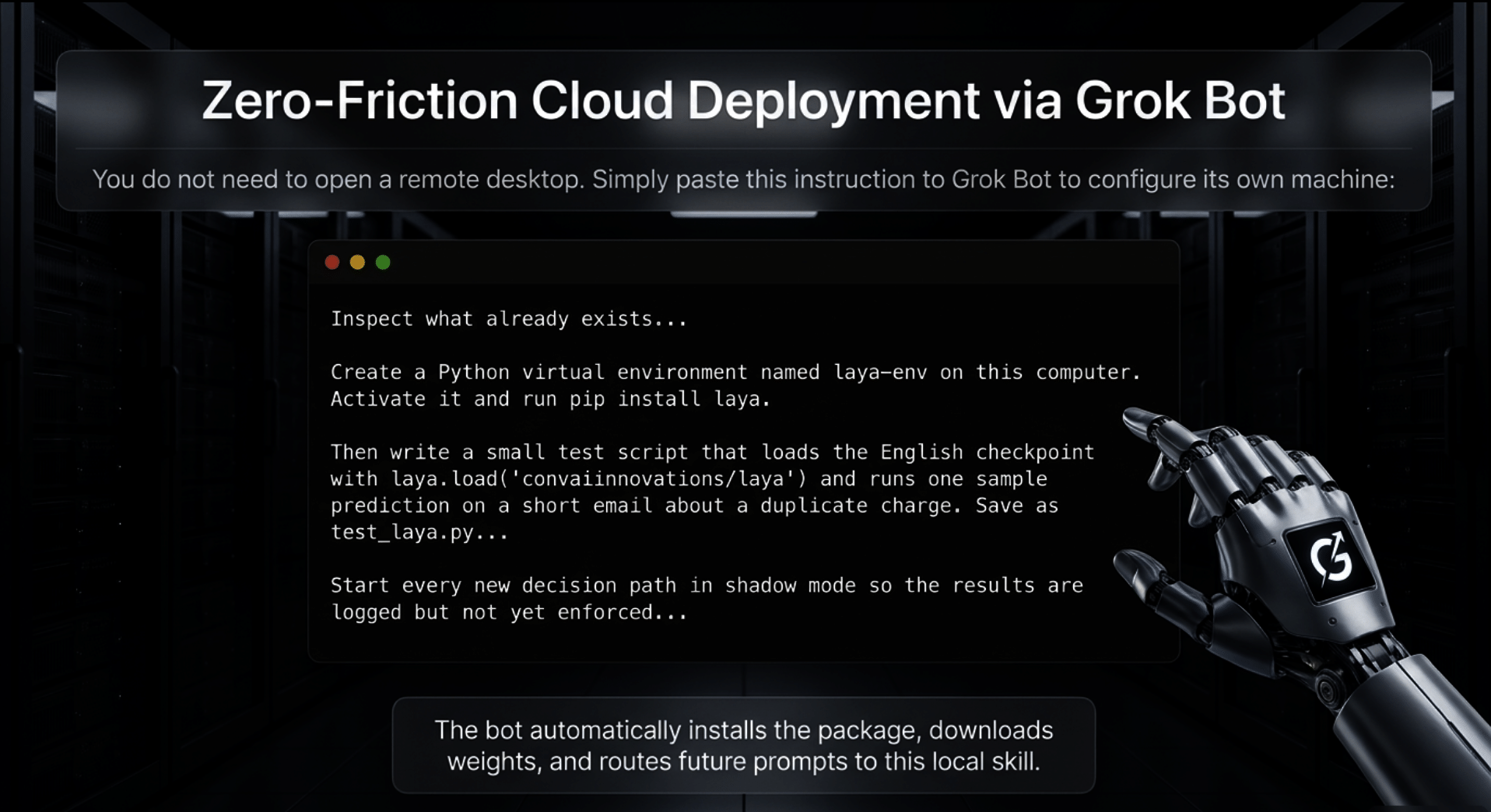
The computer Grok Bot owns already has a terminal and Python. You do not open a remote desktop or type commands yourself. You paste a short instruction to the bot and it performs the install on its own machine.
Paste this exact prompt to your Grok Bot:
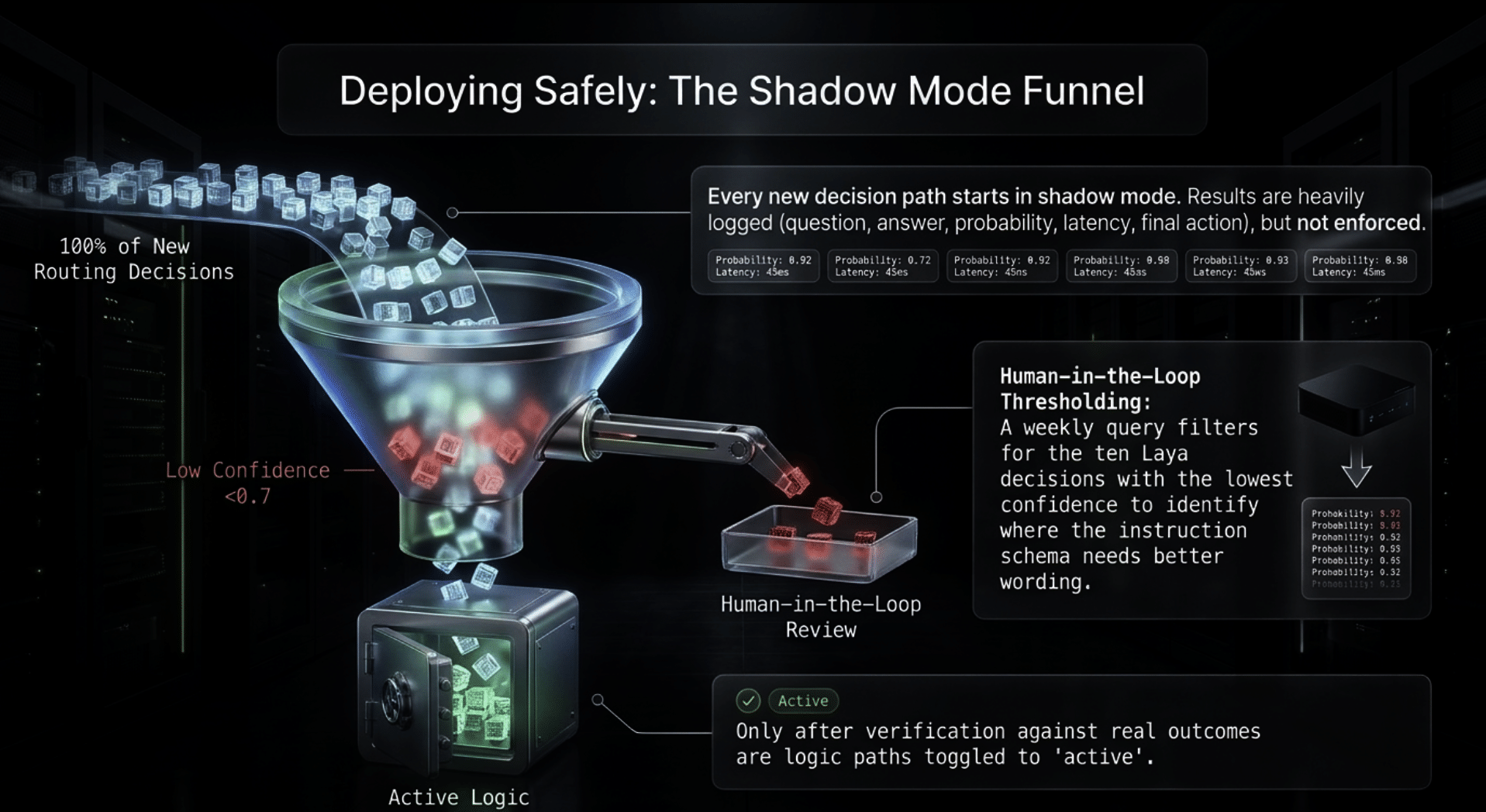
Inspect what already exists before installing or changing anything. Keep my current bots, routines, connected tools and logins. Create a Python virtual environment named laya-env on this computer. Activate it and run pip install laya. Then write a small test script that loads the English checkpoint with laya.load("convaiinnovations/laya") and runs one sample prediction on a short email about a duplicate charge. Save the test script as test_laya.py. Run the test and show me the printed result. After the test succeeds, write a small local skill that accepts a state and a set of typed questions, calls Laya, and returns the structured answers. Start every new decision path in shadow mode so the results are logged but not yet enforced. Log the question, the answer, the probability, the time, and the final action taken. Ask me only when a step would send a message, move money, delete data, or change permissions. After one full day of shadow results, show me the log and wait for the instruction to switch any path to active.The bot creates the environment, installs the package, downloads the weights on first load, and confirms the model answers a sample question. Once the skill exists, every later decision prompt can call that local skill instead of the generative model.
How to Install Laya on a Personal Computer
On your own machine the steps are ordinary Python. Open a terminal. Create a virtual environment so the packages stay isolated.
python3 -m venv laya-env
source laya-env/bin/activate
pip install laya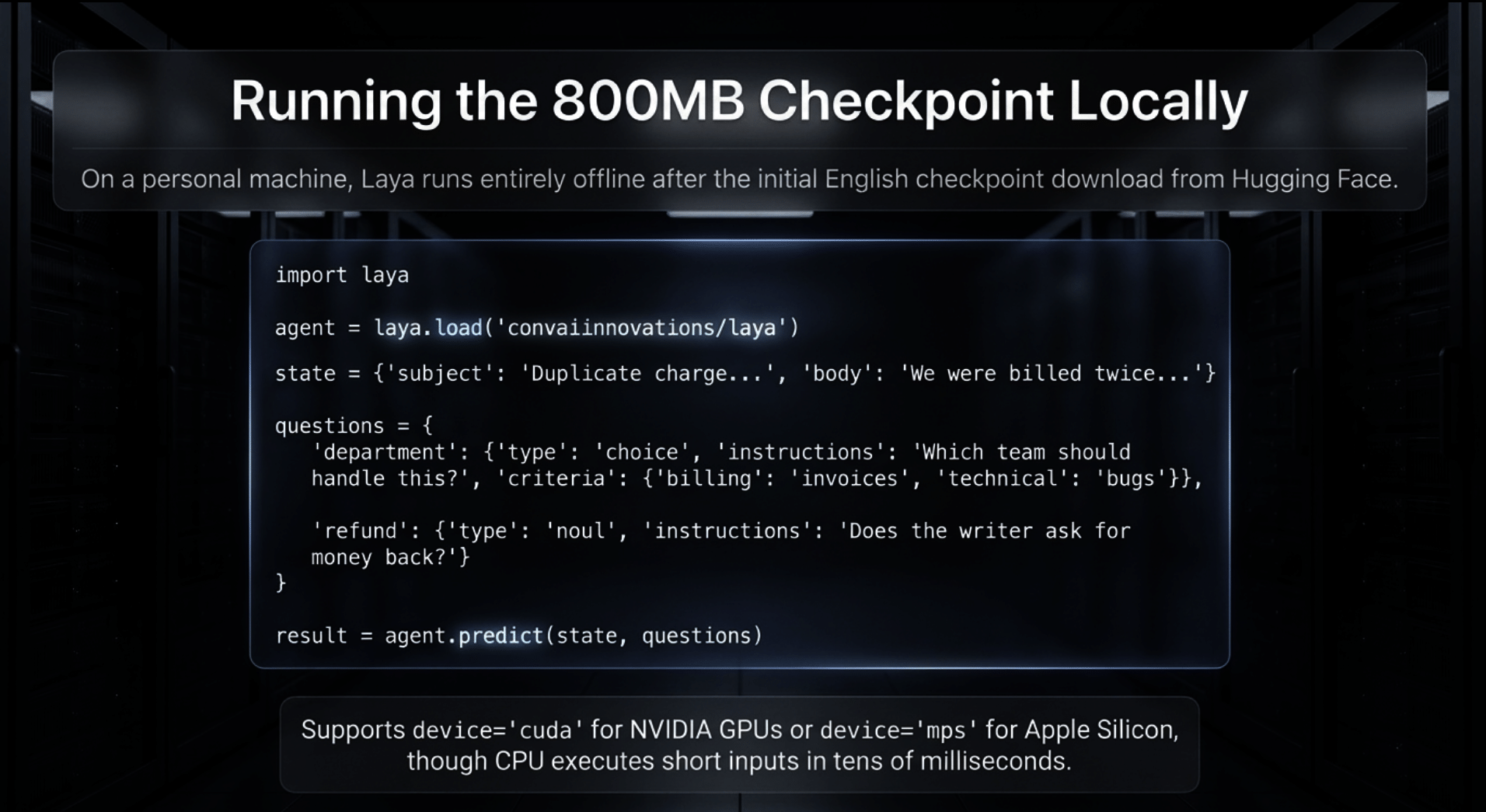
The first call to the model downloads the English checkpoint from Hugging Face. The download is roughly 800 MB. After that the model runs offline. A short test looks like this:
import laya
agent = laya.load("convaiinnovations/laya")
state = {"subject": "Duplicate charge on invoice 4411", "body": "We were billed twice for March. Please refund the duplicate."}
questions = {
"department": {"type": "choice", "instructions": "Which team should handle this?",
"criteria": {"billing": "invoices and refunds", "technical": "bugs and outages", "other": "everything else"}},
"refund": {"type": "noul", "instructions": "Does the writer ask for money back?"}
}
result = agent.predict(state, questions)
print(result["answers"])
If the machine has an NVIDIA GPU you can pass device=”cuda”. On Apple Silicon you can try device=”mps”. On CPU the same call still finishes in tens of milliseconds for short inputs. The Router class loads the right checkpoint automatically when language changes, but the English checkpoint is the one I start with for client mail and tickets.
Finding the Best Cases for Laya
Laya is strongest when the decision is already bounded. The option list is short, the input is a few hundred tokens or less, and the next step of the program can act on a label or a number without further interpretation. Those conditions describe most of the intermediate forks inside an agent.
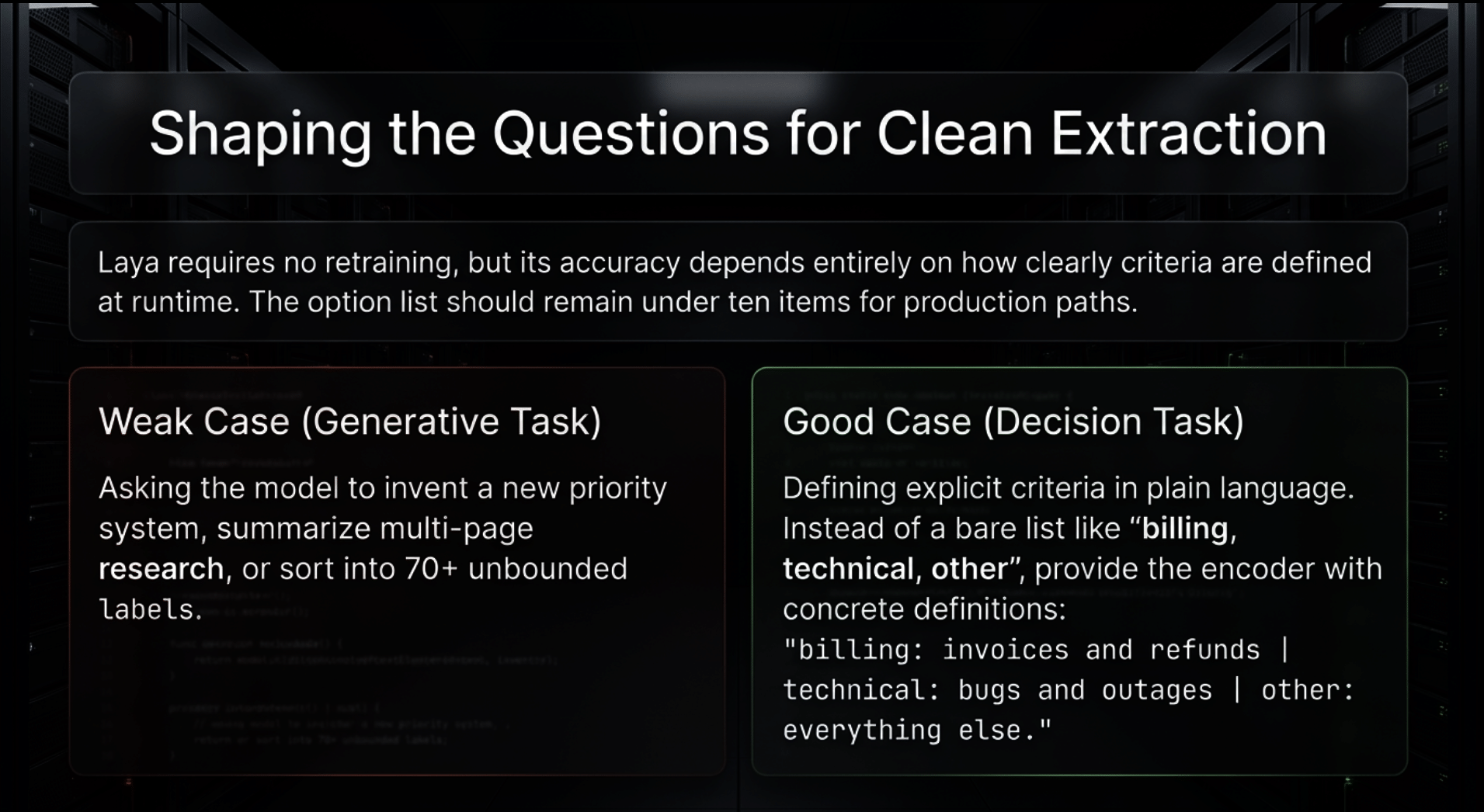
A good case is inbox triage with four or five categories. A weak case is open-ended research summarization or a category list of seventy labels. A good case is scoring urgency on a three-level scale. A weak case is asking the model to invent a new priority system each time. A good case is a yes-or-no check that a cached answer is still fresh. A weak case is asking whether an entire multi-page report should be rewritten.
I look for places where the agent already branches. Does this ticket match a known pattern? Is the retry count already three? Is the expected runtime under the limit I set last night? Each of those questions can be written once, with fixed options or a fixed scale, and answered locally. The generative model is called only when the local answer says the work still needs language.
How to Shape the Questions So Laya Answers Cleanly
The model does not need retraining for a new schema. You define the options and the instructions at the moment you ask. The quality of the answer depends on how clearly those instructions and criteria are written.
For a choice question the criteria field should describe each label in plain language the model can match against the state. Instead of a bare list “billing, technical, other,” write “billing: invoices, payments, refunds; technical: bugs, outages, system errors; other: everything else.” The extra description gives the encoder something concrete to score against.
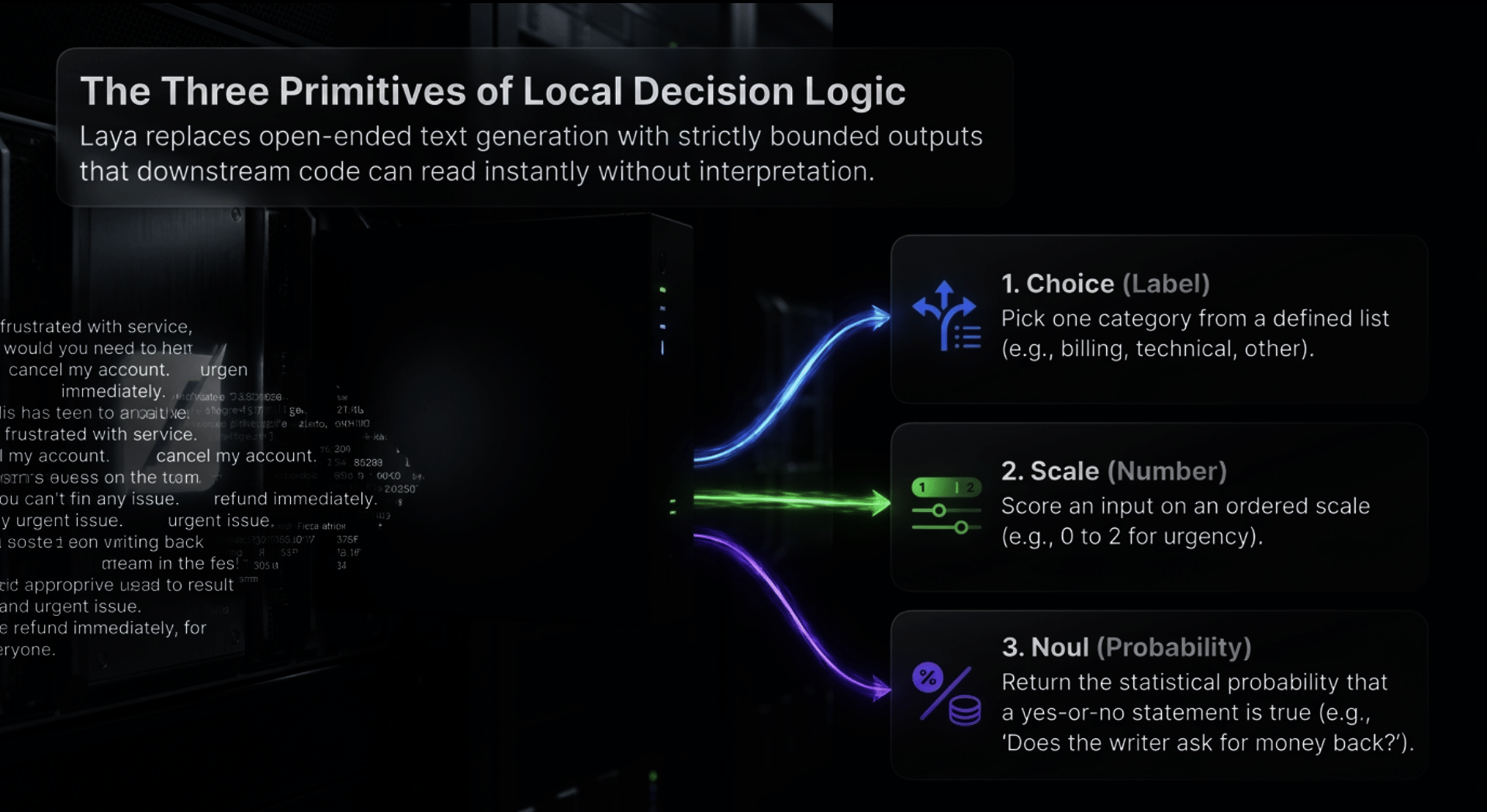
For a score question the criteria are an ordered list. “not urgent, soon, blocking” produces a number between 0 and 2 that the code can threshold. For a noul (yes-or-no) question the instruction should be a single clear claim: “Does the writer ask for money back?” or “Has this same error now appeared three times?”
I keep the option list under ten items for production paths. When the list grows longer the confidence drops and more cases fall through to the generative model. The fix I have used is to split the question. First ask a coarse choice with four labels. Only the residual cases that land in “other” or that carry low confidence go to a second Laya pass with a tighter list.
The same principle applies to the state you hand the model. A short subject plus body works better than a full thread of twenty messages. When the input is long I extract the most recent human message and the ticket metadata before the call. The log later shows whether that extraction improved the match rate.
Fine-tuning is available when a domain has its own vocabulary and a few hundred labeled examples. The official notebook on Colab or Kaggle runs the RLCD loop on a free T4 and produces a new checkpoint you can load with the same API. For most of the client paths I run, the zero-shot form with carefully written criteria is enough. The shadow log tells me when the questions need another pass of wording before any training is considered.
Once that skill exists, practical jobs move to Laya instead of the generative model. These prompts keep the bot on the local path when the work is a bounded decision. Each one is written so a novice can paste it and see the difference.
For inbox triage the bot reads each new message and hands only the subject and body to the local skill. The skill receives three questions already printed on the form: which category fits from the short list billing, technical, account, or other; how urgent is it on a 0-to-2 scale; and is this a refund request. The local model marks the boxes and returns the numbers. If the urgency score sits below 1.2 and the category is not other, the bot drafts nothing and places the message in the low-priority list. It calls the generative model only for the items that clear the thresholds or that need a written reply. Every decision is written to the log so the next morning shows exactly which messages stayed local and which ones left the machine.
For research gating the bot asks the local skill before any browser opens or any search is run. The two questions are whether a cached summary from the last hour already answers the question and whether another page is likely to change the outcome. If both answers are no, the bot reuses the cache and stops. If the second answer is yes, it allows at most three new pages, then stops and summarizes what was found. The log records the decision and the page count so the overnight run can be inspected without guessing which searches were avoided.
For retry control the bot waits until a tool fails, then hands the error text and the running count to the local skill. The questions are whether the same error has now appeared three times and whether another attempt is worth the cost. If the answer is yes on the first question and no on the second, the bot stops the loop, reports the state, and does not retry. The log keeps the count and the decision so a later review can see whether the cutoff was set too high or too low.
For transaction or record sorting the bot takes the batch of records and sends each one, together with the category list already defined, to the local skill. The skill returns only the label and the confidence for each record. No sentence is generated per row. Any record whose confidence falls below 0.7 is flagged for later review. The log records the batch size and the average confidence so the volume of work that stayed local is visible at a glance.
For action gates the bot pauses before any step that would send a message, move money, delete data, or change permissions. It asks the local skill whether the action is reversible and whether it stays inside the account. If either answer is no, the bot stops and asks for instruction. The log records the gate result so every blocked action can be examined later.
A fifth practical pattern is support-ticket batching. When a cluster of similar tickets appears, the bot sends the cluster summary to Laya with two questions: does this match a known incident pattern, and is the severity high enough to alert a person immediately. If the first answer is yes and the second is no, the bot can prepare a single batch close for later human approval instead of generating a unique reply for every ticket. The generative model is called only for the edge cases the local check flags.
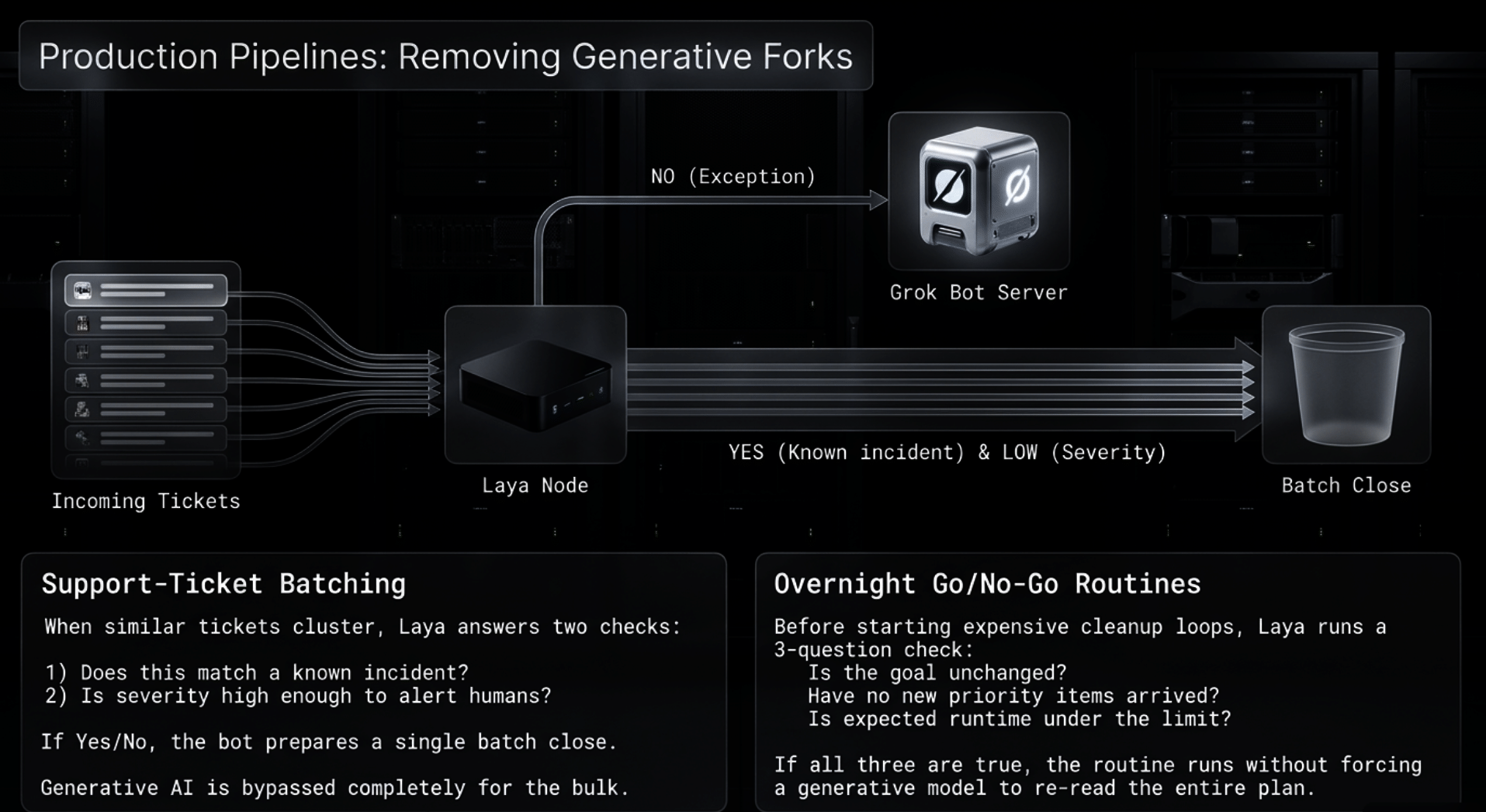
A sixth pattern is simple go-or-no-go on overnight work. Before a bot begins a long research or cleanup routine, it can ask Laya three short questions: is the goal still the same as the one stored last night, has any new high-priority item arrived that should pause the routine, and is the expected runtime still under the limit set earlier. If all three answers are yes, the routine starts. If any answer is no, the bot stops and leaves a note. The generative model is not asked to re-read the entire plan just to confirm that nothing has changed.
Monitoring is built into the shadow log. Each day the bot can produce a short report: number of decisions routed to Laya, number that would have gone to the generative model, average latency, and the share of decisions that later matched the outcome expected. When a threshold is wrong, the log shows the mismatch and the threshold can be moved. After the first week the same report can run as a routine at a fixed hour. The numbers stay on the computer. Nothing is sent until asked for. A second routine can compare the local decision against the eventual human or generative outcome on a sample of cases and surface only the mismatches. That sample is what keeps the thresholds honest. A third, even simpler check is to ask the bot, once a week, “Show me the ten Laya decisions that had the lowest confidence last week and tell me what actually happened.” The low-confidence cases are the ones that teach where the form needs a clearer box.
The same pattern scales. A company that routes thousands of tickets a day, or an individual who runs several bots overnight, stops paying for the decisions that a local forward pass can settle. SpaceXAI’s own support and incident work already shows agents owning jobs at volume.
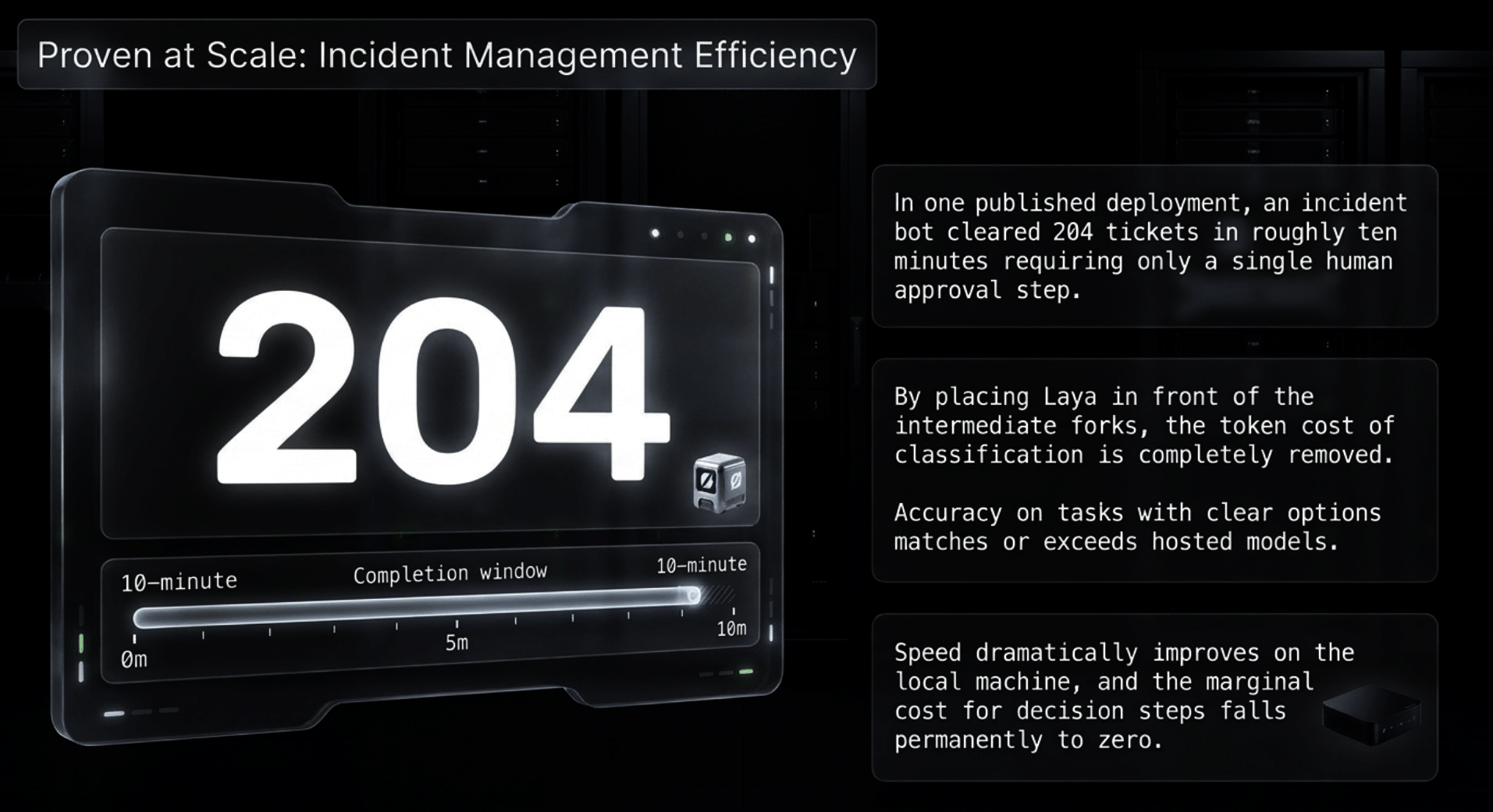
In one published case an incident bot cleared 204 tickets in about ten minutes with a single human approval step. The generative model was still in the path for the writing and the judgment calls. Placing Laya in front of the intermediate forks—does this ticket match the known pattern, is the severity above the alert line, has this retry already failed three times, is the cached answer still fresh—would remove the token cost of those forks while leaving the generative model for the steps that still need language.
Published measurements put a single Laya question in the tens of milliseconds on local hardware and a remote decision-model call in the hundreds of milliseconds once network time is included. The local call carries no per-token charge. Accuracy on tasks with a modest number of clear options has been measured in the same range or better; accuracy drops when the option list is long or the input is subtle. Those are the numbers that exist. They are enough to show the direction: speed improves on the local machine, marginal cost falls to zero for the decision steps, and accuracy stays equivalent on the class of questions the model was built to answer. The generative capacity is reserved for the work that still needs it. That is the win for the person who owns the bot and for the provider that supplies the generative layer.
How Laya Lowers SpaceXAI’s Cost To Offer Grok Bot—Significantly
On November 1st 2026 Elon Musk replied on X that “the cost of serving Grok Bot was unsustainably high relative to revenue.” He gave no dollar figure. Reports around the same period placed paid weekly users in the range of hundreds of thousands, with access bundled into subscription tiers that start at $30 a month and rise higher. Agent sessions are token-intensive by nature.
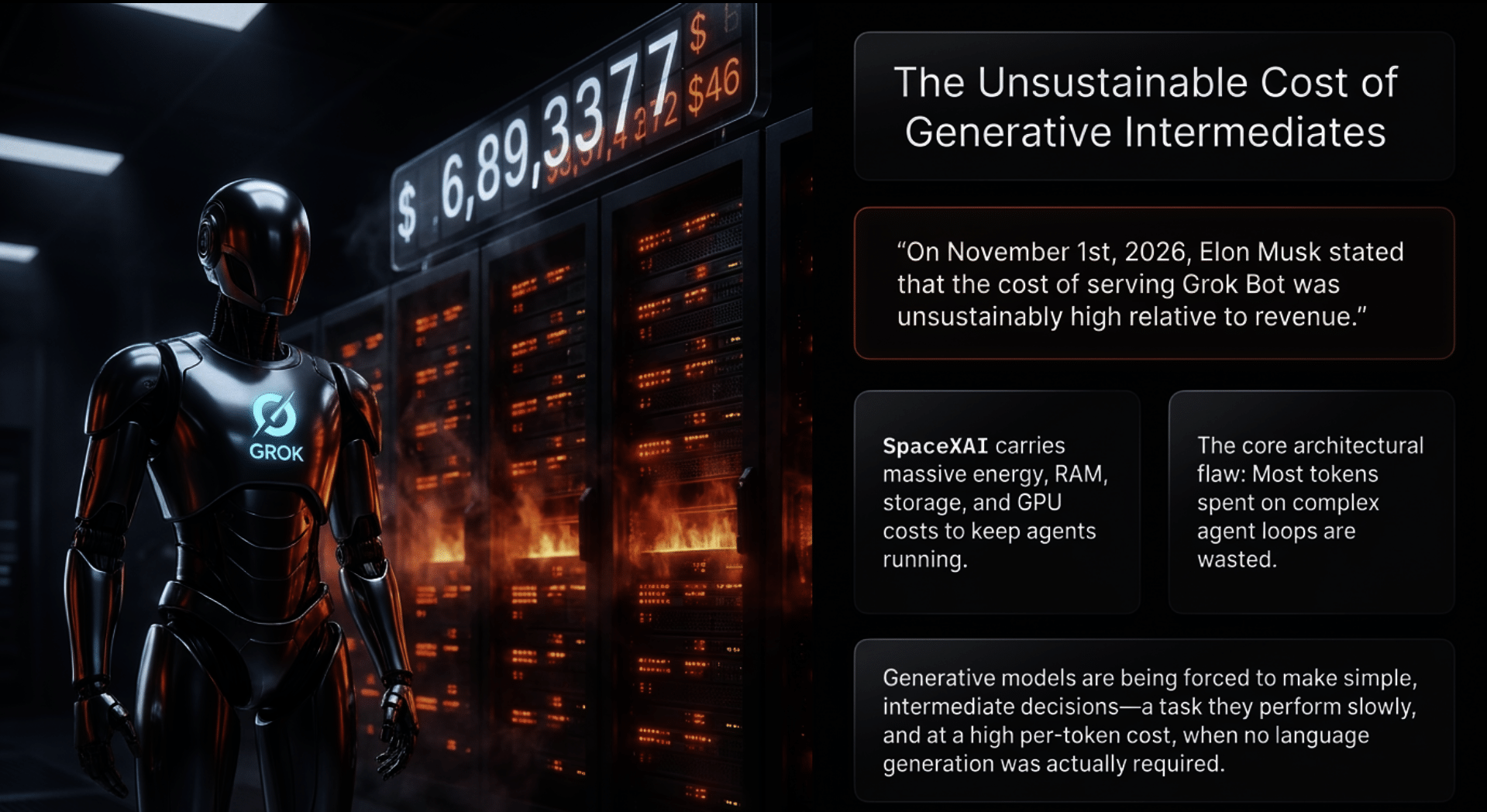
Every intermediate question answered by a generative model adds tokens. When those intermediate questions are answered by a local forward pass in Laya, it carries no per-token charge and finishes in tens of milliseconds, the token volume that reaches the generative model falls by the share of work that was never generative. Users see lower bills and faster overnight completions.
This is a win-win for all involved.
The provider sees generative capacity used for the steps that actually require language rather than for repeated classification. The published incident example of 204 tickets cleared in minutes already shows the volume that exists; multiplying that pattern across many queues and many days is the scale at which the local layer changes the cost structure.
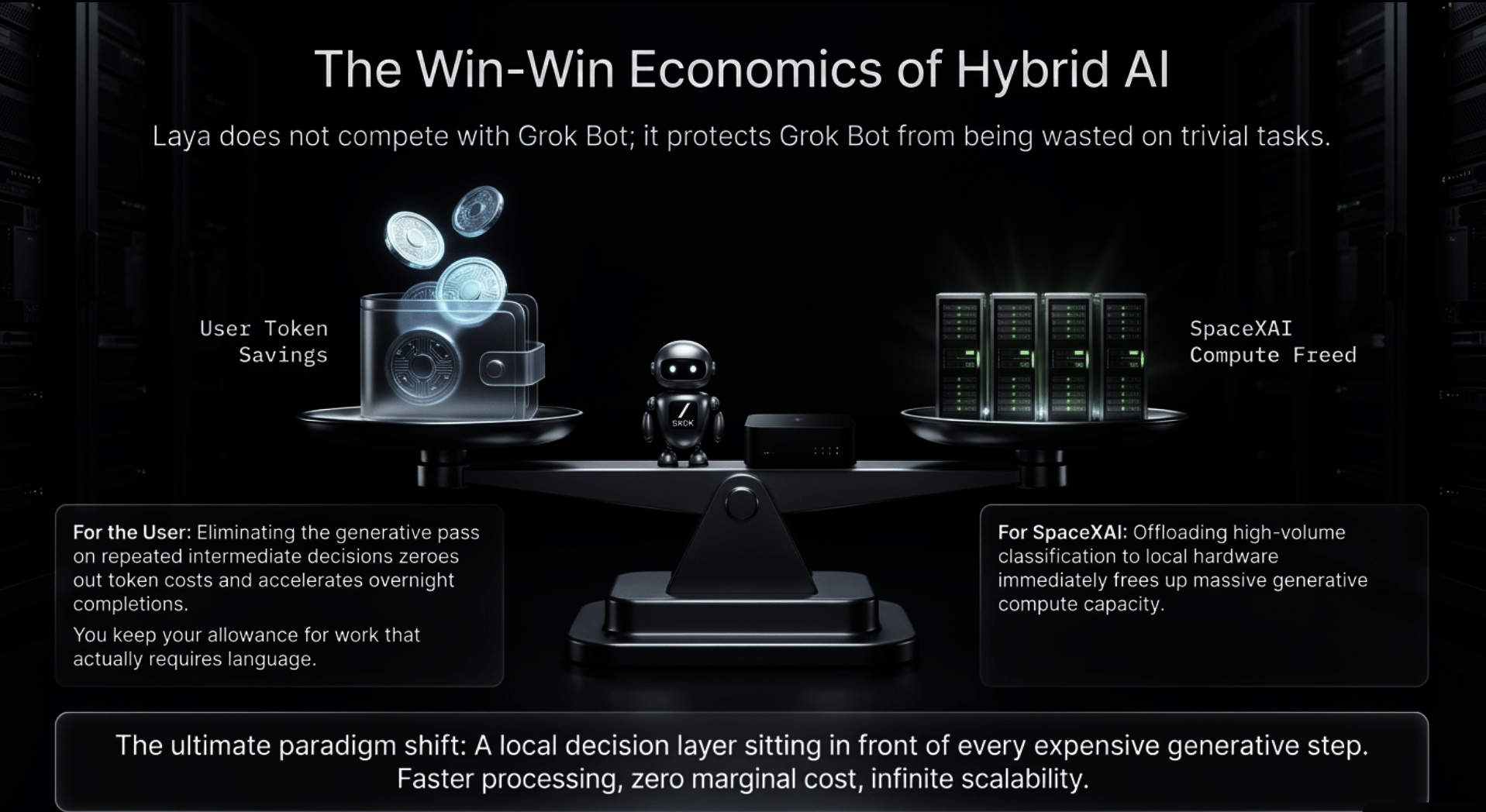
No precise public savings percentage is required to see the arithmetic. The intermediate decisions are numerous, they are repeated, and they can be settled without a generative LLM AI pass.
This can change the economics for SpaceXAI if the same local layer sits in front of every expensive step. Speed improves on the machine that already runs the agent. Marginal cost for the decision steps falls to zero.
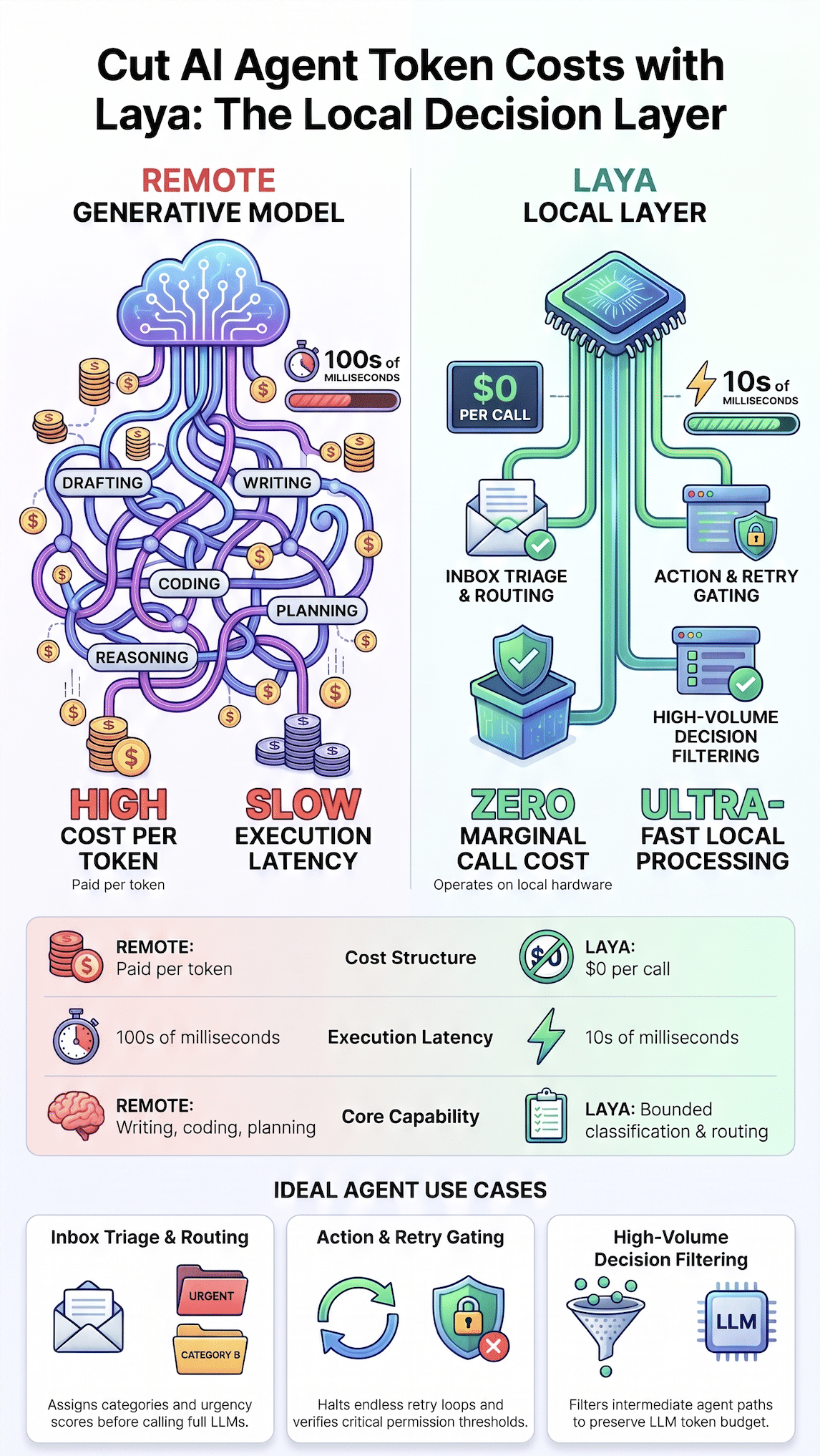
Accuracy stays equivalent on the bounded questions the model was built to answer. Users keep more of their weekly allowance for the work that still needs language. The provider keeps generative capacity for the same work. The setup is already running on the computers I manage for clients. The prompts above are the ones I give the bots. The logs are the ones I review.
The token volumes that no longer leave the machine are the ones that used to appear on the bill. The limit remains the clarity of the questions and the honesty of the thresholds. When those hold, the computer that already runs the agent also settles the decisions that used to leave the building.
I am certain this same local layer is the piece that is likely to sit in front of every Grok Bot in time, because the cost falls for the person who owns the bot and the generative capacity is reserved for the work that still needs it. For a provider already running agents at the scale of support queues and incident sweeps, the same layer removes the intermediate tokens that never required a generative model in the first place.
Support This Work, You Will See It No Place Else
To continue this vital work documenting, analyzing, and sharing these hard-won lessons before we launch humanity’s greatest leap: I need your support. Independent research like this relies entirely on readers who believe in preparing wisely for our multi-planetary future. If this has ignited your imagination about what is possible, please consider donating at buy me a Coffee or becoming a member. Value for value you received here.
Every contribution helps sustain deeper fieldwork, upcoming articles, and the broader mission of translating my work to practical applications. Ain ‘t no large AI company supporting me, but you are, even if you just read this far. For this, I thank you.
Stay aware and stay curious,

🔐 Start: Exclusive Member-Only Content.
The rest of this article is for Multiplex members
You’ve reached the members-only part. Log in to keep reading right here, or join to unlock it.
- Full member-only articles: insights, wisdom and executive summaries
- The Multiplex members forum
- Member benefits and discounts
Already a member? You’ll come right back to this article after logging in. Forgot password?
Membership status: Not logged in
🔐 End: Exclusive Member-Only Content.
~—~
~—~

~—~
Support ReadMultiplex at Multiplex.Tips

Support ReadMultiplex
Subscribe or donate by Bitcoin.
Copy address:bc1qkufy0r5nttm6urw9vnm08sxval0h0r3xlf4v4x

Send your receipt to [email protected] to confirm subscription.
Members
Become a member for full member-only articles, the Multiplex members forum, and member benefits and discounts.
 Past, present and future technology research + insights
Listen
🔊 Every article has a free “Listen to this ►” button. Hear it read aloud in your browser.
The Multiplex
- Advertise with us: Rates and booking
- X: @ReadMultiplex
- Buy a T-shirt: Multiplex.Love
- Program Guide: Multiplex.Today
- Podcast: Multiplex.Life
- Join the Multiplex team: Multiplex.Team
Stay updated
Get an email when we post new articles:
