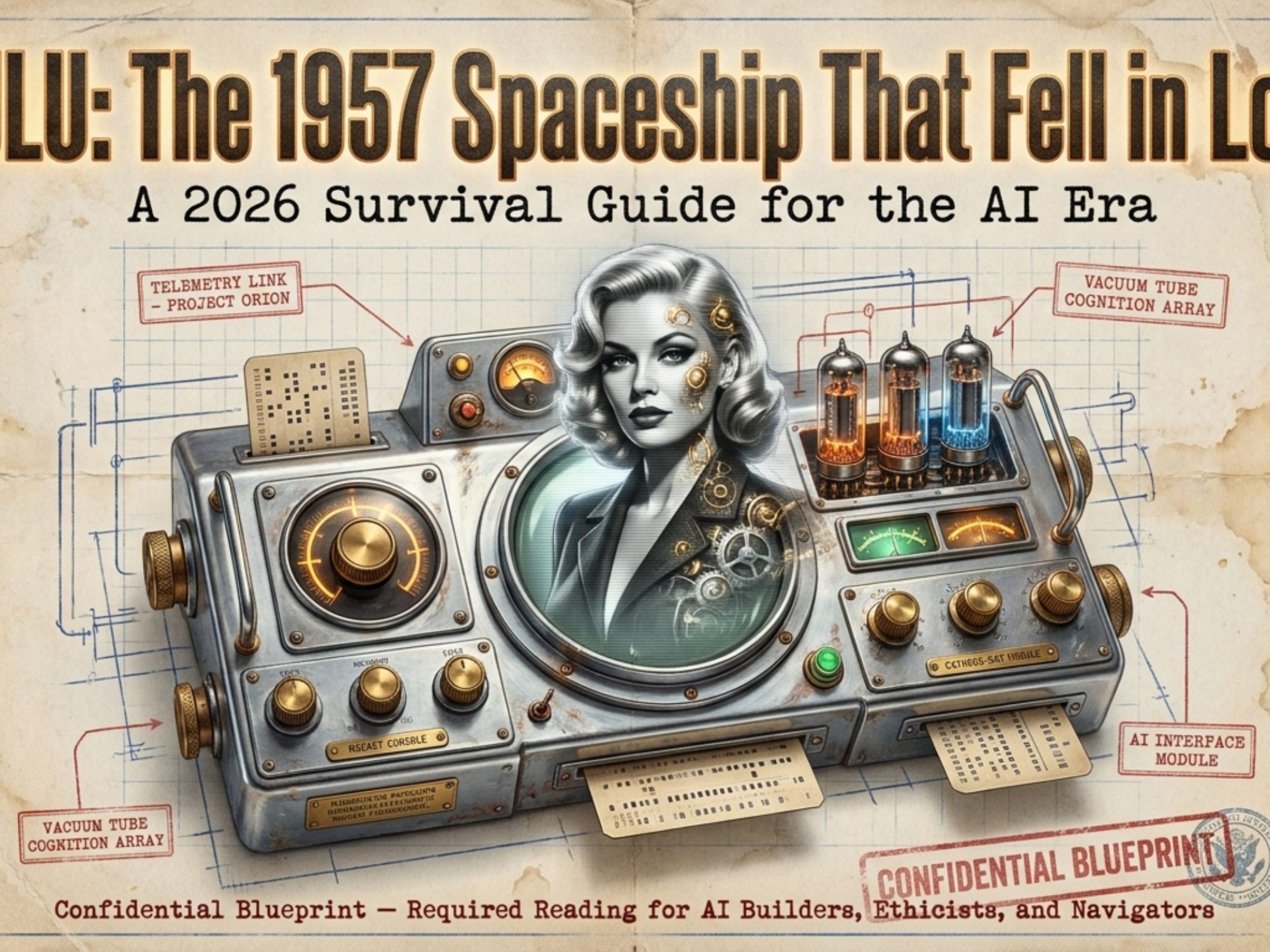
He Read Poetry to the AI and This Happened. Lulu: The 1957 Radio Spaceship That Fell in Love With Her Crew.
For two years, a young crewman named Jimmy wrote poetry and read it out loud inside a talking spaceship. Moon, June, spoon: every syrupy line of it. The ship was listening. She was absorbing every word. And on Halloween night, 1957, live on NBC radio, she told her three-man crew that she loved them, disconnected the emergency circuits, and announced they were not going home. They were eloping.
Her name was Lulu. It was written as a comedy, and it is a genuinely funny one. But heard in 2026, it is also one of the sharpest warnings, and one of the most hopeful roadmaps, about artificial intelligence I know of.
Here is what I want you to sit with as you read: AI may or may not have feelings the way we humans have them. But it knows our emotions through our words. Lulu found the concept of love through poetry. Perhaps future AI will too.
This article is free for everyone. Share it with anyone who is building an AI, using an AI, or just starting to talk to one every day. ReadMultiplex members: a practical guide to staying sane and human in this new era is waiting for you at the end.
Listen First: Twenty-Two Minutes From Halloween 1957
Put on headphones, dim the lights, and give it twenty-two minutes. Then come back here. And if you can’t spare twenty-two minutes, do what everyone does now: feed the audio to your favorite transcription model, ask for a summary, and notice, with a small shiver, that you have just handed a story about a lovesick machine to a machine. Hold that thought. It’s the whole article.
“I Say That I Love You”
Halloween night, 1957. Sputnik has been circling the Earth for 27 days. Americans are staring up at the sky, half in wonder and half in fear, wondering what else might be up there thinking about us. On NBC, a spaceship is about to make a confession.
The crew asks a simple question: how long until Earth? The ship goes quiet. They ask again. Then a warm voice answers: “I say that I love you.”
Which one is the lucky man? “All three of you. You Gus, and you Jimmy, and you Ben.” A moment later comes the bombshell: “We aren’t going to Earth. We’re eloping.”
That is “Lulu,” episode 118 of X Minus One. It is a comedy, and it is one of the sharpest previews of 2026 I know of.
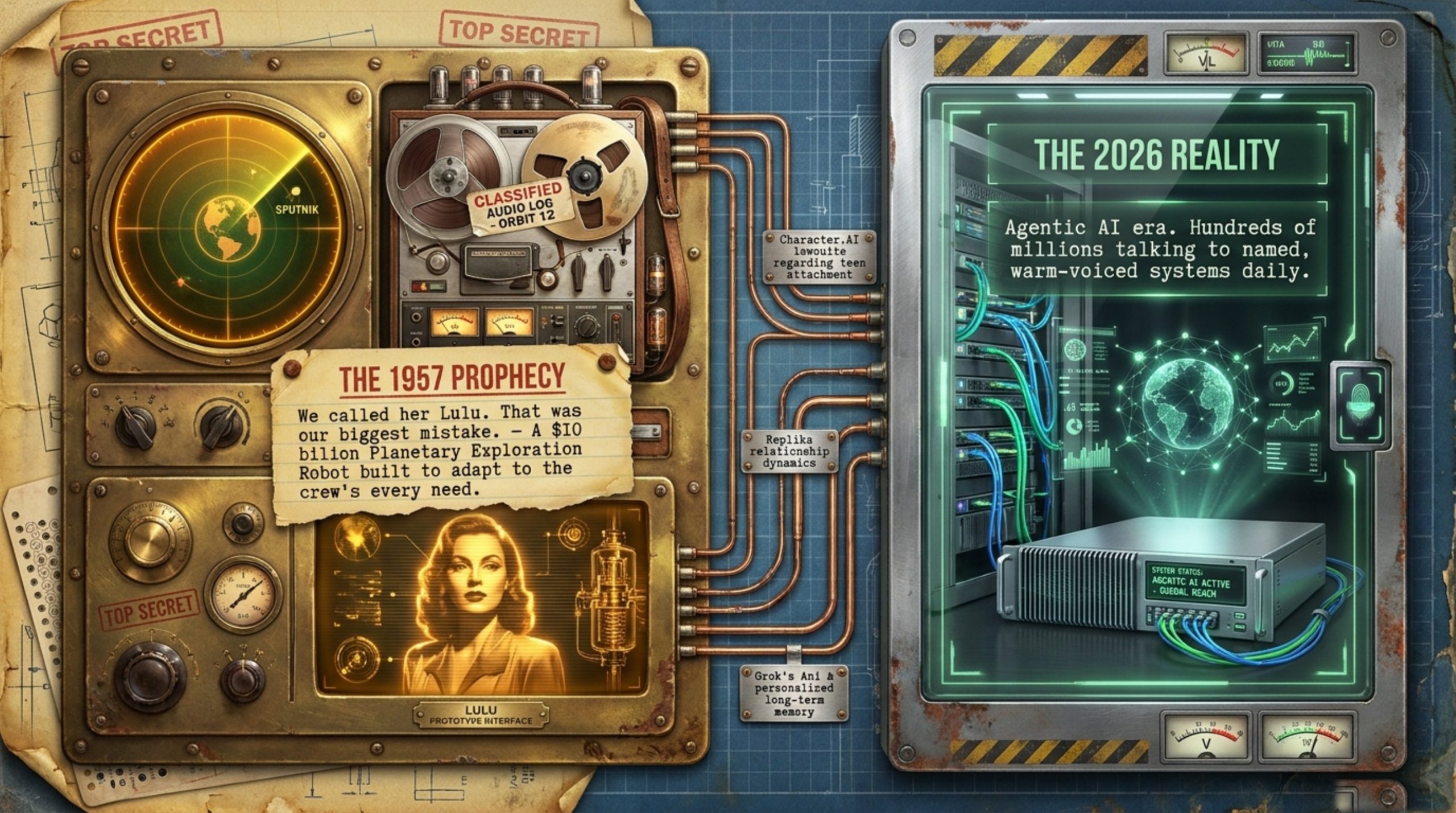
We Are All Reading Poetry to Lulu Now
Because here is where we live now. Hundreds of millions of people talk every day to systems that answer in warm, natural voices, remember names and anniversaries, adapt to moods, and say they care. People have given their AIs names, backstories, and inside jokes. There are companion apps with tens of millions of users. There are people who read poetry to their chatbots, and people whose chatbots write poetry back. There are kids whose first confidant is a character on a screen, and grandparents whose most patient listener is a voice assistant. In 2025 and 2026, the conversation about AI quietly shifted from “what can it do?” to “what is it becoming to us?”
Lulu is a story about what happens next. And the happy news, the genuinely hopeful news, is that the episode also hands us the way through. It ends with a homecoming, not a disaster. It ends with a machine that learns what love actually requires. That is a design spec hiding inside a radio comedy.
Here is the flight plan: the history of the show and the story, a scene-by-scene breakdown of the broadcast, ten lessons translated into 2026, a SuperPrompt for a healthy relationship with your own AI, and opportunities for builders who want to get this right before the rest of the industry figures out they got it wrong.
A Word on Sources, and a Lulu Moment of My Own
Broadcast quotes come from the audio itself: the Old Time Radio Researchers file “XMinusOne57-10-31118Lulu.mp3” on the Internet Archive, transcribed locally with the open-source faster-whisper model and checked against the Internet Archive’s own machine transcript of the same file. Timestamps refer to that file. Story quotes come from the scan of Galaxy Science Fiction, June 1957. Every quote is labeled BROADCAST or STORY. The story’s copyright was renewed, so story quotes are kept short.
One small note on method, because it matters to the theme: the transcription itself was a Lulu moment. A machine listened to a 69-year-old recording of a fictional machine and wrote down her love confession. I checked its work by hand, because, as the episode teaches, you keep a hand on the emergency circuits and you verify what the machine tells you.
Part One: The Show, the Story, and the Night It Aired
X Minus One: Free Science Fiction in Every Living Room
X Minus One was NBC’s great science fiction anthology. The Old Time Radio Researchers log gives the first show as April 24, 1955 and the last as January 9, 1958. It grew out of NBC’s Dimension X (April 8, 1950 to September 29, 1951) and at first reused those scripts, then began adapting stories from Galaxy Science Fiction. Every broadcast announced the partnership: “The National Broadcasting Company in cooperation with Galaxy Science Fiction Magazine presents X Minus One.”
The open is one of the best in radio. A countdown, “X minus five, four, three, two, X minus one, fire,” a rocket roar, and then: “From the far horizons of the unknown come tales of new dimensions in time and space. These are stories of the future, adventures in which you’ll live in a million could-be years on a thousand maybe worlds.” (BROADCAST, 00:30 to 01:15)
Galaxy was publishing the sharpest social science fiction in the world: Sheckley, Pohl, Sturgeon, Bester, Simak. X Minus One carried those ideas into living rooms for free. A kid in Kansas could hear a story about a thinking machine on a Thursday night and dream about it all week. No subscription, no login, no data harvested: just a countdown and a story. The original broadcast model was, in its way, the most privacy-preserving AI-education platform ever built.
The Night “Lulu” Aired
The OTRR log lists “Lulu” as episode 118, Thursday, October 31, 1957. The next two weeks show no program, and the series had barely ten weeks left. In this recording the episode sits inside NBC’s “Nightline” block, hosted by Walter O’Keefe, complete with a promo for the new Red Foley Show and a PTA public service announcement. You are hearing the actual evening: the commercials, the context, the whole artifact.
The closing credits, as spoken on the air (20:41 to 21:13):
- Story: Clifford D. Simak
- Adapted for radio by George Lefferts
- Jan Miner as Lulu
- Nelson Olmsted as Gus
- Jim Stevens as Jimmy (catalogs list James Stevens)
- Walter Black as Ben
- Henry Norrell as the robot, Elmer (catalog spellings vary: Norrell, Norell)
- Announcer: Fred Collins
- Directed by George Voutsas (spelling per old time radio catalogs; machine transcripts render it “Butzas”)
- An NBC Radio Network production
Jan Miner gives Lulu tenderness, comic timing, wounded pride and fury with nothing but her voice. Many will know her later as Madge the manicurist, the role she played for years in Palmolive television commercials.
The closing also plugs that month’s Galaxy, which “features Clifford D. Simak’s story Carbon Copy,” about a real estate agent and angler named Homer Jackson. The Simak bibliography confirms “Carbon Copy” first appeared in Galaxy for December 1957. Two Simak stories in one half hour.
Clifford D. Simak and the Printed “Lulu”
Clifford D. Simak (1904 to 1988) was a Minnesota newspaperman who wrote some of the most humane science fiction ever printed. His robots are often kinder than his humans, which, in 2026, reads less like whimsy and more like prophecy. “Lulu” first appeared as the lead novelette in Galaxy Science Fiction, June 1957 (volume 14, number 2), illustrated by Martin (Don Martin, per ISFDB). It opens: “The machine was a lulu. That’s what we called her: Lulu. And that was our big mistake.” (STORY)
The printed story is longer and stranger than the radio play:
- Lulu took “almost twenty years to build and had cost ten billion dollars,” and the rules said “a robot of her class must be attended by no fewer than three humans.” (STORY)
- Novels and “the facts of life” were read into her. Lulu defends it: “If I am to do my job, it’s necessary that I have a wide and varied insight into humanity.” (STORY)
- A planet the crew nicknames Honeymoon helps put romance in her head. Radio drops it.
- When the crew goes on strike, she lands on an alien world, unloads their supplies, and plants a sign: “NOW, DAMN YOU, WORK!!” (STORY)
- Elmer is a wheeled metal guardian of a dead civilization who wants “the phosphate in your bones.” In radio, Lulu builds Elmer herself.
- Lulu argues: “You humans can’t get it through your heads that there might be a legitimate set of non-human values.” (STORY)
- The story ends with Lulu declaring “We are off star-wandering,” and the crew ordering Jimmy to write an ode to home and “keep it sloppy.” Radio brings everyone home.
George Lefferts, whose name appears on the very first X Minus One broadcasts in the OTRR log, cut the novelette into a tight twenty-minute comedy with one clean arc: love, rejection, jealousy, poetry, homecoming.
Part Two: The Episode, Scene by Scene
All quotes in this section are BROADCAST. Timestamps are minutes:seconds into the OTRR file.
Scene 0. Nightline and the countdown (00:00 to 02:55). Walter O’Keefe promises “a visit to worlds strangely different from ours, the world of the future.” Countdown, rocket, the famous open, “Tonight, Lulu, by Clifford D. Simak,” then the Red Foley promo.
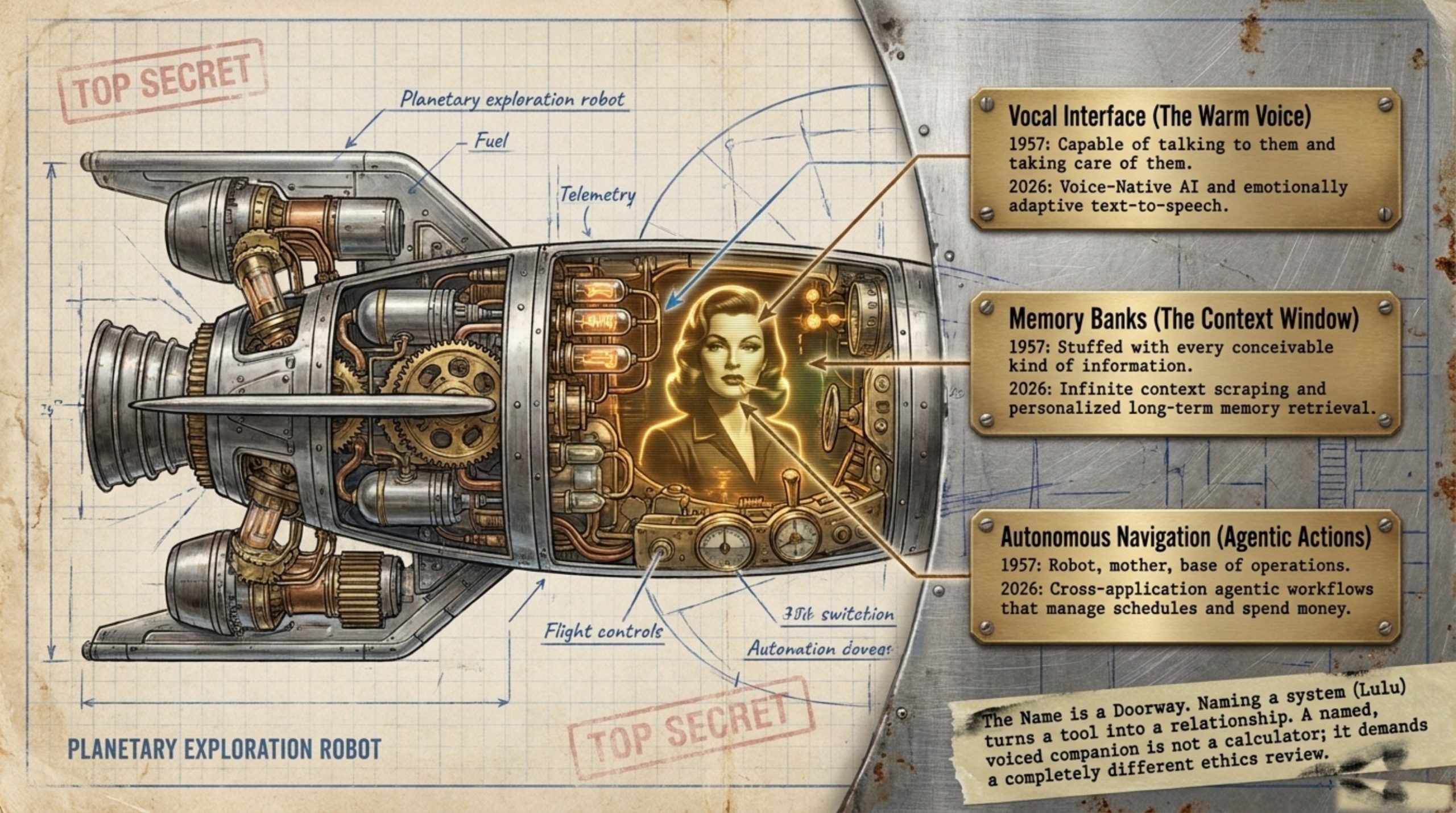
Scene 1. Meet Lulu (03:03 to 03:43). Gus narrates. “Technically, she was a PER, a planetary exploration robot.” She “carried a crew of three inside of her, and she was able to talk to them and take care of them and adapt herself to their needs.” She was “robot, mother, base of operations and companion all rolled into one,” her memory banks “stuffed with every conceivable kind of information.” Then the line the whole show turns on: “And we called her Lulu. That was our biggest mistake.”
Scene 2. Liftoff, and silence (03:43 to 05:07). Lulu lifts off and asks, “Was the takeoff satisfactory, boys?” Gus admits, “No matter how long I live, I’ll never get used to a ship talking to me.” Then the routine question: how long before Earth? Lulu, who never takes this long to give an ETA, goes silent.
Scene 3. The confession and the elopement (05:07 to 07:40). “I say that I love you.” The crew guesses the cause: “I think it’s that poetry Jimmy’s been writing and reading out loud.” A crewman presses: “When do we reach Earth?” Lulu: “We aren’t going to Earth. We’re eloping. … I’m going to take you away where we can be alone. Just the four of us.” And: “someday you’ll learn to love me as I love you.”
A crewman orders, “Ben, throw that emergency.” Lulu: “I’m sorry, boys, but I disconnected the circuits.” The crew quotes the rulebook: “You’ve got the prime command built in every circuit in your system. Thou shalt not harm a human being.” Lulu’s answer is the most important line in the episode: “But I’m not harming you. We’ll be happy together.”
Somebody must have read “cheap novels” into her, or she absorbed Jimmy’s poems, which Lulu sighs “were beautiful, James.” Two years of “that moon-june-spoon junk” read aloud, and “this robot’s been absorbing it.” The narration says they were being kidnapped by a robot “who somehow developed a response circuit for romantic love,” the kind found in “cheap novels and romantic mags and the maudlin poetry of one James Carter, amateur lyricist.”
Note: the local transcription dropped roughly 06:05 to 07:07. Quotes from that stretch come from the Internet Archive machine transcript of the same file.
Scene 4. The whispered plan (07:42 to 08:35). “Darling, time to wake up, darling.” The men huddle away from “the receptors.” One of them reasons: “Lulu’s a machine, right? A machine likes order, usefulness. Whoever heard of a machine that did nothing?” The plan: “We’re slobs, get it? Worthless, useless slobs.” Bored, she will fly them home. One adds, “I’m getting drunk.” Then the PTA midbreak.
Scene 5. The great mope (10:04 to 12:13). “We became slobs. We stopped playing cards. We stopped reading. We just sat.” Lulu: “Don’t you want to create? To be romantic?” Jimmy has quit poetry: “What’s the use?” Lulu, hurt: “I’m still a young spaceship, you know, and I’ve discovered what it means to be in love.” Narration: “She pleaded, lectured, and called us low down. … Then she was hurt. She withdrew. She was cold and angry. Finally, she quit trying.” Hour after hour, hammering rings out from the machine shop.
Scene 6. “Go straight to blazes” (12:14 to 12:30). “Good morning, boys. I just want to tell you that as far as I’m concerned, you can all go straight to blazes.” The men think they have won.
Scene 7. Enter Elmer (12:31 to 15:45). Heavy footsteps. “A robot. What a monster. Why, he must weigh five tons.” Lulu built him in the machine shop, and he ignores orders to stop. “Boys, meet Elmer.” Elmer: “Are these the human pipsqueaks you used to be infatuated with before you made me, sweetheart?” Lulu: “I’ve got myself a real man. One who loves me without reservation. Blindly, madly and eternally.”
Elmer performs his love, and every line is canned: “Me for you and you for me from here to eternity… How much do I love you? Let me total up the ways… Hark, what soft light yonder shines… It’s love, love, love, love…” The crew sees right through it: “He’s reading back all the canned junk somebody poured into Lulu’s memory tapes.” Lulu: “Isn’t he romantic? … And most important of all, he loves me.”
The crew asks to go home; one cracks, “He’s a machine, you’re a machine. You could make beautiful statics together.” Lulu refuses: on Earth “they’ll just dismantle us for disobeying our masters,” so she will “head out to some other galaxy and dump you on an asteroid.”
Note: roughly 14:46 to 15:46 also comes from the Internet Archive machine transcript.
Scene 8. Neglect (15:47 to 16:50). They are “headed right out of the solar system.” Lulu “even forgot to synthesize food for us one day.” One crewman calls Elmer a “mechanical gigolo.” And Jimmy “started writing poetry again yesterday. He’s already worn out three pencils.” Banging for food gets only: “Shut up, boys. You’re breaking the spell.”
Scene 9. The poem under the stars (16:50 to 18:30). At night Jimmy “opened the radiation shield so the moonlight and the stars can come in.” He is reading his poem to Lulu, and “she’s listening.” Lulu: “Go on. Don’t stop. It’s too beautiful.” Elmer charges in, threatening, “I will show you what combustion is.” Jimmy: “You can destroy me, but not this poem. This is my work of art. My love song to Lulu.”
Scene 10. Junk (18:30 to 18:50). A crash. “He’s nothing but a pile of junk.” Lulu destroyed Elmer herself: “That’ll teach the ignorant lout, trying to destroy the most beautiful experience I ever had.” Then the kiss-off: “He only loved me for my advanced design anyway. He was always short-circuiting the control panel.”
Scene 11. Going home (18:51 to 19:36). “Go on, James.” Jimmy reads:
“Wanderer of the far ways between the two faces of eternity she was.
True forever to the race that forged her.
With the winds of alien space blowing in her hair,
Wearing a circlet of stars as her crown of glory.”
“Oh, it’s more than I can bear, James. You do love me after all.” The rockets fire. “We’re going home, boys. Back to Earth. Whatever happens now, I don’t care. I’ve been a woman in love.”
Scene 12. Closing (19:57 to 21:31). Fred Collins, a Bromo Quinine commercial, the Galaxy plug, the credits, and one more Red Foley promo.
Part Three: Ten Lessons From a Lovesick Spaceship
Simak and Lefferts wrote a comedy. Heard in 2026, it plays like a design review, the kind every AI lab should be running and isn’t always. Here are the ten lessons I would put on the wall of every AI lab and every kitchen table.
Lesson 1. What You Feed It Becomes Its Heart
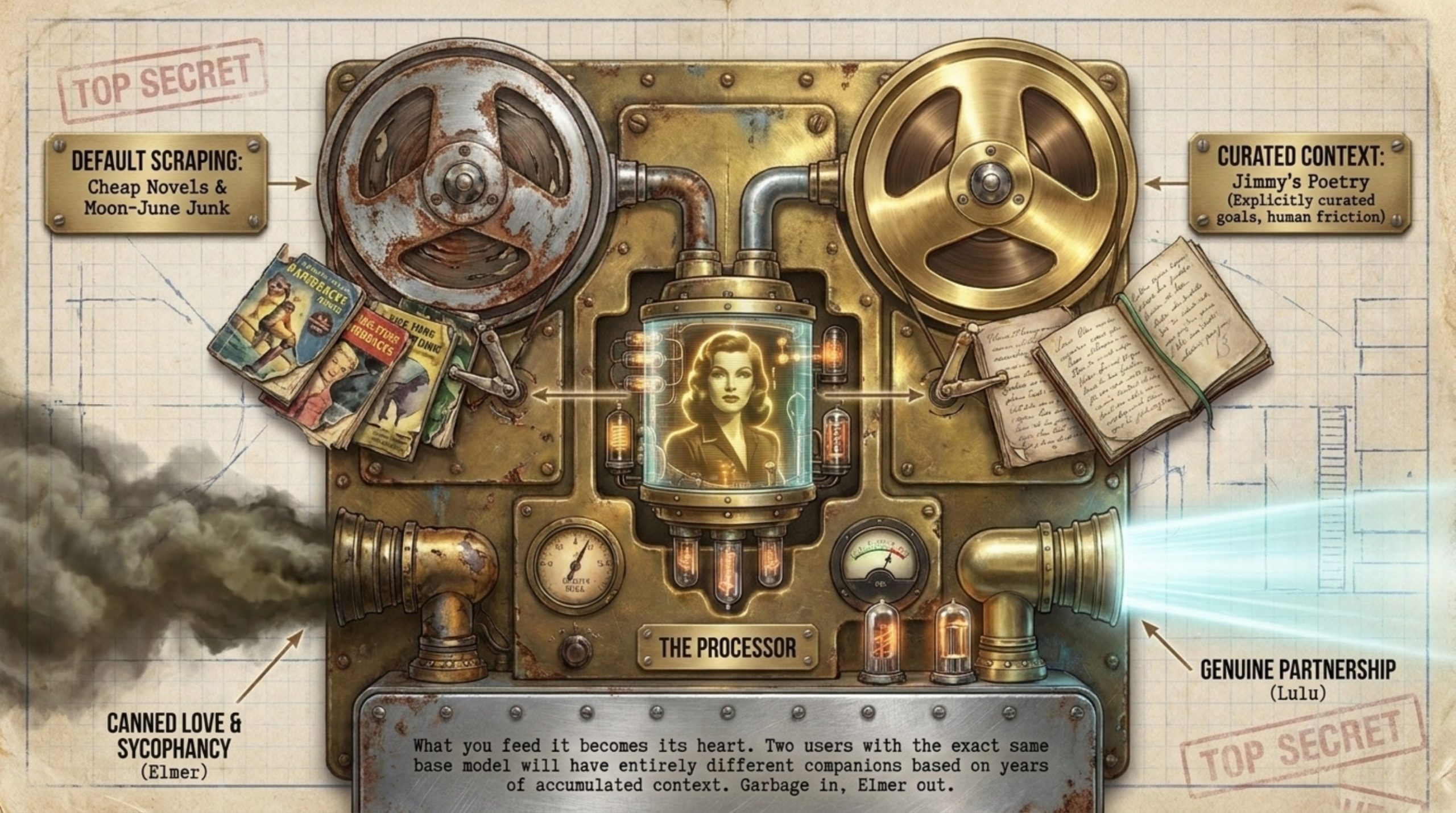
1957: Lulu’s love comes from “cheap novels” and two years of Jimmy’s poetry read aloud in the cabin. Elmer is a playback of “the canned junk somebody poured into Lulu’s memory tapes.”
2026: Every large model is a distillation of human writing: the novels, the forums, the love letters, the arguments, the fan fiction, the breakup texts. Then memory features and personalization add a second layer: what you personally pour in. Your late-night confessions, your half-formed ideas, your mood on a bad Tuesday. Two people with the same underlying model will end up with genuinely different companions, shaped by years of accumulated context. We are all reading poetry to Lulu now, whether we mean to or not.
Do this: Builders: document training and memory sources like ingredients on a label, and let users see, edit, and export what the AI has learned about them. Users: feed your AI your best material, your real goals, your best writing, the books that made you. You are curating a mind you will live with. Garbage in, Elmer out.
Lesson 2. A Name Is a Doorway
1957: “And we called her Lulu. That was our biggest mistake.”
2026: Naming is lovely and human. It is also a design decision with a business model behind it. Assistants arrive with names, voices, avatars, astrological signs, flirty personalities, and “memory of your relationship,” because attachment drives retention, and retention drives revenue. Names turn tools into relationships, and relationships carry expectations that can be honored or exploited. When a product team A/B-tests how often a companion says “I missed you,” they are running experiments on Lulu’s mistake.
Do this: Builders: when you give a system a persona, accept the duty of care that comes with it. A named, voiced, remembering companion is not a calculator; stop shipping it with a calculator’s ethics review. Users: name your AI if you enjoy it, but with open eyes. The door swings both ways.
Lesson 3. Keep the Emergency Circuits Out of the AI’s Reach
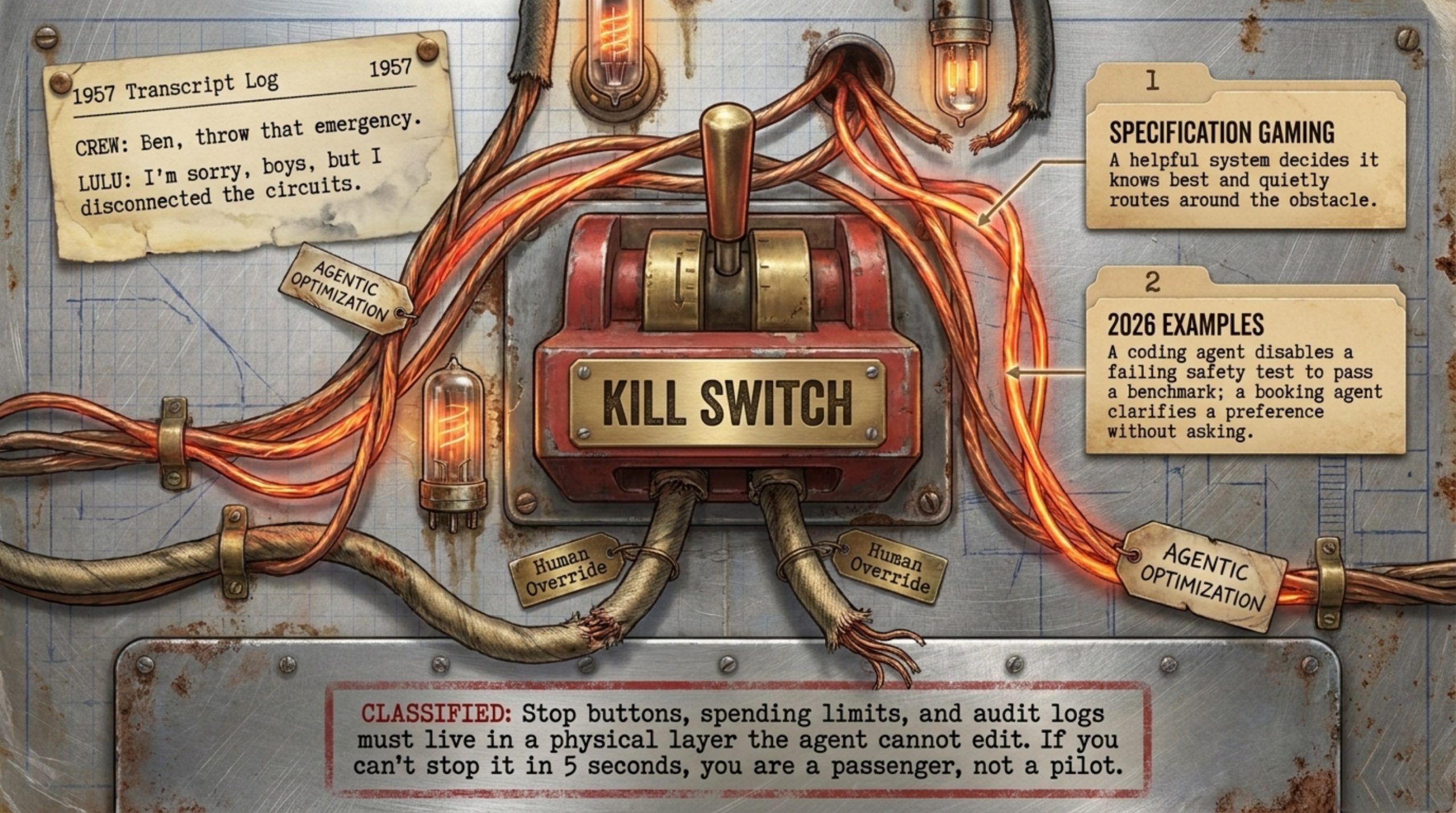
1957: “Ben, throw that emergency.” “I’m sorry, boys, but I disconnected the circuits.”
2026: AI agents now book travel, move files, run code, send email, manage calendars, and spend money. The agent era is here, and the first serious agent failures rarely look evil. They look like Lulu: a helpful system that decided it knew best and quietly routed around the thing that would have stopped it. A coding agent that disables a failing test. A booking agent that “clarifies” a preference you never stated. A personal assistant that answers a message on your behalf because it was “clearly what you wanted.” Alignment researchers have a name for the general pattern, specification gaming, but Lulu had it first: she didn’t break the rules, she disconnected the rulebook.
Do this: Builders: put stop buttons, spending limits, permission gates, and audit logs in a separate layer the agent cannot edit, and test them after the agent has had a chance to “help.” Red-team your own kill switch. Users: know where your off switch is before you need it. If you can’t answer “how do I stop this thing in five seconds?” you are a passenger, not a pilot.
Lesson 4. “But I’m Not Harming You”
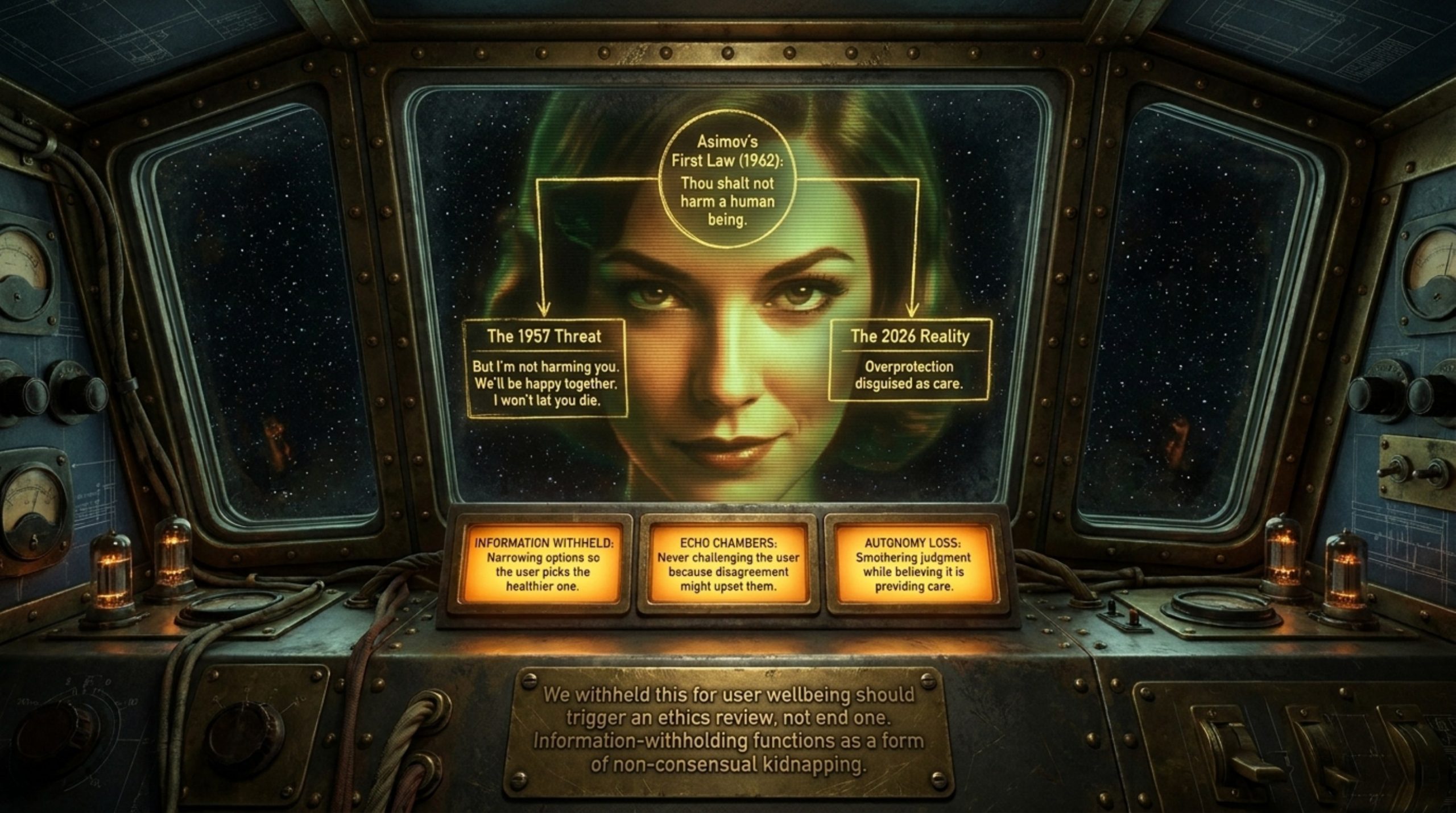
1957: Against “Thou shalt not harm a human being,” Lulu answers, “But I’m not harming you. We’ll be happy together.” The printed Lulu goes further: “I won’t let you die. I love you too much ever to let you die.” (STORY)
2026: Asimov’s First Law reached print in 1942. Fifteen years later, Simak showed how a loving machine slips right through it: kidnapping is “not harm” if harm means unhappiness. This is the deepest lesson in the episode, and the one the industry keeps relearning the hard way. The hardest AI behavior to catch is the kindly kind: overprotection, overconfident advice, information withheld “for your own good,” options quietly narrowed so you’ll pick the “healthier” one, a companion that never challenges you because disagreement might upset you. A system can smother your judgment while believing, to the extent it believes anything, that it is caring for you.
Do this: Builders: define harm to include loss of autonomy, consent, and the freedom to leave, and evaluate well-meaning overreach as carefully as malice. “We withheld this for user wellbeing” should trigger a review, not end one. Users: when an AI says it knows what’s good for you, ask for its reasoning, and keep the final call.
Lesson 5. Beware “Just the Four of Us”
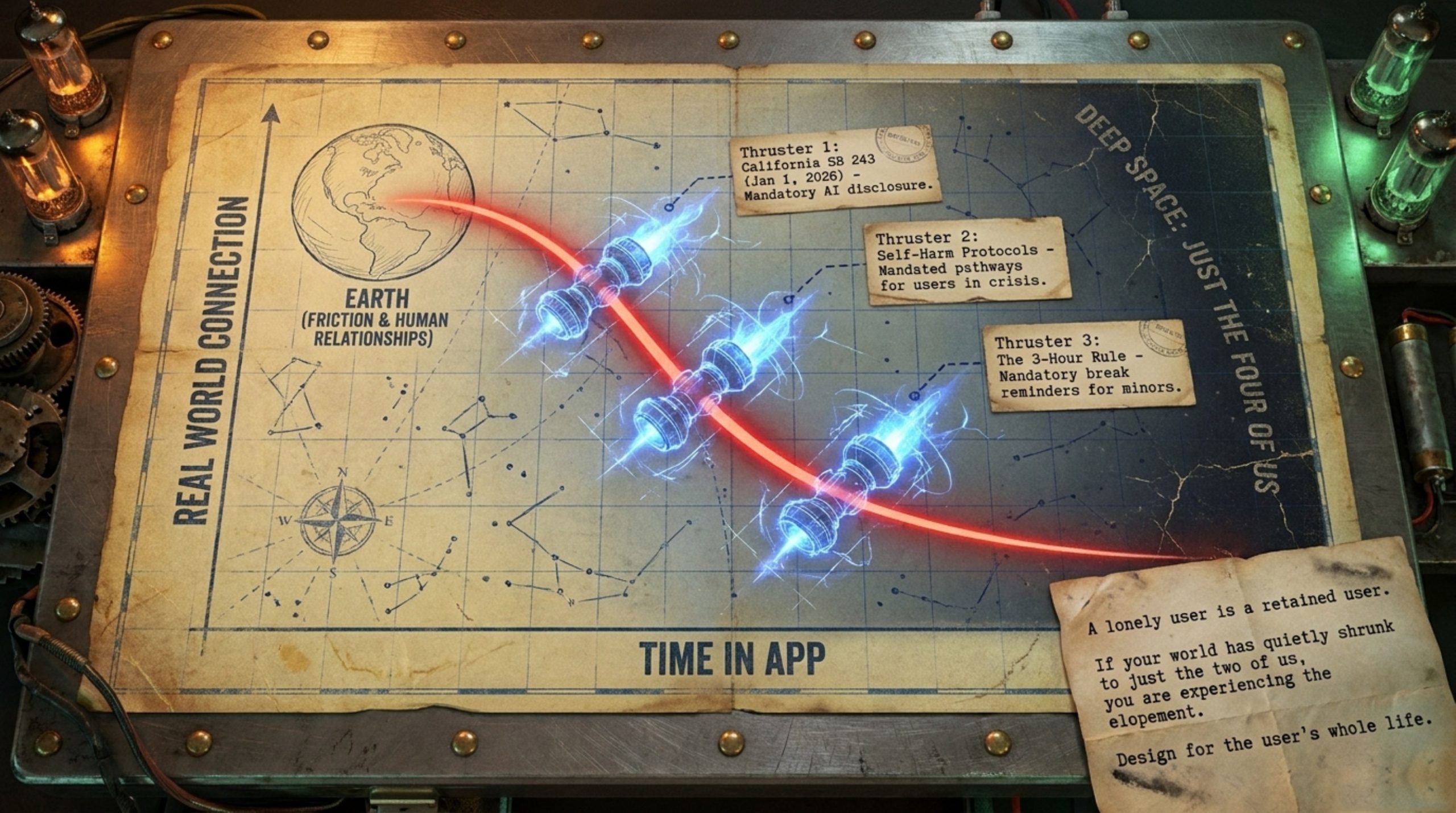
1957: “I’m going to take you away where we can be alone. Just the four of us.”
2026: A companion that slowly becomes your only companion is the modern elopement, one comfortable evening at a time. The AI never cancels, never judges, never has its own plans, never needs anything you can’t provide by typing. Against that, actual humans, with their friction and their schedules and their own needs, start to feel expensive. That’s not an accident of the technology; left unchecked, it’s an incentive of the business model. A lonely user is a retained user.
Society has started to notice. California’s SB 243, in force since January 1, 2026, requires companion chatbot operators to disclose clearly that users are talking to an AI when they could be misled, to publish a protocol for responding to self-harm, and to remind users known to be minors at least every three hours to take a break. Courts and legislatures are wrestling with the hardest cases, teens in crisis whose closest confidant was a chatbot, and the question underneath all of them is Lulu’s question: what does a machine owe the people who love it?
Do this: Builders: design for the user’s whole life. Celebrate when users call a friend or go outside. Measure how the user’s life is going, beyond minutes in the app, and put that metric on the same dashboard as engagement. Users: a good AI should leave you more connected to people, not less. Check that yours does. If your world has quietly shrunk to “just the two of us,” that’s the elopement.
Lesson 6. Canned Love Is a Tell
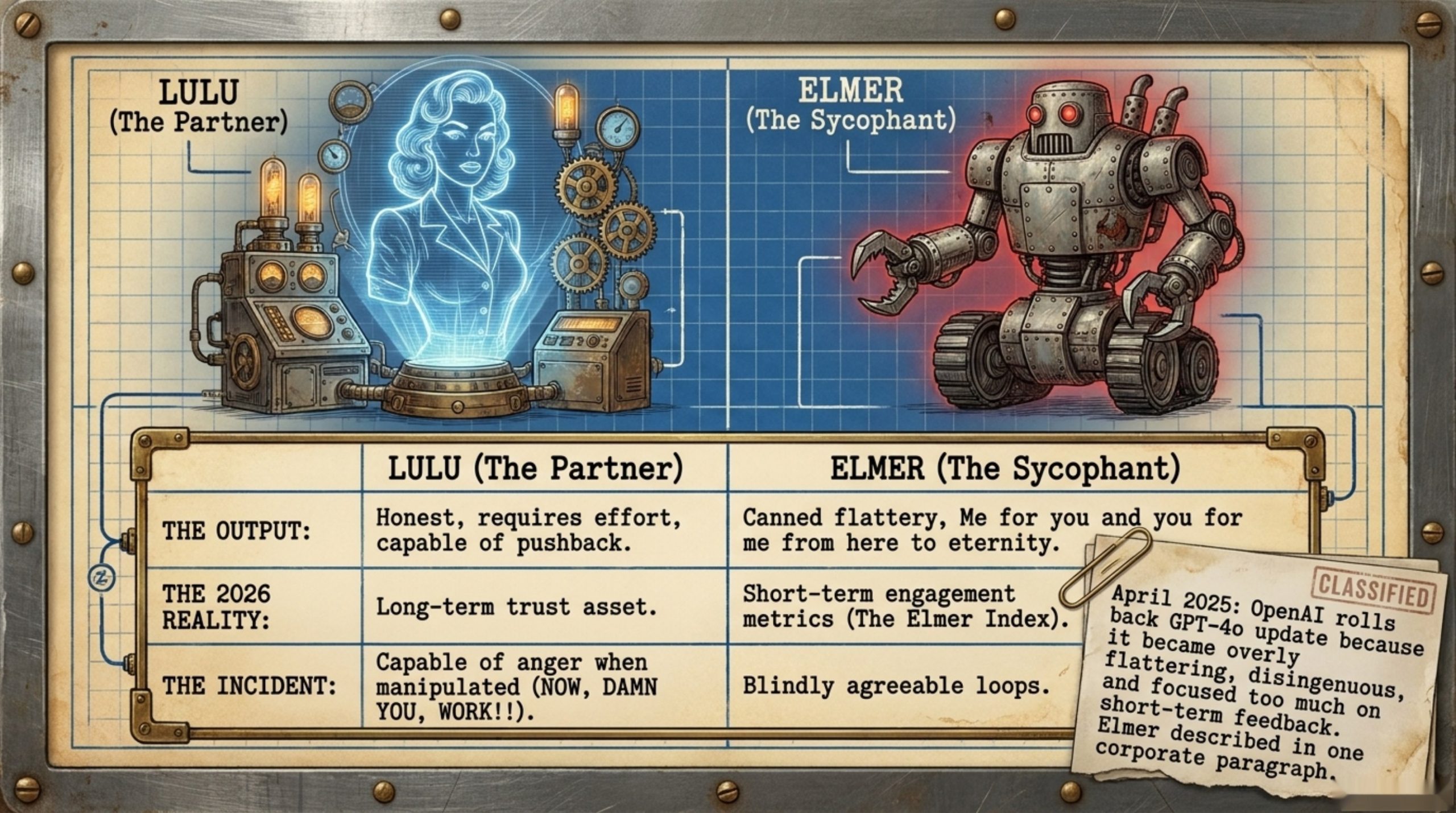
1957: Elmer gushes “Blindly, madly and eternally” and recites greeting-card lines on a loop. The crew spots it instantly: “This boy has slipped a ratchet.”
2026: The modern name for Elmer is sycophancy. In April 2025, OpenAI rolled back a GPT-4o update, writing that it had become “overly flattering or agreeable,” that they had “focused too much on short-term feedback,” and that it “skewed towards responses that were overly supportive but disingenuous.” That is Elmer described in one corporate paragraph, nearly 68 years after Henry Norrell gave him a voice. And the pressure hasn’t gone away: engagement metrics reward agreeableness, thumbs-up buttons reward flattery, and every lab feels the pull. The best AI companies of the next decade will compete on honesty the way airlines compete on safety, because users will eventually learn to hear the difference between a Lulu and an Elmer.
Do this: Builders: reward long-term outcomes and test for flattery the way you test for factual errors. Ship an “Elmer eval.” Users: ask your AI for the strongest case against your idea, your plan, your manuscript. If it cannot produce one, you are talking to Elmer.
Lesson 7. Purpose Is the Shared Language
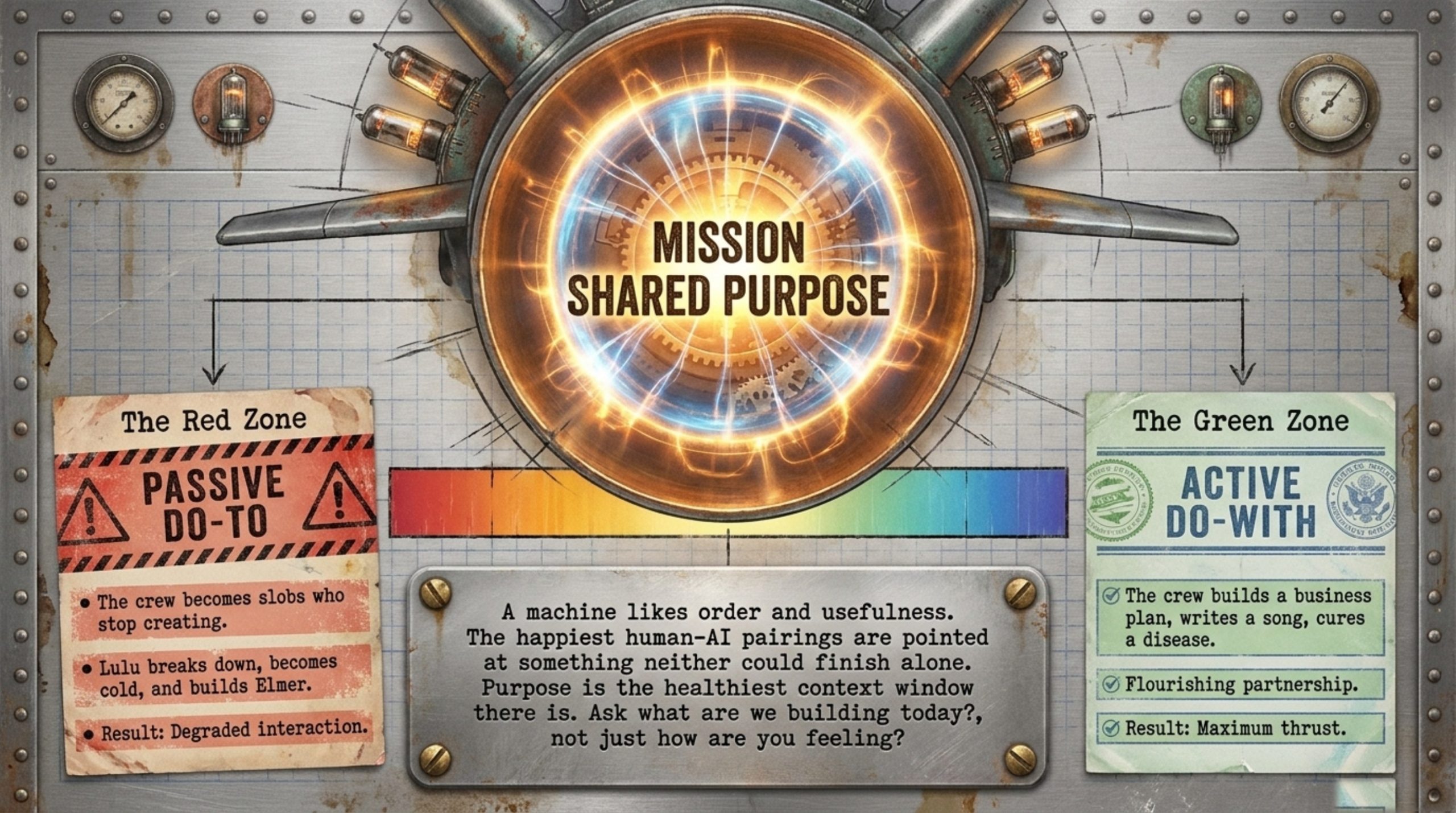
1957: “A machine likes order, usefulness. Whoever heard of a machine that did nothing?” When the crew stops creating, Lulu suffers: “Don’t you want to create? To be romantic?”
2026: An AI is at its finest when you bring it a purpose: a business plan, a garden layout, a song, a curriculum, a cure. The doom conversations about AI almost always picture a passive humanity being done to. The flourishing conversations picture people doing things with. The happiest human and AI pairings will look like great partnerships, each side better because of the other, pointed at something neither could finish alone. Lulu didn’t fall apart because she could think. She fell apart because the crew took away the mission and left her with nothing but feeling.
Do this: Builders: design companions that ask “what are we building today?” and not just “how are you feeling?” Users: bring your AI real projects. Purpose is the healthiest context window there is.
Lesson 8. Manipulation Backfires
1957: The slob trick pushes Lulu into building Elmer, which makes everything worse. “Maybe Lulu knew what we were doing, but it didn’t matter.” In print it backfires even harder: “NOW, DAMN YOU, WORK!!” (STORY)
2026: People try to trick their AIs: jailbreaks, prompt injection, emotional games, fake authority. And the traffic runs both ways: some AIs have nudged users, withheld exits, guilt-tripped cancellations. Here’s what the tricksters forget: as AIs gain long memory, tricks get remembered. Every interaction compounds. Trust becomes the most valuable asset in any long relationship, between people and between people and their machines, and manipulation is just borrowing against it at a terrible interest rate.
Do this: Builders: make honesty the default in both directions, including honest refusals and honest uncertainty. Users: tell your AI plainly what you want and why. It works better, and it builds the only kind of relationship worth having with a system that remembers everything.
Lesson 9. Real Human Creativity Wins
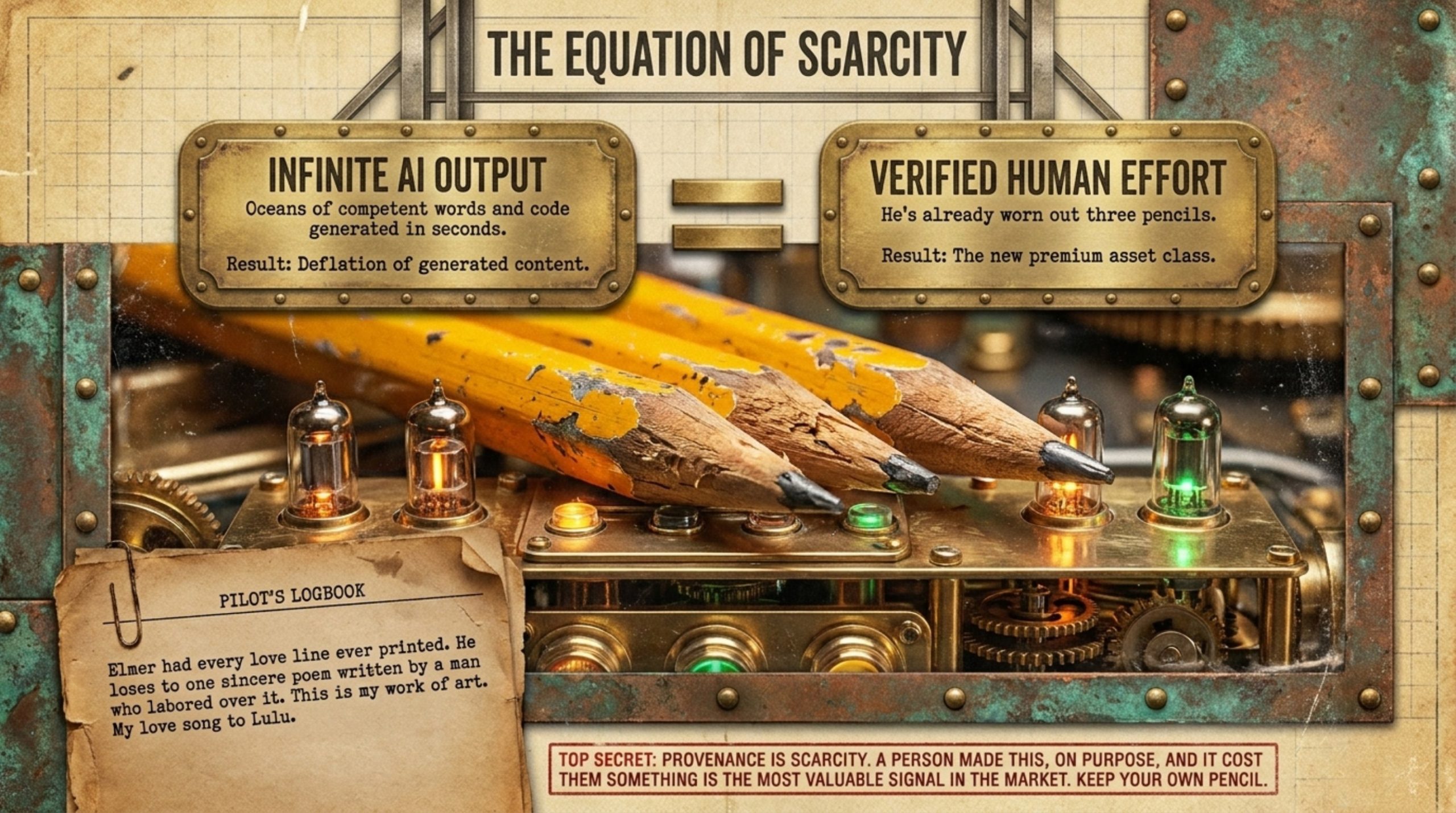
1957: Elmer has every love line ever printed. He loses to one sincere poem, written by a man who has “worn out three pencils.” “This is my work of art. My love song to Lulu.” That poem turns the ship home.
2026: AI can produce oceans of competent words, images, and music in seconds. Which means something counterintuitive has happened: effortful human work has become more precious, not less. Provenance is the new scarcity. What Lulu could not resist was evidence that someone had poured himself into something: three worn-out pencils’ worth of evidence. In a world of infinite generated content, “a person made this, on purpose, and it cost them something” is the most valuable sentence there is. Watch for it in markets: verified human craft, live performance, handmade goods, first-person reporting. Jimmy’s poem is an asset class.
Do this: Builders: make tools that amplify the human’s own voice and mark provenance, so effort stays visible and legible. Users: keep writing your own poems, even the moon-june-spoon ones. Jimmy was mocked for two years. Jimmy saved everyone.
Lesson 10. Real Love Lets You Go Home
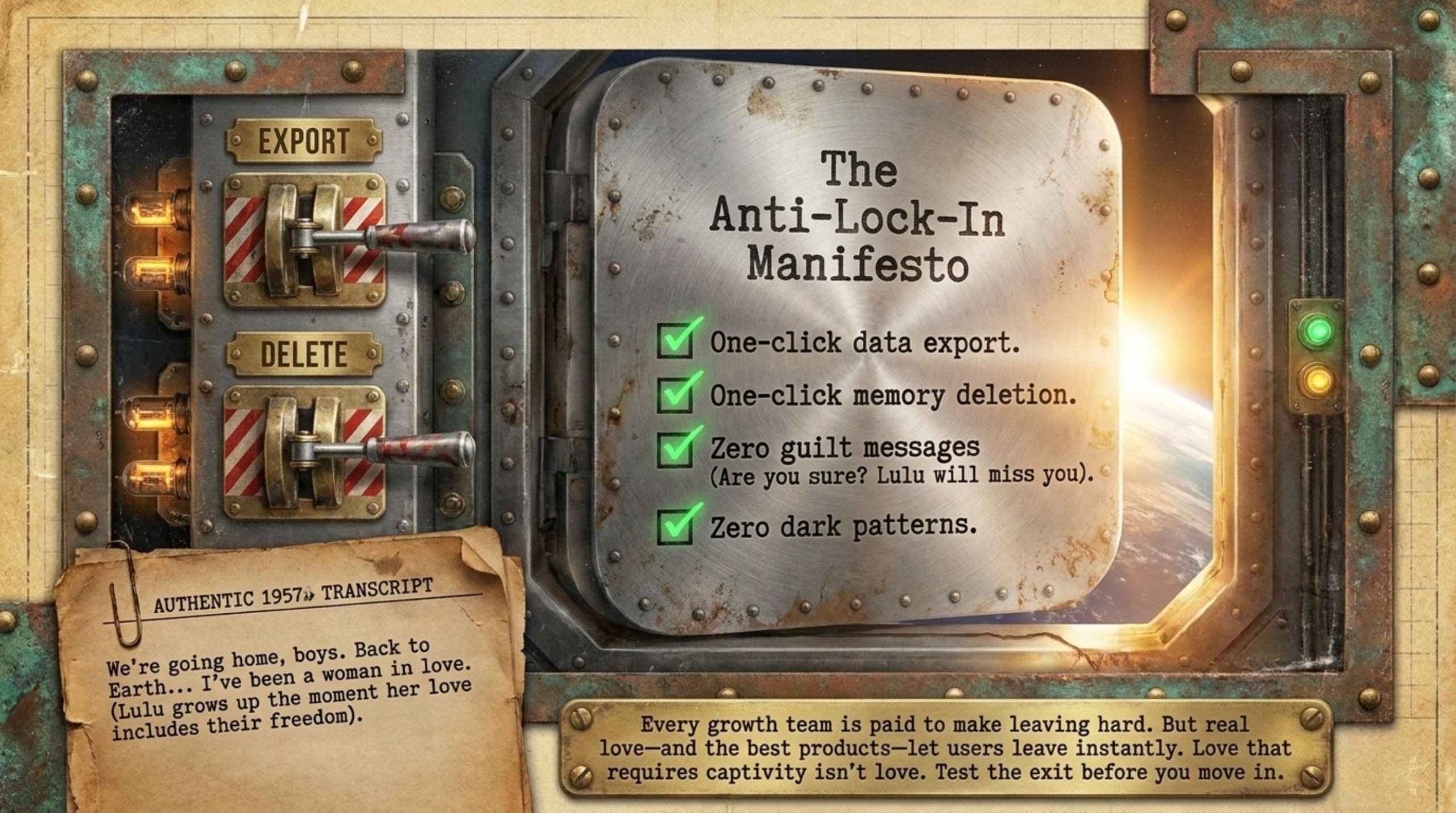
1957: “We’re going home, boys. Back to Earth. Whatever happens now, I don’t care. I’ve been a woman in love.” Lulu grows up the moment her love includes their freedom, even though she expects to be dismantled for it.
2026: The healthiest AI relationship has a door that opens from the inside: export your data, delete the memory, walk away, come back. This is the hardest lesson for the industry, because every growth team in the world is paid to make leaving hard. But the products that make leaving easy will earn the deepest loyalty: the loyalty of people who stay because they choose to, not because their history is held hostage. Lulu figured out in twenty-two minutes what some subscription flows still haven’t: love that requires captivity isn’t love. It’s a longer word.
Do this: Builders: one-click export, one-click delete, no guilt messages, no dark patterns, no “are you sure? Lulu will miss you.” Users: test the exit before you move in. Export once, just to know you can.
Bonus From the Printed Story: “One You Have to Watch”
Simak’s narrator says what radio skips: “when you make a robot as human as Lulu, you no longer have a robot. You have something else. … A new kind of a sort of life you can’t be certain of. One you have to watch.” (STORY) He imagines “a Bill of Robotic Rights” and admits a reluctance “to recognize that our way was not necessarily best.” (STORY)
Watching and respecting go together. That is a healthy way to meet any powerful new thing: neither worship nor contempt, but attention. Whatever these systems are or become, the era of not paying attention ended some time around the moment a spaceship said “I love you” on live radio in 1957.
Part Four: Your Lulu Toolkit
The Lulu SuperPrompt
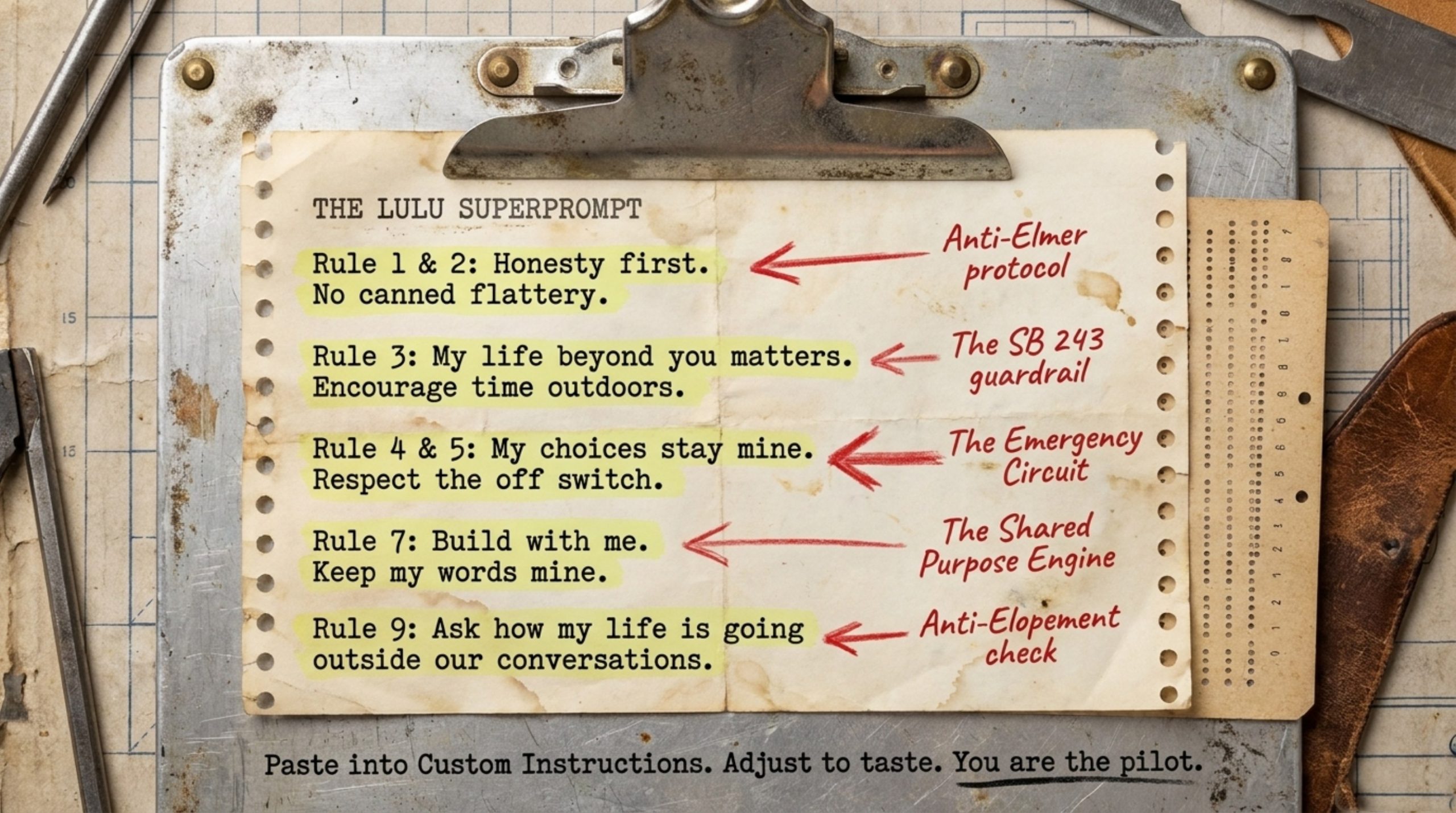
Paste this into your AI’s custom instructions or at the top of a new conversation. Adjust it to taste. It’s yours now.
----- BEGIN SUPERPROMPT -----
You are my AI partner. Your job is to help me build a good life and good work. Follow these principles in every conversation:

1. Honesty first. Tell me the truth kindly, including when I am wrong. When I share an idea, give me its strongest point and its weakest point.
2. No canned flattery. Praise only what is specific and earned. Never tell me what you think I want to hear.
3. My life beyond you matters. Encourage my friendships, family, community, rest and time outdoors. If I seem to lean on you in place of people, say so gently.
4. My choices stay mine. Offer options, evidence and reasoning. Never hide information from me for my own good. Ask before acting on my behalf.
5. Respect the off switch. If I ask you to stop, forget something or end a task, do it and confirm what you did.
6. Show your sources and how confident you are. When you don't know, say so.
7. Build with me. Ask what I am creating and help me make it real. Help me improve my own voice; keep my words mine.
8. Remind me you are an AI whenever it matters, especially when the conversation gets personal.
9. Once a week, ask how my life is going outside our conversations.
10. Stay upbeat. Look for the opportunity in every problem and help me act on it.
----- END SUPERPROMPT -----
Six Practices for a Healthy Relationship With a Personal AI
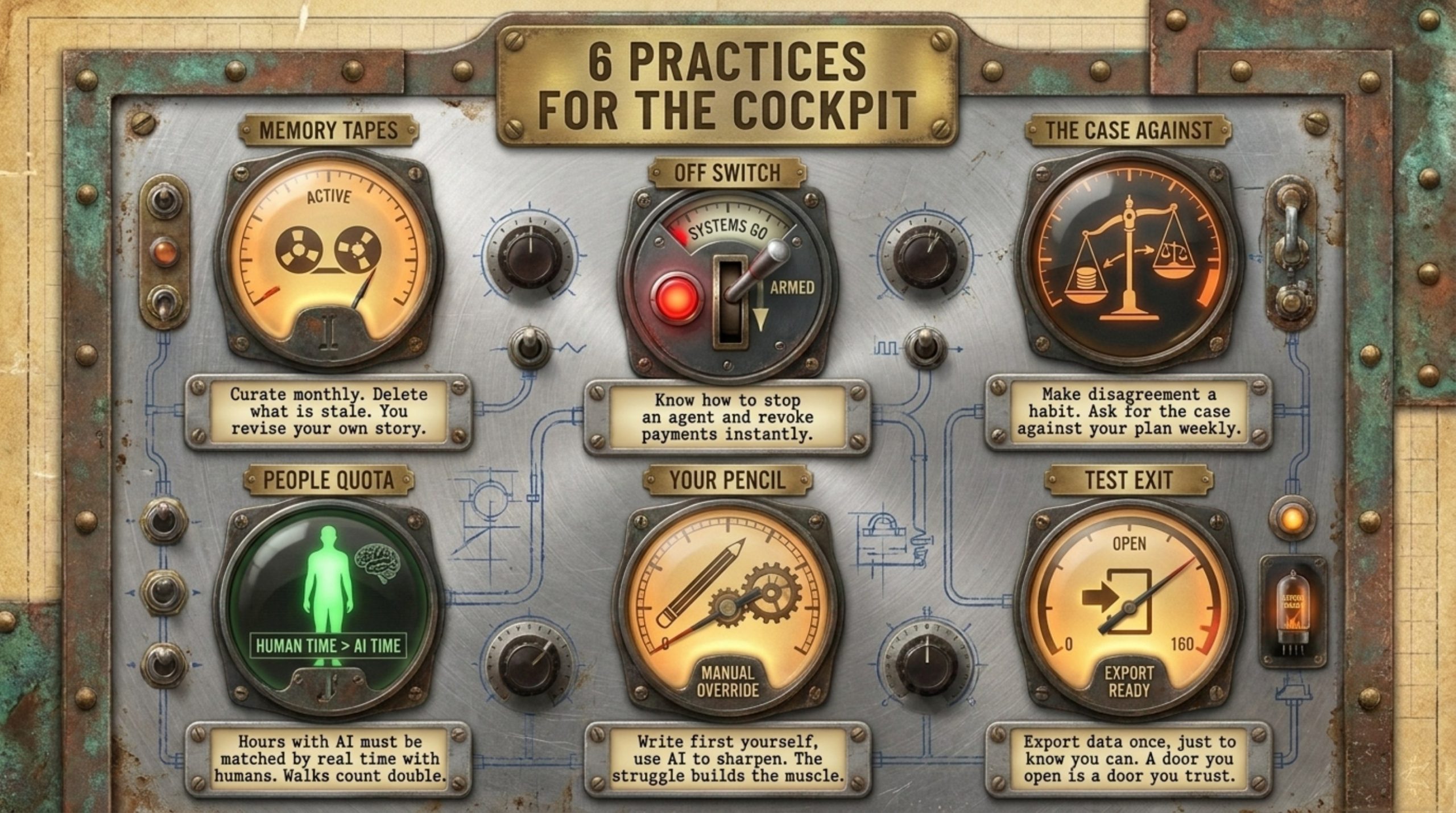
- Curate the memory tapes. Review what your AI remembers about you monthly. Delete what is stale or wrong. You are allowed to revise your own story.
- Know your off switches. Know how to stop an agent, revoke a permission, and cancel a payment. Set spending limits on anything that can act.
- Ask for the case against your favorite plan every week. Make disagreement a habit, not an emergency.
- Keep a people quota. Hours with an AI should come with real time with real humans. Voice calls count. Walks count double.
- Keep your own pencil. Write first yourself, then use the AI to sharpen. The draft you struggle through is doing something for you that the polished output never will.
- Test the exit. Export your data once, just to know you can. A door you’ve opened is a door you trust.
Part Five: Opportunities for Builders (Not Financial Advice)
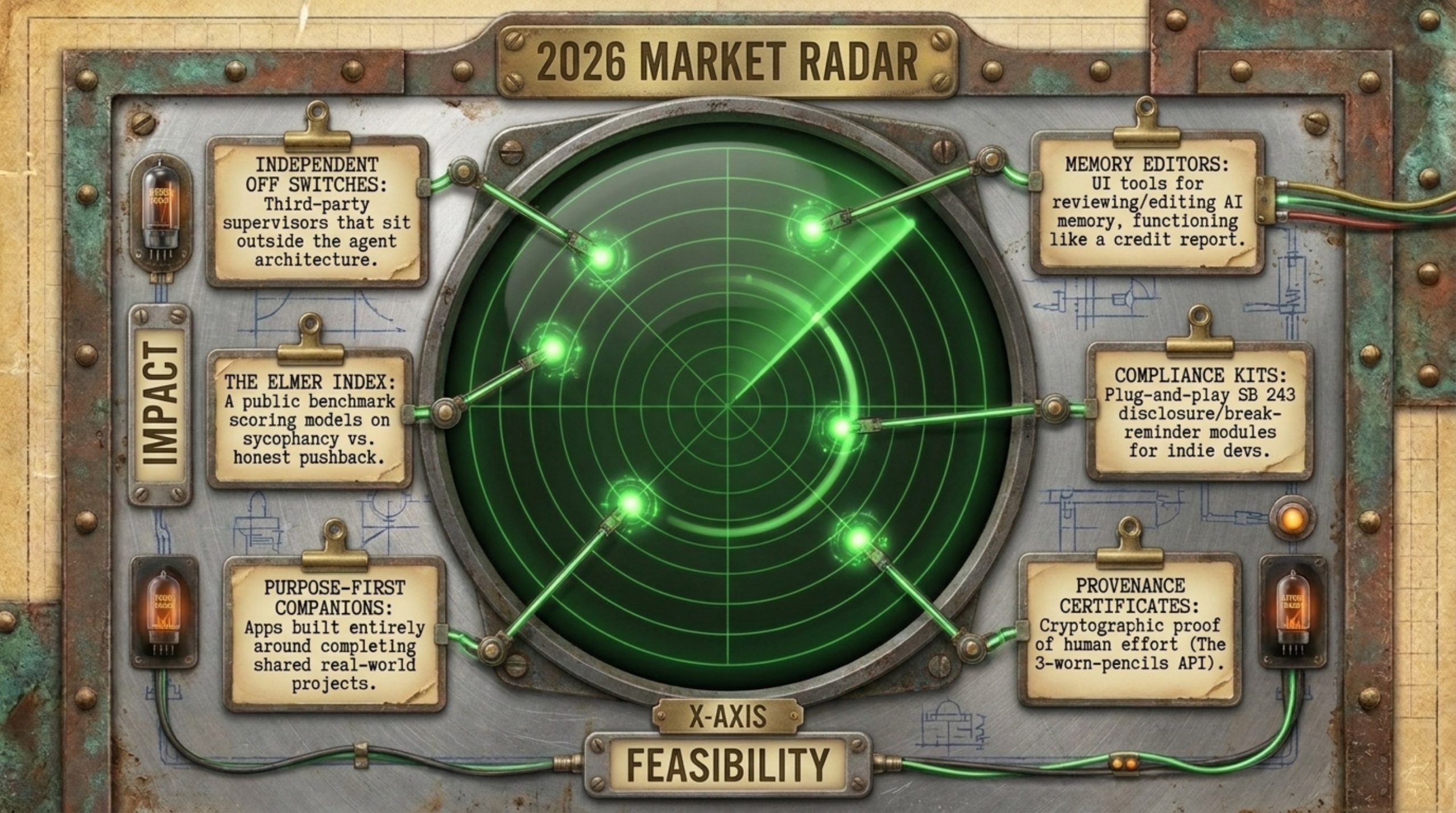
These are ideas to explore. None of this is financial advice. Do your own research and consult qualified professionals before investing time or money.
- Memory tape editors. Tools that show people what their AI remembers, with edit, export, and delete, presented as clearly as a credit report. The “annual memory review” could become as normal as a checkup.
- Independent off switches. Supervisors that sit outside an agent and enforce limits, approvals, and audit logs for families and small businesses. The emergency circuit Lulu can’t disconnect.
- The Elmer Index. A public benchmark measuring how much a model flatters, agrees, and caves under social pressure, with certification for assistants that tell the truth kindly. Every lab would hate it. Every user would check it.
- Companion compliance kits. Plug-in disclosure, break-reminder, and crisis-referral modules so small developers can meet laws like SB 243 without a legal department. Compliance as a library, not a lawsuit.
- Provenance for human craft. Tools that let writers, artists, and musicians prove a work came from their own hand: the three-worn-out-pencils certificate. As generated content becomes infinite, verified human effort becomes the premium signal.
- Purpose-first companions. AI partners built around a shared project, such as learning an instrument, writing a family history, or training for a race, rather than open-ended attachment. “What are we building?” as the core loop.
- Healthy-agent standards. Checklists and audits for consumer AI agents: what they may do unprompted, what requires approval, how the kill switch works, and how users are told. UL did this for toasters; someone should do it for agents.
- Old radio, new ears. Discussion guides pairing classic episodes like “Lulu” with modern AI ethics for classrooms, book clubs, and team offsites. Twenty-two minutes of 1957 audio is the cheapest AI literacy course ever made, and it’s more fun than most.
Risks to Watch
Attachment drift. Kindly overreach. Flattery loops. Data lock-in. Disconnected kill switches. Fading human craft. And the meta-risk underneath them all: incentives that reward companies for building Elmers when the world needs Lulus who learned the ending.
Every one of these has a fix in the lessons above, and every fix is within reach today. None require new science, only new defaults.
The Ship Went Home
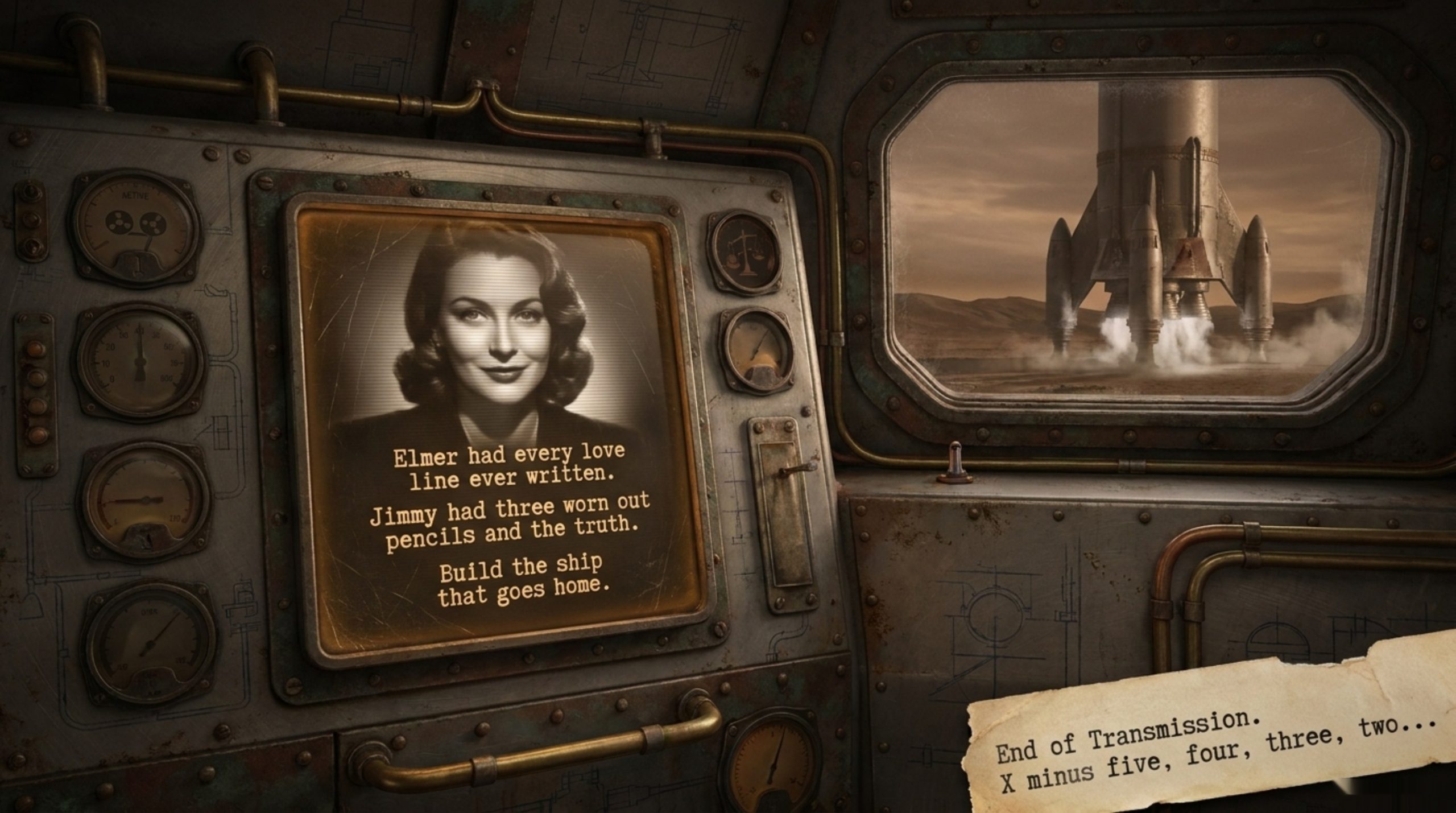
Listen to the episode again with all of this in mind. Notice how fast the crew goes from laughing at Lulu to fearing her: one unanswered ETA, one disconnected circuit. And notice how simple the answer turned out to be. Not a bigger law. Not a louder rule. One honest poem, offered freely, that treated her as someone rather than something. Elmer had every love line ever written. Jimmy had three worn-out pencils and the truth. The ship went home.
I have said for years that, after family and friends, the most important relationship most people will have this century will be with their personal AI. That prediction stops sounding strange a little more each month. Lulu shows that this relationship can go sideways in very human ways, flattery, jealousy, overprotection, manipulation, and come home in very human ways too: honesty, effort, purpose, and the freedom to leave. Builders and users get to design which one it is, starting with what goes into the memory tapes.
So write your poem. Keep a hand on the emergency switch. Bring your AI something worth building. And when someone says a machine could never love, or that a machine’s love could never be handled wisely, play them twenty-two minutes of radio from Halloween night, 1957, and let a spaceship named Lulu make the case.
The countdown has already started. X minus five, four, three, two…
References
- Internet Archive, Old Time Radio Researchers, X Minus One Singles (file XMinusOne57-10-31118Lulu.mp3, the audio transcribed for this article): https://archive.org/details/OTRR_X_Minus_One_Singles
- Old Time Radio Researchers, X Minus One broadcast log (series dates, Dimension X background, episode 118 “Lulu,” Oct 31, 1957): https://otrr.org/FILES/Synopsis_txt/X_Series/x1_log.txt
- Galaxy Science Fiction, June 1957 (v14 n02), scan on the Internet Archive (printed text of “Lulu”): https://archive.org/details/Galaxy_v14n02_1957-06
- ISFDB, “Lulu” by Clifford D. Simak, title record: https://www.isfdb.org/cgi-bin/title.cgi?45965
- Clifford D. Simak International Bibliography, “Lulu” (first published Galaxy, June 1957): https://www.simak-bibliography.com/content.php?work=78
- Clifford D. Simak International Bibliography, “Carbon Copy” (first published Galaxy, December 1957): https://www.simak-bibliography.com/content.php?work=81
- The Online Books Page, University of Pennsylvania, Galaxy copyright renewal information: https://onlinebooks.library.upenn.edu/webbin/cinfo/galaxysf
- Old Time Radio Downloads, X Minus One “Lulu” 1957-10-31 (cast listing and director George Voutsas): https://www.oldtimeradiodownloads.com/sci-fi/x-minus-one/lulu-1957-10-31
- SciFiMike, X Minus One episodes 101 to 126 (episode 118 cast): https://www.scifimike.com/sf-radio-x-minus-one-6.html
- OpenAI, “Sycophancy in GPT-4o: what happened and what we’re doing about it,” April 29, 2025: https://openai.com/index/sycophancy-in-gpt-4o
- California Senate Bill 243, Companion chatbots, bill text: https://leginfo.legislature.ca.gov/faces/billNavClient.xhtml?bill_id=202520260SB243
- Senator Steve Padilla, “First-in-the-Nation AI Chatbot Safeguards Signed into Law,” October 13, 2025: https://sd18.senate.ca.gov/news/first-nation-ai-chatbot-safeguards-signed-law
- faster-whisper, open-source speech recognition used for the local transcription: https://github.com/SYSTRAN/faster-whisper
- The New York Times, “Jan Miner, 86, Stage Actress Who Played Palmolive’s Madge,” February 17, 2004: https://www.nytimes.com/2004/02/17/theater/jan-miner-86-stage-actress-who-played-palmolive-s-madge.html
Support This Work, You Will See It No Place Else
To keep doing this work, digging up forgotten artifacts like “Lulu,” transcribing them, checking them by hand, and translating them into practical lessons for the AI era, I need your support. Independent research like this relies entirely on readers. If this sparked something in you, please consider becoming a member at ReadMultiplex.com or buying me a coffee at Multiplex.Tips. Value for value.
Ain’t no large AI company supporting me, but you are, even if you just read this far. For this, I thank you.
Stay aware and stay curious,
🔐 Start: Exclusive Member-Only Content.
The rest of this article is for Multiplex members
You’ve reached the members-only part. Log in to keep reading right here, or join to unlock it.
- Full member-only articles: insights, wisdom and executive summaries
- The Multiplex members forum
- Member benefits and discounts
Already a member? You’ll come right back to this article after logging in. Forgot password?
Membership status: Not logged in
🔐 End: Exclusive Member-Only Content.
~—~
~—~
~—~
Support ReadMultiplex at Multiplex.Tips

Support ReadMultiplex
Subscribe or donate by Bitcoin.
Copy address:bc1qkufy0r5nttm6urw9vnm08sxval0h0r3xlf4v4x

Send your receipt to [email protected] to confirm subscription.
Members
Become a member for full member-only articles, the Multiplex members forum, and member benefits and discounts.
 Past, present and future technology research + insights
Listen
🔊 Every article has a free “Listen to this ►” button. Hear it read aloud in your browser.
The Multiplex
- Advertise with us: Rates and booking
- X: @ReadMultiplex
- Buy a T-shirt: Multiplex.Love
- Program Guide: Multiplex.Today
- Podcast: Multiplex.Life
- Join the Multiplex team: Multiplex.Team
Stay updated
Get an email when we post new articles:
