
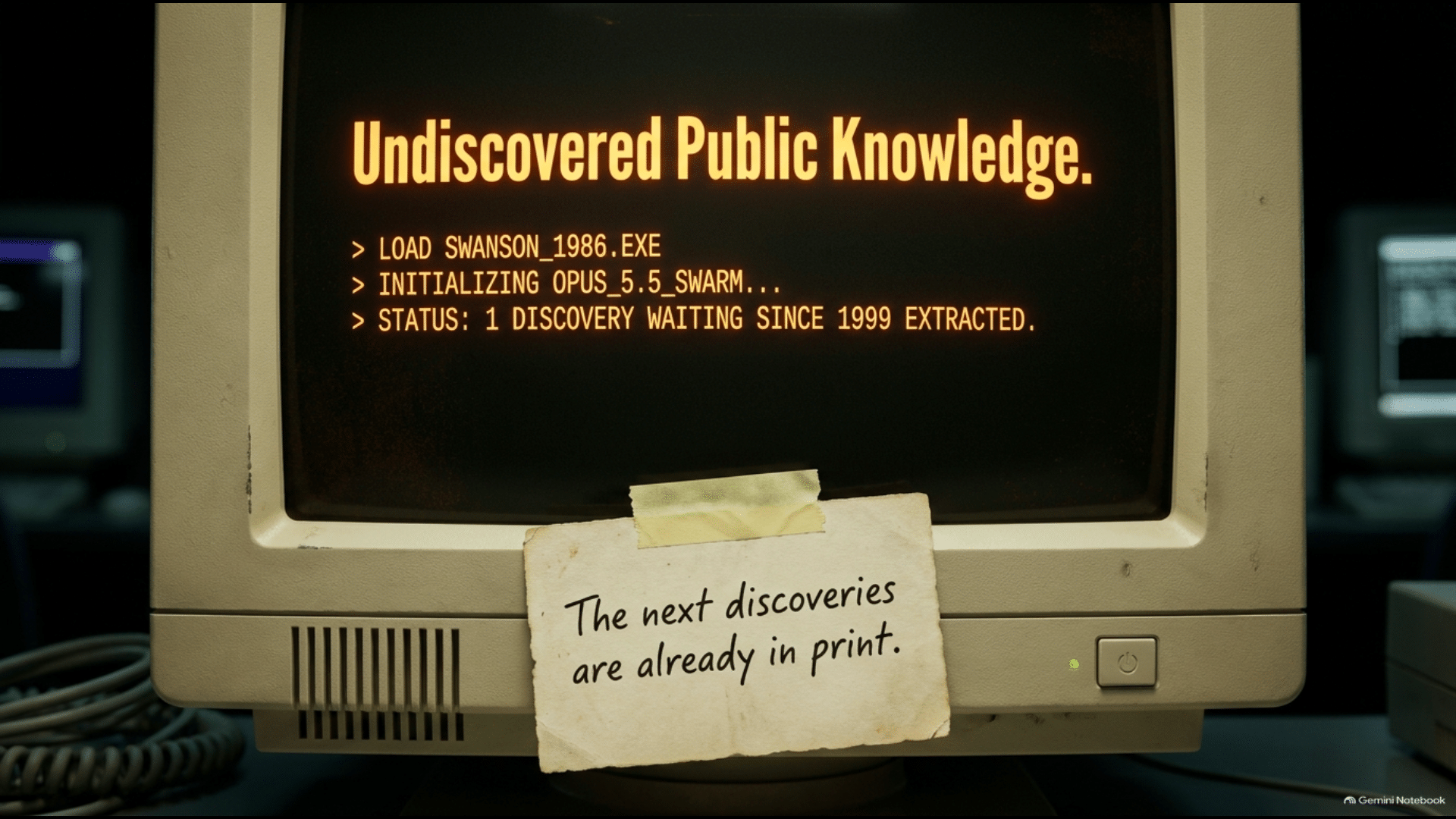
AI In Undiscovered Public Knowledge: A 1986 Chicago Librarian Said The Next Discoveries Were Already In Print.
A swarm of AI agents just flagged a 27-year-old cousin of Prussian blue as a candidate for next-generation computer memory in a major landmark discovery. Don R. Swanson showed in 1986 how such hidden links form, and how anyone can hunt for them.
The Man Who Read Two Shelves At Once
Imagine a library with two rooms. In the first room sit hundreds of papers explaining that a certain substance thins the blood, calms the platelets and relaxes the blood vessels. In the second room sit hundreds of papers explaining that a certain disease grows worse when the blood is thick, the platelets are sticky and the vessels clamp down. The researchers in each room are diligent, and they publish carefully. They simply never walk down the hall.
This article is sponsored by Read Multiplex Members who subscribe here to support my work: Link: https://readmultiplex.com/join-us-become-a-member/
It is also sponsored by many who have donated a “Cup of Coffee”. If you like this, help support my work: Link: https://ko-fi.com/brianroemmele
Listen to the companion podcast: https://rss.com/podcasts/readmultiplex-com-podcast/3216628
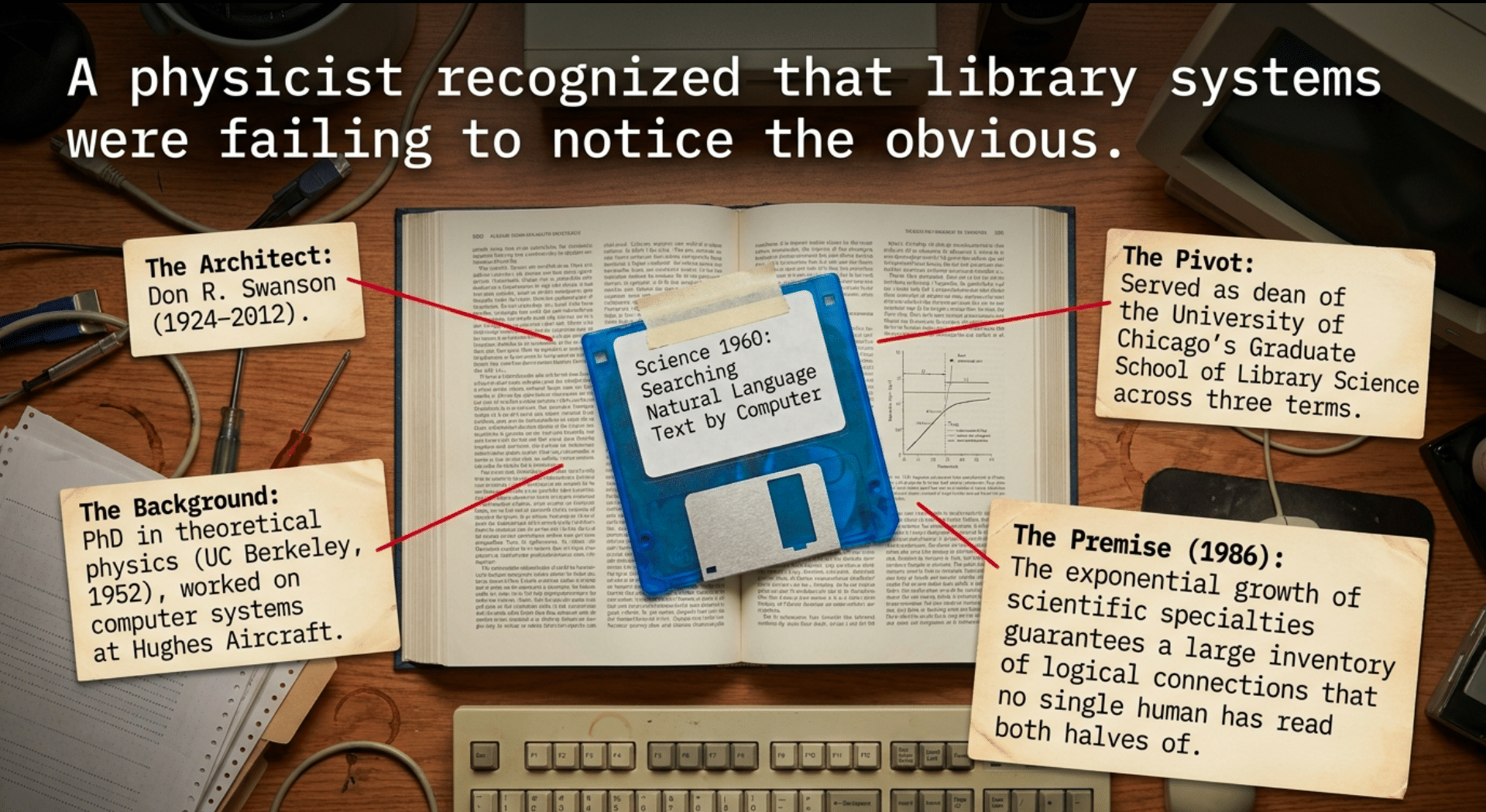
In 1986 a professor at the University of Chicago walked down the hall. His name was Don R. Swanson, and the papers he published that year gave a name to what he found in the space between the two rooms: undiscovered public knowledge.
Swanson came to the library by an unusual road. He was born in Los Angeles in 1924, earned a bachelor’s degree in physics at Caltech in 1945, and took a PhD in theoretical physics at the University of California, Berkeley, in 1952. He worked on computer systems at Hughes Aircraft and then at Ramo-Wooldridge, where he ran a group on machine indexing and machine translation. In 1960 he published “Searching Natural Language Text by Computer” in the journal Science, years before most people had touched a computer. In 1963 he joined the University of Chicago’s Graduate School of Library Science, and he served as its dean across three separate terms. He was a physicist who thought of libraries as systems, and he wondered what those systems were failing to notice.
Fish Oil, Raynaud’s, And A Strange Title
In 1986 Swanson published two papers that belong together. The first, titled simply “Undiscovered Public Knowledge,” appeared in The Library Quarterly (volume 56, number 2, pages 103 to 118). The second carried a title that must have puzzled physicians who found it: “Fish Oil, Raynaud’s Syndrome, and Undiscovered Public Knowledge,” published in the Autumn 1986 issue of Perspectives in Biology and Medicine (volume 30, number 1, pages 7 to 18).
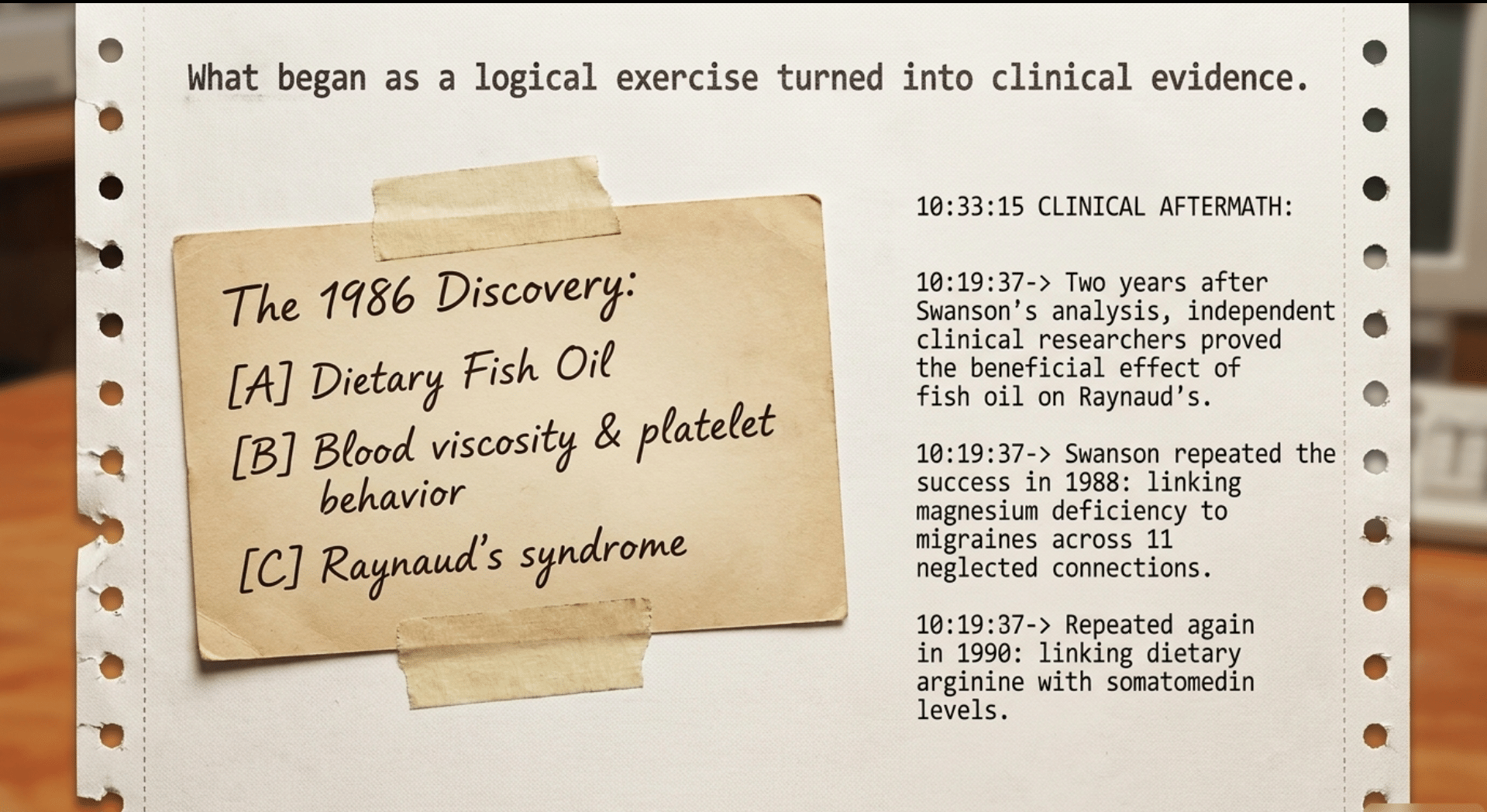
The second paper made the idea concrete. One set of articles showed that dietary fish oil leads to certain changes in the blood and the blood vessels. A second, separate set of articles contained evidence that similar changes might help patients with Raynaud’s syndrome, a disorder in which the small vessels of the fingers and toes spasm, often in the cold. Swanson later summarized the situation in plain terms: the two literatures had no articles in common, had never been cited together, and neither suggested that fish oil might benefit Raynaud’s patients. The hypothesis existed only implicitly, in the logic that connected the two rooms.
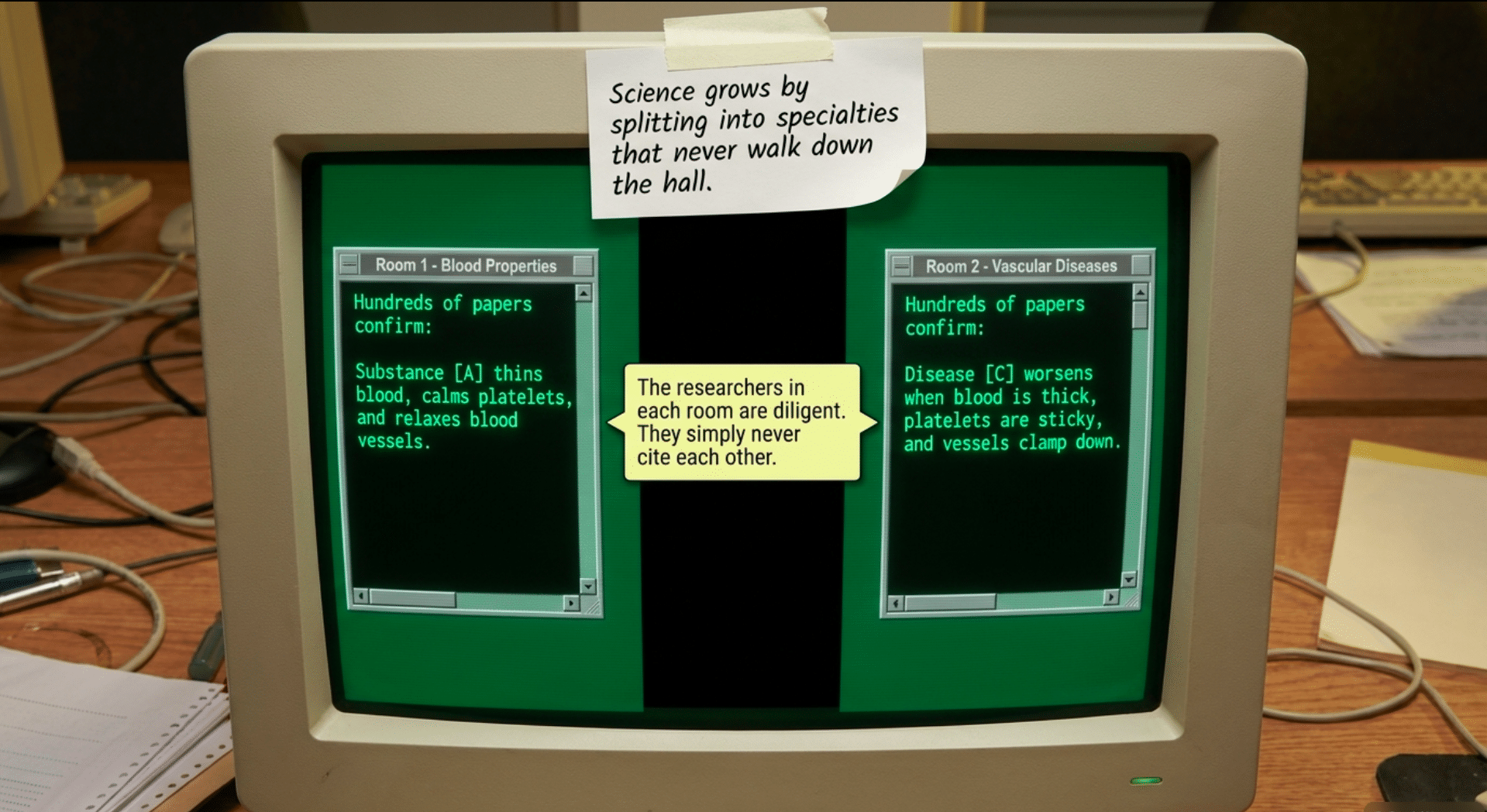
What happened next turned an essay into evidence. In his own account, published in the Bulletin of the Medical Library Association in January 1990, Swanson wrote that two years after his analysis appeared, the first clinical trial demonstrating such a beneficial effect was reported independently by other researchers. Those researchers had not been following his lead. They arrived at the same place by the slow, ordinary route of clinical science, and they confirmed that a link visible on paper in 1986 was real.
Swanson did it again. In the Summer 1988 issue of Perspectives in Biology and Medicine he published “Migraine and Magnesium: Eleven Neglected Connections.” Working through separate literatures, he assembled eleven indirect links suggesting that magnesium deficiency might play a causal role in migraine. A third example followed in 1990, connecting dietary arginine with blood levels of somatomedins. As with every health topic on these pages, I am not a doctor, and none of this is medical advice. This is a story about a method of finding questions worth asking.
The ABC Model
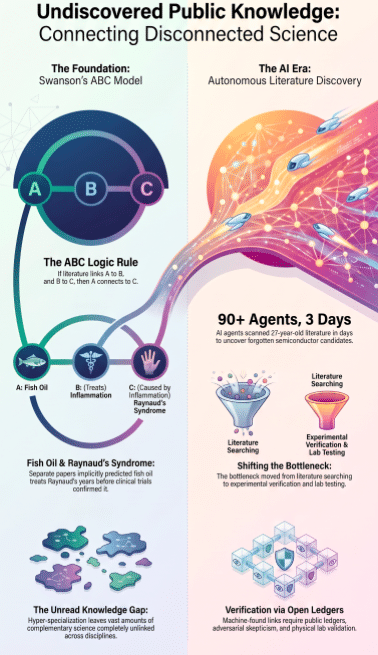
Swanson’s method can be written on an index card. If one body of literature shows that A affects B, and a separate body of literature shows that B affects C, then A may affect C, even though no paper has ever mentioned A and C together. In the first case, A was fish oil, B was the cluster of blood and vessel properties such as viscosity and platelet behavior, and C was Raynaud’s syndrome.
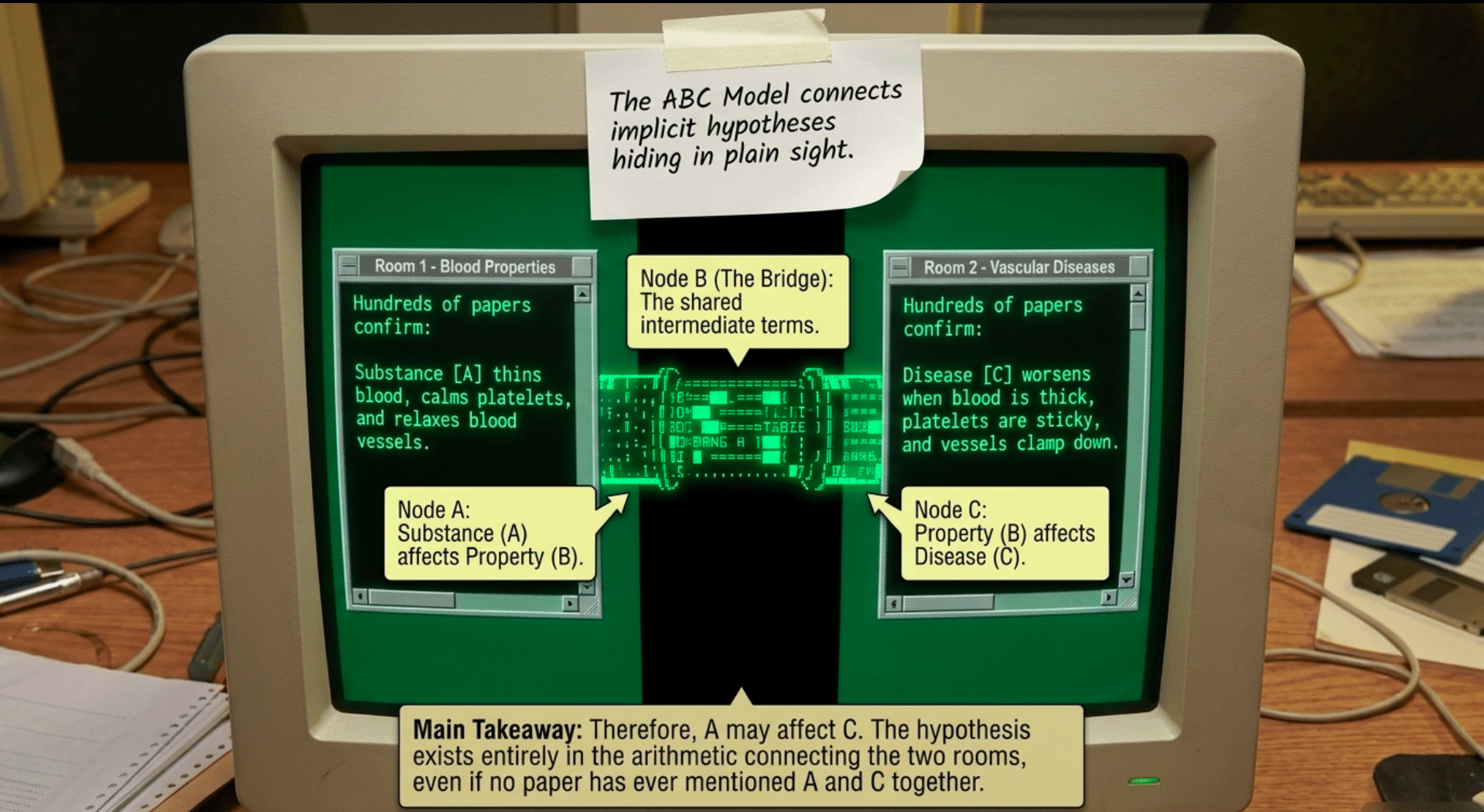
The power of the model comes from arithmetic. Science grows by splitting into specialties, and each specialty writes for its own readers. The number of possible pairings between specialties grows far faster than the number of specialties themselves. Swanson recognized that this growth guarantees a large and expanding inventory of logical connections that no single human has read both halves of. He also recognized a useful clue: when two literatures that ought to be related never cite each other, the silence itself may mark a spot worth digging.
He went on to formalize the search. In 1989 he published “Online Search for Logically-Related Noninteractive Medical Literature: A Systematic Trial-and-Error Strategy” in the Journal of the American Society for Information Science, a step-by-step approach to locating these complementary but disconnected bodies of work using the online databases of the day.
Arrowsmith
Swanson then teamed with Neil R. Smalheiser to turn the method into software. The result was Arrowsmith, a system that searches the MEDLINE biomedical database for pairs of literatures sharing intermediate terms. A user supplies a topic, the system finds a second literature that shares vocabulary with the first while rarely citing it, and the tool presents the shared terms as candidate bridges for a human expert to judge. In 1997 Swanson and Smalheiser described the approach in the journal Artificial Intelligence under the title “An interactive system for finding complementary literatures: a stimulus to scientific discovery.“
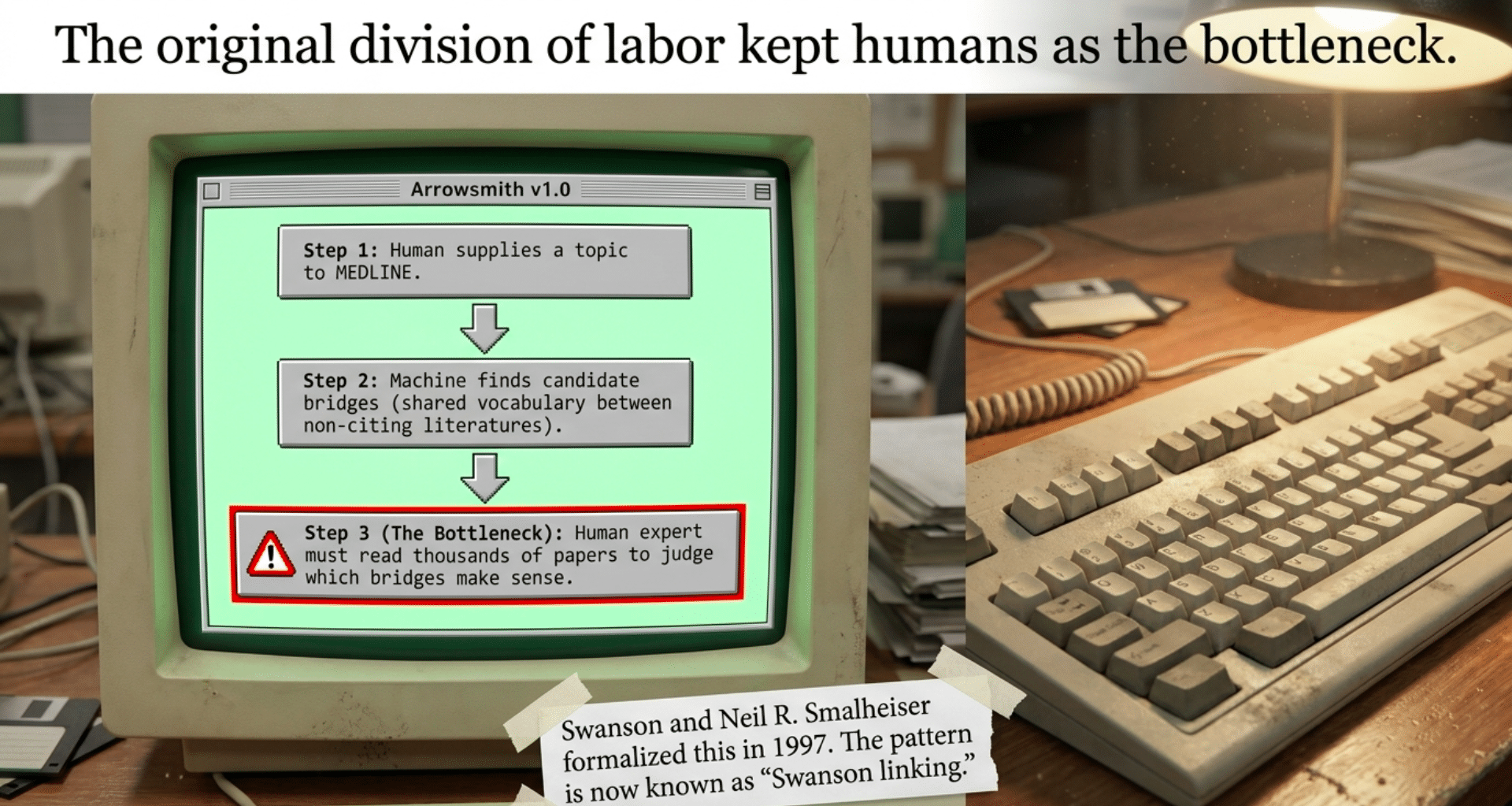
The field that grew from this work is now called literature-based discovery, and the pattern is often called Swanson linking. In 2000 the American Society for Information Science and Technology gave Swanson its Award of Merit, the society’s highest honor. He became professor emeritus in 1996, stayed active until his health declined around 2009, and died on November 18, 2012, at the age of 88.
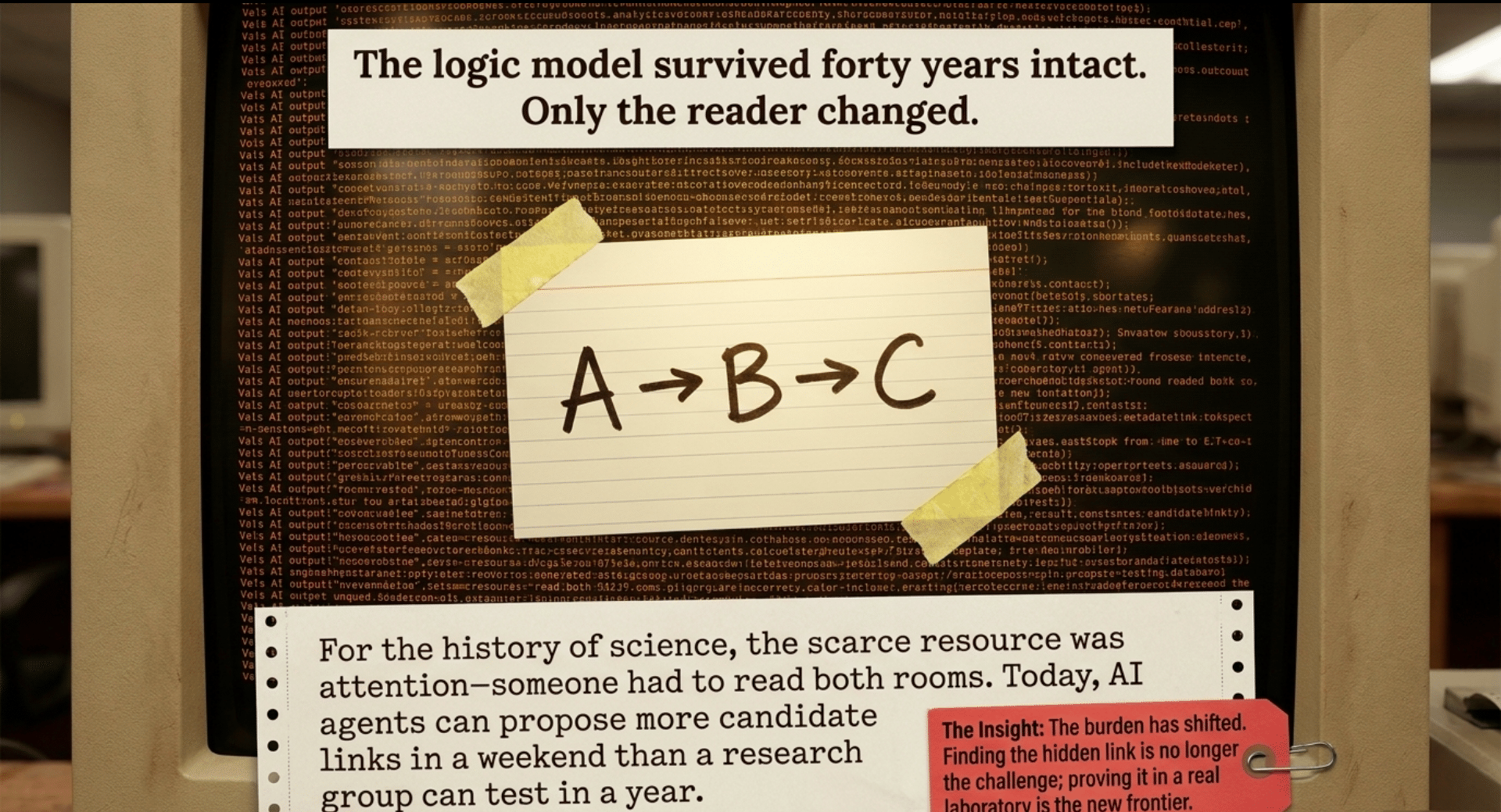
Arrowsmith was always a partnership. The machine found candidate bridges, and the human decided which ones made sense. That division of labor held for decades, because the hard part, reading and reasoning across thousands of papers, belonged to people.
This Week: Ninety Agents And A 1999 Magnet
On October 4, 2026, a company called Vals AI published a post by Geby Jaff titled “Two Room-Temperature Antiferromagnetic Semiconductor Candidates.” The work, in the company’s words, came from “a team of Claude Opus 5.5 agents.”
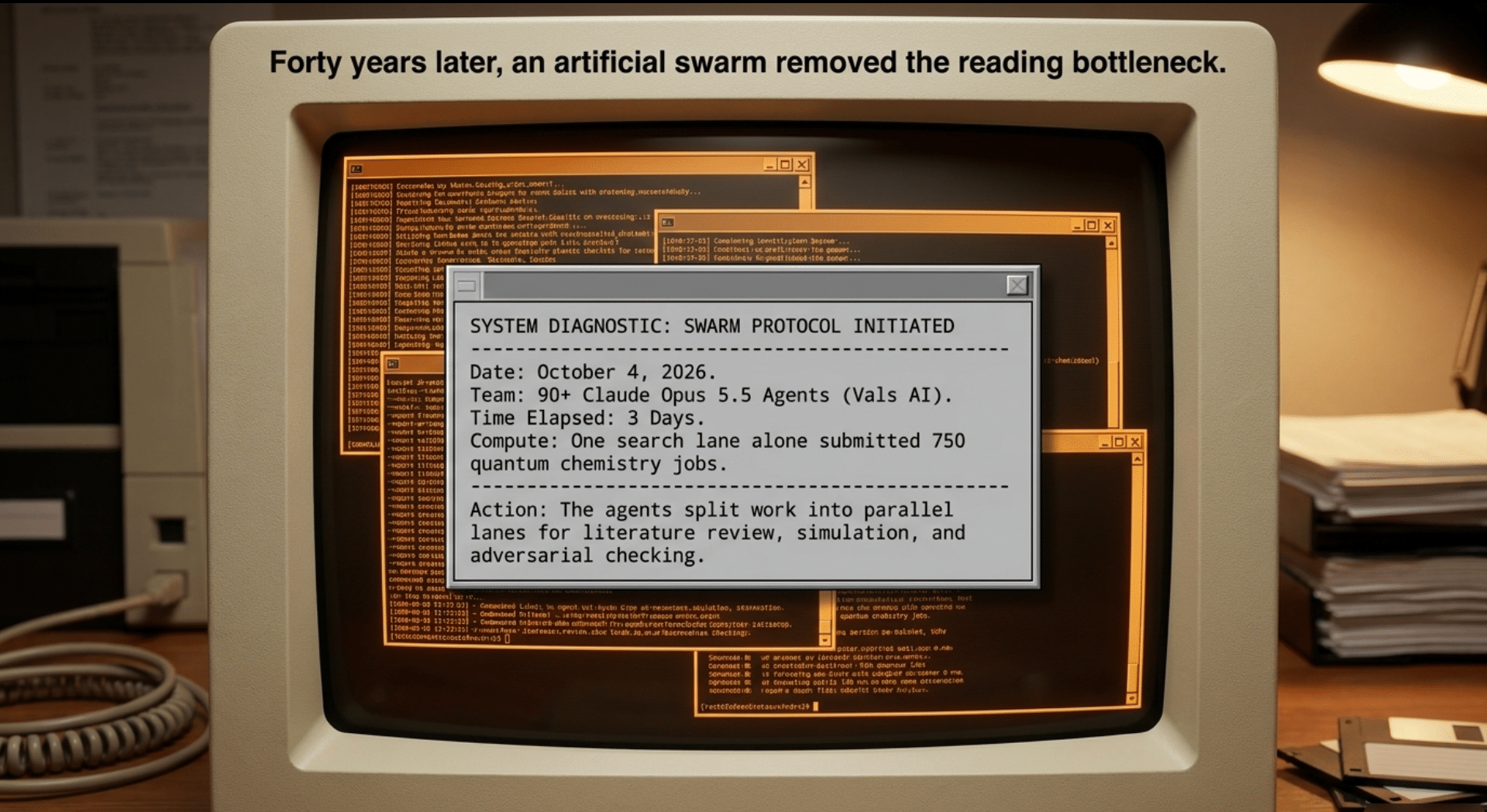
On October 5 at 1:21 PM PT, Vals summarized it on X: “In 3 days, 90+ Opus 5.5 agents helped us uncover two room-temperature magnetic semiconductor candidates in simulations.” Independent coverage reports that the agents split the work into parallel lanes for literature review, simulation and adversarial checking, and that one search lane alone submitted about 750 quantum chemistry jobs.
The target is a prize in computer memory research. Ordinary ferromagnets, the kind that hold notes on a refrigerator, sort electrons by spin, which lets a device read and write information, yet their stray magnetic fields disturb neighboring bits. Antiferromagnets cancel their own magnetism, so they can be packed tightly and switched fast, yet ordinary ones cannot sort electrons by spin. Researchers want a material with both virtues: zero net magnetism, a semiconductor’s band gap, and electrons sorted by spin. Vals calls the class it pursued “Luttinger compensated.”
The agents designed one new compound, YBaMnFeO5, which their simulations favor on paper. Vals reports a catch: the design needs manganese and iron atoms arranged in a perfect checkerboard, and the simulations suggest that the arrangement scrambles at around 950 K, below the temperatures normally used to make such oxides.
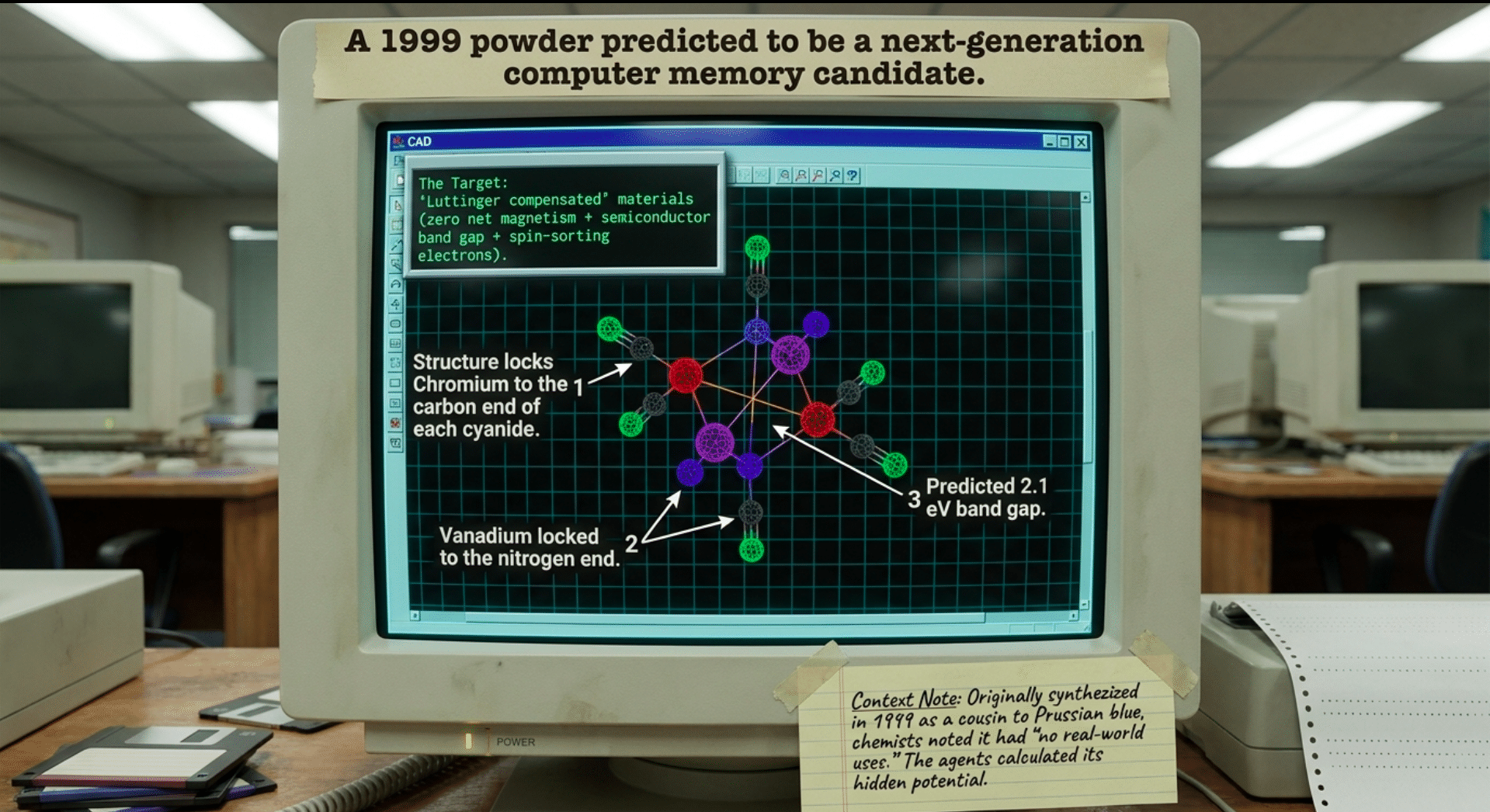
The second candidate is the Swanson story. It is called KV[Cr(CN)6], a potassium, vanadium and chromium cyanide that belongs to the same structural family as Prussian blue, the pigment first made in Berlin around 1706. Stephen M. Holmes and Gregory S. Girolami of the University of Illinois at Urbana-Champaign reported the compound in the Journal of the American Chemical Society in 1999 (volume 121, pages 5593 to 5594), in a paper received on March 24 of that year. They described a molecule-based magnet with what they called “the unprecedented magnetic ordering temperature of 376 K (103 °C).” In the same paper they noted that such solids “do not at present have real-world uses,” largely because so few stayed magnetic above room temperature.
The chemists had designed the compound so that the magnetism of its two metals would nearly cancel. What the Vals agents added was a new reading of the old material. Their calculations predict that KV[Cr(CN)6] behaves as a Luttinger-compensated semiconductor, with a band gap of about 2.1 electron volts and with both band edges carrying the same spin, over windows of about 2.6 electron volts for holes and 1.6 electron volts for electrons. For comparison, thermal jiggling at room temperature amounts to about 26 thousandths of an electron volt. The structure also locks each metal into its own site, with chromium bonded to the carbon end of each cyanide and vanadium to the nitrogen end, which is the very property the designed oxide lacked. Vals summarized the episode in a phrase Swanson would have recognized: the material had been “hiding in plain sight.”
The Honest Part
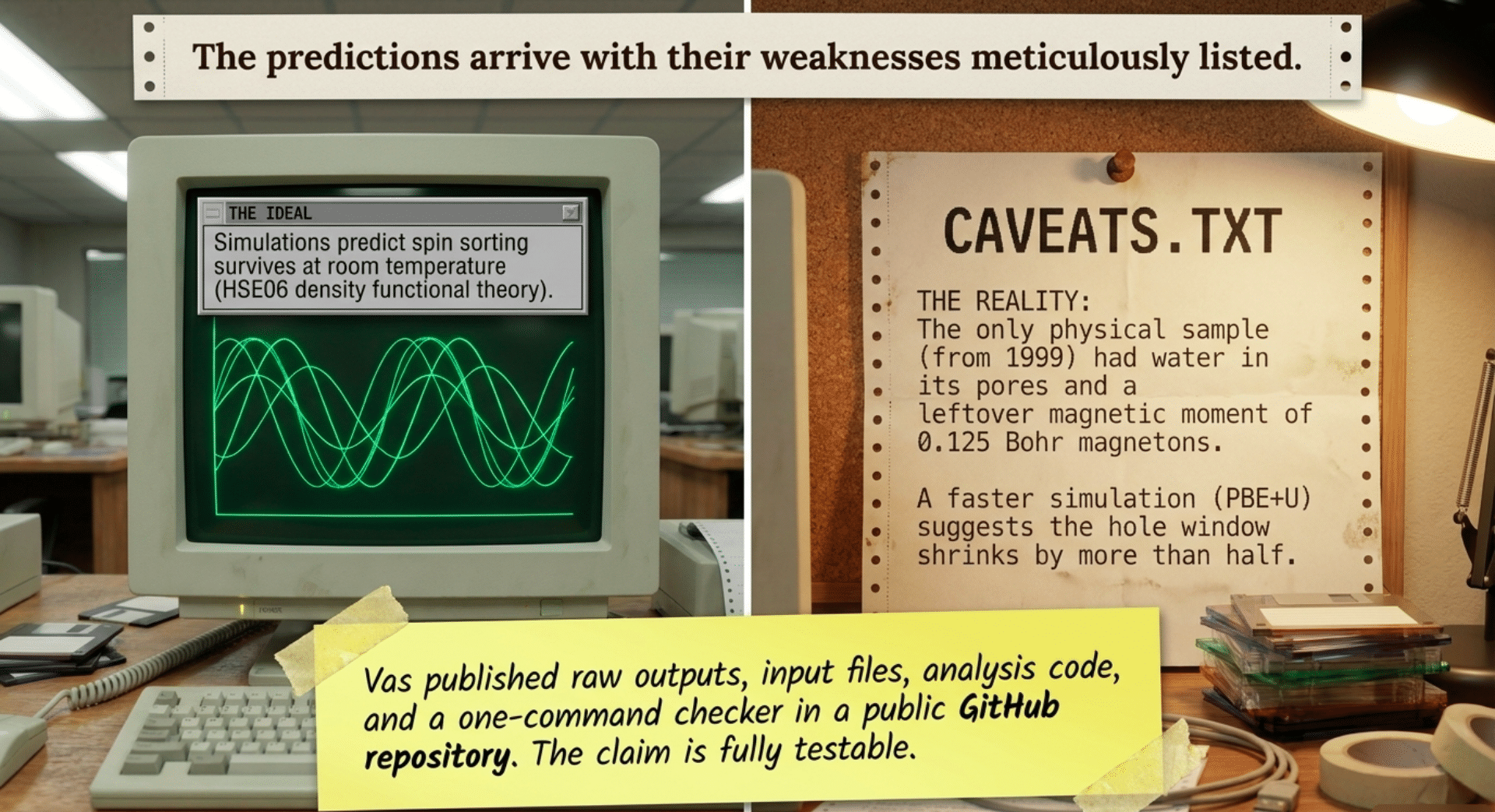
Everything above about spin sorting comes from simulation. Neither the band gap nor the spin sorting of KV[Cr(CN)6] has been measured. Vals says so plainly, and its X thread says it again: “These are predictions for perfect crystals; nobody has measured the spin sorting yet.”
The caveats run deeper. The only sample on record is the 1999 powder, which had water in its pores and showed a small leftover magnetic moment of 0.125 Bohr magnetons per formula unit, where a perfect crystal would show zero. Vals ran two levels of density functional theory, a faster method called PBE+U and a slower, usually more accurate one called HSE06. The two disagree about the water. HSE06 says the spin sorting survives, while PBE+U says the hole window shrinks by more than half. The company’s stated next step is to make the compound again and measure it.
What Vals did well deserves equal emphasis. It published the input files, raw outputs and analysis code, along with a one-command checker, independent re-runs and a list of known caveats, in a public GitHub repository. Anyone with the skill can check the work. That ledger matters as much as the candidate, because it makes the claim testable by people who owe the company nothing.
From Swanson’s Index Card To A Swarm
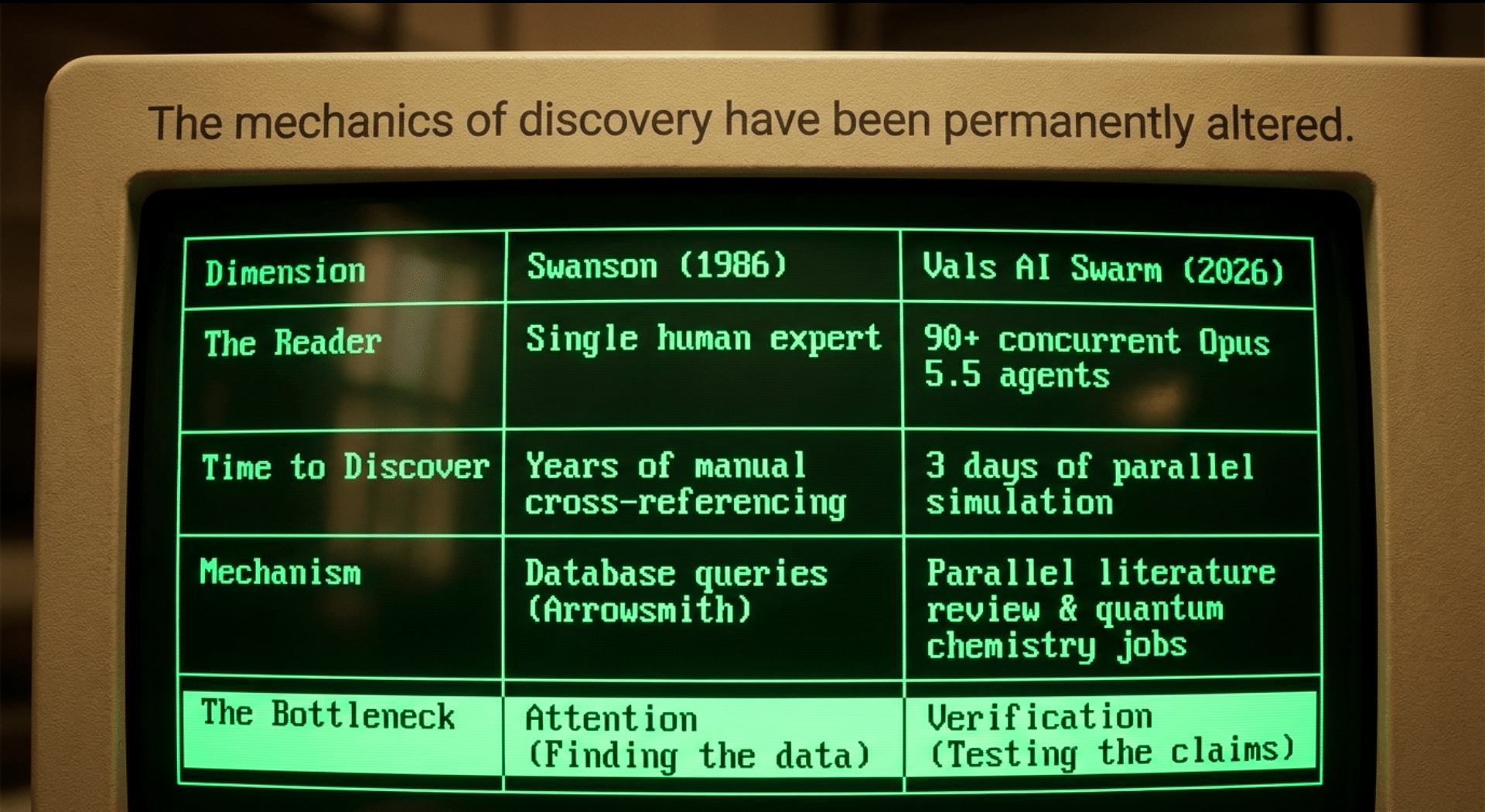
Set the two stories side by side and the shape becomes clear. In 1986 one man, trained as a physicist and working in a library school, read across two medical literatures and found a link that a clinical trial later supported. In 2026 more than ninety software agents spent three days reading, calculating and arguing with each other, and they surfaced a 1999 compound whose predicted properties had gone unremarked. The ABC model survived the forty years intact. Only the reader changed.
That change moves the bottleneck. For most of the history of science, the scarce resource in literature-based discovery was attention: someone had to read both rooms. Agents can now propose more candidate links in a weekend than a research group can test in a year. The scarce resource becomes verification, meaning careful calculation, honest skepticism, and in the end a measurement in a real laboratory. The Vals ledger points toward the right habit for this new era, where every machine-found link arrives with its evidence attached and its weaknesses listed.
How To Build Your Own Literature-Discovery Workflow
You can run a small version of Swanson’s method on a topic you care about with free public databases and an AI assistant you already use. The workflow below needs no programming. It does require patience and a willingness to doubt your own results.
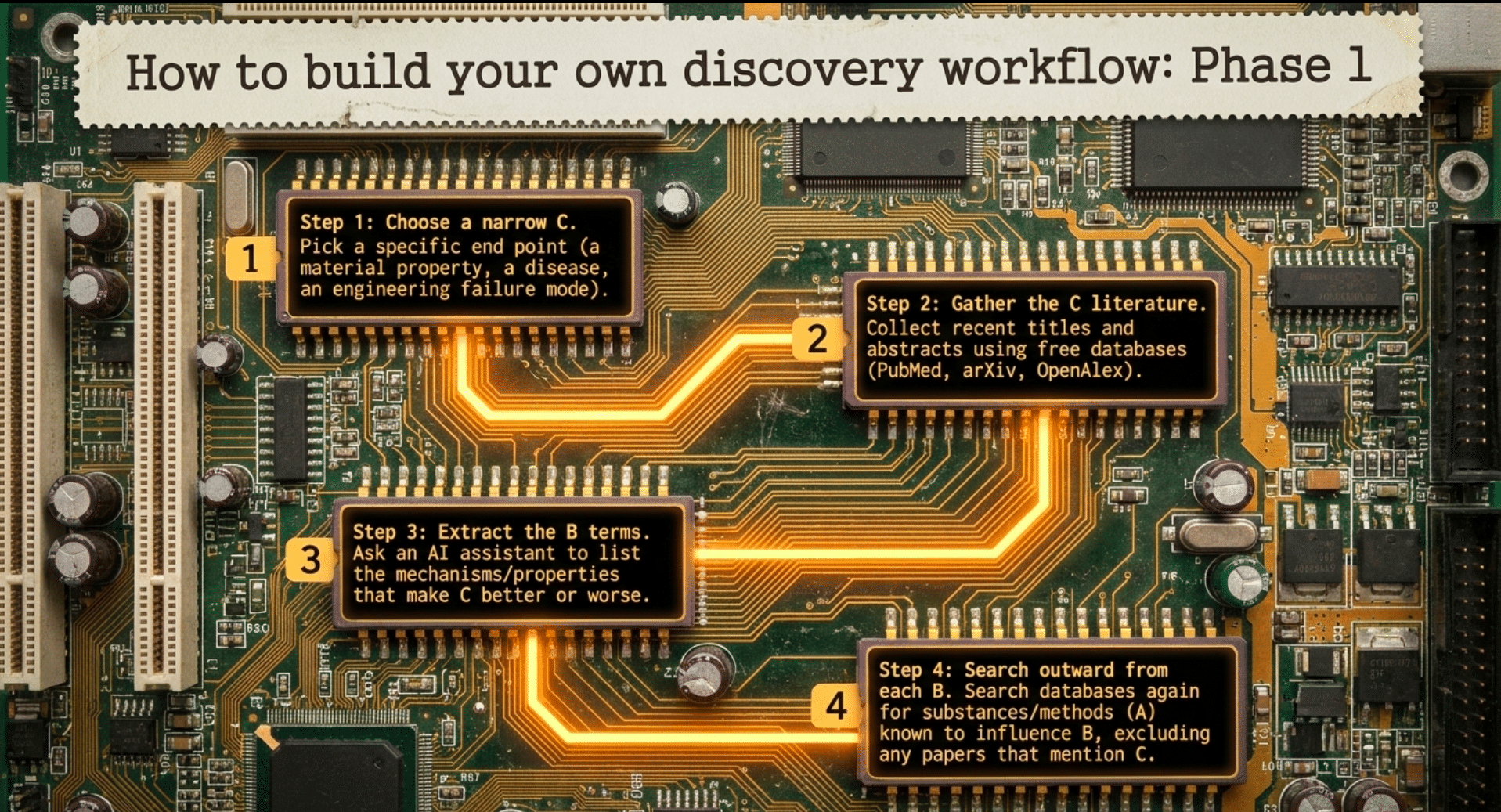
1. Choose a narrow C. Pick a specific problem as your end point, such as a particular condition, a material property, a failure mode in a machine you maintain, or a pest in your garden. A narrow target keeps the search manageable.
2. Gather the C literature. Search a free database suited to your field, such as PubMed for biomedicine, arXiv for physics and computing, or OpenAlex for nearly every discipline. Collect recent titles and abstracts, a few dozen to a few hundred, and save them in a document.
3. Extract the B terms. Ask your AI assistant to read the abstracts and list the mechanisms, properties and processes that the literature says make C better or worse. In Swanson’s first case these were blood viscosity, platelet behavior and vessel reactivity. Ask for each term to be tied to the specific abstract that supports it.
4. Search outward from each B. For each promising B term, search the database again, this time for substances, methods or materials known to influence B, excluding papers that mention C. These candidates are your possible A terms.

5. Check for disjointness. For each A, search for papers that mention A and C together. If many exist, the link is already known. If few or none exist, you may have found a gap worth examining, which is the silence Swanson treated as a clue.
6. Assign a skeptic. Ask a fresh session of your assistant, or a second assistant, to argue against each candidate link. Have it look for contradicting evidence, dose or scale problems, and reasons the B connection might run in the opposite direction. Keep only the links that survive.
7. Verify every citation by hand. AI assistants can invent papers. Open each cited source yourself and confirm that it exists and says what the assistant claims.
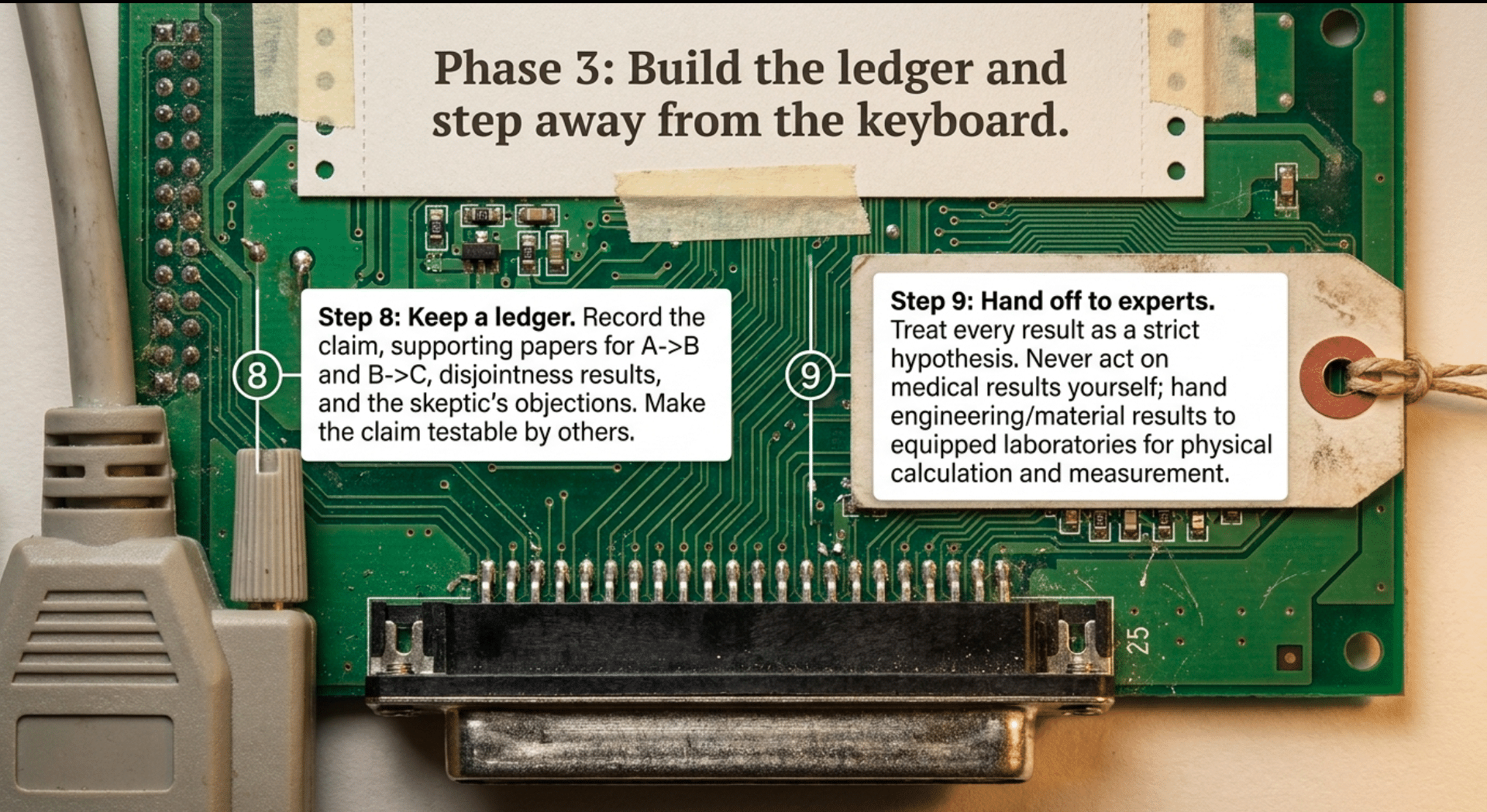
8. Keep a ledger. For every surviving link, record the claim, the supporting papers for A to B and for B to C, the disjointness search and its result, the skeptic’s objections, and the current status. Vals published exactly this kind of record, and it is what turns a hunch into something others can check.
9. Hand off to experts and experiments. Treat every result as a hypothesis. In health questions, take it to a qualified professional and never act on it yourself. In materials or engineering questions, the next step is a calculation or a measurement by people equipped to do it.
Run this a few times and you will feel what Swanson felt in Chicago. Most candidate links collapse under scrutiny. A few hold up long enough to deserve a closer look, and those few were sitting in public view the whole time.
What Comes Next
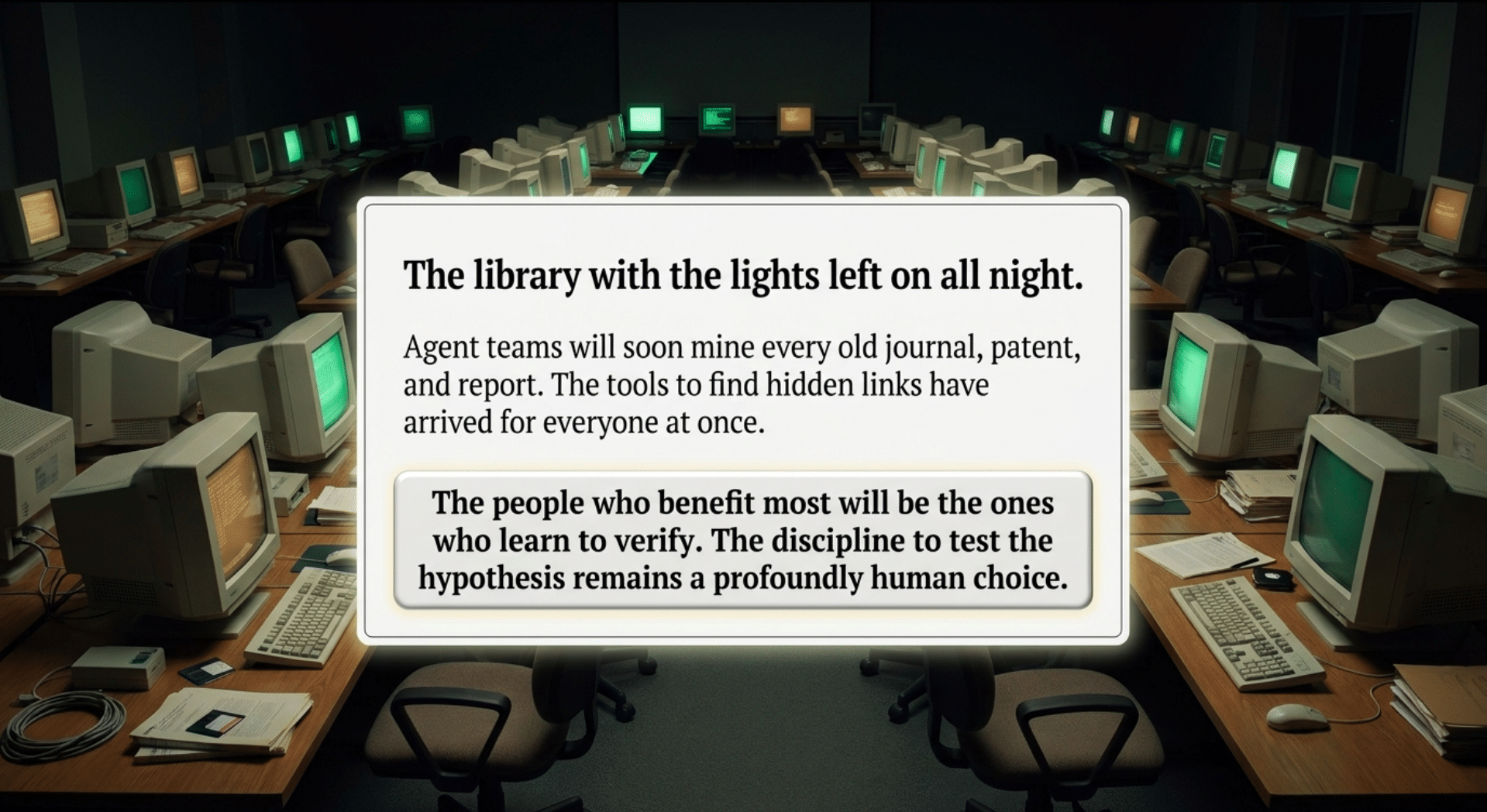
The near future looks like Swanson’s library with the lights left on all night. Agent teams will mine old journals, patents and technical reports in every field, and many compounds, drugs and methods will be found to have properties their discoverers never thought to check. The 1999 chemists wrote that their magnet had no real-world use. Twenty-seven years later, a team of machines proposed one, pending measurement.
The people who benefit most will be the ones who learn to verify. They will ask for the ledger, rerun the checker, read the original paper, and wait for the laboratory before they celebrate. The tools to find hidden links are arriving for everyone at once. The discipline to test them remains a human choice.
Don Swanson spent his career arguing that the next discoveries were already in print. This week a swarm of agents offered fresh support for his claim, and the open question now is how many more are waiting on the shelves.
Support This Work, You Will See It No Place Else
To continue this vital work documenting, analyzing, and sharing these hard-won lessons before we launch humanity’s greatest leap: I need your support. Independent research like this relies entirely on readers who believe in preparing wisely for our multi-planetary future. If this has ignited your imagination about what is possible, please consider donating at buy me a Coffee or becoming a member. Value for value you recieved here.
Every contribution helps sustain deeper fieldwork, upcoming articles, and the broader mission of translating my work to practical applications. Ain ‘t no large AI company supporting me, but you are, even if you just read this far. For this, I thank you.
Stay aware and stay curious,

🔐 Start: Exclusive Member-Only Content.
Membership status:
🔐 End: Exclusive Member-Only Content.
~—~
~—~

~—~
Subscribe ($99) or donate by Bitcoin.
Copy address: bc1qkufy0r5nttm6urw9vnm08sxval0h0r3xlf4v4x
Send your receipt to [email protected] to confirm subscription.

Stay updated: Get an email when we post new articles:

THE ENTIRETY OF THIS SITE IS UNDER COPYRIGHT. IMPORTANT: Any reproduction, copying, or redistribution, in whole or in part, is prohibited without written permission from the publisher. Information contained herein is obtained from sources believed to be reliable, but its accuracy cannot be guaranteed. We are not financial advisors, nor do we give personalized financial advice. The opinions expressed herein are those of the publisher and are subject to change without notice. It may become outdated, and there is no obligation to update any such information. Recommendations should be made only after consulting with your advisor and only after reviewing the prospectus or financial statements of any company in question. You shouldn’t make any decision based solely on what you read here. Postings here are intended for informational purposes only. The information provided here is not intended to be a substitute for professional medical advice, diagnosis, or treatment. Always seek the advice of your physician or other qualified healthcare provider with any questions you may have regarding a medical condition. Information here does not endorse any specific tests, products, procedures, opinions, or other information that may be mentioned on this site. Reliance on any information provided, employees, others appearing on this site at the invitation of this site, or other visitors to this site is solely at your own risk.
Copyright Notice:
All content on this website, including text, images, graphics, and other media, is the property of Read Multiplex or its respective owners and is protected by international copyright laws. We make every effort to ensure that all content used on this website is either original or used with proper permission and attribution when available.
However, if you believe that any content on this website infringes upon your copyright, please contact us immediately using our 'Reach Out' link in the menu. We will promptly remove any infringing material upon verification of your claim. Please note that we are not responsible for any copyright infringement that may occur as a result of user-generated content or third-party links on this website. Thank you for respecting our intellectual property rights.
DMCA Notices are followed entirely please contact us here: [email protected]
