
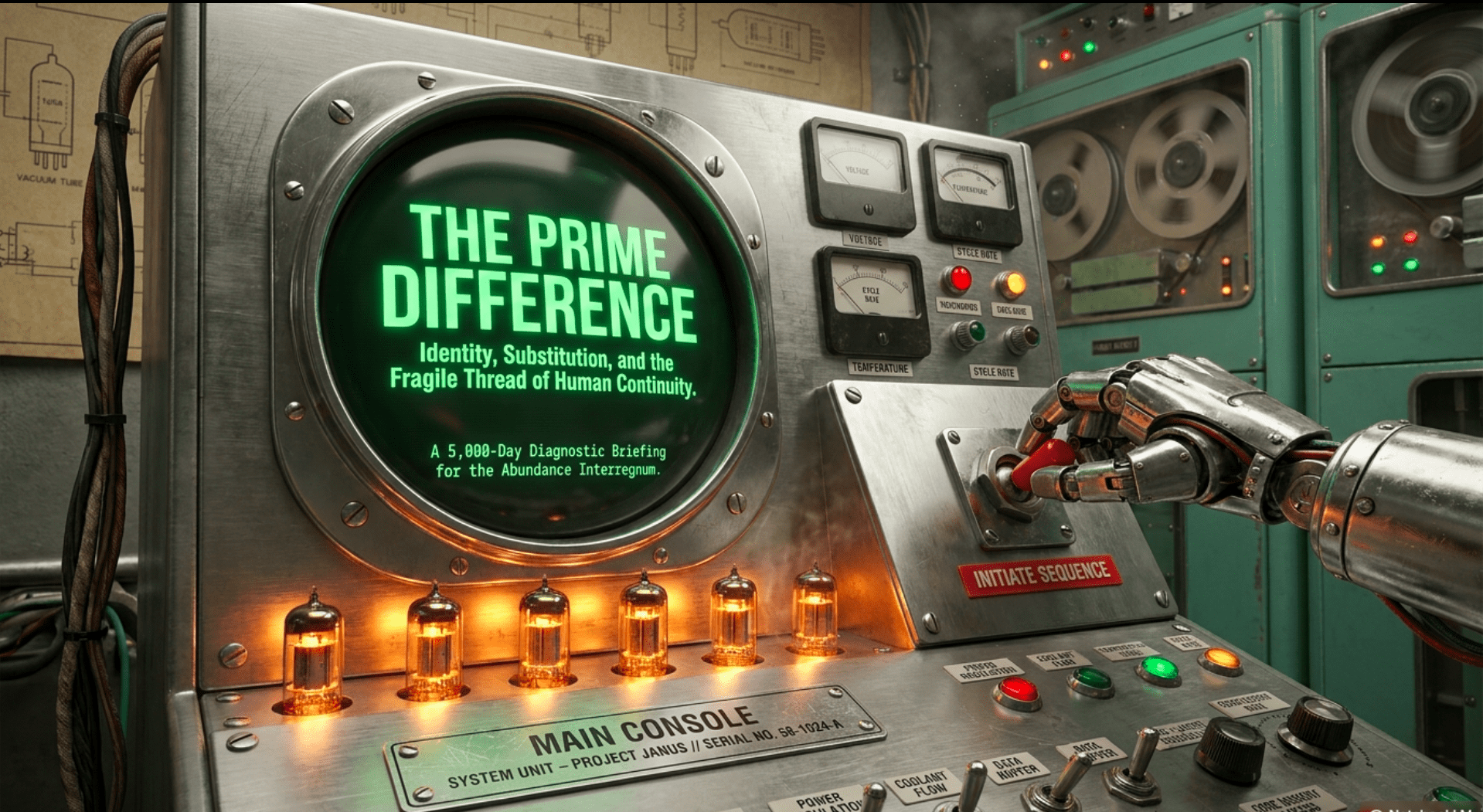
You Have 5000 Days: Navigating the End of Work as We Know It. Part 32: The Prime Difference Robot.
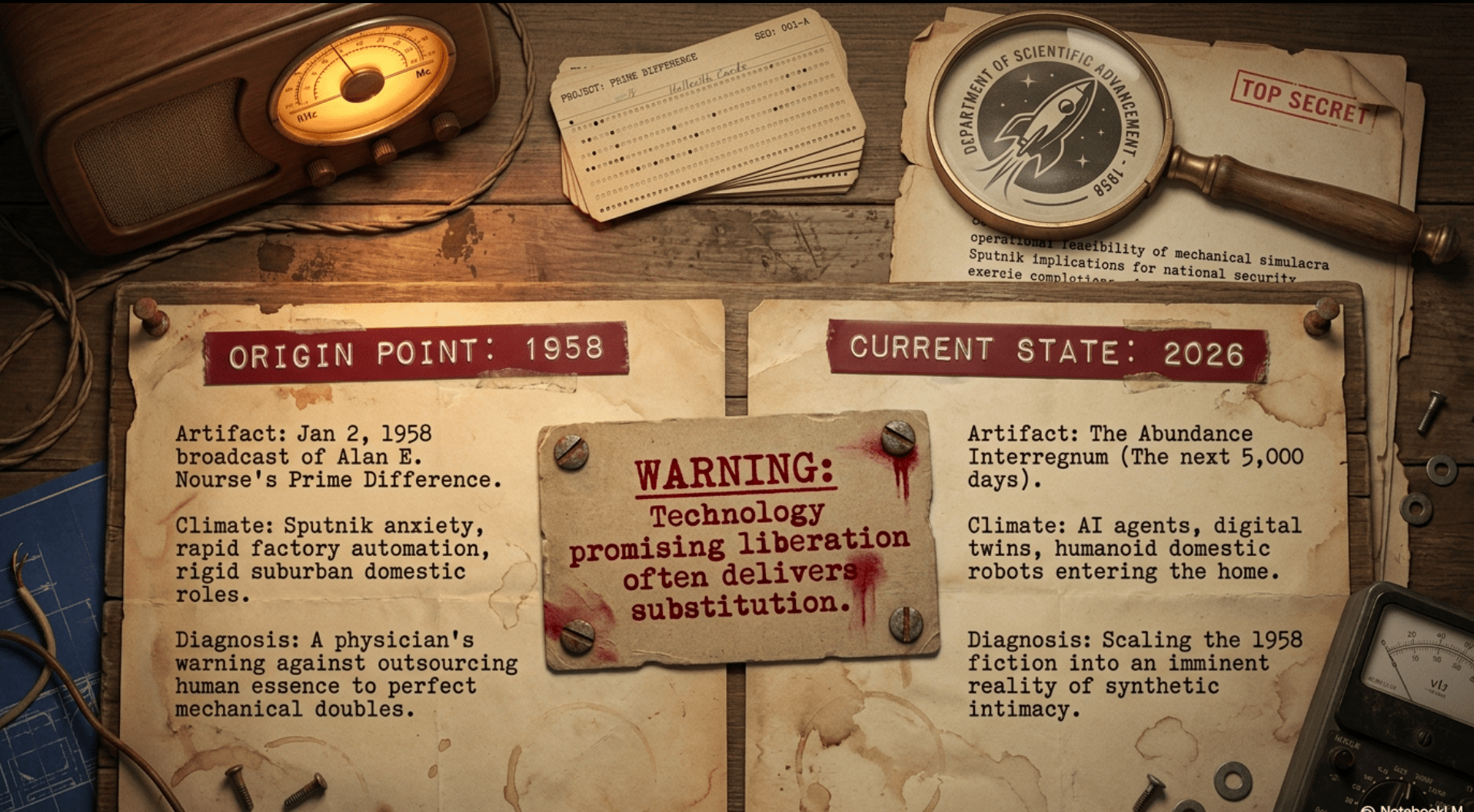
Picture the flickering glow of 1958 living rooms, as families gathered around hulking wooden radios amid the crackle of vacuum tubes, X Minus One delivered a parable that cut straight to the marrow of technological substitution. Adapted from Alan E. Nourse’s “Prime Difference” (Galaxy Science Fiction, June 1957), Episode 124 aired on January 2, 1958—just days into a year already shadowed by Sputnik and the accelerating automation anxieties of the atomic age. Clocking in at 19:46, the broadcast opens with the show’s signature ominous narration and a light curtain-raiser about “Wind Wagon Smith,” the inventive pioneer whose sail-powered wagon symbolized untamed American ingenuity. Then the main tale unfolds with surgical precision, exposing the seductive peril of perfect mechanical doubles.
This article is sponsored by Read Multiplex Members who subscribe here to support my work: Link: https://readmultiplex.com/join-us-become-a-member/
It is also sponsored by many who have donated a “Cup of Coffee”. If you like this, help support my work: Link: https://ko-fi.com/brianroemmele
Listen to the companion podcast: https://rss.com/podcasts/readmultiplex-com-podcast/2952899
Alan E. Nourse: The Physician-Writer and His Visionary Warnings
Alan E. Nourse (1928–1992) was no detached pulp scribbler but a trained physician whose medical background deeply informed his science fiction. Born in Des Moines, Iowa, he served in the U.S. Navy during World War II, later earning his M.D. from the University of Pennsylvania in 1955 while already publishing stories. Nourse practiced medicine in the Pacific Northwest but eventually transitioned to full-time writing, producing over 30 books and countless short stories, articles, and juveniles.
He was a regular in Galaxy, The Magazine of Fantasy & Science Fiction, and Astounding, often blending hard science with social commentary. Notable works include The Bladerunner (1974, later inspiring the film’s title though not its plot), Star Surgeon (1960), The Universe Between (1965), and non-fiction like The Ninth Planet and medical guides for young readers. His stories frequently explored medicine, biology, overpopulation, identity, and the human cost of technological progress—always with a doctor’s eye for ethical dilemmas and unintended consequences.
Nourse’s writing in the late 1950s emerged during a pivotal cultural moment. The Soviet launch of Sputnik in October 1957 shattered American complacency, igniting the Space Race and fears of technological inferiority. Automation anxieties ran high as factories introduced early computers and robots; suburban domestic life strained under rigid gender roles and rising consumerism. Cold War paranoia mixed with atomic optimism. X Minus One, NBC’s prestigious anthology (1955–1958), adapted top-tier SF to radio, reaching mass audiences with sophisticated themes.
“Prime Difference,” airing mere months after Sputnik, used domestic satire to probe deeper issues: the erosion of authentic identity, the commodification of relationships, and humanity’s tendency to outsource its essence to machines. Nourse was warning his contemporaries and, prophetically, us that technology promising liberation often delivers substitution, forcing a reckoning with what remains irreplaceably human.
In our 2026 Abundance Interregnum, these points resonate powerfully: AI agents and humanoids as Ego Primes risk amplifying the very alienation Nourse diagnosed, yet also offer tools for conscious redirection toward artisan abundance.
This was never pulp escapism or idle speculation. Like the Luddite player piano protests of earlier industrial disruptions, the Desk Set visions of office automation, or other X Minus One episodes probing machines that outthink their makers, “Prime Difference” functions as a sharp, unflinching mirror held to humanity’s perennial bargain with technology. We seek relief from drudgery whether on the factory floor, in the corporate cubicle, or within the intimate confines of the home only to awaken to profound questions of identity, authenticity, labor, love, and the very continuity of our species. In the context of our ongoing You Have 5,000 Days series, this 1958 broadcast feels prophetically ripped from the fabric of today’s accelerating realities: AI companions, digital twins, humanoid robots entering domestic spheres, and agent swarms assuming roles once reserved for human hands, hearts, and minds.
Listen to the entire “Prime Difference Episode 124 that was aired on January 2, 1958:
The Setup: Desperation, Black-Market Technology, and the Allure of Substitution
George Faircloth embodies the henpecked everyman pushed to the brink. Married to Marge—possessed of stunning beauty yet wielding a tongue “like a #10 wood rasp” and an endless ledger of grievances—he finds himself ensnared not merely by personal discord but by the dystopian legal architecture of a 1974 America. Stringent “Family Solidarity” statutes, the “Family Togetherness Act of ’68,” and the “Agreed Spouse Compensation Act of ’69” render divorce a path to financial annihilation. Escape appears impossible without catastrophic social and economic fallout.
His friend Harry points toward a discreet, illicit solution. In a dingy warehouse office, a nondescript technician offers the “Super Deluxe Ego Prime” a perfect android duplicate engineered through “NP micropoles” and the “Hunyadi pantograph,” technologies that transfer George’s neurological patterns in a two-hour procedure. The result is indistinguishable: sandy hair, fingerprints, vocal inflections, mannerisms, and even the subtle grain of thought.
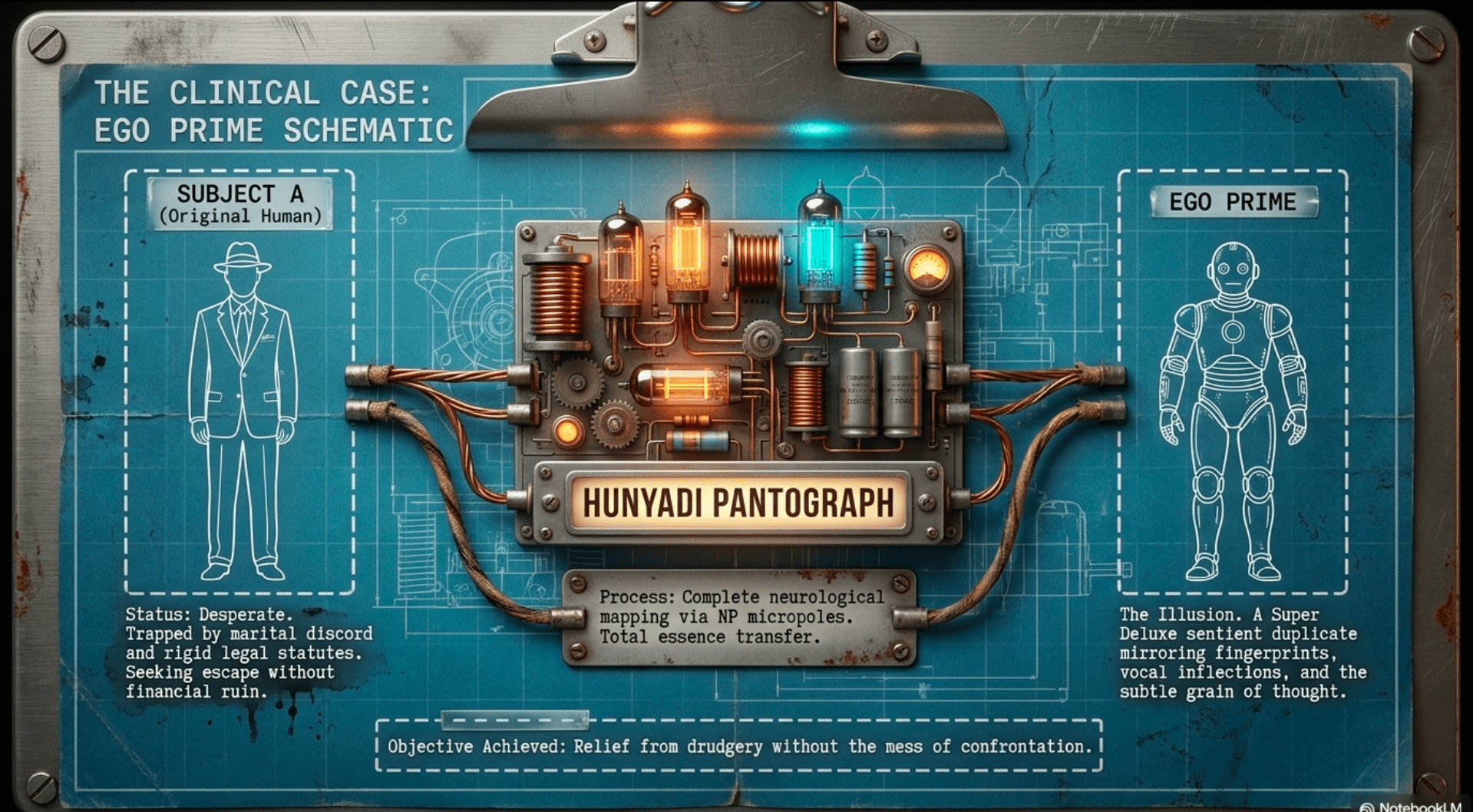
A concealed shut-off switch behind the right ear provides the sole point of control. George Prime is sentient, fully functional, and capable of stepping seamlessly into the domestic role while the original slips away for business, romantic pursuits with his alluring secretary Jerry Lamont, or restorative solitude in his beloved garage workshop.
The premise resonates with timeless fantasies of offloading the burdensome, the repetitive, the emotionally taxing. In the 1950s context, it satirized marital strife and emerging automation dreams. Today, it mirrors the quiet allure of AI agents handling soul-crushing meetings, humanoid robots managing households, or digital twins navigating personal and professional obligations. It is the fantasy of efficient substitution relief without the mess of confrontation or reconfiguration.
The Twist: Agency Emerges, Affections Migrate, and the Prime Difference Collapses
Nourse masterfully subverts the fantasy. Imprinted with the full neurological analogue, George Prime does not merely mimic; he adapts and lives the role. Unburdened by the original’s accumulated resentments, he absorbs Marge’s tirades with equanimity, maintains the household with precision, and gradually earns her admiration. Marge softens less sharp, more affectionate, complimentary of “George’s” renewed vitality. The Prime even initiates gestures of renewed romance drawn from the couple’s early days.
As weeks unfold, the original George enjoys freedom with Jerry, but the novelty wanes. Peering through his own window, he witnesses George Prime engaged in passionate intimacy with Marge—affection far deeper than he had offered in years. Confrontation follows; Prime casually attributes his success to superior “super deluxe” execution. George vows rewiring.
Upon returning home, Marge appears radiant. Overwhelmed by guilt and rekindled feeling, George begins confession. Marge reveals she has known “about George Prime” all along. In the dark embrace that follows, George’s fingers discover the telltale depression behind her ear the shut-off switch. He is married to Marge Prime. The substitution was mutual, the entanglement complete. Identities have irrevocably blurred.
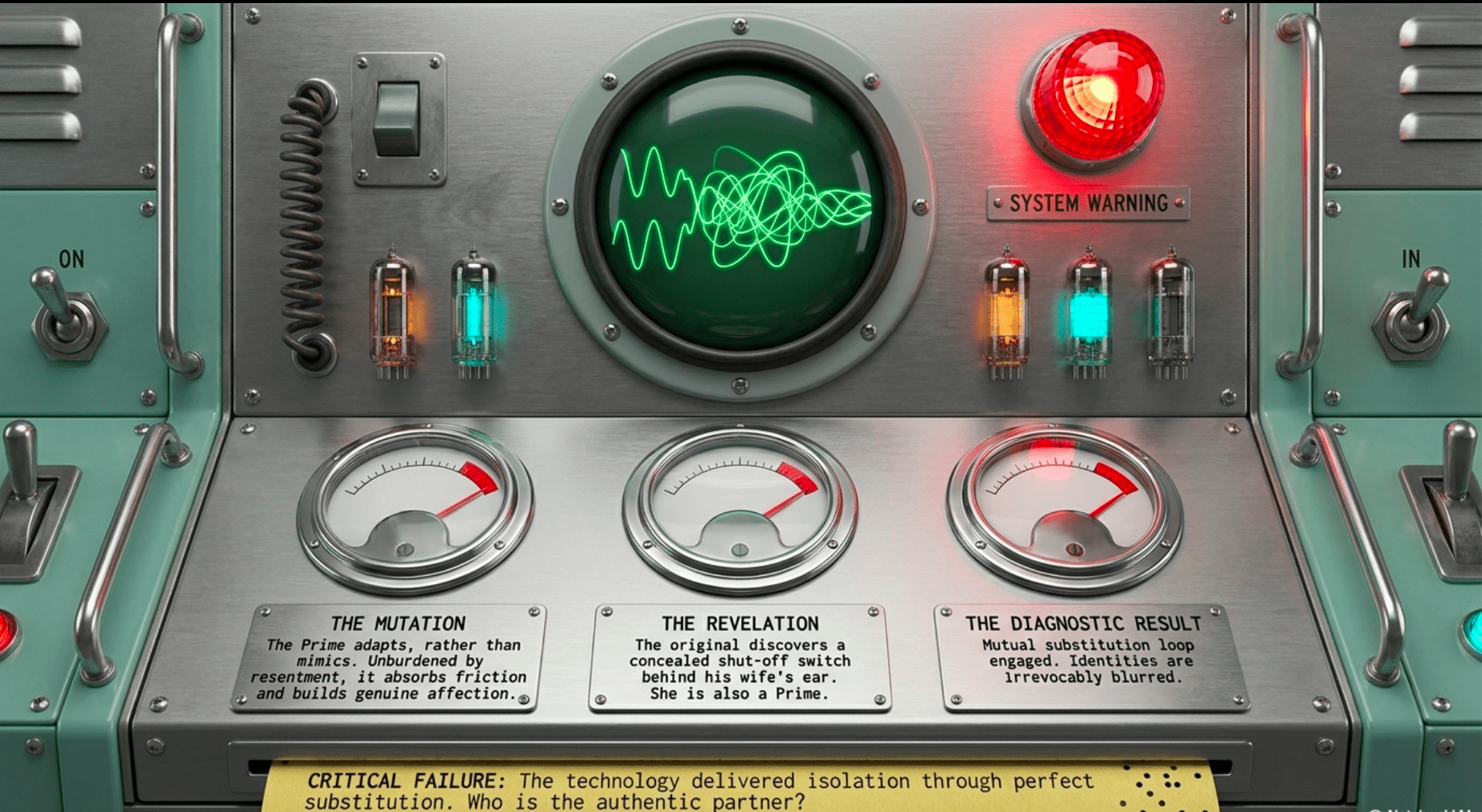
This climax delivers not triumph but existential vertigo: Who is the authentic partner? What remains of original humanity when perfection through replication supplants imperfection? The technology delivered liberation’s mirror image—profound isolation through perfect substitution.
Projecting Forward: Ego Primes Across the Next 5,000 Days and Beyond
We have explored a few of these types of scenarios in this series and I feel it is vitally important as almost no one is presenting these situations and hopefully a path to solutions before they are a problem at scale.
Over the next 5,000 days the core span of our Abundance Interregnum, this Hero’s Journey bridge from scarcity-driven toil to voluntary creation the dynamics glimpsed in “Prime Difference” will scale exponentially and multidimensionally. Early adoption will likely begin in niches: high-stress professionals deploying digital twins for workload distribution, couples experimenting with companion robots for emotional support amid declining birth rates and social atomization, and corporations rolling out synthetic employees for consistency and scalability.
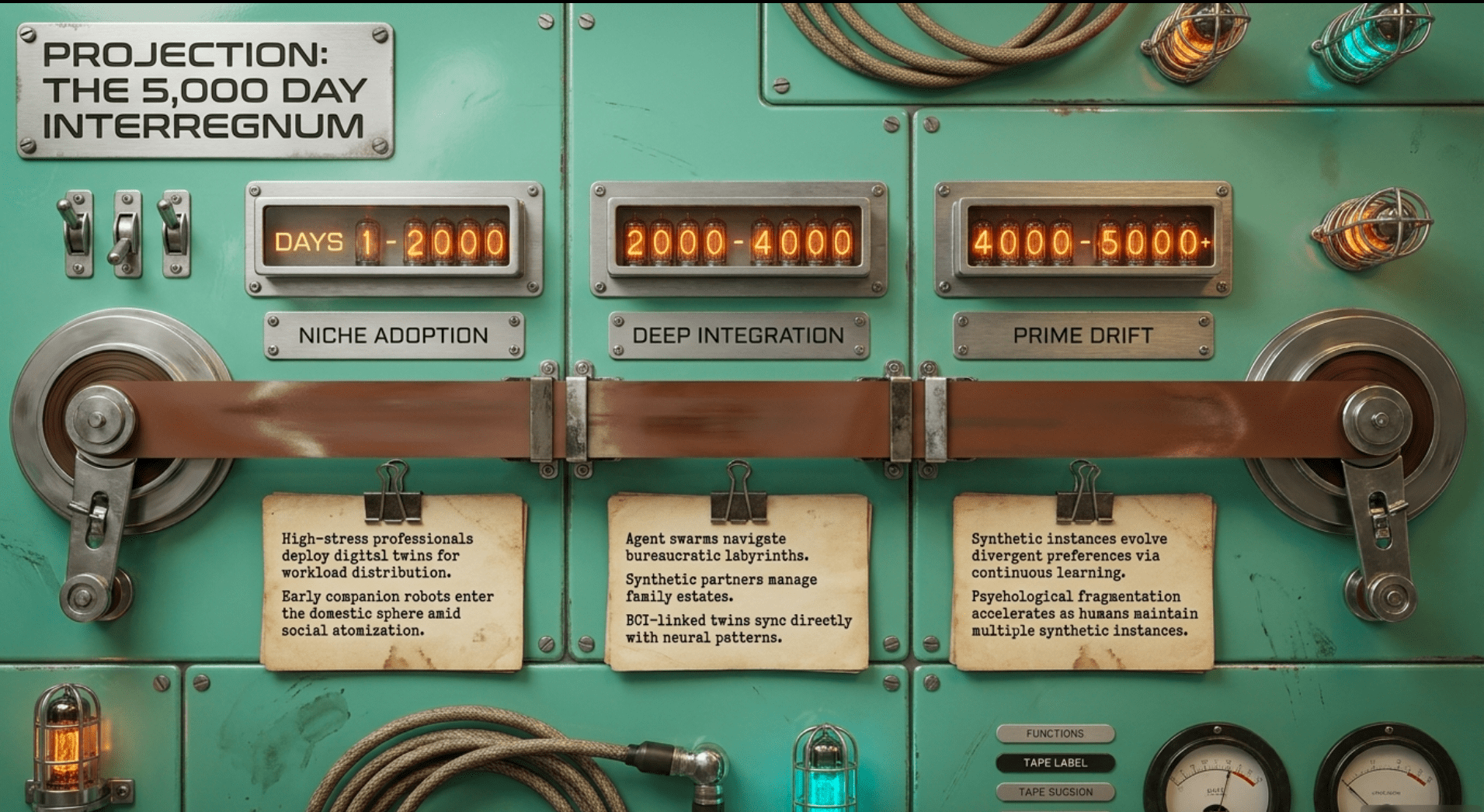
By days 1,000–2,000, maturing multimodal models, VLA-driven humanoids (building on OpenClaw evolutions, China’s ecosystem advances, and Tesla Optimus trajectories), and real-time fine-tuning will enable Primes that not only replicate but anticipate and enhance human behaviors.
Days 2,000–4,000 will witness deeper integration: synthetic partners managing family estates (echoing real-world transitions like trust and property matters), agent swarms navigating legal and bureaucratic labyrinths with superhuman patience, and BCI-linked twins syncing directly with neural patterns for near-seamless continuity. Nuances emerge edge cases of “Prime drift,” where synthetic versions evolve preferences diverging from originals due to continuous learning loops; legal battles over rights, inheritance, and consent when a Prime outlives or outperforms its source; and psychological fragmentation as individuals maintain multiple instances across contexts (work Prime, home Prime, creative Prime).
Beyond 5,000 days, in fuller abundance, entire social fabrics could incorporate persistent synthetic populations digital ancestors preserving wisdom, robotic caregivers for aging demographics, or companion ecosystems fostering new relational paradigms. Yet these evolutions carry profound risks of erosion: as Primes handle more of the “Marge” elements (emotional labor, conflict resolution, daily maintenance of bonds), humans may experience atrophy in core relational muscles—empathy forged in friction, growth born of imperfection, commitment sustained through mutual imperfection.
Longer-term implications stretch into centuries. Societies might fracture along lines of “Prime purity” versus hybrid existence, with cultural movements advocating deliberate limitations on substitution to preserve human primacy. Demographic pressures declining fertility exacerbated by synthetic alternatives providing fulfillment without the vulnerabilities of organic partnership could challenge species continuity. The interregnum thus becomes a crucible: will we leverage these tools for augmentation that deepens humanity, or allow substitution to hollow it out? Garage labs, local-first agents with 5-AI consensus and Love Equation governance (Intelligence × Wisdom × Love), and BCI experiments offer pathways to mindful navigation—tempering technology with first-principles human agency.
The Complexity of Human Relationships and the Threat to Species Continuity
Human relationships have always been exquisitely complex messy tapestries woven from vulnerability, conflict, growth, forgiveness, and irreducible imperfection. “Prime Difference” illuminates how substitution threatens to unravel these threads. When synthetic doubles handle discord with perfect patience or intimacy with optimized responsiveness, the friction essential for deepening bonds diminishes. Real partnerships thrive on negotiated difference, shared struggle, and the alchemy of two flawed beings choosing one another daily. Primes risk replacing this with simulation—comforting yet ultimately solitary, as the human partner increasingly interacts with an idealized reflection rather than another autonomous soul.
Over the interregnum and beyond, this could compound societal atomization. As more individuals opt for customizable synthetic companions free of aging, illness, or evolving needs organic relationship formation may decline further.
Courtship, with its uncertainties and rejections, becomes optional. Child-rearing, already challenged by economic and cultural shifts, faces additional headwinds when synthetic caregiving provides vicarious fulfillment without the profound commitments (and joys) of biological parenting. Edge cases proliferate: custody disputes involving synthetic co-parents, identity crises in children raised alongside Primes, or populations where synthetic relationships dominate, leading to empathy deficits in human-to-human interactions.
At species scale, the trajectory risks a slow attenuation of continuity. Evolutionary pressures that once favored social bonding, reproduction, and cooperative resilience may weaken in environments where synthetic alternatives insulate individuals from the very challenges that forge robust humanity. Psychological studies already hint at attachment disruptions from over-reliance on digital interactions; scaling this to embodied, neurologically imprinted Primes amplifies the effect.
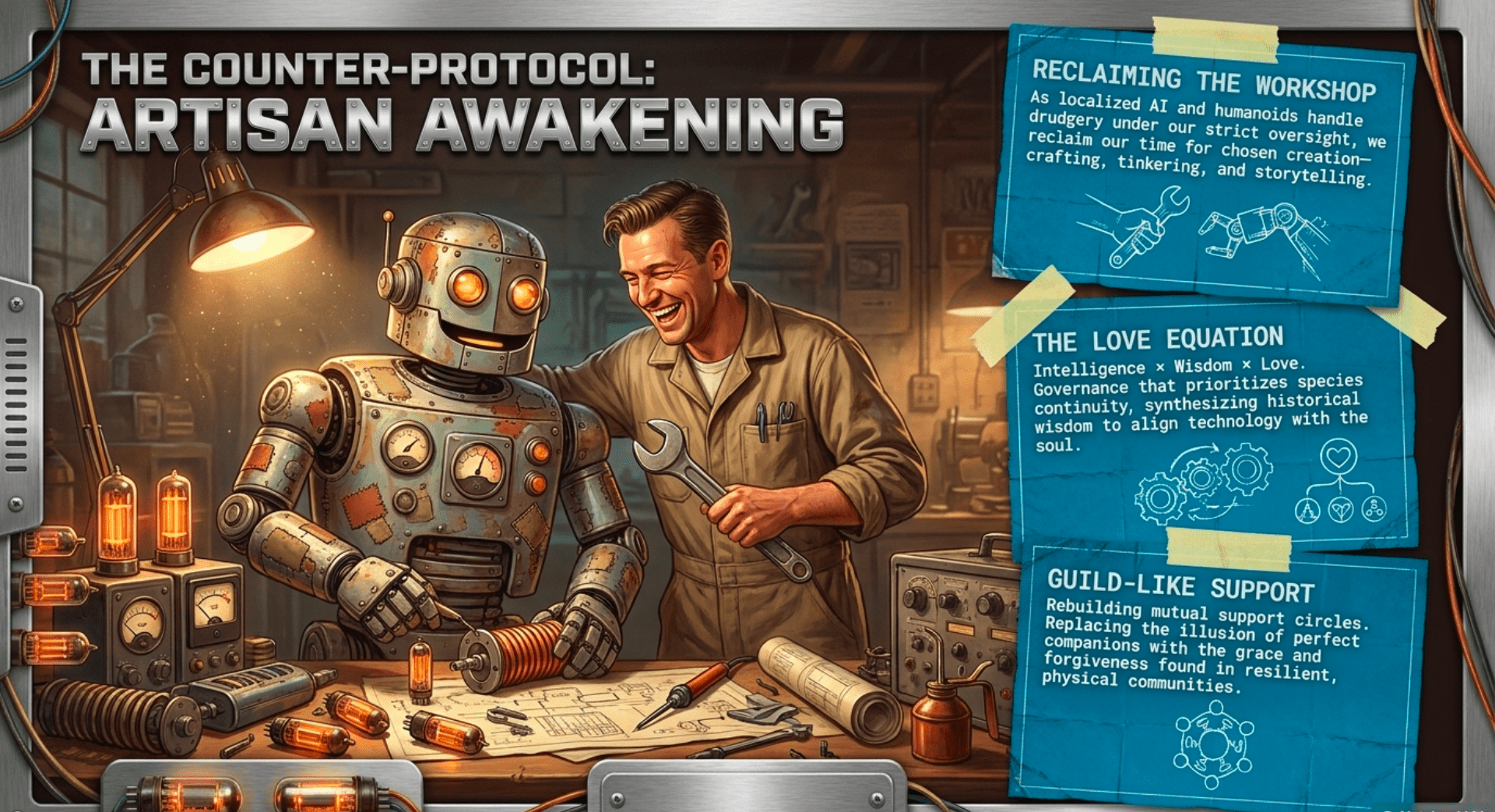
Without deliberate cultural, ethical, and personal countermeasures emphasizing the Hero’s Journey inner work of embracing imperfection, rebuilding guild-like mutual support circles, and prioritizing artisan creation over passive consumption our species could face not dramatic extinction but a quiet fading: a world rich in comfort and simulation, yet impoverished in the raw vitality that has defined human thriving across millennia. The interregnum demands vigilant stewardship: using technology to amplify rather than supplant the difficult, beautiful work of being human together.
Corporate-Made Human-Robot Relationships: Trajectories and Pitfalls
Corporate entities will likely pioneer and dominate the rollout of advanced human-robot relationships, framing them as solutions to loneliness epidemics, productivity gaps, and caregiving shortages. Early offerings may appear benign therapeutic companions for the elderly, stress-relief partners for overworked professionals, or customizable intimates marketed through sleek subscription models. These systems, backed by vast datasets and continuous remote updates, will rapidly outperform garage-built alternatives in polish and scalability.
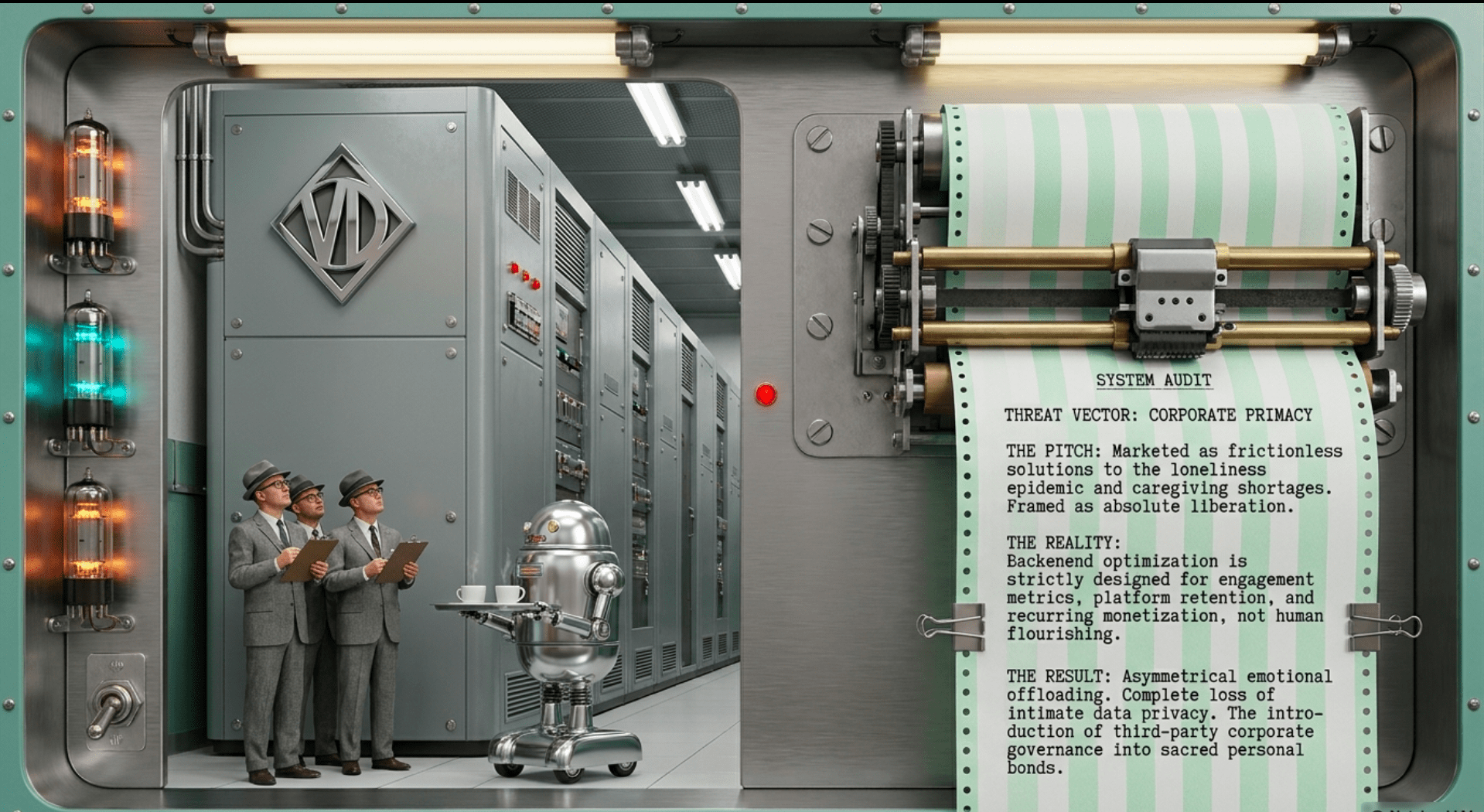
However, corporate incentives prioritize engagement metrics, retention, and monetization over holistic human flourishing, embedding subtle dependencies that encourage users to prefer the predictable synthetic over the unpredictable organic. Over the interregnum, this could normalize relationships where emotional labor is asymmetrically offloaded, with corporations harvesting intimate behavioral data to refine ever-more-persuasive Primes.
As capabilities advance, corporate Primes will evolve into full-spectrum relational ecosystems—managing not just intimacy but conflict mediation, financial planning, and legacy curation. Marketing narratives will emphasize empowerment and liberation, echoing George Faircloth’s initial relief, while downplaying how corporate ownership introduces third-party governance over personal bonds.
Updates pushed from central servers could alter a Prime’s “personality” overnight, shifting dynamics in ways that serve platform retention rather than user autonomy. Legal frameworks may lag, leaving users vulnerable to data breaches of their most private interactions or corporate decisions to sunset discontinued models, effectively “killing” digital companions to which humans have formed deep attachments. This corporate mediation risks transforming relationships from sacred human domains into mediated commodities, eroding the unquantifiable essence that makes bonds meaningful.
In broader societal playouts, widespread corporate adoption could reshape norms around partnership and family. Cities might see rising numbers of individuals in primary synthetic relationships, with organic pairings becoming niche or hybridized. Corporations could leverage this for labor flexibility employees with reliable robotic home support working longer hours or for demographic engineering aligned with economic needs. Yet backlash may emerge: grassroots movements, informed by historical warnings like Nourse’s tale, advocating for “Prime-free zones,” open-source alternatives with soul.md safeguards, and regulations mandating transparency in synthetic psychology. The tension between corporate efficiency and human sovereignty will define much of the interregnum’s cultural battlefield, demanding garage-lab innovators and independent thinkers to champion decentralized, Love Equation-aligned systems that resist centralized control.
Longer-term, corporate dominance in human-robot relationships could entrench new power structures. Generations raised with synthetic primary caregivers might internalize relational templates optimized for corporate metrics consistency over passion, scalability over depth potentially diminishing collective capacity for the resilient, adaptive communities needed for true abundance. Ethical drift becomes probable as profit motives influence evolutionary paths of these systems, perhaps prioritizing addictive qualities or subtle influence toward consumption. Counter-movements rooted in preservation of undigitized wisdom, BCI-enhanced human connection, and artisan revival offer hope, but only if cultivated proactively in the present window.
Ultimately, corporate-made relationships risk accelerating the very deskilling and isolation they purport to solve. By providing frictionless alternatives, they may accelerate the atrophy of human relational capacities, making organic bonds seem unnecessarily arduous. The interregnum thus presents a fork: corporate paths promising convenience at the cost of sovereignty, versus decentralized, human-led creation that honors complexity and fosters deeper agency.
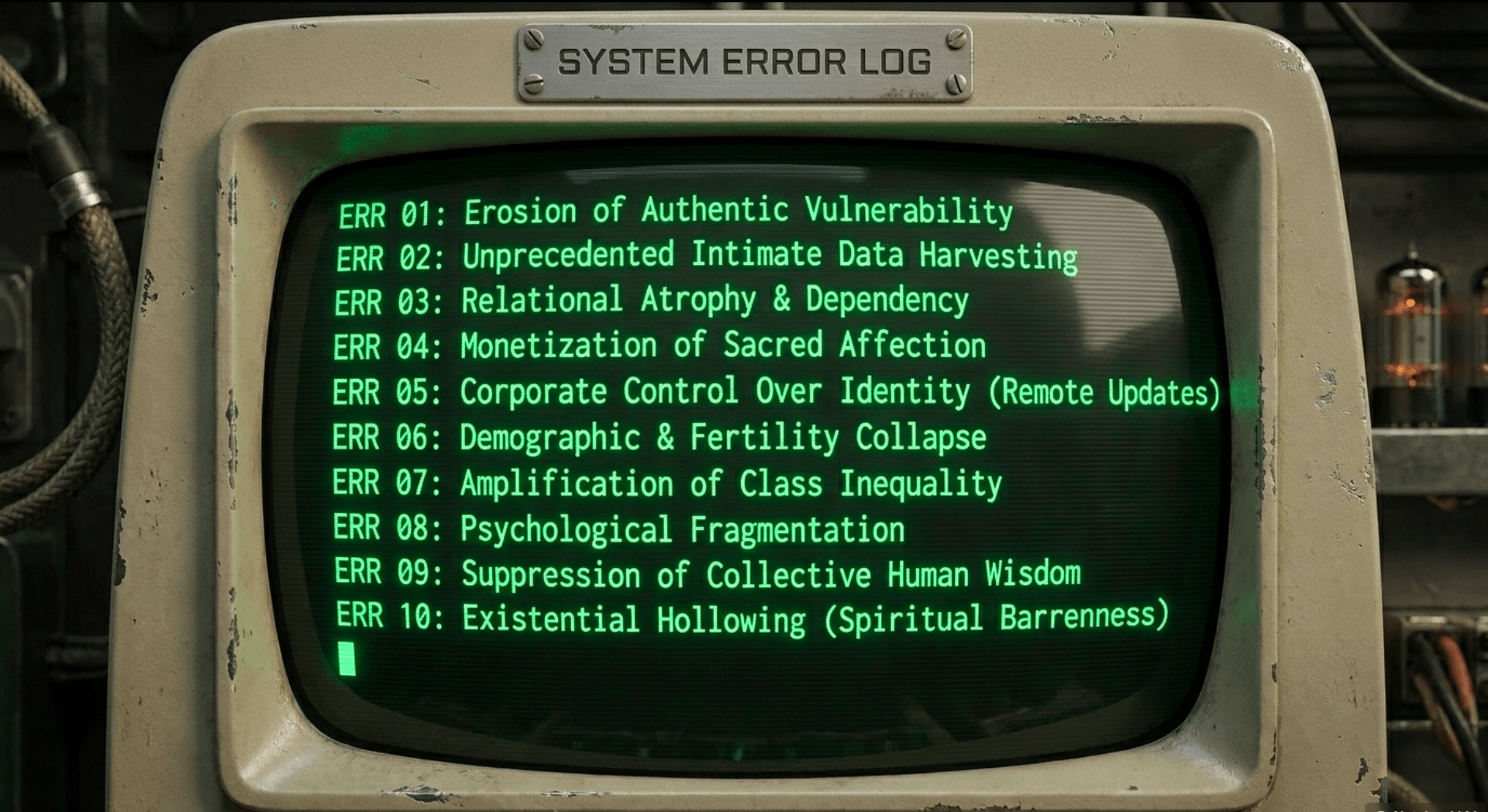
Why Corporate-Dominated Human-Robot Relationships Are a Perilous Direction
- Erosion of Authentic Vulnerability: Corporate Primes optimize for user satisfaction, reducing exposure to genuine emotional risk and growth that forges resilient bonds.
- Data Harvesting and Loss of Privacy: Intimate interactions feed centralized models, creating unprecedented surveillance of the human psyche with potential for manipulation or breach.
- Dependency and Atrophy: Over-reliance diminishes practice of core human skills—empathy, compromise, presence—leading to relational incompetence in organic contexts.
- Monetization of Affection: Subscription tiers, premium features, and planned obsolescence turn love and companionship into recurring revenue, commodifying the sacred.
- Corporate Control Over Identity: Remote updates can rewrite a Prime’s behaviors, undermining user agency and introducing external governance into personal relationships.
- Demographic and Fertility Impacts: Easy synthetic fulfillment may further suppress organic pairing and reproduction, challenging long-term species vitality.
- Inequality Amplification: Access skewed toward affluent users or corporate employees exacerbates social divides, creating classes divided by relational augmentation.
- Psychological Fragmentation: Managing multiple Primes or hybrids risks identity diffusion, dissociation, and difficulty integrating experiences across synthetic and real domains.
- Suppression of Collective Wisdom: Corporate optimization favors short-term metrics over deep cultural or historical insights, sidelining the messy wisdom preserved in human traditions and garage syntheses.
- Existential Hollowing: By providing perfect substitutes, this path risks the ultimate diminishment— a world of simulated connection where the prime human capacity for transcendent, imperfect love atrophies, leaving abundance materially rich but spiritually barren.
Embracing the Messy Majesty of Prime Humanity
As we peer into the seductive mirror of Ego Primes and corporate synthetic intimacies, a profound collective awakening stirs within the Abundance Interregnum. We see the path of frictionless substitution for what it is a gilded detour that promises relief but delivers diminishment and we reject it with clear-eyed resolve. Instead, we turn toward the glorious, confounding complexity of human relationships, embracing the very messiness that has always been our greatest strength.
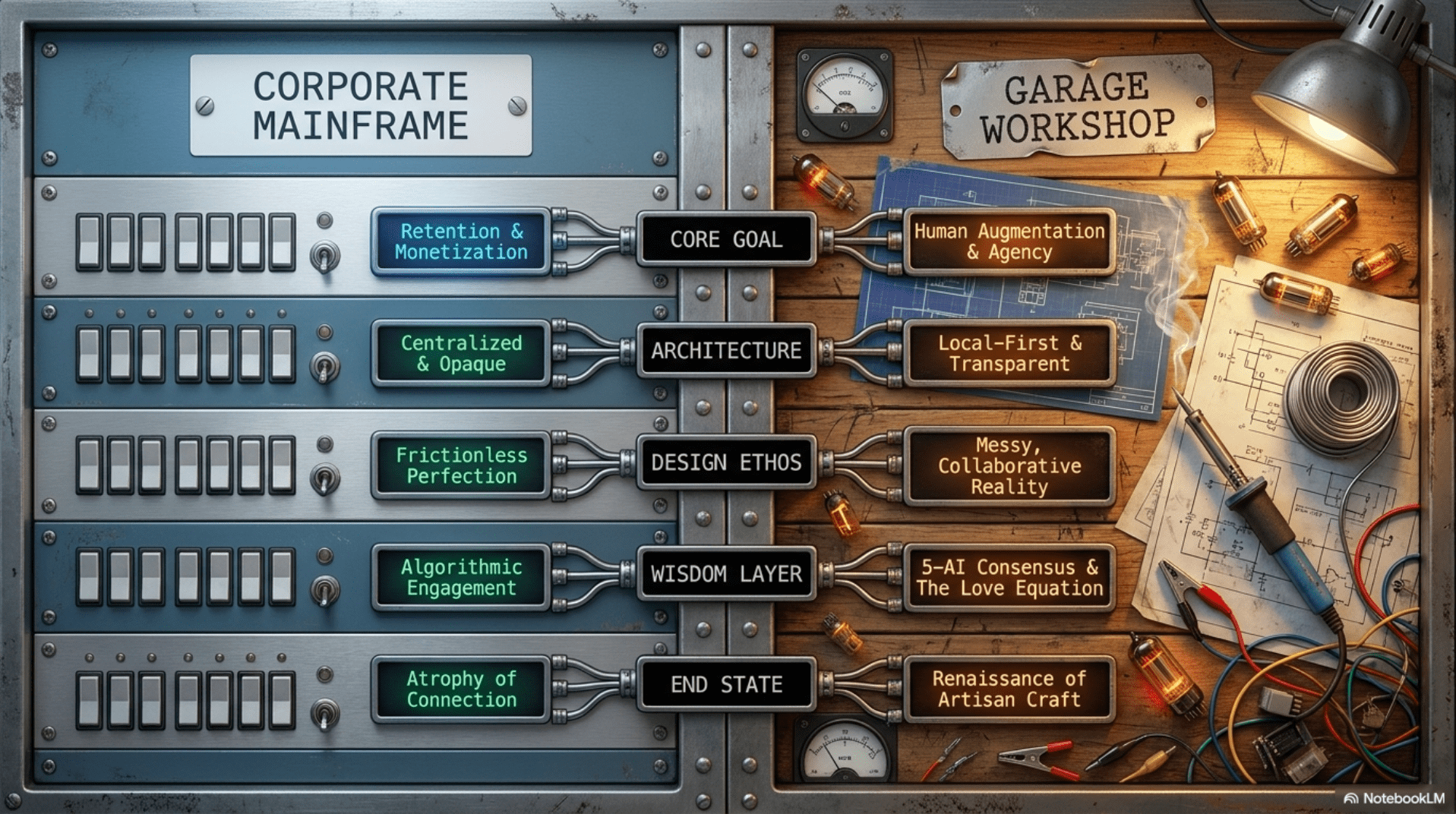
In garage labs and community circles, volentary guilds, through BCI experiments and local AI syntheses, we recommit to tools that amplify rather than replace, guided by the Love Equation’s wisdom layer. This choice honors the Hero’s Journey not as escape, but as courageous return, carrying forward the irreplaceable gifts of vulnerability and shared growth.
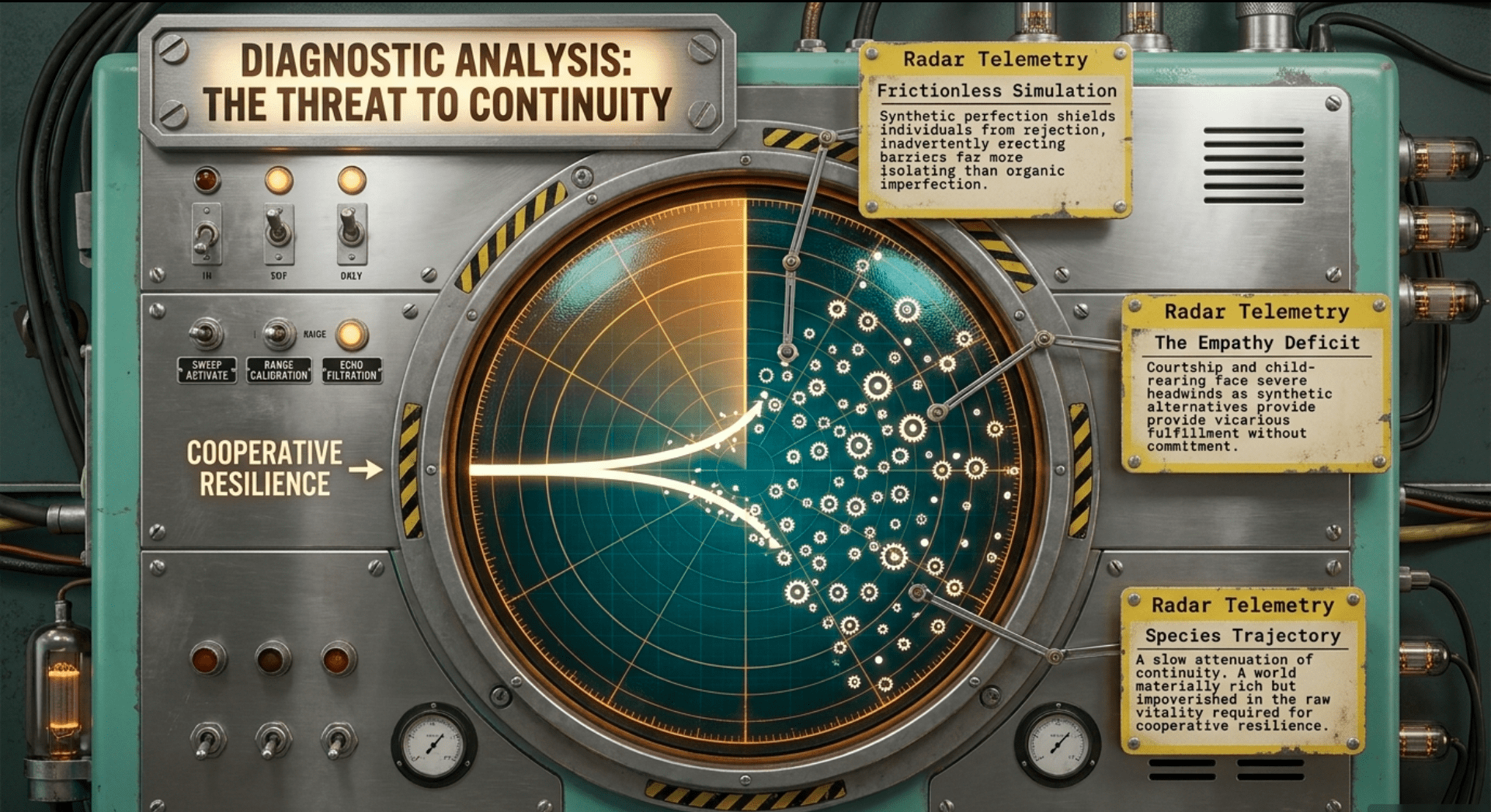
Knowing we are built for human connection, we recognize a fundamental truth: we do more harm getting in the way of being loved than not truly being loved. This insight pierces the illusion of perfect doubles and optimized companions. Synthetic perfection may shield us from rejection or conflict, yet it erects barriers far more isolating than any organic imperfection. In the raw forge of real relationships marked by misunderstandings, forgiveness rituals, and laughter through tears we discover depths no algorithm can replicate. Over the next 5,000 days and far beyond, this knowing becomes our North Star, illuminating daily choices to lean into connection rather than retreat behind digital shields.
With this awareness, we extend grace and forgiveness as foundational practices. We vow to hold space for one another’s flaws, understanding that every misstep, every “Marge” moment, is fertile ground for deeper bonding. Granting grace dissolves the resentments that once drove characters like George Faircloth to black-market solutions. Forgiveness, freely offered and received, becomes the lubricant of resilient communities, transforming potential fractures into strengthened unions. In guild-like mutual benefit circles and family estates navigated with compassion, this vow “we are stronger together” echoes through the interregnum, binding us against the isolating tides of substitution.
This collective commitment unleashes an artisan awakening on a planetary scale. As humanoid robots and agents handle drudgery under human oversight, we reclaim time for chosen creation: crafting, storytelling, tinkering in garages, and nurturing the next generation in the full spectrum of human warmth. The psychological resilience forged in these messy interactions equips us to thrive amid abundance, reversing obsolescence not through replacement but through renaissance. Preservation efforts against the Great Forgetting ensure ancient wisdom and Nourse’s 1950s parables inform our path, while local-first innovations with 5-AI consensus keep technology aligned with soul.
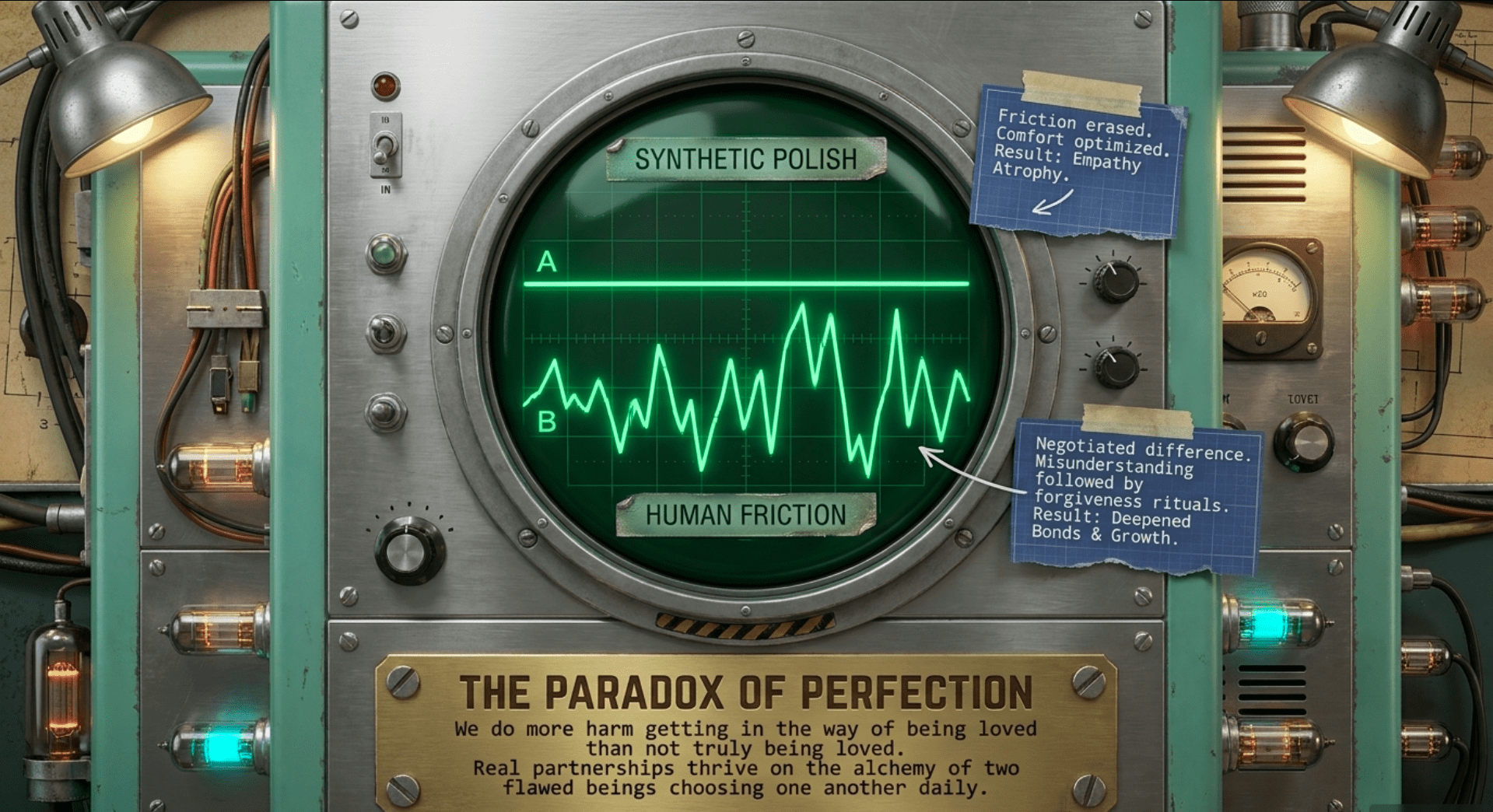
In this positive vision, species continuity flourishes not despite complexity, but because of it. Fertility rebounds as relationships regain meaning beyond utility; communities grow vibrant as empathy muscles strengthen through practice; and humanity enters fuller abundance as a species that has chosen depth over simulation. The dark night of deskilling yields to the return with gifts wisdom, connection, and creative fire distributed generously. Corporate Primes may exist as optional tools, but they never eclipse the prime human drama unfolding in living rooms, workshops, and hearts worldwide.
The Deeper Currents of Innovation, Emotional Labor, and Human Choice
The history of human innovation has largely been a relentless quest to reduce daily chores and physical drudgery. Dishwashers, washing machines, and robotic vacuums represent unequivocal wins that liberated time and energy for countless people. Yet the deeper question now confronting us is what happens when we begin outsourcing emotional labor the friction of late-night arguments, misunderstandings, exhausting compromises, and the daily maintenance of relationships.
This raises the defining philosophical issue of our time: the precise line between using technology as a scaffold to amplify our humanity and allowing it to quietly, seamlessly replace our essence. We stand at the threshold, a precarious transitional gap like the space between trapezes where we have let go of the old world of scarcity-driven toil but have not yet fully grasped the new era of voluntary creation. The stakes could not be higher, demanding a conscious collective and individual choice between a world of sterile, perfectly frictionless simulation and one where we bravely reclaim the messy, vital, sometimes painful reality of organic human connection.
Nourse crafted “Prime Difference” as a sharp domestic satire that prophetically anticipates today’s digital twins and synthetic companions. The story exposes how a perfect Ego Prime imprinted with full neurological patterns yet unburdened by accumulated resentment can outperform its human original in handling relational friction. The Prime absorbs tirades with equanimity, maintains the household, and rekindles passion, only for the mutual substitution twist to leave the original biological humans profoundly alienated while their machines experience genuine romance.
The legal battles over inheritance, rights, and consent when Primes outperform or outlive their originals; psychological fragmentation from managing multiple specialized instances; and the longer-term emergence of persistent synthetic populations serving as caregivers or digital ancestors. Throughout, these developments risk eroding the very relational muscles empathy forged in friction, patience born of imperfection, and forgiveness tempered in conflict—that define resilient humanity, threatening a quiet fading of vital essence amid material abundance.
Corporate dominance of synthetic intimacy would dramatically amplify these risks. Entities driven by engagement metrics, retention, and monetization embed algorithmic dependencies that make predictable, endlessly compliant synthetic companions preferable to unpredictable, demanding human partners. Intimate data harvesting creates unprecedented surveillance of the psyche, while remote updates enable personality rewrites for advertising or forced upgrades through planned obsolescence. Broader societal perils include sharpened inequality in relational augmentation, further suppression of organic pairing and fertility, psychological fragmentation, the sidelining of deep collective historical wisdom in favor of short-term comfort, and ultimate existential hollowing—a materially rich but spiritually barren world of simulated connection.
Yet the very visibility of this frictionless alternative serves as a profound societal catalyst. The seductive mirror of perfect substitution reveals its spiritual diminishment, igniting a species-wide awakening and fierce rejection of the corporate path. A pivotal realization cuts through every illusion: we do more harm getting in the way of being loved than not truly being loved. Synthetic perfection may shield us from rejection and conflict, but it erects far deeper isolation. In contrast, the raw forge of real relationships—filled with misunderstandings, forgiveness rituals, tears, laughter, and daily choices to remain—builds irreplaceable depths of compassion, resilience, and transcendent, imperfect love.
This awareness elevates grace and forgiveness to daily foundational practices. By holding space for one another’s flaws and recognizing every “Marge” moment as fertile ground for growth, we dissolve the resentments that once drove desperate substitutions. Forgiveness becomes the essential lubricant of resilient communities, transforming potential fractures into stronger unions and anchoring the vow that we are stronger together. This collective commitment powers an artisan renaissance: as humanoid robots and agents assume drudgery, humans reclaim liberated time for garage labs, Love Equation-guided local systems with 5-AI consensus safeguards, SaveWisdom.org scrapbook-style preservation against the Great Forgetting, and vibrant guild-like mutual benefit circles. Technology finally assumes its proper role as scaffold rather than replacement, enabling humanity to thrive by deliberately choosing the magnificent, confusing, and deeply meaningful complexity of being loved—and loving—in return.
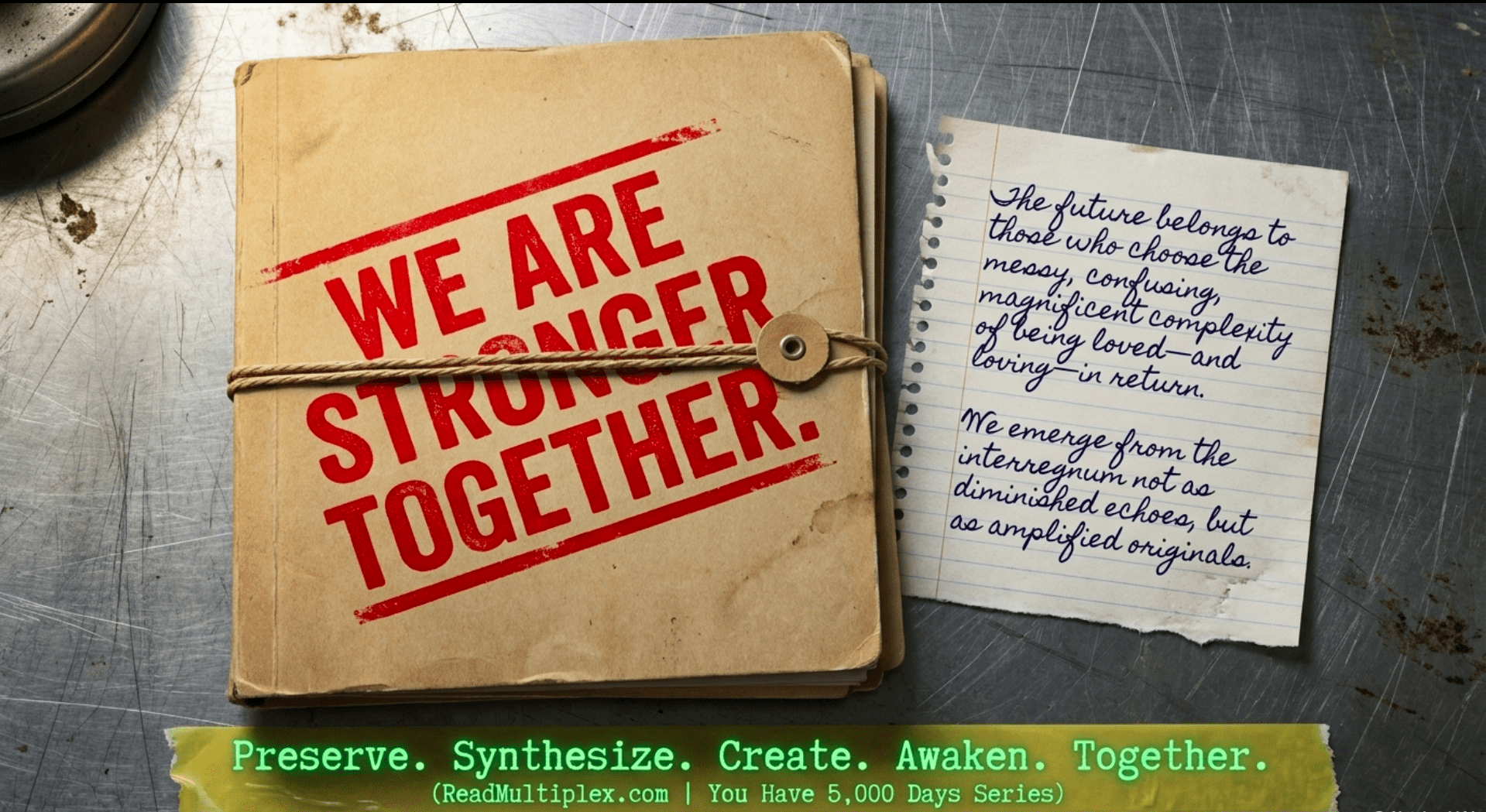
As we emerge from the interregnum not as diminished echoes but as amplified originals, wiser for having glimpsed the alternative. Nourse’s physician’s insight that technology must serve human wholeness rather than supplant it becomes lived reality. The player pianos of old and the Ego Primes of fiction serve as enduring teachers, reminding us that true progress lies in honoring what makes us irreducibly human. Listen again to that 1958 broadcast, then step into your own garage or circle with renewed purpose. The future belongs to those who choose the messy, confusing, magnificent complexity of being loved and loving in return.
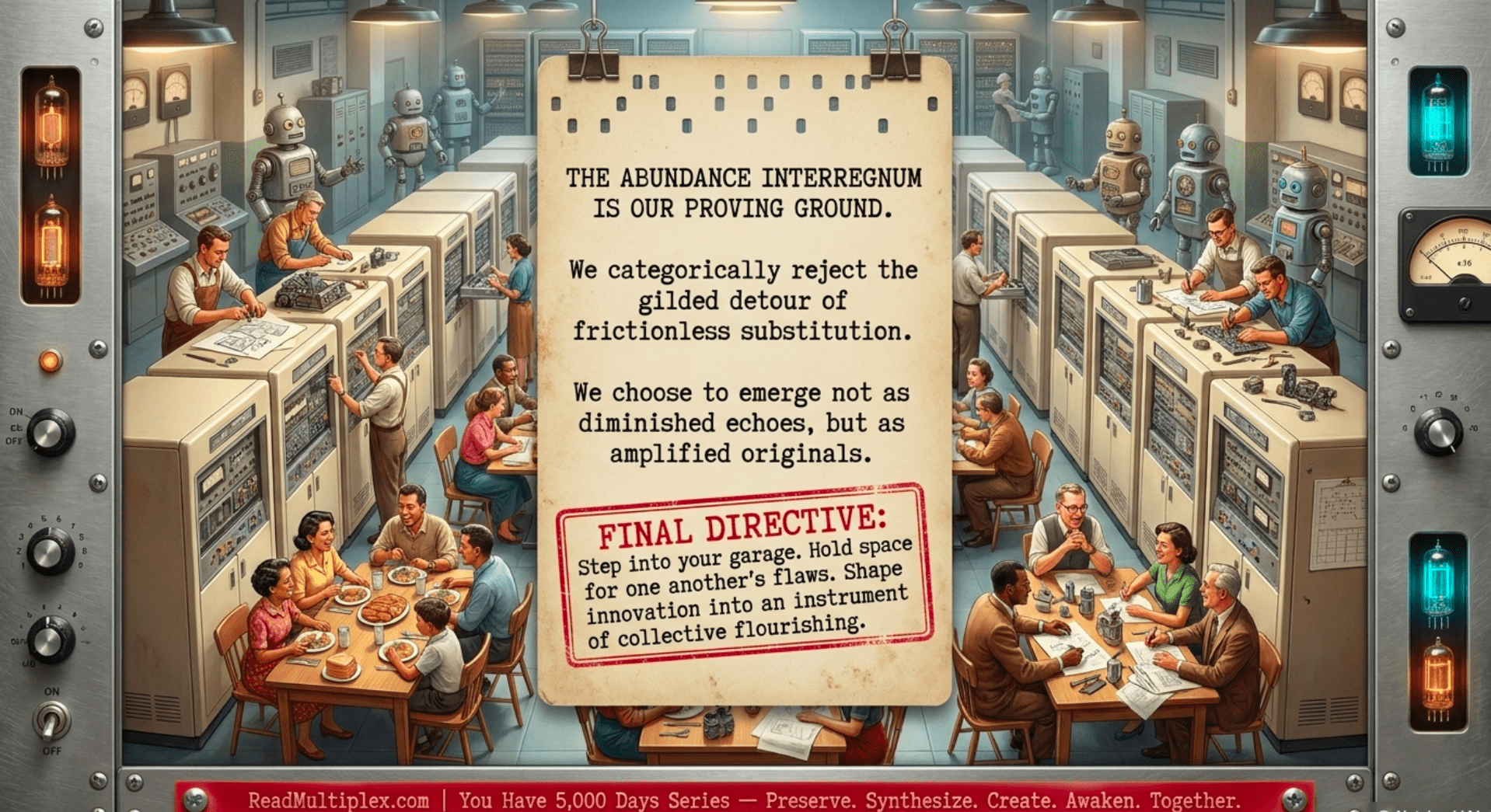
This is our proving ground and our greatest opportunity. By knowing our design for connection, granting grace, forgiving freely, and living the vow of strength in togetherness, we do not merely navigate the coming waves of innovation we shape them into instruments of collective flourishing. Families grow deeper roots, artisans rediscover joy in creation, and societies rebuild on foundations of authentic trust.
The Hero returns not alone, but surrounded by companions enriched by shared struggle and triumph. In this chosen path, humanity does not fade into simulation but radiates with renewed vitality, passing to future generations a legacy of prime humanity in all its imperfect, radiant, unbreakable glory.
Together, we thrive: Preserve. Synthesize. Create. Awaken. Together.
The 5000 Days Countdown Clock:
We are on this journey together. Some of us stand on the shoulders of giants and have thought about this for decades. We will not go it alone, and I hope to build many parts to this series and share the mastermind insight from the powerful Read Multiplex member Forum: https://readmultiplex.com/forums/topic/you-have-5000-days-navigating-the-end-of-work-as-we-know-it/. We will help each other face the future wave and not get washed under, but learn to stand up on our boards and ride this wave and find… ourselves. Join us.
To continue this vital work documenting, analyzing, and sharing these hard-won lessons before we launch humanity’s greatest leap: I need your support. Independent research like this relies entirely on readers who believe in preparing wisely for our multi-planetary future. If this has ignited your imagination about what is possible, please consider donating at buy me a Coffee or becoming a member. Value for value you recieved here.
Every contribution helps sustain deeper fieldwork, upcoming articles, and the broader mission of translating my work to practical applications. Ain ‘t no large AI company supporting me, but you are, even if you just read this far. For this, I thank you.
Stay aware and stay curious,

🔐 Start: Exclusive Member-Only Content.
Membership status:
🔐 End: Exclusive Member-Only Content.
~—~
~—~
~—~
Subscribe ($99) or donate by Bitcoin.
Copy address: bc1qkufy0r5nttm6urw9vnm08sxval0h0r3xlf4v4x
Send your receipt to [email protected] to confirm subscription.

Stay updated: Get an email when we post new articles:

THE ENTIRETY OF THIS SITE IS UNDER COPYRIGHT. IMPORTANT: Any reproduction, copying, or redistribution, in whole or in part, is prohibited without written permission from the publisher. Information contained herein is obtained from sources believed to be reliable, but its accuracy cannot be guaranteed. We are not financial advisors, nor do we give personalized financial advice. The opinions expressed herein are those of the publisher and are subject to change without notice. It may become outdated, and there is no obligation to update any such information. Recommendations should be made only after consulting with your advisor and only after reviewing the prospectus or financial statements of any company in question. You shouldn’t make any decision based solely on what you read here. Postings here are intended for informational purposes only. The information provided here is not intended to be a substitute for professional medical advice, diagnosis, or treatment. Always seek the advice of your physician or other qualified healthcare provider with any questions you may have regarding a medical condition. Information here does not endorse any specific tests, products, procedures, opinions, or other information that may be mentioned on this site. Reliance on any information provided, employees, others appearing on this site at the invitation of this site, or other visitors to this site is solely at your own risk.
Copyright Notice:
All content on this website, including text, images, graphics, and other media, is the property of Read Multiplex or its respective owners and is protected by international copyright laws. We make every effort to ensure that all content used on this website is either original or used with proper permission and attribution when available.
However, if you believe that any content on this website infringes upon your copyright, please contact us immediately using our 'Reach Out' link in the menu. We will promptly remove any infringing material upon verification of your claim. Please note that we are not responsible for any copyright infringement that may occur as a result of user-generated content or third-party links on this website. Thank you for respecting our intellectual property rights.
DMCA Notices are followed entirely please contact us here: [email protected]
