The Light We Left Behind — and What Happened When We Moved Indoors.
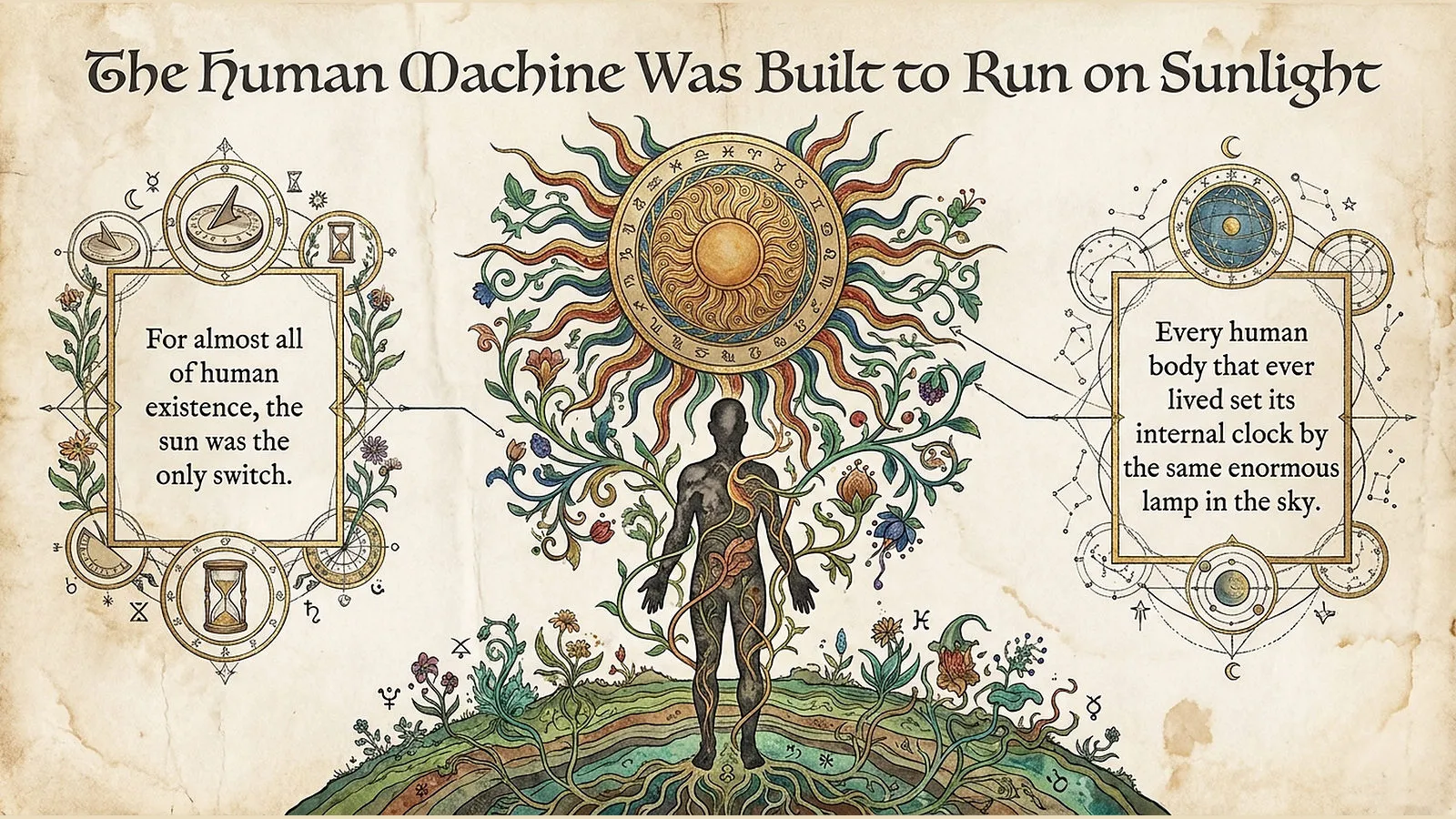
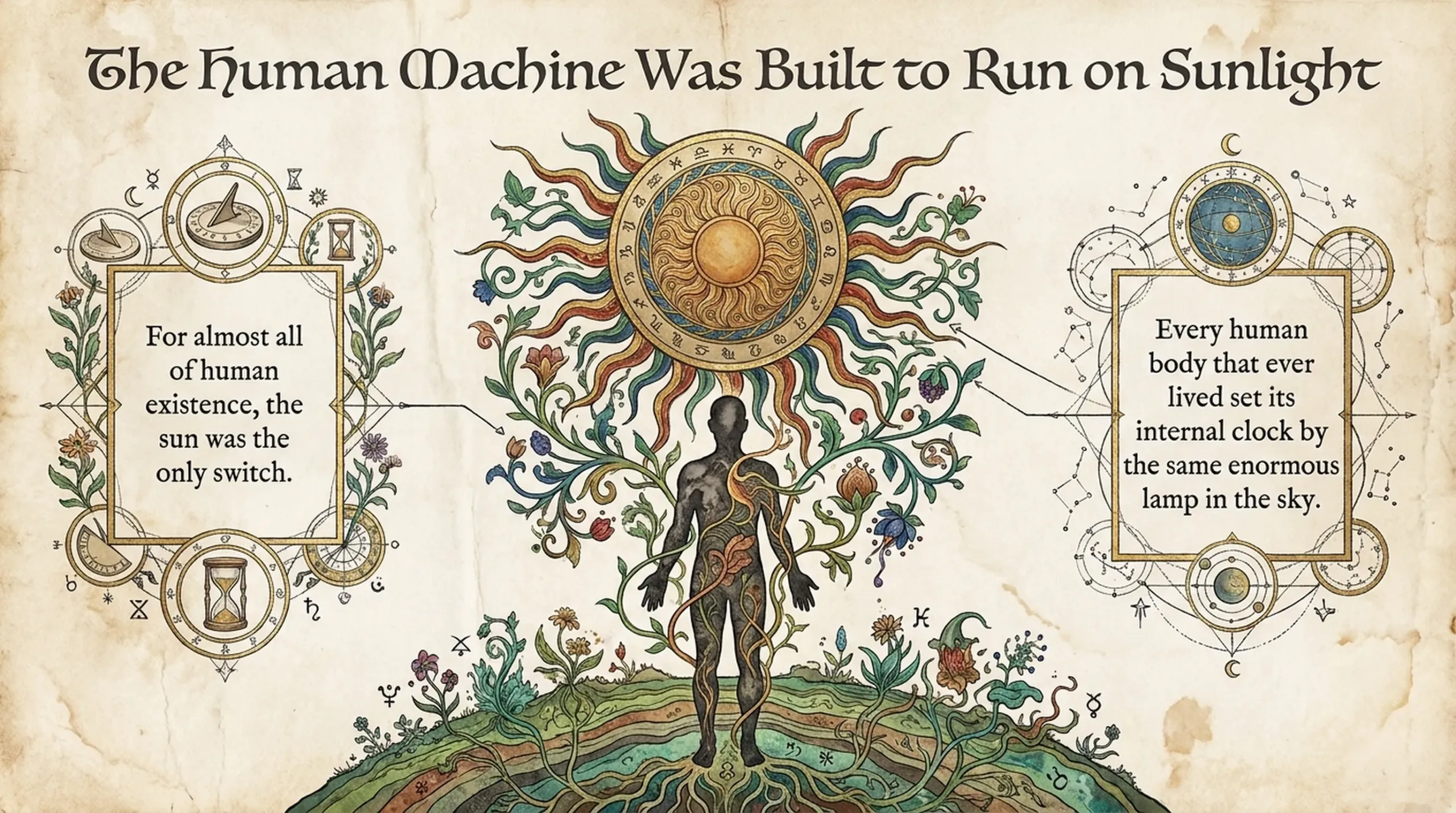
For almost all of the time humans have existed, the sun ran the day. Our ancestors woke when the eastern sky went gray, worked and walked and hunted under an open sky, and went quiet when the light went red and then went out. There was no switch on the wall. The only lamps were the sun, the moon, the stars and the fire, and the fire was dim, orange and low. Every human body that ever lived set its internal clock by the same enormous lamp in the sky.
That lamp did far more than let us see. It warmed the skin and made vitamin D in it. It told the brain when to be alert and when to make melatonin. It tanned the shoulders of farmers in summer and faded in winter, and the body tracked the seasons through it. Long before anyone had a word for wavelength, people knew in their bones that the sun was a nutrient.
This article is sponsored by Read Multiplex Members who subscribe here to support my work: Link: https://readmultiplex.com/join-us-become-a-member/
It is also sponsored by many who have donated a “Cup of Coffee”. If you like this, help support my work: Link: https://ko-fi.com/brianroemmele
Listen to the companion podcast: https://rss.com/podcasts/readmultiplex-com-podcast/3357018
Even civilization kept us outside for most of the day. Egyptian farmers worked the Nile fields from dawn to dusk. Roman soldiers marched in the open. Medieval peasants spent their lives in the fields, and their children played in the lanes. Houses were dark inside, so work happened in doorways, courtyards and fields. Even the scholar copying books in a monastery wanted a window, because a window was the only good lamp there was.
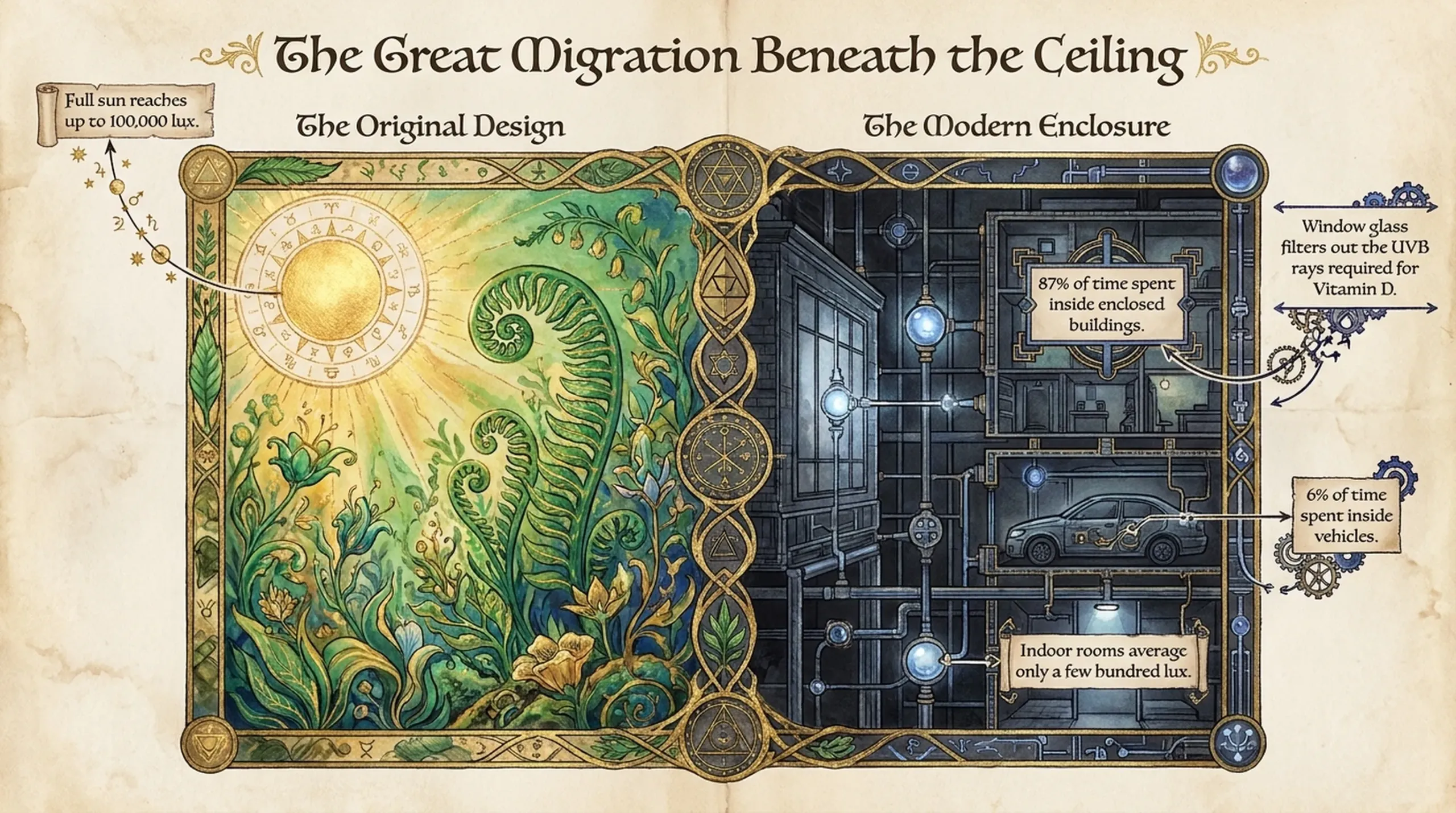
Then came the great move indoors. In about a century and a half, gas light, then the electric bulb, then the factory, the office, the car and the screen pulled most of us inside for most of the day. A large United States survey around the turn of this century found that people spent about 87 percent of their time inside buildings and about 6 percent inside vehicles. Inside, the light is a tiny fraction of daylight. Window glass filters out the part of sunlight that makes vitamin D. And at night, for the first time in history, we stay bathed in bright light long after the sun goes down.
We did not decide to do this to ourselves. It happened as a side effect of progress. Indoor workers stopped seeing the sun except on weekends. Children spent their days at desks and their evenings in front of screens. Sun protection messages, which are right about sunburn, told many people to avoid the sun altogether. Somewhere along the way, a species that evolved under the open sky turned into a species that lives under a ceiling.
So here is the question this article chases, the third in a series. I have already written about the ground beneath our feet and the electromagnetic rhythm in the air around us. This piece is about the light from above. If every human body was built to run on sunlight, what happens when we take the sunlight away, and what does the science say, honestly, about giving it back? The answer runs through a Danish physician’s Nobel Prize, a Swiss mountain clinic, Soviet coal mines and Arctic towns where workers were dosed with ultraviolet like a vitamin, Russian space-medicine labs, NASA’s light-emitting diodes, a Swedish study of thirty thousand women, and some of the most beautiful discoveries in modern neuroscience.
The Lost Light
Sunrise, the eye’s hidden clock, and the skin’s own pharmacy. Then walls, glass and electric light. Eight key papers, Finsen’s Nobel, Rollier’s sun clinics, the Soviet war on “light starvation,” what space stations taught us about light, and the honest skin-cancer math.
In my companion pieces, How Humans Were Always Grounded to Earth — and What Happened When We Cut the Wire and The Earth Has a Heartbeat — and What Happened When We Shut It Out, I wrote about the charged ground below us and the planet’s electromagnetic rhythm in the air around us. This article looks straight up. Of the three ancestral signals, sunlight is the one with by far the deepest and most solid science behind it. It is also the one where the honest answer has two sides, because the same light that sets your clock, builds your vitamin D and seems to lower your blood pressure can also burn your skin and, over time, help cause skin cancer.
So this is not a sermon for sunbathing, and it is not a scare piece about the sun. It is a first-principles look with a paper trail, and the paper trail comes first. Below are the eight papers I think matter most, what each one did, what it found, why it matters and where it is weak. Then the physics and biology of sunlight in plain words. Then the history: the Nobel Prize for light, the mountain sun clinics, and the Soviet program that treated a lack of sunlight as an occupational disease, with photaria in the mines and the Arctic. Then what was learned about light in space, the newer science of red and near-infrared light, and an honest section on skin cancer. At the end is a short list of gear and books I would actually use.
The Science First: The Eight Papers That Matter Most
I picked these eight because together they cover the big claims: the eye’s hidden clock receptor, what natural light does to the human clock, sun habits and survival, sunlight and blood pressure, sunlight and children’s eyes, how the skin makes vitamin D, bright light and depression, and the real skin-cancer risk. Every link goes to the journal, PubMed, the DOI or the free full text at PubMed Central, so you can read each one yourself.
A word before you read them. Sunlight science mixes very strong evidence (randomized trials on myopia, light therapy and sunscreen; precise laboratory physiology on the eye and skin) with large observational studies, where people who go outside more may differ in many other ways from people who do not. I will tell you which is which. I will also not hide the risk side. A real look at sunlight has to hold both in the same hand.
1. The Hidden Eye: Berson, Hattar and the Melanopsin Cells (2002)
Citation: Berson DM, Dunn FA, Takao M. “Phototransduction by retinal ganglion cells that set the circadian clock.” Science. 2002;295(5557):1070-1073. DOI 10.1126/science.1067262 · PubMed 11834835. Companion paper: Hattar S, Liao HW, Takao M, Berson DM, Yau KW. “Melanopsin-containing retinal ganglion cells: architecture, projections, and intrinsic photosensitivity.” Science. 2002;295(5557):1065-1070. PMC2885915
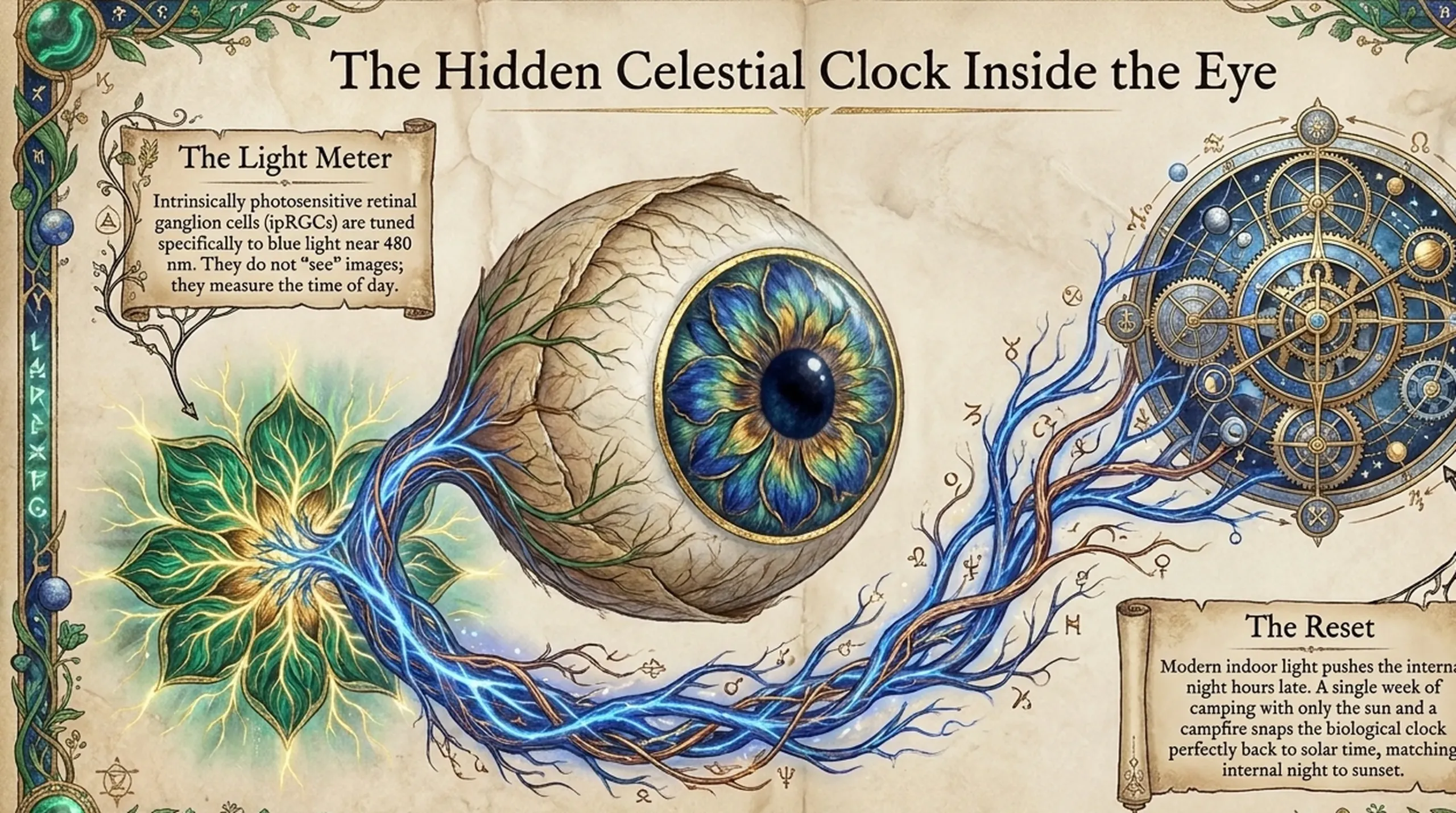
- What they did: For more than a century, textbooks said the eye sees with two kinds of light sensors, rods and cones. David Berson’s team at Brown University recorded from the retinal ganglion cells that send their wires to the brain’s master clock, the suprachiasmatic nucleus. They blocked all input from rods and cones with drugs, and even cut the cells free from the rest of the retina. In the companion paper, King-Wai Yau’s group at Johns Hopkins showed that these same cells contain a light-sensitive pigment called melanopsin and traced where they project in the brain.
- What they found: The clock-projecting ganglion cells responded to light on their own. They were a third class of photoreceptor in the mammalian eye, slow and sustained, most sensitive to blue light near 480 nanometers, and wired straight to the circadian clock. They are now called intrinsically photosensitive retinal ganglion cells, or ipRGCs.
- Why it matters: This is the anatomy of why daylight matters for health. The eye is not only a camera. It is also a light meter that tells the brain what time it is. The human pigment was first found in the inner retina by Ignacio Provencio and colleagues in 2000 (PMC6772411), and later measured with a peak near 479 nanometers (PMC3619500). Human action-spectrum studies in 2001 had already found that melatonin suppression peaks in the blue around 460 nanometers, with a profile that rods and cones could not explain (Thapan, Arendt and Skene, PMC2278766).
- Honest limits: The 2002 recordings were done in rats and mice. The human evidence for the same system comes from action spectra, from studies in blind people and from later work, and it is strong, but the clean single-cell proof is animal work. ipRGCs also feed rods and cones into their signal in the living eye, so “blue light only” is a simplification.
2. Back to the Campfire: Wright and Colleagues, University of Colorado (2013 and 2017)
Citation: Wright KP Jr, McHill AW, Birks BR, Griffin BR, Rusterholz T, Chinoy ED. “Entrainment of the human circadian clock to the natural light-dark cycle.” Current Biology. 2013;23(16):1554-1558. DOI 10.1016/j.cub.2013.06.039 · PMC4020279. Follow-up: Stothard ER, et al. “Circadian Entrainment to the Natural Light-Dark Cycle across Seasons and the Weekend.” Current Biology. 2017;27(4):508-513. PMC5335920
- What they did: Kenneth Wright’s lab measured volunteers’ light exposure, sleep and melatonin rhythm during a normal week of modern life, then sent them camping in the Colorado Rockies for a week with no electric light, no flashlights and no phones, only the sun and a campfire. In 2017 they repeated it in winter and tested a single weekend of summer camping.
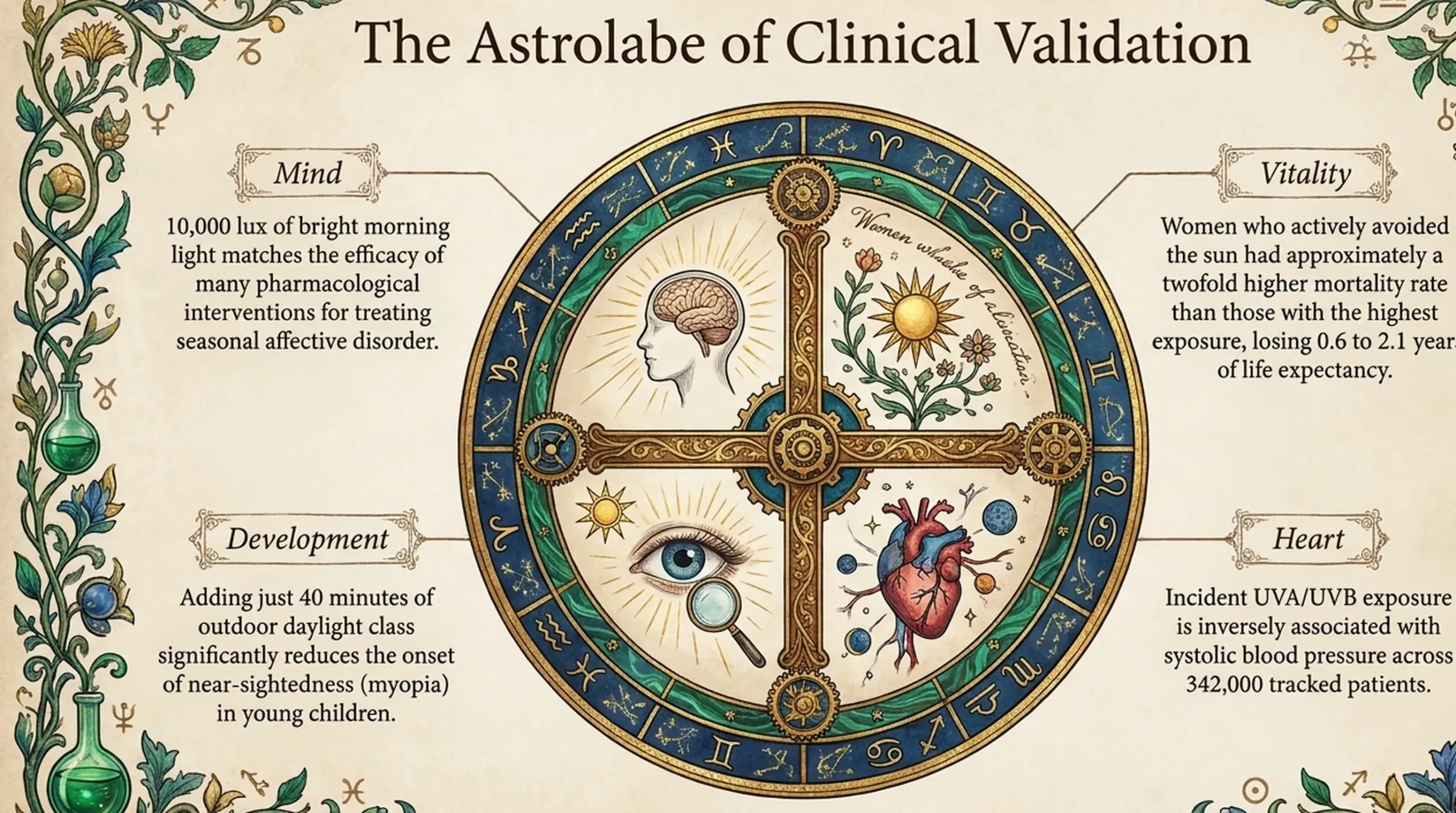
- What they found: Modern life gave people much less light during the day and much more after sunset, and their internal night ran late. After a week of only natural light, the internal clock snapped to solar time. In the authors’ words, “the beginning of the internal biological night occurs at sunset and the end of the internal biological night occurs before wake time just after sunrise.” Late chronotypes, the night owls, shifted the most. In 2017 the body’s biological night expanded in winter, as it does in other animals, and a single weekend of camping achieved about 69 percent of the shift seen after a full week.
- Why it matters: This is the cleanest demonstration that the modern indoor and electric-light environment shifts the human clock later, and that natural light shifts it back quickly. It also suggests that “night owl” is partly a product of our lighting, not only our genes.
- Honest limits: These were small groups of healthy young adults, and camping changes many things at once (activity, meals, social life, temperature). The studies measured circadian timing, not long-term health outcomes.
3. The Swedish Women: Lindqvist and the MISS Cohort (2014 and 2016)
Citation: Lindqvist PG, Epstein E, Landin-Olsson M, Ingvar C, Nielsen K, Stenbeck M, Olsson H. “Avoidance of sun exposure is a risk factor for all-cause mortality: results from the Melanoma in Southern Sweden cohort.” Journal of Internal Medicine. 2014;276(1):77-86. DOI 10.1111/joim.12251 · PubMed 24697969. Follow-up: Lindqvist PG, et al. “Avoidance of sun exposure as a risk factor for major causes of death: a competing risk analysis of the Melanoma in Southern Sweden cohort.” J Intern Med. 2016;280(4):375-387. DOI 10.1111/joim.12496 · PubMed 26992108
- What they did: Between 1990 and 1992, Swedish researchers enrolled 29,518 women aged 25 to 64 in southern Sweden, originally to study melanoma. Each woman answered detailed questions about her sun habits (sunbathing in summer, in winter, on holidays abroad, tanning beds) and many other factors, including smoking, education and exercise. The team then followed them for about 20 years.
- What they found: There were 2,545 deaths. All-cause mortality was inversely related to sun exposure. The death rate among women who avoided the sun was “approximately twofold higher” than in the group with the most sun exposure. The 2016 follow-up found that the gain came mainly from fewer cardiovascular and other non-cancer deaths, and that “nonsmokers who avoided sun exposure had a life expectancy similar to smokers in the highest sun exposure group.” Avoiders lost an estimated 0.6 to 2.1 years of life expectancy.
- Why it matters: This is the study that put the cost of sun avoidance on the table. The same group later reported a dose-dependent link between low sun exposure and high blood pressure (PubMed 33721253), and an independent Swedish cohort of women also found sunbathing vacations linked to lower overall and cardiovascular mortality, while frequent solarium use was linked to higher mortality (Yang et al. 2011, PubMed 21297041).
- Honest limits: This is observational. Women who sunbathe may be healthier to begin with, and people who are already ill may avoid going out (reverse causation). The authors adjusted for many factors, and the 2016 paper explicitly looked at competing risks, but no adjustment can fully remove that bias. The study was done in a low-UV country, and the women who sunbathed more did have more skin cancer. The finding is a strong signal, not proof that sun exposure itself adds years.
4. Sunlight and Blood Pressure: Weller, Feelisch and the Nitric Oxide Store (2014 and 2020)
Citation: Liu D, Fernandez BO, Hamilton A, Lang NN, Gallagher JMC, Newby DE, Feelisch M, Weller RB. “UVA irradiation of human skin vasodilates arterial vasculature and lowers blood pressure independently of nitric oxide synthase.” Journal of Investigative Dermatology. 2014;134(7):1839-1846. DOI 10.1038/jid.2014.27 · PubMed 24445737. Population follow-up: Weller RB, et al. “Does Incident Solar Ultraviolet Radiation Lower Blood Pressure?” J Am Heart Assoc. 2020;9(5):e013837. PMC7335547
- What they did: Blood pressure and cardiovascular deaths rise with latitude and in winter, and Edinburgh dermatologist Richard Weller suspected sunlight itself was part of the reason, not only vitamin D. Human skin holds a large store of nitric oxide compounds (nitrite, nitrate and related molecules). In 24 healthy volunteers, the team exposed the skin to UVA light (the longer-wave ultraviolet that does not make vitamin D) while carefully controlling for heat, and measured blood pressure, blood flow and circulating nitric oxide products.
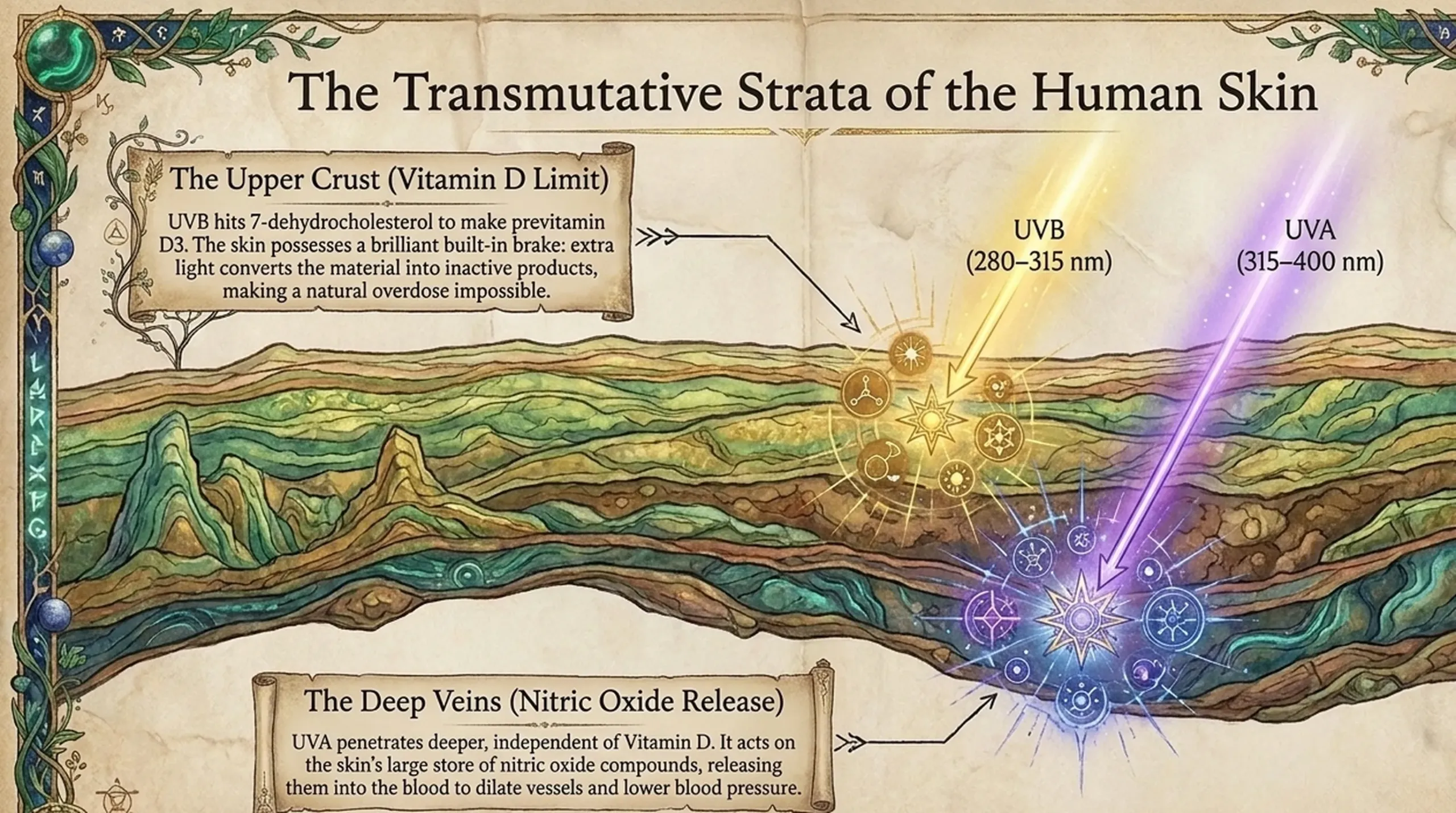
- What they found: Two standard erythemal doses of UVA lowered blood pressure, with falling nitrate and rising nitrite in the blood, and the effect did not depend on the enzymes the body normally uses to make nitric oxide. The light was releasing nitric oxide from the skin’s own store. In 2020, Weller’s group analyzed 342,457 dialysis patients at 2,178 US clinics, whose blood pressure is measured at every session, and found that incident UVA and UVB were inversely associated with systolic pressure after adjusting for temperature.
- Why it matters: This is a plausible, measured mechanism for a cardiovascular benefit of sunlight that has nothing to do with vitamin D. It may also help explain why vitamin D pills have mostly disappointed in heart trials while sun exposure keeps showing up as protective in observational data. An earlier German study found a similar effect with whole-body UVA (Opländer et al. 2009, PubMed 19797169), and a 2010 European Heart Journal review laid out the hypothesis (PubMed 20215123).
- Honest limits: The drops in blood pressure in the volunteer study were modest and short-term. The dialysis population is very different from healthy people, and the 2020 analysis is observational. No trial has yet shown that a sun-exposure program lowers heart attacks or strokes.
5. Children’s Eyes: He and Colleagues, Guangzhou (2015)
Citation: He M, Xiang F, Zeng Y, Mai J, Chen Q, Zhang J, Smith W, Rose K, Morgan IG. “Effect of Time Spent Outdoors at School on the Development of Myopia Among Children in China: A Randomized Clinical Trial.” JAMA. 2015;314(11):1142-1148. DOI 10.1001/jama.2015.10803 · PubMed 26372583
- What they did: Nearsightedness (myopia) has exploded worldwide. A 2016 analysis projected that about half the world’s population, nearly 5 billion people, will be myopic by 2050 (Holden et al., PubMed 26875007). After Australian work found that time outdoors, not just less reading, protected children (Rose et al. 2008, PubMed 18294691), this team randomized 12 primary schools in Guangzhou, China. Six added one 40-minute outdoor class at the end of every school day for three years. The other six continued as usual. About 1,900 first-graders, average age 6.6, took part.
- What they found: After three years, 30.4 percent of children in the outdoor schools had developed myopia, compared with 39.5 percent in the control schools, a difference of 9.1 percentage points (P < .001).
- Why it matters: This is a randomized trial, the strongest kind of evidence, and it shows that simply being outside protects children’s eyes. A larger Taiwanese cluster trial measured the light itself and found that outdoor time at 1,000 lux or more, even in shade, reduced myopic shift, and that “relatively lower outdoor light intensity activity with longer time outdoors, such as in hallways or under trees, also can be considered” (Wu et al. 2018, PubMed 29371008). The leading explanation is that bright light releases dopamine in the retina, which slows the eye’s growth in length; animal work shows that high illuminance slows experimental myopia (Ashby et al. 2009, PubMed 19516016).
- Honest limits: The effect was meaningful but not total. Children in the outdoor schools still developed myopia, and the difference in eye length did not reach significance. Outdoor time also changes how far children focus, so light is not the only possible mechanism. The Japanese finding that violet light (360 to 400 nanometers) may be the protective part of daylight is intriguing but early (Torii et al. 2017, PMC5233810).
6. How Skin Makes Vitamin D, and Why It Cannot Overdose: Holick and Colleagues (1981 and 1988)
Citation: Holick MF, MacLaughlin JA, Doppelt SH. “Regulation of cutaneous previtamin D3 photosynthesis in man: skin pigment is not an essential regulator.” Science. 1981;211(4482):590-593. DOI 10.1126/science.6256855 · PubMed 6256855. And: Webb AR, Kline L, Holick MF. “Influence of season and latitude on the cutaneous synthesis of vitamin D3.” J Clin Endocrinol Metab. 1988;67(2):373-378. DOI 10.1210/jcem-67-2-373 · PubMed 2839537
- What they did: Michael Holick’s group at Boston University worked out the photochemistry. UVB light (roughly 290 to 315 nanometers) hits 7-dehydrocholesterol in the skin and converts it to previtamin D3, which slowly turns into vitamin D3. In 1981 they exposed human skin to simulated sunlight and tracked every product. In 1988 they put the same starting molecule outdoors in sealed vials in Boston, Edmonton, Los Angeles and Puerto Rico through the year.
- What they found: With continued exposure, previtamin D3 reached a plateau at about 10 to 15 percent of the starting material, and the extra light converted it into two inactive products, lumisterol and tachysterol. In other words, the skin has a built-in brake, which is why sunlight cannot cause vitamin D poisoning the way huge doses of pills can. In the second study, winter sunlight in Boston (42.2 degrees north) made no previtamin D3 from November through February, and in Edmonton (52 degrees north) the “vitamin D winter” ran from October through March.
- Why it matters: This is the physics of the vitamin D winter. Above roughly 40 degrees of latitude, the sun is too low for months each year to make vitamin D at all, no matter how long you stay out. Darker skin needs longer exposure to reach the same level, though the plateau is the same. Holick’s 2007 New England Journal of Medicine review remains the standard overview of deficiency (PubMed 17634462).
- Honest limits: Vitamin D made in the skin and vitamin D in a pill are the same molecule once in the blood, and large trials of vitamin D pills have been humbling. The VITAL trial gave 2,000 IU a day or placebo to 25,871 US adults and found no reduction in invasive cancer or cardiovascular events (Manson et al. 2019, PMC6425757). A meta-analysis of individual patient data did find fewer acute respiratory infections with daily or weekly supplements, with the biggest benefit in people who were very deficient (Martineau et al. 2017, PMC5310969). The lesson I take is that vitamin D is a real and important marker of sun exposure, but probably not the only thing sunlight does for us.
7. The Winter Depression: Rosenthal at the NIMH (1984), Terman at Columbia (1998)
Citation: Rosenthal NE, Sack DA, Gillin JC, Lewy AJ, Goodwin FK, Davenport Y, Mueller PS, Newsome DA, Wehr TA. “Seasonal affective disorder. A description of the syndrome and preliminary findings with light therapy.” Archives of General Psychiatry. 1984;41(1):72-80. DOI 10.1001/archpsyc.1984.01790120076010 · PubMed 6581756. And: Terman M, Terman JS, Ross DC. “A controlled trial of timed bright light and negative air ionization for treatment of winter depression.” Arch Gen Psychiatry. 1998;55(10):875-882. DOI 10.1001/archpsyc.55.10.875 · PubMed 9783557
- What they did: Norman Rosenthal, a South African psychiatrist who noticed his own mood sink in New York winters, described 29 patients at the US National Institute of Mental Health with depressions that came back every year at the same season, with oversleeping, overeating and carbohydrate craving. He named it seasonal affective disorder, SAD. A key step came from Alfred Lewy’s finding, in 1980, that bright light, but not ordinary room light, suppresses melatonin in humans (PubMed 7434030). Michael and Jiuan Su Terman at Columbia later ran one of the largest controlled trials of light therapy: 158 patients, 10,000 lux for 30 minutes a day, morning versus evening, with a placebo of low-density negative ions.
- What they found: In Rosenthal’s preliminary study, extending the day with bright artificial light had an antidepressant effect in 11 patients. In Terman’s trial, bright light and high-density negative ions both beat the low-density placebo, and by strict remission criteria, morning light worked better than evening light.
- Why it matters: This is where “10,000 lux for 30 minutes in the morning” comes from. A 2005 meta-analysis of randomized trials found effect sizes of 0.84 for bright light in SAD, “equivalent to those in most antidepressant pharmacotherapy trials” (Golden et al., PubMed 15800134). In 2016, a Canadian randomized trial in non-seasonal major depression found that light alone beat placebo and the combination of light and fluoxetine did best, with 58.6 percent remission (Lam et al., PubMed 26580307).
- Honest limits: Blinding light therapy is hard, because patients can see how bright the lamp is. A 2020 meta-analysis of 19 trials confirmed a benefit but a smaller one (standardized mean difference of 0.37) and flagged heterogeneous small studies with moderate-to-high risk of bias (Pjrek et al., PubMed 31574513). Bright light can trigger mania in people with bipolar disorder, so medical supervision matters there.
8. The Honest Risk: Green and the Nambour Sunscreen Trial (2011)
Citation: Green AC, Williams GM, Logan V, Strutton GM. “Reduced melanoma after regular sunscreen use: randomized trial follow-up.” Journal of Clinical Oncology. 2011;29(3):257-263. DOI 10.1200/JCO.2010.28.7078 · PubMed 21135266. Context: Gandini S, et al. “Meta-analysis of risk factors for cutaneous melanoma: II. Sun exposure.” Eur J Cancer. 2005;41(1):45-60. PubMed 15617990
- What they did: In 1992, Adèle Green’s team randomly assigned 1,621 adults in Nambour, Queensland, one of the sunniest places on Earth, to daily sunscreen on the head and arms or to their usual discretionary use, until 1996. They then followed them until 2006 through the cancer registry and pathology labs.
- What they found: Ten years after the trial ended, 11 new primary melanomas had occurred in the daily-sunscreen group and 22 in the discretionary group (hazard ratio 0.50, a borderline result at P = .051). For invasive melanomas the difference was larger: 3 versus 11 (hazard ratio 0.27). The same trial found that daily sunscreen slowed visible skin aging (Hughes et al. 2013, PubMed 23732711).
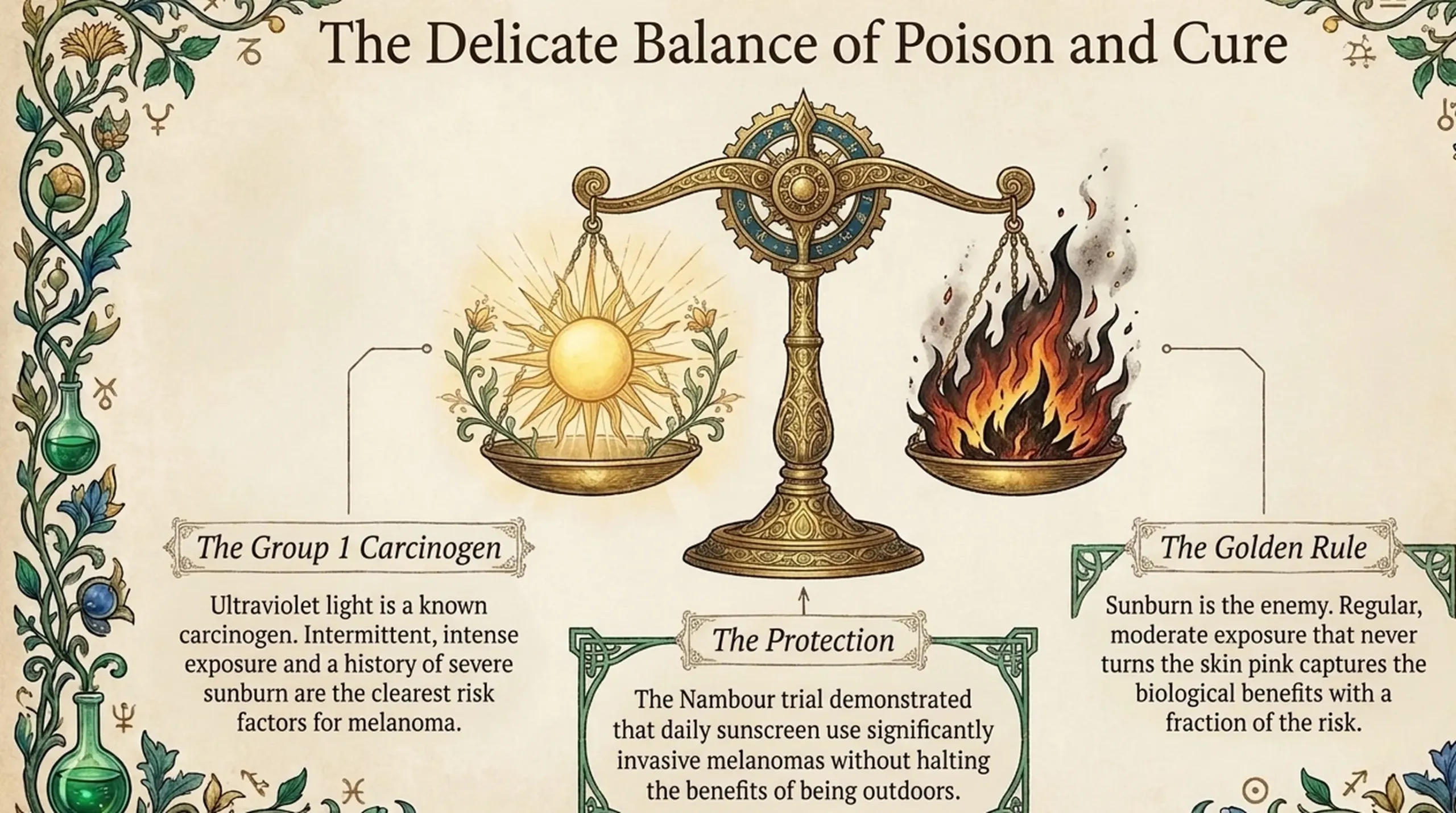
- Why it matters: I put this paper in the top eight on purpose. Solar ultraviolet radiation is classified by the International Agency for Research on Cancer as a Group 1 carcinogen (IARC Monographs volume 100D). The Gandini meta-analysis shows the pattern that matters for your choices: intermittent, intense exposure and a history of sunburn are the clearest risk factors for melanoma, while high, steady occupational exposure did not raise melanoma risk and, in the better studies, was inversely associated with it. Sunburn is the enemy. Regular, moderate light is a different thing.
- Honest limits: The trial was in subtropical Australia with mostly fair-skinned participants, and the melanoma counts were small. Chronic sun exposure is clearly linked to the more common non-melanoma skin cancers (basal and squamous cell carcinoma) and to skin aging, even when melanoma risk is not raised (Armstrong and Kricker 2001, PubMed 11684447).

What These Eight Papers Mean Together
Put the eight side by side and a clear picture forms. The human eye contains a dedicated light meter, wired to the master clock, that is tuned to the blue of the daytime sky. The modern indoor and electric environment gives that meter too little light by day and too much by night, and a few days of natural light reset it. Skin exposed to sunlight makes vitamin D through a self-limiting reaction, and separately releases nitric oxide that relaxes blood vessels. Children who spend more time in daylight grow up with healthier eyes. Bright light treats seasonal depression about as well as many drugs. And people who avoid the sun, at least in a country like Sweden, die earlier.
On the other side of the ledger, ultraviolet light damages DNA and causes skin cancer, and sunburn in particular raises melanoma risk. The weight of the evidence does not say “maximize sun.” It says that humans need regular daylight, especially in the eyes in the morning and on the skin in moderate doses, and that burning is the thing to avoid. The research world has been slowly moving to that position. A 2023 assessment by the United Nations Environment Programme’s effects panel weighed the harms and benefits of solar radiation together (Neale et al., PMC9976694), and Weller’s 2024 essay in the Journal of Investigative Dermatology is titled, plainly, “Sunlight: Time for a Rethink?” (PubMed 38661623).
More Papers Worth Reading
- Night light and diabetes. In about 85,000 UK Biobank participants who wore light sensors, brighter light at night predicted higher risk of type 2 diabetes, independent of genetic risk. Windred DP, et al. Lancet Reg Health Eur. 2024;42:100943. PMC11281921
- Outdoor light and mood. In more than 400,000 UK Biobank participants, more time in outdoor light was associated with better mood, better sleep and fewer depressive symptoms. Burns AC, et al. J Affect Disord. 2021;295:347-352. PMC8892387
- Room light at night. Ordinary room light before bed suppressed melatonin onset and shortened melatonin duration in healthy adults. Gooley JJ, et al. J Clin Endocrinol Metab. 2011;96(3):E463-E472. PMC3047226
- Screens before bed. Reading on a light-emitting e-reader before bed delayed sleep, suppressed melatonin, shifted the clock later and reduced next-morning alertness compared with a printed book. Chang AM, et al. PNAS. 2015;112(4):1232-1237. PMC4313820
- Blue light and alertness. Short-wavelength light suppressed melatonin and raised alertness, body temperature and heart rate more than longer-wavelength light. Cajochen C, et al. J Clin Endocrinol Metab. 2005;90(3):1311-1316. PubMed 15585546
- Sunlight and the immune system. A major review of how ultraviolet light modulates immunity through vitamin D and through other pathways. Hart PH, Gorman S, Finlay-Jones JJ. Nat Rev Immunol. 2011;11(9):584-596. PubMed 21852793
- T cells that sense light. Human and mouse T lymphocytes respond directly to low-dose blue light by making hydrogen peroxide, which increases their motility. Phan TX, et al. Sci Rep. 2016;6:39479. PMC5171715
- Ultraviolet and metabolism. In mice on a high-fat diet, ultraviolet exposure suppressed weight gain and signs of metabolic syndrome independently of vitamin D, partly through nitric oxide. Geldenhuys S, et al. Diabetes. 2014;63(11):3759-3769. PubMed 25342734
- Sunlight as a disinfectant. Simulated summer sunlight inactivated 90 percent of SARS-CoV-2 on surfaces every 6.8 minutes in simulated saliva. Ratnesar-Shumate S, et al. J Infect Dis. 2020;222(2):214-222. PMC7313905
- Sunlight in hospitals. A historical and current review of sunlight and fresh air in infection control, from Florence Nightingale’s wards to modern hospital design. Hobday RA, Dancer SJ. J Hosp Infect. 2013;84(4):271-282. PMC7132476
- The global balance. A global burden estimate led by Robyn Lucas found that too much UV causes about 1.6 million disability-adjusted life years lost per year, but that reducing global UV exposure to very low levels “might” cause a far larger burden through vitamin D deficiency, up to 3.3 billion. Lucas RM, et al. Int J Epidemiol. 2008;37(3):654-667. PubMed 18276627
- Colon cancer and latitude. The 1980 paper that launched the sunlight-vitamin D-cancer hypothesis. Garland CF, Garland FC. Int J Epidemiol. 1980;9(3):227-231. PubMed 7440046
What the Science Does Not Yet Show
I hold this subject to the same standard as the others, so here is the plain version. There is no randomized trial showing that a sun-exposure program makes people live longer; the mortality evidence is observational. The UVA and blood pressure effect is real in the lab, but no trial has shown it prevents heart attacks or strokes. Vitamin D pills have not reproduced most of the benefits that sun exposure shows in observational data, and nobody yet knows exactly which parts of sunlight account for the difference.
Some popular claims I could not source at all. I found no controlled evidence for “sungazing,” staring at the sun at sunrise or sunset, and staring at the sun can permanently burn the retina (solar retinopathy). I found no good evidence that diet makes skin immune to sunburn or skin cancer. I found no evidence that sunscreen use causes melanoma; the one long-term randomized trial found the opposite. And I could not verify the often-repeated numbers about how many tuberculosis patients the mountain sun clinics cured, so I do not repeat them. If someone quotes you a cure rate from the sanatorium era, ask for the source.
The Physics and Biology in Plain Words
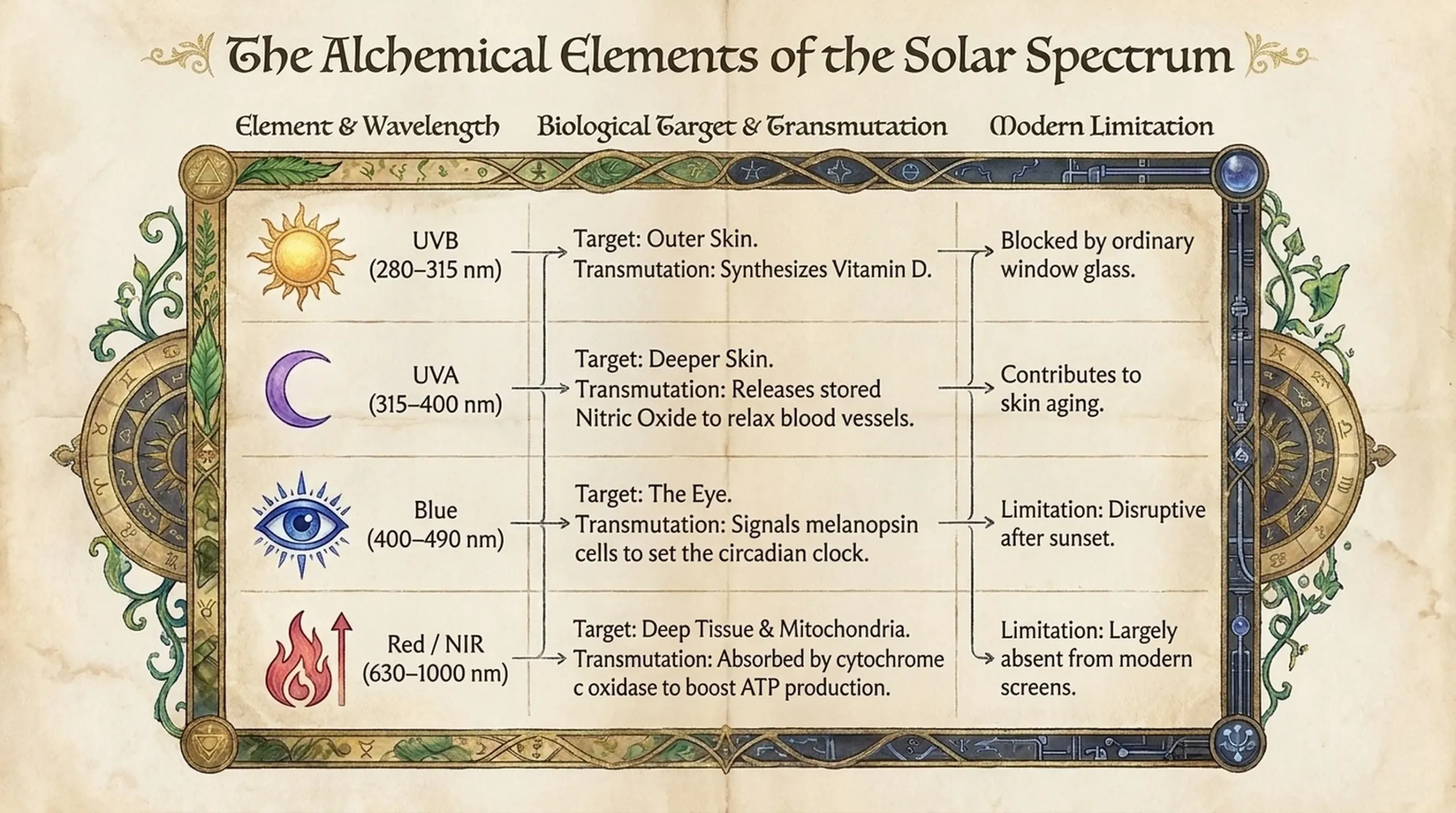
Sunlight is a spectrum, a range of electromagnetic waves of different lengths, measured in nanometers (billionths of a meter). At the ground, it runs from about 290 nanometers in the ultraviolet, through the visible colors from violet near 400 to deep red near 700, and on into the infrared beyond. The ozone layer removes almost all of the shortest and most dangerous ultraviolet, UVC. What reaches us is UVB (about 280 to 315 nanometers), UVA (315 to 400), visible light, and a great deal of near- and mid-infrared. A large part of the sun’s energy at the surface arrives as infrared that you feel as warmth but cannot see.
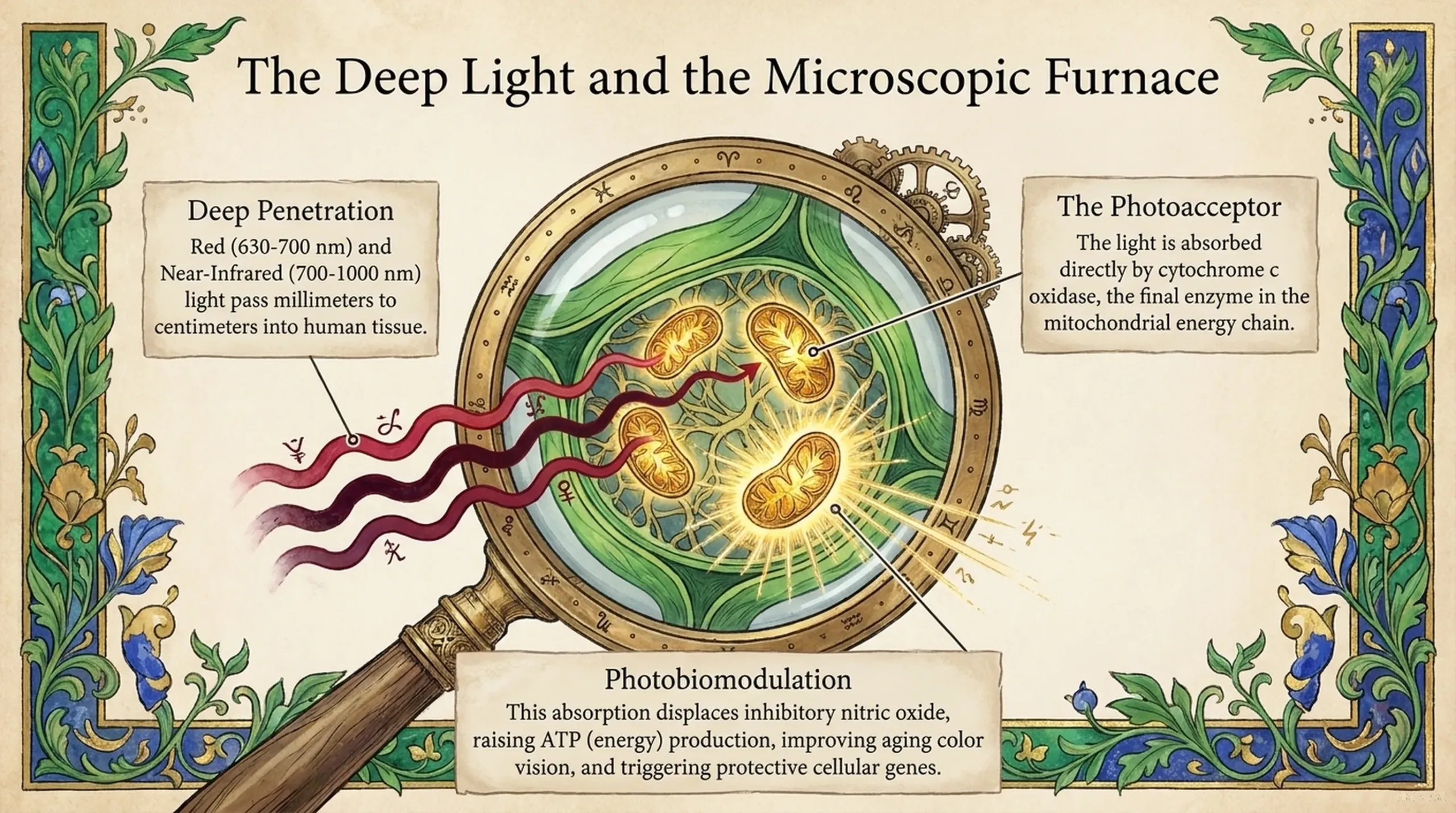
Each band does different work in the body, because each is absorbed by different molecules at different depths. UVB is absorbed in the outer layers of skin, where it makes vitamin D and, in excess, damages DNA and causes sunburn. UVA goes deeper into the skin, darkens existing pigment, releases nitric oxide and contributes to skin aging. Visible blue light around 460 to 480 nanometers is the main signal for the ipRGCs in the eye that set the clock. Red light and near-infrared, roughly 630 to 900 nanometers, travel the deepest into tissue, millimeters to centimeters, and are absorbed by an enzyme in the mitochondria, cytochrome c oxidase.
Two facts change how you think about indoor life. First, ordinary window glass blocks most UVB, so you cannot make vitamin D sitting behind a window; Alfred Hess showed in 1922 that the antirachitic rays of the sun “did not penetrate window glass” (Hess, Unger and Pappenheimer, PMC2128316). Second, the light levels are wildly different. A typical lit room or office is a few hundred lux. Outdoors in shade is often thousands of lux, and full sun can reach tens of thousands to around 100,000 (see the myopia review by Morgan et al. 2018). Your eyes adapt so well that indoors feels bright, but your clock and your retina know the difference, which is why the Taiwanese myopia trial measured outdoor time above 1,000 and 3,000 lux.
In Plain Words: Why Wavelength Matters
Light is not one thing. Its wavelength decides which molecule absorbs it, how deep it goes and what it does. A device that says “red light” or “full spectrum” is only useful if it delivers the right wavelength, at the right intensity, for the right time.
- UVB, about 280 to 315 nm: makes vitamin D in the outer skin. Too much burns and damages DNA. Window glass blocks most of it.
- UVA, 315 to 400 nm: goes deeper into skin, releases nitric oxide that relaxes blood vessels, and contributes to skin aging and cancer.
- Violet and blue, about 400 to 490 nm: the main signal to the eye’s melanopsin clock cells (peak near 480 nm). Great in the morning, disruptive at night.
- Red, about 630 to 700 nm (660 and 670 nm are the most studied): absorbed by cytochrome c oxidase in mitochondria; reaches a few millimeters into tissue.
- Near-infrared, about 700 to 1,000 nm (850 nm is common in devices): goes deepest, invisible to the eye.
Safety notes
- Near-infrared is invisible and does not make you blink or squint. Wear goggles rated for red and near-infrared, and never look into the LEDs.
- Start with short sessions, a few minutes at a comfortable distance, and build up slowly. With light, more is not better.
- Never burn your skin, never look at the sun, and skip tanning beds.
- Check whether any medicine you take causes light sensitivity, and talk with your doctor if you have an eye, skin or mood condition.
I. The Original Design: Life Built Around the Sun
Sunlight is the oldest signal life has. The first clocks inside living cells were built to anticipate it. Cyanobacteria, plants, insects, fish and mammals all carry internal circadian clocks that run close to 24 hours and are reset by light each day. Our own clock sits in the suprachiasmatic nucleus, a small cluster of neurons above the crossing of the optic nerves, and its main input is the melanopsin light meter described in paper 1.
The skin evolved under the same sky. Nina Jablonski and George Chaplin showed that human skin color tracks the strength of ultraviolet light across the planet, and argued that pigment evolved as a balance between protecting the body from too much UV and letting in enough to make vitamin D (Jablonski and Chaplin 2000, PubMed 10896812). Our species spent most of its history outdoors in Africa, then spread to every latitude, and skin pigment shifted along the way. Every one of those ancestors lived by daylight. None of them spent a winter under fluorescent tubes.
II. The Great Move Indoors
The change came fast. Gas lighting spread through cities in the nineteenth century, Edison’s incandescent bulb arrived in 1879, and in the twentieth century the factory, the office, the school, the car and finally the screen moved most human life under a roof. The US National Human Activity Pattern Survey, which interviewed 9,386 people, found that respondents spent an average of 87 percent of their time in enclosed buildings and about 6 percent in enclosed vehicles (Klepeis et al. 2001, PubMed 11477521).
That left our eyes and skin with three problems at once. By day, indoor light is a small fraction of outdoor light, so the clock gets a weak “morning” signal. By night, electric light and screens send a false “day” signal, which suppresses melatonin and pushes the clock later, as Gooley and Chang showed. And window glass strips out the UVB that makes vitamin D, so a sunny office desk does nothing for it. Wright’s camping studies show the result: a clock running hours late relative to the sun, which snaps back within days when the electric world is switched off.
III. Light That Kills Germs and Light That Won a Nobel Prize
The modern science of sunlight as medicine started in London in 1877, when Arthur Downes and Thomas Blunt put test tubes of nutrient broth on a window ledge, some shaded and some in the sun. The sunlit tubes stayed clear. The shaded ones clouded with bacteria. Their paper, “Researches on the effect of light upon Bacteria and other organisms,” was published by the Royal Society (Proc R Soc Lond, DOI 10.1098/rspl.1877.0068). It is the root of the long tradition of sunlit hospital wards that Hobday and Dancer trace through Florence Nightingale to modern infection control (PMC7132476).
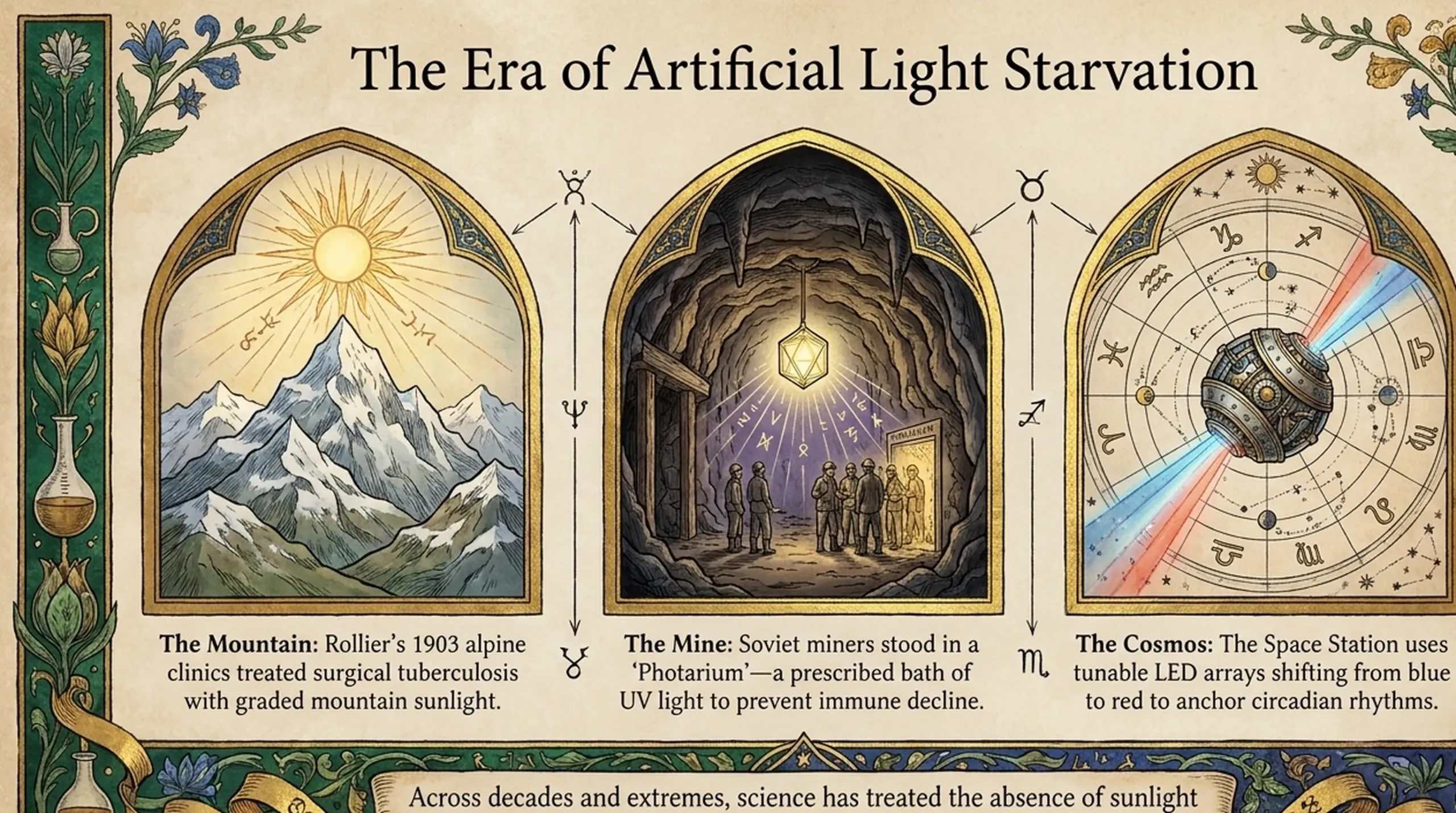
The first great clinician of light was Niels Ryberg Finsen, a Faroese-born physician in Copenhagen who suffered from a progressive illness himself and was fascinated by the sun’s effects. Finsen built carbon-arc lamps with quartz lenses and water-cooled filters to concentrate the ultraviolet and violet part of the spectrum and used them to treat lupus vulgaris, a disfiguring tuberculosis infection of the skin. In 1903 he received the Nobel Prize in Physiology or Medicine “in recognition of his contribution to the treatment of diseases, especially lupus vulgaris, with concentrated light radiation, whereby he has opened a new avenue for medical science” (Nobel Prize). He died the next year, at 43. His life and lamps are described in Grzybowski and Pietrzak, PubMed 22855977, and in a short history of phototherapy and vitamin D by Jarrett and Scragg, PubMed 27892584.
IV. The Sun Cure: Rollier, the Rickets Cure and the Sanatorium Era
In 1903, the same year as Finsen’s prize, a Swiss physician named Auguste Rollier opened a clinic at Leysin, high in the Alps above Lake Geneva, to treat tuberculosis of the bones and joints, the so-called surgical tuberculosis, with graded sun exposure. Patients, many of them children, were exposed a little at a time, starting with the feet and moving up the body over days, to avoid burning, and lay out on terraces in mountain air in winter as well as summer. Rollier photographed his patients before and after, and his book Heliotherapy appeared in English in 1923 (Internet Archive). The historian Tania Woloshyn has analyzed those portraits and how they were used to promote the treatment (Woloshyn 2013, PubMed 23538398), and a 2017 review in the Journal of the Royal College of Physicians of Edinburgh revisits the sanatorium era and asks what it can teach modern medicine (Greenhalgh and Butler, PubMed 29465107).
At the same time, light solved one of the great childhood diseases of the industrial city: rickets, the softening and bending of growing bones. In Berlin in 1919, Kurt Huldschinsky cured rickets in children with ultraviolet light from a mercury-quartz lamp (Kuntz 2021, PubMed 34879410). In New York, Alfred Hess and colleagues showed that sunlight prevented rickets, that a few minutes of mercury-vapor or carbon-arc light worked too, that the effective rays did not pass through window glass, and that pigmented skin needed a larger dose (Hess, Unger and Pappenheimer 1922, PMC2128316; Hess, Am J Public Health 1922, PMC1354036). Within a decade, the active substance was identified as vitamin D.
For a generation, the sun was medicine. Open-air schools, sun terraces and “sun cure” clinics spread across Europe and North America. Then antibiotics arrived. Streptomycin, found in 1943, cured tuberculosis far more reliably than sunlight, and the sanatoriums emptied. Heliotherapy faded from medicine just as the idea of sun avoidance began to grow. What survived was a narrower, more precise form of light medicine: ultraviolet phototherapy for skin diseases like psoriasis, blue light for newborn jaundice, and bright light for depression.
V. The Soviet Archive: “Light Starvation” and the Photaria
Here is a part of the story that most English-speaking readers have never seen. While Western medicine was dropping heliotherapy, the Soviet Union built a national public-health program around the opposite idea: that a lack of ultraviolet light is a preventable occupational disease. Soviet hygienists called it ultrafioletovaya nedostatochnost’, “ultraviolet deficiency,” or more vividly svetovoe golodanie, “light starvation,” and they treated it with ultraviolet lamps the way a nutritionist treats a vitamin deficiency.
The coal mines
The program began with the miners. A Soviet design standard reprinted in an official collection traces it to early 1946, when the Ministry of the Coal Industry for the western regions issued instructions that new pithead buildings must include, in addition to the medical post, a fotariy, a photarium, “for irradiating underground workers with mountain sun” (“горным солнцем,” the Soviet name for the mercury-quartz UV lamp). In 1947 the Ukrainian Institute of Occupational Hygiene and Occupational Diseases in Kharkiv drew up temporary technical specifications for photaria, approved by the USSR Ministry of the Coal Industry (USSR Ministry of Health instructions 1158-74, as reprinted in 1982).
A miner coming off shift went from the locker room through an inhalation room and the showers, and then through the photarium, where he stood for a few minutes around a central bank of mercury-quartz or erythemal (sunburn-spectrum) lamps, front and back, before collecting his clean clothes. A 2015 Russian mining-safety paper reproduces the floor plans and photographs of Kuzbass miners in the photarium, and notes that the practice has now largely died out because of the hazards and costs of the old lamps (Nikulin, Ryabinin and Letyukhin 2015, CyberLeninka).
The Arkhangelsk conference and the honest critics
In 1954, the Third All-Union Conference on the problem of compensating for ultraviolet deficiency met in Arkhangelsk, on the White Sea. Its resolution led to a February 1956 meeting in Stalino (today Donetsk), called by the Ukrainian Ministry of Health and the USSR Academy of Sciences’ Institute of Biological Physics, with about 100 participants. The report of that meeting by Professor N. M. Dantsig, published in the journal Gigiena i Sanitariya, is remarkable for its candor (Dantsig 1956, CyberLeninka). It records that Professor Z. N. Gorkin and Associate Professor S. M. Svidler found that miners who received three courses of 20 photarium sessions a year were less prone to flu, tonsillitis, skin infections and rheumatism, and that lost-workday illness from flu, boils and peripheral nerve disease fell by almost half compared with a control group.
Then the report does something I wish more modern papers did. It says the conclusions rested on a relatively small sample (1,000 people) and only two years of observation, that the morbidity accounting had methodological errors that could not rule out other health measures, and that the institutes responsible had not done the work properly. In other words, the Soviet hygienists believed in the photaria, and they also said plainly that the evidence was not yet good enough.
The national rules
The program kept growing anyway. On October 7, 1965, the Chief Sanitary Physician of the USSR, Pavel Lyarsky, signed the “Instructions on the prevention of light starvation in people,” developed with the Institute of Biophysics of the USSR Academy of Sciences and the Sysin Institute of General and Communal Hygiene (as cited by Nikulin et al., above). In 1974 the USSR Ministry of Health issued instructions 1158-74 for designing and operating artificial ultraviolet installations at industrial enterprises. They required UV installations at workplaces north of the Arctic Circle, and further south (above 45 degrees north) wherever people worked in rooms with essentially no daylight, including underground miners. They banned lamps emitting any radiation shorter than 280 nanometers, excluded workers exposed to photosensitizing chemicals such as coal-tar pitch and creosote, and set the photarium routine: a three-minute pass, 10 to 15 centimeters from the lamps, every day of the autumn-winter season (north of 60 degrees, from November 1 to March 1) (instructions 1158-74). The document states its reasoning directly: experience with preventive UV irradiation among residents of the Far North with its long polar night, and among underground workers, had “shown the high effectiveness of this measure.”
Two kinds of installation were specified: photaria for short, intense doses, and “long-acting” systems that added a low level of ultraviolet to the ordinary lighting of a workroom, so everyone in the room received a small dose all day. Soviet researchers were still publishing on the team method of irradiating coal miners in 1984 (Svetlichnyi and Rubtsov, PubMed 6505802).
How much should we trust this? The Soviet program was large, sincere and backed by laboratory work, but most of its outcome data were collected without the randomized, blinded designs we would demand today, and the Soviet authors themselves said so in 1956. The program is best read as a huge natural experiment and a set of hypotheses, not as proof. It is also an important historical fact: an entire superpower once treated sunlight as a nutrient that workers were owed.
VI. Light in Orbit: What the Space Doctors Learned
Spacecraft are built to keep the sun’s ultraviolet out, because above the atmosphere it is dangerous. A NASA explainer on spaceflight nutrition says that spacecraft are shielded against ultraviolet, so astronauts’ vitamin D “has to be provided by their diet,” and that vitamin D levels commonly fall in flight (NASA, “Nutritional Concerns of Spaceflight”). The same problem appears in Antarctica, where NASA scientists tested vitamin D supplements in winter-over crews at McMurdo Station (Smith et al. 2009, PubMed 19225122).
The Soviet and Russian space doctors carried their light-starvation thinking into orbit. In 1986, N. E. Panferova of the Institute of Biomedical Problems in Moscow reviewed the case for using ultraviolet radiation on long space flights, concluding it could be used “in view of its vitamin-forming, desensitizing, bactericidal, and supporting properties” (Panferova 1986, PubMed 3512904). In 1989 her team kept volunteers for 60 days under artificial light in a sealed chamber in Moscow in winter and compared two UV regimens. Gradually increasing doses up to 2 minimal erythemal doses raised blood levels of vitamins D, A and E and of calcium, phosphorus and copper, and slightly increased natural killer cell activity; a fixed low dose was inadequate, and 3 erythemal doses caused signs of overexposure (Panferova et al. 1989, PubMed 2565989). In 1992 the group analyzed “the development of UV deficiency in the cosmonauts” and ways to prevent vitamin D deficiency in flight (Belakovsky et al. 1992, PubMed 1301098). I could read only the abstracts of these Russian papers, not the full texts, so I am reporting what the abstracts say and nothing more.
On the American side, the problem in orbit turned out to be the clock. A NASA-funded study of 64 astronauts on 80 shuttle missions and 21 on the International Space Station found chronic sleep loss and pervasive use of sleeping pills; 12 of 16 ISS crew members used them (Barger et al. 2014, PMC4188436). With 16 sunrises a day and dim, unchanging cabin light, circadian misalignment was common and was linked to worse sleep and more medication (Flynn-Evans et al. 2016, PMC5515517). NASA’s answer was to change the light. George Brainard’s group at Thomas Jefferson University helped develop tunable LED lighting for the station that can shift between a blue-enriched light for alertness and a red-shifted light for the hours before sleep (Brainard et al. 2016, PubMed 27607152). In effect, the space station has been fitted with an artificial sun and sunset.
NASA also gave us the modern red-light device. In the 1990s, LED arrays from NASA’s space plant-growth work were tested on tissue healing. Harry Whelan’s team, supported through NASA’s Marshall Space Flight Center, reported that NASA LED arrays at 670, 720 and 880 nanometers improved musculoskeletal training injuries in Navy SEALs by more than 40 percent and shortened wound-healing time for crew on a US Navy submarine (Whelan et al. 2001, PubMed 11776448). Those were early, small, uncontrolled reports, but they launched the field that follows.
VII. The Light Inside the Light: Red and Near-Infrared
Most talk about sunlight focuses on ultraviolet. But a large share of the energy in sunlight is red and infrared, and that part of the spectrum has its own biology. Red light (about 630 to 700 nanometers) and near-infrared (about 700 to 1,000) pass through the skin far more deeply than ultraviolet or blue, and are absorbed by cytochrome c oxidase, the last enzyme in the mitochondrial energy chain.
The Russian biophysicist Tiina Karu, working at the Institute of Laser and Information Technologies of the Russian Academy of Sciences, spent decades mapping the action spectra of red and near-infrared light on cells and proposed cytochrome c oxidase as the primary photoacceptor (Karu 1999, PubMed 10365442). Margaret Wong-Riley and Harry Whelan later showed that 670-nanometer LED light rescued neurons poisoned with mitochondrial toxins and increased cytochrome c oxidase activity (Wong-Riley et al. 2005, PubMed 15557336). Michael Hamblin at Harvard’s Wellman Center summarized the leading model: light absorbed by cytochrome c oxidase can displace inhibitory nitric oxide, raise the mitochondrial membrane potential and ATP production, and trigger a brief burst of reactive oxygen signaling that switches on protective genes (Hamblin 2018, PMC5844808; Hamblin 2017, PMC5523874). The field calls this photobiomodulation.
The most interesting recent human work comes from Glen Jeffery’s lab at University College London. In 2020, people around 40 and older who were given brief exposures to a dim 670-nanometer light showed significant improvement in color contrast sensitivity on the blue (tritan) axis, which is vulnerable to mitochondrial aging; younger people did not change (Shinhmar et al. 2020, PubMed 32596723). In 2021, a single 3-minute morning exposure at only about 8 milliwatts per square centimeter at the eye improved color contrast for about a week (Shinhmar et al. 2021, PMC8613193). In 2024, a single 15-minute exposure to 670-nanometer light on the body reduced the rise in blood sugar after a glucose drink by 27.7 percent, integrated over two hours (Powner and Jeffery 2024, PubMed 38378043).
Some researchers have gone further. Scott Zimmerman and Russel Reiter proposed in 2019 that near-infrared in sunlight stimulates melatonin production inside mitochondria throughout the body, as a protective antioxidant system separate from the night-time melatonin made by the pineal gland (Zimmerman and Reiter 2019, DOI 10.32794/mr11250016). This is a hypothesis paper. It is interesting and testable, and it has not yet been confirmed in people.
There is a cautionary tale here too. Repeated low-level red-light therapy, shining a red laser into children’s eyes for a few minutes a day, slowed myopia progression in a large Chinese randomized trial (Jiang et al. 2022, PubMed 34863776). But in 2023, JAMA Ophthalmology published a case of retinal damage in a 12-year-old after such treatment (Liu et al. 2023, PubMed 37227712). The same light that can help the retina can harm it when the dose is wrong. Never shine any red or infrared device into your own or a child’s eyes outside of a supervised clinical setting.
VIII. The Honest Risk: Sunburn, Skin Cancer and Aging
I promised to be straight about the risk. Ultraviolet light, both UVB and UVA, damages the DNA of skin cells. Solar radiation is an established human carcinogen (IARC volume 100D). Chronic exposure drives most basal and squamous cell skin cancers and much of visible skin aging, and intermittent burning exposure, especially in childhood and in fair-skinned people, is a key driver of melanoma (Gandini et al. 2005; Armstrong and Kricker 2001). Tanning beds are a separate and worse problem. In the Swedish cohort studied by Yang and colleagues, regular solarium use was linked to higher overall and cancer mortality even as sunbathing vacations were linked to lower mortality (PubMed 21297041).
The useful way to hold this is that the dose makes the poison. A burn is the clearest sign of a harmful dose, and it is entirely avoidable. Short, regular exposure that never reaches pink, combined with shade, hats and clothing when the UV index is high, and sunscreen on the face and on long exposures, captures most of the benefit with a fraction of the risk. Risk is very different for different people. Someone with very fair skin, many moles, a family history of melanoma, an organ transplant or a photosensitizing medication needs to be much more careful than someone with darker skin. Ask your doctor or dermatologist what is right for your skin.
| Domain | What has been observed | Strength of evidence |
|---|---|---|
| Body clock (eye) | Melanopsin ipRGCs drive the clock; a week of natural light moved the internal night to sunset (Berson, Hattar; Wright) | Strong (lab physiology, small field studies) |
| Mood | Bright light treats seasonal and non-seasonal depression (Rosenthal; Terman; Golden; Lam; Pjrek) | Strong (randomized trials, imperfect blinding) |
| Children’s eyes | More outdoor time reduces new myopia (He; Wu) | Strong (randomized trials) |
| Vitamin D | UVB makes it in skin with a built-in limit; none in winter above about 40 degrees (Holick; Webb) | Strong (photochemistry) |
| Blood pressure | UVA releases nitric oxide from skin and lowers pressure; UV linked to lower pressure in 342,457 patients (Liu, Weller) | Moderate (lab and observational) |
| Survival | Sun avoiders had about twice the death rate of the most exposed women in Sweden (Lindqvist) | Moderate (observational, possible bias) |
| Mitochondria | 670 nm light improved aging color vision and blunted blood sugar rise (Jeffery lab) | Early (small human studies) |
| Soviet photaria | Fewer sick days in irradiated miners, with self-reported flaws in the data (Dantsig 1956) | Weak (uncontrolled) |
| Skin cancer | UV is a Group 1 carcinogen; sunburn and intermittent exposure raise melanoma risk; daily sunscreen reduced it (IARC; Gandini; Green) | Strong (trials and meta-analyses) |
IX. How to Live in the Light Again
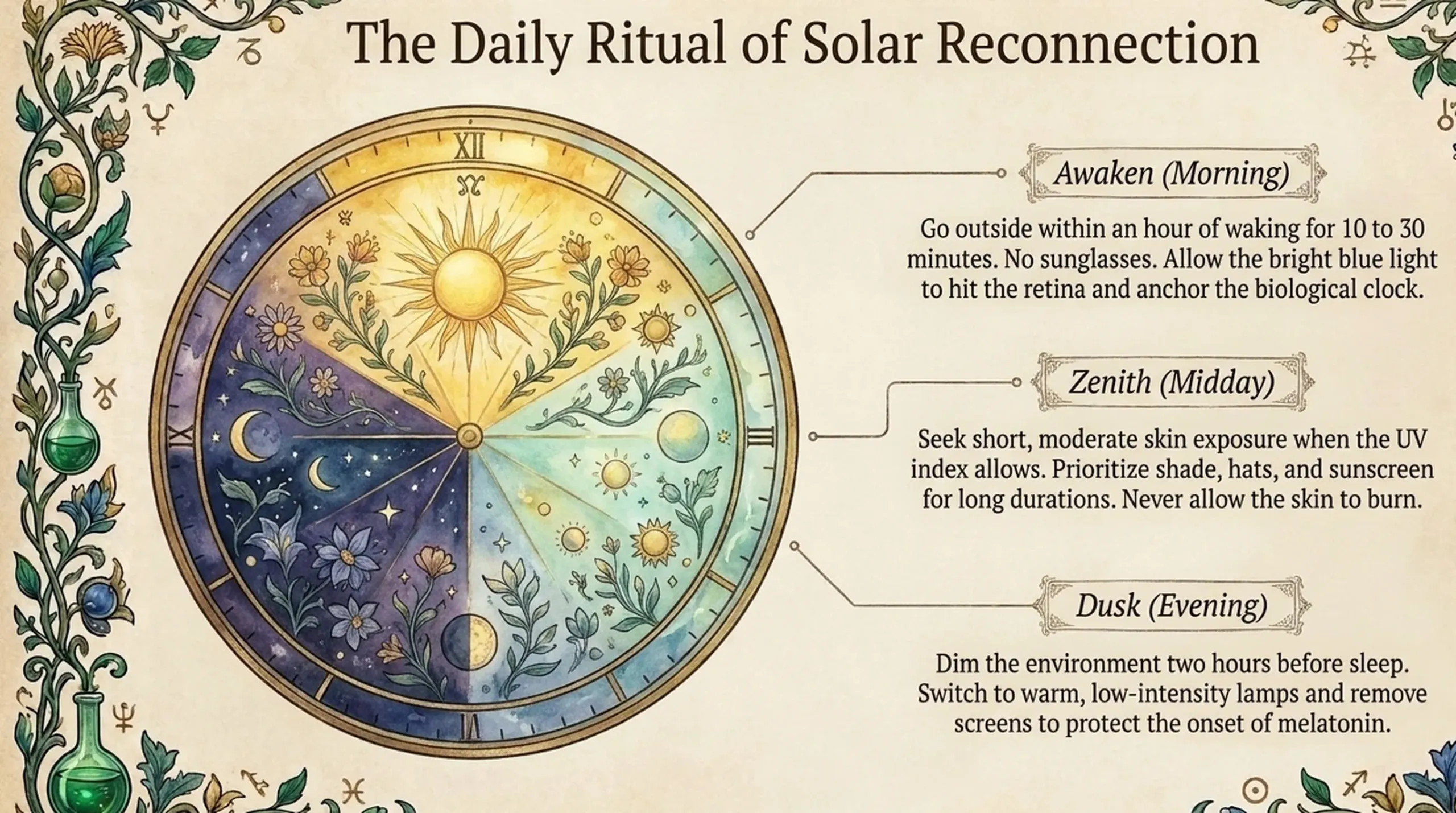
The original method is still the best one. Get outside in the morning. Even on an overcast day, outdoor light is usually far brighter than indoor light, and morning light is the strongest signal for setting the clock earlier. Ten to thirty minutes, with no sunglasses (but never looking at the sun), is a reasonable start, and the Wright and Stothard camping studies show how quickly the clock responds.
Get daylight on your skin, in moderation. When the UV index is moderate, short exposures of arms and legs, well short of any pinkness, let the skin do what it evolved to do. In winter at high latitudes, the sun is too low to make vitamin D at all, which is exactly when the Soviets ran their photaria and when many doctors suggest checking vitamin D levels.
Get children outside. The myopia trials are some of the strongest evidence in this whole article. Recess, outdoor classes, walks to school and weekends outside protect their eyes, and shade still counts.
Darken the night. Dim the lights after sunset, use warm, low lamps, keep screens out of the bedroom and make the bedroom dark. Light at night is the mirror image of light starvation by day.
Pair it with the other two ancestral signals. The grounding article covers bare skin on the Earth, and the Schumann resonance article covers the planet’s electromagnetic rhythm. The best place to get all three is the same: outside, in the morning, barefoot on the grass, under the open sky.
Start Free Tomorrow Morning
- Within an hour of waking, go outside for 10 to 30 minutes. Walk if you can. No sunglasses, but never look directly at the sun.
- Check the day’s UV index in your weather app or at the US EPA’s UV Index page. At 3 and above, plan shade, a hat and clothing for long exposures.
- On days with a moderate UV index, let your arms and legs see the sun for a short while, well short of any pinkness. Never burn.
- Take a break outside at midday, even for five minutes, and in winter especially.
- Get children outdoors for at least an hour or two a day, in shade when the sun is strong.
- Two hours before bed, dim the lights, switch to warm lamps and put the screens away.
- Keep a simple log for two weeks: minutes outdoors in the morning, sleep time, wake time, mood and energy. Your own data beats anyone’s sales pitch.
Safety First: Read This Before You Change Your Sun Habits or Buy a Light Device
- Never burn. Sunburn is the clearest controllable risk factor for melanoma.
- Never look directly at the sun, and do not practice “sungazing.” It can permanently damage the retina.
- If you have very fair skin, many moles, a personal or family history of skin cancer, an organ transplant, lupus or another photosensitive condition, talk with a dermatologist before increasing sun exposure.
- Many common medicines make skin more sensitive to light, including some antibiotics, diuretics, acne drugs and anti-inflammatories. Check with your pharmacist.
- Do not use tanning beds. They are not a substitute for sunlight, and frequent use is linked to higher mortality.
- Bright light therapy can trigger mania in people with bipolar disorder and may not suit people with some eye diseases. Talk with your doctor first.
- Protect your eyes from red and near-infrared panels. Near-infrared is invisible and does not trigger your blink reflex. Wear proper goggles and do not stare into the LEDs.
- Start any light device with short sessions and build up slowly. More is not better.
- Do not stop or change any medication or treatment because of anything in this article. Talk with your doctor first.
The Gear: My Amazon List and Why
You do not need to buy anything to get back into the light. The sun is free. But if you live far north, work indoors, or want to measure and improve your own light environment, these are the items I would actually use. I list the claims from each product listing as the seller states them; I have not lab-tested them.
As an Amazon Associate I earn from qualifying purchases. It costs you nothing extra and helps support this work.
Bright light for dark mornings (the SAD research standard)
- Carex Day-Light Classic Plus Light Therapy Lamp. Why: it delivers the research dose. The listing claims 10,000 lux at 12 inches of glare-free white light, the intensity and distance used in Terman’s 10,000-lux trials (paper 7). Honest note: the lamp does not replace a diagnosis, and 10,000 lux only counts at the stated distance.
Full-spectrum, high-CRI bulbs for the rooms you live in
- Norb Everyday Sun Full Spectrum LED Bulb, 5000K, CRI 97. Why: a daylight-colored bulb with a very high color rendering index (the listing claims CRI 97), so daytime rooms look and feel closer to daylight. Honest note: “full spectrum” in a bulb means good color across the visible range. It does not include the UV of sunlight and will not make vitamin D, and a bulb gives far fewer lux than a therapy lamp or the outdoors.
- DiCUNO ProOE A19 LED Bulb, 5000K, CRI 98. Why: the listing claims CRI 98 and a boosted deep red (R9), at a lower cost per bulb in a 6-pack, good for a whole kitchen or office. Honest note: use daylight bulbs by day and switch to warm, dim lamps in the evening, because bright blue-rich light at night works against your clock.
Red and near-infrared at the research wavelengths
- Hooga HG300 Red Light Therapy Panel, 660 nm and 850 nm. Why: a compact panel at the two most studied photobiomodulation wavelengths, 660-nanometer red and 850-nanometer near-infrared, with a listing claim of over 73 mW/cm² irradiance at 6 inches. That sits in the range Karu, Wong-Riley and Hamblin describe, where light reaches cytochrome c oxidase (section VII). Honest note: most human studies used specific doses on specific conditions, and none established a general wellness benefit for home panels. Wear eye protection.
- Viconor 300W Red Light Therapy Panel, 660 nm and 850 nm Dual-Chip. Why: a larger panel for bigger areas of the body, with the same 660/850 nm wavelengths and a listing claim of 140 mW/cm² at 6 inches. Honest note: higher irradiance means you reach a dose faster, not that more is better. Jeffery’s 670 nm eye studies used only about 8 mW/cm² at the eye. Start with a few minutes at a greater distance, and never point it at your eyes.
- Mito Red Light Therapy Glasses (600 to 900 nm). Why: eye protection designed for red and near-infrared panels; regular sunglasses do not block near-infrared. Honest note: the listing offers IR3 (80 percent reduction) and IR5 (95 percent reduction). I would choose the darker IR5 and still not look into the LEDs.
Measure your light
- Dr.meter Digital Lux Meter (0 to 200,000 lux). Why: lets you see the difference between your office (hundreds of lux), the shade outside (thousands) and full sun, and check that a therapy lamp really gives 10,000 lux where you sit. The Taiwanese myopia trial used 1,000 and 3,000 lux thresholds. Honest note: inexpensive lux meters are approximate, but more than good enough for this.
- Sunlight UV Index Meter with UV Dose Reminder. Why: shows the real UV index where you stand, which can differ from the forecast near water, snow or at altitude, and beeps at a chosen dose, which helps you avoid ever burning. Honest note: a phone weather app’s UV forecast is free and fine for most people.
Read deeper
- The Healing Sun: Sunlight and Health in the 21st Century by Richard Hobday. Why: a readable history of heliotherapy from Finsen and Rollier to the sanatoriums, by the researcher who later co-wrote the hospital-sunlight review cited above. Honest note: it is an advocate’s book, so check the claims against the papers.
- The Light Revolution: Health, Architecture, and the Sun by Richard Hobday. Why: how buildings once let the sun in for health, and how we lost that. The best book on daylight and architecture for a general reader.
- Winter Blues by Norman E. Rosenthal, M.D.. Why: by the psychiatrist who named seasonal affective disorder (paper 7). The practical guide to light therapy for dark months.
What I left off and why: I left off tanning beds and UV lamps for home tanning, because the evidence on them points to harm. I left off any device that claims to “replace sunlight,” because none reproduces the full spectrum and intensity of the sun. And I left off sungazing guides, because staring at the sun can blind you.
X. The Abundance Reading
I have argued for years that we are walking into an Abundance era of technology. Light is the clearest case of what that means for the body. A century ago, light was scarce indoors and night was dark. Now light is almost free, everywhere, all the time, and that is exactly the problem: we have abundant light at the wrong times and in the wrong places, and a starvation of the right light at the right times.
Nobody planned this. The move indoors was a side effect of progress, like rubber soles cutting us off from the ground and steel and radio drowning out the Earth’s rhythm. The Soviets recognized light starvation as a real problem decades ago and treated their miners and Arctic workers with lamps. NASA rebuilt the light on the space station to give astronauts a sunrise and sunset. We can do the same for ourselves with much simpler tools: a morning walk, open blinds, children outside, dark evenings and, where it helps, a well-chosen lamp.
The prescription is the oldest one there is. Go outside in the morning. Let the light into your eyes and, briefly, onto your skin. Never burn. Make the night dark. Take your shoes off, as the companion article on grounding explains, and stand under the same sky that every one of your ancestors stood under, inside the planet’s ancient electromagnetic rhythm. The sun is still up there, doing what it has always done. We just have to step back out into it.
Primary Sources
- Berson DM, Dunn FA, Takao M. Science. 2002;295(5557):1070-1073. DOI 10.1126/science.1067262
- Hattar S, et al. Science. 2002;295(5557):1065-1070. PMC2885915
- Provencio I, et al. “A novel human opsin in the inner retina.” J Neurosci. 2000;20(2):600-605. PMC6772411
- Thapan K, Arendt J, Skene DJ. J Physiol. 2001;535(Pt 1):261-267. PMC2278766
- Bailes HJ, Lucas RJ. Proc Biol Sci. 2013;280(1759):20122987. PMC3619500
- Lewy AJ, et al. “Light suppresses melatonin secretion in humans.” Science. 1980;210(4475):1267-1269. DOI 10.1126/science.7434030
- Wright KP Jr, et al. Curr Biol. 2013;23(16):1554-1558. PMC4020279
- Stothard ER, et al. Curr Biol. 2017;27(4):508-513. PMC5335920
- Lindqvist PG, et al. J Intern Med. 2014;276(1):77-86. DOI 10.1111/joim.12251; 2016;280(4):375-387. DOI 10.1111/joim.12496
- Lindqvist PG, Landin-Olsson M, Olsson H. Photochem Photobiol Sci. 2021;20(2):285-292. DOI 10.1007/s43630-021-00017-x
- Yang L, et al. Cancer Epidemiol Biomarkers Prev. 2011;20(4):683-690. DOI 10.1158/1055-9965.EPI-10-0982
- Liu D, et al. J Invest Dermatol. 2014;134(7):1839-1846. DOI 10.1038/jid.2014.27
- Weller RB, et al. J Am Heart Assoc. 2020;9(5):e013837. PMC7335547
- Opländer C, et al. Circ Res. 2009;105(10):1031-1040. DOI 10.1161/CIRCRESAHA.109.207019
- Feelisch M, et al. “Is sunlight good for our heart?” Eur Heart J. 2010;31(9):1041-1045. DOI 10.1093/eurheartj/ehq069
- He M, et al. JAMA. 2015;314(11):1142-1148. DOI 10.1001/jama.2015.10803
- Wu PC, et al. Ophthalmology. 2018;125(8):1239-1250. DOI 10.1016/j.ophtha.2017.12.011
- Rose KA, et al. Ophthalmology. 2008;115(8):1279-1285. DOI 10.1016/j.ophtha.2007.12.019
- Holden BA, et al. Ophthalmology. 2016;123(5):1036-1042. DOI 10.1016/j.ophtha.2016.01.006
- Morgan IG, et al. “The epidemics of myopia: Aetiology and prevention.” Prog Retin Eye Res. 2018;62:134-149. DOI 10.1016/j.preteyeres.2017.09.004
- Ashby R, Ohlendorf A, Schaeffel F. Invest Ophthalmol Vis Sci. 2009;50(11):5348-5354. DOI 10.1167/iovs.09-3419
- Torii H, et al. EBioMedicine. 2017;15:210-219. PMC5233810
- Holick MF, MacLaughlin JA, Doppelt SH. Science. 1981;211(4482):590-593. DOI 10.1126/science.6256855
- Webb AR, Kline L, Holick MF. J Clin Endocrinol Metab. 1988;67(2):373-378. DOI 10.1210/jcem-67-2-373
- Holick MF. “Vitamin D deficiency.” N Engl J Med. 2007;357(3):266-281. DOI 10.1056/NEJMra070553
- Manson JE, et al. (VITAL). N Engl J Med. 2019;380(1):33-44. PMC6425757
- Martineau AR, et al. BMJ. 2017;356:i6583. PMC5310969
- Rosenthal NE, et al. Arch Gen Psychiatry. 1984;41(1):72-80. DOI 10.1001/archpsyc.1984.01790120076010
- Terman M, Terman JS, Ross DC. Arch Gen Psychiatry. 1998;55(10):875-882. DOI 10.1001/archpsyc.55.10.875
- Golden RN, et al. Am J Psychiatry. 2005;162(4):656-662. DOI 10.1176/appi.ajp.162.4.656
- Lam RW, et al. JAMA Psychiatry. 2016;73(1):56-63. DOI 10.1001/jamapsychiatry.2015.2235
- Pjrek E, et al. Psychother Psychosom. 2020;89(1):17-24. DOI 10.1159/000502891
- Green AC, et al. J Clin Oncol. 2011;29(3):257-263. DOI 10.1200/JCO.2010.28.7078
- Hughes MC, et al. Ann Intern Med. 2013;158(11):781-790. DOI 10.7326/0003-4819-158-11-201306040-00002
- Gandini S, et al. Eur J Cancer. 2005;41(1):45-60. DOI 10.1016/j.ejca.2004.10.016
- Armstrong BK, Kricker A. J Photochem Photobiol B. 2001;63(1-3):8-18. PubMed 11684447
- IARC Monographs Volume 100D: Radiation. 2012. IARC Publications
- Lucas RM, et al. Int J Epidemiol. 2008;37(3):654-667. DOI 10.1093/ije/dyn017
- Neale RE, et al. Photochem Photobiol Sci. 2023;22(5):1011-1047. PMC9976694
- Weller RB. “Sunlight: Time for a Rethink?” J Invest Dermatol. 2024;144(8):1724-1732. DOI 10.1016/j.jid.2023.12.027
- Windred DP, et al. Lancet Reg Health Eur. 2024;42:100943. PMC11281921
- Burns AC, et al. J Affect Disord. 2021;295:347-352. PMC8892387
- Gooley JJ, et al. J Clin Endocrinol Metab. 2011;96(3):E463-E472. PMC3047226
- Chang AM, et al. PNAS. 2015;112(4):1232-1237. PMC4313820
- Cajochen C, et al. J Clin Endocrinol Metab. 2005;90(3):1311-1316. DOI 10.1210/jc.2004-0957
- Jablonski NG, Chaplin G. “The evolution of human skin coloration.” J Hum Evol. 2000;39(1):57-106. DOI 10.1006/jhev.2000.0403
- Klepeis NE, et al. J Expo Anal Environ Epidemiol. 2001;11(3):231-252. DOI 10.1038/sj.jea.7500165
- Hart PH, Gorman S, Finlay-Jones JJ. Nat Rev Immunol. 2011;11(9):584-596. DOI 10.1038/nri3045
- Phan TX, et al. Sci Rep. 2016;6:39479. PMC5171715
- Geldenhuys S, et al. Diabetes. 2014;63(11):3759-3769. DOI 10.2337/db13-1675
- Garland CF, Garland FC. Int J Epidemiol. 1980;9(3):227-231. DOI 10.1093/ije/9.3.227
- Ratnesar-Shumate S, et al. J Infect Dis. 2020;222(2):214-222. PMC7313905
- Downes A, Blunt TP. “Researches on the effect of light upon Bacteria and other organisms.” Proc R Soc Lond. 1877;26:488-500. DOI 10.1098/rspl.1877.0068
- Hobday RA, Dancer SJ. J Hosp Infect. 2013;84(4):271-282. PMC7132476
- Nobel Prize in Physiology or Medicine 1903: Niels Ryberg Finsen. NobelPrize.org
- Grzybowski A, Pietrzak K. Clin Dermatol. 2012;30(4):451-455. DOI 10.1016/j.clindermatol.2011.11.019
- Jarrett P, Scragg R. “A short history of phototherapy, vitamin D and skin disease.” Photochem Photobiol Sci. 2017;16(3):283-290. DOI 10.1039/c6pp00406g
- Rollier A. Heliotherapy. London: Oxford Medical Publications; 1923. Internet Archive
- Woloshyn TA. Med Humanit. 2013;39(1):38-46. DOI 10.1136/medhum-2012-010281
- Greenhalgh I, Butler AR. “Sanatoria revisited: sunlight and health.” J R Coll Physicians Edinb. 2017;47(3):276-280. DOI 10.4997/JRCPE.2017.314
- Kuntz B. “Kurt Huldschinsky: A pioneer in the struggle against rickets” (in German). Dtsch Med Wochenschr. 2021;146(24-25):1606-1612. DOI 10.1055/a-1172-5019
- Hess AF, Unger LJ, Pappenheimer AM. J Exp Med. 1922;36(4):427-446. PMC2128316; Hess AF. Am J Public Health. 1922;12(2):104-107. PMC1354036
- Dantsig NM. “Soveshchanie po voprosam primeneniya ul’trafioletovogo oblucheniya dlya shakhterov” (Meeting on the use of ultraviolet irradiation for miners). Gigiena i Sanitariya. 1956;(6). CyberLeninka
- USSR Ministry of Health. Instructions 1158-74 on the design and operation of artificial ultraviolet irradiation installations at industrial enterprises, May 24, 1974 (reprinted in an RSFSR occupational-hygiene collection, Izhevsk, 1982). PDF
- Nikulin AN, Ryabinin DV, Letyukhin ID. “Preventive ultraviolet irradiation of miners in context to planning labor protection measures.” Gornyi Informatsionno-Analiticheskii Byulleten’. 2015;(S7). CyberLeninka
- Svetlichnyi VA, Rubtsov AA. Sov Zdravookhr. 1984;(10):40-42. PubMed 6505802
- Panferova NE. Kosm Biol Aviakosm Med. 1986;20(1):4-12. PubMed 3512904
- Panferova NE, et al. Kosm Biol Aviakosm Med. 1989;23(2):59-63. PubMed 2565989
- Belakovsky MS, Anisimova IV, Panferova NE. Aviakosm Ekolog Med. 1992;26(2):4-6. PubMed 1301098
- Smith SM, et al. “Vitamin D supplementation during Antarctic winter.” Am J Clin Nutr. 2009;89(4):1092-1098. DOI 10.3945/ajcn.2008.27189
- NASA. “Nutritional Concerns of Spaceflight.” NASA NTRS
- Barger LK, et al. Lancet Neurol. 2014;13(9):904-912. PMC4188436
- Flynn-Evans EE, et al. NPJ Microgravity. 2016;2:15019. PMC5515517
- Brainard GC, et al. Curr Opin Pulm Med. 2016;22(6):535-544. DOI 10.1097/MCP.0000000000000329
- Whelan HT, et al. “Effect of NASA light-emitting diode irradiation on wound healing.” J Clin Laser Med Surg. 2001;19(6):305-314. DOI 10.1089/104454701753342758
- Karu T. J Photochem Photobiol B. 1999;49(1):1-17. PubMed 10365442
- Wong-Riley MT, et al. J Biol Chem. 2005;280(6):4761-4771. DOI 10.1074/jbc.M409650200
- Hamblin MR. Photochem Photobiol. 2018;94(2):199-212. PMC5844808; AIMS Biophys. 2017;4(3):337-361. PMC5523874
- Shinhmar H, et al. J Gerontol A Biol Sci Med Sci. 2020;75(9):e49-e52. DOI 10.1093/gerona/glaa155; Sci Rep. 2021;11:22872. PMC8613193
- Powner MB, Jeffery G. J Biophotonics. 2024;17(5):e202300521. DOI 10.1002/jbio.202300521
- Zimmerman S, Reiter RJ. “Melatonin and the Optics of the Human Body.” Melatonin Research. 2019;2(1):138-160. DOI 10.32794/mr11250016
- Jiang Y, et al. Ophthalmology. 2022;129(5):509-519. DOI 10.1016/j.ophtha.2021.11.023
- Liu H, et al. “Retinal Damage After Repeated Low-level Red-Light Laser Exposure.” JAMA Ophthalmol. 2023;141(7):693-695. DOI 10.1001/jamaophthalmol.2023.1548
This article is for education. It is not medical advice. Talk with your doctor before you change anything about your health care, your medicines or your sun exposure.
Members: The Light-Starvation Files and the Sunlight Field Manual
Read Multiplex members get the part I could not fit in a free article: my source-by-source notes on the Soviet light-starvation program and the Russian space-medicine papers, with the original Russian titles and how much weight to give each one; a close look at what the space station’s light teaches us about our own homes; a hedged, not-medical-advice 30-day Morning Light experiment you can run with free tools; how to dose light by the numbers (lux, UV index and minutes); how to use a red-light panel without fooling or hurting yourself; and the open questions I most want answered. If you want it, join Read Multiplex here. Your membership is what keeps this work independent.
Support This Work, You Will See It No Place Else
To continue this vital work documenting, analyzing, and sharing these hard-won lessons before we launch humanity’s greatest leap: I need your support. Independent research like this relies entirely on readers who believe in preparing wisely for our multi-planetary future. If this has ignited your imagination about what is possible, please consider donating at buy me a Coffee or becoming a member. Value for value you recieved here.
Every contribution helps sustain deeper fieldwork, upcoming articles, and the broader mission of translating my work to practical applications. Ain ‘t no large AI company supporting me, but you are, even if you just read this far. For this, I thank you.
Stay aware and stay curious,

🔐 Start: Exclusive Member-Only Content.
The rest of this article is for Multiplex members
You’ve reached the members-only part. Log in to keep reading right here, or join to unlock it.
- Full member-only articles: insights, wisdom and executive summaries
- The Multiplex members forum
- Member benefits and discounts
Already a member? You’ll come right back to this article after logging in. Forgot password?
Membership status:
🔐 End: Exclusive Member-Only Content.
~—~
~—~
~—~
Support ReadMultiplex at Multiplex.Tips

Support ReadMultiplex
Subscribe or donate by Bitcoin.
Copy address:bc1qkufy0r5nttm6urw9vnm08sxval0h0r3xlf4v4x

Send your receipt to [email protected] to confirm subscription.
Members
Become a member for full member-only articles, the Multiplex members forum, and member benefits and discounts.
 Past, present and future technology research + insights
Listen
🔊 Every article has a free “Listen to this ►” button. Hear it read aloud in your browser.
The Multiplex
- Advertise with us: Rates and booking
- X: @ReadMultiplex
- Buy a T-shirt: Multiplex.Love
- Program Guide: Multiplex.Today
- Podcast: Multiplex.Life
- Join the Multiplex team: Multiplex.Team
Stay updated
Get an email when we post new articles:
