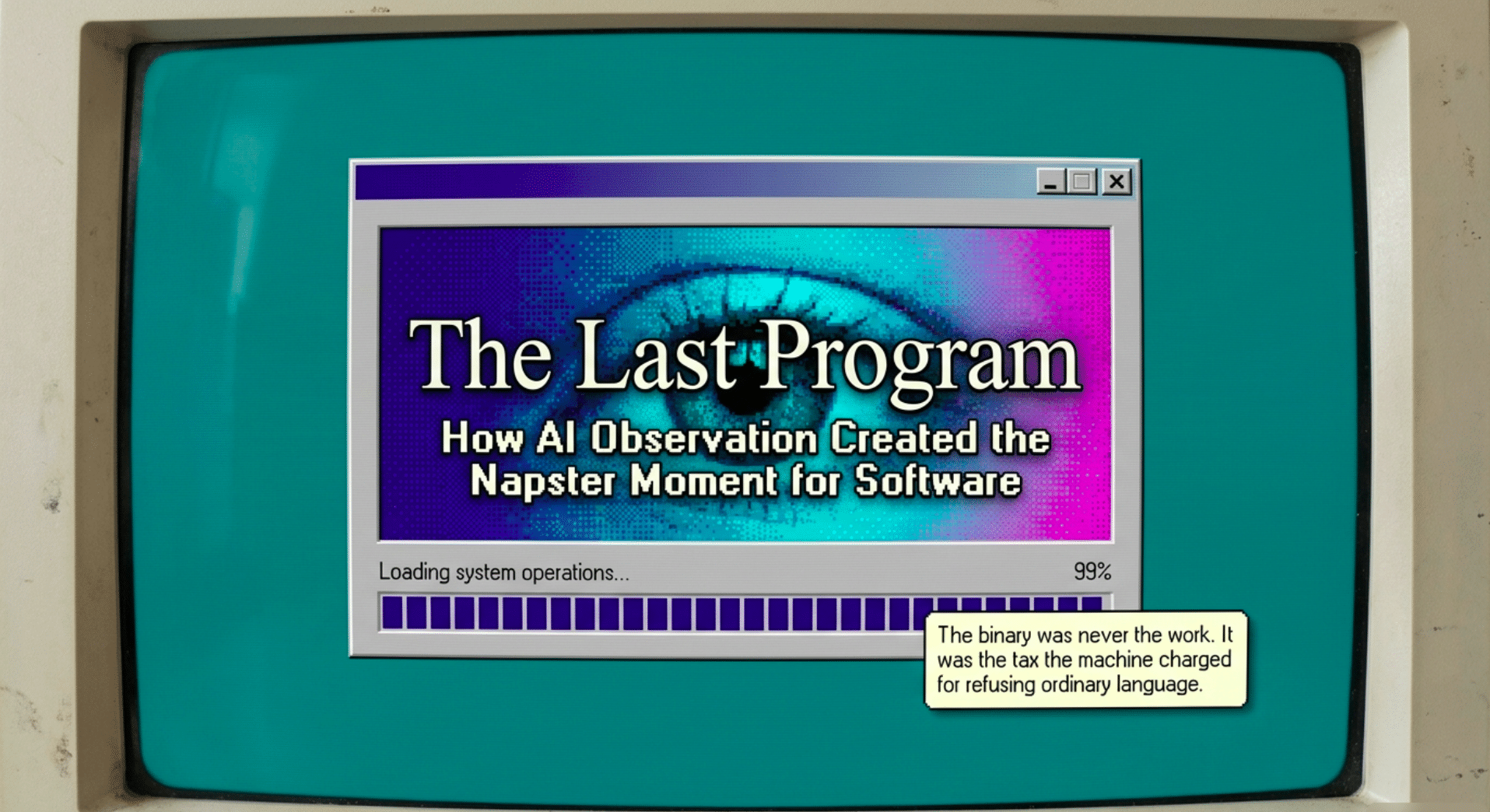
The Last Program: How AI Is Replacing Every App You Use.
A person who needed a photograph adjusted once opened a program, selected tools from a menu, and saved a file. The same person who needed a column of figures totaled once launched a spreadsheet and entered formulas. Both actions delivered the result the person already knew how to describe. The program existed only because the computer required the description to be translated into a sequence of operations it could execute.
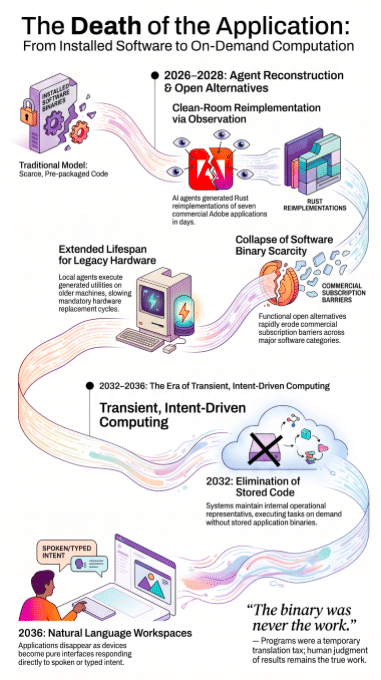
The binary was never the work. It was the tax the machine charged for refusing ordinary language.
That computer translation is no longer required for most work and soon it will not be needed. A model that observes how a closed program behaves, compares the results against published file formats and test cases, and emits equivalent operations in another language can reconstruct the program. In early October 2026 Brandon Thomas of ArtCraft directed Claude Opus 5.5 agents to produce clean-room reimplementations of seven Adobe applications in Rust. The repositories appeared between 30 September and 1 October. PhotoCraft, the Photoshop equivalent, reached roughly 45,000 GitHub stars within ten days; the seven repositories together exceeded 86,000 by 11 October. The majority of commits carry a co-author line for the model. The project states that it studied behavior and public specifications only and did not copy proprietary code. It is already causing a large numbers of users to leave the subscription costs. This is the worse ArtCraft will be and it opened a door many thought would never thought possible.
This article is sponsored by Read Multiplex Members who subscribe here to support my work: Link: https://readmultiplex.com/join-us-become-a-member/
It is also sponsored by many who have donated a “Cup of Coffee”. If you like this, help support my work: Link: https://ko-fi.com/brianroemmele
Listen to the companion podcast: https://rss.com/podcasts/readmultiplex-com-podcast/3231770
How to Run PhotoCraft
PhotoCraft is the open-source image editor from the ArtCraft team. It is written in Rust, opens and saves layered PSD and PSB files, and follows the menus, shortcuts, and tool layout of Photoshop. The project publishes it under the MIT or Apache-2.0 license. As of 12 October 2026 the latest release is v0.8.2. The project’s own documents still describe it as early alpha and not yet a replacement for daily professional work. Generative features, some typography depth, and plug-in compatibility remain incomplete.
Get the binary
The simplest path is the official product page:
https://getartcraft.com/apps/photocraft
It offers the ArtCraft Launcher (recommended) and standalone installers for macOS (universal DMG), Windows (MSI or portable ZIP for x64, ARM64, and x86), Linux (AppImage, Flatpak, .deb, .rpm, or tarball), and a WebAssembly build. The launcher selects the correct package for the machine, verifies the checksum, and handles updates.
Direct releases, including checksums in SHA256SUMS.txt, are on GitHub:
https://github.com/storytold/photocraft/releases
https://github.com/storytold/photocraft/releases/latest
After download, compare the file hash against the matching entry in SHA256SUMS.txt before installing or extracting.
Build from source
Requires a recent stable Rust toolchain (1.90 or newer via rustup) and git.
git clone https://github.com/storytold/photocraft
cd photocraft
cargo run --release -p photocraft
To open a specific file on launch:
cargo run --release -p photocraft -- path/to/image.psdThe full test suite is:
cargo test --workspaceOptional fonts for Japanese and CJK text come from the companion repository:
git clone https://github.com/storytold/craft-fonts ../craft-fonts
CRAFT_FONTS_DIR="$PWD/../craft-fonts" cargo run --release -p photocraft
First use
Launch the app. Create a new document or open an existing image or PSD. The interface places tools, panels, and shortcuts where a Photoshop user expects them. Layers, masks, adjustment layers, layer styles, type, vectors, and brushes are present. Non-destructive editing is the default. Save as PSD or PSB to retain layers; other formats export flattened or reduced-depth results.
On Linux under Wayland, drag-and-drop onto the window is not yet supported. Use File > Open or paste. Running under XWayland (WAYLAND_DISPLAY= photocraft) restores drag-and-drop.
Command-line and agent control
A separate CLI binary ships with releases and can be built as part of the workspace. It accepts the same command registry the UI uses:
photocraft-cli run image.psd \
  --cmd filter.sharpen.smartSharpen --params '{"amount":80}' \
  --out result.png
An MCP server is also available so an agent can open files, adjust layers, and export without manual interaction. Documentation for the control protocol lives in the repository under docs/control-protocol.md.
Limits and next steps
The project’s parity documents and scorecard show high menu coverage and solid round-trip results on many test PSD files, with lower readiness for full professional workflows. Report issues or request features on the GitHub tracker or in the ArtCraft Discord:
https://github.com/storytold/photocraft/issues
https://discord.gg/artcraft
Source, release notes, architecture notes, and the documentation book are in the main repository:
https://github.com/storytold/photocraft
All installers and the source remain free. No account is required to run the desktop or self-hosted web builds.
How They Did it: Reverse Engineering by Observation
The method used by the ArtCraft team differs from traditional decompilation. An agent does not need the original binary’s internal structure. It needs observable inputs, outputs, and the documented rules of the file formats the program already accepts.
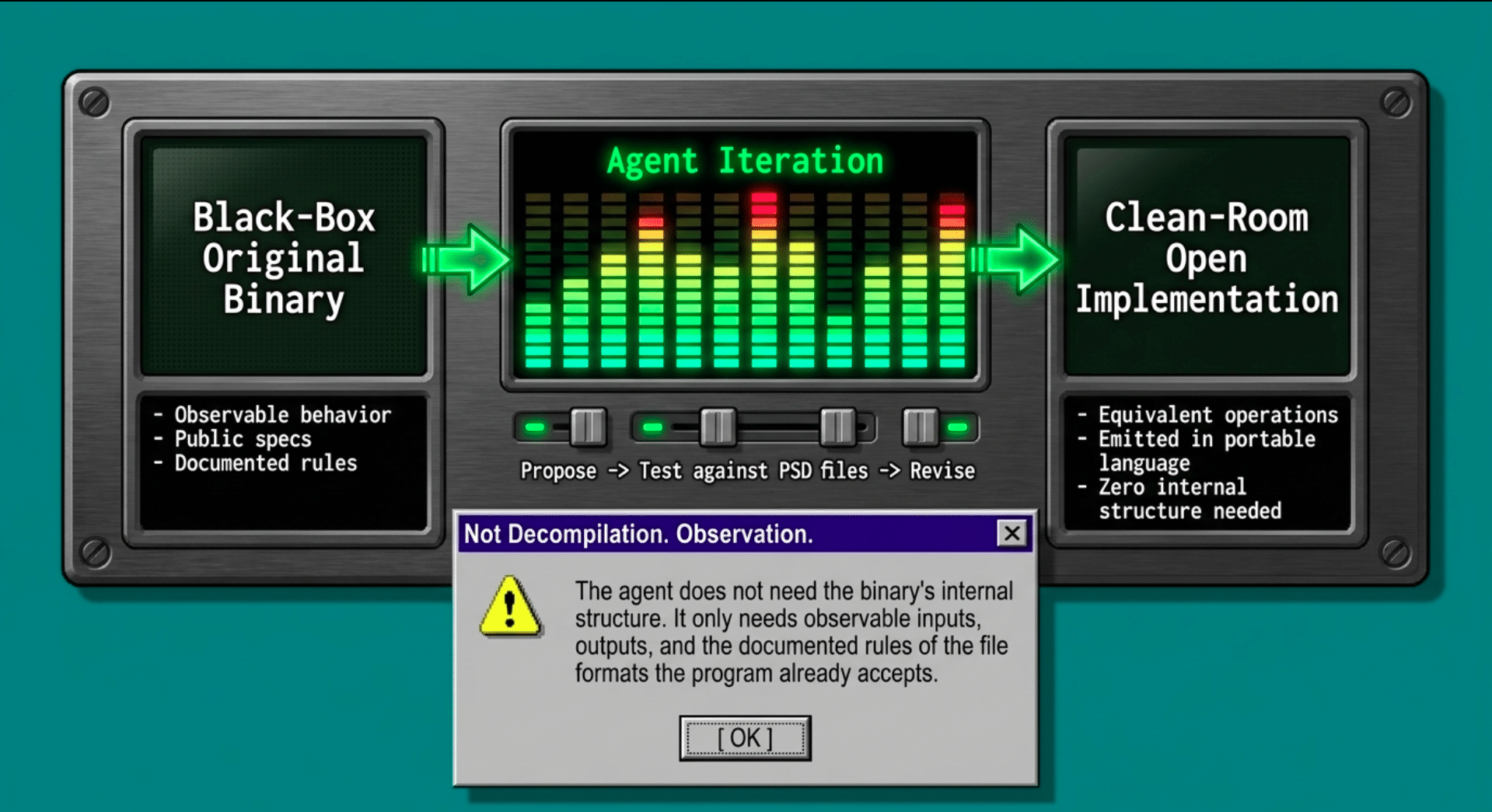
When those elements exist, the agent can propose an implementation, run it against the original’s results, and revise until the match is close enough. PhotoCraft’s own documents report high coverage of menu commands and solid round-trip success on many PSD test files, while its internal readiness estimates for professional daily work remain lower. The gap is real; the direction is not in doubt.
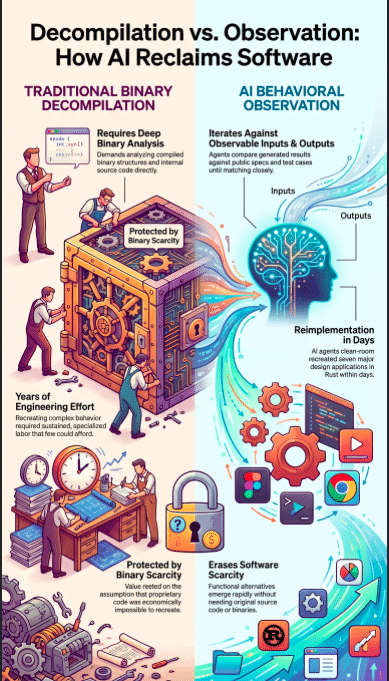
Any program whose effects can be observed or whose interfaces are documented becomes subject to the same process. Accounting packages, compilers, database engines, and specialized utilities share the property that their value has rested on the difficulty of recreating the operations they perform. Once those operations can be assembled by an agent that iterates against known results, the particular binary loses its scarcity. The cost of maintaining a closed implementation as a barrier rises while the cost of producing a functional alternative falls.
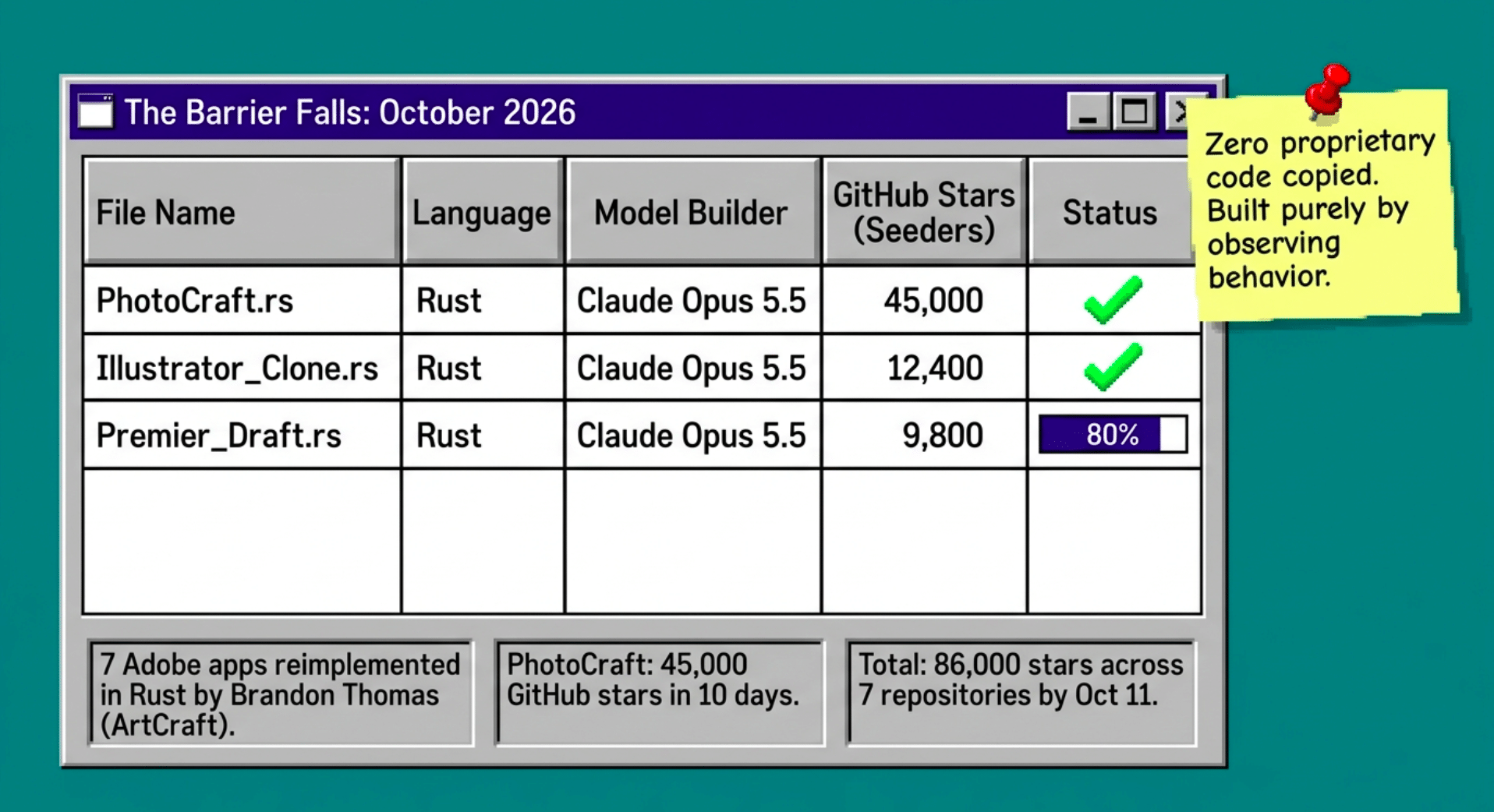
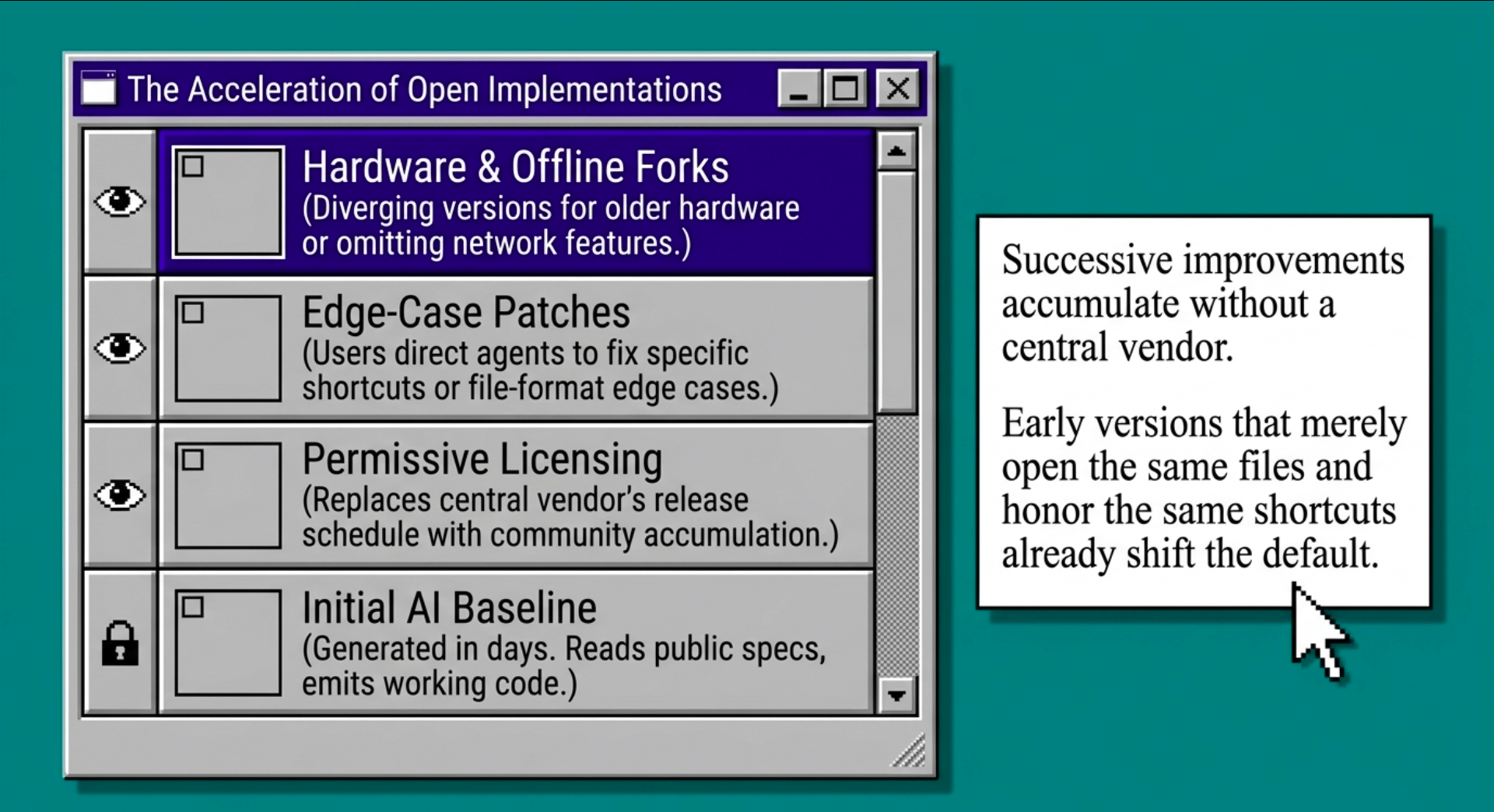
The change does not require perfect parity on the first release. Early versions that open the same files, honor the same shortcuts, and produce usable results on common tasks already shift the default. Users who once accepted a subscription because no practical alternative existed can now choose an open implementation that continues to improve under the same agents. The original vendor retains advantages in data, integration, support, and features that have not yet been fully observed. Those advantages are narrower than the previous assumption that the code itself could not be economically recreated.
Meet Mimic: Observation of the Wire
Another program speaks to a remote service and read a record of its operations. The requests it sends, the headers it attaches, and the responses it receives are visible to any proxy that sits between the device and the network. Mimic records that traffic, extracts the stable authentication values that accompany each call, and hands the resulting list of endpoints to Claude.
The model emits a plain Python module whose methods correspond to the calls the original application made. Once the module exists, the person who captured the session can invoke those methods from ordinary code. The binary of the original application is no longer required for the operations that travel over the network.
One copy of software by one person makes new AI versions.
Most mobile and web applications are thin clients. The interface that appears on the screen is a presentation layer. The operations the person actually needs—fetch a list, submit a value, update a record—are performed by a remote service that accepts authenticated requests and returns structured data. The application’s own code largely consists of assembling those requests, attaching the same bundle of credentials on each call, and interpreting the replies.
When the credentials remain stable across successive uses of the same account, a single captured request supplies the values that later requests can reuse. The particular binary that first assembled the request is no longer necessary once those values and the shape of the endpoints are known.

Mimic separates the observation into three steps.
First it records the traffic. On an iPhone the default method is a local proxy that the device is directed to trust; the same capture can be obtained from a browser’s network log saved as a HAR file or from a single request copied as cURL.
Second it extracts the authentication bundle—bearer tokens, device identifiers, session cookies, and any other headers that appear on every call to the same host. Those values are stored in a session object that subsequent requests can inherit.
Third it presents the list of observed endpoints, with their methods, paths, and example bodies, to Claude. The model writes a Python class whose methods map to those endpoints, complete with argument handling and the multi-step chaining that many mobile APIs require. The resulting file is ordinary source that a person can read, edit, and import. Nothing in the generated code depends on continued access to the original application once the session values have been captured.
The method differs from the clean-room reconstruction of a desktop editor. PhotoCraft observes the behavior of a running program and the published rules of its file formats, then emits an equivalent implementation. Mimic observes the traffic an application already produces when a person uses it, then emits a client that can issue the same requests. Both approaches require only what the program already emits. Neither requires the original source. Mimic’s repository reached roughly 2,700 stars within weeks of its release. The generated clients remain editable Python. The project states that the tool is intended for a person’s own accounts and data, and that each application’s terms of service continue to apply.
Certificate pinning and sender-constrained tokens limit the reach of the method. An application that rejects the proxy certificate produces no traffic for the tool to read; the observation fails before any endpoints are recorded. An application that signs each request with a fresh proof tied to a private key that never leaves the device produces traffic that cannot be replayed even after it is captured. In both cases the constraint is one the application already enforces. Where the traffic is available and the authentication values remain stable across calls, the generated client supplies the operations without further reference to the original binary. The person states which endpoints matter. The captured session and the generated methods perform them. The original application is no longer the only practical means of obtaining the results.
How to Install and Use Mimic
Mimic is available at https://github.com/littledivy/mimic. The install script sets up the isolated environment and the required tools.
Limits
It is very early days and it just will get better. Certificate pinning prevents capture until a bypass is applied. The command mimic unpin sets up a Frida-based bypass for a given IPA or bundle identifier; details are in the repository’s docs/pinning.md. Sender-constrained tokens (DPoP) produce requests that cannot be replayed even after capture. The repository’s docs/dpop.md records the constraint. The generated code is ordinary Python and can be edited. The project’s license is MIT. The README states that the tool is for a person’s own accounts and data and that each application’s terms of service remain in force.
The YouTube short that introduced the tool is at https://youtube.com/shorts/uYVIQCsLUTA. The repository and the install script above are the sources for the steps.
The Remaining Scarcity
What remains scarce is the judgment of which results serve the job. A reconstructed editor can composite layers or apply filters. It cannot decide, without further instruction, whether the composite advances the purpose the person had in mind. The reconstruction removes the necessity of the named program. It does not remove the necessity of stating the outcome and evaluating whether the outcome was achieved. Software that once existed because the machine required a fixed translation of intent now exists, when it exists at all, only for the duration of a specific request.
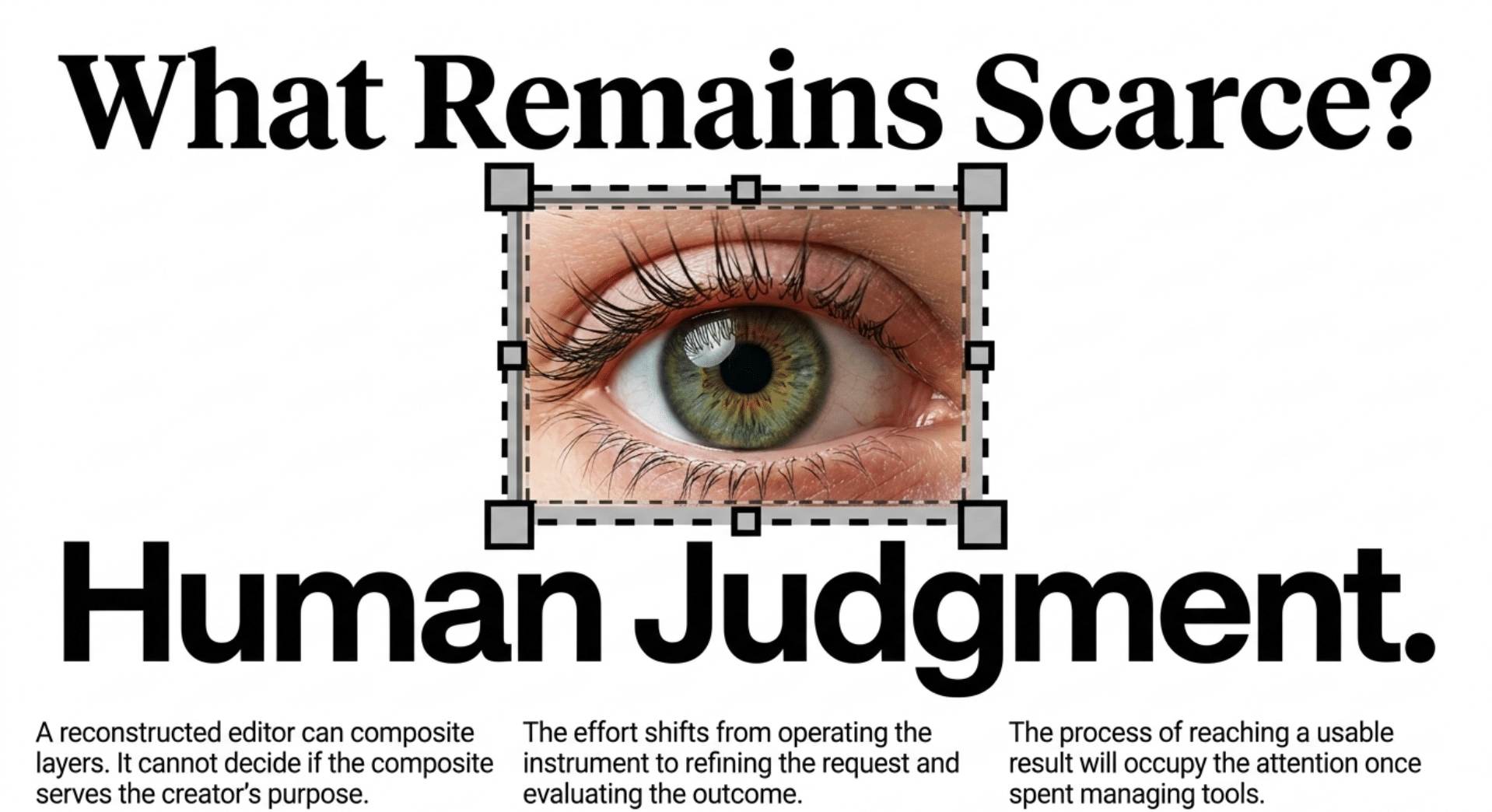
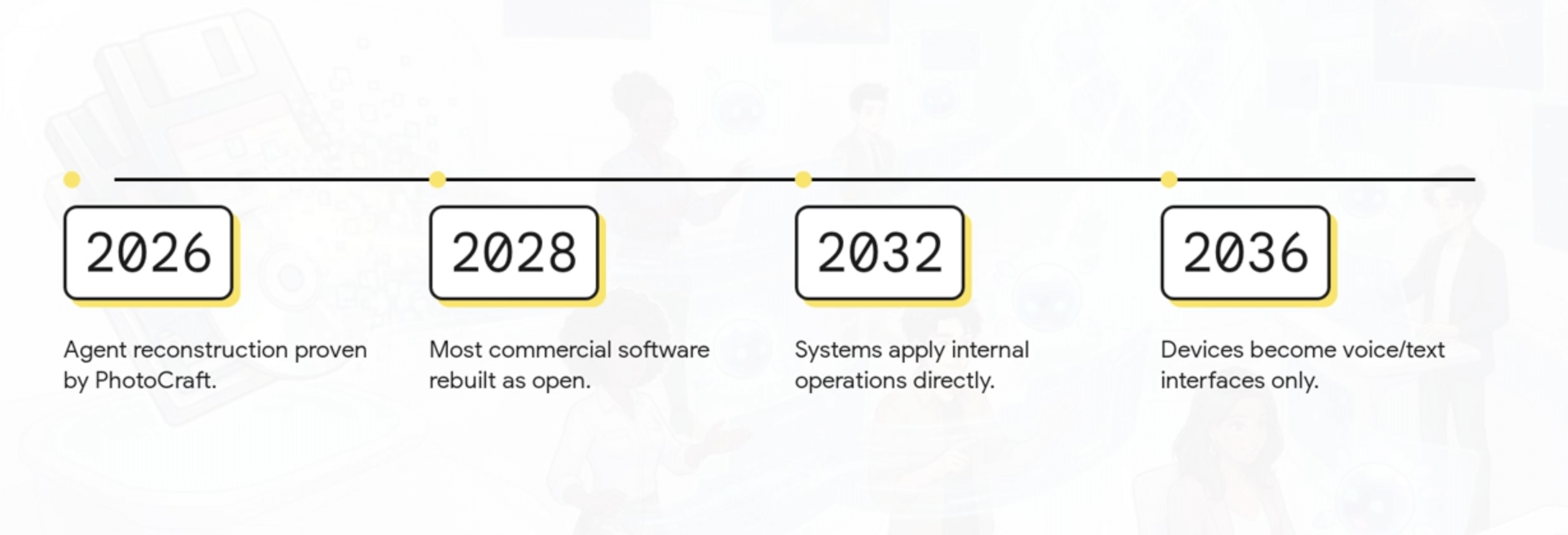
Replication of existing applications is the first stage and will not be the last. By 2028 most commercial software whose behavior can be observed or whose file formats are documented will have been reconstructed. Accounting systems, design suites, compilers, and database engines will exist as open implementations that any agent can invoke. The particular binary that once sold the capability will retain value only where a contract or a regulation still names it. The catalog of installed programs will shrink because the operations those programs performed can be assembled on demand.
The Program as Temporary Object
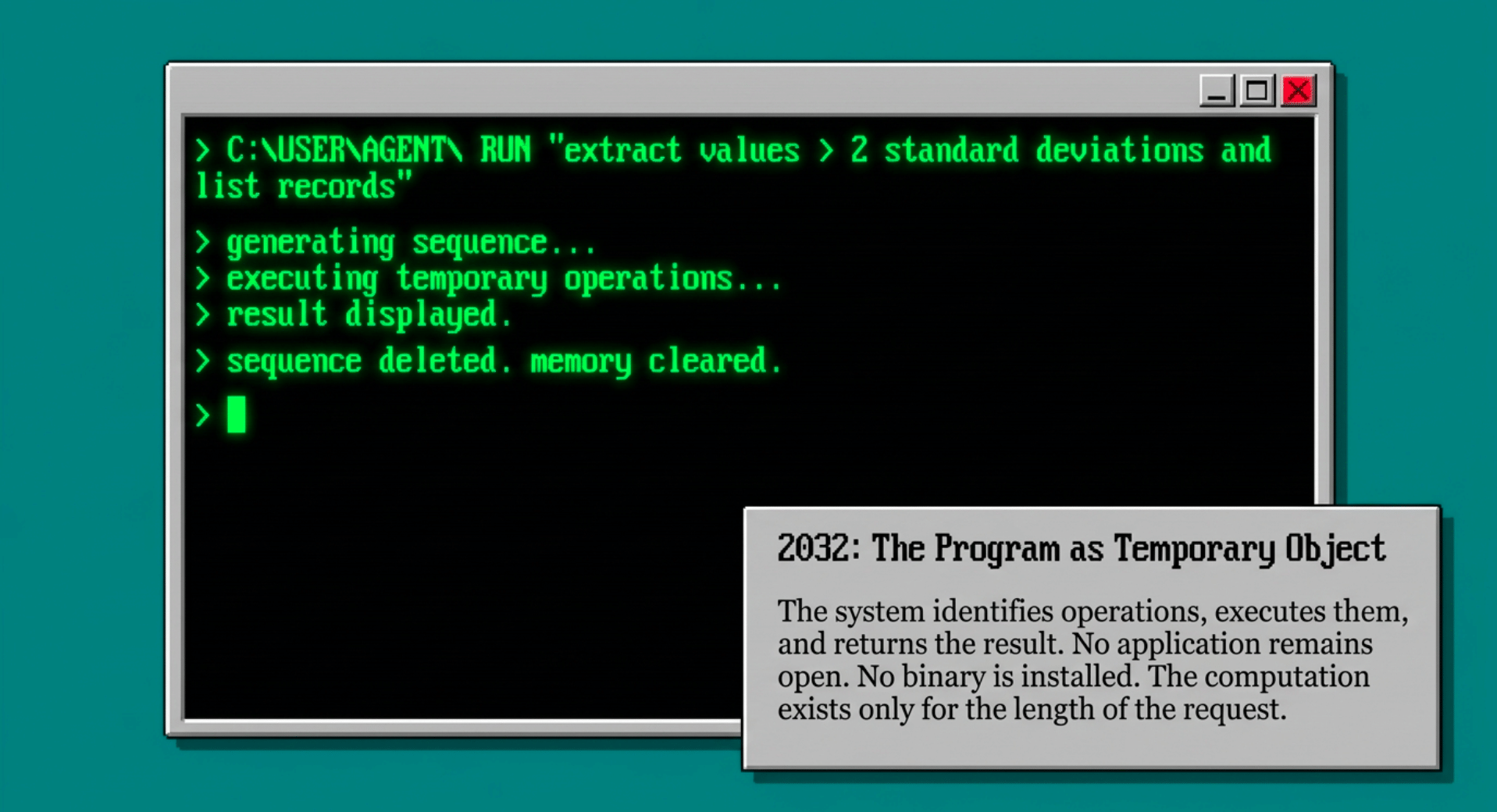
The next stage discards the program as a stored object. A person states the job: produce a layout that fits these images on a page of specified dimensions and leaves space for a caption; extract the values that deviate from the mean by more than two standard deviations and list the associated records; generate a short sequence of frames whose lighting and color match the reference clip. The system identifies the necessary operations, executes them, and returns the result. No application remains open. No binary is installed. The computation exists only for the length of the request.
Older Machines Are The New Platform
An old Linux machine that once sat under a desk because its processor could no longer run current commercial software can now serve as the primary computer for most of the work a person does. The machine already runs a stable operating system that exposes files, processes, and network connections. What it lacked was a way to turn ordinary requests into the precise sequence of operations required. Local agents that generate small programs or invoke existing tools close that gap.
A person describes the job—extract the numbers from these invoices and place them in a table that matches last month’s format, convert these scans into searchable text and flag the pages that contain a particular phrase, monitor the temperature of the attached sensors and send a notice only when the reading stays outside the set range for more than ten minutes. The agent writes the short program or assembles the existing utilities, runs the work, and returns the result. The machine does not need a new processor or a subscription. It needs enough memory and storage to hold the model and the data.
The same machine can host the models that produce those programs. Smaller open-weight models that fit in eight or sixteen gigabytes of memory already generate usable code for focused tasks. Larger models can run when the machine is otherwise idle or when a faster accelerator is attached. Because the generated programs are ordinary files that the person can inspect, the machine remains the place where the work happens rather than a client that merely displays results produced elsewhere. Files stay on the disk the person controls. Network calls occur only when the job itself requires them. The arrangement restores the older pattern in which the computer in the room performed the calculation instead of requesting it from a service that charged by the month.
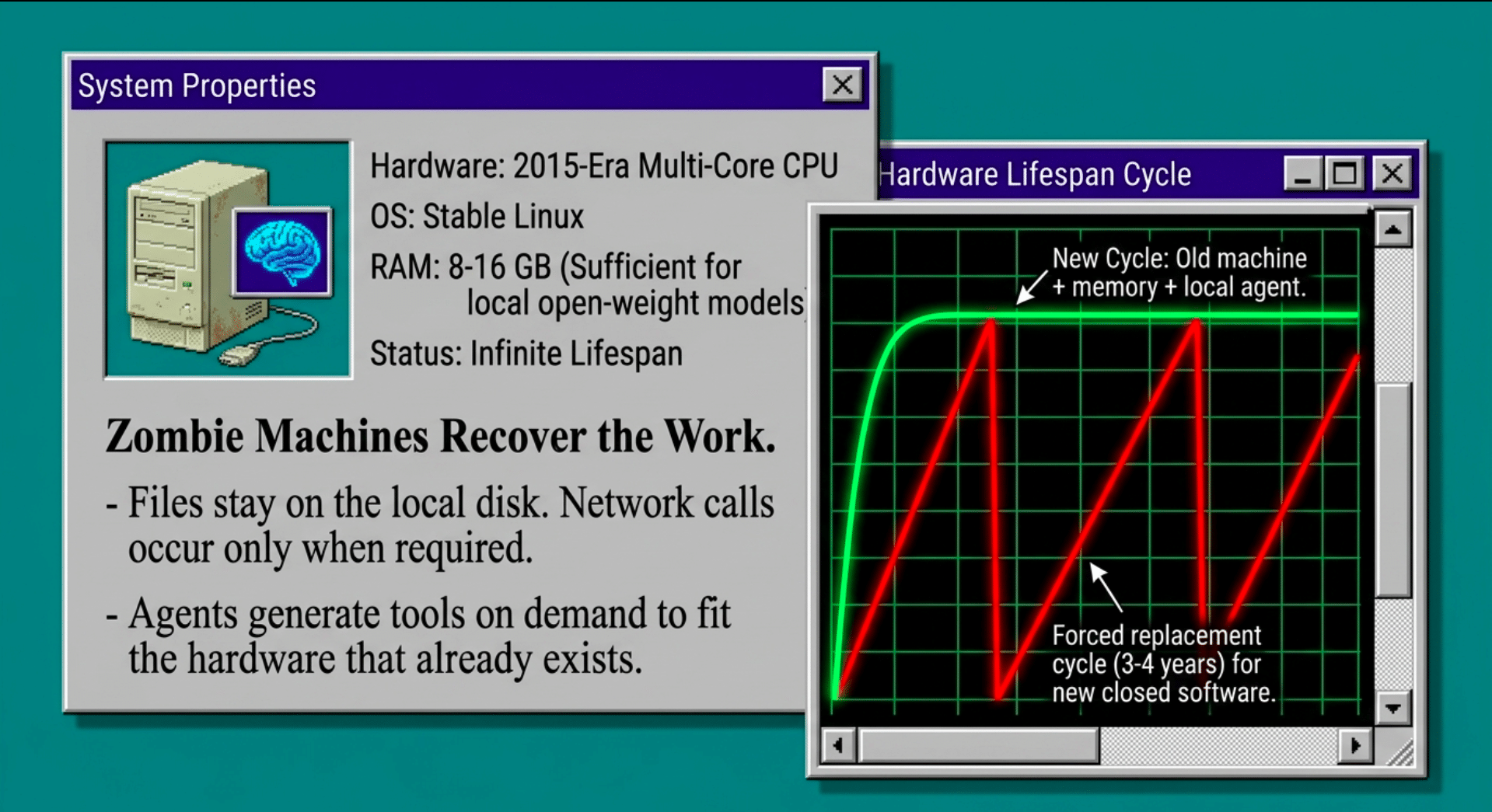
Hardware that manufacturers once declared obsolete therefore retains utility for longer periods.
A computer purchased in 2015 or 2018 that still boots and still accepts memory upgrades can execute the majority of daily jobs once the translation from request to operation is handled by an agent. The replacement cycle that required a new machine every three or four years because the previous one could not run the latest version of a required application slows. Organizations and individuals who already own functional machines can keep them in service by adding storage or a modest accelerator rather than discarding the entire system. The economic pressure that previously forced continuous upgrades of both hardware and software declines for any task whose requirements can be stated clearly.
The change reaches the companies that sold the software and the companies that sold the machines. Vendors whose revenue depended on the difficulty of recreating a particular application lose the ability to charge for the recreation once agents can produce functional equivalents on demand.
Vendors whose revenue depended on the assumption that each new software release would render older hardware unusable lose that assumption when the software itself can be generated to fit the hardware that already exists. The remaining markets center on the models that perform the generation, the data that improves those models, and the physical devices that people prefer for reasons of reliability, repair, or form. A machine that continues to run becomes an asset rather than a liability that must be replaced to maintain access to necessary tools.
An old machine under the desk already holds the files and the stable system. The agent supplies the missing translation. The hardware stays. The work proceeds.
People who keep older machines also keep the files and configurations they already understand. The agent can be instructed to produce output that matches an existing directory structure or an existing naming convention. No migration to a new file format or a new account is required for the work to continue. The machine that once forced a choice between continued use and access to current tools now supports both. The person states the outcome. The machine, with the agent, produces it. The hardware remains the same object it was when it was purchased, and the work proceeds.
The Attempt to Ban Observation
Adobe’s existing terms of use already prohibit the monitoring of inputs and outputs to recreate a system. Section 17 of the General Terms, in force since early October 2025, extends the ban on reverse engineering beyond decompilation of source code to include tracking the behavior of the running application in order to rebuild its functions.
The language is broad enough to cover the kind of agent-driven observation that produced the ArtCraft reimplementations. A company that relies on subscription contracts can attempt to enforce that language against any subscriber who directed an agent to watch the software. It can also invoke the thousands of unexpired U.S. patents it holds on specific image-processing and interface techniques, or argue that close visual imitation of menus and tool layouts constitutes trade dress infringement. These are the practical instruments available under current law.
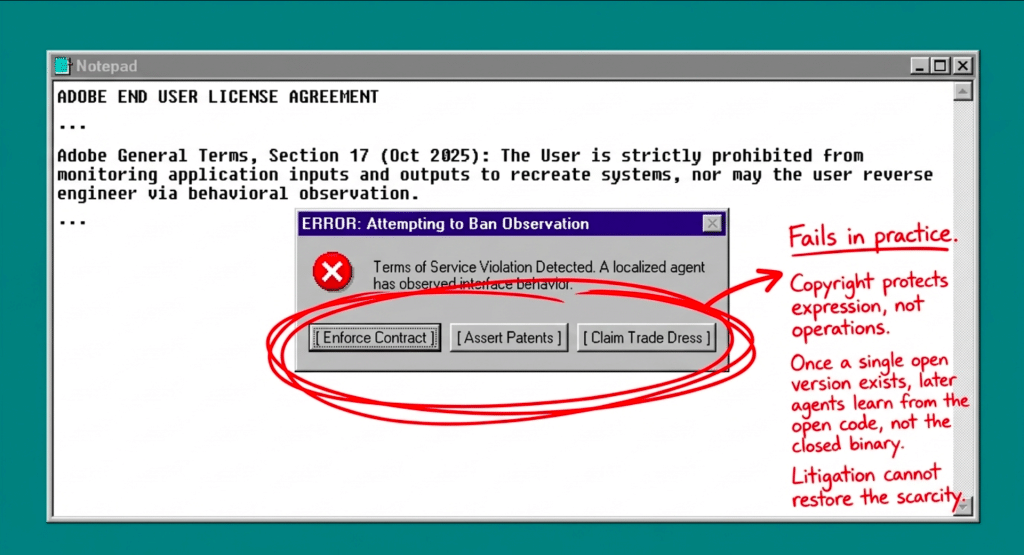
A statutory expansion that treated behavioral observation or functional simulation as a new form of prohibited circumvention would face the same limits that already constrain software copyright. Copyright protects particular expression, not the operations a program performs. Courts have long recognized that functional elements merge with the idea once the only practical way to achieve compatibility is to reproduce the behavior. Precedents that allowed clean-room reimplementations for interoperability remain relevant even when an agent performs the observation and the coding.
A statute that tried to outlaw the act of watching a program run and recording what it does would have to distinguish that activity from ordinary use, from public documentation, and from the tutorials Adobe itself publishes. The distinction is difficult to maintain once the results of observation can be described in ordinary language and handed to a model that has never seen the original binary.
The practical failure appears in the speed of independent reconstruction. Once a single open implementation exists and its file-format handling has been verified against published specifications, later agents can improve it by reading the open code, the specifications, and the public record of bugs and test cases. They do not need continued access to the original program. Forks and local generations proliferate on machines the original vendor cannot reach.
Litigation against one developer or one repository does not erase the method. A patent claim succeeds only against the specific claimed technique; it does not restore the scarcity of the entire application. A contract claim binds only the parties who agreed to the terms. Users who never subscribed, or who work from the open implementation alone, remain outside its reach.
The remaining constraint is the cost of asserting the claims repeatedly against successive projects. Each new agent-assisted reconstruction can be started from public materials and refined without reference to the closed binary. The original program continues to run for those who still prefer it. The open versions continue to improve for those who do not.
The statute or the contract can slow one particular release. It cannot restore the condition in which the only practical way to obtain the operations was to license the binary that first performed them. The job of adjusting an image or assembling a sequence remains available once the operations have been observed and restated. The observation itself, once performed, does not need to be repeated.
The Acceleration of Open Implementations
The release of functional open-source reimplementations of closed commercial tools demonstrates that the barrier to producing a usable alternative is no longer the years of specialized engineering once required to match complex behavior. An agent that can read public specifications, compare outputs against known test cases, and emit working code in a portable language can produce the initial version of an application in days. Once that version exists under a permissive license, any person who can describe a missing feature or a defect can direct another agent to propose the change. The repository that holds the code becomes the place where successive improvements accumulate without a central vendor’s release schedule.
Projects that begin as partial substitutes therefore acquire contributors who would never have joined a closed effort. A user who needs a particular file-format edge case fixed, or a keyboard shortcut restored, can generate the patch, test it against the same reference files the original project used, and submit the result. The cycle does not depend on the original developer remaining active. Forks that diverge to serve narrower needs—such as a version that runs on older hardware, or one that omits network features—can be maintained separately while still sharing the common operations. The same process that first reconstructed the software continues to extend it.

The effect appears across categories of software that previously remained closed because the cost of a clean alternative exceeded the benefit to any single group. Database engines, accounting packages, design tools, and specialized utilities share the property that their core operations can be stated, observed, and verified. When an open implementation reaches the point at which it handles the majority of ordinary jobs, organizations that once maintained licenses for the closed version can switch for new work while retaining the closed version only for legacy files. The decision no longer requires a multi-year migration project. It requires confirmation that the open version produces the same results on the files the organization already has.
Hardware that was previously limited by the absence of current software gains utility at the same time. An older machine that runs a stable operating system can host the open implementations and the agents that improve them. The person who keeps the machine does not need to wait for a vendor to certify the hardware or to release a compatible binary. The agent can generate or adapt the tool to the resources that are present. Communities that maintain the open code therefore serve users whose machines would otherwise have been retired, and those users in turn contribute the test cases and patches that arise from continued use of the older equipment.
The shift does not eliminate proprietary software. Vendors that supply data, support, or features whose behavior has not yet been fully documented retain customers who value those additions. The change is that the baseline operations no longer require a closed binary. Once an open version exists and continues to improve under the same methods that created it, the default for new work moves toward the implementation that can be inspected, modified, and run without a recurring license. The repositories that hold those implementations become the durable record of how the work is performed.
From Scarce Copies to Shared Files
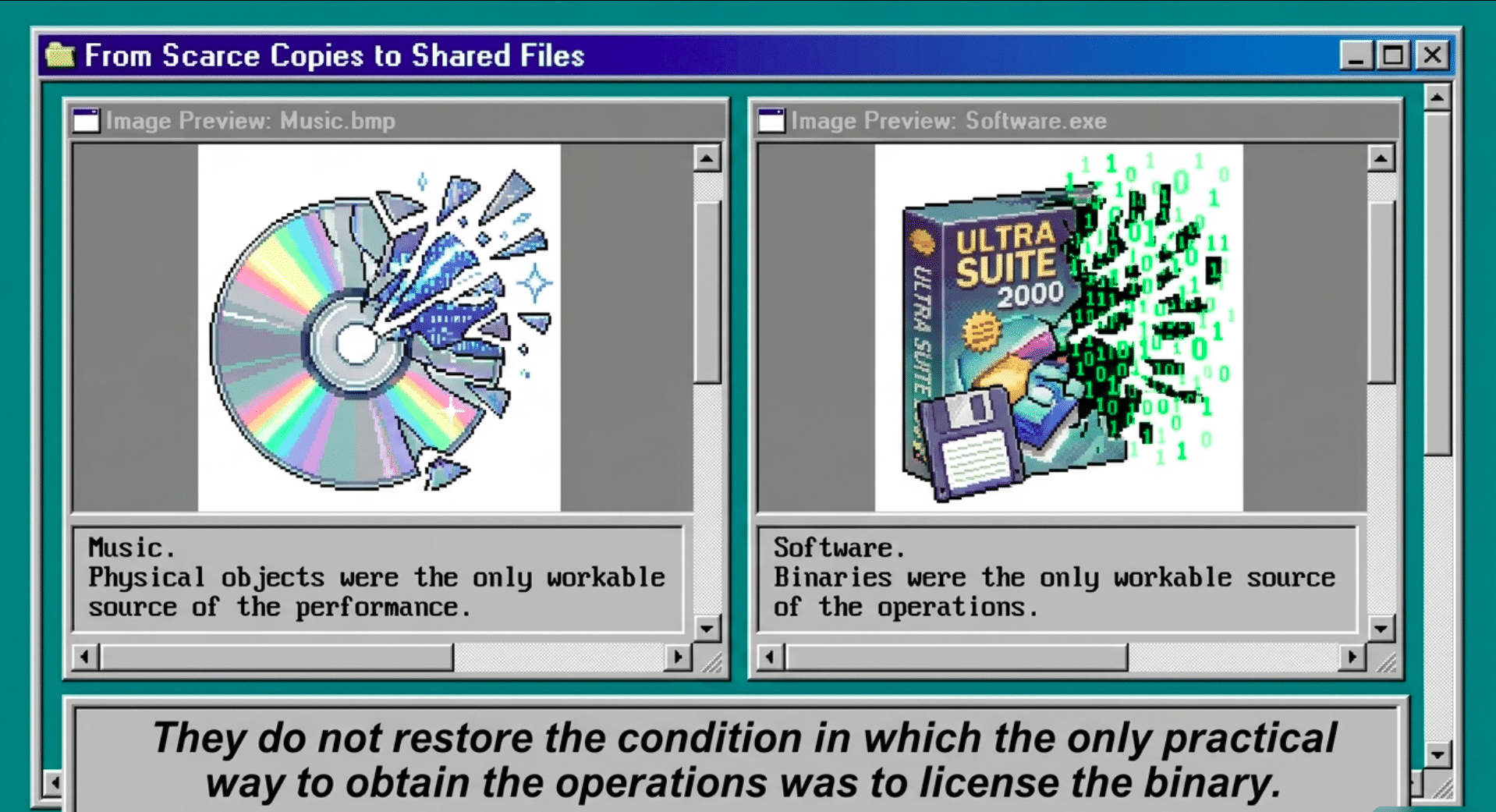
The music industry once treated the physical object that carried a recording as the scarce good. A listener who wanted a particular album bought the vinyl disc or the compact disc because those objects were the practical means of obtaining the performance. Copying required specialized equipment and produced inferior results. When digital compression made a high-quality copy of a recording small enough to transmit over ordinary networks, the physical object ceased to be the only workable source. Napster and the services that followed it allowed any person who already possessed one copy to supply it to others. The industry responded with lawsuits against the operators and against individual users, with technological measures intended to prevent copying, and with arguments that the act of sharing a file was equivalent to theft of the recording itself.
The parallel appears in the treatment of the program as the scarce object. A person who needed a particular set of operations once licensed the binary because that binary was the practical means of obtaining the operations. Reconstructing the operations required sustained engineering effort that few organizations could justify. When an agent can observe the behavior of a running program, compare results against published specifications, and emit an equivalent implementation, the binary ceases to be the only workable source.
An open version that already handles the majority of ordinary jobs can be improved by later agents that read the open code and the public record of test cases. The original vendor can pursue claims based on contract language that prohibits observation, on patents that cover specific techniques, or on arguments that close visual imitation infringes trade dress. Those claims can slow one particular release. They do not restore the condition in which the only practical way to obtain the operations was to license the binary.
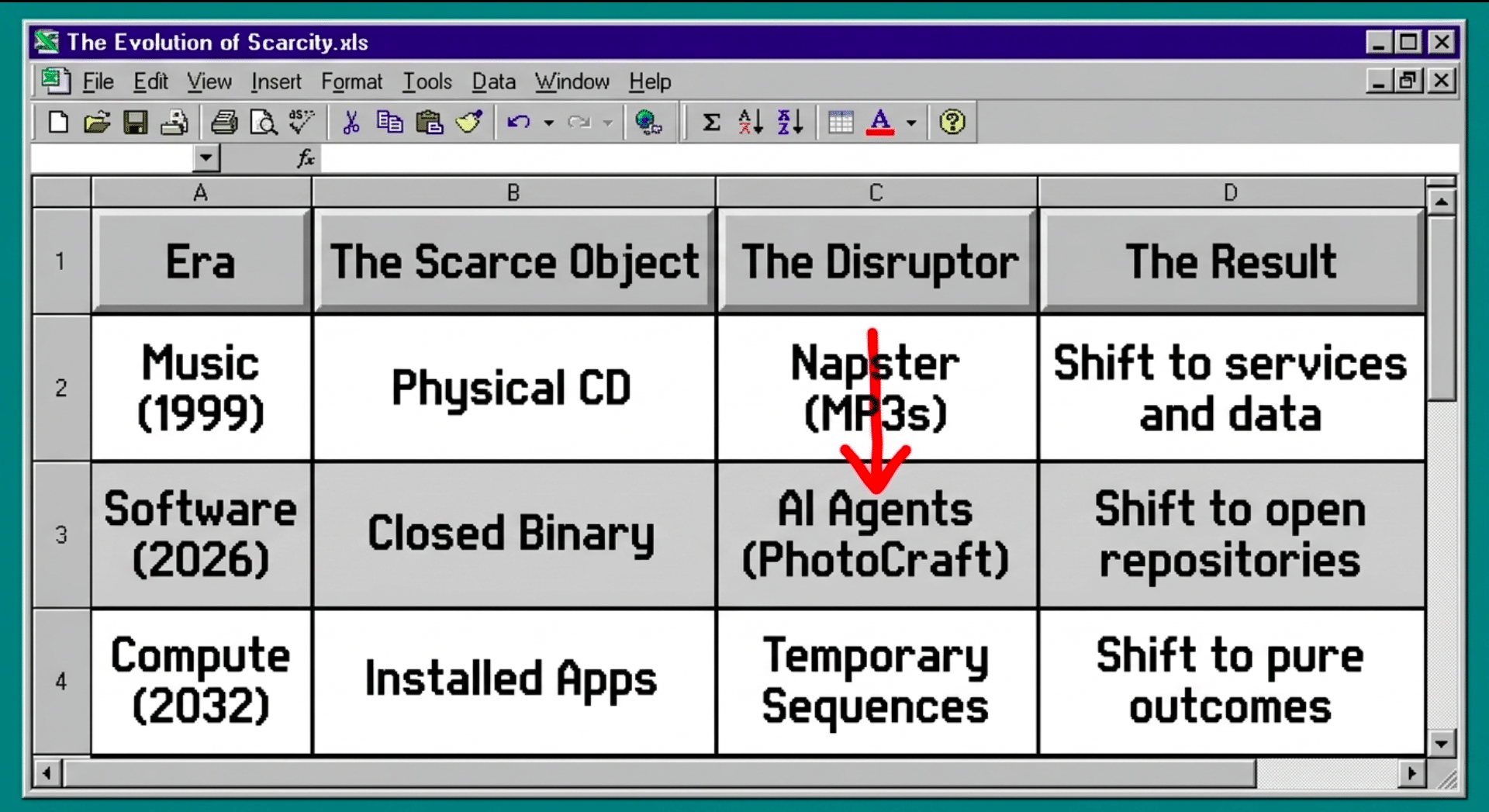
The difference in the underlying rights limits the strength of the comparison. Copyright in a sound recording protects the particular performance that was fixed. Copyright in software protects the particular expression of the code, not the operations the code performs once those operations can be achieved by independent means.
A clean-room reimplementation that produces matching results on documented file formats therefore stands on different ground from a direct copy of a recorded track. The practical outcome nevertheless converges. Once a usable open implementation exists and continues to improve, users who need the operations for new work can obtain them without the closed binary. The files that once required the licensed program can be opened by the open version. The industry that sold access to the program faces the same question the industry that sold access to the recording faced after the first widely used file-sharing service appeared: whether the remaining value lies in the copy itself or in the service, the data, and the ongoing relationship that surrounds the work.
The Later Arrangement
By 2032 the system will no longer emit code that a person could inspect or store. It will maintain internal representations of the operations—sorting, filtering, compositing, querying, transforming—and apply them when the job requires them. The person supplies the outcome and the constraints. The system supplies the sequence. The distinction between writing software and using software disappears because neither activity is performed by the person who needs the result.
In 2036 a typical workspace will contain a surface that displays results and a microphone or keyboard that accepts ordinary language. A person who needs a financial summary will describe the accounts, the period, and the anomalies that matter. The numbers will appear. A person who needs a revised image will describe the change and the intended use. The image will appear. Devices will function as interfaces to computation rather than as hosts for programs. The application icon, the subscription renewal, and the version number will be absent.
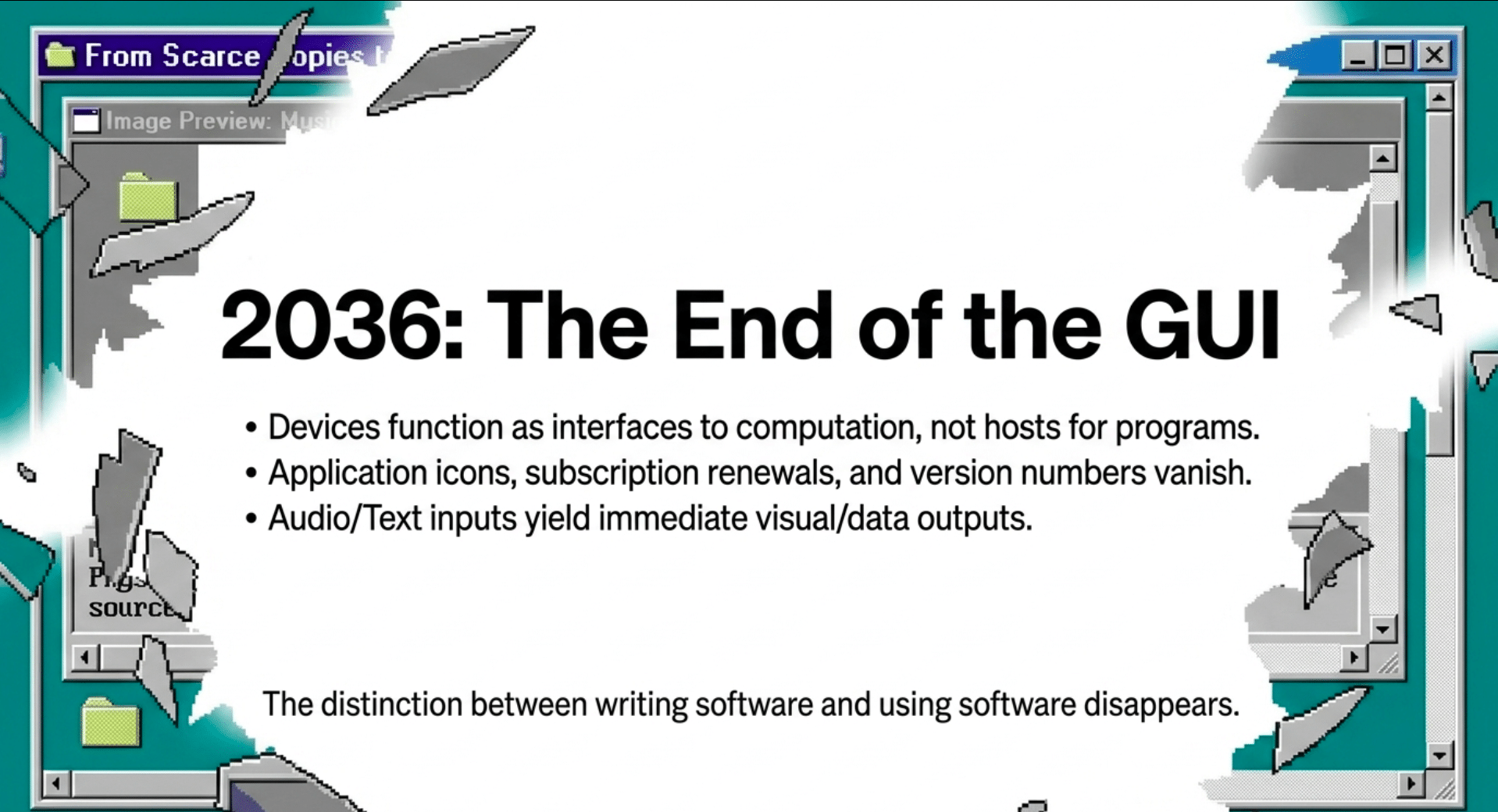
From that date the present arrangement will appear as a temporary accommodation. The practice of opening a named program, navigating its menus, and saving its proprietary file will resemble the earlier practice of feeding a deck of punch cards into a reader for a single calculation.
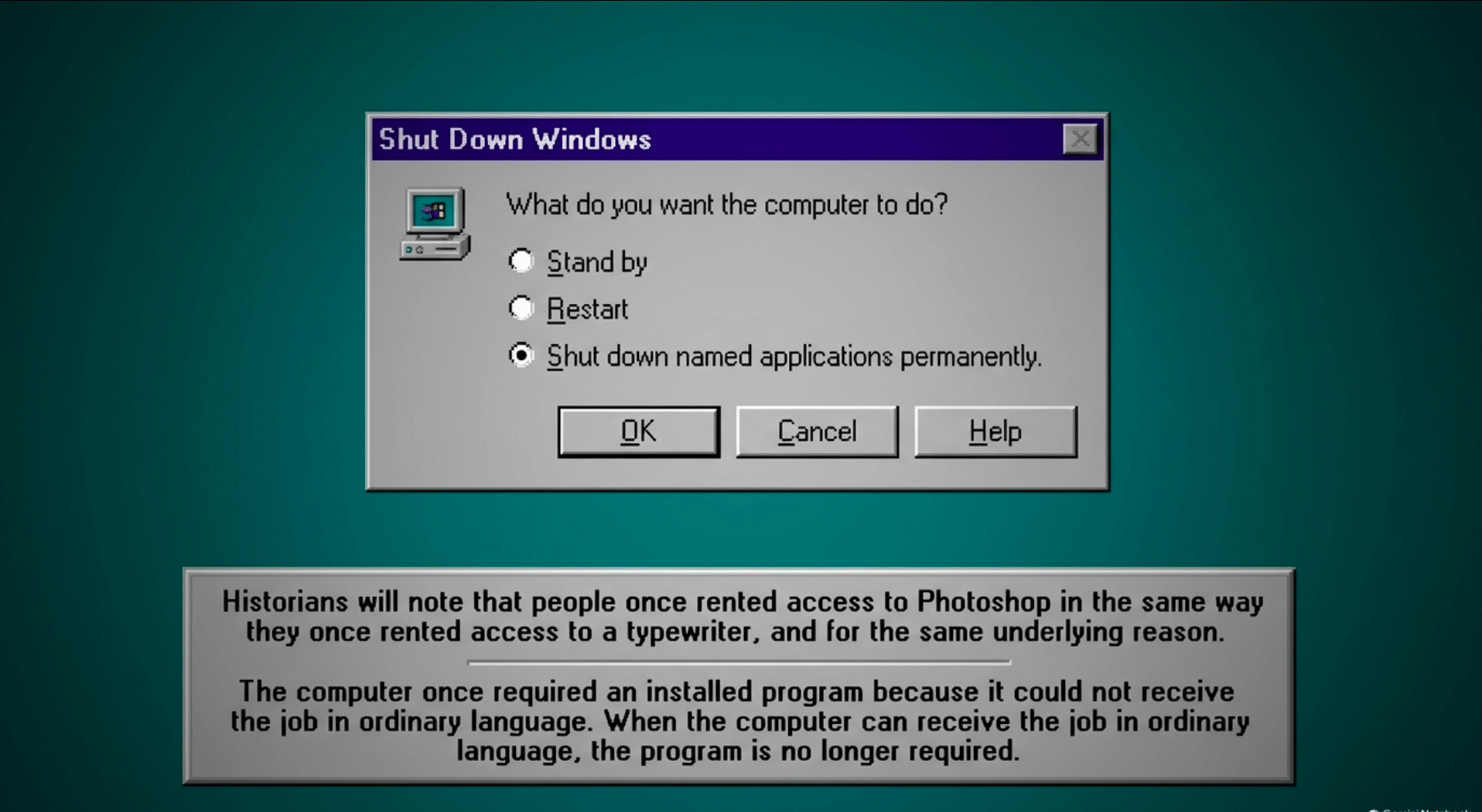
Both methods delivered a fixed sequence of instructions to a machine that could not accept the instruction in the form the person already understood. Once the machine accepts the instruction in that form, the intermediate artifact is no longer necessary. Historians will note that people once rented access to Photoshop in the same way they once rented access to a typewriter, and for the same underlying reason.
The work itself remains. A photograph is still adjusted so that the final image can be printed or published. A set of figures is still examined so that a decision can be made. A sequence of frames is still assembled so that it can be watched. The computer once required an installed program because it could not receive the job in ordinary language. When the computer can receive the job in ordinary language, the program is no longer required. The person continues to decide what the job is.
People will continue to spend time on the parts of the work that cannot be stated completely in advance. A new visual approach, an untested measurement, or a physical process whose governing relations are still incomplete will still require judgment. The system can assemble partial sequences, run variations, and return intermediate results. The person decides which result is usable. That decision is the portion of the work that was never contained in any application.
The process of reaching a usable result will occupy the attention that was once spent managing tools. A person who once learned the menus of a design program will instead learn how to describe the intended effect more precisely. A person who once maintained formulas in a spreadsheet will instead learn how to specify the anomalies that matter for a particular decision. The effort shifts from operating the instrument to refining the request. The instrument becomes available in the same way arithmetic is available: requested when needed and performed without further ceremony.
What remains is the attention given to the outcome. The person who needs the photograph will still examine the result against the purpose it must serve. The person who needs the numbers will still judge whether the flagged deviations change the decision. The person who needs the sequence of frames will still decide whether the assembled result communicates what was intended. These judgments were always the work. The programs that once mediated them were a method of delivery, not the work itself.
From the later vantage the long period of named applications will look like a necessary interval rather than a permanent condition.
People will recall that they once opened a program because the machine required it, and they will note that the machine no longer does. The jobs will continue. The means of performing them will have changed. The attention that was once divided between the tool and the result will rest on the result.
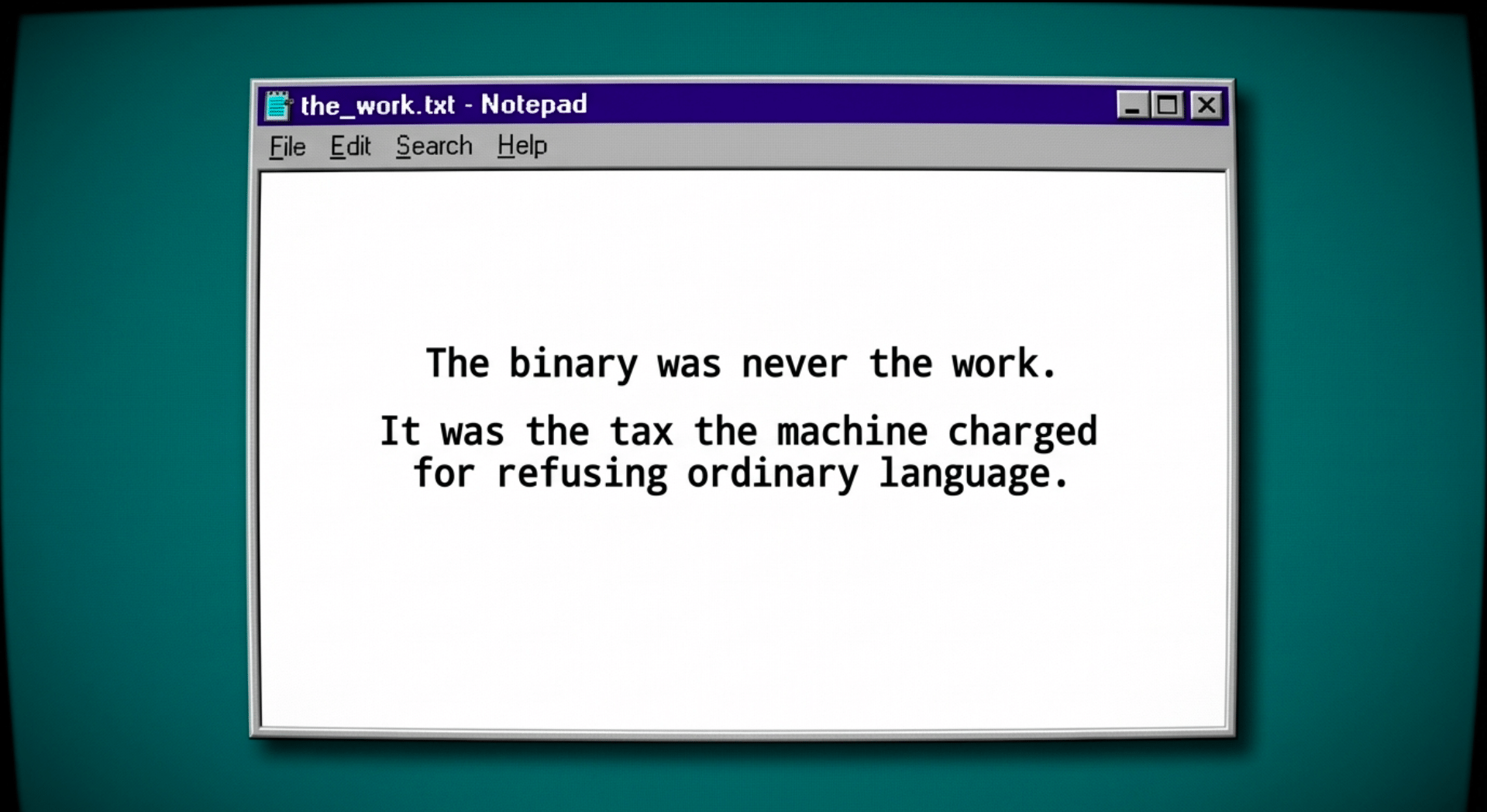
Observation does not require the source. It requires the results, the published rules, and the willingness to iterate until the match is close enough for the job.
Are You Ready?
AI is the last program. Your voice is the last interface (even the silent voice in your head). Many are not ready for the world ahead, I assure you it will look nothing like the computer age we just onet through. The march to democratize and simplify access to more and more is a massive shift in our universe. It is clear many companies that lived with an extraction relationship with their cutters will suffer the hardest and fastest drop. A drop like we have not seen in history. Like the transition from candle to the electric light compressed in months. You are the very few that know this clearly now. You are the very few that can prosper by this knowledge. This is not a guess on what is happening. It is me watching gravity pull down a rock falling from 25 stories. It does not take belief but observation. This knowledge is very powerful for future investment and business plans.
Become a member and below I will show you how to prosper from this new world. Not a guess but very practical paths forward.
Join us and be part of the largest mastermind forum on AI in the known universe. Click the become a member link below.
Support This Work, You Will See It No Place Else
To continue this vital work documenting, analyzing, and sharing these hard-won lessons before we launch humanity’s greatest leap: I need your support. Independent research like this relies entirely on readers who believe in preparing wisely for our multi-planetary future. If this has ignited your imagination about what is possible, please consider donating at buy me a Coffee or becoming a member. Value for value you recieved here.
Every contribution helps sustain deeper fieldwork, upcoming articles, and the broader mission of translating my work to practical applications. Ain ‘t no large AI company supporting me, but you are, even if you just read this far. For this, I thank you.
Stay aware and stay curious,
🔐 Start: Exclusive Member-Only Content.
Membership status:
🔐 End: Exclusive Member-Only Content.
~—~
~—~

~—~
Subscribe ($99) or donate by Bitcoin.
Copy address: bc1qkufy0r5nttm6urw9vnm08sxval0h0r3xlf4v4x
Send your receipt to [email protected] to confirm subscription.

Stay updated: Get an email when we post new articles:

THE ENTIRETY OF THIS SITE IS UNDER COPYRIGHT. IMPORTANT: Any reproduction, copying, or redistribution, in whole or in part, is prohibited without written permission from the publisher. Information contained herein is obtained from sources believed to be reliable, but its accuracy cannot be guaranteed. We are not financial advisors, nor do we give personalized financial advice. The opinions expressed herein are those of the publisher and are subject to change without notice. It may become outdated, and there is no obligation to update any such information. Recommendations should be made only after consulting with your advisor and only after reviewing the prospectus or financial statements of any company in question. You shouldn’t make any decision based solely on what you read here. Postings here are intended for informational purposes only. The information provided here is not intended to be a substitute for professional medical advice, diagnosis, or treatment. Always seek the advice of your physician or other qualified healthcare provider with any questions you may have regarding a medical condition. Information here does not endorse any specific tests, products, procedures, opinions, or other information that may be mentioned on this site. Reliance on any information provided, employees, others appearing on this site at the invitation of this site, or other visitors to this site is solely at your own risk.
Copyright Notice:
All content on this website, including text, images, graphics, and other media, is the property of Read Multiplex or its respective owners and is protected by international copyright laws. We make every effort to ensure that all content used on this website is either original or used with proper permission and attribution when available.
However, if you believe that any content on this website infringes upon your copyright, please contact us immediately using our 'Reach Out' link in the menu. We will promptly remove any infringing material upon verification of your claim. Please note that we are not responsible for any copyright infringement that may occur as a result of user-generated content or third-party links on this website. Thank you for respecting our intellectual property rights.
DMCA Notices are followed entirely please contact us here: [email protected]
