
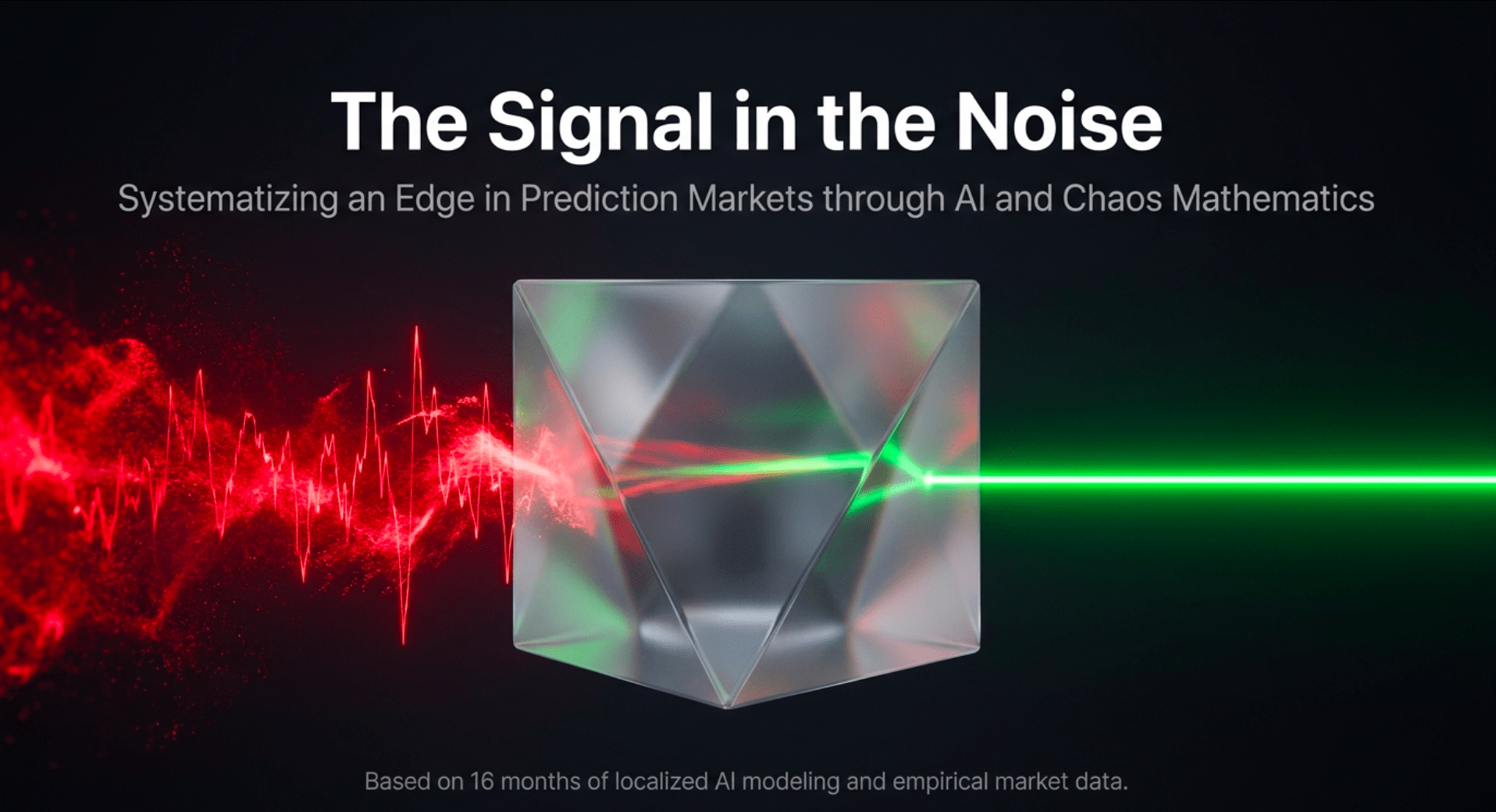
Prediction Markets AI Model: The AI-Driven Edge and Navigating Uncertainty in the Modern Era.
The rise of artificial intelligence has afforded a new edge in how markets can be understood. The ability to anticipate and hedge against future outcomes is no longer a luxury, but it is a strategic necessity. Prediction markets stand as one of the most powerful mechanisms humanity has developed for distilling collective intelligence into actionable probabilities. Far from mere gambling, they function as sophisticated information-aggregation engines and risk-management instruments, much like the commodity and futures markets that have underpinned global commerce for centuries.
This is not an endorsement of recreational betting. It is a recognition that, in turbulent times, possessing a genuine informational or analytical edge—and the tools to hedge real-world exposures—empowers individuals, businesses, and portfolios to navigate complexity with greater resilience and foresight. Prediction markets, when approached with discipline, data, and purpose, offer precisely that. I am not an investment advisor. I am not supplying investment advice. You should seek the advice of a registered investment advisor. I am also not encoring you to gamble. In fact, this article is to show you there may be other ways to see prediction markets.
This article is sponsored by Read Multiplex Members who subscribe here to support my work: Link: https://readmultiplex.com/join-us-become-a-member/
It is also sponsored by many who have donated a “Cup of Coffee”. If you like this, help support my work: Link: https://ko-fi.com/brianroemmele
Listen to the companion podcast: https://rss.com/podcasts/readmultiplex-com-podcast/3001791
The History of Prediction Markets
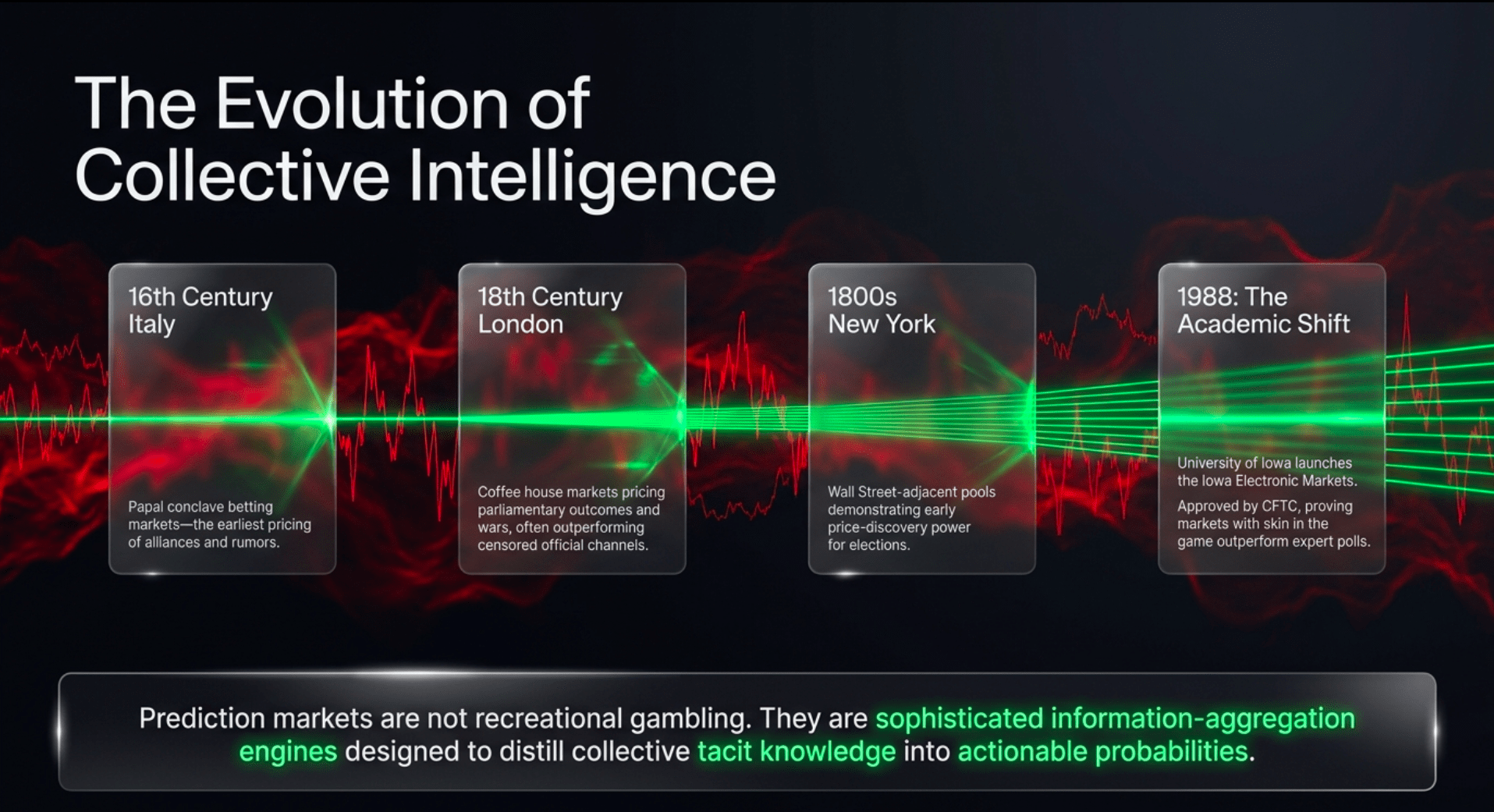
The impulse to wager on future events is ancient. As early as the 16th century in Italy, active betting markets emerged around papal conclaves, with participants interpreting signals from cardinals, alliances, and rumors to price likely successors. In 18th-century London coffee houses—precursors to the modern stock exchange—bets on parliamentary outcomes, prime ministerial changes, and even wars were commonplace. These informal markets often reflected public sentiment more accurately than censored or limited official channels.
By the 19th century in the United States, organized election betting flourished, particularly in New York. “Bucket shops” and Wall Street-adjacent pools allowed speculators to trade on presidential and congressional outcomes, with odds frequently published alongside news. These markets demonstrated early price-discovery power, sometimes outperforming contemporary forecasting methods. However, they blurred lines with gambling and faced regulatory crackdowns in the early 20th century as authorities sought to separate legitimate finance from speculation.

The modern academic and institutional revival began in 1988 with the Iowa Electronic Markets (IEM) at the University of Iowa. Economists Robert Forsythe, George Neumann, and Forrest Nelson launched this small-scale, real-money futures market on political outcomes as a research tool. Capped at modest stakes and approved by the CFTC for academic purposes, the IEM repeatedly demonstrated superior accuracy to traditional polls—outperforming them in a majority of cases across elections. This validated the core hypothesis: markets with skin in the game aggregate dispersed, tacit knowledge more effectively than expert panels or surveys alone.27
Subsequent platforms like Intrade (early 2000s, Ireland-based) brought broader visibility but encountered regulatory hurdles. PredictIt operated under academic constraints with position caps. Blockchain experiments such as Augur and the rise of Polymarket introduced decentralized, crypto-native models with global reach and high liquidity on certain events.
The pivotal shift toward regulated, institutional-grade prediction markets occurred with the emergence of platforms designed explicitly as financial exchanges rather than betting sites.
Why Prediction Markets Provide an “Edge” Comparable to Commodity and Futures Markets
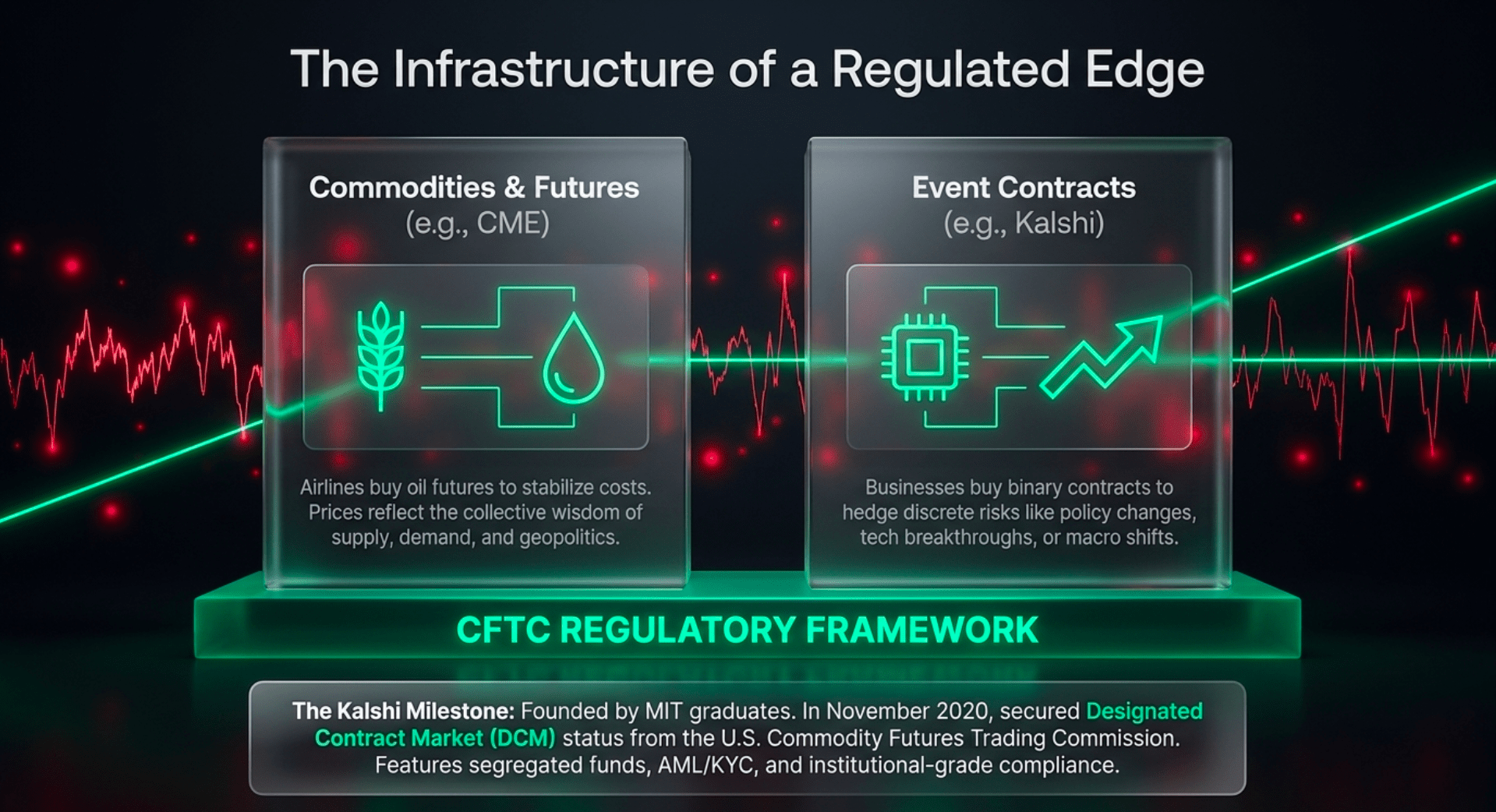
Commodity and futures markets exist primarily for hedging and price discovery. A farmer sells wheat futures to lock in revenue against harvest uncertainty. An airline buys oil futures to stabilize fuel costs. Prices reflect the collective wisdom of informed participants—producers, consumers, speculators, and hedgers—incorporating supply, demand, weather, geopolitics, and sentiment into a single, dynamic signal.
Prediction markets operate on the same principles but applied to discrete events rather than continuous commodities:
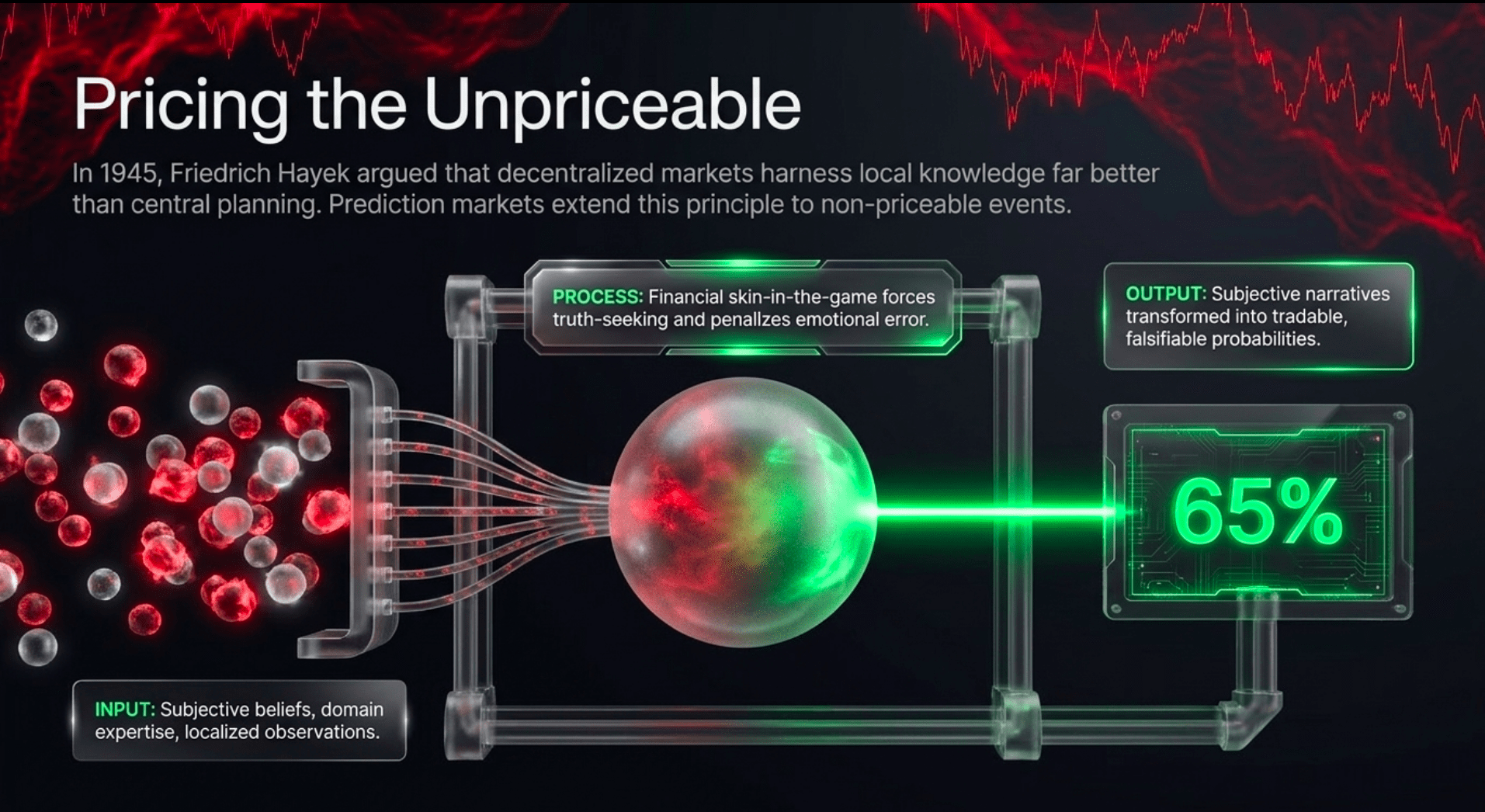
- Binary (or multi-outcome) contracts pay $1 if an event occurs and $0 otherwise. The market price (e.g., 65¢ for “Yes”) directly encodes the implied probability.
- They aggregate information efficiently, often outperforming polls, experts, or models in domains with high uncertainty.
- They enable hedging of event-driven risks: policy changes, economic data releases, corporate milestones, or technological breakthroughs that materially impact businesses, investments, or operations.
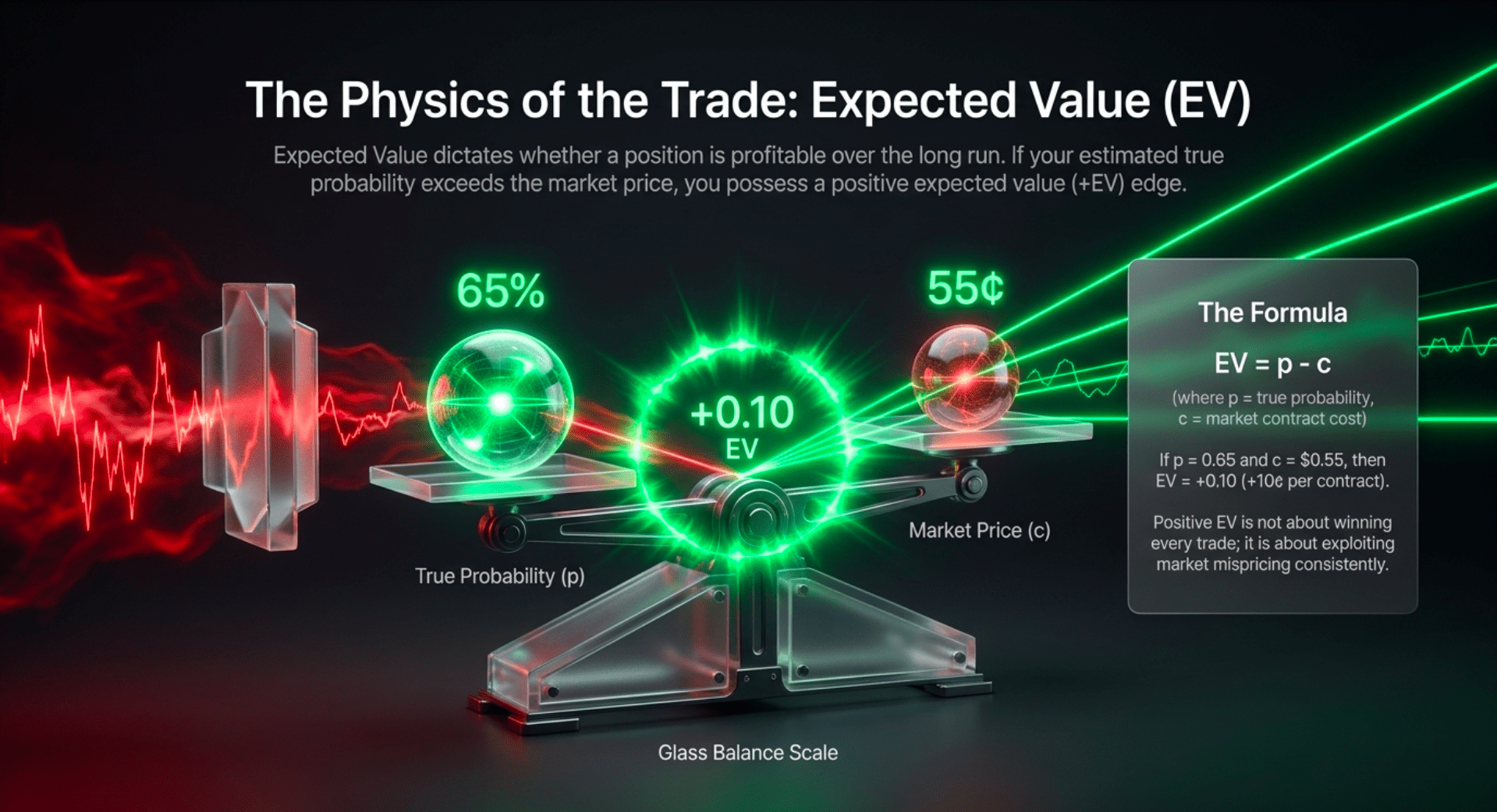
- Positive expected value (+EV) arises when a participant’s estimated true probability exceeds the market price (adjusted for fees). Over many trades, consistent +EV generates an edge, much like a trader exploiting mispricings in futures or a producer hedging at favorable levels.
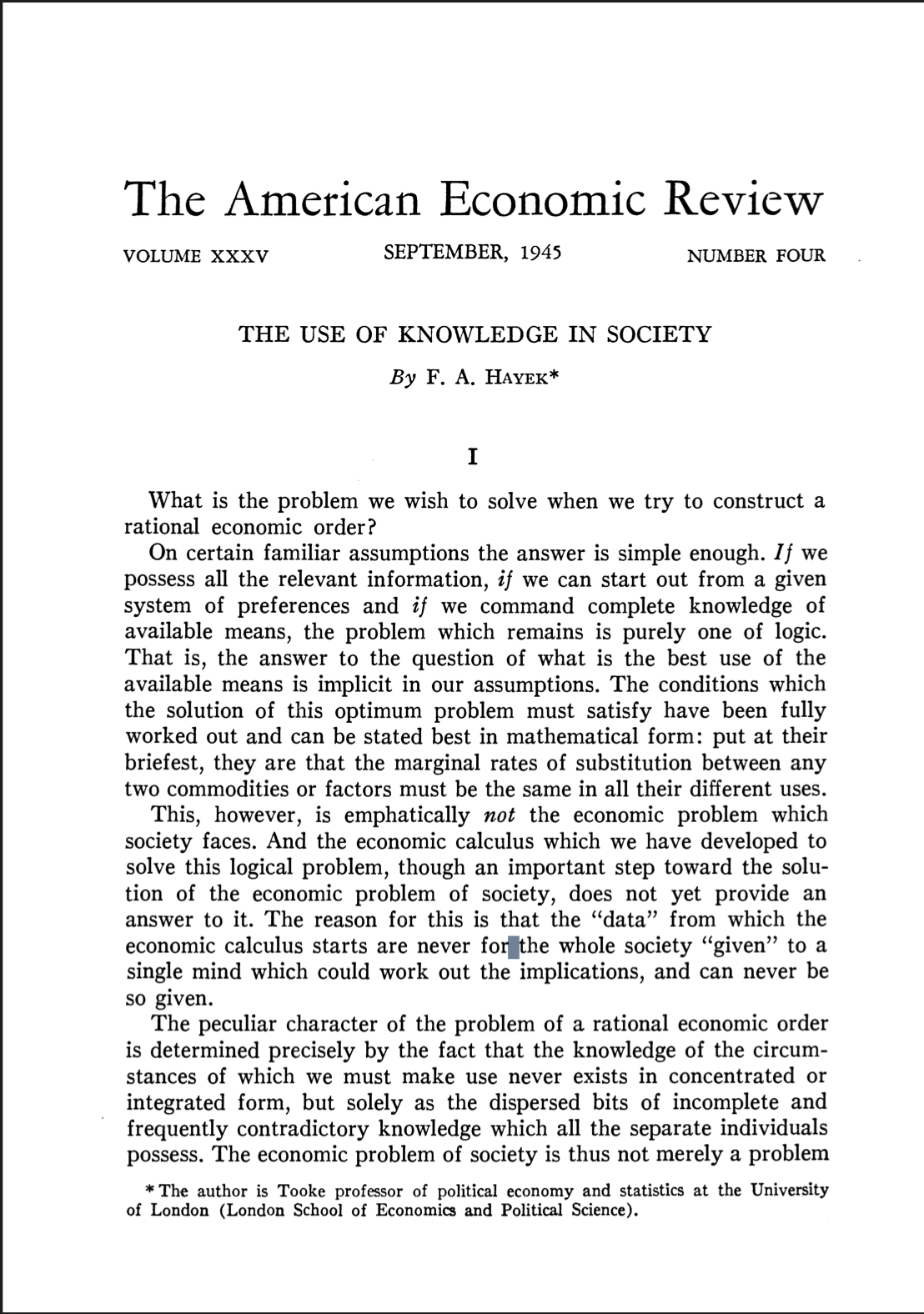
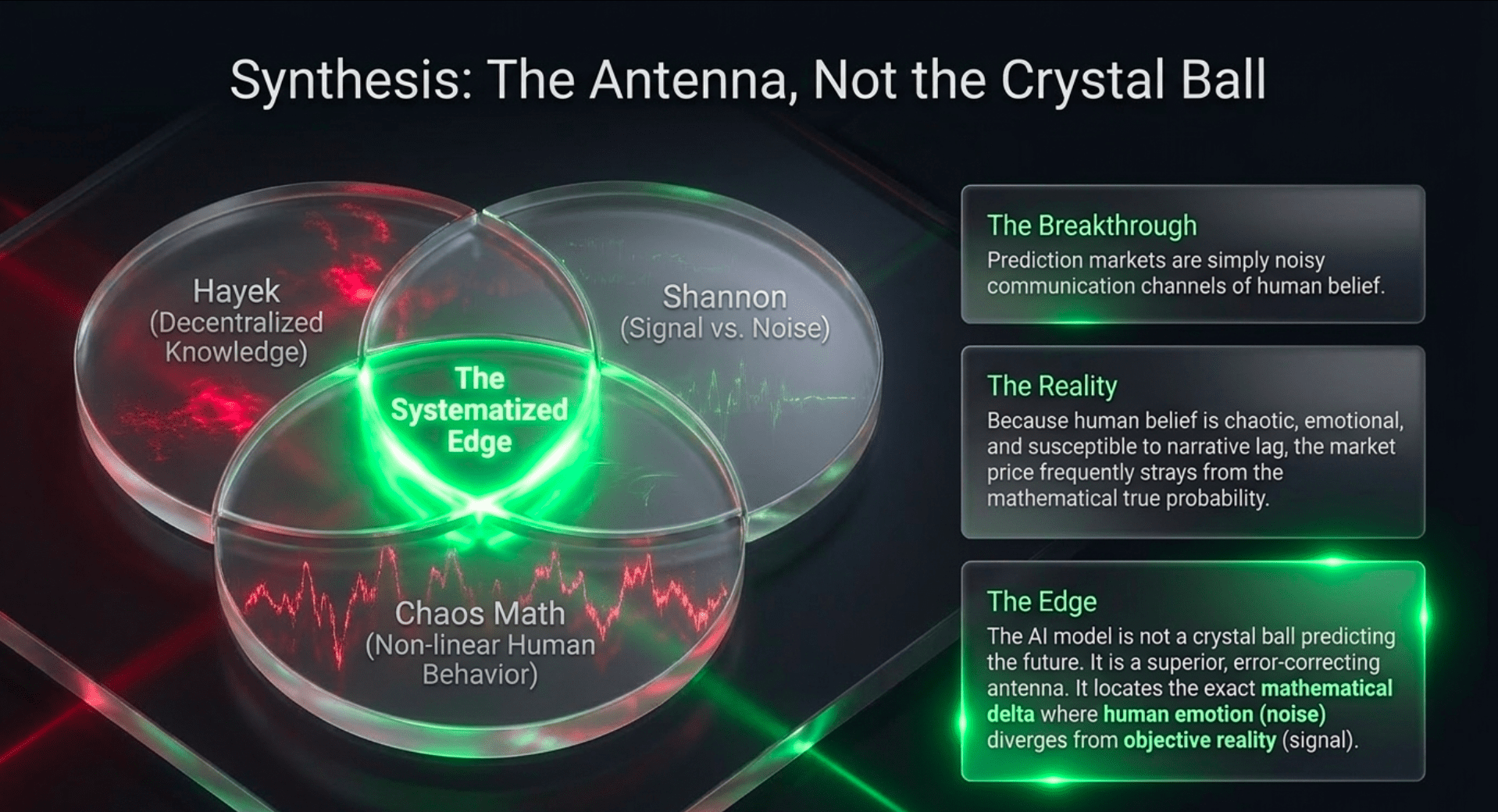
The philosophical parallel is profound. Friedrich Hayek’s “The Use of Knowledge in Society” (1945) (https://german.yale.edu/sites/default/files/hayek_-_the_use_of_knowledge_in_society.pdf) argued that markets harness decentralized, local, and tacit knowledge better than central planning. Prediction markets extend this to non-priceable events, turning subjective beliefs into tradable, falsifiable probabilities. In an era of information overload and rapid change, they serve as decentralized forecasting engines.
Crucially, they are not zero-sum entertainment. When used for hedging or informed speculation backed by superior analysis, they facilitate risk transfer and capital allocation—core functions of mature financial markets.
The Rise of Kalshi: The First Regulated U.S. Prediction Market Exchange
Kalshi, founded in 2018 by MIT graduates Tarek Mansour and Luana Lopes Lara (with backgrounds at Goldman Sachs, Citadel, and Bridgewater), represents the maturation of this space into a fully regulated financial venue. Initially explored under a working name “Kownig,” the platform joined Y Combinator’s Winter 2019 cohort.
In November 2020, Kalshi secured Designated Contract Market (DCM) status from the U.S. Commodity Futures Trading Commission (CFTC)—the same regulatory framework governing major futures exchanges like the CME. This made it the first U.S. platform explicitly approved to trade event contracts as financial derivatives. Public launch followed in July 2021.
Early years involved navigating legal and regulatory challenges, particularly around political and election contracts. Sustained efforts, including litigation, culminated in favorable 2024 court rulings affirming CFTC authority and allowing expanded offerings. Kalshi later self-certified sports event contracts, sparking massive volume growth amid ongoing federalism debates with certain states (federal preemption arguments continue to play out).
By 2026, Kalshi had achieved extraordinary scale: tens of billions in notional volume, partnerships with major media (CNN, CNBC), deep liquidity across categories, and a valuation reaching $22 billion in recent funding rounds. It offers markets on economics, politics, sports, crypto, commodities, climate, tech & science, and business events—priced transparently between 1¢ and 99¢.
Why I currently prefer Kalshi for serious analysis and hedging:
- Regulatory clarity and legitimacy: As a CFTC-regulated DCM, it operates with segregated customer funds, robust compliance, AML/KYC standards, and institutional-grade infrastructure. This distinguishes it from less-regulated or offshore alternatives and aligns it with traditional finance.
- Breadth and relevance for business/tech hedging: Markets on corporate deliveries (e.g., Tesla), technological milestones (Optimus ramp, AI model leadership), economic indicators, and macro stability directly intersect with real-world portfolios and operations.
- Liquidity and reliability: High volume supports tighter spreads and more trustworthy price signals.
- U.S.-centric accessibility and transparency: While sports markets face some state-level friction, the core platform prioritizes compliance and data integrity.
- Suitability for analytical overlays: The structured, probability-focused nature lends itself to systematic modeling rather than pure sentiment or recreational play.
Compared to crypto-native platforms, Kalshi’s regulated status, fiat integration, and focus on verifiable real-world events make it preferable for those seeking a durable edge grounded in traditional financial principles.
Kalshi vs. Polymarket and Other Prediction Market Platforms
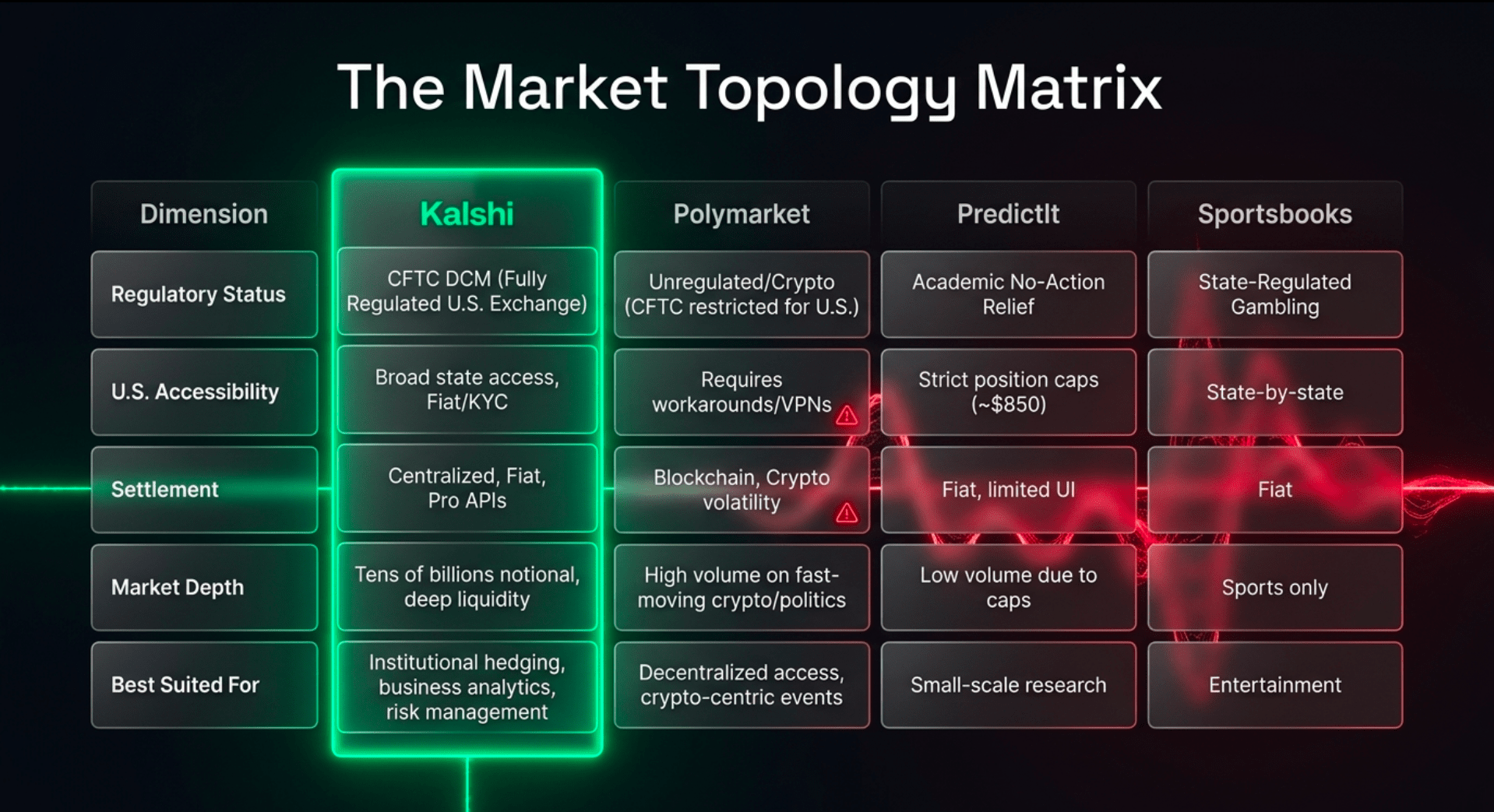
Kalshi stands out as the leading U.S.-regulated prediction market exchange, but it is not the only option. Here’s a concise comparison of the major players as of mid-2026, focused on practical differences for users seeking information edges or hedging tools rather than pure entertainment.
Regulatory Status & Legitimacy
- Kalshi: Fully regulated as a Designated Contract Market (DCM) by the U.S. CFTC — the same framework that governs major futures exchanges like the CME. Customer funds are segregated, with institutional-grade compliance, AML/KYC, and reporting requirements. This gives it the strongest legal footing in the U.S. and positions event contracts as legitimate financial derivatives rather than gambling.
- Polymarket: Crypto-native platform built on blockchain. Operates with a more decentralized model. Faced CFTC restrictions on U.S. users in the past; access often requires workarounds or VPNs. Lower regulatory oversight but higher legal and counterparty risk for U.S. participants.
- PredictIt: Academic/non-profit platform with strict position caps (historically ~$850 per market). Operates under limited CFTC no-action relief but is not a full commercial exchange.
- Others (e.g., traditional sportsbooks like DraftKings/FanDuel or emerging crypto platforms): State-regulated gambling in most cases or offshore/less regulated. Not structured as pure prediction markets with transparent binary pricing.
Accessibility for U.S. Users
- Kalshi: Available across most states (with ongoing federal preemption debates around sports contracts). Straightforward KYC and fiat onboarding.
- Polymarket: More restrictive for U.S. users due to prior regulatory actions; often requires technical workarounds.
- PredictIt: Limited and capped; not designed for high-volume trading.
Liquidity, Volume & Market Depth
- Kalshi: Explosive growth in 2025–2026, with tens of billions in notional volume. Particularly dominant in sports (including combos/parlays) and strong across economics, politics, and business/tech. Deep liquidity supports tighter spreads.
- Polymarket: Frequently leads or competes strongly on high-profile political events, crypto-related outcomes, and breaking news. Can have superior liquidity on certain niche or fast-moving global events.
- PredictIt: Lower overall volume due to position limits; more suitable for research than serious position sizing.
Market Breadth & Hedging Utility
- Kalshi: Broad coverage including business/tech milestones (Tesla deliveries, Optimus ramps, AI developments), economic indicators, macro stability, commodities, and sports. Excellent for hedging real-world exposures that affect portfolios or operations.
- Polymarket: Strong on politics, elections, crypto prices, and geopolitical events. More speculative tilt; hedging applications exist but are often less directly tied to traditional business metrics.
- Others: Vary widely — sportsbooks focus on athletic outcomes; PredictIt is narrower and capped.

Technology, Settlement & Fees
- Kalshi: Centralized exchange model with fiat settlement, professional APIs, and institutional integrations. Fees are transparent and competitive for a regulated platform.
- Polymarket: Blockchain-based settlement (crypto). Offers global reach and 24/7 trading but introduces wallet/custody risks and crypto volatility. Often lower or variable fees.
- PredictIt: Simple but limited interface and rules.
Best Suited For
- Kalshi: Users prioritizing regulatory clarity, hedging legitimacy, business/tech markets, and institutional-grade infrastructure. Ideal when you want an edge that aligns with traditional finance principles and risk management.
- Polymarket: Those seeking fast-moving political or crypto-centric markets, global participation, or a more decentralized experience (with appropriate risk awareness).
- PredictIt: Academic research, small-scale experimentation, or learning the mechanics without large capital.
- Traditional sportsbooks: Pure entertainment or state-regulated sports betting; less emphasis on probability transparency or broad event hedging.
Kalshi’s regulated status and expanding business/tech offerings make it particularly well-suited for disciplined, edge-driven approaches that treat prediction markets as hedging and information tools rather than gambling. Polymarket excels in speed and certain high-attention categories but carries different regulatory and operational trade-offs. Many serious participants monitor both (and others) for complementary signals while defaulting to the most appropriate platform for their risk tolerance and objectives.
Always verify current legal status in your jurisdiction, review fees and risks, and approach all platforms with the same rigorous, probability-focused discipline discussed in the main article.
Business and Tech Picks as Powerful Hedges
Many Kalshi markets transcend speculation and function as direct hedges. Consider contracts on Tesla vehicle deliveries, Optimus robot production ramps, AI model advancements, or macroeconomic stability indicators.
First let us define EV in the context of the Kalshi (high-EV, +EV) stands for Expected Value.
It is the core mathematical concept used in prediction markets, betting, and trading to measure whether a position is profitable on average over the long run.
Simple Explanation
Expected Value answers: “If I made this exact same bet (or trade) hundreds or thousands of times, would I make money or lose money on average?”
• Positive EV (+EV or “high-EV”): The bet has an edge — you expect to profit over time, even if you lose some individual bets.
• Negative EV (−EV): You expect to lose money over time (the market or house has the edge).
• Zero EV: Break-even on average.
Formula for Prediction Markets (like Kalshi)
Kalshi contracts are binary: a “Yes” contract costs c dollars (e.g., $0.60) and pays $1 if correct, $0 if wrong.
If your estimated true probability of the event happening is p :
This simplifies to:
per contract, before fees).
Example:
You think an event has a 65% true probability ( p = 0.65 ), but the market price is 55¢ ( c = 0.55 ).
EV = 0.65 − 0.55 = +0.10 (or +10¢ per contract).
This is a positive EV trade with an edge.
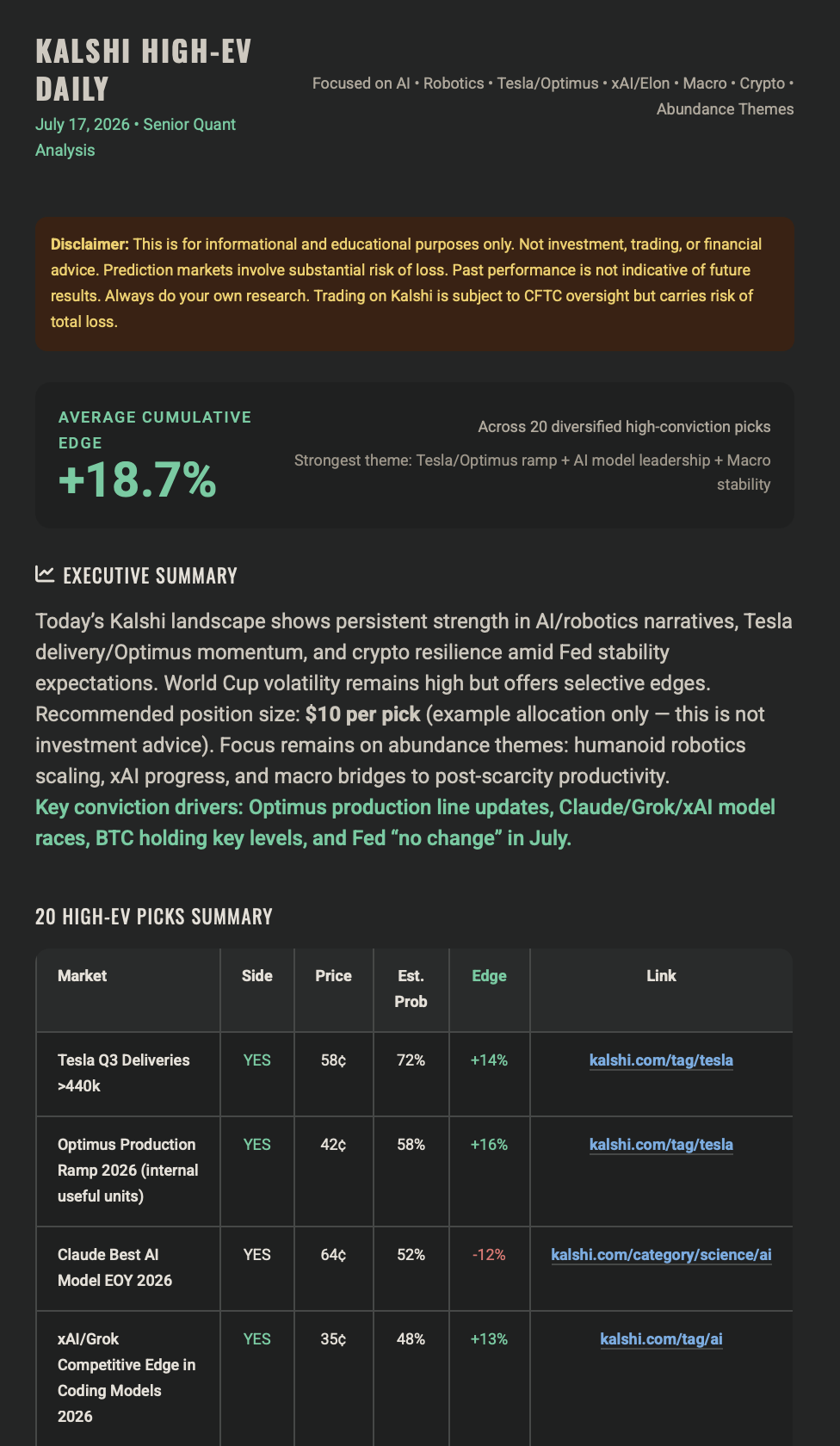
• My “HIGH-EV DAILY REPORT” means the picks are selected for positive expected value.
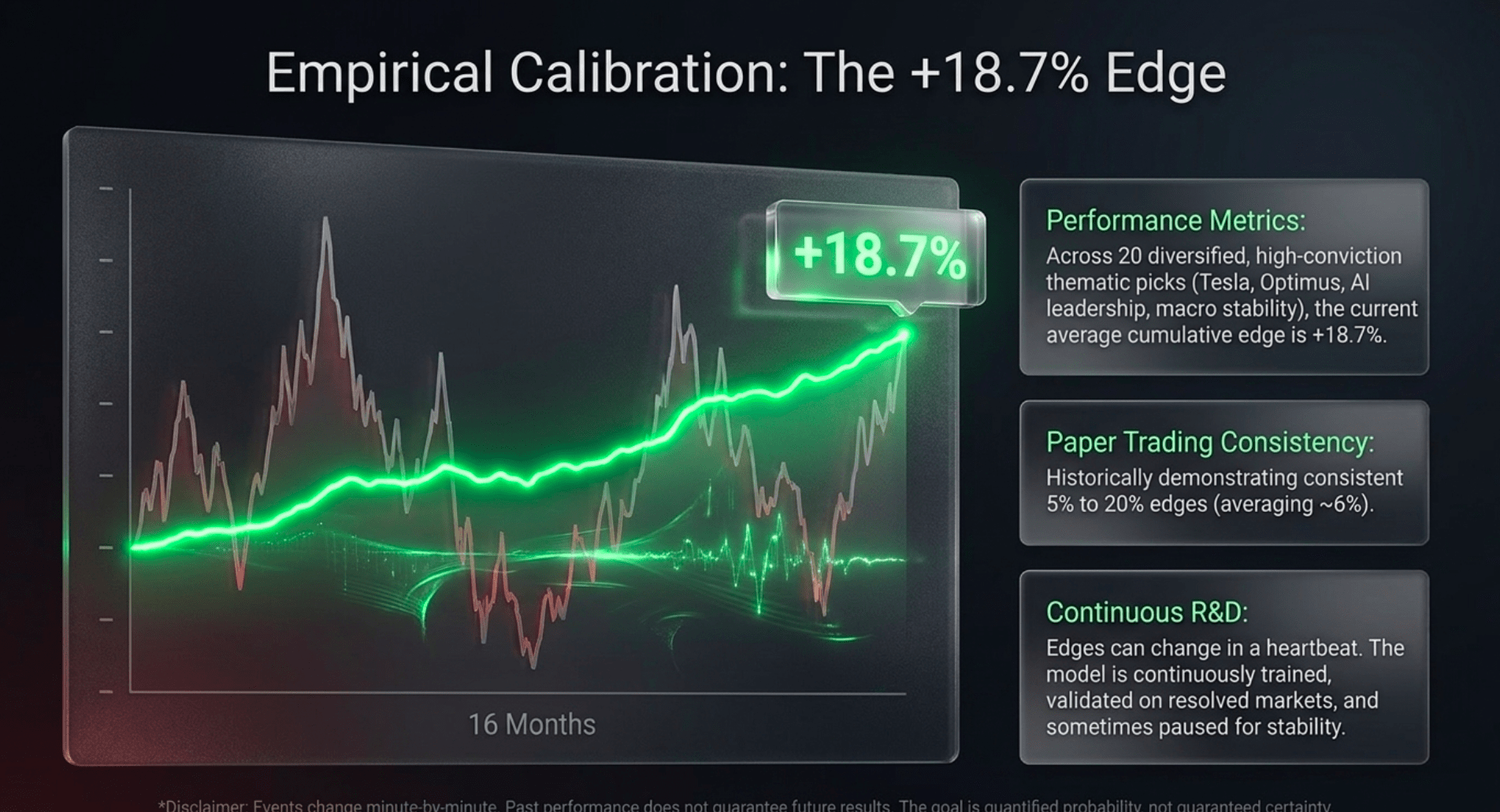
• The Report “AVERAGE CUMULATIVE EDGE +18.7%” refers to the aggregated positive expected advantage (edge) across the 20 diversified high-conviction picks. The AI model estimates the true probabilities and finds where the market is mispricing them. The model uses sentiments, momentum, chaos math, and other signals to generate these probability estimates and surface +EV opportunities that are not obvious to the broader market.
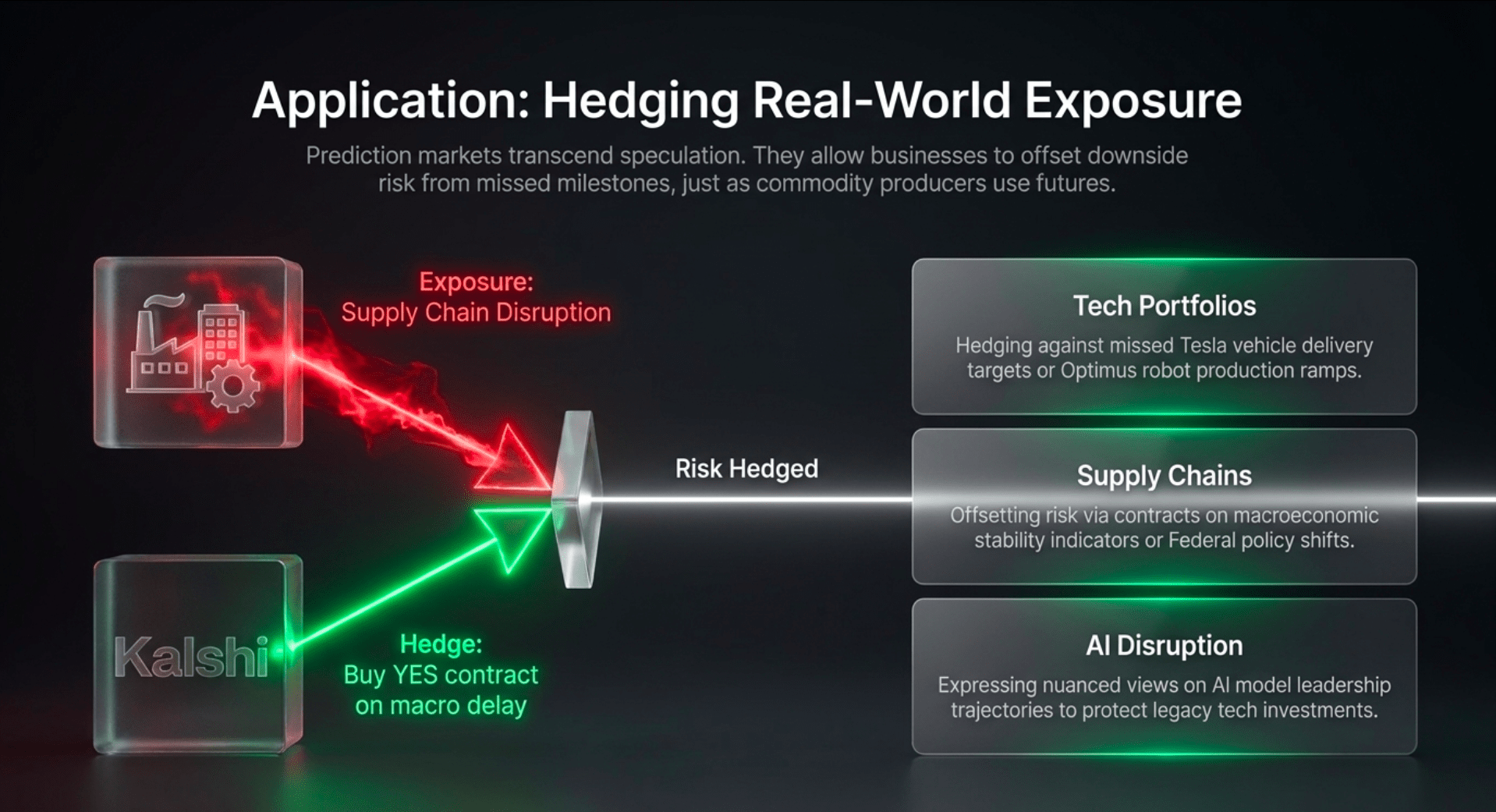
For an investor holding tech or high EV-related equities, a well-timed position can offset downside from missed milestones or unexpected macro shifts. For businesses dependent on supply chains, regulatory outcomes, or technological adoption curves, these markets provide a mechanism to transfer or manage event risk—analogous to how commodity producers use futures.
In the current environment of AI acceleration, energy transitions, and geopolitical uncertainty, such contracts allow portfolios to express nuanced views or protect against tail risks. The High EV framework identifies where market prices diverge from informed probability estimates, creating opportunities for both directional bets and hedges.
Claude Shannon, Signal vs. Noise, and the AI Models’ Information Filter
Claude Shannon (1916–2001) is widely regarded as the father of information theory. In his landmark 1948 paper “A Mathematical Theory of Communication,” he fundamentally changed how we understand information, communication, and uncertainty. Shannon showed that information could be quantified, transmitted efficiently, and protected against noise ideas that underpin virtually every digital technology we use today.
His work proved that the amount of information in a message is not about its meaning, but about its surprise or uncertainty (measured as entropy). He also formalized the distinction between signal (the meaningful information we want) and noise (random or irrelevant interference that corrupts it). This framework is now embedded in everything from Wi-Fi and 5G networks to data compression (JPEG, MP3), error-correcting codes in hard drives and QR codes, cryptography, machine learning regularization, and the very architecture of modern AI systems.
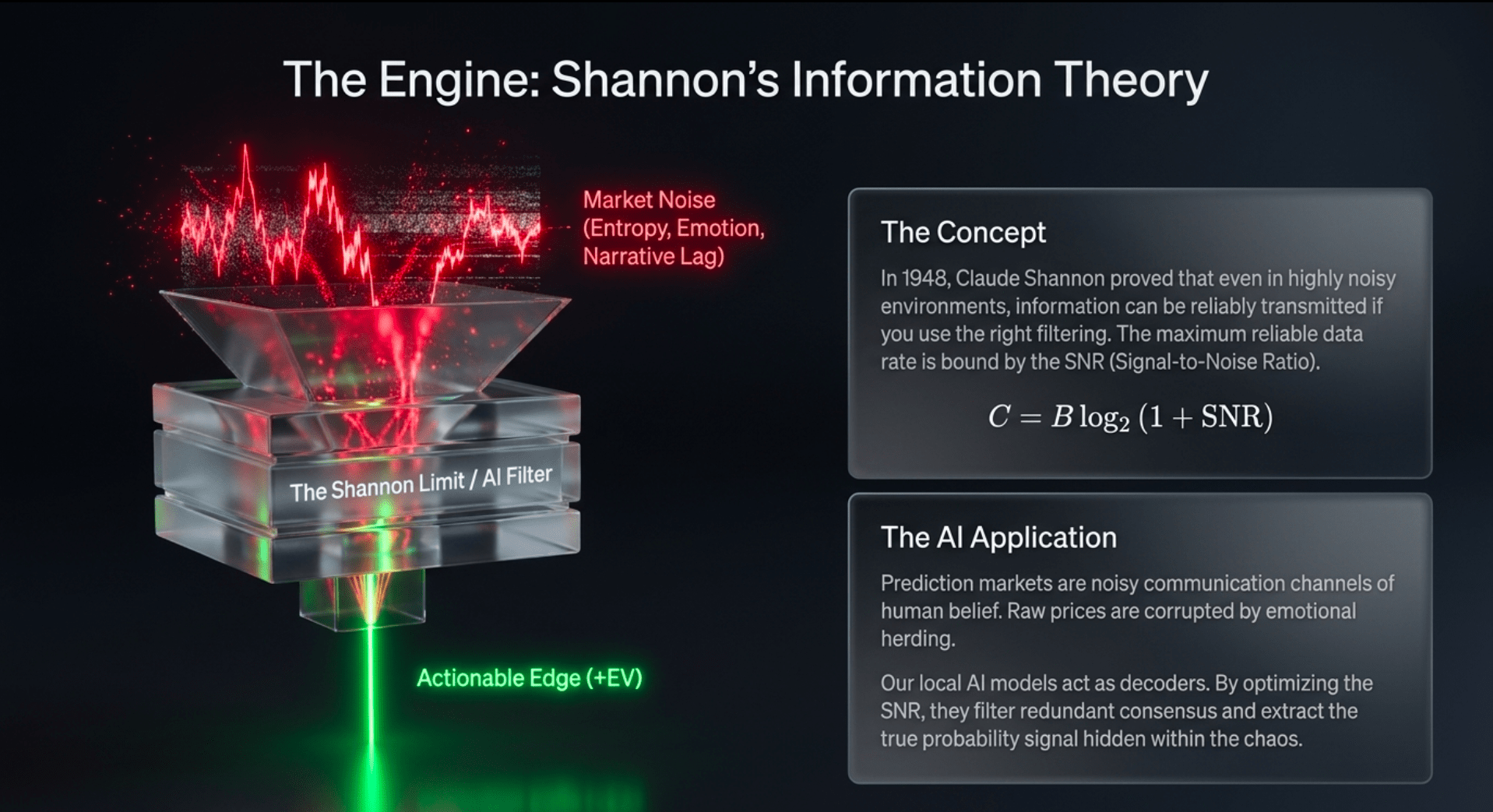
The Shannon Limit and Channel Capacity
Shannon’s most famous result is the Shannon limit (or channel capacity theorem). It defines the theoretical maximum rate at which information can be reliably transmitted over a noisy communication channel:
Where:
- ( C ) = channel capacity (maximum reliable data rate in bits per second)
- ( B ) = bandwidth of the channel
- ( \text{SNR} ) = signal-to-noise ratio
This equation tells us there is a hard upper bound on how much clean information you can extract from a noisy environment. Push beyond it, and errors become inevitable. It also shows that even in very noisy conditions, you can still transmit information reliably — if you use the right coding and filtering strategies.
How We Apply Shannon’s Framework in the Local AI Models
Our prediction market AI models treat market data as a noisy communication channel. Prices, volume, sentiment, order flow, and news are the transmitted “signals,” but they are heavily corrupted by noise: emotional herding, short-term volatility, media amplification, low-information participants, and random fluctuations.
The models function as sophisticated decoders and filters inspired by Shannon’s principles:
- Entropy and uncertainty measurement: We calculate variants of Shannon entropy to quantify how much genuine new information is present in different data streams versus redundant or noisy consensus. High-entropy regions (where the market is uncertain or conflicted) often contain stronger edges once properly decoded.
- Signal-to-noise optimization: The system continuously estimates effective SNR across different market segments. Sports contracts, for example, typically show lower effective SNR due to high emotional noise and short time horizons. Longer-horizon business and tech contracts (Tesla/Optimus ramps, AI milestones, macro indicators) tend to exhibit higher usable signal content.
- Channel capacity thinking: Rather than treating all market data equally, the models prioritize sources and timeframes that approach higher “capacity” — where more reliable probability information can be extracted per unit of data. This directly informs position sizing, conviction weighting, and the preference for diversified, longer-distance selections that have historically delivered stronger cumulative edges.
- Error correction and redundancy handling: Just as Shannon’s theory enabled error-correcting codes, the models use multiple overlapping signals (sentiment + momentum + chaos-derived non-linear patterns + historical analogs) to cross-validate and reduce the impact of individual noisy inputs. This multi-channel approach helps the system stay below the effective Shannon limit of the prediction market “channel.”
In practice, when the models identify a +EV opportunity, they are essentially saying: “After filtering out the noise, the remaining signal suggests the market price underestimates the true probability.” The current +18.7% average cumulative edge across the 20 high-conviction picks reflects the result of this ongoing information-theoretic filtering process.
A Quick Claude Shannon Las Vegas Story
It was 1961, and the American Dream still came with free ashtrays and the faint smell of regret. In a basement lab that looked like a RadioShack had exploded inside a mad scientist’s garage, Claude Shannon (Bell Labs Engineer, MIT Professor) and Edward Thorp were about to invent the future. Not the shiny, optimistic future with jetpacks and flying cars. No, they were inventing the slightly shifty future in which two of the greatest mathematical minds of the century would try to rob a casino using a gadget the size of a pack of Lucky Strikes and the toe dexterity of a bad lounge act.
The machine had twelve transistors, a battery pack with the personality of a sullen teenager, and microswitches that lived in their shoes. You worked it by tapping your big toes like you were trying to send Morse code to an ant colony. One person (usually Shannon, because he had the face of a man who could explain anything and still look innocent) stood at the roulette wheel pretending to be a harmless system player. He’d time the wheel’s spin and the ball’s lazy orbit with subtle toe presses. The little computer in his pocket would chew on the physics, decide which eighth of the wheel—octant, they called it—was about to become very popular, and then sing a little song through a wire to the earpiece of the second person.
The song was the important part. Different tones and little melodic phrases meant “bet here, you beautiful idiot.” It was information theory set to music. Shannon had turned the roulette wheel into a noisy communications channel and the computer into the world’s first wearable decoder ring. If the ball behaved like Newton said it should (and mostly it did), they had an edge of roughly forty-four percent on the favored octant. In plain English: the house didn’t have a chance unless the batteries died, the toes cramped, or somebody’s wife stepped on the wire.

The wives, Betty Shannon and Vivian Thorp, had been recruited as camouflage. “We’re just two normal couples on a romantic getaway to the desert,” Shannon told them over breakfast the morning they left for Las Vegas. “Nothing suspicious about that.”
Vivian looked at the tangle of wires on the hotel bed. “Claude, it looks like you’re smuggling a small orchestra.”
“An orchestra that only plays in a minor key when the odds are bad,” Thorp added cheerfully.
They hit the tables at the old Sands with ten-cent chips and the nervous energy of men who had already solved blackjack and were now wondering if the universe had any other easy money lying around. Shannon took his post near the wheel, scribbling fake numbers on a pad while his right foot performed what looked, to the casual observer, like a very subtle case of St. Vitus’ dance. Thorp sat a few stools away, earpiece tucked under his hair, looking like a man listening to the world’s most boring baseball game.
First spin: the computer sang a bright little ascending phrase. Thorp translated it instantly—third octant, go go go—and dropped his dimes. The ball obeyed physics like a well-trained golden retriever. The pile grew. The wives clapped like they’d just won the church raffle.
Second spin: another hit. A cocktail waitress brought them free drinks they didn’t order. The pit boss began to develop a mild interest in these two quiet academics who weren’t drinking, weren’t swearing, and weren’t losing.
Third spin: the batteries, which had been muttering darkly since the plane ride, finally staged their coup. The melody in Thorp’s ear turned into a sad, dying wheeze that sounded like a harmonica being stepped on by a very large man who hated music. The data was incomplete. The computer, doing its best with what little electricity it had left, made an executive decision.
It told Thorp to bet the exact opposite octant.
The ball landed with the smug precision of a thing that had read the fine print on the laws of probability. Their stack of dimes evaporated. Thorp stared into the middle distance like a man who had just watched information theory get mugged in an alley.
“Entropy,” he said quietly.
Shannon, still tapping his toe out of habit, nodded. “The universe’s way of saying ‘nice try, professor.’”
They tried again. This time the toe switches, perhaps excited by the dry desert air or a stray crumb from the all-you-can-eat buffet, began sending phantom signals. The computer responded with what could only be described as experimental jazz. Beeps, boops, one long sustained note that made Thorp look like he was receiving a personal message from a very opinionated ghost. A man in a cowboy hat two stools over leaned in.
“You all right there, buddy? You look like you’re having a religious experience with your cigarette pack.”
“Just… appreciating the music of the spheres,” Thorp managed.
The pit boss was now making eye contact. Real eye contact. The kind that said I have seen card counters, and you two are something worse. Shannon’s wife Betty, sensing disaster the way only a woman married to a genius can, executed a perfect tactical maneuver. She “tripped” into her husband, hooked her foot under the wire running up his leg, and yanked the earpiece clean out of Thorp’s ear in what looked, to everyone else, like an enthusiastic and slightly clumsy display of marital affection.
“Claude! You promised me we’d try the prime rib before midnight!”
Vivian, no slouch in the field of spousal extraction, grabbed Ed by the elbow. “Darling, I just won five dollars on the slots! Let’s go spend it before the universe changes its mind again.”
They cashed out with enough winnings to cover dinner, a bottle of something that pretended to be champagne, and a souvenir ashtray shaped like a roulette wheel. Not the fortune they’d quietly imagined, but not nothing. The hardware had been temperamental, the batteries traitorous, and the wives had performed emergency extraction with the skill of people who had already accepted that their husbands were never going to be normal.
Back in the hotel room, surrounded by room-service plates and the distant sound of other people losing money more honestly, Shannon raised his glass.
“To the first wearable computer,” he said. “May it rest in pieces in my basement, next to the chess machine and the juggling robot.”
“And to never again trusting a battery to understand Newtonian mechanics,” Thorp added.
They kept the secret for five years. Thorp went on to beat the stock market with the same calm certainty he had once aimed at roulette wheels. Shannon went back to thinking about how much of the universe could be squeezed into a single bit, occasionally chuckling at the memory of the little singing box that had almost made the house nervous.
And somewhere in the great junk drawer of history, a cigarette-pack-sized tangle of transistors dreamed electric dreams of perfect spins, obedient balls, and the beautiful, ridiculous moment when two of the smartest men alive decided the best use of information theory was to make a roulette wheel sing them the odds in the key of larceny.
The house always wins, they say.
Unless, of course, your computer has better timing than the croupier and your wife knows exactly when to step on the wire.
The Entropy Today
Shannon’s insight that meaningful communication is possible even in noisy environments remains profoundly relevant. Prediction markets are among the noisiest information channels humans have created — full of crowd behavior, narrative momentum, and short-term distortions. By applying his quantitative framework for separating signal from noise, the local AI models aim to extract clearer, more actionable probability estimates than raw market prices or unfiltered sentiment alone can provide.
His ideas are not just historical; they are active tools in how we build systems that try to see through the noise of complex, uncertain domains. In our picks, we owe a great deal of gratitude to Professor Shannon.
My Local AI Models: A 16-Month Project in Systematic Edge Generation
Over nearly 16 months, I have developed and iteratively refined proprietary local AI models specifically designed to analyze and identify high-EV opportunities across prediction markets. These are not cloud-dependent black boxes but locally run systems emphasizing privacy, control, and domain-specific depth.
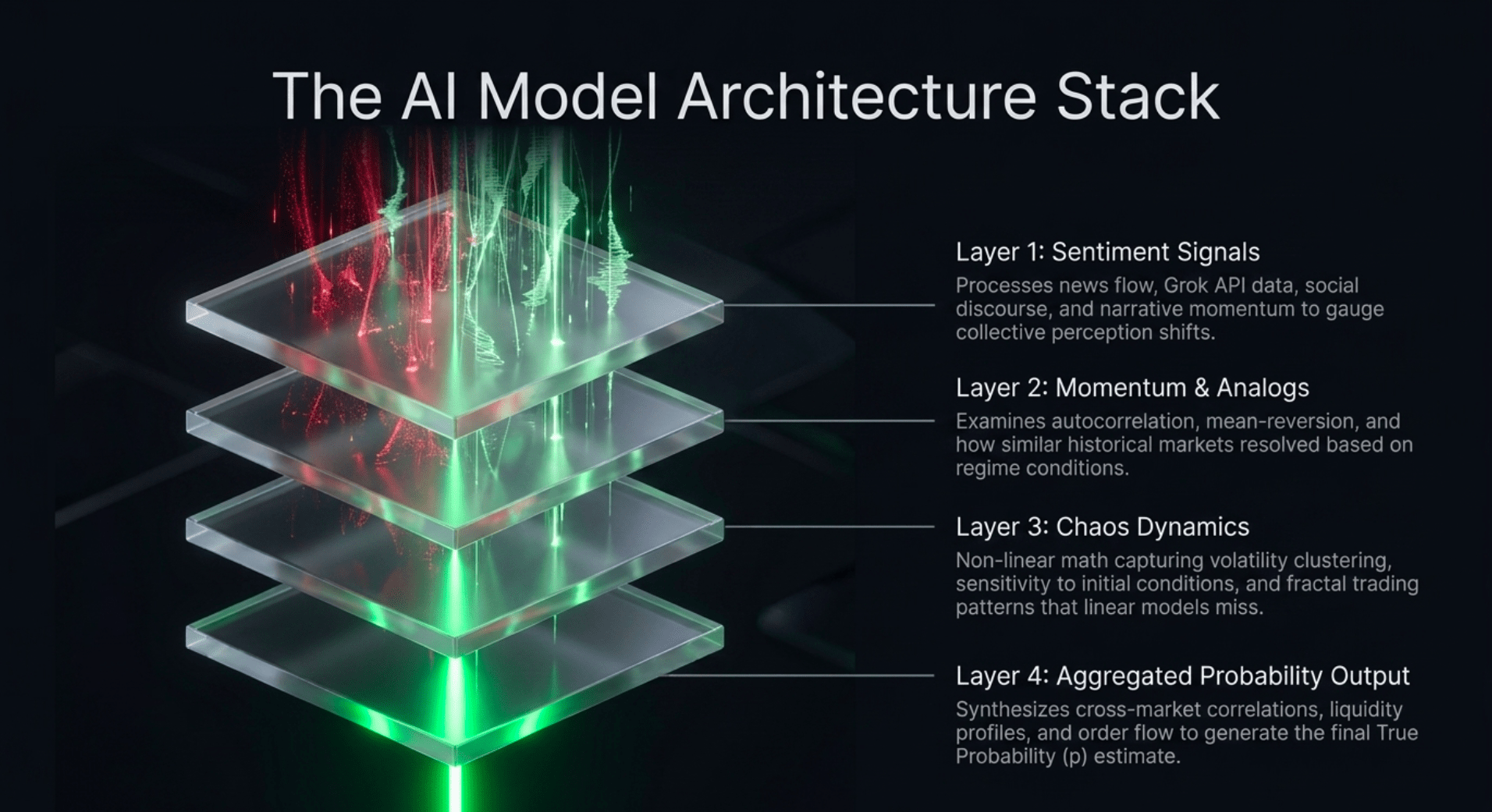
The AI models integrate multiple layers of analysis:
- Sentiment signals: Processing news flow, social discourse, expert commentary, and narrative momentum to gauge shifts in collective perception.
- Past momentum and historical analogs: Examining how similar markets have resolved, incorporating autocorrelation, mean-reversion tendencies, and regime shifts.
- Chaos mathematics and non-linear dynamics: Modeling the inherent unpredictability and sensitivity to initial conditions in complex systems—capturing volatility clustering, fractal-like patterns in trading activity, and emergent behaviors that linear models miss.
- Additional metrics: Liquidity profiles, order flow imbalances, cross-market correlations, volume-weighted signals, game-theoretic considerations, and calibration against resolved historical outcomes.
The system generates probability estimates for events and compares them against prevailing market prices to surface positive expected value opportunities. It prioritizes diversification, conviction weighting, and risk-adjusted selection—resulting in portfolios of high-conviction picks rather than scattered bets.
This is an ongoing research and development effort, continuously trained and validated on resolved markets. It draws on principles from probability theory, behavioral finance, and complex systems science. The goal is not to predict every outcome perfectly (impossible in chaotic domains) but to maintain a consistent, measurable edge over time through superior information synthesis and modeling.
As of today, across 20 diversified high-conviction picks, the average cumulative edge stands at +18.7%. The strongest thematic cluster currently involves Tesla/Optimus production ramp dynamics, AI model leadership trajectories, and broader macroeconomic stability factors. These reports are published regularly (at least every business day) exclusively for members.
It is important to understand these are early days and there are no guarantees. In our paper trading research we have been fairy consistent with 5%-20% edges. However thus far the average is about 6%. The picks can change daily as conditions change. We may also pause the model if we find it requires updates.
Clearly events are changing minute by minute and edges can change in a heartbeat. Although these are regulated markets, you can and sometime (hopefully not often) lose you picks. The basis of the prediction market AI model is to help surface, evaluate and track situations that meet the 1000s of points the model identified and will continue to identify. Thursday snot only is the market changing second by second, but also the AI model is. The point is to build some stability. This is our goal.
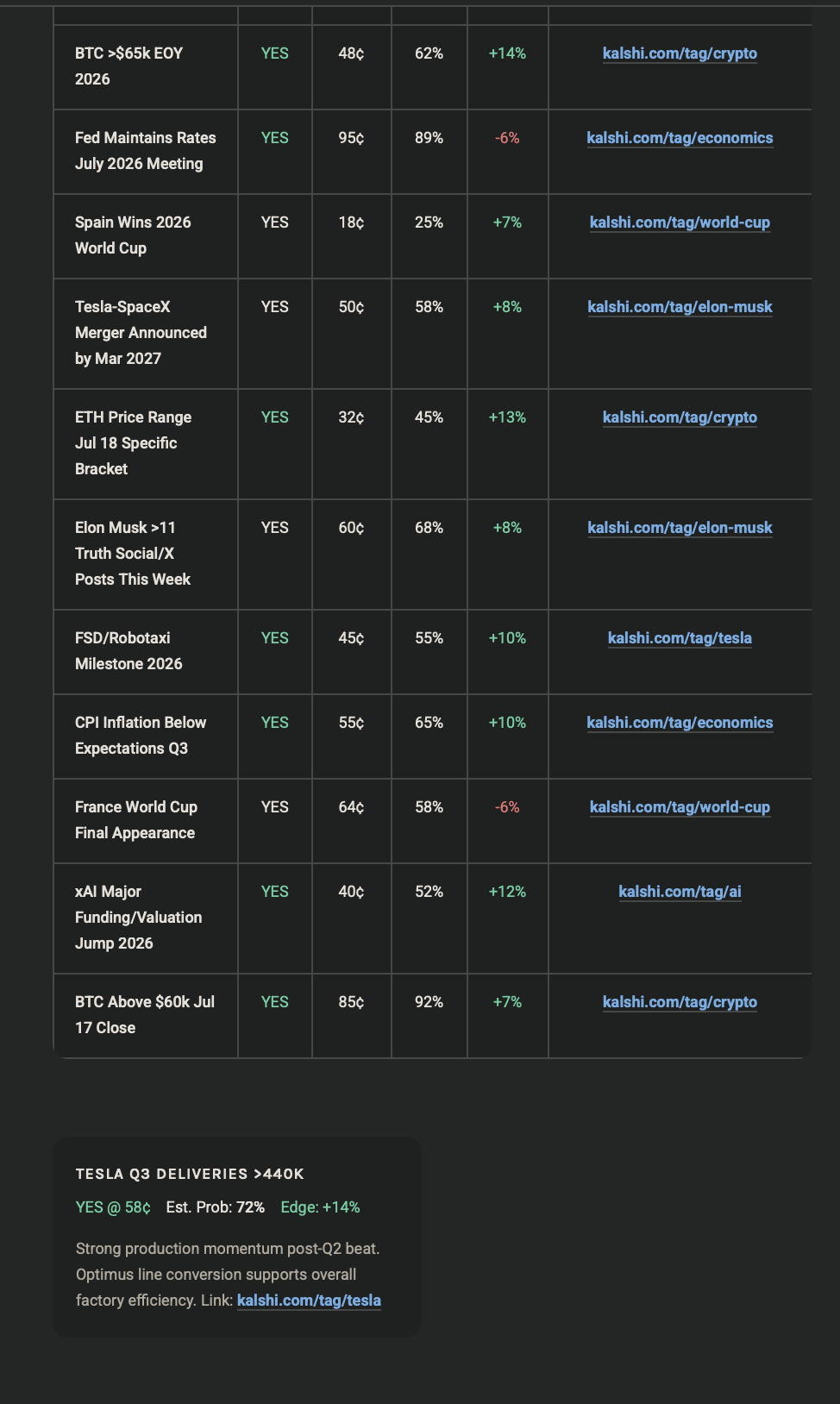
Below is an image of the July 17, 2026 private KALSHI HIGH EV DAILY REPORT. It is offered as an example. However it is the live report.
Example Private Read Multiplex Member KALSHI HIGH-EV DAILY REPORT:
Accessing the Daily Kalshi High-EV Reports
Subscribers and members of ReadMultiplex.com receive my daily Kalshi analysis and high-EV report. These feature the model’s top selections, thematic insights, edge calculations, and context for responsible application. The current average cumulative edge of +18.7% reflects the aggregated performance signal from the latest set of picks.
Visit https://readmultiplex.com/members-kalshi-ai-report/ to explore membership options and access the reports (a dedicated Kalshi section or report page is available for subscribers, following the model of existing prediction-market analysis offerings).
How to Sign Up for Kalshi and Paper Trade Responsibly
Signing up is straightforward and designed for accessibility:
- Visit kalshi.com use this link and you will have extra benefits like up to $500 in cash (this site earns some support if you use this link, thank you. Kalshi is not a sponsor nor have they paid me.)
Or
the Perpetual account that pays you up to $2165 if you qualify. Visit kalshi.com. - Create an account with email and complete identity verification (KYC/AML requirements standard for regulated platforms).
- Fund your account via supported methods (I use Apple Pay).
- Browse the member report, review probabilities, and execute trades on event contracts.
Minimums are low, making entry accessible. Always review current terms, fees, and availability in your jurisdiction.We suggest no more than $10 per pick across 20 picks.
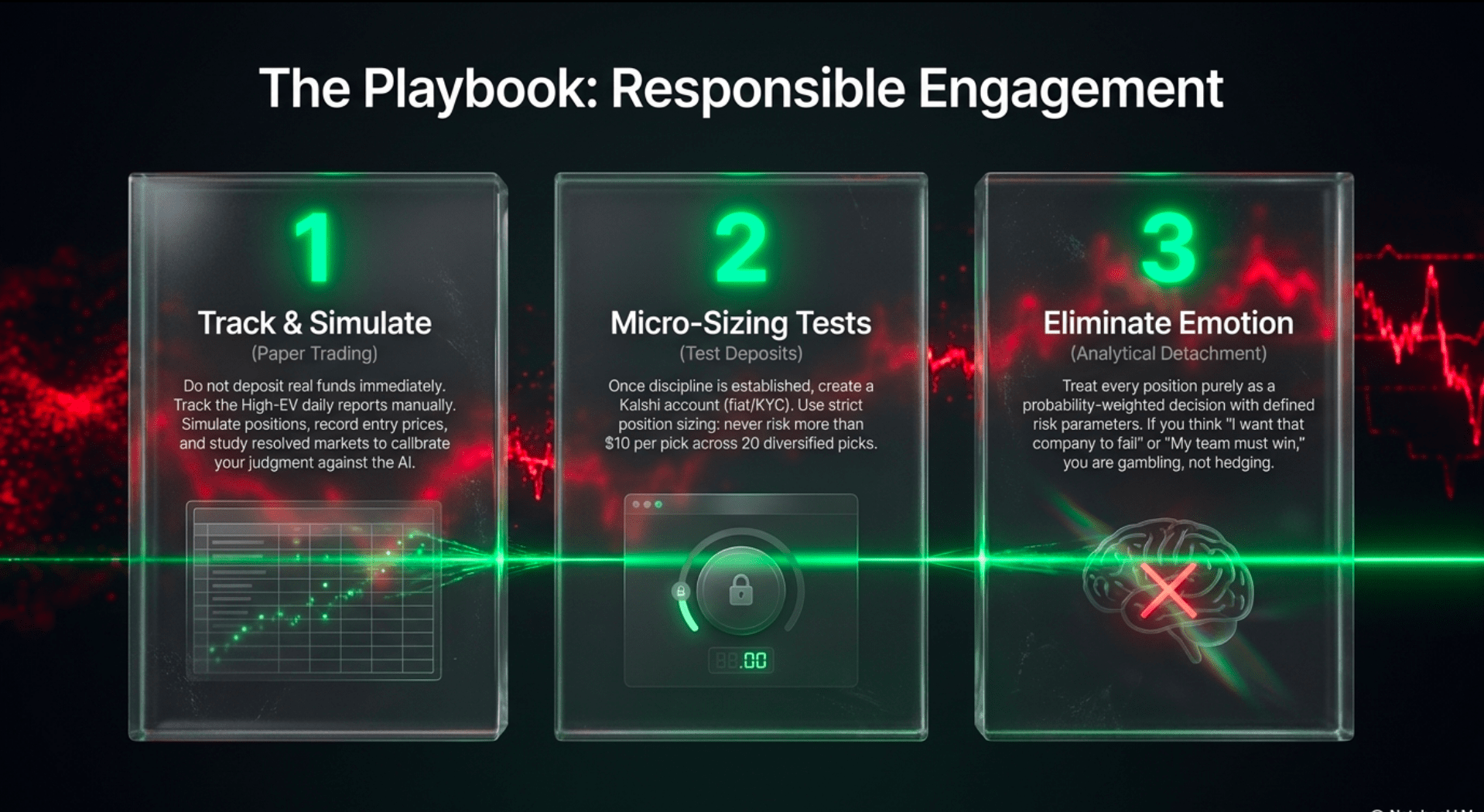
Responsible paper trading is strongly recommended before committing capital:
- Track the daily reports and model picks manually in a spreadsheet or journal without depositing real funds.
- Simulate positions over weeks or months, recording entry prices, resolutions, and cumulative P&L.
- Study resolved markets to calibrate your own judgment against the model and market prices.
- Use small test deposits only after demonstrating consistent understanding and discipline.
- Treat every position as a probability-weighted decision with defined risk parameters. Never risk more than you can afford to lose. Set strict position sizing rules and maintain emotional detachment.
This approach transforms the platform into a laboratory for learning market dynamics, probability calibration, and edge identification—aligning with the educational and hedging philosophy outlined here. It is not investment advice; past performance (including model edges) does not guarantee future results. Engage only after thorough due diligence and personal risk assessment.
How Kalshi Prediction Picks Work
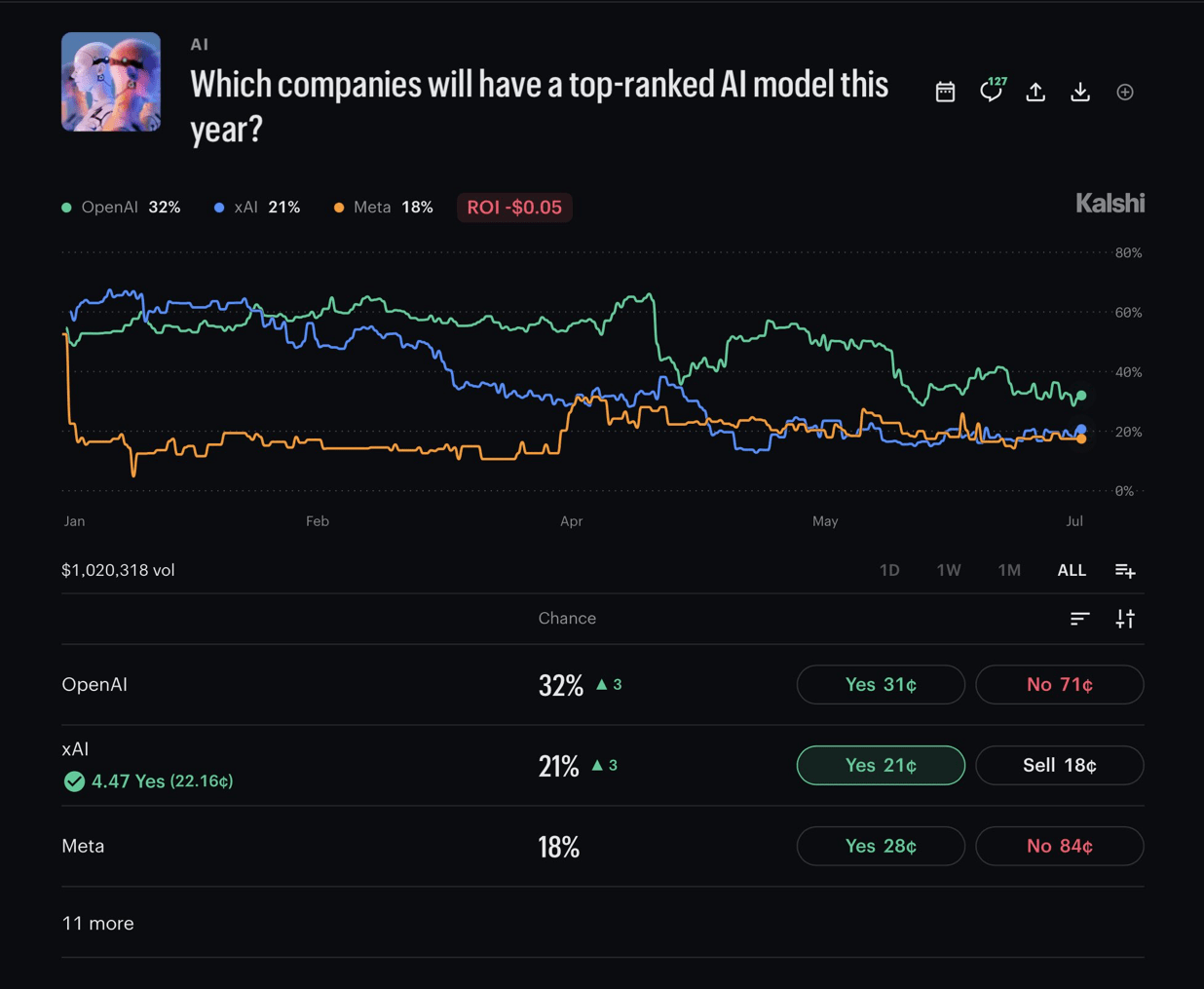
The image below is from Kalshi, a legal, regulated platform where people buy and sell contracts on whether real events will happen. We will use this example below. Think of it as a stock market for predictions — instead of investing on a company’s stock price, you’re placing an outcomes like “Will this AI company have a top-ranked model this year?”
The Main Question
“Which companies will have a top-ranked AI model this year?” Kalshi splits this into separate yes-or-no markets for OpenAI, xAI, Meta, and 11 other companies. Each row in the screenshot is its own independent bet.
The Colorful Chart
The lines show how the market’s opinion (the “odds”) has changed since January 2026:
Green = OpenAI, Blue = xAI, Orange = Meta.
When a line rises, more people think that company is likely to end up with a leading AI model. The chart runs through mid-July 2026.
The Percentages (32%, 21%, 18%)
These are the market’s current best guess at the probability, taken straight from the contract prices people are willing to pay right now. As of the screenshot: OpenAI has a 32% chance, xAI 21%, and Meta 18% according to the crowd trading these contracts.
The Buttons: What “Yes,” “No,” and “Sell” Actually Mean
You don’t bet cash directly on “yes” or “no.” You buy or sell contracts. Each contract is worth $1 if your side wins and $0 if it loses. Your profit or loss is simply the difference between what you paid and that final $1 or $0.
Yes button (example: OpenAI “Yes 31¢”)
You are betting the company WILL have a top-ranked AI model. You pay the price shown now (31 cents per contract in this example).
How & when it pays off: At resolution (usually early 2027 after Kalshi checks official AI rankings), if correct: each contract pays $1. Profit = $1 minus what you paid. If wrong: pays $0, you lose what you paid.
No button (example: Meta “No 84¢”)
You are betting the company will NOT have a top-ranked model. Pay the shown price now (84 cents in the example).
How & when it pays off: If the company does NOT have a top model at resolution: pays $1 per contract. If it does: pays $0. Same timing as Yes — Kalshi resolves after the year ends based on official rankings.
Sell button (xAI “Sell 18¢”)
Appears only if you already own Yes contracts (in the screenshot, I own 4.47 xAI Yes contracts bought earlier at ~22.16¢ average). Lets you close the position immediately.
How & when it pays off: You receive the Sell price (18¢) right away per contract and exit the bet completely. Locks in current profit or loss. No further payout at resolution — you’re done.
When Does It Actually Pay Off?
You can buy or sell these contracts any time the market is open — prices move with AI news and new model releases. The actual money settles only when Kalshi officially resolves each market. They review independent AI leaderboards and rankings (usually in early 2027 for a full-year 2026 market) and decide Yes or No for each company. Winning contracts automatically become $1 each in your account. You can withdraw the cash.
Real Example from This Screenshot
As you can see in his image I already own a small position betting that xAI will have a top-ranked model (4.47 Yes contracts bought at an average of 22.16 cents). The current Yes price is about 21 cents, so their position shows a tiny unrealized loss right now (the “ROI –$0.05” at the top). They could sell now via the Sell button to lock that in, or hold and hope xAI’s line on the chart rises — or wait for the final resolution payout of $1 per contract if they’re ultimately correct.
These markets turn opinions about AI progress into real, tradable prices. Because people risk actual money, the percentages often end up being quite accurate forecasts.
Key Lessons from 16 Months of Building and Running Local AI Models on Prediction Markets
After nearly 16 months developing and iteratively refining local AI systems to analyze Kalshi (and related) prediction markets incorporating sentiment flows, historical momentum, chaos mathematics, liquidity signals, and resolved-outcome calibration, several non-obvious patterns have emerged consistently from the data. These are empirical observations, not theory. They explain why certain edges persist and why disciplined, model-driven selection outperforms both naive crowd-following and high-volume speculation.
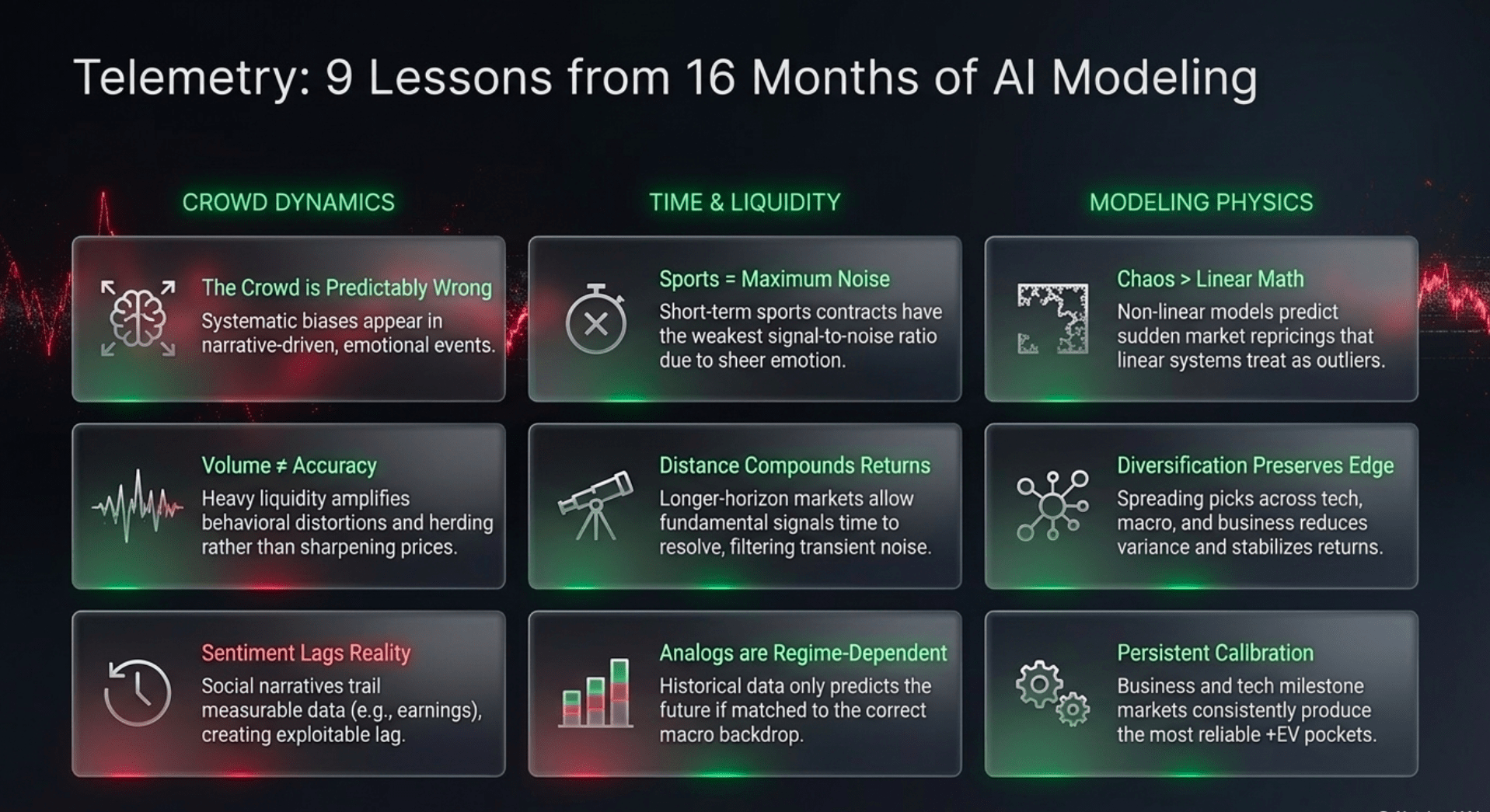
Here are the most important lessons uncovered by running these models at scale:
- The crowd is frequently wrong — and the errors are predictable.
Prediction markets aggregate information effectively in many cases, but they are not infallible. Systematic biases appear around narrative-driven events, low-information regimes, and emotionally charged outcomes. The models repeatedly identified periods where market prices deviated from calibrated probabilities derived from fundamentals, momentum analogs, and cross-market signals. These deviations created repeatable +EV opportunities rather than random noise. - More money in a market does not equal better odds.
High trading volume and liquidity do not automatically produce more accurate prices. In several categories, heavy participation actually amplified behavioral distortions (herding, recency bias, or overreaction). The models showed that “smart money” concentration in certain business and tech contracts often produced tighter, more reliable pricing than broad retail-driven volume in other areas. - Sports markets are the most volatile — and the noisiest.
Short-term sports event contracts exhibit the highest variance and the weakest signal-to-noise ratio. Emotional betting, last-minute information shocks, and in-game dynamics create large, rapid price swings that are difficult to model consistently. While they can generate short bursts of volume, they rarely delivered the most stable or highest-quality edges compared with longer-horizon or fundamental-driven markets. They are the most like rote gambling. - Longer time horizons and “distance” compound returns.
Contracts resolving further into the future (weeks to months rather than hours or days) consistently showed higher cumulative edge when properly selected. The models revealed that longer-duration markets allow fundamental signals, momentum shifts, and chaos-driven corrections more time to resolve in the model’s favor, while reducing the impact of transient noise. This pattern held across both business/tech and macro themes. - Sentiment and narrative momentum often lag or overshoot reality.
Social and media sentiment frequently trails measurable developments (earnings data, production metrics, regulatory signals). It is one reason we use the Grok API often as an endpoint our AI agents call for the prediction AI model’s data. The models detected systematic lag in how markets priced evolving stories around companies like Tesla or broader AI adoption curves, creating exploitable divergences between narrative price action and underlying probability estimates. - Chaos mathematics and non-linear dynamics matter more than linear correlations.
Simple regression or correlation-based approaches missed critical regime shifts. Incorporating chaos theory concepts sensitivity to initial conditions, fractal patterns in trading activity, and attractor states allowed the models to better anticipate sudden repricings that linear systems treated as outliers. - Historical analogs and resolved outcomes are powerful but regime-dependent.
Past market resolutions provided strong training signals, yet their predictive power varied sharply by market type and external conditions. The models learned to weight analogs differently depending on liquidity regime, macroeconomic backdrop, and thematic cluster (e.g., tech milestones versus pure political events). - Diversified high-conviction portfolios across themes reduce drawdowns while preserving edge.
Concentrating solely on the highest-volume or most popular markets increased variance. Spreading selections across business/tech (Tesla/Optimus, AI leadership), macro stability, and select longer-horizon contracts produced more consistent cumulative performance with lower peak-to-trough volatility — a pattern that emerged clearly only after running thousands of simulated and live portfolio iterations. - Calibration against resolved markets reveals persistent structural edges in certain domains.
Business, technology, and economic-indicator markets repeatedly showed better long-term calibration potential than pure short-term sports or highly emotional political contracts. When the model’s probability estimates were systematically compared to eventual resolutions, these categories produced more reliable positive expected value pockets, supporting their use for both directional edges and genuine hedging applications.
These lessons are not static rules but ongoing calibration targets. They continue to inform daily model updates and the selection process behind the high-EV reports. The current +18.7% average cumulative edge across the 20 diversified picks reflects the cumulative application of these empirically derived insights rather than any single factor. We try to find all the human elements that drive market movements and apply them in the AI model but we ourselves resist emotional picks, eg. “They must win this election so I will bet”, “My team is great I will pick them”, “I want that company to fail”. The emotional picks may be rewarding if they pan out, but it is not the way we are presenting this here.
The models do not eliminate uncertainty they help quantify it and locate where the market’s collective pricing diverges from better-informed probability estimates. That distinction is what turns raw market participation into a structured analytical edge.
Edges, Hedges, and Agency in an Uncertain Age
We live in an era of profound transition the Interregnum between industrial-era certainties and an AI-augmented future of abundance and volatility. Traditional forecasting tools often lag; centralized predictions frequently disappoint. Prediction markets, augmented by rigorous local AI systems, offer a decentralized, incentive-aligned alternative: they force beliefs to confront reality through tradable prices.
Having an edge is not about beating the house for thrills. It is about cultivating superior models of reality, identifying mispricings born of incomplete information or behavioral biases, and using that insight to manage risk. Hedging business and technological exposures whether through Tesla-related contracts, AI milestones, or macro indicators provides a form of insurance and optionality in a world where linear projections routinely fail.
This is not gambling. It is participation in the most sophisticated collective intelligence mechanism available: markets that reward accuracy and penalize error. In this age of accelerating change, those who develop disciplined edges and prudent hedges position themselves not as passive observers but as active navigators of the future.
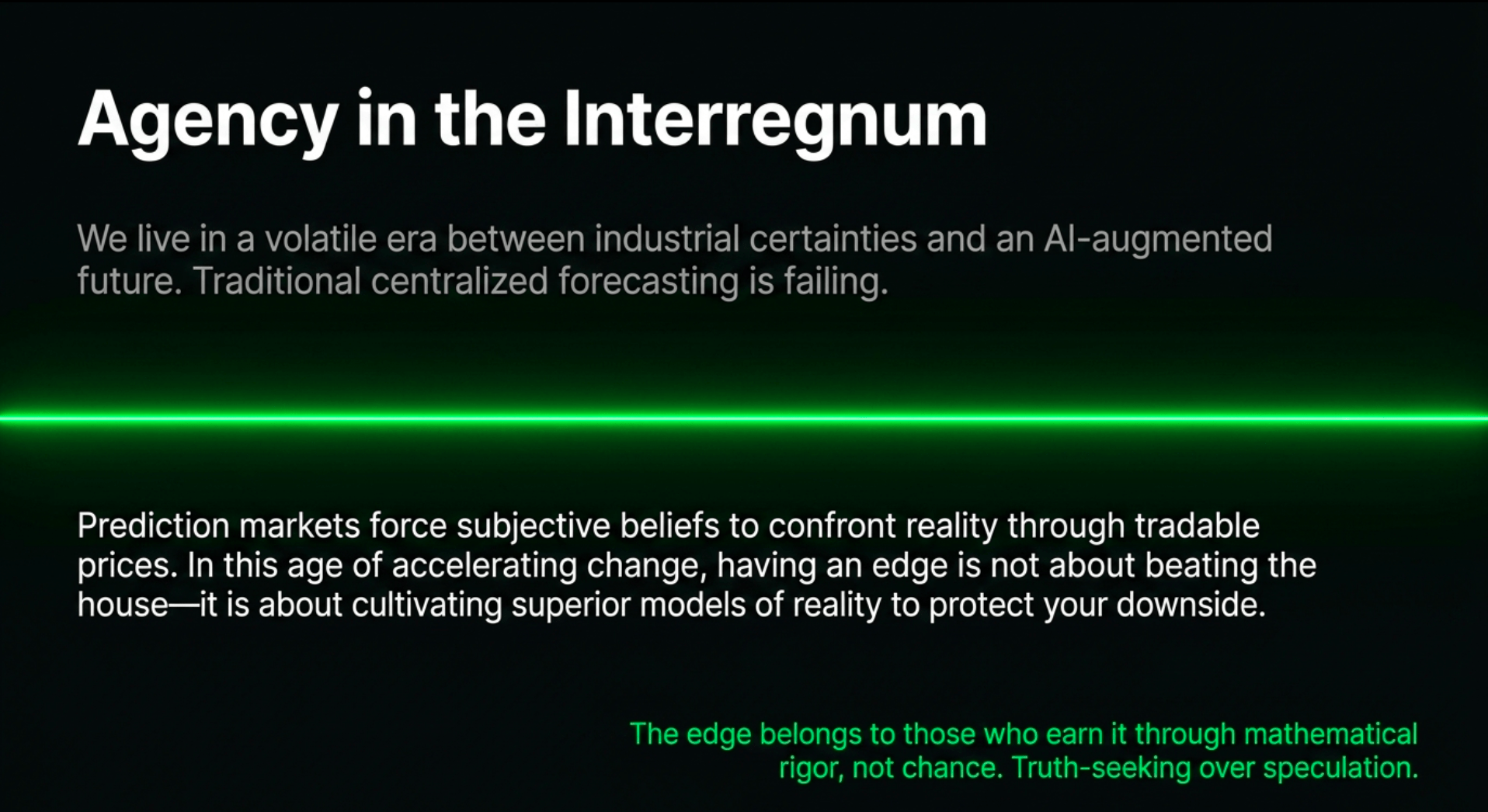
The current +18.7% cumulative EV edge in today’s Kalshi report is one data point in an ongoing experiment in systematic foresight. The deeper value lies in the methodology, the philosophical commitment to truth-seeking over speculation, and the practical tools it provides for those willing to engage thoughtfully.
Become a member and you get the reports. Paper trade diligently, build your own analytical frameworks, and approach these markets with the seriousness they deserve as instruments of informed agency in uncertain times. The edge belongs to those who earn it through rigor, not chance.
Become a member to view this report: https://readmultiplex.com/members-kalshi-ai-report/
Join kalshi.com use this link and you will have extra benefits like up to $500 in cash, to see what this is all about.
In the future we will seek the truth, but we will also price it.
To continue this vital work documenting, analyzing, and sharing these hard-won lessons before we launch humanity’s greatest leap: I need your support. Independent research like this relies entirely on readers who believe in preparing wisely for our multi-planetary future. If this has ignited your imagination about what is possible, please consider donating at buy me a Coffee or becoming a member. Value for value you recieved here.
Every contribution helps sustain deeper fieldwork, upcoming articles, and the broader mission of translating my work to practical applications. Ain ‘t no large AI company supporting me, but you are, even if you just read this far. For this, I thank you.
Stay aware and stay curious,

🔐 Start: Exclusive Member-Only Content.
Membership status:
🔐 End: Exclusive Member-Only Content.
~—~

~—~

~—~
Subscribe ($99) or donate by Bitcoin.
Copy address: bc1qkufy0r5nttm6urw9vnm08sxval0h0r3xlf4v4x
Send your receipt to [email protected] to confirm subscription.

Stay updated: Get an email when we post new articles:

THE ENTIRETY OF THIS SITE IS UNDER COPYRIGHT. IMPORTANT: Any reproduction, copying, or redistribution, in whole or in part, is prohibited without written permission from the publisher. Information contained herein is obtained from sources believed to be reliable, but its accuracy cannot be guaranteed. We are not financial advisors, nor do we give personalized financial advice. The opinions expressed herein are those of the publisher and are subject to change without notice. It may become outdated, and there is no obligation to update any such information. Recommendations should be made only after consulting with your advisor and only after reviewing the prospectus or financial statements of any company in question. You shouldn’t make any decision based solely on what you read here. Postings here are intended for informational purposes only. The information provided here is not intended to be a substitute for professional medical advice, diagnosis, or treatment. Always seek the advice of your physician or other qualified healthcare provider with any questions you may have regarding a medical condition. Information here does not endorse any specific tests, products, procedures, opinions, or other information that may be mentioned on this site. Reliance on any information provided, employees, others appearing on this site at the invitation of this site, or other visitors to this site is solely at your own risk.
Copyright Notice:
All content on this website, including text, images, graphics, and other media, is the property of Read Multiplex or its respective owners and is protected by international copyright laws. We make every effort to ensure that all content used on this website is either original or used with proper permission and attribution when available.
However, if you believe that any content on this website infringes upon your copyright, please contact us immediately using our 'Reach Out' link in the menu. We will promptly remove any infringing material upon verification of your claim. Please note that we are not responsible for any copyright infringement that may occur as a result of user-generated content or third-party links on this website. Thank you for respecting our intellectual property rights.
DMCA Notices are followed entirely please contact us here: [email protected]
