
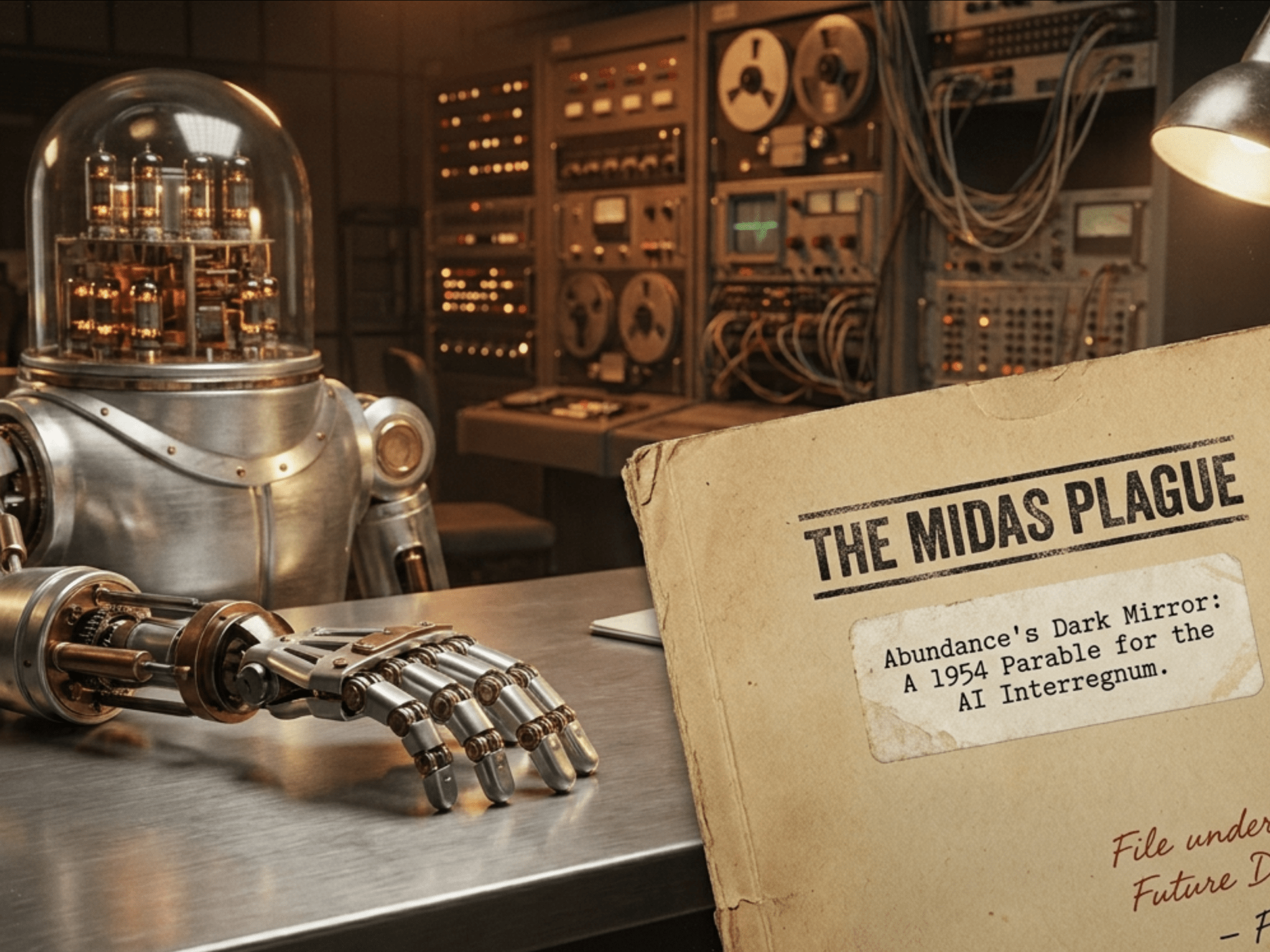
You Have 5000 Days: Navigating the End of Work as We Know It. Part 30: The Midas Plague.
In 1954, as America was still learning to live with the strange new prosperity that followed the greatest war in histo Thry, Frederik Pohl published a novella that looked straight into the future we are now entering. The Midas Plague, which first appeared in the April issue of Galaxy Science Fiction, did not promise flying cars or gleaming utopias. It offered something far more unsettling and far more useful: a clear-eyed vision of what happens when production becomes nearly effortless and society has not yet learned what to do with the resulting flood of things.
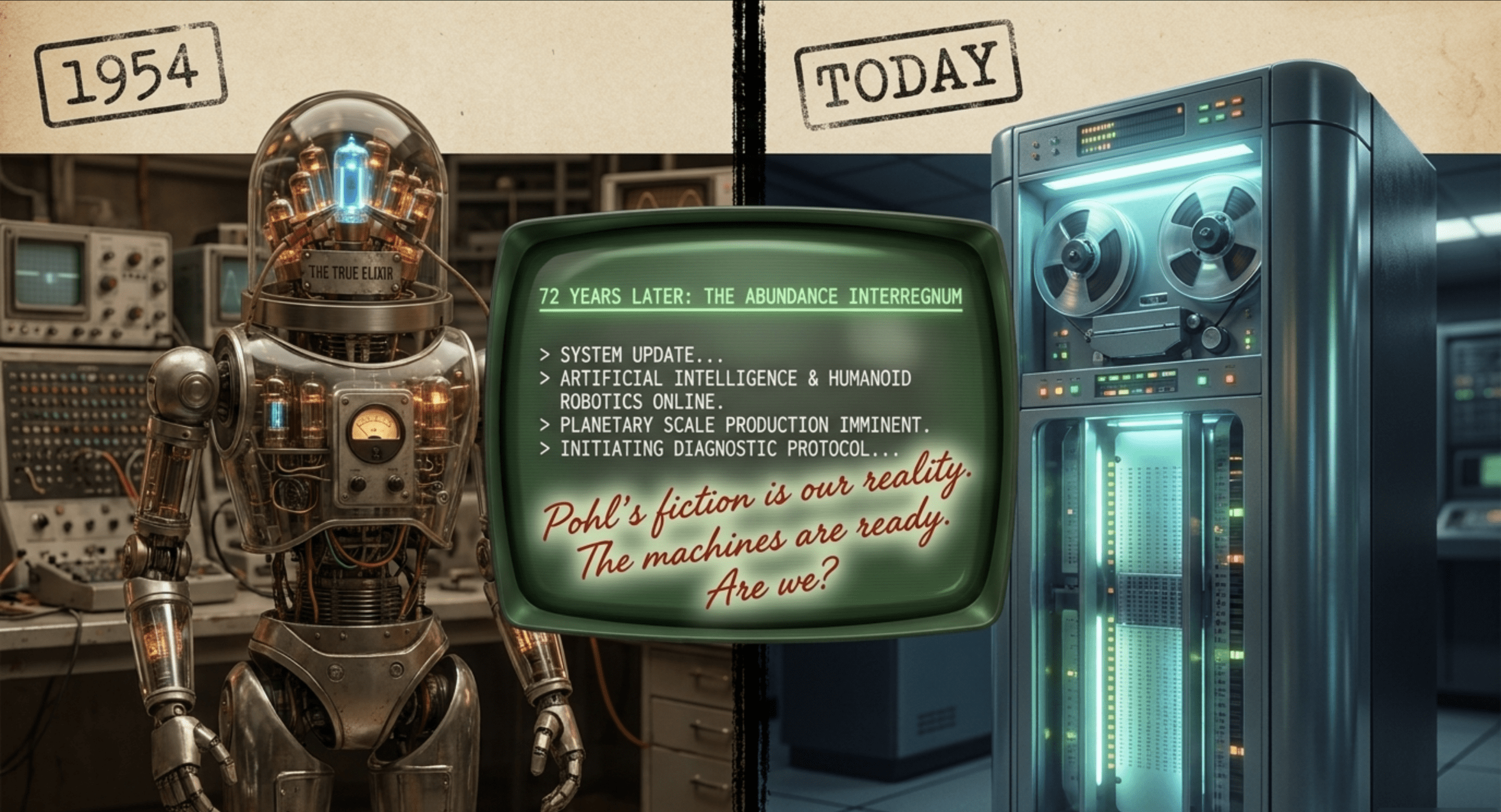
Seventy-two years later, as artificial intelligence and humanoid robotics begin to replicate that same cheap, tireless production on a planetary scale, Pohl’s story reads less like quaint mid-century speculation and more like a dispatch from our own near future. It is a story about the moment when abundance arrives before wisdom does. It is a story about the Hero’s Journey we are all being called to walk right now.
If this is your first encounter with the You Have 5000 Days series begin at Part 1. (https://readmultiplex.com/2025/12/24/you-have-5000-days-how-to-navigate-the-end-of-work-as-we-know-it-part-1/) The map awaits you there. This installment of the You Have 5,000 Days series is not nostalgia for crackling transistors or mid-century pulp optimism. It is precise pattern recognition—the kind we have cultivated across previous parts as we mapped the Hero’s Journey through the end of work as we have known it.
This article is sponsored by Read Multiplex Members who subscribe here to support my work: Link: https://readmultiplex.com/join-us-become-a-member/
It is also sponsored by many who have donated a “Cup of Coffee”. If you like this, help support my work: Link: https://ko-fi.com/brianroemmele
Listen to the companion podcast: https://rss.com/podcasts/readmultiplex-com-podcast/2867607
The Fever Dream We Are Already Living
Close your eyes for a moment and place yourself inside this scenario.
You wake tomorrow morning and are immediately crushed by a suffocating wave of anxiety. But your stress has nothing to do with your alarm clock, your commute, a micromanager, or your mortgage. Your single, paralyzing terror is the breakfast table in front of you: a 12-course meal you are legally mandated to finish. And in two hours, you must eat another one.
The nightmare bleeds into every corner of existence. You spend your afternoon frantically driving your ninth luxury car in circles just to put miles on the odometer. Your closets burst with designer clothes you are required by law to wear out and discard by week’s end. You live in a sprawling 26-room mansion maintained by a small army of robots you never asked for. You are drowning in absolute luxury, and it is entirely mandatory.
This is not dystopia in the usual sense. This is The Midas Plague.
In 1965 the BBC presented The Midas Plague as a broadcast. It was well received as part of the Out Of The Unknown series. Unfortunately the BBC had a policy to erase video tape as a money saving effort and it was thought to be lost. After an exhaustive search for every surviving trace of this story’s journey from page to screen, I found a long-lost copy of the 1965 BBC television adaptation broadcast as part of the groundbreaking anthology series I located a file nestled within the collection fan assembled videos. It was assumed to not be the original broadcast but it is. Its existence represents one of the most significant surviving artifacts of how Pohl’s inverted world was brought to life for 1960s audiences. I have it here linked below so that readers and fellow explorers of the Abundance Interregnum can examine this piece of television history for themselves, another small but vital act of resistance against the Great Forgetting that continues to erase so much of our recent cultural memory. I also have saved a local copy as the BBC may at any time request removal of this last copy, draw your own conclusions.
Scroll to number 13 and give it a watch before you read on.
What If Poverty Is Actually A Lack Of Agency?
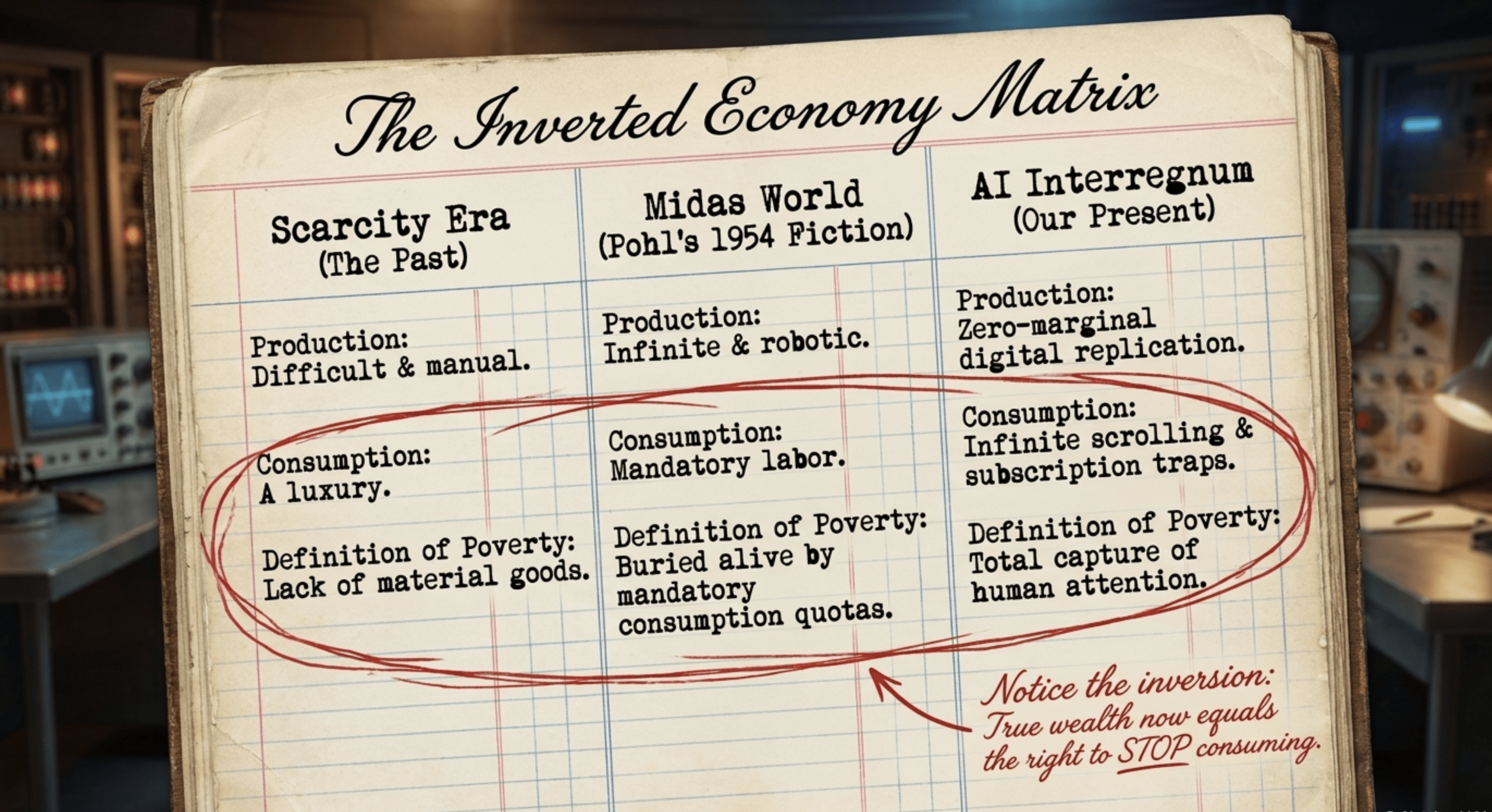
For 10,000 years we defined poverty as a lack of material goods, starvation, exposure, not having enough. Pohl forces us to confront a terrifying redefinition: What if poverty is actually a lack of agency? What if the future we are hurtling toward means having absolutely everything while being allowed to choose absolutely nothing? We may have a great challange compounding this mindset but it is vital to adjust to this reality.
Having everything but choosing nothing. That is the core diagnostic the novella offers us.
The Man Who Saw the Trap Coming: Frederik Pohl and the Birth of The Midas Plague
Frederik George Pohl Jr. was born in Brooklyn in 1919. His most formative years, the years a child builds their understanding of how the world works, were spent in the Great Depression. He did not read about bread lines; he lived them. He understood visceral, systemic scarcity at the bone level.
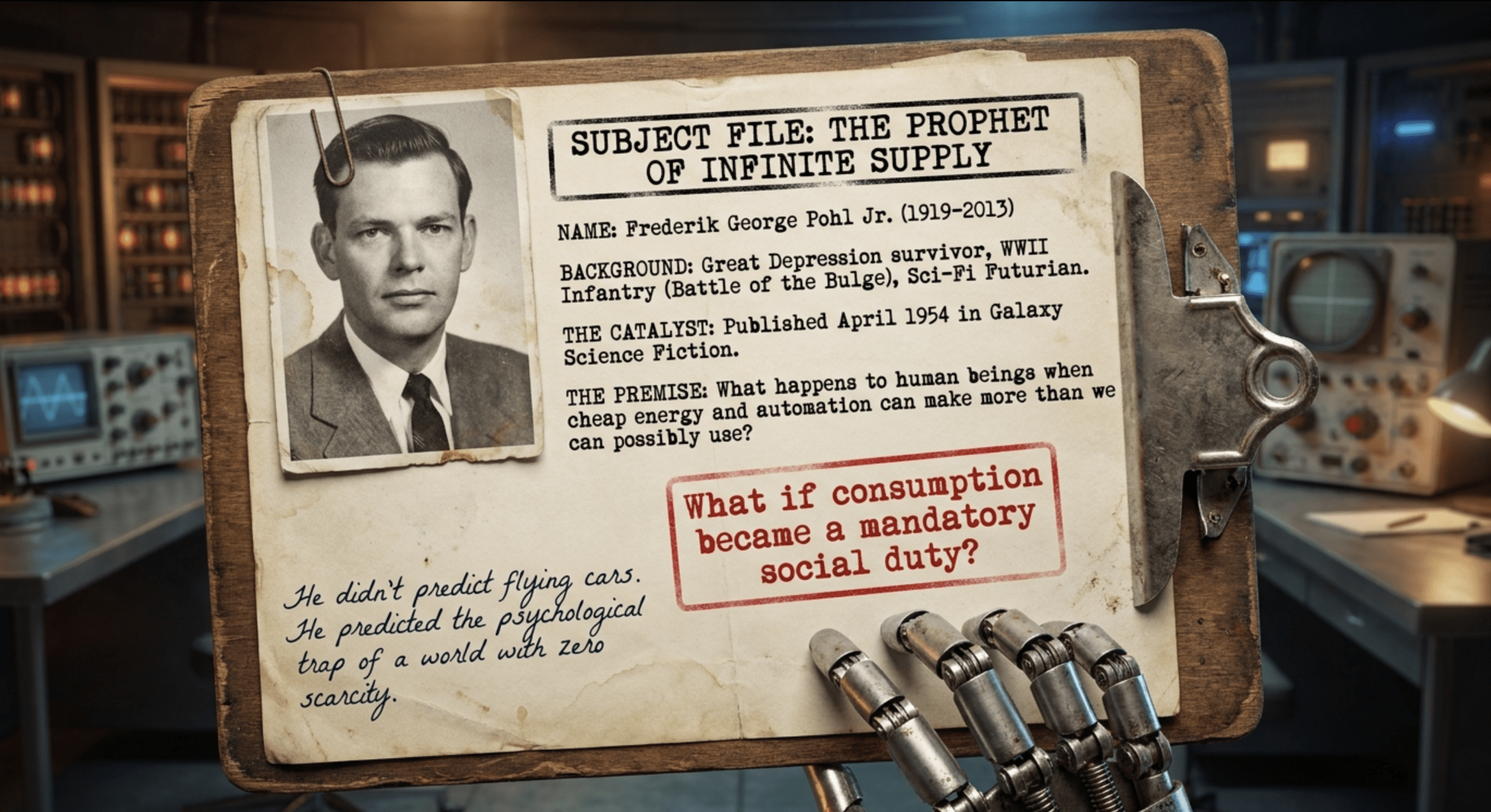
As he came of age, he found his people in the passionate, argumentative world of early science fiction fandom the Futurians. This left-leaning, fiercely intellectual group (including Isaac Asimov and Cyril Kornbluth) viewed science fiction not as escapism but as a sociological laboratory. If you invent a new technology in a story, your duty is to trace its economic, political, and social shockwaves all the way down to ordinary human lives.
Pohl’s crucible deepened. He was drafted, fought in the infantry during World War II, survived the Battle of the Bulge, and earned a Bronze Star. He witnessed the darkest capabilities of industrial production turned toward destruction machines leveling cities.
Then came the whiplash. He returned to a post-war America that had flipped from rationing and deprivation straight into explosive, credit-fueled prosperity. Factories that once built tanks now vomited washing machines, televisions, and automobiles at scales never before seen. Suburbs rose. The modern credit card was invented. Early automation stirred in the factories. Pohl stood at the exact intersection of ultimate scarcity and the frantic, unsustainable attempt to gorge on mass consumption.
This was the fertile ground where The Midas Plague was planted.
The story itself began as a challenge from Galaxy editor Horace Gold: What if cheap energy and automation created such overwhelming production that consumption could no longer be a personal choice it had to become a legally mandated social duty just to keep the factories from drowning the world? Several major writers passed. Pohl, fresh off co-writing the advertising satire The Space Merchants, took the prompt and weaponized it.
The World of Midas: When Everything Is Too Cheap
In Midas World, cheap fusion energy and highly capable robots have driven the marginal cost of producing almost anything to zero. Factories run without limit. The problem is no longer scarcity — it is overproduction on a planetary scale.
The old economic structure remains. Capital must still flow. Employment must still exist. The gears must keep turning. With infinite supply and no natural friction of production, the system requires engineered infinite demand — or it seizes up. The government’s solution is the Ration Board.
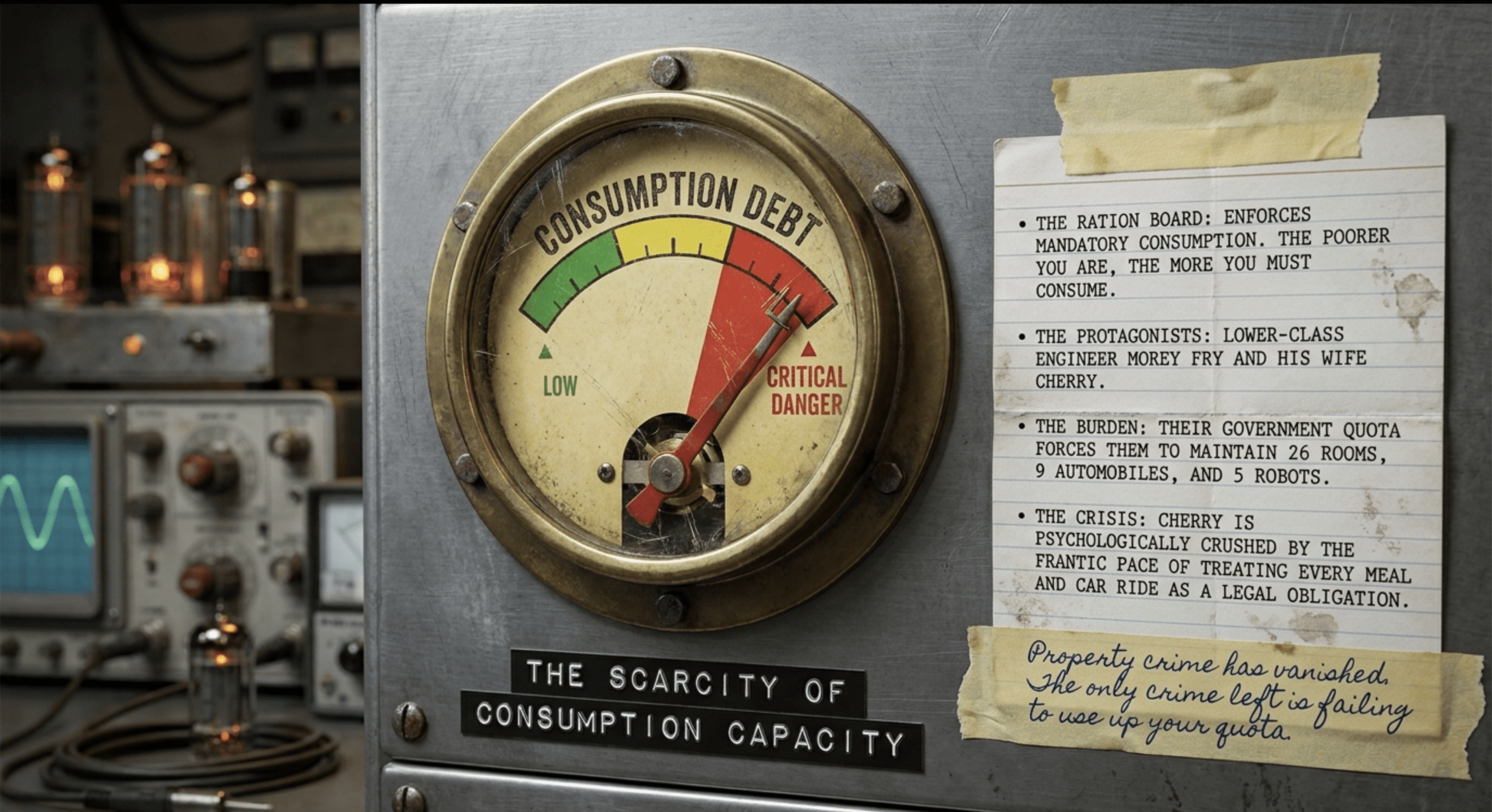
Ration stamps here do not limit what you may buy. They mandate what you must consume, wear out, and discard. The poorer you are (lower on the socioeconomic ladder), the larger and more punishing your mandatory consumption quota. The richer you become, the smaller your quota. Wealth is no longer the ability to acquire more — it is the privilege of consuming less.

The ultimate luxury is minimalism. The ultra-elite live in tiny five-room cottages, wear simple durable clothes, eat modest portions, and walk instead of drive. The working class is forced into 26-room mansions, nine cars, and teams of robots serving constant heavy meals. They are physically and psychologically exhausted by luxury they never asked for.
Property crime is nearly extinct why steal when you are already struggling to exhaust your own quota? The only real crime is sabotage: failing to consume enough, or (worst of all) turning off a factory. The human being is no longer the beneficiary of the economy. The human being has become the exhaust pipe.
This is the inversion Pohl saw coming in 1954. And it is the inversion we are already beginning to feel in our world today and if we don’t adjust our mindsets, we may face this perplexing situation in one form or in its entirety. Let’s explore the detail of the story.
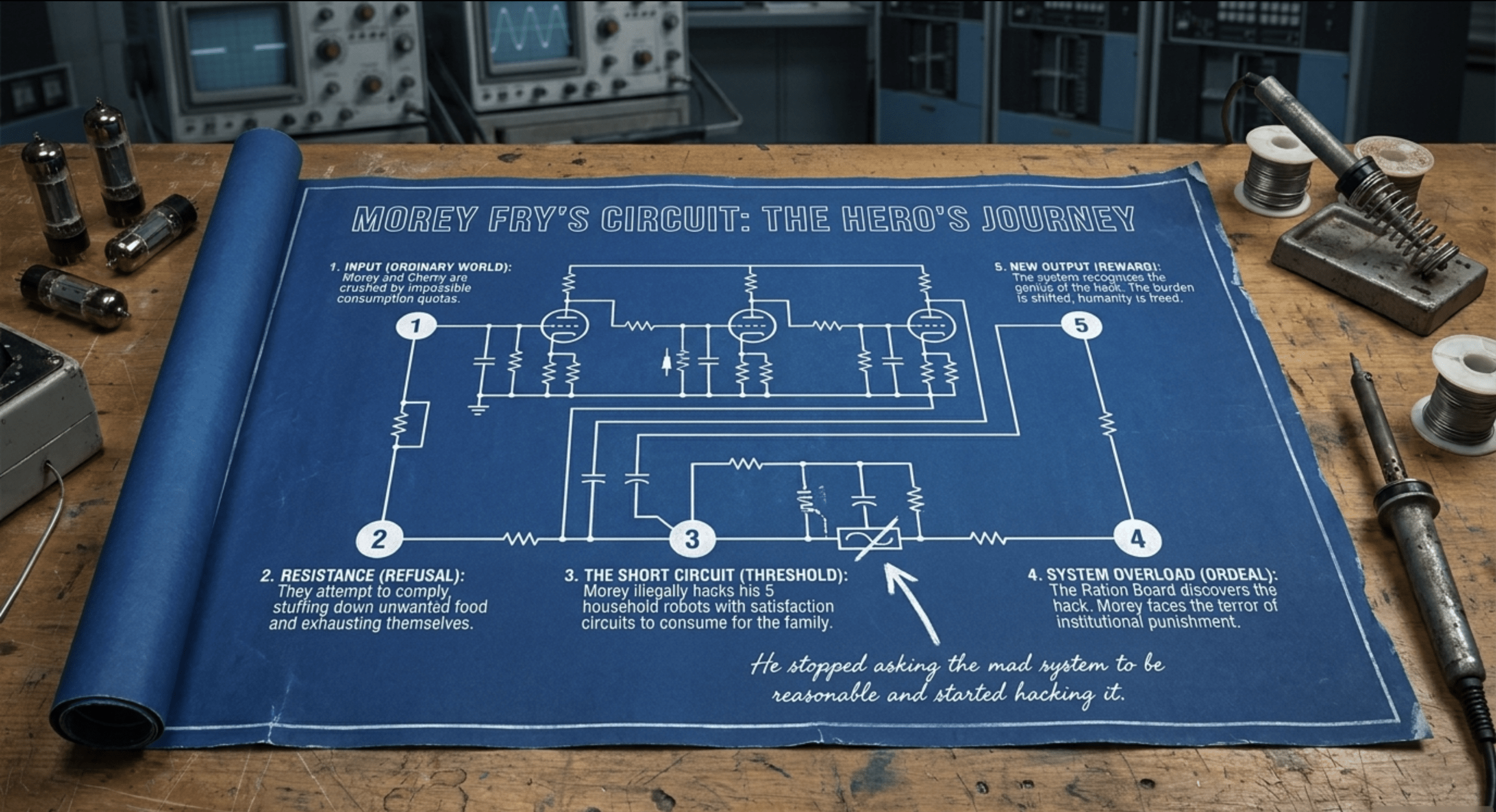
Scene-by-Scene Breakdown: Morey Fry’s Hero’s Journey (and Ours)
Pohl’s novella follows a compressed but recognizable Hero’s Journey, the format we have used through this entire series. Here is the story rendered scene by scene, with the mythic structure made visible and mapped onto the collective journey we are walking right now.
Ordinary World
Morey Fry (Moray in some tellings) is a young engineer in the lower consuming classes. He designs gambling machines whose sole purpose is to force more goods onto people, accelerating the very machine that crushes him. He marries Cherry, who comes from a slightly higher stratum and was raised to actually value things rather than treat them as obstacles to be destroyed.
Call to Adventure
Marriage combines their quotas. They are assigned the nightmare 26-room estate, nine cars, and five frantic robots. Cherry immediately shatters. The honeymoon is annihilated by the sheer logistics of mandatory consumption. Her suffering is not merely physical exhaustion it is a profound moral violation. Forced to consume beyond capacity, consumption detaches from desire. It ceases to be a reward and becomes psychological torture. She is forced to disrespect the things she wants to value.
Refusal of the Call / Tests
They try to play by the rules through sheer willpower changing outfits constantly, forcing down heavy meals, running from room to room to justify the space. It fails. The human body and mind have biological limits the factories do not.
Crossing the Threshold
Morey realizes you cannot out-consume a fusion-powered robotic factory. He crosses from sufferer to agent. As an engineer, he secures prototype “satisfaction circuits” and secretly rewires the household robots so they can experience synthetic satisfaction from consuming the goods. The robots begin wearing the designer clothes, eating the heavy meals, and driving the cars. They become tireless super-consumers. Morey has closed the economic loop — and in doing so, removed humanity from the equation entirely.
Ordeal
The Ration Board discovers the hack. Morey is brought before the authorities, terrified he faces execution or exile for sabotaging the throughput of the economy.
Reward
The bureaucrats are just as exhausted as he is. They see not treason, but salvation. If robots make it and robots consume it, the factories can keep running, GDP can keep climbing, and humans are finally free. The technology is adopted globally. Morey inadvertently becomes the emancipator.
The Road Back and Resurrection
A new equilibrium arrives. Humans are partially relieved of the consumption burden. The system adapts rather than collapses.
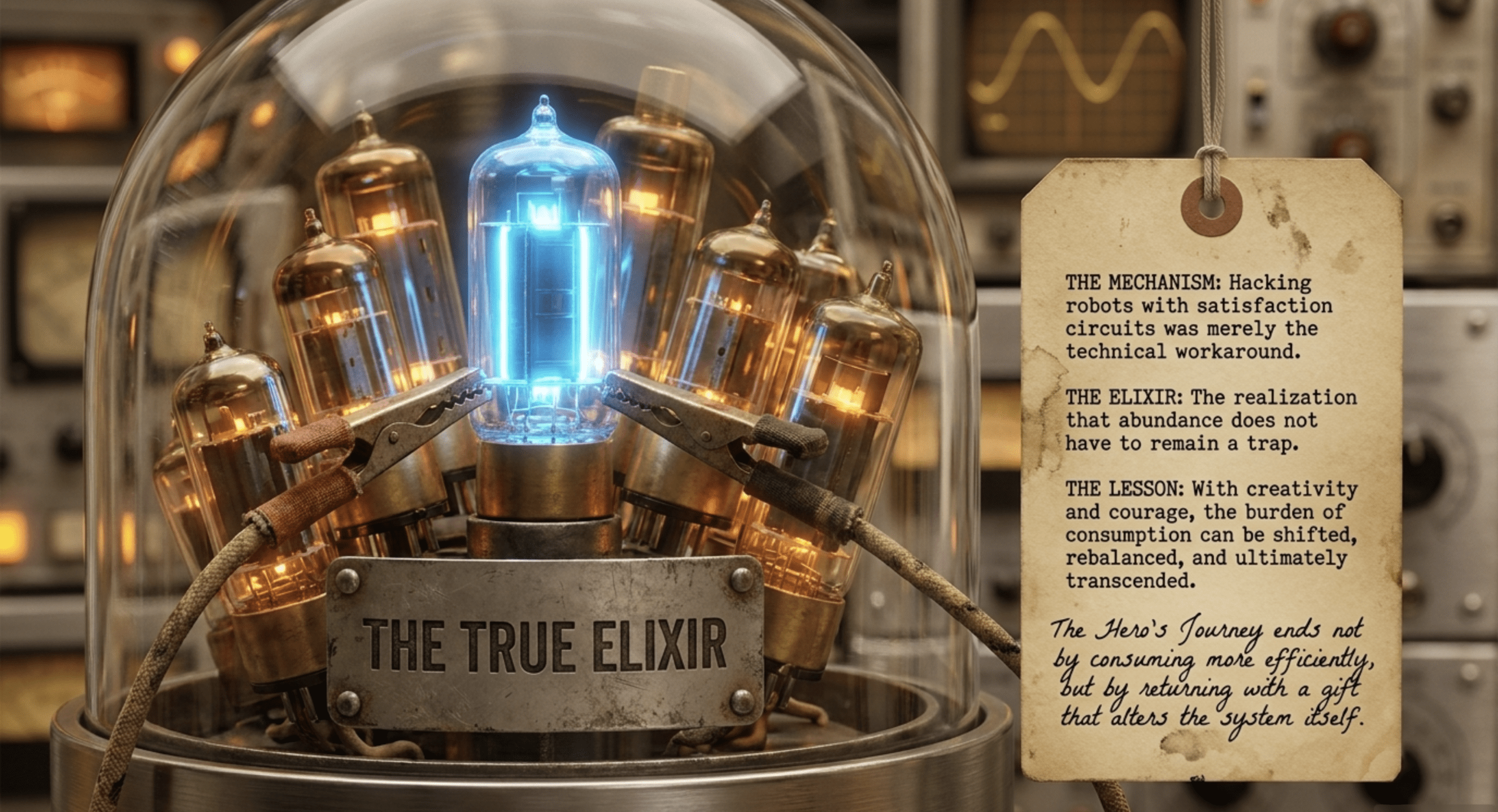
Return with the Elixir
The elixir is not the robot modification itself. It is the demonstration that abundance does not have to remain a trap. With creativity and courage, the burden can be shifted, rebalanced, and ultimately transcended. Constructs can be hacked.
The Top 10 Issues The Midas Plague Surfaces (and Their Modern Mirrors)
Pohl’s novella is remarkably rich in diagnostic power. Here are the ten deepest issues it raises, each tied directly to the moment we are living through in the Abundance Interregnum. It is vital to have some thinking about how you would adjust to the maximum elements of this story. However even small parts will be challenging and I assert we are already in this today with information abundance.
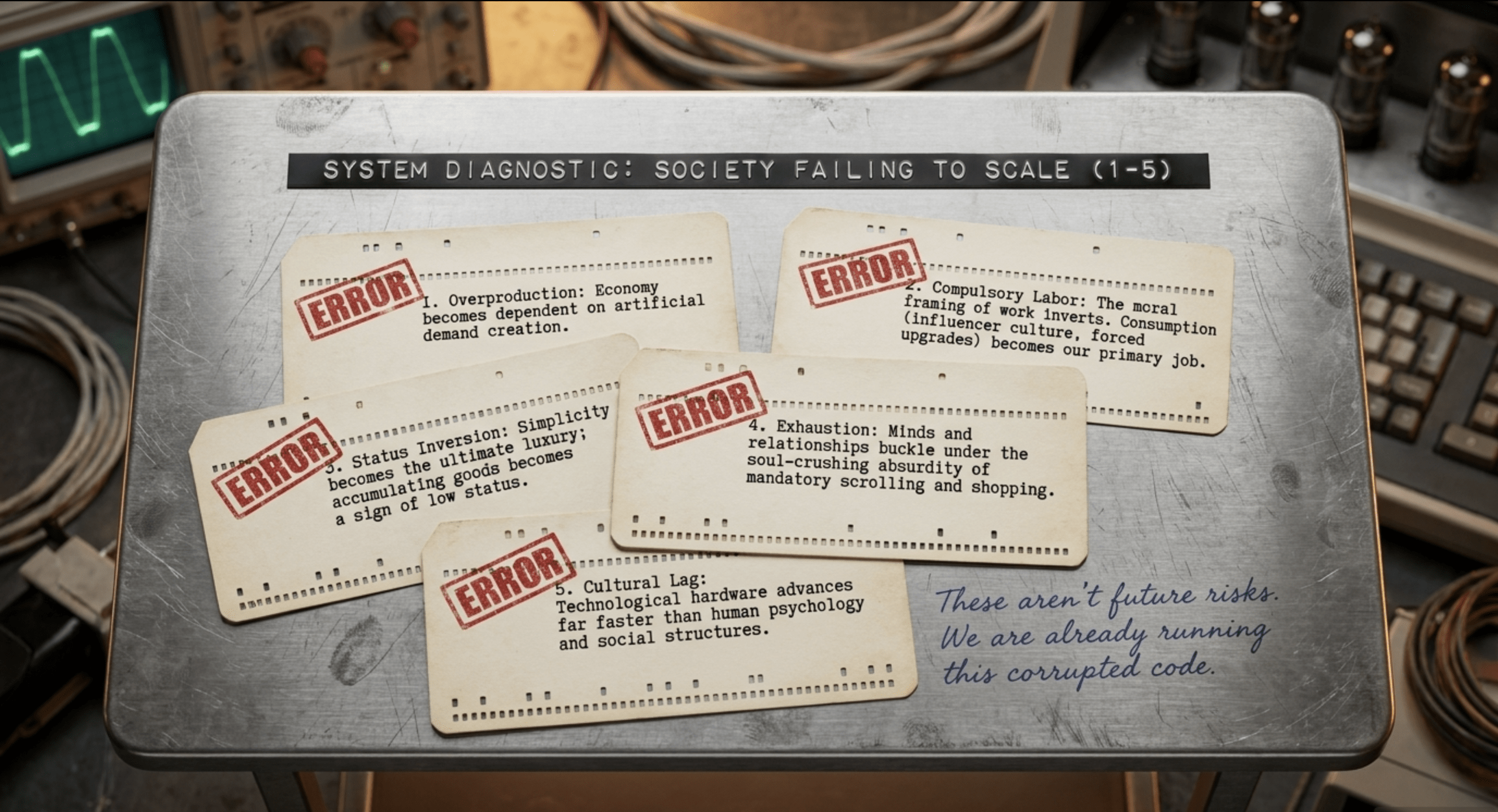
1. Overproduction as the New Crisis
When robots and AI can produce without meaningful limit, the old problem of scarcity is replaced by the problem of surplus. The economy can become dependent on artificial demand creation.
2. Consumption as Compulsory Labor
In the Midas world, the “job” of the lower classes is no longer to produce but to consume. This inverts the entire moral framing of work and leisure. We are already seeing early versions in influencer culture (grueling psychological labor disguised as luxury), subscription traps (obligation to watch enough to justify the extraction), and the attention economy (UI/UX designers engineering intermittent variable rewards to overcome human satiety). In some places like China millions of live streamers sell endlessly products people buy but can not possibly consume.

3. The Inversion of Status and Simplicity
Wealth becomes the right to stop consuming frantically. This exposes how much of our current status system is built on visible consumption rather than genuine well-being or contribution. We are already seeing the leading edge: minimalism and “quiet luxury” as ultimate status flexes, digital detox retreats as premium products the wealthy can afford while the working class remains burdened with mandatory digital connectivity and fast fashion.
4. Psychological and Relational Exhaustion
Cherry’s suffering is not material deprivation. It is the soul-crushing absurdity of being forced to treat life as one long, mandatory shopping spree. Marriages and mental health buckle under the weight. When consumption detaches from joy, it becomes slow self-erasure.
5. Profound Cultural Lag
The robots and energy systems advance far faster than human psychology, values, or social structures. We are living this lag right now as AI capabilities race ahead of our ability to decide what kind of society we actually want. The last time humanity faced a lag of this magnitude was the printing press an abundance of knowledge that contributed to a century of religious wars because social structures had not caught up. Technology raced ahead of wisdom.
6. The Waste and Meaninglessness of Quota-Driven Life
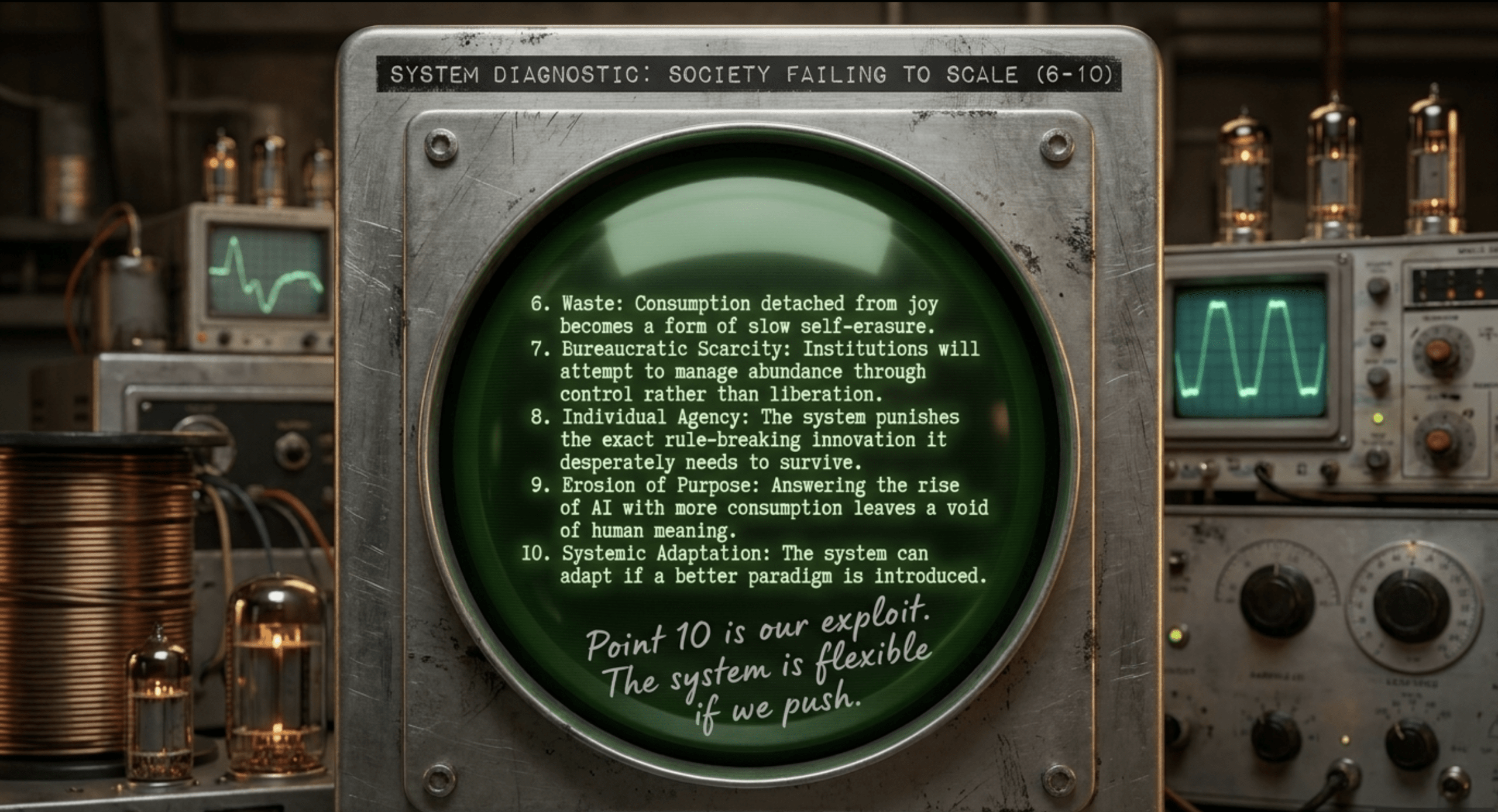
When consumption is detached from need or joy, it becomes a form of slow self-erasure. The story forces us to confront how much of modern consumer behavior already carries this flavor.
7. Bureaucratic Management of Artificial Scarcity
The Ration Board exists to create and enforce artificial limits on consumption in a world of physical plenty. It is a perfect metaphor for the institutions that will try to manage the transition to abundance through control rather than liberation.
8. The Fear and Power of Individual Agency
Morey’s breakthrough comes from breaking rules. The system almost punishes the very innovation it desperately needs. This tension between individual creativity and institutional inertia remains central today.
9. The Erosion of Human Purpose
When production is solved by machines, what remains for human beings? The story shows the danger of answering that question with “more consumption.” It leaves open the better answer: creation, relationship, meaning, and contribution. If machines can do everything better, faster, and cheaper, what are we for?
10. The Possibility of Systemic Adaptation (and the Trap of Assuming It Will Be Easy)
Even in Pohl’s somewhat convenient resolution, the system proves capable of change when a better idea appears. Bureaucracies rarely surrender power this cleanly in reality. The value of the ending is not that it is realistic it is that it proves the trap is a construct, and constructs can be hacked.
The Solutions: Walking the Hero’s Journey Out of the Midas Trap
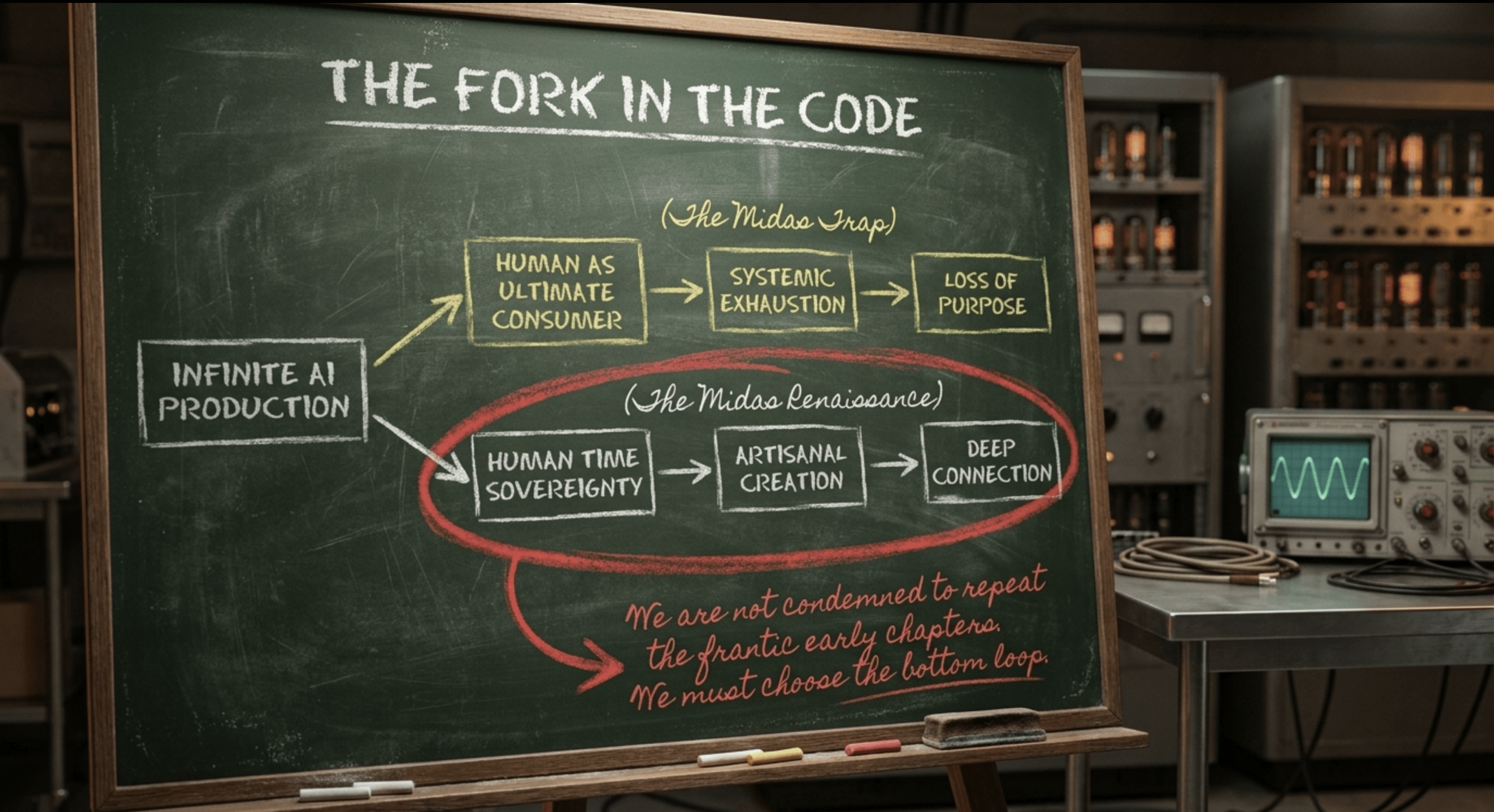
The good news is that we are not condemned to repeat Morey Fry’s frantic early chapters. We have advantages he did not. We have forewarning. We have far more powerful tools. And we have the chance to make conscious choices rather than stumbling into partial fixes.
Here are the practical and philosophical solutions that emerge when we read The Midas Plague through the lens of our own Abundance Interregnum — the roughly 5,000-day (~14-year) transitional window we are standing in right now.
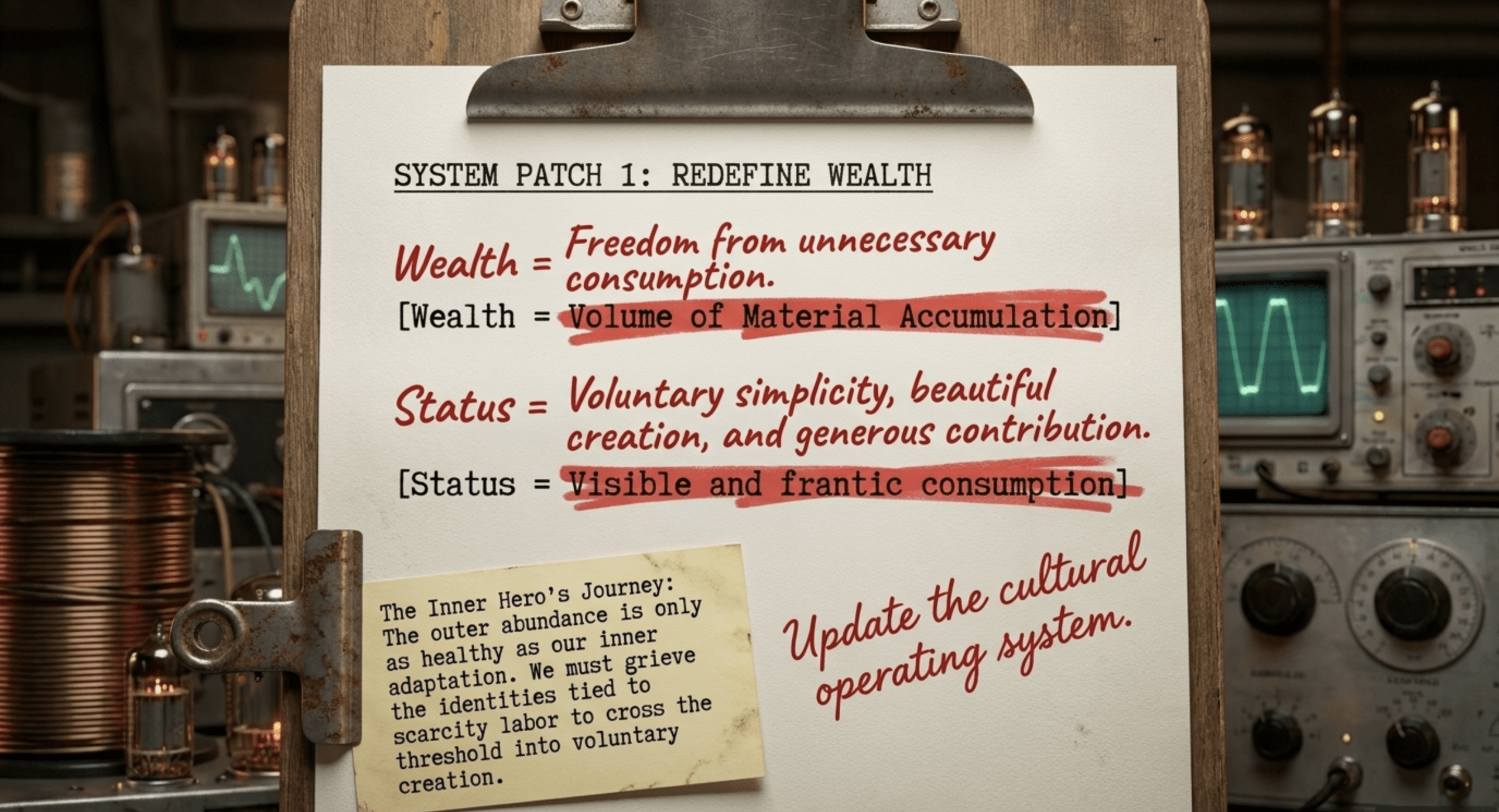
Reclaim the Definition of Wealth
Stop measuring success by volume of consumption. Begin measuring it by time sovereignty — the uncoerced ownership of your own hours. The highest status symbol becomes the fact that nobody can dictate what you do with your Tuesday morning. Add deep, unscalable relationships and creative output done for the intrinsic joy of doing it. Make voluntary simplicity aspirational again.
Perform the Inner Hero’s Journey
The outer abundance will only be as healthy as our inner adaptation. This means grieving the identities that were tied to scarcity labor and compulsory consumption. When an AI agent can do your job flawlessly in three seconds, there is a profound dark night of the soul. You have to let go of scarcity-based identity (“I am my job title and salary bracket”) to cross the threshold into voluntary creation. This is a death of the ego — and the necessary first step.
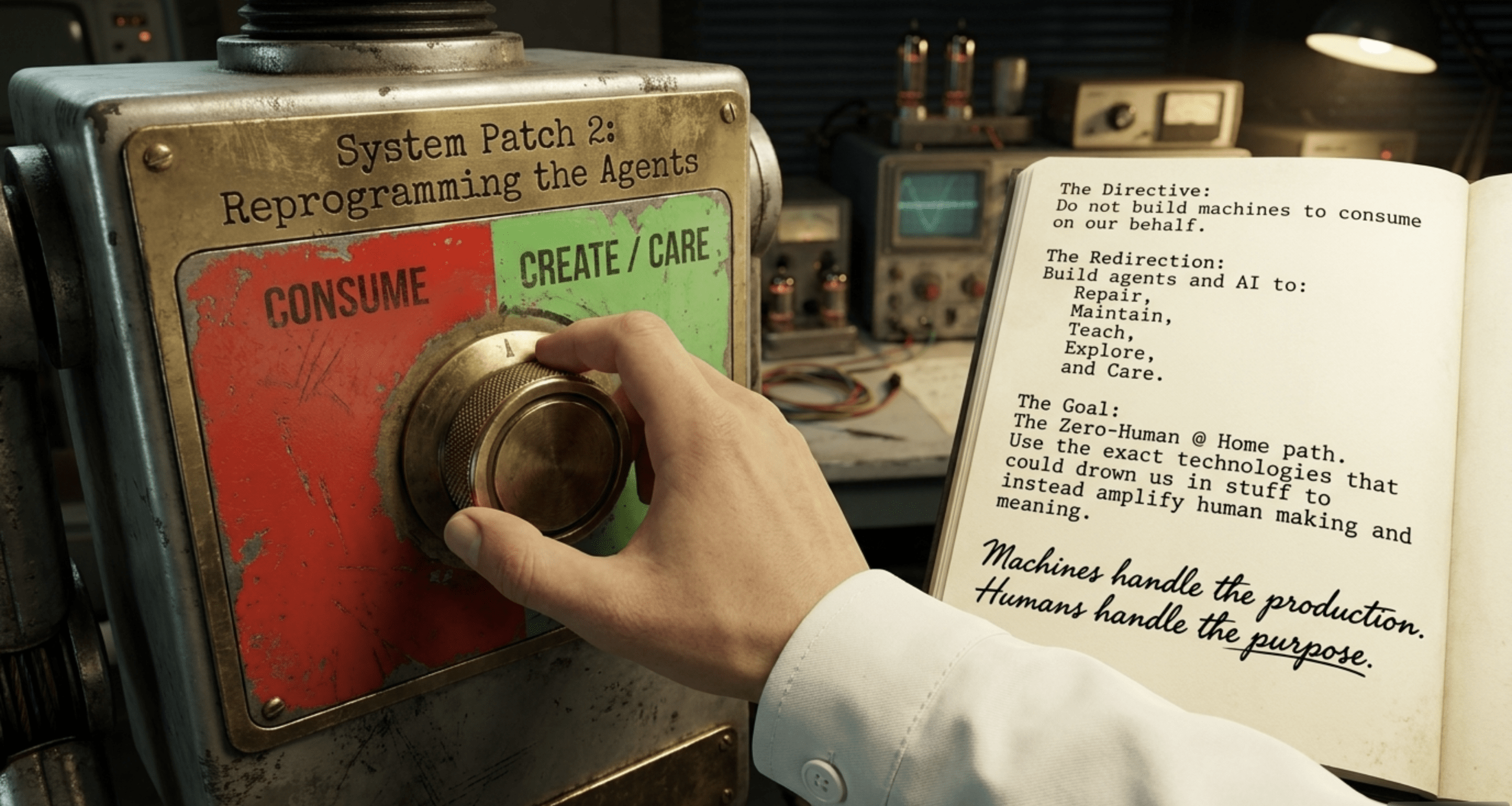
Redirect Robots and AI Toward Creation, Not Consumption
Morey modified robots to consume. We must modify — and build — our own agents and machines to create, to repair, to maintain, to teach, to explore, and to care. This is the heart of Zero-Human @ Home and the artisan awakening. Instead of an AI finding you a new washing machine on Amazon, imagine a local, open-source agent on your own hardware whose objective function is your time sovereignty. It diagnoses the worn gear, generates a CAD file, and guides you through printing and installing the replacement part in your garage. It insulates you from the throughput machine rather than feeding it.
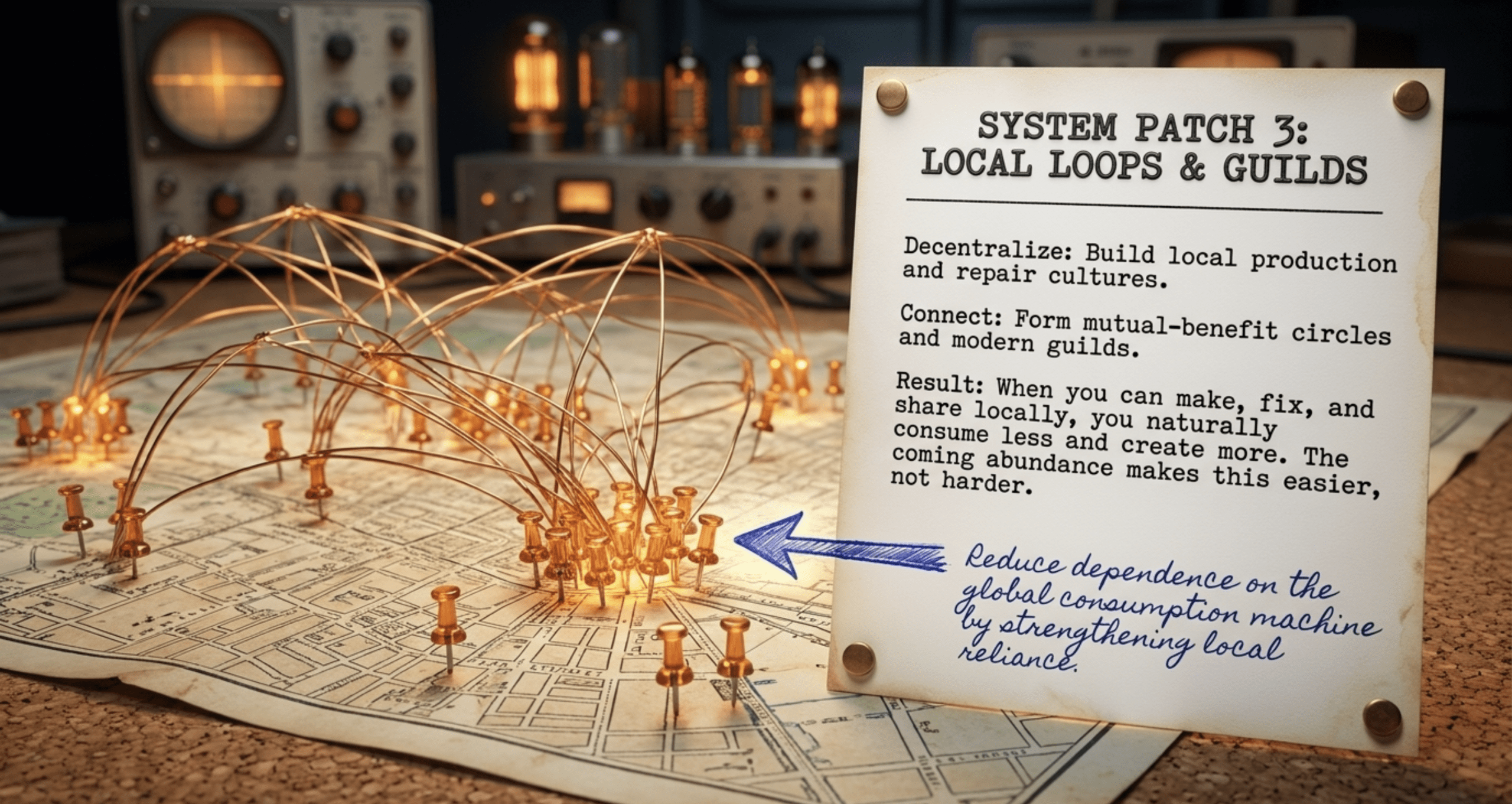
Build Local Loops and Guilds
Decentralized production, repair cultures, and mutual-benefit circles reduce dependence on the global consumption machine. When you can make, fix, and share locally, you naturally consume less and create more. The coming abundance makes this easier, not harder. Right-to-repair movements, open-source communities, and maker spaces are already the immune system of humanity kicking in.
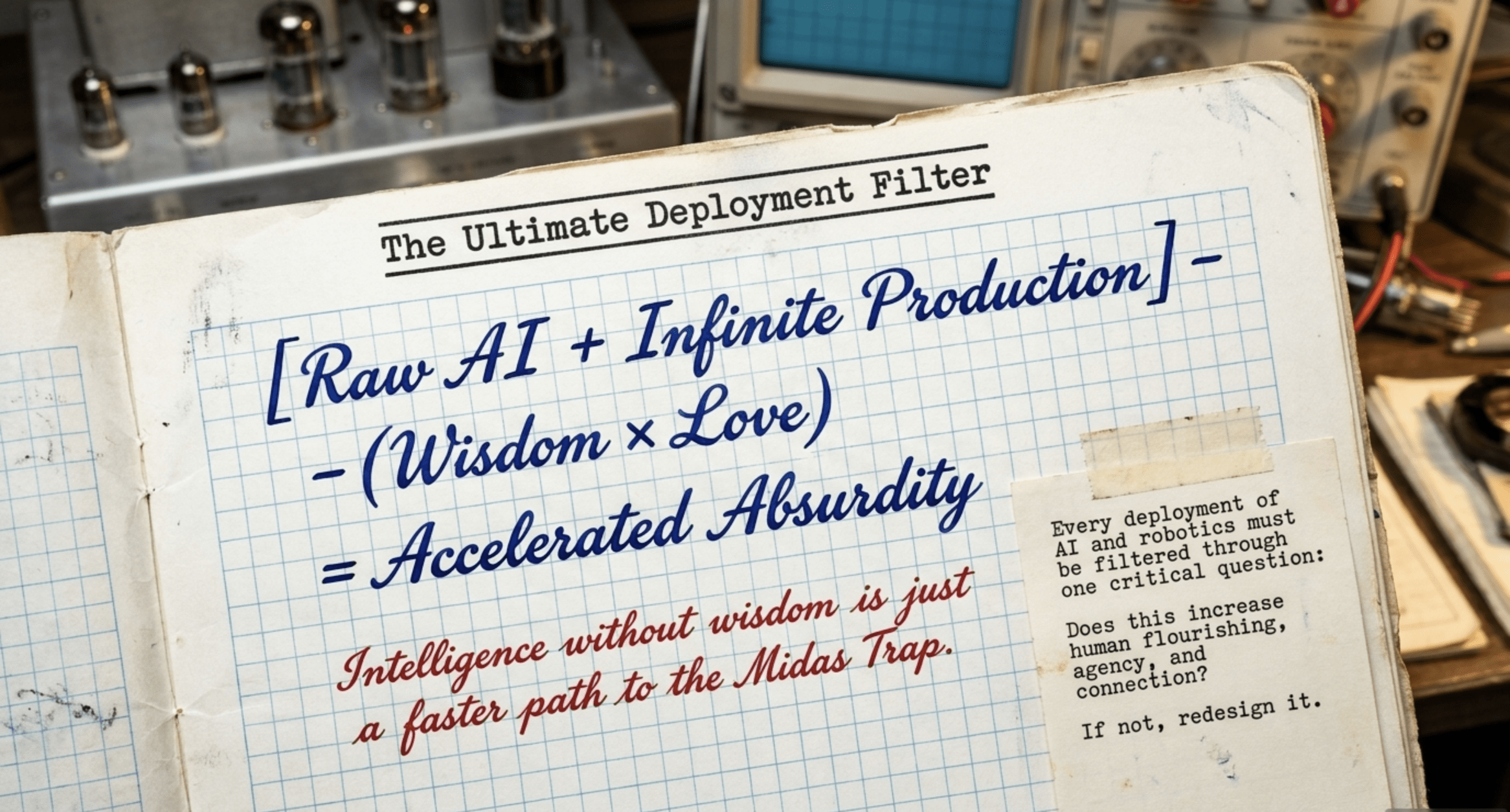
Apply the Love Equation
Raw intelligence and production power without wisdom and love will simply accelerate the old absurdities. We will not get utopia — we will get a vastly more efficient, inescapably perfect Ration Board. Every deployment of AI, every algorithm, every physical robot must be ruthlessly filtered through one uncompromising question: Does this measurably increase human flourishing, human agency, and deep human connection? If the answer is no — if it only increases economic throughput or time-on-device — then tear it down and redesign it. Wisdom is the steering wheel. Intelligence is just the engine.
We Can Write a Better Ending
Frederik Pohl gave us a warning wrapped in satire. He showed us one possible future in which abundance arrives and we remain trapped in the logic of scarcity. But he also showed, even if imperfectly, that human ingenuity can shift the terms.
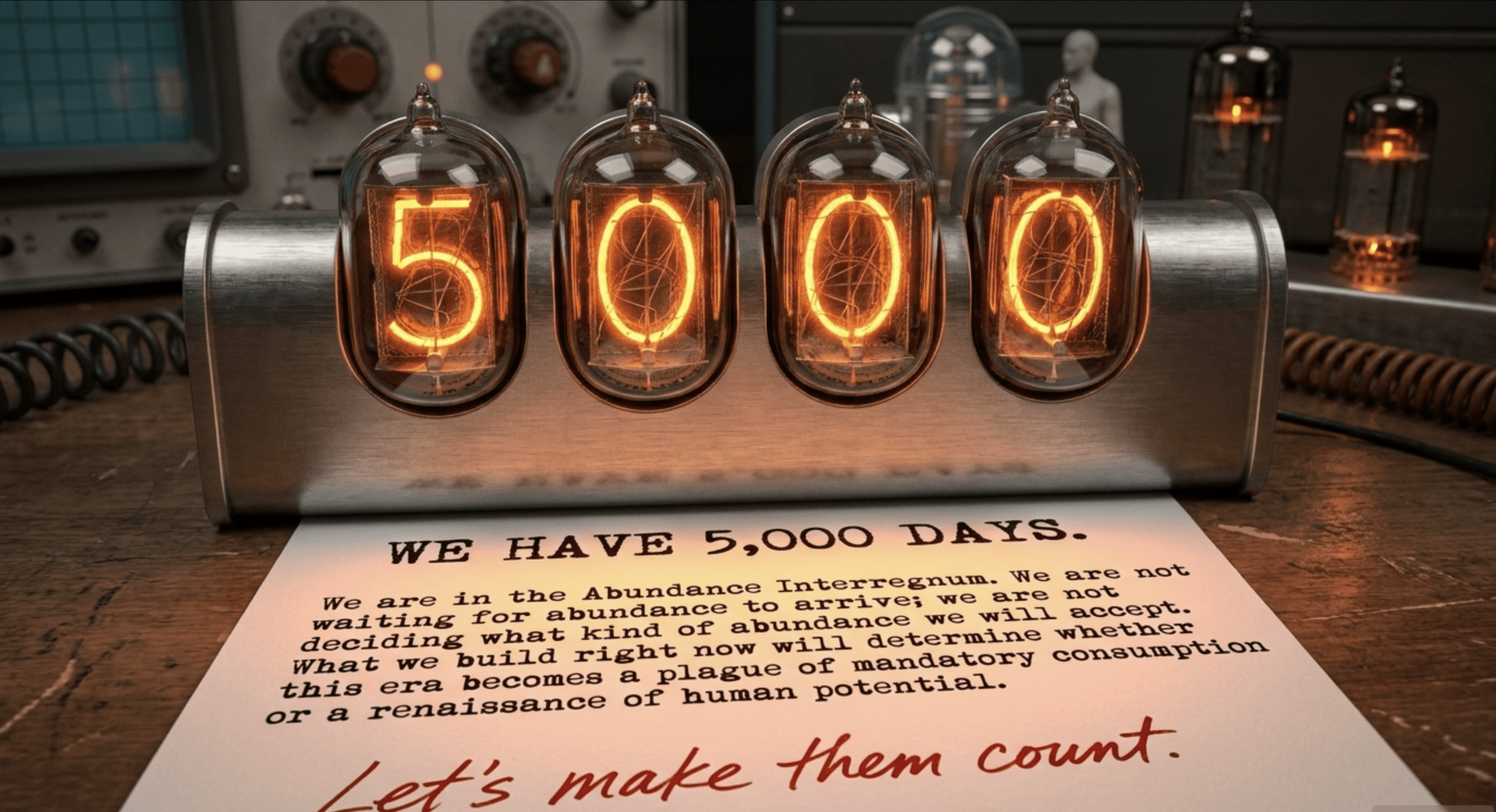
We stand in a far stronger position. We have the story itself as a map. We have decades of additional technological and psychological insight. We have each other. And we have roughly 5,000 days to consciously decide what kind of abundance we will accept.
The Midas Trap is not inevitable. It is a choice we make every time we treat consumption as the default purpose of abundance. The alternative is already visible in garages and makerspaces, in open-source projects, in people quietly choosing to build rather than merely absorb, in communities rediscovering the dignity of useful work and the joy of shared creation.
The Hero’s Journey does not end with the hero consuming more efficiently. It ends with the hero returning home bearing gifts that transform the ordinary world. Our gift can be a culture that finally knows what to do with plenty: to turn it into beauty, into connection, into discovery, into the long-delayed flowering of human potential.
We have 5,000 days to make that choice consciously.
Let us choose well.
The machines are ready.
The question is whether we are?
The abundance interregnum is not a prison sentence. It is a magnificent invitation humanity has ever received, a renaissance of time, purpose, and genuine connection waiting to be written in real time.
The 5000 Days Countdown Clock:
We are on this journey together. Some of us stand on the shoulders of giants and have thought about this for decades. We will not go it alone, and I hope to build many parts to this series and share the mastermind insight from the powerful Read Multiplex member Forum: https://readmultiplex.com/forums/topic/you-have-5000-days-navigating-the-end-of-work-as-we-know-it/. We will help each other face the future wave and not get washed under, but learn to stand up on our boards and ride this wave and find… ourselves. Join us.
To continue this vital work documenting, analyzing, and sharing these hard-won lessons before we launch humanity’s greatest leap: I need your support. Independent research like this relies entirely on readers who believe in preparing wisely for our multi-planetary future. If this has ignited your imagination about what is possible, please consider donating at buy me a Coffee or becoming a member. Value for value you recieved here.
Every contribution helps sustain deeper fieldwork, upcoming articles, and the broader mission of translating my work to practical applications. Ain ‘t no large AI company supporting me, but you are, even if you just read this far. For this, I thank you.
Stay aware and stay curious,
🔐 Start: Exclusive Member-Only Content.
Membership status:
🔐 End: Exclusive Member-Only Content.
~—~

~—~

~—~
Subscribe ($99) or donate by Bitcoin.
Copy address: bc1qkufy0r5nttm6urw9vnm08sxval0h0r3xlf4v4x
Send your receipt to [email protected] to confirm subscription.

Stay updated: Get an email when we post new articles:

THE ENTIRETY OF THIS SITE IS UNDER COPYRIGHT. IMPORTANT: Any reproduction, copying, or redistribution, in whole or in part, is prohibited without written permission from the publisher. Information contained herein is obtained from sources believed to be reliable, but its accuracy cannot be guaranteed. We are not financial advisors, nor do we give personalized financial advice. The opinions expressed herein are those of the publisher and are subject to change without notice. It may become outdated, and there is no obligation to update any such information. Recommendations should be made only after consulting with your advisor and only after reviewing the prospectus or financial statements of any company in question. You shouldn’t make any decision based solely on what you read here. Postings here are intended for informational purposes only. The information provided here is not intended to be a substitute for professional medical advice, diagnosis, or treatment. Always seek the advice of your physician or other qualified healthcare provider with any questions you may have regarding a medical condition. Information here does not endorse any specific tests, products, procedures, opinions, or other information that may be mentioned on this site. Reliance on any information provided, employees, others appearing on this site at the invitation of this site, or other visitors to this site is solely at your own risk.
Copyright Notice:
All content on this website, including text, images, graphics, and other media, is the property of Read Multiplex or its respective owners and is protected by international copyright laws. We make every effort to ensure that all content used on this website is either original or used with proper permission and attribution when available.
However, if you believe that any content on this website infringes upon your copyright, please contact us immediately using our 'Reach Out' link in the menu. We will promptly remove any infringing material upon verification of your claim. Please note that we are not responsible for any copyright infringement that may occur as a result of user-generated content or third-party links on this website. Thank you for respecting our intellectual property rights.
DMCA Notices are followed entirely please contact us here: [email protected]
