
You Have 5000 Days: Navigating the End of Work as We Know It. Part 26: I Feel Poor.
We have walked together through twenty five profound chapters of our collective Hero’s Journey. Joseph Campbell’s monomyth has lit our path across the roughly thirteen point seven year crucible from late 2025 toward the threshold of 2039. Artificial intelligence and robotics are dissolving the ancient tether that once bound survival to ceaseless toil. What awaits is not emptiness but a renaissance where work transforms into vocation. Purpose becomes chosen. We master both the realm of scarcity we depart and the plenitude that beckons.
If this is your first encounter with the You Have 5000 Days series begin at Part 1. (https://readmultiplex.com/2025/12/24/you-have-5000-days-how-to-navigate-the-end-of-work-as-we-know-it-part-1/) The map awaits you there. Today in Part 26 we confront the most insidious dragon of all. It does not roar from the outside like job loss or currency devaluation. It whispers from within. This dragon is the hedonic treadmill. It explains why superabundance skyrockets at the precise moment wages plummet and the old currency loses its grip. It is the major psychological and economic problem of our Interregnum. Yet it is also the forge that will temper the heroes who emerge on the other side.
This article is sponsored by Read Multiplex Members who subscribe here to support my work: Link: https://readmultiplex.com/join-us-become-a-member/
It is also sponsored by many who have donated a “Cup of Coffee”. If you like this, help support my work: Link: https://ko-fi.com/brianroemmele
Listen to the companion podcast: https://rss.com/podcasts/readmultiplex-com-podcast/2765757
Feeling Poor in an Age of Exploding Plenty
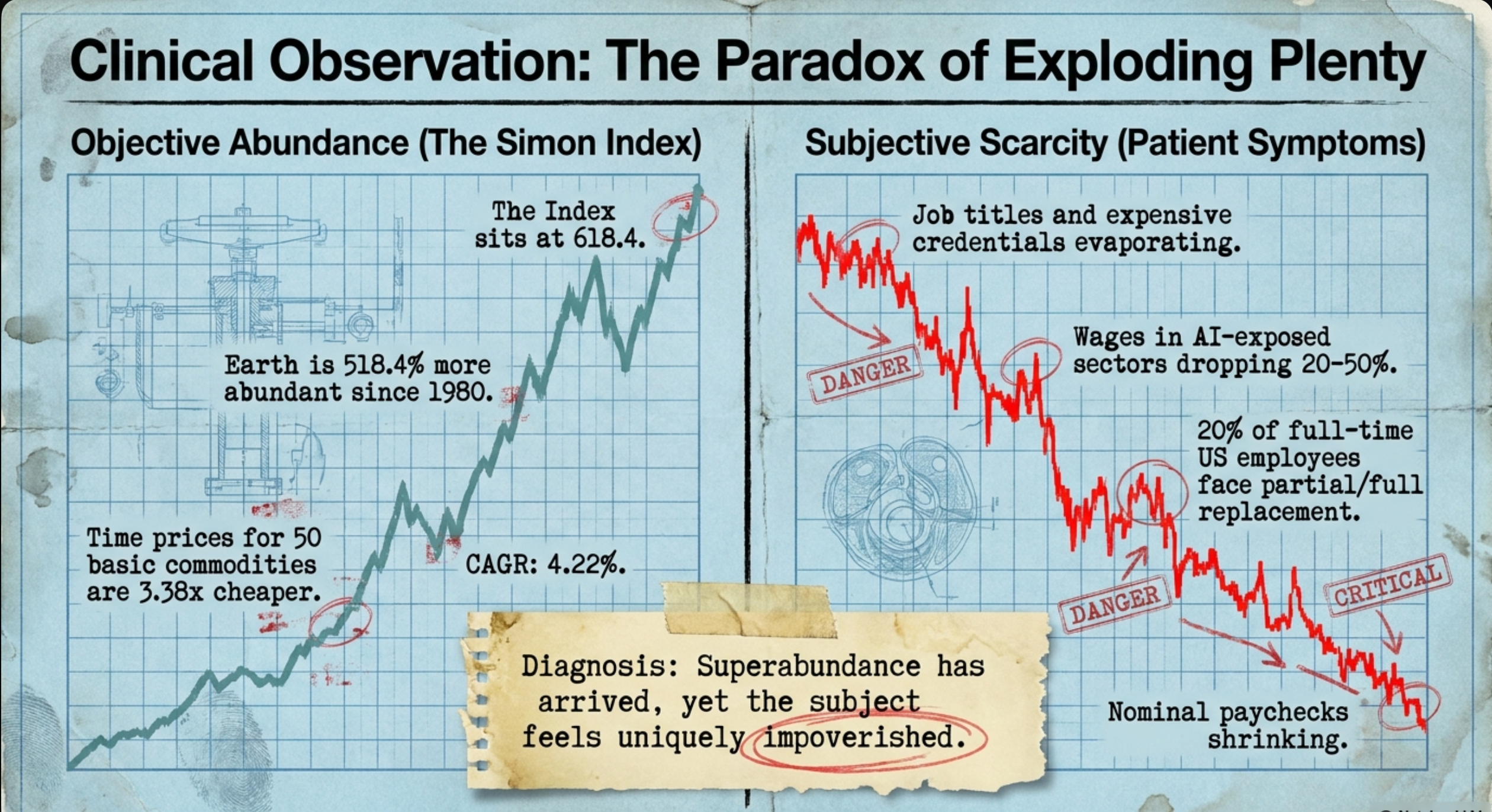
You stand in the Ordinary World of the early Interregnum. I just wrote about the 2025 Simon Abundance Index (2026 just came out) , (https://readmultiplex.com/2026/04/17/you-have-5000-days-navigating-the-end-of-work-as-we-know-it-part-24-the-doomslayer/) has just confirmed what Julian Simon prophesied. Between 1980 and 2024 the time prices for fifty basic commodities fell dramatically. One hour of average global work today buys roughly 3.38 times more of the typical basket than it did in 1980. Earth itself is now 418.4 percent more abundant since 1980 according to the broader Simon Abundance Framework. Superabundance is not coming. It is already here and compounding in plain sight at a compound annual growth rate of 4.2 percent.
Yet one very real aspect is there is an asymmetrical element we can not ignore: Highly regulated industries via protection systems have not seen a direct 418.4 percent in increase in abundance. The most important aspect we will cover in future articles is why and how. These issues are big and impactful but only part of the story.
The History Economics and Mathematics of the Treadmill and the Easterlin Paradox
Have you ever noticed how the most miraculous things become completely infuriating the moment they stop working perfectly? Consider the device you are likely using right now to read or listen to this. It possesses more raw computational power than the entire infrastructure that sent humanity to the moon. In the 1980s, equivalent processing power would have cost millions and required a gymnasium-sized facility with massive cooling systems. For the first week it feels like pure magic.
Then the battery dips, a page loads 4 seconds instead of half a second, and physiologically you feel stressed—angry at the miracle in your pocket. This is not ingratitude. Your anxiety is a highly rational response to a very specific economic restructuring. We validate that feeling completely. The cultural narrative that dismisses it as mere pessimism misses the structural reality.
Yet you feel poor.
Surveys of life satisfaction in developed nations have barely budged. Wages in AI exposed sectors are already dropping. Twenty percent of full time U S employees have seen their roles partially or fully replaced. Nominal paychecks shrink while the currency itself wobbles under the weight of transition policies like Universal High Income experiments and the slow erosion of fiat trust.
College degrees that cost tens or hundreds of thousands of dollars now open doors to roles that artificial intelligence performs faster and cheaper. Job titles that once anchored identity evaporate. The math is merciless. The psychology is harsher.
This is the call to adventure. The data invite you to cross the threshold into the special world of the Interregnum. But first you must meet the dragon that guards the way.
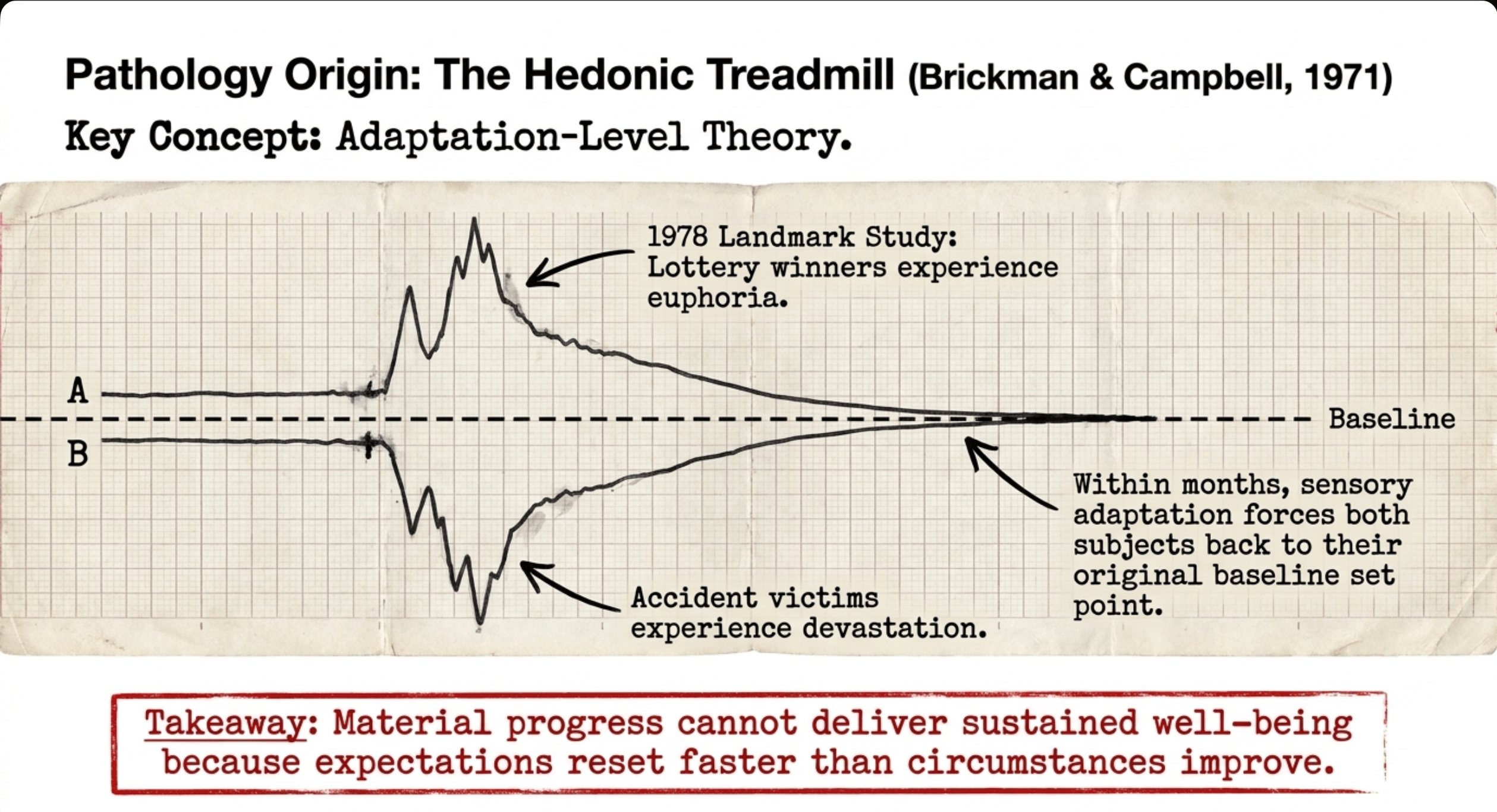
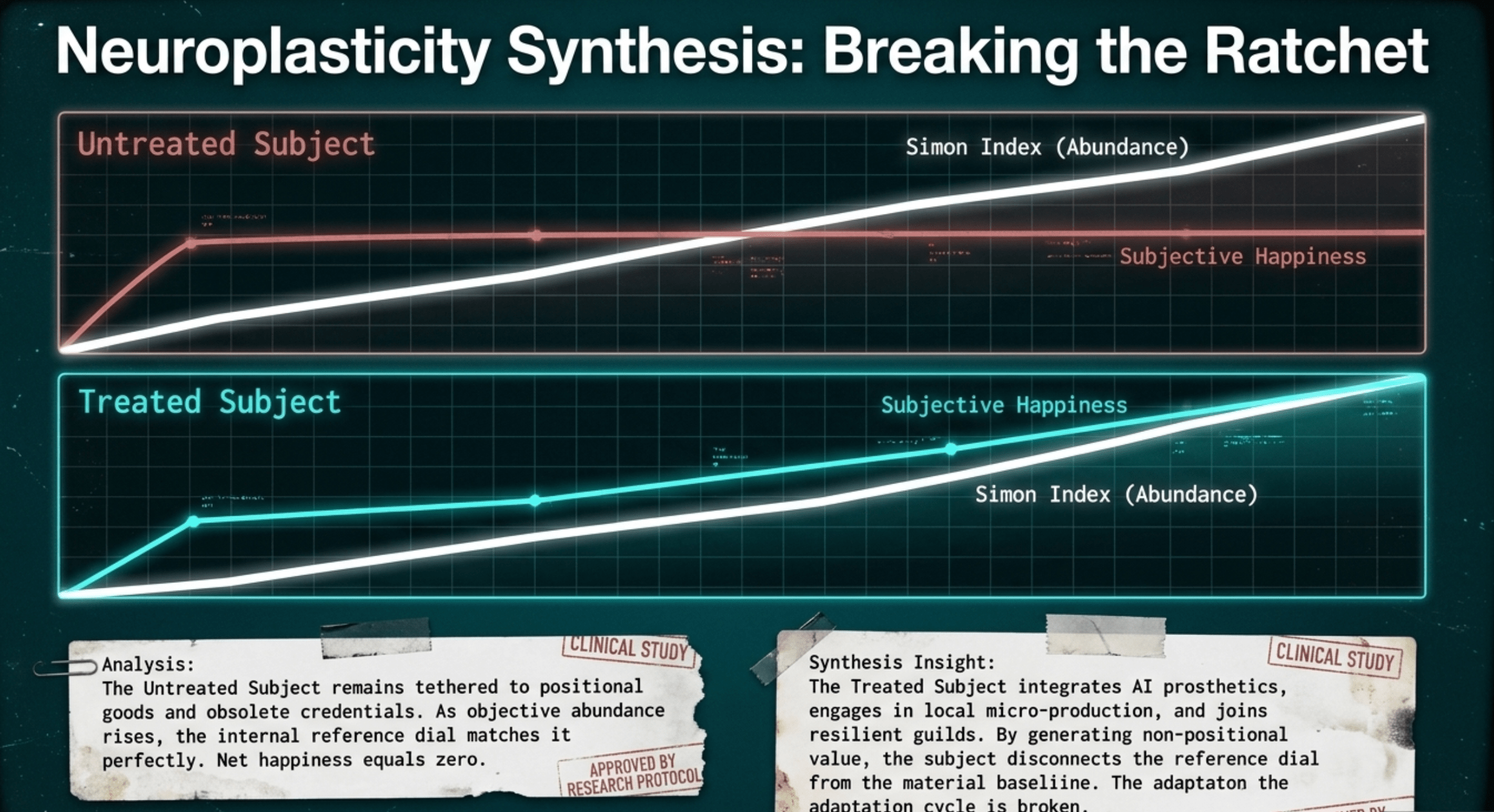
The hedonic treadmill was first named in nineteen seventy one by psychologists Philip Brickman and Donald Campbell in their landmark paper Hedonic Relativism and Planning the Good Society. Drawing on adaptation level theory from Harry Helson, they argued that human happiness functions like sensory perception.
Just as your nose quickly stops noticing a constant smell, or you step from a dark theater into blinding sunlight only for your pupils to constrict and normalize it, the mind rapidly adjusts to new circumstances, good or bad and returns to a baseline set point. Brickman and Campbell warned that this relativism makes permanent gains in happiness difficult unless society plans deliberately for it. They saw it as a central challenge for any good society.
The theory gained empirical weight in nineteen seventy eight when Brickman and colleagues studied twenty two lottery winners and twenty nine people who had become paraplegics after traumatic accidents. Winners experienced euphoria; paraplegics devastation. Yet within months to years, both groups returned close to their original baselines. Later research extended this to marriage, divorce, bereavement, promotions, and demotions.
The treadmill works bidirectionally, protecting from lasting despair but robbing lasting joy from material gains. Evolutionarily, this makes sense: a hunter-gatherer permanently euphoric after one mammoth hunt would starve rather than continue. The mechanism is a survival shield that forces adaptation but prevents savoring progress.
From a psychological perspective, this activates deep complexes operating largely outside conscious awareness. Alfred Adler’s inferiority complex stands central: the universal feeling of inferiority (rooted in childhood dependency) drives striving for superiority and mastery. In the Interregnum, objective abundance collides with collapsing wages, degrees, and titles, triggering primary inferiority (personal deficits) and secondary inferiority (gap to idealized security/status). This fuels maladaptive overcompensation—endless comparisons, lifestyle inflation, rigid clinging to obsolete credentials, leaving a perpetual “not enough” state.

Carl Jung’s shadow complex and projection add another layer: disowned traits (vulnerability, obsolescence, dependency, resentment) are cast outward onto AI, elites, or systems, blocking individuation and wholeness. Erik Erikson’s stages reveal identity vs. role confusion and generativity vs. stagnation crises when work’s anchors (structure, mastery, dignity, belonging) erode, producing symptoms akin to anticipatory grief or AI Replacement Dysfunction (AIRD)—anxiety, insomnia, rumination, denial, worthlessness, resentment, hopelessness.
Attachment theory shows anxious styles clinging to status and avoidant styles withdrawing; Freudian dynamics pit id-driven consumption against superego demands for worth, with the ego mediating collapse. These intersect dynamically: inferiority fuels shadow projection and identity fracture. The treadmill is partial health, relationships, and meaning adapt slower but material and positional domains reset fastest (lambda near 1 in the adaptation equation). Examplesinclude neurodivergence (rigidity as protection) or trauma histories (heightened helplessness), underscoring adaptation is modulated by personal psychology, culture, and prior attachments.
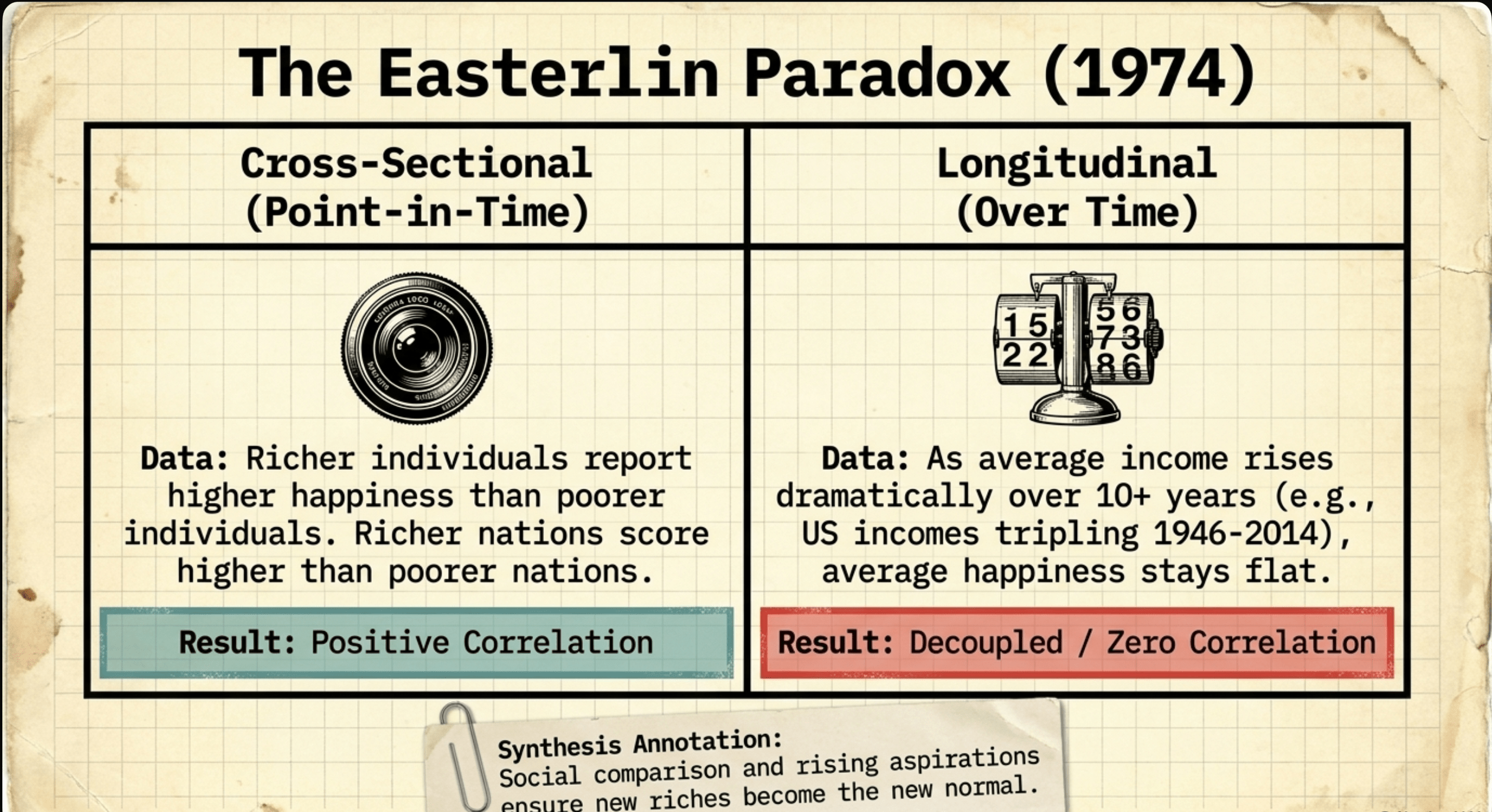
This mechanism collides perfectly with the Easterlin paradox, first documented by economist Richard Easterlin in his nineteen seventy four paper Does Economic Growth Improve the Human Lot? Cross-sectionally, richer people and nations report higher happiness. Longitudinally, as incomes triple (e.g., U.S. real per capita 1946–2014), average happiness stays flat despite massive gains in comfort and variety. Short-term fluctuations track the economy, but long-run trends decouple due to social comparison and rising aspirations.
Recent analyses through 2025 confirm robustness, especially in rich countries with diminishing returns beyond thresholds. In the Interregnum this becomes acute: Simon Index superabundance explodes while tradable sectors (remotely performable digital work: coding, analysis, design, contract review) see 20–50% wage deflation and ~20% roles partially/fully replaced. Positional goods (elite credentials, prime real estate, status symbols deriving value from exclusivity) inflate amid UHI experiments and currency wobbles, functional basics cheapen, signaling goods do not.
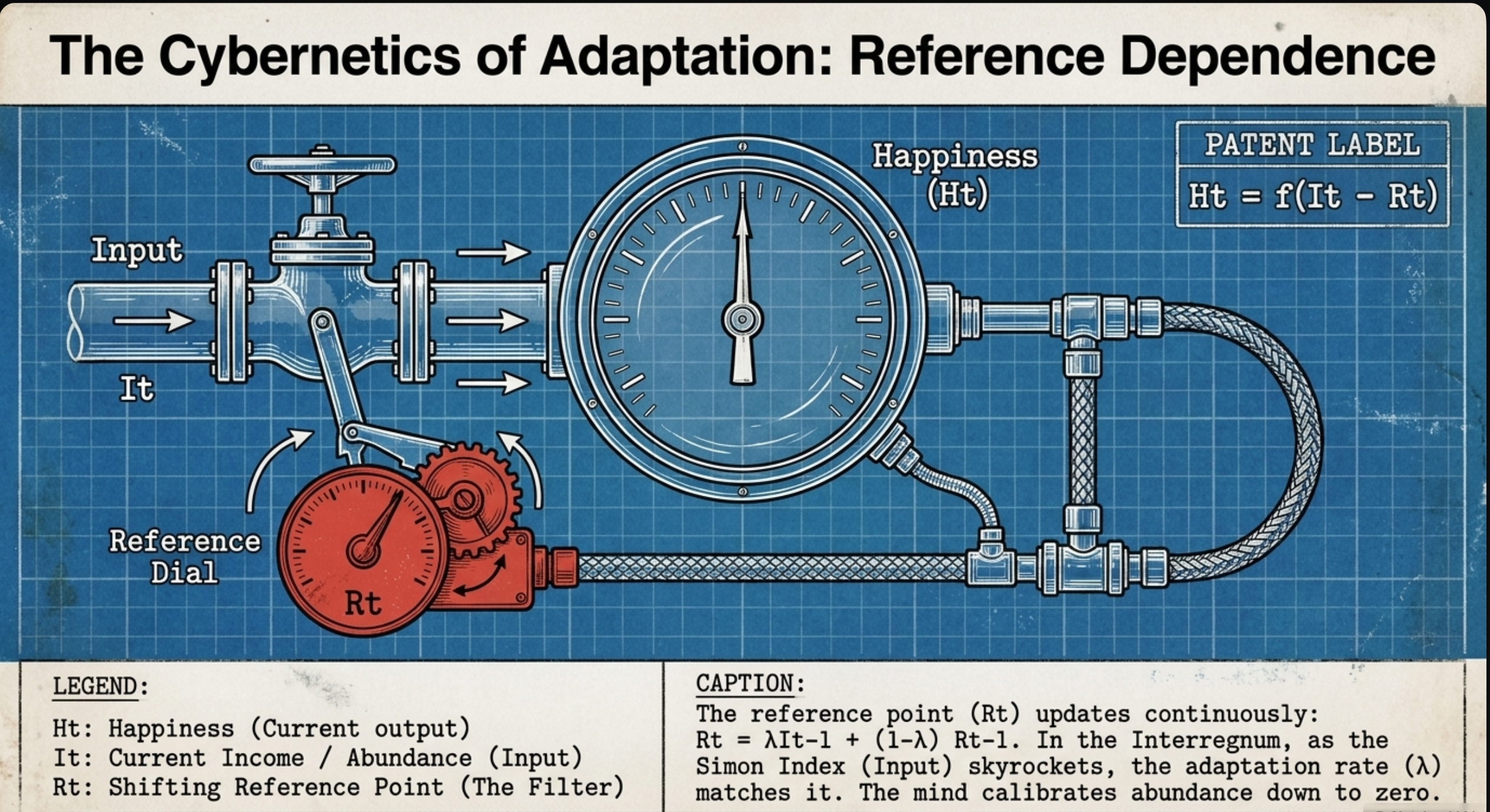
Economists formalize this with reference dependence. Happiness H at time t equals f of (I_t minus R_t), where I is current income/circumstances and R is the shifting reference point that adapts rapidly:
R_t = λ · I_{t-1} + (1-λ) · previous R (λ often near 1 for material goods).
Your reference point compares not to 1980 but to last Tuesday’s curated highlights or infinite social media peaks. Aspirations climb as fast as (or faster than) gains, especially in contexts like China or today’s global transition. Superabundance skyrockets. Perceived scarcity persists.
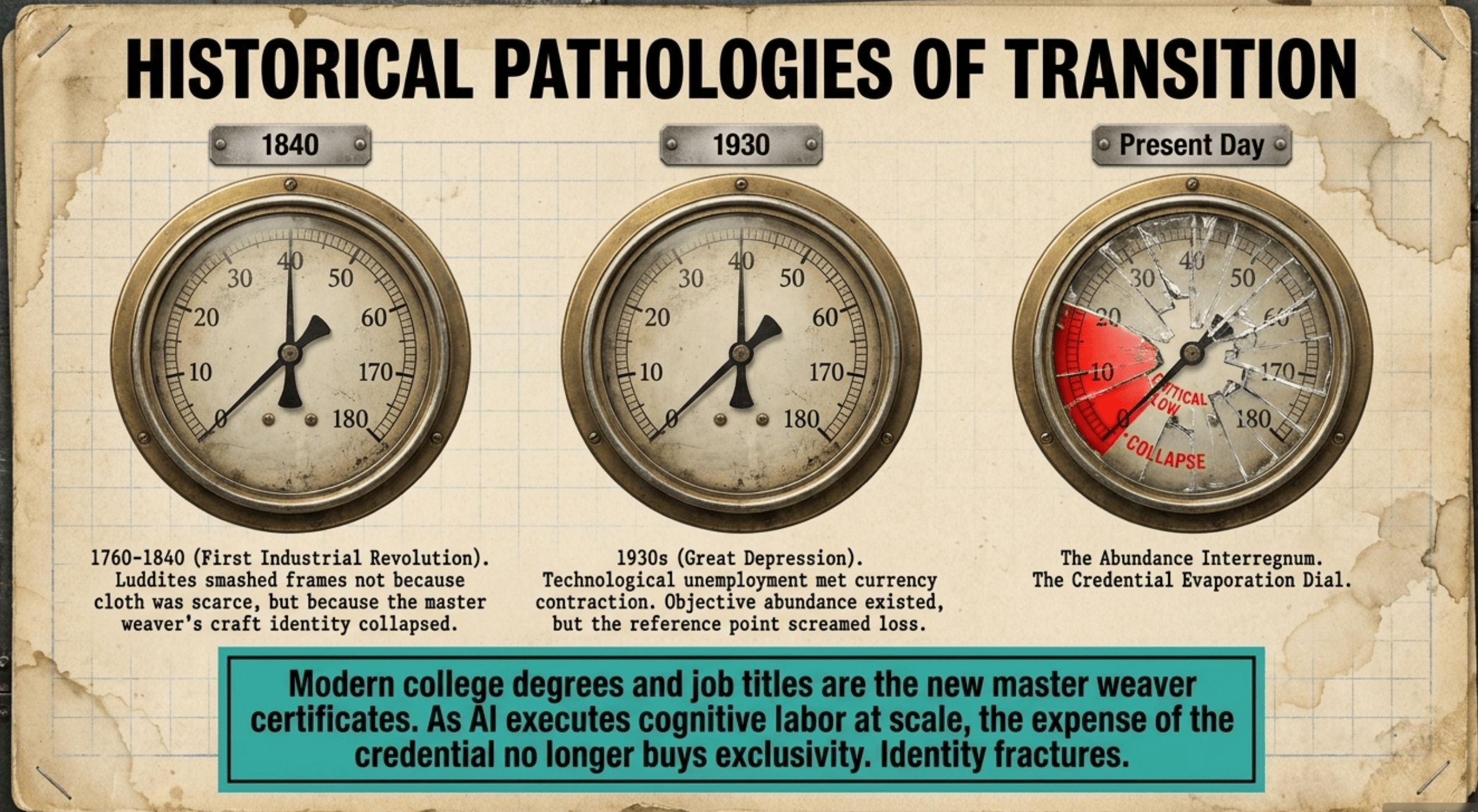
History offers the clearest analogy. During the first Industrial Revolution (1760–1840), Luddite master weavers, highly skilled, high-status watched power looms explode cloth abundance. Their craft identity and wages collapsed; new factory jobs offered less pay and zero prestige. They smashed looms not because abundance failed, but because it devalued their human capital. English enclosures displaced peasants from meaningful land-based identity into cities despite soaring output. Your college degree is the modern master weaver certificate, years and debt for signaling that AI now renders non-exclusive (drafting contracts, diagnosing conditions, coding at unmatched scale).
Identity fractures. This is a profound psychological wound, Eriksonian crisis layered with Adlerian inferiority and Jungian shadow, triggering reevaluation of self-worth no material gain immediately soothes.
The Harsh Realities and the Major Problem of Our Time
This mismatch between skyrocketing superabundance and collapsing nominal wages plus currency value is the central dragon of the Interregnum. It is not a side effect. It is the major problem. Here are the top five ways it manifests with brutal clarity.
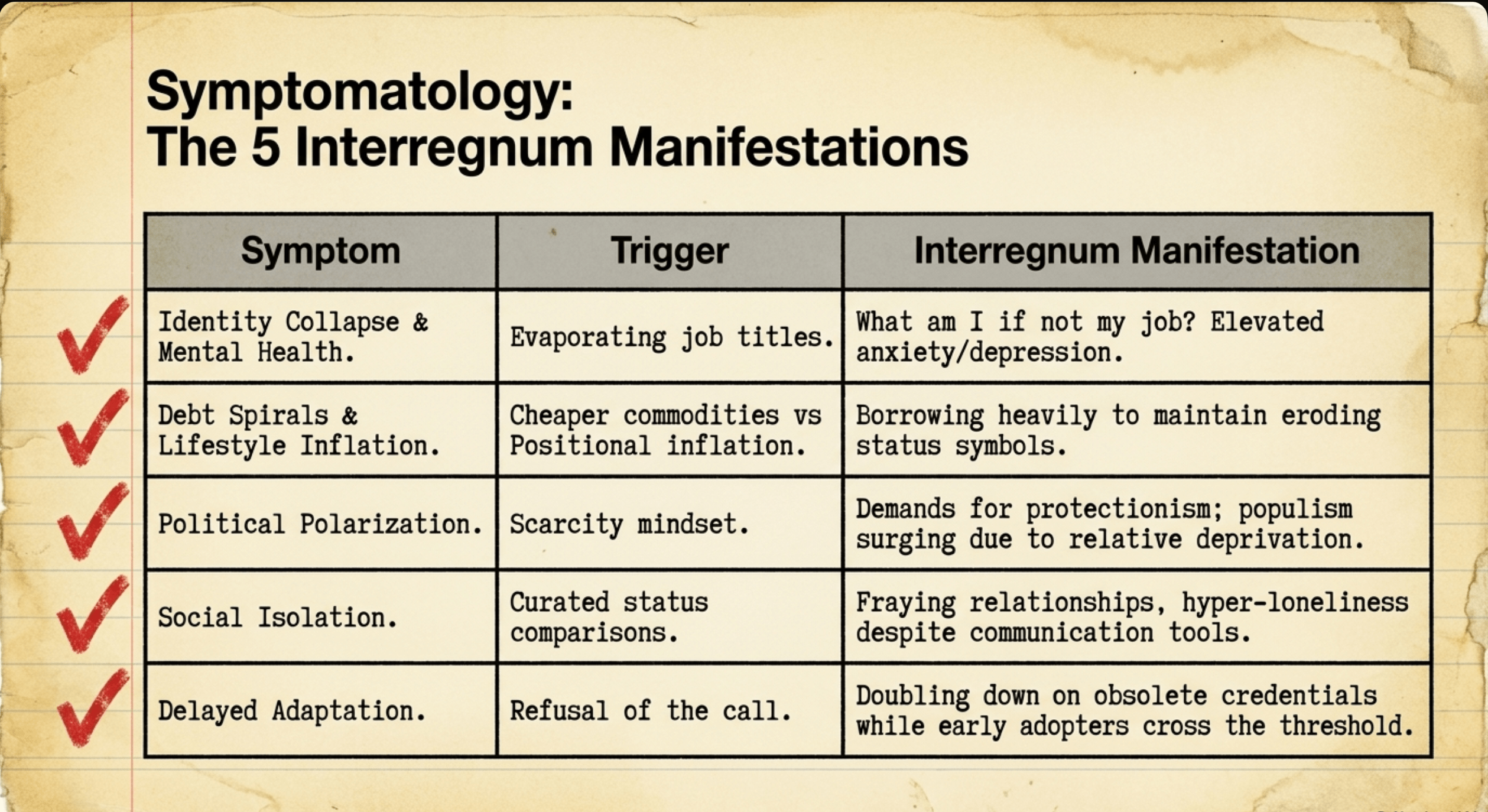
First identity collapse and mental health crisis. When your worth was tied to a paycheck and a title the treadmill forces constant upward comparison. As wages drop and degrees lose luster millions confront the question what am I if I am not my job. Depression and anxiety rates already elevated in the transition will spike. History shows this in every major disruption. The enclosure movements in England displaced peasants who once found meaning in the land. They wandered into cities feeling worthless even as agricultural output soared.
Psychologically this activates a full-blown role-identity complex intertwined with AIRD-like responses: anxiety, insomnia, paranoia, denial, worthlessness, resentment, and hopelessness. The inferiority complex intensifies here relative deprivation theory explains how objective gains feel like losses when compared to peers or past selves, fostering rumination or withdrawal. Shadow projection turns internal voids into external scapegoats (AI, institutions), while attachment insecurities amplify isolation.
Second debt spirals and lifestyle inflation. Cheaper commodities free cash but the treadmill redirects it toward new necessities. People borrow more to maintain status symbols that once signaled success. Housing in desirable zones positional education and experiences become the new scarcity goods. Currency devaluation makes old debts heavier in real terms. The result is a paradox. Resources abound yet personal balance sheets strain. This taps into a power/control complex: the illusion of agency through consumption becomes a maladaptive coping mechanism, masking deeper fears of helplessness. Adlerian overcompensation drives the chase for superiority via positional goods.
Third political polarization and backlash. Those clinging to the old scarcity mindset demand protectionism or larger safety nets. Populism surges as the treadmill amplifies feelings of relative deprivation. Analogous to the nineteen thirties when technological gains met currency contraction and gave rise to extremism. The dragon feeds on the gap between objective plenty and subjective loss. Here shadow projection plays a key role, unowned fears of irrelevance are externalized onto “elites,” AI, or institutions, fueling collective complexes of victimhood or moral superiority.
Fourth social isolation and status anxiety. Social media accelerates comparisons. You see curated lives of apparent winners while your own reference point shifts. Relationships fray as families split over adaptation strategies. The Interregnum becomes lonelier even as communication tools proliferate. Status anxiety (a modern expression of Adlerian striving) erodes social bonds, turning potential community into competitive isolation. Anxious attachment styles exacerbate this.
Fifth delayed adaptation and missed opportunity. Many refuse the call entirely. They double down on obsolete credentials or lobby for barriers. The treadmill keeps them running in place while early adopters cross into the reward phase. History’s great divide appears here. The adaptable thrive. The rigid suffer longest. Examples include neurodivergent individuals or those with trauma histories who may experience heightened rigidity as a protective mechanism.
These five manifestations are not inevitable doom. They are the inmost cave of the Hero’s Journey. The ordeal where the old self dies, provided we consciously integrate the complexes rather than flee them.
The Reward and the Road Back: Twenty Solid Ways to Thrive in the Chaos
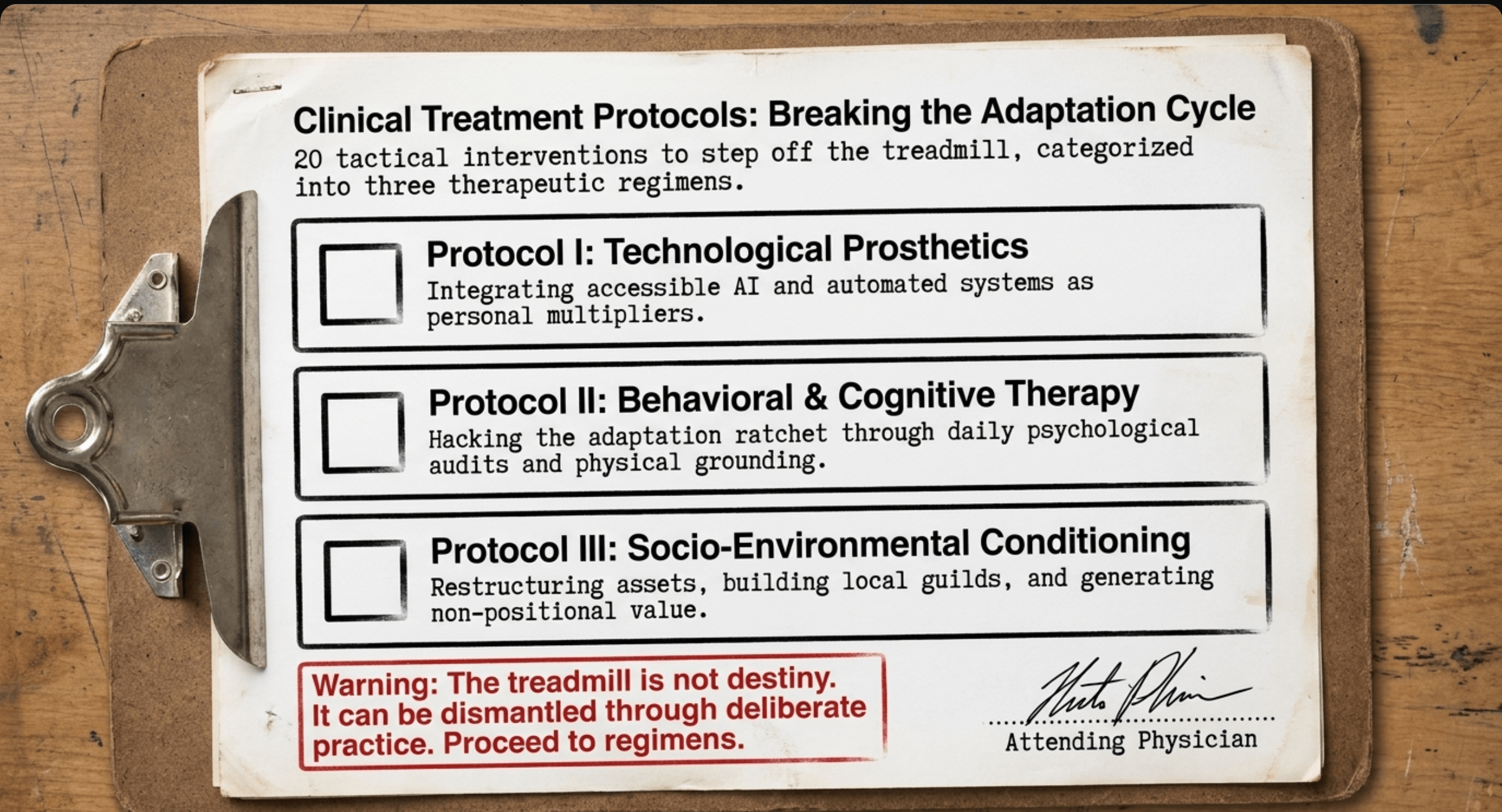
You emerge from the cave with the elixir. The treadmill is not destiny. It can be slowed and even stepped off through deliberate practice. Here are twenty concrete ways to thrive during this Interregnum chaos. Each draws on history’s lessons and the practical map we have built across the series. They turn the dragon into an ally. These are grounded in today’s realities of April twenty twenty six where advanced AI tools like large language models and local agents are powerful and accessible on laptops and phones while full humanoid robots like early Optimus prototypes remain limited to research labs or basic demos in controlled environments and are not yet household capable affordable or reliable for everyday use by most people. Each strategy also directly counters specific psychological mechanisms—interrupting adaptation loops, reframing comparisons, rebuilding identity through agency, withdrawing projections, and fostering secure attachment.
1- Integrate advanced AI companions as your immediate personal system right now by setting up a private local large language model on your laptop or using subscription tools like Grok Claude or similar accessible platforms to act as an always available thought partner for research planning daily decision making and skill building. Configure it with your personal documents and preferences so it remembers your goals and provides tailored advice without sending data to external servers. History shows that when tools like the personal computer arrived in the nineteen eighties power shifted to individuals who adopted them early and integrated them into daily life. Your AI system begins automating routine tasks like summarizing news drafting emails or brainstorming side projects immediately. Costs are low often under twenty dollars a month for premium access. Wages become less central when your digital partner multiplies your output without needing physical hardware yet and you can start this evening with free open source options. Use it not as a mere search engine but as a tireless chief of staff—interrogating research papers, structuring timelines, or tutoring bespoke skills. This counters the control complex by restoring immediate agency and reduces inferiority feelings through visible productivity gains.
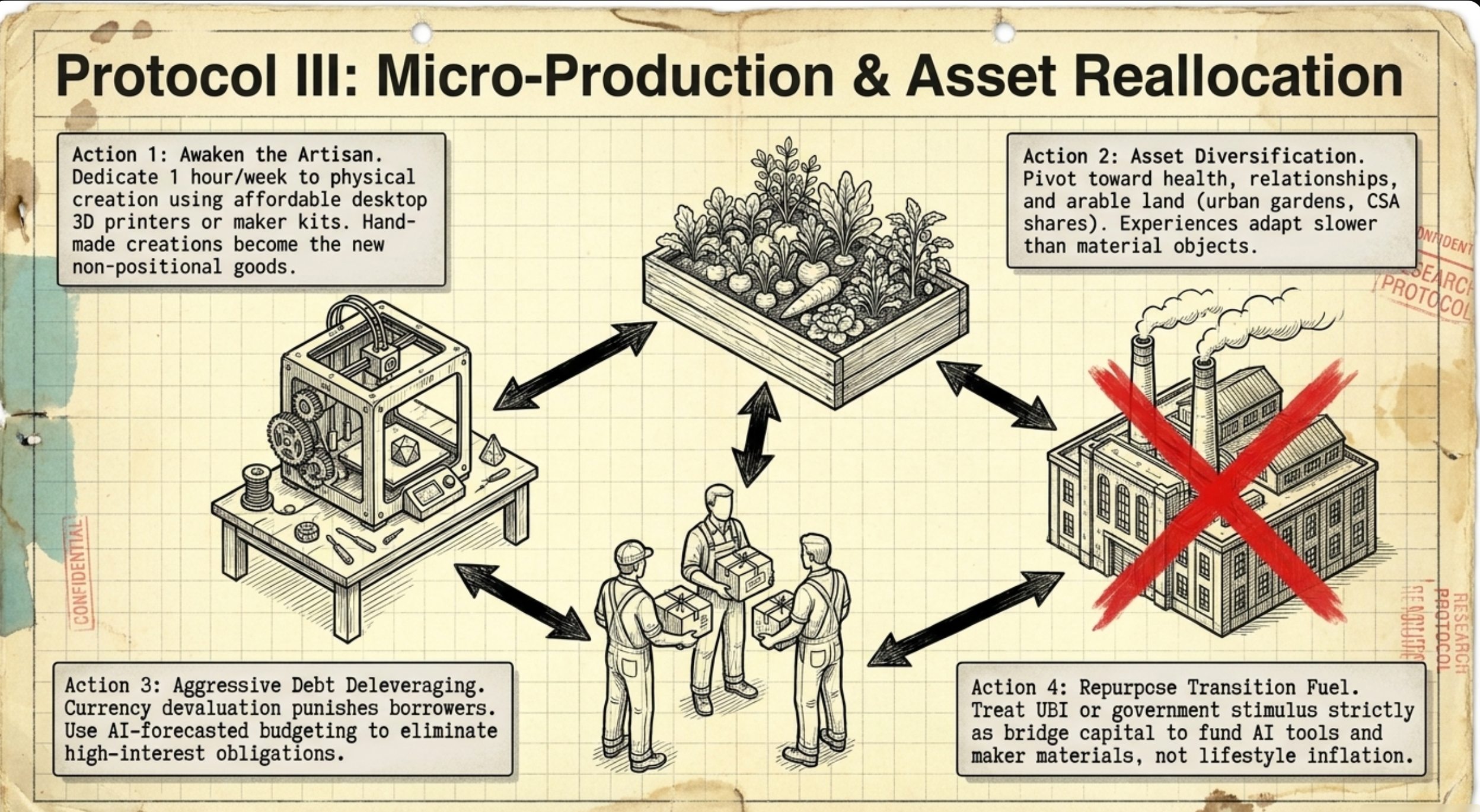
2- Awaken the artisan within through hands on creation with today’s accessible tools by dedicating at least one focused hour each week to physical making using affordable desktop 3D printers filament and open source designs downloaded from sites like Thingiverse or Printables. Begin with simple projects like custom phone stands personalized tools or decorative items that express your unique vision and then sell them on platforms like Etsy. Pottery woodworking or custom electronics kits from local maker stores restore identity and provide tangible satisfaction. The Industrial Revolution deskilled artisans yet those who retained craft found meaning when machines took rote work. Your creations become the new positional good that the treadmill cannot cheapen and you can generate small income streams right now while building skills for the future. When AI makes digital perfection infinite, human imperfection and physical tangibility become scarce and valuable, providing closed-loop satisfaction absent in infinite digital work.
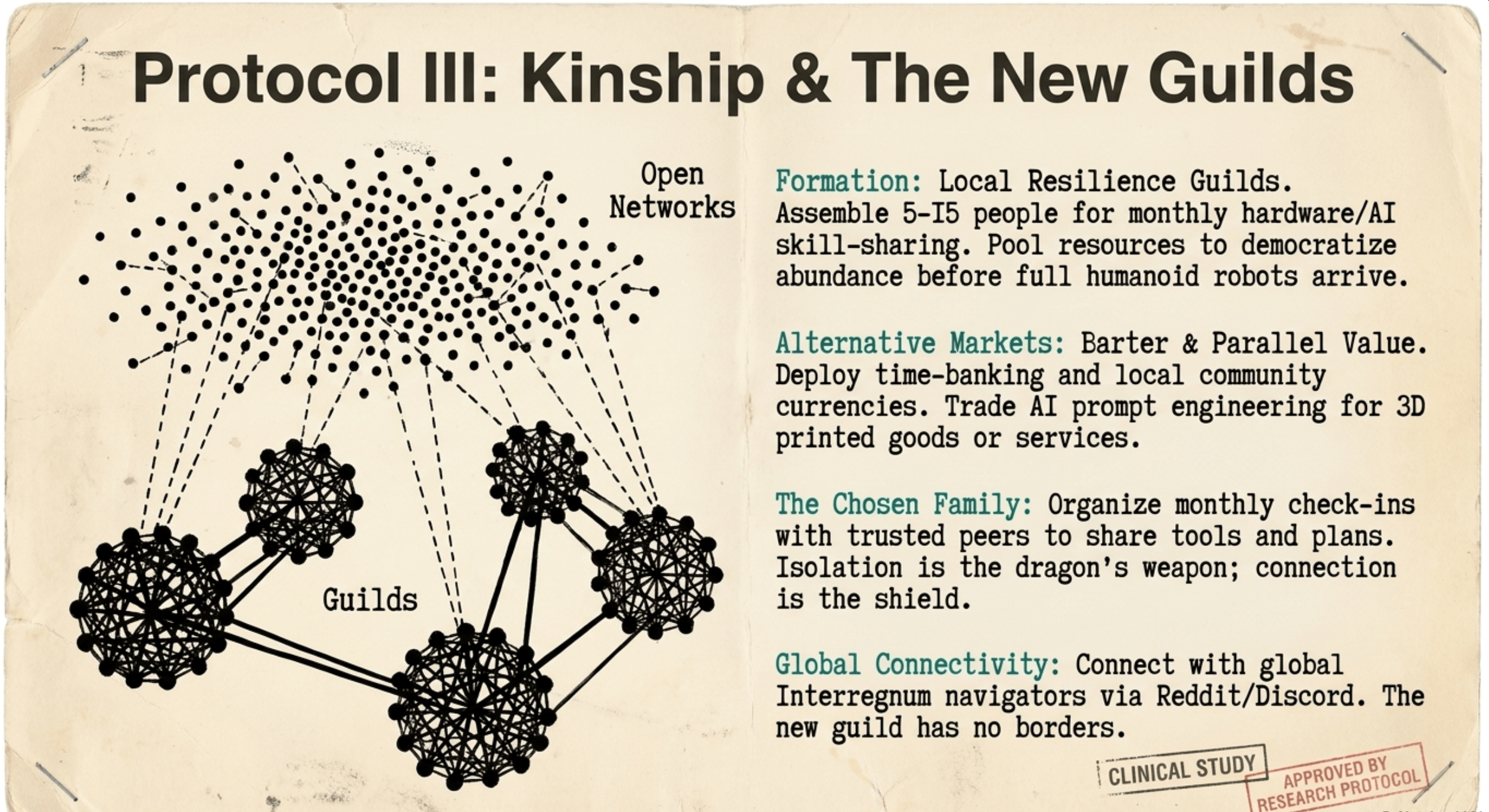
3- Form or join local guilds of five to fifteen people who meet in person or via secure video calls by reaching out through community maker spaces libraries or online groups like X maker communities and private websites like ReadMultiplex, to share knowledge free AI prompts 3D printing tips and early robotic kits like small programmable arms from Arduino or Raspberry Pi starter projects. Set ground rules for monthly show and tell sessions where members demonstrate one new technique or project. Medieval guilds preserved skills through disruption. In the Interregnum they democratize abundance even before full humanoid robots arrive. Guilds make community and pool resources to experiment with emerging hardware together reducing individual costs and providing accountability and encouragement. Status here derives from what you build and teach, not corporate logos.
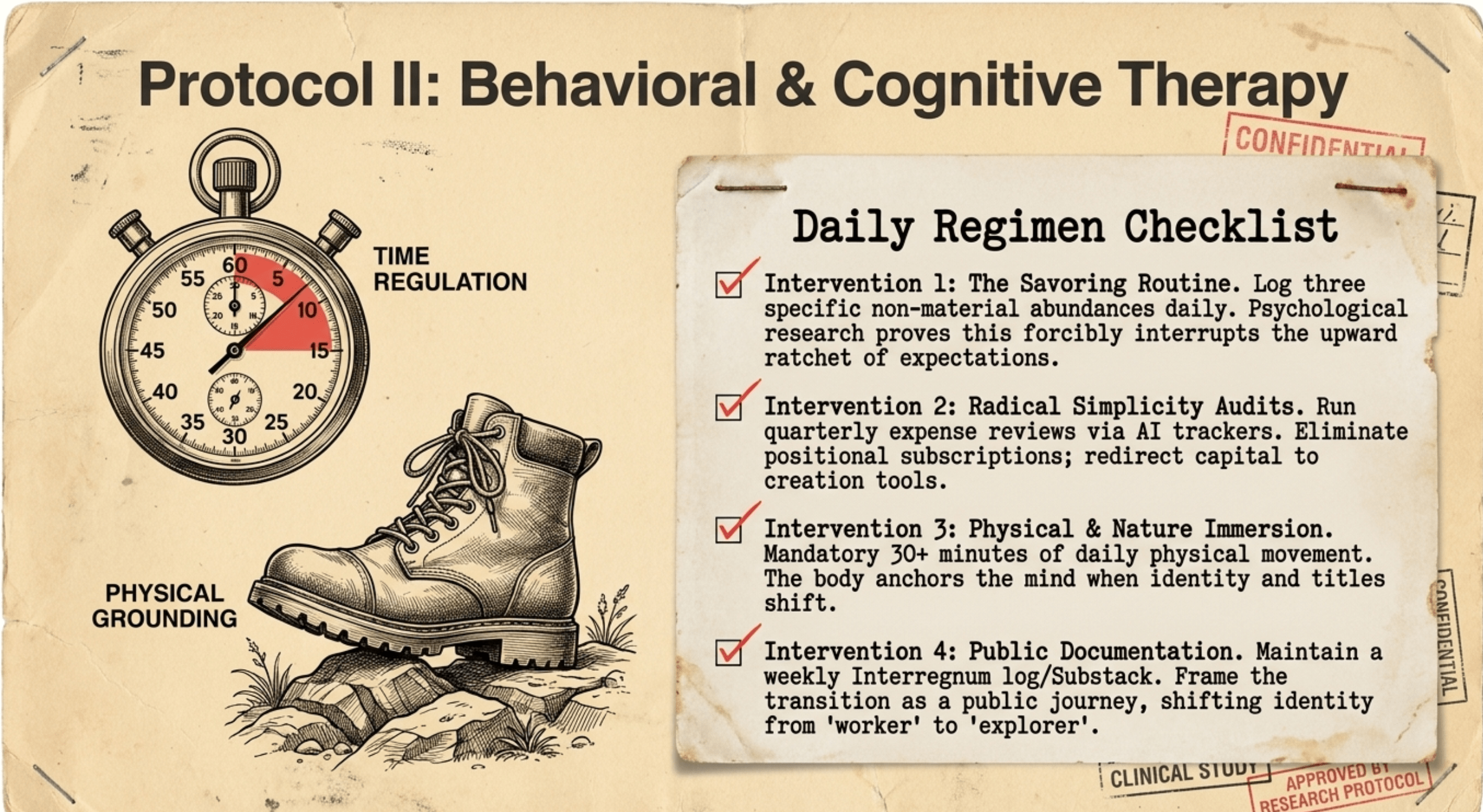
4- Practice daily gratitude and savoring by writing three specific abundances you notice each morning in a simple notebook or a dedicated app on your phone. Focus on non material things like a meaningful conversation a small skill you learned through AI guidance or the taste of a home cooked meal. Set a recurring phone reminder to do this before checking email or social media. Psychological research shows this interrupts the upward ratchet of expectations. It worked for survivors of the Great Depression who reframed scarcity into resilience and it works today when your AI companion can even suggest personalized prompts or review your entries for patterns. This biologically pins the reference point down.
5- Invest time in open source artificial intelligence and software projects on platforms like GitHub or Hugging Face by contributing small improvements such as testing new local models sharing effective prompt templates or curating datasets that run on consumer hardware. Spend one hour weekly reviewing issues and submitting pull requests or comments. The personal computer revolution exploded because of open standards. Your contributions accelerate the curve that ends the wage currency trap without waiting for physical robots and they build your reputation in communities that often lead to freelance opportunities or collaborations today, even non-coders can curate data or share prompts. This reframes deprivation into collaborative striving.
6- Diversify into non positional assets by focusing on health relationships and small scale local resources rather than status goods. Start a small garden using today’s smart planters or apps that provide AI optimized planting schedules based on your local climate data or join community supported agriculture shares through local farms. Experiences adapt more slowly than objects. History’s resilient families in every transition owned the basics and the bonds and you can begin immediately with low cost kits available online or at garden centers.
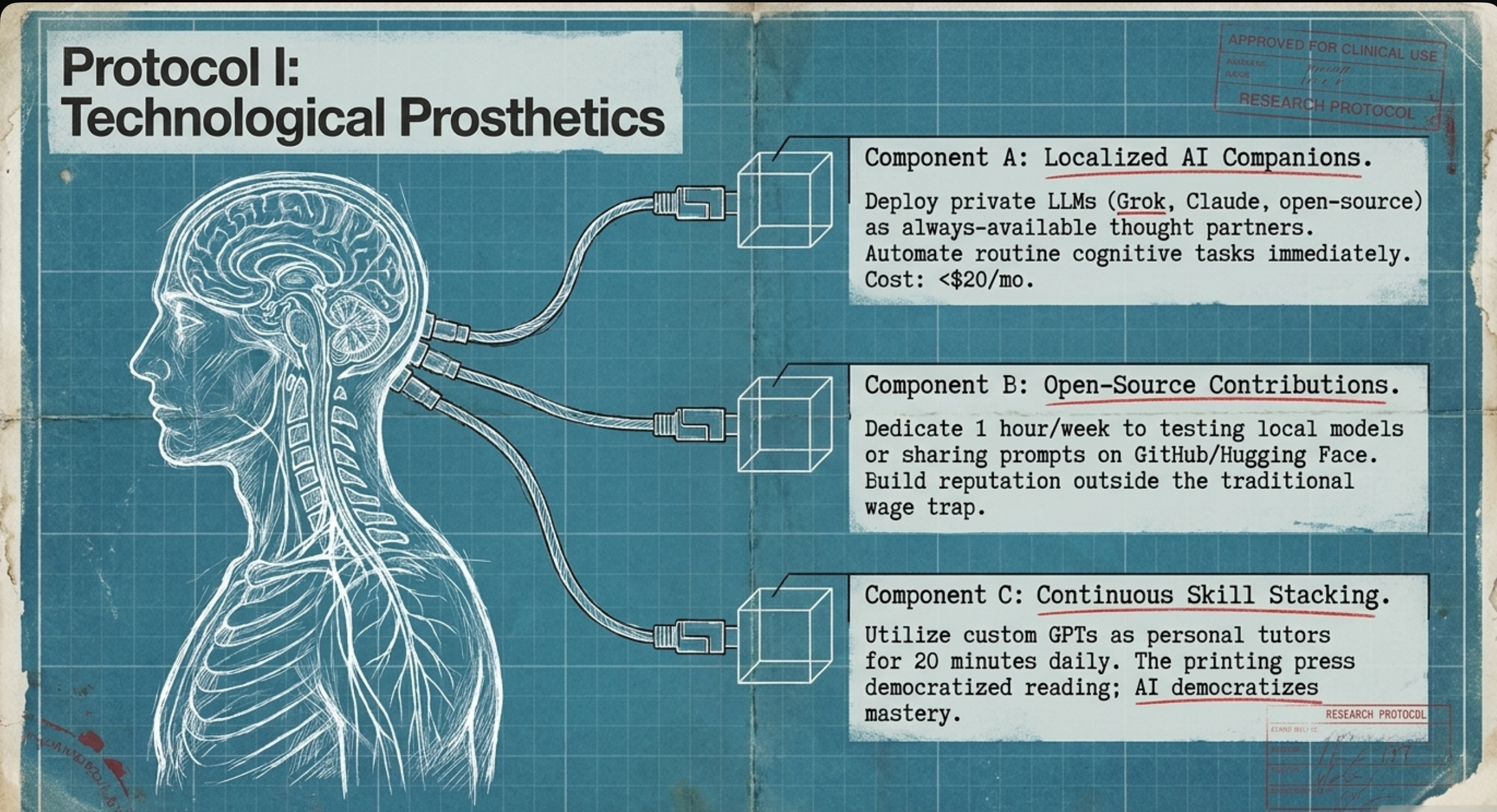
7- Learn continuous skill stacking with today’s artificial intelligence tutors by treating your private AI model as a mentor that updates faster than any college. Dedicate twenty minutes daily to deliberate practice using tools like custom GPTs or open source models for learning coding languages trades like basic electronics or even creative writing. Track progress in a simple spreadsheet and ask the AI to quiz you or suggest next steps. The printing press once made books the great equalizer. Artificial intelligence is the next press and it is already in your pocket ready to use on any device.
8- Reduce debt aggressively by paying down high interest obligations first using free budgeting apps enhanced with AI forecasts that analyze your spending patterns and suggest automated transfers. Review your statements weekly and negotiate rates where possible. Currency devaluation punishes borrowers. The nineteenth century homesteaders who cleared land free of debt outlasted those who mortgaged everything when farm prices fell. Track everything in real time with current spreadsheet tools linked to your bank accounts for instant visibility.
9- Launch micro production ventures using today’s 3D printers laser cutters and AI design assistants by creating and selling custom goods on demand such as personalized keychains phone cases or digital products like printable templates and online courses. Use free AI tools to generate designs and listings. The cottage industries of the early Industrial Revolution kept families afloat when factory wages lagged. Yours scale globally through platforms like Etsy or Gumroad immediately and require only a few hundred dollars in startup equipment.
10- Experiment with community currencies and barter rings through local apps or time banking platforms that exist today by joining or starting groups on apps like TimeBanks or local Facebook community pages to trade time skills or digital designs. Offer AI prompt engineering sessions or 3D printed items in exchange for services. During the Weimar hyperinflation of the nineteen twenties Germans used scrip and mutual credit to bypass collapsing marks. Your networks create parallel value using free tools and strengthen local resilience right now.
11- Prioritize daily physical movement and nature immersion by walking building or gardening with simple tools and AI guided plans from free fitness or gardening apps that suggest routes or schedules based on your location. Aim for at least thirty minutes outdoors daily. The body anchors the mind when identity shifts. Roman legions maintained morale through disciplined routines amid empire wide change. Your routine builds the same fortitude and costs nothing beyond time while improving mental clarity.
12- Document your Interregnum journey in public by starting a simple blog video log or Substack newsletter using free AI assistance for editing outlines and images. Post weekly updates on your experiments with AI tools or maker projects. The Renaissance artists who chronicled their experiments attracted patrons and collaborators. Your story becomes legacy and potential micro income when old titles fade and platforms reward authentic voices today.
13- Master AI enhanced historical crafts like basic blacksmithing weaving or electronics then optimize designs with free CAD software and AI suggestions for improvements. Take beginner classes at local maker spaces or follow step by step YouTube series augmented by AI explanations. The Shakers turned simple tools into global brands during nineteenth century upheaval. Your versions become heirlooms the treadmill cannot erode and you can learn entry level skills through accessible resources now.
14- Build a chosen family resilience circle by organizing monthly potlucks or virtual check ins with three to five trusted friends or neighbors. Share meals plans tool libraries and AI tips. The pioneer wagon trains of the American West survived because groups pooled resources. Isolation is the dragon’s favorite weapon. Connection is your shield and it starts with a text message or group chat today.
15-. Treat any government transition payments as bridge fuel only. Use Universal High Income trials or stimulus checks to fund your AI subscriptions 3D printer filament and guild supplies not lifestyle inflation. Set up a dedicated savings account and allocate percentages automatically via apps. The New Deal programs of the nineteen thirties bought time for some but delayed adaptation for others. Spend yours on ownership not consumption using current budgeting tools to allocate automatically.
16- Secure micro plots of arable land or urban garden space even a balcony or community plot through local programs or apps that connect gardeners. Use AI apps for soil analysis and planting schedules based on real time weather data. Feudal peasants who held small allotments endured the Black Death and enclosure better than landless laborers. Local food security outlasts currency swings and urban farming kits with grow lights are available affordably online right now.
17- Create art or stories that explore the Interregnum using AI as co creator not replacement. Write short fiction compose music with free tools or design visuals and share them on platforms. The Romantic poets of the Industrial Revolution captured the human cost and beauty of change. Your work gives voice to the era and attracts an audience that values authenticity on current social and content platforms.
18- Adopt radical simplicity audits quarterly by reviewing expenses with AI powered trackers that categorize spending and suggest cuts. Eliminate one positional item such as unused subscriptions and redirect savings to creation tools. The Stoics of ancient Rome thrived amid empire volatility by focusing on what they controlled. Your audits free resources for what matters and apps make the process effortless today.
19- Connect with global Interregnum navigators through open platforms like X or specialized forums for AI makers and hobbyists. Share blueprints failures and prompts in active threads. The early internet communities of the nineteen nineties bootstrapped the digital age. Your network becomes the new guild without borders and it is live and active today with thousands of participants.
20- Review and update your personal Hero’s Journey map every ninety days using a simple digital journal or Notion template enhanced by AI summaries that pull key insights from your entries. Mark progress slay old dragons and celebrate small abundances with a ritual like a favorite meal. The greatest explorers from Magellan to Shackleton kept logs that turned chaos into legend. Your map becomes the compass that leads you and others to the renaissance and you can begin it this afternoon with free templates.
The Road Home and the Return with the Elixir
You return to the Ordinary World transformed. The hedonic treadmill still spins but you no longer run blindly. Superabundance continues its exponential rise. Wages and old currency settle into new equilibrium. You have crossed the threshold claimed the reward and now live the new story. The Interregnum was never the end of work. It was the birth of chosen vocation.
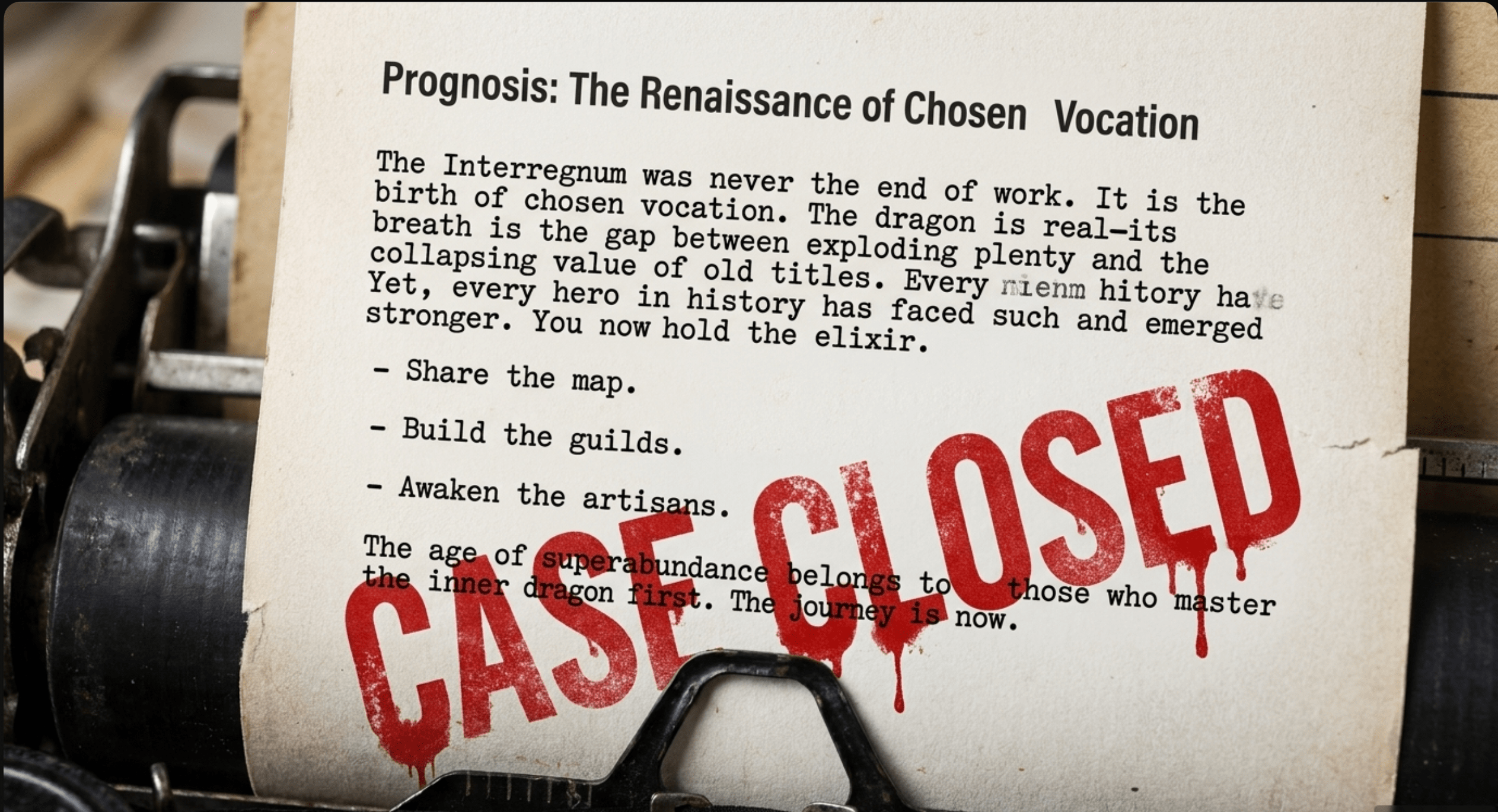
The dragon is real. Its breath is the gap between exploding plenty and the collapsing value of old titles and degrees. Yet every hero in history faced such a beast and emerged stronger, precisely by integrating the psychological complexes it revealed (inferiority into striving, shadow into wholeness, identity crisis into generativity) rather than denying them. As intelligence itself becomes abundant and practically free, status will shift from credentials or raw cognition to chosen vocation, physical mastery, community contribution, and authentic narrative. You now hold the elixir. Share it. Build the guilds. Awaken the artisans. The age of superabundance belongs to those who master the inner dragon first.
This is Part 26 of You Have 5000 Days. The series continues. The map is yours. The journey is now.
Get off the treadmill…
The 5000 Days Countdown Clock:
We are on this journey together. Some of us stand on the shoulders of giants and have thought about this for decades. We will not go it alone, and I hope to build many parts to this series and share the mastermind insight from the powerful Read Multiplex member Forum: https://readmultiplex.com/forums/topic/you-have-5000-days-navigating-the-end-of-work-as-we-know-it/. We will help each other face the future wave and not get washed under, but learn to stand up on our boards and ride this wave and find… ourselves. Join us.
To continue this vital work documenting, analyzing, and sharing these hard-won lessons before we launch humanity’s greatest leap: I need your support. Independent research like this relies entirely on readers who believe in preparing wisely for our multi-planetary future. If this has ignited your imagination about what is possible, please consider donating at buy me a Coffee or becoming a member. Value for value you recieved here.
Every contribution helps sustain deeper fieldwork, upcoming articles, and the broader mission of translating my work to practical applications. Ain ‘t no large AI company supporting me, but you are, even if you just read this far. For this, I thank you.
Stay aware and stay curious,

🔐 Start: Exclusive Member-Only Content.
Membership status:
🔐 End: Exclusive Member-Only Content.
~—~
~—~

~—~
Subscribe ($99) or donate by Bitcoin.
Copy address: bc1qkufy0r5nttm6urw9vnm08sxval0h0r3xlf4v4x
Send your receipt to [email protected] to confirm subscription.

Stay updated: Get an email when we post new articles:

THE ENTIRETY OF THIS SITE IS UNDER COPYRIGHT. IMPORTANT: Any reproduction, copying, or redistribution, in whole or in part, is prohibited without written permission from the publisher. Information contained herein is obtained from sources believed to be reliable, but its accuracy cannot be guaranteed. We are not financial advisors, nor do we give personalized financial advice. The opinions expressed herein are those of the publisher and are subject to change without notice. It may become outdated, and there is no obligation to update any such information. Recommendations should be made only after consulting with your advisor and only after reviewing the prospectus or financial statements of any company in question. You shouldn’t make any decision based solely on what you read here. Postings here are intended for informational purposes only. The information provided here is not intended to be a substitute for professional medical advice, diagnosis, or treatment. Always seek the advice of your physician or other qualified healthcare provider with any questions you may have regarding a medical condition. Information here does not endorse any specific tests, products, procedures, opinions, or other information that may be mentioned on this site. Reliance on any information provided, employees, others appearing on this site at the invitation of this site, or other visitors to this site is solely at your own risk.
Copyright Notice:
All content on this website, including text, images, graphics, and other media, is the property of Read Multiplex or its respective owners and is protected by international copyright laws. We make every effort to ensure that all content used on this website is either original or used with proper permission and attribution when available.
However, if you believe that any content on this website infringes upon your copyright, please contact us immediately using our 'Reach Out' link in the menu. We will promptly remove any infringing material upon verification of your claim. Please note that we are not responsible for any copyright infringement that may occur as a result of user-generated content or third-party links on this website. Thank you for respecting our intellectual property rights.
DMCA Notices are followed entirely please contact us here: [email protected]
