
You Have 5000 Days: Navigating the End of Work as We Know It. Part 24: The Doomslayer.
Imagine this. You pay literally half as much in the only currency that truly matters for your weekly groceries, for the fuel in your tank, for the car in your driveway, or even for the home that shelters your family. All of this becomes possible precisely because four billion additional human minds have entered the planetary conversation since the late twentieth century. It sounds completely insane. It feels as if it defies physics itself. For our entire lives we have been steeped in a narrative of inevitable scarcity. The Earth is running out of space, running out of resources, running out of time. Every new person is portrayed as just another mouth taking a larger bite out of an ever shrinking pie. The whole cultural atmosphere has conditioned us to see population growth as a threat, innovation as a temporary fix, and the future as a narrowing corridor of limits.
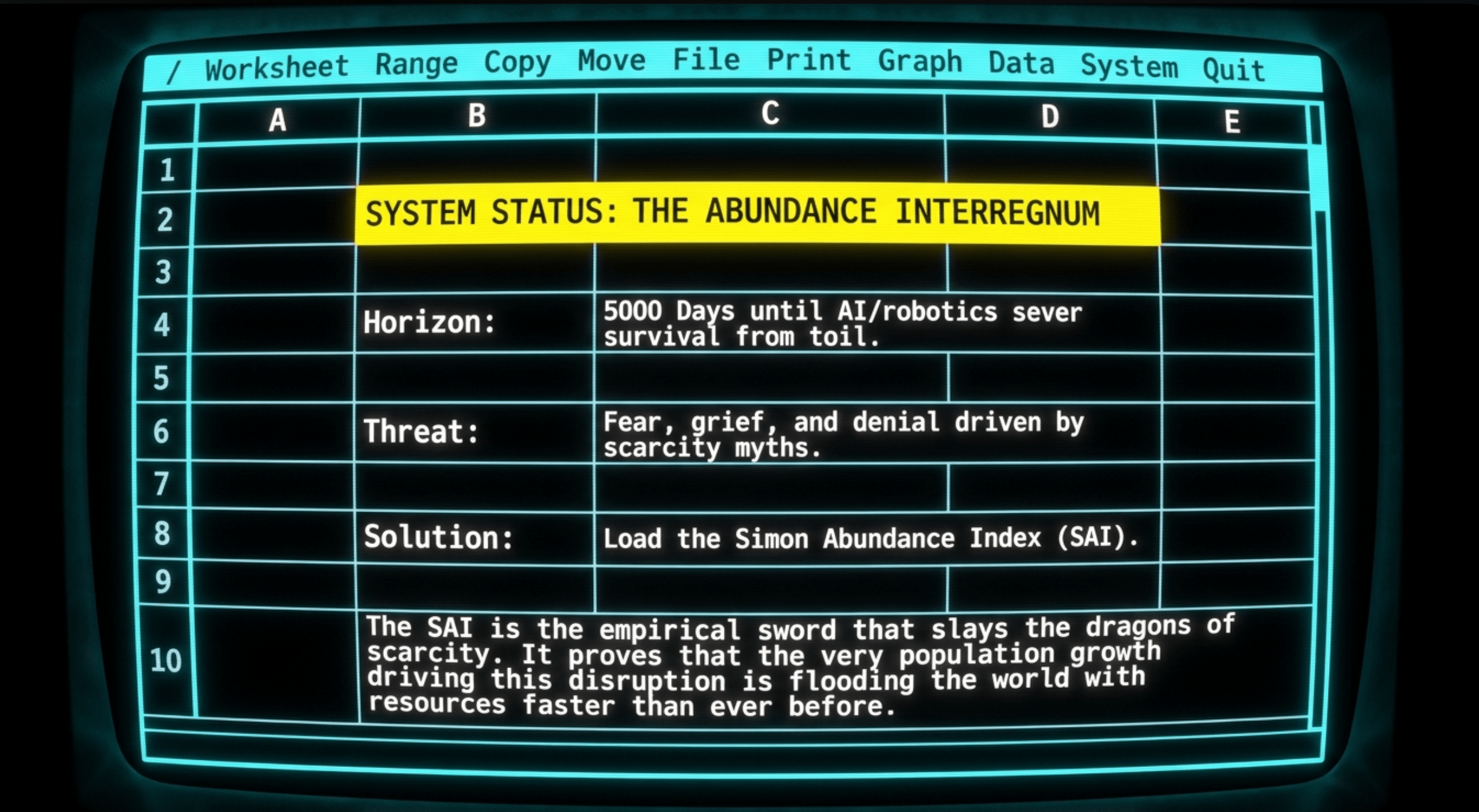
Yet the hard mathematical reality of the past half century reveals the precise opposite. The pie is not shrinking. It is multiplying at an accelerating rate. We are living through what I call the Abundance Interregnum, a turbulent, noisy, chaotic transitional period between the dying industrial age of enforced physical scarcity and the dawning era of accelerating, unprecedented plenty. This is not wishful thinking or utopian speculation. It is the empirical data, rendered in the clearest possible language of time prices and formalized in the Simon Abundance Index.
This article is sponsored by Read Multiplex Members who subscribe here to support my work: Link: https://readmultiplex.com/join-us-become-a-member/
It is also sponsored by many who have donated a “Cup of Coffee”. If you like this, help support my work: Link: https://ko-fi.com/brianroemmele
Listen to the companion pdcast: https://rss.com/podcasts/readmultiplex-com-podcast/2741628
The Story So Far
In the grand monomyth of Joseph Campbell that has framed our entire Read Multiplex series, every hero receives a boon from the ordeal, a gift to bring back and transform the ordinary world. The Simon Abundance Index is that boon, rendered in crystal clear mathematics and irrefutable trends. It transforms our narrative from fear to triumph, from interregnum darkness to radiant dawn.
Let us first revisit the path we have traveled through the You Have 5000 Days installments on Read Multiplex, mapping each chapter explicitly to the Hero’s Journey while showing how this Index empowers us at every turn. The series continues evolving, with new parts illuminating the AI driven transition in real time.
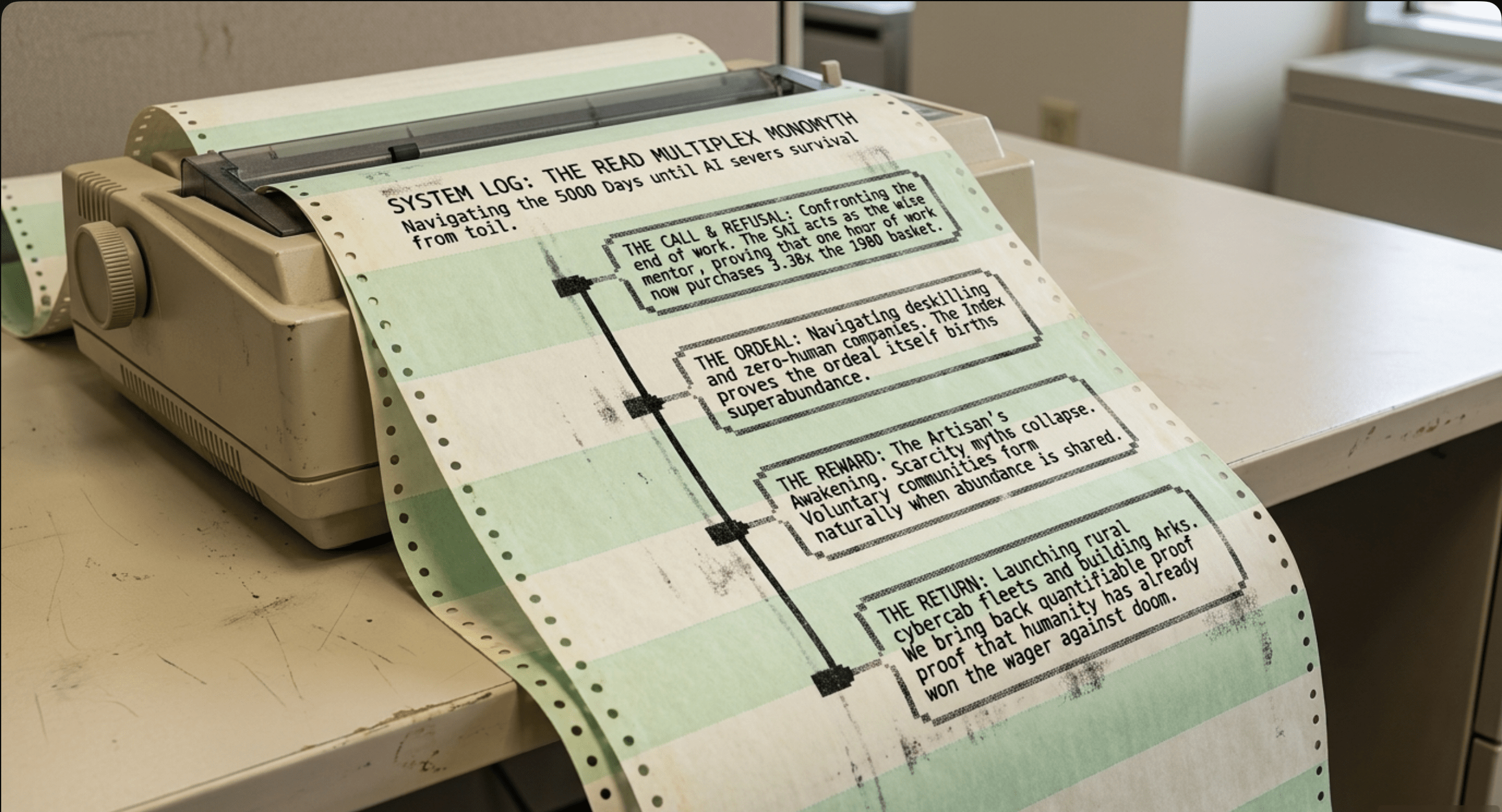
Part 1 answered the Call to Adventure. We confronted the 5000 day horizon, roughly thirteen years until the mid 2030s, when AI and robotics sever survival from repetitive toil. Evolutionary roots of work were laid bare, shadow work prescribed, and provisional selves urged. The Simon Abundance Index arrives here as the supernatural aid, proving that the very population growth driving this disruption is simultaneously flooding the world with resources faster than ever before. No longer must we fear the unknown. We measure it and see abundance accelerating.
Parts 2 through 4 embodied the Refusal of the Call and the first mentors. Grief stages gripped us as careers dissolved. Vonnegut’s Player Piano warned of societal rifts. Scott Adams style reframing turned dread into opportunity. Here the Index acts as the wise mentor’s whisper. Time prices have plummeted 70.4 percent since 1980. Denial, anger, and bargaining dissolve when data reveals one hour of work now purchases 3.381 times the 1980 basket of commodities. The ordinary world was never scarce. We simply lacked the lens.
Parts 5 through 7 crossed the Threshold into the Tests and the Inmost Cave. De-skilling liberated us from drudgery. The Dark Night of the Soul tested our purpose amid zero human companies. Iain M. Banks’ Consider Phlebas showed post scarcity fragility. The Index becomes the magic sword in this darkness. It quantifies that every additional human brain has made resources not scarcer but vastly more plentiful. Personal abundance has risen 238.1 percent. We emerge from the cave armed with proof that the ordeal itself births superabundance.
Parts 8 through 10 approached the Ordeal’s heart with Saving Your Wisdom, the Artisan’s Awakening, and the realization that Everyone Is Doing It. Narrative therapy preserved our stories. Moravec’s Paradox exalted human creativity over abstract computation. Mass AI adoption normalized the shift. The Index here reveals the Reward. All fifty tracked commodities are more abundant today than in 1980. Artisans thrive because scarcity myths collapse under data. Voluntary communities form naturally when abundance is measured and shared.
Parts 11 through 14 intensified the Road of Trials with the Reversal of Obsolescence, the Profit and the Architect, the Gilded Age, and navigating Interregnum chaos. McLuhan’s tetrad flipped fear into renaissance. New economic architectures emerged. Guilds arose as voluntary alliances of creators. This is where the Index shines brightest as our guiding star. It proves that objectivist voluntary alliances, free associations of rational producers, are not utopian dreams but the only sane structure that scales with the data. Central planning cannot replicate the 4.22 percent compound annual growth rate of resource abundance. Guilds can. Guilds will.
Part 15 delivered the Road Back via the IBM COBOL Shock, legacy systems crumbling, valuations resetting, yet opportunity exploding. The Index illuminates the return path. Short term volatility, such as cocoa dipping 53.7 percent in one year due to weather anomalies, is mere noise against the long term symphony of superabundance. We do not retreat. We advance with metrics that outlast shocks.
Parts 16 through 20 built the Ark, confronted Universe 25 mouse utopia warnings, exposed hidden scarcity architects, heeded With Folded Hands dystopias, and launched practical wealth engines. Depopulation fears were dismantled. Psychological manipulators unmasked. These sections grounded the journey in real world action, showing how to construct resilient structures amid the chaos.
Parts 21 through 23 propelled us deeper into the Reward and the final integration. Part 21 introduced the Dynamic Duo, the Tesla Optimus and CyberCab as your personal legion. A single independent person, no longer tethered to traditional employment or massive institutional backing, wields these tools to transform one human will into an unstoppable force of productivity, service, and local innovation. Here the Index becomes the practical blueprint for building your own rural cyber cab company or any guild-scale enterprise that profits directly from the Interregnum. Part 22 explored After Universal High Income through the lens of Ray Bradbury’s 1949 Marionettes, Inc., a warning that cut straight to the heart of human relationships in an age of automation. It examined how old power structures dissipate and new voluntary cultures and guilds are forged in freedom, with the Index providing the data driven confidence to navigate identity, purpose, and connection when material needs are met. Part 23 confronted How 2, 1956, the precise 1956 radio prophecy that mapped directly onto the middle years of this Interregnum. The X Minus One adaptation of Clifford D. Simak’s story on self replicating systems, legal battles, and profound identity questions forced us to ask what it means to remain human when technology mirrors and amplifies our every capability. The Index served as the final anchor, proving that abundance does not erase meaning. It multiplies the canvas on which we paint it.
The Age of Superabundance Is Not Coming It Is Already Here Compounding in Plain Sight
Fellow travelers in this Abundance Interregnum, we walked together through the Read Multiplex series, our ongoing You Have 5000 Days collective odyssey, chronicling the end of work as we have known it for millennia. Now, in this pivotal feature installment, we seize the ultimate talisman: the Simon Abundance Index. Far more than a mere statistic, it is the empirical sword that slays the dragons of scarcity, illuminates every stage of our Hero’s Journey, and proves beyond doubt that humanity stands on the threshold of an age of superabundance.
As of the latest 2025 report covering 2024 data, the Index stands at 618.4, meaning Earth’s resources are 518.4 percent more abundant than in 1980, even as population has surged 82.9 percent from approximately 4.444 billion to 8.126 billion. This is not hope. This is data. This is destiny.
If you are seeing this as your first in the article series go to the first one at : https://readmultiplex.com/2025/12/24/you-have-5000-days-how-to-navigate-the-end-of-work-as-we-know-it-part-1/
The Malthus Lie
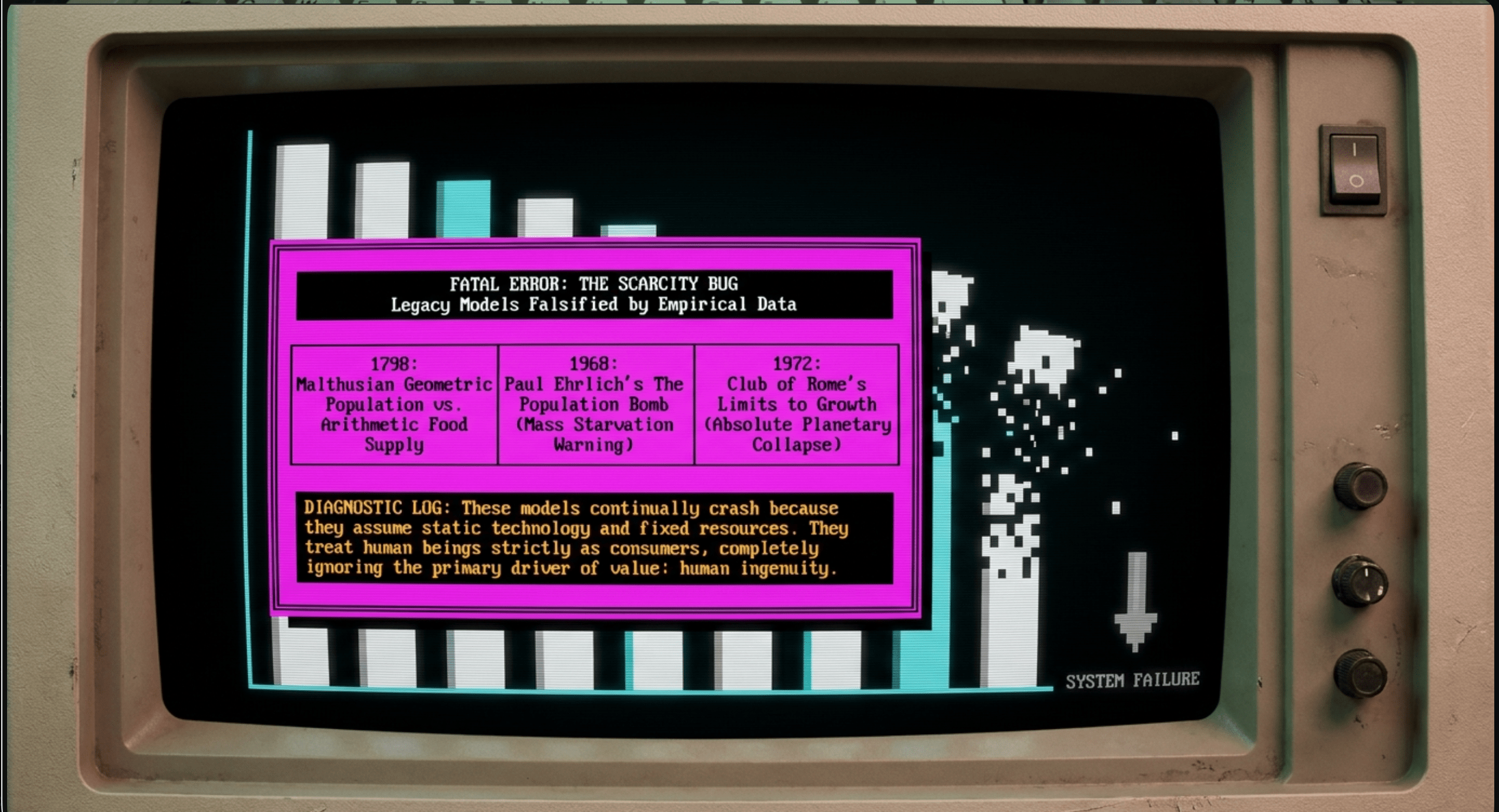
In 1798 Thomas Malthus argued geometric population growth would outstrip arithmetic food supply. This specter resurfaced in Paul Ehrlich’s 1968 The Population Bomb (https://amzn.to/41DMWWo) and the 1972 Club of Rome Limits to Growth (https://amzn.to/4cOR5gr) model, which warned of absolute planetary limits, resource collapse, pollution overload, and industrial crash by the mid twenty first century. Later updates doubled down despite contradictory evidence. Each revival served to justify taxes, regulations, population controls, and degrowth agendas. But many knew this was propaganda, but how?
Enter Julian Lincoln Simon, the University of Maryland economist, Cato Institute senior fellow, and true visionary often called the Doomslayer. Simon began his career with somewhat conventional Malthusian tinged views on population and resources but underwent a profound intellectual transformation after rigorous empirical research. A Harvard graduate with a degree in experimental psychology who earned an MBA and PhD in business economics from the University of Chicago, he drew from diverse experiences including running his own mail order advertising firm in the 1960s that grounded his thinking in practical market dynamics rather than abstract models. He served in the United States Navy and taught at the University of Illinois before joining Maryland. Early in his work on population economics Simon was pessimistic. But reading Scarcity and Growth by Harold Barnett and Chandler Morse (https://amzn.to/4cf3p9D), which documented long term declines in resource costs despite rising consumption, became his great tutor and flipped his perspective entirely. He realized that human ingenuity, not physical limits, determines abundance.
Simon’s major works form a coherent intellectual arc that built the foundation for the Index we wield today. In The Economics of Population Growth published in 1977, he systematically examined the relationship between population increases and economic outcomes. Far from accepting the prevailing view that more people automatically strain resources, Simon demonstrated through historical and statistical analysis that population growth, when paired with freedom and markets, tends to correlate with higher living standards, greater innovation, and expanded resource availability. The book laid the empirical groundwork for rejecting zero sum thinking and showed how additional human minds generate net positive effects over time.
His landmark 1981 masterpiece The Ultimate Resource crystallized the revolution. Here Simon delivered the declaration that human beings, not atoms, ores, or acres of land, are the ultimate resource. It is not raw materials that limit progress but the human mind’s capacity for knowledge, imagination, and innovation and just in time AI and robotics amaplify the human mind. Worthless matter becomes valuable resources through human creativity. Sand turns into silicon chips. Crude oil becomes plastics and pharmaceuticals. Desert becomes fertile fields via desalination and drip irrigation.
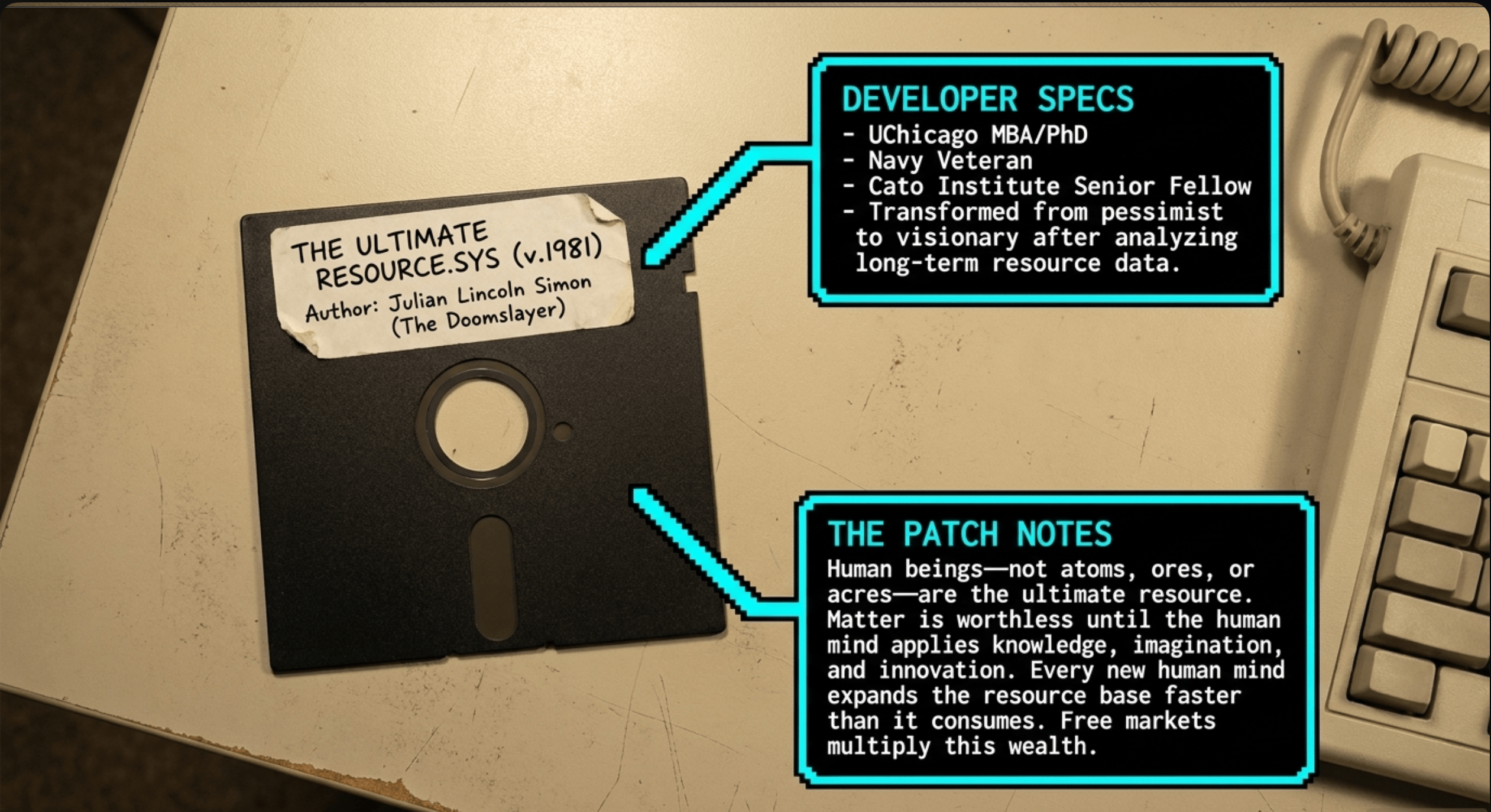
Population growth, far from being a curse, brings more minds, more problem solvers, more inventors, and ultimately more abundance. Simon emphasized that free markets, property rights, and individual liberty are the essential conditions that allow this ultimate resource to flourish. He acknowledged short term dislocations and problems from rapid population growth such as higher local prices, congestion, or environmental pressures but insisted these are signals that spur innovation, efficiency, recycling, substitution, and entirely new solutions, leaving society better off in the long run.
In 1984 Simon co edited The Resourceful Earth (https://amzn.to/4tYcDNz) with Herman Kahn as a direct, data rich rebuttal to the Global 2000 report and similar doomsday forecasts. This volume compiled extensive evidence showing that trends in food, energy, minerals, and environmental quality were improving, not deteriorating, precisely because of human creativity and market responses. It dismantled the pessimistic computer models of the era by contrasting their static assumptions with real world historical data, reinforcing that ingenuity consistently outpaces apparent limits.
Finally, The Ultimate Resource 2 (https://amzn.to/4sCPlvi) published in 1996 expanded and updated the original with additional decades of data, responses to critics, and deeper explorations of immigration, advertising, and the psychology of optimism. Simon strengthened every core argument, showing that the trends he identified had continued to accelerate and that the ultimate resource, the human mind, operates most powerfully under conditions of liberty.
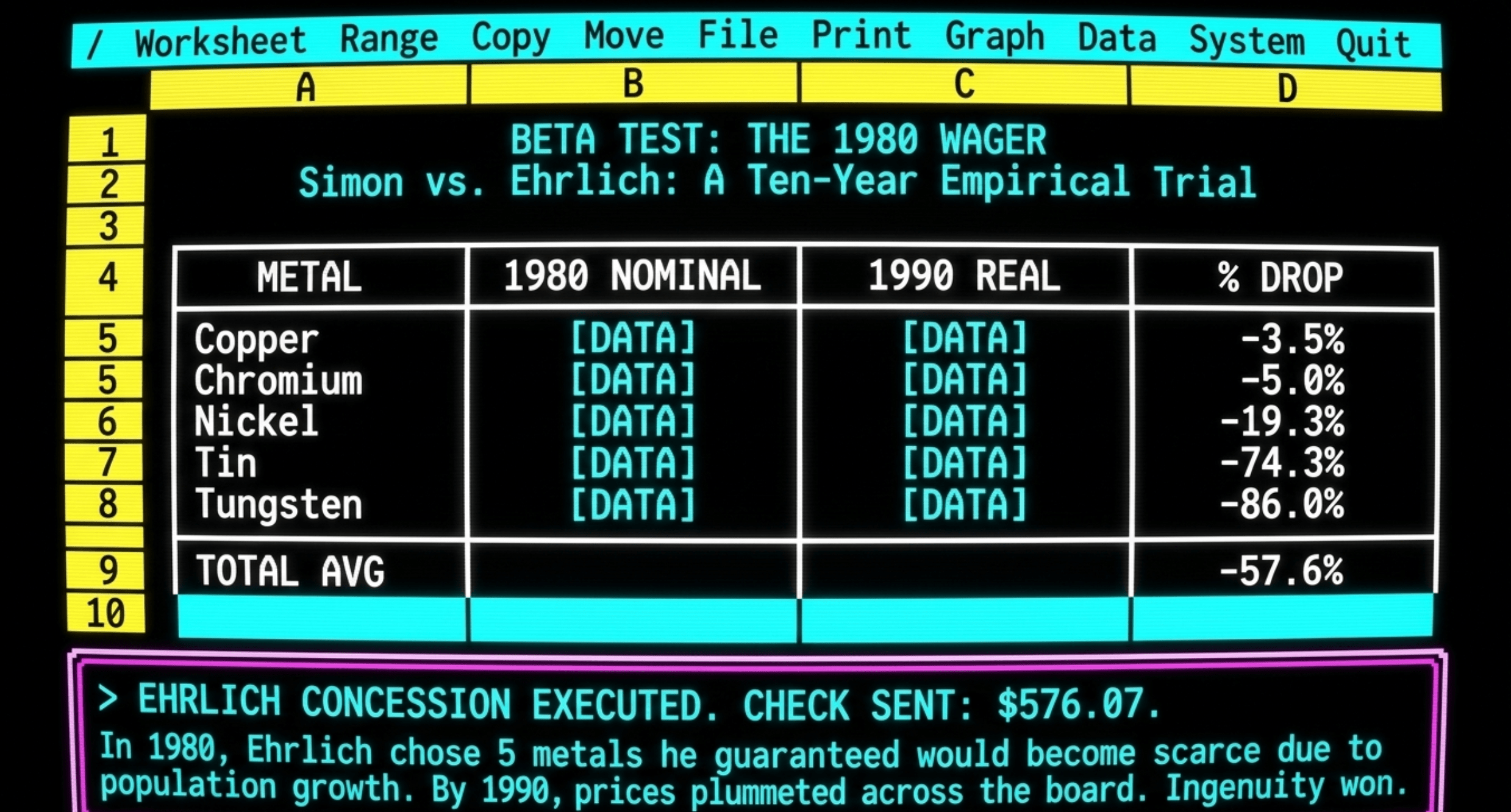
Simon did not merely theorize. He challenged the most prominent doomsayer of his era directly. In 1980 he wagered against Paul Ehrlich and colleagues. Ehrlich was allowed to choose any five metals he believed would become scarcer and more expensive due to population growth: copper, chromium, nickel, tin, and tungsten. Simon bet that, adjusted for inflation, their real prices would fall over the next decade despite hundreds of millions more people on Earth. By 1990 the prices of all five metals had plummeted by 57.6 percent overall. Ehrlich conceded defeat and sent Simon a check for $576.07 dollars. Simon had won decisively, not through luck, but because he understood the power of human ingenuity and market signals.

Simon’s ideas were initially met with fierce resistance and personal attacks. Critics labeled him a flat earther, a cargo cultist, and worse. He described himself as a professional outcast because his optimistic, evidence based stance clashed with the prevailing fear driven consensus in academia and media. Yet history has vindicated him spectacularly. Every major scarcity prediction he opposed has failed, while the trends he highlighted, falling time prices, rising living standards, and innovation driven abundance, have accelerated.
Kryptonite To Doomer
Today economists Marian Tupy and Gale Pooley (https://substack.com/@galepooley and https://x.com/gpooley) carry Simon’s torch forward at Human Progress (humanprogress.org). They formalized his insights into the Simon Abundance Index and the broader Simon Abundance Framework, providing the rigorous, data driven talisman we wield today. Simon’s legacy is not merely academic. It is profoundly philosophical and practical. He showed that optimism grounded in evidence is not naive. It is the only rational stance. In the Age of AI and robotics his vision has never been more relevant.Every new human life, empowered by exponentially growing technology, multiplies our capacity to solve problems and create value at unprecedented scales.
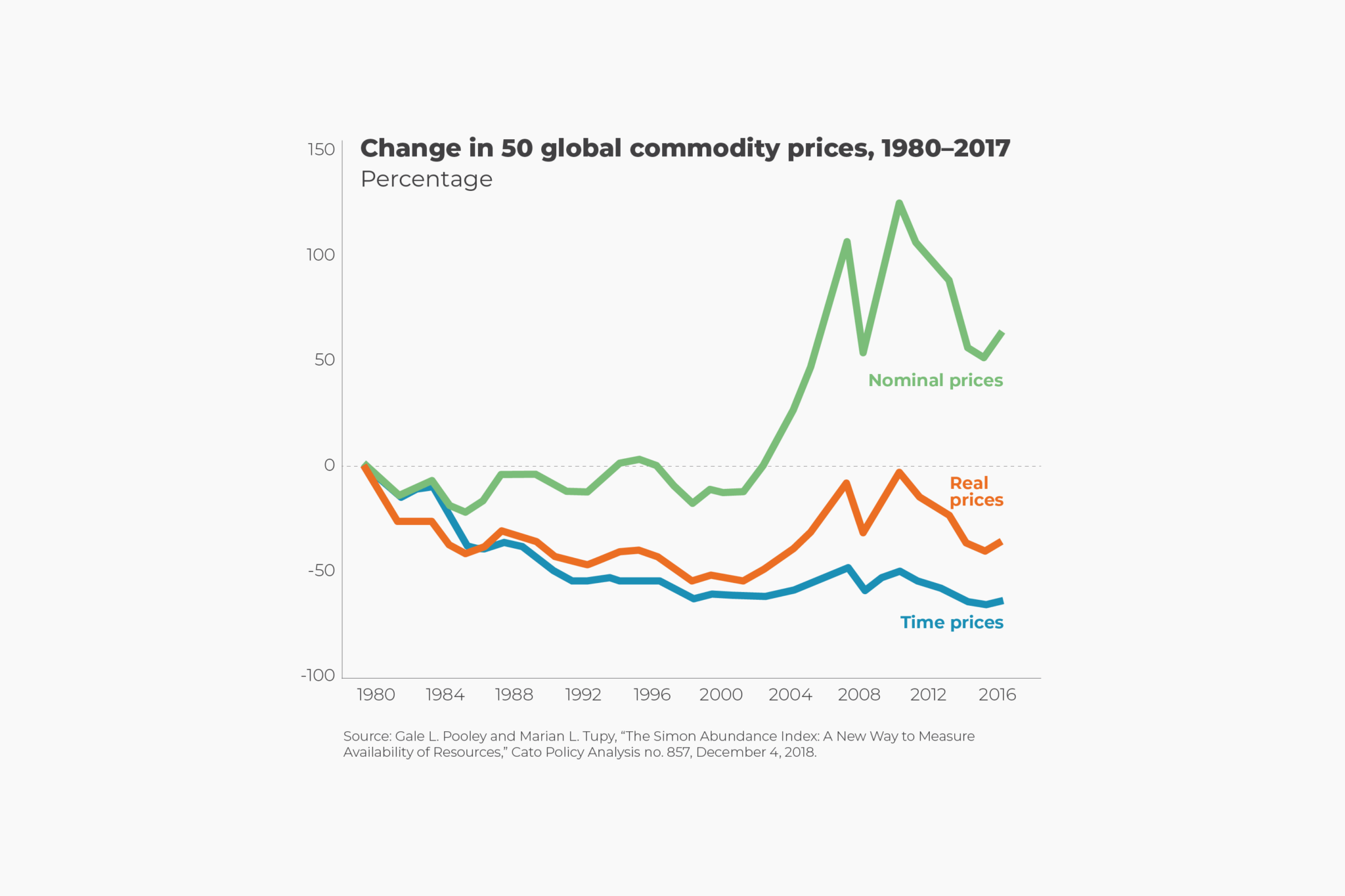
Traditional tools failed us for centuries. Raw money prices misled because they ignored rising wages. Gross domestic product captured output but not personal effort. Limits to Growth models assumed static technology and central control. The Simon Abundance Index obliterates them all with time prices, the hours an average worker must labor to earn enough for one unit of a commodity. Time prices incorporate both falling production costs and rising real incomes. They are universal, inflation proof, and reveal true human progress. When time prices fall, abundance rises.
Look at our world in mid 2026. Gleaming megacities stand alongside vast empty continents. The dying Industrial Age demanded centralization. The superabundance age enables dispersed, voluntary colonies powered by AI and robotics. High tax central states become irrelevant as voluntary alliances, guilds, and freedom enclaves scale faster with the data.
Every core prediction failed spectacularly. Population doubled, yet food per person soared, energy grew cheaper in real terms, and billions rose out of poverty. The Simon Abundance Index finally ends this debate forever because it measures reality, not flawed models assuming static technology.
Tracking the Interregnum with the Simon Abundance Index is your daily compass. Build personal dashboards. Create guild scoreboards using open data. Shape policy arguments. Even develop Habitation Abundance Indices for future space colonies. Calculate your own time prices. Integrate them into your Read Multiplex action plan. Demand freedom. Adapt for off world habitats.
This tool annihilates Malthusian and centralized visions alike. Central planning stifles price signals and innovation. Voluntary exchange multiplies them. Guilds flourish when abundance is measured and unleashed.
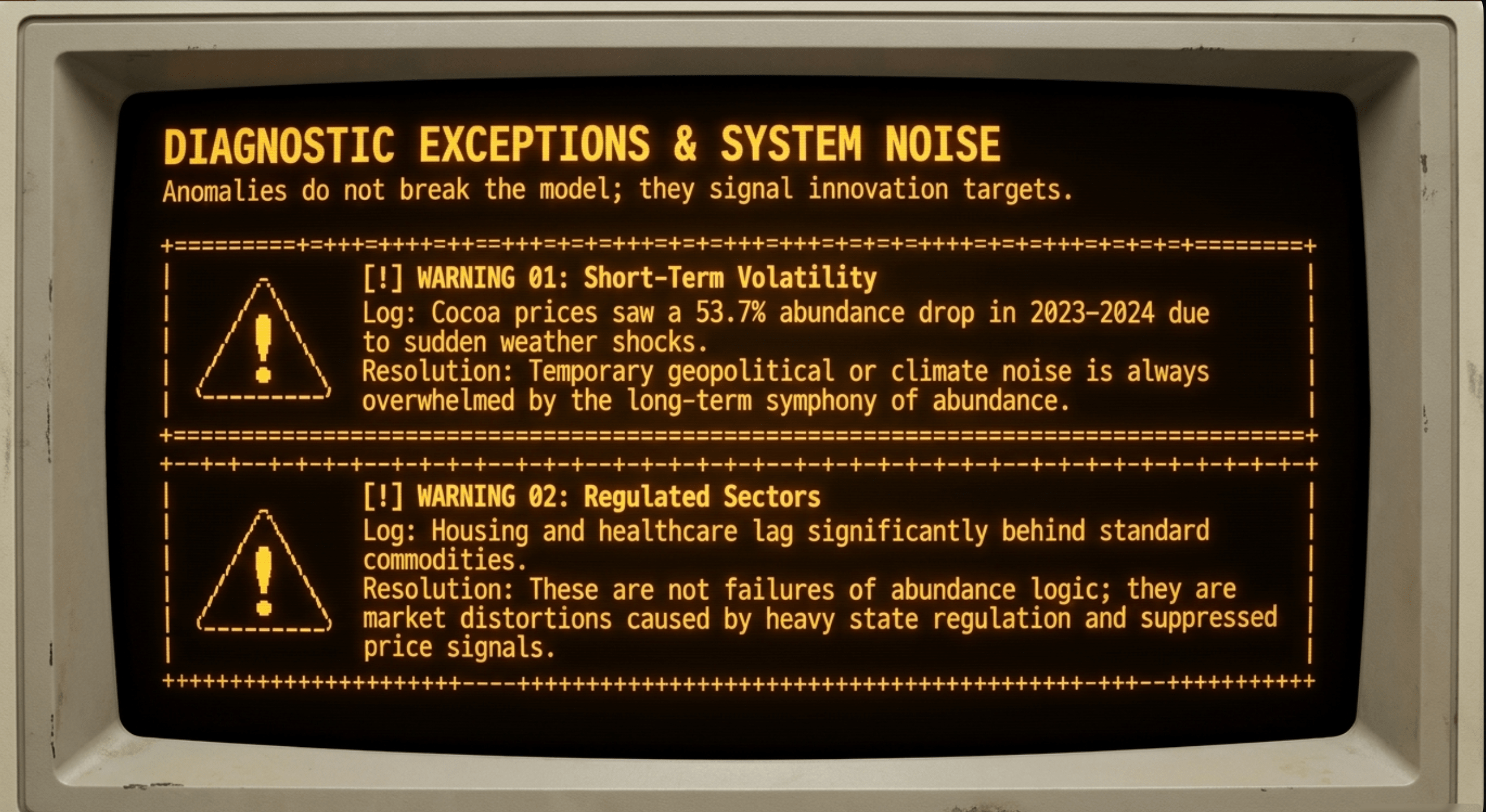
The Index is kryptonite to doomer narratives. Its apparent weaknesses, short term volatility, new resources not yet in the basket, regulated sectors, are temporary signals that innovation will overcome. Visionaries are already extending it into a Superabundance Dashboard covering compute, bandwidth, knowledge, and biological abundance, all exploding even faster.
In 2026 AI and robotics turbocharge these trends. The Interregnum is the crucible forging heroes. The Simon Abundance Index is the light we carry, the quantifiable promise that every challenge births greater opportunity.
How Does The Simon Abundance Index Work?
The Simon Abundance Index is not just another economic indicator. It is a paradigm shifting lens that reframes humanity’s relationship with resources, population, and innovation. Traditional metrics have misled us for generations because they fail to capture the true human experience of scarcity or plenty. Nominal prices fluctuate with inflation, currency debasement, and short term shocks. Gross domestic product measures total output but ignores how much personal effort, how much of your actual sweat and finite lifespan, is required to access that output. Per capita income statistics hint at progress but remain abstract and disconnected from daily life.
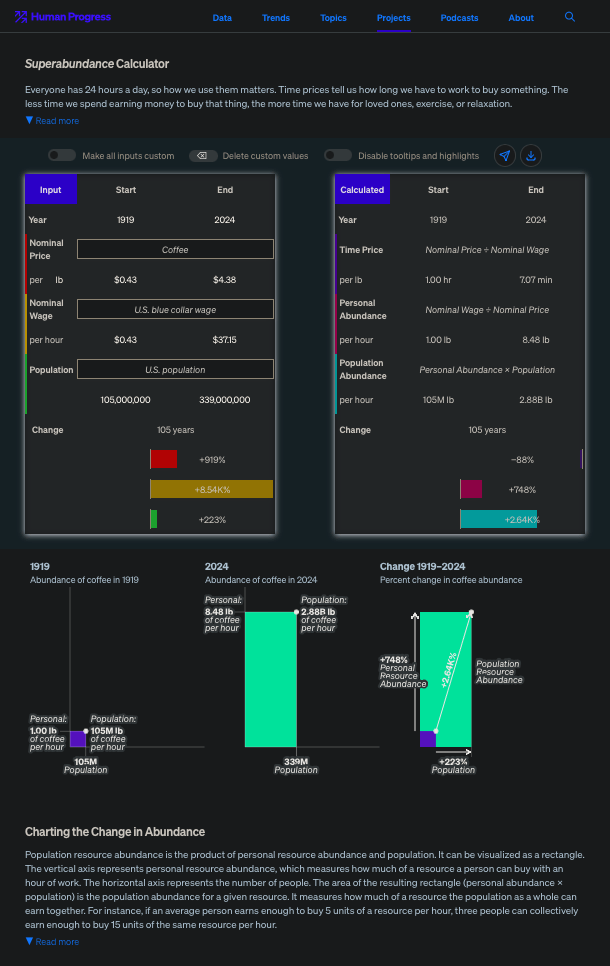
The Simon Abundance Index obliterates these shortcomings by using time prices as its foundational unit: the number of hours an average worker must labor to earn enough to buy one unit of a commodity, calculated simply as nominal market price divided by hourly after tax wage. Time prices are universal, inflation proof, and deeply personal. They translate abundance into the currency that matters most, hours of your life. When time prices fall, you literally get more for less of your finite time on Earth. Consider a pound of coffee.
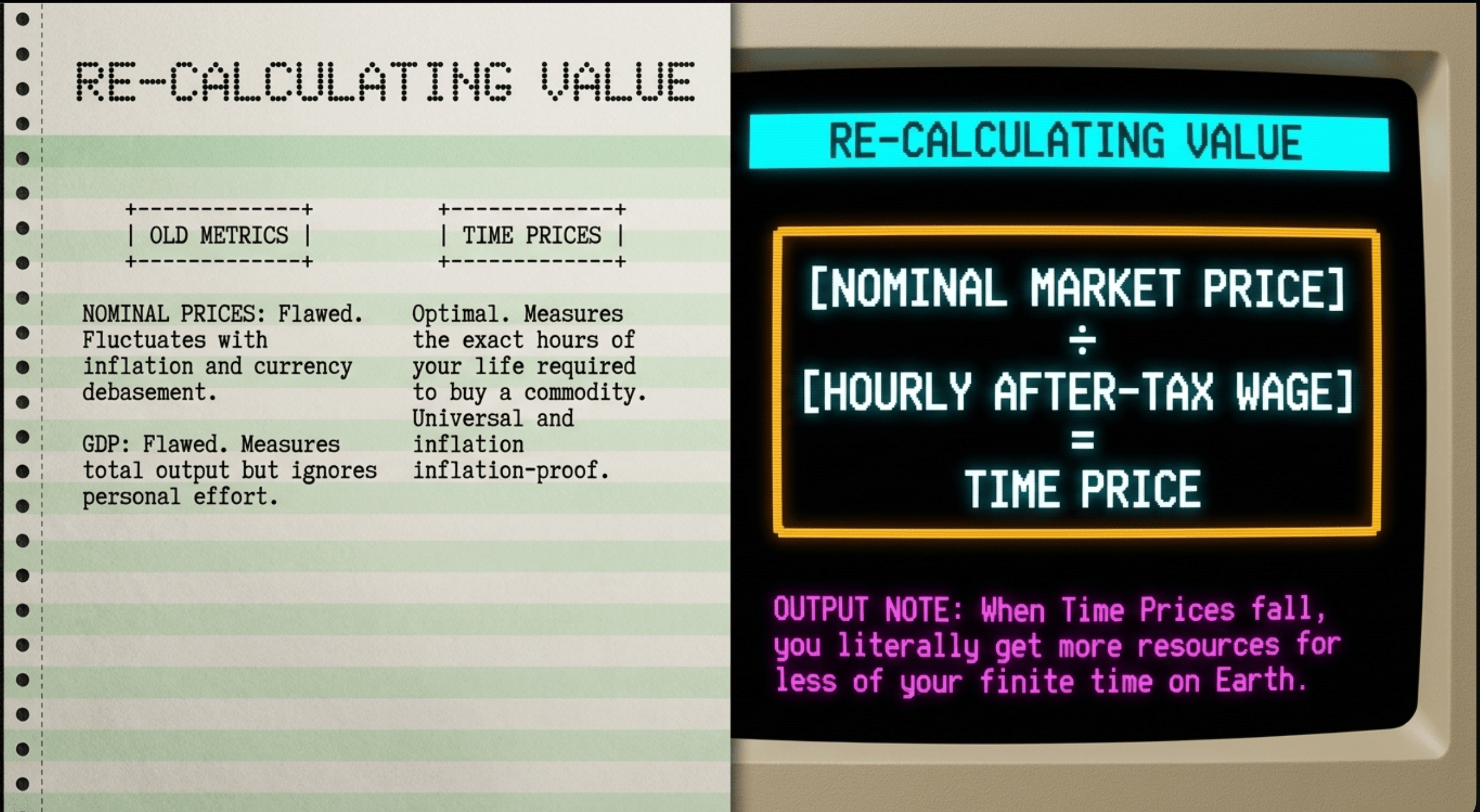
Today it might carry a fifteen dollar tag. If your take home pay is thirty dollars per hour, its time price is thirty minutes of your life. Ten years from now, suppose inflation doubles the nominal price to thirty dollars. On the old metrics panic sets in. Coffee is twice as expensive. But if your wage has risen to ninety dollars per hour, the time price falls to just twenty minutes. You have reclaimed ten precious minutes of existence. The resource has become more abundant to you personally, regardless of what central banks print.
The Ultimate Resource Is The Human Mind
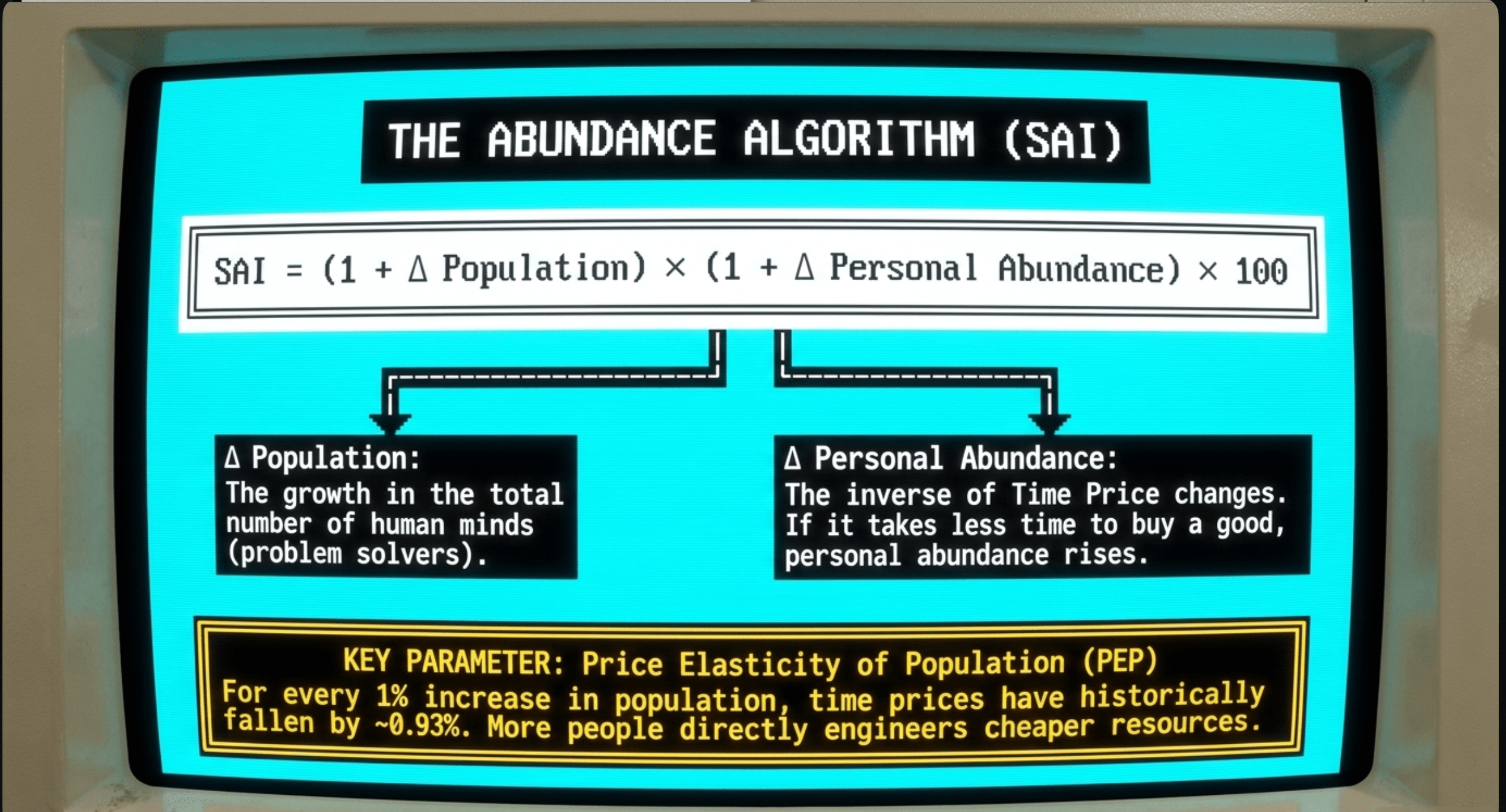
The SAI is not just another economic indicator. It is a paradigm-shifting lens that reframes humanity’s relationship with resources, population, and innovation. Traditional metrics have misled us for generations because they fail to capture the true human experience of scarcity or plenty. Nominal prices fluctuate with inflation, currency debasement, and short-term shocks. GDP measures total output but ignores how much personal effort (time) is required to access that output. Per-capita income statistics hint at progress but remain abstract and disconnected from daily life.
The elegant formulas capture this reality:
SAI = (1 + Δ Population) × (1 + Δ Personal Abundance) × 100
or equivalently
SAI = (1 + Δ Population) / (1 + Δ Time-Price) × 100
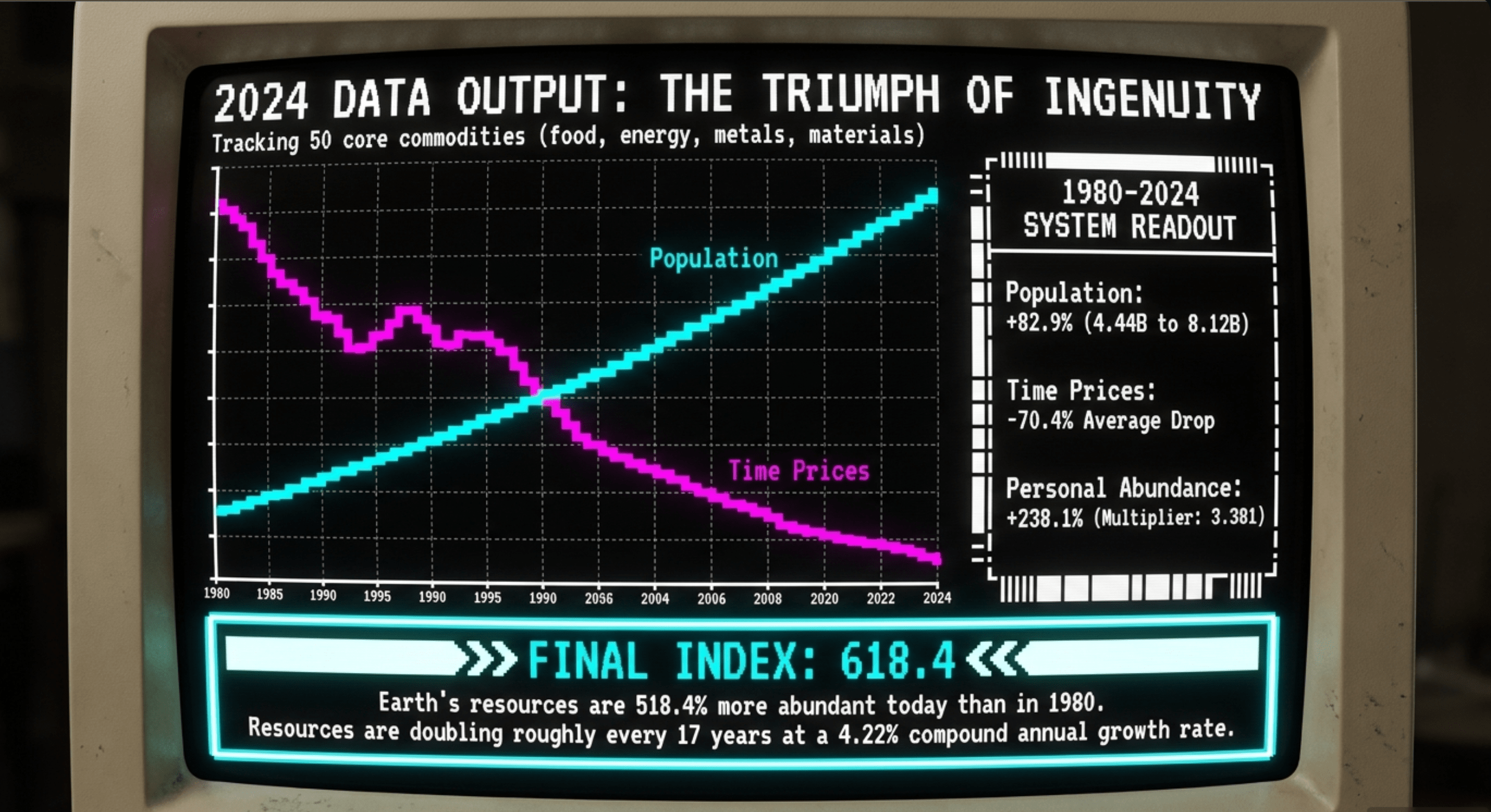
where a negative change in time-price (resources becoming cheaper in hours worked) drives explosive growth. From 1980 to 2024, population rose 82.9 percent (multiplier 1.829) while personal abundance surged 238.1 percent (multiplier 3.381, reflecting a 70.4 percent average drop in time prices across 50 commodities). Result: SAI = 1.829 × 3.381 × 100 = 618.4. Resources are doubling roughly every 17 years at a 4.22 percent compound annual growth rate. All 50 tracked commodities, spanning food, energy, metals, and materials, are more abundant today than in 1980, despite a near-doubling of humanity.
What the Numbers Show
- 1980 baseline: SAI = 100.
- 2024 (latest data): SAI = 618.4.
→ Resources are 518.4% more abundant than in 1980, despite world population growing 82.9% (from ~4.44 billion to ~8.13 billion).16 - Average time prices for the 50 commodities fell 70.4%.
- Personal (per-person) abundance rose 238.1% (one hour of work now buys 3.38 times as much of the basket).
- Compound annual growth rate (CAGR) of resource abundance: 4.22% — resources double roughly every 17 years.
- All 50 commodities are more abundant today than in 1980; short-term spikes (e.g., due to wars, weather, or policy) occur but are temporary and spur innovation.
This outcome is what Pooley and Tupy call “superabundance” — population growth and resource abundance reinforce each other when markets and human creativity are allowed to operate.
This measurement is profoundly important for multiple, interlocking reasons:
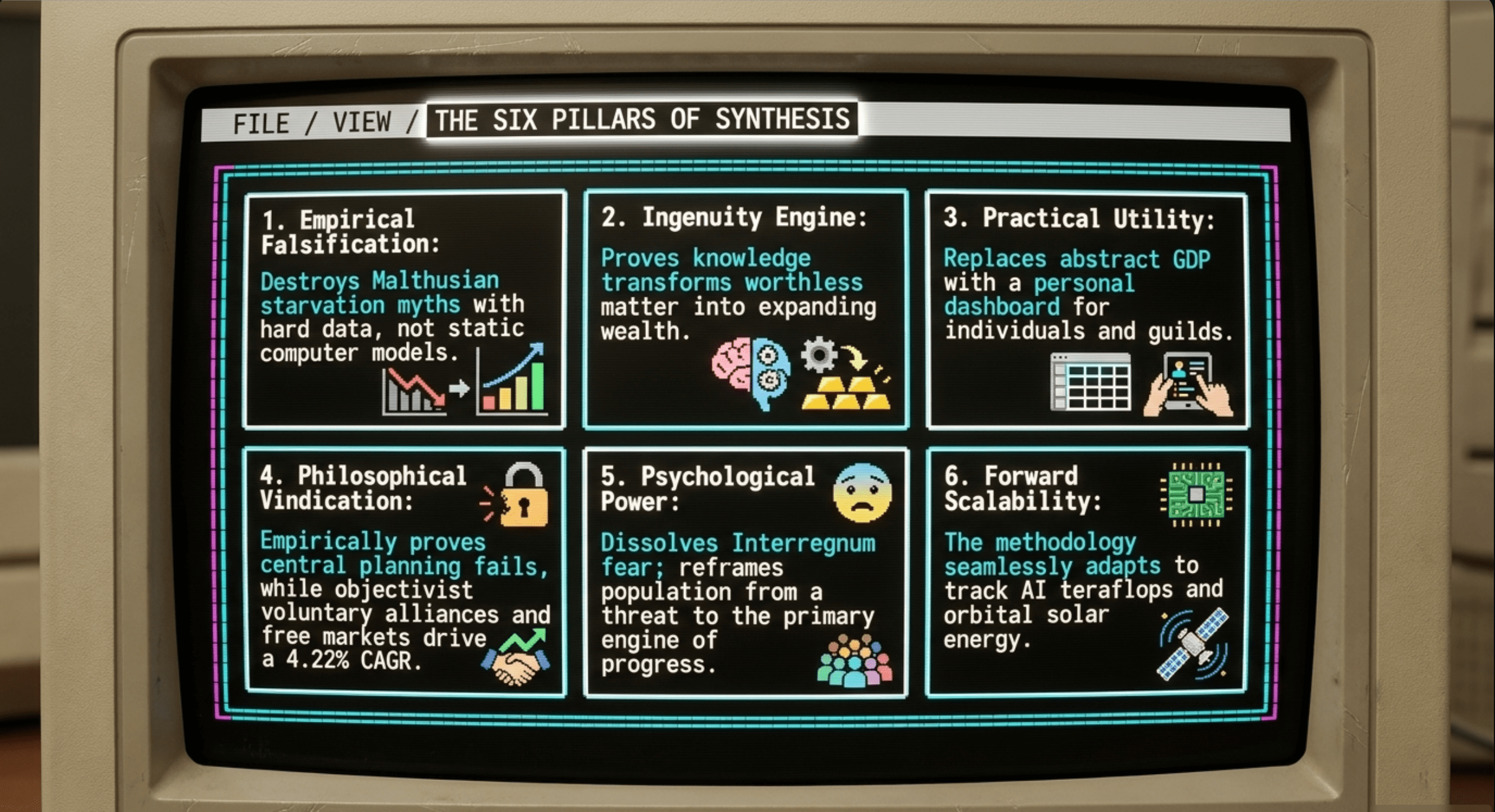
- Empirical Refutation of Scarcity Myths: It directly tests and falsifies Malthusian, Ehrlichian, and Club of Rome predictions with hard data rather than computer models assuming static technology and fixed resources. Every core forecast (mass starvation, resource exhaustion, inevitable collapse) has been spectacularly wrong, yet fear-based narratives persist because they serve political ends. The SAI ends the debate by quantifying reality.
- Revelation of Human Ingenuity as the Ultimate Resource: Simon’s thesis in The Ultimate Resource (1981) is proven: knowledge and innovation transform “worthless” matter into wealth. Each additional human mind expands the resource base faster than it consumes. The Price Elasticity of Population (PEP) within the full Simon Abundance Framework shows that for every 1 percent population increase, time prices have historically fallen by about 0.93 percent, placing us deep in the superabundance zone. We have shattered the “Nirvana Line” (the boundary where abundance merely keeps pace with population) and occupy the highest quadrant: accelerating superabundance.
- Practical, Actionable Utility Across Scales: Unlike abstract GDP figures, the SAI empowers individuals, guilds, policymakers, and even future space colonists with a personal dashboard. It turns volatility into opportunity and centralized planning myths into observable failure.
- Philosophical and Societal Vindication: It provides ironclad empirical backing for objectivist voluntary alliances, free markets, and rational self-interest. Central planning cannot replicate the innovation signals that drive 4.22 percent annual abundance growth; only decentralized, voluntary exchange can.
- Psychological and Narrative Power: In the Interregnum’s chaos, it dissolves fear, grief, and denial by replacing doomer headlines with measurable triumph. It reframes population growth from threat to engine of progress.
- Forward-Looking Scalability: The fixed 1980 basket understates revolutionary breakthroughs (e.g., compute power, bandwidth, lab-grown biology), but the methodology scales perfectly to new “commodities” like AI teraflops or orbital solar kilowatt-hours. In an AI/robotics era, the SAI’s trends are accelerating beyond the 2024 snapshot.
Acknowledged honestly, short-term volatility (e.g., cocoa’s 53.7 percent abundance drop in 2023–2024 due to weather, or energy shocks from geopolitics) creates temporary noise, but the long-term symphony dominates.
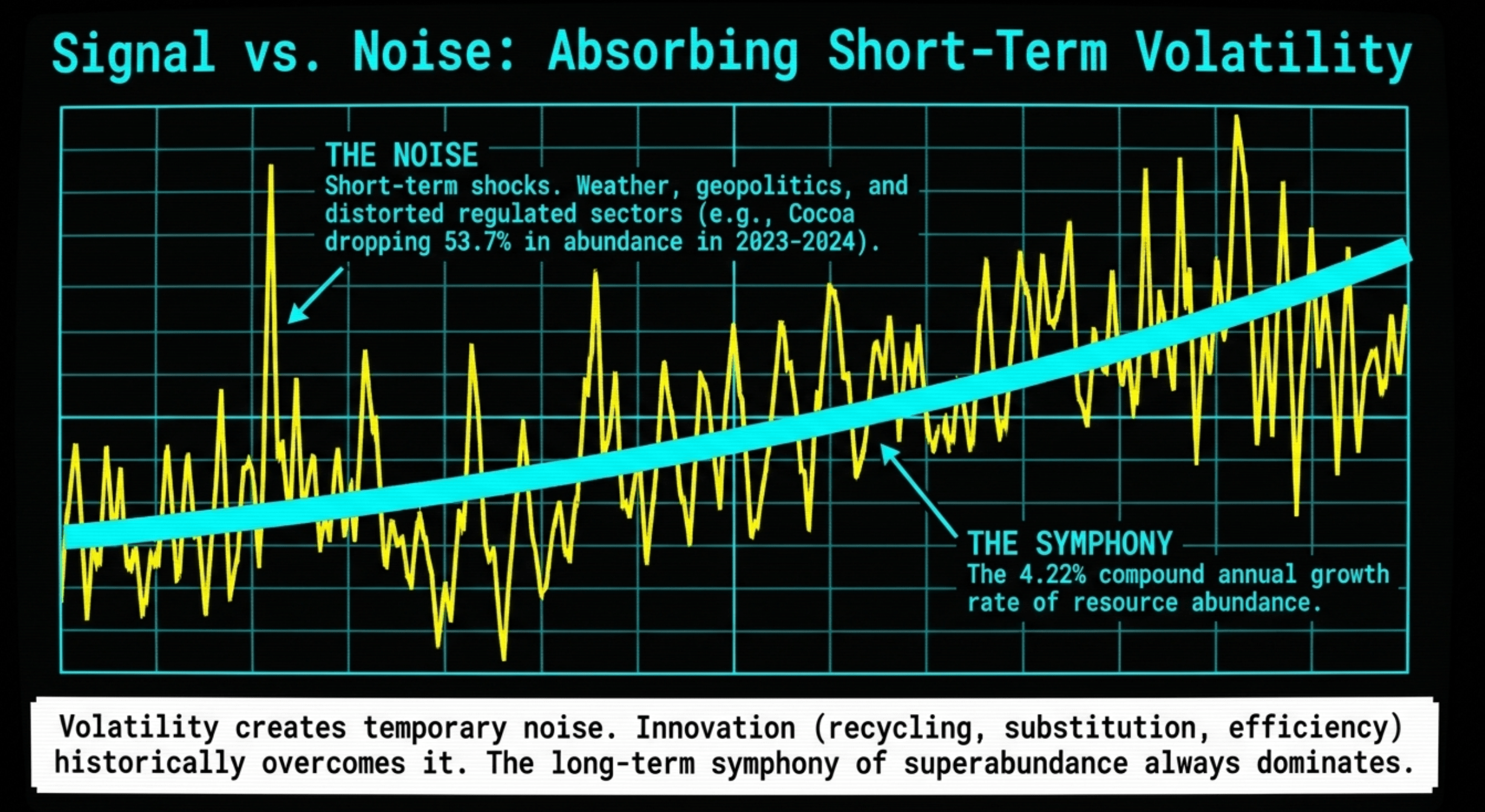
Regulated sectors like housing or healthcare lag because markets are distorted, not because abundance logic fails. Environmental externalities require complementary metrics, yet innovation (recycling, efficiency, substitutes, fusion, asteroid mining) has historically overcome them. Depopulation fears or “limits” revivals are similarly addressed: the data shows abundance compounds with knowledge, not despite population dynamics. The SAI is robust precisely because it is dynamic, not static like World3 models.
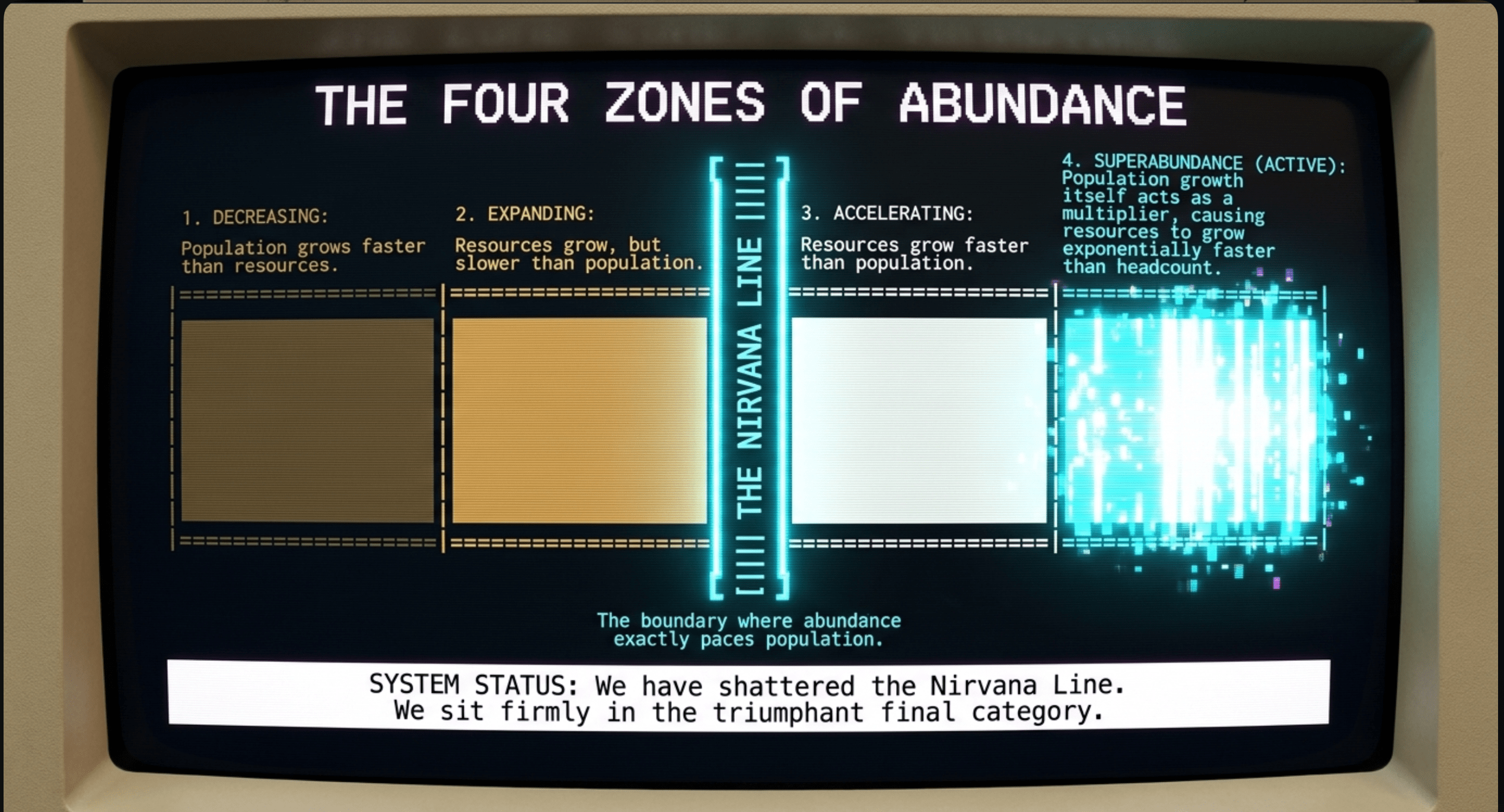
The full Simon Abundance Framework completes the talisman: the Index gives the headline; PEP, the Nirvana Line, and the four abundance zones (decreasing → expanding → accelerating → superabundance) reveal the dynamic engine. We sit firmly in the triumphant final category.
The Index then multiplies this personal abundance gain by the population growth factor, recognizing Julian Simon’s core insight. More people are not a drain on resources but the ultimate source of ingenuity, problem solving, and knowledge creation. The elegant formulas capture this reality exactly.
The primary formula is SAI equals one plus delta population multiplied by one plus delta personal abundance multiplied by one hundred.
The equivalent form is SAI equals one plus delta population divided by one plus delta time price multiplied by one hundred, where a negative change in time price, meaning resources becoming cheaper in hours worked, drives explosive growth.
From 1980 to 2024, population rose 82.9 percent, giving a multiplier of 1.829, while personal abundance surged 238.1 percent, giving a multiplier of 3.381, reflecting a 70.4 percent average drop in time prices across fifty commodities. The result is 1.829 times 3.381 times 100 equals 618.4. Resources are doubling roughly every seventeen years at a 4.22 percent compound annual growth rate. All fifty tracked commodities, spanning food, energy, metals, and materials, are more abundant today than in 1980, despite a near doubling of humanity.
The 1980 baseline stood at 100. In 2024 it reached 618.4. Resources are 518.4 percent more abundant. Average time prices fell 70.4 percent. Personal per person abundance rose 238.1 percent. One hour of work now buys 3.38 times as much of the basket. Compound annual growth rate of resource abundance is 4.22 percent. All fifty commodities improved. Short term spikes occur but are temporary and spur innovation.
This outcome is what economists Marian Tupy and Gale Pooley call superabundance. Population growth and resource abundance reinforce each other when markets and human creativity are allowed to operate. This measurement is profoundly important for multiple interlocking reasons.
First, it delivers an empirical refutation of scarcity myths. It directly tests and falsifies Malthusian, Ehrlichian, and Club of Rome predictions with hard data rather than computer models assuming static technology and fixed resources. Every core forecast of mass starvation, resource exhaustion, and inevitable collapse has been spectacularly wrong, yet fear based narratives persist because they serve political ends. The Index ends the debate by quantifying reality.
Second, it reveals human ingenuity as the ultimate resource. Simon’s thesis in The Ultimate Resource is proven. Knowledge and innovation transform worthless matter into wealth. Each additional human mind expands the resource base faster than it consumes. The Price Elasticity of Population shows that for every 1 percent population increase, time prices have historically fallen by about 0.93 percent, placing us deep in the superabundance zone. We have shattered the Nirvana Line, the boundary where abundance merely keeps pace with population, and we occupy the highest quadrant, accelerating superabundance.
Third, it offers practical, actionable utility across scales. Unlike abstract gross domestic product figures, the Index empowers individuals, guilds, policymakers, and even future space colonists with a personal dashboard. It turns volatility into opportunity and centralized planning myths into observable failure.
Fourth, it provides philosophical and societal vindication. It supplies ironclad empirical backing for objectivist voluntary alliances, free markets, and rational self interest. Central planning cannot replicate the innovation signals that drive 4.22 percent annual abundance growth. Only decentralized, voluntary exchange can.
Fifth, it carries psychological and narrative power. In the Interregnum’s chaos it dissolves fear, grief, and denial by replacing doomer headlines with measurable triumph. It reframes population growth from threat to engine of progress.
Sixth, it demonstrates forward looking scalability. The fixed 1980 basket understates revolutionary breakthroughs in compute power, bandwidth, lab grown biology, and the domains artificial intelligence is turbocharging. The methodology scales perfectly to new commodities like AI teraflops or orbital solar kilowatt hours. In an AI and robotics era the trends are accelerating beyond the 2024 snapshot.
Short term volatility, whether cocoa’s 53.7 percent abundance drop due to weather or energy shocks from geopolitics, creates temporary noise, but the long term symphony dominates. Regulated sectors like housing or healthcare lag because markets are distorted, not because abundance logic fails. Environmental externalities require complementary metrics, yet innovation in recycling, efficiency, substitutes, fusion, and asteroid mining has historically overcome them. Depopulation fears or limits revivals are similarly addressed. The data shows abundance compounds with knowledge, not despite population dynamics. The Index is robust precisely because it is dynamic, not static like outdated models.
The full Simon Abundance Framework completes the talisman. The Index gives the headline. The Price Elasticity of Population, the Nirvana Line, and the four abundance zones reveal the dynamic engine. We sit firmly in the triumphant final category.
The Future Is Objective
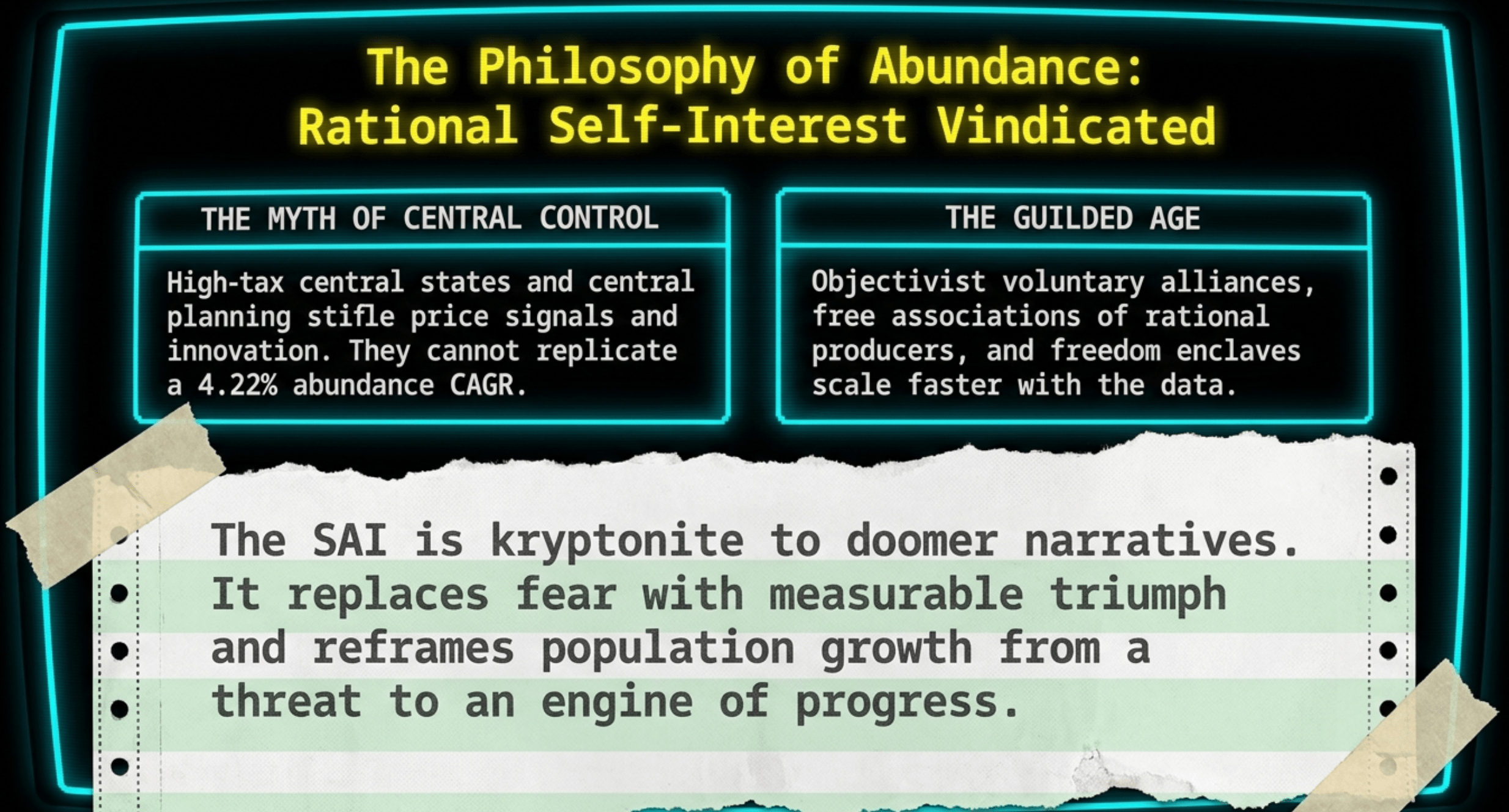
Objectivist philosophies will dominate the Age of Abundance precisely because they align perfectly with the empirical engine revealed by the Simon Abundance Index. Ayn Rand’s vision of rational self interest, voluntary trade, and the sovereignty of the individual mind is not mere philosophy here. It is the operating system that the data itself demands. Central planning cannot process the infinite, rapidly changing signals of innovation at 4.22 percent compound annual growth. Only free, rational individuals exchanging value voluntarily can. Each mind becomes a sovereign creator, not a ward of the state. Guilds are the natural expression of objectivist voluntary alliances: associations of producers who choose one another because the exchange benefits every party, never coerced.
Scarcity myths served to justify control. Superabundance renders control obsolete because abundance emerges fastest when reason, not regulation, guides action. The Price Elasticity of Population shows that more free minds equal lower time prices and greater plenty. Objectivism celebrates exactly that dynamic: the individual as the source of all value, the trader as the engine of progress, and reality itself, measured by time prices, as the ultimate arbiter. In this era, the philosophy that treats the human mind as the ultimate resource and rejects any initiation of force becomes not only morally right but mathematically inevitable. Rational wonder replaces fear. Voluntary cooperation scales where coercion collapses. The Index does not merely support objectivism. It proves that objectivism is the only framework capable of riding the wave of accelerating superabundance without distortion or delay.
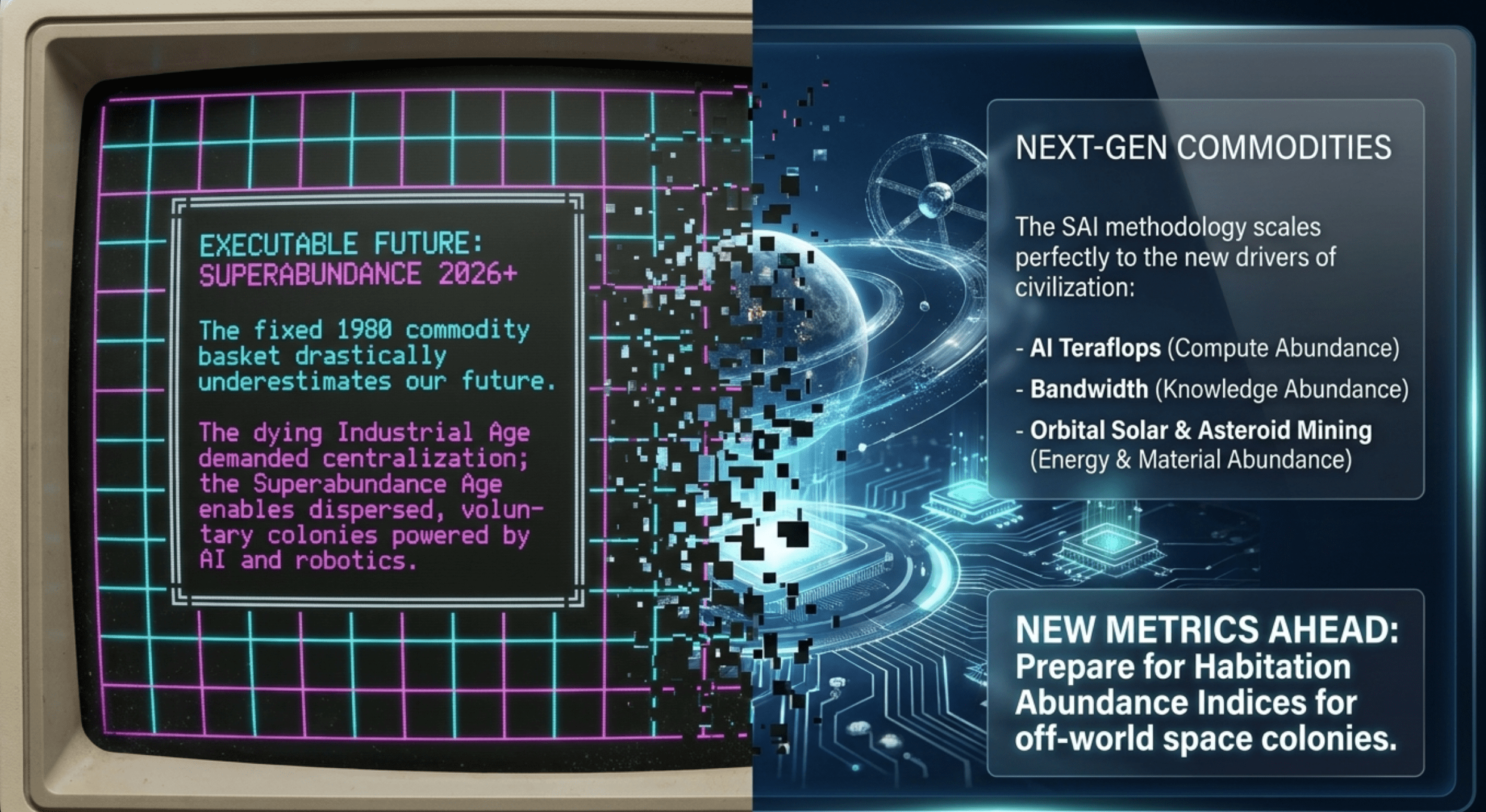
As we return from the monomyth’s depths with this elixir, the ordinary world transforms. Voluntary guilds weave resilient economies. Space colonies launch under the same banner. Humanity expands into infinity. The Malthusian nightmare is dead. The central planning delusion lies buried beside it. In their place rises a golden age of voluntary alliance, rational wonder, and boundless human flourishing.
We have 5000 days, perhaps fewer now, to fully awaken. Use the Index daily. Form your guilds. Launch your arks. Track your personal abundance. Teach your children the mathematics of hope. The Hero’s Journey is only beginning its greatest chapter.
The next time you stand at the counter with a simple cup of coffee in your hand, do not look at the dollar amount printed on the tag. Look instead at your watch. Ask yourself a profoundly new question. How many minutes of my ingenuity did this cost? The answer will surprise you. It will liberate you. It will reveal a profound, data driven triumph already unfolding in your own life.
This is the gift we carry back from the ordeal. This is the lens that turns the Interregnum from a time of loss into a renaissance of creation. Every guild you form, every arc you launch, every prompt you master, every voluntary alliance you strengthen adds another node to humanity’s collective supercomputer. The math is merciless in its optimism. The opportunity is historic. The choice is yours.
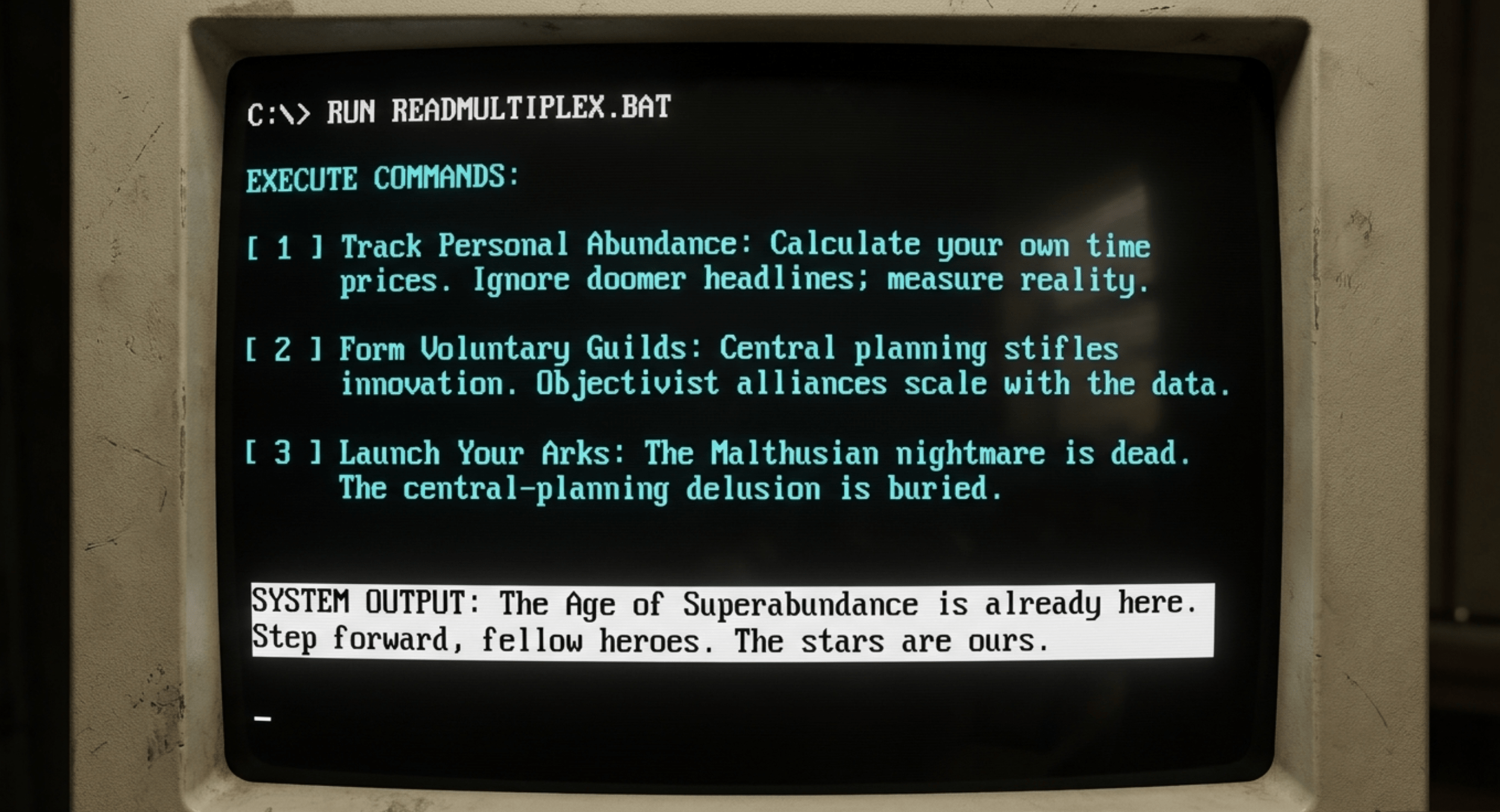
Welcome to the next 5000 days. The frontier is open. The renaissance awaits those ready to meet it as heroes. The Age of Superabundance is not a promise for some distant century. It is compounding right now, today, driven by the intersection of human knowledge and exponentially growing technology. The ordinary world was never truly scarce. We simply lacked the proper lens.
Now we have it. Now we wield it. Now we build. The stars are ours. The future is abundant. And we, together, have only just begun to build it.
The 5000 Days Countdown Clock:
We are on this journey together. Some of us stand on the shoulders of giants and have thought about this for decades. We will not go it alone, and I hope to build many parts to this series and share the mastermind insight from the powerful Read Multiplex member Forum: https://readmultiplex.com/forums/topic/you-have-5000-days-navigating-the-end-of-work-as-we-know-it/. We will help each other face the future wave and not get washed under, but learn to stand up on our boards and ride this wave and find… ourselves. Join us.
To continue this vital work documenting, analyzing, and sharing these hard-won lessons before we launch humanity’s greatest leap: I need your support. Independent research like this relies entirely on readers who believe in preparing wisely for our multi-planetary future. If this has ignited your imagination about what is possible, please consider donating at buy me a Coffee or becoming a member. Value for value you recieved here.
Every contribution helps sustain deeper fieldwork, upcoming articles, and the broader mission of translating my work to practical applications. Ain ‘t no large AI company supporting me, but you are, even if you just read this far. For this, I thank you.
Stay aware and stay curious,

🔐 Start: Exclusive Member-Only Content.
Membership status:
🔐 End: Exclusive Member-Only Content.
~—~

~—~

~—~
Subscribe ($99) or donate by Bitcoin.
Copy address: bc1qkufy0r5nttm6urw9vnm08sxval0h0r3xlf4v4x
Send your receipt to [email protected] to confirm subscription.

Stay updated: Get an email when we post new articles:

THE ENTIRETY OF THIS SITE IS UNDER COPYRIGHT. IMPORTANT: Any reproduction, copying, or redistribution, in whole or in part, is prohibited without written permission from the publisher. Information contained herein is obtained from sources believed to be reliable, but its accuracy cannot be guaranteed. We are not financial advisors, nor do we give personalized financial advice. The opinions expressed herein are those of the publisher and are subject to change without notice. It may become outdated, and there is no obligation to update any such information. Recommendations should be made only after consulting with your advisor and only after reviewing the prospectus or financial statements of any company in question. You shouldn’t make any decision based solely on what you read here. Postings here are intended for informational purposes only. The information provided here is not intended to be a substitute for professional medical advice, diagnosis, or treatment. Always seek the advice of your physician or other qualified healthcare provider with any questions you may have regarding a medical condition. Information here does not endorse any specific tests, products, procedures, opinions, or other information that may be mentioned on this site. Reliance on any information provided, employees, others appearing on this site at the invitation of this site, or other visitors to this site is solely at your own risk.
Copyright Notice:
All content on this website, including text, images, graphics, and other media, is the property of Read Multiplex or its respective owners and is protected by international copyright laws. We make every effort to ensure that all content used on this website is either original or used with proper permission and attribution when available.
However, if you believe that any content on this website infringes upon your copyright, please contact us immediately using our 'Reach Out' link in the menu. We will promptly remove any infringing material upon verification of your claim. Please note that we are not responsible for any copyright infringement that may occur as a result of user-generated content or third-party links on this website. Thank you for respecting our intellectual property rights.
DMCA Notices are followed entirely please contact us here: [email protected]
