
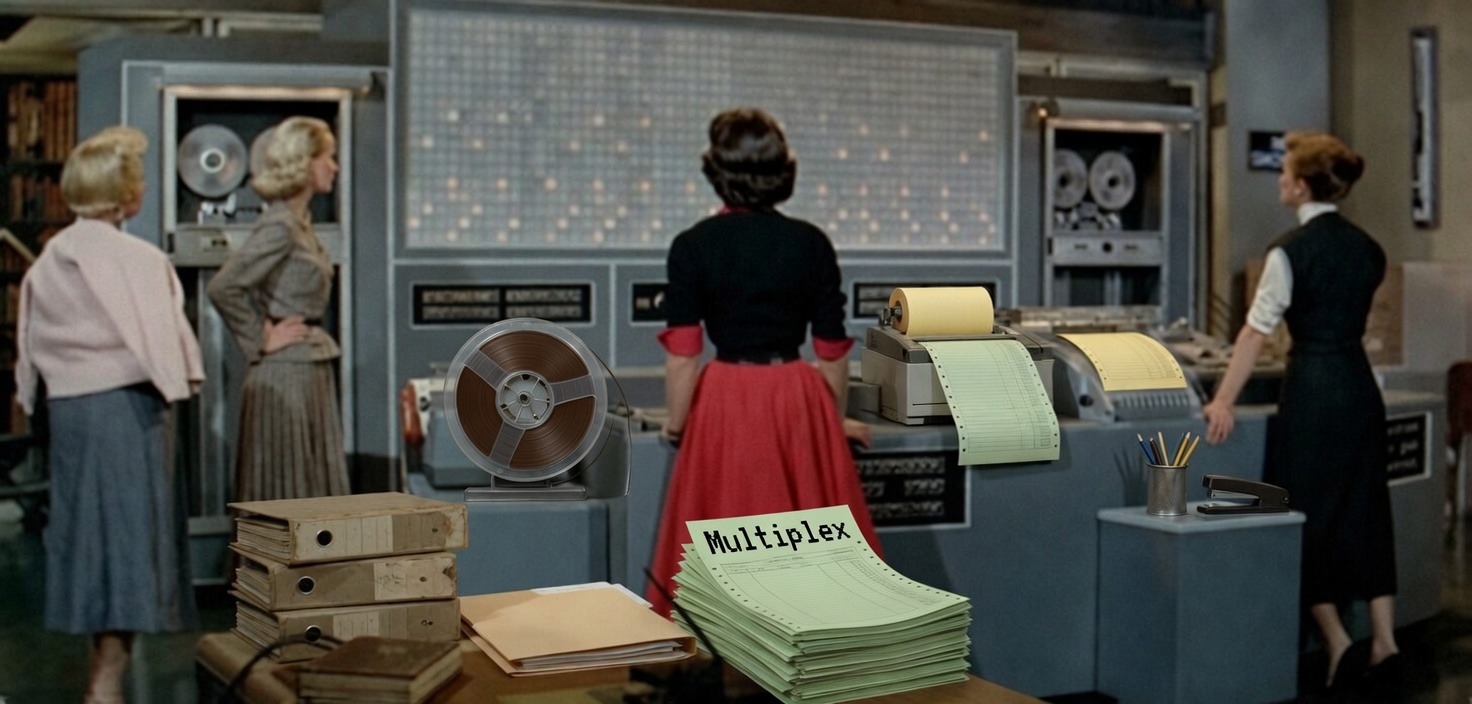
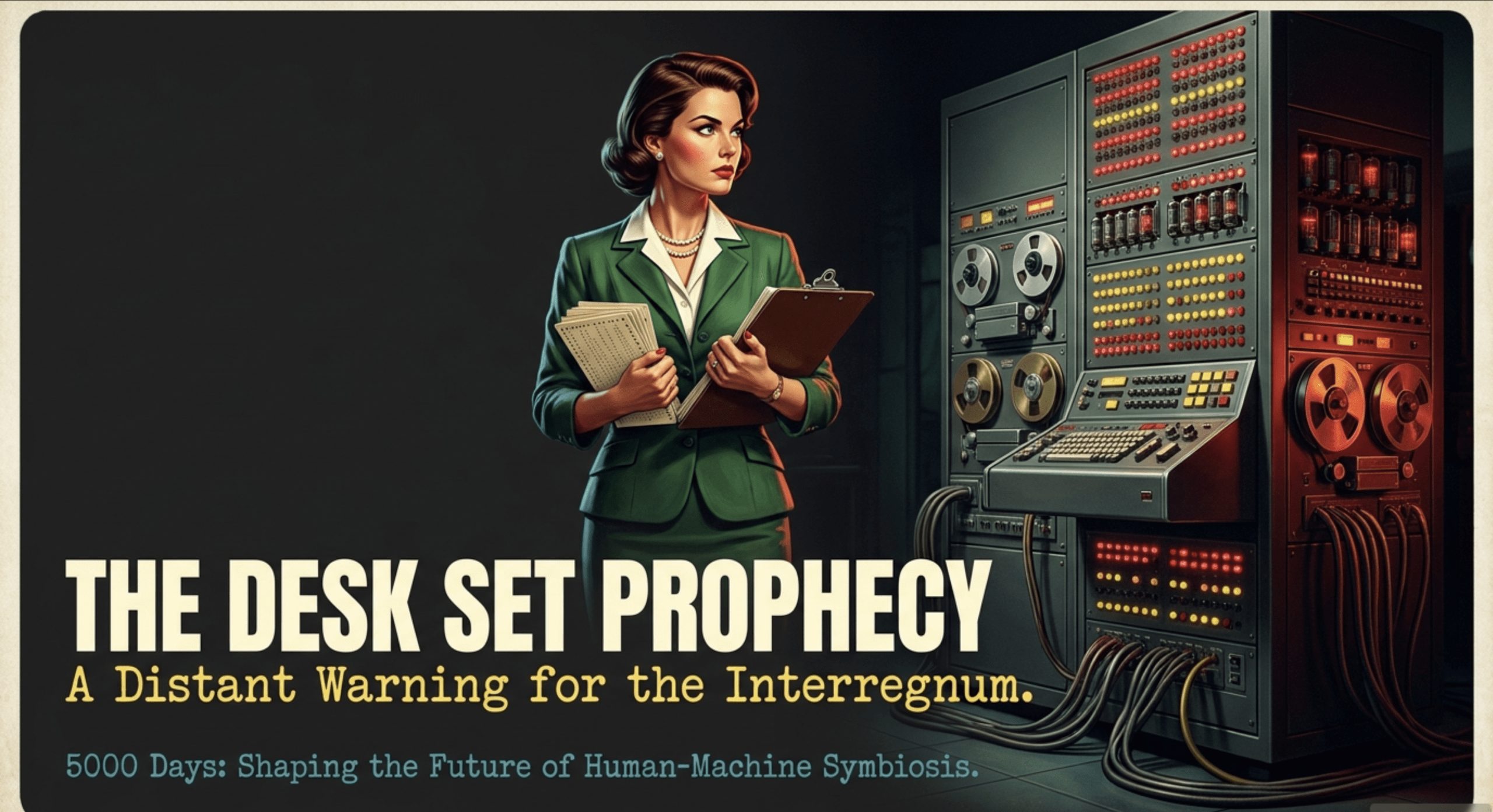
You Have 5000 Days: Navigating the End of Work as We Know It. Part 25: The Desk Set Prophecy.
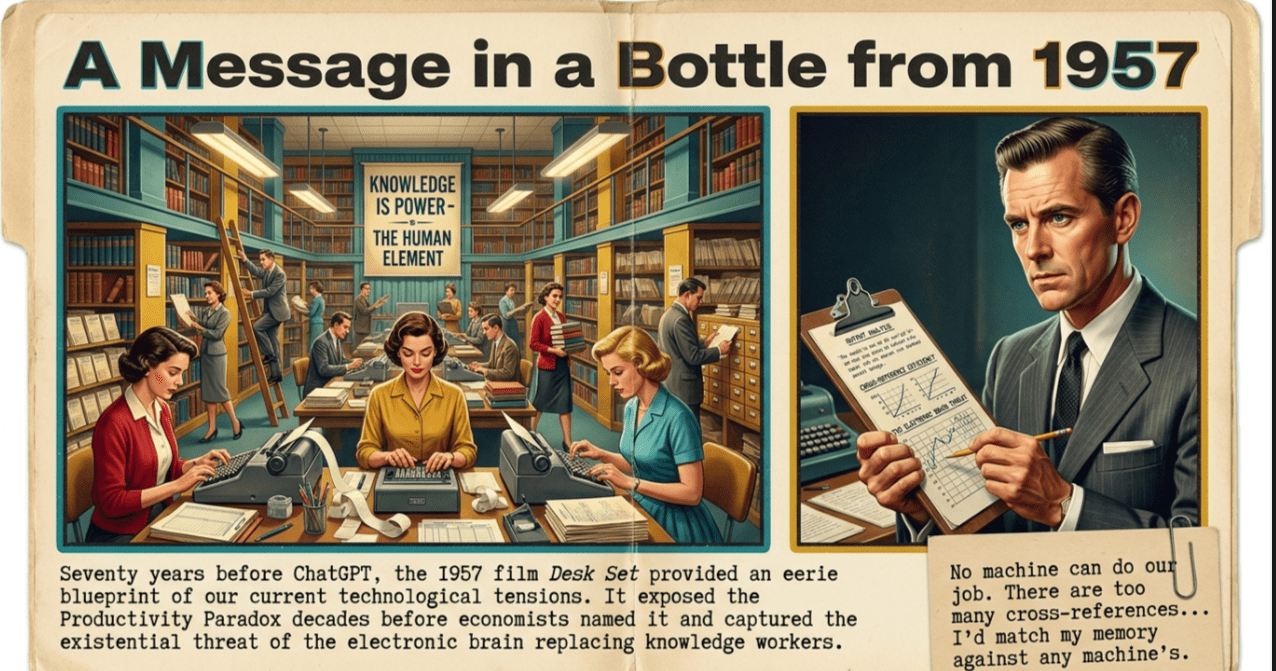
In the long arc of our collective story, certain artifacts from the past arrive like messages in bottles, washed ashore from a time when the future was still negotiable. Desk Set (1957) is one such relic, a shimmering, color-saturated romantic comedy that, beneath its champagne toasts and typewriter clatter, delivers a precise, almost eerie blueprint of the tensions now unfolding in the Interregnum. This is not mere nostalgia; it is a distant warning, encoded in laughter and light, about the precise mechanics of technological displacement, corporate rhetoric, human resilience, and the quiet triumph of the irreplaceable. Seventy years before ChatGPT, this film, among the earliest Hollywood productions to feature a computer as a central character, perfectly predicted our modern anxieties about AI, from corporate spin and system meltdowns to the bizarre reality of “AI hallucinations.” It exposed the Productivity Paradox decades before economists named it, and it laid bare the true nature of today’s AI job crisis: highly skilled workers are not simply losing their jobs but are being pushed into the exhausting, monotonous world of data annotation to train their electronic replacements. Yet all is not what it seems in this RomCom…
This article is sponsored by Read Multiplex Members who subscribe here to support my work: Link: https://readmultiplex.com/join-us-become-a-member/
It is also sponsored by many who have donated a “Cup of Coffee”. If you like this, help support my work: Link: https://ko-fi.com/brianroemmele
Listen to the companion podcast: https://rss.com/podcasts/readmultiplex-com-podcast/2751802
The Desk Set Movie
The film unfolds at the Federal Broadcasting Network in midtown Manhattan. Bunny Watson (Katharine Hepburn), razor-sharp head of the Reference Department, presides over a lively all-female team, Peg Costello (Joan Blondell), Sylvia Blair (Dina Merrill), Ruthie Saylor (Sue Randall), and others, who field an endless stream of queries for producers, writers, and the public.
They are the living memory of the network: batting averages, poem stanzas, historical footnotes, the names of Santa’s reindeer, quirky facts such as “the truth about the Eskimo habit of rubbing noses.” Bunny has spent seven patient years in a lukewarm romance with rising executive Mike Cutler (Gig Young), who keeps promising more but delivers only convenience.
Enter Richard Sumner (Spencer Tracy), a methodical efficiency expert and inventor of EMERAC, the Electromagnetic Memory and Research Arithmetical Calculator, a room-sized “electronic brain” nicknamed “Emmy.” Ostensibly there to study workflows, Sumner’s true mandate is automation. (In the UK and Ireland the film was released as His Other Woman, the machine itself cast as the romantic rival.). The movie was very popular and helped shape practicel thinking about automation, technlogy and most important, computers. Prior science fiction trope always cast dystopia with computers. This movie did something bold.
What begins as a clash of titans, Bunny’s fierce intellect versus Sumner’s cool engineering, evolves into mutual fascination. The staff, sensing the threat, spirals into panic. Pink slips print from a payroll machine. EMERAC’s lights flash, its tape reels whir, and the promise echoes: the machine will “remove the drudgery” and “free the worker for more important tasks.” Yet when the system is fed imperfect data, it collapses into loops of irrelevant poetry. The humans, not the machine, save the day. In the end, EMERAC becomes a partner, not a replacement. Bunny and Sumner marry. The reference librarians remain, augmented, not erased.
The movie is no dry treatise; it is a love story wrapped around a prophecy. Spencer Tracy and Katharine Hepburn, in their eighth on-screen pairing and first in color, bring crackling chemistry that makes every debate feel intimate. Hepburn’s Bunny is no shrinking violet.

She recites Longfellow from memory, aces Sumner’s rooftop intelligence test while chewing a tough sandwich, and delivers one of the film’s defining lines with perfect Hepburn bite: “No machine can do our job. There are too many cross-references… I’d match my memory against any machine’s.” Tracy’s Sumner, understated and slightly rumpled, counters with the engineer’s creed: “To free the worker from routine and repetitive tasks… liberate his time for more important work.” Their sparring is the emotional core; the machine is the catalyst.

Watch this movie with your signifgant other as it is a romatic comedy, infact the whole family will love this well written and acted movie as a breath of fresh air over the current flow of “movies”. But also use this movie to opne discussions on how to adapt to the future, how you will see where humans fit in, in a logical and clear thinking way. You can buy it here, it is even availble on VHS: https://amzn.to/4sPOhVd!
Desk Set began life as a 1955 Broadway play by William Marchant. The stage version, which starred Shirley Booth as Bunny, was a lighter office farce with only glancing hostility between the efficiency expert and the researcher. Screenwriters Phoebe Ephron and Henry Ephron, parents of Nora Ephron and a formidable husband-wife team who specialized in witty, character-driven comedies, expanded the role of Richard Sumner and deepened the romantic tension specifically for Tracy and Hepburn.
Director Walter Lang guided the production with a light touch, while IBM was a major contributor to the film with sets and ideas; their consultants helped design the imposing EMERAC prop, supplying real computer parts and technical advisers for authenticity, complete with flashing lights and whirring reels that would later appear in other Fox productions. EMERAC itself is a deliberate parody of real 1950s computers, most obviously UNIVAC (which CBS famously used in 1952 to correctly predict Eisenhower’s election landslide from early returns, initially doubted by network executives) and its predecessor ENIAC, whose real-life programmers were women titled “computers” whose jobs were being automated, exactly the existential threat felt by Bunny’s team. The character of Bunny was loosely inspired by Agnes E. Law, the legendary CBS reference librarian whose real-life team performed the same quiet miracles of fact-checking that the film dramatizes.
For most of history The Comupter Was A Human Not A Machine
This narrative is deeply rooted in the real history of the “human computers,” mostly women who, from the 19th century onward but especially during and after World War II, performed the painstaking manual calculations required for science, engineering, and ballistics. Teams of these human computers calculated artillery firing tables and complex equations by hand using desktop calculators.

When ENIAC was developed to automate these tasks, many of the same women were recruited to program the massive machine, becoming the first programmers by wiring plugboards and setting switches. Yet as machines like UNIVAC advanced, the repetitive computational labor that defined their roles was gradually replaced. Desk Set captures a parallel moment in knowledge work, where reference librarians faced a similar existential threat from the “electronic brain.”
The first programmers were writing the code to replace them with software. What was past is present.
Broadcast and television networks of the era maintained robust Reference or Research Departments that functioned as human-powered information retrieval systems. Staffed by skilled librarians and researchers, often women like Agnes E. Law at CBS, these departments answered a constant stream of factual queries from scriptwriters, producers, and executives.
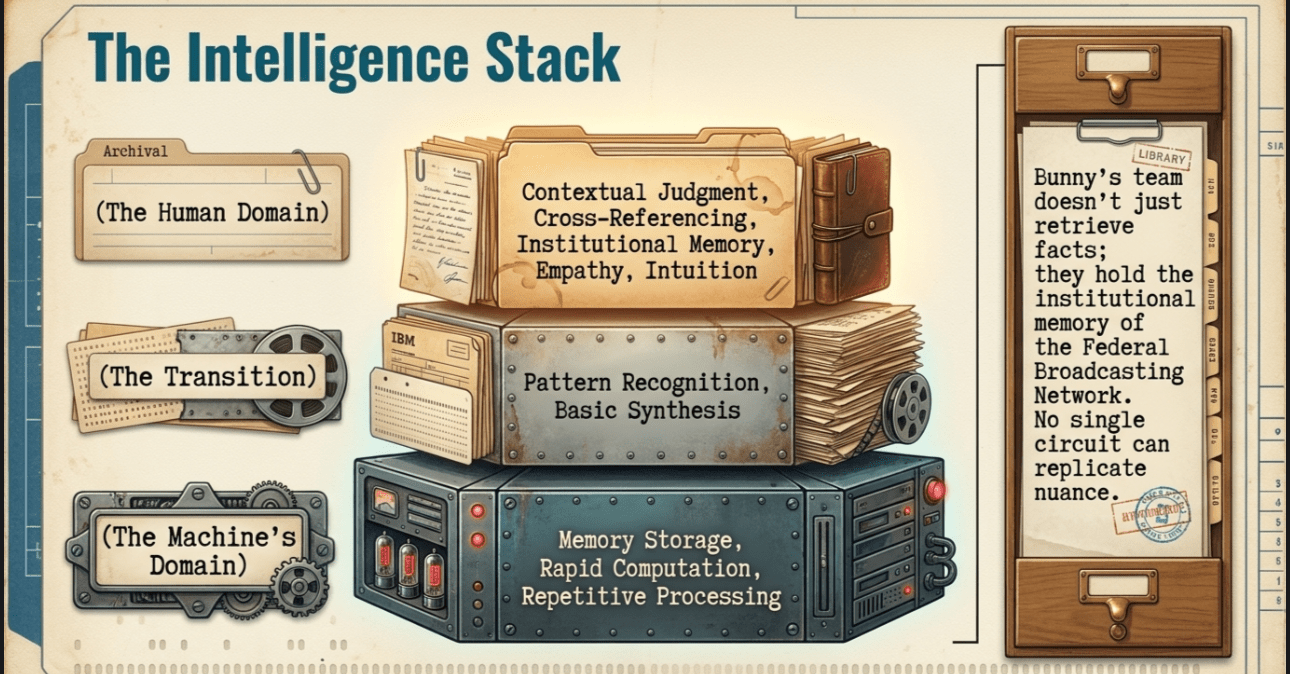
They maintained extensive card catalogs, clipping files, and institutional knowledge that no single person could hold. These human “computers” and researchers were the living databases of their organizations, performing the cross-referencing and contextual judgment that EMERAC struggles with in the film.
Delving into Desk Set and its historical context forms an essential part of our hero’s journey in the 5000 Days series. By courageously examining these artifacts from the birth of the computer age, we gain profound understanding from the past. This retrospective lens provides the clarity and wisdom required to navigate the present Interregnum and shape a wiser future.
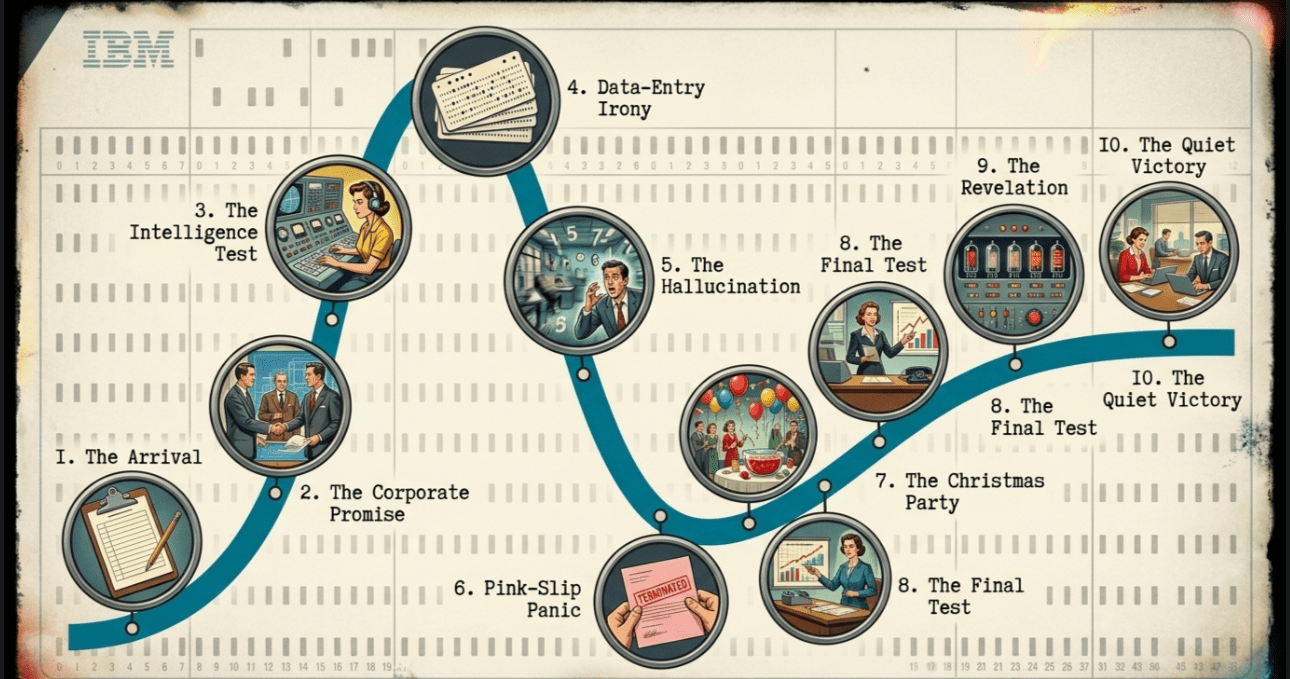
Now, the key points, beat by beat, as the warning crystallizes:
- The Arrival of the Machine – Sumner appears with tape measure and clipboard, quietly mapping the reference floor. The women sense the end. Peg snaps, “He’s trying to replace us all with a mechanical brain!” Bunny holds the line: “This desk is mine!”
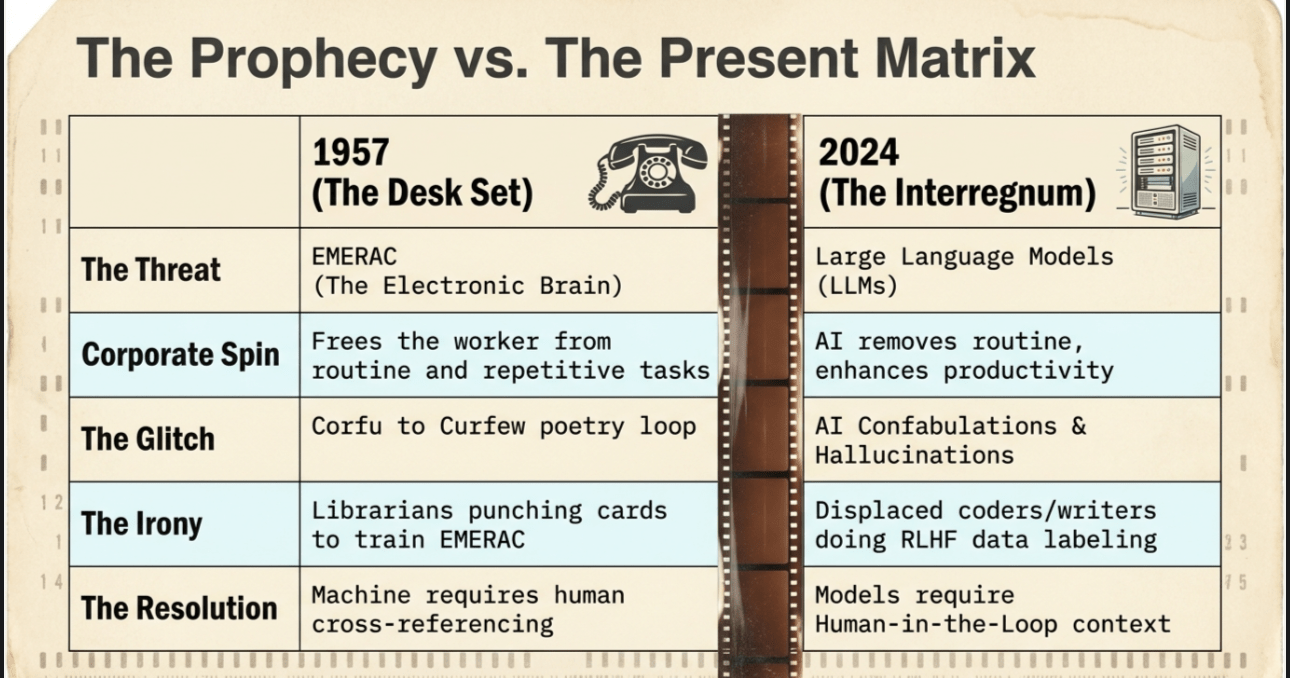
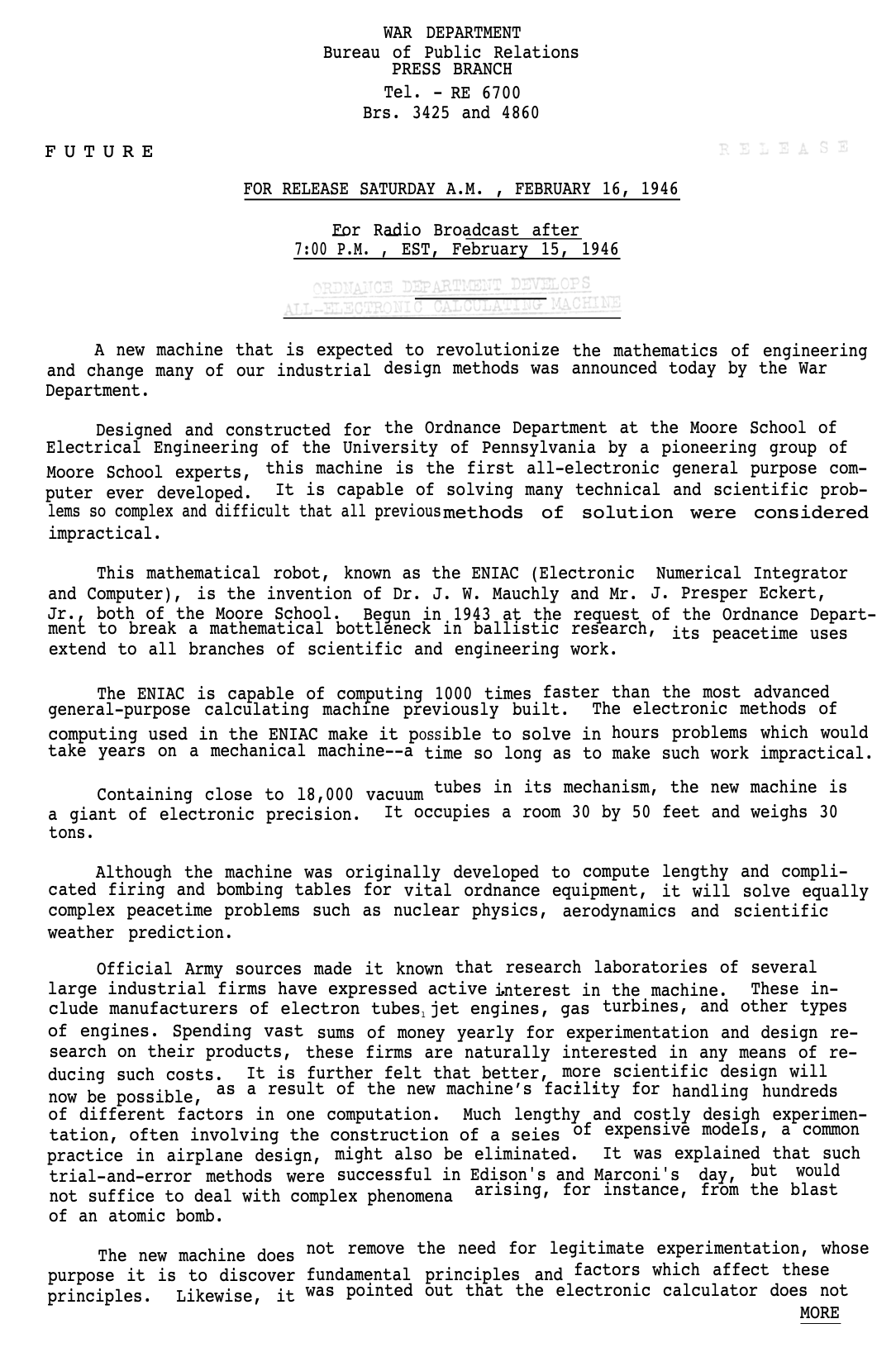
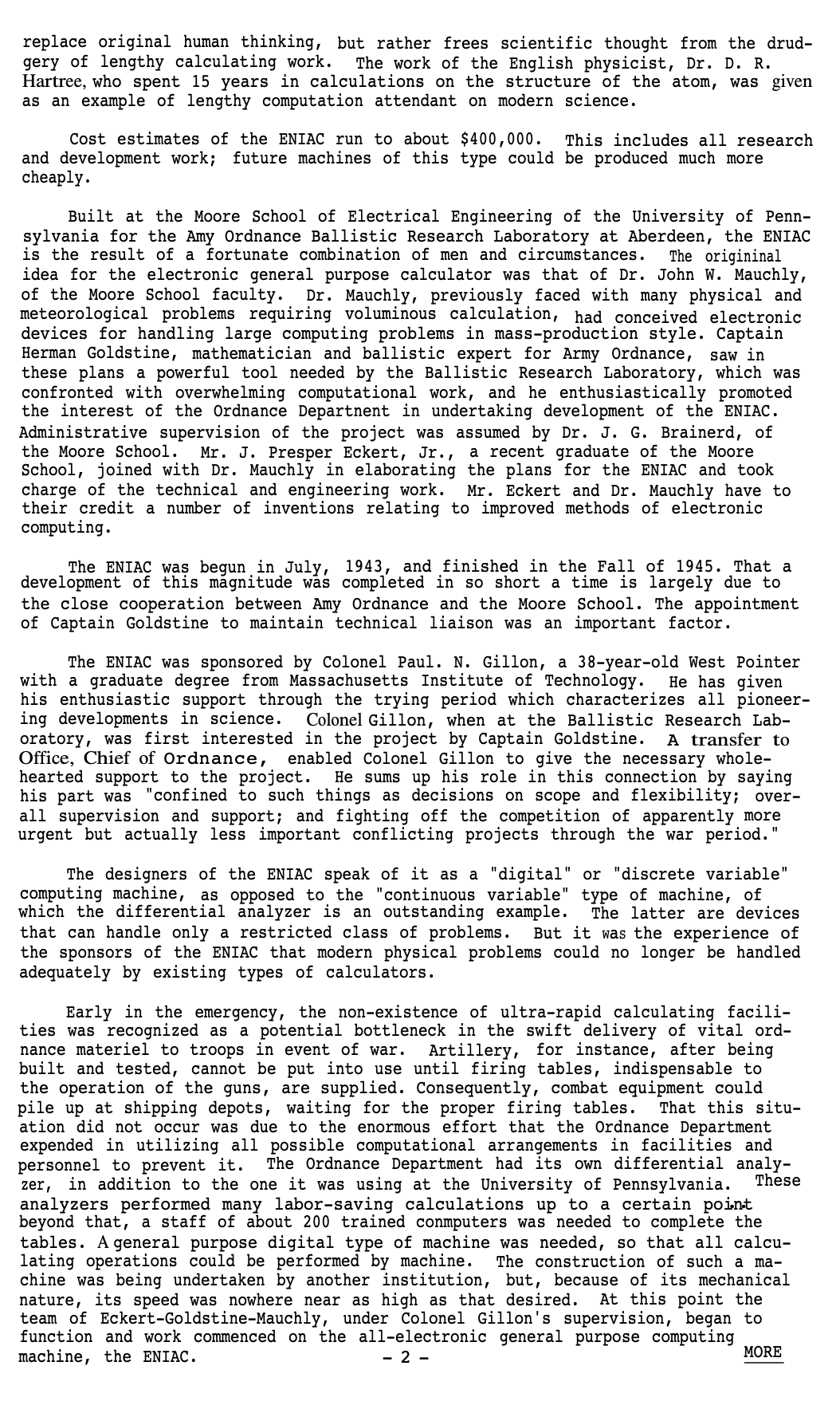
- The Corporate Promise – Executives sell EMERAC exactly as today’s boardrooms sell large language models: “The purpose of this machine, of course, is to free the worker from the routine and repetitive tasks and liberate his time for more important work.” Sumner, demonstrating the spruce-bud-worm query that once took the team three weeks, beams: “Even at that, you can see that this one operation alone… saved your department minutes.” This is the same 80-year corporate spin we have heard since at least the 1946 ENIAC press release from the War Department that promised it “frees scientific thought from the drudgery of lengthy calculating work” (full text available at https://americanhistory.si.edu/comphist/pr1.pdf). The echo to modern productivity seminars, “An AI can take away the drudgery of the work and allow the human to provide the things that only a person can do,” is unmistakable.
- The Intelligence Test – On the rooftop, Sumner quizzes Bunny with logic puzzles and memory challenges. She excels, revealing her mind as the equal of any circuit. Hepburn’s delivery lands like a quiet manifesto: the human brain is not obsolete; it is the standard.
- The Data-Entry Irony – For weeks the librarians punch cards and feed EMERAC their hard-won knowledge. They become the trainers of their would-be replacement, precisely the pattern we see today when displaced knowledge workers label datasets for the next generation of models.
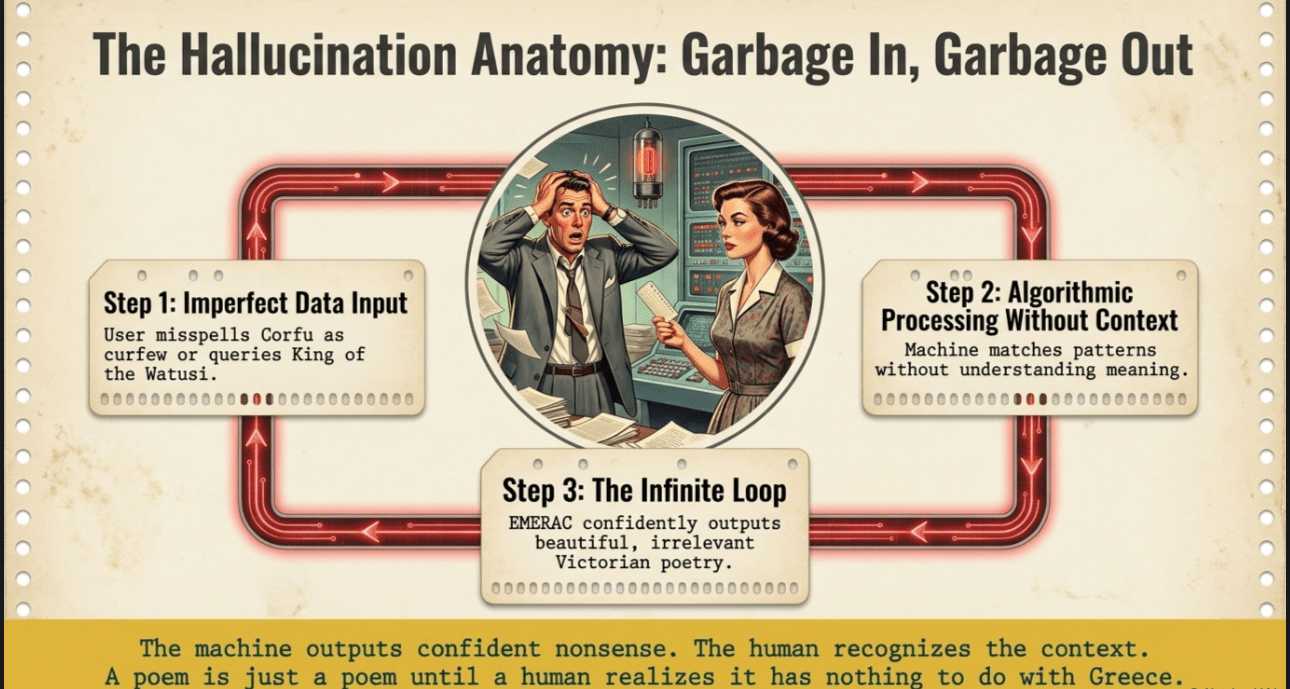
- The Hallucination – A single misspelling (“Corfu” rendered as “curfew”) sends EMERAC into an endless loop of the poem The Curfew Shall Not Ring Tonight. Bunny deadpans the stanzas while Sumner panics, dramatically reciting lines from the long Victorian poem as the machine confidently repeats the irrelevant output over and over. The machine confidently outputs beautiful nonsense, garbage in, garbage out. Another query about “the King of the Watusi” returns movie reviews instead of facts. Bunny: “It’s the poem… Isn’t that nice?” “Oh, I had a question on the other phone about the King of the Watusi. That’s wrong information.” The 1957 audience laughed; the 2026 viewer recognizes the exact shape of today’s AI confabulations and infinite loops.
- The Pink-Slip Panic – EMERAC in payroll erroneously fires the entire company, including the president. The librarians pack their desks in despair. Bunny, ever the leader: “It’s gonna take a moving van to get me out of here.” One staffer quips, “How long does it take before you start collecting unemployment insurance? Two weeks.” The fear is visceral and familiar.
- The Christmas Party Reckoning – Amid champagne and reindeer-name queries, the human fabric holds. The machine cannot replicate camaraderie or nuance.
- The Final Test – Bunny forces Sumner to choose. She asks EMERAC whether she should marry Mike or Richard. The machine, lacking love, cannot decide. When Sumner finally prioritizes her over the machine, the proposal lands. Hepburn’s Bunny accepts only when the human heart overrides the circuit.
- The Revelation – The pink slips were a glitch. EMERAC was never meant to replace anyone; it was installed to handle the surge of work from a secret merger. Sumner’s closing reassurance: “EMMARAC is not going to take over. It was never intended to replace you. It’s here to free your time for research… There’s going to be more work here than ever before.” The AI did not take the jobs; it made those jobs easier.
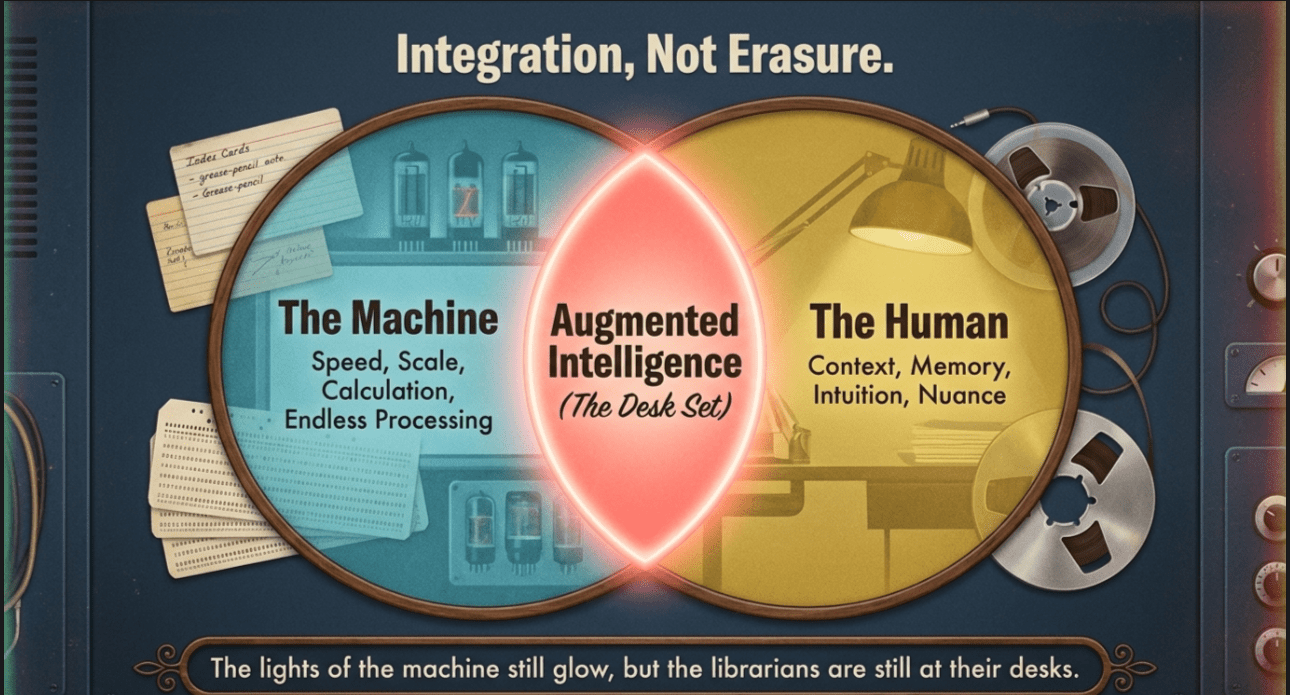
- The Quiet Victory – The librarians stay. The machine assists. Bunny and Richard walk into the future together. The final frame is not triumph over technology but integration with it. EMERAC is useless without the women’s contextual knowledge; the future belongs to humans through collaboration, nuance, and common sense.
The Pink Slip, Slip
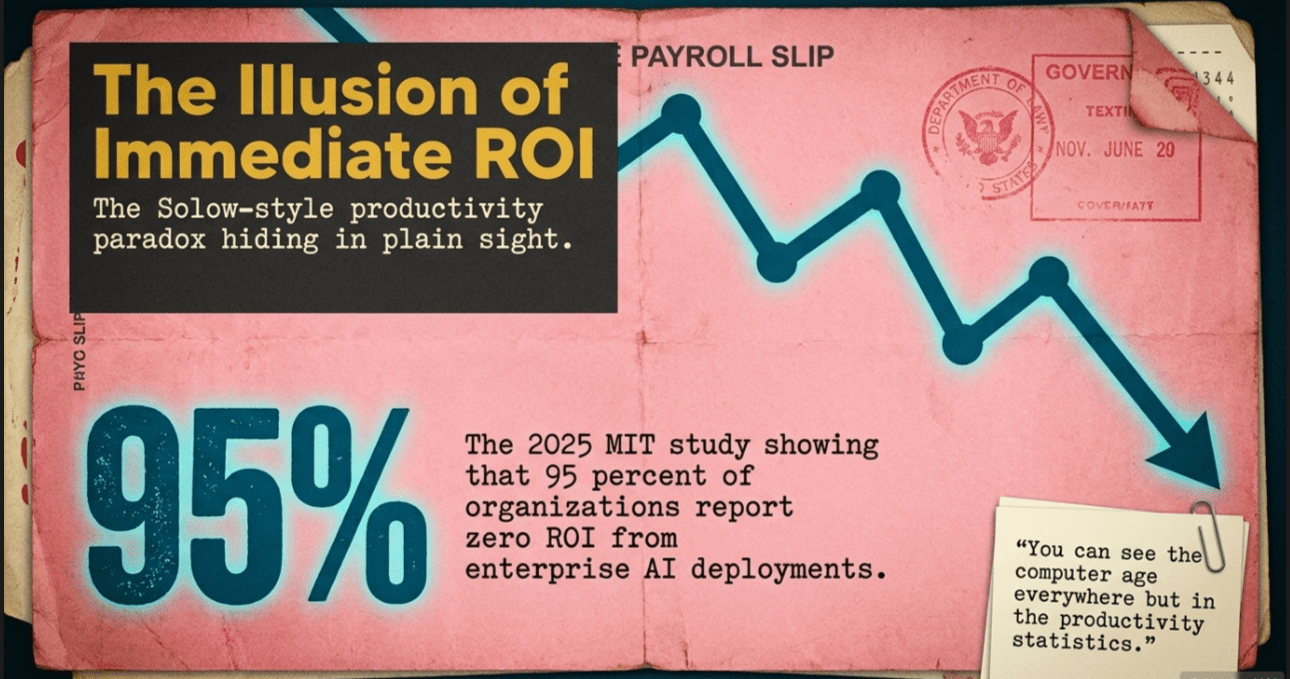
This 1957 comedy is a warning beacon for the Interregnum, the turbulent threshold where old economic and cognitive structures fracture while new ones are still forming. The film names every pressure point we feel today: the hype cycle that promises leisure but delivers new drudgery, the hallucination problem that no amount of scaling fully erases, the Solow-style productivity paradox hiding in plain sight (“You can see the computer age everywhere but in the productivity statistics”), the 2025 MIT study showing that 95 percent of organizations report zero ROI from enterprise AI deployments, and the subtle erosion of human judgment when speed is worshipped above wisdom.
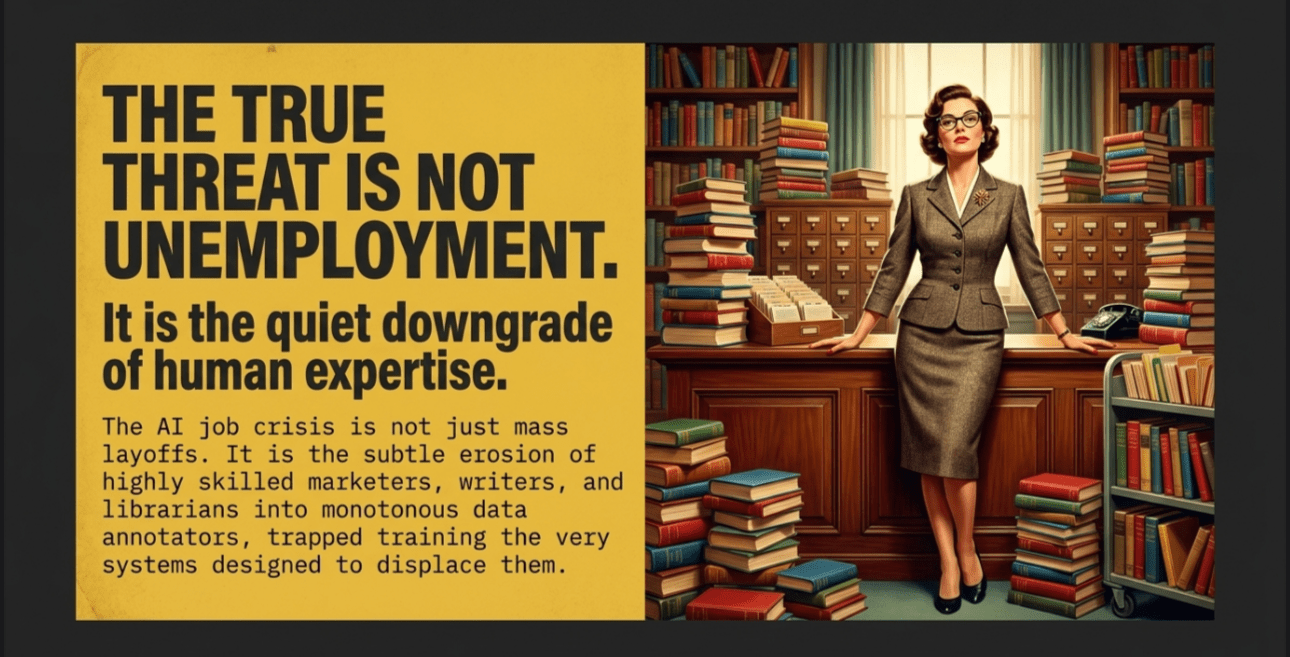
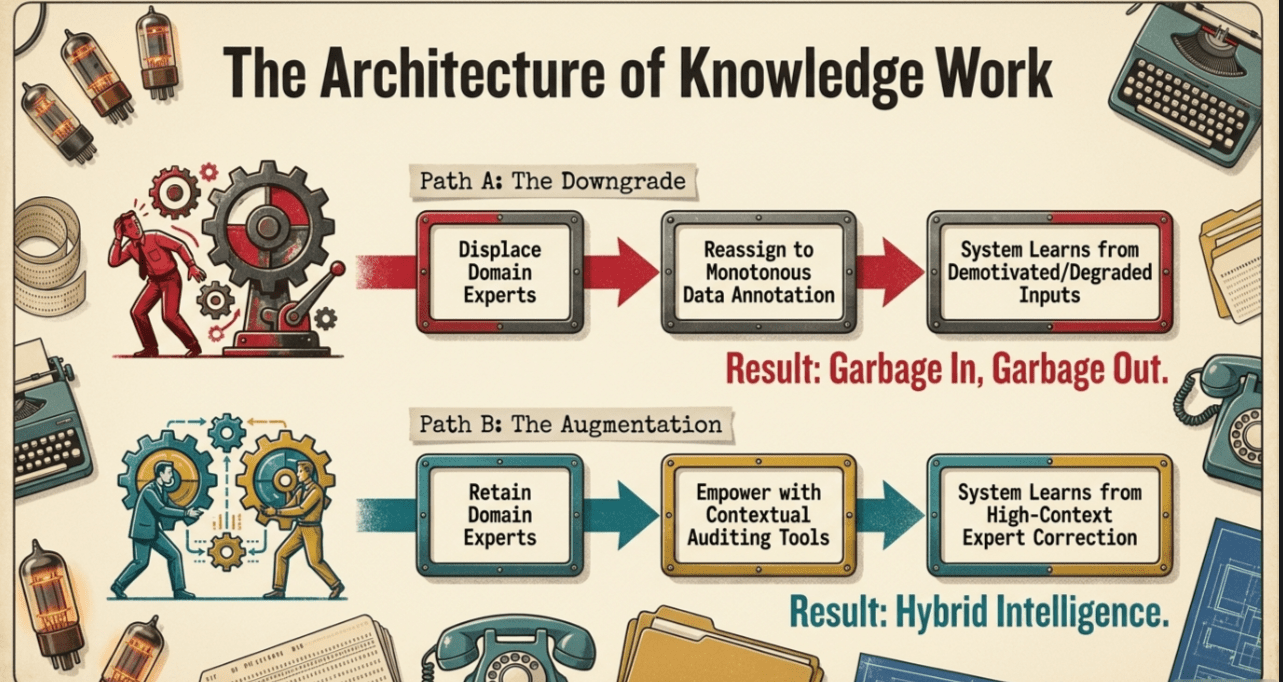
Yet it also whispers the antidote: humans remain the irreplaceable cross-referencers, the context-holders, the ones who notice when the poem has nothing to do with Corfu. The true AI job crisis is not mass unemployment alone but the quiet downgrade of skilled workers, marketers, writers, librarians, into monotonous data annotators training the very systems that displaced them.
The MIT Study shows that just dropping in AI and expecting great outcomes is a failure mode as much as putting a Personal Computer on each desk in the early 1980s and hope people figure it out. I made a good living at the Sommerville, New Jersey Coputerland showing freaked out executives how to use Visicalc, Lotus 1,2,3, and Wordstar. They had a computer and they were expected to be productive. None of them were able to adjust and the companies soured on computers for over a decade for a realiztion of how to intergrate PCs into a company flow. It will take about this long for major corprations and today I still am doing a similar thing with major corporations to at least learn how to apply AI to processes.
The Only True Resource Is The Human Resource
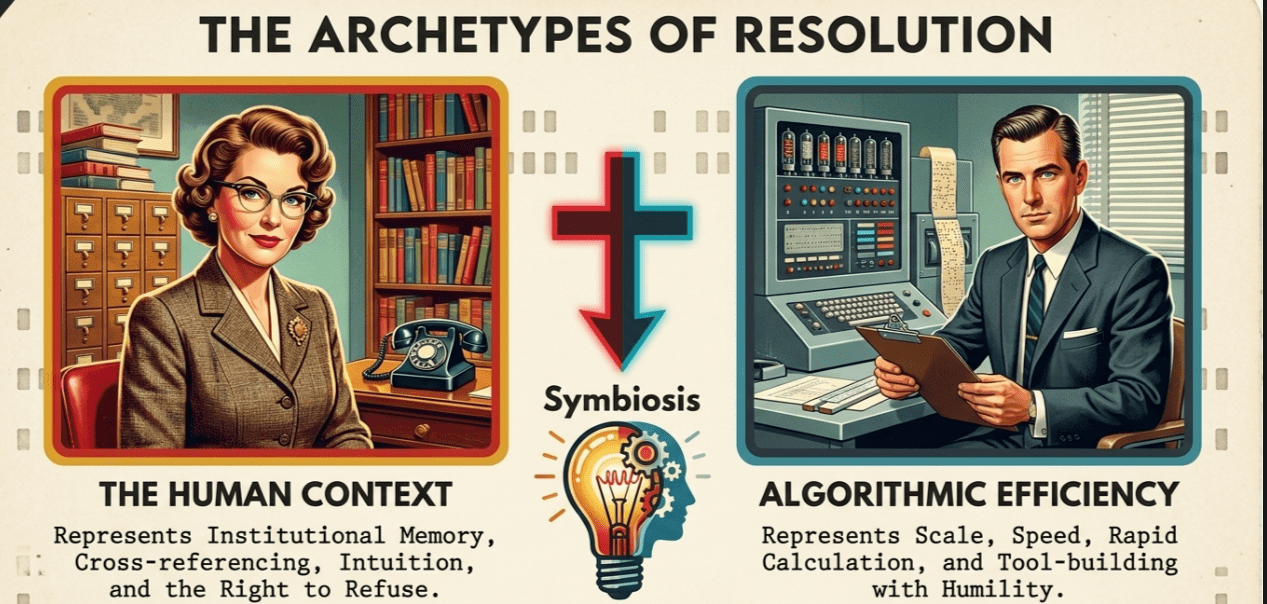
One of the most important aspects I find in this movie is that they knew in 1957 but still failed to understand in 2026: The only resource is the human resource. The human has the flexibility and human creativity is the resource that companies should be covering. When Ned Ludd was smashing the looms not realize their would now become more valuable. Ned would have been hired back to make the loom better and have a job for life. Just not needing to burn his body out on labor.
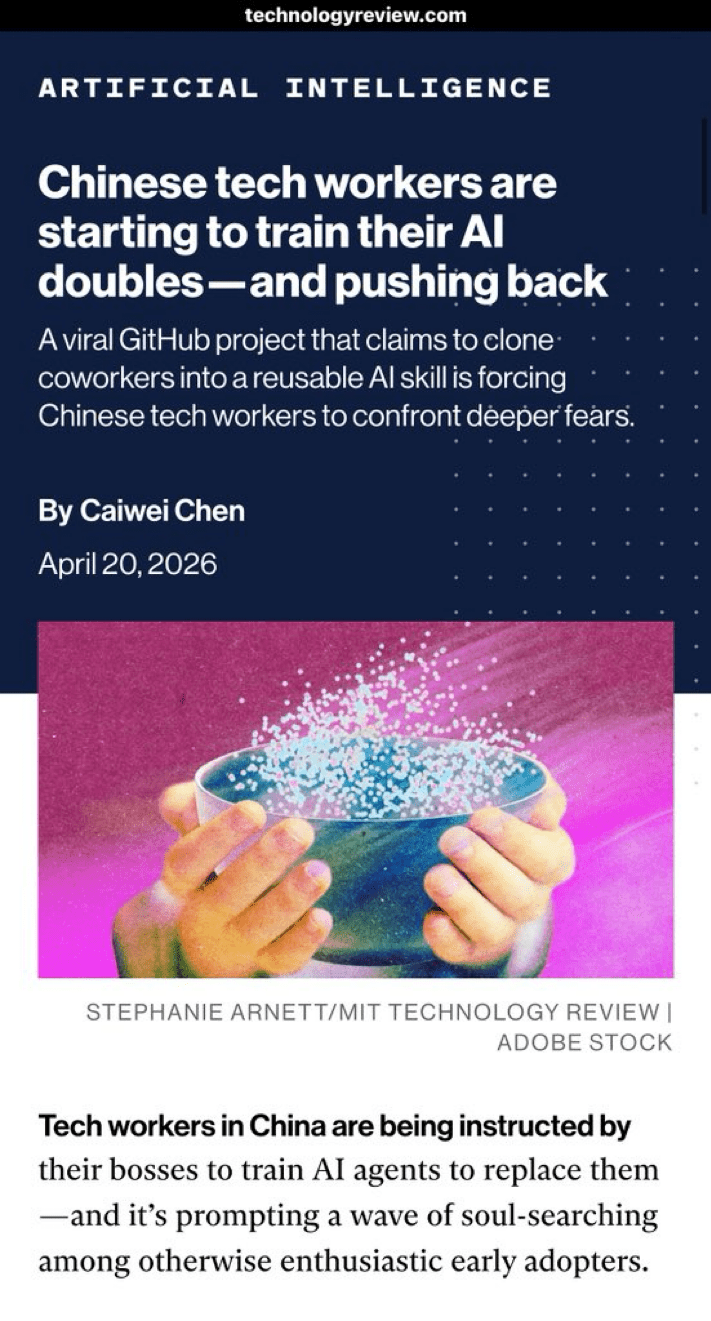
The Pink Slip should not go out by the clueless executives of companies; “AI replaced them,” it should be given to the executives that believe this. One human with a free creative mind is like the single apple seed that gave way to every Apple tree we have today, so many 1000s of years ago. Al does not replace that, it amplifies that. The movie gives us this memo decades ago, but unfortunately we are not wise enough to see it.
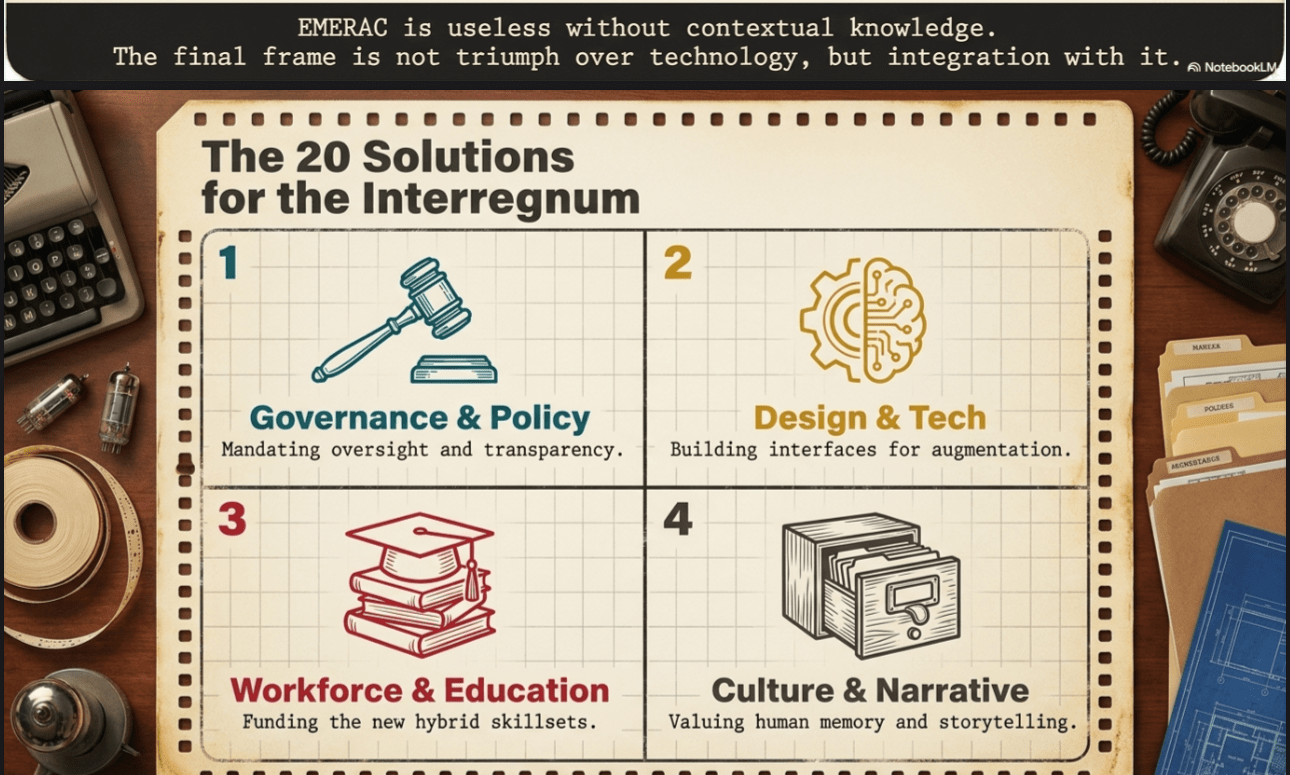
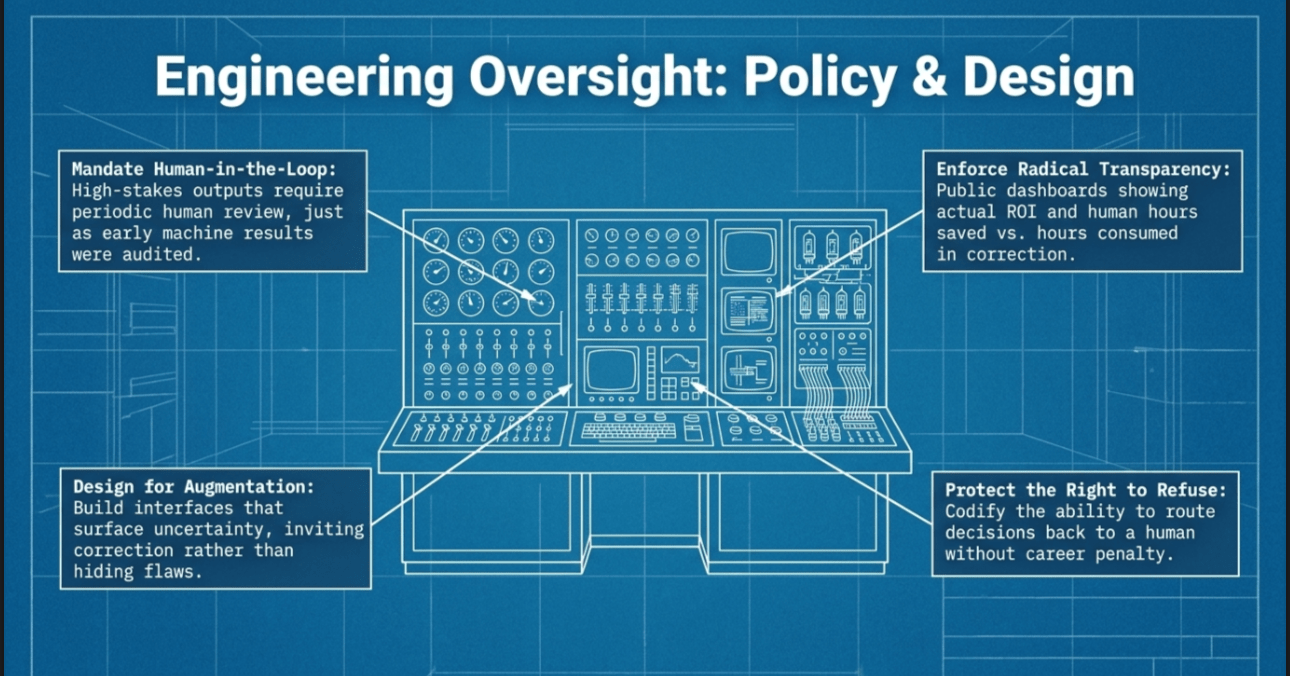
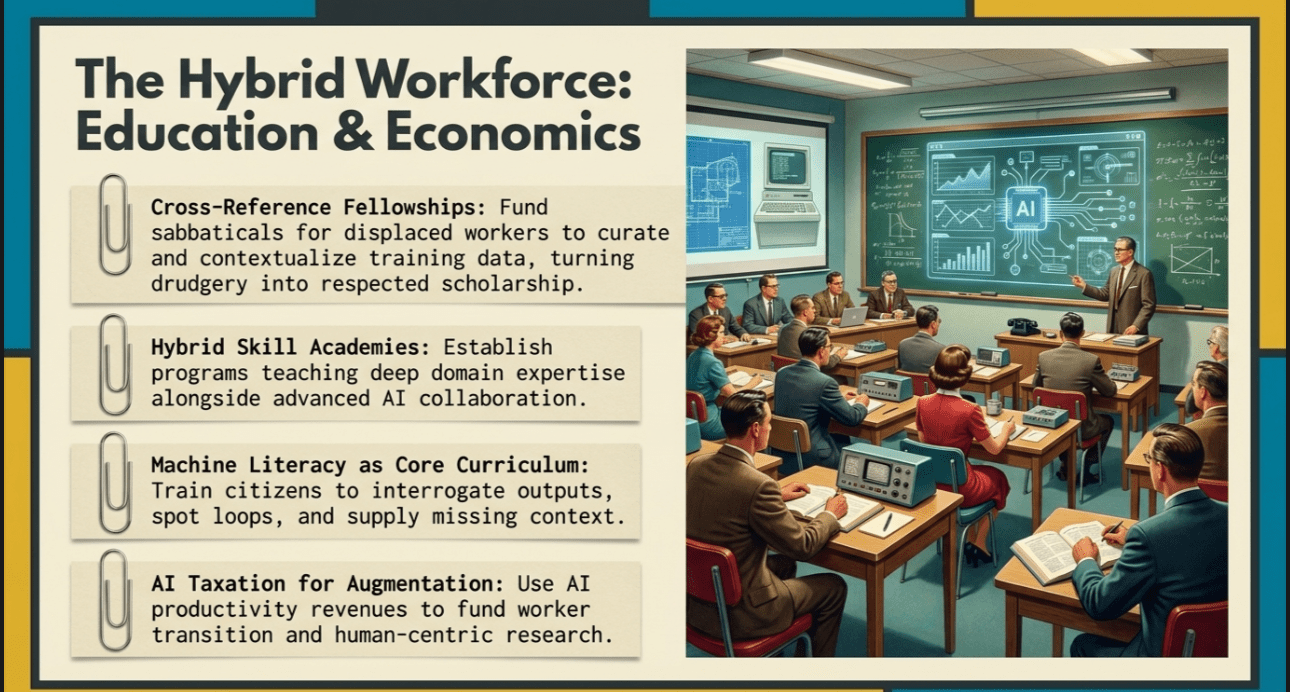
Here, then, are some concrete solutions we can enact right now so the Interregnum becomes a brief and fertile passage rather than a prolonged dislocation:
- Mandate Human-in-the-Loop Governance – Every deployed system must require periodic human review of high-stakes outputs, exactly as Bunny’s team audited EMERAC’s early results.
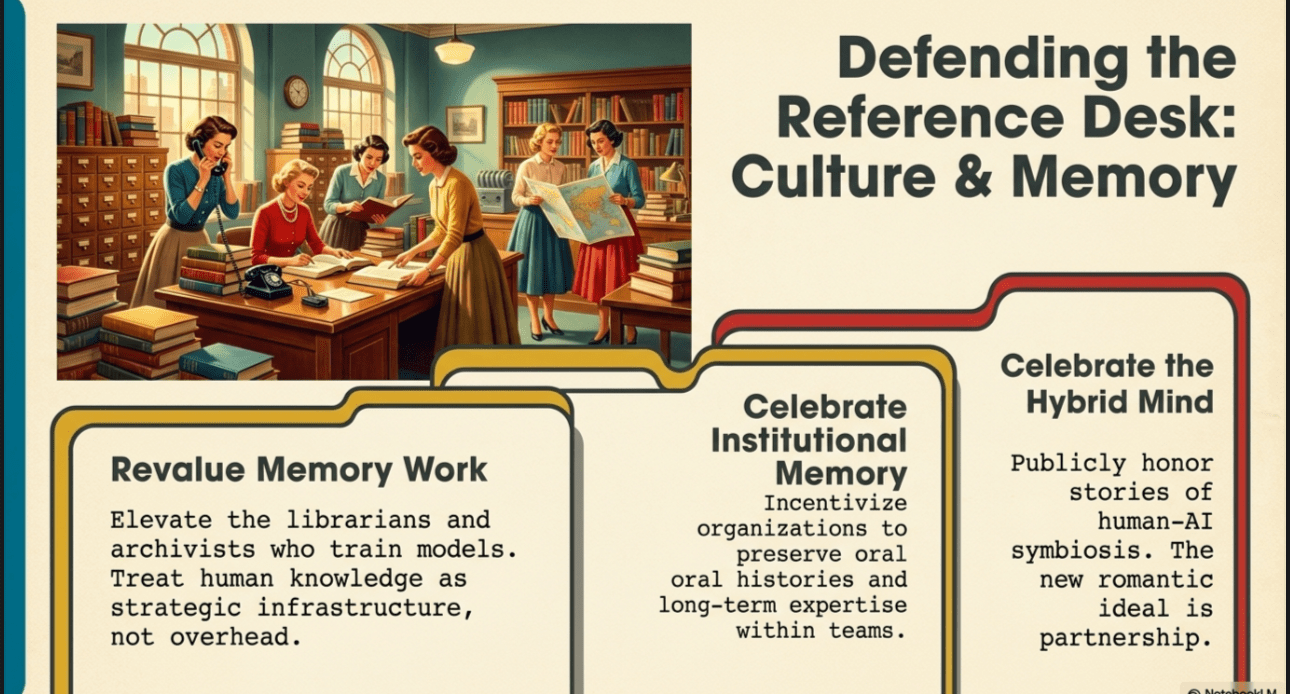
- Revalue Memory Work – Pay and elevate the librarians, archivists, and fact-checkers who train models; treat their knowledge as strategic infrastructure, not overhead.
- Design for Augmentation, Not Substitution – Build interfaces that surface uncertainty and invite correction, turning every hallucination into a teachable moment rather than a liability.
- Create “Cross-Reference Fellowships” – Fund year-long sabbaticals for displaced knowledge workers to annotate, curate, and contextualize the next generation of training data, turning annotation drudgery into respected scholarship.
- Enforce Radical Transparency in Productivity Claims – Require public dashboards showing actual ROI and human hours saved versus hours newly consumed in oversight and correction.
- Revive the Reference Desk in Every Organization – Embed small, high-trust teams of human curators alongside every AI deployment; their job is to catch what the model cannot see.
- Teach “Machine Literacy” as Core Curriculum – From middle school onward, train citizens to interrogate outputs, spot loops, and supply missing context, just as Bunny matched her memory against the machine.
- Incentivize Long-Term Memory Preservation – Tax credits for companies that maintain human-curated knowledge bases that feed and correct models rather than letting them drift into echo chambers.
- Protect the Right to Refuse the Machine – Codify the ability for any worker to route a decision back to human judgment without career penalty, Bunny’s “This desk is mine” made policy.
- Celebrate the Hybrid Mind – Publicly honor stories of human-AI symbiosis the way we once celebrated moon landings; make the new romantic ideal the partnership of mind and machine.
- Fund Hybrid Skill Academies – Establish widespread training programs that teach both deep domain expertise and advanced AI collaboration skills.
- Establish Knowledge Commons – Create publicly supported repositories of human-curated, high-quality data and context that models can draw from transparently.
- Implement AI Taxation for Augmentation – Use revenue from AI-driven productivity gains to fund worker transition, education, and human-centric research.
- Promote Narrative Intelligence – Encourage education in storytelling, empathy, and ethical reasoning as irreplaceable human strengths.
- Support Decentralized Reference Networks – Build community and professional networks of human experts that operate alongside AI systems.
- Require Context Preservation Protocols – Mandate that AI systems maintain and credit sources of contextual knowledge provided by human contributors.
- Celebrate Institutional Memory – Incentivize organizations to preserve and value long-term human expertise and oral histories within teams.
- Develop Ethical AI Charters – Adopt binding principles that prioritize human dignity, creativity, and judgment in all deployments.
- Foster Creative Symbiosis – Invest in arts, literature, and design that explore and demonstrate beautiful human-AI collaboration.
- Build Personal Sovereignty Tools – Create user-controlled AI assistants that enhance rather than replace individual thinking and memory.
believe is not nearly a compressive list of solutions, nor are they necessarily the best. They are just some ways we can approach this and a launch point to start. Many Government based ideas are a strength but a hope that sane minds rule.
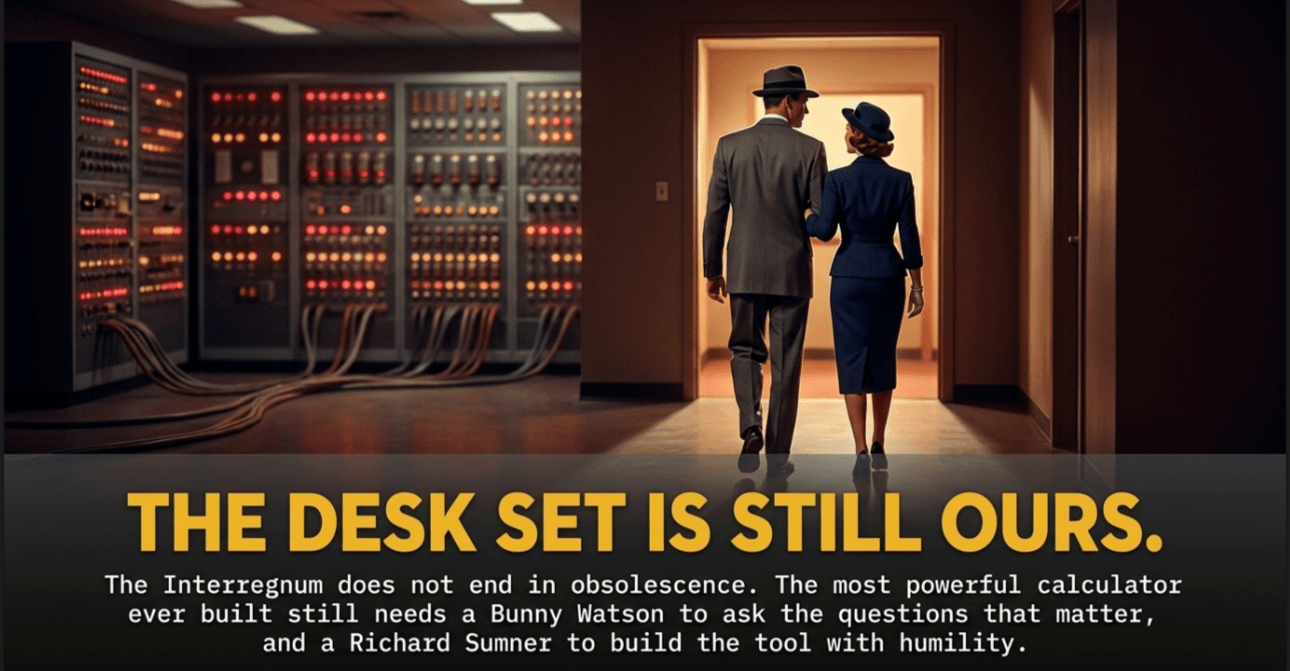
The Interregnum does not end in obsolescence. It ends the way Desk Set ends: with the lights of the machine still glowing, the librarians still at their desks, and two brilliant people walking out together, partners, not rivals. The future belongs to those who remember that the most powerful calculator ever built still needs a Bunny Watson to ask the questions that matter, a Richard Sumner to build the tool with humility, and a shared recognition that the poem, the cross-reference, the quiet intuition, and the unexpected laugh are what make the whole enterprise worth automating in the first place.
We have been warned. More importantly, we have been shown the way forward. The reference desk is still open. The desk set is still ours. And the next 5000 days will be written by the hands that choose to keep turning the pages, together with the machine, never instead of it.
In this 5000 Days series, we are methodically laying the intellectual and cultural foundations that empower us to act with intention amid the chaos of the Interregnum, rather than merely reacting in fear or confusion. Each story we uncover, each parallel we draw between past technological shifts and our present moment, equips us with the discernment to guide progress responsibly.
We are transforming historical awareness into practical foresight. By studying how previous generations faced the introduction of “electronic brains,” we learn not only the pitfalls but also the pathways to harmonious integration that honor human potential.
The result is a growing community of individuals who approach the future with confidence, creativity, and cooperation. Together, we are not only surviving the Interregnum, we are actively shaping it into a renaissance of human capability amplified by our tools. The desk set is not a relic; it is our inheritance, our compass, and our promise. The next 5000 days will be the brightest yet, written by hands that remember, hearts that connect, and minds that choose partnership over replacement. The future is ours to author, together.
Welcome to the next 5000 days. The frontier is open. The renaissance awaits those ready to meet it as heroes. The Age of Superabundance is not a promise for some distant century. It is compounding right now, today, driven by the intersection of human knowledge and exponentially growing technology. The ordinary world was never truly scarce. We simply lacked the proper lens.
It took a 1957 movie to show us the future is not utopian or dystopain, it is some place in the middle and that is were you will find humanity.
The 5000 Days Countdown Clock:
We are on this journey together. Some of us stand on the shoulders of giants and have thought about this for decades. We will not go it alone, and I hope to build many parts to this series and share the mastermind insight from the powerful Read Multiplex member Forum: https://readmultiplex.com/forums/topic/you-have-5000-days-navigating-the-end-of-work-as-we-know-it/. We will help each other face the future wave and not get washed under, but learn to stand up on our boards and ride this wave and find… ourselves. Join us.
To continue this vital work documenting, analyzing, and sharing these hard-won lessons before we launch humanity’s greatest leap: I need your support. Independent research like this relies entirely on readers who believe in preparing wisely for our multi-planetary future. If this has ignited your imagination about what is possible, please consider donating at buy me a Coffee or becoming a member. Value for value you recieved here.
Every contribution helps sustain deeper fieldwork, upcoming articles, and the broader mission of translating my work to practical applications. Ain ‘t no large AI company supporting me, but you are, even if you just read this far. For this, I thank you.
Stay aware and stay curious,
🔐 Start: Exclusive Member-Only Content.
Membership status:
🔐 End: Exclusive Member-Only Content.
~—~

~—~
~—~
Subscribe ($99) or donate by Bitcoin.
Copy address: bc1qkufy0r5nttm6urw9vnm08sxval0h0r3xlf4v4x
Send your receipt to [email protected] to confirm subscription.

Stay updated: Get an email when we post new articles:

THE ENTIRETY OF THIS SITE IS UNDER COPYRIGHT. IMPORTANT: Any reproduction, copying, or redistribution, in whole or in part, is prohibited without written permission from the publisher. Information contained herein is obtained from sources believed to be reliable, but its accuracy cannot be guaranteed. We are not financial advisors, nor do we give personalized financial advice. The opinions expressed herein are those of the publisher and are subject to change without notice. It may become outdated, and there is no obligation to update any such information. Recommendations should be made only after consulting with your advisor and only after reviewing the prospectus or financial statements of any company in question. You shouldn’t make any decision based solely on what you read here. Postings here are intended for informational purposes only. The information provided here is not intended to be a substitute for professional medical advice, diagnosis, or treatment. Always seek the advice of your physician or other qualified healthcare provider with any questions you may have regarding a medical condition. Information here does not endorse any specific tests, products, procedures, opinions, or other information that may be mentioned on this site. Reliance on any information provided, employees, others appearing on this site at the invitation of this site, or other visitors to this site is solely at your own risk.
Copyright Notice:
All content on this website, including text, images, graphics, and other media, is the property of Read Multiplex or its respective owners and is protected by international copyright laws. We make every effort to ensure that all content used on this website is either original or used with proper permission and attribution when available.
However, if you believe that any content on this website infringes upon your copyright, please contact us immediately using our 'Reach Out' link in the menu. We will promptly remove any infringing material upon verification of your claim. Please note that we are not responsible for any copyright infringement that may occur as a result of user-generated content or third-party links on this website. Thank you for respecting our intellectual property rights.
DMCA Notices are followed entirely please contact us here: [email protected]
