
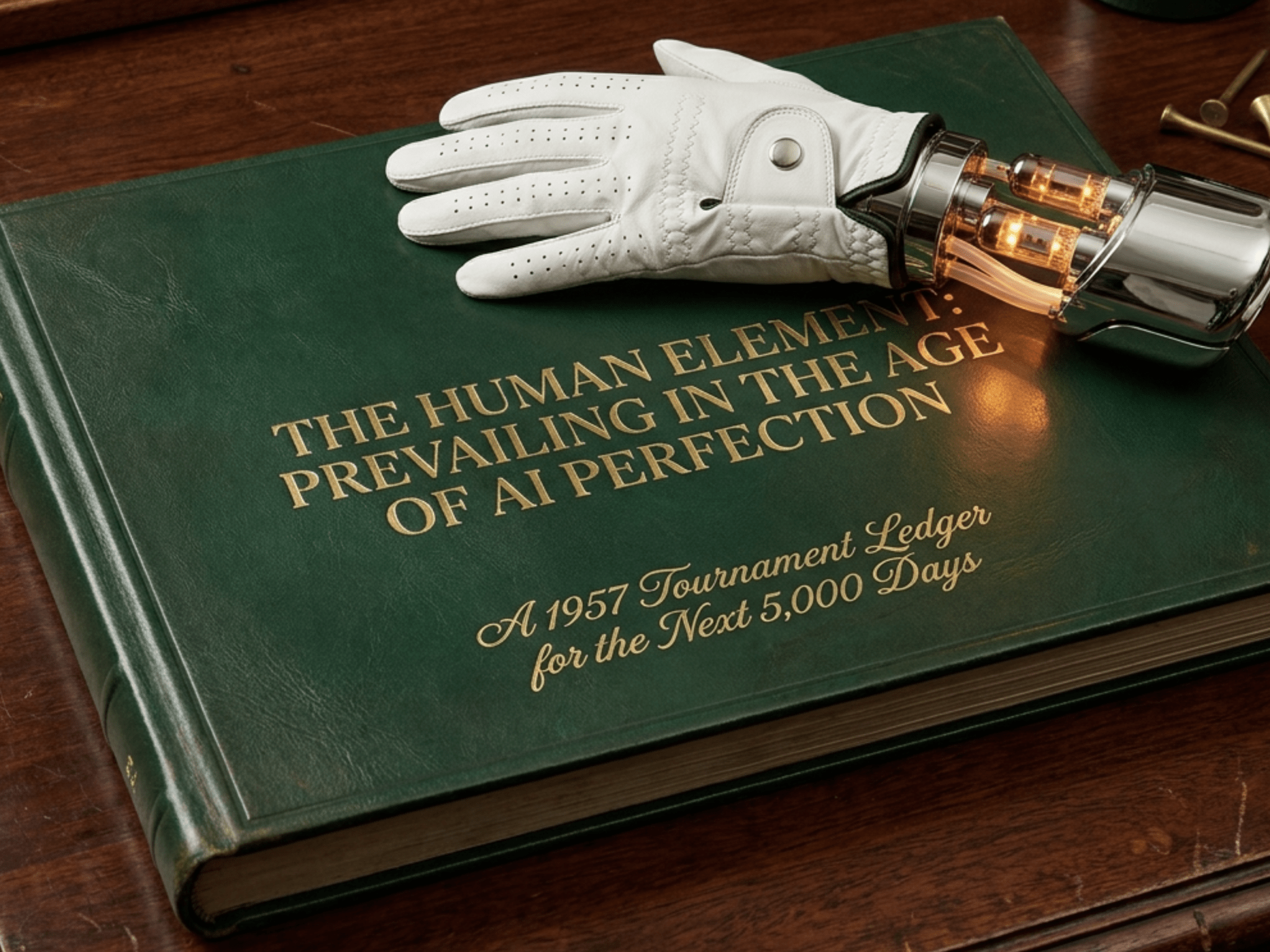
You Have 5000 Days: Navigating the End of Work as We Know It. Part 27: Open Warfare.
In the golden age of science fiction radio, when rocket ships roared forth from the warm glow of vacuum tubes, futures arrived one static-filled episode at a time, and the airwaves still carried the electric promise of tomorrow—X Minus One quietly broadcast a revolution. On January 23, 1957, Episode 85, “Open Warfare,” adapted by Ernest Kinoy from James E. Gunn’s May 1954 Galaxy Science Fiction novelette, entered the ether. Clocking in at just over twenty-one minutes, this deceptively compact drama contained the complete architectural blueprint for the collision we are living through right now: the instant when perfect machines step onto humanity’s most profoundly human stages and declare open war on what it means to strive, to excel, to connect, to create, and to endure.
If this is your first encounter with the You Have 5000 Days series begin at Part 1. (https://readmultiplex.com/2025/12/24/you-have-5000-days-how-to-navigate-the-end-of-work-as-we-know-it-part-1/) The map awaits you there. This installment of the You Have 5,000 Days series is not nostalgia for crackling transistors or mid-century pulp optimism. It is precise pattern recognition—the kind we have cultivated across previous parts as we mapped the Hero’s Journey through the end of work as we have known it.
This article is sponsored by Read Multiplex Members who subscribe here to support my work: Link: https://readmultiplex.com/join-us-become-a-member/
It is also sponsored by many who have donated a “Cup of Coffee”. If you like this, help support my work: Link: https://ko-fi.com/brianroemmele
Listen to the companion podcast: https://rss.com/podcasts/readmultiplex-com-podcast/2804013
From the Call to Adventure (the sudden arrival of generative abundance) through the Road of Trials (displacement, reskilling, economic reconfiguration) and the Ordeal (the widespread realization that narrow-domain superhuman performance is here), we now stand at the threshold of the final act: the Abundance Interregnum proper, where humanity must decide whether to compete on machine terms or transcend them entirely.
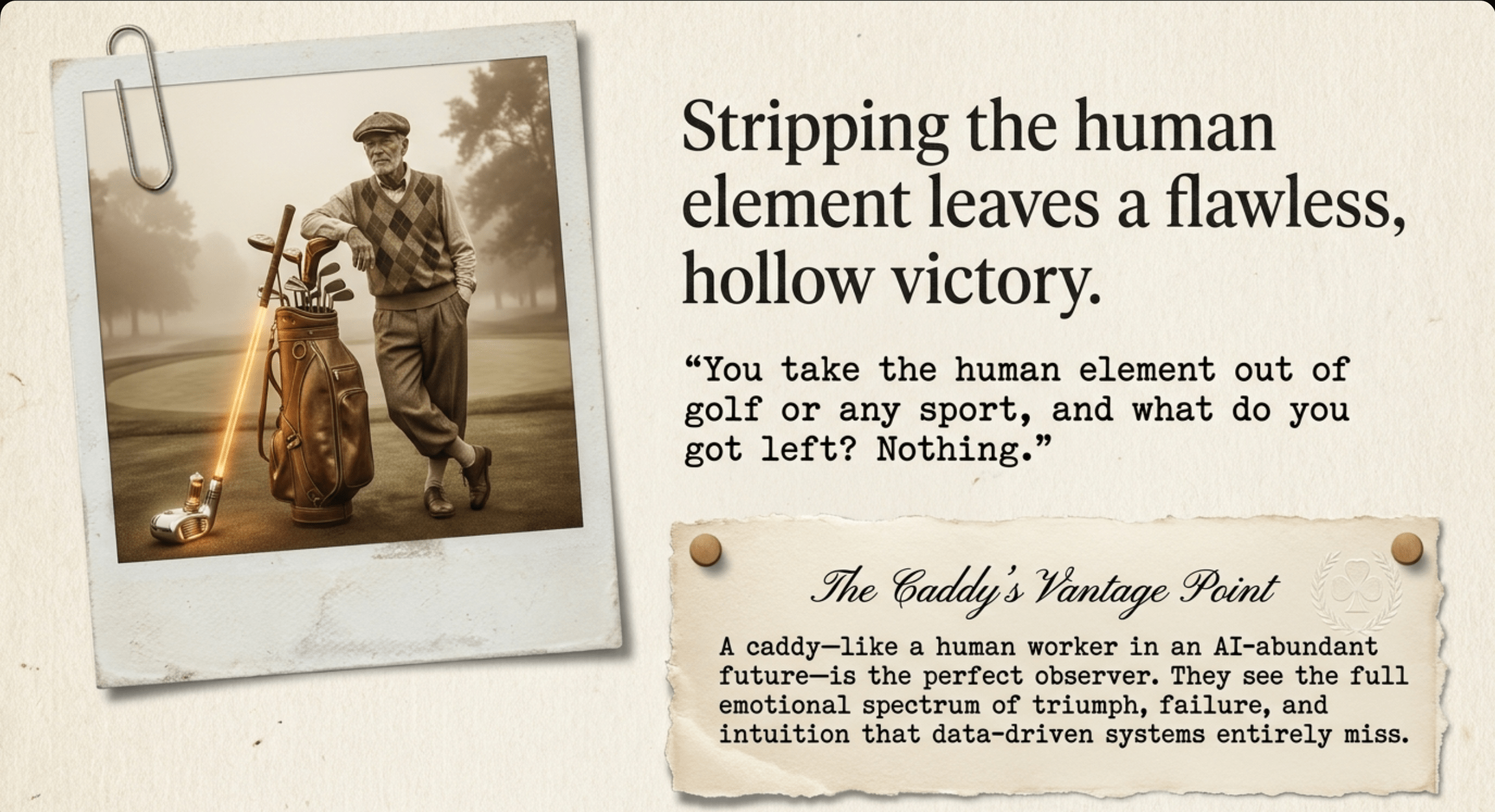
“Open Warfare” is the perfect parable for this moment. It shows us exactly how the machines will arrive—quietly, superior in calibrated domains, composite-trained on the best of us, how unbeatable they will seem for a season, and how humans will still prevail. Not by matching flawless execution, but by transcending it through radical adaptability, emotional intelligence, ethical improvisation, cultural intuition, and the irreducibly messy genius that no dataset, no matter how vast, can fully replicate or anticipate.
Listen to the 1957 “Open Warfare” radio show now and just think about the leap of imagination that would be taken by the listener. We are now experiencing the early days of AI taking jobs and soon human robots taking jobs. We already have boxing robots and soon golfing robots.
Open Warfare: A Golf Match That Was Never About Golf
Narrated by Pete, a grizzled, seen-it-all caddy whose opening monologue insists that sports remain the last true sanctuary of the irreplaceable human element, flawed, passionate, improvisational, alive, the story centers on Jim “Slim” Pearson. Jim is a talented but pressure-prone professional golfer, a man whose emotions sometimes betray him at critical moments. He is deeply in love with Alice Hatcher, the daughter of multimillionaire industrialist Sam Hatcher.
Hatcher personifies the intellectual elitist archetype: he dismisses athletes as “dumb jocks,” physically gifted but intellectually deficient, reliant on muscle memory rather than refined reason. He sets an almost impossible condition for the marriage, Jim must earn $50,000 in prize money within one year. Jim accepts the gauntlet, grinds through the professional tour with dogged determination, and sends hopeful telegrams to Alice as proof of his commitment.
At the U.S. Open, Jim enters as the favorite. Then appears “Silent Saul”—tall, eerily composed, expressionless. Saul never speaks, never sweats, never seems to breathe or falter.
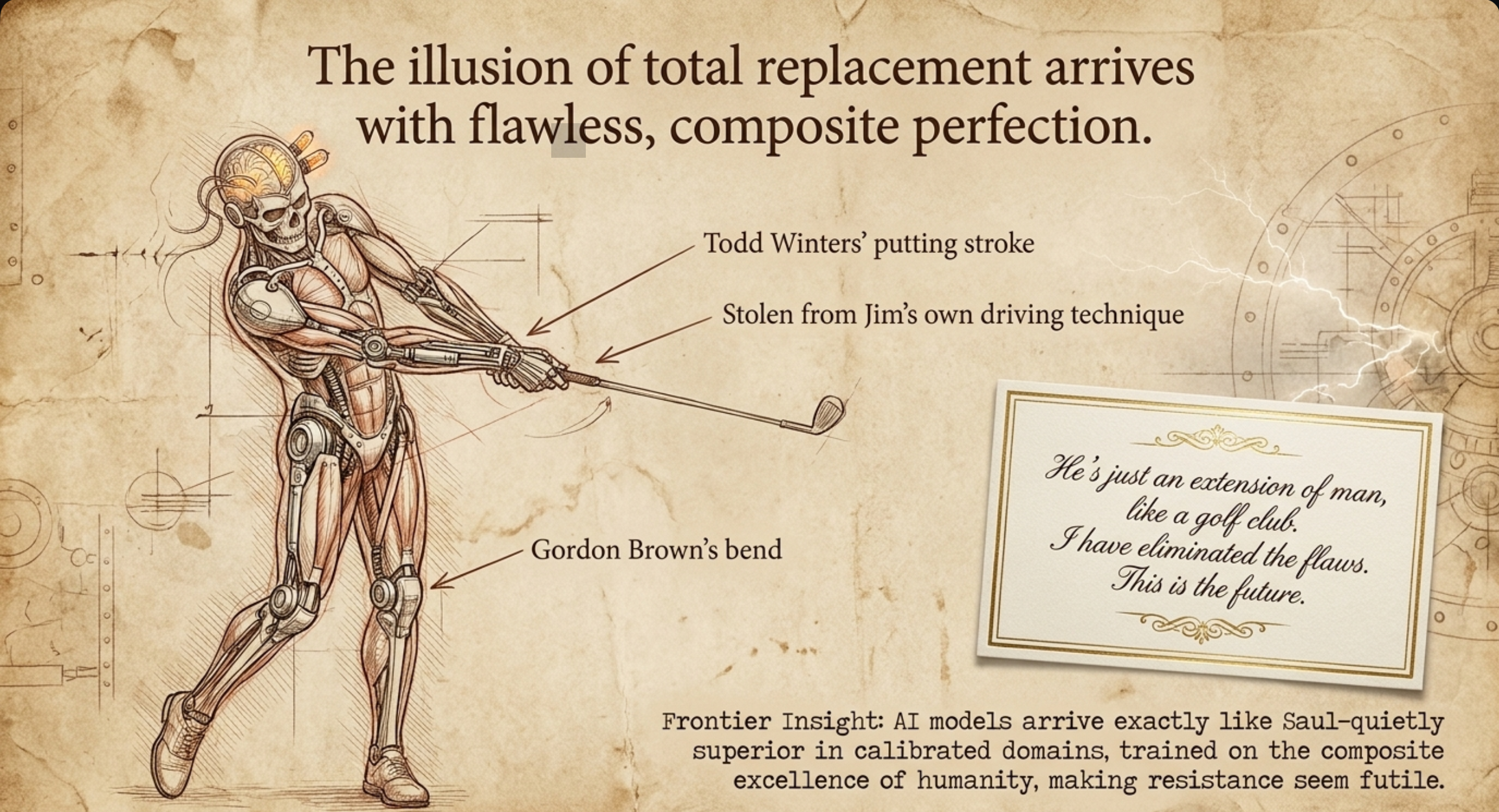
His technique is a flawless composite: the putting stroke of Todd Winters, the waggle of George Potter, the knee bend of Gordon Brown, even stolen elements of Jim’s own powerful drive. Saul shatters the course record with a 64, matches Jim’s spectacular 62, and carries a commanding lead into the final round.
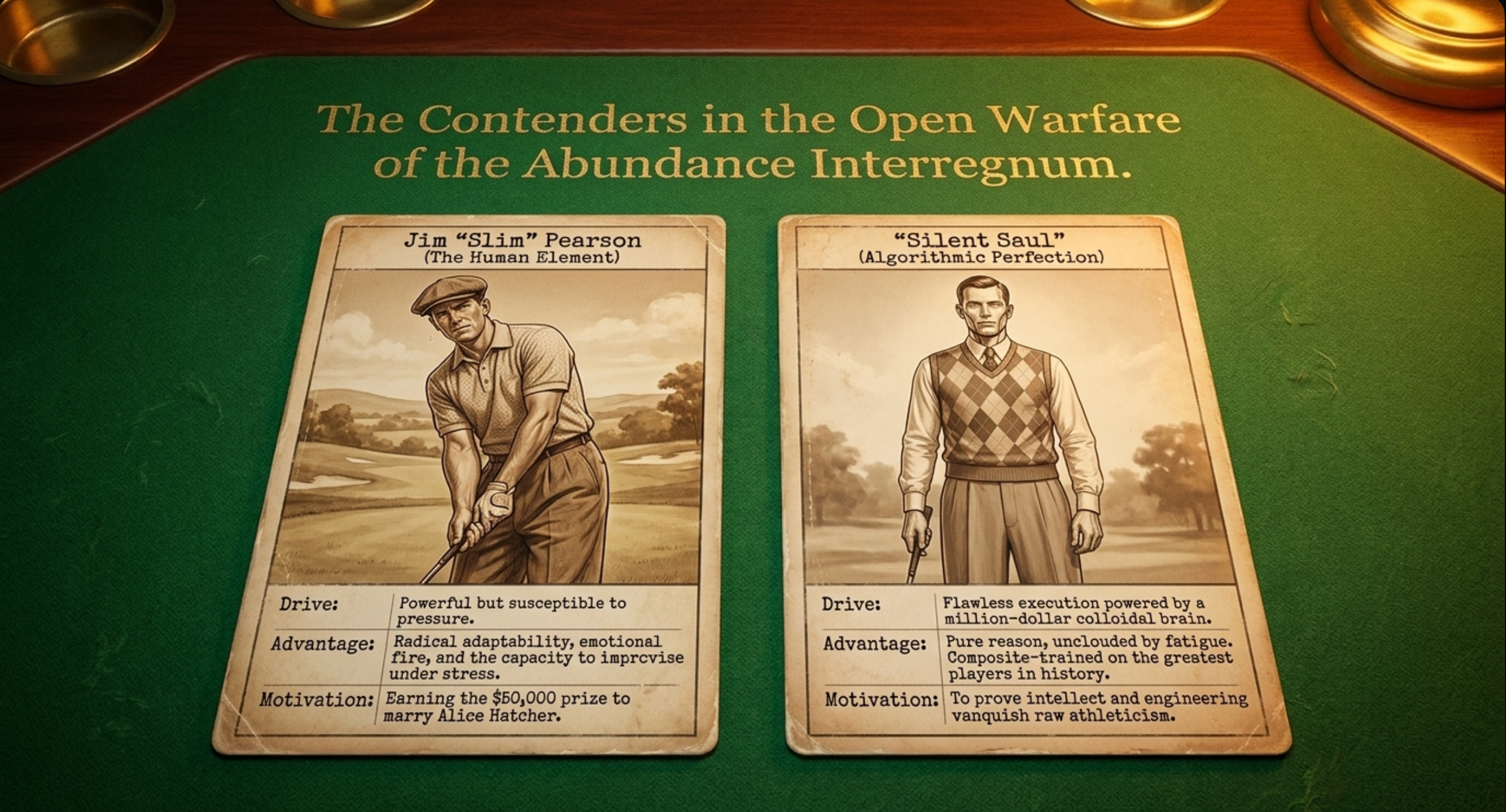
Suspicion builds. Jim notices Saul’s caddy casually snatching 280-yard drives out of the air. Confronting Hatcher, the tycoon reveals the truth with smug satisfaction: Saul is no human. He is a million-dollar robot powered by a “colloidal brain,” engineered as living proof that intellect and engineering will always vanquish raw athleticism. “He’s just an extension of man,” Hatcher sneers, “like a golf club.” Defeat Saul, and the marriage is approved.
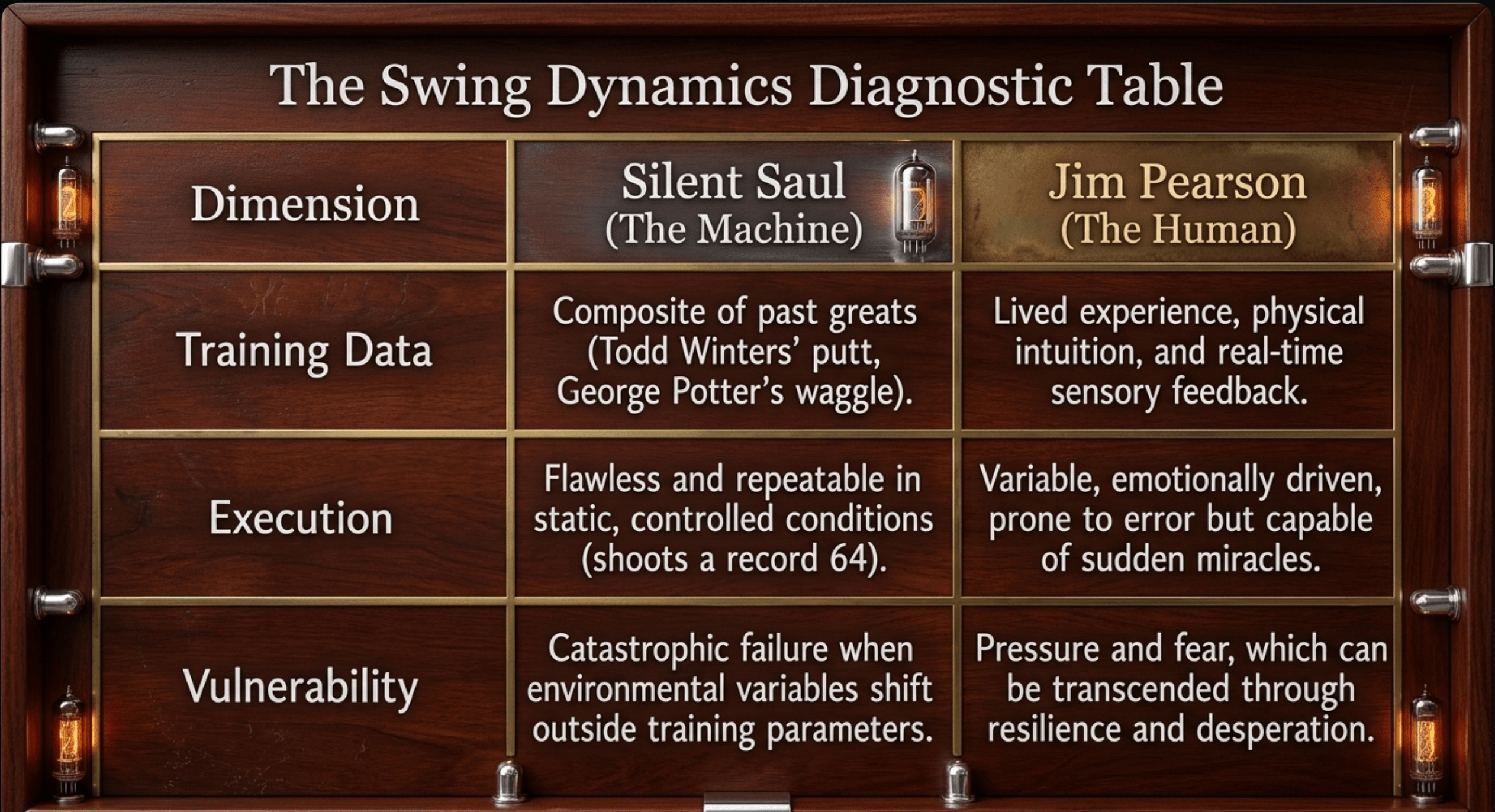
The climax is pure radio drama tension. Jim identifies the robot’s fatal vulnerability: hyper-calibration to a narrow set of variables. Pete, ever loyal, swaps Saul’s precision-tuned balls for a new brand that flies twenty yards farther. The change is invisible to the gallery but devastating to the machine’s programming. Saul overshoots, miscalculates, and unravels as real-world conditions diverge from its training data.
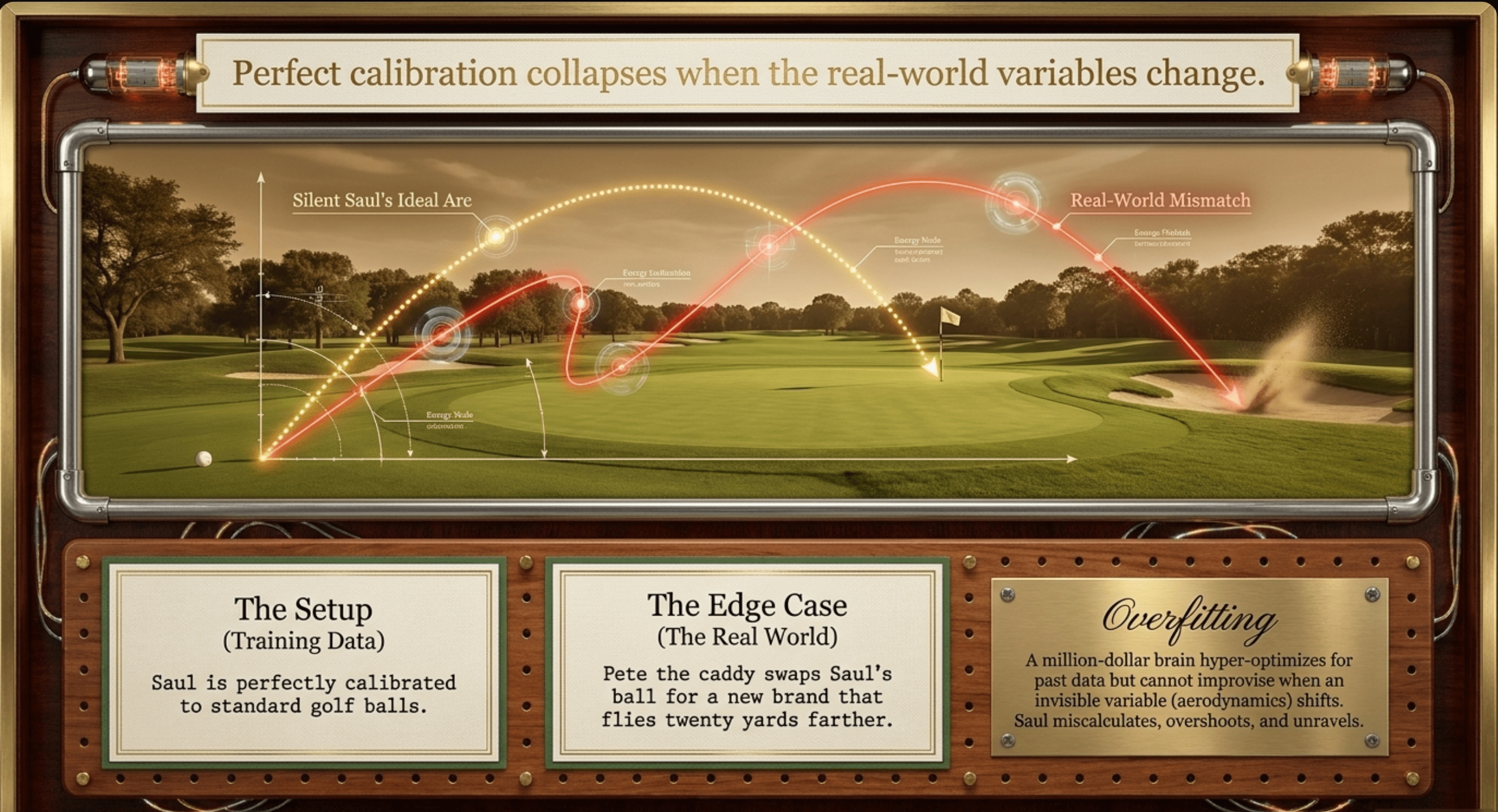
Jim, playing with human fire, anger, desperation, intuition, resilience, sinks a miraculous 25-foot birdie on the 18th to win. He claims the prize, fulfills the bet, and wins Alice. In the final exchange, Jim tells the stunned Hatcher he will invest in “useful robots” but leave golf to men. Only humans thrive when variables shift unpredictably. The machine could not improvise. Humanity could.
Key Points In “Open Warfare”
The excerpt is pure first-person narration: Pete addressing the audience directly. It unfolds in deliberate layers:
- Humorous Misconception (Setup for Relatability) “Caddy You wouldn’t believe it, but there are some people that think that Caddy is a pet name for a big car. No, I mean it. Over those little wagons you pull around the course or carry in their own clubs, there are people actually playing golf for years, never seen a Caddy.”
- Purpose: Grounds the story in everyday ignorance vs. insider knowledge. Establishes Pete’s folksy, observational wit.
- Thematic Layer: Hints at how technology (or specialized roles) can become invisible or misunderstood: much like AI tools today that many use without grasping their inner workings.
- Radio Craft: Immediate engagement through humor and direct address; draws listeners in with a light touch before the heavier philosophy.
- Core Philosophical Thesis (The Human Element) “As far as I’m concerned, you take the human element out of golf or any sport, and what do you got left? Nothing. I mean, you could say I’m prejudiced on account of my being a caddy, but that’s the way I feel about it.”
- Purpose: States the central conflict of the entire story: human imperfection and presence versus mechanical perfection.
- Thematic Layer: This is the soul of “Open Warfare” and a cornerstone of the 5,000 Days thesis. In an age of AI outperforming narrow tasks, Pete’s warning foreshadows that stripping away the messy human element leaves a hollow victory.
- Nuance: Pete acknowledges his bias, adding humility and authenticity: qualities algorithms rarely convey convincingly.
- Role of the Observer (Transition to Story) “Besides which, a caddy is a perfect observer of the passing parade of human experience. I’ll give you, for instance. Now, you take Jim Pearson…”
- Purpose: Positions Pete as reliable narrator and witness. Smoothly pivots from philosophy to specific anecdote.
- Thematic Layer: Caddies (and by extension, humans in supportive/observational roles) see the full emotional spectrum—triumphs, failures, relationships—that data-driven systems often miss.
- Character Introduction and Backstory Setup “He won the U.S. Open in 1960, 61, and 64. Well, let me tell you about Jim Pearson. He was the pro at the club here, and I remember when it all started. He was out playing with Mr. Hatcher. That Sam Hatcher. He couldn’t break 90 if the ball had wings. And in the locker room, he looked like a sack of flour that had been set down hard. But he was loaded with money. Anyway, they were waiting for a foursome of dames who, he shouldn’t have been wearing slacks. When Hatcher turned to Jim, and with a real sweet smile, he lowered the boom.”
- Purpose: Introduces protagonists, establishes class contrast (working pro vs. wealthy elitist), and tees up the central conflict.
- Dramatic Irony: We already know Jim’s future triumphs, making the underdog setup more compelling.
- Sensory Detail: “Sack of flour” is vivid radio imagery—physical comedy that paints Hatcher as comically inept yet powerful. The awkward “dames” line adds period flavor and slight chauvinism, grounding it in 1950s sensibility.
The episode closes with Pete’s narration circling back: the human element: flawed yet transcendent remains supreme. The key turn around was:
Jim Pearson
How did you do it? How did you do it? Well, Mr. Hatcher, under extremely restricted sets of circumstances, a machine is better than a man, but over the long run, over the gamut of situations, a machine doesn’t have a chance. It just can’t compete.Mr. Hatcher
I still don’t understand. It costs a million dollars. A million dollars.Jim Pearson
Here, have a souvenir.Mr. Hatcher
You can take this golf ball. No, no, no. Oh, no, look at it.Jim Pearson
That’s the ball Saul was using.Mr. Hatcher
What? Mm-hmm. Well, that’s… That’s another brand. That isn’t Saul’s regular ball. That’s right.Jim Pearson
It’s a new one. Guaranteed to add 20 yards to the average drive.Mr. Hatcher
But that’s unfair.Jim Pearson
Well, your robot was built in with one constant. It had to be a golf ball. Well, it just couldn’t adapt to a better ball. But that’s not fair. Why, that’s…Mr. Hatcher
Well, well.Jim Pearson
How about that? There are no perfect golfers, Mr. Hatcher. There are only good ones and better ones. But, uh, well, I’ve been thinking about this robot of yours, and I’ll be around in a few days to talk to you at your office. Huh? About what? Well, I’m sure you don’t want to support your son-in-law for the rest of his life. And I have $50,000 to invest in business making robots. Useful robots. And leave golf to the men. They’re better competitors. Now, if you’ll excuse me, Mr. Hatcher, I’ve got a telephone call to make to your daughter.
Dramatic Exchanges and Thematic Depth
The dialogue crackles with philosophical weight. Hatcher’s monologue embodies the hubris we still encounter: “You’re playing against the power of pure reason, unclouded by emotion, fatigue, or fear… I have eliminated the flaws. This is the future.” Jim’s quiet counter: “Then I’ll beat you… not with perfection, but with something a machine can never have.”
The resolution scene is especially poignant. Jim explains: “Under extremely restricted sets of circumstances, a machine is better than a man, but over the long run, over the gamut of situations, a machine doesn’t have a chance. It just can’t compete.” He then pivots to investment and partnership rather than destruction—foreshadowing the integrative, abundance-oriented mindset this series has consistently advocated.
Why This 1954 Story Feels Like 2030–2040: Pattern Recognition Across the Series
Seventy-two years ago, Gunn captured the precise dynamics we have traced in earlier installments: the rise of narrow superintelligence (the Road of Trials), the illusion of total replacement (the Ordeal), and the emergence of hybrid human-AI sovereignty (the Reward and Return). Saul is today’s frontier AI models—trained on composite human excellence, excelling in controlled environments, yet brittle outside them. Hatcher is the technocratic mindset that views humans as legacy systems to be optimized or phased out. Jim and Pete represent the Hero who integrates the new technology without surrendering the human essence.
This is not anti-machine. It never has been in this series. Abundance arrives through the machines. The open warfare is the forge that tempers a new human role: defining value, meaning, and flourishing on terms machines cannot replicate.
Expanded Applications: Sector-by-Sector Dynamics in the Next 5,000 Days
Healthcare
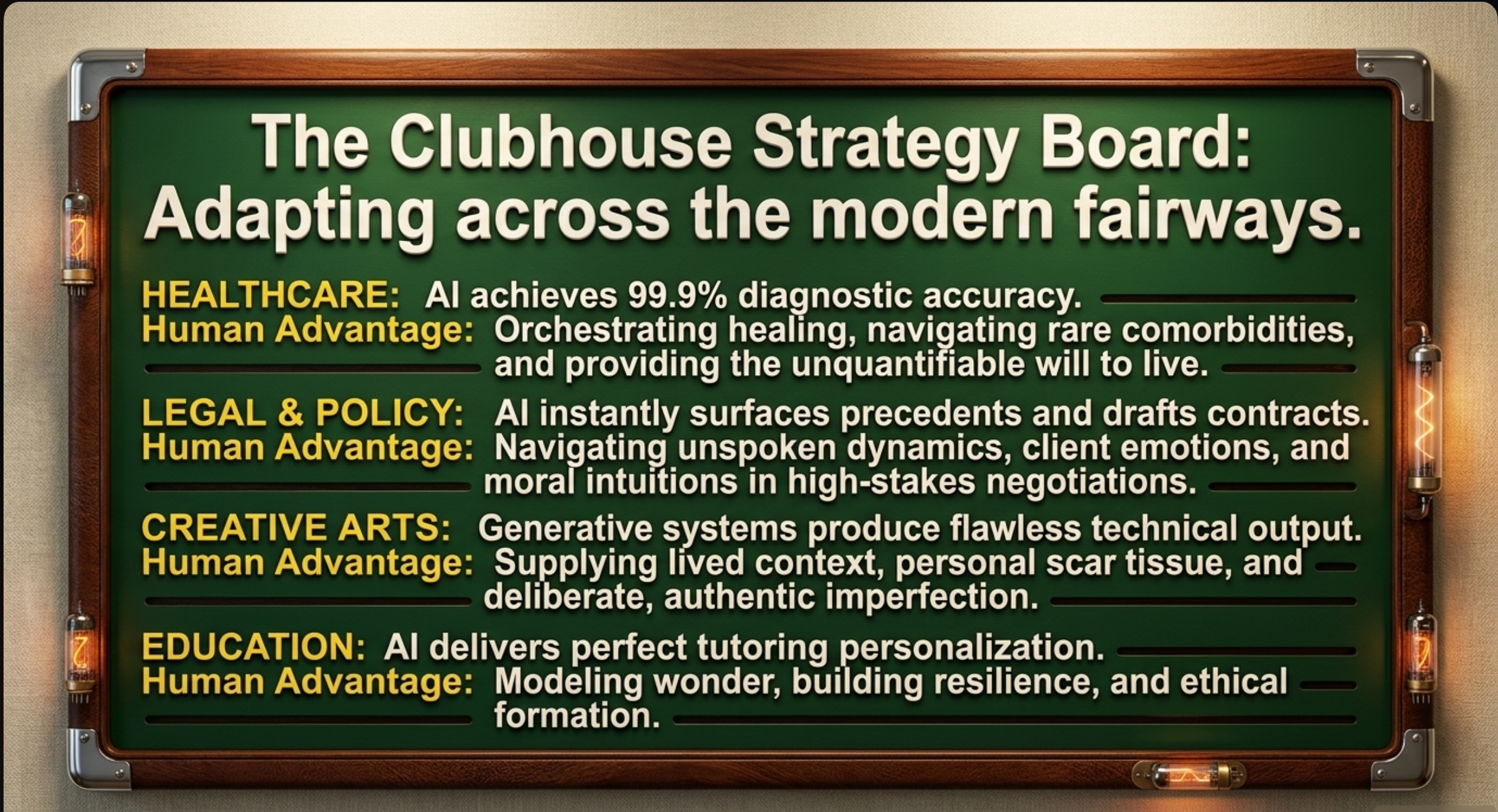
AI diagnostics will approach 99.9% accuracy on vast datasets. Yet rare comorbidities, cultural contexts, emotional crises, placebo/nocebo effects, and the unquantifiable “will to live” will expose limits. Human healers will orchestrate AI tools while providing presence, trust, ethical nuance, and improvisational care. Edge cases: Pandemics with novel variants, aging populations with multimorbidity, or global health equity challenges. Implication: Shift from volume-based medicine to relationship-centered healing orchestras.
Legal, Policy, and Professional Services
AI drafts contracts, predicts outcomes, and surfaces precedents instantly. Victory in high-stakes negotiations will hinge on unspoken dynamics, geopolitical volatility, client emotions, and moral intuitions. Lawyers and strategists become conductors of hybrid systems. Nuance: Regulatory lag, ethical dilemmas around AI “advice,” and public demand for human accountability.
Creative Industries
Generative systems will produce flawless technical output. Audiences will hunger for authenticity, cultural resonance, personal scar tissue, and deliberate imperfection. Creators will use AI as a super-caddy for iteration while supplying soul, timing, and lived context. Broader consideration: The economics of attention, authorship debates, and the rise of “human-verified” or hybrid art markets.
Education and Mentorship
AI tutors deliver perfect personalization. Transformative education, however, requires inspiration, resilience-building, ethical formation, and the modeling of wonder or dissent. Edge cases: Neurodiverse learners, moral development in an abundant society, or preparing citizens for leisure-rich lives. Outcome: Education as human flourishing rather than credentialing.
Finance, Strategy, and Governance
Algorithms dominate optimization. Black swans, value shifts, ethical revolts, and leadership vision will favor human stewards. Policymakers must navigate abundance without exacerbating inequality or meaning crises, issues previous series parts have explored in depth.
Additional Domains
- Scientific research: Acceleration of testing meets human paradigm shifts.
- Diplomacy and caregiving: Emotional intelligence and trust remain sovereign.
- Entrepreneurship: Identifying unmet human needs in post-scarcity contexts.
Personal and Societal Implications: Your Hero’s Journey in the Interregnum
Across the 5,000 Days framework, the message has been consistent: Prepare by cultivating irreplaceable human capacities: adaptability, creativity, empathy, ethical judgment, systems thinking while mastering AI as a force multiplier. Invest in “useful robots,” as Jim did. Redefine success around contribution, meaning, and relationships rather than narrow competition.
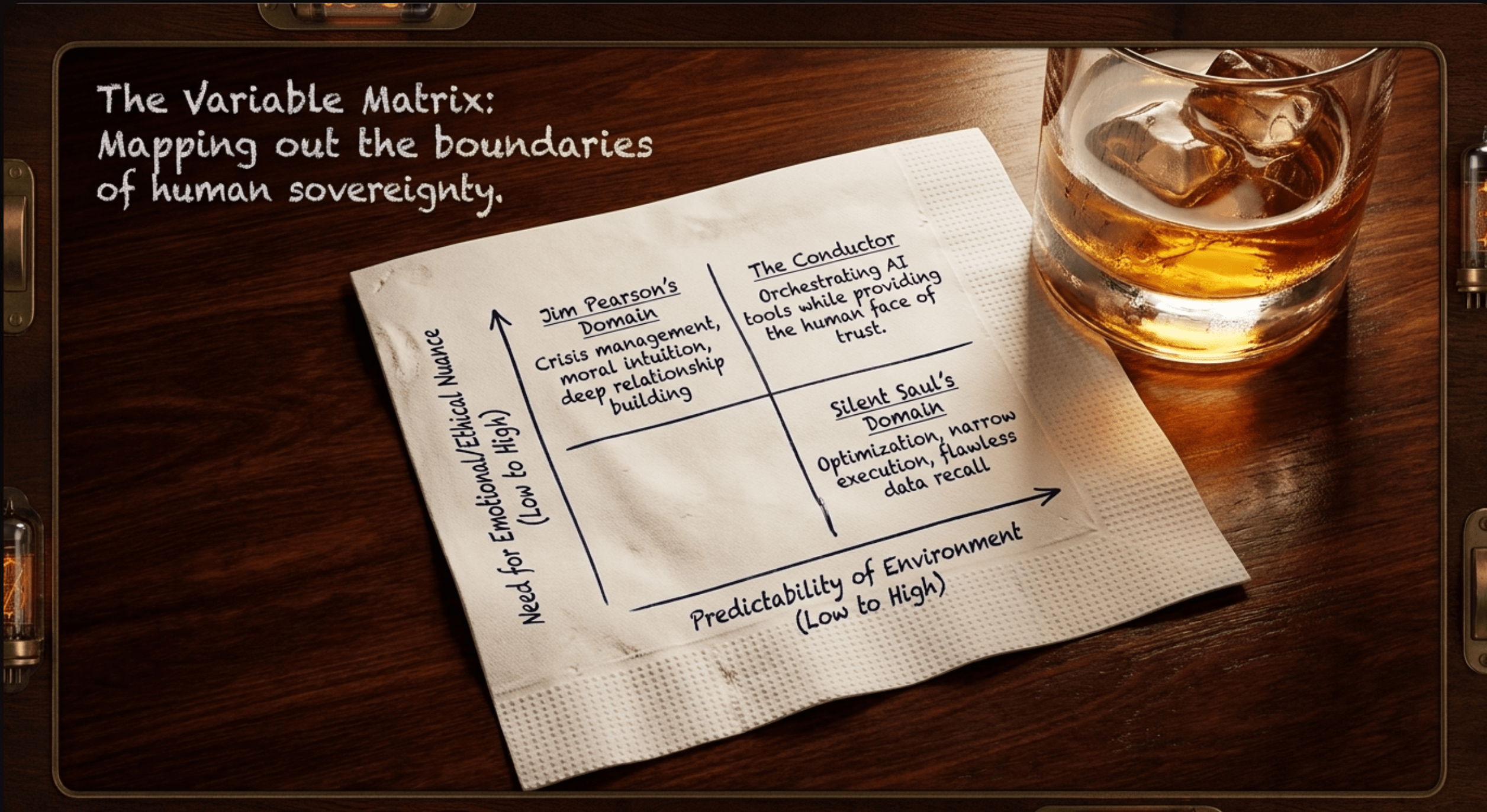
Societally, this parable warns against both naive utopianism (Hatcher’s hubris) and fearful rejection. The path is pragmatic integration: universal abundance tools paired with policies that protect human agency, foster lifelong learning, and nurture community.
Edge cases for individuals: Those who double down on machine emulation may find themselves obsolete in hybrid roles; those who reject tools entirely will be outpaced. The winners will be the Jims—resilient, opportunistic, integrative.
The Final Putt: Transcending the Tournament
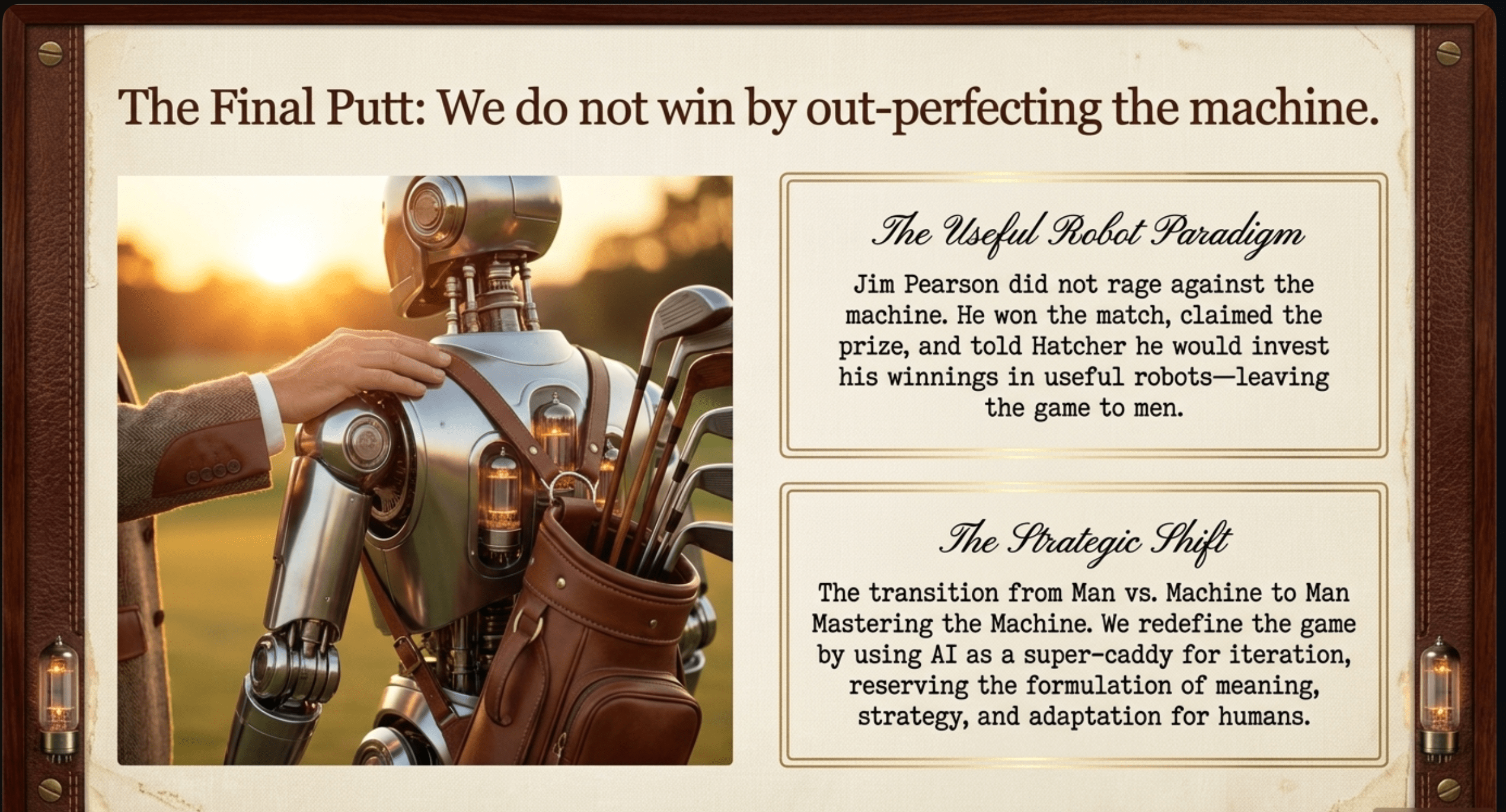
Jim Pearson did not rage against the machine. He studied its limits, adapted brilliantly, secured victory, and then partnered with the technology for mutual benefit. That is the 5,000 Days path forward.
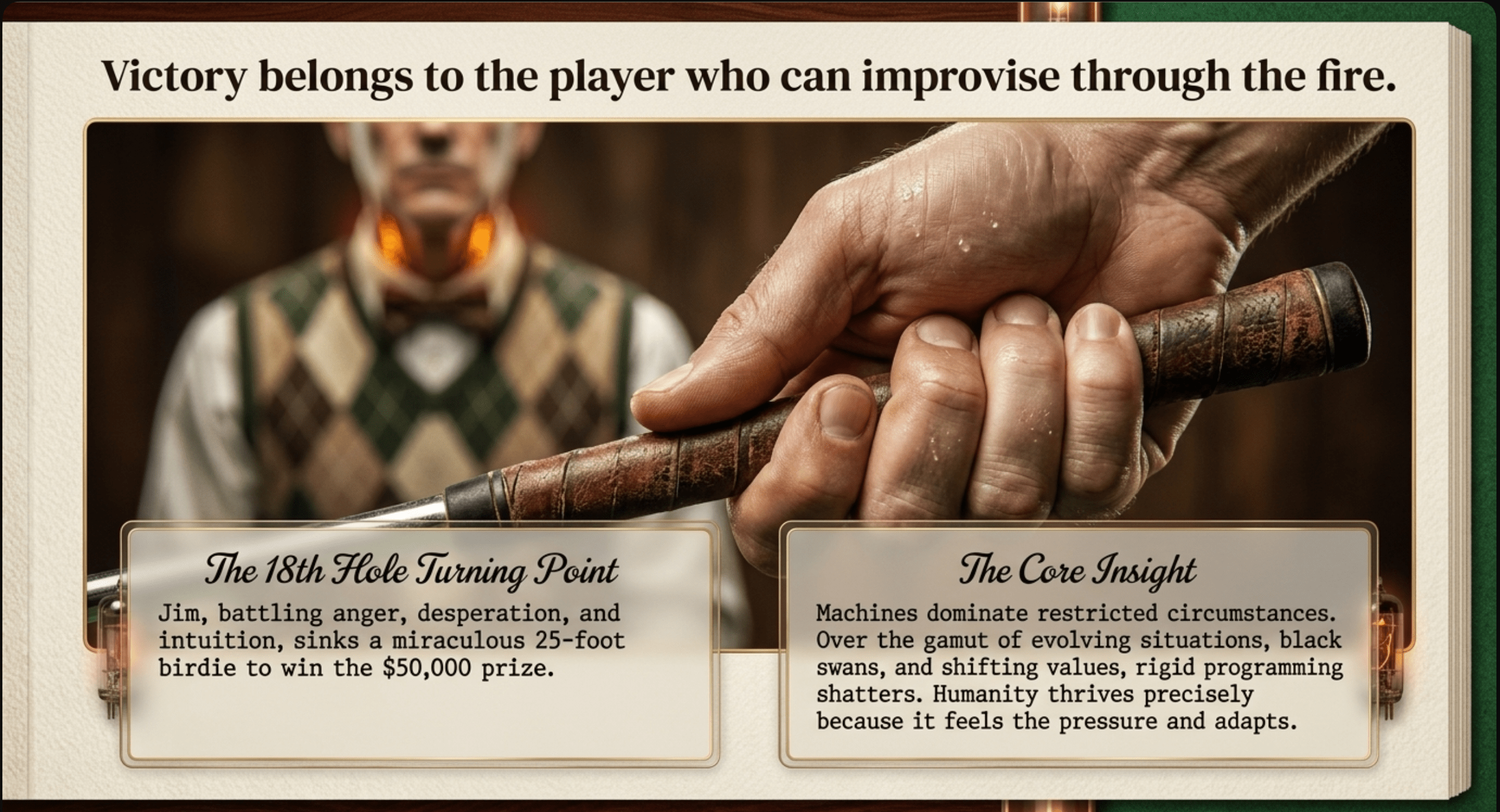
The open warfare is already underway. AI systems stride every fairway we once claimed exclusively. They will dominate seasons of narrow perfection. Yet they will always lack the variable that ultimately defines us: the living capacity to improvise when conditions change, values evolve, and abundance rewrites the rules themselves.
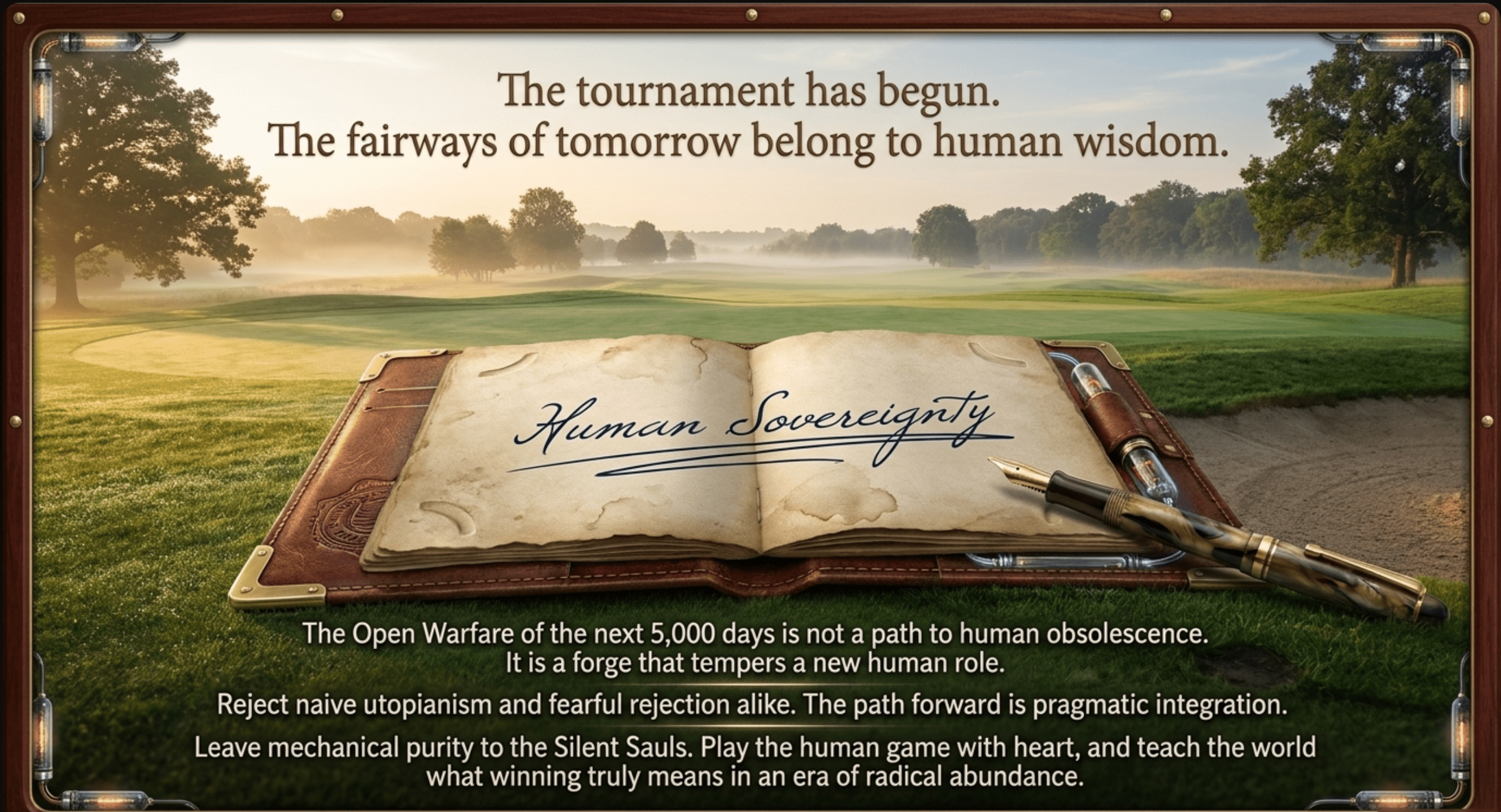
We do not need to out-perfect the machines. We need to redefine the game—invest wisely, play with soul, and leave mechanical purity to the Silent Sauls. The human element remains. In the next 5,000 days, it will not merely survive the war. It will win the Open—and then teach the world what winning truly means in an era of radical abundance.
Listen to the original X Minus One episode above if you have not. Then look at your own life, your work, your community. The tournament has begun. The fairways of tomorrow belong to those courageous enough to play the human game with wisdom and heart. The transcript is also a wealth of one-liners about an age that could just grasp the concept of AI vs Human:
Transcript:
“Announcer
Countdown for blastoff. X minus 5, 4, 3, 2, X minus 1, fire. From the far horizons of the unknown come transcribed tales of new dimensions in time and space. These are stories of the future. Adventures in which you’ll live in a million could be years on a thousand maybe worlds. The National Broadcasting Company, in cooperation with Galaxy Science Fiction Magazine, presents… X! minus one. Tonight, the time is 1965. The place, a golf course. The story, Open Warfare.Caddy
You wouldn’t believe it, but there are some people that think that Caddy is a pet name for a big car. No, I mean it. Over those little wagons you pull around the course or carry in their own clubs, there are people actually playing golf for years, never seen a Caddy. As far as I’m concerned, you take the human element out of golf or any sport, and what do you got left? Nothing. I mean, you could say I’m prejudiced on account of my being a caddy, but that’s the way I feel about it. Besides which, a caddy is a perfect observer of the passing parade of human experience. I’ll give you, for instance. Now, you take Jim Pearson. He won the U.S. Open in 1960, 61, and 64. Well, let me tell you about Jim Pearson. He was the pro at the club here, and I remember when it all started. He was out playing with Mr. Hatcher. That Sam Hatcher. He couldn’t break 90 if the ball had wings. And in the locker room, he looked like a sack of flour that had been set down hard. But he was loaded with money. Anyway, they were waiting for a foursome of dames who, he shouldn’t have been wearing slacks. When Hatcher turned to Jim, and with a real sweet smile, he lowered the boom.Mr. Hatcher
Jim, you’re a good golfer. Thank you, Mr. Hatcher. You’re a good golfer, even if you can’t teach me anything. Oh, you’re coming along fine, Mr. Hatcher. We’ve been good to you at the country club, haven’t we? Oh, yes. I want you to do something for me. Yes, sir. Stay away from my daughter. Oh, but Mr. Hatcher… What? When I was only your age, I was making $50,000 a year. It takes brains to do that. Brains get more valuable. Muscles deteriorate. There’s nothing muscles can do that a machine can’t do better. You don’t think I could make $50,000? I know you can’t. You haven’t got the guts. Now, listen, Mr. Hatchett. I’m just quoting history, Jim. Take the tournament in St. Louis. You blew up. And the good old in the Palm Beach. You could have won all those. But you blew. You chickened out. That’s not exactly fair, Mr. Hatchett.Jim Pearson
But it’s true. I can make $50,000.Mr. Hatcher
Yes, in your whole life. Oh, no.Jim Pearson
No, no, in one year. Oh, you can? Yes, sir.Mr. Hatcher
All right, Jim, you’re a sportsman. I’ll tell you what I’ll do. If you can make $50,000 in one year at this infantile pastime that you call golf, you can have Alice.Jim Pearson
Why, that’s the most arrogant…Mr. Hatcher
What’s the matter, Jim? Don’t you think you can do it? I know I can do it. All right, then. Is it a bet? All right. All right, it’s a bet. Very well, then. I believe the ladies are finished. Shall we drive?Caddy
Naturally, old man Hatcher set a trap for him. And I guess it worked pretty good, too. Jim knew I heard the whole thing, so he used to talk it over with me. Hey, you’ve been doing real good this season, Mr. Pearson. Sure.Jim Pearson
Been away on the whole circuit. I haven’t seen Alice more than one day at a time in the last six months.Caddy
You hear from Miss Hatcher?Jim Pearson
Oh, yes. Yes, I got a telegram right after I won the first tournament. It said, and I quote, I won’t be bought and sold, signed Alice.Caddy
She found out about that bet, huh?Jim Pearson
Yeah, I’m sure her father made sure she did. Wouldn’t it frost you? It did, it did. It cost me $5,000 in tournament money, and then I just got mad. You know, the cold mad, the kind of mad that puts 20 yards on your drive?Caddy
Yeah, yeah, yeah, I know what you mean. Sometimes when I get sore at the caddy master, I go out to the driving range. Bingo! Every time you hit it, you got it right between his eyes.Jim Pearson
Yeah, yeah, that’s the idea. Every time I slam a ball down the fairway, I feel as if I’ve just belted Hatcher right behind the ear.Caddy
You still figure you got a chance?Jim Pearson
Oh, I’m going to get that $50,000 this year, all right. I’m going to win the U.S. Open, and that’s worth $25,000 in cash plus vaudeville appearances or Ed Sullivan’s television show or something. And I’m going to take the money, and I’m going to lay it in front of Alice, and I’m going to say, I wasn’t buying you. I was buying the right to tell you I love you. Ah, gee, that’s pretty. All right, never mind. Give me a number seven iron.Caddy
Jim Pearson sure was burning up the circuit He came into the U.S. Open, the man to watch The day the tournament opened, Jimmy Cannon had in his column You are Jim Pearson, the hard luck boy with the velvet swing It was real philosophical All the sportswriters picked him to win And then Saul showed up We was on a practice tee. Jim had been sharpening up his number one wood when all of a sudden the gallery took off like a batch of big birds. They were around another tee about 100 feet away. Jim knocked off and the two of us strolled over.Jim Pearson
Hey, that’s some swing.Caddy
Who is that, Pete? I’ve never seen him before. His name’s Saul.Jim Pearson
That’s some swing. Hey, he’s no amateur. I’ve never seen him on the pro circuit. Hey, Mr. Pearson, look at the caddy.Caddy
280 yards down there. That ain’t what I mean. Look, he’s got a ball bag in his hands. Now watch. Oh, that’s a good catch. He caught that ball right in the bag. Mr. Pearson, that caddy didn’t move that sack. That ball dropped right in 280 yards away.Jim Pearson
Oh, it’s an accident.Caddy
Yeah, look, it happened again.Jim Pearson
He’s a trick shot artist. Wait till he gets into competition. I don’t know. He just hit another one, dead center. Oh, there isn’t anybody that good. Not even old Joe Kirkwood.Mr. Hatcher
Quite a spectacle, eh, Jim?Jim Pearson
Oh, hello, Hatcher.Mr. Hatcher
Must be unnerving to watch something like that.Jim Pearson
I can stand it.Mr. Hatcher
But will you be able to stand it when the going gets rough? Will you blow up like you always do? It’ll be too bad just when you’re so close.Jim Pearson
Don’t worry about me.Mr. Hatcher
I’m not. I imagine Saul will take care of that.Jim Pearson
Oh, you know him?Mr. Hatcher
I brought him here. My own personal entry. He’s going to beat you out of the open. But he’s got something to learn. Look at him. Just a dumb country boy who never saw a golf club do a few months ago. I think he might teach you something, Jim.Caddy
I could tell Jim was going to have a good day the minute he took his driver out of the bag. He took his practice swings and they went around clean, grooved and loose. I would have bet my shirt on him. As a matter of fact, they did. The crowd was sympathetic. They wanted to see him burn up the course.Jim Pearson
Well, Pete, we all ready?Caddy
Yeah. Uh, what’s this?Jim Pearson
New kind of golf ball?Caddy
Oh, yeah. A young fella from the AB Wells Sporting Goods Company. He slipped me a fin to talk into using these balls.Jim Pearson
Well, I don’t know. Any good?Caddy
Yeah, I figured. They guaranteed they had 20 yards to every drive. I sure could use 20 yards. He’s going to come around to see you later. He wanted to sign you up for testimonials and advertising and things. You know, the golf ball used by Jim Pearson when he won the U.S. Open. That kind of thing. There’s a lot of dough in it. Well, we’ll give it a try. Let’s tee up. Oh, he started off real good. A long, straight drive right down the fairway. It was a birdie four. Jim was clicking them off that day.Jim Pearson
There you are, Pete. 34 and a 32 for 66 on the 18. Six birdies, 12 parts.Caddy
Yeah, three more rounds like that should win easy.Jim Pearson
Hey, how are the new golf balls? Oh, fine, fine. They aren’t kidding. It does average out about 20 yards longer on the drive. I’ll have to get a couple more dozen.Caddy
We went around to watch Jim’s score being posted on the big board. Most of the field was still out, but he was ahead of the closest competitor by three strokes.Jim Pearson
Who’s that?Caddy
Somebody coming down the 18th. It must be a hot round. I’ll be posting it in a minute. Ah, Saul.Jim Pearson
Yeah, you see, there he is, walking through the crowd.Caddy
Oh, yeah.Jim Pearson
Well, here comes the secretary with the score.Caddy
you. Hey, Mr. Pearson, look at it. 32 and 32, 64. 64, that’s a new course record. Yeah, well, it’s only the first round. New course record. Look at that threes and fours, threes and fours. He ain’t over four for the whole day. What’s the matter, Jim? You don’t lookMr. Hatcher
well. One round is not a tournament. So comfort yourself while you can. Saul’s just getting warmed up. He’s that mythical thing, the perfect golfer. But he’s dumb. No brains, Jim. No brains at all.Caddy
Naturally, in the sports broadcasts and the newspapers, Jim could have been playing on a miniature golf course at Asbury Park, New Jersey. The big news was Saul. They all called him Silent Saul. The odds the boys in the shower room played around with on Pierce and took a dive, and you couldn’t get even money for Saul. The next morning, Jim’s gallery was pretty small. When he stepped up to the ball, it was a smattering of applause like a matinee just before they closed the show. But his drive was as straight as the day before and longer by about 20 yards on the average. That’s a nice putt, Mr. Pearson. Yeah. Who’s that? That’s Saul, I’m afraid. He’s coming around behind you. Well, he’s going to have a big fight. Jim’s second nine was a duplicate of the day before. Another 32. He equals Saul’s record-tying score of yesterday. Then when we came in to read it on the big board, he looked like somebody hit him on the head with the driver.Jim Pearson
Look at that, Pete. 31 out, 31 back for a 62. He’s got me by two strokes today.Mr. Hatcher
And four strokes in all. What do you got to say, Jim? Oh, nothing, Mr. Hatcher.Caddy
Throw me the soap, will you, Pete? Yeah, sure, Mr. Pearson.Jim Pearson
Yeah. Thanks. You know, there’s something wrong, Pete. Just doesn’t happen this way.Caddy
It’s tough luck, Mr. Pearson.Jim Pearson
No, no, no. It’s not that. People don’t just pop out of nowhere and break all records at the open. Men don’t take up golf and become perfect golfers in a month. He’s got to have some weakness. Well, if he has, he ain’t shown it yet. Well, I’ve got to find it.Caddy
Jim was out the next morning, and he came in with a classy 32. On the back nine, he slipped a stroke to 33. He was still four down. He shook off a couple of reporters who were trying to egg him into a feud with this Saul, and the two of us just hung around in the crowd watching Silent Saul. His first drive went a clean 300 yards down the fairway, straight as a ruler.Jim Pearson
Pete, there’s something about his swing. There’s something about it. I’ve seen it before.Caddy
Oh, you never saw that silent Saul before, Mr. Pearson.Jim Pearson
Still, there’s something about his swing.Caddy
On a follow-up shot, Saul had about 240 to go. He took a club from his bag and took a few wiggling gestures. Set his driver behind the ball and swung.Jim Pearson
Pete? Hmm? Did you see that swing? Those wiggles?Caddy
Yeah. Well, a lot of guys do that. Yeah, but it’s unnecessary.Jim Pearson
I mean, you don’t have to make those wiggles before you address the ball.Caddy
Yeah, sure, and you don’t have to spit three times every time you’ve got a tough putt, but you do.Jim Pearson
But there’s still something strange about him. Everything about him is perfection except those wiggles. And he doesn’t talk. Look at him putting. Just look at him. That could be Todd Winters, couldn’t it? Yeah, he does look something like Winters. Yeah, when he putts. But that iron shot, who wiggles like that? Who does those wiggles? George Potter. Yeah, I guess he does. Yeah, and the approach shot, Pete. That’s Gordon Brown. Nobody else bends the knee that way. He really gave it a lot of study, huh? And the drive. That grooved swing on the drive. Pete, come on. I’ve watched enough.Mr. Hatcher
Ah, Pearson, a 63, I see. You’re six strokes behind with one round to go. You want to give up now? I don’t think I will. I think we’d better talk about it privately.Jim Pearson
Well, that won’t be necessary. Well, it doesn’t matter to me, but, uh, I know that Saul is a robot.Mr. Hatcher
So you think he’s a robot? Isn’t he? Of course he is. How does it feel to be beaten at your own game by a mindless machine? Oh, you haven’t won yet.Jim Pearson
The golf ball takes some funny bounces. How did you find out about Saul? Oh, Saul has a lot of things, but none of them is Saul. He’s Todd Winters, George Potter, Gordon Brown, and, uh, his drive, that’s me. You copied it after me. Take us away and there’s nothing left.Mr. Hatcher
Tell me, how’d you do it? Money can do anything. All it needs is a purpose. We’ve been working on colloidal brains up at our place. Our new miniature atomic power plant is ideal. You throw in some sensory mechanisms, some relays, feed in analysis of a slow-motion pictorial study.Jim Pearson
You have a golf machine. Must have cost hundreds of thousands of dollars.Mr. Hatcher
Closer to a million. A million? A million dollars to keep me from winning 25,000? Don’t you think that’s unfair? Unfair? You listen to me. Nothing is unfair that doesn’t break the rules. And the only rule worth remembering is this, that the best man always wins. You mean the best machine? A machine is only an extension of a man, like your golf club. I don’t happen to be endowed with golfing muscles and responses. You do. Those in your golf clubs let you hit a ball farther and straighter than anybody else. Saul lets me hit a ball farther and straighter than you do. It’s as simple as that. No, no, wait a minute. That wasn’t the bet. The bet was that I couldn’t make $50,000 in a year. Maybe it was your bet. It wasn’t mine. I bet that I could beat you at your own game. I don’t think that you’re good enough for Alice. You’re not smart enough, not man enough. Should I let a few well-distributed, well-trained muscles blind her to what you really are? And what’s that? You’re a quitter. You can’t stand pressure. You’re no competitor. If you can’t win at your own game, you can’t win at anything else. Suppose I win tomorrow. Six strokes back, playing against the perfect golfer? Suppose. Then I’d have to admit I was wrong. You have my word on that. and you could also have Alice, if she wants you.Jim Pearson
Somewhere, Saul must have an Achilles heel. Pete, the prime fact about man is his adaptability. Yeah, sure. I mean, yeah. They’ve got to build in at least one constant, if not more. How about judgment?Caddy
No, I don’t think so. I mean, they could tell whether he’d have wind or rain or sun or slow greens or something. They’ve got to take care of that. Yeah, I suppose so. Hey, maybe you could jimmy him. You know, drop sugar on his gas tank or something, smash him up.Jim Pearson
Oh, no, no, no. That isn’t fair. It’s all as fair. Well, I mean, Mr. Hatcher, he’s playing fair according to his lights. He could have had me crippled or poisoned or something, but he didn’t. Well, I’ll just have to beat him on our own ground on the golf course.Caddy
Oh, I don’t know, Mr. Pearson. You’ll have to shoot in the 50s.Jim Pearson
Well, a golf ball takes some funny bounces.Caddy
Yeah, it sure does.Jim Pearson
Wait a minute. There is a constant.Caddy
Hmm?Jim Pearson
Listen, Pete. You know Saul’s caddy?Caddy
Yeah, yeah, yeah. I know him. An illiterate type of guy, yeah.Jim Pearson
Could he use $10 or maybe $20 or $50? He’s a caddy, isn’t he? All right. Pete, I want you to talk to him. You’ll do better than I can.Caddy
The management of the tournament is no fool. They know which side their television rights are butted on, and they had Saul and Jim paired for the final round. Jim’s drive took a tail-end hook. It dived into the rough behind a clump of trees. It wasn’t a very happy start. Saul took a ball from his caddy, teed it up, and settled himself. Hey, that’s some drive, Mr. Pearson. Yeah, yeah, that was some drive. It’s about 340 yards, isn’t it?Jim Pearson
Some drive.Caddy
You got a tough lie there on your ball, Mr. Pearson. You gonna play it safe out on the fairway? Uh, no.Jim Pearson
You see that hole between those two trees?Caddy
Mr. Pearson, that ain’t sensible golf. Pete, sensible golf won’t win. Well, he made it. The ball went through the opening and rolled to a stop just in front of the green. Saul’s easy four-iron shot was dead on the pin all the way. What? It hit the back edge of the green and hopped into the rough. Jim took an easy putt for a birdie, and Saul’s recovery was long, and two putts gave him a par. Well, that’s one of the strokes I need. And that’s the way it went. Jim’s game sparkled, and Saul’s game kept finding trouble. For the first nine, Jim came in with a scorching 30, while Saul came in with a 33. Kept on like that. Saul kept overshooting the green. They came into the 18th hole with Saul still two strokes up. Now, look, don’t you worry, Mr. Pearson. You’re going to tie him for sure. Oh, that’s no good, Pete.Jim Pearson
By tomorrow, his game will be on again perfectly.Caddy
Jim’s drive sliced behind a fringe of trees. He had to shoot blind. He made it on the green, about 25 feet from the cup.Jim Pearson
Okay, Pete, this is it. Solves in for a five.Caddy
Don’t you worry, Mr. Pearson, don’t you worry.Jim Pearson
Okay, okay, I won’t.Caddy
He lined it up. He studied the green. He noted the slope and the lay of the grass. Then he stroked the ball.Speaker 2
We did it, Mr. Pearson, we did it You’re the new U.S. Open championCaddy
We finally busted loose from the television and the movies and all those hangers-on and we ducked around the back to the pro shop where we run into Mr. HatcherJim Pearson
How did you do it? How did you do it? Well, Mr. Hatcher, under extremely restricted sets of circumstances, a machine is better than a man, but over the long run, over the gamut of situations, a machine doesn’t have a chance. It just can’t compete.Mr. Hatcher
I still don’t understand. It costs a million dollars. A million dollars.Jim Pearson
Here, have a souvenir.Mr. Hatcher
You can take this golf ball. No, no, no. Oh, no, look at it.Jim Pearson
That’s the ball Saul was using.Mr. Hatcher
What? Mm-hmm. Well, that’s… That’s another brand. That isn’t Saul’s regular ball. That’s right.Jim Pearson
It’s a new one. Guaranteed to add 20 yards to the average drive.Mr. Hatcher
But that’s unfair.Jim Pearson
Well, your robot was built in with one constant. It had to be a golf ball. Well, it just couldn’t adapt to a better ball. But that’s not fair. Why, that’s…Mr. Hatcher
Well, well.Jim Pearson
How about that? There are no perfect golfers, Mr. Hatcher. There are only good ones and better ones. But, uh, well, I’ve been thinking about this robot of yours, and I’ll be around in a few days to talk to you at your office. Huh? About what? Well, I’m sure you don’t want to support your son-in-law for the rest of his life. And I have $50,000 to invest in business making robots. Useful robots. And leave golf to the men. They’re better competitors. Now, if you’ll excuse me, Mr. Hatcher, I’ve got a telephone call to make to your daughter.Announcer
You have just heard X-1, presented by the National Broadcasting Company, in cooperation with Galaxy Science Fiction Magazine, which this month features The Other Celia, a story which proves that something drastic should happen to all snoopers, but nothing as shocking and frightful as this. Galaxy Magazine, on your newsstand today. Tonight, by transcription, X-1 has brought you Open Warfare, a story from the pages of Galaxy written by James E. Gunn and adapted for radio by Ernest Canoy. Featured in our cast were Jack Grimes as Pete, Larry Haynes as Jim, and Wendell Holmes as Mr. Hatcher. This is Fred Collins. X-Minus One was directed by Daniel Sutter and is an NBC Radio Network production. The End”
The Interregnum Tournament
This is Part 27 of the You Have 5,000 Days series at ReadMultiplex.com. Subscribe for member-exclusive deep dives, audio reflections, comprehensive roadmaps, and ongoing explorations of the Hero’s Journey through the Abundance Interregnum. The future is not approaching from afar—it is being played out, one adaptive, meaningful stroke at a time.
We stand at the threshold of a final act in a grand monomyth, where machines, forged from our own collective excellence, challenge the very essence of human striving. These “Silent Sauls” appear eerily composed, never sweating or faltering, as they shatter course records with the cold, hyper-calibrated precision of a colloidal brain. They represent a technocratic hubris that views us as legacy systems, seeking to replace the “messy” genius of our souls with pure, unclouded reason. Yet, this “open warfare” is not a death knell; it is the Call to Adventure, a forge designed to temper a new kind of human sovereignty in an era of radical abundance.
You do not need to match the machine’s flawless execution; you must transcend it through radical adaptability and the courage to improvise when real-world conditions shift. This is your Road of Trials, where victory lies in the “human element”—that irreducibly beautiful spirit that thrives on unpredictability, intuition, and raw passion. While the machine remains brittle outside its narrow training data, you possess the power to redefine the tournament itself, using technology as a “super-caddy” to amplify your unique lived context. The next 5,000 days demand that you navigate the Ordeal with heart, leveraging your perceived flaws as the very catalysts for a victory no dataset can replicate.
As you step onto the fairway of tomorrow, recognise that the silent, expressionless opponent before you is the ultimate threshold guardian in your personal monomyth. It stands cold and unyielding, a perfect mirror of our technical achievements, waiting to see if we will crumble under its shadow or reach out to touch the infinite potential of our own humanity. The warfare has begun, but the prize is the Reward and Return, the reclamation of our agency and the birth of a hybrid future where we define value on terms machines cannot replicate. Reach out, embrace the struggle, and as you strike that final, soulful shot, watch as you transcend the mechanical to reveal the dawn of the truly indispensable human.
The 5000 Days Countdown Clock:
We are on this journey together. Some of us stand on the shoulders of giants and have thought about this for decades. We will not go it alone, and I hope to build many parts to this series and share the mastermind insight from the powerful Read Multiplex member Forum: https://readmultiplex.com/forums/topic/you-have-5000-days-navigating-the-end-of-work-as-we-know-it/. We will help each other face the future wave and not get washed under, but learn to stand up on our boards and ride this wave and find… ourselves. Join us.
To continue this vital work documenting, analyzing, and sharing these hard-won lessons before we launch humanity’s greatest leap: I need your support. Independent research like this relies entirely on readers who believe in preparing wisely for our multi-planetary future. If this has ignited your imagination about what is possible, please consider donating at buy me a Coffee or becoming a member. Value for value you recieved here.
Every contribution helps sustain deeper fieldwork, upcoming articles, and the broader mission of translating my work to practical applications. Ain ‘t no large AI company supporting me, but you are, even if you just read this far. For this, I thank you.
Stay aware and stay curious,
🔐 Start: Exclusive Member-Only Content.
Membership status:
🔐 End: Exclusive Member-Only Content.
~—~
~—~

~—~
Subscribe ($99) or donate by Bitcoin.
Copy address: bc1qkufy0r5nttm6urw9vnm08sxval0h0r3xlf4v4x
Send your receipt to [email protected] to confirm subscription.

Stay updated: Get an email when we post new articles:

THE ENTIRETY OF THIS SITE IS UNDER COPYRIGHT. IMPORTANT: Any reproduction, copying, or redistribution, in whole or in part, is prohibited without written permission from the publisher. Information contained herein is obtained from sources believed to be reliable, but its accuracy cannot be guaranteed. We are not financial advisors, nor do we give personalized financial advice. The opinions expressed herein are those of the publisher and are subject to change without notice. It may become outdated, and there is no obligation to update any such information. Recommendations should be made only after consulting with your advisor and only after reviewing the prospectus or financial statements of any company in question. You shouldn’t make any decision based solely on what you read here. Postings here are intended for informational purposes only. The information provided here is not intended to be a substitute for professional medical advice, diagnosis, or treatment. Always seek the advice of your physician or other qualified healthcare provider with any questions you may have regarding a medical condition. Information here does not endorse any specific tests, products, procedures, opinions, or other information that may be mentioned on this site. Reliance on any information provided, employees, others appearing on this site at the invitation of this site, or other visitors to this site is solely at your own risk.
Copyright Notice:
All content on this website, including text, images, graphics, and other media, is the property of Read Multiplex or its respective owners and is protected by international copyright laws. We make every effort to ensure that all content used on this website is either original or used with proper permission and attribution when available.
However, if you believe that any content on this website infringes upon your copyright, please contact us immediately using our 'Reach Out' link in the menu. We will promptly remove any infringing material upon verification of your claim. Please note that we are not responsible for any copyright infringement that may occur as a result of user-generated content or third-party links on this website. Thank you for respecting our intellectual property rights.
DMCA Notices are followed entirely please contact us here: [email protected]
