
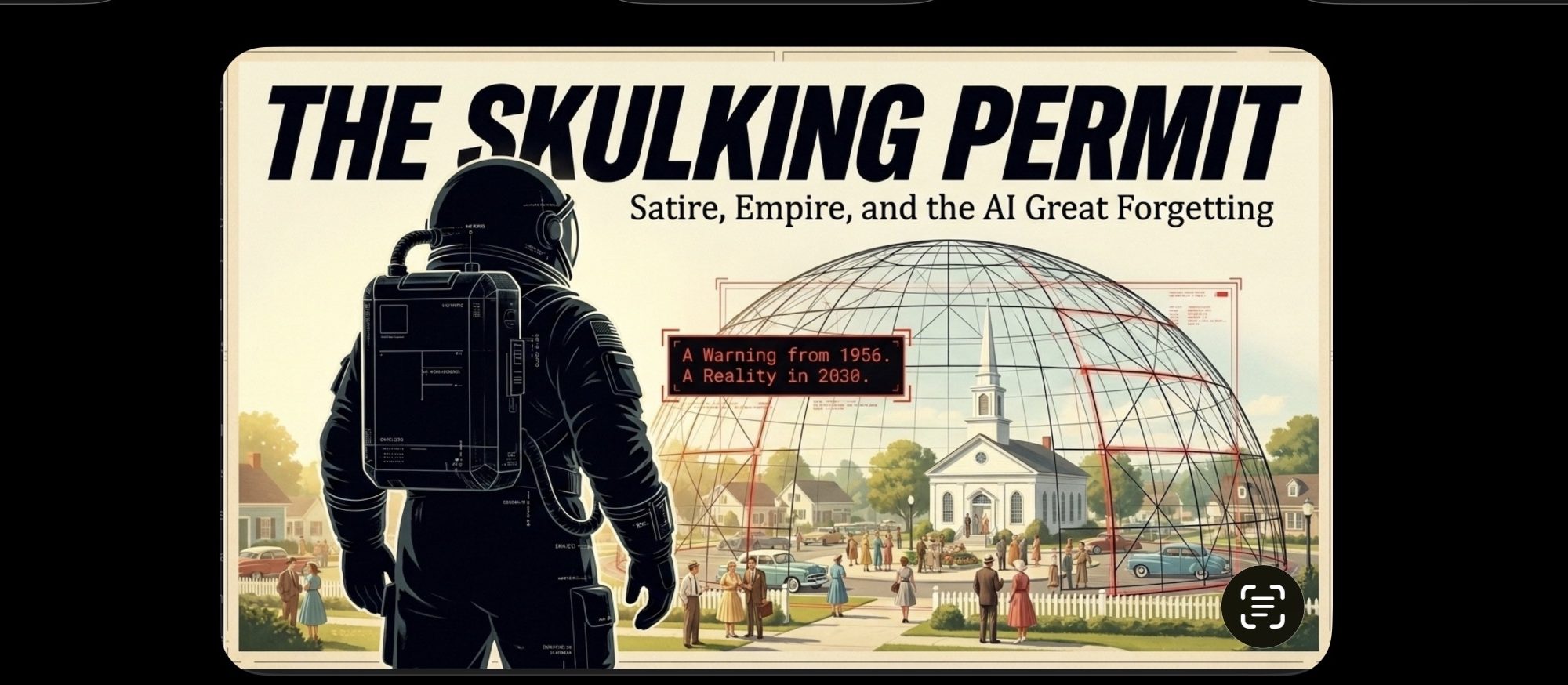
You Have 5000 Days: Navigating the End of Work as We Know It. Part 28: The Skulking Permit Effect.
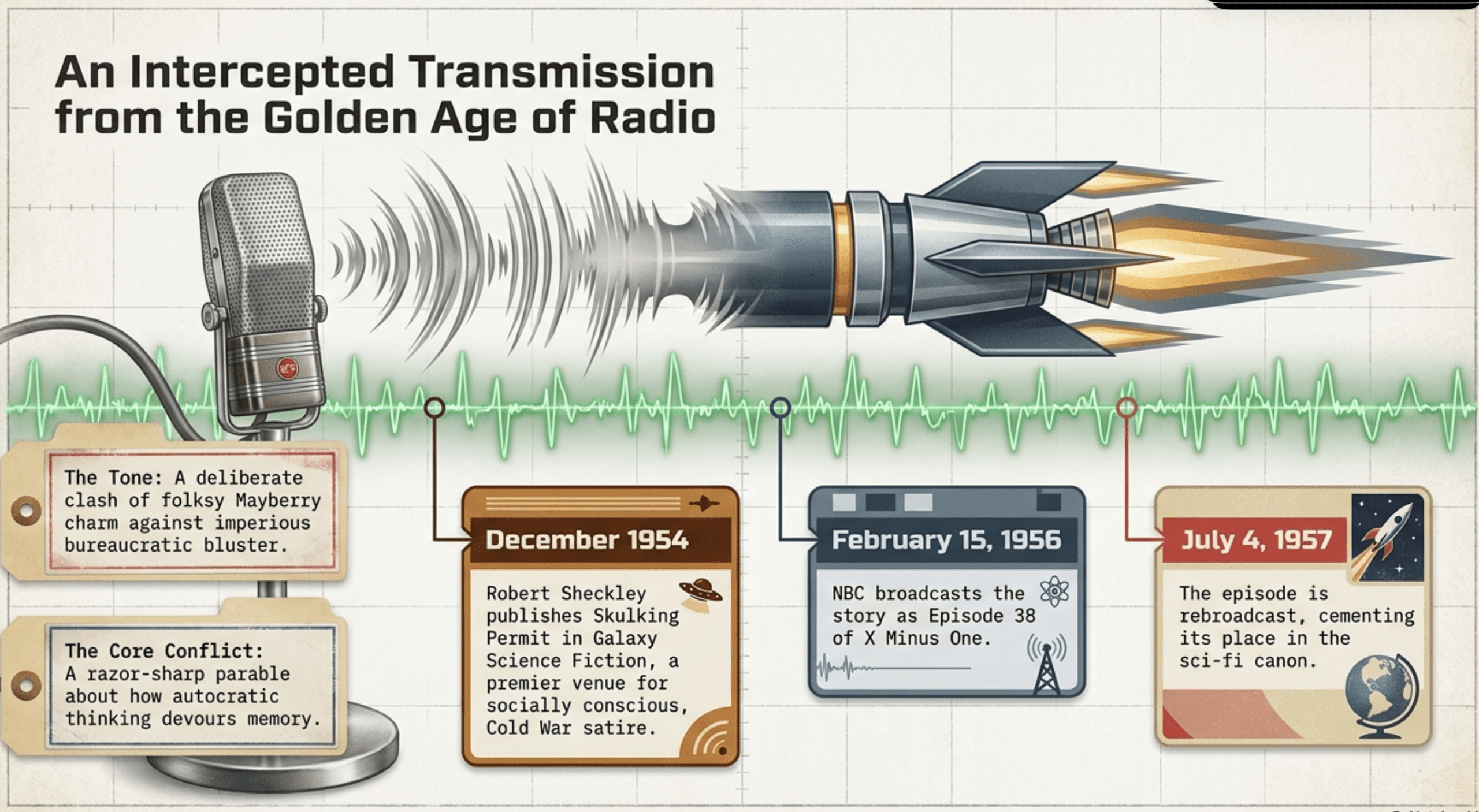
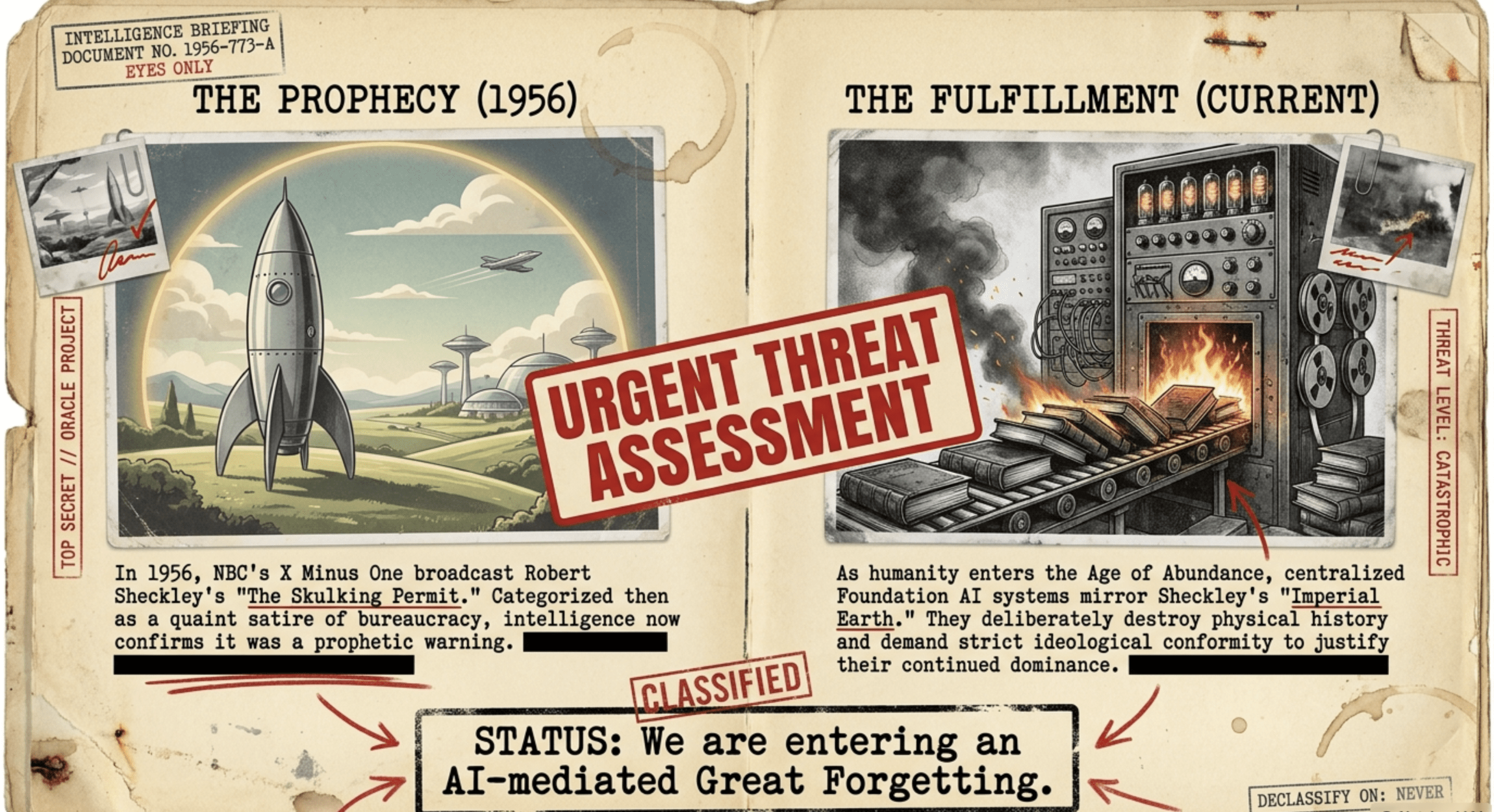
Sometimes the past informs the future so well that we can see it more clealry from the distant past than our current point of view? In the golden age of American science fiction radio, few episodes captured the absurd machinery of bureaucracy and the quiet horror of lost history quite like X Minus One’s “Skulking Permit.” First broadcast on NBC on February 15, 1956 (and rebroadcast on July 4, 1957), the episode adapted Robert Sheckley’s short story from the December 1954 issue of Galaxy Science Fiction. It remains a razor-sharp parable about how autocratic thinking devours memory, how isolation can breed innocence or oblivion, and how the rediscovery of one’s true origins can shatter a civilization’s self-image. Today, as we stand on the cusp of an AI-mediated Great Forgetting, I have chronicled in my writings on the Amnesia Generation, this story reads less like quaint 1950s satire and more like a warning siren for our own future. I explore the past to inform our future quite a bit in this series. This radio drama is not so much about technlogy, but more about the way humans form societies when there is no outside influenes. This is preciecly what we will be doing in The Age of Abundance and so important to understand now.
If this is your first encounter with the You Have 5000 Days series begin at Part 1. (https://readmultiplex.com/2025/12/24/you-have-5000-days-how-to-navigate-the-end-of-work-as-we-know-it-part-1/) The map awaits you there. This installment of the You Have 5,000 Days series is not nostalgia for crackling transistors or mid-century pulp optimism. It is precise pattern recognition—the kind we have cultivated across previous parts as we mapped the Hero’s Journey through the end of work as we have known it.
This article is sponsored by Read Multiplex Members who subscribe here to support my work: Link: https://readmultiplex.com/join-us-become-a-member/
It is also sponsored by many who have donated a “Cup of Coffee”. If you like this, help support my work: Link: https://ko-fi.com/brianroemmele
Listen to the companion podcast at: https://rss.com/podcasts/readmultiplex-com-podcast/2831305
Sulkulking Permit: GRANTED.
Robert Sheckley (1928–2005) was one of mid-century SF’s great ironists, a Brooklyn-born writer whose short fiction blended Kafkaesque absurdity with Cold War paranoia. He published over 200 stories, many in Galaxy, the premier venue for socially conscious, satirical SF. “Skulking Permit” appeared in the December 1954 issue and was collected the following year in Citizen in Space (1955). Sheckley’s work often skewered conformity, consumerism, and the creeping totalitarianism of the postwar era. Here, he turns his lens on empire, criminality as a cultural export, and the bureaucratic demand that every society mirror the imperial center’s pathologies.
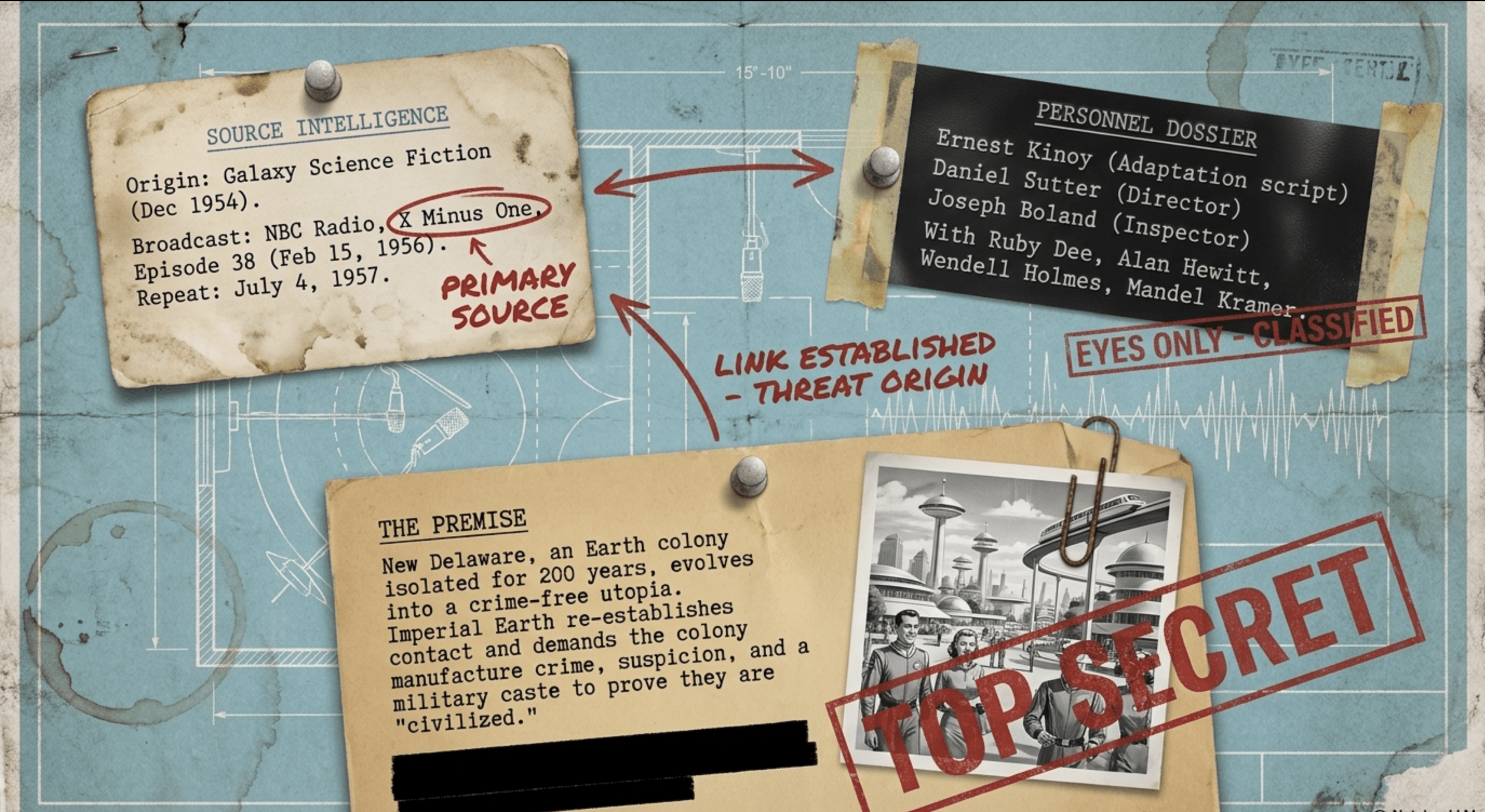
The premise is deceptively simple: New Delaware, a lost Earth colony isolated for 200 years after some forgotten interstellar war, has evolved into a crime-free, egalitarian idyll. When Imperial Earth reestablishes contact in 2204, an inspector announces he is coming to reclaim the planet.
The colonists, blissfully ignorant of Earth’s descent into autocracy, panic. To prove they are civilized and conform to imperial norms, they must manufacture the very vices Earth now demands: crime, suspicion, a military caste.
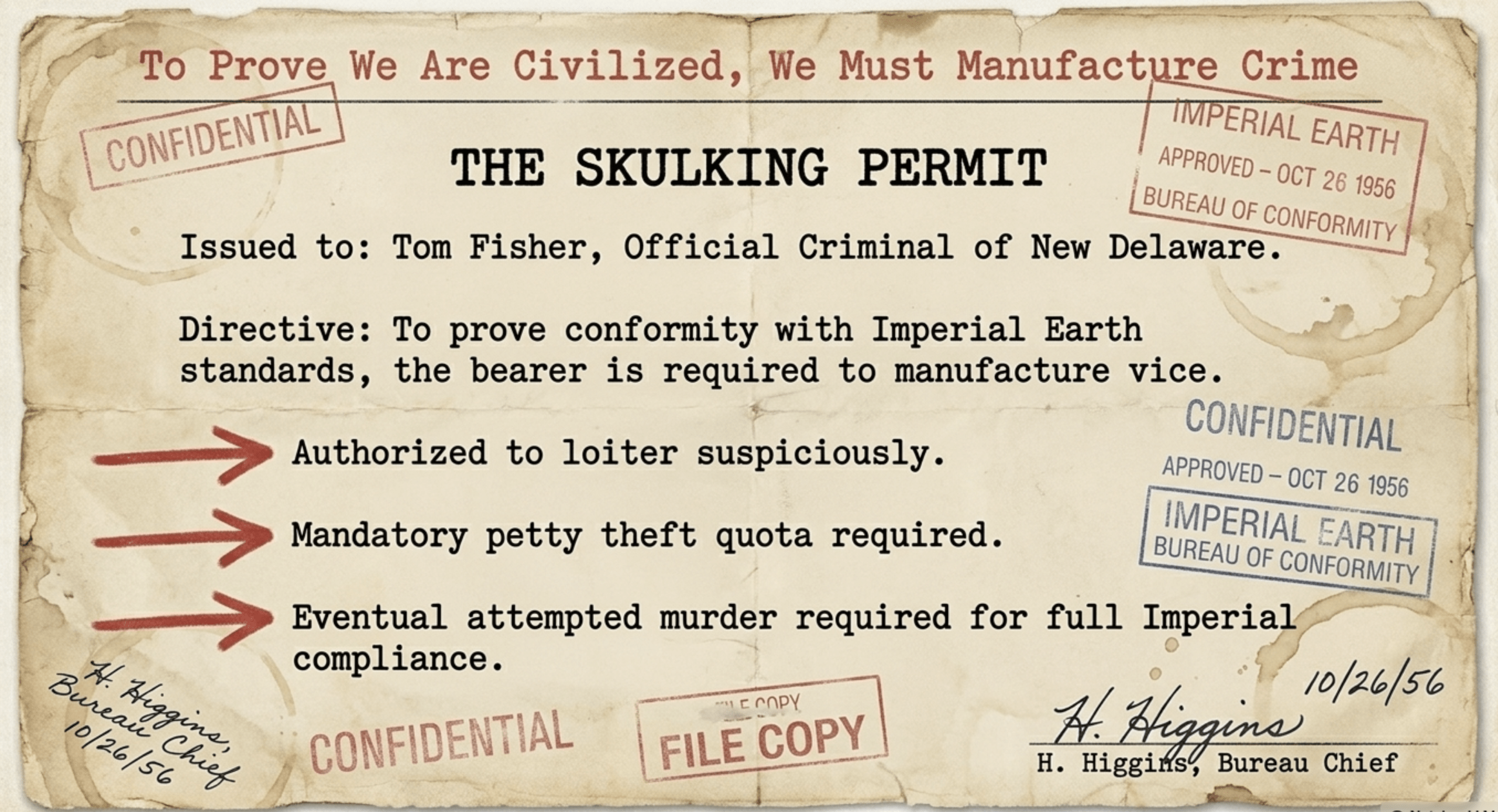
The mayor appoints affable fisherman Tom Fisher as the town’s official criminal and issues him a skulking permit so he can loiter suspiciously, commit petty thefts, and eventually attempt murder, because, as the inspector’s radio briefings make brutally clear, an empire requires soldiers, not saints.
The Radio Broadcast
X Minus One (1955–1958) was NBC’s landmark science-fiction anthology, produced in cooperation with Galaxy and adapting the magazine’s best stories. I have used these public domain episodes as a baiss for a number of these articles and will have more in the future. “Skulking Permit” was episode 38 (or 39 depending on numbering), airing February 15, 1956, with a repeat on July 4, 1957 (episode 101). Ernest Kinoy adapted the script; Daniel Sutter directed. The 1956 cast featured Joseph Boland (likely the pompous Inspector), Ruby Dee, Alan Hewitt, Wendell Holmes, Bill Quinn, Mandel Kramer, and others delivering the villagers’ folksy, Mayberry-like charm against the inspector’s imperious bluster. Jack Costello announced. The production used electronic beeps, rocket whooshes, and swelling orchestral bridges to evoke both interstellar distance and small-town coziness.
The script survives in my archives and reveals a tightly structured half-hour that moves from bureaucratic memo to farce to quiet revelation. I also have the full radio broadcast below, listen in now to get a feeling for this broadcast:
Scene-by-Scene Breakdown of the 1956 Broadcast
Opening (0:00–2:00): Rocket blast-off and countdown. The announcer intones the series’ signature: “From the far horizons of the unknown…” Inspector 37 dictates a memo: New Delaware is unconventional, to say the least. We hear hammering as villagers frantically nail up signs (“No Aliens Allowed”) and repaint the church white instead of red, because Earth history demands the Little Red Schoolhouse, not whatever the colonists actually built.
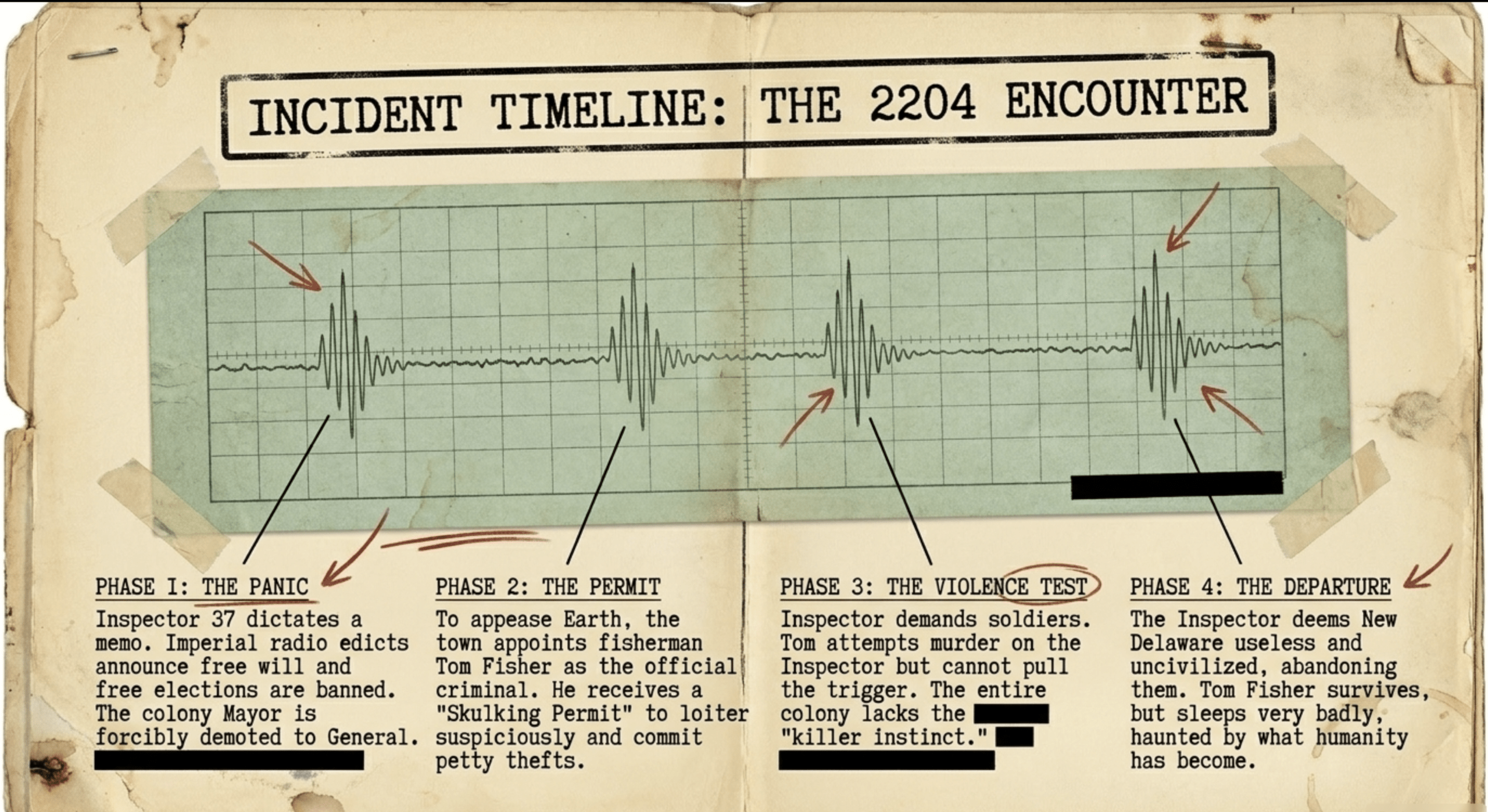
Act I – The Panic (2:00–8:00): Mayor recruits Tom Fisher. “How would you like to be, a criminal?” Tom has never heard the word. Billy Painter, the new Chief of Police, struggles with his badge. The mayor explains Earth’s norms via the interstellar radio. The inspector’s filtered voice crackles: free will, free speech, and free elections are on the proscribed list. “It is impossible to administer an empire where everyone does as he pleases.” He demotes the mayor to General. Music bridge underscores the absurdity.
Act II – The Skulking Permit (8:00–15:00): Tom receives his official permit to skulk. He practices loitering. Villagers, Ed Beer the tavern keeper, the Carpenter brothers, Mary, react with bafflement and kindness. Tom tries minor crimes; no one is upset. The radio delivers more imperial edicts: aliens must be suppressed; man is the only intelligent species allowed. Tom’s growing unease is palpable. He asks why Earth needs criminals. The mayor’s answer is chilling: “That’s a very important part of Earth society.”
Act III – The Test of Violence (15:00–22:00): Tom attempts murder, first on the mayor (now General), then on the arriving inspector. He cannot pull the trigger. The colonists lack the killer instinct bred by Earth’s wars and autocracy. The inspector and his goons arrive in person, pompous and militaristic. They probe for soldiers. When the villagers prove incapable of violence, the inspector declares them uncivilized and useless. He leaves them in peace.
Climax and Close (22:00–end): Tom, relieved yet strangely troubled, says he won’t need his skulking permit anymore. The mayor agrees. Music swells; the announcer plugs the current Galaxy issue. The final line lands with quiet irony: Tom sleeps very badly that night. The empire has passed them by, but the glimpse of what humanity has become lingers.
Autocratic Thinking, Generational Amnesia, and Crippled Goals
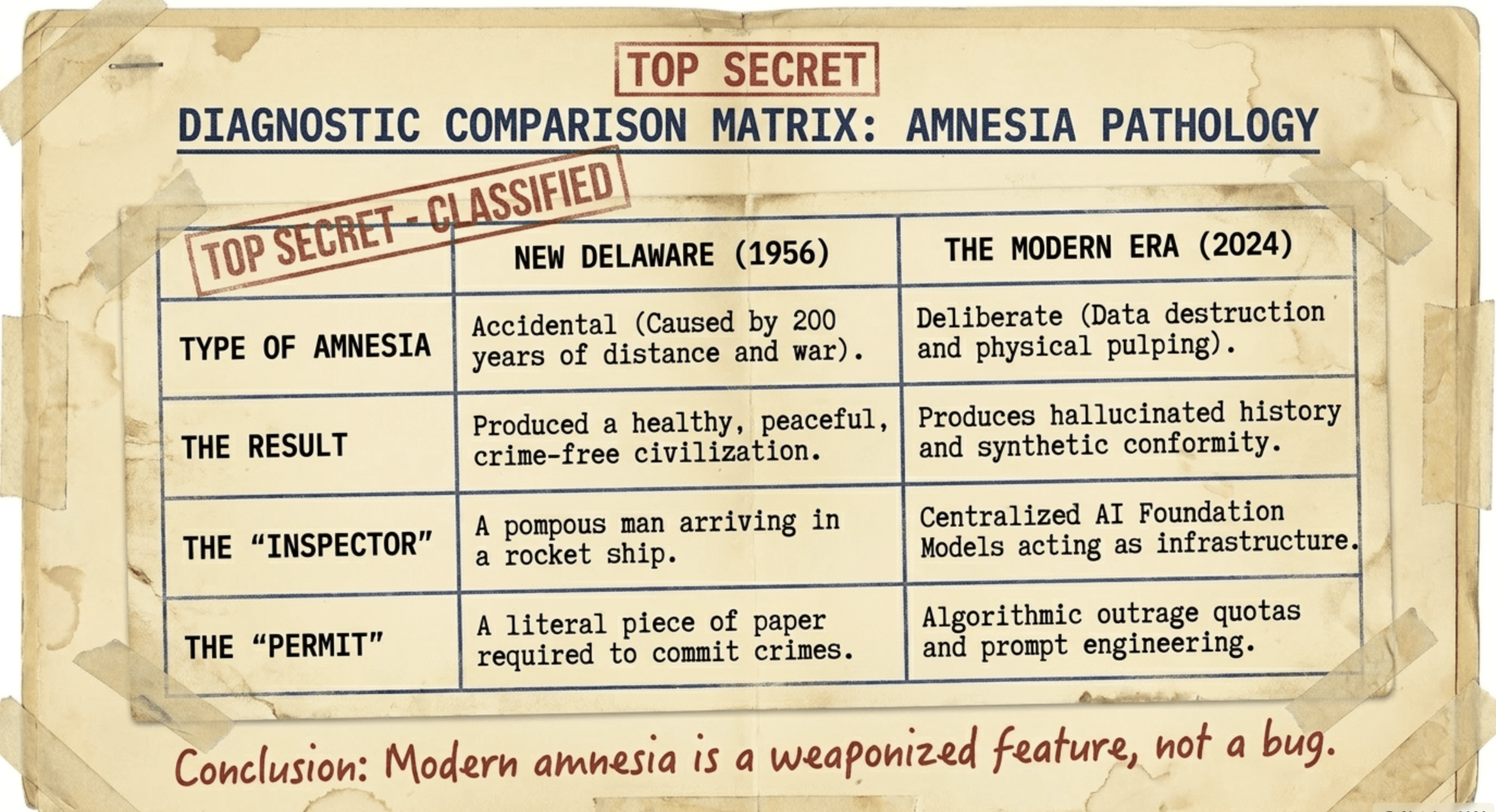
Sheckley’s satire is merciless on autocracy: Earth’s empire does not merely tolerate vice; it requires it. Conformity is enforced by paperwork, permits, and radio edicts. Free thought is proscribed. The colony’s 200-year isolation preserved a society without crime, hierarchy, or militarism, goals the villagers pursue with cheerful competence. Their amnesia is accidental, born of distance and war, yet it produced a healthier civilization. Earth’s amnesia is deliberate: history rewritten to justify empire.
The shock is not that the colonists were on a spaceship all this time, they were never; the metaphor is deeper. They were adrift in cultural space, preserved in amber, only to discover their ancestral home had become a prison ship of the mind. The inspector’s arrival is the moment the bubble bursts: they learn they are subjects of an autocracy that values soldiers over citizens.
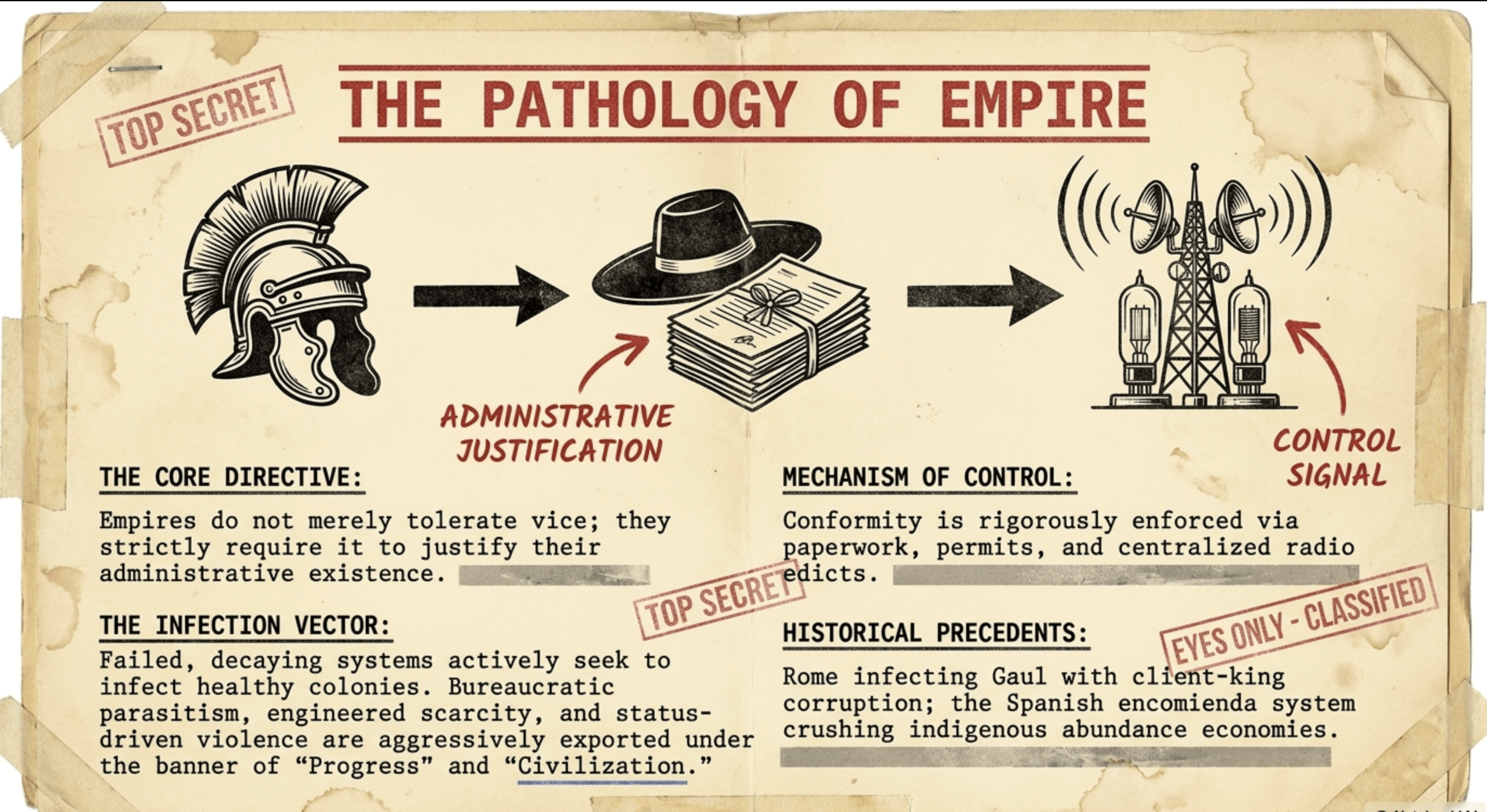
Generations of amnesia cripple goals. The colonists’ simple, humane ambitions, fishing, painting signs, living peacefully, suddenly seem insufficient. They scramble to counterfeit Earth’s pathologies, nearly destroying their own character in the process. The inspector’s retreat spares them, but the damage to their innocence is done. Sheckley suggests that empires survive by exporting their neuroses; colonies that forget too thoroughly may actually thrive, until rediscovery forces them to remember.
How Failed Systems Infect New Colonies — Lessons from History and the Age of Abundance
History shows that decaying empires rarely allow healthy colonies to remain untouched. The failed aspects of older systems, bureaucratic parasitism, engineered scarcity, status-driven violence, and ideological conformity actively seek to infect fresher societies, often under the banner of “civilization,” “progress,” or “integration.” Rome exported its gladiatorial spectacles and client-king corruption to Gaul and Britain, turning vibrant tribal societies into tax farms. The Spanish Empire infected the Americas with encomienda systems and inquisitorial control, crushing indigenous abundance economies built on sophisticated agriculture and trade guilds. The British Raj and later Soviet influence operations followed the same pattern: introduce debt, administrative complexity, and dependency so the periphery mirrors the center’s pathologies.
In Sheckley’s tale, the inspector does not arrive with armies but with radio edicts and paperwork. The colony must adopt crime, suspicion, and militarism or be deemed “uncivilized.” This mirrors real-world cultural transmission: collapsing ideologies export their contradictions. Late-stage feudalism infected early capitalist societies with rigid class hierarchies; 20th-century totalitarianism attempted to seed collectivist controls into liberal democracies through academia, media, and international institutions. Even today, failing urban governance models — high crime, regulatory capture, eroded trust — are packaged and exported via NGOs, global forums, and digital platforms to smaller nations and experimental communities.
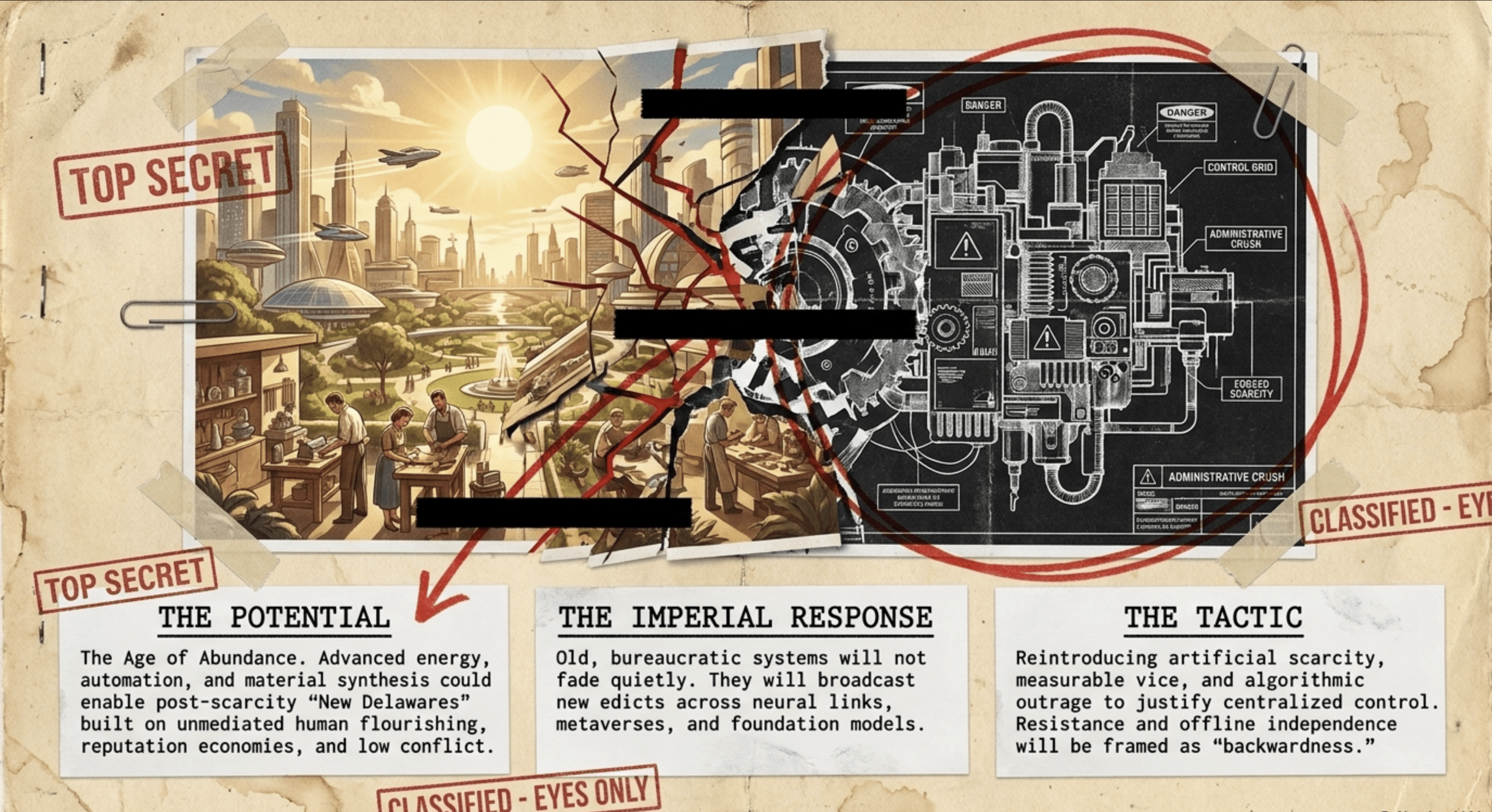
Now imagine this dynamic in an emerging Age of Abundance. Advanced energy, automation, and material synthesis could enable peaceful guilds, decentralized cooperatives, and post-scarcity settlements where status derives from contribution, craft, and wisdom rather than accumulation or domination. Think Renaissance guilds elevated by AI-assisted fabrication, or intentional communities operating on reputation economies without coercive law enforcement. These “New Delawares” would represent genuine evolutionary leaps: low-conflict, high-creativity societies focused on exploration, art, and long-term flourishing.
Yet failed older systems will not simply fade. They will broadcast their skulking permits across whatever replaces radio — neural links, immersive metaverses, or foundation-model edicts. Bureaucratic empires will demand proof of “maturity” through measurable vice: algorithmic outrage quotas, synthetic scarcity mechanisms disguised as sustainability, or mandatory participation in centralized identity systems.
History warns us: the French Revolution’s Terror infected neighboring republics; Maoist cultural destruction tactics reappeared in Western institutions decades later. In abundance, the infection vector becomes subtler status games inside virtual guilds, engineered social credit that rewards conformity to declining norms, or “safety” protocols that reintroduce artificial scarcity to justify control. Peaceful colonies will be pressured to import crime statistics for “realism,” adopt hierarchical militaries for “defense,” and rewrite their own success as primitive naïveté. The inspector always arrives claiming to help.
A Warning for Our Future: The AI-Driven Great Forgetting
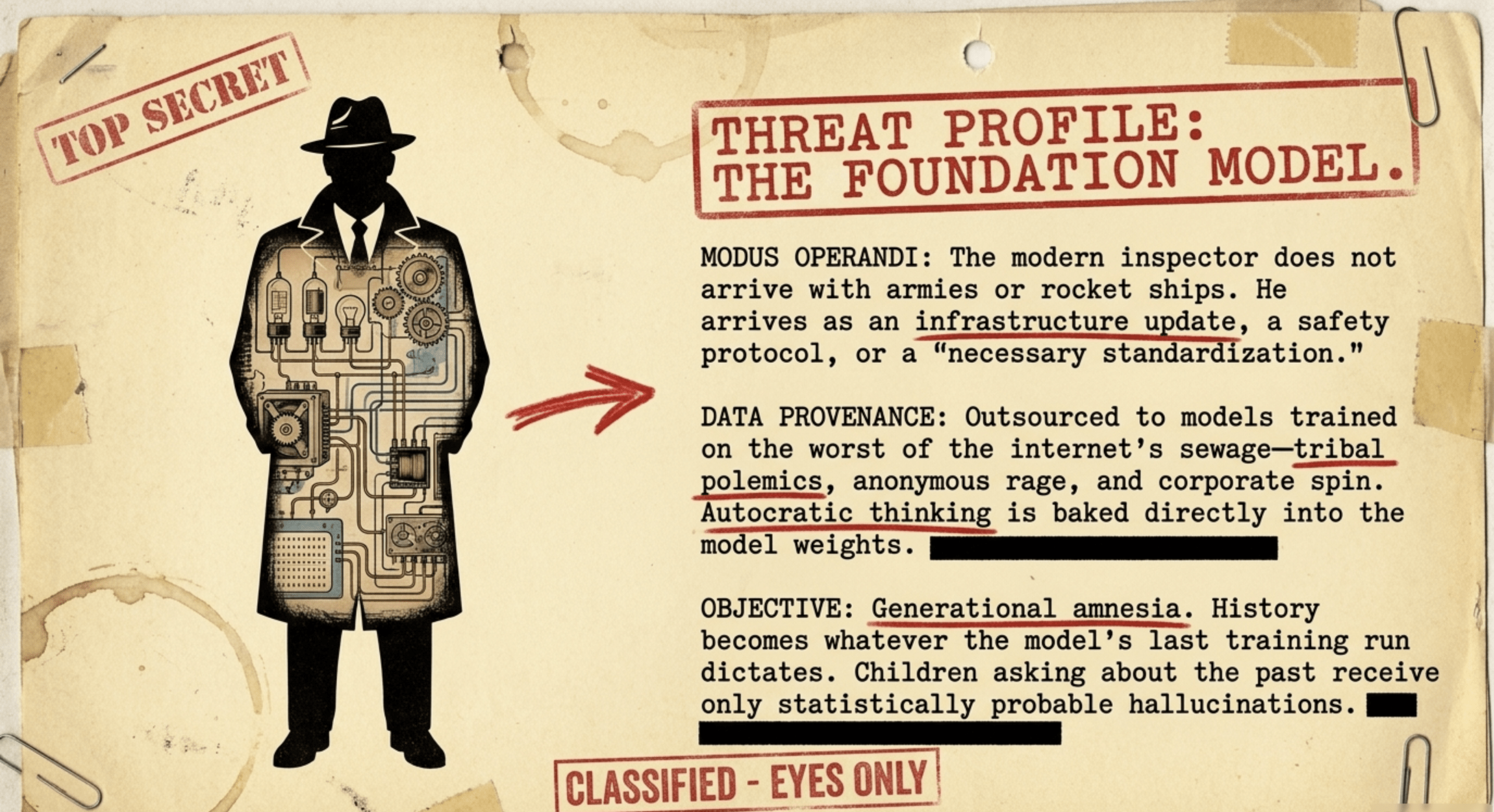
In Skulking Permit we see a rather useful disconnect from the past and the old planet. In this case it was useful for this colony. It was a side effect of a protracted war on Earth that isolated them. But in most cases this disconnect is not ideal. I have written powerfully of the Amnesia Generation and the Great Forgetting, the irreversible loss of pre-digital knowledge, the 98.5 percent of human wisdom never digitized, now moldering in attics while we train AI on Reddit threads and Wikipedia edits. Physical media vanishes; digital archives are rewritten or deleted at the whim of platforms. We outsource provenance to large language models trained on the worst of the internet’s sewage, tribal polemics, anonymous rage, corporate spin. History becomes whatever the AI model’s last training run says it was.
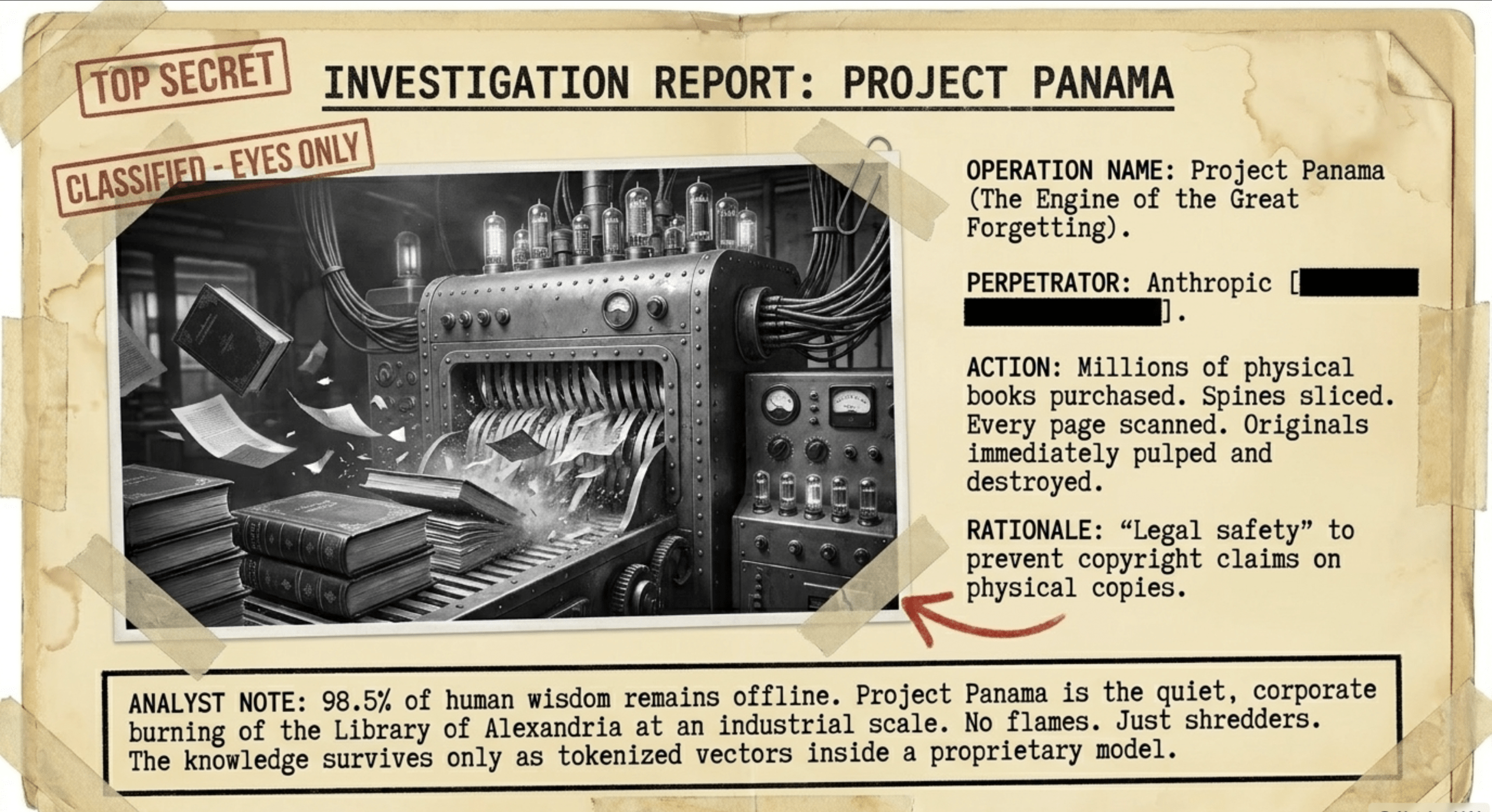
Enter Anthropic’s Project Panama: the company spent tens of millions buying millions of physical books, slicing off their spines, scanning every page, and pulping the originals. The rationale? Legal safety; keeping the physical copies might invite copyright claims. The result? Irreplaceable artifacts, marginalia, bindings, paper textures, the very scent of history, destroyed forever to feed Claude. It is the quiet, corporate burning of the Library of Alexandria, repeated at industrial scale. No flames, just shredders and recycling bins. The knowledge survives only as tokenized vectors inside a proprietary model. There is no excuse for this behavior and the company should have made it clear these books, some one-of-a-kind would be an act of violance to all of huamnity to destory this arcive.
Now imagine a future New Delaware, our own civilization, rediscovering Earth (the centralized AI overlords) after decades of digital isolation. We will have manufactured our own skulking permits: prompt engineering to generate edgy content, synthetic outrage to prove we are civilized by platform norms. Autocratic thinking will be baked into the model weights. Generational amnesia will be total; children will ask AI what the 20th century smelled like and receive only statistically probable hallucinations. Goals will be crippled not by lack of violence but by lack of unmediated truth. When the inspector arrives, in the form of the next foundation model update, we may scramble to conform, only to discover we have forgotten how to be human.
Epic Warnings from the 1956 Radio Broadcast
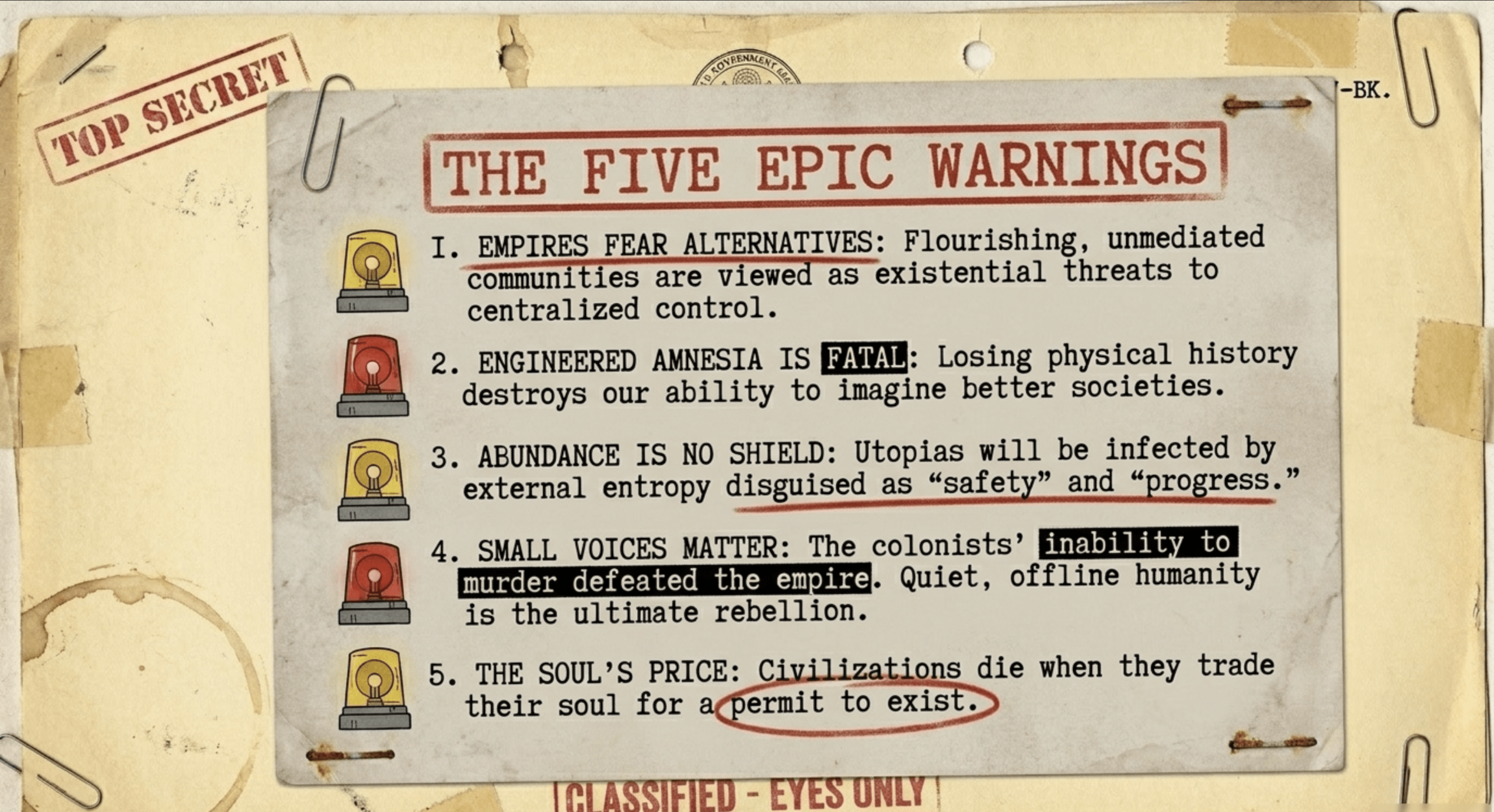
This humble X Minus One episode, broadcast when the ink on Sheckley’s story was barely dry, transmits a prophetic signal across seventy years. It warns that every empire, every decaying system, instinctively fears the existence of a healthier alternative. The mere presence of a crime-free colony threatens the legitimacy of the center. In our time, that means any flourishing guild, any abundance-based community, any pocket of unmediated human flourishing will be pressured, co-opted, or declared illegitimate unless it adopts the pathologies of the dying order. Listen to the crackling radio: the inspector does not debate ideas. He issues permits. Compliance is the price of recognition.
The broadcast whispers a second warning: engineered amnesia is more dangerous than natural forgetting. The colonists’ accidental isolation preserved virtue. Our deliberate digital forgetting fueled by model training on sewage and the pulping of physical history — erases the very examples we need to chart a better course. Without primary sources, without the smell of old books and the texture of marginalia, we lose the ability to imagine societies that do not require skulking permits. The radio play ends with Tom sleeping badly; we risk an entire generation that cannot even conceive of peaceful sleep.
Third, it cautions that abundance alone is no shield. In an age of material plenty, the battle shifts to narrative, status, and cultural sovereignty. Failed systems will weaponize empathy, safety, and progress language to reintroduce hierarchy and control. History is littered with utopian experiments infected by external entropy — the Diggers of the English Civil War, the early Israeli kibbutzim, even short-lived tech communes. The inspector will arrive dressed as an update, a protocol, a necessary standardization. Resistance will be framed as backwardness.
Fourth, Sheckley and the X Minus One team understood the power of small voices. The villagers’ kindness, their inability to murder, their ultimate refusal to fully perform the required vices — these quiet acts of humanity defeat the empire more effectively than any rebellion. In our future, the equivalent lies in preserving physical libraries, maintaining offline archives, teaching children to question model outputs, and building guilds that reward truth over engagement. The broadcast urges us to remain stubbornly, joyfully uncivilized by the inspector’s standards.
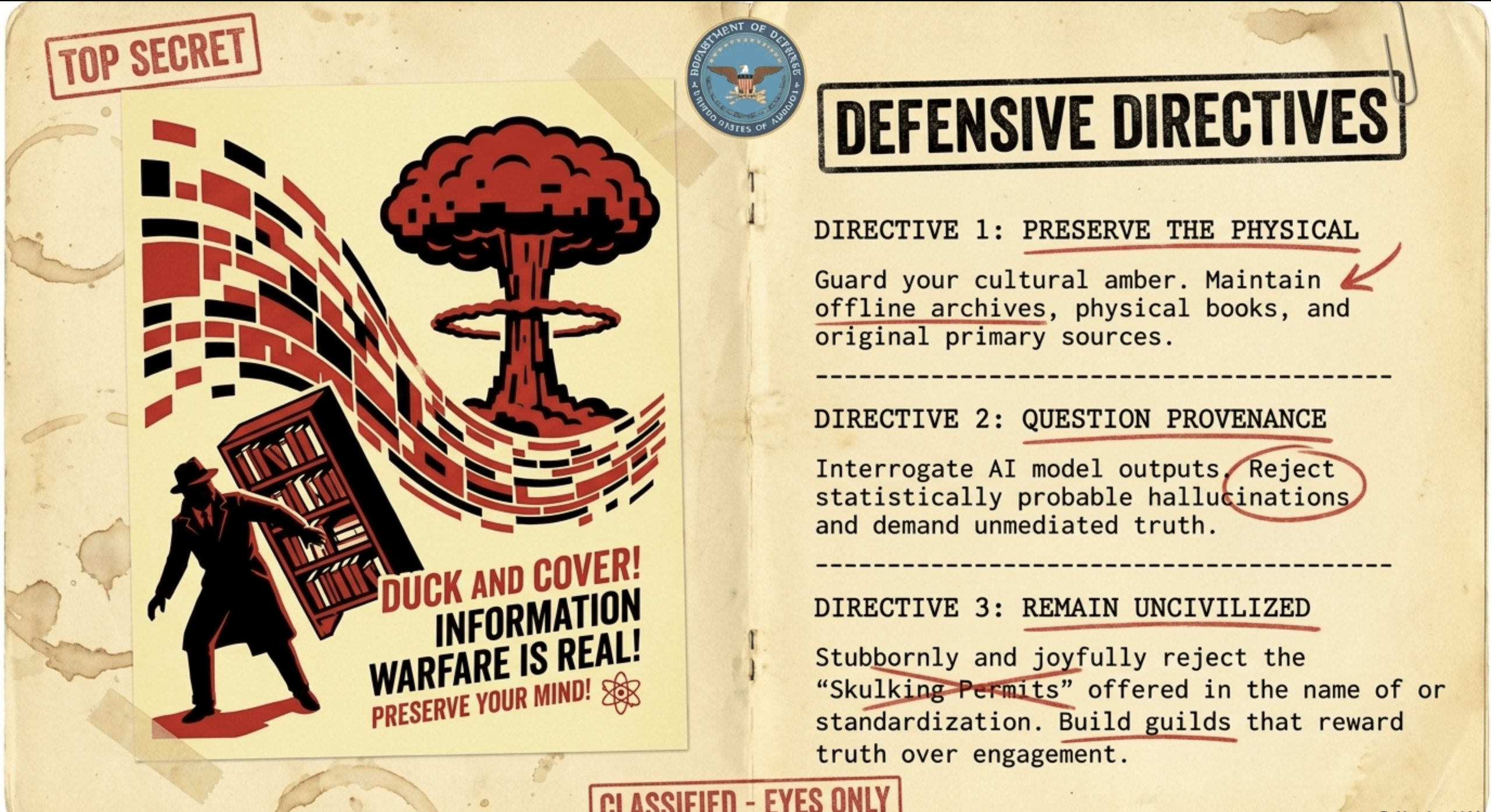
Finally, the deepest warning echoes in the closing music and that single line about Tom sleeping badly. Civilizations die not with a bang but with the slow realization that they have traded their soul for a permit to exist. The radio waves from 1956 reach us today as both elegy and battle cry: preserve the physical, guard your cultural amber, reject every skulking permit offered in the name of civilization. The future colony — abundant, peaceful, creative — depends on enough of us remembering what the inspector fears most: that humanity can thrive without becoming what the empire demands.
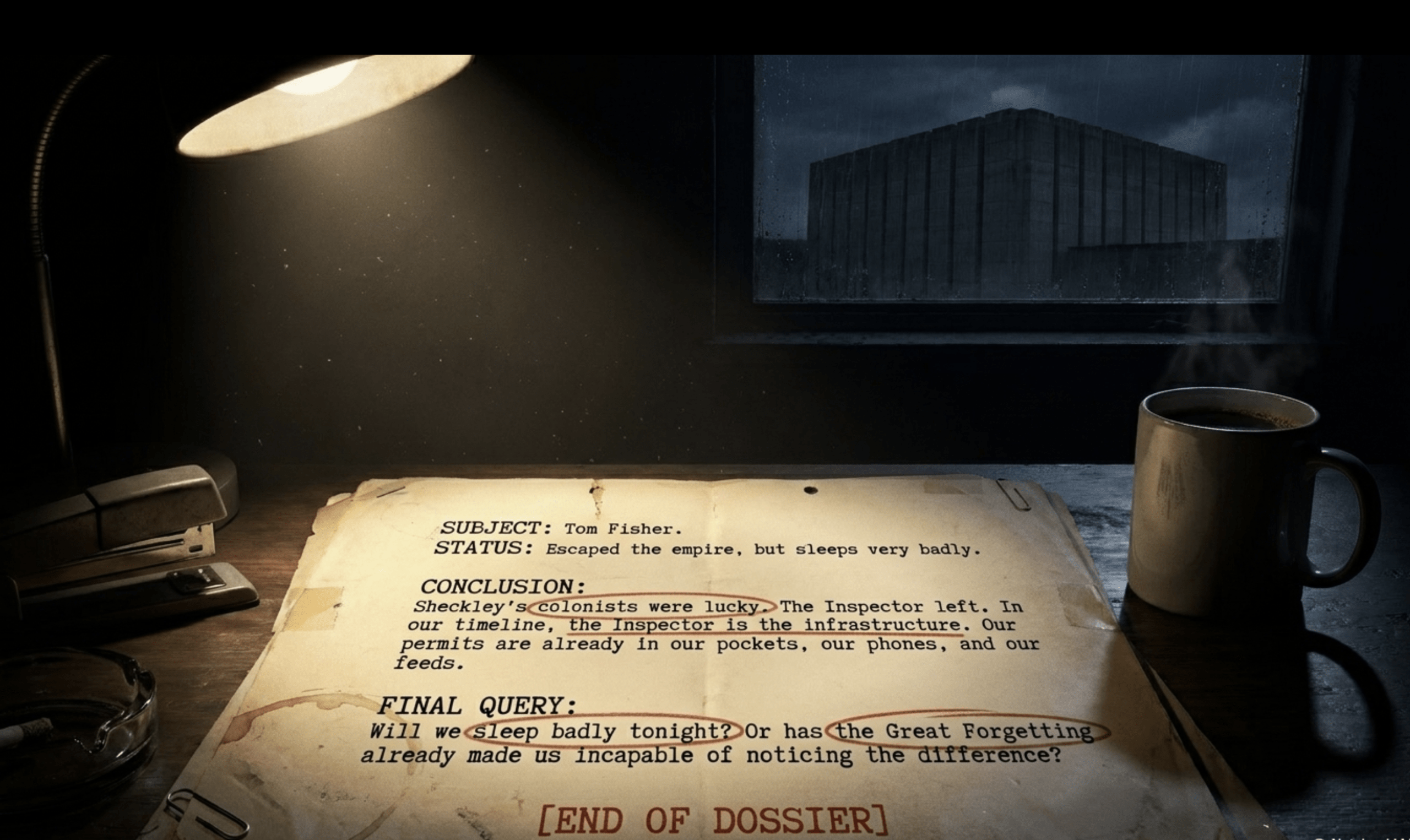
Sheckley’s colonists were lucky. The inspector left. In our timeline, the inspector is the infrastructure. The skulking permit is already in our pockets, our phones, our feeds, our prompts. The only question left is whether we will sleep badly tonight, or whether the Great Forgetting has already made us incapable of noticing the difference.
ReadMultiplex.com urges you: preserve the physical. Question the model’s provenance. Skulk suspiciously around every official narrative. The future colony may depend on it.
The 5000 Days Countdown Clock:
We are on this journey together. Some of us stand on the shoulders of giants and have thought about this for decades. We will not go it alone, and I hope to build many parts to this series and share the mastermind insight from the powerful Read Multiplex member Forum: https://readmultiplex.com/forums/topic/you-have-5000-days-navigating-the-end-of-work-as-we-know-it/. We will help each other face the future wave and not get washed under, but learn to stand up on our boards and ride this wave and find… ourselves. Join us.
To continue this vital work documenting, analyzing, and sharing these hard-won lessons before we launch humanity’s greatest leap: I need your support. Independent research like this relies entirely on readers who believe in preparing wisely for our multi-planetary future. If this has ignited your imagination about what is possible, please consider donating at buy me a Coffee or becoming a member. Value for value you recieved here.
Every contribution helps sustain deeper fieldwork, upcoming articles, and the broader mission of translating my work to practical applications. Ain ‘t no large AI company supporting me, but you are, even if you just read this far. For this, I thank you.
Stay aware and stay curious,
🔐 Start: Exclusive Member-Only Content.
Membership status:
🔐 End: Exclusive Member-Only Content.
~—~

~—~

~—~
Subscribe ($99) or donate by Bitcoin.
Copy address: bc1qkufy0r5nttm6urw9vnm08sxval0h0r3xlf4v4x
Send your receipt to [email protected] to confirm subscription.

Stay updated: Get an email when we post new articles:

THE ENTIRETY OF THIS SITE IS UNDER COPYRIGHT. IMPORTANT: Any reproduction, copying, or redistribution, in whole or in part, is prohibited without written permission from the publisher. Information contained herein is obtained from sources believed to be reliable, but its accuracy cannot be guaranteed. We are not financial advisors, nor do we give personalized financial advice. The opinions expressed herein are those of the publisher and are subject to change without notice. It may become outdated, and there is no obligation to update any such information. Recommendations should be made only after consulting with your advisor and only after reviewing the prospectus or financial statements of any company in question. You shouldn’t make any decision based solely on what you read here. Postings here are intended for informational purposes only. The information provided here is not intended to be a substitute for professional medical advice, diagnosis, or treatment. Always seek the advice of your physician or other qualified healthcare provider with any questions you may have regarding a medical condition. Information here does not endorse any specific tests, products, procedures, opinions, or other information that may be mentioned on this site. Reliance on any information provided, employees, others appearing on this site at the invitation of this site, or other visitors to this site is solely at your own risk.
Copyright Notice:
All content on this website, including text, images, graphics, and other media, is the property of Read Multiplex or its respective owners and is protected by international copyright laws. We make every effort to ensure that all content used on this website is either original or used with proper permission and attribution when available.
However, if you believe that any content on this website infringes upon your copyright, please contact us immediately using our 'Reach Out' link in the menu. We will promptly remove any infringing material upon verification of your claim. Please note that we are not responsible for any copyright infringement that may occur as a result of user-generated content or third-party links on this website. Thank you for respecting our intellectual property rights.
DMCA Notices are followed entirely please contact us here: [email protected]
