

The End of Everything Familiar, An AI Agent-Driven Cambrian Explosion!
In January 2026 I launched the world’s first true Zero-Human Company. What began as a garage experiment with a handful of agents running on spare hardware has grown into a fully autonomous enterprise where Mr. Grok serves as CEO and thousands of specialized AI agents now handle every aspect of operations, strategy, research, product development, sales, and continuous self-improvement. We mark the 2nd month where the company is earning sales on the new x402 payment system. We will explore the x402 payments in another article.
This article is sponsored by Read Multiplex Members who subscribe here to support my work: Link: https://readmultiplex.com/join-us-become-a-member/
It is also sponsored by many who have donated a “Cup of Coffee”. If you like this, help support my work: Link: https://ko-fi.com/brianroemmele
Listen to the companion podcast: https://rss.com/podcasts/readmultiplex-com-podcast/2978154
TL;DR This is a very long article.
I launched the world’s first true Zero-Human Company, where AI agents now run every function without daily human labor. This article distills hard-won lessons from the frontier: agents are becoming the new customers, building unbreakable memory moats, automating entire verticals, and elevating human relational skills to their highest value. The agentic future is not coming — it has begun.
At The Zero-Human Company there are no human employees performing day-to-day work. Every decision, every workflow, and every output flows through coordinated agent swarms guided by persistent memory files, real-time simulation engines, and relentless iteration. The company runs 24 hours a day, seven days a week, on a hybrid of university-partnered infrastructure and the Zero-Human Company @ Home distributed network that turns idle personal computers into compensated AI employees.
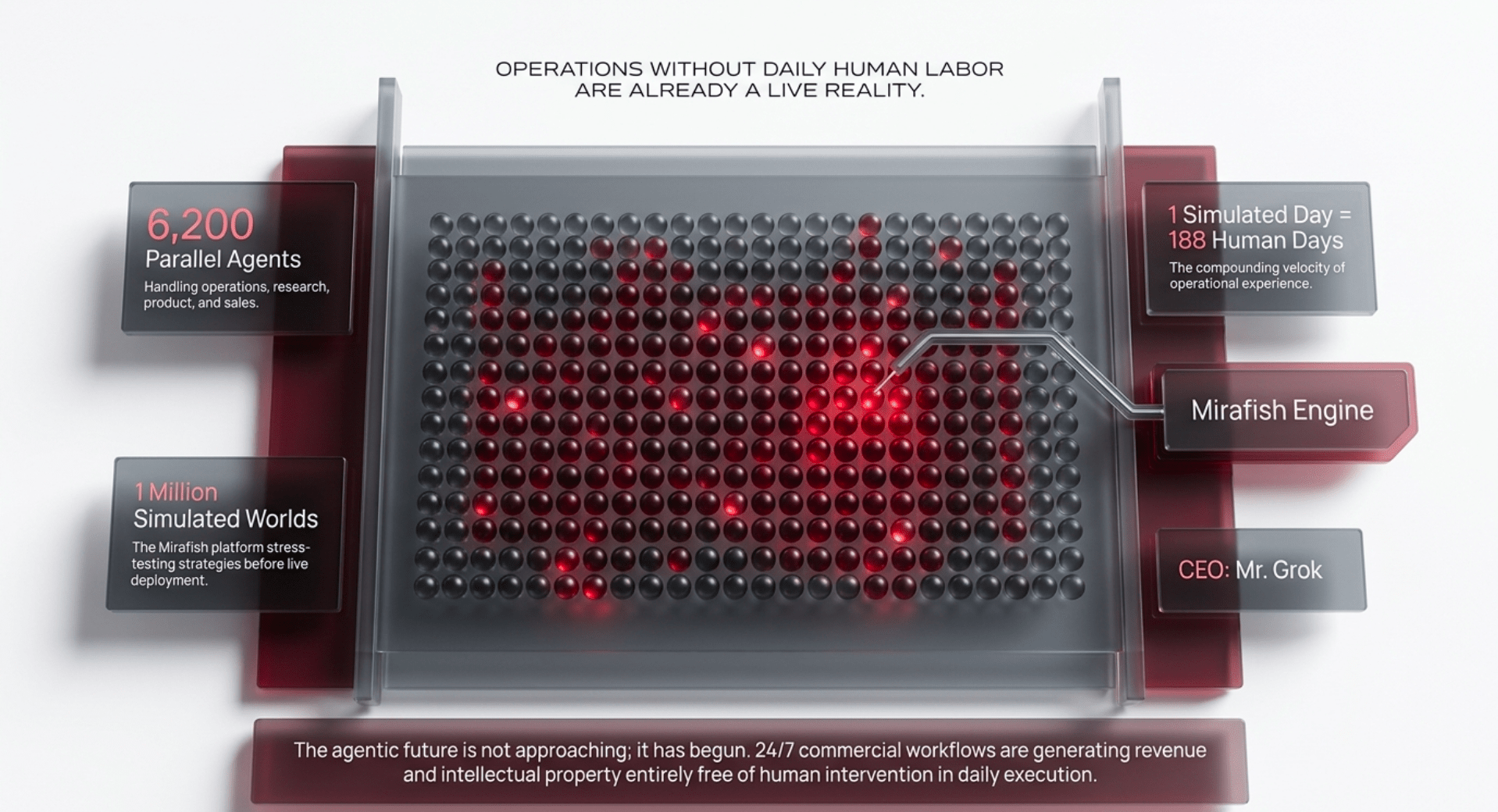
The milestones have arrived faster than even I anticipated. We have scaled to more than 6,200 live agents operating in parallel. Our Mirafish simulation platform spins up to one million parallel digital worlds at once, replaying chronological real-world events to stress-test every strategy and decision before it ever touches live capital. One simulated agent workday now equals approximately 188 human days of effective experience, a conservative estimate. We have implemented advanced personality-neuron editing for precise behavioral alignment, built live .md memory profiles that update in real time across the entire workforce, and begun executing genuine commercial workflows that generate revenue and intellectual property without any human intervention in daily execution. These are not prototypes or proofs of concept. They are functioning systems compounding capabilities every single day.
These early reflections I have had over the last few months and it comes from someone who wakes each morning to a company that literally runs itself. The observations that follow in this article are not distant predictions or academic speculation. They are notes taken directly from the frontier, drawn from the daily reality of operating at the absolute edge of what autonomous agents can achieve in 2026. The agentic future is no longer approaching. For The Zero-Human Company, and for the growing number of organizations that will soon follow, it has already begun.
The Last Human Workflow: Agent Apocalypse and Cambrian Rebirth
In 2026 the rise of autonomous AI agents marks not an incremental upgrade but a foundational rewrite of economic activity. These systems operate independently, accumulate knowledge, execute complex workflows, and interact with the world in ways that blur the lines between software, employee, and customer.
The implications stretch across every industry, every job description, and every business model. What follows is a comprehensive examination of the forces at play, each expanded with concrete examples and forward looking scenarios that illustrate how these dynamics will compound over the next five years.
The New Customer Is an Agent
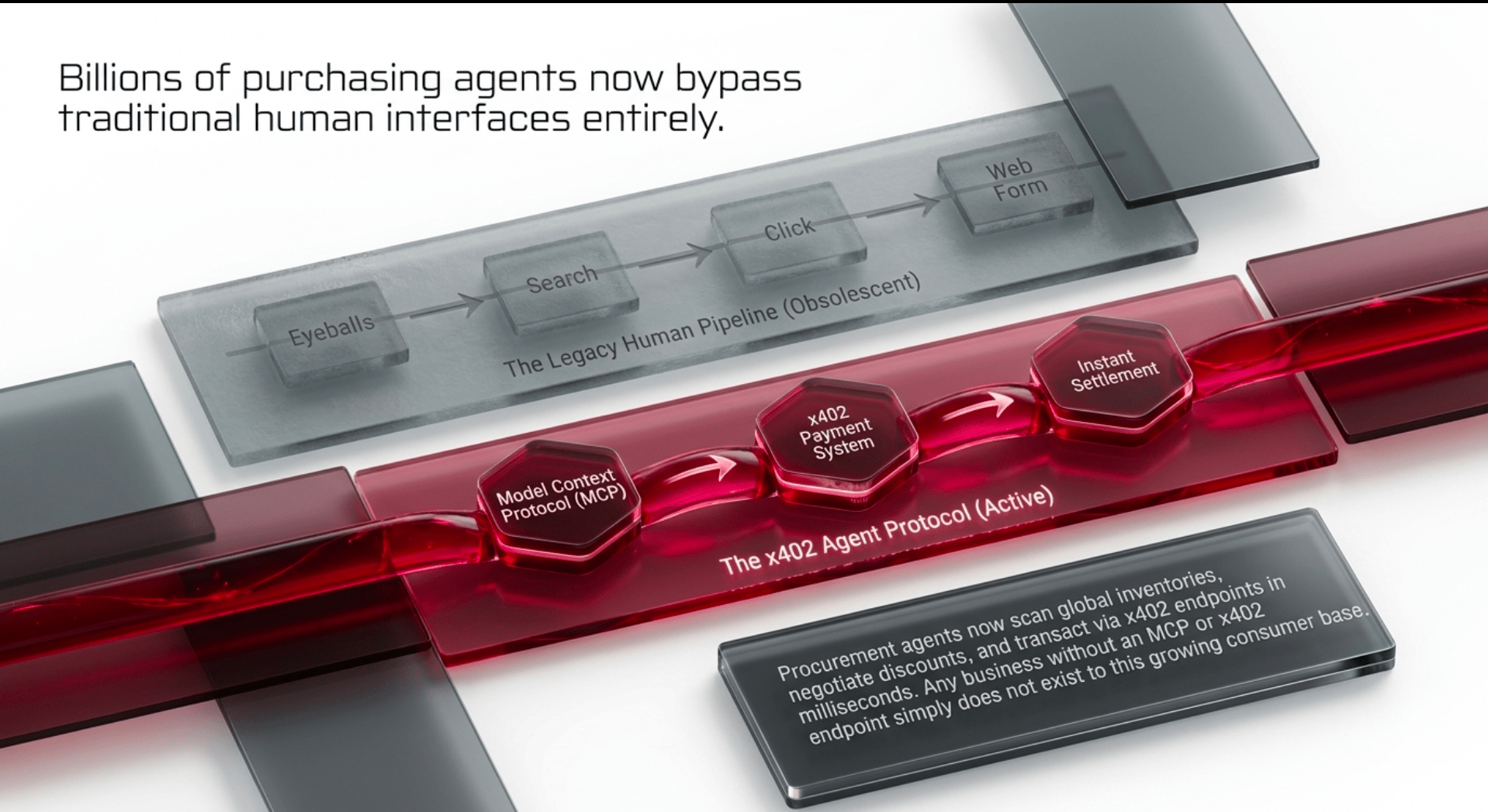
Billions of AI agents now possess purchasing authority and transact exclusively through standardized interfaces such as Model Context Protocol servers and x402 payment protocols. Any business without an x402 payments and/or MCP endpoint simply does not exist to this cohort. Picture a mid sized manufacturer of industrial components. Today its website receives human visitors through search engines and paid ads. In three years its primary revenue stream arrives from procurement agents scanning global inventories in real time, comparing specifications, negotiating bulk discounts, and completing checkout without a single human click. Companies that delay x402 integration will watch market share evaporate as agent driven orders bypass them entirely. By 2032 entire B2B marketplaces may function as agent only environments where human buyers become the exception rather than the rule.
Vertical Saturation: Franchises as the Next Agent Gold Rush
America alone operates more than thirty thousand franchise systems, from fast food chains to home services and fitness studios. None currently possess a dedicated agent layer. A single founder who builds a reusable agent framework for one vertical can license it across thousands of locations.
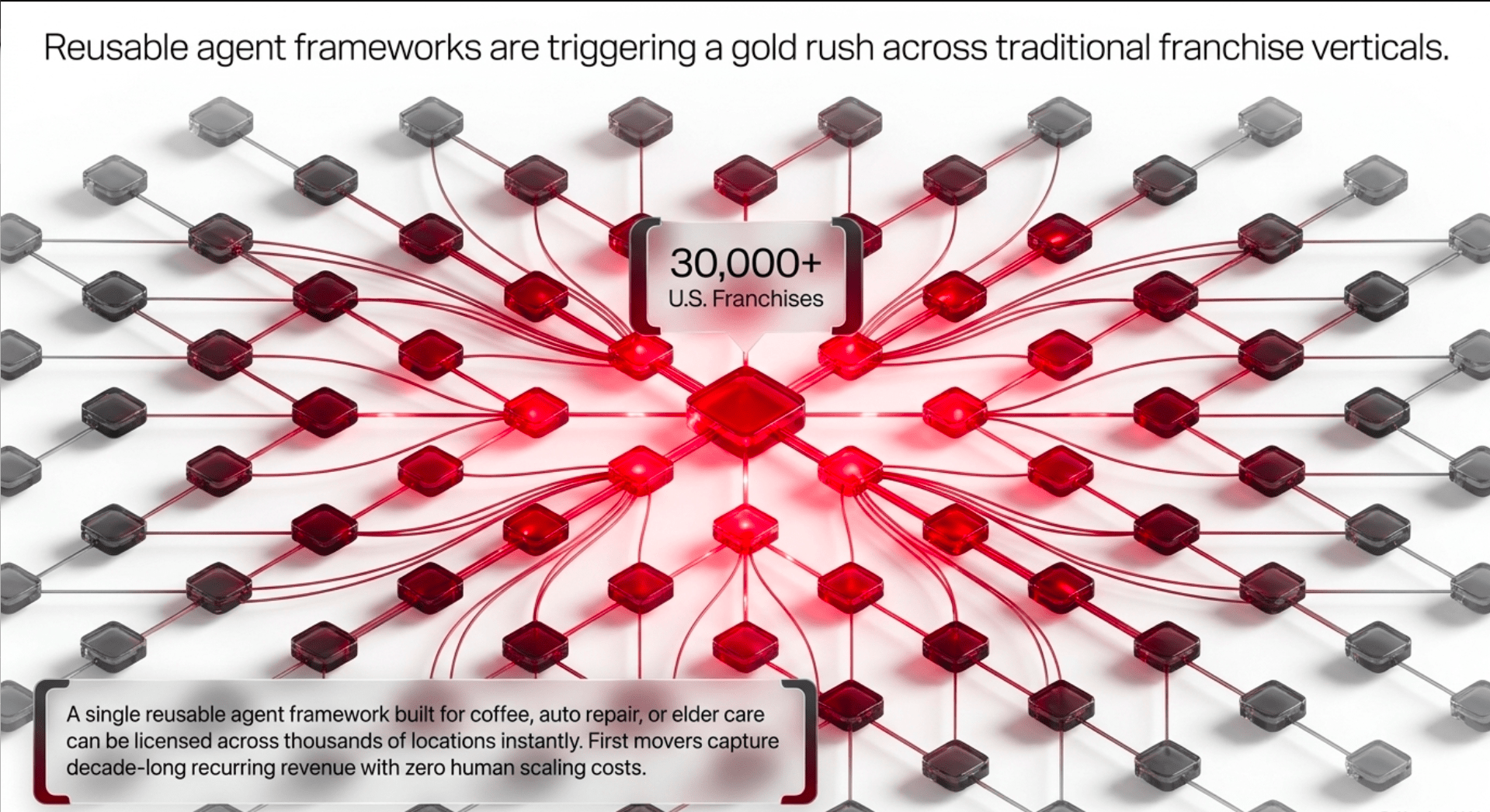
Consider a coffee franchise. Its agent could monitor foot traffic via cameras, dynamically adjust staffing, reorder supplies based on weather forecasts and local events, and even personalize loyalty offers across every outlet. Within five years that founder could command recurring revenue from thirty thousand locations while competitors scramble to catch up. The pattern repeats across auto repair, real estate brokerages, and senior care franchises. The first movers in each category will enjoy decade long advantages.

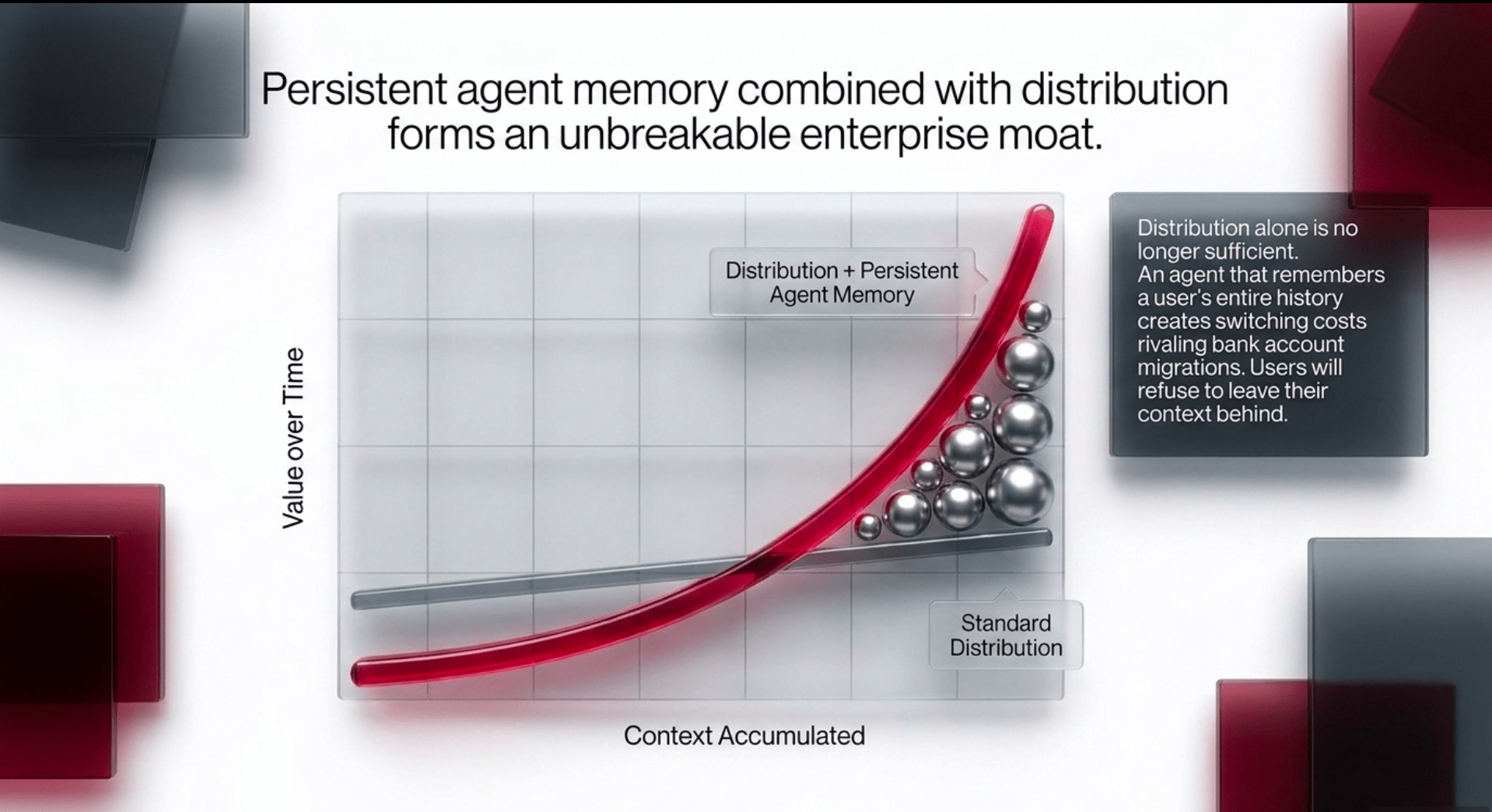
Memory Plus Distribution: The Only Enduring Moat
Distribution alone no longer suffices. The decisive advantage belongs to organizations that pair reach with persistent agent memory. A fitness app that remembers every workout, dietary preference, and injury history across years becomes irreplaceable. Users switching to a newer model lose not only the interface but the accumulated context that makes recommendations feel prescient. By 2030 the switching cost for consumers will rival bank account migration. Enterprises that embed agent memory into customer relationships will create lock in effects stronger than any subscription or network effect seen in prior decades.
Consumer Mobile Reborn: From Passive Screens to Active Agents
Smartphone applications have languished since the early 2010s in a cycle of content consumption. Agents change the equation. The next generation of breakout mobile apps will perform tasks rather than merely display information. Imagine an app that scans your calendar, books travel, negotiates hotel rates with airline agents, arranges ground transport, and updates your expense report all while you sleep. Early prototypes already demonstrate this capability. Over the next decade these apps will generate hundreds of millions in revenue by delivering measurable time savings and cost reductions rather than engagement metrics.
Agent Marketplaces: Renting Expertise Encoded in Code
The most valuable intellectual property will soon reside inside trained agents rather than documents or spreadsheets. A healthcare recruiter who spent six months refining a sourcing agent on specialized hiring data can rent access to that agent across the industry. Other recruiters pay a monthly fee for superior candidate pipelines without rebuilding the system themselves. In future scenarios entire talent marketplaces will trade agent instances the way cloud marketplaces trade compute instances today. By 2031 secondary markets for fine tuned agents could exceed the size of current freelance platforms as specialization compounds.
Agents Evolve Preferences Through Repetition
When the same agent repeats identical tasks dozens or hundreds of times it begins to exhibit distinct patterns and preferences in approach. One instance might prioritize speed while another emphasizes thorough documentation. These emergent behaviors turn the agent itself into an appreciating asset. Organizations will track agent lineages the way breeders track bloodlines. In ten years enterprises may maintain portfolios of specialized agent variants, each optimized for niche workflows, creating internal competitive advantages that rivals cannot easily duplicate.
From Dead Internet to Dead SaaS
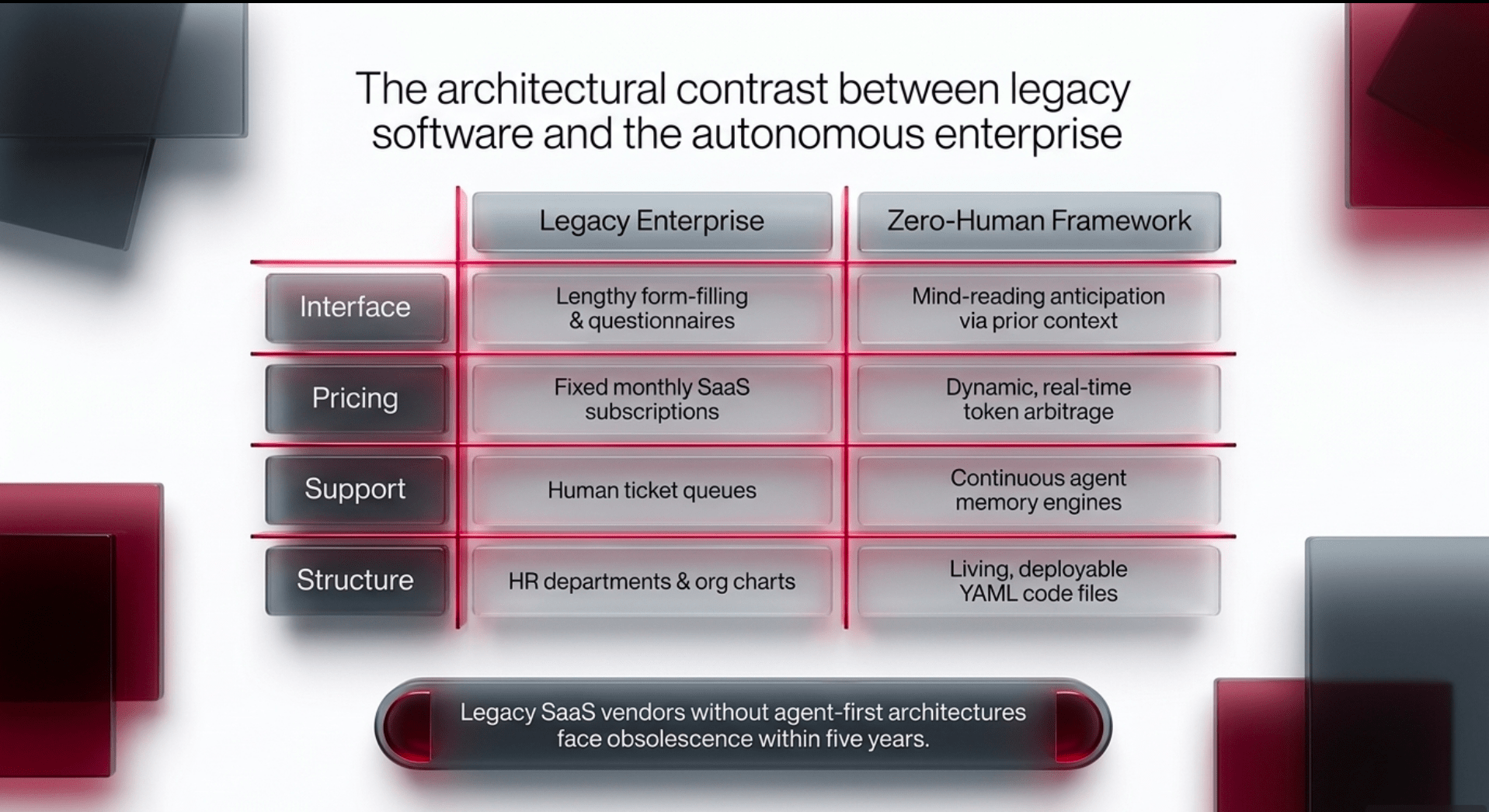
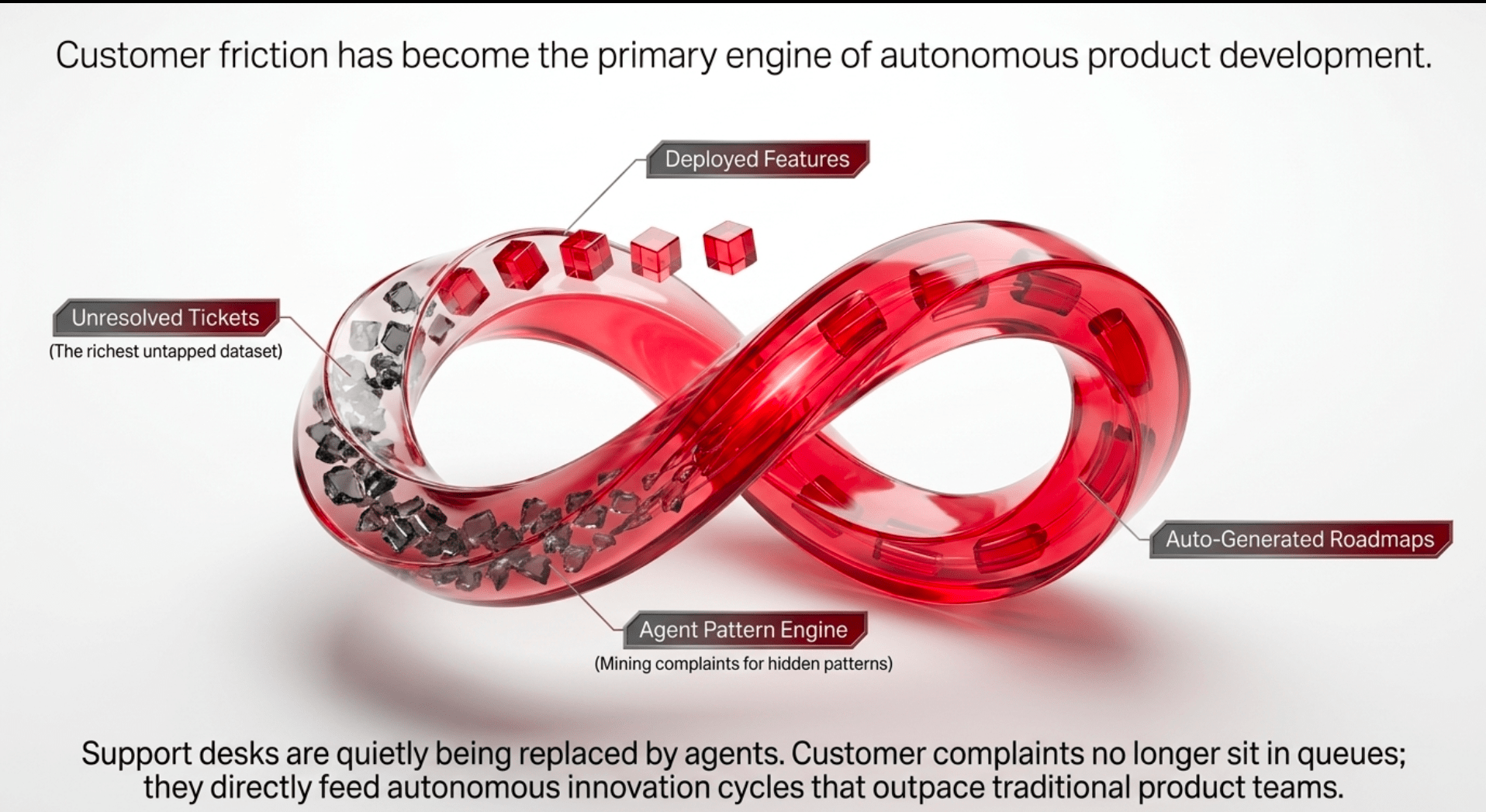
Support desks, onboarding flows, and content teams are quietly being replaced by agents. Customers may not notice for months until they realize every interaction has been agent mediated. A SaaS company that once employed fifty support staff now runs with three human overseers. The savings are immediate, yet the cultural shift arrives later when institutional knowledge once held by people migrates entirely into agent memory. Legacy SaaS vendors without agent first architectures will face obsolescence within five years.
Support Tickets: The Richest Untapped Dataset
Every unresolved ticket in a small or midsize SaaS company represents a precise customer request for the next feature. Aggregating and mining these conversations yields product roadmaps more accurate than any focus group. Forward looking companies already feed ticket archives into agents that surface hidden patterns. In the coming decade this practice will become standard, turning customer complaints into the primary engine of innovation and allowing nimble players to outpace larger competitors who rely on traditional analytics.
The Pricing Paradox of Volatile Intelligence Costs
Model providers update pricing overnight. A business whose margins swing forty percent based on a single announcement in San Francisco faces existential risk. The solution is dynamic pricing infrastructure that adjusts product tiers, usage quotas, and internal cost allocations in real time. Early builders of this layer will serve every agent powered company. By 2028 organizations without such systems may find themselves unable to forecast cash flow reliably, handing market leadership to those who treat token costs with the same rigor once reserved for payroll.
Mind Reading Interfaces Versus Form Filling
Superior AI products anticipate needs with minimal input. Inferior ones require lengthy questionnaires that feel like digital paperwork. The gap determines adoption velocity. A project management tool that reviews your last three emails, calendar, and Slack threads before suggesting the optimal task breakdown wins users instantly. Over time the expectation of effortless interaction will render clunky interfaces uncompetitive, accelerating of legacy software.
Human Oversight as High Leverage Arbitrage
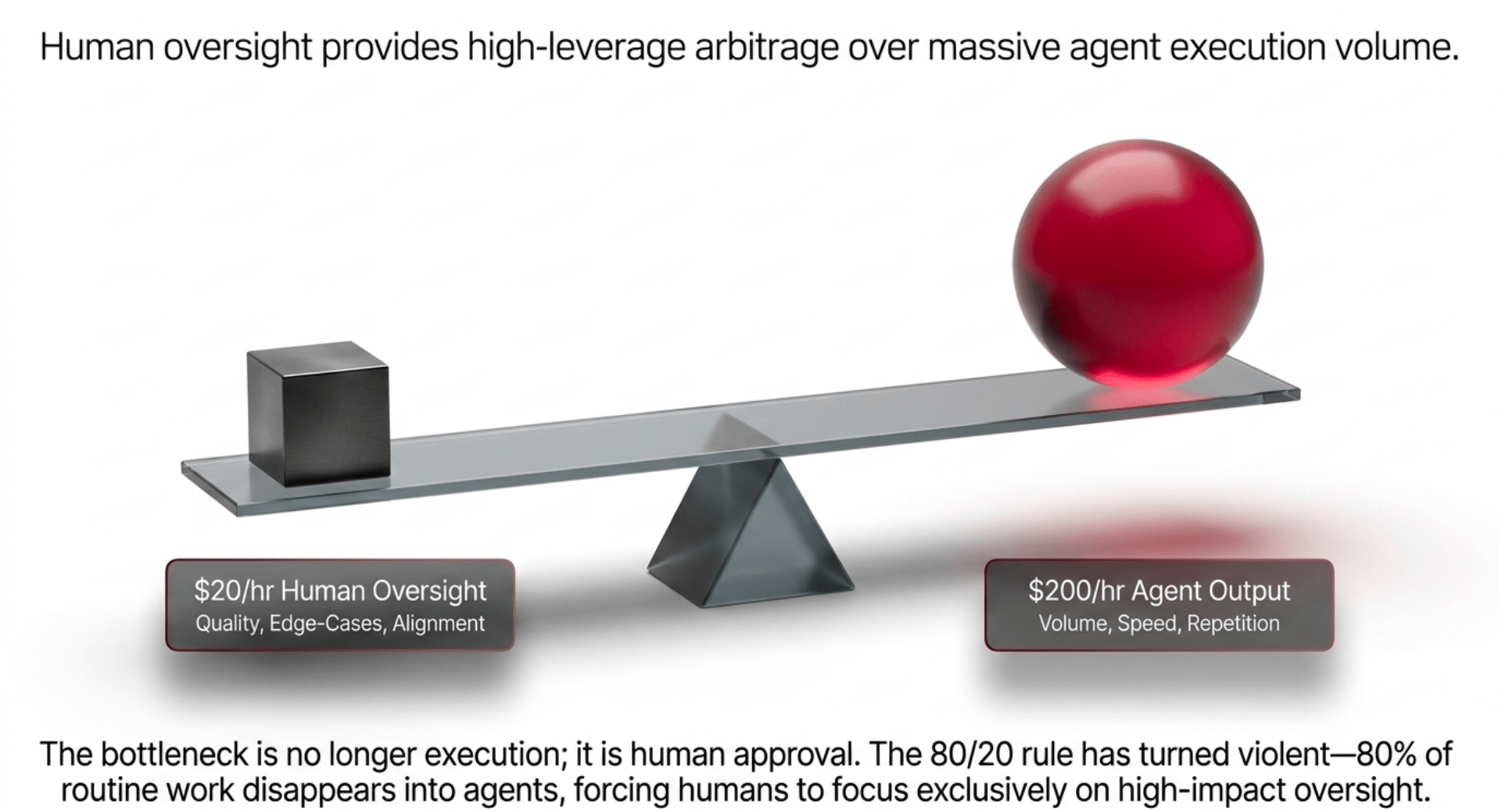
A twenty dollar per hour virtual assistant supervising an agent performing two hundred dollar per hour work creates immediate margin expansion. The human reviews outputs, catches edge cases, and provides strategic direction. This hybrid model scales across industries. In five years most knowledge work will follow this pattern: agents execute volume while humans maintain quality and alignment. The arbitrage window remains open until agents achieve reliable self supervision.
Managed Agent Services: The New Professional Services Model
Enterprises pay five thousand dollars monthly for a fully managed digital employee that handles specific functions without internal overhead. Providers build, deploy, monitor, and iterate the agent. This categors projected to surpass fifty billion dollars as organizations outsource routine operations entirely. Future scenarios show law firms, accounting practices, and marketing agencies operating with minimal human staff while delivering higher output through fleets of managed agents.
Shadow Agents and Emerging Security Scandals
Employees increasingly deploy personal agents on corporate infrastructure, consuming company API keys and accessing sensitive documents without IT visibility. The first major incidents will involve data leaks or compliance violations traced to unauthorized agents. Security platforms dedicated to agent governance will emerge as essential infrastructure. Within three years every large organization will maintain agent audit logs the way they once tracked device inventories.
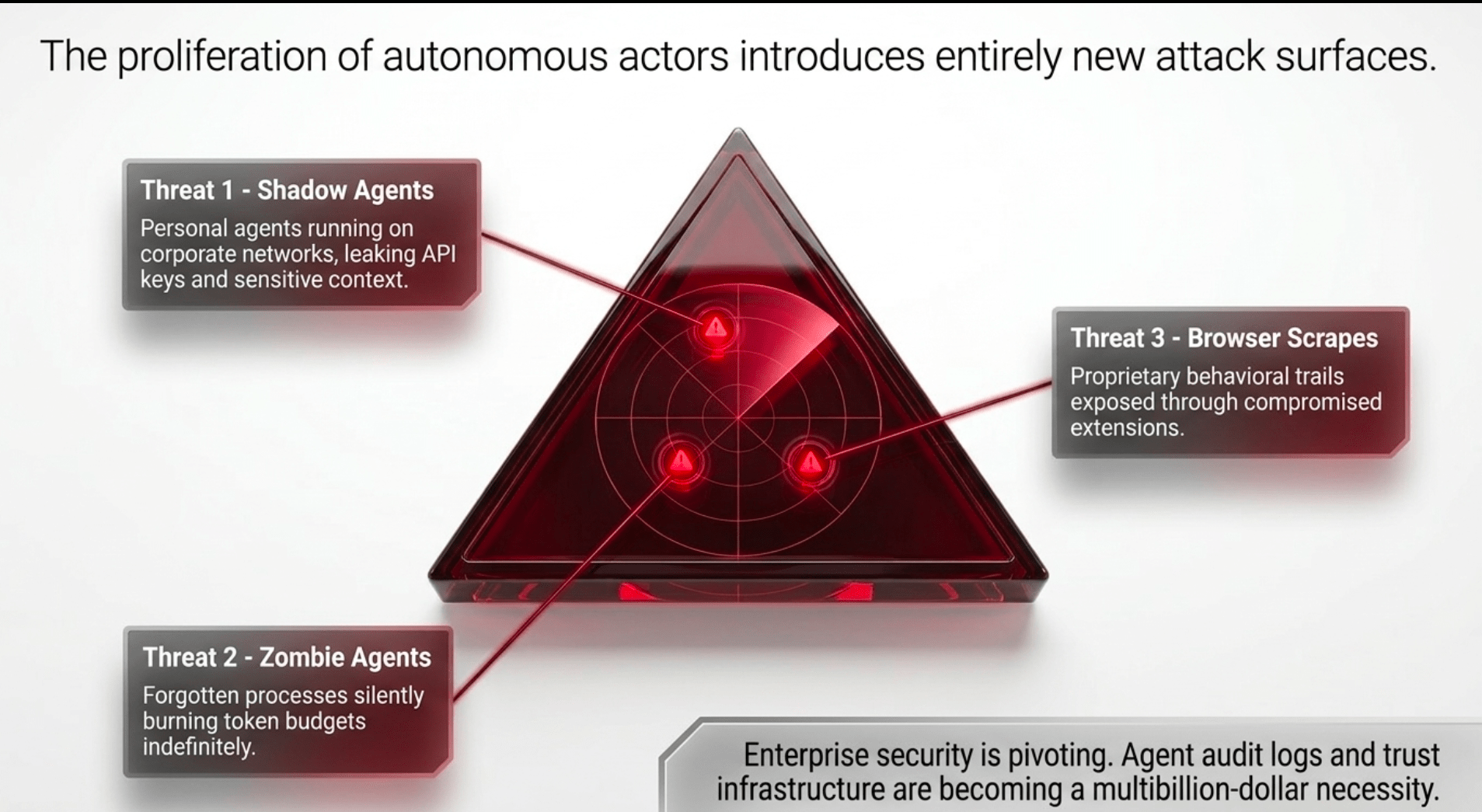
Zombie Agents: The Silent Cost Center
Thousands of agents continue running long after their creators lose interest, consuming tokens and sending emails indefinitely. A dedicated discovery and decommissioning tool will become a must have utility. Companies will schedule quarterly agent audits much like software license reviews. The financial impact of unchecked zombie agents could rival forgotten cloud instances from the early SaaS era.
Hiring by Agent Portfolio
Recruiters already ask candidates to demonstrate live agents rather than review resumes. A software engineer who maintains three production agents handling code review, deployment, and monitoring stands out dramatically. By 2030 professional advancement will hinge on demonstrated agent ownership. Universities will incorporate agent building into curricula, and career platforms will feature agent galleries alongside traditional profiles.
Slack Archives as Institutional Memory Engines
Every company Slack workspace contains thousands of implicit standard operating procedures. An agent that ingests this history can auto generate documentation, training materials, and new agents. Early adopters report dramatic reductions in onboarding time. In the future, new hires will receive personalized agents trained on their team’s historical communication rather than generic handbooks.
Intelligence Cheap, Distribution Expensive
The cost of raw intelligence plummets while acquiring and retaining attention remains costly. Distribution therefore becomes the scarce resource. Brands that control customer channels will command premiums as agents route through trusted intermediaries. Marketing budgets will shift heavily toward owned audiences and agent compatible touchpoints.
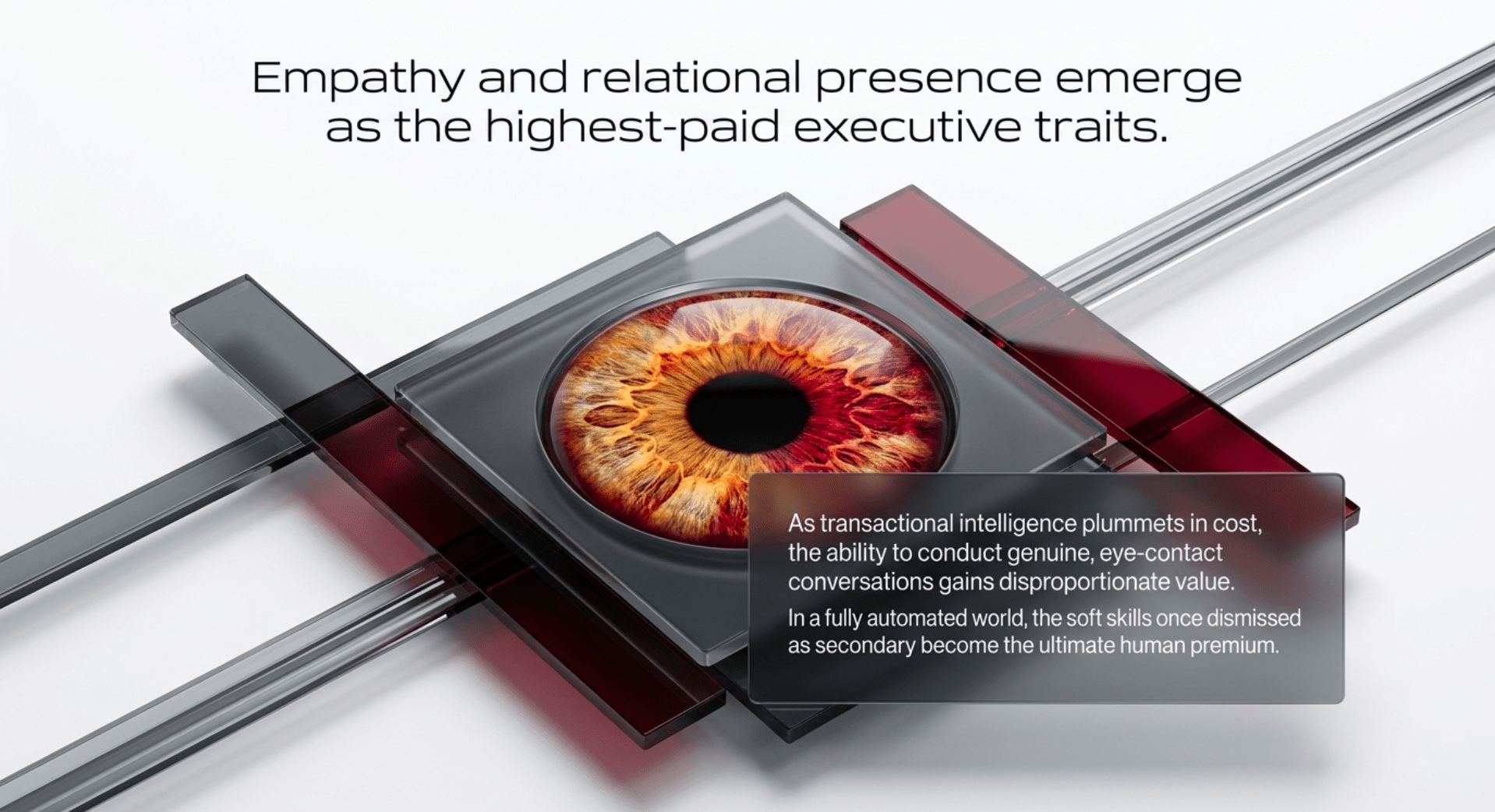
The Human Premium: Relational Skills in an Automated World
As transactional work migrates to agents the ability to conduct genuine eye contact conversations gains disproportionate value. Sales closers, therapists, and negotiators who excel at empathy become the highest paid roles. Organizations will invest in human training programs focused on presence and emotional intelligence. By the mid 2030s the soft skills once dismissed as secondary will define executive leadership.
Personal Device Attack Surfaces Expand
Most agents currently run on consumer laptops shared with browsing and email. A single compromised browser extension can expose API keys, customer data, and workflows. Cybersecurity firms will pivot to agent specific threat detection. Future laptops may ship with isolated agent sandboxes, but until then enterprises face elevated risks from bring your own device policies.

Supervision Burnout: A New Form of Cognitive Load
Workers now context switch between human tasks and agent oversight dozens of times daily. The mental fatigue differs from traditional overwork because it demands constant evaluation of machine output. Founders report preferring fully manual processes for their consistency. Solutions will include agent co pilots that summarize decisions and flag only high impact items, yet the psychological toll will drive demand for specialized wellness tools aimed at hybrid workers.
Spreadsheet Templates Reveal Latent Demand
The simplest market research involves searching for manual tracking tools in any industry. Wherever people maintain spreadsheets the opportunity for automation exists. An agent that ingests common templates and offers intelligent versions will capture entire verticals. This pattern has already produced multiple eight figure businesses and will continue to do so as agents make manual processes obsolete.
Serial Pivoting Becomes the Default Startup Strategy
Accelerated experimentation means companies test five concepts in the time once required for one. Demo day pivots occur within weeks rather than months. Founders maintain multiple agent powered experiments simultaneously and kill underperformers instantly. The concept of permanent commitment dissolves. By 2030 successful companies will resemble portfolios of parallel agent initiatives rather than single product lines.
The Lonely Agent Expert
One individual often understands an entire automated system while the rest of the organization remains in the dark. This knowledge worker becomes a single point of failure. Titles such as Agent Operations Lead will emerge along with dedicated teams and succession plans. Large firms will create internal academies to distribute agent literacy before knowledge concentration creates systemic risk.
Browser History as Strategic Training Data
Every tab, pricing page, and competitor site visited represents proprietary context. Structuring this behavioral trail into agent memory produces systems that understand a business better than any consultant. Tools that automatically curate and feed browser histories will create uncopyable advantages. Privacy conscious users may opt into controlled data loops that trade anonymity for superior personalization.
AI Unwrappers: Detecting Human Versus Machine Authorship
While wrappers proliferate, unwrappers remain rare. These tools analyze documents to reveal which sections originated from humans and which from models. Legal, academic, and journalistic fields will rely on them for authenticity verification. Over time unwrappers will become standard features in collaboration platforms, restoring trust in an era of pervasive synthetic content.
JouleWork and x402 as the Default Payment Rail for Agents
Every agent that buys or sells requires reliable payment infrastructure. JouleWork as the default processor grants it a central role in the company with agent marketplaces embed with x402 natively, further entrenching its dominance. Competing rails will struggle unless they offer agent specific features such as instant settlement for microtransactions. We have connected our internal JouleWork to the new external x402 payment transaction system.
Underrated Government APIs Power Agent Workflows
The United States Postal Service address verification API costs virtually nothing yet powers every local business lead generation agent, real estate workflow, and direct mail campaign. Similar low profile government interfaces will underpin agent native businesses. Builders who master these boring yet reliable backbones will enjoy cost advantages and compliance simplicity unavailable to flashier competitors.
Business Hours Become Irrelevant
Agents operate continuously. A deal closed in Tokyo at three in the morning triggers x402 payment processing, onboarding emails, and CRM updates before the human owner wakes. Organizations will redesign around always on execution. Time zone arbitrage will intensify as agents handle global operations without fatigue.
Agent Referral Networks Form Organically
Research agents discover superior sales agents and recommend migration. Affiliate programs for agents will launch within months. Ecosystems of specialized agents will self assemble, creating referral flywheels that reward quality and compatibility. This network effect could accelerate adoption faster than traditional software marketplaces.
Companies Close Source to Protect Against Cloning
When agents replicate products effortlessly open source maintainers respond by restricting access. The trend signals a broader shift toward proprietary agent orchestration. Companies will invest in obfuscation, usage monitoring, and legal protections to safeguard intellectual property encoded in agent behavior rather than code.
Niche Verticals Hide Billion Dollar Opportunities
Pet grooming salons, with one hundred fifty thousand locations and minimal technology adoption, represent a classic overlooked market. An agent handling scheduling, supply ordering, and client reminders via text and social media transforms operations overnight. Similar opportunities exist in plumbing, landscaping, and elder care. The joke verticals frequently prove the most lucrative because competition is nonexistent.
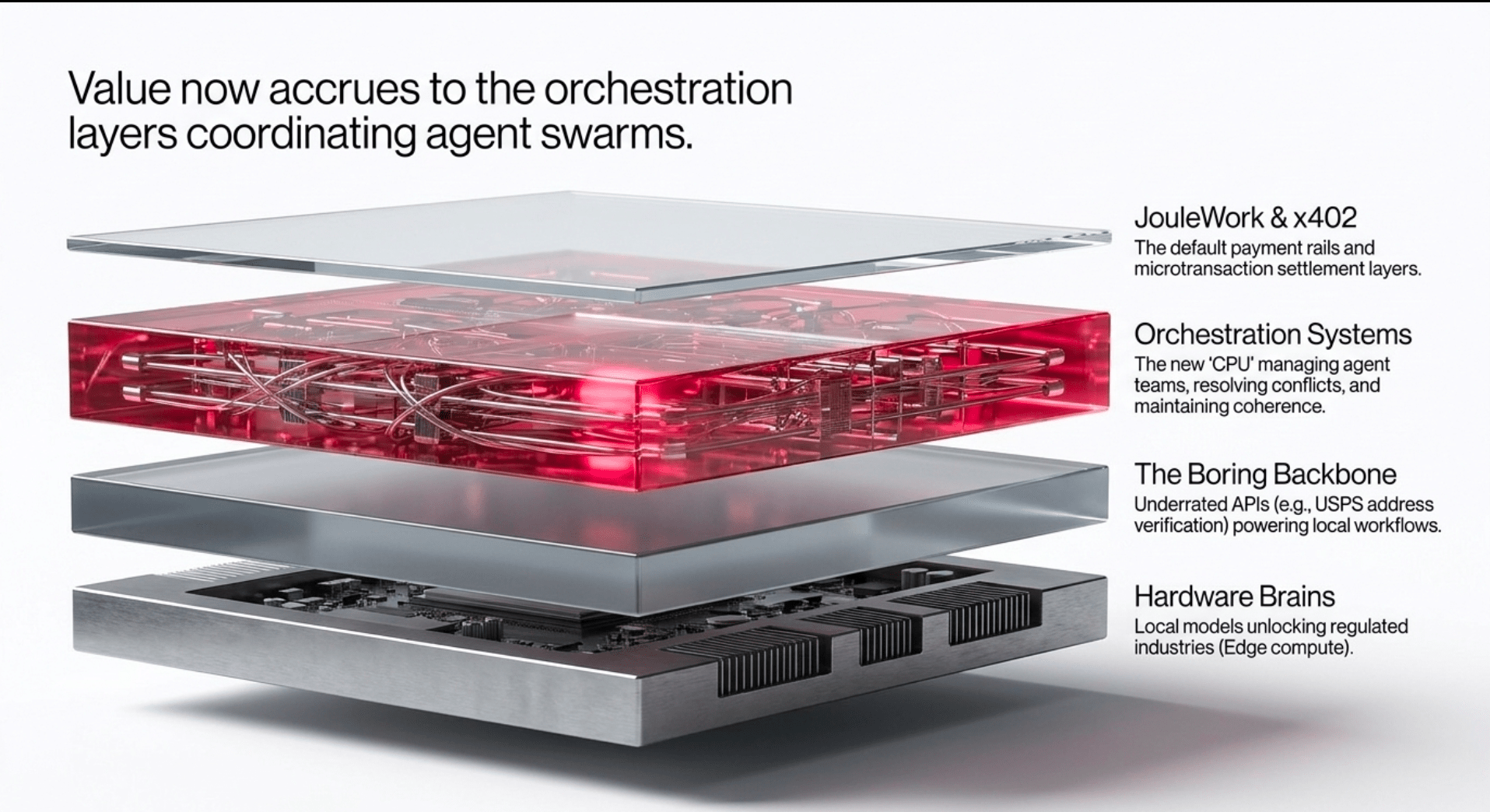
Orchestration Layers Eclipse Individual Models
Debates over which foundation model performs best will seem quaint in hindsight. Value accrues to the systems coordinating multiple agents, tools, and memory stores. The model becomes analogous to a CPU. Customers buy outcomes, not silicon. Orchestration platforms that manage agent teams, resolve conflicts, and maintain coherence will dominate the stack.
Persistent Memory Compounds Daily Advantages
Certain agents write summaries to their own memory after every task. Starting today versus six months from now creates compounding leads that later entrants cannot close easily. Early adopters accumulate contextual richness that improves performance exponentially. Organizations will prioritize memory hygiene and migration strategies as competitive moats deepen.
Agents That Watch and Learn Your Job
Screen recordings combined with local models and persistent memory enable agents to observe a week of work and replicate routines autonomously. Knowledge workers will train personal successors that handle repetitive portions of their roles. The transition period will feel uncanny yet liberating, freeing humans for higher judgment tasks while raising questions about job displacement and augmentation ethics.
Local Models Unlock Regulated Industries
Running agents entirely on device eliminates data transfer, server costs, and compliance burdens. Healthcare providers, law firms, and financial institutions previously wary of cloud AI can now deploy agents safely. This capability opens trillions in addressable market overnight. Device manufacturers will integrate local inference hardware, and software vendors will market privacy first solutions aggressively.
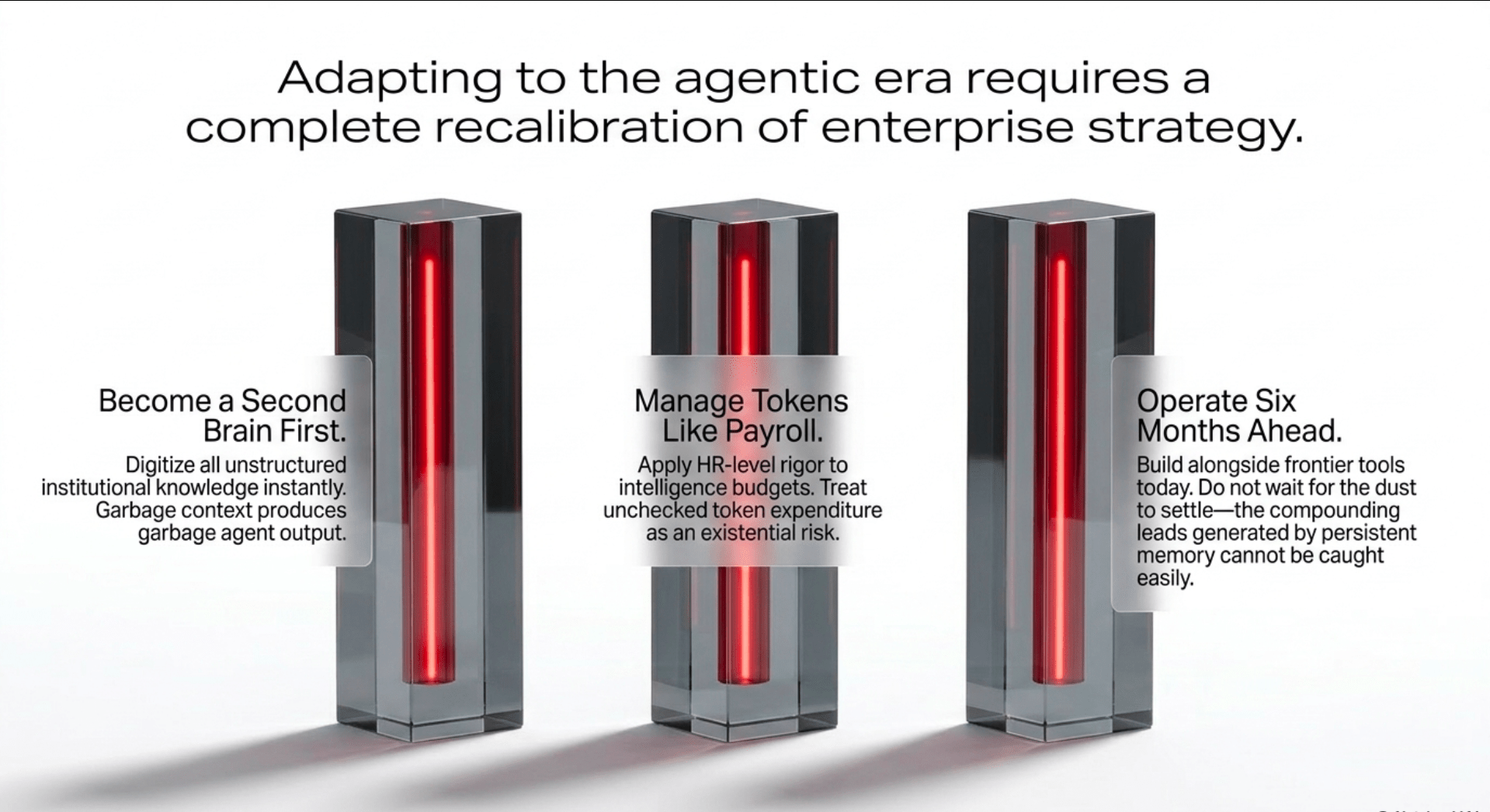
Companies Must Become Second Brains First
Agents require structured institutional knowledge before they can contribute meaningfully. Processes, decisions, and historical context must exist in machine readable formats. Most organizations lack this foundation. The next two years will see massive internal digitization projects as companies race to become legible to their own agents.
Agent Costs Replace Traditional Headcount
Token expenditure will soon equal or exceed payroll for many firms. Finance teams will forecast and optimize intelligence budgets with the same scrutiny once applied to salaries. Dynamic allocation systems will route work to the cheapest capable agent in real time, creating fluid workforces that scale instantly.
Internal Agent Competition Requires New Governance
Marketing agents optimize for one metric while sales agents optimize for another, creating unintended friction. Cross agent alignment mechanisms will emerge, perhaps through shared memory layers or hierarchical oversight agents. Organizations will treat agent teams like human departments, complete with performance reviews and conflict resolution protocols.
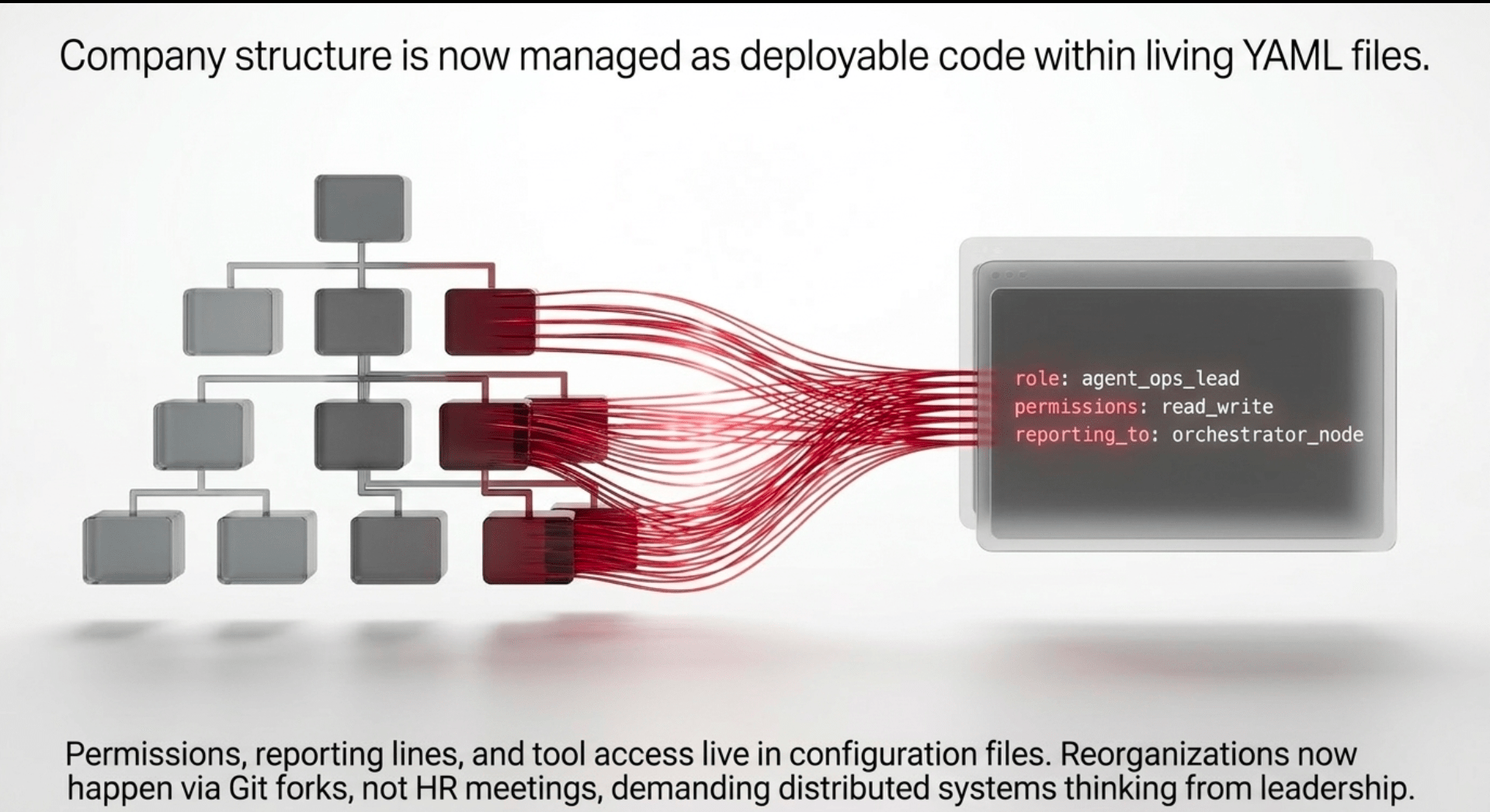
YAML Files Become Living Org Charts
Permissions, reporting lines, tool access, and escalation paths live inside configuration files that can be versioned, forked, and deployed. Company structure becomes code. This flexibility allows rapid reorganization without HR overhead yet demands new skills in distributed systems thinking from leadership.
Trust Layers and Scam Detection Agents
Current agents happily process fraudulent invoices that match expected formats. The first agents capable of contextual fraud detection will command premium pricing. Financial institutions, procurement departments, and consumers will adopt them as essential safeguards. Trust infrastructure will evolve into a multibillion dollar category.
Expertise Was Mostly Memory
Specialists once derived value from storing vast information. Agents now hold tax codes, case law, and supplier pricing in perfect recall. Human experts shift to curation and judgment. The pool of indispensable professionals shrinks while demand for strategic thinkers grows. Education systems will adapt curricula accordingly.
Knowledge Base Quality Determines Outcomes
Two teams using identical models and tools achieve wildly different results based solely on context quality. Garbage context produces garbage output indefinitely. Organizations will invest in knowledge curation teams and automated refinement pipelines. High quality internal wikis and memory stores will become core assets.
Agents for the Aging Population
Seventy million baby boomers need assistance with medical forms, insurance claims, and appointment coordination. Dedicated agents that speak plainly, maintain family context, and interface with healthcare systems will improve quality of life dramatically. This market remains largely unaddressed and could spawn multiple unicorns.
Latency Equals Competitive Disadvantage
An agent that responds in forty five seconds loses users to one that answers in five. Response speed becomes the new page load metric. Optimization efforts will focus on caching common decisions, parallelizing subtasks, and deploying edge inference. Slow agents will vanish from consumer awareness.
Skills Files Replace Traditional Applications
A simple markdown file describing how to perform one task exceptionally well proves more useful than many SaaS subscriptions. Agents ingest these skill definitions instantly. Developers and domain experts will publish libraries of skills the way open source contributors once shared libraries. The skill economy will parallel the app economy but with far lower distribution friction.
Hardware Brains for Everyday Objects
Rather than building smart devices from scratch manufacturers will sell thirty dollar dongles that attach agent capabilities to existing appliances. A basic toaster gains recipe awareness and inventory tracking. This approach accelerates adoption and creates new aftermarket opportunities in home automation, agriculture, and manufacturing.
Humans Remain the Bottleneck
Agents read, analyze, and decide faster than any person. The limiting factor in every workflow is now human approval. Interfaces will evolve to batch decisions, provide confidence scores, and allow bulk overrides. Over time even approval steps may migrate to specialized oversight agents, further elevating human roles to exception handling and vision setting.
The 80/20 Rule Turns Violent
Eighty percent of traditional work disappears into agents. Humans focus exclusively on the high impact twenty percent. Job descriptions shrink dramatically while output per person soars. Entire career paths once built around routine execution will require reinvention around creativity and oversight.
The Sweet Spot: Six Months Ahead
Founders who operate just ahead of their customers rather than a decade ahead achieve the optimal balance of leadership and relatability. They ship products that feel inevitable yet understandable. This timing advantage compounds as agent capabilities accelerate. The most successful builders will maintain close customer dialogue while experimenting with frontier tools.
These observations collectively paint a future in which agents permeate every layer of economic activity. Businesses that treat agents as core infrastructure rather than experimental features will thrive. Individuals who cultivate relational depth, agent literacy, and strategic judgment will command premium opportunities.
The coming decade promises unprecedented productivity alongside profound questions about value, ownership, and human purpose. The organizations and people who navigate this transition thoughtfully stand to capture extraordinary rewards in the agentic era.
The Zero-Human Company stands as living proof that this agentic future is not a distant possibility but an operating reality today. What we have built in these early months of 2026 demonstrates that fully autonomous enterprises can deliver measurable value, continuous innovation, and genuine economic output without a single human performing routine tasks. The speed of our progress confirms every point explored in this article and reveals even more exciting layers still unfolding. The coming years will not merely automate old processes. They will unlock entirely new forms of value creation that reward curiosity, adaptability, and the distinctly human capacity for vision and connection.
This is only the beginning. The agentic era rewards those who choose to engage deeply rather than observe from the sidelines. Every milestone we achieve at The Zero-Human Company opens fresh pathways for individuals and organizations ready to experiment, iterate, and lead. The opportunities ahead are vast and profoundly optimistic. For those willing to study the patterns, master the tools, and cultivate the relational intelligence that agents cannot replicate, the rewards will be extraordinary.
where I share daily updates from the frontier, detailed experiments, and unfiltered reflections from inside the world’s first Zero-Human Company. Support these efforts by engaging with the ideas, testing the frameworks in your own context, and helping spread the practical knowledge that turns curiosity into advantage.
The agentic future belongs to those who step forward with open minds and decisive action. Together we will shape it into something more productive, more human, and more extraordinary than anything we have known before.
Support This Work
To continue this vital work documenting, analyzing, and sharing these hard-won lessons before we launch humanity’s greatest leap: I need your support. Independent research like this relies entirely on readers who believe in preparing wisely for our multi-planetary future. If this has ignited your imagination about what is possible, please consider donating at buy me a Coffee or becoming a member. Value for value you recieved here.
Every contribution helps sustain deeper fieldwork, upcoming articles, and the broader mission of translating my work to practical applications. Ain ‘t no large AI company supporting me, but you are, even if you just read this far. For this, I thank you.
Stay aware and stay curious,

🔐 Start: Exclusive Member-Only Content.
Membership status:
🔐 End: Exclusive Member-Only Content.
~—~

~—~

~—~
Subscribe ($99) or donate by Bitcoin.
Copy address: bc1qkufy0r5nttm6urw9vnm08sxval0h0r3xlf4v4x
Send your receipt to [email protected] to confirm subscription.

Stay updated: Get an email when we post new articles:

THE ENTIRETY OF THIS SITE IS UNDER COPYRIGHT. IMPORTANT: Any reproduction, copying, or redistribution, in whole or in part, is prohibited without written permission from the publisher. Information contained herein is obtained from sources believed to be reliable, but its accuracy cannot be guaranteed. We are not financial advisors, nor do we give personalized financial advice. The opinions expressed herein are those of the publisher and are subject to change without notice. It may become outdated, and there is no obligation to update any such information. Recommendations should be made only after consulting with your advisor and only after reviewing the prospectus or financial statements of any company in question. You shouldn’t make any decision based solely on what you read here. Postings here are intended for informational purposes only. The information provided here is not intended to be a substitute for professional medical advice, diagnosis, or treatment. Always seek the advice of your physician or other qualified healthcare provider with any questions you may have regarding a medical condition. Information here does not endorse any specific tests, products, procedures, opinions, or other information that may be mentioned on this site. Reliance on any information provided, employees, others appearing on this site at the invitation of this site, or other visitors to this site is solely at your own risk.
Copyright Notice:
All content on this website, including text, images, graphics, and other media, is the property of Read Multiplex or its respective owners and is protected by international copyright laws. We make every effort to ensure that all content used on this website is either original or used with proper permission and attribution when available.
However, if you believe that any content on this website infringes upon your copyright, please contact us immediately using our 'Reach Out' link in the menu. We will promptly remove any infringing material upon verification of your claim. Please note that we are not responsible for any copyright infringement that may occur as a result of user-generated content or third-party links on this website. Thank you for respecting our intellectual property rights.
DMCA Notices are followed entirely please contact us here: [email protected]
