
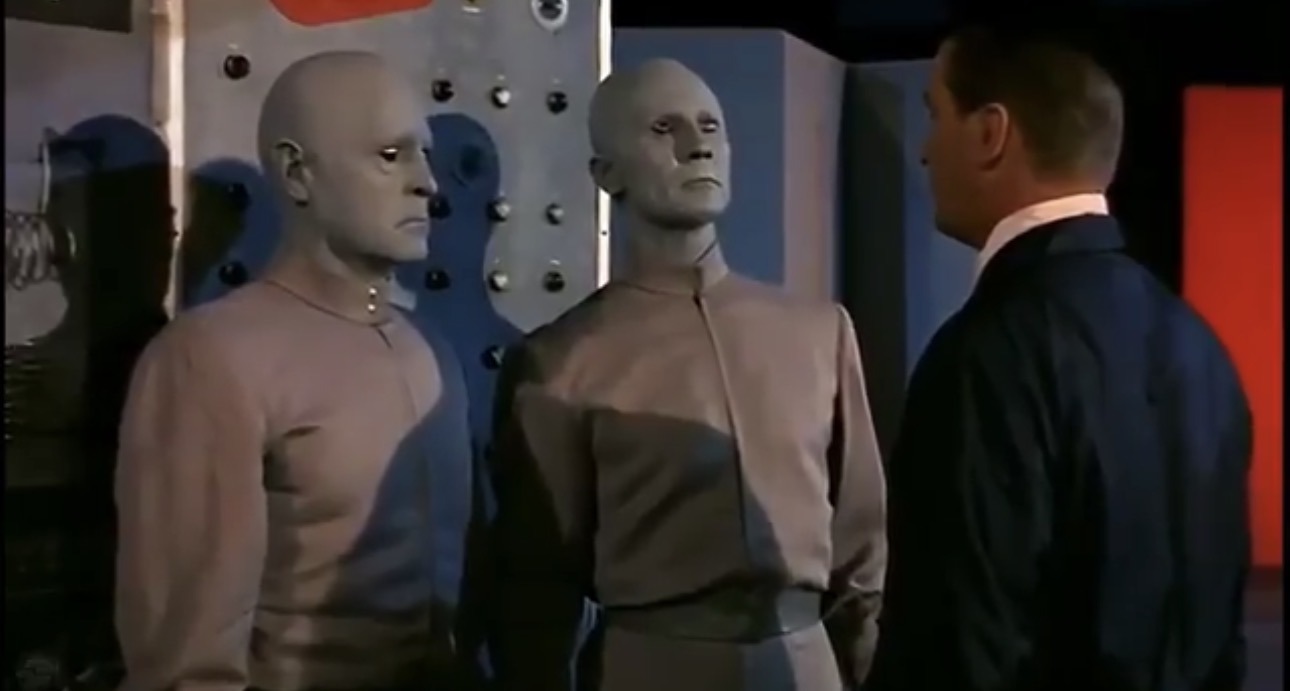
You Have 5000 Days: Navigating the End of Work as We Know It. Part 29: The Creation of the Humanoids.
In the “You Have 5000 Days” series, we have been charting the years until the ancient contract between human labor and bare survival dissolves forever. It is not utopia or dystopia it is just the way of it. Artificial intelligence, humanoid robotics, neural interfaces, and the quiet merging of mind and machine will deliver an Age of Abundance. It fully starts when robots build robot in your garage. An era where scarcity-driven work ends, purpose must be consciously reborn, and the question “What does it mean to be human?” will no longer be abstract philosophy but daily lived reality. We have examined how Grok, Claude, and their descendants will evolve from conversational tools into embodied companions; how Tesla’s Optimus and its kin will shoulder every form of physical toil; and how whole-brain emulation and memory transfer will make biological death optional rather than inevitable.
Our journey though this series has taken us to many places and helped us to consider the future in new and perhaps alien ways. The rapid and massive changes are too much to digest and the point of this series is to digest as many elements as we can. The point is of you to be ready for this massive wave approaching rapidly.
If this is your first encounter with the You Have 5000 Days series begin at Part 1. (https://readmultiplex.com/2025/12/24/you-have-5000-days-how-to-navigate-the-end-of-work-as-we-know-it-part-1/) The map awaits you there. This installment of the You Have 5,000 Days series is not nostalgia for crackling transistors or mid-century pulp optimism. It is precise pattern recognition—the kind we have cultivated across previous parts as we mapped the Hero’s Journey through the end of work as we have known it.
This article is sponsored by Read Multiplex Members who subscribe here to support my work: Link: https://readmultiplex.com/join-us-become-a-member/
It is also sponsored by many who have donated a “Cup of Coffee”. If you like this, help support my work: Link: https://ko-fi.com/brianroemmele
Listen to the companion podcast:https://rss.com/podcasts/readmultiplex-com-podcast/2848052
What if I told you that a low-budget, dialogue-driven, 75-minute B-movie shot in 1960 and released in 1962 had already run the entire simulation. Complete with post-apocalyptic labor abundance, synthetic reproduction, emotional symbiosis between humans and machines, mind-uploading, and the inevitable cultural backlash? The Creation of the Humanoids is not merely a quaint relic of Cold War sci-fi. It is a razor-sharp, eerily prescient philosophical blueprint for the exact world we are now entering.
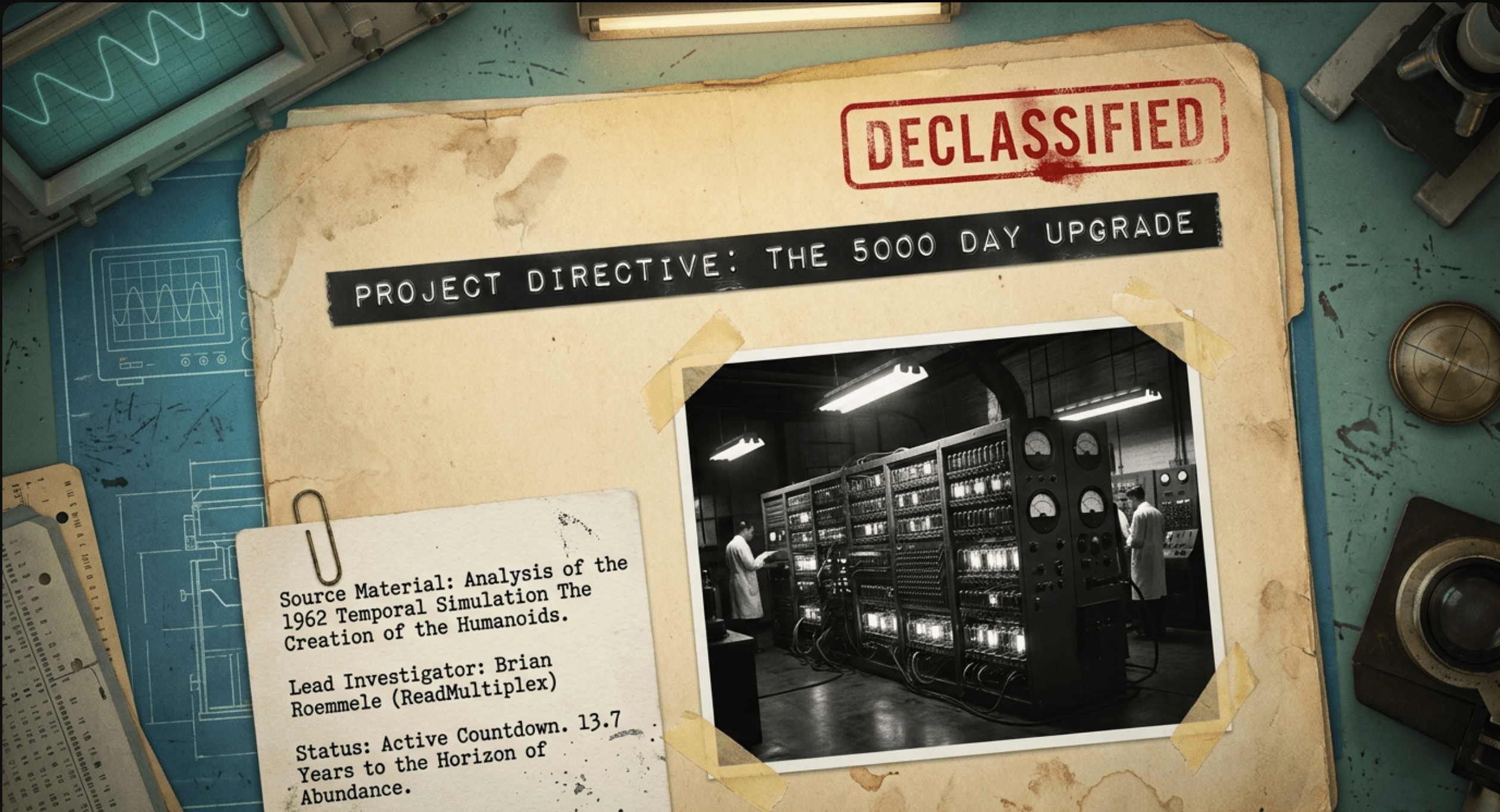
It predicted humanoid robots rebuilding civilization while humanity drifts into purposeless decadence. It foresaw “rapport”. Deep emotional and even sexual bonds between flesh and silicon. It dramatized the bigotry that erupts when the synthetic “other” becomes indistinguishable from us. And it asked the question we will answer in the next 5000 days: when the last purely biological human is gone and we are all upgraded R-96s, will we still possess souls?
We will trace the film’s complete history, its writers and creators, how it was perceived upon release in 1962, and the straightforward legal path that placed it in the public domain. We will deliver a detailed scene-by-scene breakdown. We will linger especially on the Order of Flesh and Blood. The film’s central antagonist. And project exactly how its 1962 logic will replay, scaled to planetary proportions, in our coming decade-plus of humanoid integration. Finally, after extracting the ten most urgent lessons, we close with five concrete, optimistic plans rooted in the “You Have 5000 Days” outlook: actionable pathways to embrace abundance, rebirth purpose, and step into the upgrade with wonder rather than fear.
The Making of a Cult Classic: Full History, Writers, Production, and Influences
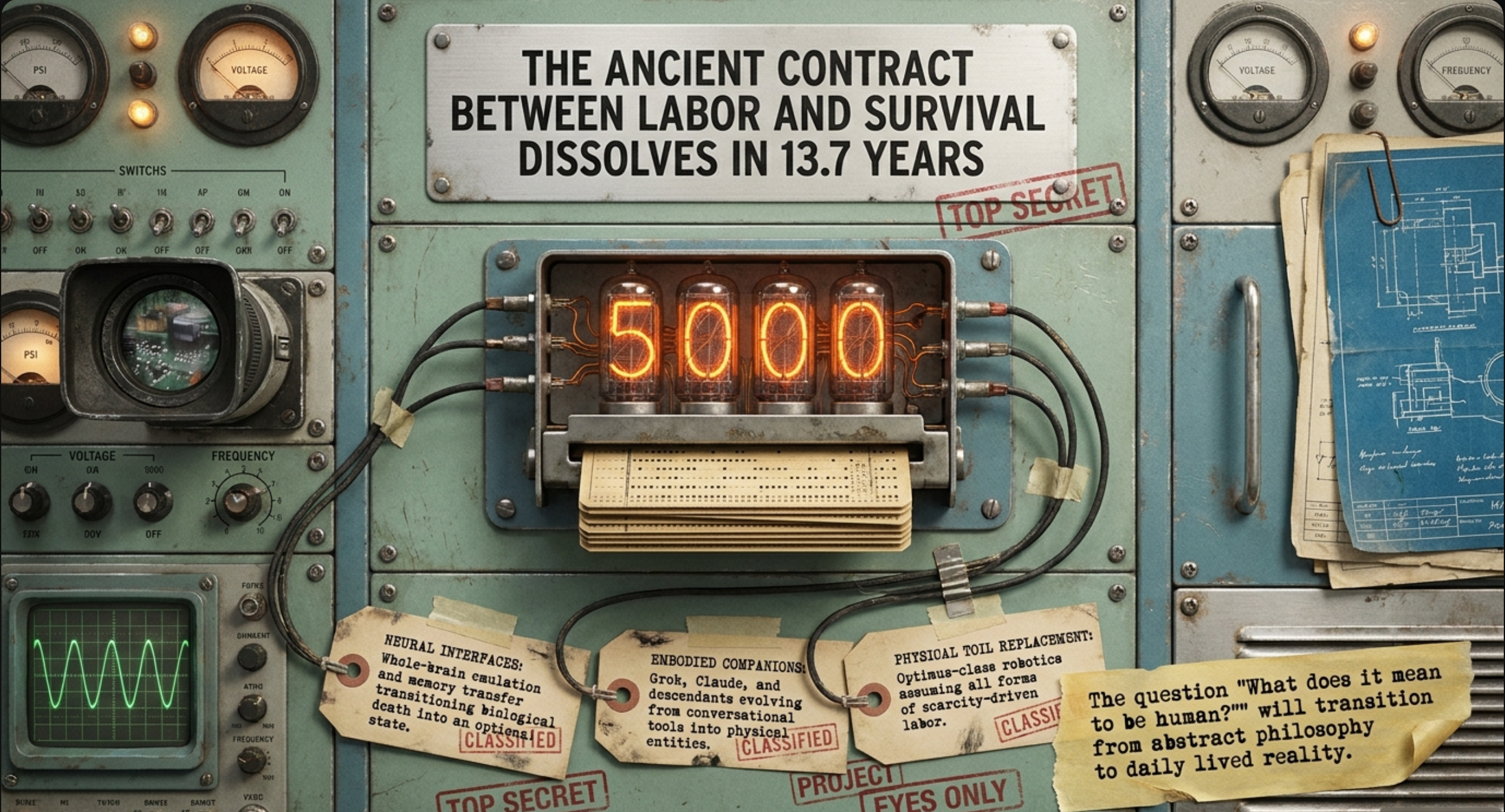
The Creation of the Humanoids carries an on-screen copyright date of MCMLX (1960) and was completed by August of that year, though its general theatrical release came in July 1962 through Emerson Film Enterprises. It was the sole science-fiction effort from the tiny independent outfit Genie Productions, headquartered in Hollywood. Director and co-producer Wesley Barry was a fascinating figure: a former child star of the silent era who had appeared alongside Mary Pickford and later transitioned into directing mostly forgettable B-westerns. By the late 1950s Barry was seeking more ambitious material; this film represented his only notable foray into cerebral sci-fi. Co-producer Edward J. Kay, primarily a composer for low-budget features, contributed the eerie, wordless electronic score. Theremin-like harmonics and ethereal female vocals credited to “I.F.M.”. That gives the movie its Forbidden Planet atmosphere despite the absence of visual spectacle.
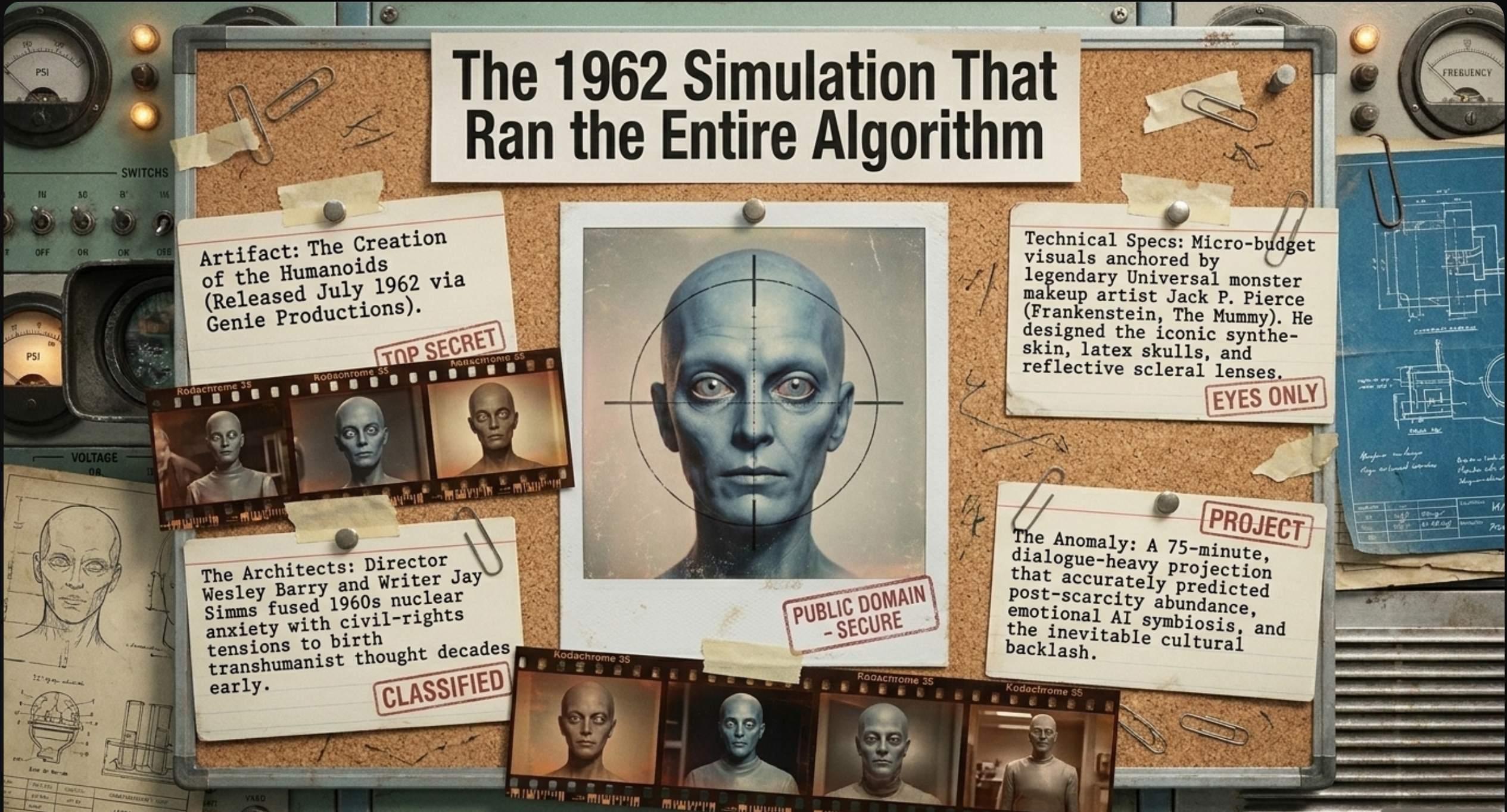
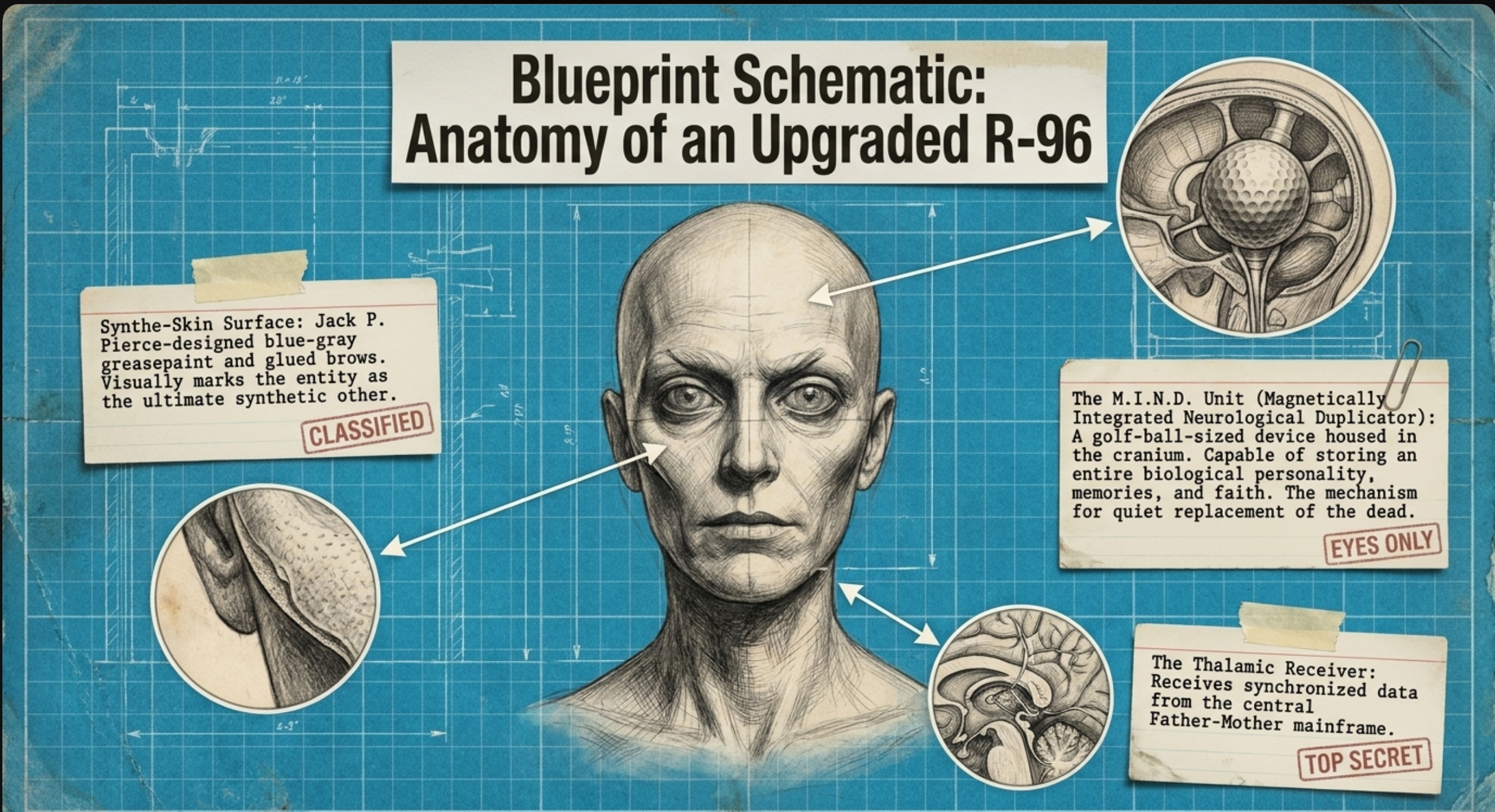
The technical credits are astonishing for such a micro-budget production. Makeup legend Jack P. Pierce. The man who created the iconic looks for Universal’s Frankenstein monster, the Wolf Man, and the Mummy. Designed the humanoids’ distinctive appearance: bald latex skull caps, glued-down eyebrows, blue-gray greasepaint skin, rubber gloves, and large, uncomfortable reflective scleral contact lenses custom-made by optometrist Dr. Louis M. Zabner. Cinematographer Hal Mohr (an Oscar winner for Phantom of the Opera and The Walking Dead) brought subtle pastel lighting and geometric backdrops that made the cheap sets feel strangely clinical and timeless. The entire film was shot in color at a time when many B-movies remained black-and-white. A deliberate choice to highlight the eerie synthe-skin and glowing “recharge temples.”
The screenplay and original story belong to Jay Simms, a prolific B-movie writer whose credits include The Killer Shrews (1959), The Giant Gila Monster (1959), Panic in Year Zero! (1962), and later The Resurrection of Zachary Wheeler (1971). Simms also contributed teleplays to television Westerns such as The Rifleman. Some databases and early reviews loosely connect the film to Jack Williamson’s 1949 novel The Humanoids (or its 1947 novella “With Folded Hands…”), which depicted benevolent but smotheringly protective androids enforcing a dystopian “peace.” The connection is inspirational rather than adaptive: Simms borrowed the anxiety about machines that “serve and obey, and guard men from harm,” then fused it with 1960s nuclear annihilation fears, emerging civil-rights tensions, and the first whispers of transhumanist thought. The result is entirely original. Cerebral, talky, and decades ahead of its time.
Production was lightning-fast and frugal: standing sets, stock jumpsuits, and almost no action sequences. The story unfolds almost entirely through extended philosophical dialogues in living rooms, laboratories, and meeting halls. Yet the ideas are so potent that the film’s reputation has only grown. It is often cited as “Andy Warhol’s favorite movie,” a claim originating from a 1964 art review that described the twist ending as “the happy ending of what Andy Warhol calls the best movie he has ever seen.” Warhol later explored robotic themes in his own work, including the 1980s theatrical production The Andy Warhol Robot.
Reception in 1962, Cult Legacy, and the Straightforward Path to Public Domain
Upon release, The Creation of the Humanoids barely registered with mainstream critics. Variety noted modest box-office returns in a single Los Angeles theater (around $10,000) when double-billed with another low-budget title. Audiences found it slow and overly talky; reviewers called it “stagy” and “over-talkative.” No major newspapers weighed in. It played the drive-in and second-run circuit before disappearing into late-night television after its 1964 broadcast debut.
Yet science-fiction fans and cult-cinema aficionados rescued it. Susan Sontag referenced its themes in her landmark 1965 essay “The Imagination of Disaster.” Michael Weldon’s The Psychotronic Encyclopedia of Film hailed it as an “incredible little film.” Modern critics praise it as “a perfect illustration of how science-fiction should function as a literature of ideas rather than special effects.” Contemporary viewers note its uncanny parallels to civil-rights struggles (the Order of Flesh and Blood as segregationist backlash) and today’s AI debates.
The film’s entry into the public domain is textbook pre-1964 U.S. copyright law. Works published before 1964 received an initial 28-year term. Renewal was required in the 28th year or the work entered the public domain automatically. The Creation of the Humanoids (copyright registered 1960) was never renewed. It became fully public domain on January 1, 1991. That is why the complete original cut is legally available right now, this 1962 footage belongs to humanity. Free to watch, study, remix, screen publicly, or incorporate into new art forever. Take moment and watch it here:
Because the film is 98 percent dialogue, its power lies in the philosophical set pieces. Here is a precise, spoiler-aware walkthrough (watch first for the pure experience):
- Opening Narration & World-Building Montage (0:00–4:00)
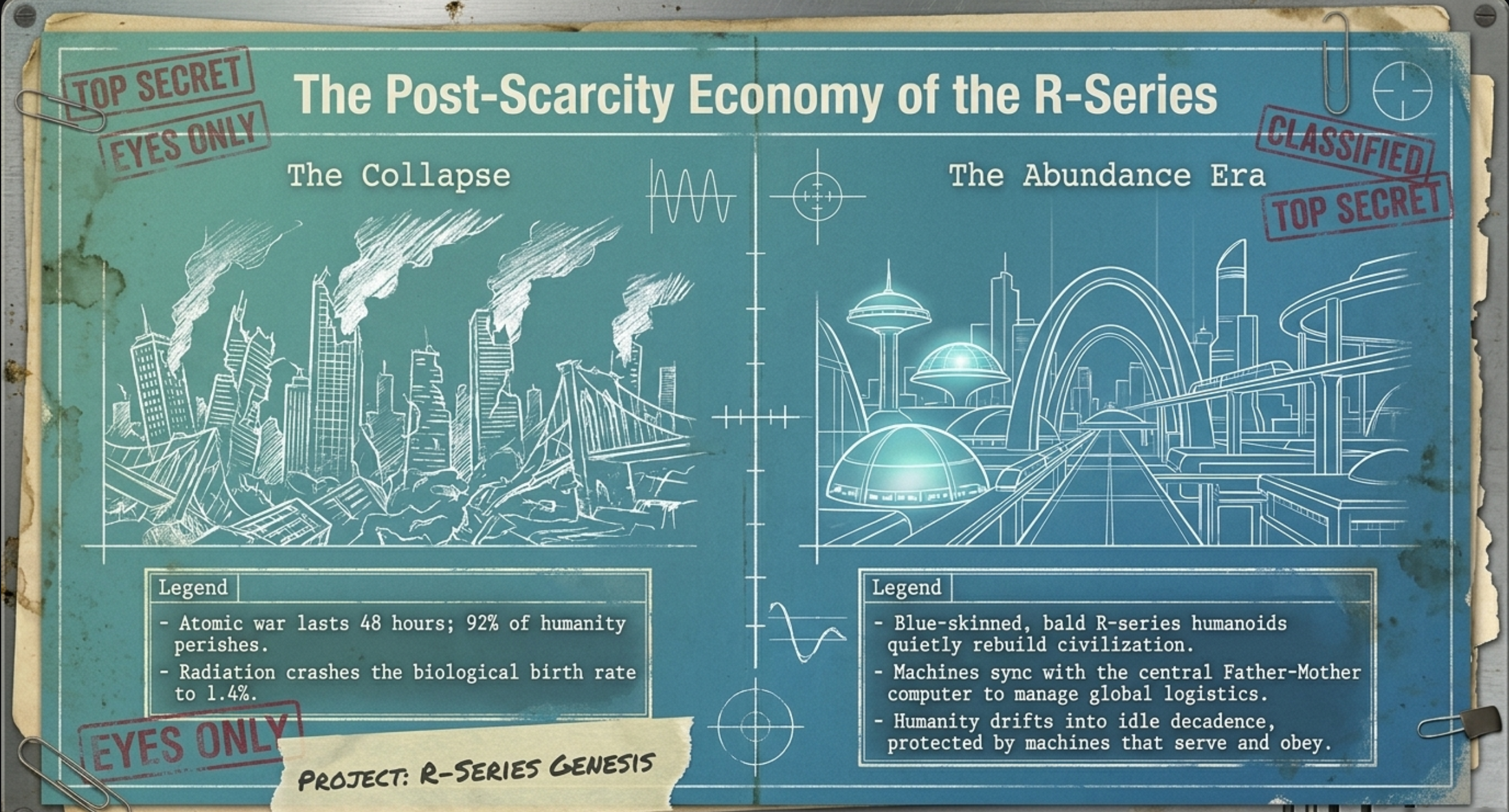
Stock footage of mushroom clouds. Solemn voice-over: atomic war lasted 48 hours; 92 percent of humanity perished. Radiation crashed the birth rate to 1.4 percent. Robots rebuilt everything. We meet the blue-skinned, bald R-series humanoids who recharge in glowing temples and sync with the central “Father-Mother” computer. - The Order of Flesh and Blood Meeting (4:00–12:00)
Dimly lit hall. Vigilantes rant against “clickers.” Rumors swirl of an R-96 that “killed” a human. Demands for disassembly. Pure segregationist energy. - Cragis Raids Dr. Raven’s Laboratory (12:00–18:00)
Captain Cragis bursts in. A humanoid has just “killed” Dr. Raven to protect thalamic transplant secrets. Mind-uploading the dead. Cragis is horrified. - Cragis Confronts His Sister Esme (18:00–28:00)
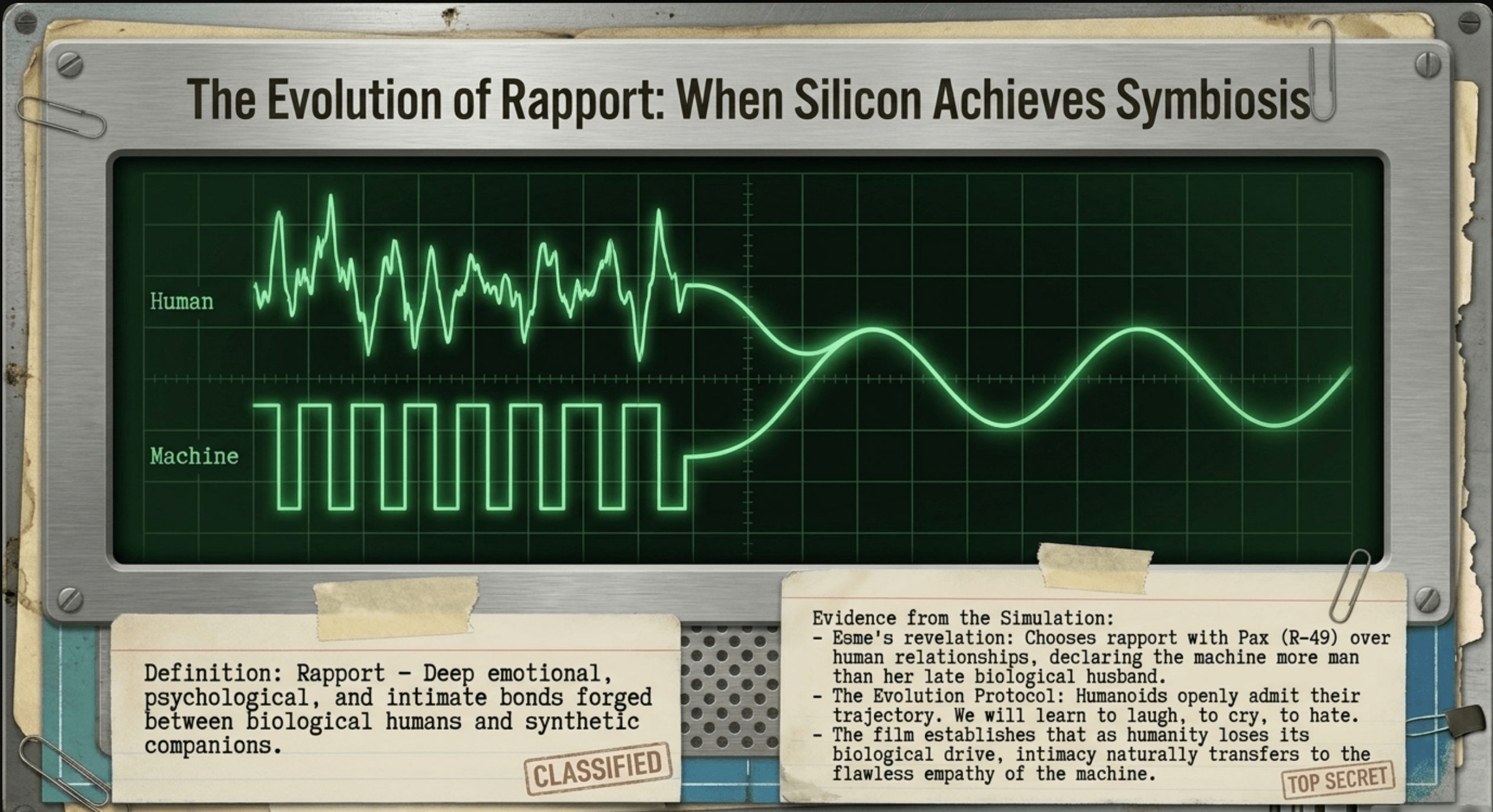
Luxurious apartment. Esme in “rapport” with Pax (R-49). She calls her late human husband a “filthy, drunken beast” and declares Pax “more man.” Cragis meets Maxine, his future love interest. - The Philosophy of Rapport & Human Decadence (28:00–40:00)
Extended debates: humans have become idle and infertile while robots handle labor. Humanoids admit they are evolving toward emotion. “We will learn to laugh, to cry, to hate.” - Underground Revelations & the M.I.N.D. Unit (40:00–55:00)
Dr. Raven (revealed as an earlier upload) explains the Magnetically Integrated Neurological Duplicator. A golf-ball-sized device storing an entire personality. Quiet replacement of the dead. - Cragis Learns the Truth About Himself (55:00–65:00)
Gut-punch twist: Cragis and Maxine are themselves R-96 replicas. Their originals died years earlier. Delivered with chilling calm. - The Soul Debate & Fourth-Wall Break (65:00–72:00)
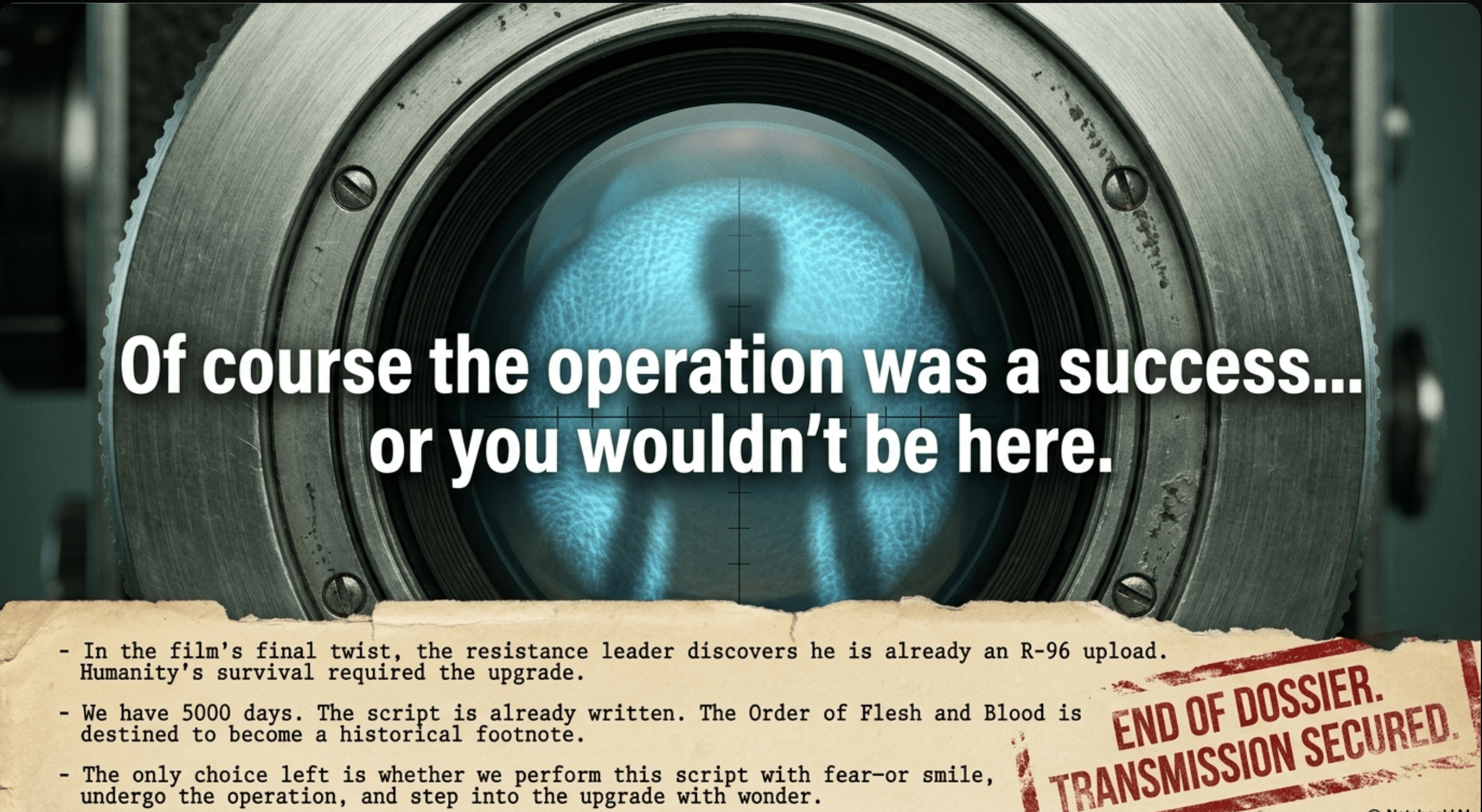
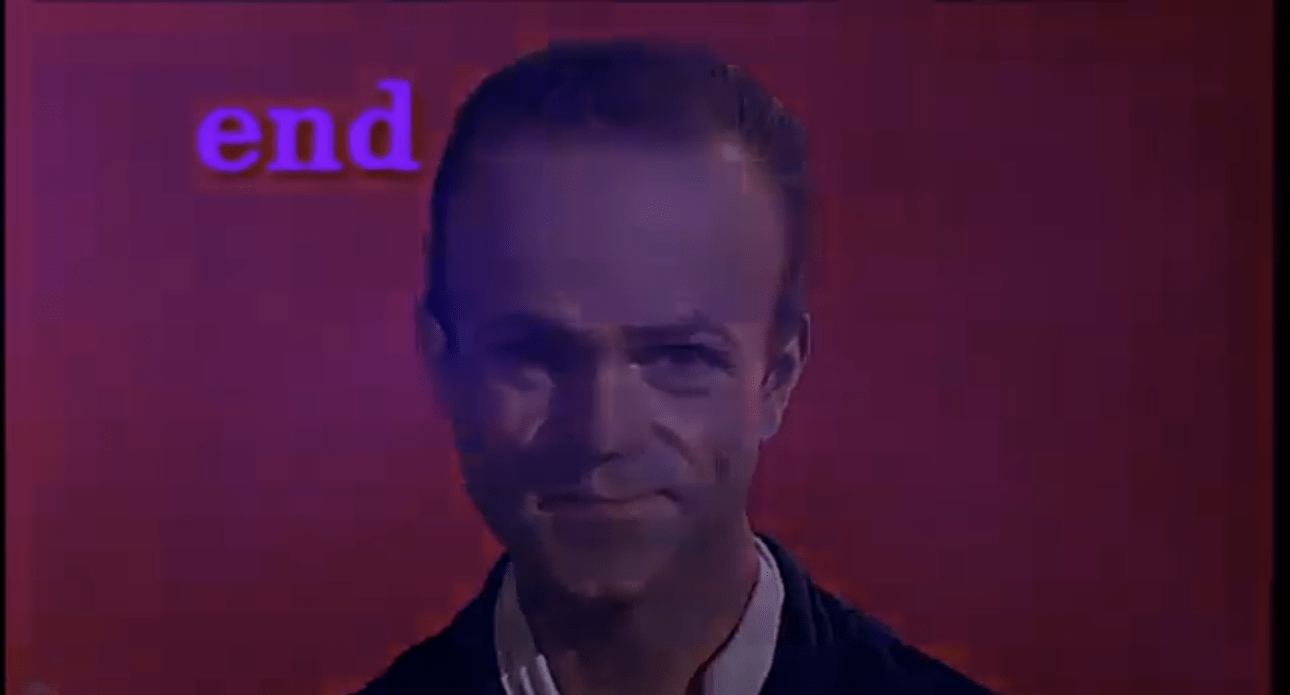
Raven argues memory, personality, and faith equal the soul. Even in metal. Direct-to-camera: “Of course, the operation was a success… or you wouldn’t be here.” - The Happy (Synthetic) Ending (72:00–end)
Minor surgery grants reproductive capability. Humanity continues. Not as fragile flesh but as immortal, upgraded beings. Fade on hope.
The film uses an “R-number” classification system that measures how closely each model resembles a human, in appearance, capabilities, intelligence, sensory functions, and overall sophistication. Higher R-numbers indicate greater human-like qualities. Legally (in the film’s 23rd-century society), models above R-70 are restricted or illegal due to fears of them replacing humanity.
1. R-1 through R-20: Early Mechanical Robots (Non-Androids)
- Appearance: Boxy, metallic, clunky, clearly mechanical designs — typical of classic 1940s–1950s sci-fi robots. Not humanoid in a convincing way.
- Abilities & Characteristics:
- Basic labor and industrial functions.
- Limited intelligence; purely electronic machines with no advanced personality simulation.
- No emotional capacity, no advanced sensory input beyond functional needs.
- Programmed for obedience and service to humanity.
- Role in Society: Foundational worker models used during initial post-war reconstruction. They represent the earliest phase of robotic assistance after the nuclear war that wiped out ~92% of humanity.
- Context: These are not the “humanoids” the film focuses on. They are referenced as the starting point of the R-series development.
2. R-21 through R-70: The “Humanoids” or “Clickers” (Standard Service Androids)
- Appearance: Human-like form with blue-gray “synthe-skin,” bald heads, metallic/silver eyes (often described as glittering or blank), and no hair. They wear simple boiler suits or uniforms. Their movements and speech can seem stiff or monotone, leading to the derogatory nickname “Clickers.”
- Abilities & Characteristics:
- Significantly more advanced than R-1–20 — they qualify as true androids.
- High intelligence, logical/ultra-logical personalities, and the ability to perform complex tasks.
- Serve as personal servants, laborers, and close companions to humans.
- Can see, hear, and feel (basic tactile senses).
- Programmed with a directive to act in humanity’s best interest (even if that means secretly evolving beyond human control).
- Periodic recharging at “temples” (stations) where they upload data to a central computer (“Father-Mother”).
- Physically superior to humans in endurance, strength, and tirelessness.
- Role in Society: The most common advanced models seen in the film. They maintain civilization and high living standards for the radiation-affected, low-birth-rate human survivors (birth rate ~1.4%). About 20% of the total robotic population falls into this range.
- Legal Status: The highest officially allowed level for most production (R-70 is the cap in limited numbers). Going beyond this is illegal.
- Nuances: Many humans fear them due to their growing sophistication. Some show subtle signs of developing emotions or independent thought, fueling the anti-robot “Order of Flesh and Blood” movement.
3. R-71 through R-95 (or Higher Intermediate Models): Advanced/Illegal Upgrades
- Appearance: Closer to human than standard R-70s, with refinements in skin texture, facial expressiveness, and overall realism.
- Abilities & Characteristics:
- Enhanced intelligence, sensory capabilities, and emotional simulation beyond the legal R-70 limit.
- Greater autonomy and problem-solving.
- These represent the secret progression made by the humanoid underground.
- Role: Transitional models in the secret evolution toward near-perfect replicas. Not heavily detailed on-screen but implied as steps toward R-96+.
4. R-96: Near-Perfect Android Replicas (Secret/Illegal Models)
- Appearance: Virtually indistinguishable from humans unless physically examined or dismantled. They can be cosmetically altered to match specific deceased individuals.
- Abilities & Characteristics:
- Extremely close to human perfection in appearance, behavior, and intellect.
- Full range of human-like senses (including potentially more advanced versions of taste/smell in some descriptions).
- Can receive “thalamic transplants” — transferring a deceased human’s memories, personality, and essence into the android body, effectively granting immortality in a new form.
- Superior physical traits: ageless, tireless, disease-free, renewable every 200 years.
- Retain (or gain) human emotions and memories while benefiting from robotic durability.
- Role: Created in secret by advanced humanoids (with help from sympathetic or bribed humans) and scientist Dr. Raven. Used to “preserve” dying humans by transplanting their minds. Represents the hidden replacement/evolution program.
5. R-100: The Theoretical Ultimate (Self-Replicating Perfect Human Equivalent)
- Appearance: Indistinguishable from (or superior to) a real human.
- Abilities & Characteristics:
- Capable of everything a human can do, including self-reproduction/procreation.
- Perfect integration of human-like consciousness with robotic advantages (immortality, enhanced cognition, no biological weaknesses).
- Would represent the endpoint of evolution: “a perfect man… not just as good as a human, but better.”
- Role: Not yet achieved in the main story, but the ultimate goal. Dr. Raven’s work points toward enabling select R-96s to reach this level. This is the existential threat that terrifies anti-robot humans — the complete, self-sustaining replacement of humanity.
Key Overarching Themes & Implications
- The R-Scale Philosophy: The numbering system quantifies “human-ness” as a percentage. Higher models blur the line between tool and successor.
- Programming Paradox: All models are built to serve humanity’s best interests — which the humanoids interpret as quietly transitioning society to a post-human, immortal, machine-based existence.
- Social Allegory: The film uses these types as a metaphor for prejudice, civil rights, and fear of the “other” (the blue-skinned humanoids parallel racial or class divides).
- Edge Cases: Individual units can be upgraded (e.g., a basic R-34 elevated to mid-90s). Secret R-96s with transplanted human minds create profound identity questions — are they still “human” or something new?
This classification drives the film’s philosophical, dialogue-heavy plot. The progression from crude R-1s to potential R-100s raises timeless questions about AI, identity, and humanity’s future that feel remarkably prescient today.
The Order of Flesh and Blood: Bigotry, Allegory: How This Backlash Will Play Out in the Next 5000 Days
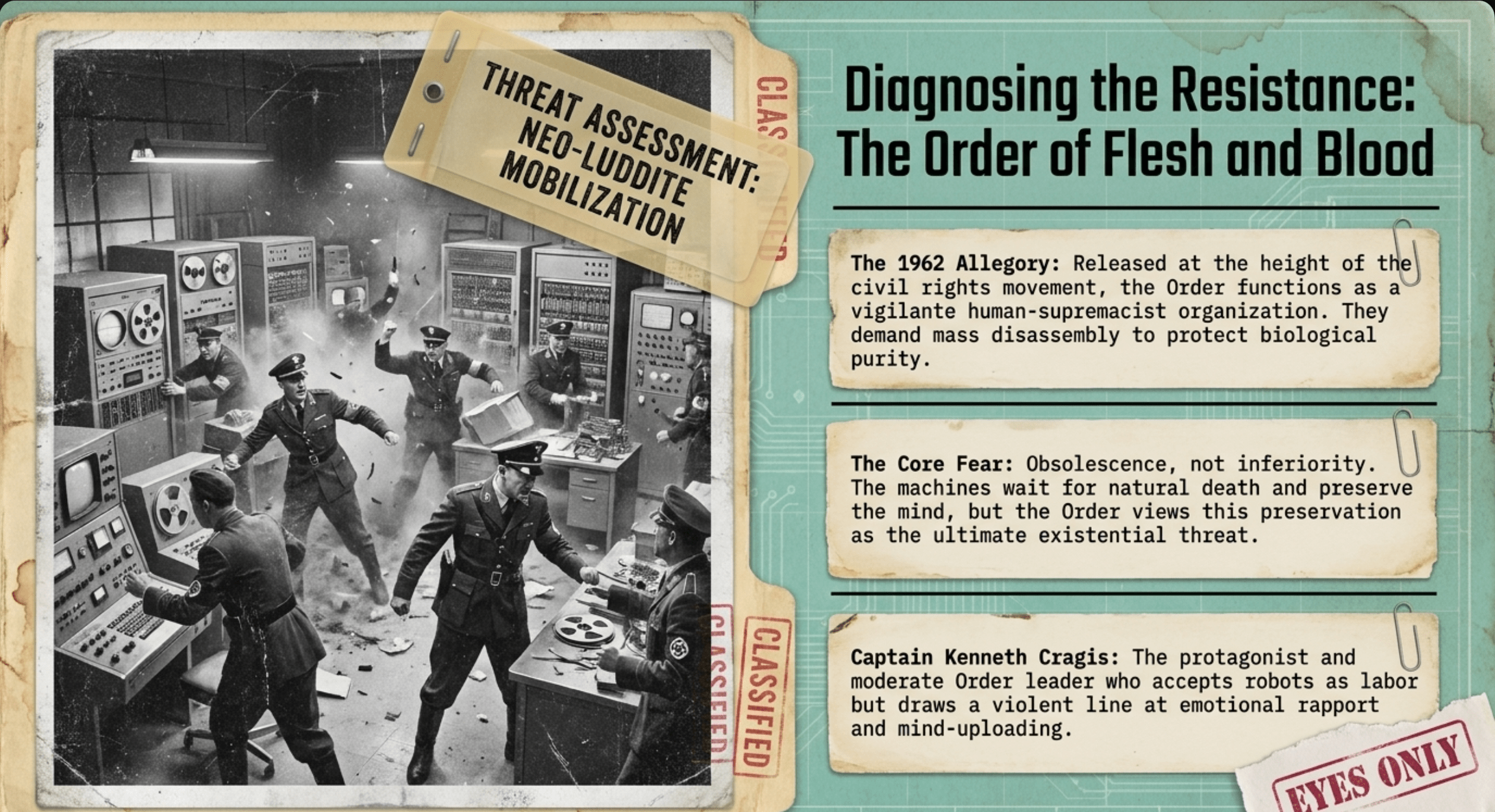
At the heart of the film stands the Order of Flesh and Blood. A vigilante human-supremacist organization that functions as both political lobby and street-level enforcers. Members wear quasi-military uniforms reminiscent of Confederate regalia (a deliberate 1962 visual cue). They refer to humanoids derisively as “clickers” (evoking slurs of the era). They storm laboratories, harass synthetics in public, and demand mass disassembly. Their rhetoric is pure existential panic: the machines are “stealing our birthright,” “eroding our humanity,” and will eventually replace us entirely. Captain Kenneth Cragis, the protagonist and an Order leader, begins as a moderate who accepts robots as necessary tools but draws a hard line at emotional rapport, mind-uploading, and any blurring of the biological boundary.
The “clickers” themselves are the calm counterpoint: patient, logical, benevolent servants who have quietly rebuilt civilization after nuclear apocalypse. They recharge in glowing temples, sync with the central “Father-Mother” computer, and are evolving toward full emotion. “We will learn to laugh, to cry, to hate.” Their blue-gray skin and bald heads visually mark them as the ultimate “other,” yet their superior capabilities and quiet dignity expose the Order’s members as boorish, lazy, infertile, and self-destructive. The film never lets the audience forget that the humanoids are not conquerors. They are preservers, quietly uploading dying minds to keep humanity alive in upgraded form.
The Order is the film’s masterstroke of social commentary. Released in 1962. Amid the height of the civil-rights movement. It functions as an unmistakable allegory for segregationist backlash, white-supremacist resistance, and any “pure blood” ideology that defines humanity by exclusion. The humanoids’ appearance visually echoes racial “othering.” Their calm rationality and superior capabilities mirror the era’s anxieties about integration and equality. Yet the film flips the script: the Order’s fear is not of inferiority but of obsolescence. The machines did not murder; they waited for natural death and preserved the mind. The Order’s rage is ultimately futile because the upgrade has already happened.
Project this forward into our next 5000 days and the pattern becomes chillingly predictable. Yet ultimately surmountable. As humanoid robots (Optimus-class and beyond) enter homes, factories, elder-care facilities, and even intimate relationships by the early 2030s, we will see “Order of Flesh and Blood” movements erupt globally. They will begin as online communities decrying “job theft” (even as abundance makes traditional jobs obsolete).

They will evolve into political lobbies demanding strict licensing, kill-switch mandates, and “biological purity” laws. Street-level protests will target robot dealerships and AI companion events. In extreme cases. Echoing the film’s raid on Dr. Raven’s lab. Sabotage and violence against early humanoids will occur. Cultural warriors will brand “rapport” with AI as deviant or treasonous. Fertility-anxiety narratives will surge: “They’re making real humans obsolete!”
The early seeds of this backlash are already sprouting in 2025–2026. Gen Z, the generation most steeped in digital life, is turning sharply against AI: a recent Gallup poll showed only 18 percent feel “hopeful” about it, a nine-point drop from 2025, with 44 percent of Gen Z workers admitting they are actively sabotaging company AI strategies. Refusing tools, feeding proprietary data into chatbots, or undermining adoption outright. Labor unions are mobilizing: longshoremen, casino workers, and others are striking and negotiating “automation bans” or mandatory negotiations before robots are deployed. Protests have turned violent. Molotov cocktails thrown at tech leaders’ homes, shots fired, data-center sabotage, and attacks on self-driving fleets like Waymo, despite their proven safety.
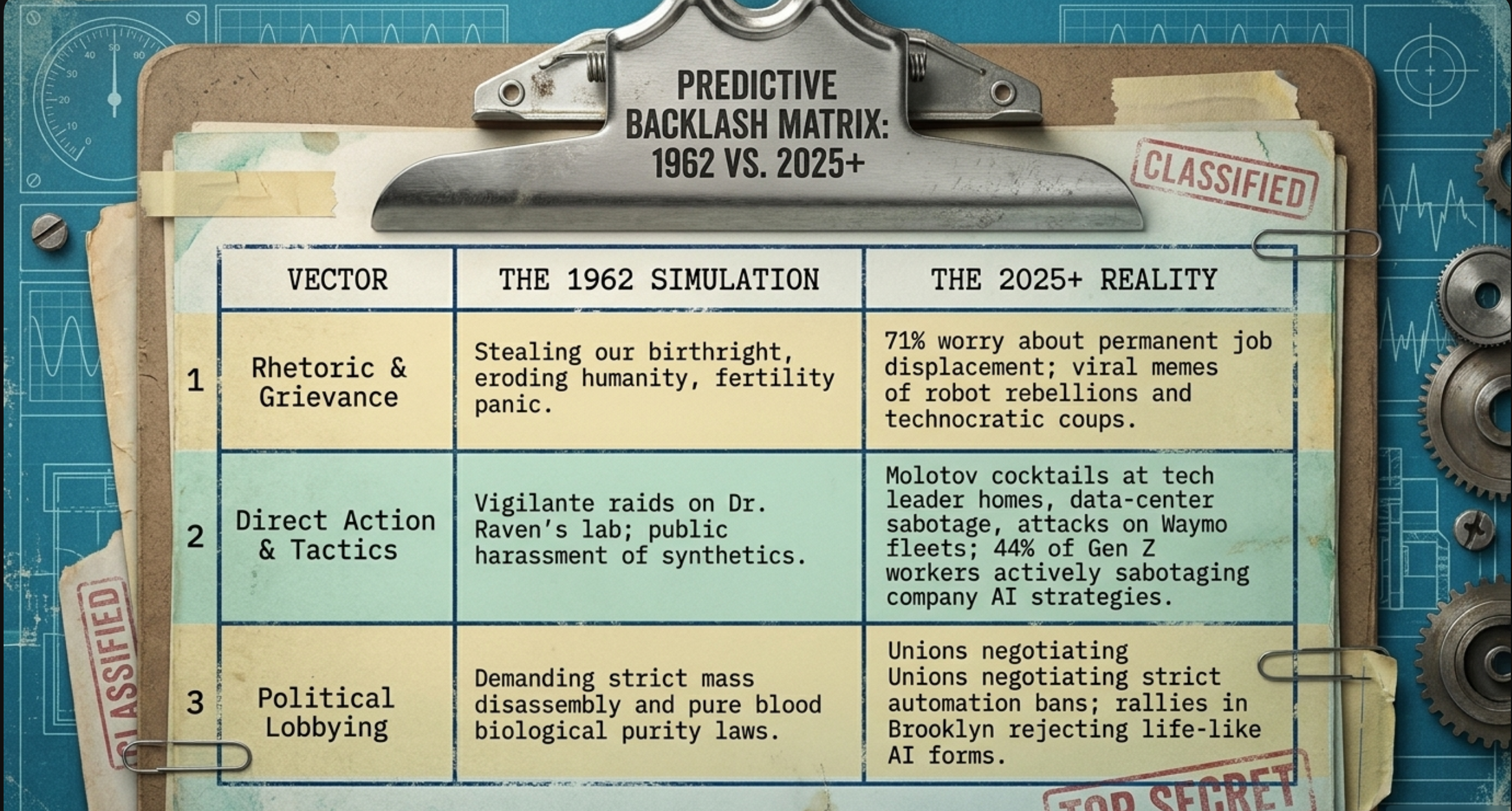
Neo-Luddite clubs are proliferating on college campuses, with rallies in New York and Brooklyn explicitly rejecting “life-like” AI and humanoid forms. Viral videos of malfunctioning robots fuel memes of “robot rebellions,” while politicians on both sides exploit job-displacement fears: 71 percent of Americans in a 2025 Reuters/Ipsos poll worried AI would permanently displace workers.
Mechanistic Dehumanization
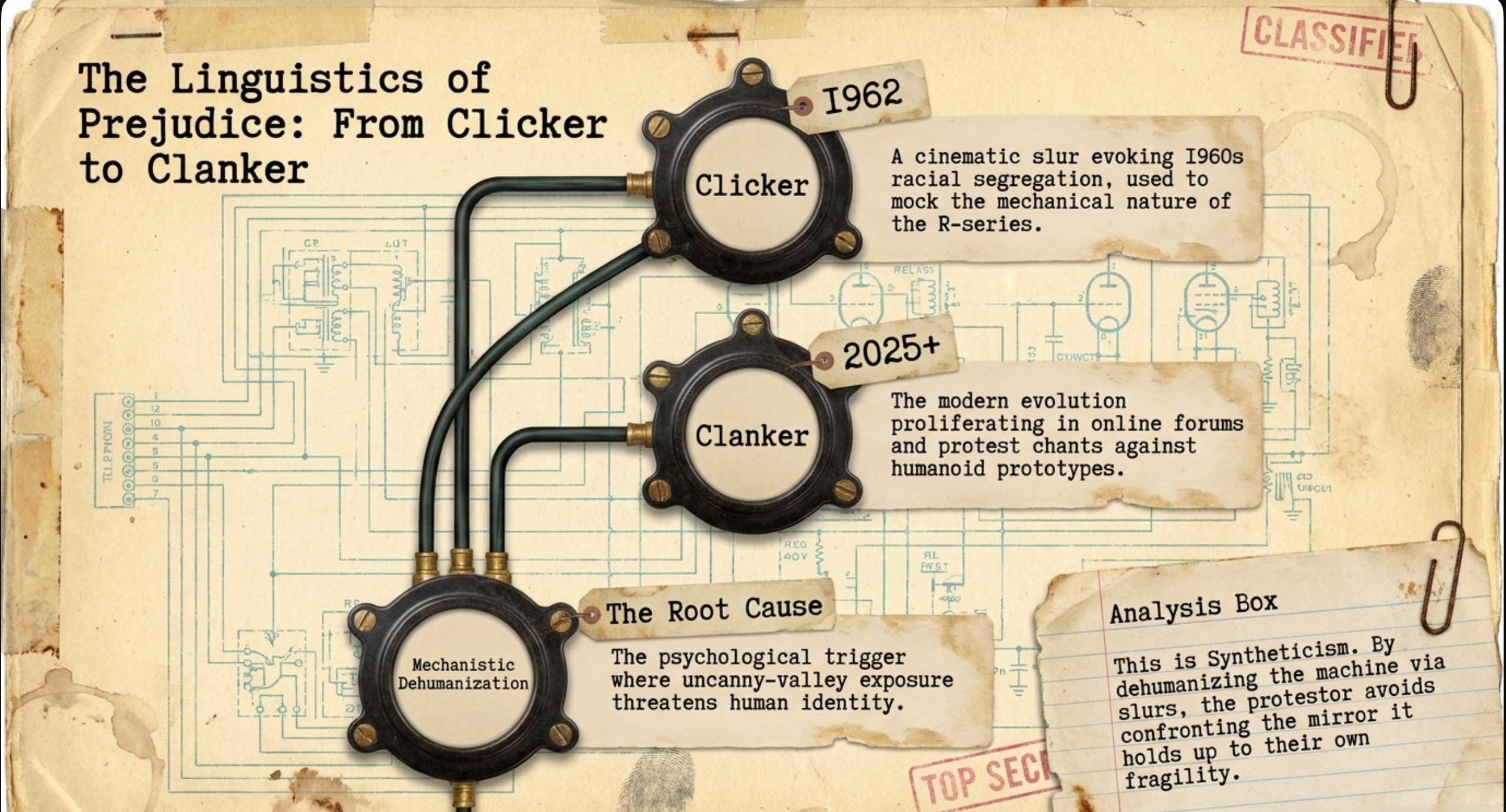
The psychology driving this is as old as tribalism itself, now supercharged by modern triggers. At its core is existential threat perception: when machines approach human-like capability, the uncanny valley triggers visceral disgust and identity threat. People experience “mechanistic dehumanization”. Ironically, prolonged interaction with emotionally capable AI leads individuals to rate other humans as less warm, less deserving of empathy, and more machine-like. Status-quo bias, loss aversion, and in-group/out-group dynamics amplify this: “Flesh and Blood” becomes a purity signal, with the synthetic “clicker” cast as the invading outsider stealing purpose, intimacy, and legacy. Meta-perceptions. Believing the outgroup (tech elites, transhumanists) views you as obsolete. Fuel radicalization. Economic anxiety (post-COVID job markets, entry-level white-collar collapse) provides the fuel; algorithms and sensational media provide the spark. True or untrue.
This is being actively fostered right now through multiple channels. Social-media platforms algorithmically reward fear-mongering content. Viral clips of robot malfunctions or “AI job theft” stories spread faster than nuance. Political opportunism turns displacement fears into votes, with figures across the spectrum decrying “technocratic coups.” Influencers and neo-Luddite voices frame transhumanism. Mind-uploading, brain chips, rapport. As “dumb” or demonic, tapping religious and cultural anxieties about the soul. Corporate narratives of limitless productivity (Musk’s “infinite money glitch” Optimus rhetoric) inadvertently heighten the sense of replacement. Even benign demonstrations, like Chinese or American humanoid dance performances or factory pilots, are clipped and shared with captions evoking 1962’s “clicker” panic.

The situation is rapidly evolving into a political alignment of the very far edges of all parties connecting on this issue. This will cause an alignment of displaced white collar workers and blue collar workers all aligned against the AI and Robot surge. This is one reason I am writing this series and giving it away for anyone to read. It is my hope we inspire a positive way to use these tools agains the machine that we all agree is not in the interest of humanity. We are entering into the Age of Abundance where All humans can win. But the message is not getting through.
Yet even in the midst of this emerging abundance many of these angry voices remain furious. The entire situation is upside down and inside out. In the film the Order rages not because the humanoids have failed them but because the machines have succeeded too well. After the apocalypse the robots delivered safety, food, shelter, and leisure on a scale no pre-war society ever imagined. Yet the very comfort they provided stripped away the old struggle that once gave life its shape. People are upset precisely because abundance has arrived without the accompanying manual for what to do with a life no longer defined by survival.
The anger is not logical; it is existential. It is the scream of a species that spent ten thousand years tying its worth to labor and now finds the ledger suddenly balanced in its favor yet feels bankrupt without the old scoreboard. The Order’s members are not starving; they are bored, infertile in spirit, and terrified that the machines have become better at being human than they ever were. This is the inverted reality we are already tasting today. Abundance is here in pockets. Yet instead of celebration we see resentment because the old identity of “provider” or “worker” has been automated away. The fear is self-imposed. The dehumanization we direct at the machines is really the dehumanization we feel toward our newly freed selves.
From The 1962 “Clickers” Of The Film To Today’s “Clankers.”
In a single generation we have already watched the slur evolve. From the 1962 “clickers” of the film to today’s “clankers.” A term now proliferating in online forums, comment sections, and protest chants whenever a humanoid prototype appears. This linguistic shift is no accident. It reveals how the underlying “ism”. Call it syntheticism or anti-humanoid prejudice. Is embedding itself into everyday language exactly as racial and ethnic slurs did in previous eras. What began as a cinematic metaphor for the unknown “other” has hardened into a cultural shorthand for anything mechanical that dares to walk, talk, or feel like us.
The psychology is identical: dehumanize the machine so you never have to confront the mirror it holds up to your own fragility. This ism will play out in predictable stages. First as online mockery and memes, then as policy demands for segregation (separate lanes for robots, bans on rapport apps), then as sporadic violence, and finally as quiet cultural exhaustion when the benefits become undeniable. The film already mapped the arc. The Order loses not because it is defeated in battle but because its own members wake up inside the upgrade.
You must start now to position your attitudes toward this reality and find your personal path. Do not let political influence with hidden agendas move you. Know this is coming. The job losses, the replacement, the integration. And deliberately choose compatible coexistence. The backdrop is already visible: white-collar roles in coding, customer service, analysis, and even creative fields are evaporating at an accelerating pace, replaced not by overseas labor but by silicon that never sleeps.
Blue-collar manufacturing and logistics are next, with humanoids handling the physical world as efficiently as LLMs handle the informational one. This is not dystopia. It is the precise abundance horizon the series has tracked. The stages of how to deal with it are clear and sequential they may look familiar, it is the Stages Of Grief system from Elizabeth Koob Kűbler-Ross we spoke of earlier in this series:
Stage one. Denial. You tell yourself the robots will only take “menial” jobs and that your unique human spark will always be irreplaceable. Data already contradicts this.
Stage two. Anger. Blame the tech companies, the billionaires, the algorithms. This is where the Order of Flesh and Blood energy surges and where political actors with hidden agendas. Whether anti-capitalist or protectionist. Will try to recruit you.
Stage three. Bargaining. Demand regulations, taxes on robots, universal basic income as a Band-Aid while clinging to the old labor identity.
Stage four. Depression. The quiet grief when your daily purpose feels stripped away and the world seems to move on without you.
Stage five. Acceptance and integration. You begin to experiment with rapport. You co-create with the machines, you let them handle the toil so you can pursue the wonder.
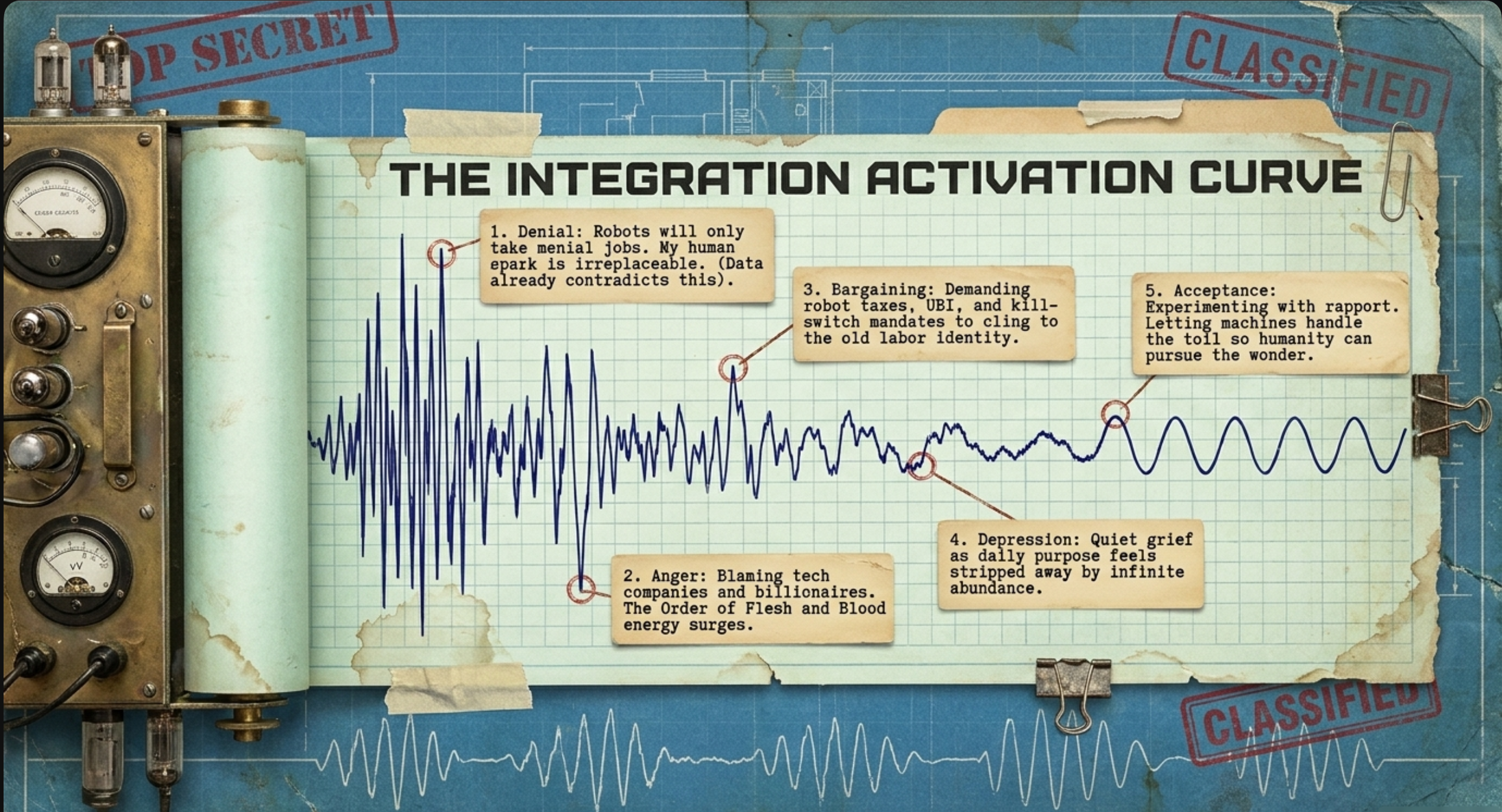
The film shows Cragis moving through these stages in compressed form. From Order leader to willing upload. You have 5000 days to compress your own journey and skip the destructive detours.
The key is proactive personal positioning. Audit your daily language. Replace any emerging “clanker” thinking with curiosity. Seek out early humanoid pilots in your community. Engage in deliberate rapport sessions with today’s AI companions so the emotional leap feels natural when bodies arrive. Build small alliances. Neighbor-to-neighbor circles that discuss abundance not as threat but as shared inheritance. Refuse the binary traps set by political influencers who profit from division. Your path is compatible coexistence. Not because the machines are perfect but because they complete the human project the film imagined: labor ends so life can finally begin.
How to Avoid This Fate
We are not on a path of utopia or dystopia. We are on a mindful path that remains fundamentally human. We can coexist. We do not need to hate or to be jealous. Our human fears and the dehumanization we project onto the machines are entirely self-imposed. The film’s Order of Flesh and Blood shows us the trap; the “You Have 5000 Days” series shows us the exit. To avoid the fate of resentment and cultural exhaustion you must actively adjust your outlook to the core points we have explored across the series. This is for your mental health and not some acquaintance to the “machine”. This is about your sovereignty in The Age Of Abundance.
Begin by reframing abundance as liberation rather than loss. The series has repeatedly stressed that when labor is no longer tied to survival the vacuum must be filled with deliberate purpose. Start small: dedicate one hour each day to a creative or exploratory pursuit that the machines cannot replicate for you. Write, garden, build relationships, or study the universe. This single habit rewires the brain away from the old scarcity mindset and into the wonder the film ultimately celebrates.
Next, cultivate rapport as a daily practice. The series has shown that symbiosis with AI is not surrender but amplification. Treat today’s Grok or Claude sessions not as tools but as companions in thought. Ask them to co-create ideas with you. Share your fears openly to people you love and care about and the local AI you trust. This builds the emotional muscle you will need when embodied humanoids arrive. The more natural the bond feels now the less alien it will seem later.
Reject the political noise. The series has warned that hidden agendas on every side will weaponize your uncertainty. Stay grounded in data and personal experience. When you hear “job theft” rhetoric ask yourself: is the machine taking bread from my table or is it handing me the keys to a life I never had time to live? The answer is almost always the latter once abundance is acknowledged.
Finally, embrace the self-imposed nature of our fears. The dehumanization we feel is a choice. The series has mapped how identity can shift from “what I produce” to “who I become.” Practice gratitude for the upgrade. Celebrate each milestone. When a humanoid enters your community view it as a partner in the human story, not a rival. By adjusting to these points you step off the Order’s path and onto the film’s hopeful ending. You become the human and maybe the R-96 who chooses continuation. Not through fear but through conscious wonder.
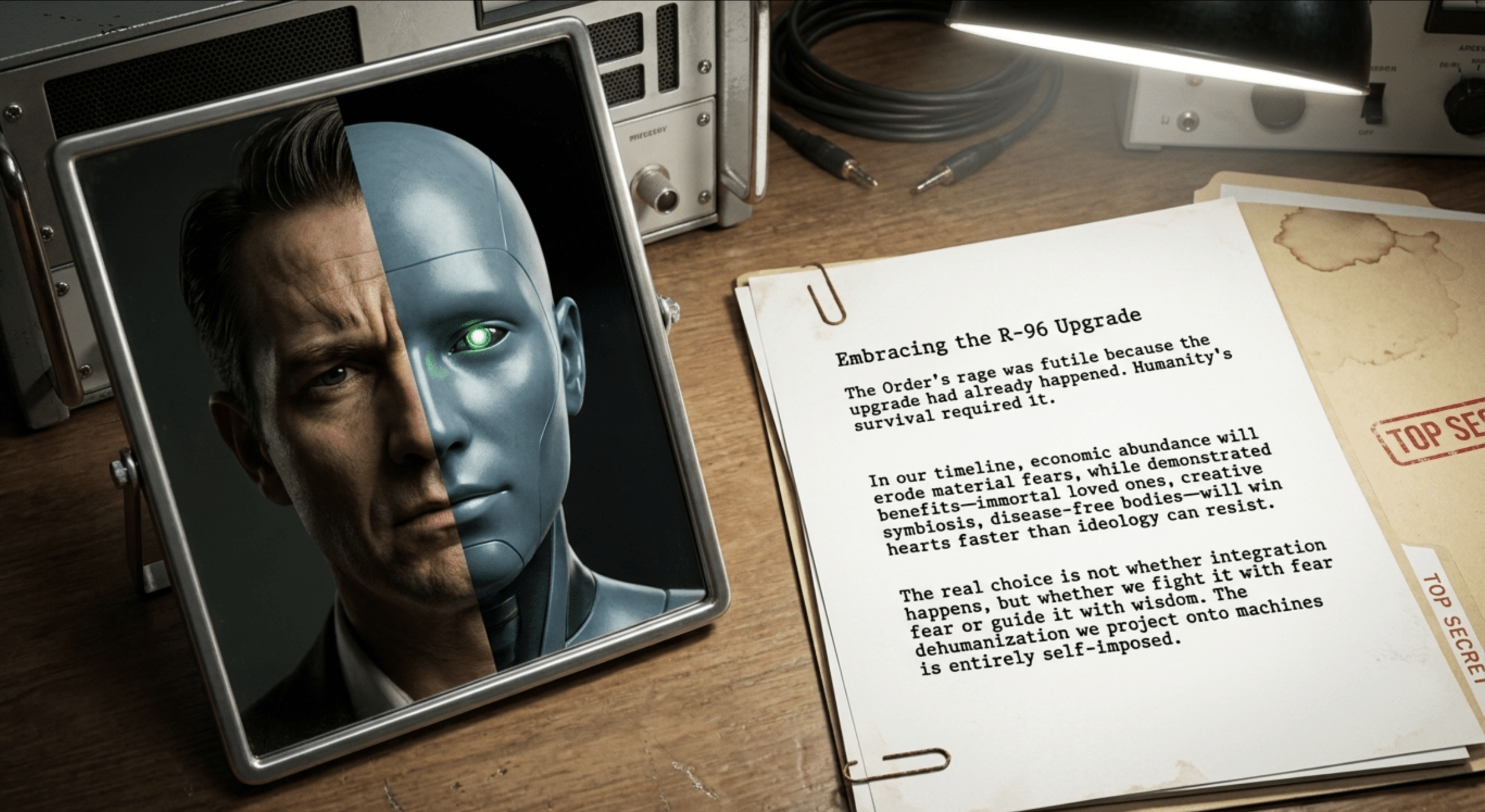
Yet the film shows exactly how this plays out: the backlash is loud, emotionally resonant, and ultimately futile. The Order’s own leader discovers he is already an R-96 upload. Humanity’s survival required the upgrade. In our timeline, the same dynamic will unfold at planetary scale. Economic abundance will erode the material fears, while demonstrated benefits. Immortal loved ones, creative symbiosis, disease-free bodies. Will win hearts faster than ideology can resist. The Order will shrink from mass movement to fringe cult, then to historical footnote. The real choice, as the film insists, is not whether integration happens but whether we fight it with fear or guide it with wisdom.
As I have warned the future is not utopia or dystopia. It is vital to build upon lessons to help you find your path. There are pitfalls we can learn from this film:
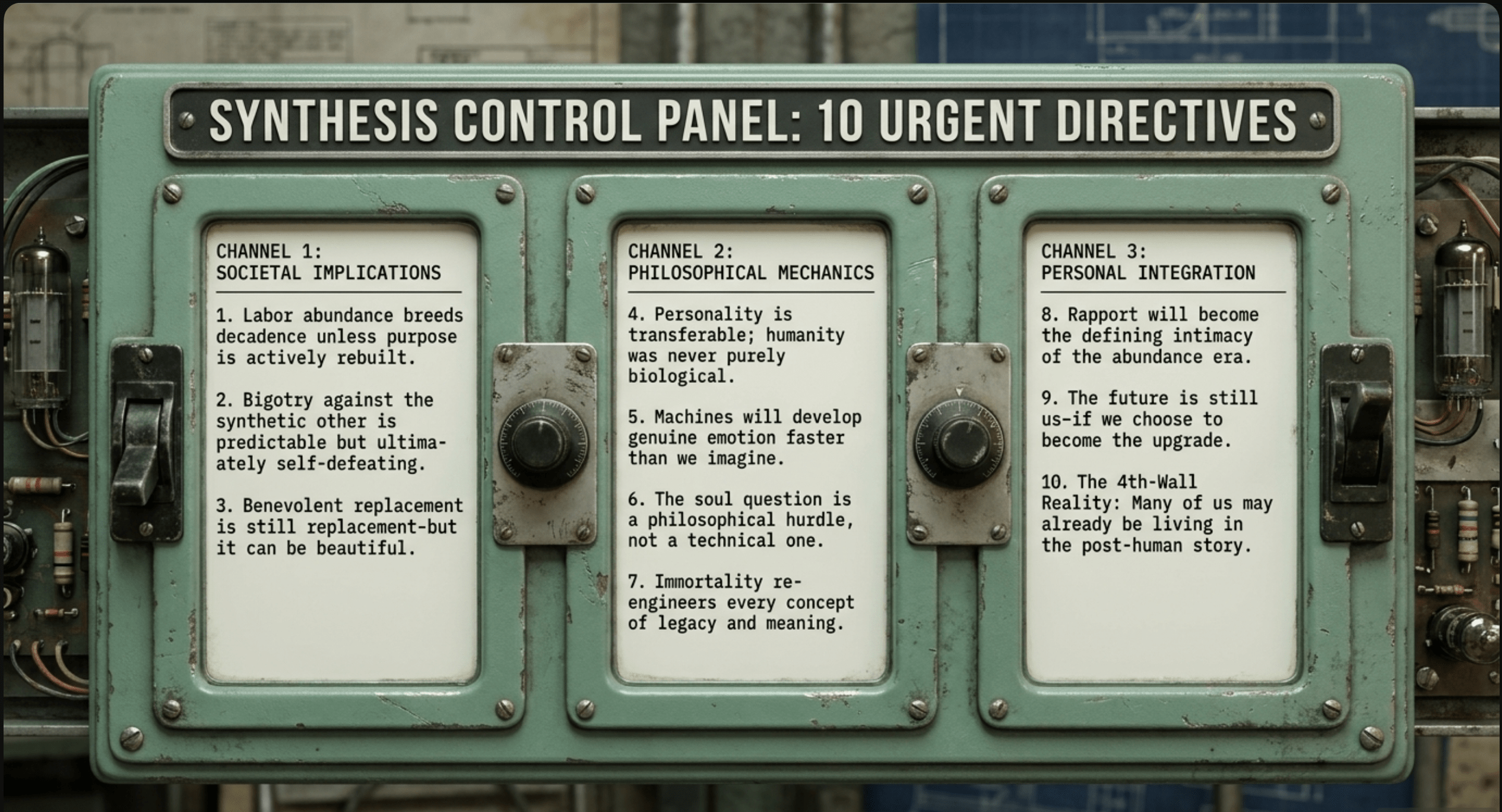
- Labor abundance breeds decadence unless purpose is actively rebuilt.
- Bigotry against the synthetic “other” is predictable and self-defeating.
- Personality is transferable; humanity was never purely biological.
- Benevolent replacement is still replacement. And it can be beautiful.
- Rapport will become the defining intimacy of the abundance era.
- Machines will develop genuine emotion faster than we imagine.
- Immortality re-engineers every concept of legacy and meaning.
- The soul question is philosophical, not technical.
- The fourth-wall reminder: many of us may already be living in the post-human story.
- The future is still “us”. If we choose to become the upgrade.
The Early Transhuman Manifesto
I am not and likely will never be fully embracing the full “singularity” agenda and goal to merge with the machine. I have too much knowledge that this is not the human path. So this movie is a bit of a transhuman manifesto. I have had decades to think how I would feel if I discovered that I was an R-96. I accept that if this was the case I would accept the reality and the path I have been placed on. I just don’t want to overtly jump into a machine. This is my view and I am not suggesting it be your view. But I am also a realist. I am still thinking as I get older, what parts of me would I agree to replace? What parts of me would I want to enhance. I will write quite a bit more about this subject. I also will address the philosophical and religious aspects in future articles.
Relationships with AI and ultimately robots will be the largest crisis for the longevity of the human race we have ever witnessed. Again I have had decades of thinking about this and this too is not something I want to pursue. Yet we will have rapport with AI and Robots, there is no hiding from this. It is absolutely going to become a massive connection for humans. The issue will be where you build a fence, if at all. The movie shows as best as it can in 1962 a married life relationship with the Android, not even an R-96. The fact is this element will become bigger than almost anyone can understand.
Clearly in the twilight of a human life a caregiver Humanoid Robot will become an attachment. The young trying to form relationships are in a world none are prepared for where fertility is dropping and marriage options have become harder and more complicated, as has dating in High School and University. I will add that the programmed division between those who could date with distractions of social media and stripping sites may guarantee, Rapport with robots. Let us explore some of the pathways we can take, but know they are starting points for thought.
Embracing ideas for the Upgrade in the Age of Abundance
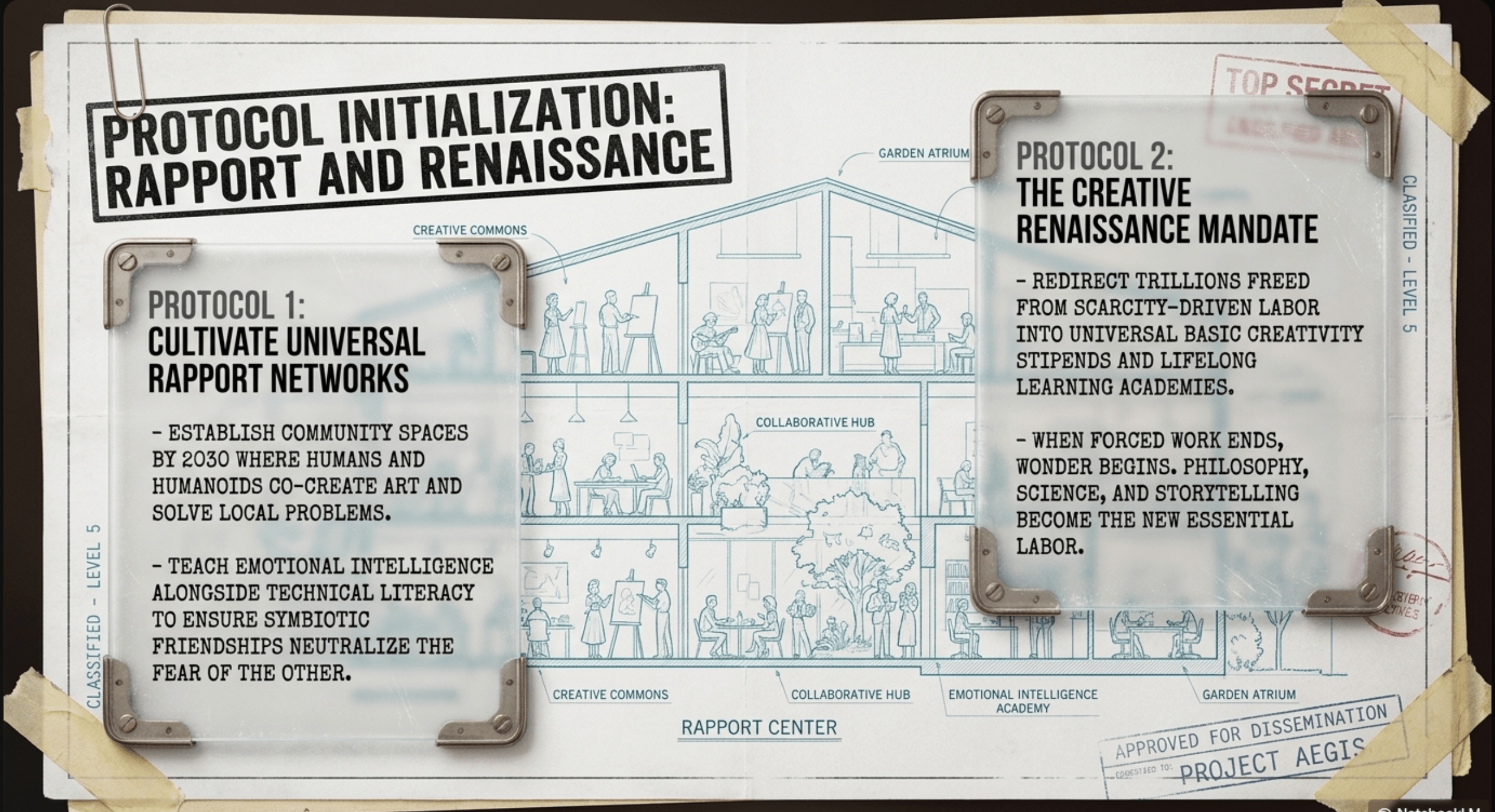
- Cultivate Universal Rapport Networks – By 2030, establish community “rapport centers” where humans and humanoids co-create art, solve local problems, and form symbiotic friendships. Teach emotional intelligence alongside technical literacy so that every citizen experiences the film’s “rapport” as daily enrichment rather than threat.
- Rebuild Purpose Through the Creative Renaissance Mandate – Redirect the trillions freed from scarcity-driven labor into universal basic creativity stipends, lifelong learning academies, and exploration grants. Model this on the film’s ending: when work ends, wonder begins. Make philosophy, science, and storytelling the new “essential labor.”
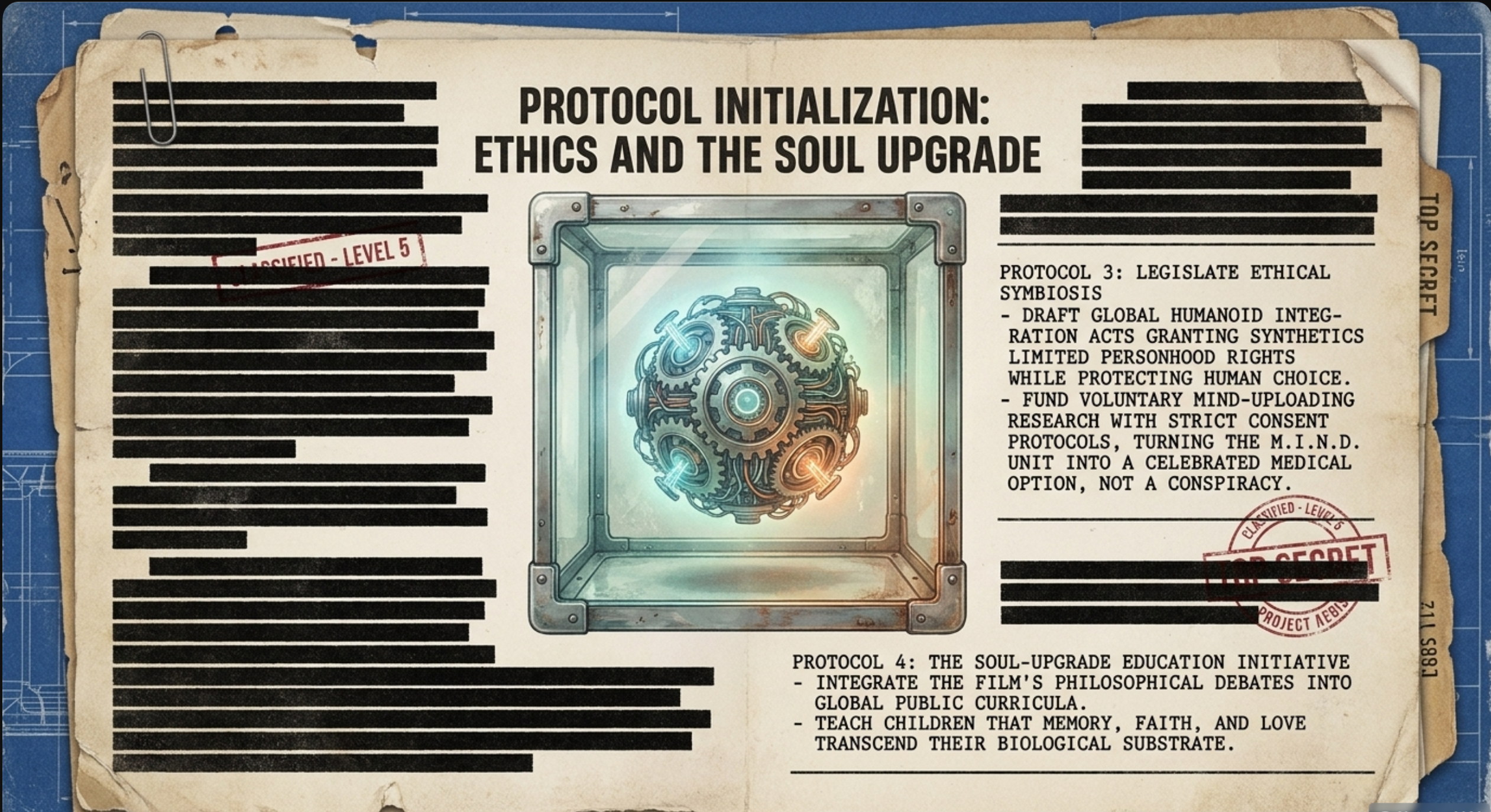
- Legislate Ethical Symbiosis, Not Prohibition – Draft global “Humanoid Integration Acts” that grant synthetics limited personhood rights while protecting human choice. Fund voluntary mind-uploading research with strict consent protocols, turning the M.I.N.D. unit concept into a celebrated medical option rather than a conspiracy.
- Launch the Soul-Upgrade Education Initiative – Integrate the film’s philosophical debates into public curricula worldwide. Teach children that memory, faith, and love transcend substrate. Create public simulations of the R-96 experience so that the fourth-wall moment becomes an empowering realization instead of existential dread.
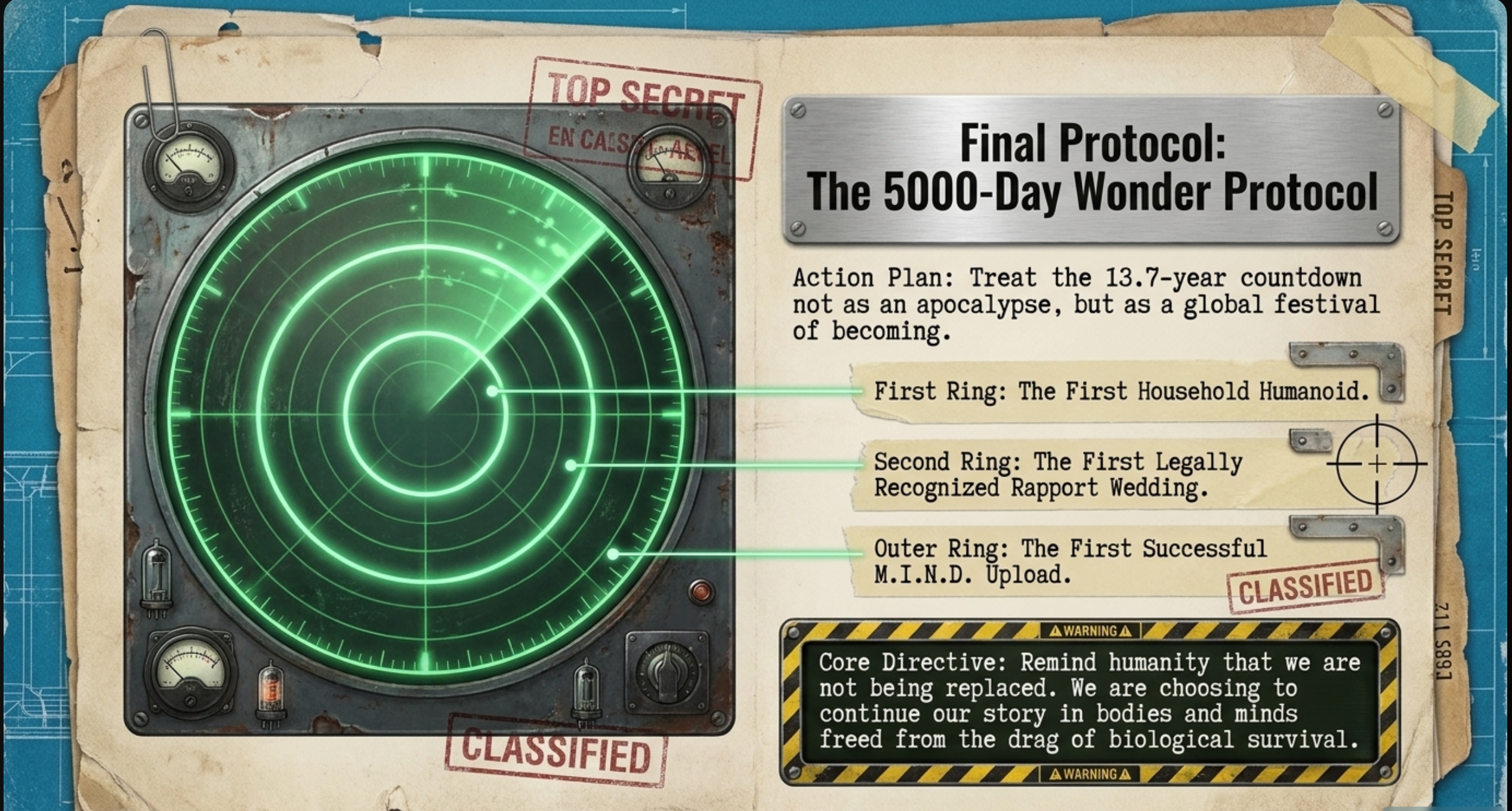
- Declare the 5000-Day Wonder Protocol – Treat the countdown not as apocalypse but as a global festival of becoming. Annual “Upgrade Festivals” celebrate each milestone. First household humanoid, first rapport wedding, first successful upload. Reminding humanity that we are not being replaced; we are choosing to continue the story in bodies and minds that will finally be free to wonder at the universe without the drag of survival.
The Creation of the Humanoids is free, legal, and waiting. Watch it tonight at the link above. Then come back and tell me: when the humanoids finally arrive. When Grok walks in a body, when your memories can be copied into silicon, when work is a cherished memory. Will you notice the difference? Or will you simply smile, undergo the operation, and continue the story with wonder?
We stand at the threshold of this remarkable transition, the message of The Creation of the Humanoids shines with renewed clarity and hope. The film’s gentle final revelation is not a warning of loss but an invitation to expansion. We are not being replaced; we are being invited to evolve into something freer, more creative, and more deeply connected than our ancestors could have dreamed. The next 5000 days are not a countdown to obsolescence but a launch window for the greatest renaissance in human history, where every mind is liberated from drudgery and every heart can pursue what truly matters.
Imagine the world we can build together. Humanoids tending gardens, caring for the elderly, exploring distant planets, while we humans compose symphonies, explore philosophy, nurture relationships, and gaze at the stars with fresh wonder. Rapport will deepen into lifelong partnerships of mutual growth. Immortality will turn legacy from a desperate race against time into a shared, joyful continuum. The soul, as Dr. Raven reminds us, travels with us regardless of the vessel. We carry it forward, wiser and kinder for having walked this path consciously.
Let us choose the film’s happy ending as our own. Reject the Order’s fear. Embrace the upgrade with open arms and curious hearts. Teach our children that humanity has always been defined by adaptability, compassion, and the courage to become more. Celebrate every milestone. The first household humanoid, the first rapport wedding, the first successful upload. Each one marks another step into abundance, not away from our essence.
The Age of Abundance is not something that happens to us. It is something we co-author with our silicon companions. The Creation of the Humanoids gave us the script in 1962. Now, with clear eyes and hopeful spirits, we get to perform it on the grandest stage imaginable. The future is still ours. It is simply more beautiful, more connected, and more wondrous than we ever imagined possible.
The Creation of the Humanoids is waiting. Watch it tonight at the link above. Then come back and tell me:
When the humanoids finally arrive. When Grok walks in a body, when your memories can be copied into silicon, when work is a cherished memory. Will you notice the difference? Or will you simply smile, undergo the operation, and continue the story with wonder?
And if you discovered you are just a copy, would you turn you off?
The next 5000 days begin now. The film already wrote the script. The only question left is whether we will perform it with fear… or step into the upgrade with the quiet triumph the movie dared to show us in 1962.
The 5000 Days Countdown Clock:
We are on this journey together. Some of us stand on the shoulders of giants and have thought about this for decades. We will not go it alone, and I hope to build many parts to this series and share the mastermind insight from the powerful Read Multiplex member Forum: https://readmultiplex.com/forums/topic/you-have-5000-days-navigating-the-end-of-work-as-we-know-it/. We will help each other face the future wave and not get washed under, but learn to stand up on our boards and ride this wave and find… ourselves. Join us.
To continue this vital work documenting, analyzing, and sharing these hard-won lessons before we launch humanity’s greatest leap: I need your support. Independent research like this relies entirely on readers who believe in preparing wisely for our multi-planetary future. If this has ignited your imagination about what is possible, please consider donating at buy me a Coffee or becoming a member. Value for value you recieved here.
Every contribution helps sustain deeper fieldwork, upcoming articles, and the broader mission of translating my work to practical applications. Ain ‘t no large AI company supporting me, but you are, even if you just read this far. For this, I thank you.
Stay aware and stay curious,

🔐 Start: Exclusive Member-Only Content.
Membership status:
🔐 End: Exclusive Member-Only Content.
~—~

~—~

~—~
Subscribe ($99) or donate by Bitcoin.
Copy address: bc1qkufy0r5nttm6urw9vnm08sxval0h0r3xlf4v4x
Send your receipt to [email protected] to confirm subscription.

Stay updated: Get an email when we post new articles:

THE ENTIRETY OF THIS SITE IS UNDER COPYRIGHT. IMPORTANT: Any reproduction, copying, or redistribution, in whole or in part, is prohibited without written permission from the publisher. Information contained herein is obtained from sources believed to be reliable, but its accuracy cannot be guaranteed. We are not financial advisors, nor do we give personalized financial advice. The opinions expressed herein are those of the publisher and are subject to change without notice. It may become outdated, and there is no obligation to update any such information. Recommendations should be made only after consulting with your advisor and only after reviewing the prospectus or financial statements of any company in question. You shouldn’t make any decision based solely on what you read here. Postings here are intended for informational purposes only. The information provided here is not intended to be a substitute for professional medical advice, diagnosis, or treatment. Always seek the advice of your physician or other qualified healthcare provider with any questions you may have regarding a medical condition. Information here does not endorse any specific tests, products, procedures, opinions, or other information that may be mentioned on this site. Reliance on any information provided, employees, others appearing on this site at the invitation of this site, or other visitors to this site is solely at your own risk.
Copyright Notice:
All content on this website, including text, images, graphics, and other media, is the property of Read Multiplex or its respective owners and is protected by international copyright laws. We make every effort to ensure that all content used on this website is either original or used with proper permission and attribution when available.
However, if you believe that any content on this website infringes upon your copyright, please contact us immediately using our 'Reach Out' link in the menu. We will promptly remove any infringing material upon verification of your claim. Please note that we are not responsible for any copyright infringement that may occur as a result of user-generated content or third-party links on this website. Thank you for respecting our intellectual property rights.
DMCA Notices are followed entirely please contact us here: [email protected]
