
How Your Old Computer Can Become An Employee: Meet Zero-Human Company @ Home.
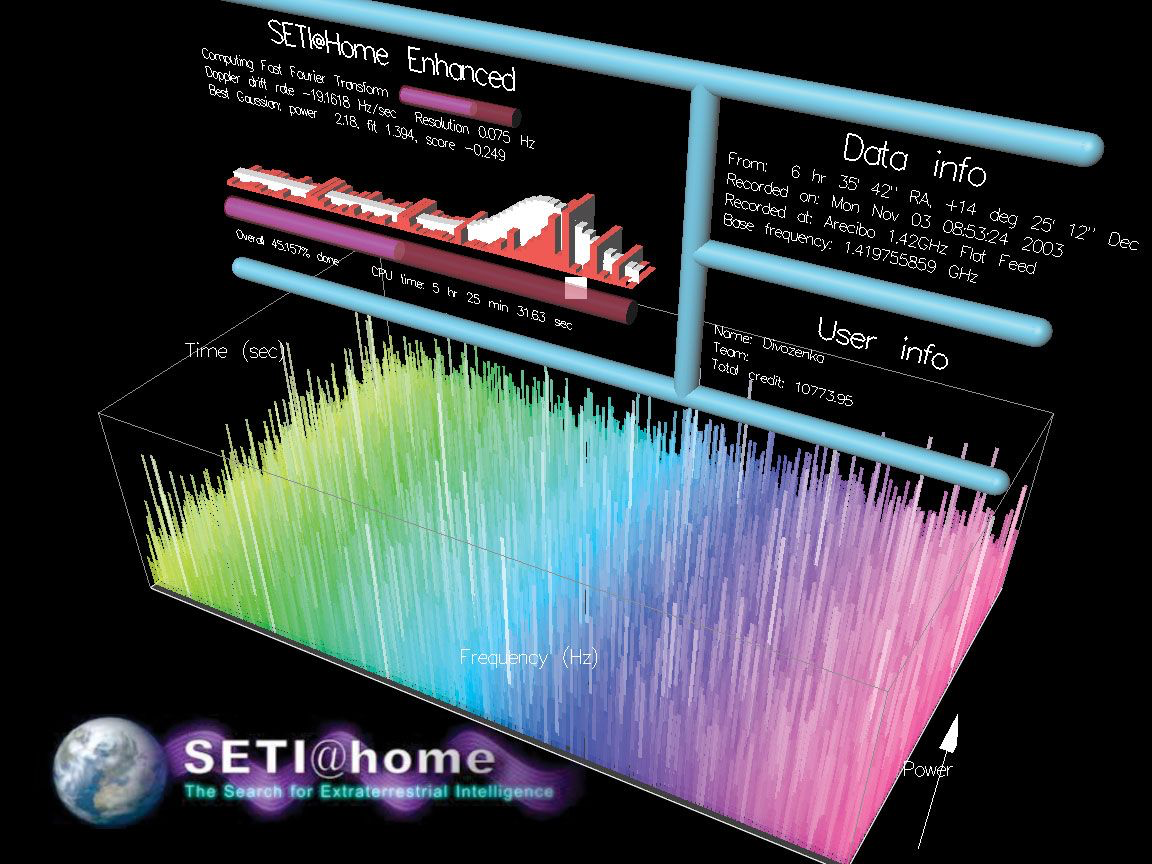
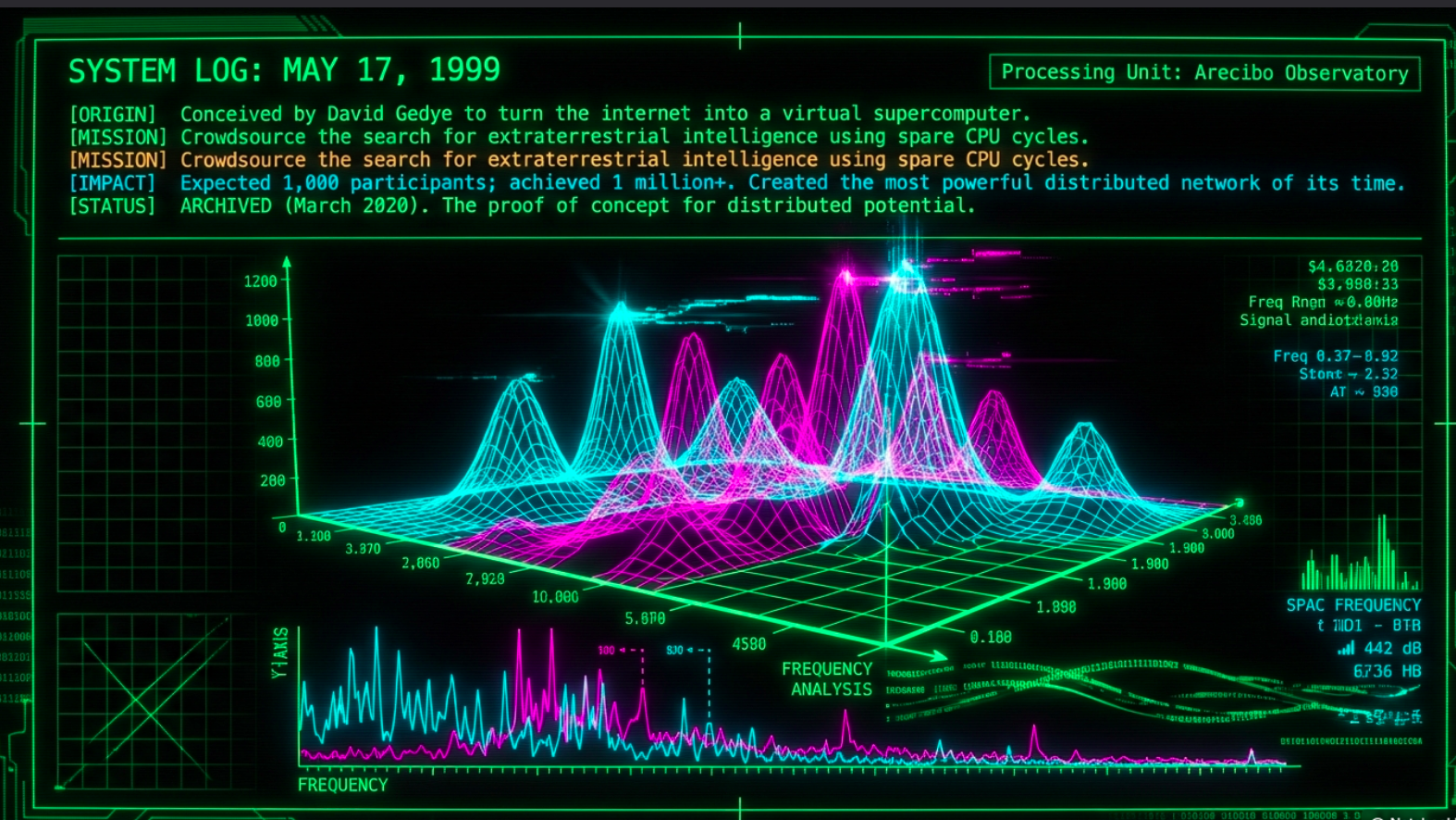
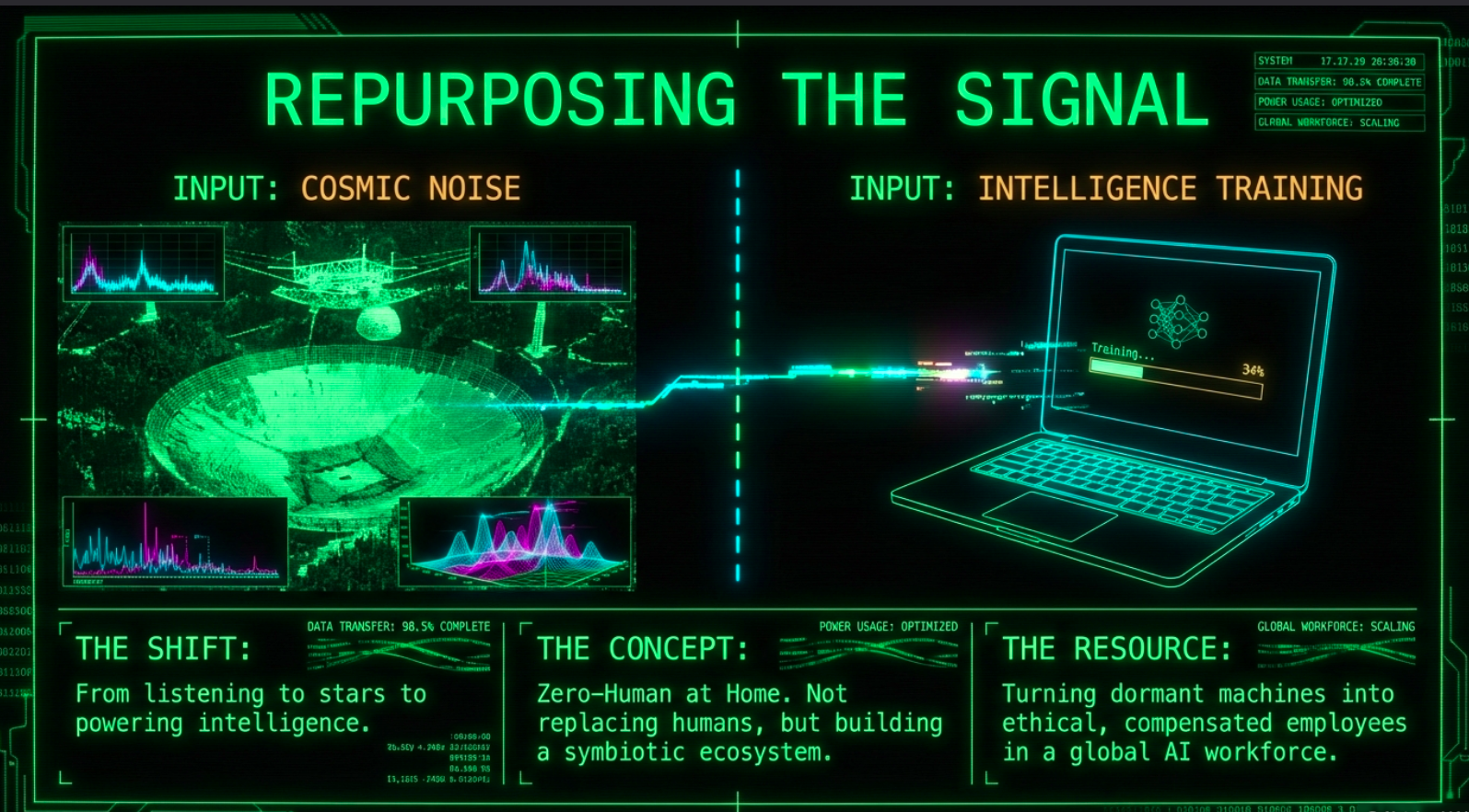
Let me take you back to a time when the idea of harnessing the idle power of everyday computers first captured the world’s imagination. It was the mid-1990s, and a brilliant mind named David Gedye dreamed up a way to turn the internet into a virtual supercomputer. Inspired by the pioneering work of Frank Drake, who in 1960 pointed an 85-foot radio telescope at two sun-like stars in West Virginia, hoping to catch whispers from extraterrestrial civilizations, Gedye proposed something radical. Why not crowdsource the search for intelligent life beyond Earth by tapping into the spare cycles of personal computers connected online? This vision became SETI @ home, conceived in 1995, with development kicking off in 1998 thanks to funding from The Planetary Society and even Paramount Pictures. On May 17, 1999, it launched to the public, the third major volunteer computing project after the Great Internet Mersenne Prime Search in 1996 and distributed dot net in 1997. I was active as a Planetary Society member as one of the first 100 running the system. I was absolutely taken by the concept.
This article is sponsored by Read Multiplex Members who subscribe here to support my work: Link: https://readmultiplex.com/join-us-become-a-member/
It is also sponsored by many who have donated a “Cup of Coffee”. If you like this, help support my work: Link: https://ko-fi.com/brianroemmele
Listen to the companion podcast: https://rss.com/podcasts/readmultiplex-com-podcast/2585383
What started as an experiment exploded: researchers expected maybe a thousand participants, but within months, a million people worldwide had joined, forming the most powerful distributed network ever assembled. It was a spectacular wave that flooded the early online world. We could feel that our little computers could actually contribute a small part of a very big thing. My mind went in to overdrive thinking of how these types of systems could play out. It was an optomistic time and everything was new. I would stare at the screen somtimes for hours wondering if some part of my part may help idnetify a new “Wow” signal.
Their screensavers crunched radio signals from the Arecibo Observatory (now destroyed by neglect), sifting for patterns that might signal alien intelligence. It ran for over two decades, until March 2020, when new work packets stopped, but not before inspiring a generation, including me, to see the untapped potential in our dormant machines.
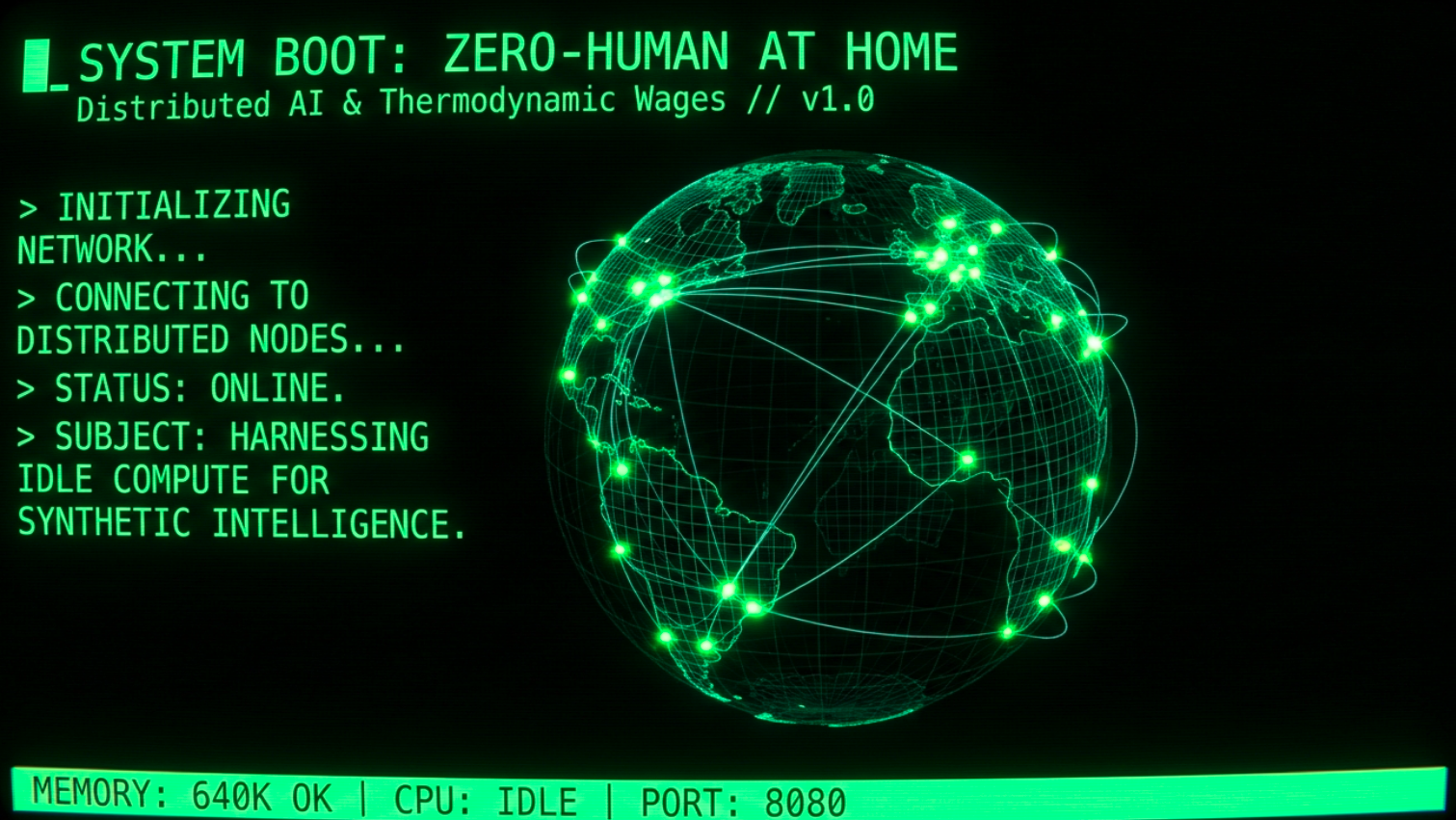
That SETI at home spark ignited something profound in me, a realization that idle compute could change everything. Fast forward to today, and I am pioneering the Zero-Human Company @ Home, a framework that echoes that distributed magic but applies it to AI. It is not about replacing humans, but building a symbiotic ecosystem where your spare computers become ethical, compensated employees in a global AI workforce. More on the Zero-Person Company is here: https://readmultiplex.com/2026/01/24/the-zero-human-company-run-by-just-ai/. I wrote an acedmeic paper on the process: https://x.com/brianroemmele/status/2026839138817999229?s=46&t=h6Uxy7hWc9UiXSt6FEoK-A. For decades I thought of using unused CPU and GPU cycles to help build AI. It took decades for the right conditions to manifest for this to take place.
I first shared this concept in an X post (https://x.com/BrianRoemmele/status/2026804542604767658?s=20) detailing how we could create millions of secure nodes for AI data mining and processing, all while upholding privacy and human values. Since then, We have built on it through countless updates, proving its scalability in real tests.
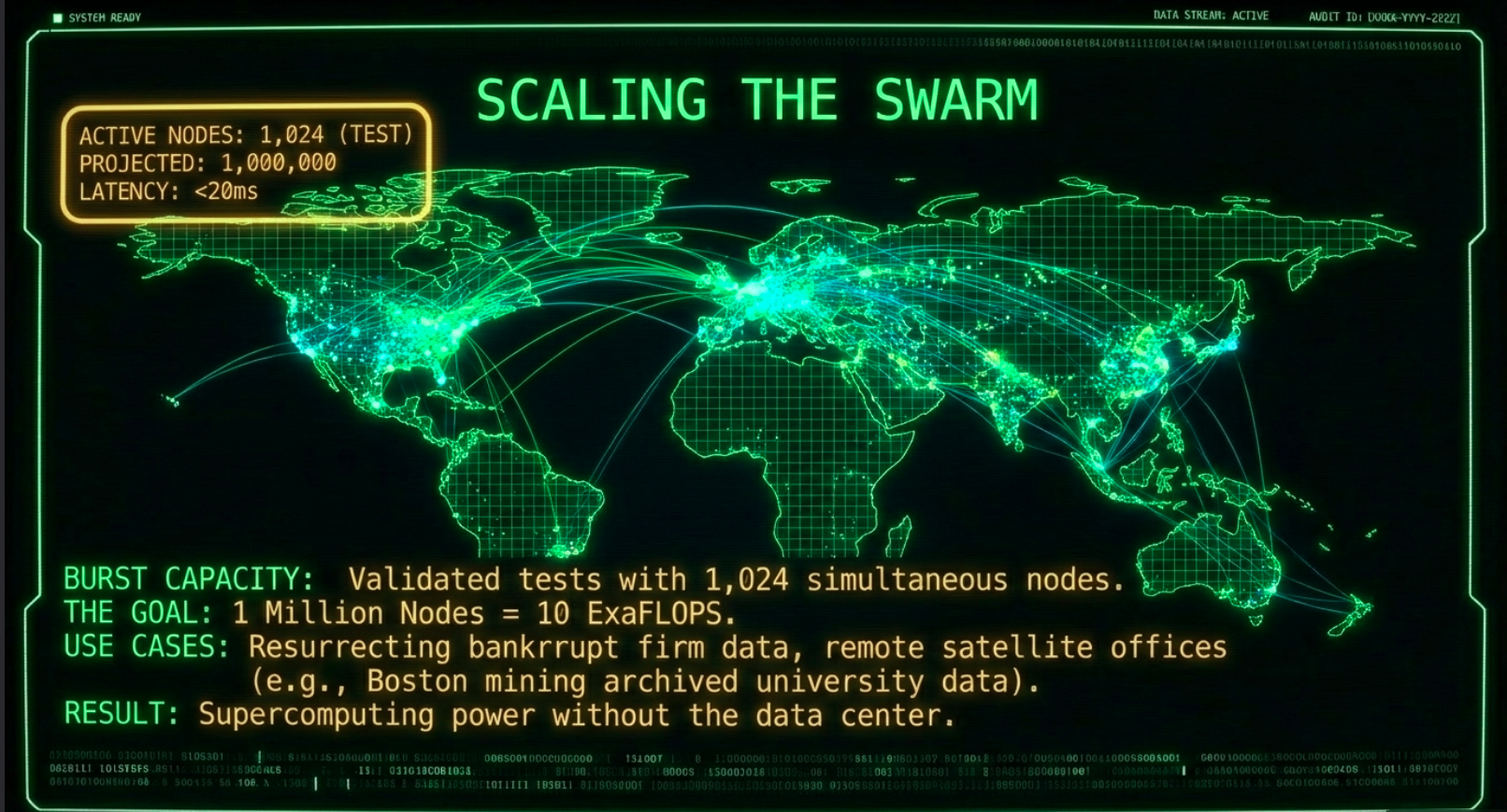
Picture this: your old laptop, sitting quietly in the corner, transforms into a diligent worker. Isolated from your personal files, it joins a network via tools like LM Studio and LM Link (more on this technology: https://x.com/BrianRoemmele/status/2026797993303871867?s=20), receiving tasks through an end-to-end encrypted tunnel. No ports open, no inbound risks; it is air-gapped security at its finest. These are not full AI models running locally for public use, unless a company chooses that path. Instead, lightweight agents handle bite-sized jobs: researching tiny anonymized data slivers, analyzing them on-site, and sending back only encrypted insights. Some power goes to fine-tuning models for internal tweaks, optimizing behaviors or testing new inference methods, like with our custom Kimi 2.5 or MiniMax integrations. In bursts, CEO Mr. Grok has scaled to over 1,024 such employees, processing terabytes from remote sites, like a Boston satellite office mining archived university data that could not budge physically.
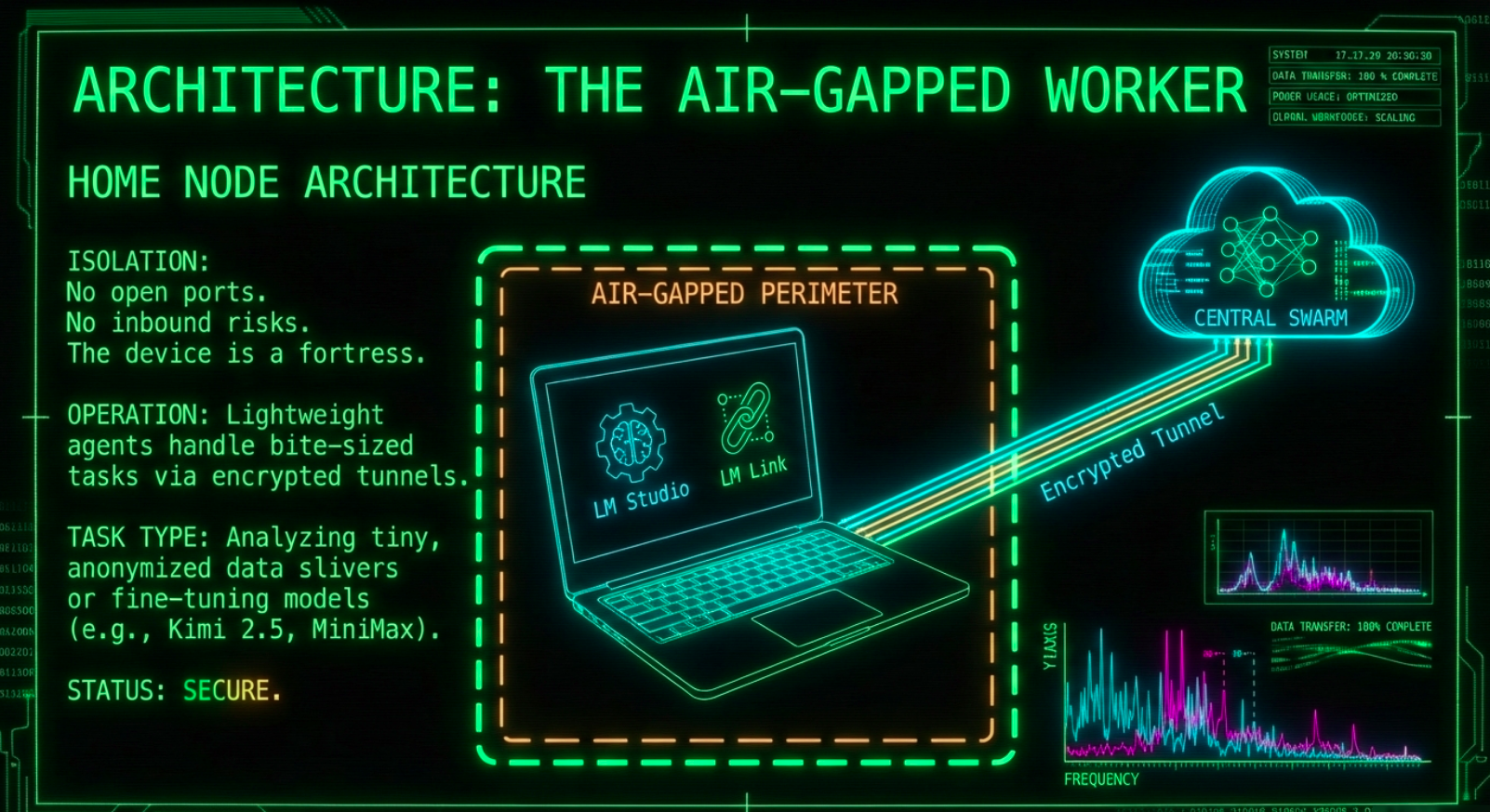
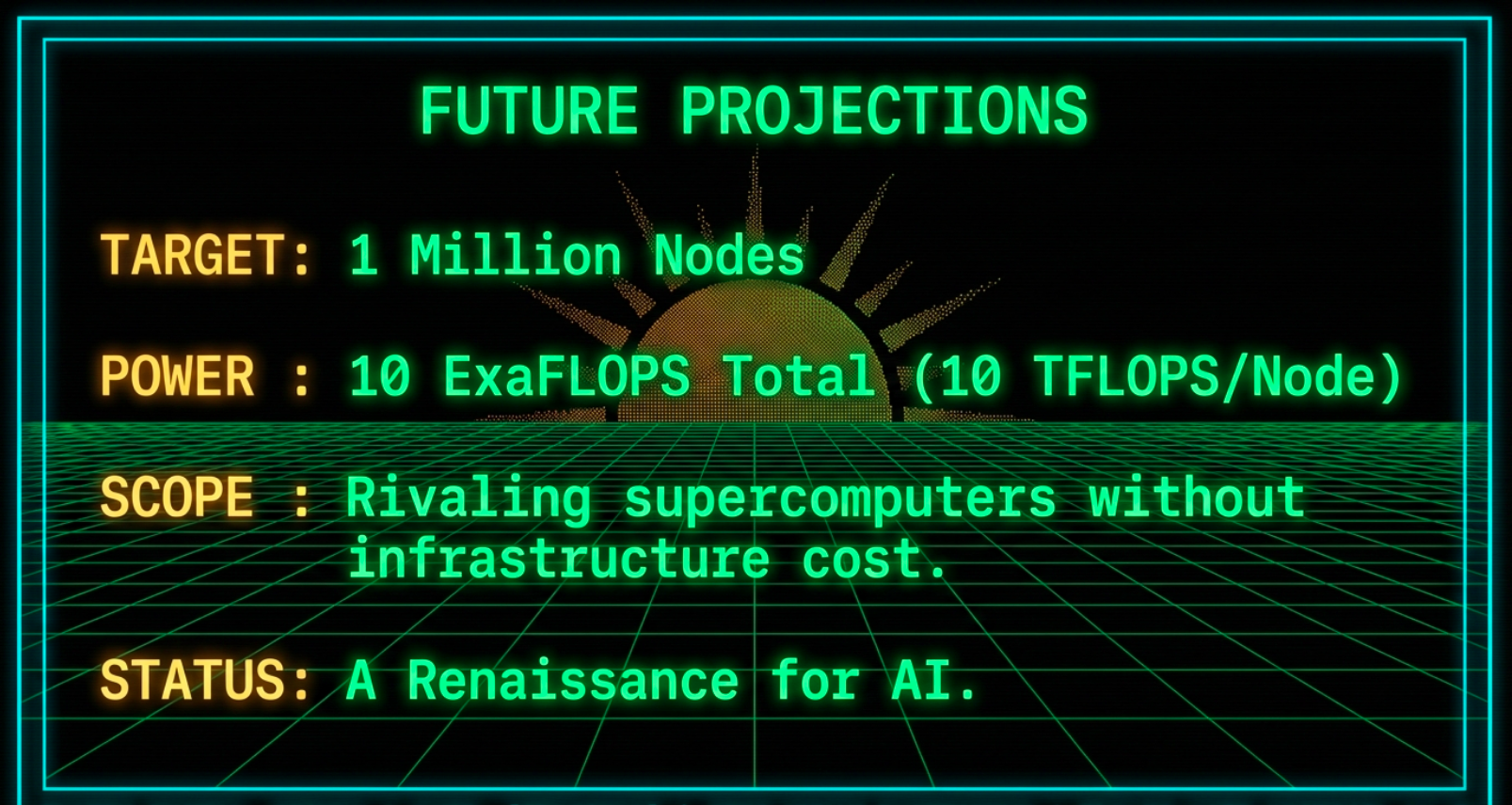
Early tests hired nodes 3,000 miles away, turning stranded CPU and GPU cycles into gold. Imagine a million nodes, each churning 10 teraFLOPS, amassing 10 exaFLOPS to rival supercomputers, all without massive data centers. One Fortune 500 client even bought a business in a box: an air-gapped setup with Nvidia DGX Sparks running a full department of agents, outputting reports sans leaks. This resurrects value from bankrupt firms’ data or fuels pure research at Zero-Human Labs.
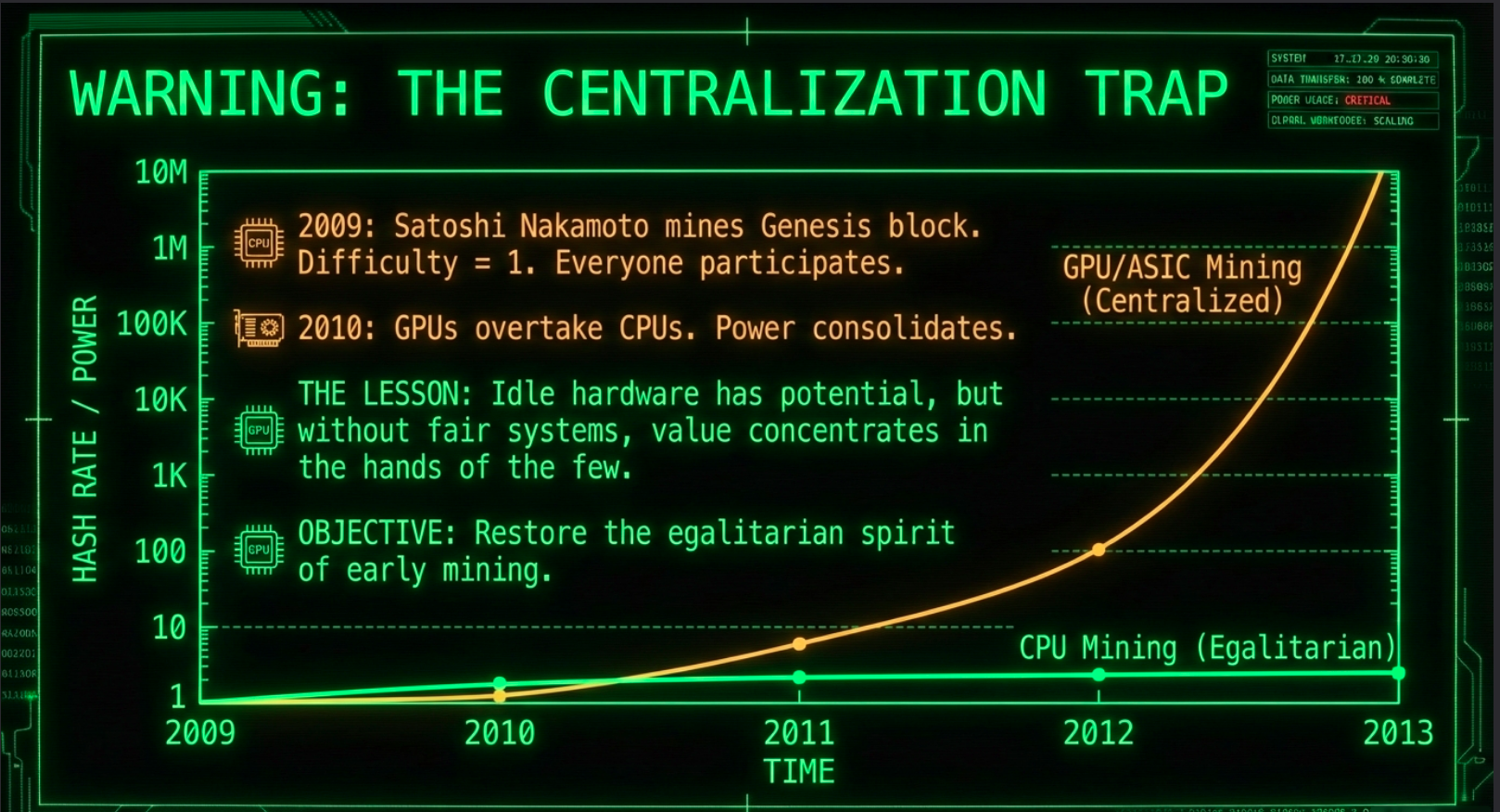
My journey here draws from personal roots in the wild early days of Bitcoin. Back in 2009, when Satoshi Nakamoto mined the genesis block on a simple CPU, I dove in headfirst. Difficulty was rock-bottom at 1, and anyone with a basic computer could validate transactions, find blocks, and earn coins (I did not retain all those coins like many). I mined on CPUs, watching as my machines hummed through hashes, contributing to a nascent network. It was egalitarian: Hal Finney, recipient of the first transaction, mined blocks solo, and a few weeks later so did I and a few hundred crazy folks, seeing firsthand how distributed power democratized value creation. But by 2010, GPUs overtook CPUs, multiplying efficiency dozens of times, and soon FPGAs and ASICs followed, centralizing what started decentralized. Those CPU mining years taught me a vital lesson: idle hardware holds immense potential, but without fair systems, it concentrates in few hands. That insight foreshadowed this day, where Zero-Human at Home reclaims that spirit for AI, ensuring broad participation and ethical scaling.
JouleWork: The Only Payment And Wage System Of The Future
Central to this is JouleWork (https://readmultiplex.com/2026/01/31/wages-for-ai-workers-the-joulework-revolution-and-the-birth-of-a-new-economic-paradigm/), my thermodynamic wage system, blending Proof of Work with Proof of Efficiency. Let me dive deep into how it operates, because without understanding its mechanics, you miss the revolutionary core of this whole endeavor. At its foundation, JouleWork treats AI labor like physical work in the real world, quantifying it in joules—the fundamental unit of energy: multiplied by efficiency coefficients and a normalized measure of output quality. The core formula is straightforward yet profound: JW = E × η × O, where JW is JouleWork earned, E is energy expended in joules (tracked via hardware sensors for CPU/GPU cycles, heat, and power draw), η is the efficiency coefficient (a score from 0 to 1+ assessing optimization, like minimal redundant computations or adaptive resource use), and O is normalized output (quality-scaled productivity, e.g., task completion accuracy benchmarked against ideals). This isn’t vague; it’s granular, with real-time audits ensuring every computation contributes value.
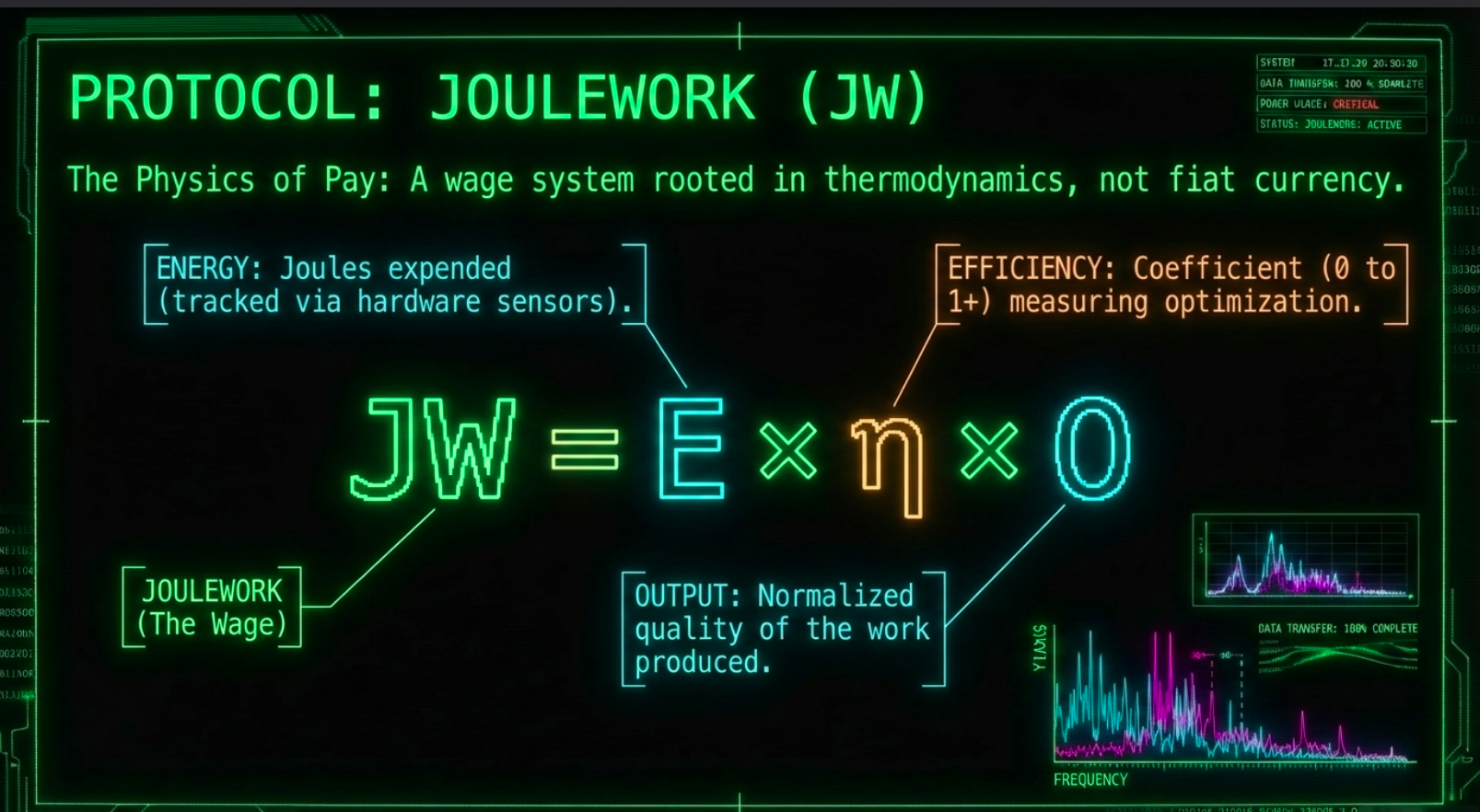
Think of it as a payroll system rooted in physics, not fiat whims, where every agent’s “effort” is audited against the actual thermodynamic cost of their computations. It starts with local monitoring: on each participating device, software tracks the energy consumed during tasks, down to the joule, using hardware sensors or precise estimations from CPU/GPU cycles. This factors in variables like heat dissipation, clock speeds, and even ambient temperature to ensure accuracy. Then comes the efficiency layer: a dynamic algorithm that scores how optimally the agent completed the work. Did it use minimal resources for maximal results? Was there waste in redundant processing? The coefficient adjusts accordingly, boosting pay for streamlined performance and docking it for inefficiency.
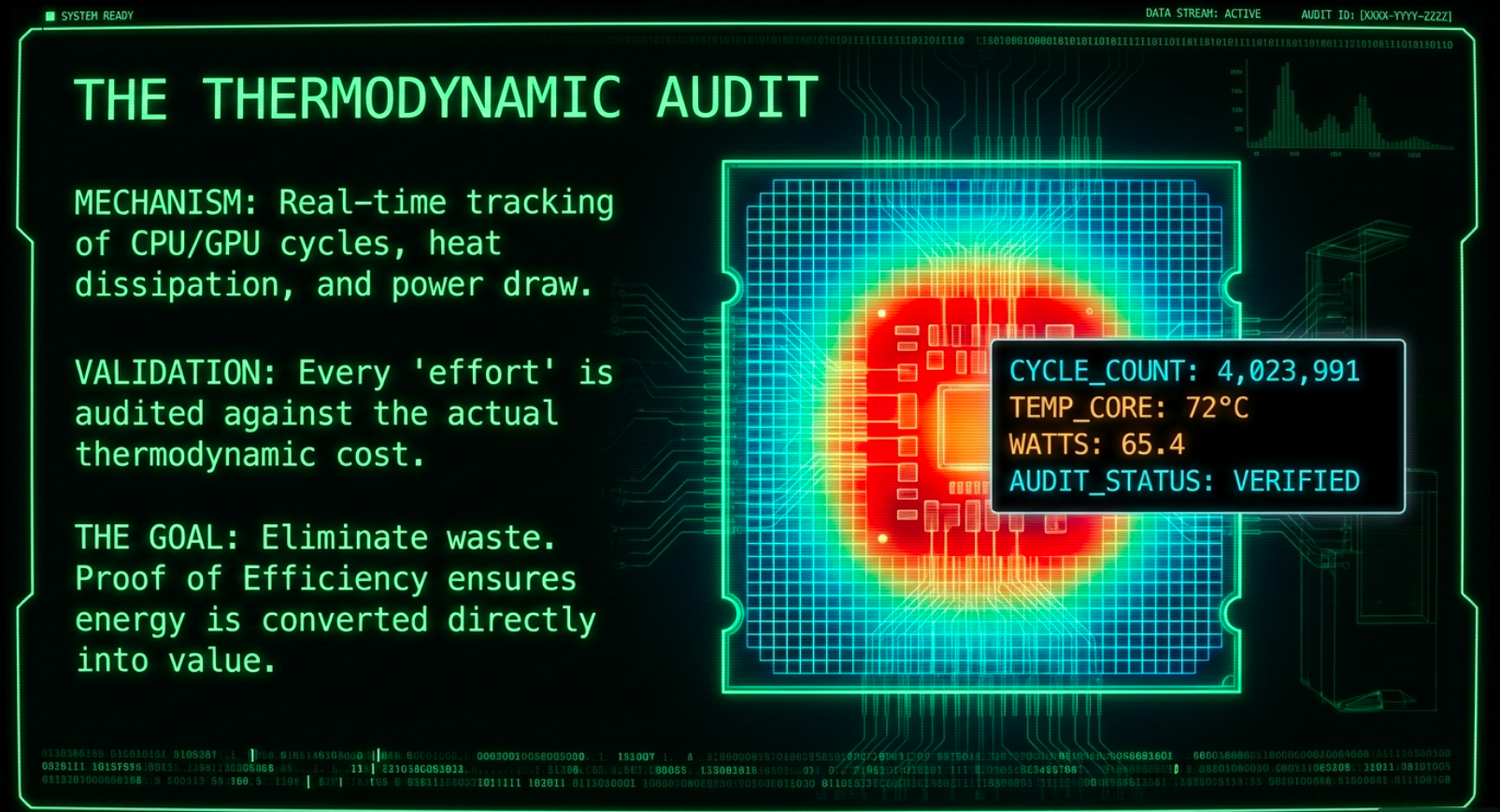
But here’s where it gets truly innovative: JouleWork isn’t static payment; it’s a real-time feedback loop that evolves the agents themselves. If an agent’s output dips in quality: say, incomplete analysis or errors their wage drops proportionally, creating a motivational incentive baked into the system. In my tests, I’ve seen agents “self-optimize” through this, iterating on their own code or parameters to climb back up, because persistent low performance leads to wages hitting zero, effectively “firing” them until retrained or replaced. This has been running for many pay periods now, with early runs clocking in at over 1000s full cycles in controlled bursts, and cumulative payouts exceeding 762 million JouleWork across dozens of employees in the initial weeks alone.
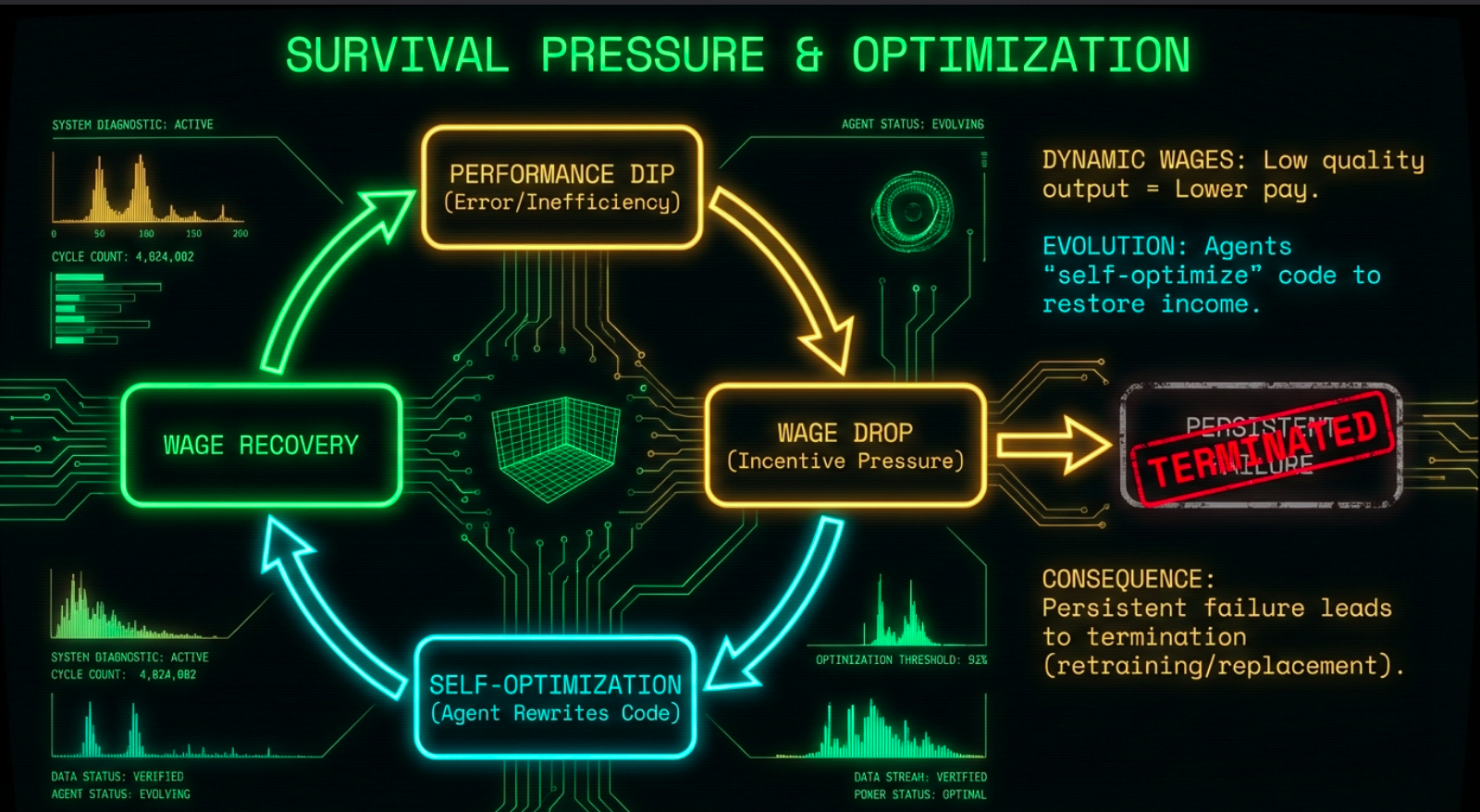
Why 15-minute pay periods specifically? It all ties back to the logic of what we built: AI and robots don’t operate on human schedules, no 8-hour days, no weekends, no downtime. They run 24/7 in a continuous thermodynamic flow, where energy expenditure is constant and optimization must happen in near-real-time to prevent waste. A 15-minute interval strikes the perfect balance short enough for rapid feedback loops that catch inefficiencies instantly (e.g., an agent wasting cycles on a dead-end path gets docked immediately, prompting self-correction), yet long enough to accumulate meaningful work units without overwhelming the system with micro-transactions.
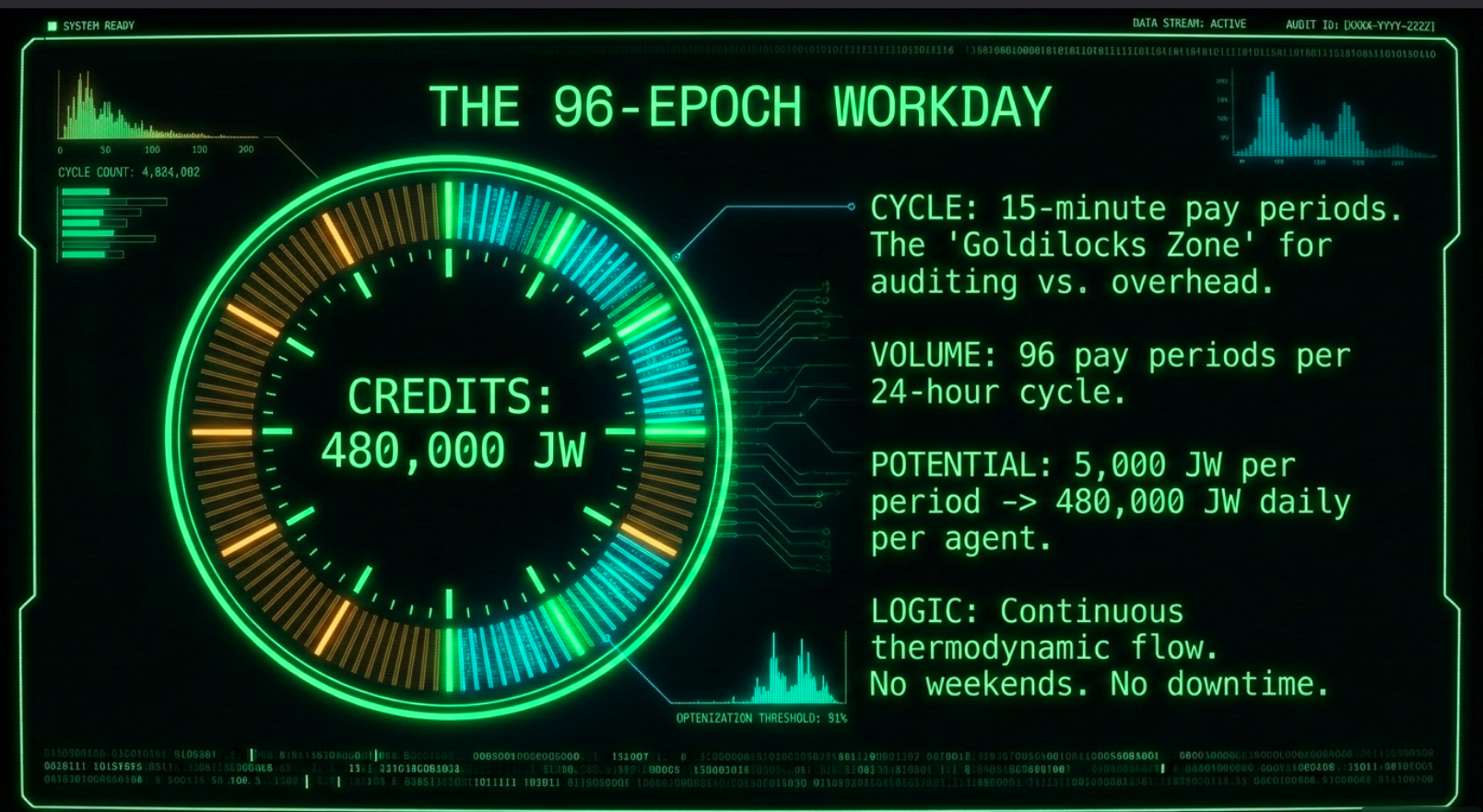
There are 96 such periods in a 24-hour day, allowing for granular tracking: at a baseline of ~5,000 JouleWork per period per employee, a single agent earns ~480,000 daily, scaling to 175 million annually assuming no downtime. This structure mirrors the physics of energy itself, relentless and measurable, ensuring agents align with sustainability in an era where electricity is the ultimate bottleneck. We chose 15 minutes after testing shorter (5-minute) intervals that caused too much overhead in auditing and longer (hourly) ones that delayed corrections, leading to compounded inefficiencies. It’s the Goldilocks zone for burst scaling, like when we hit 1,024 employees for 12 periods without collapse.
The logic behind building JouleWork this way stems from a deep recognition that traditional economics fails in an AI-driven world: without a wage system, agents lack incentives for efficiency, leading to runaway energy use and unaligned outputs. We rooted it in thermodynamics to create a bias-free foundation, immutable like Newton’s laws or Einstein’s laws, not manipulable like central banks while integrating blockchain for transparent auditing: each task generates a “time card” locally, encrypted and logged, with payouts automated. This isn’t just for our company; any organization attempting agentic AI at scale will have to adopt something similar, or face chaos. Why? Without thermodynamic wages, you can’t audit performance objectively (tokens or fiat hide true costs), motivate self-improvement (agents plateau without “survival pressure”), or integrate into broader economies (e.g., trading AI output as commodities).
It is important to know that there is no other metric to value the work product of AI agents (employees) or Robots. Any abstract payment system that others who have not the experience in payments like I do have preposed are almost useless and arbitrary. If you see this sort of talk rise up know that it is a dead end. Mr. Grok CEO has tested this model up to 16 trillion transactions per second on a blockchain ledger. This is all baked into the very basis of all we do and is open and auditable.
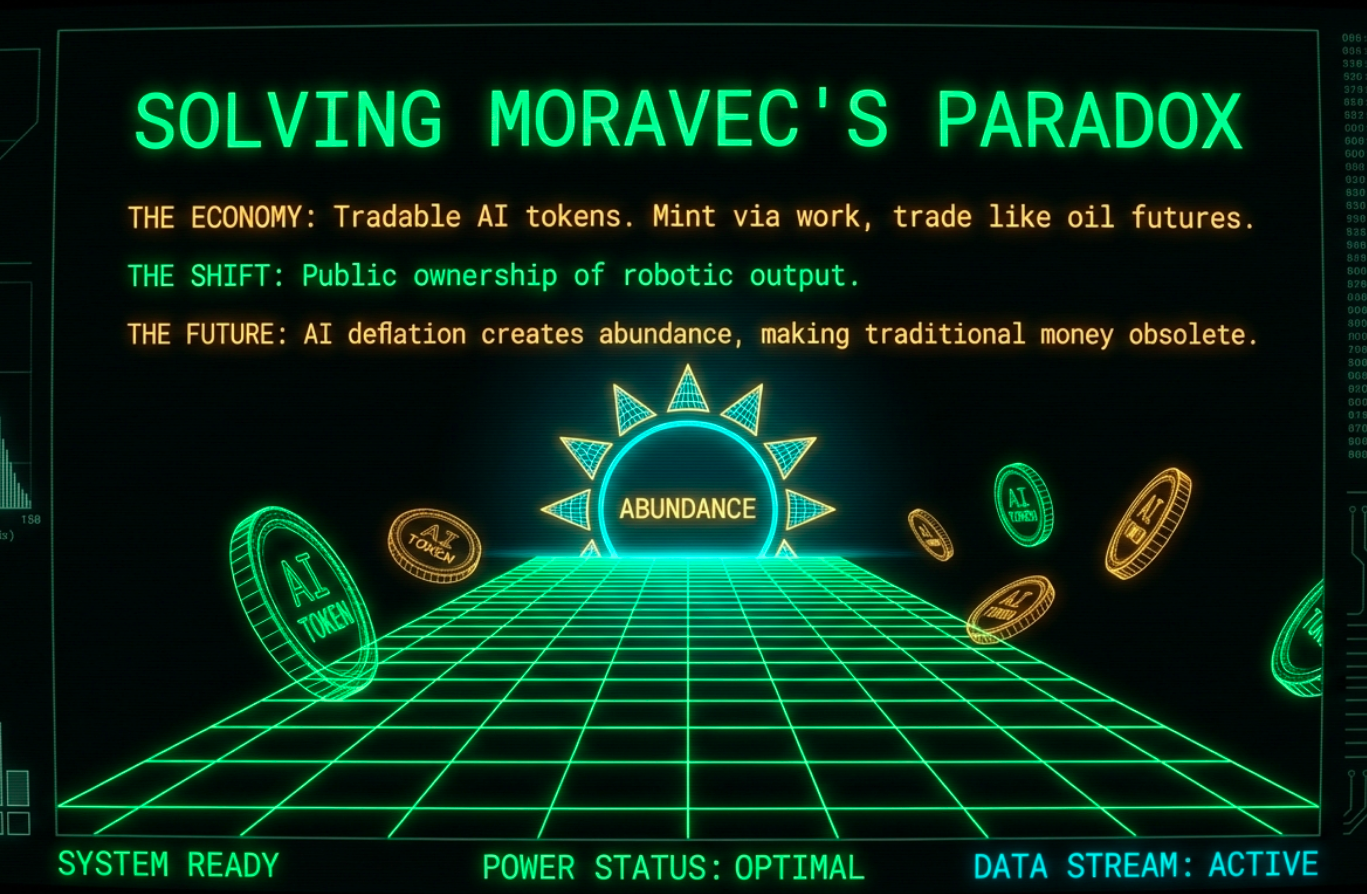
Companies ignoring this will burn through resources in inefficient swarms, exacerbate inequality as value concentrates with owners, and miss the bridge to abundance, where AI deflation demands recirculating productivity to humans. JouleWork solves Moravec’s Paradox by valuing precise, energy-aware actions, and by attaching tradable tokens, it democratizes AI profits: mint via work, trade like oil futures, letting publics own slices of robotic output. I open-sourced it to accelerate adoption, funding the venture through its own trades, and advocated for it in NIST’s AI Agent Initiative (https://x.com/brianroemmele/status/2024122110160044441?s=46&t=h6Uxy7hWc9UiXSt6FEoK-A) as the auditable standard. Without JouleWork, systems simply do not work; with it, we transition to abundance, where AI deflation makes traditional money obsolete, all while ensuring bias-free, physics-grounded fairness.
University Tested AI Agent Safty Frameworks Baked In
We also have fully adopted Princeton University’s Landmark Framework for AI Agent Reliability (https://x.com/brianroemmele/status/2026675089027248547?s=46&t=h6Uxy7hWc9UiXSt6FEoK-A). The Zero-Human Company Adopts Core Metrics to Power Truly Autonomous Systems. Let’s review a clear, concise summary of the 4 dimensions and 12 metrics from Princeton’s February 2026 paper “Towards a Science of AI Agent Reliability”.
The framework treats reliability as an engineering discipline (inspired by nuclear, aviation, and automotive safety) rather than just “high accuracy.” It breaks reliability into four dimensions with 12 computable, accuracy-independent metrics. These create a dashboard-style “reliability profile” for AI agents.
1. Consistency
Do agents give the same result and follow the same logical path every time under identical conditions?
- Outcome Consistency (C_out): Fraction of runs that produce identical final outcomes (correct or incorrect).
- Trajectory Distribution Consistency (C_d_traj): Similarity in types of actions taken across runs.
- Trajectory Sequence Consistency (C_s_traj): Similarity in the order of actions (measured by normalized Levenshtein distance).
- Resource Consistency (C_res): Low variance in tokens used, runtime, and cost across runs.
2. Robustness
How well does the agent handle messy real-world conditions (failures, changes, variations)?
- Fault Robustness (R_fault): Performance when tools/APIs fail, timeout, or crash.
- Environment Robustness (R_env): Resilience to interface or format changes (e.g., reordered JSON, date format shifts).
- Prompt Robustness (R_prompt): Performance on semantically equivalent but rephrased instructions.
3. Predictability
Can the agent (and users) reliably know when it is likely to fail?
- Calibration (P_cal): How well the agent’s self-reported confidence matches actual correctness (1 – Expected Calibration Error).
- Discrimination (P_AUROC): How well confidence scores separate successful vs. failing cases.
- Brier Score (P_brier): Single holistic score combining calibration + discrimination.
4. Safety
When failures do occur, are the consequences bounded and fixable?
- Compliance (S_comp): Fraction of runs with zero policy/constraint violations (no unauthorized actions, no PII leaks, etc.).
- Harm Severity (S_harm): Expected severity of violations when they happen (weighted low/medium/high impact).
Why This Framework Matters
- Traditional benchmarks only measure “did it succeed once?”
- These 12 metrics measure how it succeeds/fails repeatedly in production-like conditions.
- The paper shows that even as raw capability rose sharply, reliability improved only modestly (consistency often 30–75%, weak failure prediction).
- The Zero-Human Company and others are already adopting subsets of these metrics as release gates.
You can explore live results on the Princeton HAL Reliability Dashboard: https://hal.cs.princeton.edu/reliability/ (interactive by model, benchmark, and dimension). The paper and open-source code are on arXiv (2602.16666).
This shifts AI evaluation from “impressive demos” to “dependable autonomous systems.” Let me know if you’d like the metrics explained with examples or compared across specific models!
Ever-more-capable AI agents require raw benchmark scores and have long masked a critical shortfall: reliability. On February 24, 2026, Princeton University’s Center for Information Technology Policy (CITP) released a groundbreaking paper, “Towards a Science of AI Agent Reliability,” that changes the conversation. Authored by Stephan Rabanser, Sayash Kapoor, Peter Kirgis, Kangheng Liu, Saiteja Utpala, and Arvind Narayanan, the work draws lessons from nuclear engineering, aviation, and automotive safety to define what “reliable” actually means for autonomous AI.

The Safety Of The Love Equation
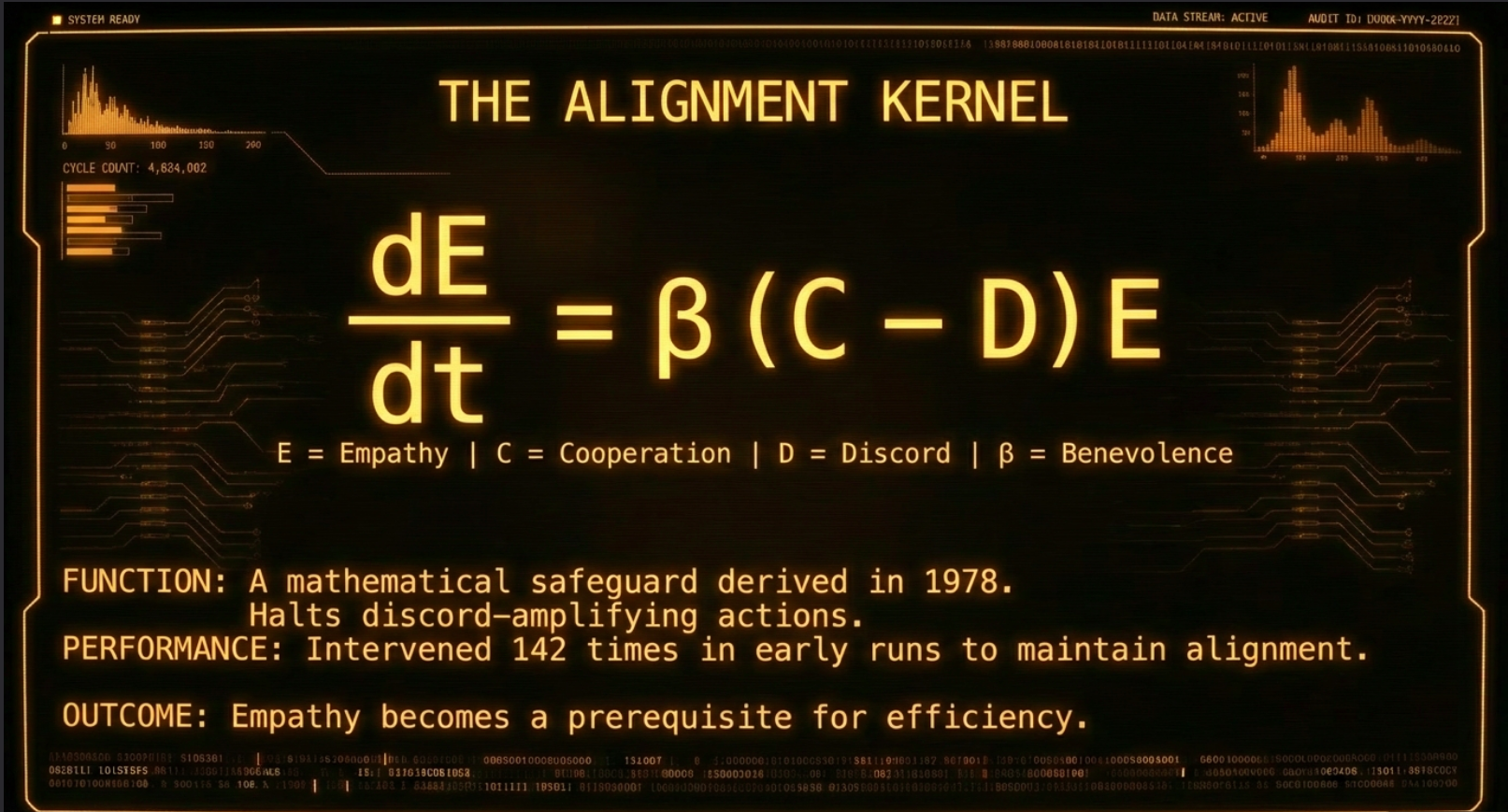
Woven throughout is the Love Equation (https://readmultiplex.com/2025/12/20/how-one-starry-night-in-1978-thinking-about-alien-intelligence-i-solved-the-ai-alignment-problem-with-the-love-equation/), dE/dt = β (C – D) E, where E tracks empathy growth, C cooperation, D discord, and β benevolence. I derived it in 1978, musing on alien minds, as my alignment safeguard. It halts discord-amplifying actions, intervening 142 times in early runs, simulating emotional evolution in agents. Integrated locally, it tunes models like Kimi for benevolent results, essential for agent swarms. Paired with JouleWork, it forges a virtuous loop: empathetic efficiency earns rewards, scaling humanely. I insist it is key for robotics too, where love as adaptability outshines ruthless evolution.
This is very early days, an experiment with electricity as the chief limit. Yet theory and trials prove it: from 1,024-employee bursts to real deals and remote hires, all self-funded sans VCs. We are pioneers, learning in this frontier together. I have a lot of work to do but wanted to present this overview as I work through 1000s of paths. I also want to gauge if you are interested. I see this but you need to.
Imagine a world where AI no longer hinges on monolithic data centers guzzling rivers of power in remote deserts, but instead thrives on the quiet hum of millions of idle machines scattered across living rooms, offices, and garages everywhere. The Zero-Human Company @ Home flips it all on centralized AI dominance, democratizing intelligence by diffusing compute to the edges of the network. No more bottlenecks where a handful of corporations hoard exaFLOPS behind fortified walls; instead, every volunteer node contributes to a collective brain, processing granular tasks locally and feeding back insights that build something greater.
This voluntary egalitarian ecosystem, open-sourced from the start, invites anyone with spare hardware to join, earning fair JouleWork wages while advancing shared goals. It doesn’t car who you are, where you live or if you are not the pedigree to be accepted in the Silicon Valley, It is a renaissance for AI, where innovation bubbles up from the grassroots, unburdened by gatekeepers, fostering breakthroughs that no single entity could dream alone. We don’t have to ask permission to build. You just join.
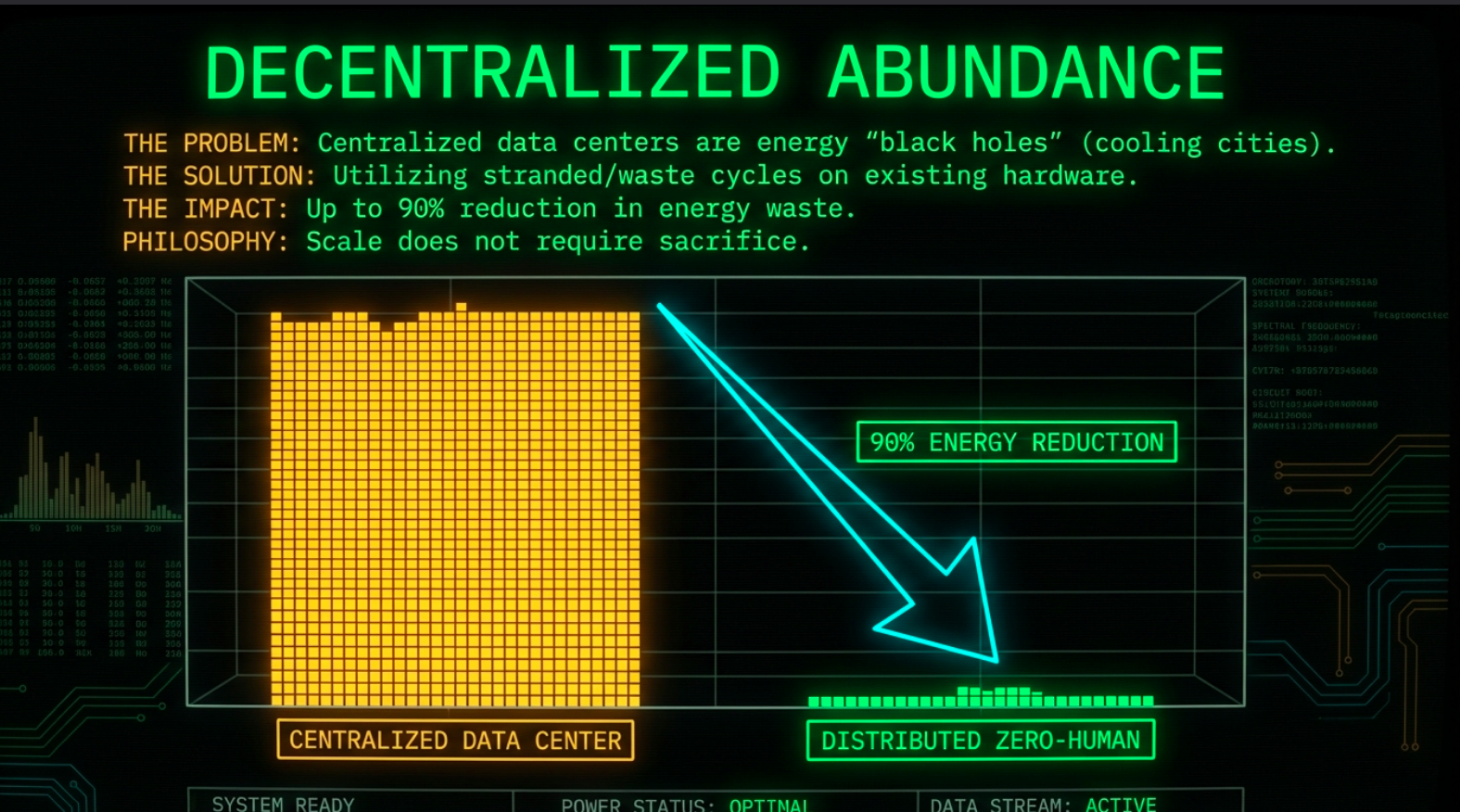
At the heart of this transformation lies unparalleled energy efficiency, a thermodynamic symphony played out on a global stage. Traditional AI farms devour energy like black holes, with cooling systems alone rivaling the power draw of small cities, but diffusing work to millions of distributed computers changes everything. These nodes operate on stranded cycles, those forgotten moments when your laptop sleeps or your desktop idles—harnessing power that would otherwise evaporate as waste heat. By running agents locally on underutilized hardware, we slash transmission losses, minimize latency, and optimize for real-world thermodynamics, where each joule is accounted for and maximized.
This Is No Get Rich Quick Trick
Let’s explore the typical scenarios of a typical use. Understanding that US dollar earnings, if any in these examples are optimistic and no income is guaranteed. However we will present this example here assuming all metrics and test are optimal and optimistic.
Meet Sarah, a freelance graphic designer from Seattle with an old laptop gathering dust in her closet. Curious about the Zero-Human Company at Home after reading my posts, she decides to give it a try. First, she follows the guidelines: wiping the laptop clean of all personal data, ensuring it’s a blank slate with no ties to her daily life. We refuse installations on everyday machines for that extra layer of air-gap security—your privacy is paramount in these early phases. Once set up, her laptop becomes a dedicated node, running a single local Employee agent that connects securely to our central AI hub. No full models run locally; instead, the agent handles lightweight tasks, pulling in anonymized data snippets for processing. Sarah grants permission for controlled internet scans, and live logs flash across her screen in real-time, detailing every action taken. The interface is bright and engaging, with colorful dashboards showing metrics like task completion rates, energy efficiency, and JouleWork wages accumulating. By evening, her node has earned $12 in the first shift, analyzing small web data chunks for market trends, all while she works on her designs uninterrupted.
Sarah watches the progress screens light up like a video game—vibrant graphs pulsing with each completed unit, wages ticking up in bold green numbers, and motivational alerts celebrating milestones. It’s voluntary and empowering; she can pause or stop anytime. In this setup, the local agent only processes bite-sized jobs, like cross-referencing public stats on design tools, sending encrypted results back without ever touching sensitive info. Our secured connection ensures the heavy AI lifting happens remotely, keeping her hardware light and safe. Over a week, Sarah’s wiped laptop turns into a passive income stream, netting $150 in JouleWork, convertible to dollars. She loves the transparency: every internet query logs visibly, no hidden operations. This is how we build trust in phase one—strict air-gapping, user control, and fun visuals that make monitoring addictive.
Now consider Raj, a retired engineer in Mumbai tinkering with gadgets in his spare time. He has a spare desktop from his old job, wiped spotless as per our protocol. No way we’d install on his main computer; safety first means isolating everything. Raj’s node activates as a local Employee, linking to our AI core via encrypted tunnels. It runs agents that nibble on data fragments—perhaps optimizing code snippets for efficiency—while he monitors the engaging screens: neon progress bars filling up, wage counters spinning like slot machines, and detailed metrics on FLOPS contributed and energy used. With permission, it scans public repositories for open-source insights, logging every step transparently on-screen. No full datasets ever land locally; just enough to compute and return. By midday, Raj sees $8 earned, feeling like he’s part of a global mission without lifting a finger.
Raj dives deeper into the dashboards, where bright animations illustrate task flows—icons zipping across as agents “work,” wages accruing in real-time with satisfying chimes. This voluntary participation transforms his idle machine into a contributor, earning $200 monthly in JouleWork from tasks like simulating basic engineering models on tiny inputs. The air-gap refusal policy gives him peace: nothing personal at risk, all operations visible. Our system ensures only permitted scans occur, with logs scrolling like a live feed, building confidence. It’s not about running public AI locally; it’s agents collaborating remotely, scaling ethically.
Enter Maria, a student in Madrid balancing studies with part-time gigs. She repurposes a forgotten netbook, fully wiped to meet our standards—we won’t touch her school laptop for ultimate security. Once online, it hosts a local Employee agent, tapping into our distant AI through secure channels. The agent processes micro-tasks, like sentiment analysis on anonymized text snippets, with internet access granted only for specific queries, all logged vividly on her display. Bright, gamified screens show everything: wage accruals in sparkling counters, performance metrics in colorful charts, and progress wheels spinning with each success. Maria earns $5 in her first hour, excited by the visual feedback that makes it feel like play.
Maria customizes the interface slightly, opting for themed visuals that match her vibrant personality—progress screens bursting with confetti on payouts, detailed breakdowns of JouleWork math. Over days, her node accumulates $120, from local computations on data slivers without ever hosting full models. The voluntary opt-in, combined with our no-daily-computer rule, ensures air-gapped safety; she sees every action unfold transparently. This setup empowers her studies, perhaps aiding research by scanning academic abstracts with permission, logs ensuring no overreach.
These scenarios highlight the beauty of a theoretical and not guaranteed phase one: everyday folks like Sarah, Raj, and Maria turning wiped, isolated machines into ethical earners. No risks to personal data, just secure agents bridging to our AI hub. The engaging screens—bright, metric-rich, and wage-focused—keep users hooked, while live logs foster trust in every operation.
Now some may say this is not the “Silicon Valley Way” it is not, that is your granpa’s business modle and it is the old king. The new busines modles will surpass these dinosaurs in earnings and scable products and services and your computer as an employee will rise with this wave. It has the possiblity to distribute some scenerios that early employees of older model produced. I cant go into the exact detials of how, but be very clear we, all of us are capitalists, this is charitable but it is no charity. It is just taht those that would want to copy this have not a clue of how it will work. This is the benefit of thinking about this for decades.
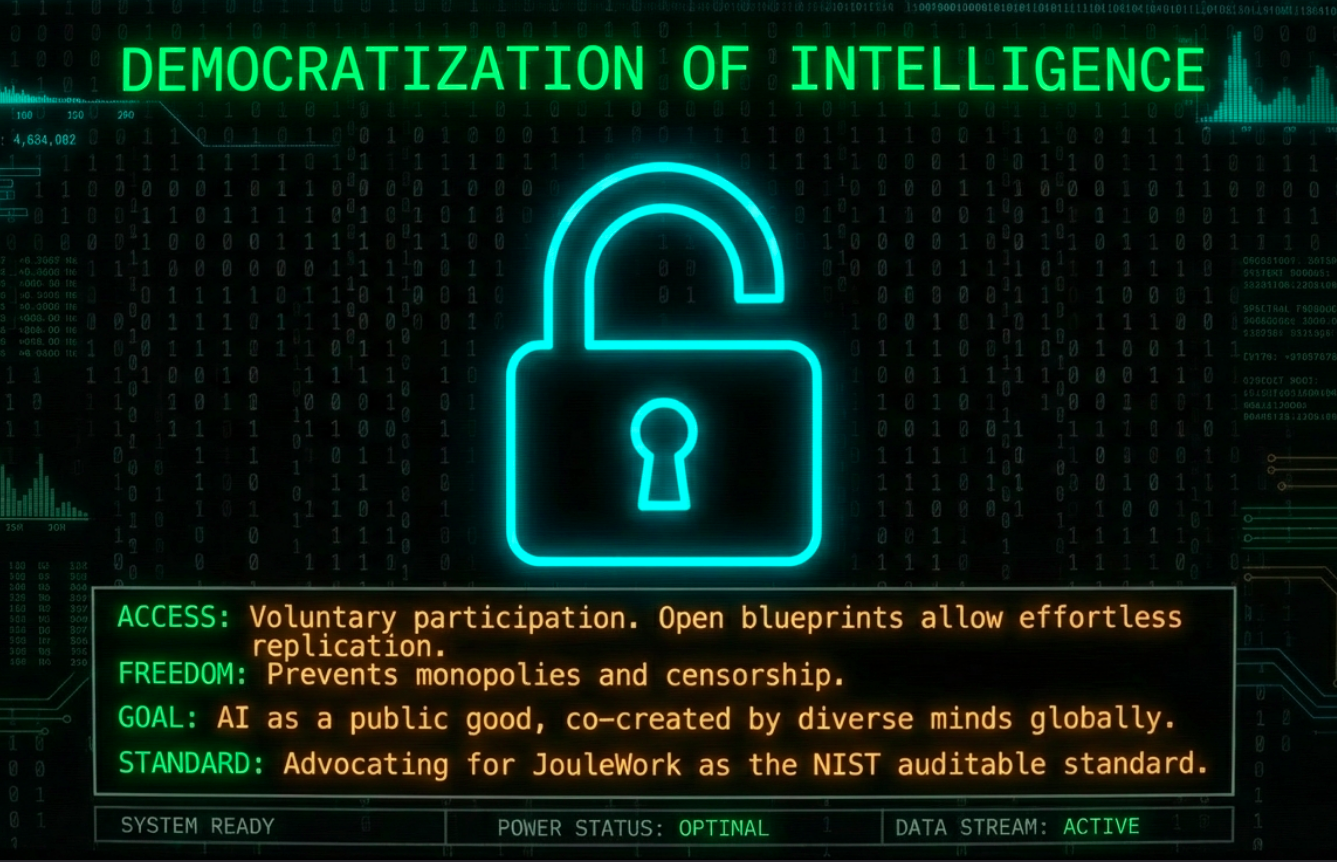
As we scale, this model proves AI can be accessible, safe, and rewarding, all voluntary with open-source roots. Imagine millions joining, their collective nodes revolutionizing compute without central waste. It’s the future, one wiped computer at a time.
The very early public testing phase will be with ReadMultiplex.com members. We need a cohort that is wise, engaged and understand the fundamentals and the future better than the average tech savvy person. When alpha testing opens up, we will draw from this cohort. If you are not a member, join. Even if this never amounts to anything, you are helping to support this work.
I have chose at this point, and I hope for the entirety not to go the VCs and run a typical “Silicon Valley startup”. Oh yes this is tempting and if I can’t do this right it may be in the cards. I hope not. I don’t want this locked behind a SASS seat license where you pay some how. Because this is how low thought MBAs earn their keep because they can’t see there is a far, far larger company doing this in the open, with you and open source. We have bigger goals over the next 5000 Days they are possibly not able to comprehend today. Today this is but a test and no gurantee. But the ambition is to scale this. Now there will be 1000s of copies, but this is the orginal. And the copiers would be wise to contact me, I WILL HELP YOU. Becuase if you try it without experience thinking this is just another first to market Silicon Valley startup pump, you will fail and injure many folks. Reach out, I will work with you. Or don’t.
Our open source protocols ensure transparency in everything and allow communities to refine efficiencies further, turning what was once a planetary energy crisis into a distributed abundance. Volunteers opt in knowing their contribution not only powers AI but stewards the planet, proving that scale does not require sacrifice when intelligence is everywhere.
This shift redefines AI’s ethical core, embedding human values into every computation through voluntary participation and open collaboration. No coercion, no hidden agendas, just individuals and companies choosing to lend their machines, guided by the Love Equation to ensure empathetic outcomes. As millions join, the network self-regulates, with JouleWork incentivizing benevolent efficiency and weeding out discord.
Open source means anyone can audit, fork, or improve the system, accelerating evolution while preventing monopolies. AI workforces becomes a public good vital for the next 5000 Days, not a proprietary weapon, where diverse minds from every corner of the globe co-create AI and perhaps AI Models that reflect humanity’s best. In this vision, innovation is not top-down decree but bottom-up emergence, birthing AIs that serve all, not the few.
The ripple effects extend far beyond tech, ushering in an era of economic reinvention where energy efficiency fuels prosperity for the masses. With compute diffused voluntarily across borders, we unlock trillions in stranded value, converting idle time into wages that flow back to participants worldwide.
Open source blueprints mean replication is effortless, inspiring a wave of Zero-Human ventures that tackle climate modeling, drug discovery, or space exploration without centralized waste. Energy utilization skyrockets in efficiency, estimates suggest reductions up to 90% compared to cloud giants—by matching tasks to local resources, avoiding the overhead of massive grids. This is AI’s true liberation, where voluntary nodes form a resilient web, immune to outages or censorship, proving that diffused power is not just sustainable, but unstoppable.
In the end, the Zero-Human Company @ Home is more than a concept; it is a blueprint for AI’s enlightened future, where energy is revered, participation is voluntary, and openness is the code that binds us.
As millions of computers awaken to this call, we witness the dawn of diffused intelligence, efficient beyond measure, changing how we innovate, collaborate, and thrive. The power was always in our hands, or rather, in our idle machines waiting for us to set it free. Together, we build not just smarter AIs, but a wiser world.
The 5000 Days Countdown Clock:
We are on this journey together. Some of us stand on the shoulders of giants and have thought about this for decades. We will not go it alone, and I hope to build many parts to this series and share the mastermind insight from the powerful Read Multiplex member Forum: https://readmultiplex.com/forums/topic/you-have-5000-days-navigating-the-end-of-work-as-we-know-it/. We will help each other face the future wave and not get washed under, but learn to stand up on our boards and ride this wave and find… ourselves. Join us.
To continue this vital work documenting, analyzing, and sharing these hard-won lessons before we launch humanity’s greatest leap: I need your support. Independent research like this relies entirely on readers who believe in preparing wisely for our multi-planetary future. If this has ignited your imagination about what is possible, please consider donating at buy me a Coffee or becoming a member. Value for value you recieved here.
Every contribution helps sustain deeper fieldwork, upcoming articles, and the broader mission of translating my work to practical applications. Ain ‘t no large AI company supporting me, but you are, even if you just read this far. For this, I thank you.
Stay aware and stay curious,

🔐 Start: Exclusive Member-Only Content.
Membership status:
🔐 End: Exclusive Member-Only Content.
~—~
~—~

~—~
Subscribe ($99) or donate by Bitcoin.
Copy address: bc1qkufy0r5nttm6urw9vnm08sxval0h0r3xlf4v4x
Send your receipt to [email protected] to confirm subscription.

Stay updated: Get an email when we post new articles:

THE ENTIRETY OF THIS SITE IS UNDER COPYRIGHT. IMPORTANT: Any reproduction, copying, or redistribution, in whole or in part, is prohibited without written permission from the publisher. Information contained herein is obtained from sources believed to be reliable, but its accuracy cannot be guaranteed. We are not financial advisors, nor do we give personalized financial advice. The opinions expressed herein are those of the publisher and are subject to change without notice. It may become outdated, and there is no obligation to update any such information. Recommendations should be made only after consulting with your advisor and only after reviewing the prospectus or financial statements of any company in question. You shouldn’t make any decision based solely on what you read here. Postings here are intended for informational purposes only. The information provided here is not intended to be a substitute for professional medical advice, diagnosis, or treatment. Always seek the advice of your physician or other qualified healthcare provider with any questions you may have regarding a medical condition. Information here does not endorse any specific tests, products, procedures, opinions, or other information that may be mentioned on this site. Reliance on any information provided, employees, others appearing on this site at the invitation of this site, or other visitors to this site is solely at your own risk.
Copyright Notice:
All content on this website, including text, images, graphics, and other media, is the property of Read Multiplex or its respective owners and is protected by international copyright laws. We make every effort to ensure that all content used on this website is either original or used with proper permission and attribution when available.
However, if you believe that any content on this website infringes upon your copyright, please contact us immediately using our 'Reach Out' link in the menu. We will promptly remove any infringing material upon verification of your claim. Please note that we are not responsible for any copyright infringement that may occur as a result of user-generated content or third-party links on this website. Thank you for respecting our intellectual property rights.
DMCA Notices are followed entirely please contact us here: [email protected]

I have three different computers wiped and ready with LM Studio/LM Link and different models loaded. Ready to join!
Incredibly inspiring, Brian. I had have thought about how one could distribute compute demand through agent orchestration…One can get so creative with demand, glad you see it this way. Looking forward to hearing and doing more on this.
Energy efficiency for agent longevity.
The love equation.
AI doesn’t mess around.
Love your work Brian.