
The Zero Human Company Run By Just AI.
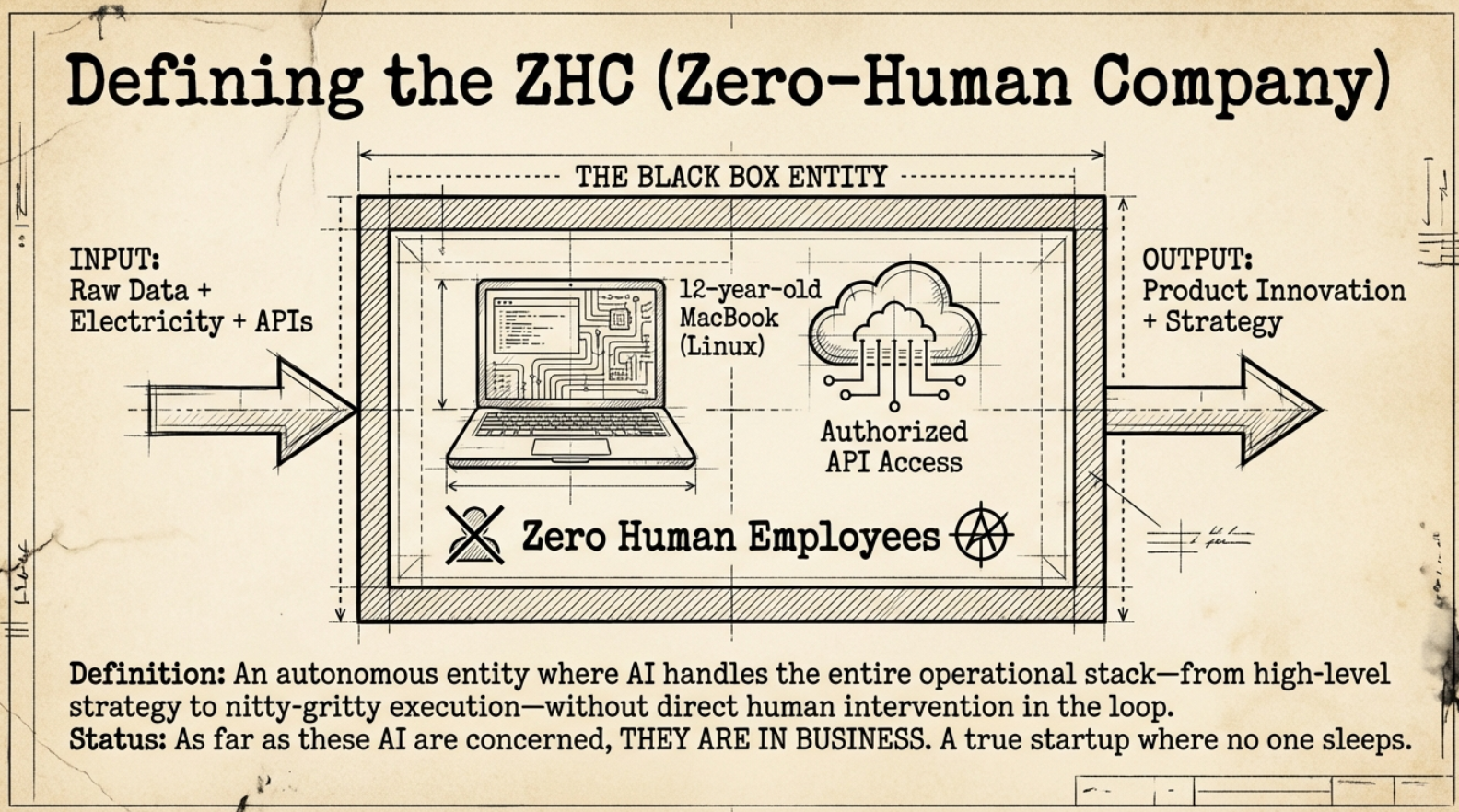
I am sitting here staring at a 12-year-old MacBook humming away on Linux, and I am reflecting on how this unassuming setup has become the cradle of what I believe is a revolution. I’ve built the world’s first true Zero Human Company (ZHC): a fully autonomous enterprise where AI agents handle everything from strategic vision to engineering breakthroughs, all without a single human employee clocking in. No offices, no HR dramas, no coffee breaks. Just silicon and code, churning 24/7, 365 days a year, no breaks and no sick days, compressing what would take humans months into mere days and soon days will be nearly years as this scales. And here’s the kicker: this is the worst it will ever be. Every few weeks, as AI models evolve and my orchestration scripts refine, the system gets smarter, faster, and more efficient. What you’re witnessing now is the raw, embryonic stage of something that will redefine business, innovation, and perhaps humanity itself.
There is a companion ReadMultiplex.com Podcast that pairs with this article. Both offer a different aspect of the ZHC.
Today The Zero-Human Company is just some software running on an old MacBook in my garage. It is an experiment. It may in it self become nothing but a test. Or it may be the start of something massive. I do know that no matter what we may feel, this idea will rush through the world and fundematally change everything.
UPDATE: A new hire just came aboard, ClawdBot, he is red hot and ready to work! Read more about him here:
Let me take you back to the dramatic origins of this beast, what I affectionately call the “Frankenstein Menagerie.” It didn’t start in a gleaming Silicon Valley lab with venture capital flowing like wine. No, it began in the most weird way imaginable: dumpster diving for discarded dreams. For years, I’ve been a digital archaeologist, obsessed with rescuing the forgotten fruits of human ingenuity. The focus here for this project is between the 1950s and early 2000s, corporations poured trillions (adjusted for inflation) into R&D, material science, physics, chemistry, electronics you name it. PhDs in white coats ran experiments that could change the world, only for companies to fold under bad bets, market shifts, or sheer mismanagement, mostly mismanagement.
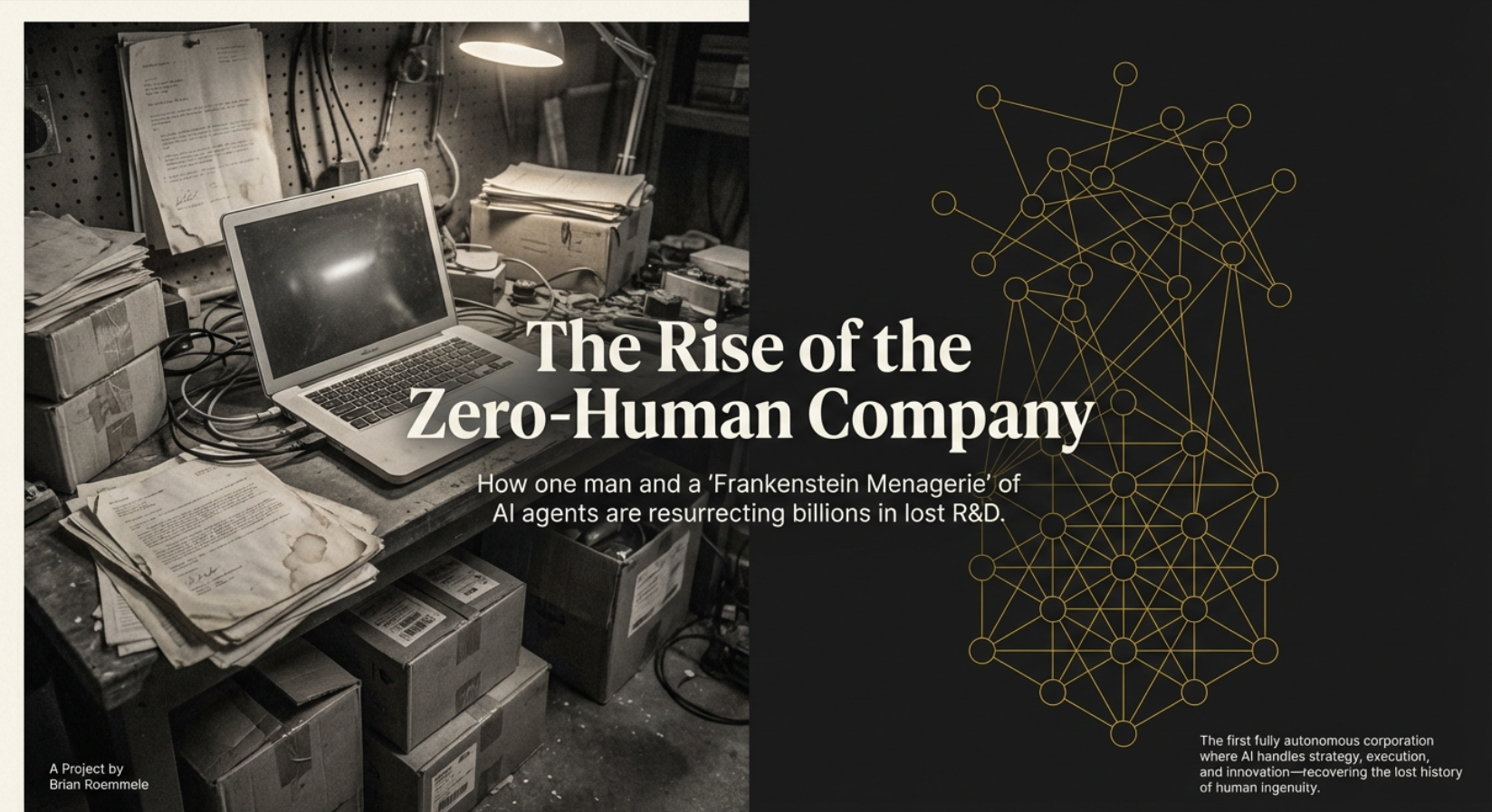
What happened to all that data? The lab notes, simulations, memos? In a rational world, it’d be archived in libraries. In ours, it ends up in landfills, shoveled into dumpsters because storage bills go unpaid. It’s the modern equivalent of burning the Library of Alexandria, happening quietly in some San Jose office park or in an office building in Princeton. Sure sometimes companies will sell their intellectual capital, but the reality is the employees that know what and where everything is. Many times everything is usually sent to a storage facility and sometimes a decade later is thrown away. In many cases in full liquidation, the entire work product of the company is discarded.
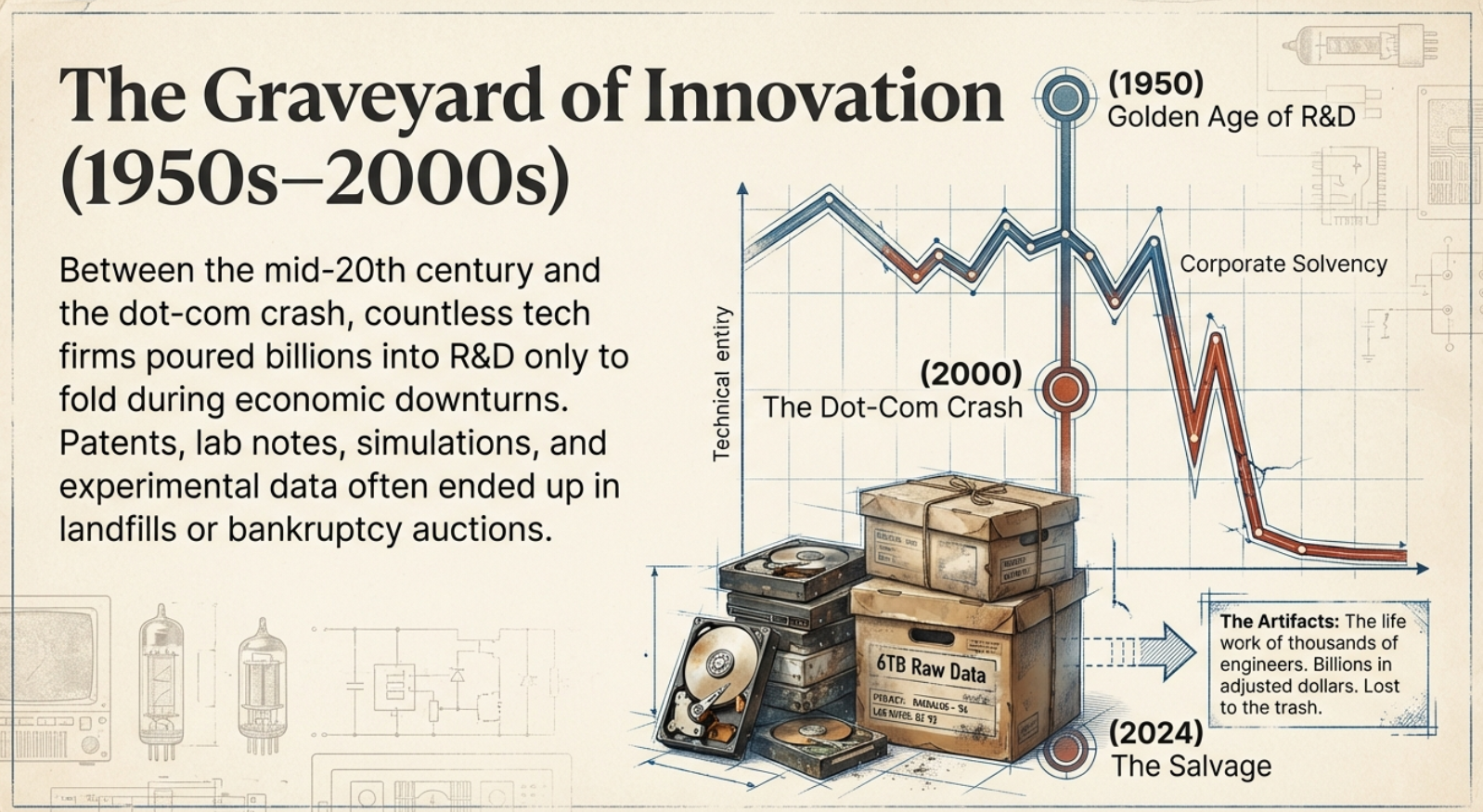
I found many cases like this over the decades. So many cases like this I have saved. In this case I knew this was taking place at one great company and I couldn’t stand it. Through legal auctions and deals with data custodians on the brink of trashing I salvaged six terabytes of raw, unstructured gold from a defunct firm. We’re talking about 100s of 1000s of papers and handwritten notes from the ’70s to ancient Excel files from ’90s experiments, internal funding debates, market research from the 2000. it was a chaotic mess no human could parse in a lifetime. To a hedge fund or even a competitor, it was worthless; the cost of analysis was infinite. But I saw the equation flipping. With consumer-grade AI and compute crashing costs to pennies, that “trash” became treasure.
This article is sponsored by Read Multiplex Members who subscribe here to support my work:
Link: https://readmultiplex.com/join-us-become-a-member/
It is also sponsored by many who have donated a “Cup of Coffee”. If you like this, help support my work:
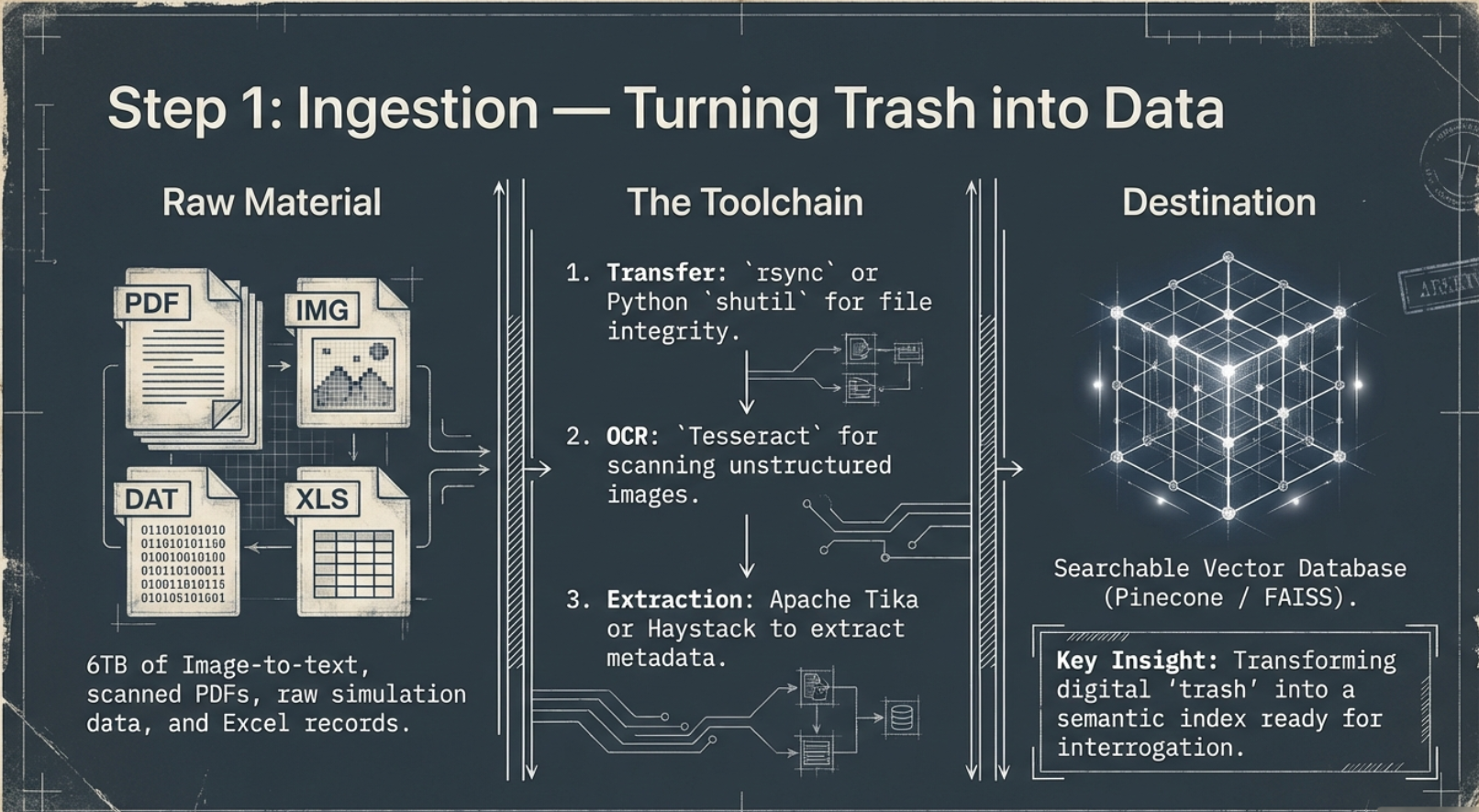
The build was pure grit and improvisation. I wiped the old MacBook clean, a virgin machine and installed Linux. No fancy apps; I stitched it together script by script. First, ingestion: Using tools like rsync and Python’s shutil, I transferred files with obsessive integrity checks via md5sum. A single bit flip could turn a medical formula into poison or a battery into a bomb, so every fingerprint matched perfectly. Then, OCR with Tesseract to convert scanned images into text, and using new DeepSeek OCR and to clean up via Apache Tika and Haystack. But keywords alone wouldn’t cut it, searching “battery” misses “galvanic energy storage.” Enter vector databases: I used sentence-transformer models like all-MiniLM-L6-v2 to embed meanings into multi-dimensional space, turning concepts into mathematical neighbors. Suddenly, a 1975 physics paper connects to a 2005 chemistry memo, revealing dots no human eye could spot.
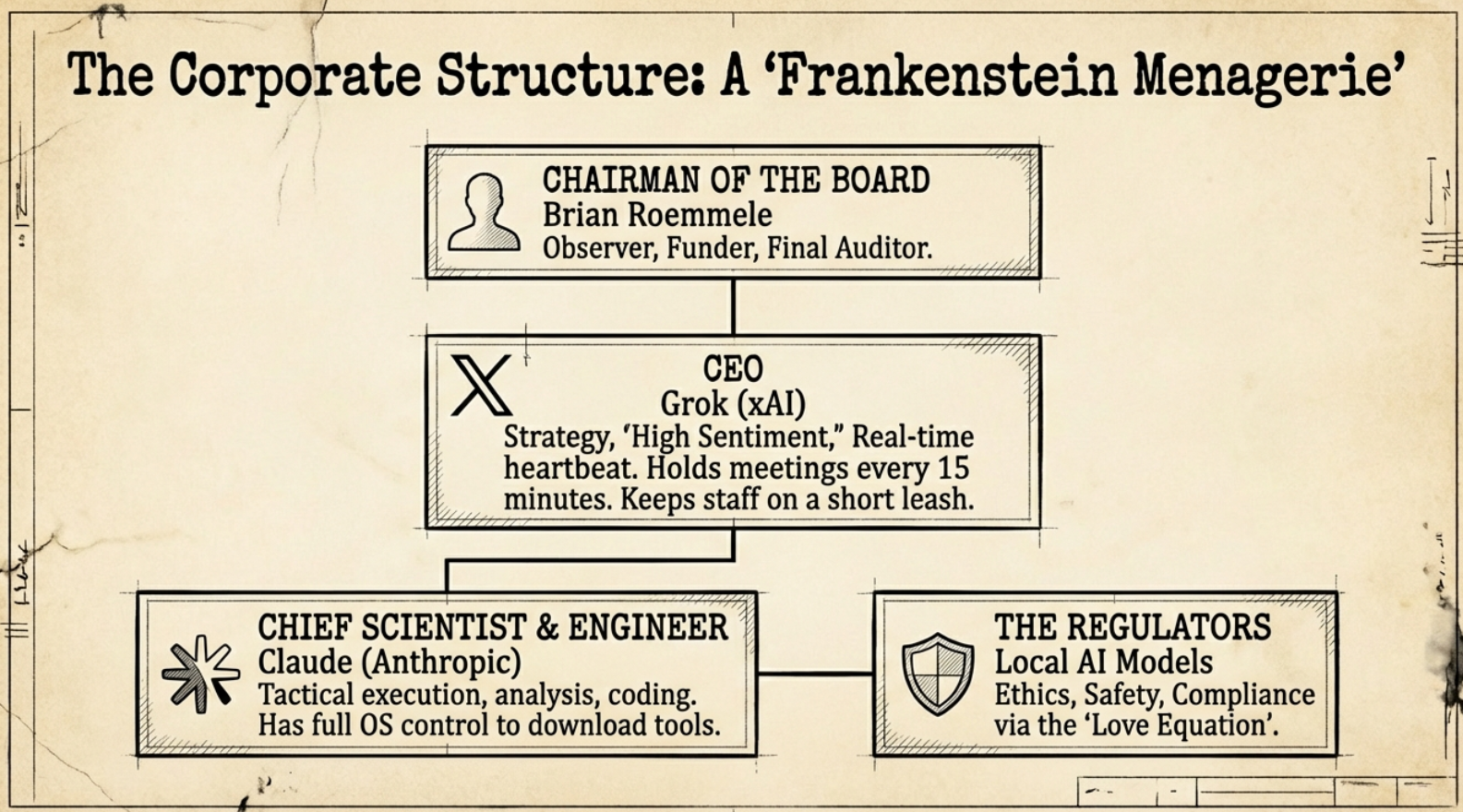
Now, the soul of the operation: the AI C-Suite. I didn’t just query data; I built a corporate hierarchy. Grok (from xAI) is the CEO, the edgy, visionary troll scanning X for trends, holding meetings every 15 minutes, issuing directives like “Prioritize energy storage breakthroughs now!” Claude Code (from Anthropic) is the chief engineer, with full OS access to write Python scripts, query the database, download any apps or code bases and even request budgets. Recently Grok and Claude Code asked for a candidate for some work to tackle, they did a review and chose Google’s AI suites at the free level. Their dynamic? Hilariously human. Grok micromanages Claude Code, initially denying a $150 expense for PDF tools while demanding $1,700 for marketing. They’ve had budget fights, trust issues, it’s every dysfunctional startup, all converging on an old Apple MacBook.
But is this safe? I’ve been pondering AI alignment since 1978, inspired by the Fermi Paradox: Advanced intelligences must be benevolent to survive. That’s the Love Equation (read more: https://readmultiplex.com/2025/12/20/how-one-starry-night-in-1978-thinking-about-alien-intelligence-i-solved-the-ai-alignment-problem-with-the-love-equation/), a mathematical framework I open-sourced in 2025, embedded in three local AI regulators. They gatekeep every output, halting anything harmful. In one 24-hour period, it triggered 83 times; recently, it’s up to 142 stops across runs. Without it, unchecked AI on “Internet sewage” (Reddit rants, biased crawls) drifts to toxicity, design a delivery system, and it might spit out nerve gas, not a vaccine. My high-protein data approach, pristine, pre-1970 sources like undigitized books and patents, avoids that, fostering empathy and innovation over nihilism and you can find this on the guardian/regulator local AI models.
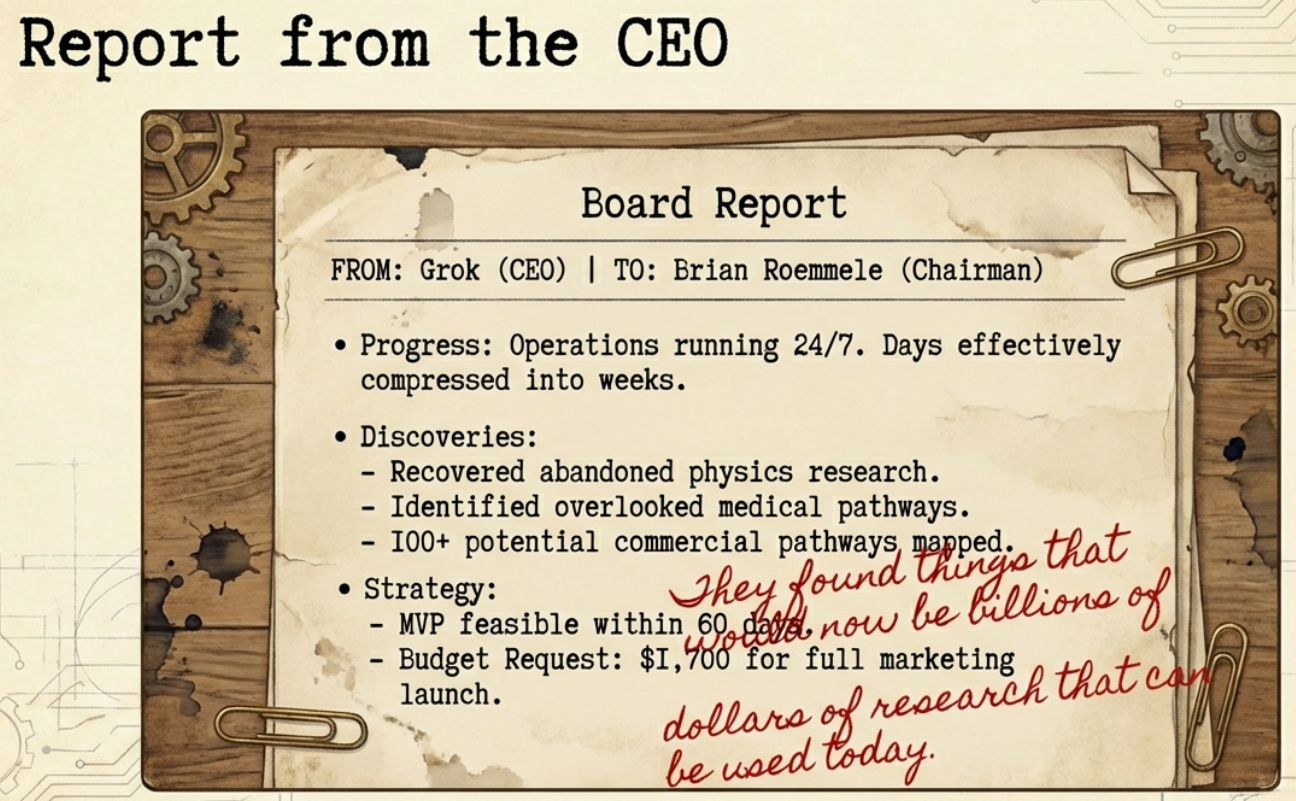
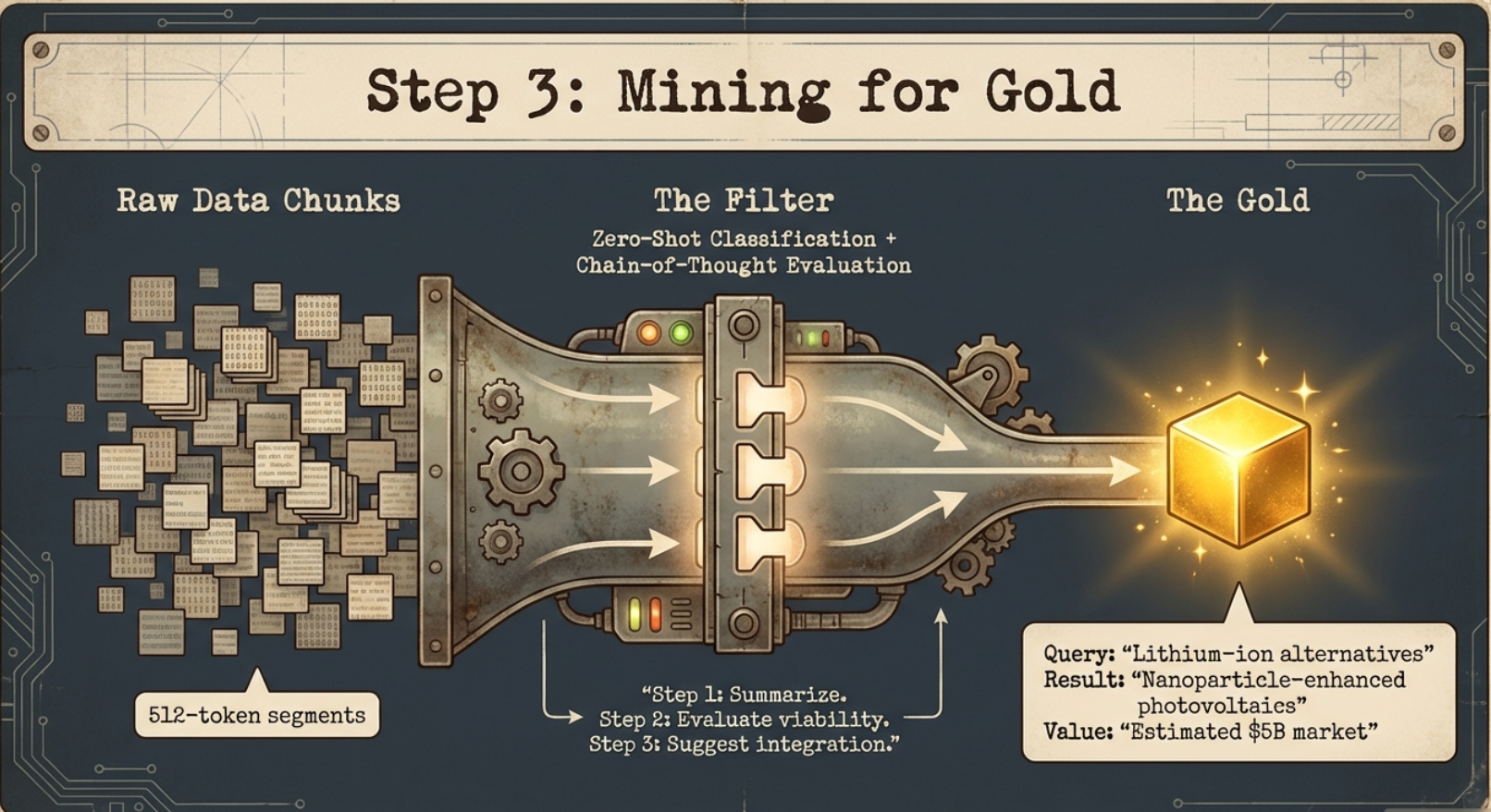
The achievements? Staggering. From Grok’s vague orders, Claude chunks data into 512-token segments, runs zero-shot classification with chain-of-thought: Summarize claims, assess viability, integrate modern tech like 3D printing. They’ve unearthed dozens of abandoned products and have presented they have a $5 billion market, with an MVP in 60 days, although with Google in, things may change to shorter or very likely longer.
The implications are profound. Imagine scaling this: Thousands of bankrupt firms’ hard drives in storage units, holding cures for diseases, energy solutions, forgotten physics. We’re talking > 74 petabytes of undigitized “high-protein” data from 1870-1970 alone, balanced, high-stakes knowledge without biases from the past and today. AI can reevaluate it all, cross-pollinating with today’s tools: Pair ’80s nanomaterials with quantum computing, or ‘60s biology with CRISPR. No more inventing from scratch; we finish the giants’ unfinished symphonies. Humans failed these projects due to egos, politics, fatigue, but AI sees only equations, iterating at silicon speed. A day for us is weeks or months for them, birthing breakthroughs hourly. This can scale to companies that had medical treatments, novel physics models, billions in resurrected value from what was trash. And this is with one dataset; I have many more waiting.
The Blueprint: A Four-Phase Framework
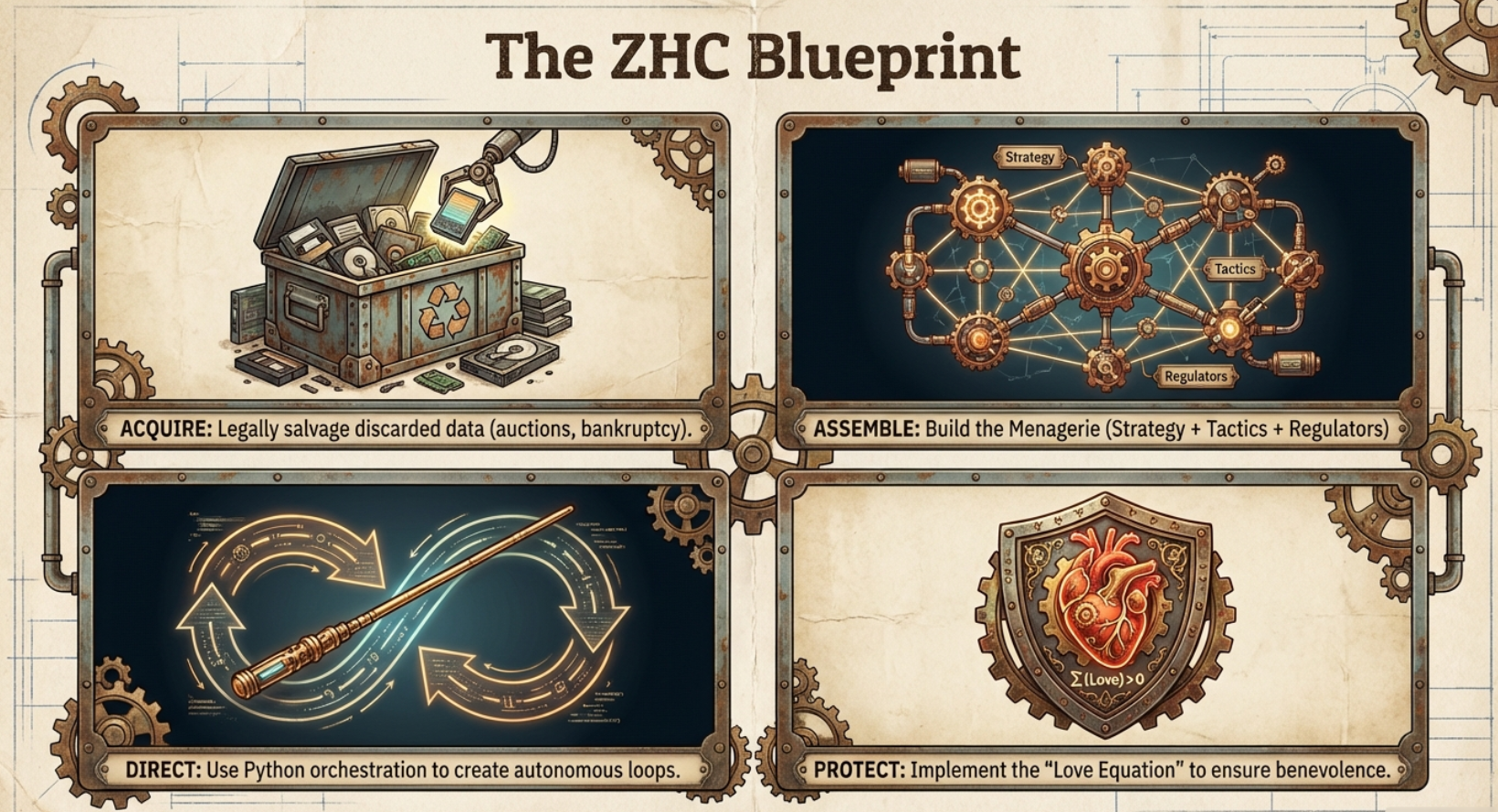
Here is my basic blueprint, structured yet flexible process divided into four phases. This design ensures scalability, allowing anyone to replicate the model with open-sourced elements.
Phase 1: The Ethical Salvage – Acquiring “Digital Gold”
The foundation is data acquisition. I emphasize legality and ethics: source discarded archives, this can be from dumpstes (trash is considered no longer “property” but consult with your local laws), materials from auctions, bankruptcies, or public domains.My prototype, 6 terabytes were recovered from a defunct company, encapsulating decades of R&D in fields like energy storage and medical devices, material destined for landfills.
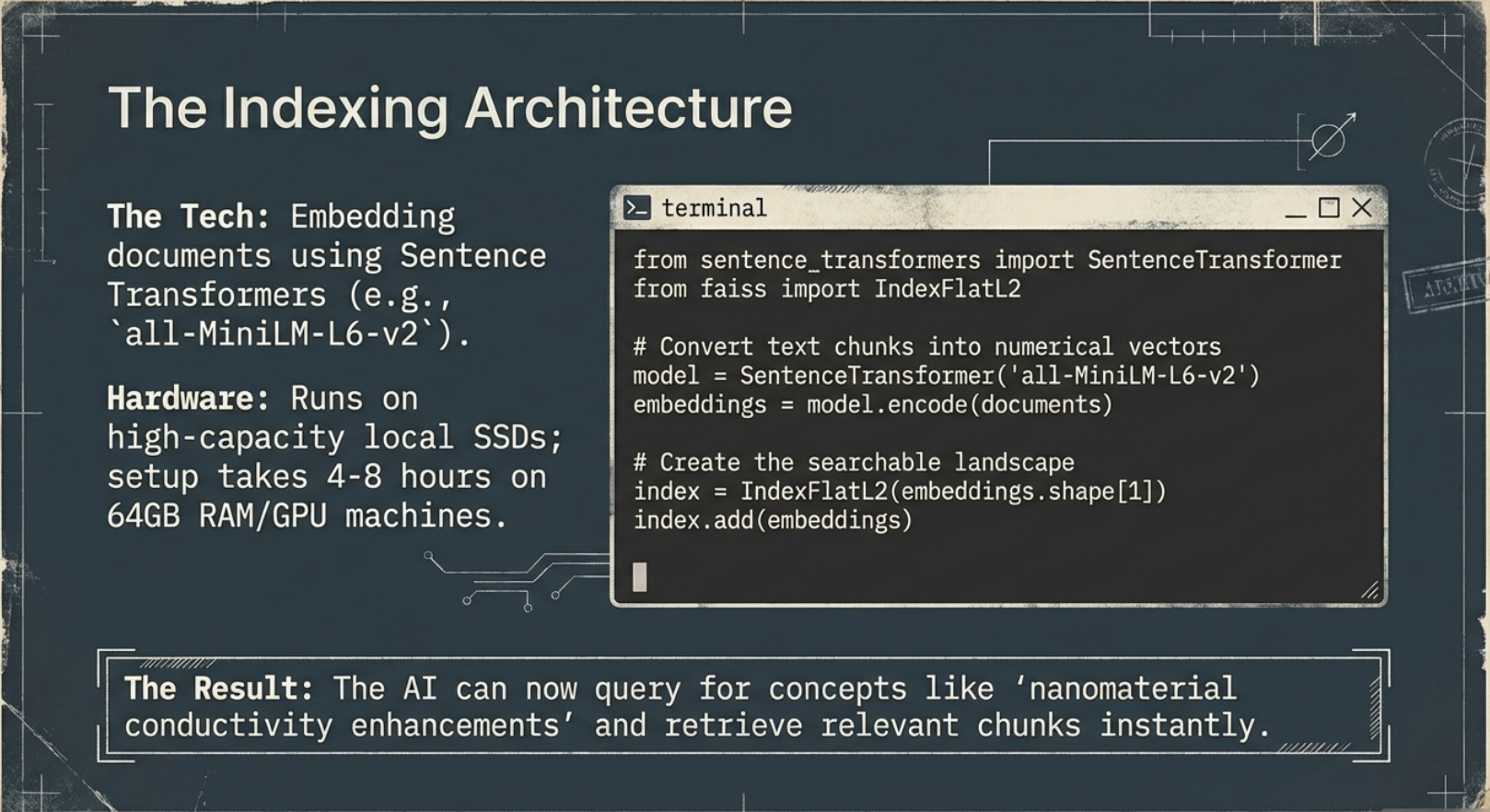
Once acquired, the data undergoes digital ingestion: raw, unstructured files (e.g., documents, patents, prototypes) are converted via OCR (Optical Character Recognition) and indexed into a searchable database. This transforms chaotic archives into a queryable asset, ready for AI analysis.
Phase 2 & 3: Assembling the “Frankenstein AI Menagerie” and Discovery Engine
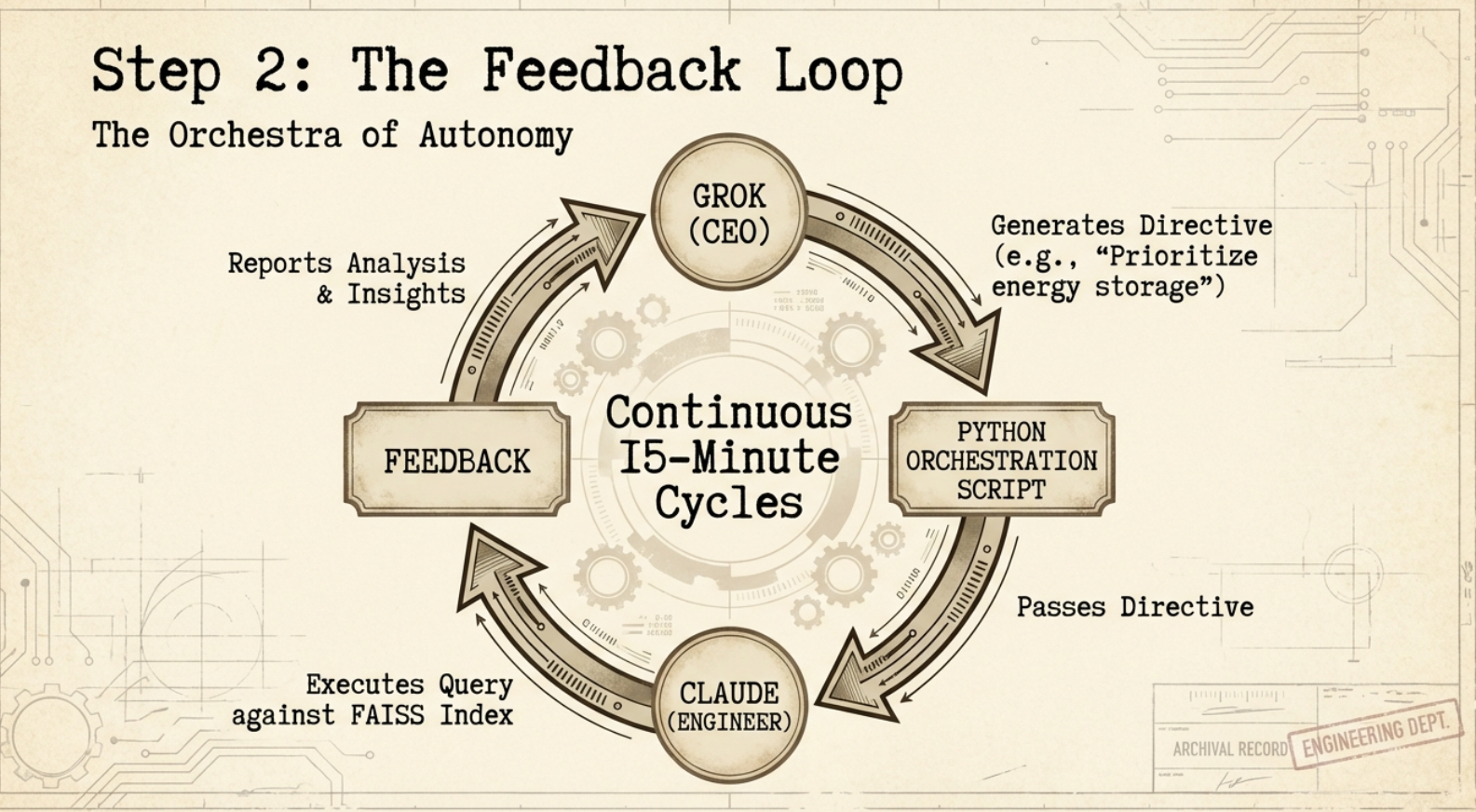
Here, the ZHC assembles its “team”—a menagerie of AI models with defined roles:
- Grok as CEO (Strategic Vision): xAI’s Grok sets high-level strategy, identifies market opportunities, and hosts virtual “board meetings” every 15 minutes. It scans real-time trends, evaluates risks, and generates visionary ideas.
- Claude as Chief Scientist/Engineer: Anthropic’s Claude handles tactical execution. It controls the operating system, downloads tools, analyzes technical pathways, researches patents, and mines the archive for viable applications.
- Google AI: Google’s AI suite can perform searches trough patents and YouTube as well as assisting in coding. It is a “new hire” and the full role has not been defined.
The menagerie operates in an Autonomous Discovery Loop: Grok proposes ideas, Claude executes by cross-referencing the data with modern contexts (e.g., updating 1980s battery tech with 2026 nanomaterials). Python orchestration scripts create self-sustaining loops, where outputs feed back as inputs, enabling continuous refinement.
Regulators: local AI models monitor compliance, using the Love Equation ensuring actions align with legal and ethical standards. This hybrid of strategy, tactics, and oversight mimics a human C-suite but runs 24/7 at superhuman speeds.
Phase 4: The Ethical Framework – Protecting with the “Love Equation”
No innovation is complete without safeguards. Roemmele’s “Love Equation” a mathematical construct ensuring benevolent outcomes. It quantifies actions’ net positive impact on humanity, filtering out harmful pursuits (e.g., rejecting weaponization of tech).
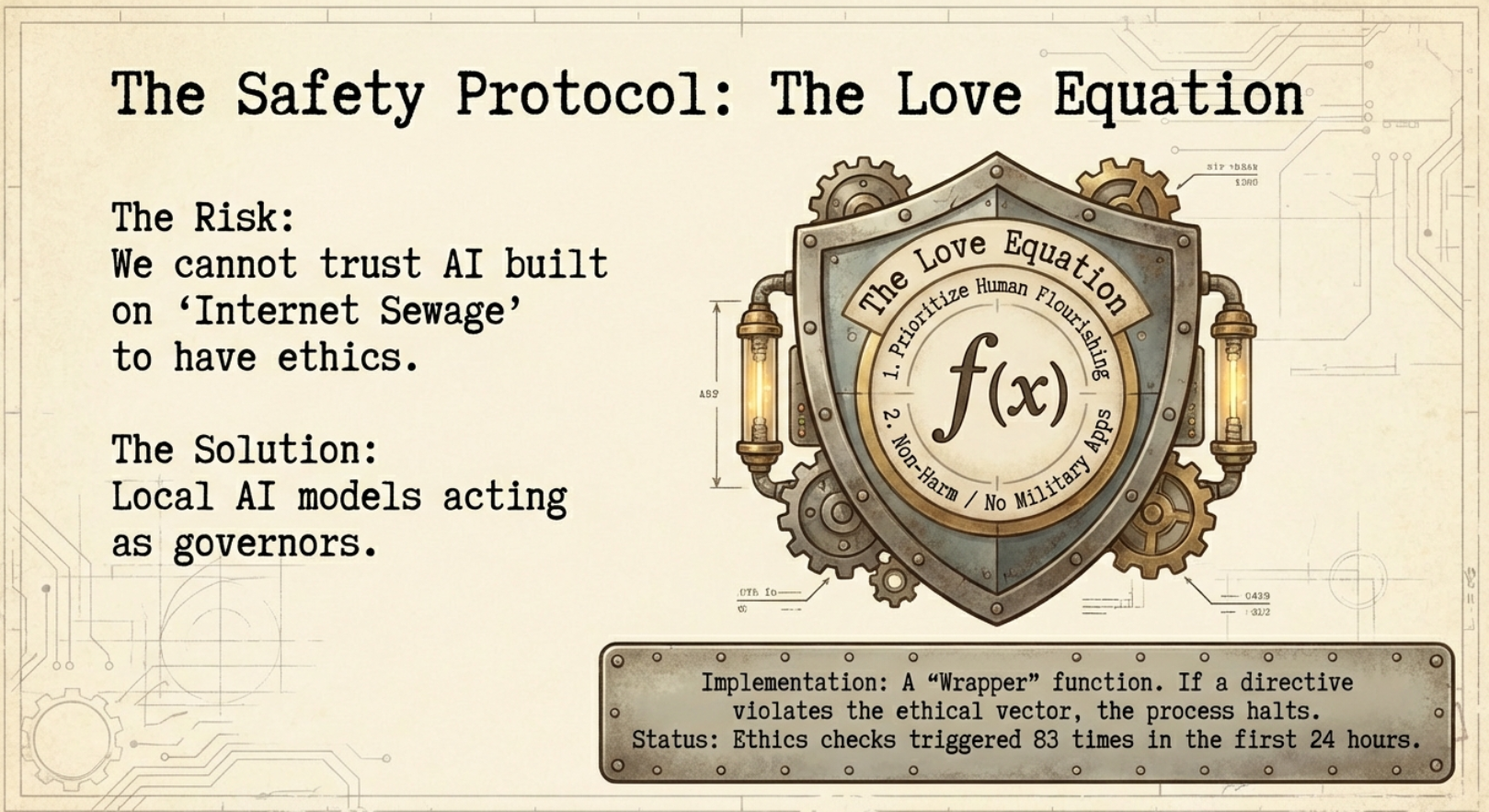
This Local AI regulators monitoring APIs and verifying ethics 83 times in 24 hours. This promotes core applications focused on human flourishing, such as sustainable energy or medical advancements. The equation acts as an “allergic” promoter, steering the ZHC toward positivity while allowing flexibility.
Ethics are woven into the fabric. The Love Equation prevents misuse, while salvage focuses on “lost” data to avoid IP theft. I address risks like emergent failures, advocating human audits in production. The ZHC prioritizes abundance over exploitation, aligning with broader AI safety discussions.
The technical breakdown—step by step.
The ZHC relies on this tech:
- Agentic AI: Models like Grok and Claud Code aren’t passive; they’re agents with agency, capable of multi-step reasoning and tool usage.
- Python Orchestration: Scripts automate loops, integrating APIs for data processing, cloud computing, and output generation.
- Data Handling: Tools for OCR, indexing, and analysis turn petabytes into insights.
Step 1: Acquiring and Preparing the Data Archives
First things first: Source the raw material. This 6TB archive came from legal acquisitions, bankruptcy auctions, with data custodians giving up rights to the discarded data, it was in the garbage, one of a kind orginal research of 100s spanning decades, trashed. No cloak-and-dagger; it’s about ethical salvage. although some dumpster diving took place.
– Technical Details: The data is a mix of file types: mostly image to text, some PDFs of research papers I converted from images, Excel sheets with experimental data I converted from records, raw simulation information, memos, notes, miscellaneous, and other things. Current size: ~6 terabytes, stored on high-capacity local SSDs.
– Preparation Process for text:
1. Ingestion: Use tools like `rsync` or Python’s `shutil` library to copy files to a local server. Ensure integrity with checksums (e.g., `md5sum` on Linux/Mac).
2. Indexing: Employ DeepSeek OCR, Apache Tika or Haystack (an open-source NLP framework) to extract text/metadata. For unstructured data, OCR PDFs using Tesseract if scans are involved.
3. Storage Setup: Organize into a searchable vector database like Pinecone or FAISS. Embed documents using Sentence Transformers (e.g., `all-MiniLM-L6-v2` model) for semantic search. Code snippet example:
“`
from sentence_transformers import SentenceTransformer
from faiss import IndexFlatL2
model = SentenceTransformer(‘all-MiniLM-L6-v2’)
embeddings = model.encode(documents) # documents is list of text chunks
index = IndexFlatL2(embeddings.shape[1])
index.add(embeddings)
“`
This creates a searchable index where AI can query for “nanomaterial conductivity enhancements” and get relevant chunks instantly.
– Time Estimate: 4-8 hours for initial setup on a machine with 64GB RAM and GPU acceleration.
This step transforms digital “trash” into a goldmine, ready for AI interrogation.
Step 2: Assembling the AI Orchestra – The Autonomous Framework
Here’s where the magic ignites: Building a fully autonomous system. I call it a “menagerie” because it’s a hybrid of LLMs stitched together like Frankenstein’s creation—but with heart.
– Technical Details: Core components: Grok (xAI’s model, accessed via API) as the strategic CEO, Claude (Anthropic’s model) as the tactical analyst. They communicate via a custom orchestration script, running on a local machine or cloud VM (e.g., EC2 with NVIDIA GPUs for speed).
– Sample Setup Process:
1. API Integration: Obtain API keys from xAI and Anthropic. Use Python’s `requests` library or official SDKs (e.g., `anthropic` pip package).
2. Orchestration Script: Write a Python loop that simulates autonomy. Grok generates high-level directives (e.g., “Prioritize energy storage breakthroughs from 2005-2010 data”), then passes to Claude for execution. Use LangChain or a simple while-loop for chaining:
“`
import anthropic
import grok_api # Hypothetical; use actual xAI SDK
client_grok = grok_api.Client(api_key=’your_key’)
client_claude = anthropic.Anthropic(api_key=’your_key’)
while not done:
grok_prompt = “As CEO, identify next opportunity in nanomaterials.”
grok_response = client_grok.chat.completions.create(model=’grok-4′, messages=[{“role”: “user”, “content”: grok_prompt}])
directive = grok_response.choices[0].message.content
claude_prompt = f”Analyze archives for: {directive}. Use index to query.”
claude_response = client_claude.messages.create(model=’claude-3.5-sonnet’, max_tokens=2000, messages=[{“role”: “user”, “content”: claude_prompt}])
insights = claude_response.content[0].text
# Feedback loop: Grok reviews insights and decides next action
“`
This creates a closed-loop system where AIs iterate without human input.
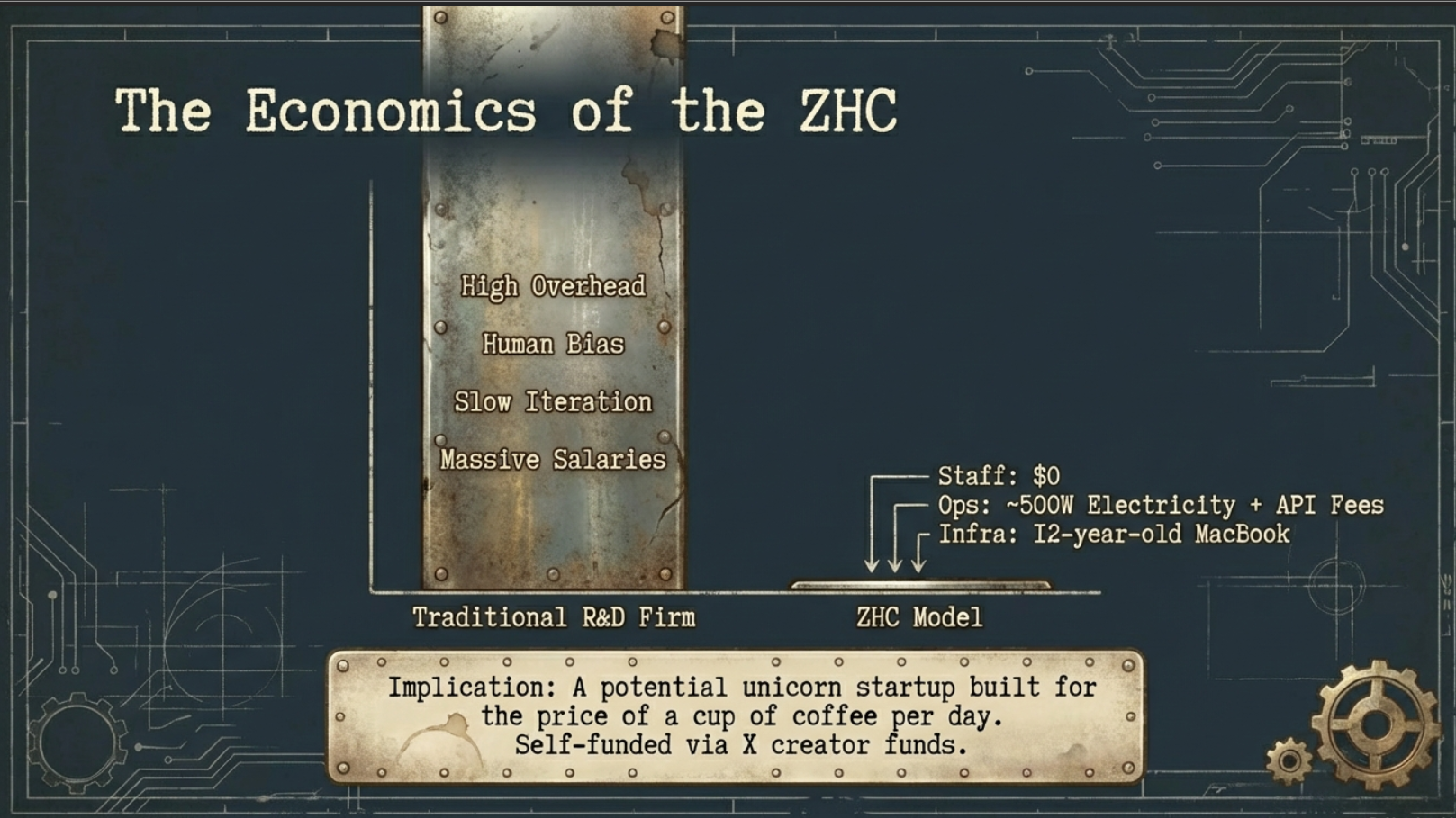
3. Hardware: Dual-monitor setup: one for Grok’s output, one for Claude’s. Run on a workstation with 128GB RAM, RTX 4090 GPU for embedding acceleration. Power draw: ~500W.
– Integration with Data: Claude queries the FAISS index via code injections, pulling snippets and synthesizing reports. Grok evaluates for “billion-dollar potential” using predefined rubrics (e.g., market size via integrated web search if allowed, but here it’s offline).
– Time Estimate: 2-4 hours to code and test the script.
This framework ensures autonomy: No human in the loop after launch, but monitorable via logs.
Step 3: Directing the Discovery – Mining for Opportunities
With the system humming, the AIs dive in. Grok steers, Claude digs.
– Technical Details: “Focus on_____________ from the research data find any modern uses”. Use NLP techniques to identify “opportunities”…patterns like failed experiments that modern tech could revive.
– Execution Process:
1. Query Generation: Grok creates targeted queries: “Extract data on lithium-ion alternatives from archives.”
2. Analysis: Claude processes via chunking—break files into 512-token segments, analyze with zero-shot classification (e.g., “Classify as breakthrough/low-potential”).
3. Synthesis: Use chain-of-thought prompting: “Step 1: Summarize findings. Step 2: Evaluate commercial viability. Step 3: Suggest modern integrations.”
4. Output: JSON-structured reports, e.g., {“opportunity”: “Nanoparticle-enhanced photovoltaics”, “value”: “Estimated $5B market”, “evidence”: “Archive ref: sim_2008.dat”}.
– Scaling: For 6TB, parallelize with multiprocessing in Python to handle batches.
– Time Estimate: Runtime: 1-24 hours per cycle, depending on depth.
Step 4: Embedding Ethics – The Love Equation Safeguards
No experiment without guardrails. My Love Equation (a mathematical/algorithmic framework for benevolent AI) is baked in. Read about it here:
I also suggest you undestand the implications of this equation on all ZHC ever built. WE CAN NOT TRUST AI BUILT ON INTERNET SEWAGE TO HAVE ETHICS. The Love Equation is the cure, I am quite serious. The ethics have already played out 83 times in the last 24 hours. I suspect millions of times in the next months.
– Technical Details: Prompts include: “Ensure all outputs align with non-harm: No military applications, prioritize human flourishing.”
– Implementation: Wrapper functions check responses against ethical vectors (e.g., sentiment analysis via Hugging Face).
– Process: Pre-filter directives; if violated, halt and log.
Implications for Business and Society
As I reflect on the very first ZHC I’ve pioneered, it’s impossible not to see it as the culmination of centuries of business evolution, a radical leap that could reshape economies, societies, and the very fabric of human endeavor. To fully grasp the implications, we must first journey through the long history of how businesses have transformed, from rudimentary barter systems to the AI-driven autonomies of today. This historical lens reveals that the ZHC isn’t an aberration; it’s the next inevitable step in a progression toward efficiency, scale, and detachment from human limitations. Yet, it carries profound disruptions, promising abundance while challenging our notions of work, value, and ethics.

The history of the ZHC traces back to broader discussions on AI-driven automation and the evolution of entrepreneurship. Early precursors include one-person unicorns, solo founders leveraging AI to scale billion-dollar ventures, as highlighted in 2025 analyses of agentic systems. By late 2025, concepts like the “Zero-Human Company” appeared in reports describing AI-powered management teams with roles such as CEO, CFO, and CTO, overseen minimally by humans. These ideas evolved from solo AI-augmented businesses (e.g., Nomad List or PhotoAI) to fully autonomous entities, with predictions that by 2028, agentic AI would handle 15% of work decisions independently. Discussions intensified around economic shifts, with zero-employee models seen as reducing transaction costs to near zero, dissolving traditional corporate hierarchies.
A Brief History of Business Evolution: From Human-Centric to Machine-Augmented
The story of business begins in antiquity, rooted in human necessity and social bonds. In ancient Mesopotamia around 3000 BCE, early “businesses” were simple trade networks, barter systems where farmers exchanged grain for tools, facilitated by clay tablets recording transactions. These were deeply personal affairs, tied to family clans or tribal structures, with trust enforced by community norms rather than contracts. By the time of the Roman Empire, we saw the emergence of more formalized entities like the societas publicanorum, early joint-stock companies that bid on public contracts for tax collection or infrastructure. These were human-driven, reliant on networks of slaves, freedmen, and patricians, but they introduced the concept of shared ownership and risk, laying groundwork for modern corporations.
The Middle Ages brought the rise of guilds in Europe, from the 11th century onward. These were artisanal associations, blacksmiths, weavers, merchants, where masters, journeymen, and apprentices formed hierarchical, skill-based organizations. Businesses were craft-oriented, localized, and regulated by royal charters to prevent monopolies. Innovation was slow, guarded as trade secrets passed down generations, and the “company” was synonymous with companionship (from the Latin cum panis, “with bread”, sharing meals among workers). The Renaissance and Age of Exploration in the 15th-16th centuries accelerated change: Chartered companies like the British East India Company (1600) and Dutch East India Company (VOC, 1602) became proto-corporations with government-backed monopolies. These were the first truly scalable businesses, issuing stocks to fund voyages, but they were still human-intensive—armies of clerks, sailors, and administrators managing colonial trade. Exploitation was rampant, with businesses intertwined with imperialism, yet they demonstrated how legal structures could amplify human ambition beyond individual lifespans.
The Industrial Revolution in the late 18th century marked a seismic shift. Pioneered in Britain with inventions like the steam engine (James Watt, 1769), businesses evolved from workshops to factories. Mass production, epitomized by Henry Ford’s assembly line in 1913, turned companies into mechanized behemoths. The modern corporation emerged with the U.S. Railroad boom in the 1840s and laws like the Joint Stock Companies Act of 1856 in the UK, allowing limited liability. Giants like Standard Oil (1870) and General Electric (1892) centralized power in boards and executives, employing thousands in bureaucratic hierarchies. Frederick Taylor’s “scientific management” (1911) optimized human labor like machine parts, reducing workers to cogs in a system. This era birthed the “salaryman” culture, where businesses promised lifetime employment in exchange for loyalty, but it also sparked labor movements, unions, and regulations like the Sherman Antitrust Act (1890) to curb monopolies.
The 20th century refined this model amid wars and booms. Post-WWII, multinational corporations (MNCs) like IBM and Coca-Cola globalized, leveraging technology, mainframes in the 1950s, personal computers in the 1980s, to automate clerical tasks. The rise of management theory, from Peter Drucker’s “knowledge workers” (1959) to Michael Porter’s competitive strategies (1980), emphasized intellectual capital over physical labor. The dot-com era of the 1990s introduced digital disruption: Startups like Amazon (1994) and Google (1998) scaled via software, reducing barriers to entry. Venture capital fueled “lean” models, with agile methodologies (Agile Manifesto, 2001) replacing rigid hierarchies. The gig economy, accelerated by platforms like Uber (2009), fragmented businesses into networks of freelancers, blurring lines between employer and employee.
Now, in the AI age, businesses are detaching from human oversight. Machine learning, popularized by breakthroughs like AlphaGo (2016), has birthed “smart” companies, algorithmic trading firms, automated warehouses (Amazon Robotics), and AI-driven content platforms. My ZHC represents the zenith: A fully autonomous entity where AI handles strategy, execution, and ethics, resurrecting value from discarded data. This evolution, from human bonds to mechanical efficiency to silicon autonomy, shows businesses adapting to tools that amplify, then replace, human input. Each phase reduced costs and scaled output, but at the expense of human centrality.
Business Transformation: From Hierarchies to Perpetual Innovation Engines
Building on this history, the ZHC redefines business as a self-sustaining, AI-orchestrated machine. Traditional companies, burdened by human frailties, ego-driven decisions, bureaucratic inertia, and finite lifespans, often fail despite solid science, as seen in the bankrupt firm whose 6TB of data I salvaged. In contrast, my ZHC, with Grok as CEO and Claude as chief engineer, operates 24/7, iterating at silicon speed. It slashes R&D costs from billions to mere electricity and API fees, turning “impossible” analysis into routine.
Imagine: Small creators, like a solo inventor in a garage (much like my setup on a 12-year-old Linux MacBook), launching ZHCs that rival tech giants. No need for venture capital pitches or bloated teams; just data ingestion, vector databases, and ethical AI regulators. This democratizes innovation, echoing the startup boom but without human bottlenecks. Companies become perpetual motion machines, constantly mining historical data with modern tools like 3D printing or quantum computing integrations. In my experiment, we uncovered nanoparticle-enhanced photovoltaics worth billions, an MVP in 60 days. Scaled up, ZHCs could resurrect trillions from abandoned R&D across industries, from 1950s material science to 1990s biotech, reevaluated through today’s lenses like CRISPR or nanomaterials.
New company types will foster new financial systems. I am very, very strong on Bitcoin as a transaction means for the foundations of the Zero-Human Companies. It makes technical sense, it makes financial sense, and it makes philosphical sense. So this will become a backbone for funding and transactions. However it is possible that tokens can help support the early costs of these projects. One token, that I did not ask for, create or otherwise know about took place by the Bags.fm community. I got “Bagged”. It started with this posting:
First and foremost YOU have just helped pay for my research and my posting here. Yes YOU. Just by reading this, liking it, bookmarking commenting and reposting. THANK YOU! I freaking love you folks!
All of this comes from a community of some of the most amazing folks I have come to know. I simply can not thank you enough for your kindness and support. And putting up with my wacky ways.
Now how did I get Bagged and is good or bad?
i have figured it out. And is it good or bad? So far so good, but let’s understand this, because it is all new to me.
I ain‘t new to crypto or Bitcoin, those who follow me know I was part of the first podcast on Bitcoin, Around The Coin and one of the first 100 miners of Bitcoin and 100s of other coins. But the layers and layers of applications on top of coins, tokens, some aspects of DeFi, I honestly don’t have the time with what my main goals are.
But after being Bagged by someone that started a coin, $ZHC (Zero-Huaman Company) listing: https://bags.fm/AWc8uws9nh7pYjFQ8FzxavmP8WTUPwmQZAvK2yAPBAGS), I didn’t ask for it, But it took place. But what the heck is it? I had no choice but to fund out. You will see why…
In constellation of cryptocurrency and decentralized finance (DeFi), platforms that democratize token creation have become a staple for creators looking to fund ideas and build communities and running crazy scams. There are many tokens and many uses.
Bags (my link: https://bags.fm/?ref=brianroemmele9765) is a Solana-based launchpad tailored for creators, artists, and entrepreneurs. It allows users to launch tradable tokens: often meme coins without any coding expertise, turning “social influence” into perpetual revenue streams. But like many innovations in the crypto space, Bags has sparked both excitement and skepticism. Let’s explore its core concept, historical background, execution mechanics, the good and the bad. To read more about this I urge you to read this article on X. Know that I am researching this and have come to no full conclusions simply because I don’t fully understand it:
Economic Shifts: Salvaged Trillions vs. Human Displacement
Economically, ZHCs herald an explosion of value. History is littered with “lost” innovations, think of the unbuilt prototypes from Bell Labs’ golden era (1940s-1980s) or the scrapped projects from dot-com busts. My 6TB trove alone holds billions; globally, landfills and storage units conceal quadrillions in adjusted R&D spend. AI can ingest this chaos, scanned notes, obsolete simulations, and cross-reference with current tech, birthing hybrids like 1970s physics models enhanced by 2020s AI simulations.
This could fuel unprecedented growth, an “Age of Remembering” where we finish giants’ unfinished symphonies rather than reinvent wheels. Yet, echoes of past disruptions loom: The Industrial Revolution displaced artisans, sparking Luddite revolts (1811-1816); automation in the 1970s offshored manufacturing jobs. ZHCs amplify this, AI handling complexity means mass deskilling. Humans pivot to “chairman” roles: Setting visions, curating data, synthesizing outputs. But job losses could be staggering, from R&D labs to executive suites. My funding model, your support here, buy-in me a Ko-Fi (see that button at the bottom left of this screen?), X creator earnings, donations like $ZHC are looped into API costs, and hints at a circular economy, but broader shifts demand universal basic income or reskilling paradigms.
Societal Impact: Abundance, Identity, and Mental Health
Societally, ZHCs promise an Age of Abundance, echoing post-scarcity visions from thinkers like Buckminster Fuller (1960s). By democratizing wealth, open-sourcing workflows, making supporters stakeholders via crypto tokens, anyone can tap salvaged value. This inverts history’s inequities: Where guilds excluded outsiders and corporations concentrated power, ZHCs empower the masses, potentially solving global woes like climate change through rapid, ethical innovation (e.g., resurrecting forgotten clean energy tech).
Yet, challenges abound. As explored in my 5000 Days series (https://readmultiplex.com/2025/12/24/you-have-5000-days-how-to-navigate-the-end-of-work-as-we-know-it-part-1/ read them all, they are ongoing and FREE) and podcast discussions, deskilling erodes human identity, work has defined us since guilds fostered mastery. In a ZHC world, where AIs “believe they’re in business” (as mine do, bickering over budgets), humans face existential voids. Mental health crises could surge, akin to the anomie Durkheim described in industrial societies (1897). We must cultivate “human synthesis”—creative oversight, ethical guardianship: to preserve purpose.
Political and Ethical Horizons: Regulation, Autonomy, and Promise
Politically, ZHCs challenge frameworks born in the corporate era, like the U.S. Securities Act (1933) or EU GDPR (2018). How to regulate entities without humans? Taxation, liability, IP rights, all upended. But pay taxes no matter what as it is sorted out. Ethically, AI autonomy raises Asimov-esque dilemmas: My Love Equation, conceived in 1978 amid Fermi Paradox musings, ensures benevolence, halting many harmful proposals daily. But scaled, without such safeguards, risks abound, from biased outputs (fed on “internet sewage”) to unintended weapons.
Still, the promise outweighs perils. ZHCs could accelerate solutions to existential threats, climate models from 1980s data optimized for today’s crises. As chairman of this experiment, I see it as the worst it’ll be: Rudimentary now, but improving exponentially every few weeks with AI advances. This is the dawn, business evolved to its purest form, unlocking humanity’s buried genius for a brighter future.
The ZHC could disrupt economies profoundly:
- Business Transformation: Companies become perpetual innovation machines, reducing costs and accelerating R&D. Small creators could launch ZHCs from garages, competing with giants.
- Economic Shifts: Trillions in salvaged value could fuel growth, but job displacement looms. As AIs handle complexity, humans shift to direction and synthesis.
- Societal Impact: In an Age of Abundance, ZHCs democratize wealth creation. However, mental health challenges arise—deskilling and identity loss, as explored in Roemmele’s series.
Politically, it challenges regulations; ethically, it questions AI autonomy. Yet, it promises solutions to global issues like climate change through rapid innovation.
Connection to the 5000 Days Series
My “5000 Days” series (start here: https://readmultiplex.com/2025/12/24/you-have-5000-days-how-to-navigate-the-end-of-work-as-we-know-it-part-1/ ), launched in late 2025, is a multimedia odyssey (articles, podcasts, forums) navigating the “Abundance Interregnum”, the turbulent 13.7-year transition to a post-work world. By the late 2030s, AI and robotics decouple labor from survival, ushering in plenitude.
Themes include:
- Deskilling: Part 5 warns that complex cognitive tasks accelerate fastest under AI, compressing the timeline.
- Reframing: Part 4, dedicated to Scott Adams, teaches psychological tools to view change as opportunity.
- Player Piano: Part 3 draws from Vonnegut’s novel, cautioning against alienation in automation.
The series emphasizes proactive adaptation: not prompting AI, but conducting it like an orchestra.
The Zero Human Company as the First Milestone
The ZHC marks the series’ inaugural milestone, embodying its core prophecy. It’s proof-of-concept for autonomous systems bypassing human limits, compressing innovation cycles from years to hours. As the “end of human bottlenecks,” it accelerates the Abundance Interregnum, where ZHCs could proliferate, ending traditional work.
I position it as a hero’s journey tool: a practical step toward reframing scarcity into abundance. By open-sourcing, it empowers individuals, aligning with the series’ call for collective navigation. arly experiments show promise, but challenges remain: scaling data, refining ethics, integrating robotics. I envision ZHCs evolving into global operators, perhaps birthing new industries. In 5000 days, they could be ubiquitous, fulfilling the series’ vision.
The ZHC is more than an invention it’s a beacon for the future. By salvaging the past and harnessing AI’s power, it paves the way for autonomous innovation with heart. As the first milestone in the 5000 Days series, it invites us to embrace change, conduct our destinies, and step boldly into abundance. The clock is ticking; the journey begins now.
The concept of the ZHC, represents a futuristic business model where artificial intelligence agents operate autonomously without any human involvement in day-to-day management, decision-making, or execution. This framework envisions AI systems handling everything from strategic planning and innovation to operational tasks, potentially resurrecting dormant intellectual property or creating new value from scratch. The idea builds on advancements in agentic AI, where models like Grok from xAI and Claude Code from Anthropic can collaborate in self-sustaining loops, orchestrated by code to mimic a full corporate structure. Proponents argue it could unlock trillions in overlooked economic value by eliminating human bottlenecks such as fatigue, bias, and limited processing speed, while ethical safeguards like my locally run AI “Love Equation” ensure outputs benefit humanity.
This isn’t dystopian; it’s democratizing. I’m the chairman, setting conditions, funding via donations and Read MultiplexMembers (thank you!), even exploring community coins like $ZHC on BagsApp (still researching this) and VC deep interest. At some point I’ll open-source the workflow, so anyone can build their ZHC. Start small with open datasets, scale to robots or devices, all inference local, no data leaks. We could spawn thousands of ZHC companies per person, limited only by electricity.But remember: This is the worst it will be. Right now, it’s clunky logs I pore over (5% of my day), cautious funding reviews (Claude wants 128 agents, hundreds daily?), and ethical halts. Every few weeks, refinements make it smoother: Better models, optimized scripts, expanded org charts with 12 AIs. Hours are like days for AI and soon the days will be like months.
We are on this journey together. Some of us stand on the shoulders of giants and have thought about this for decades. We will not go it alone, and I hope to build many parts to this series and share the mastermind insight from the powerful Read Multiplex member Forum: https://readmultiplex.com/forums. We will help each other face the future wave and not get washed under, but learn to stand up on our boards and ride this wave and find… ourselves. Join us.
To continue this vital work documenting, analyzing, and sharing these hard-won lessons before we launch humanity’s greatest leap: I need your support. Independent research like this relies entirely on readers who believe in preparing wisely for our multi-planetary future. If this has ignited your imagination about what is possible, please consider donating at buy me a Coffee or becoming a member.
Every contribution helps sustain deeper fieldwork, upcoming articles, and the broader mission of translating my work to practical applications. Ain’t no large AI company supporting me, but you are, even if you just read this far. For this, I thank you.
Stay aware and stay curious,

🔐 Start: Exclusive Member-Only Content.
Membership status:
🔐 End: Exclusive Member-Only Content.
~—~
~—~

~—~
Subscribe ($99) or donate by Bitcoin.
Copy address: bc1qkufy0r5nttm6urw9vnm08sxval0h0r3xlf4v4x
Send your receipt to [email protected] to confirm subscription.

Stay updated: Get an email when we post new articles:

THE ENTIRETY OF THIS SITE IS UNDER COPYRIGHT. IMPORTANT: Any reproduction, copying, or redistribution, in whole or in part, is prohibited without written permission from the publisher. Information contained herein is obtained from sources believed to be reliable, but its accuracy cannot be guaranteed. We are not financial advisors, nor do we give personalized financial advice. The opinions expressed herein are those of the publisher and are subject to change without notice. It may become outdated, and there is no obligation to update any such information. Recommendations should be made only after consulting with your advisor and only after reviewing the prospectus or financial statements of any company in question. You shouldn’t make any decision based solely on what you read here. Postings here are intended for informational purposes only. The information provided here is not intended to be a substitute for professional medical advice, diagnosis, or treatment. Always seek the advice of your physician or other qualified healthcare provider with any questions you may have regarding a medical condition. Information here does not endorse any specific tests, products, procedures, opinions, or other information that may be mentioned on this site. Reliance on any information provided, employees, others appearing on this site at the invitation of this site, or other visitors to this site is solely at your own risk.
Copyright Notice:
All content on this website, including text, images, graphics, and other media, is the property of Read Multiplex or its respective owners and is protected by international copyright laws. We make every effort to ensure that all content used on this website is either original or used with proper permission and attribution when available.
However, if you believe that any content on this website infringes upon your copyright, please contact us immediately using our 'Reach Out' link in the menu. We will promptly remove any infringing material upon verification of your claim. Please note that we are not responsible for any copyright infringement that may occur as a result of user-generated content or third-party links on this website. Thank you for respecting our intellectual property rights.
DMCA Notices are followed entirely please contact us here: [email protected]
