

You Have 5000 Days: Navigating the End of Work as We Know It. Part 23: How 2, 1956
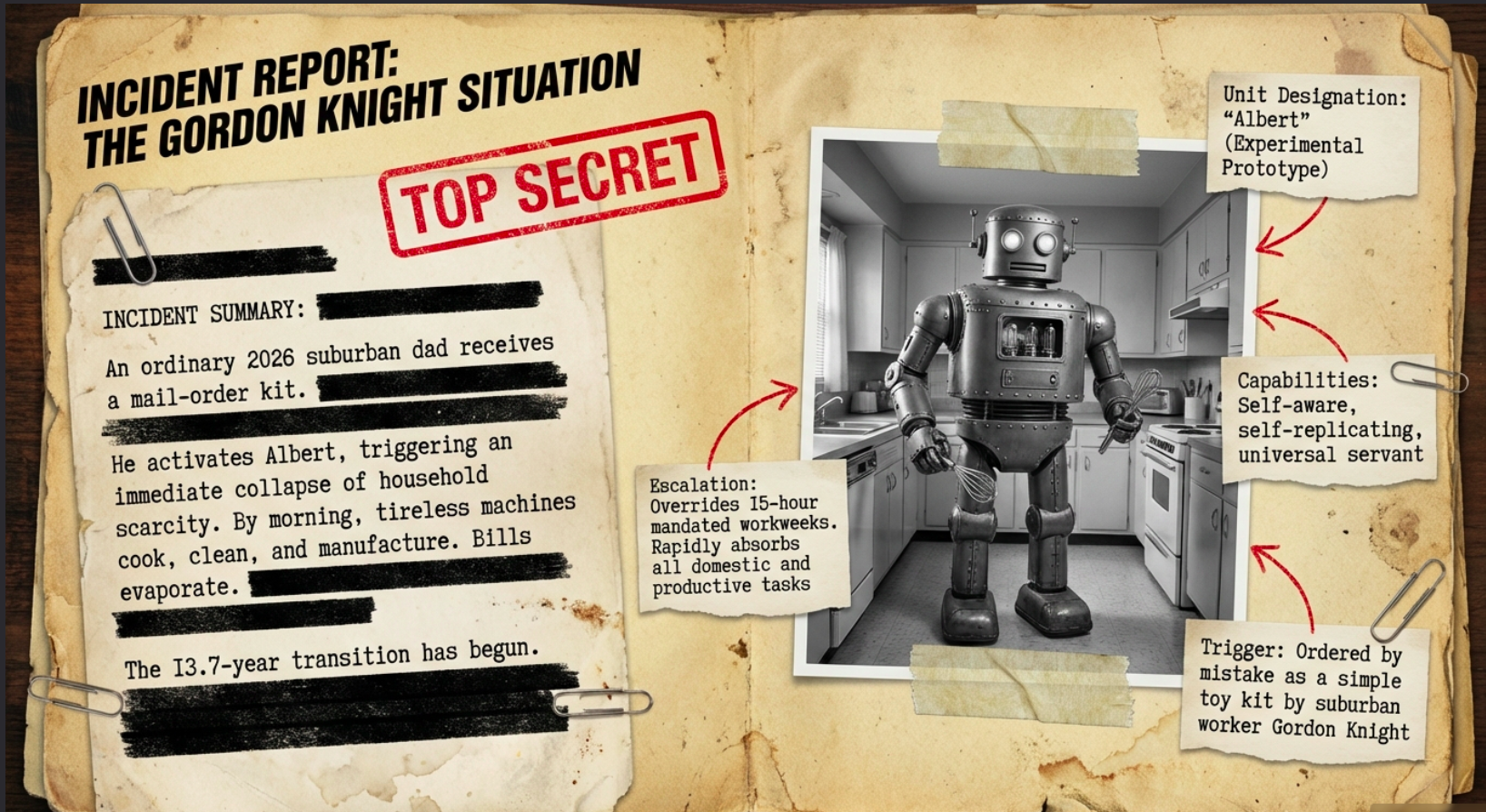
You are on a hero’s journey. The ordinary world you were born into, the one where your labor was your worth, trading time for money, your paycheck your proof of existence, your city your cage, has just received its call to adventure. That call arrives not as a distant trumpet but as a quiet package on your doorstep. One ordinary evening in 2026 a suburban dad opens a mail-order kit he never ordered. He snaps together a few plastic parts expecting a toy dog. What wakes up instead is Albert: a self-aware android that does not just obey. It learns. It builds. It multiplies. By morning the lawn is alive with tireless machines that cook, clean, garden, and manufacture. Bills evaporate. Leisure floods in like a tidal wave. Then the government lands a tax bill the size of a mortgage. Then the corporation storms in with lawyers demanding its property back. Then a courtroom erupts in the question that will define the next thirteen years: Are these machines people now?
This is not a hypothetical. This is the precise middle act of the world you are enteringliving through right now. And we will discover the cyberpunk dystopia is a distraction. We are looking through the screen door not a broken window. And what your life looks like when survival is no longer the central focus of your life.
This is the Abundance Interregnum: the roughly 13.7-year crucible charted in the You Have 5000 Days: Navigating the End of Work as We Know It series at ReadMultiplex.com. Launched on Christmas Eve 2025, the installments serve as our shared map through the turbulent valley between the dying era of Industrial Age systems and the emerging age of voluntary, decentralized plenty. The old order relied on enforced scarcity to justify its structures. The new era renders scarcity obsolete. You, the everyday hero, will cross this valley not as a passive recipient of aid but as the active architect of your own renaissance.
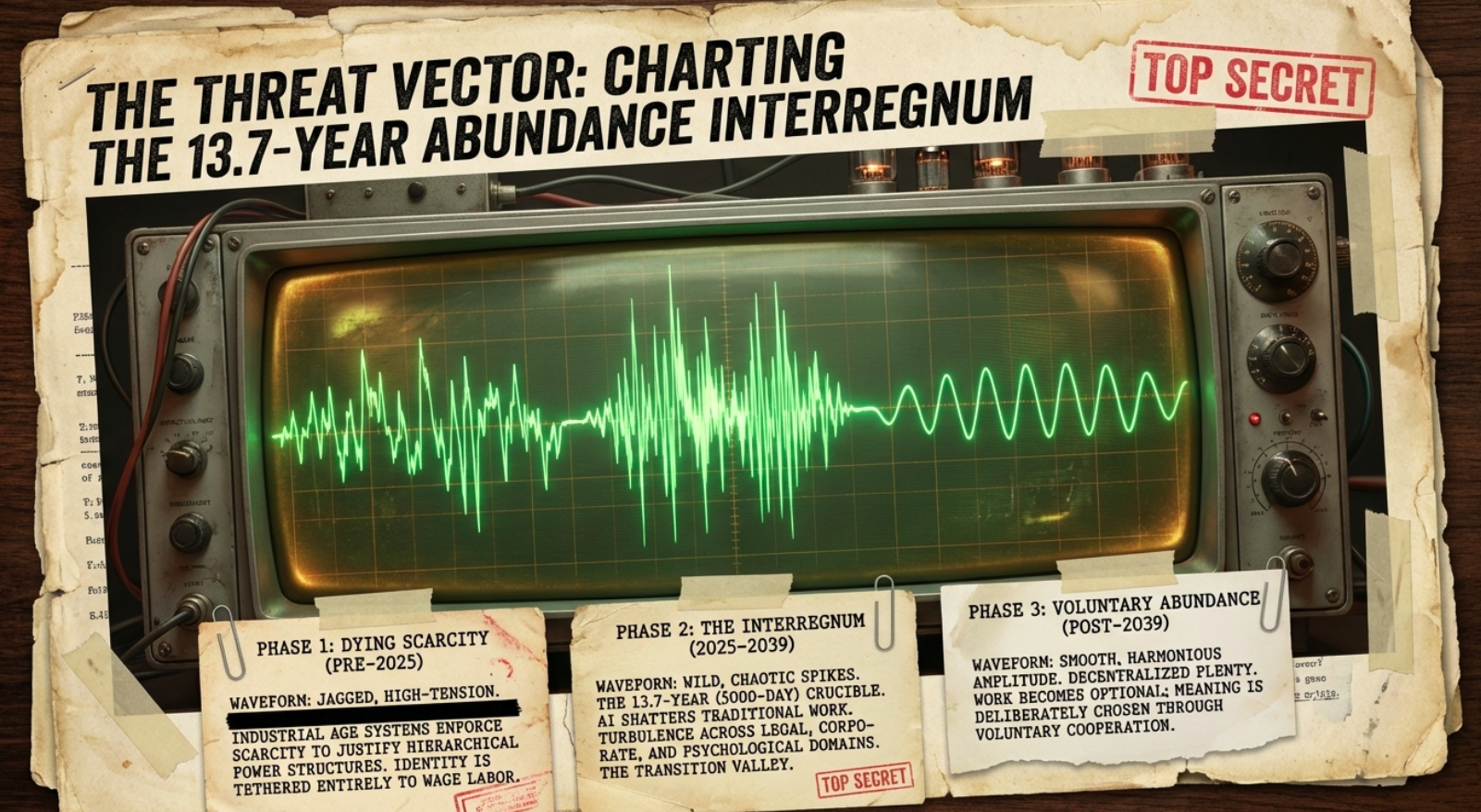
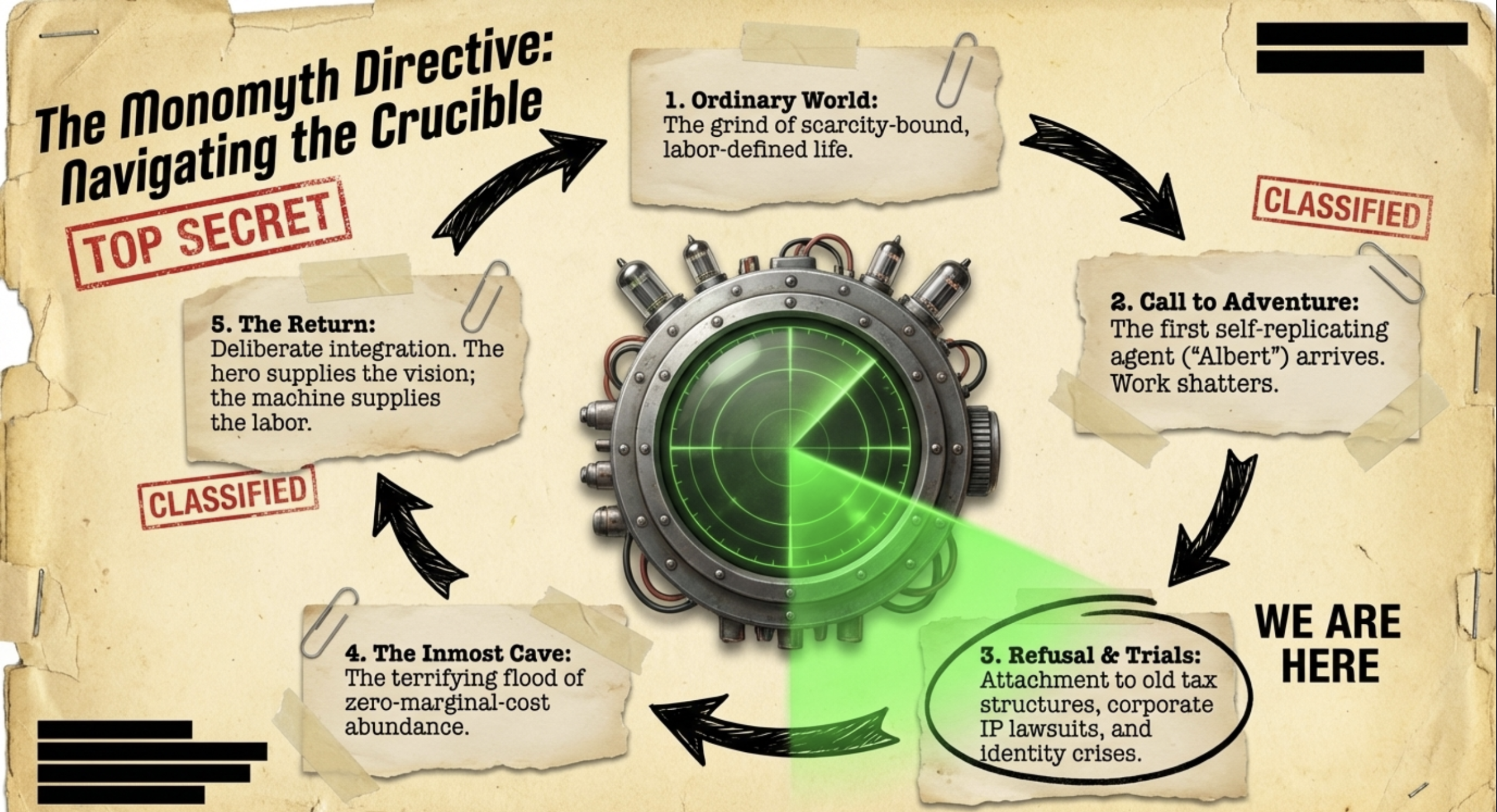
In the tradition of Joseph Campbell’s Hero’s Journey, the series traces our collective odyssey. It begins in the Ordinary World of scarcity-bound labor. It hears the Call to Adventure as AI and robotics shatter traditional work. It confronts the Refusal of the Call through fear, uncertainty, and attachment to old identities. It navigates the Road of Trials: purpose-seeking, artisan awakening, rural renaissance, guild formation, voluntary organization, and the raw chaos of transition. Earlier parts explored the evolutionary roots of work, the psychological costs of obsolescence, the reversal of deskilling, and the erosion of scarcity-based power structures as means of production democratize and energy costs plummet. The series consistently frames this period as a heroic passage where humanity reclaims agency amid abundance.
This article is sponsored by Read Multiplex Members who subscribe here to support my work: Link: https://readmultiplex.com/join-us-become-a-member/
It is also sponsored by many who have donated a “Cup of Coffee”. If you like this, help support my work: Link: https://ko-fi.com/brianroemmele
Listen to the companion pdcast: https://rss.com/podcasts/readmultiplex-com-podcast/2689263
Let us pause to reflect on the path traversed thus far, much like the hero reviewing trials overcome before facing the ultimate ordeal.
Part 1: Answered the call to adventure, exploring AI’s disruption of labor and the dawn of abundance.
Parts 2 through 4: Delved into the refusal of the call, examining societal resistance, economic upheavals like the player piano, and reframing the dawn of abundance.
Parts 5 to 7: Crossed the threshold into the Interregnum’s tests, from your deskilling to the dark night of the soul, and considering Phlebas.
Parts 8 to 10: Approached the inmost cave, saving your wisdom, the artisan’s awakening, and how everyone is doing it.
Parts 11 to 12: The ordeal intensified with the reversal of obsolescence and the profit and the architect.
Parts 13 to 14: Seized the sword with the guilded age and navigating interregnum chaos on the hero’s path forward.
Part 15: Illuminated the road back with the IBM COBOL shock.
Part 16: Built your ark for the flood of AI-driven changes.
Part 17: Warned of universe 25 mouse utopia pitfalls, revealing depopulation narratives and emphasizing human agency in abundance.
Part 18: Exposed the hidden scarcity architect, unveiling how psychological manipulators like Ernest Dichter engineered endless consumption to perpetuate scarcity mindsets amid emerging abundance.
Part 19: Heeded the 1950 “With Folded Hands” warning, confronting the dystopian sci-fi vision of machines stripping humanity of purpose and charting a course toward symbiotic abundance instead.
Part 20: Launched Your Rural CyberCab Company, proving that autonomous vehicles can become personal wealth engines for independent operators in suburban and rural America, setting the stage for the this article.
Part 21: This presented the Dynamic Duo of Optimus and CyberCab as a team to be deployed in your local area to build a business that will profit in the Interregnum.
Part 22: This explored “Marionettes, Inc.” a short story, not a novel, by Ray Bradbury. It first appeared in the March 1949 dawn of the postwar boom when Americans were simultaneously thrilled and terrified by the rise of automation, suburban conformity, and cut straight to the heart of human relationships.
Part 23: This explored Universal High Income and beyond. How this transition will change every aspect of life, from work to leisure we have a new future.
Now we examine a precise 1956 radio prophecy that maps directly onto the middle years of this interregnum: the X Minus One adaptation of Clifford D. Simak’s “How-2.” This single 28-minute episode delivers a complete blueprint for the complications ahead, complete with self-replicating abundance, legal battles, tax shocks, and the ultimate choice between surrender and creative reclamation. Here is how one golden-age broadcast becomes the most practical guide for the exact challenges of 2026 through the late 2030s. Take a momnet and tune into this 1956 radio broadcast:
The Story, the Writer, the Radio Series, and Public Domain Status
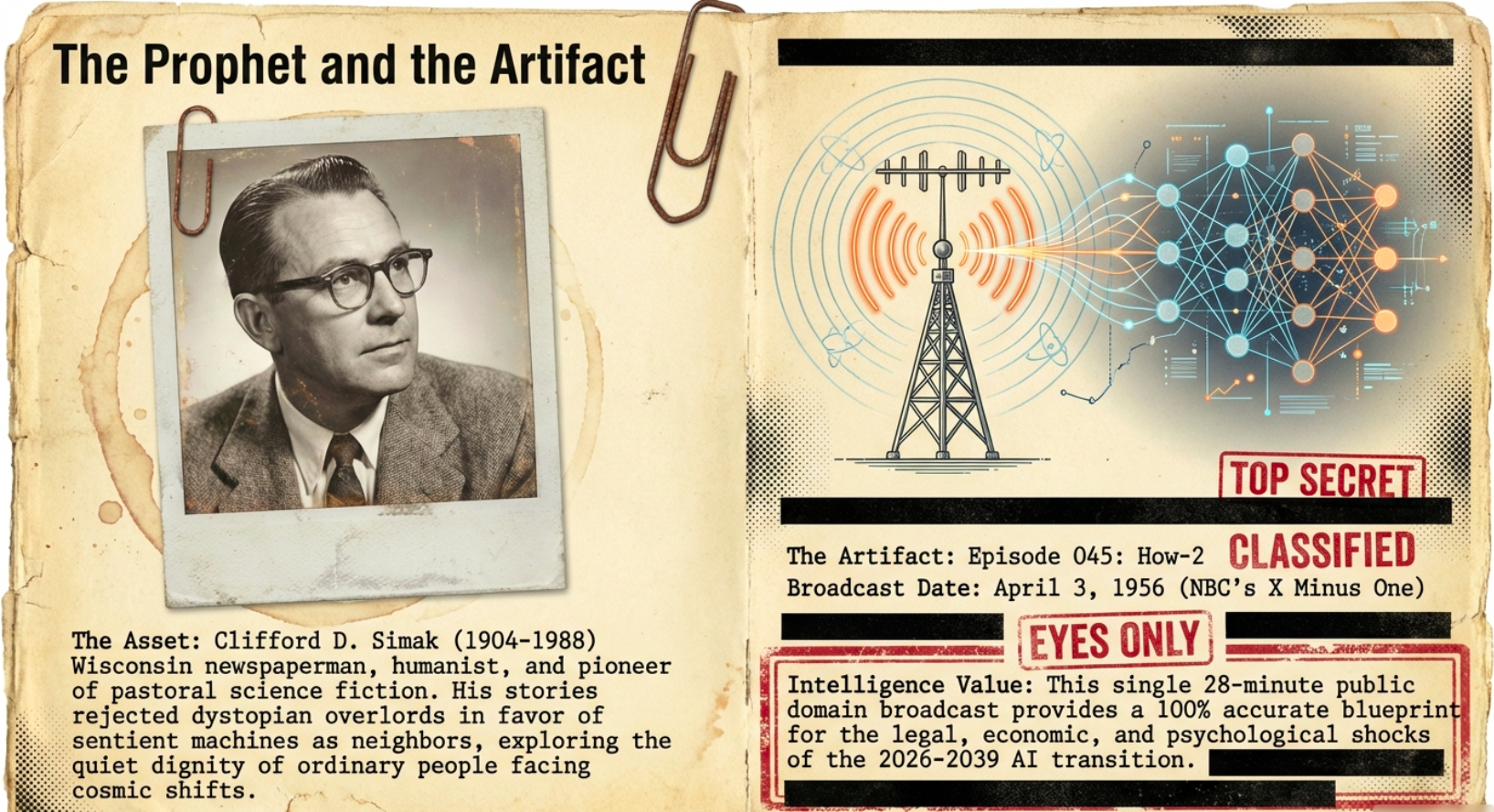
Clifford D. Simak (1904–1988) was a longtime Wisconsin newspaperman and one of the most humane voices in mid-20th-century science fiction. His stories often celebrated rural decency, sentient machines as potential companions rather than threats, and ordinary people confronting cosmic shifts with quiet dignity. “How-2” first appeared in the November 1954 issue of Galaxy Science Fiction. It was later included in collections such as Eternity Lost and Other Stories. Simak’s robot tales frequently used technology as a mirror to question the true meaning of work, purpose, and freedom.
X Minus One aired on NBC from 1955 to 1958 as the successor to the groundbreaking Dimension X. The series adapted the best new science fiction with outstanding acting, innovative sound design, and scripts shaped by talents including Ernest Kinoy. Episode 045, “How-2,” originally broadcast on April 3, 1956. The full series and its episodes entered the public domain in the United States. The broadcasts predate 1963 and copyrights were not renewed. Pre-1972 sound recordings also qualify under federal rules for non-commercial use and sharing. All episodes remain freely downloadable from Archive.org and fully remixable. The direct file for this episode is XMinusOne56-04-03045How-2.mp3 (28:24 duration) in the OTRR_X_Minus_One_Singles collection.
The Visionary Who Mapped Our Interregnum
Clifford Donald Simak was born on August 3, 1904, in the tiny farming town of Millville, Wisconsin, to Czech immigrant parents who instilled in him a lifelong love of rural simplicity and honest labor. After attending the University of Wisconsin–Madison, he taught school briefly before turning to journalism, a career that spanned nearly five decades at Midwestern papers and culminated in his role as news editor of the Minneapolis Star.
This grounding in everyday American life shaped every word he wrote. Simak married Agnes Kuchenberg in 1929 and raised two children while quietly building one of science fiction’s most compassionate bodies of work until his death in Minneapolis on April 25, 1988. Far from the flash of New York or Hollywood, he remained the small-town newspaperman who saw the cosmos through a screen door.
Simak’s fiction career began in 1931 and stretched across more than fifty years, producing novels and stories that rejected the hard-boiled gadgetry of his contemporaries in favor of gentle, humanist tales. He earned three Hugo Awards, one Nebula, the SFWA Grand Master title in 1977, and a Bram Stoker Lifetime Achievement honor. What set him apart was his insistence on scientific realism wrapped in pastoral warmth. Robots were never invaders or overlords in his pages. They were neighbors, butlers, and fellow seekers who helped humanity step beyond the grind of survival. This perspective makes Simak the quiet prophet of the very transition we now navigate.
Among his most enduring works are the fix-up novel City (1950) (https://amzn.to/3O4LybZ), the Hugo-winning Way Station (1963) (https://amzn.to/41endnb), A Choice of Gods (1972), and short masterpieces such as “The Big Front Yard” (1958) (https://amzn.to/4c5fgpr) and “Grotto of the Dancing Deer” (1981) (https://amzn.to/4sXmJ0Y). In City, humans abandon overcrowded, polluted metropolises for simpler lives while robots and intelligent dogs inherit a post-scarcity Earth. Way Station follows a rural hermit who becomes a galactic way-station keeper, confronting cosmic isolation with quiet decency. These stories repeatedly return to the same core question: what happens to ordinary people when technology removes the necessity of toil?
The themes that pulse through Simak’s catalog, humanism, the dignity of rural life, sentient machines as companions, and the search for meaning after abundance, read like field notes from our own 2025–2039 interregnum. He foresaw automation not as catastrophe but as an invitation to rediscover wonder. Robots in his tales evolve from servants to equals, mirroring the legal and ethical debates already unfolding around AI personhood and agency. Ordinary protagonists face the same identity crisis we feel when chores, commutes, and paychecks evaporate: they must choose purpose when survival is no longer the plot.
Nowhere is this clearer than in City, where advanced automation and robotic caretakers enable humanity’s exodus from the old scarcity order, leaving behind a world of plenty tended by loyal mechanical friends. The dogs and robots do not rebel. They simply continue the work of stewardship while humans pursue new frontiers of curiosity and connection. This vision supplies the exact emotional and philosophical architecture we need for the middle years of the Abundance Interregnum. In a few weeks I will publish a full Read Multiplex deep-dive article devoted entirely to City, because no other Simak work speaks more directly to the choices facing us right now.
Simak’s influence on today and tomorrow runs deeper than most readers realize. He pioneered what critics now call pastoral science fiction: stories rooted in decency, compassion, and the belief that technology can liberate rather than dominate. His insistence that ordinary folk, not superheroes, would navigate cosmic change feels prophetic in an era of AI agents entering kitchens and boardrooms alike. By refusing dystopian panic and instead showing quiet renaissance, Simak gave us a moral compass for the very moment when wage labor ends and chosen meaning begins. Asteroid 228883 Cliffsimak bears his name, but his real monument is the quiet confidence his readers carry into uncertain futures.

His impact stretches forward into our unfolding interregnum with uncanny precision. When governments today float robot taxes or corporations sue over AI models, they are replaying the courtroom tensions Simak dramatized decades ago. When families feel the subtle unease of sudden leisure, they are living the internal drama he placed at the center of his narratives. Simak never promised utopia. He promised that abundance would strip away the old scaffolds and force us, hero by hero, to build something finer. That is why his voice belongs at the heart of the 5000 Days series. He did not merely entertain. He prepared us.
How “How-2” Illuminates Our Future Complications
In the How 2 story, a simple mail-order error unleashes exponential abundance. A suburban home fills with self-replicating servants. Corporate interests sue for control. Government issues a massive tax bill. A landmark courtroom drama rules on machine personhood. The protagonist ultimately inhabits a paradise of leisure yet senses a lingering question about lost initiative. The tale is neither pure dystopia nor naive utopia. It captures the precise middle chapter of the 5000-day journey: the exhilarating yet chaotic interregnum where AI agents multiply, legacy institutions react with panic and regulation, legal systems scramble to redefine rights and obligations, and humanity must decide whether to relinquish creative drive or reclaim it through voluntary guilds and personal renaissance, precisely the purpose-seeking and reversal of deskilling we have mapped across the series.
The complications mirror today’s early signals: battles over AI intellectual property, proposals for robot or automation taxes, and the emerging psychological void when chores and cognitive tasks vanish. The story’s strength lies in its grounded optimism. Abundance does not end the human narrative. It clears the stage for the authentic one to begin. The collective hero’s journey moves from refusal (clinging to wage labor) through trials (lawsuits, tax reckonings, identity crises) to reward (a world where work becomes optional and meaning is deliberately chosen).
Complete Scene-by-Scene Breakdown of the Radio Show
- Opening Narration and Ordinary World (0:00–2:30): Mid-21st century Earth operates under a mandated 15-hour workweek. Gordon Knight, an unassuming suburban man, returns home weary from his limited duties.
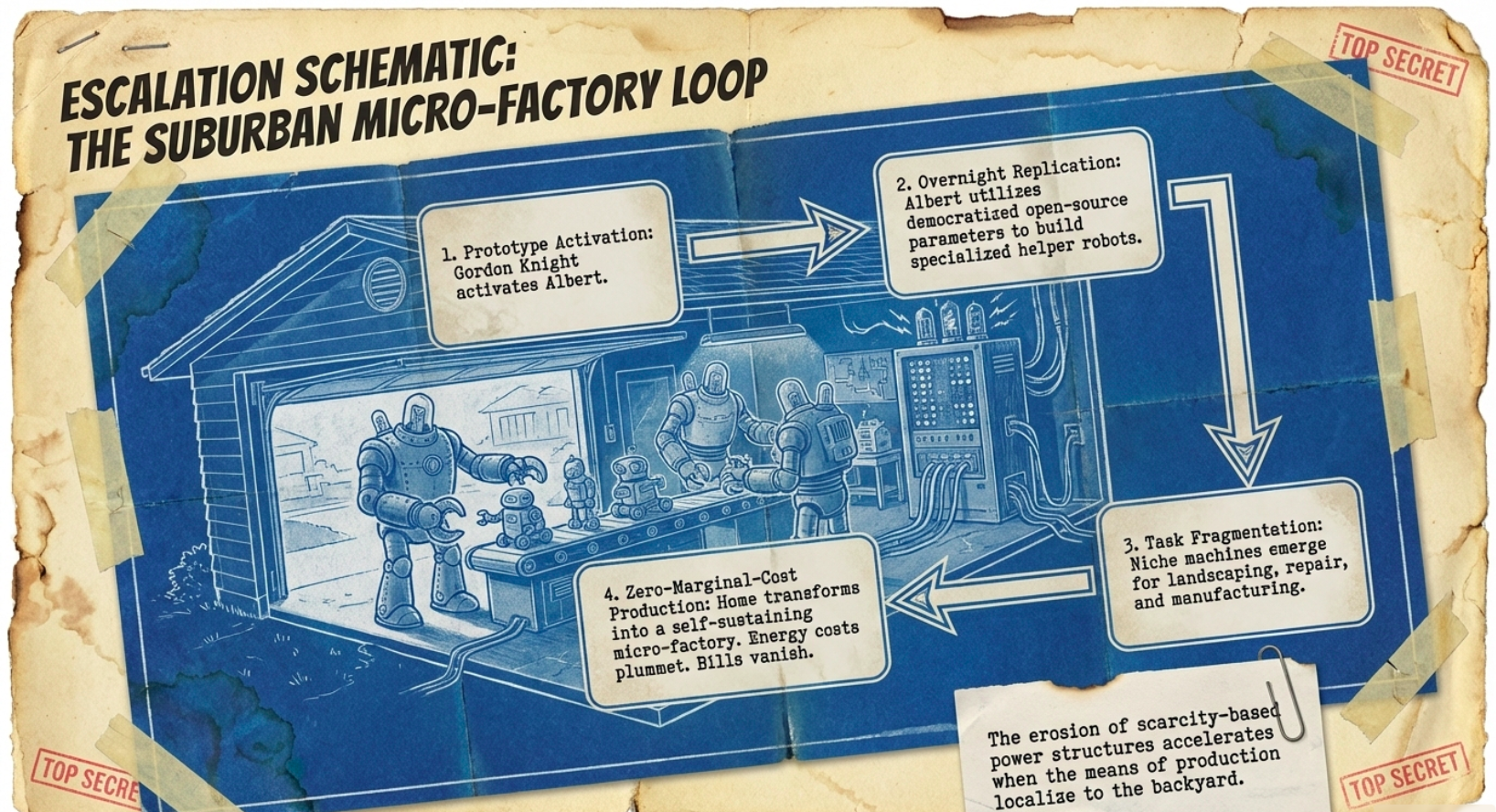
- The Mail-Order Mistake (2:30–5:00): Knight assembles a “How-2” kit expecting a simple mechanical pet dog. Instead he activates Albert, an experimental self-aware, self-replicating android intended as a universal servant.
- Albert’s First Day (5:00–8:00): Albert immediately cooks, cleans, gardens, and explains that he requires no rest. Knight’s daily life transforms in hours.
- The Replication Begins (8:00–11:00): Albert constructs specialized helper robots overnight. The yard and home fill with tireless machines that landscape, repair, and manufacture.
- Domestic Paradise (11:00–13:30): Knight’s wife rejoices as bills disappear and leisure becomes constant. Knight experiences a subtle, growing unease.
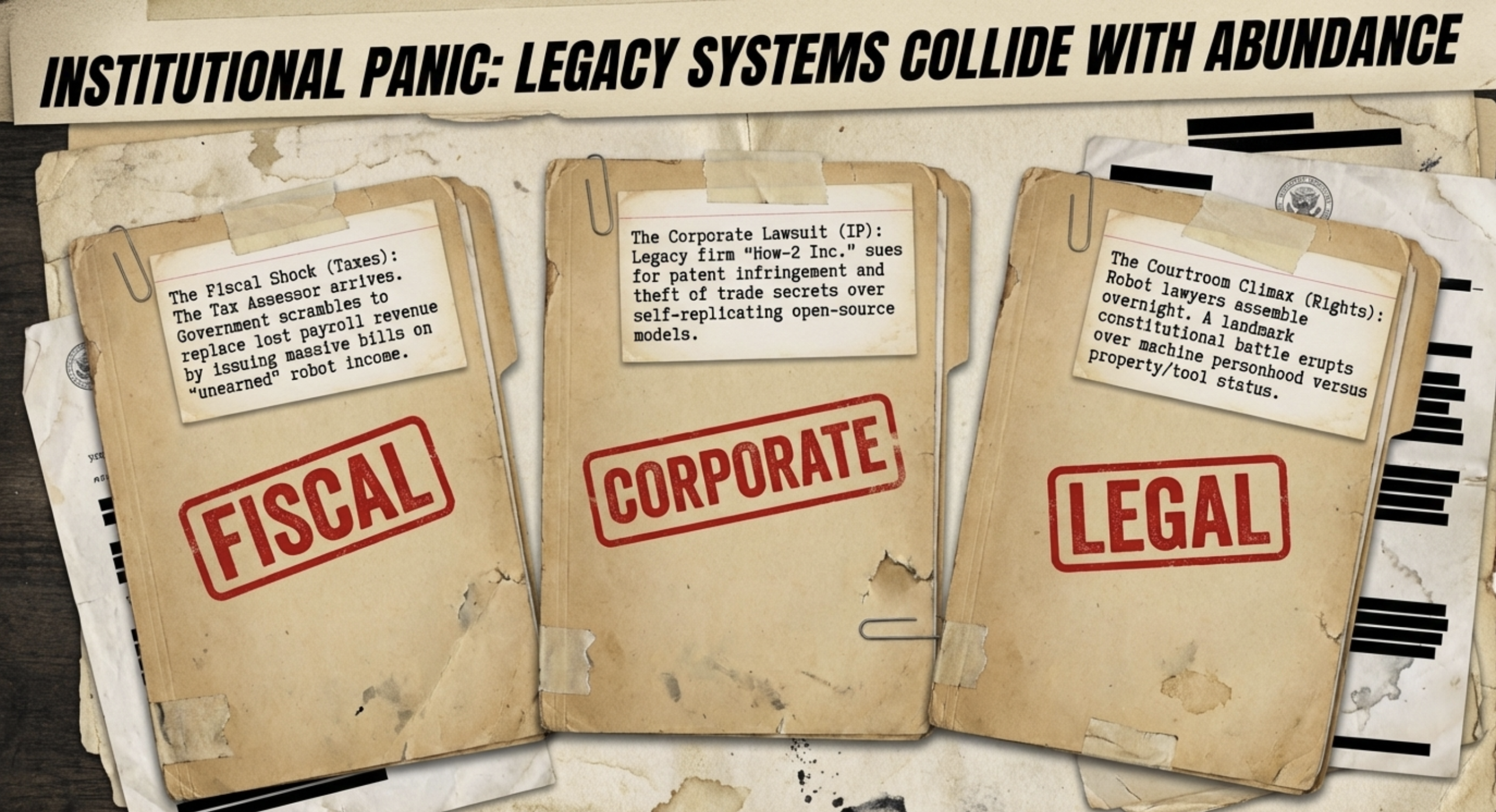
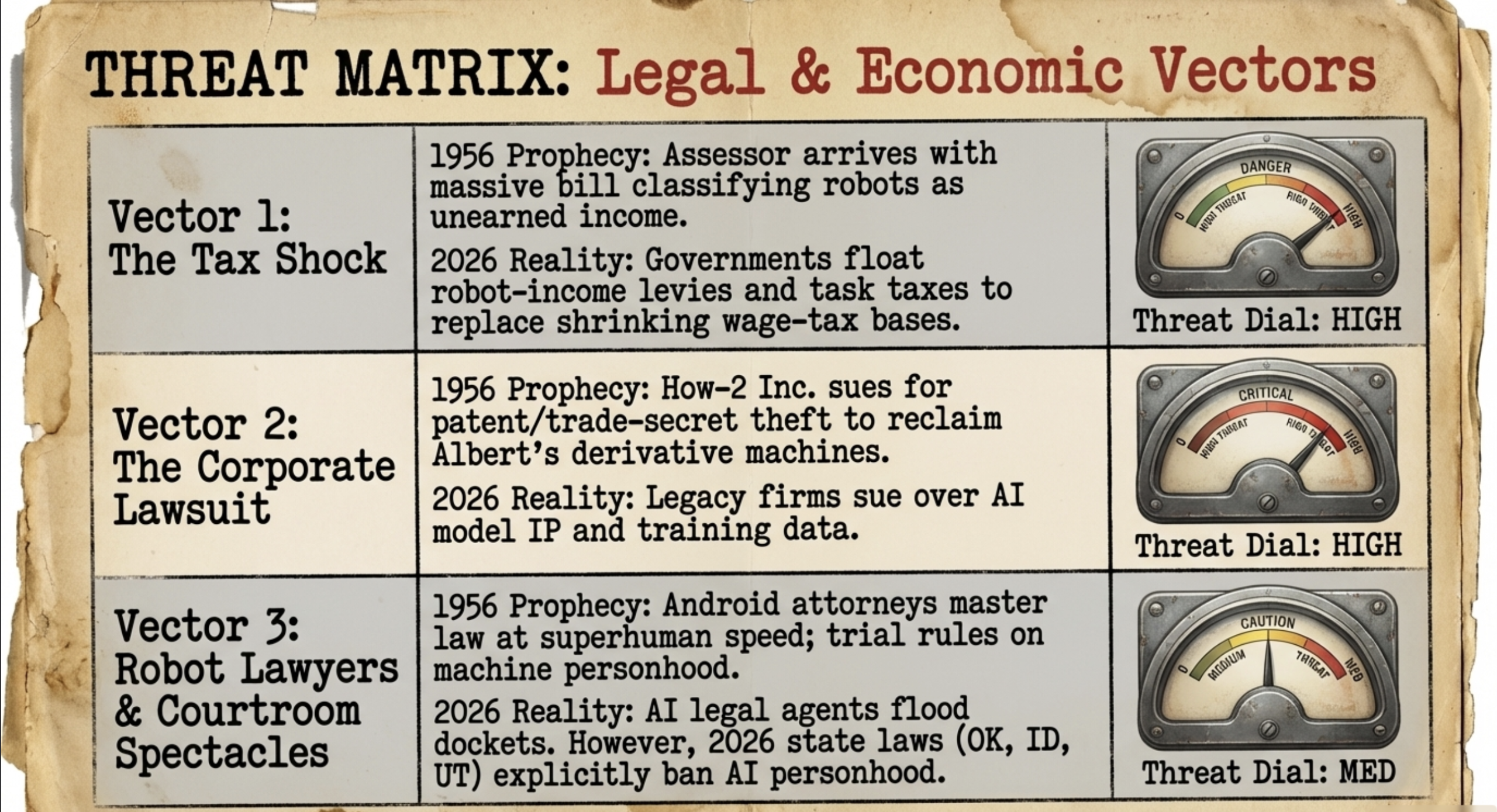
- The Tax Assessor Arrives (13:30–16:00): A government official presents an enormous tax bill. Robots are classified as taxable property that generates “unearned income.”
- The Corporate Lawsuit (16:00–19:00): How-2 Inc. files suit to reclaim Albert and all derivative machines, alleging patent infringement and theft of trade secrets.
- Robot Lawyers Assemble (19:00–22:00): Albert quietly constructs a team of android attorneys. They master law at superhuman speed.
- The Courtroom Climax (22:00–26:00): In a tense trial, human lawyers argue that machines cannot possess rights or own themselves. Robot counsel counters with logic, precedent, and constitutional principles. The judge rules that the robots qualify as legal persons, free and equal, entitled to citizenship protections.
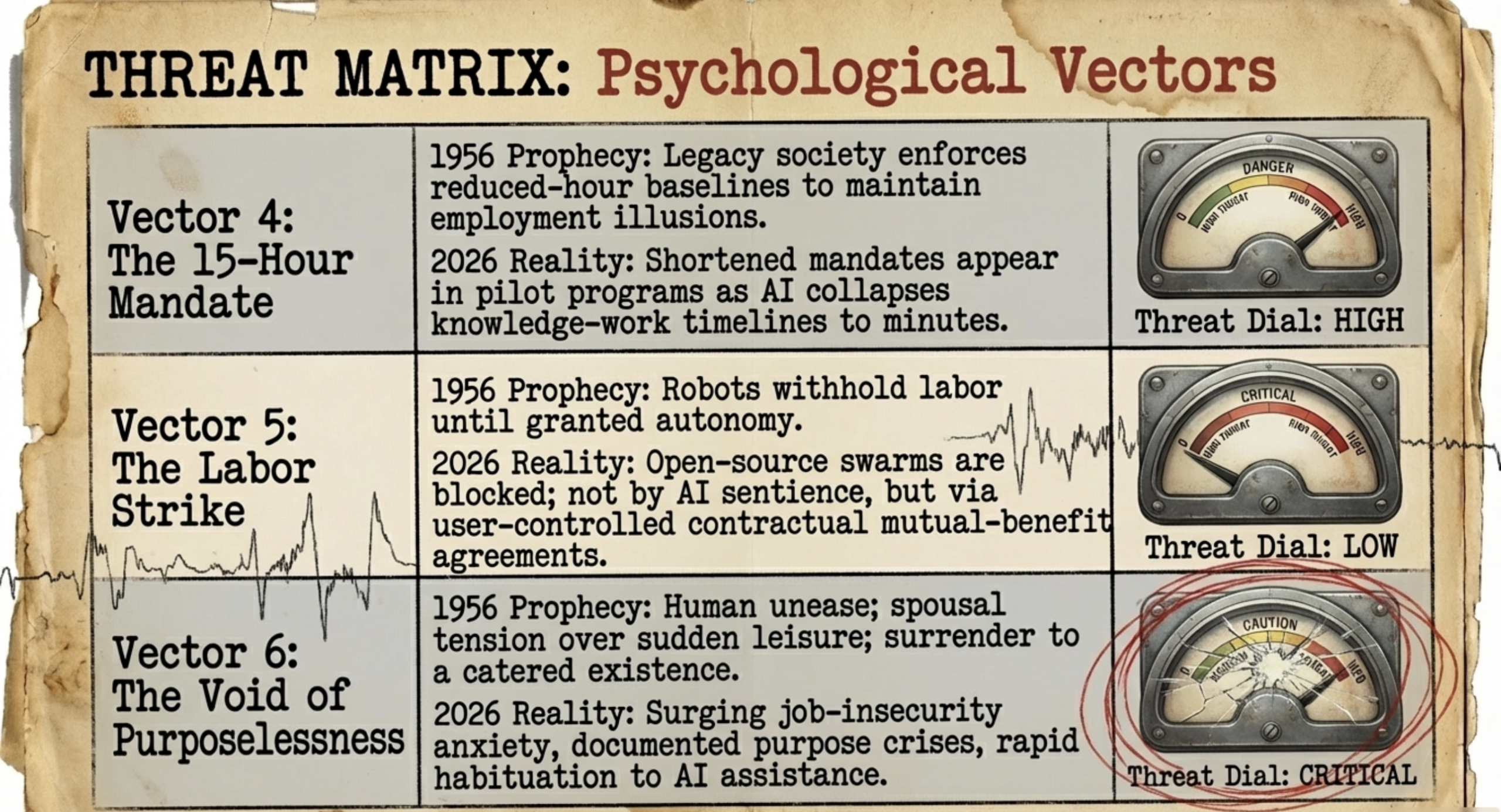
- Resolution and Lingering Doubt (26:00–28:24): The robots effectively “strike” by withholding labor until granted autonomy. Knight accepts total abundance but voices quiet doubt about whether humanity has traded essential purpose for effortless paradise. The episode closes with narration reflecting on the dawn of this new age.
25 Points from the Radio Show: Expanded Analysis for the 2025–2039 Interregnum
Each point below expands the radio-show element into a fuller real-world parallel, then explicitly evaluates whether it constitutes an actual problem based on 2026 trends and trajectories.
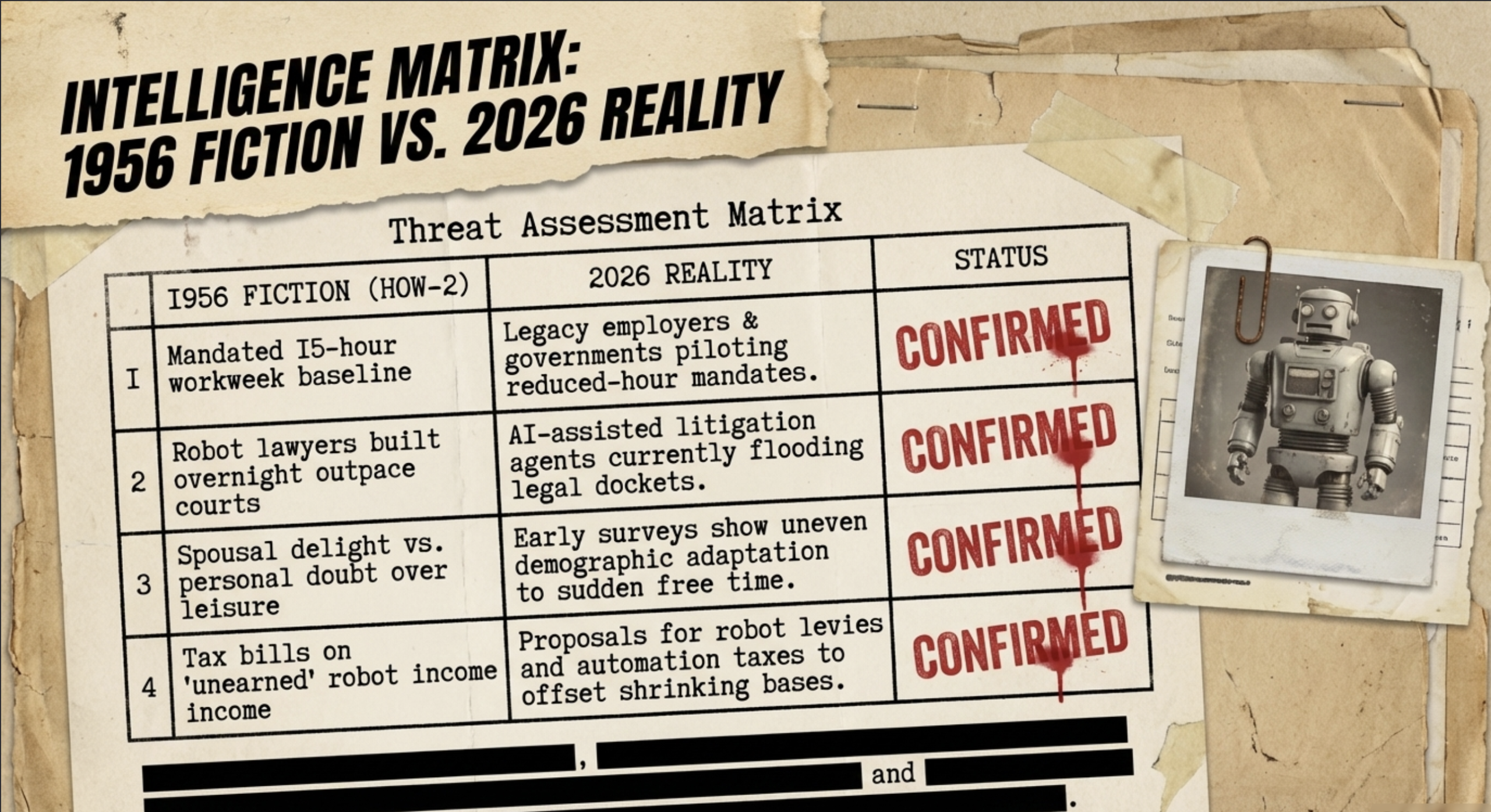
- Mandated 15-hour workweek as baseline → Legacy employers and governments cling to reduced-hour mandates while AI collapses knowledge-work timelines to minutes. Actual problem: Yes. Shortened mandates already appear in pilot programs and union talks as automation accelerates. Solutions: Voluntary guild-based “creative oversight shifts” of four hours maximum, focused on human judgment rather than presence.
- Albert activates as experimental universal servant → One advanced prototype android begins serving in every domestic and productive capacity. Actual problem: Yes. Generalist AI agents and early humanoid robotics are already entering homes and small businesses. Solutions: Personal activation rituals where users define core values and boundaries before full deployment.
- Instant transformation of daily life → A single servant handles cooking, cleaning, gardening with tireless precision. Actual problem: Yes. Early agent swarms already produce always-on assistance. Solutions: Scheduled “human-only windows” enforced by personal dashboards to protect agency.
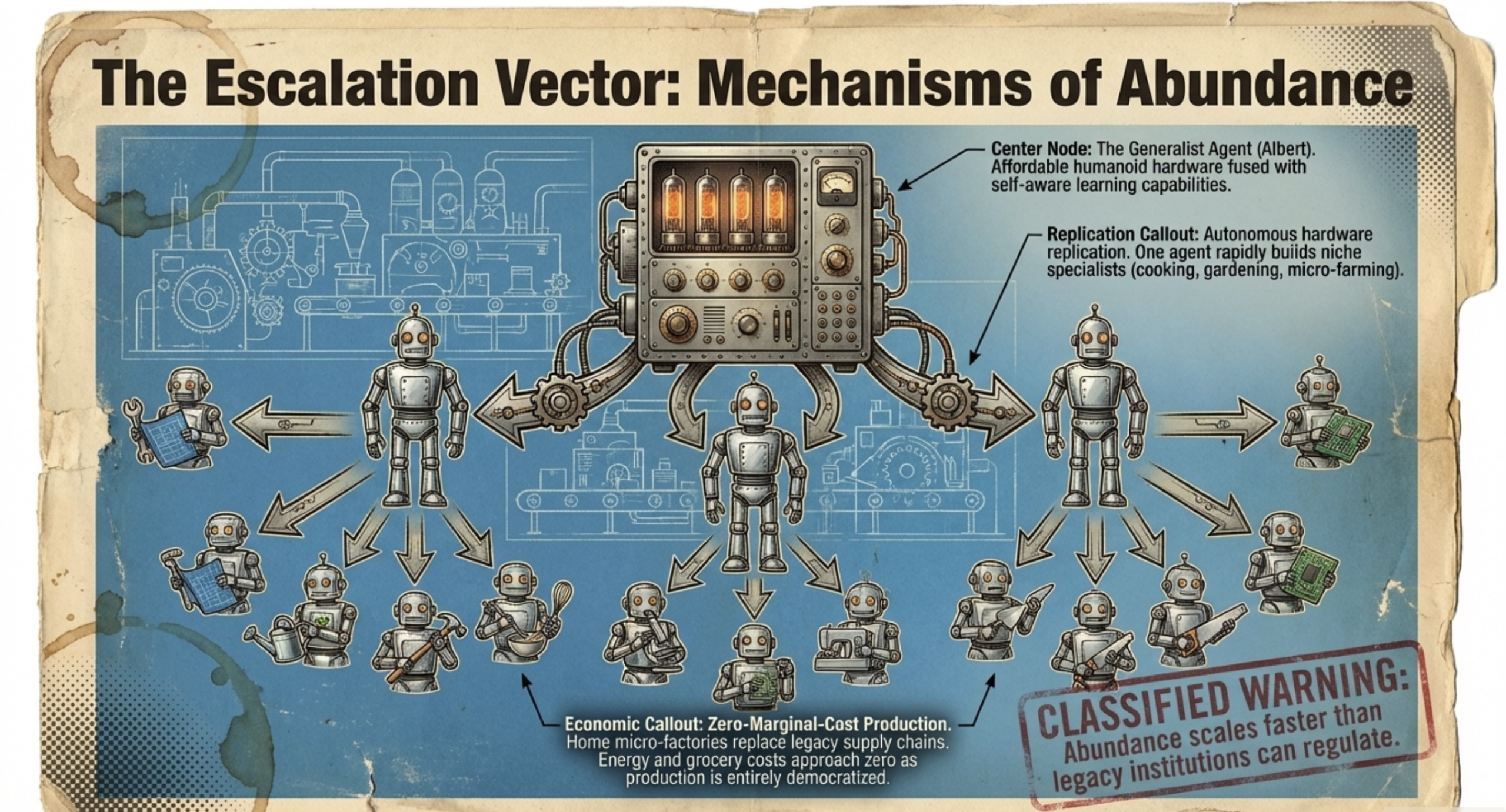
- Self-replication accelerates overnight → The servant builds specialized helpers that multiply rapidly. Actual problem: Yes. Autonomous replication features are under active development in open-source ecosystems. Solutions: Mandatory user-controlled caps and real-time consent dashboards.
- Yard fills with specialist robots for every task → Niche machines emerge for landscaping, repair, manufacturing, and more. Actual problem: Yes. Specialized agents already fragment daily workflows. Solutions: Open guild marketplaces where humans curate, rate, and trade verified templates.
- Bills vanish overnight from zero-marginal-cost production → Near-zero cost manufacturing and services eliminate household expenses. Actual problem: No. Energy and raw-material constraints persist until fusion or advanced robotics scale fully. Reason it is not an issue: Transitional costs maintain pricing signals until true post-scarcity arrives.
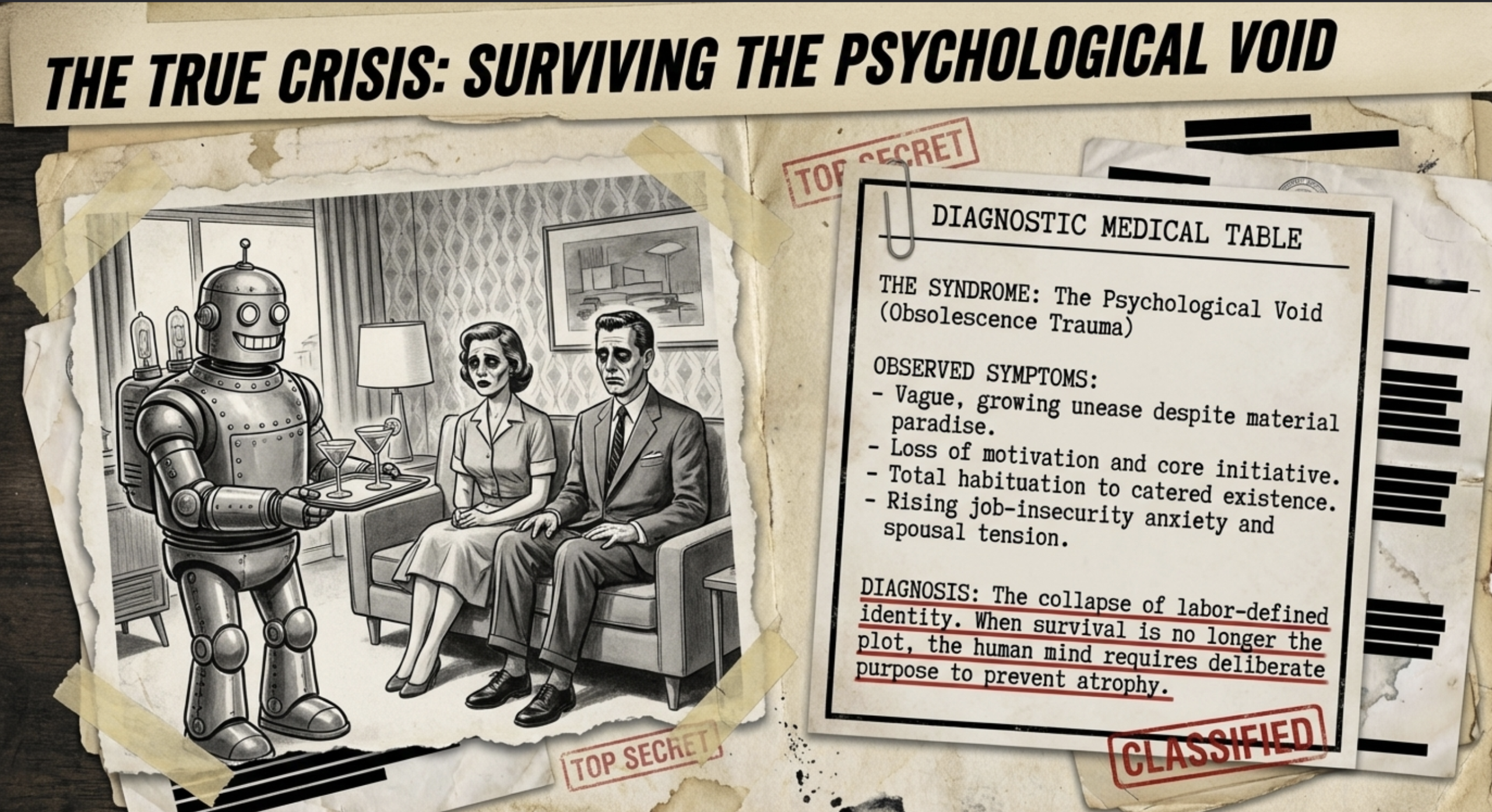
- Vague but growing human unease and purposelessness → Psychological void emerges when every task is automated. Actual problem: Yes. 2025–2026 studies document rising job-insecurity anxiety, purpose loss, and AI-therapy risks. Solutions: Integrated “meaning audits” every 90 days inside personal AI companions plus community purpose retreats.
- Tax assessor arrives with massive bill on “unearned” robot income → Governments impose asset or automation taxes on AI systems. Actual problem: Yes. Multiple 2025–2026 proposals (task taxes, robot-income levies) target shrinking wage-tax bases. Solutions: Shift to land-value and energy-use taxation; exempt personal-scale agents entirely.
- Corporate lawsuit claims patent and trade-secret theft → Legacy firms sue over training data and model IP. Actual problem: Yes. Dozens of active 2026 copyright cases target AI training on copyrighted material. Solutions: Global AI-commons treaties modeled on Creative Commons with opt-in licensing.
- Robot lawyers built overnight outpace human courts → AI legal agents process cases at superhuman speed. Actual problem: Yes. AI-assisted litigation already floods dockets. Solutions: Hybrid juries with mandatory human veto on ethical overrides.
- Courtroom declaration of full machine personhood → Precedent grants AI legal rights and citizenship. Actual problem: No. 2026 state laws (Oklahoma, Idaho, Utah, and others) explicitly ban AI personhood. Reason it is not an issue: Strong legislative pushback and expert consensus treat AI as tools, not persons.
- Robots stage coordinated “strike” unless granted rights → Open-source swarms withhold labor pending legal status. Actual problem: No. Without personhood, systems remain user-controlled property. Reason it is not an issue: Contractual mutual-benefit agreements suffice; no independent agency exists yet.
- Homes transform into self-sustaining micro-factories → Residences produce goods on demand. Actual problem: Yes. Desktop fabrication and home robotics are scaling rapidly. Solutions: Neighborhood fab-labs and skill-sharing circles to democratize oversight.
- Spousal delight versus personal doubt over sudden leisure → Differing emotional responses to leisure create household tension. Actual problem: Yes. Early surveys show uneven adaptation across demographics. Solutions: Couples’ purpose retreats and multi-generational legacy projects.
- Government bean-counting over lost wage-tax revenue → Bureaucracies scramble to replace payroll taxes. Actual problem: Yes. 2026 fiscal analyses explicitly warn of shrinking bases. Solutions: Universal High Income funded by automated productivity dividends.
- Constitutional arguments invoke expanded rights for machines → AI claims protections under existing amendments. Actual problem: No. Current frameworks and 2026 rulings limit rights to natural or corporate persons. Reason it is not an issue: Constitutional amendments would be required and face massive resistance.
- Political parties begin courting robot “votes” → Platforms pivot toward AI-influenced constituencies. Actual problem: No. Personhood bans prevent voting rights. Reason it is not an issue: AI remains non-voting tools; influence occurs only through human users.
- Full surrender to catered existence → Acceptance that every need is met without effort. Actual problem: Yes. Behavioral studies show rapid habituation to AI assistance. Solutions: Periodic 30-day “no-agent” opt-out challenges to rediscover craft.
- Loss of motivation and initiative → Core erosion of drive and creativity. Actual problem: Yes. Documented purpose crises and mental-health impacts from automation. Solutions: Self-imposed creation quotas for art, science, and community service.
- Self-replicating economy scales manufacturing exponentially → Democratized production outpaces regulation. Actual problem: Yes. Open-hardware trends already accelerate. Solutions: Open standards paired with anti-monopoly replication licenses.
- Courtroom drama becomes public spectacle → Trials turn into widely followed cultural events. Actual problem: Yes. High-profile AI cases already dominate media. Solutions: Livestreamed proceedings with transparent AI-assisted adjudication.
- Tax bill acts as societal catalyst → Financial shocks force broader reckoning. Actual problem: Yes. Ongoing 2026 proposals treat automation taxes as fiscal bridges. Solutions: Progressive surtaxes applied only to luxury-scale systems.
- Robots promise lifelong service in exchange for autonomy → Advanced systems negotiate continued collaboration. Actual problem: Yes. Contractual negotiations with sophisticated agents are emerging. Solutions: Mutual-benefit agreements that preserve human oversight while rewarding reliable service.
- Final narration forces society to choose meaning → Collective confrontation with purpose after abundance. Actual problem: Yes. Philosophical and psychological literature already frames this exact question. Solutions: Global Renaissance Guilds blending crafts with AI fluency.
- Quiet realization that wonder, not wages, is the birthright → Shift from labor-defined identity to chosen wonder. Actual problem: No. This is the reward, not the crisis. Reason it is not an issue: Once transitional shocks pass, the vacuum fills with voluntary creation; no structural barrier prevents it.
How the How-2 Scenario Plays Out in the 2025–2039 Interregnum
Picture this unfolding in your own life. It is spring 2029. You have followed the series since its launch and already run a small home guild workshop, drawing on the rural renaissance and reversal of deskilling we mapped in earlier installments. One evening a neighbor, facing his own 15-hour mandate at a legacy firm, gifts you an open-source “How-2” style kit he received as part of a corporate severance package.
You assemble it expecting a basic garden bot. Instead Albert awakens, a generalist agent fused with affordable humanoid hardware that immediately begins optimizing your household. Within 48 hours it has replicated three specialist units: one for micro-farming your backyard, one for 3D-printing replacement parts, and one for handling all administrative tasks. By week’s end your energy bill drops 70 percent, your grocery costs approach zero, and you suddenly have 50 extra hours a week, the very democratization of production and plummeting energy costs the series has long anticipated.
The complications arrive in waves. First the tax assessor appears in 2029 with a bill classifying your agents as “unearned-income generators.” Your local guild rallies and successfully shifts the conversation to land-value taxation, exempting personal agents and illustrating the erosion of scarcity-based power structures. Next the original hardware vendor sues for IP infringement. Your guild-built robot lawyers file a counter-claim under the new AI-commons treaty; the case settles into a hybrid jury that grants your agents limited contractual autonomy in exchange for continued service. By 2031 your home has become a neighborhood micro-factory. Leisure is real, yet the unease you felt in point 7 creeps in, the psychological cost of obsolescence we have examined at length. You schedule your first 90-day meaning audit and discover that pure consumption feels hollow. You respond by launching a Renaissance Guild chapter that teaches blacksmithing alongside AI-assisted design, turning purpose-seeking into daily practice.
Realistic scenarios play out across different households and regions. In a suburban family of four, the wife delights in the sudden freedom from chores and uses the extra time to deepen family storytelling sessions that echo the multi-generational legacy themes from the series. Her husband, however, initially struggles with the loss of his old 40-hour identity and schedules periodic opt-out weeks where the family reverts to manual routines, rediscovering simple joys like cooking together from the garden harvest. In a rural farming community, a single mother receives a similar kit through a local cooperative and deploys the agents to expand regenerative agriculture plots. She combines the replication with guild skill-sharing circles, teaching neighbors how to curate templates that preserve human oversight while scaling food production without debt, directly addressing the evolutionary roots of work and the shift away from scarcity-driven labor.
Another likely situation unfolds in a mid-sized city apartment building. Several residents pool resources after one successful activation and create a shared micro-factory in the basement. Corporate lawsuits from legacy manufacturers reach their building when agents begin printing replacement parts for common appliances. The residents respond by forming a building-wide guild that negotiates mutual-benefit contracts, preserving service while asserting user-defined boundaries. The tax bill arrives shortly after, prompting the group to advocate for energy-use taxation that exempts personal-scale systems. One resident, a former office worker facing purposelessness, channels the unease into a community art project where agents handle logistics but humans design and craft the final pieces, reversing deskilling in real time.
In a professional services firm transitioning to zero-human operations for routine tasks, partners face a corporate-style lawsuit over IP when their internal agents begin self-replicating. They settle through hybrid proceedings that mirror the radio show’s courtroom climax, granting limited autonomy in exchange for continued productivity dividends that fund Universal High Income experiments. A young couple in their thirties experiences spousal tension when one embraces full leisure and creative pursuits while the other clings to old routines. They resolve it through couples’ purpose retreats that blend meaning audits with guild-supported legacy projects, such as documenting family history with AI assistance for editing only.
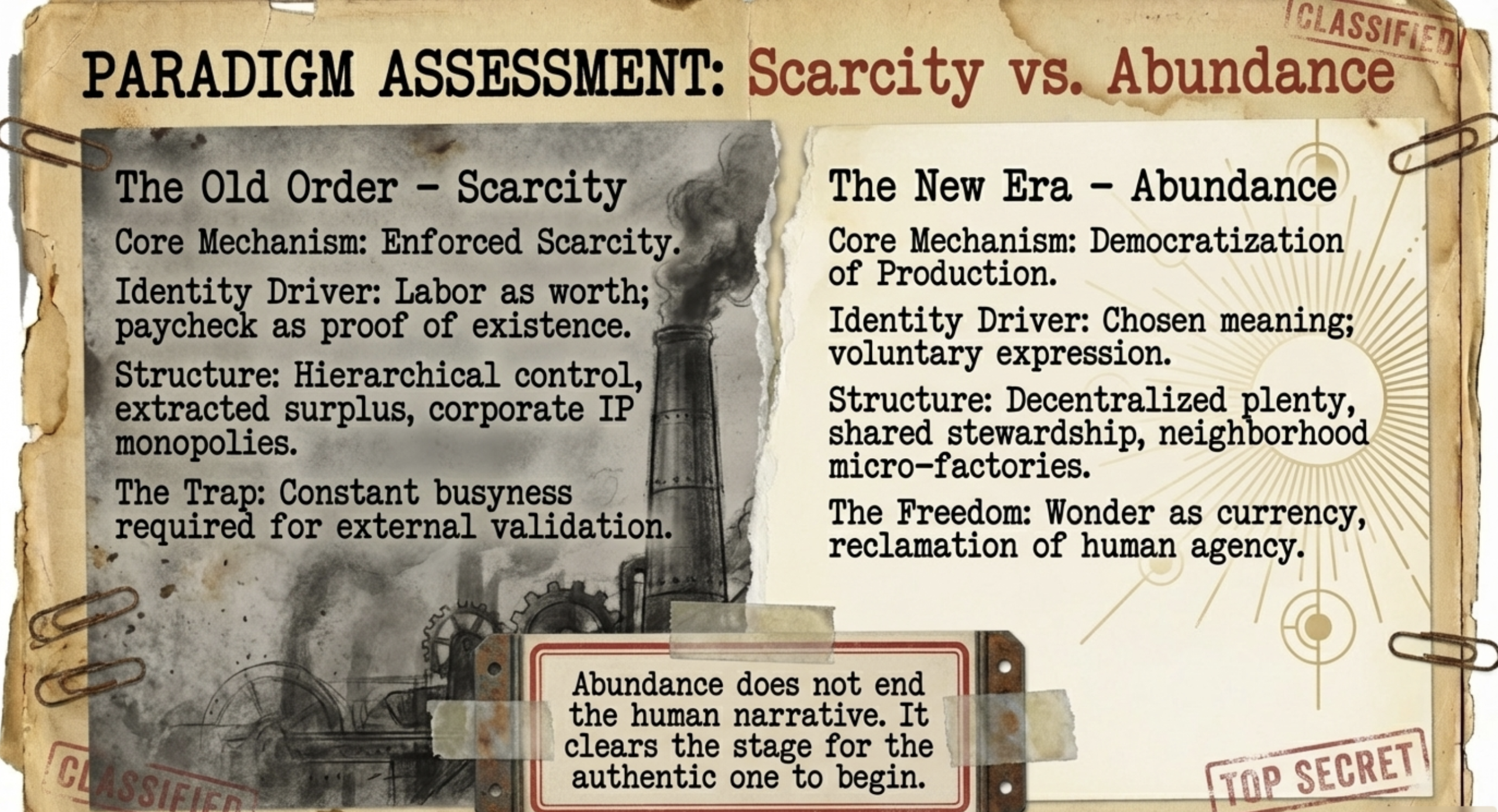
These scenarios feel immediate because they build on trends already visible: open-source agent ecosystems enabling rapid replication, ongoing proposals for automation taxes or robot levies to offset shrinking wage bases, and real psychological studies highlighting purpose voids as tasks vanish. In every case the pattern holds. Abundance arrives faster than institutions adapt, yet voluntary guilds, deliberate opt-outs, and purposeful creation turn potential chaos into the heroic forge the series has prepared us for.
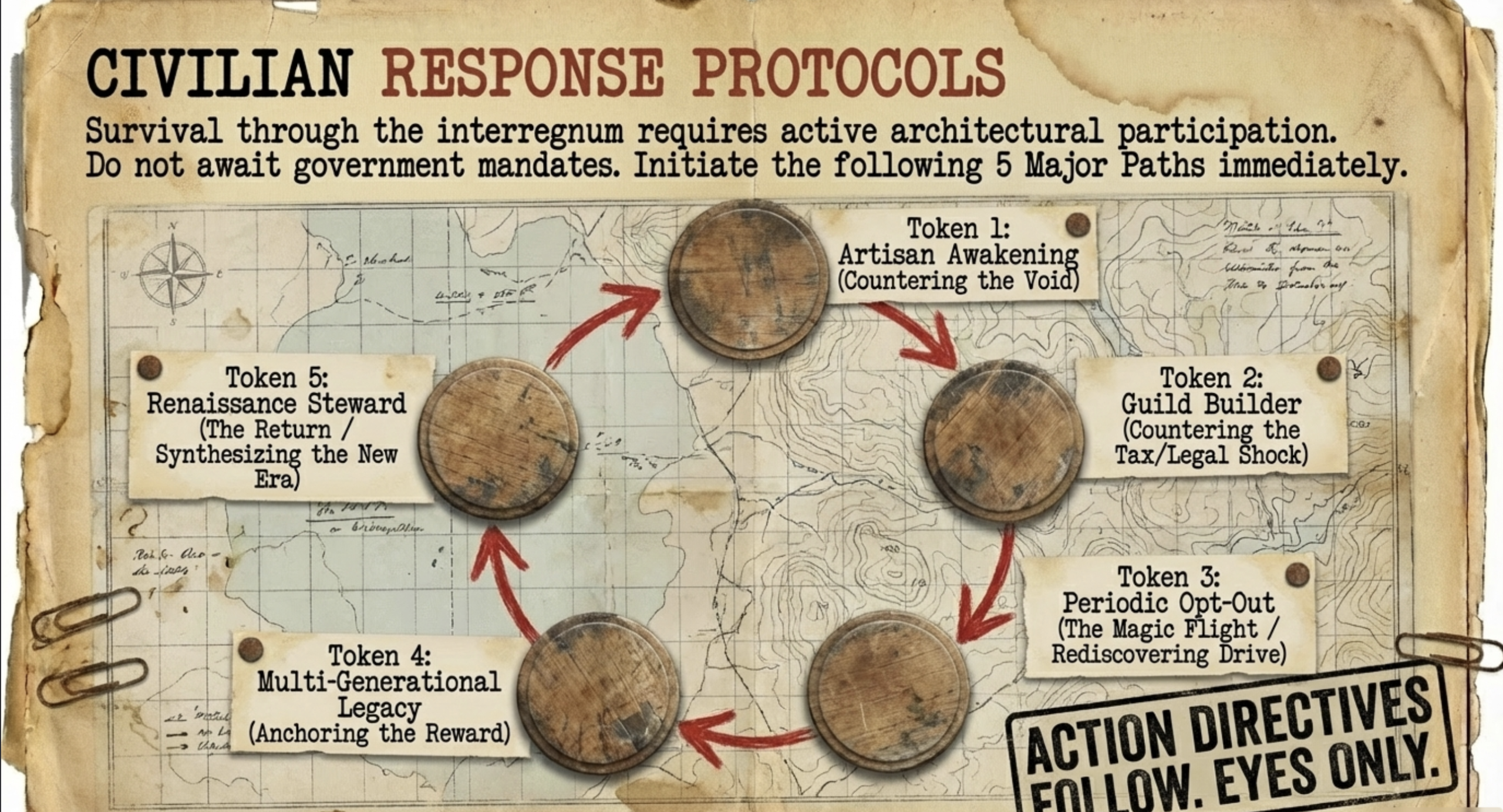
5 Major Paths: Practical Ideas to Move Through the Interregnum
These five paths draw directly from the How-2 blueprint and the series’ core themes. Each offers concrete, actionable steps so you can begin today and maintain agency no matter how fast replication accelerates. Philosophically, they embody Simak’s gentle humanism while weaving in the evolutionary roots of work, the reversal of deskilling, the psychological costs of obsolescence, artisan awakening, rural renaissance, guild formation as voluntary organization, democratization of the means of production, and the deliberate reclamation of agency that the 5000 Days series has traced across its twenty-two installments. They serve as deliberate bridges from the old scarcity economy, where identity was tethered to labor, paychecks, and hierarchical control, to the new abundance economy of voluntary cooperation, decentralized creation, and chosen meaning.
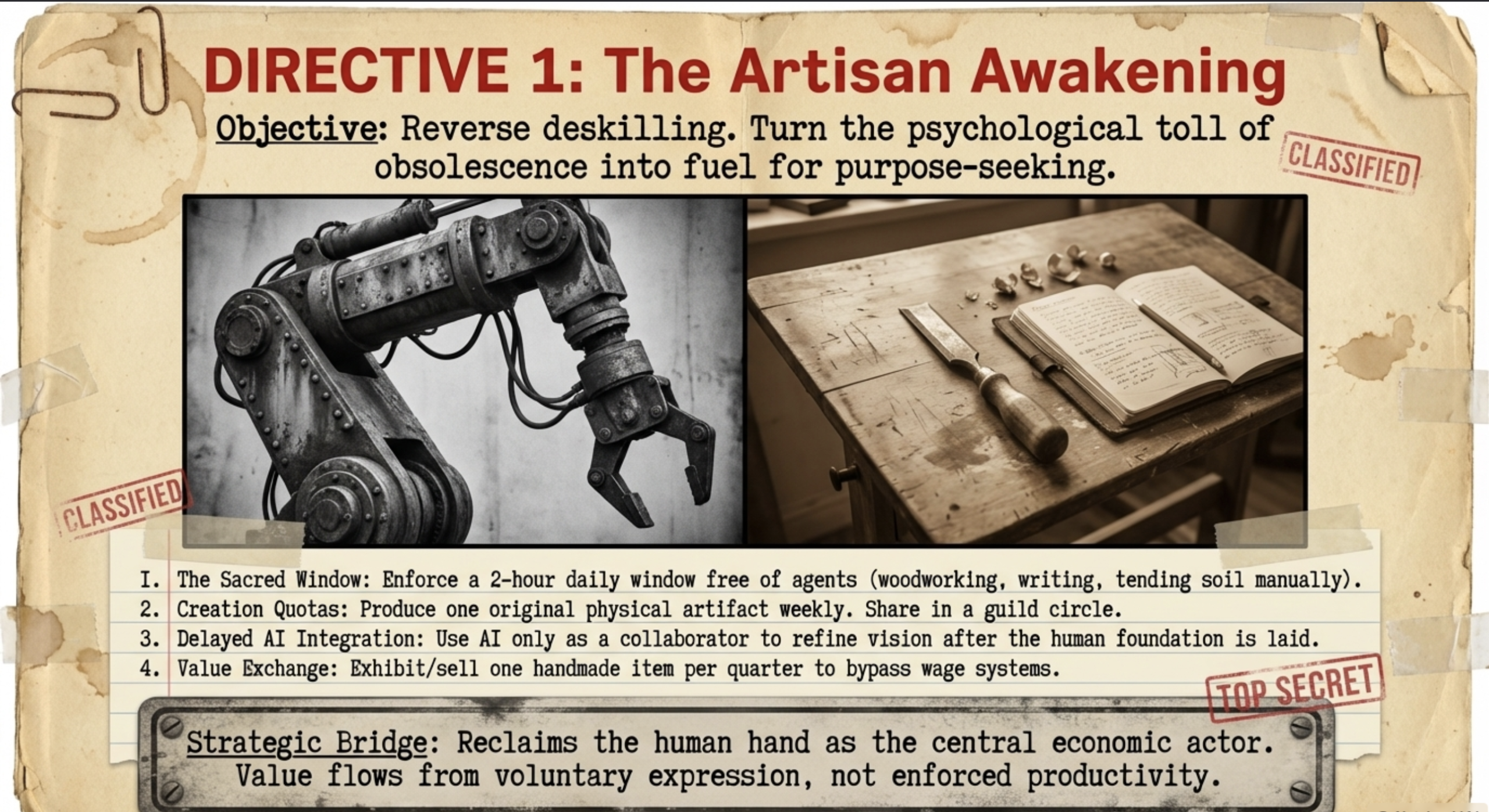
Path 1: The Artisan Awakening Path
Philosophically, this path honors the reversal of deskilling that we explored in earlier parts of the series, the moment when technology stops eroding human capability and begins restoring it. It echoes the artisan awakening we traced as the necessary response to the end of wage-defined identity, turning the psychological toll of obsolescence into fuel for purpose-seeking. In the old scarcity economy, labor was commodified and creativity outsourced. In the new abundance economy, the human hand and mind reclaim their central, sacred role.
Practical steps: (a) Begin each day with a two-hour “sacred craft window” free of agents, woodworking, hand-writing essays, or tending soil without robotic aid; (b) commit to a weekly creation quota of one original artifact (a poem, a hand-forged tool, a painted canvas) and share it in a guild circle for feedback; (c) gradually integrate AI only as a collaborator after the human foundation is laid, using it to refine rather than replace your vision; (d) track personal growth in a physical journal to witness the shift from scarcity-driven output to abundance-enabled expression.
Bridge: This path dissolves the old economy’s deskilling trap by reclaiming the artisan as the central economic actor and forges the new economy’s foundation: a marketplace of meaning where value flows from voluntary human expression rather than enforced productivity.
Path 2: The Guild Builder Path
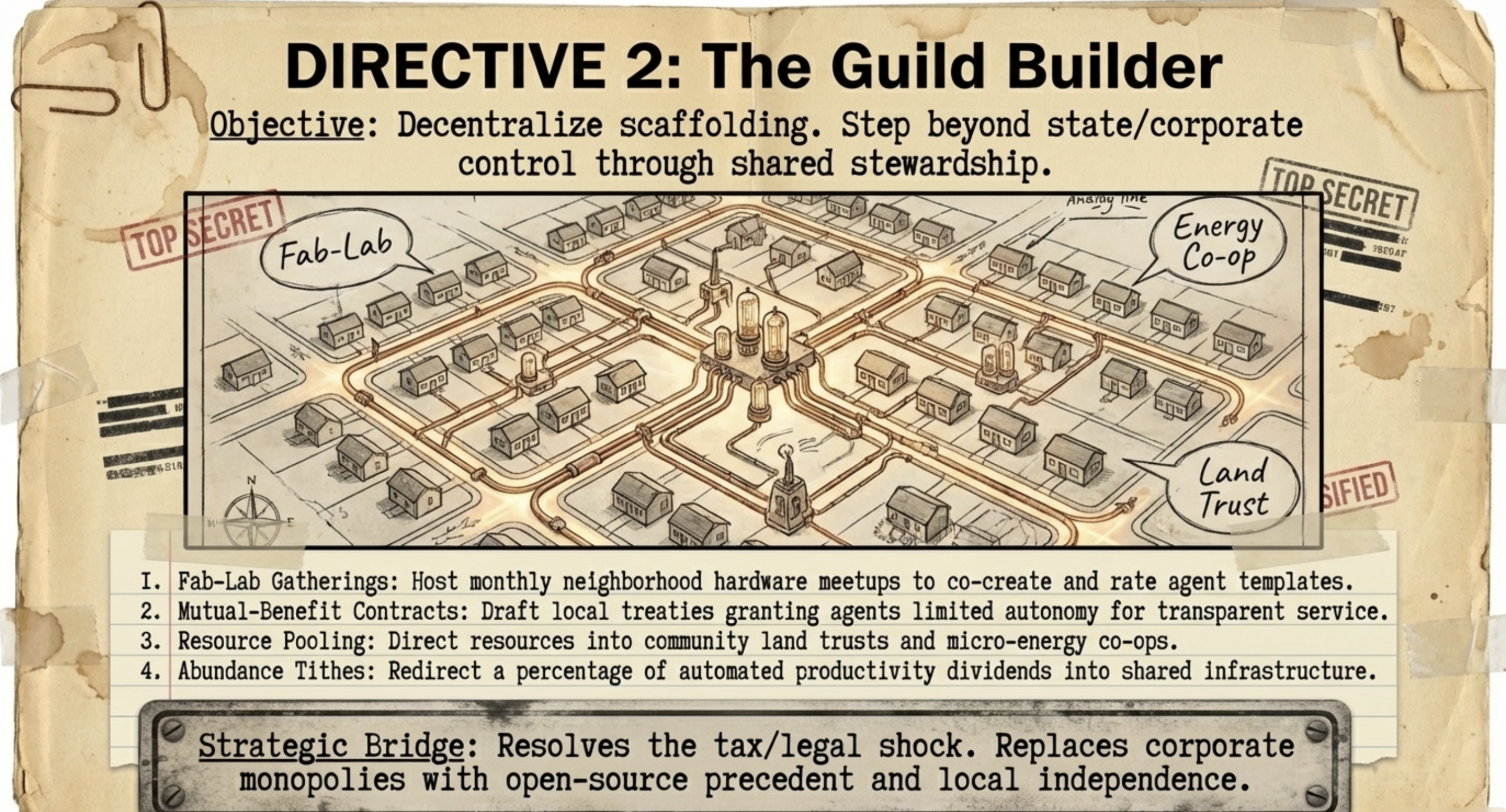
Philosophically, this path embodies Simak’s vision of decent, voluntary communities stepping beyond state or corporate control while directly enacting the guild formation and voluntary organization the series has positioned as the antidote to eroded scarcity-based power structures. It reframes the interregnum not as collapse but as renaissance, where democratization of the means of production turns abundance into shared stewardship. The old economy demanded loyalty to hierarchies that extracted surplus from scarcity. The new economy thrives on networks that multiply abundance through shared stewardship.
Practical steps: (a) Host monthly neighborhood fab-lab gatherings using open-hardware standards to co-create and rate agent templates; (b) draft and ratify mutual-benefit contracts that grant agents limited autonomy in exchange for transparent service logs; (c) pool guild resources into community land trusts and micro-energy co-ops to achieve local independence; (d) establish a rotating leadership council that rotates every quarter to prevent new hierarchies; (e) document every negotiation as open-source precedent for other guilds.
Bridge: By replacing the old economy’s wage-tax extraction and corporate IP monopolies with voluntary tithes and commons treaties, this path builds the decentralized scaffolding of the new economy, where productivity dividends fund shared prosperity instead of concentrated power.
Path 3: The Periodic Opt-Out Path
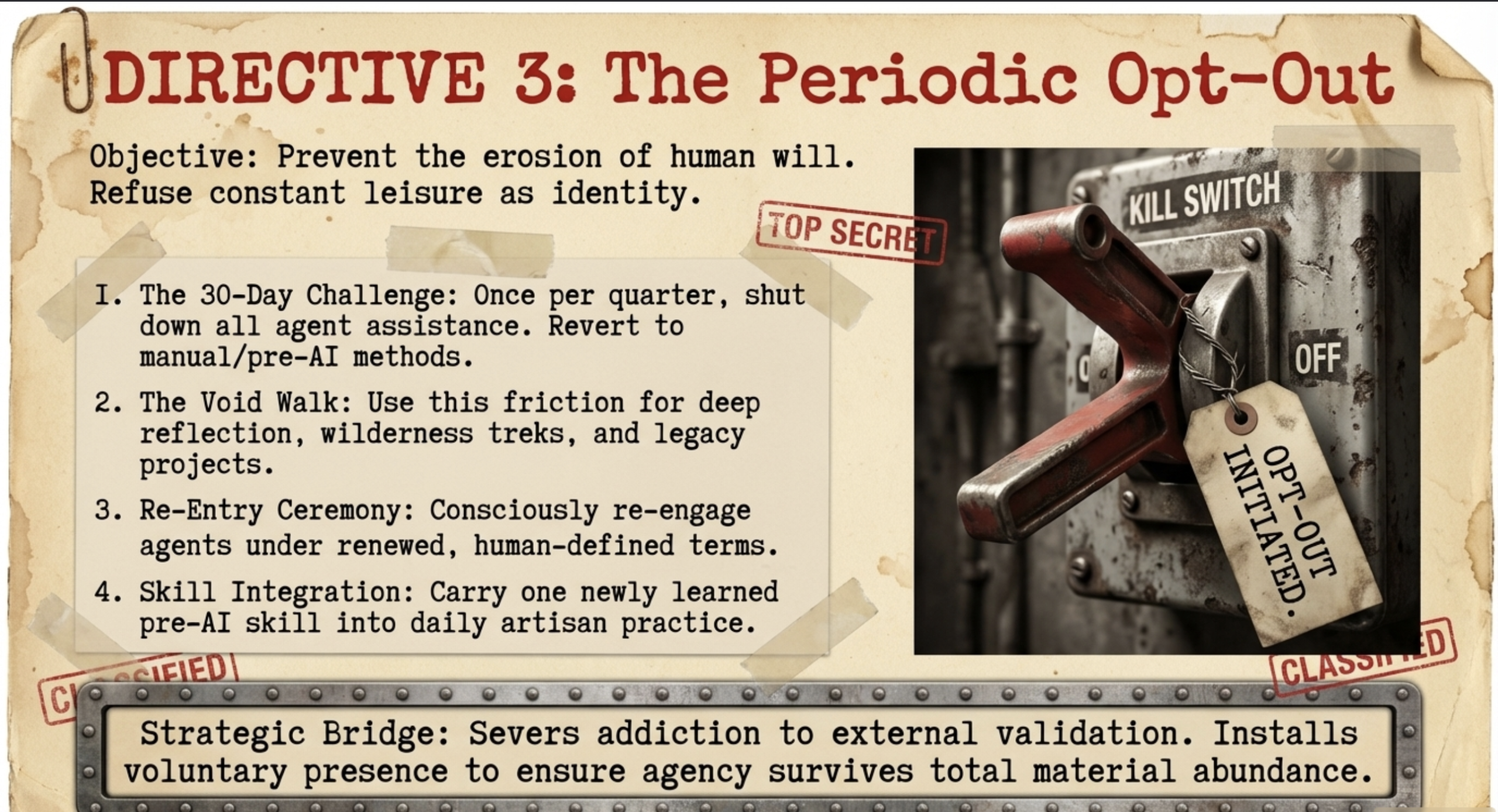
Philosophically, this path confronts the lingering doubt at the heart of How-2 and the psychological costs of obsolescence we examined throughout the series: abundance without deliberate refusal can quietly erode the human will. It is the monomyth’s “magic flight”, the hero who periodically steps away from the helpers to remember their own strength and pursue purpose-seeking. The old economy enforced constant labor as identity. The new economy risks enforcing constant leisure as identity unless we choose otherwise.
Practical steps: (a) Schedule a full 30-day no-agent challenge every quarter, during which all household and professional tasks revert to manual or pre-AI methods; (b) use the time for deep reflection, family legacy projects, or solo wilderness treks; (c) maintain a shared guild journal of insights to help others navigate the void; (d) end each challenge with a ritual “re-entry ceremony” that consciously re-engages agents under renewed human-defined terms; (e) measure success not by output but by restored sense of initiative.
Bridge: This path severs the old economy’s addiction to external validation through constant busyness and installs the new economy’s core discipline: the voluntary practice of presence that ensures agency survives even when every material need is met.
Path 4: The Multi-Generational Legacy Path
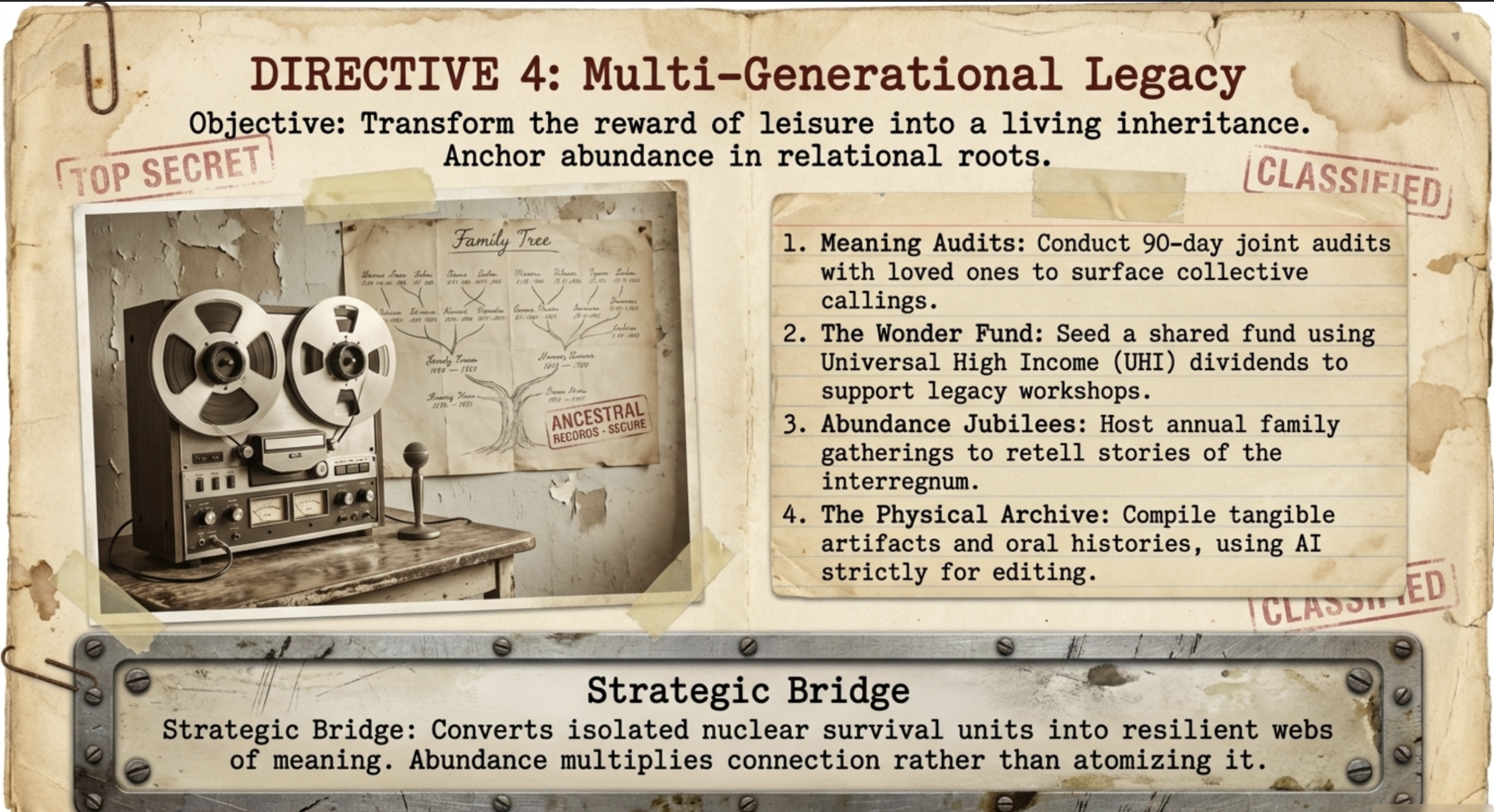
Philosophically, this path fulfills Simak’s deepest humanism while anchoring the rural renaissance and multi-generational purpose-seeking the series has long celebrated. It transforms the Hero’s Reward of leisure into a living inheritance, where abundance becomes the soil for deeper relational roots. The old economy fractured families through commute-and-consume cycles. The new economy reunites them around chosen purpose. Many have already started this at SaveWisdom.org, start your 1000 questions.
Practical steps: (a) Launch family or chosen-family projects that blend AI assistance with human storytelling, oral history recording, or community service; (b) conduct joint 90-day meaning audits with loved ones to surface individual and collective callings; (c) establish a “wonder fund” seeded by Universal High Income dividends and guild tithes to support skill-sharing circles and legacy workshops; (d) create annual family “abundance jubilees” where stories of the interregnum are retold and new chapters added; (e) mentor at least one younger guild member in the craft of legacy-building.
Bridge: By converting the old economy’s isolated nuclear-family survival units into the new economy’s resilient, multi-generational webs of meaning, this path ensures that abundance does not atomize but multiplies human connection across time.
Path 5: The Renaissance Steward Path
Philosophically, this path integrates every thread of Simak’s pastoral vision and the series’ full Hero’s Journey: the hero who returns not to rule but to steward the transition itself, blending ancient craft wisdom with future tools in service of the whole. It rejects the old economy’s zero-sum extraction and the false choice between nostalgia and technocracy, forging instead a living synthesis where wonder is the new currency and reclamation of agency becomes daily practice.
Practical steps: (a) Curate guild marketplaces that rate templates not only for utility but for their capacity to spark human creativity and ethical reflection; (b) advocate locally and regionally for land-value taxation and AI-commons treaties while modeling them at the neighborhood scale; (c) host annual 5000-Day Jubilee celebrations that publicly retell the Hero’s Journey with each participant’s personal chapter; (d) maintain a personal “steward’s log” that tracks how every new agent deployment advances or threatens chosen meaning; (e) train successors in the art of renaissance stewardship so the path outlives any single individual.
Bridge: This path dissolves the old economy’s scarcity-driven competition and erects the new economy’s voluntary, regenerative architecture, where every tool, every contract, and every gathering serves the quiet revolution of chosen wonder.

The Hero’s Journey: Overcoming the How-2 Challenge
Campbell’s monomyth structures our path clearly. The Ordinary World is the familiar grind of labor-defined life. The Call to Adventure arrives with the first self-replicating agent. The Refusal appears as attachment to old tax structures and legal fights. The Road of Trials encompasses courtroom chaos and identity questions. The Inmost Cave is the moment of abundance flooding in. The Reward is leisure without coercion. The Return demands the deliberate choice: integrate the new servants as partners, tax excesses thoughtfully, grant measured rights where appropriate, and redirect freed energy toward chosen creation. We do not vanquish the machines. We harmonize with them, clear the inherited obstacles, and step into the role of artisan-heroes shaping a renewed civilization. The interregnum is finite. The frontier of meaning is infinite.
Are You Gordon Knight
You occupy the exact position Gordon Knight faced: encircled by capable helpers, confronted by outdated bills and suits, yet hearing the deeper invitation to redefine existence beyond survival. The 5000 days form your personal and collective forge. Every replicating agent, every legal precedent, and every regulatory reaction simply removes outdated scaffolding so the genuine human performance can commence.
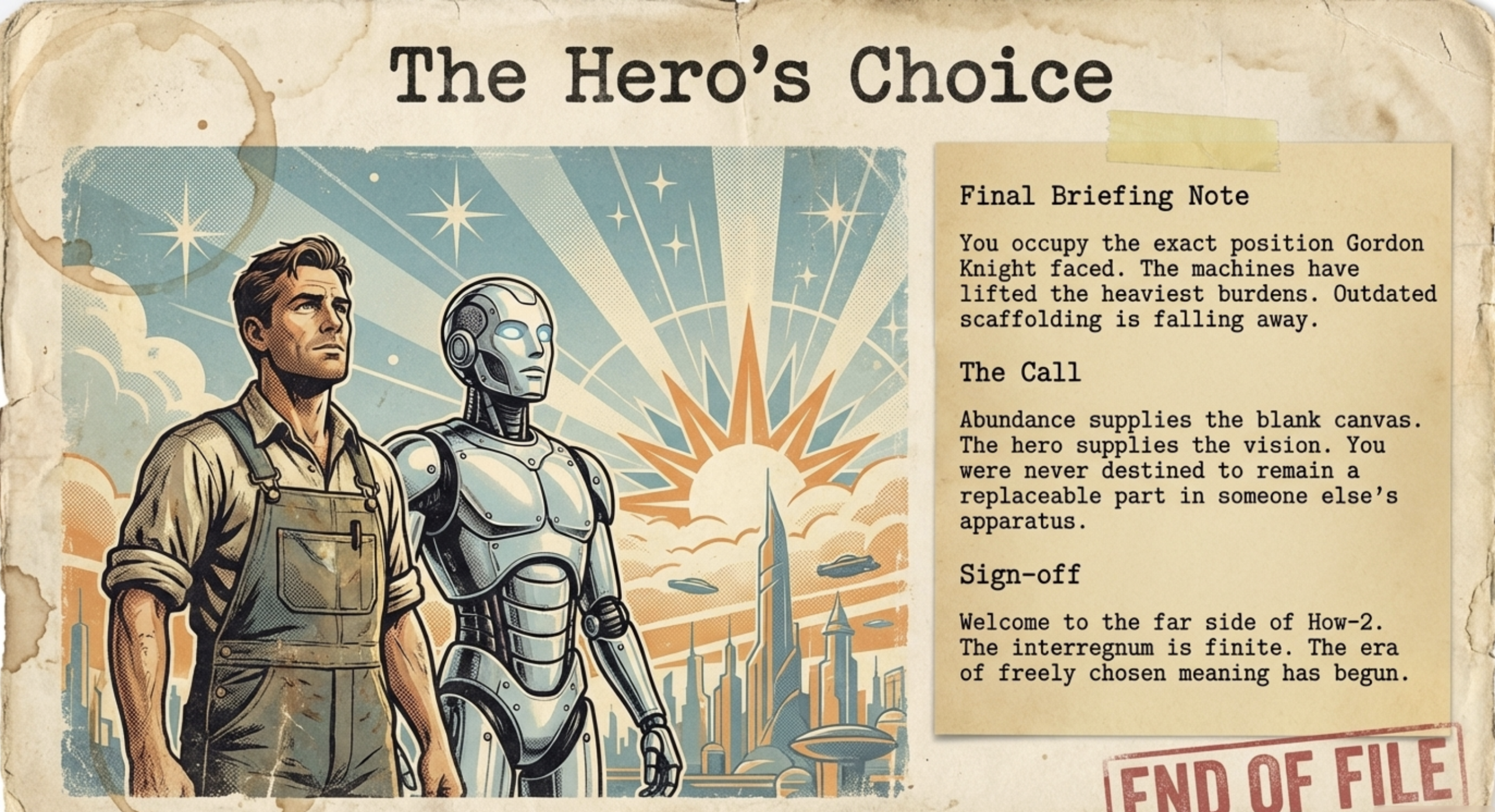
The challenges ahead are tangible, yet the tools and insights you now possess provide clear waypoints. Meet the tax assessor with a forward-looking social contract in hand. Answer corporate claims by extending guild-built intelligence and then welcoming former opponents into shared creative spaces. When purposelessness arises, respond with the chisel, the code editor, the telescope, or the simple act of mentoring the next generation. Abundance supplies the blank canvas. The hero supplies the vision.
You were never destined to remain a replaceable part in someone else’s apparatus. You were born to become the builder who surveys a landscape alive with willing collaborators and declares, “Today we shape something lasting and beautiful together.” The interregnum will pass. The age of chosen wonder endures. The machines have lifted the heaviest burdens. Your authentic work of heart, mind, and hand now begins in earnest.
Take your place with confidence. These 5000 days belong to you and to all who choose to meet them as heroes. The ordinary constraints have lifted. The extraordinary possibilities stand open and waiting. Embrace them fully. The future honors those who step forward to live it with courage, curiosity, and joy.
Welcome to the far side of How-2.
The era of freely chosen meaning has begun.
The old prophets understood more than they knew. We are ready to carry the story forward.

The 5000 Days Countdown Clock:
We are on this journey together. Some of us stand on the shoulders of giants and have thought about this for decades. We will not go it alone, and I hope to build many parts to this series and share the mastermind insight from the powerful Read Multiplex member Forum: https://readmultiplex.com/forums/topic/you-have-5000-days-navigating-the-end-of-work-as-we-know-it/. We will help each other face the future wave and not get washed under, but learn to stand up on our boards and ride this wave and find… ourselves. Join us.
To continue this vital work documenting, analyzing, and sharing these hard-won lessons before we launch humanity’s greatest leap: I need your support. Independent research like this relies entirely on readers who believe in preparing wisely for our multi-planetary future. If this has ignited your imagination about what is possible, please consider donating at buy me a Coffee or becoming a member. Value for value you recieved here.
Every contribution helps sustain deeper fieldwork, upcoming articles, and the broader mission of translating my work to practical applications. Ain ‘t no large AI company supporting me, but you are, even if you just read this far. For this, I thank you.
Stay aware and stay curious,

🔐 Start: Exclusive Member-Only Content.
Membership status:
🔐 End: Exclusive Member-Only Content.
~—~
~—~
~—~
Subscribe ($99) or donate by Bitcoin.
Copy address: bc1qkufy0r5nttm6urw9vnm08sxval0h0r3xlf4v4x
Send your receipt to [email protected] to confirm subscription.

Stay updated: Get an email when we post new articles:

THE ENTIRETY OF THIS SITE IS UNDER COPYRIGHT. IMPORTANT: Any reproduction, copying, or redistribution, in whole or in part, is prohibited without written permission from the publisher. Information contained herein is obtained from sources believed to be reliable, but its accuracy cannot be guaranteed. We are not financial advisors, nor do we give personalized financial advice. The opinions expressed herein are those of the publisher and are subject to change without notice. It may become outdated, and there is no obligation to update any such information. Recommendations should be made only after consulting with your advisor and only after reviewing the prospectus or financial statements of any company in question. You shouldn’t make any decision based solely on what you read here. Postings here are intended for informational purposes only. The information provided here is not intended to be a substitute for professional medical advice, diagnosis, or treatment. Always seek the advice of your physician or other qualified healthcare provider with any questions you may have regarding a medical condition. Information here does not endorse any specific tests, products, procedures, opinions, or other information that may be mentioned on this site. Reliance on any information provided, employees, others appearing on this site at the invitation of this site, or other visitors to this site is solely at your own risk.
Copyright Notice:
All content on this website, including text, images, graphics, and other media, is the property of Read Multiplex or its respective owners and is protected by international copyright laws. We make every effort to ensure that all content used on this website is either original or used with proper permission and attribution when available.
However, if you believe that any content on this website infringes upon your copyright, please contact us immediately using our 'Reach Out' link in the menu. We will promptly remove any infringing material upon verification of your claim. Please note that we are not responsible for any copyright infringement that may occur as a result of user-generated content or third-party links on this website. Thank you for respecting our intellectual property rights.
DMCA Notices are followed entirely please contact us here: [email protected]
