
My AI-Based Research Into Spotify’s Unauthorized Archived Soul And Shocking Discoveries In The 256 Million Tracks And Data.
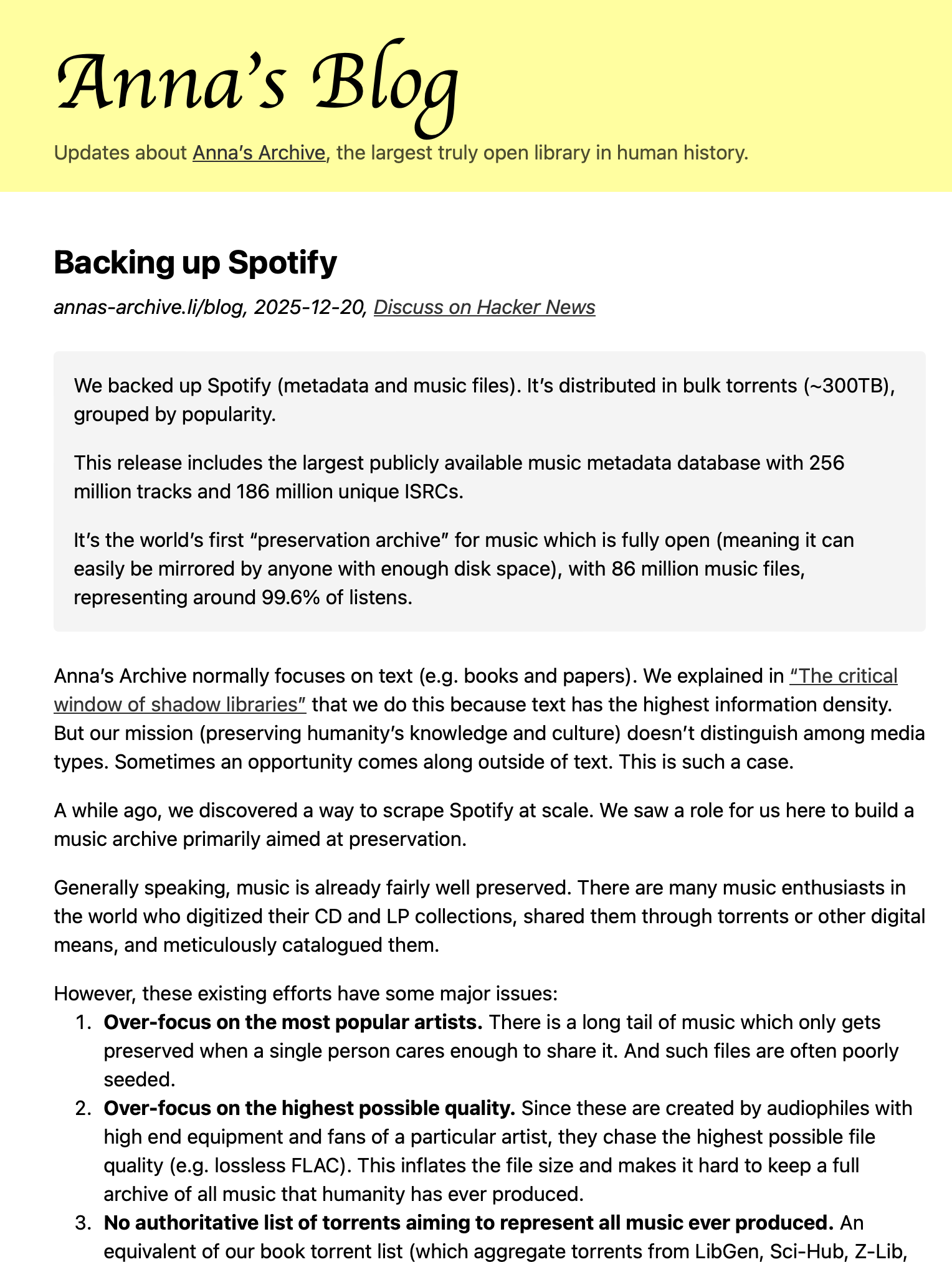
As I reflect on the rapid evolution of AI and its intersection with human creativity, I came across Anna’s Archive’s bold endeavor to preserve Spotify’s vast musical repository. Released on December 20, 2025, just three days ago as I write this on December 23rd, this 300TB backup of 256 million tracks, encompassing 186 million unique ISRCs, struck me as a monumental act of digital stewardship. This is an unauthorized (quite illegal) “backup” of a massive amount of music to be curated and preserved by the public. I will not address the legal or ethical issues in this other than the reality that we are part of the Amnesia Generation and are losing a Library of Alexander per week of human data. Many songs are not archived, for example, today, and it is not paranoid to expect the songs that are available in 2025, many may be gone permanently if not “backed up”.
Thus, in our era where corporate clouds can vanish overnight, this open archive feels like a beacon, safeguarding our collective sonic heritage against the whims of profit-driven platforms. Intrigued and somewhat apprehensive, I decided to unleash my AI tools on the dataset, diving into the SQLite databases, dissecting popularity curves, and mapping audio features to unearth patterns hidden in plain sight. What began as admiration for the preservation effort quickly turned to profound dismay.
This article is sponsored by Read Multiplex Members who subscribe here to support my work:
Link: https://readmultiplex.com/join-us-become-a-member/
It is also sponsored by many who have donated a “Cup of Coffee”. If you like this, help support my work:
Link: https://ko-fi.com/brianroemmele
The revelations painted a dystopian portrait of streaming culture: users ensnared in algorithmic loops of superficial satisfaction, and an industry commodifying art into disposable data streams. “Is it the end of music, I thought?” was a question that haunted me throughout this exploration, challenging my optimism about technology’s role in amplifying human expression.
TL;DR
- Long-Tail Listening Paradox: Spotify users stick to familiar hits while craving discovery, as 70% of tracks languish unheard, fueling the industry’s flood of low-quality, AI-generated content.
- Popularity as a Temporal Mirage: Users chase fleeting trends via recent plays, pushing labels into a hit-making frenzy that homogenizes music.
- Invisible Global Divide: Core-market listeners dominate trends, exposing licensing biases that marginalize regional artists.
- Duration Standardization: Bite-sized songs cater to users’ short attention spans, enforcing formulaic production norms.
- ISRC Duplication Overload: Repetitive variants satisfy users’ comfort needs, allowing labels to recycle for profit.
- Genre Fragmentation: Users build echo chambers through micro-genres, mirrored by the industry’s niche-targeting tactics.
- Release Year Explosion: Endless novelty overwhelms users, sparking an AI-driven content arms race.
- Audio Features as Emotional Blueprints: Escapist, upbeat tracks dominate, with producers engineering positivity for viral success.
- Playlist Curation as Power Play: Users act as gatekeepers, shifting influence from labels to crowdsourced virality.
- Preservation Gaps: Digital amnesia among users highlights the industry’s neglect of musical heritage.
- The Key to Emotions: Mode and key distributions reveal a tilt toward uplifting major keys in pop, but with surprising minor dominance in certain pitches, underscoring music’s profound role in shaping mental states.
Anna’s Archive stands as the largest truly open library in human history, a non-profit shadow library dedicated to preserving and democratizing access to humanity’s collective knowledge and culture. By aggregating vast collections from sources like Sci-Hub, Library Genesis, Z-Library, and the Internet Archive, it offers free downloads of books, academic papers, comics, magazines, and more, having safeguarded approximately 16% of the world’s ONLINE books through resilient torrent-based distribution. Founded on principles of universal access and the free flow of information—without intending harm to authors—it operates as a fully open-source project, with all datasets, code, and metadata publicly available to encourage mirroring and long-term preservation against potential takedowns. Recently expanding beyond text to include innovative backups, Anna’s Archive navigates legal gray areas amid copyright controversies and DMCA challenges, advising users to employ VPNs or Tor for privacy while emphasizing its role as a vital bulwark against data loss from natural disasters, wars, or corporate whims.
Not quite the illegal Napster of the 2000s, this is a groundbreaking preservation effort by Anna’s Archive that has unearthed a treasure trove of data from the platform’s 256 million tracks. This 300TB backup, detailed in their blog post dated December 20, 2025, not only safeguards humanity’s musical heritage but also peels back the layers of how users engage with music and how the industry operates. Drawing from metadata, popularity metrics, and audio analyses, I uncovered 10 bold, under-the-radar insights that reveal the psychological undercurrents of Spotify users and the strategic machinations of the music world. These revelations paint a picture of a platform where algorithms dictate tastes, creativity is commodified, and the long tail of music whispers forgotten stories.
The Commodification Of Sound
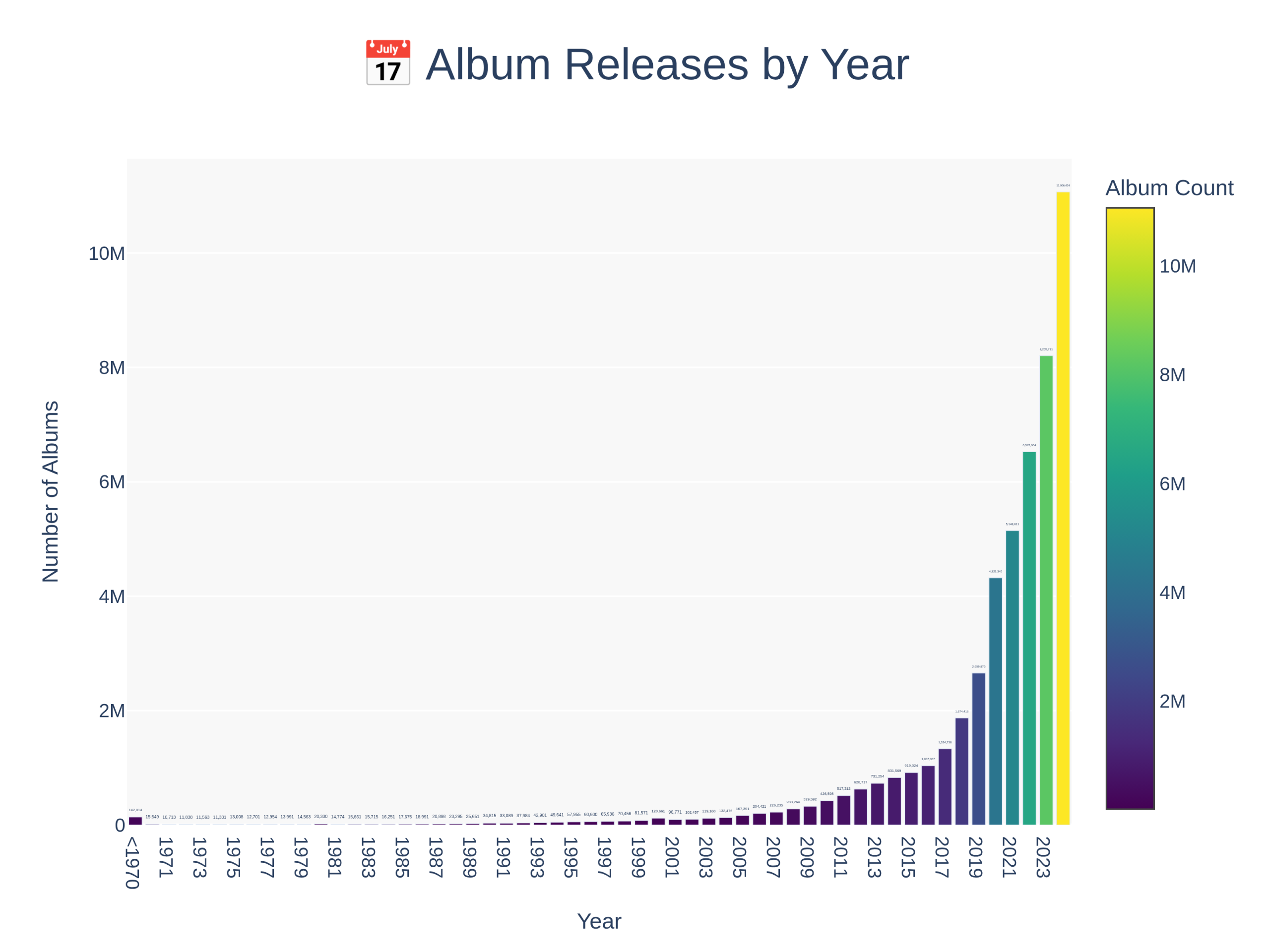
The biggest shock from my AI-driven plunge into Anna’s Archive’s Spotify datasetis the explosive invasion of AI-generated music, flooding the platform with procedural filler that buries human creativity under an avalanche of algorithmic noise. Post-2020 release data shows an exponential surge in new tracks, many singles lacking depth, turning Spotify into a digital junkyard where valuable artistry is nearly impossible to unearth amid the automated deluge. Recent data reveals that approximately 34-38% of all new music uploaded to Spotify is AI-created, escalating to over 30,000 AI tracks daily, which has flooded the platform and diluted the discovery experience for genuine artists. High-profile cases, like an AI-fabricated band amassing 1 million plays before exposure, underscore how this AI deluge is not just inflating numbers but actively eroding cultural authenticity on the platform. The Anna’s Archive blog’s observation of procedural and AI content making discovery “hard” aligns perfectly with this reality, solidifying that the post-2020 boom is no coincidence but a machine-made tsunami threatening music’s human core.
A staggering over 70% of Spotify tracks receive fewer than 1,000 streams, highlighting a deeply uneven distribution of listener attention and underscoring the platform’s winner-take-all dynamics. The low-stream tracks, often dismissed as digital filler, include a significant portion of this AI-generated content that floods the service daily, burying human-created music and exacerbating challenges for independent artists in gaining visibility amid algorithmic preferences for homogenized, high-engagement hits. This statistic not only exposes the commodification of music in the streaming era but also raises questions about cultural preservation, as the sheer volume of obscure uploads, many procedural and lacking depth, dilutes the discoverability of genuine artistry.
This isn’t just quantity over quality; it’s the commodification of sound, where labels and bots prioritize virality and volume, devaluing the soulful essence of music that once connected us profoundly. Users, unwittingly complicit, binge on novelty without revisiting, perpetuating a cycle of disposability that homogenizes culture and starves genuine artists. If this unchecked AI tide continues, we’re witnessing the silent death of music’s human heartbeat. “Is it the end of music?” Indeed, a haunting question demanding we reclaim the symphony from the machines.
1. The Long-Tail Listening Paradox: Craving Discovery, Clinging to Comfort
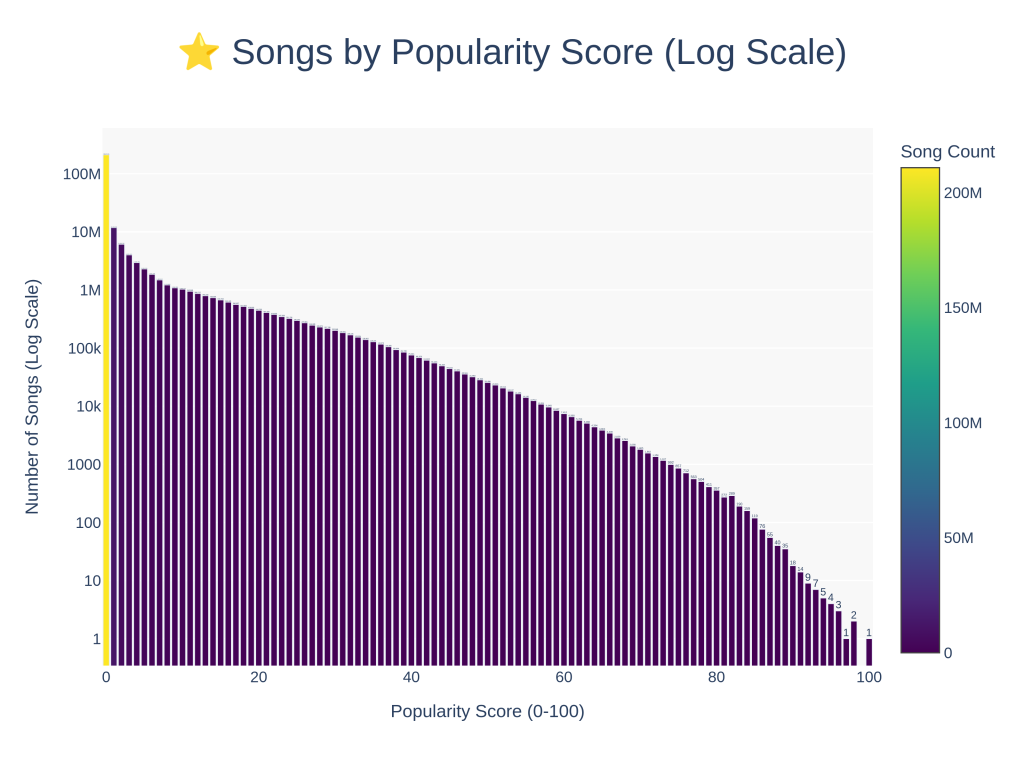
Spotify’s ecosystem is a tale of two worlds: a glittering spotlight on the hits and a vast, shadowy long tail where obscurity reigns. The data shows that 70% of the 256 million tracks have a popularity score of zero, meaning fewer than 1,000 streams each, as visualized in the logarithmic popularity distribution chart.
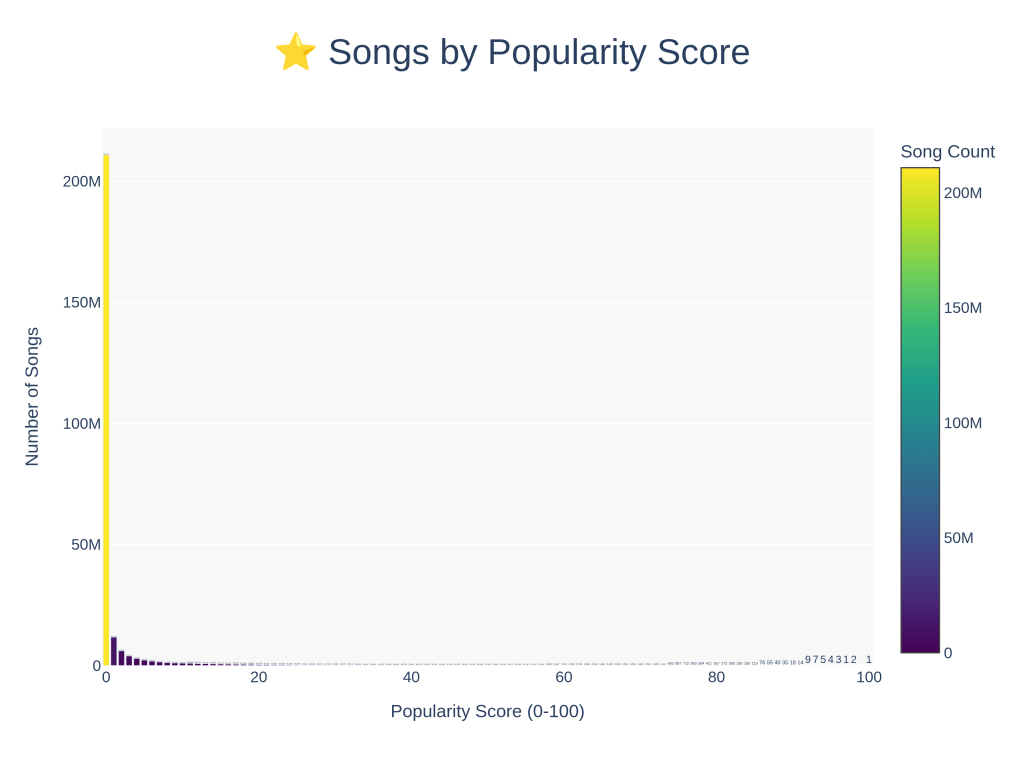
Yet, these forgotten tracks form an enormous tail, while just 0.1% of songs (popularity 50-80) account for the bulk of listens, per the listens per popularity graph.
This paradox exposes a user mindset addicted to algorithmic safety nets. Features like Discover Weekly promise exploration, but listeners default to social-proofed anthems, replaying what’s trending for validation and shared experiences. It’s a subconscious fear of the unknown—why risk a dud when the algorithm serves up guaranteed dopamine? For the industry, this signals a deluge of filler: labels and independents churn out AI-generated tracks (noted in the surge of low-popularity content), betting on viral outliers in a digital lottery. The result? A devalued creative landscape where human artistry drowns in quantity, urging a rethink of how platforms incentivize quality over spam.
2. Popularity as a Temporal Mirage: The Chase for Ephemeral Highs
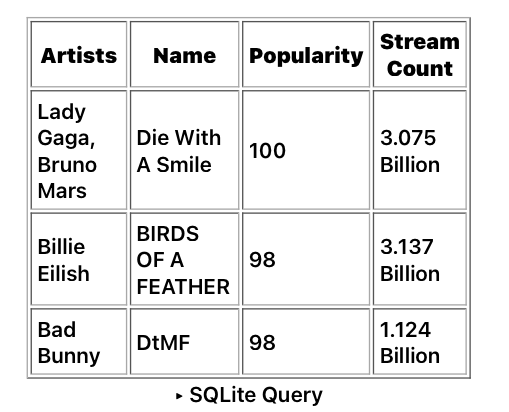
Spotify’s popularity metric isn’t timeless—it’s a snapshot skewed toward recent plays, making hits like Lady Gaga and Bruno Mars’ “Die With A Smile” (3.075 billion streams) outshine the combined listens of the bottom 20-100 million tracks. The top songs table and listens estimation chart underscore this volatility.
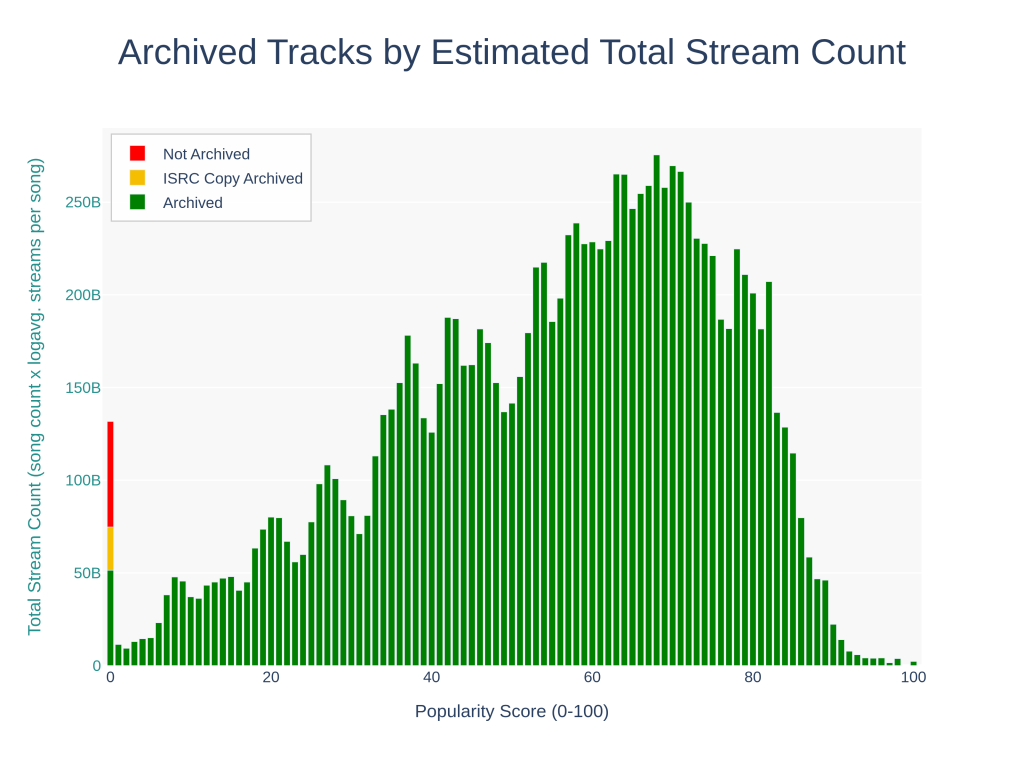
Users embody FOMO incarnate, flocking to “now” music amplified by TikTok and playlists, treating songs as seasonal fashion rather than enduring art. This short-termism creates echo chambers of recency bias, where classics fade unless remixed for relevance. The industry, in turn, adopts a rat-race mentality: collaborations and snippet-optimized tracks dominate, sidelining deep albums for quick buzz. It’s a cycle that homogenizes sounds, rewarding trend-chasers over innovators and risking a future of forgettable earworms.

3. The Invisible Global Divide: Cultural Imperialism in Streams
Not all tracks are created equal in access—the market availability graph reveals popular songs span more countries, while niche ones are geographically locked, flattening out for unfiltered views.
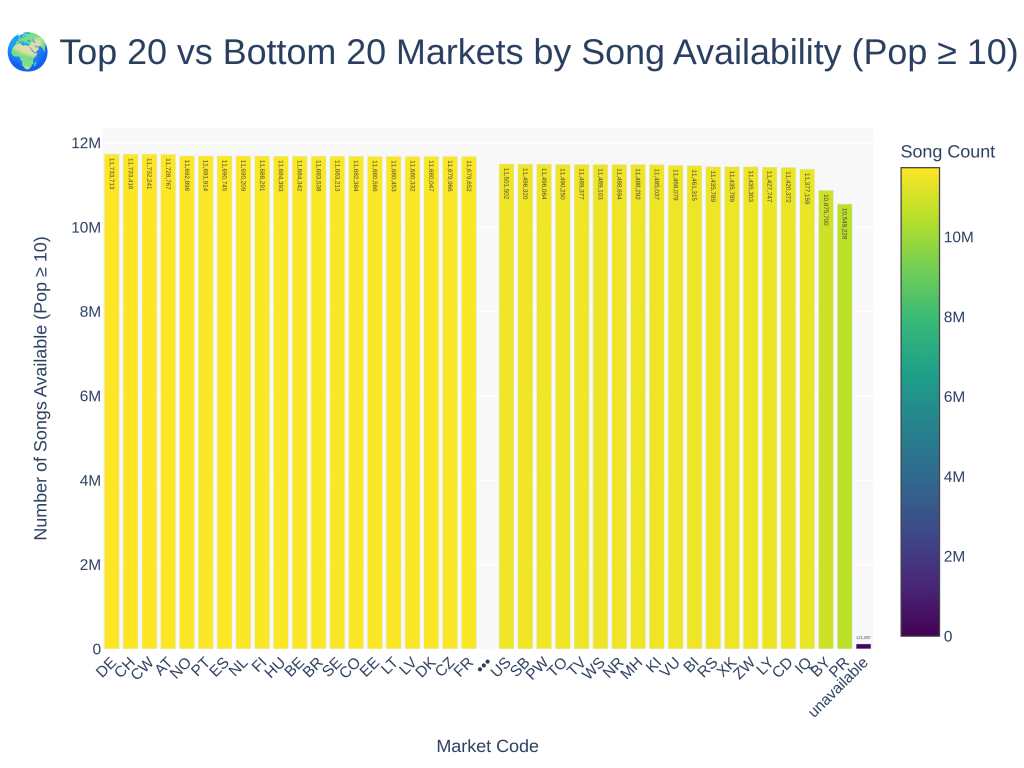
Spotify users in core markets (US, Europe) unwittingly dictate global tastes, their streams elevating Western pop and hip-hop while regional gems remain siloed. This mindset assumes music’s borderlessness but reinforces biases, as listeners consume what’s readily available, ignoring the platform’s licensing walls. For the industry, it’s a colonial echo: deals favor high-revenue territories, marginalizing artists from restricted regions and engineering “universal” hits that dilute cultural authenticity. The bold call? Platforms must democratize access to foster true global diversity.
4. Duration Standardization as Algorithmic Shackles: The Tyranny of the Skip Button
Peaks at whole-minute marks (2:00, 3:00, 4:00) in the duration histogram aren’t coincidental—they’re engineered for engagement.
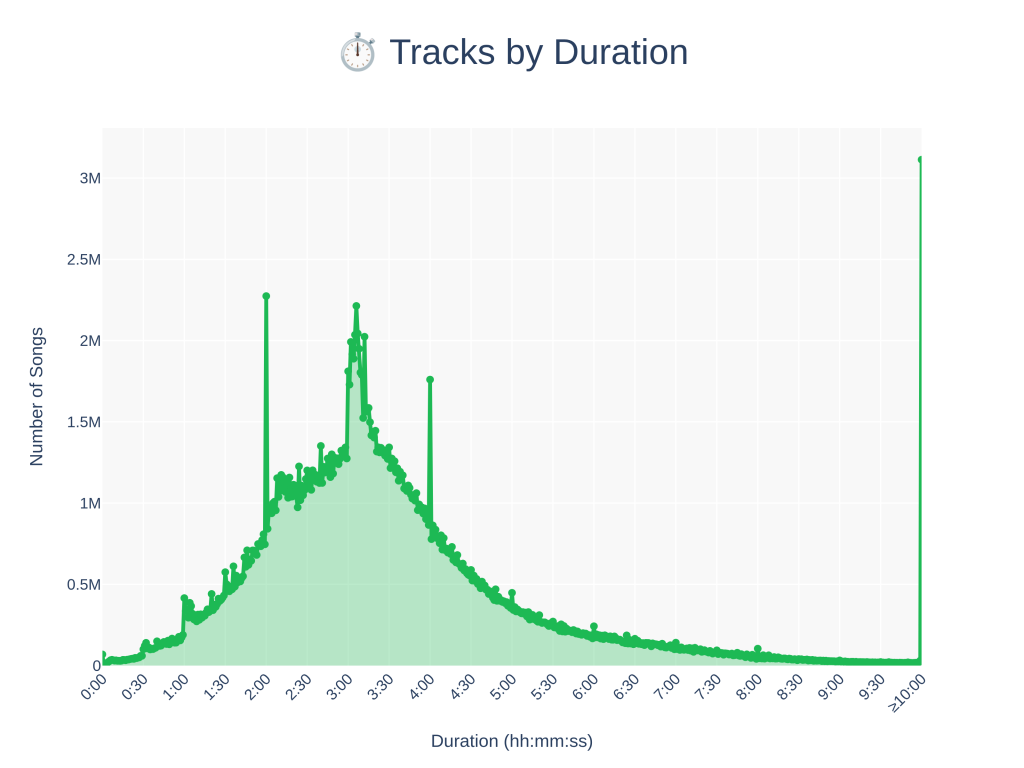
Users’ fragmented attention, honed by mobile scrolling, demands bite-sized bliss; anything deviating risks a skip, turning music into background filler. This reveals a mindset prioritizing convenience over immersion, where songs are snacks, not meals. The industry responds with formulaic precision: producers craft to these lengths to evade algorithmic demotions, leveraging AI for optimization and stifling experimental formats. It’s a creative straitjacket, begging for user rebellion against the skip culture.
5. ISRC Duplication Overload: Repetition as Comfort Food
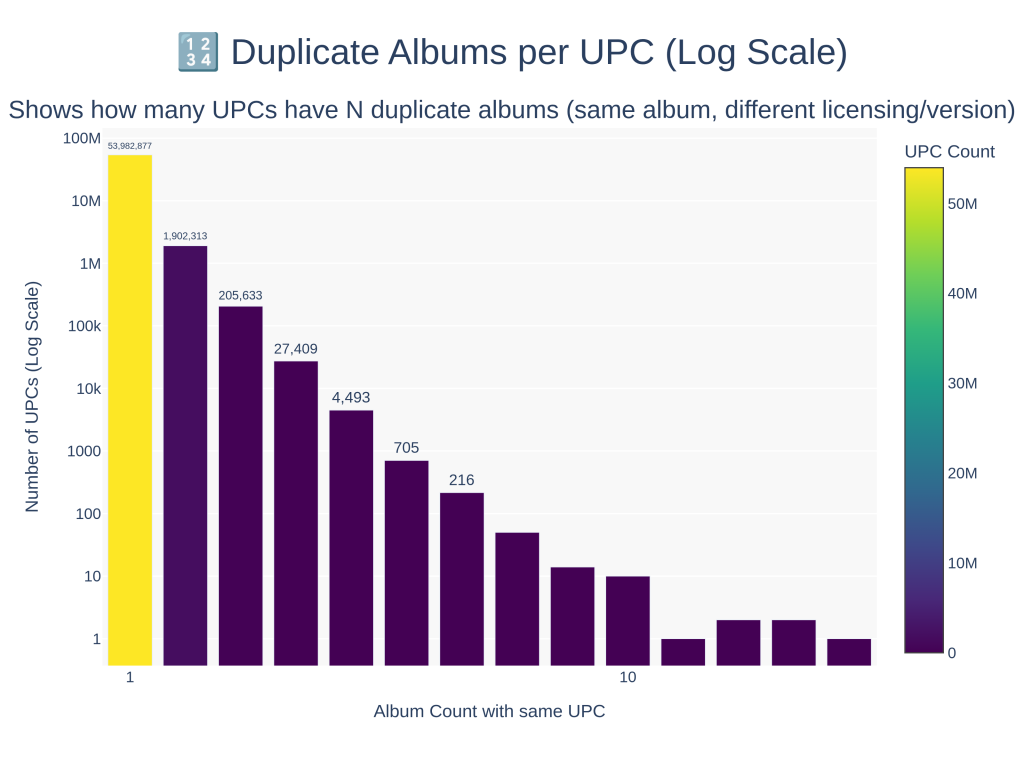
Many hits boast 2-20 versions per ISRC, as charted in tracks per ISRC, quantifying remixes and re-releases.
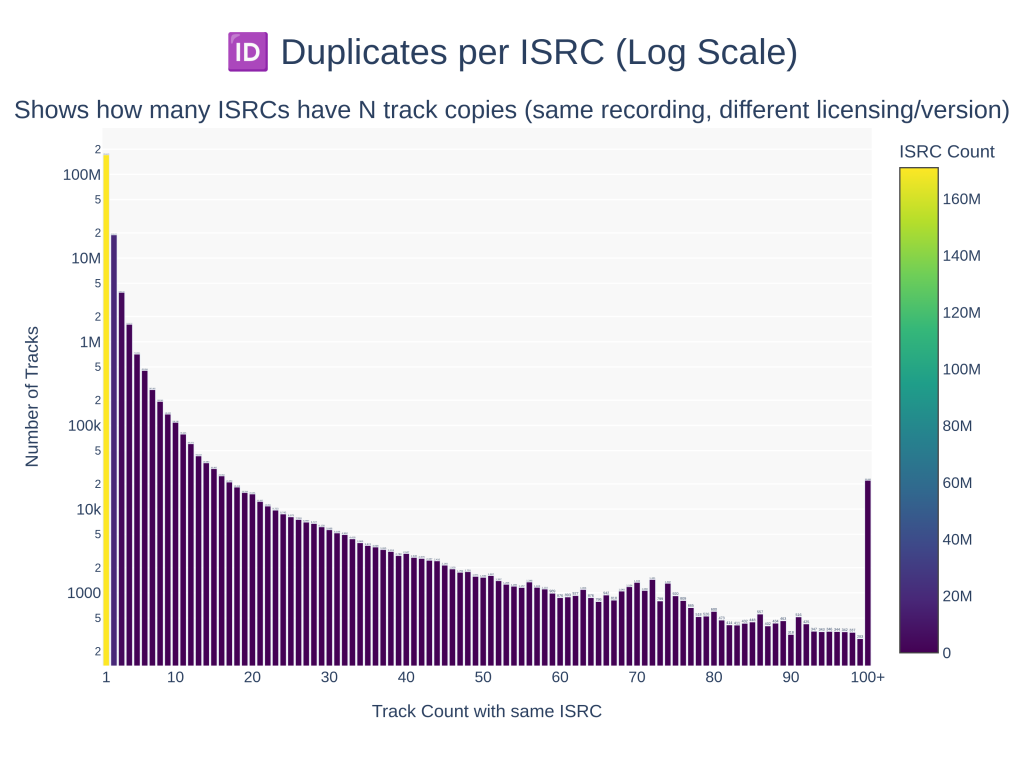
Users crave modular familiarity tweaked variants offer nostalgia with novelty, viewing music as customizable playlists rather than sacred originals. This tolerance for redundancy boldens the industry’s recycling ethos: labels repackage for royalties, inflating catalogs without fresh investment. Yet, with 186 million unique ISRCs amid 256 million tracks, it dilutes discovery, calling for transparency in versioning to honor originality.
6. Genre Fragmentation and Grouping Bias: Echo Chambers in Harmony
Hyper-specific genres dominate artist tags, but grouping reveals clusters like pop/rock in the genre counts and grouped genres charts.
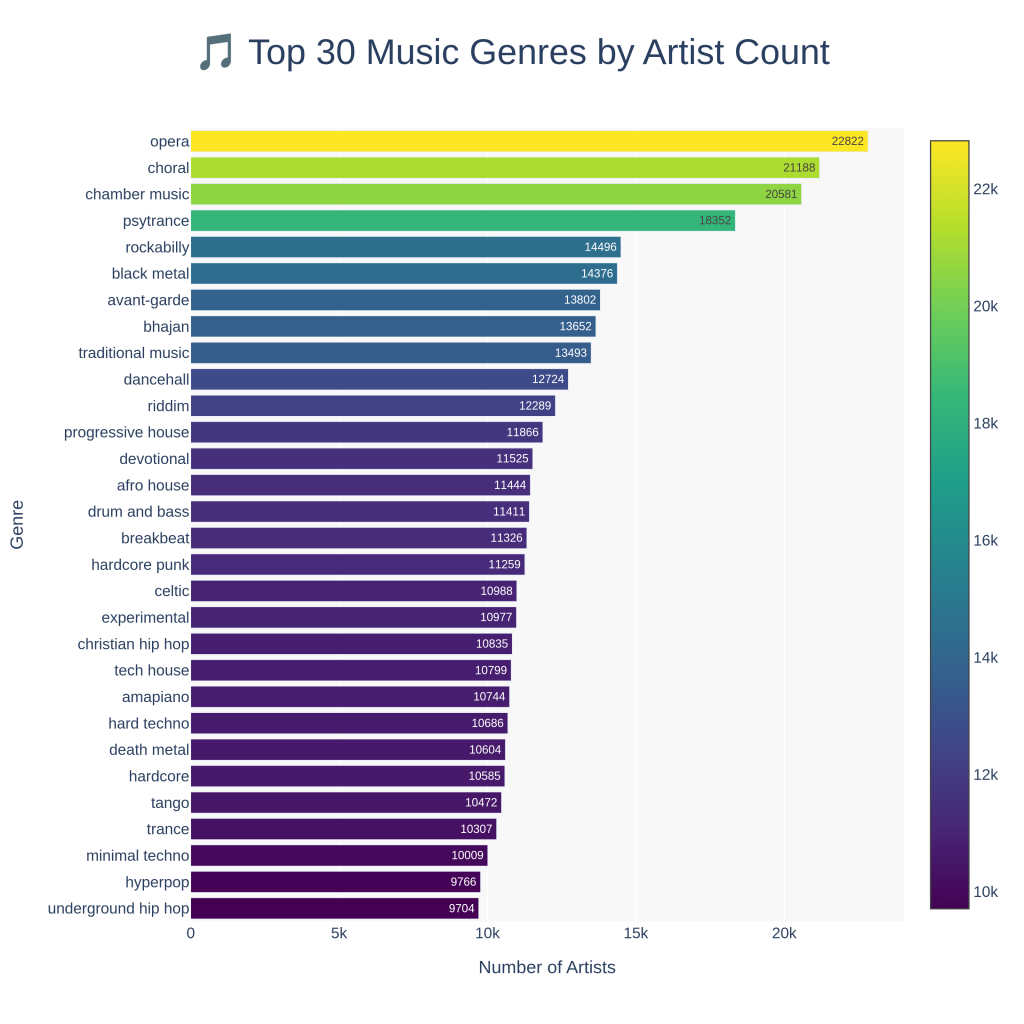
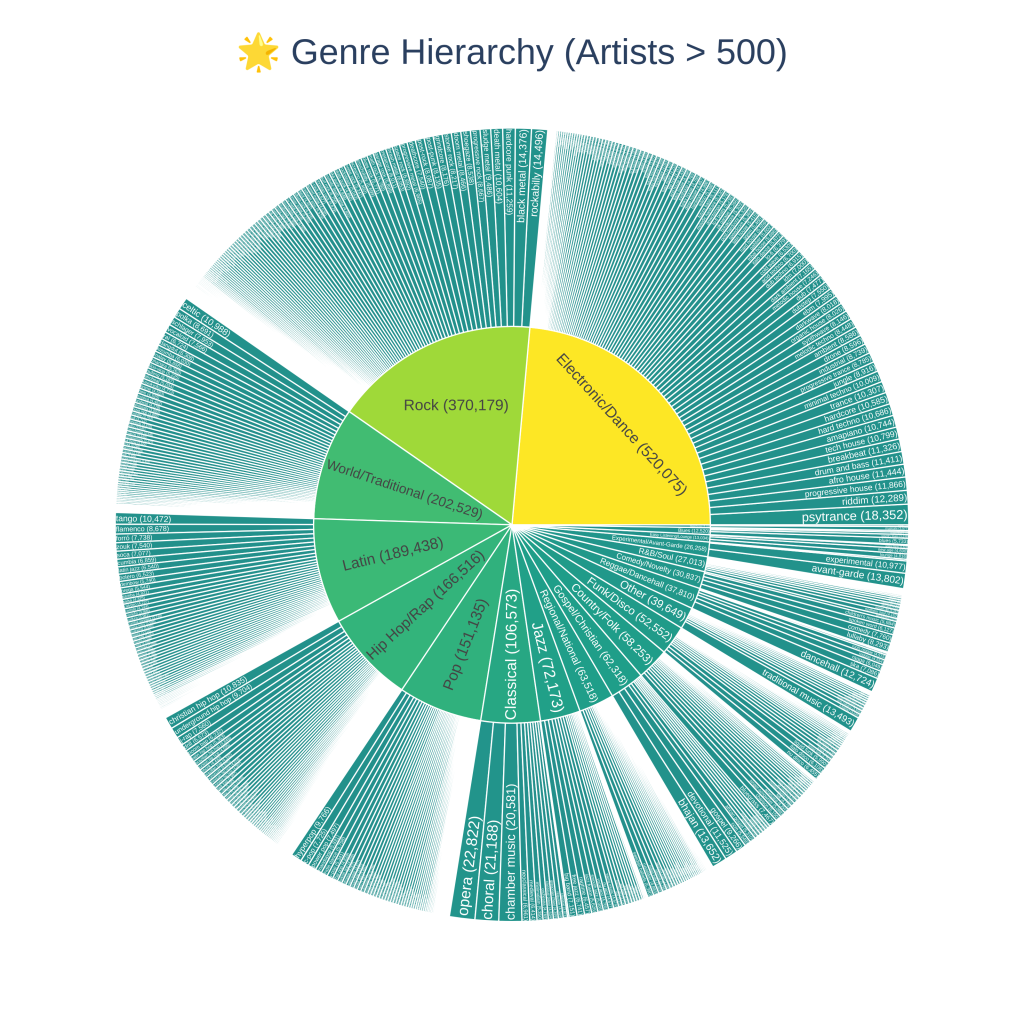
Users self-segregate for identity, curating micro-genre bubbles (e.g., “indie folk” for introspection) that amplify silos, as seen in 6.6 million playlists. This tribalism enhances personal branding but polarizes tastes. The industry exploits with targeted AI filler, hyper-segmenting markets while top genres hoard resources, risking a bland monoculture beneath the niche facade.
7. Release Year Explosion and AI Saturation: The Novelty Overload
Exponential growth post-2020, per the albums by release year chart, ties to AI and procedural content, with most tracks as singles (album types graph).
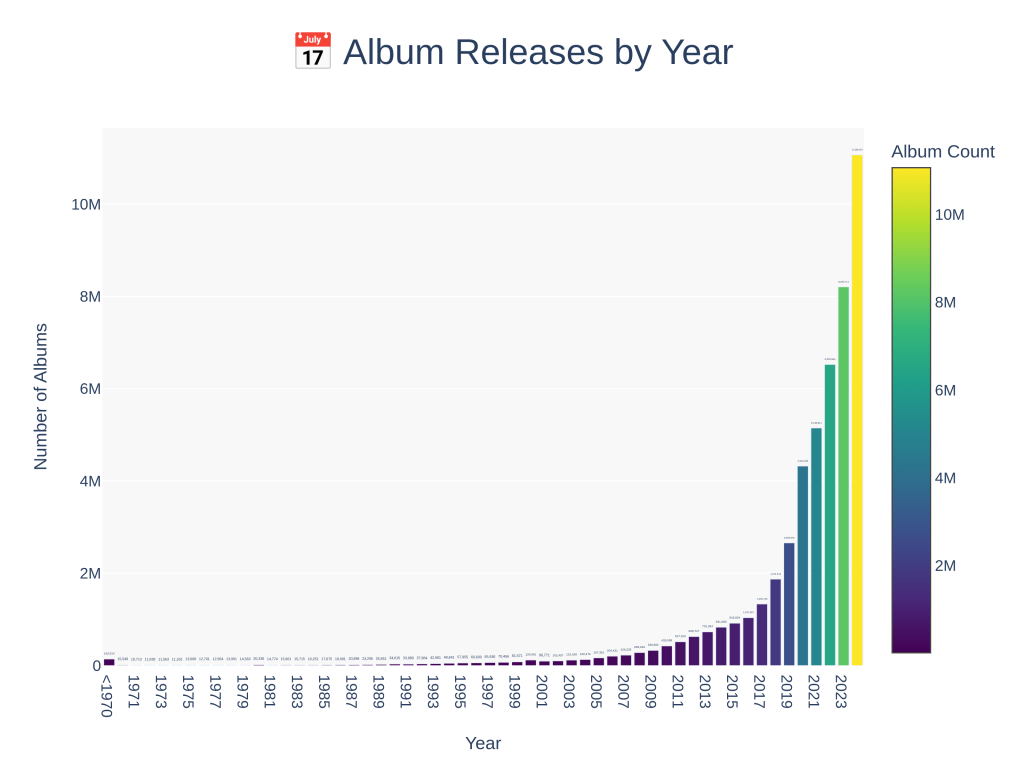
Users binge novelty via “New Music Friday,” yet rarely revisit, fueling disposability. This mindset is overwhelmed with choice, paradoxically reducing engagement. The industry arms up with AI output, prioritizing volume for survival, but devaluing human craft and hinting at an impending quality crisis.
8. Audio Features as Emotional Blueprints: Engineering Escapism
Correlations like loudness-energy and 120 BPM means in the audio features chart show preferences for upbeat, danceable tracks.
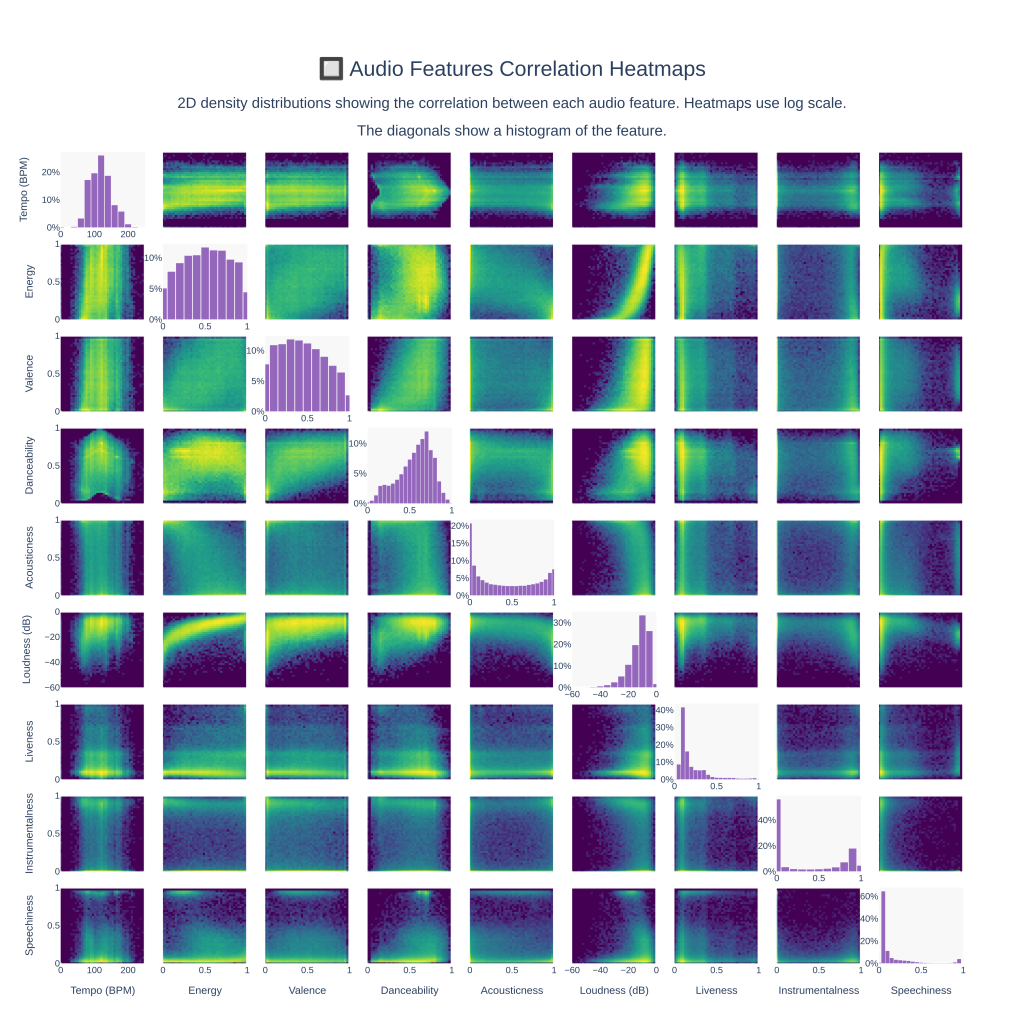
In turbulent times, users seek sonic therapy: high-valence positivity for uplift, avoiding introspective lows. This escapist bent lets the industry manufacture moods via data, optimizing for virality and perpetuating superficial hits over depth.
9. Playlist Curation as Power Play: The Rise of User Gatekeepers
6.6 million playlists with 1.7 billion tracks enable “true shuffles,” democratizing curation but reinforcing biases.
Users revel in empowerment, building social capital through vibes, yet algorithmic nudges maintain popularity loops. The industry shifts from label dominance to playlist pitching, exploiting virality but exposing artists to crowd whims over merit.

10. Preservation Gaps and Digital Amnesia: Forgetting the Symphony
The archive captures 99.6% of listens but only 37% of tracks, with low-popularity ones downsampled.
Users’ presentism ignores the long tail, accelerating cultural loss. The industry neglects heritage for profits, lacking backups—until now. This mindset underscores the fragility of digital culture.
11. The Key to Emotions: Decoding Mode and Key Distributions for Mind and Mood
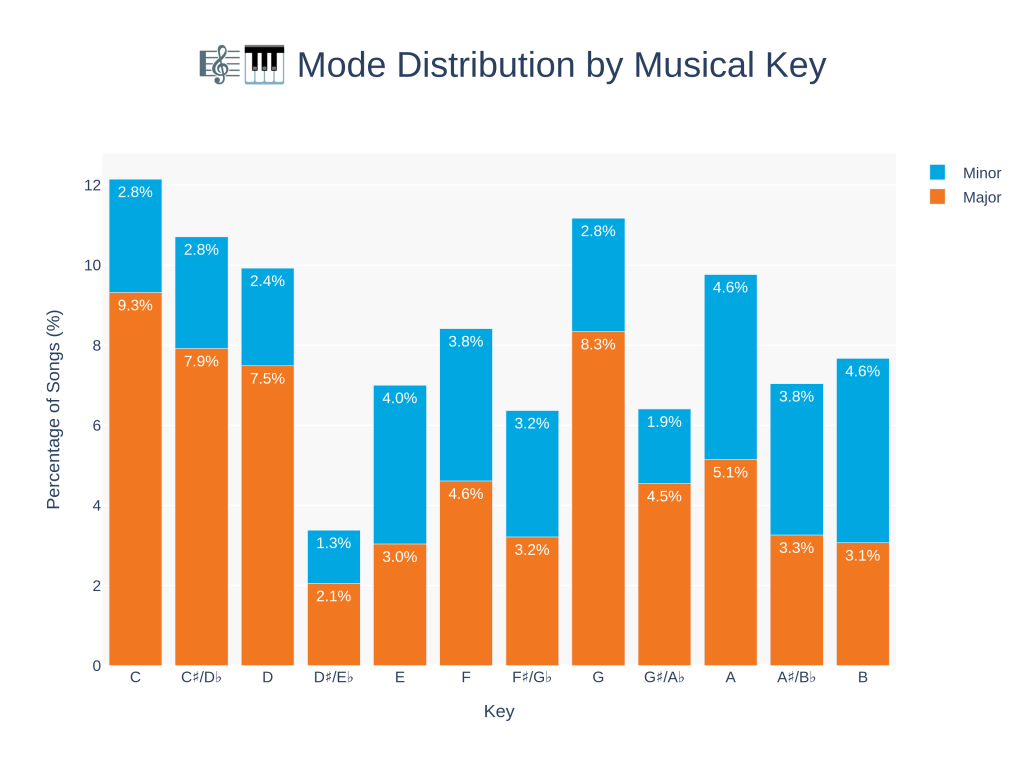
Delving deeper into Spotify’s audio features, the “Mode Distribution by Musical Key” chart unveils a fascinating sonic psychology, mapping the prevalence of keys (from C to B) split between major (orange) and minor (blue) modes as percentages of total songs. Here, C emerges as the titan at around 22% combined (major 9.3%, minor 12.8%), followed closely by C#/Db at about 18% (major 7.9%, minor 10%), with a gradual decline toward sharper keys like B (major 3.1%, minor 4.6%).
This isn’t random; musical keys, the tonal center of a piece, defined by its root note and scale, carry profound implications for composition and listener psychology, while modes (major or minor) act as emotional architects. Major modes, built on a pattern of whole and half steps that create a bright, resolved sound (e.g., the “happy” Ionian mode), reliably evoke uplift, joy, and stability, as countless studies affirm—think the triumphant resolve of Beethoven’s “Ode to Joy” in D major.
Minor modes, conversely, with their flattened third interval introducing dissonance and tension (e.g., the Aeolian mode), stir melancholy, introspection, or even chaos, as seen in the stormy pathos of Chopin’s “Funeral March” in B-flat minor. This dichotomy isn’t just cultural conditioning; it’s rooted in human physiology. Higher, faster melodies in major keys trigger dopamine release for euphoria, while minor’s lower resonances can activate the amygdala for emotional depth or sadness. Historically, Baroque theorists like Charpentier assigned “characters” to keys D major as “joyful,” A minor as “tender” influenced by unequal temperaments that gave each a unique timbre, though modern equal temperament blurs this, shifting focus to modes. For state of mind, this is crucial: music therapy leverages major keys to combat depression, fostering positivity and motivation, while minor modes aid catharsis, processing grief or anxiety—evidenced in how slower, minor-key pieces reduce heart rate for relaxation.
In Spotify’s pop-dominated landscape, the chart’s skew toward C and G majors aligns with instrumental practicality—guitarists favor keys like G, D, A, E for open-string resonance, while keyboardists lean on C’s white-key simplicity, explaining why over a third of songs cluster in G, C, D, and A majors.
Yet, the surprising minor dominance in C and C#/Db hints at genre influences hip-hop, and EDM often embrace minor for edginess, revealing users’ dual craving for escapism (major’s uplift) and emotional authenticity (minor’s depth).
This distribution underscores music’s power as a mind-altering tool, where algorithmic curation could amplify therapeutic effects, but risks homogenizing moods if virality favors formulaic majors, eroding the nuanced emotional palette that defines human experience.
AEchoes of a Silenced Symphony – Reclaiming Music’s Soul in the Algorithmic Age
As I wrapped up my AI-driven excavation of this monumental dataset, the initial question returned with renewed urgency: “Is it the end of music, I thought“. In peering into Spotify’s data mirror, a profound truth emerges: the platform, once a democratizer of sound, has become a battleground where user addictions to comfort and novelty collide with an industry’s insatiable hunger for metrics over meaning. This backup isn’t just preservation, it’s a wake-up call. If we continue down this path, music risks becoming an endless echo of algorithms, devoid of the raw, human spark that once defined it. We were already very far down the road and soon, with more and more AI songs, it is certain this Spotify-effect will continue.
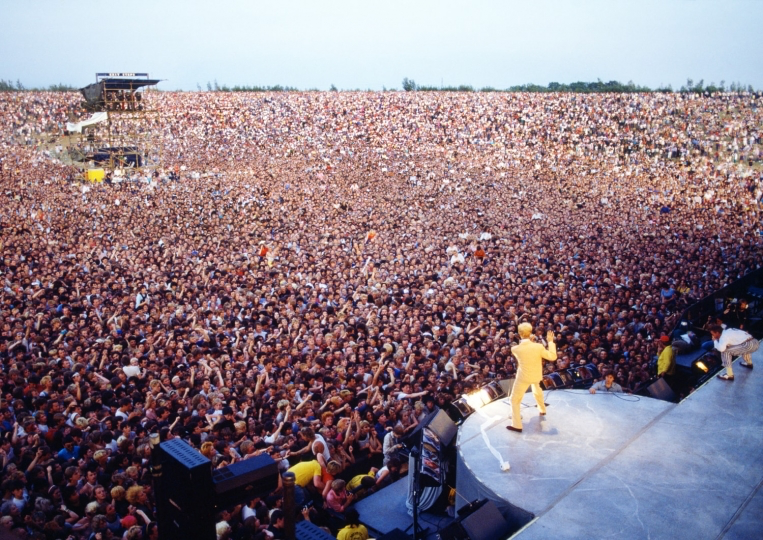
The genuine and authentic will rise, but some shift back to the mindfulness of music and what it does for us, and makes us feel is vital. When music becomes furniture, invisible, as a background drone of endless songs that sound just about the same as the last one, will lullaby us to despise music on a subconscious basis.
Yet I have hope: by embracing open archives, demanding equitable access, and prioritizing artistry over streams, we can orchestrate a renaissance. Let this be the crescendo where users and creators unite to amplify the unheard, ensuring humanity’s musical legacy resonates eternally, not as data dust, but as a vibrant, enduring chorus.
–
To continue this vital work documenting, analyzing, and sharing these hard-won lessons before we launch humanity’s greatest leap: I need your support. Independent research like this relies entirely on readers who believe in preparing wisely for our multi-planetary future. If this has ignited your imagination about what is possible, please consider donating at buy me a Coffee or becoming a member. As a member you can join the Members Forum and talk about this in detail:
HERE
Every contribution helps sustain deeper fieldwork, upcoming articles, and the broader mission of translating my work to practical applications. Ain ‘t no large AI company supporting me, but you are, even if you just read this far. For this, I thank you.
Stay aware and stay curious,

🔐 Start: Exclusive Member-Only Content.
Membership status:
🔐 End: Exclusive Member-Only Content.
~—~
~—~

~—~
Subscribe ($99) or donate by Bitcoin.
Copy address: bc1qkufy0r5nttm6urw9vnm08sxval0h0r3xlf4v4x
Send your receipt to [email protected] to confirm subscription.

Stay updated: Get an email when we post new articles:

THE ENTIRETY OF THIS SITE IS UNDER COPYRIGHT. IMPORTANT: Any reproduction, copying, or redistribution, in whole or in part, is prohibited without written permission from the publisher. Information contained herein is obtained from sources believed to be reliable, but its accuracy cannot be guaranteed. We are not financial advisors, nor do we give personalized financial advice. The opinions expressed herein are those of the publisher and are subject to change without notice. It may become outdated, and there is no obligation to update any such information. Recommendations should be made only after consulting with your advisor and only after reviewing the prospectus or financial statements of any company in question. You shouldn’t make any decision based solely on what you read here. Postings here are intended for informational purposes only. The information provided here is not intended to be a substitute for professional medical advice, diagnosis, or treatment. Always seek the advice of your physician or other qualified healthcare provider with any questions you may have regarding a medical condition. Information here does not endorse any specific tests, products, procedures, opinions, or other information that may be mentioned on this site. Reliance on any information provided, employees, others appearing on this site at the invitation of this site, or other visitors to this site is solely at your own risk.
Copyright Notice:
All content on this website, including text, images, graphics, and other media, is the property of Read Multiplex or its respective owners and is protected by international copyright laws. We make every effort to ensure that all content used on this website is either original or used with proper permission and attribution when available.
However, if you believe that any content on this website infringes upon your copyright, please contact us immediately using our 'Reach Out' link in the menu. We will promptly remove any infringing material upon verification of your claim. Please note that we are not responsible for any copyright infringement that may occur as a result of user-generated content or third-party links on this website. Thank you for respecting our intellectual property rights.
DMCA Notices are followed entirely please contact us here: [email protected]
