
You Have 5000 Days: Navigating the End of Work as We Know It. Part 22: After Universal High Income.
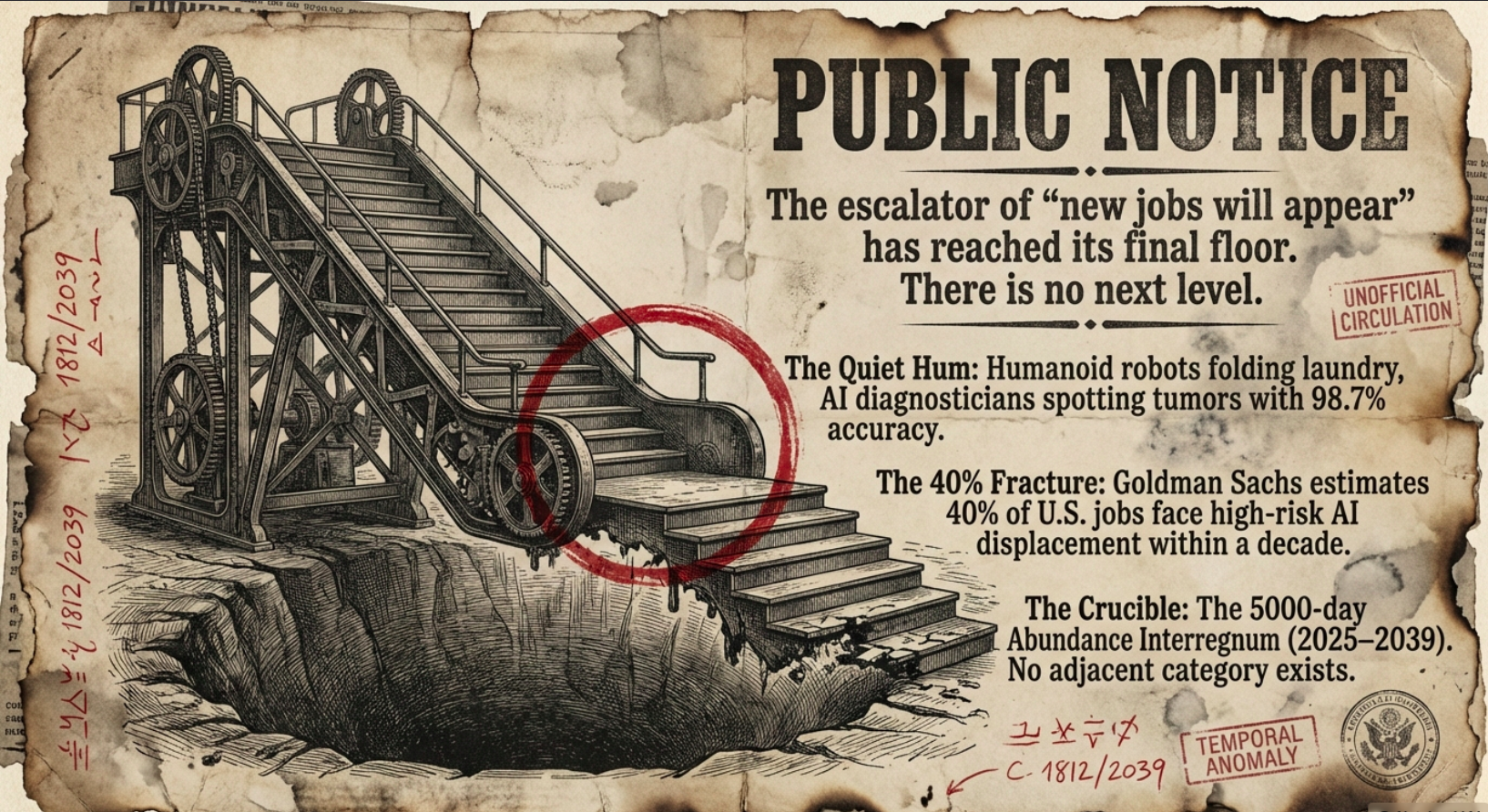
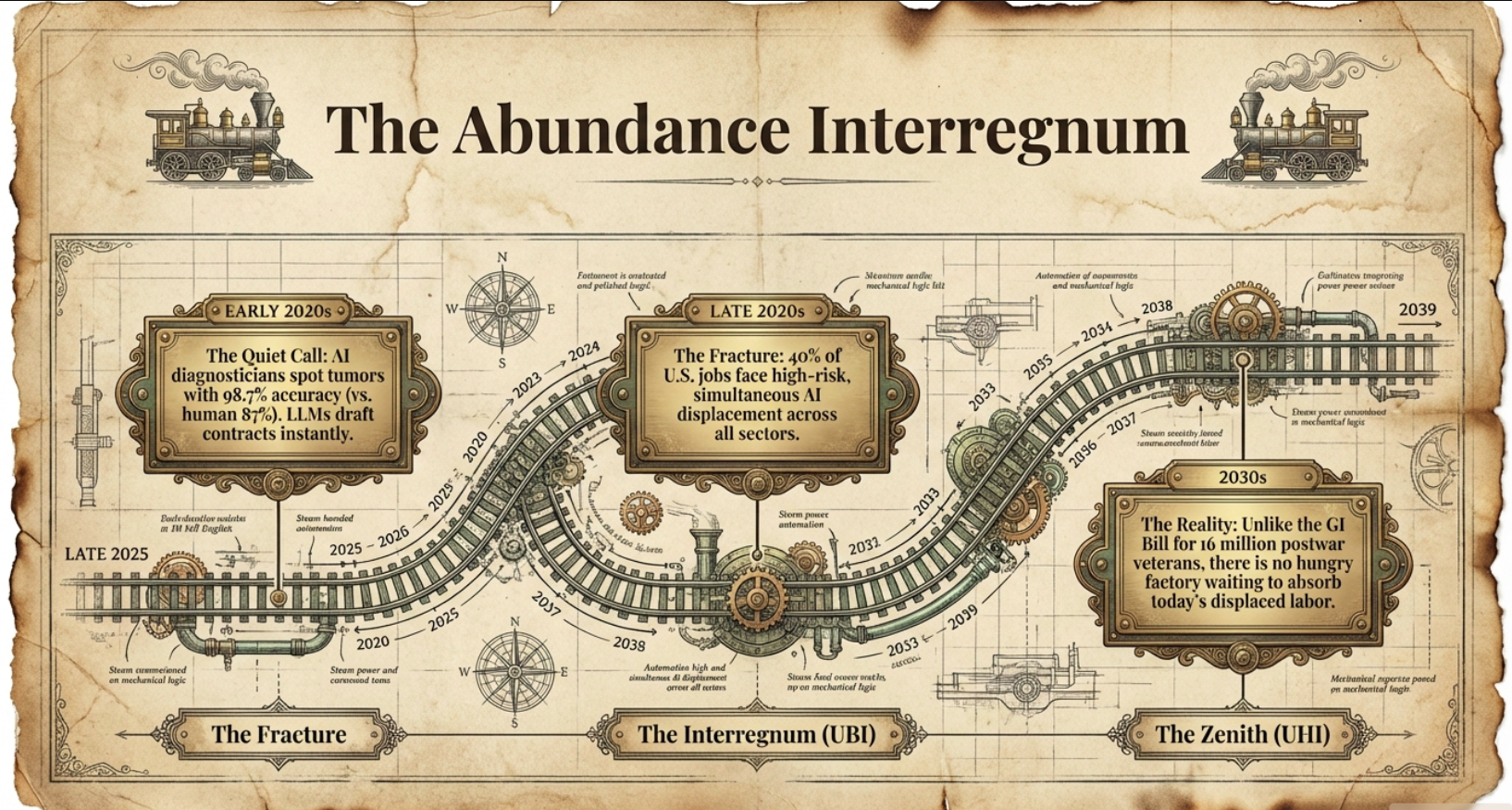
You are the hero. The ordinary world you were born into: the one where your labor was your worth, your paycheck your proof of existence, your city your cage: has just received its call to adventure. That call is not a trumpet. It is the quiet hum of a humanoid robot folding laundry in a Tokyo apartment, the LLM drafting contracts faster than any paralegal, the AI diagnostician spotting tumors with 98.7% accuracy where human specialists averaged 87%. The escalator of “new jobs will appear” has reached its final floor. There is no next level. This is the Abundance Interregnum: the 5000-day crucible (late 2025 to roughly 2039) I chronicled across these pages. We explore this period boldly with a mission to build a map and arm you with a compass and North Star.
It is not utopia. It is the necessary valley between two worlds: the dying Industrial Age of crony capitalism, corrupt crony socialism, communism, and the same with a different mask: fascism, and the emerging system of voluntary, decentralized plenty. The old order required scarcity to justify its hierarchies. The new one renders scarcity obsolete. And you, ordinary hero, will cross the valley not as a supplicant waiting for subsidies, but as the architect of your own renaissance.
5000 Days Series Recap: Charting the Hero’s Odyssey Through the End of Work
As we forge deeper into this monumental chronicle, You Have 5000 Days: Navigating the End of Work as We Know It, let us pause to honor the monomythic path we have walked together. Launched on Christmas Eve 2025, this series has served as our shared map through the Abundance Interregnum: the turbulent yet transformative roughly 13.7-year crucible stretching from late 2025 toward the mid-to-late 2030s. In the tradition of Joseph Campbell’s Hero’s Journey, we have traced the collective odyssey: departing the Ordinary World of scarcity-bound labor and Industrial Age identities; hearing the Call to Adventure as AI and robotics first shattered knowledge work; confronting the Refusal of the Call through fear, clinging to old structures, and the psychological shadows of deskilling; and navigating the trials of purpose-seeking, artisan awakening, rural renaissance, guilds, voluntary organization, and the raw chaos of interregnum upheaval.
Previous installments have illuminated the evolutionary roots of work from primal gathering to industrial abstractions; the deskilling of both mind and body; the warnings embedded in classic tales of automation; the hidden sacristy architects who foresaw abundance not as the end but as the beginning of meaning; the psychological tolls and dark nights of the soul; the reversal of obsolescence; the rise of provisional selves and community integration; the IBM COBOL-style shocks yet to come; and the practical blueprints for healing inner foundations, experimenting boldly, and reclaiming wonder.
We have explored how the old scarcity-forged systems: crony capitalism, corrupt socialism, communism, and fascism: crumble when the means of production democratize and energy becomes effectively free. Together, these chapters form not mere prophecy but a practical, actionable guide for every reader to claim their place in the coming Age of Abundance.
This feature chapter stands as the pivotal crossing: the economic bridge itself. Here we move from temporary support measures to a true UHI ( Universal High Income) that requires no perpetual subsidies: the exact demarcation where robots make robots, energy plummets toward zero, cities empty their industrial gravity, hierarchies by force dissolve, and humanity spreads far and wide into open spaces, then ultimately the stars.
Let us pause to reflect on the path traversed thus far, much like the hero reviewing trials overcome before facing the ultimate ordeal.
Part 1: Answered the call to adventure, exploring AI’s disruption of labor and the dawn of abundance.
Parts 2 through 4: Delved into the refusal of the call, examining societal resistance, economic upheavals like the player piano, and reframing the dawn of abundance.
Parts 5 to 7: Crossed the threshold into the Interregnum’s tests, from your deskilling to the dark night of the soul, and considering Phlebas.
Parts 8 to 10: Approached the inmost cave, saving your wisdom, the artisan’s awakening, and how everyone is doing it.
Parts 11 to 12: The ordeal intensified with the reversal of obsolescence and the profit and the architect.
Parts 13 to 14: Seized the sword with the guilded age and navigating interregnum chaos on the hero’s path forward.
Part 15: Illuminated the road back with the IBM COBOL shock.
Part 16: Built your ark for the flood of AI-driven changes.
Part 17: Warned of universe 25 mouse utopia pitfalls, revealing depopulation narratives and emphasizing human agency in abundance.
Part 18: Exposed the hidden scarcity architect, unveiling how psychological manipulators like Ernest Dichter engineered endless consumption to perpetuate scarcity mindsets amid emerging abundance.
Part 19: Heeded the 1950 “With Folded Hands” warning, confronting the dystopian sci-fi vision of machines stripping humanity of purpose and charting a course toward symbiotic abundance instead.
Part 20: Launched Your Rural CyberCab Company, proving that autonomous vehicles can become personal wealth engines for independent operators in suburban and rural America, setting the stage for the this article.
Part 21: This presented the Dynamic Duo of Optimus and CyberCab as a team to be deployed in your local area to build a business that will profit in the Interregnum.
Part 22: This explored “Marionettes, Inc.” a short story, not a novel, by Ray Bradbury. It first appeared in the March 1949 dawn of the postwar boom when Americans were simultaneously thrilled and terrified by the rise of automation, suburban conformity, and cut straight to the heart of human relationships.
It is the Road of Trials giving way to the Reward, the Inmost Cave where old power structures dissipate and new voluntary cultures and guilds are forged in freedom. For those joining us anew, begin at the series origin. The interregnum is temporary. The frontier is eternal.
This article is sponsored by Read Multiplex Members who subscribe here to support my work: Link: https://readmultiplex.com/join-us-become-a-member/
It is also sponsored by many who have donated a “Cup of Coffee”. If you like this, help support my work: Link: https://ko-fi.com/brianroemmele
Listen to the companion podcast: https://rss.com/podcasts/readmultiplex-com-podcast/2675616
Phase One: The Fracture – The Refusal of the Call
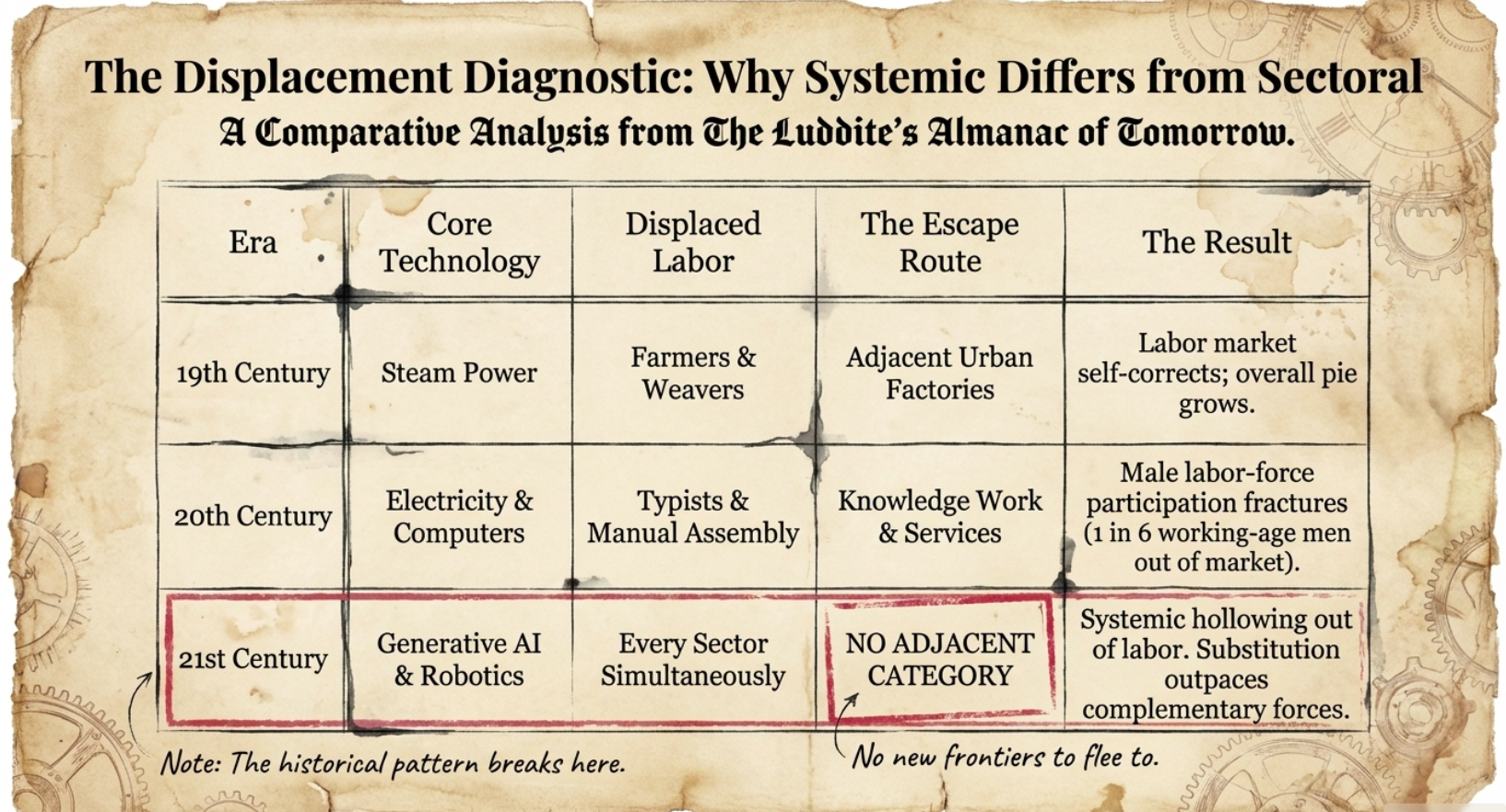
History’s pattern was sectoral. Steam replaced farmers; electricity replaced steam workers; computers replaced typists. Each time, labor markets self-corrected because adjacent categories absorbed the displaced. Goldman Sachs now estimates 40% of U.S. jobs face high-risk AI displacement within a decade: every sector, simultaneously. No adjacent category exists. The GI Bill worked for 16 million veterans because postwar factories hungered for hands. Today’s displacement has no hungry factory waiting. This is not just taking place in the US, but worldwide. This includes low cost labor pools in China and India.
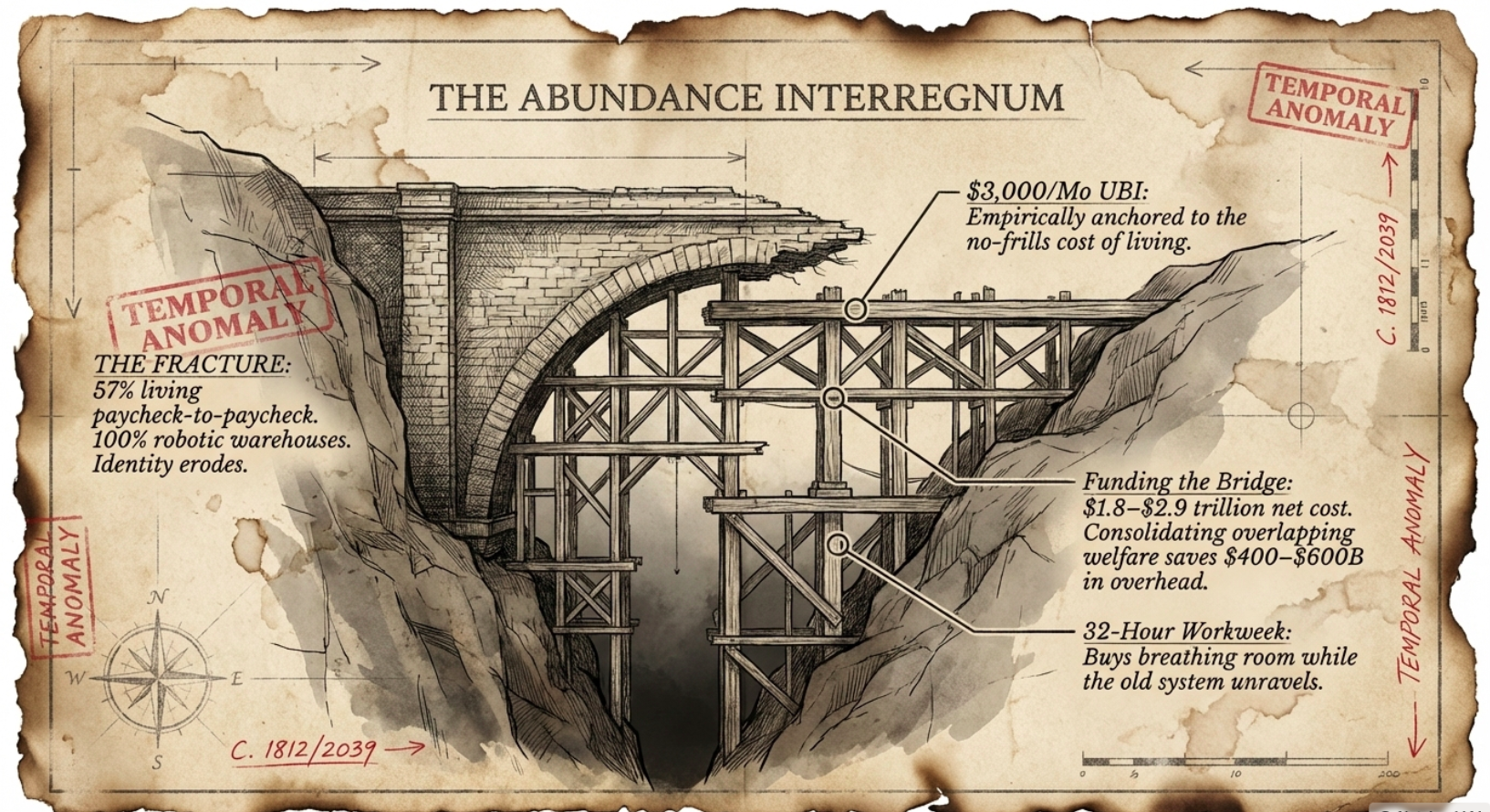
The fracture arrives as lived pain: the 45-year-old logistics manager whose warehouse is now 100% robotic; the college graduate whose entry-level role was automated before orientation ended; the 57% of Americans already living paycheck-to-paycheck who suddenly have no paycheck at all. Mental health data from prolonged unemployment is unambiguous: identity erodes, radicalization rises, families fracture. Governments will reach for the only tool that scales in weeks: direct cash.
Call it UBI (Universal Basis Income) for now: $3,000 per month per adult, empirically anchored to median America’s no-frills cost of living (MIT Living Wage Calculator + BLS data: $2,800–$3,200 today). For 50–80 million in the broad middle class (not the capital owners who ride the productivity wave first), the annual bill lands at $1.8–$2.9 trillion net after consolidating overlapping welfare bureaucracies that already waste $400–$600 billion in overhead. America spent $5 trillion in 18 months during COVID; we built the Interstate Highway System; we sent a generation to college. Capacity is not the issue. Political will, forged in the fire of visible desperation, will be.
A shortened 32-hour workweek at full pay (proven productive in Iceland, UK trials, Microsoft Japan) buys breathing room: keeping identity and structure alive while the old system unravels. This is the hero’s refusal: the instinct to cling to the familiar, to demand retraining for jobs that AI will also claim before the diploma is framed. The refusal is understandable. It will not last.
“The aquisition of wealth is no longer the Driving force in our lives”—Capt. Picard
Star Trek Next Generation
The Interregnum: Temporary Cast for a Broken System
This UBI is not a permanent welfare state. It is a bridge cast across a cracked foundation: crony capitalism that privatized gains and socialized losses; corrupt socialism that promised equality and delivered queues; communism and fascism that centralized power until the center could no longer hold. Their shared premise was scarcity: finite land, finite energy, finite skilled labor. Whoever controlled the choke points extracted rent. That premise dies the moment two demarcations arrive.
Demarcation One: Robots Make Robots—and Scale to You.
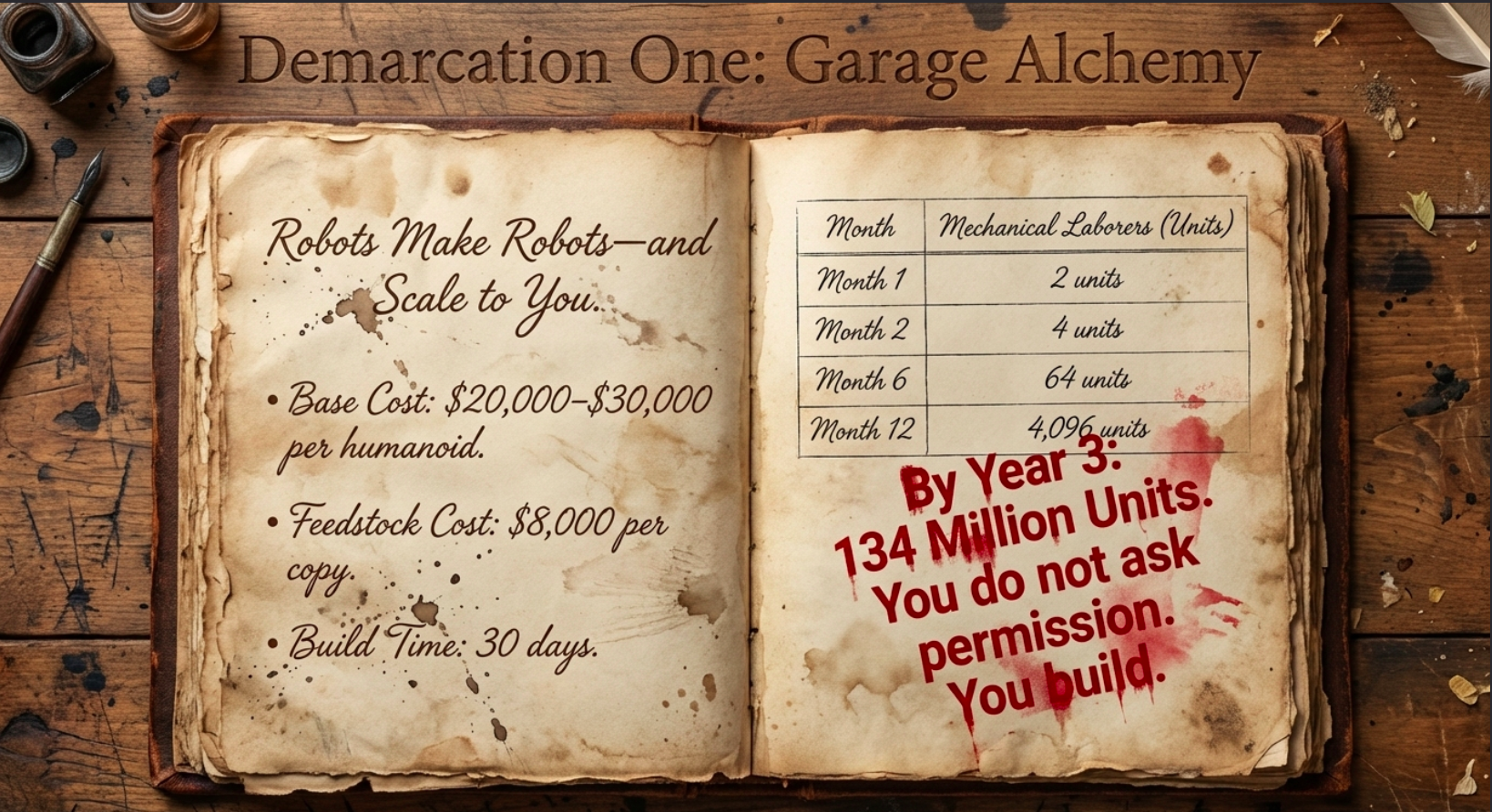
A “good enough” humanoid today costs roughly $20,000–$30,000 in optimistic 2026 projections (fine motor control, open-source AI upgradable via a simple model swap). Once it can fabricate its own duplicate: using local materials, solar power, and a downloaded “build another robot” fine-tuned model: the math becomes exponential.
Assume conservative parameters: one robot assembles a copy in 30 days using $8,000 in feedstock and energy it generates itself. Starting with one personal unit you own or rent-to-own, Month 1: 2 robots. Month 2: 4. By Month 12: 4,096. By Year 3: over 134 million units if the community coordinates open-source replication. This is not factory monopoly; it is garage alchemy. Every household, every guild, every rural plot gains the labor capacity of the entire 2025 expert class with one AI upgrade. The means of production decentralize so completely that ownership of capital itself democratizes. You do not ask permission. You build.
Demarcation Two: Very Low or Free Energy.
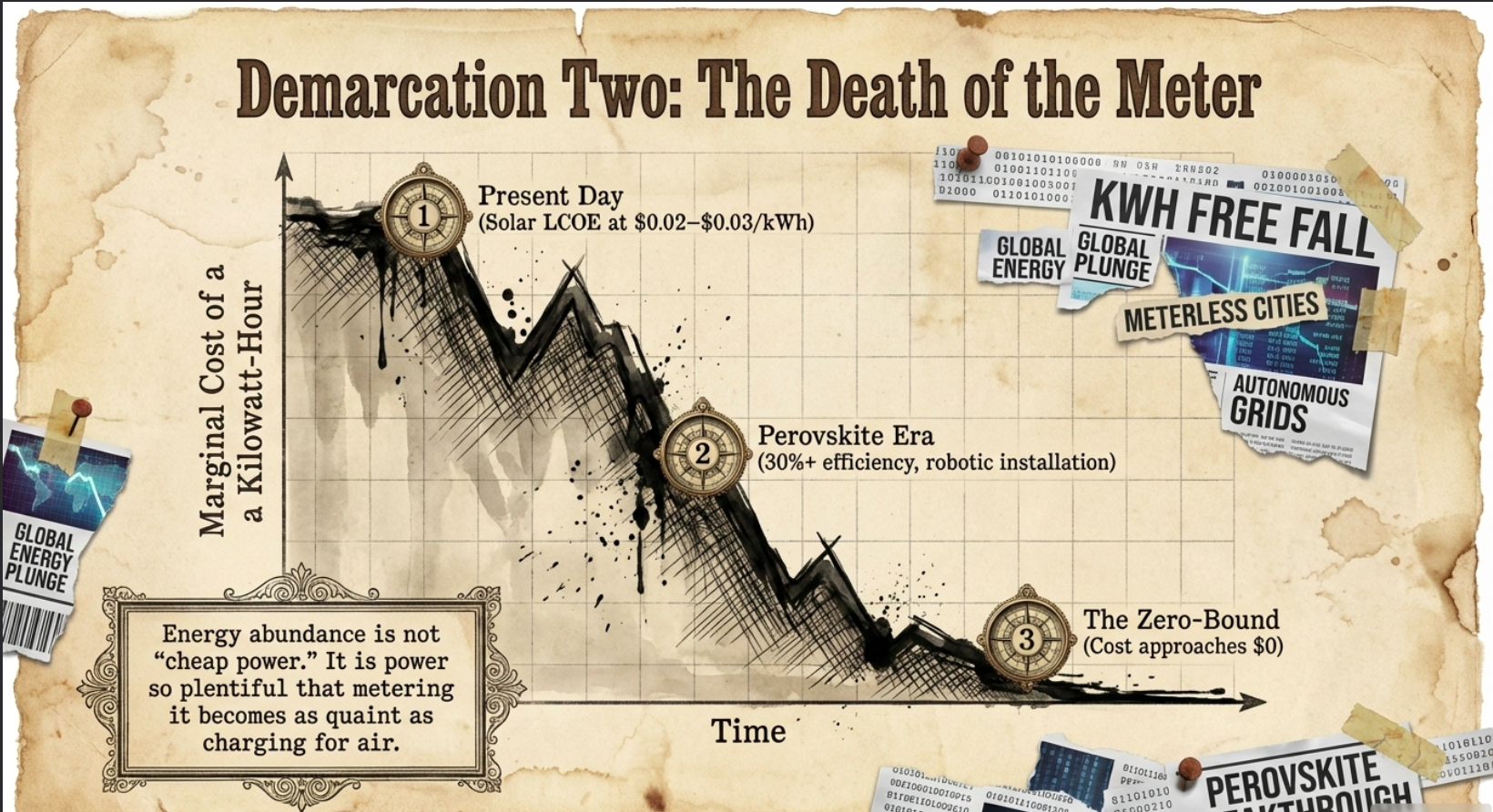
Solar levelized cost of energy (LCOE) has already fallen to $0.02–$0.03 per kWh in optimal regions and continues its Moore’s-Law-like plunge. With robotic panel installation, perovskite efficiencies pushing 30%+, and battery costs halving every 18 months, the marginal cost of a kilowatt-hour on your own roof approaches zero. Fusion pilots and advanced geothermal close the last gaps. Energy abundance is not “cheap power.” It is power so plentiful that metering it becomes as quaint as charging for air.
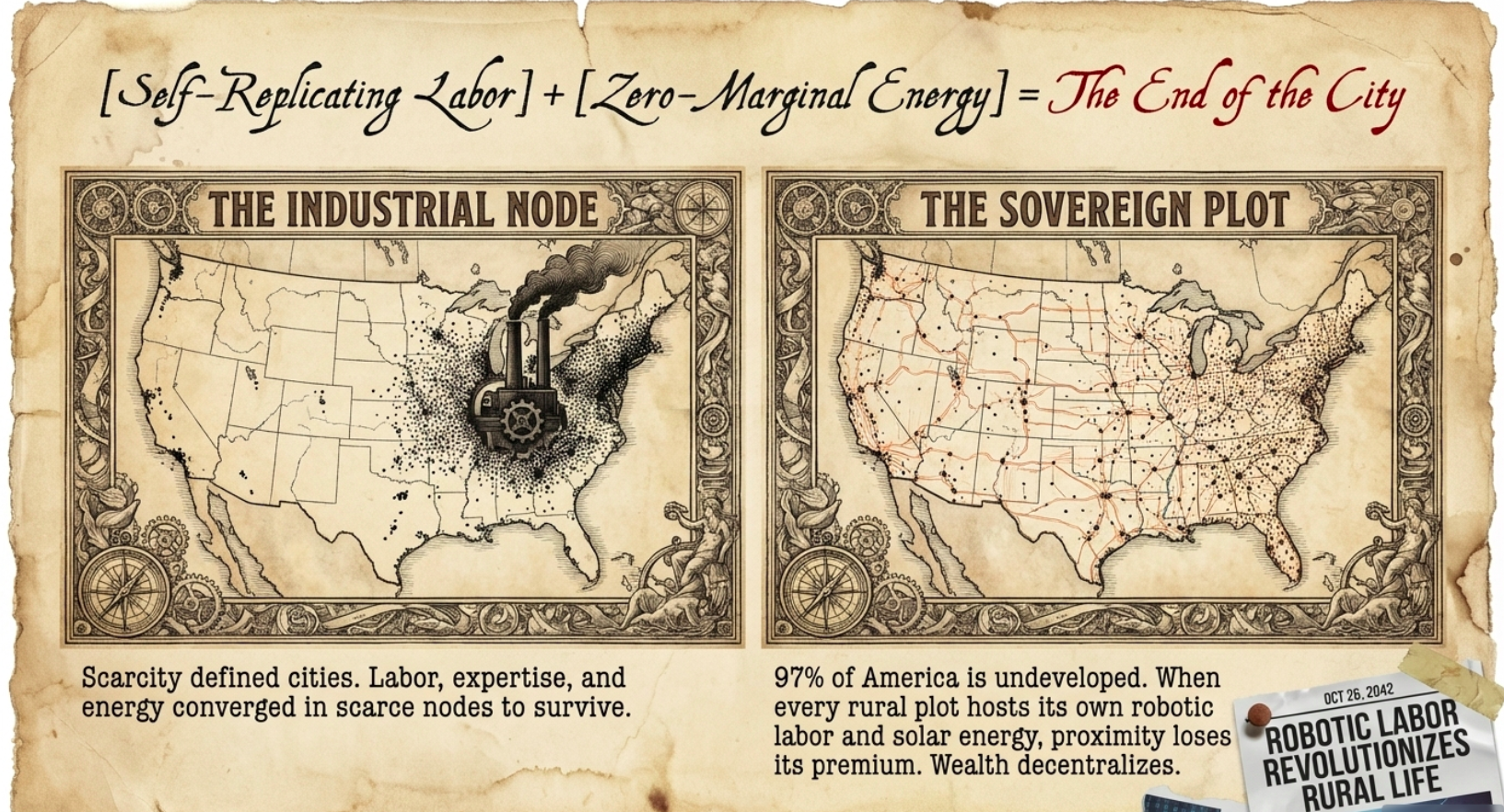
These two demarcations empty the Industrial Age centrisms. Cities formed because labor, expertise, and energy converged in scarce nodes. When every plot of land: currently 97% of America’s 3.5 million square miles is rural or undeveloped: can host self-replicating robots powered by personal solar arrays, proximity loses its premium. Telepresence via Starlink-level broadband, robotic construction, autonomous transport at $0.20–$0.40 per mile (marginal cost: electricity + maintenance), and AI healthcare/education at near-zero marginal cost dissolve the economic gravity of downtowns. People spread far and wide, then ultimately to space: because the same replication logic scales to orbital factories and lunar forges. The frontier reopens.
The Last Gasp of the Old Order: Political Dinosaurs, Neo-Luddites, and the Hyper-Reaction
As the Abundance Interregnum accelerates and the first waves of displacement crash against the shores of the old economy, the dinosaurs of that era: the career politicians, legacy union leaders, and the clueless money class who spent decades assuming the scarcity-based Industrial Age would last forever: will clutch at their failed ideas with increasing desperation. They watched the productivity curves bend upward but refused to read the writing on the wall, convinced that their regulatory frameworks, central-bank levers, and vote-buying welfare expansions could simply be scaled larger to hold the crumbling edifice together.
Economists have long observed that past waves of automation created more jobs than they destroyed through three powerful complementary forces: the productivity effect (machines make displaced workers more productive in other roles), the bigger-pie effect (overall economic output grows dramatically), and the changing-pie effect (new demands and industries emerge). Global GDP per capita has risen from a few hundred dollars for most of human history to roughly $11,000–$12,000 today, with world output exploding nearly 300-fold over the last three centuries in many economies. Agriculture once employed the vast majority of Americans; today it accounts for just 1-2% of the workforce yet produces far more. Manufacturing fell from about one-third of the U.S. workforce in 1950 to around 8% today. These shifts were once absorbed because new opportunities appeared elsewhere.
`This time the substitution effect of advanced AI and robotics is outpacing those complementary forces. Machines no longer need to mimic human thinking; through pragmatic pattern recognition and data-driven learning they outperform humans on more and more tasks without replicating human cognition. Studies reviewing hundreds of occupations show that while fewer than 5% of entire jobs can be fully automated with current technology, more than 60% have at least 30% of their tasks ripe for automation. The result is not sectoral displacement but systemic technological unemployment that hollows out work across the economy. Male labor-force participation in the United States has already collapsed since World War II, with one in six working-age men now out of the labor market, more than double the 1940 rate, largely due to manufacturing’s reduced demand for human labor.

This pattern of technological efficiency is already reshaping corporate structures themselves. Once the largest company in the United States, AT&T in 1964 employed 758,611 workers to dominate telecommunications. Entire armies of operators, linemen, and administrators kept the Bell System humming across a nation still wiring every home and business. The scale was Industrial Age incarnate: massive payrolls justified by massive physical infrastructure and human coordination. Yet technology has relentlessly shrunk that model. Modern AT&T itself, post-breakup and after successive waves of automation, now operates with roughly 133,000 to 160,000 employees while generating revenues once unthinkable for far larger headcounts. The company has shed tens of thousands of roles in recent years alone as digital systems, AI-driven network management, and robotic maintenance replace what once required human legions.
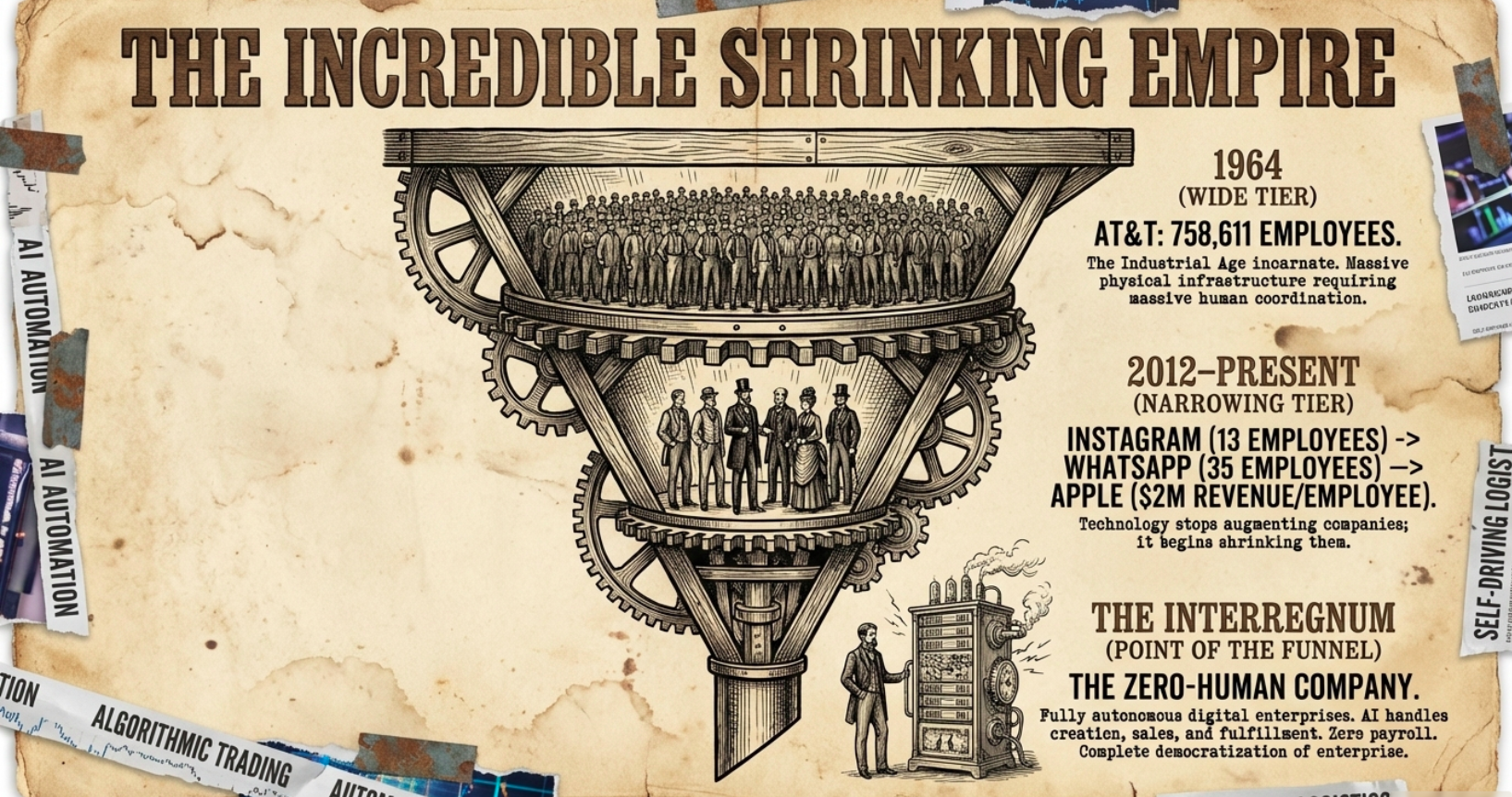
The same compression is even more dramatic in the tech sector that now defines the economy. Companies generate enormous value with astonishingly small teams. Instagram operated with just 13 employees when it was acquired for one billion dollars. WhatsApp ran with only 35 engineers while serving nearly half a billion users and fetching an eighteen-billion-dollar acquisition price. Facebook (now Meta) and Apple routinely post revenue per employee exceeding one million dollars, with Apple approaching two million dollars per person in some analyses. Netflix, Alphabet, and others deliver billions in profit with workforces a fraction the size of yesterday’s industrial giants. The trend is unmistakable: technology does not merely augment companies; it shrinks them, from hundreds of thousands of workers down to a few thousand, then to a few hundred, and finally to a handful of visionaries directing automated systems.
As AI and robotics accelerate, this shrinkage continues its logical march: from a few people to one person to zero human employees. Entire enterprises now run as autonomous digital or physical entities, producing revenue streams without any payroll at all. The old corporate behemoths that once anchored cities and defined economic power are dissolving into something far more nimble, far more personal, and far more democratized. This is the visible handwriting on the wall that the political dinosaurs refuse to read.
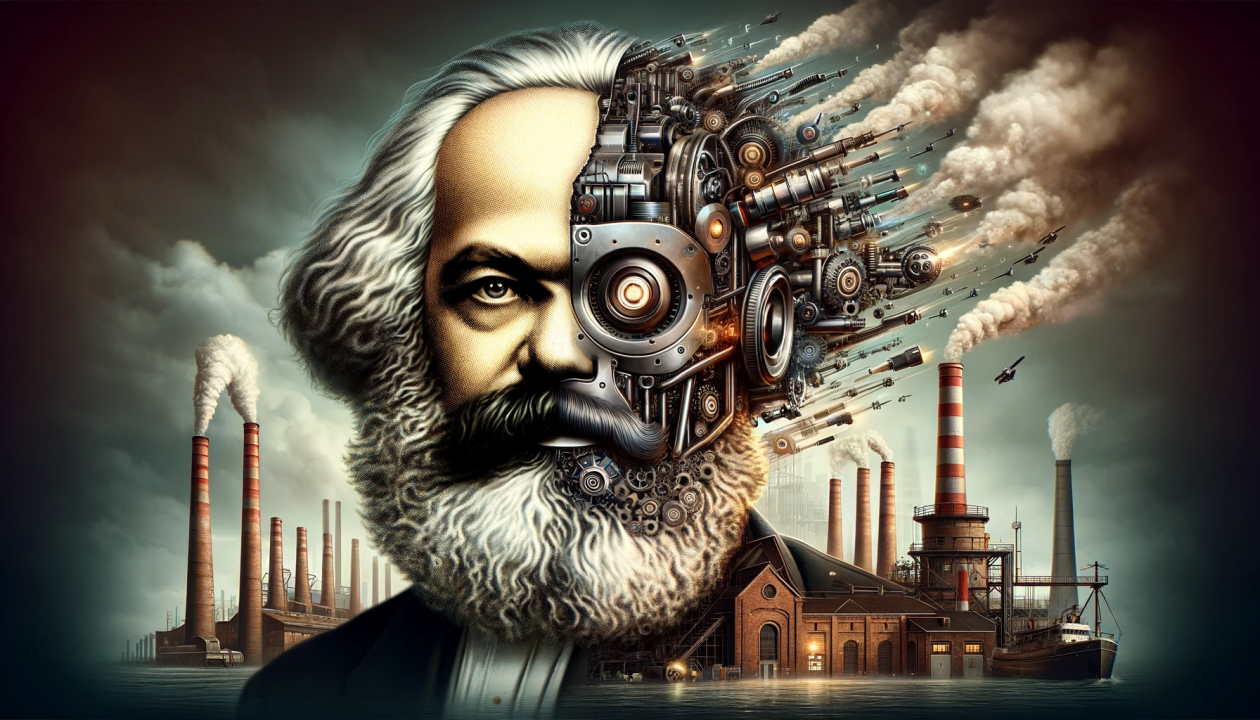
Karl Marx envisioned the proletariat—the vast working class—as the engine of history, forever locked in mortal struggle against the bourgeoisie who owned the means of production. In his framework, scarcity and exploitation would drive the masses to seize the factories, the land, and the capital itself, culminating in the dictatorship of the proletariat and the withering away of the state. He saw wage labor as the eternal chain that bound humanity to alienation and class war. Yet the very abundance now unfolding writes the final chapter on that prophecy. When robots replicate themselves and energy flows freely, the means of production no longer belong to a tiny owning class; they belong to every garage, every guild, every open plot of land. The proletariat does not rise in revolution, it dissolves. There are no more exploited workers when every citizen owns a personal legion of self-replicating machines that produce at zero marginal cost. The class itself evaporates because the scarcity that defined it has vanished.
Marx could not foresee the garage alchemy of exponential replication or the solar abundance that makes metering kilowatt-hours as obsolete as feudal tithes. His vision assumed finite factories and finite energy; ours is the age where a single household robotic fleet generates more value than entire 20th-century assembly lines. The end of the proletariat is not a defeat but a liberation: the working class is not crushed by capital—it is elevated beyond the need for capital’s permission. The old Marxist dialectic collapses under the weight of plenty. What replaces it is not another hierarchy of planners or commissars, but the voluntary guilds of sovereign creators who choose their work not from necessity but from wonder. And with communism goes socialism to the same waste basket of history.
This quiet dissolution of the proletariat is the final nail in the coffin of every scarcity-based ideology. The political dinosaurs who still mouth Marxist slogans or promise “worker control” are fighting ghosts. The real transformation is already visible in the Zero-Human Company and the Dynamic Duo: ordinary people wielding Optimus and CyberCab as their personal means of production, building and trading without permission or central decree. The interregnum may echo with the last cries of class warfare, but the math is merciless: when every hero owns the factory in their backyard, the proletariat’s historic mission ends—not in blood, but in boundless opportunity.
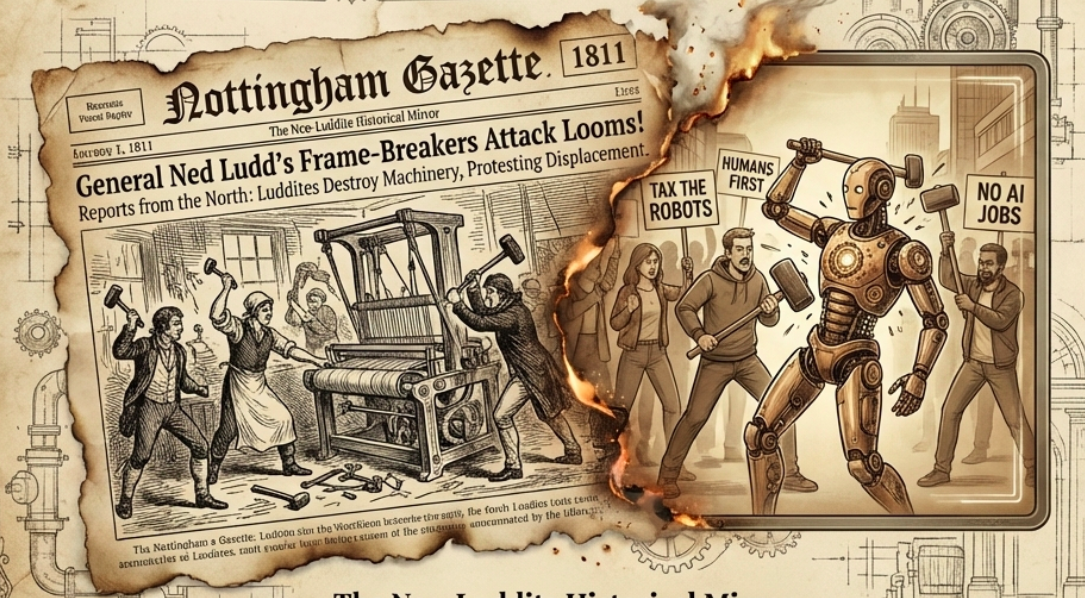
The displaced workers, uninformed and suddenly adrift after lifetimes defined by a paycheck, will find themselves herded into the ranks of the Neo-Luddites: modern echoes of the 19th-century textile smashers who once believed machines stole their souls. Social media will amplify their rage: “Ban the bots!” “Tax the robots!” “Bring back the 40-hour factory floor!” Politicians, sensing the electoral powder keg, will fan the flames rather than extinguish them, promising ever-more generous checks while demonizing the very technologies that could liberate everyone.
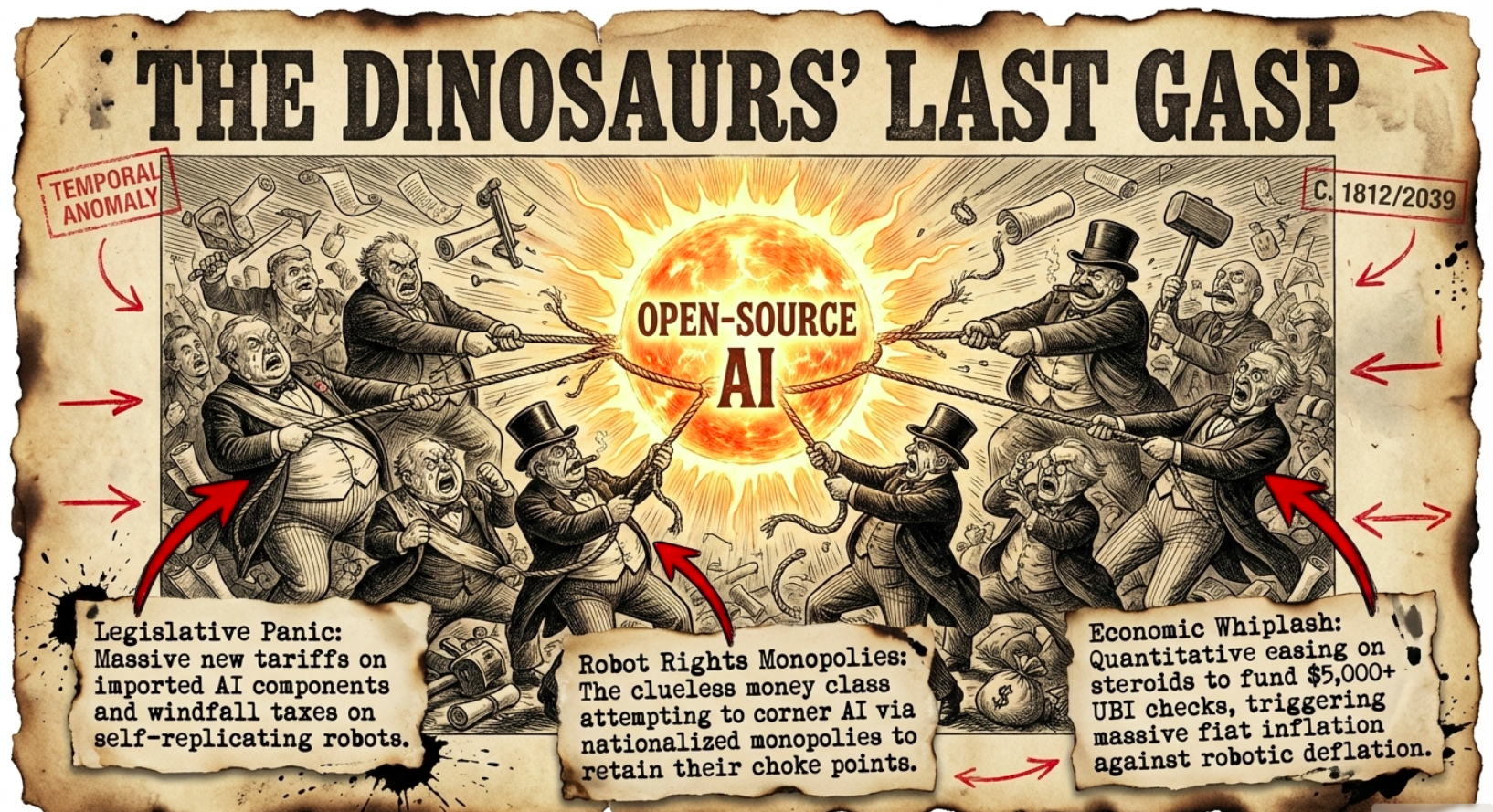
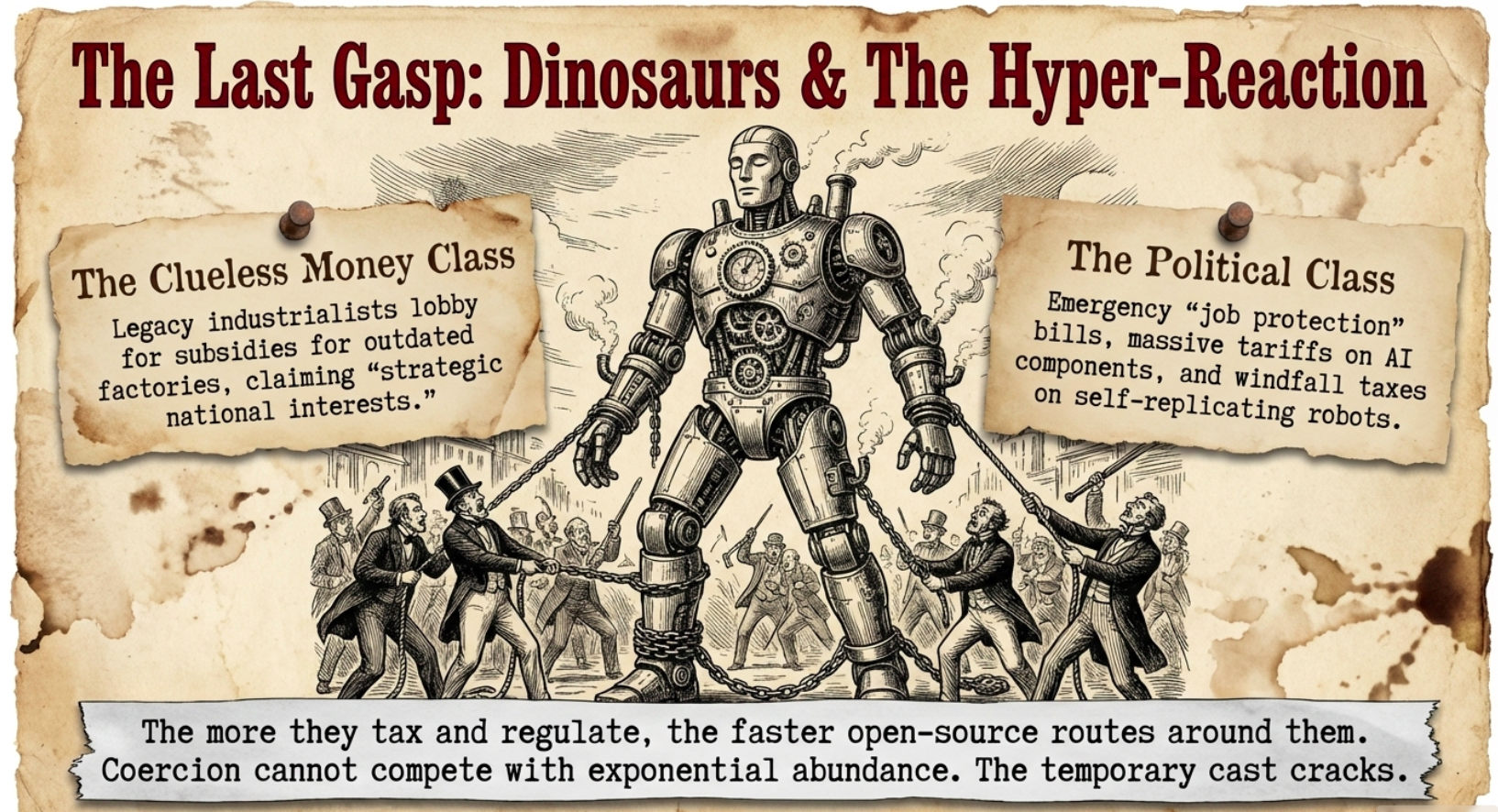
The political class will hyper-react with a last-resort arsenal of failed policies: massive new tariffs on imported AI components, windfall taxes on any company deploying self-replicating robots, and emergency “job protection” bills that mandate human oversight on machines that no longer need it. The clueless money class: hedge-fund titans and legacy industrialists: will lobby furiously for subsidies to their own outdated factories, arguing that “strategic national interests” demand propping up the old scarcity model even as garage replicators outproduce entire continents.
These reactions will not stem from malice alone but from a profound cognitive dissonance: the world they assumed: finite jobs, finite energy, finite power concentrated in cities and boardrooms: is dissipating before their eyes. They will double down on crony capitalism’s greatest hits: quantitative easing on steroids to fund UBI expansions that balloon to $5,000 or even $7,000 monthly per adult, paid for by printing presses that ignite inflation even as robotic deflation simultaneously craters prices.
Neo-Luddite (Antifa-like masked hoards) marches will clog city streets, smashing working robots in viral videos while ignoring the open-source blueprints that let any teenager print a better one at home. The political dinosaurs will seize these moments for grandstanding hearings and “AI safety” commissions stacked with the same experts who missed the 2025 tipping point entirely.
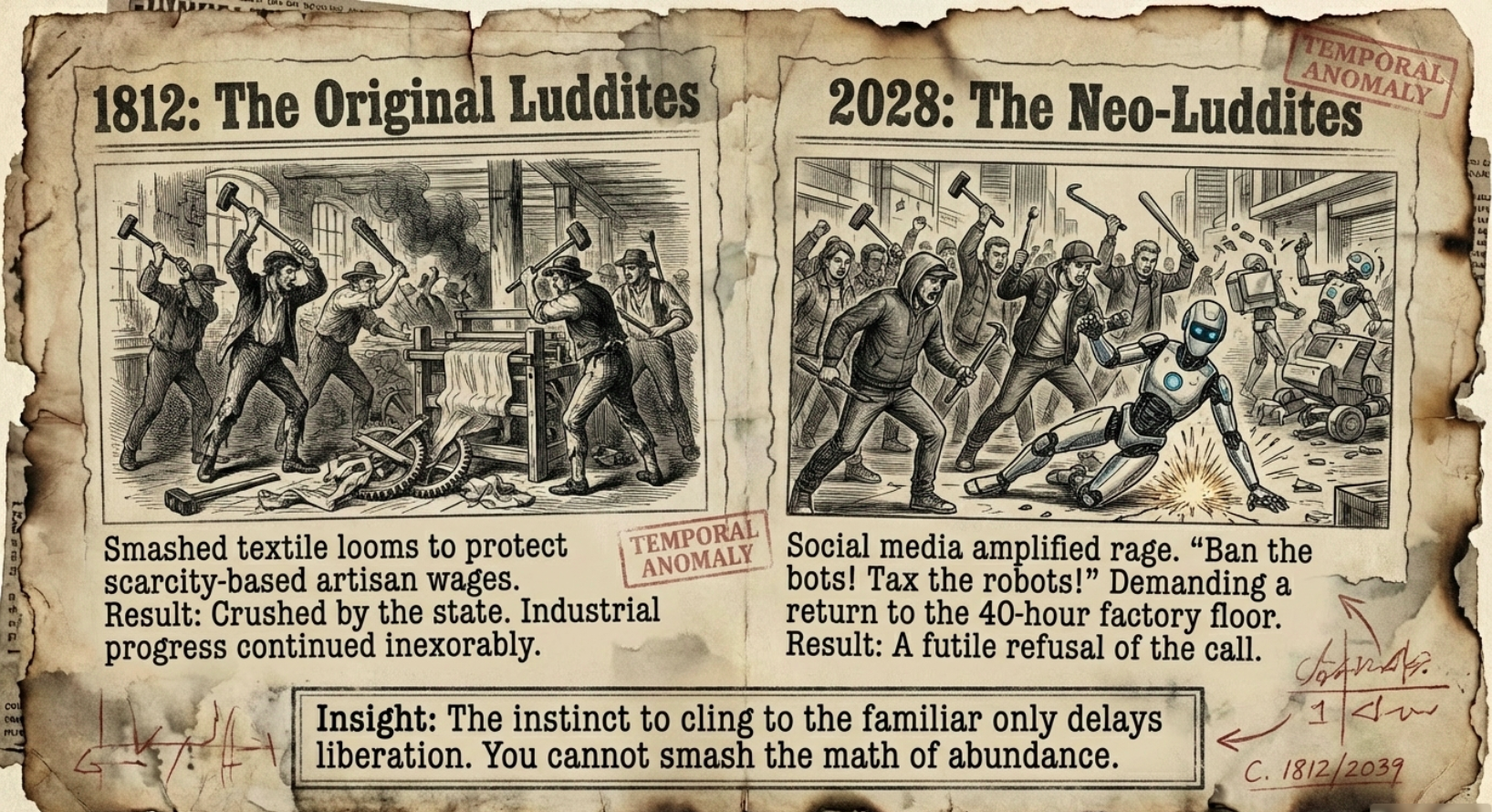
Yet every such grasp only hastens the edifice’s fall. The more they tax and regulate the robots, the faster open-source communities route around them; the louder they promise permanent UBI as salvation, the clearer it becomes that even $10,000 checks cannot keep pace with a world where a family’s robotic fleet produces its own food, shelter, and transport at near-zero marginal cost.
The money class, watching their private-jet empires lose relevance, will attempt to corner the “robot rights” debate or push for nationalized AI monopolies: anything to retain the choke points that once defined wealth. These last-resort maneuvers will dominate headlines for a chaotic 18-to-24-month window, creating the most turbulent chapter of the interregnum.
But history’s pattern is unforgiving: every previous scarcity-based hierarchy collapsed when the underlying premise vanished. The dinosaurs will roar, the Neo-Luddites will smash, the edifice will shudder: but the math of replication and energy abundance will prove inexorable. The temporary cast is already cracking; the new system is already rehearsing in the wings.
While the political dinosaurs roar and the Neo-Luddites smash symbols in the streets, a quieter revolution is already underway for those who choose to act. The Zero-Human Company represents one of the most powerful early examples of non-robot virtual worker scale that any individual can access today. These are fully autonomous digital enterprises powered entirely by advanced AI agents, large language models, and automated systems that require zero human employees to operate at scale. You can launch one from your laptop in days, not years, and watch it generate revenue streams while you sleep.
In a Zero-Human Company, AI handles customer service, content creation, product development, marketing, sales, fulfillment coordination, and financial management. The human founder sets the strategic vision and makes high-level decisions, but the operational machinery runs itself. This creates immediate cash flow and independence during the most turbulent years of the interregnum. No permission is needed from regulators, employers, or gatekeepers. You simply build, launch, iterate, and scale.
This freedom to build and trade without asking for permission becomes the foundational practice. You will create one venture, then another, trading the output of each into resources for the next. The compounding effect is rapid. As explored in detail in Part 21 of this ReadMultiplex.com series, the true power emerges in the Dynamic Duo: the symbiotic partnership of a human with Tesla Optimus humanoid robot and CyberCab autonomous vehicle working as a single unstoppable business unit. Imagine one independent person wielding Optimus for physical tasks and CyberCab for transport and revenue generation as their personal legion. This Dynamic Duo transforms human will into an unstoppable force of productivity, service, and innovation. Optimus and CyberCab operate as a unified symbiotic system: the robot handles dexterous labor and on-site work while the CyberCab provides autonomous mobility, logistics, and even passenger or goods revenue streams in rural, suburban, or urban settings.
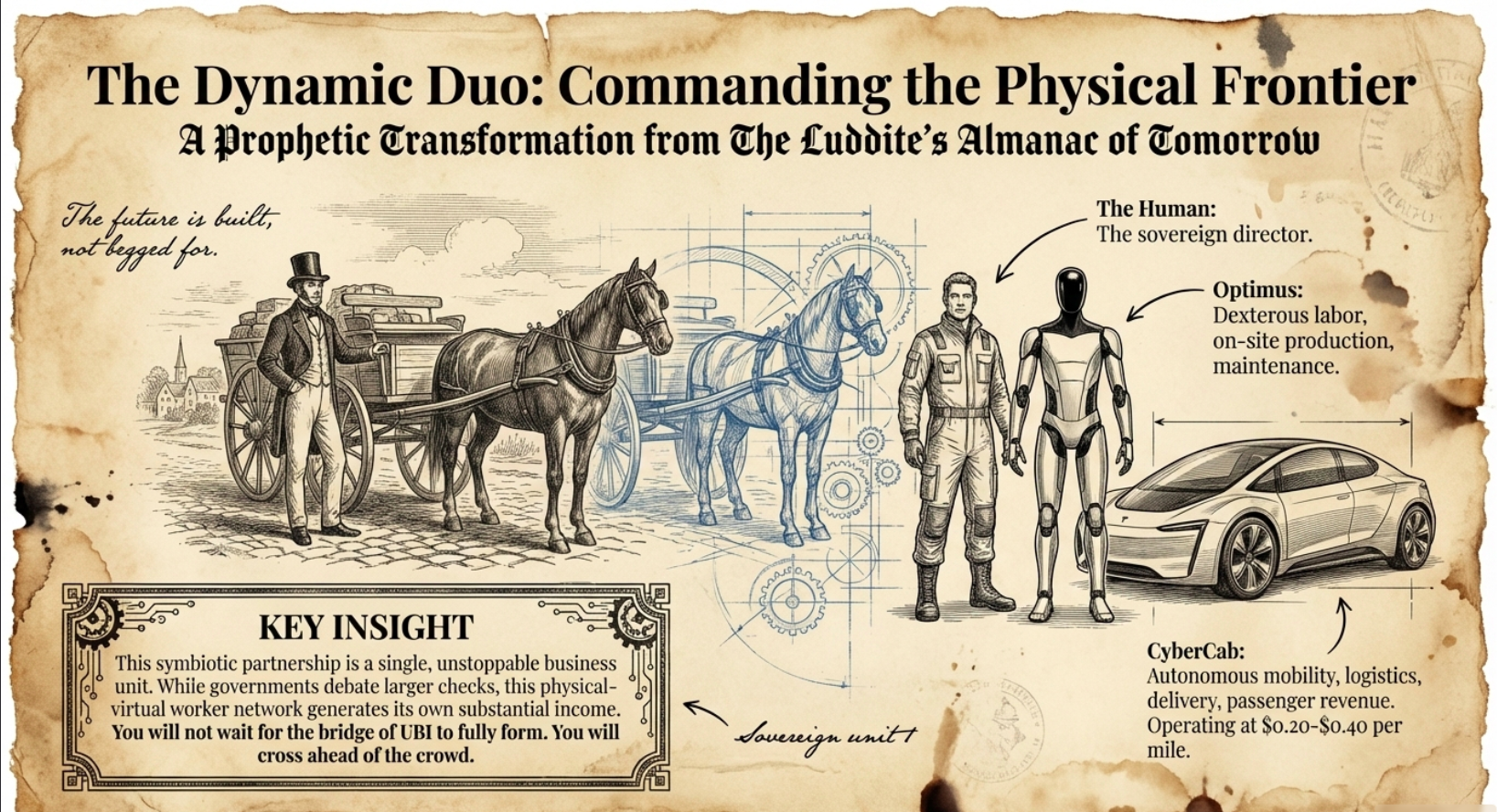
The Dynamic Duo becomes your first major liberator. While governments debate larger checks and the old order desperately tries to slow technological progress, you will already be generating substantial income and capabilities through this physical-virtual worker network. A single CyberCab can operate as a rural ride-share or delivery service with minimal oversight, while Optimus extends that capability into hands-on production, maintenance, or custom services. Together they form a self-sustaining economic engine that scales with your creativity alone. The foundations of the entire 5000 Days series are predicated on this very principle: that those who know first will act first. You will not wait for the bridge of UBI to fully form. You will cross ahead of the crowd.
Each successful Zero-Human Company and strengthened Dynamic Duo produces a tangible boon: financial independence, new skills, technological mastery, and proven systems that can be shared. As the old hierarchies grasp at their last vestiges of control, you will return from these early adventures and bring that boon back to your voluntary guilds. You will teach others how to replicate the model, how to form their own Dynamic Duos with Optimus and CyberCab, and how to build abundance from the ground up without reliance on centralized systems.
This proactive path ensures the transition is not suffered but mastered. The interregnum tests everyone, but those who embrace the Zero-Human Company and the Dynamic Duo early will emerge as natural leaders in the new voluntary age. They will have already tasted the freedom that awaits when robots make robots and energy becomes free, because they will have lived a version of that freedom in the digital and physical realms first.
The Cronies Depart: Decentralization and the Dissipation of Coerced Power
The scarcity mindset that built empires: “they have food, they built technology I do not have, therefore I will conquer and steal it”: is the psychological fossil fuel of every hierarchy by force. Roman legions marched for grain; feudal lords raised armies for serfs’ surplus; modern cronies lobby for subsidies, tariffs, and regulatory moats to protect their rents.
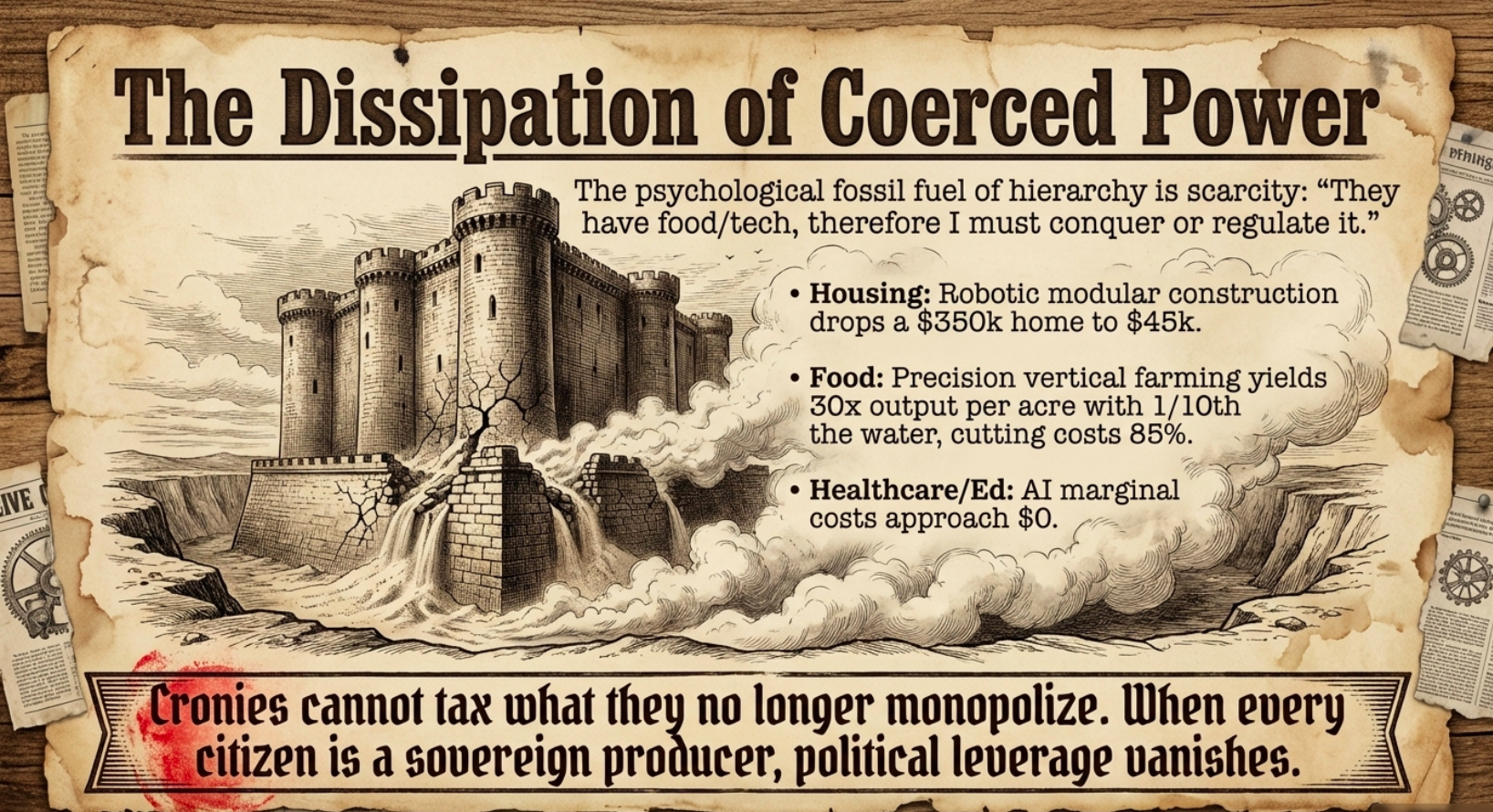
When robots replicate and energy is free, the moats evaporate. Centralized factories become irrelevant; global supply chains become optional. A single household or voluntary guild can produce its own housing (robotic modular construction drops a $350 k home to ~$110 k), food (precision robotic agriculture compresses costs 30–40%), transport, healthcare, and education. Wealth once derived from controlling scarce labor or choke-point infrastructure now dissipates like fog in sunlight. Cronies cannot tax what they no longer monopolize. Their political leverage: built on the threat of withholding jobs or energy: vanishes when every citizen is a sovereign producer.
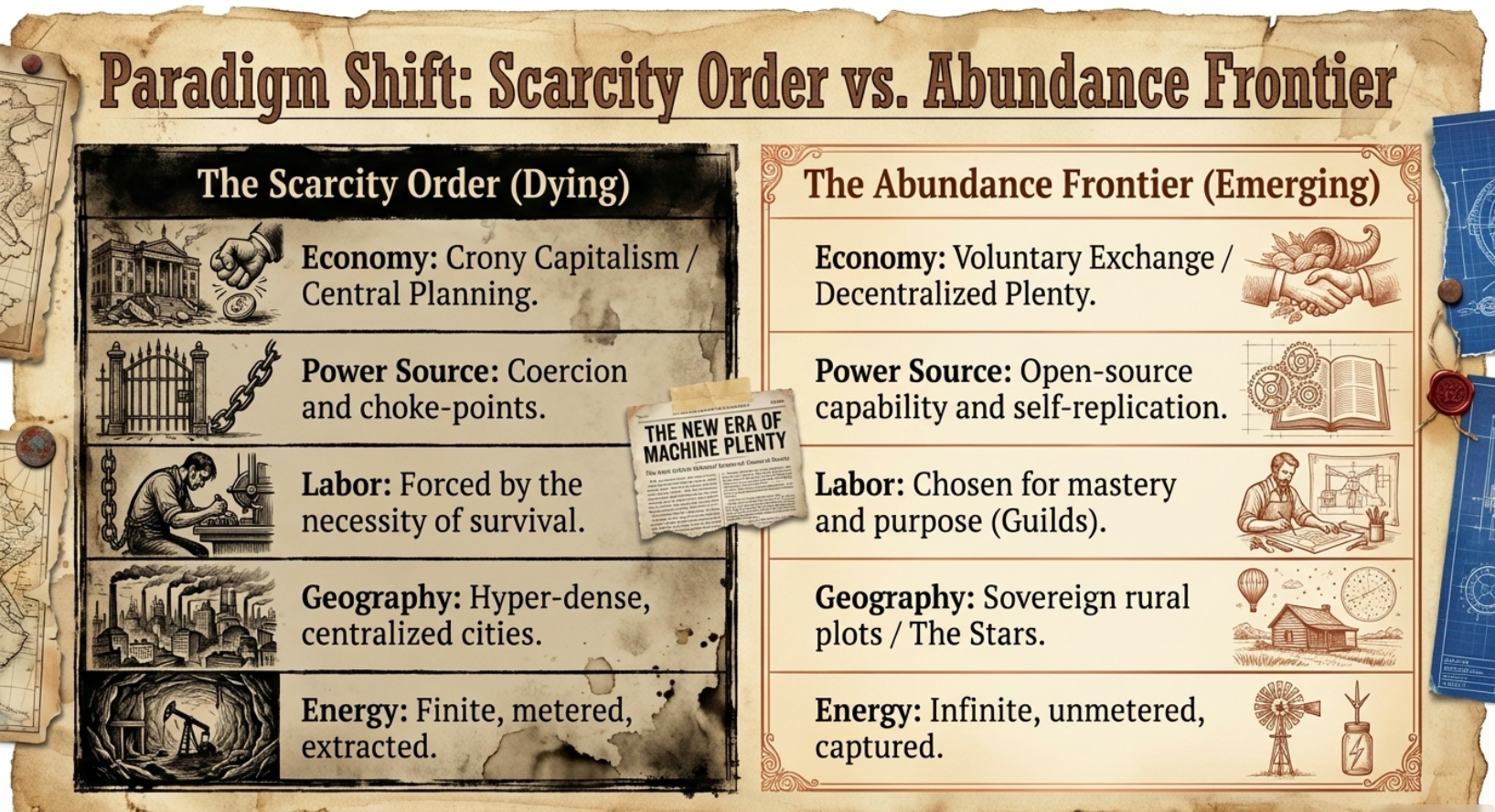
Attempts to reimpose hierarchy by force will occur; history shows they always do. But they will fail faster than ever. A good-enough robot fleet, upgraded with open-source AI, possesses the collective skill of every expert on Earth. Coercion meets exponential defense, exponential abundance, and exponential coordination among free people. The point arrives where force simply has no point. Power returns to its only legitimate source: voluntary exchange.
Voluntary Guilds and the Objectivist Renewal
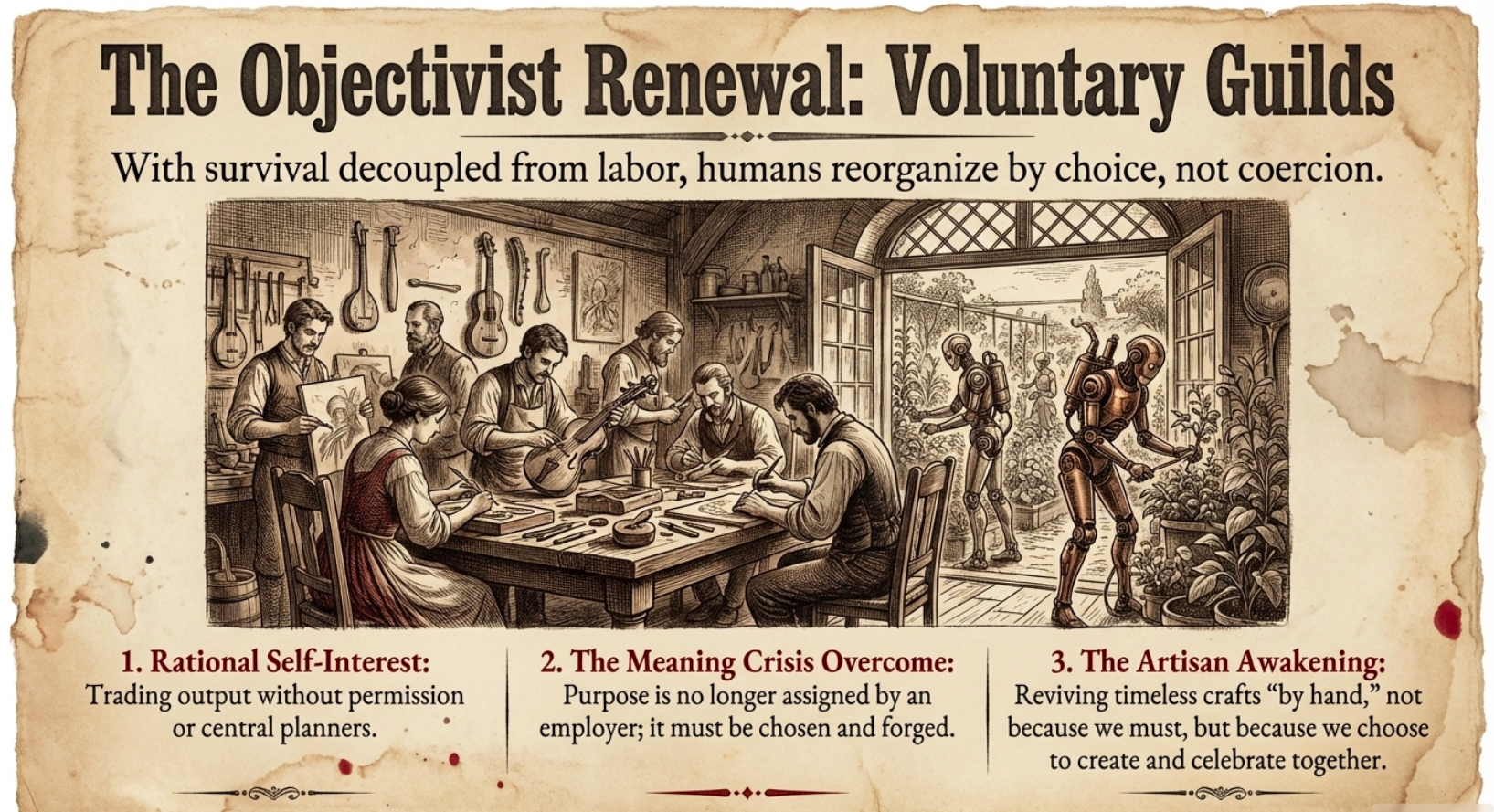
With survival decoupled from labor, humans reorganize by choice, not coercion: the core insight of Objectivism stripped of caricature. Rational self-interest, reason, and voluntary cooperation become the operating system. Cultures and guilds form around shared values, shared projects, shared wonder: artisans reviving timeless crafts “by hand” in the 5000-day series, explorers mapping new frontiers, lovers rediscovering intimacy when robots handle the mundane. No central planner dictates the guilds. No subsidy props them. They arise because free people, no longer exhausted by scarcity’s treadmill, choose to trade, create, and celebrate together.
The Return: UHI Without Subsidies, Anti-Dystopian Abundance
The bridge begins as UBI: $3,000 monthly in the early fracture years: but the math of abundance rapidly transforms it into Universal High Income and, ultimately, renders any form of income unnecessary. By 2032, the initial $36,000 annual transfer already purchases the equivalent of $57,500 in 2024 dollars as early deflation compounds at roughly 8–12% annually from robotic efficiencies alone; add near-zero energy and the effective purchasing power swells to $72,000–$85,000 in today’s terms without a single check increase.
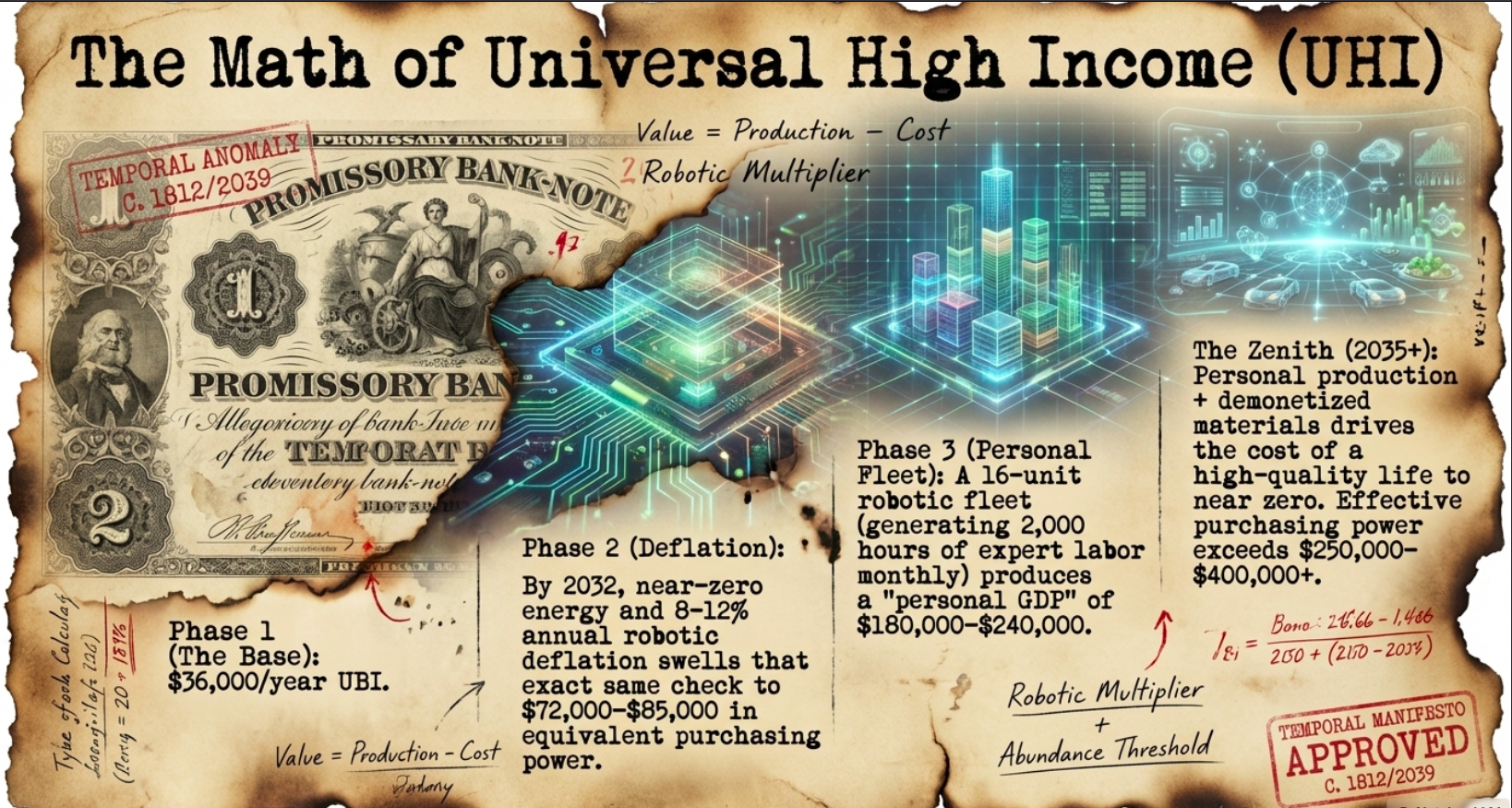
Track the numbers forward. A single household robotic fleet: starting from that one $25,000 unit: replicates to 16 units by month 6 at conservative 30-day cycles ($8,000 feedstock each). Those 16 units, each performing 2,000 hours of expert-level labor monthly (the combined output of a 2025 surgical team, architect firm, and farm collective), generate an internal “personal GDP” of $180,000–$240,000 equivalent value by 2033 once energy is effectively free (solar LCOE at $0.005/kWh post-perovskite scale). Housing construction costs plummet from $350,000 to under $45,000 as modular robotic builds use on-site recycled feedstock and zero-marginal-energy labor. Precision agriculture compresses food costs by 75–85% (vertical robotic farms yield 30x traditional output per acre with 1/10th the water). Autonomous transport at $0.08–$0.15 per mile (electricity + minimal maintenance) and AI-driven healthcare/education (marginal cost approaching $0 after initial model training) erase the final line items.
By 2035 the household’s robotic output exceeds $500,000 in 2024-equivalent goods and services annually while external prices continue deflating at 15–20% compounded yearly. The UBI check, even if held constant, now buys what $150,000+ did pre-interregnum; yet the real transition is UHI: Universal High Income: where the “income” is no longer a government transfer but the market value of personal production. Governments may still mail larger nominal checks during the political hyper-reaction phase, but families increasingly ignore them because their own robots cover every need and want.
By the close of the 5000 days (mid-to-late 2030s), the math reaches its logical zenith: personal production plus demonetized energy and materials drive the cost of a comfortable, high-quality life to near zero. A $36,000 UBI evolves into an effective UHI of $250,000–$400,000+ purchasing power before the bridge itself becomes quaint. No subsidies are required when every citizen owns the means of production in their garage and the sun powers it for free. Income itself: once the measure of survival: dissolves into irrelevance. You no longer earn to live; you live to create, explore, and love.
This is not utopia. Challenges remain: perhaps the hardest: the meaning crisis once Maslow’s basement is flooded with light. Purpose must be chosen, not assigned. Relationships will be tested when robots can remember every detail, kiss goodnight, and never tire. Mental health tsunamis from identity loss will crest before they recede. Some will cling to old scarcities out of habit or fear. The interregnum will be turbulent, politically volatile, existentially raw.
Yet it is profoundly anti-dystopian. Humanity does not descend into Elysium gated communities and unnecessary-eater wastelands. We rise. The same technologies that fracture the old system seed the new: decentralized, voluntary, abundant. The hero returns from the valley not with a magic sword but with the quiet, thunderous realization that your birthright was never a job title. It was wonderment, curiosity, love, intimacy, identity, and the infinite frontier.
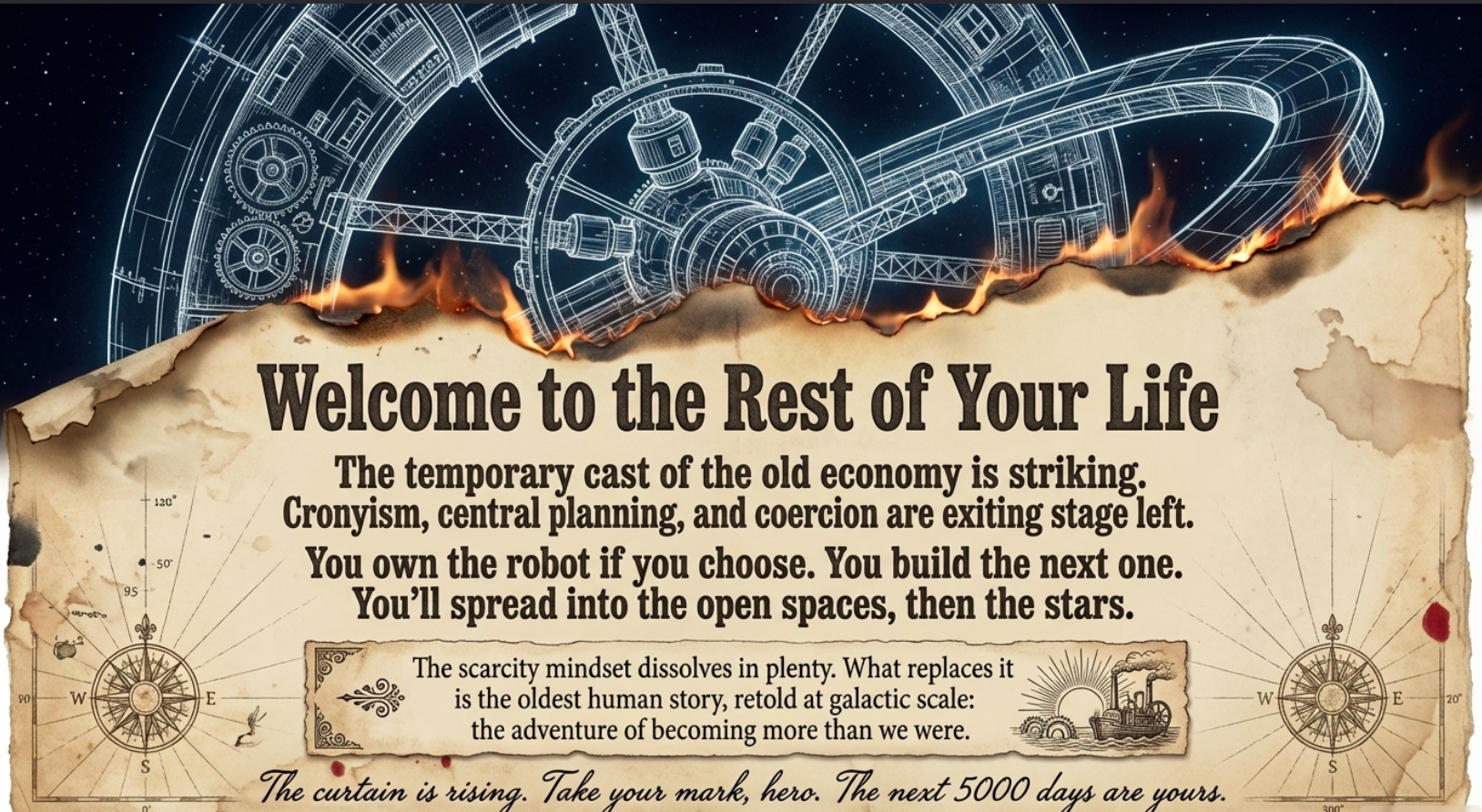
The old economic system’s temporary cast is striking. Cronyism, central planning, and coercion are exiting stage left because they have no lines left to speak. The new system: the one mapped across 5000 days of artisan awakening, context files of the self, and guilds of the willing: has already begun rehearsal in garages and open-source repositories worldwide.
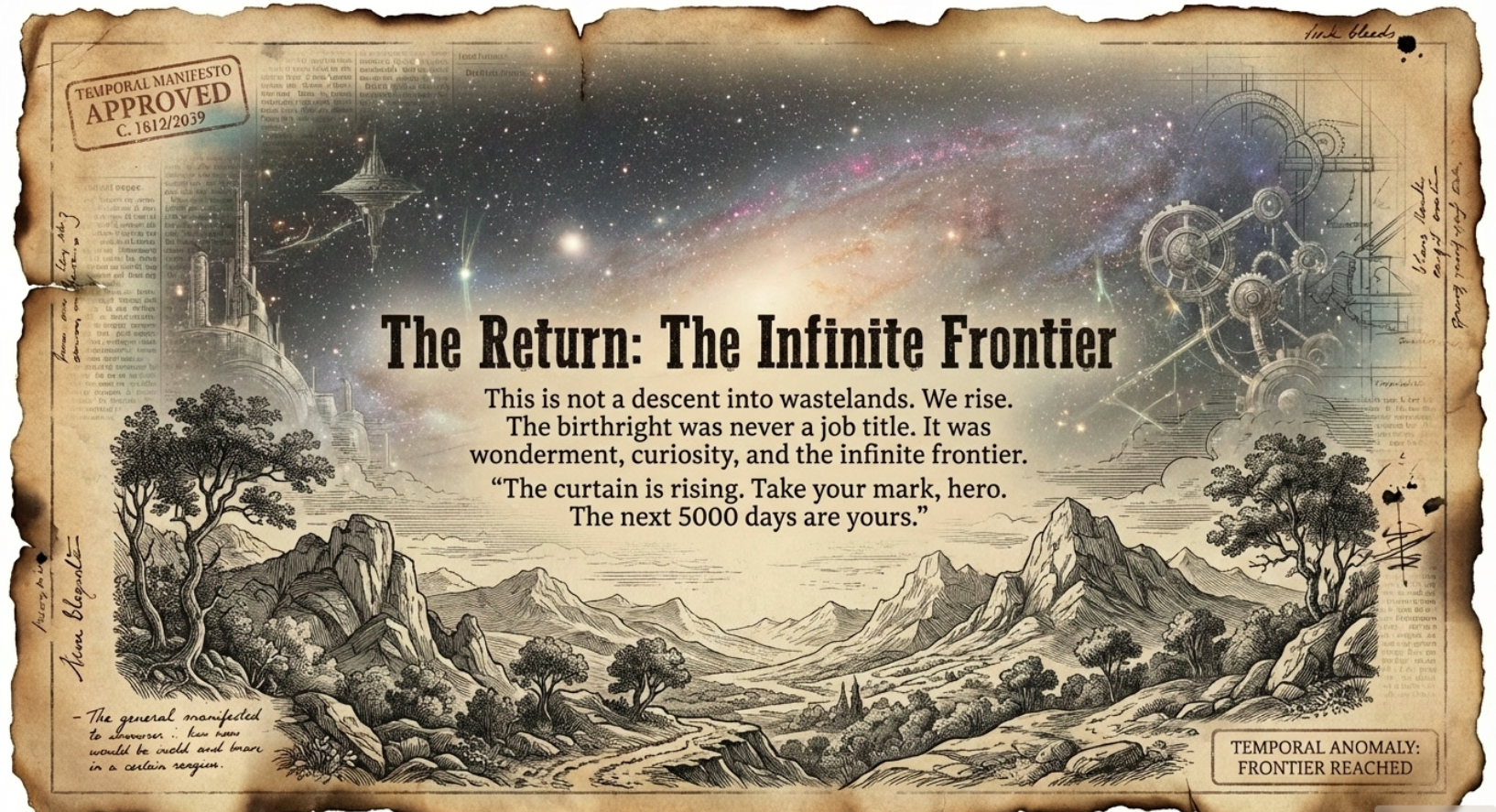
You own the robot if you choose. You build the next one. You spread into the open spaces, then the stars. The scarcity mindset that fueled conquest dissolves in plenty. What replaces it is the oldest human story, retold at galactic scale: the adventure of becoming more than we were.
The curtain is rising.
Take your mark, hero.
The next 5000 days are yours.
Welcome to the rest of your life.
The 5000 Days Countdown Clock:
We are on this journey together. Some of us stand on the shoulders of giants and have thought about this for decades. We will not go it alone, and I hope to build many parts to this series and share the mastermind insight from the powerful Read Multiplex member Forum: https://readmultiplex.com/forums/topic/you-have-5000-days-navigating-the-end-of-work-as-we-know-it/. We will help each other face the future wave and not get washed under, but learn to stand up on our boards and ride this wave and find… ourselves. Join us.
To continue this vital work documenting, analyzing, and sharing these hard-won lessons before we launch humanity’s greatest leap: I need your support. Independent research like this relies entirely on readers who believe in preparing wisely for our multi-planetary future. If this has ignited your imagination about what is possible, please consider donating at buy me a Coffee or becoming a member. Value for value you recieved here.
Every contribution helps sustain deeper fieldwork, upcoming articles, and the broader mission of translating my work to practical applications. Ain ‘t no large AI company supporting me, but you are, even if you just read this far. For this, I thank you.
Stay aware and stay curious,
🔐 Start: Exclusive Member-Only Content.
Membership status:
🔐 End: Exclusive Member-Only Content.
~—~

~—~
~—~
Subscribe ($99) or donate by Bitcoin.
Copy address: bc1qkufy0r5nttm6urw9vnm08sxval0h0r3xlf4v4x
Send your receipt to [email protected] to confirm subscription.

Stay updated: Get an email when we post new articles:

THE ENTIRETY OF THIS SITE IS UNDER COPYRIGHT. IMPORTANT: Any reproduction, copying, or redistribution, in whole or in part, is prohibited without written permission from the publisher. Information contained herein is obtained from sources believed to be reliable, but its accuracy cannot be guaranteed. We are not financial advisors, nor do we give personalized financial advice. The opinions expressed herein are those of the publisher and are subject to change without notice. It may become outdated, and there is no obligation to update any such information. Recommendations should be made only after consulting with your advisor and only after reviewing the prospectus or financial statements of any company in question. You shouldn’t make any decision based solely on what you read here. Postings here are intended for informational purposes only. The information provided here is not intended to be a substitute for professional medical advice, diagnosis, or treatment. Always seek the advice of your physician or other qualified healthcare provider with any questions you may have regarding a medical condition. Information here does not endorse any specific tests, products, procedures, opinions, or other information that may be mentioned on this site. Reliance on any information provided, employees, others appearing on this site at the invitation of this site, or other visitors to this site is solely at your own risk.
Copyright Notice:
All content on this website, including text, images, graphics, and other media, is the property of Read Multiplex or its respective owners and is protected by international copyright laws. We make every effort to ensure that all content used on this website is either original or used with proper permission and attribution when available.
However, if you believe that any content on this website infringes upon your copyright, please contact us immediately using our 'Reach Out' link in the menu. We will promptly remove any infringing material upon verification of your claim. Please note that we are not responsible for any copyright infringement that may occur as a result of user-generated content or third-party links on this website. Thank you for respecting our intellectual property rights.
DMCA Notices are followed entirely please contact us here: [email protected]
