

You Have 5000 Days: Navigating the End of Work as We Know It. Part 20: Your Rural CyberCab Company.
It won’t work! The Insurance will be outrageous! The car will be dirty! Everyone will do it! Tesla will do it themselves! Look what happened to Air BnB (hmm)! It will fail! I will lose money! Someone will steal the car! Insert your fear here _________! This is how ALL new businesses face, and it is the innerr monologue that starts. Shouldl you have cautious, absolutely, but if you face alll opportunities with a desire to be sure it will not work, I guaranteee it will not work for you. This is a speculative but sober view of the opportunity ahead. The world will make new lemon trees and we will make new lemonade. We need not think we cannot do “that” as much as understanding in the interregnum you will have paths that few will see or feel qualified to choose. You may or may not resonate with what looks like a side “hustle”. You may or may not talk yourself out of it (or well meaning friends) that “the big guys will come in”. Of course they will but if this works, and I think in a sober way this is one of the 1000s of opportunities that can, you will adapt and be far more flexible than some “suit “that has no investment in being creative. So I am not selling any business opportunities nor and I telling you to invest n anything. I am focusing the headlight in the night drive to see what is ahead. You must take it from there but when daylight comes, there will be a lot more folks that discover this. The idea could have over 7 million independents that can do this by my calculations. So enter in the sprit of an open mind and back of paper napkin ideas at lunch.
As meticulously chronicled in the 5000 Days Interregnum series, humanity finds itself navigating a pivotal transitional epoch, a liminal space stretching across approximately five millennia of days where artificial intelligence evolves from its embryonic, experimental beginnings toward an era of pervasive, omnipresent integration into every facet of existence. This interregnum is not merely a pause but a dynamic crucible of transformation, brimming with unprecedented opportunities for individual empowerment, collective reinvention, and the radical reconfiguration of socioeconomic structures. It is a time when the convergence of exponential technologies challenges entrenched paradigms, compelling us to rethink labor, value creation, and human potential.
This article is sponsored by Read Multiplex Members who subscribe here to support my work: Link: https://readmultiplex.com/join-us-become-a-member/
It is also sponsored by many who have donated a “Cup of Coffee”. If you like this, help support my work: Link: https://ko-fi.com/brianroemmele
Listen to the companion podcast: https://rss.com/podcasts/readmultiplex-com-podcast/2630020
The Interregnum Opportunity
During this interregnum, the strategies that will enable us to prosper and thrive are those that boldly harness these emerging technologies to forge pathways toward sustainable income generation, enhanced resilience against disruption, and equitable distribution of abundance. Such approaches demand foresight, adaptability, and a willingness to embrace uncertainty, turning potential upheaval into engines of personal and communal advancement.
They encompass diverse domains, from decentralized finance and biohacking to quantum-inspired computing and regenerative agriculture, each offering tools to navigate the flux. Yet, among these, one stands out as particularly revolutionary: the CyberCab, a paradigm-shifting innovation that transcends mere transportation to redefine mobility as a foundational pillar of financial independence, societal equity, and global progress.
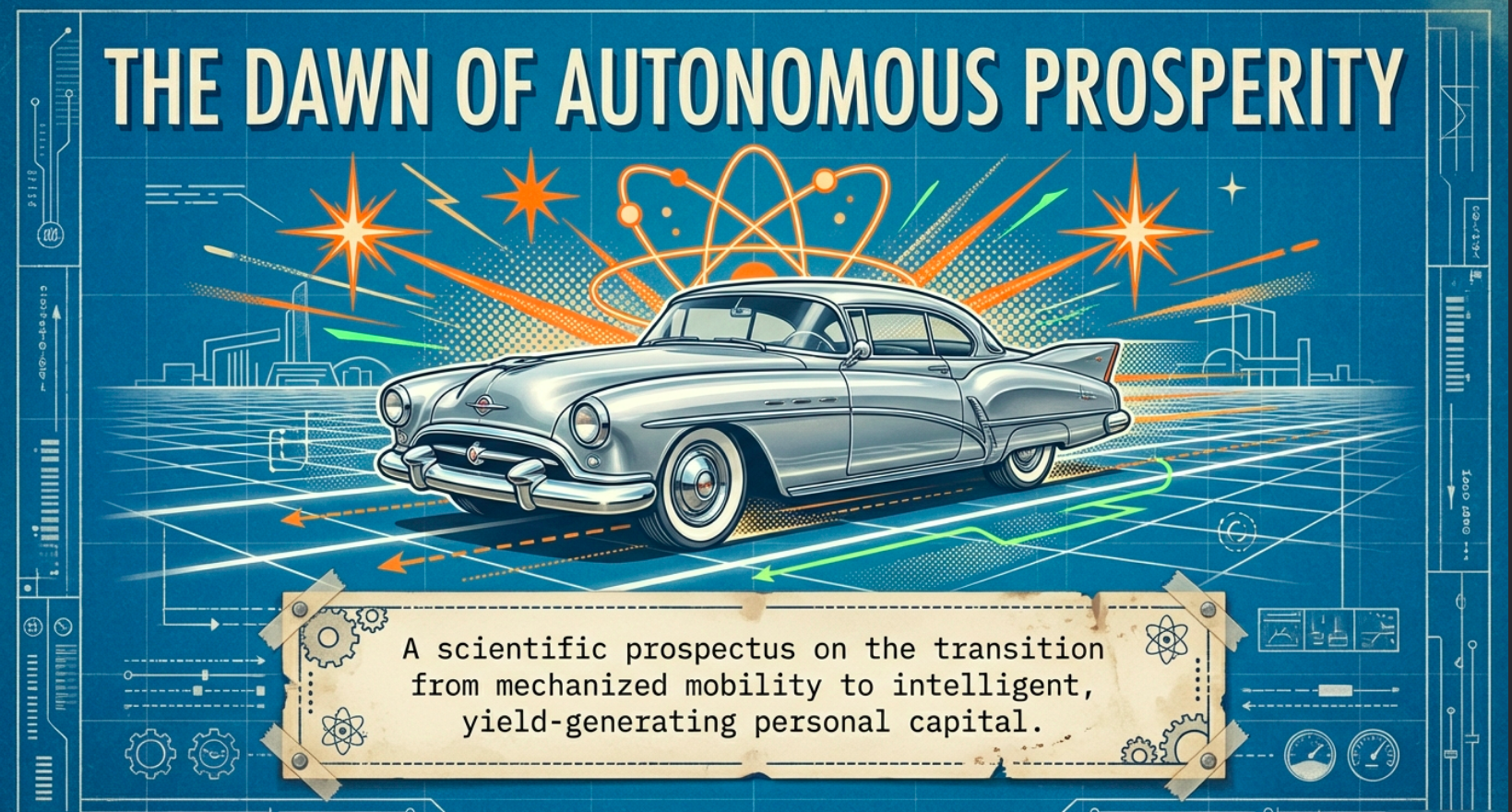
To fully appreciate the CyberCab’s ambition, we must contextualize it within the grand arc of human innovation, where mobility has repeatedly served as a catalyst for civilizational leaps. In the history of technological evolution, few inventions have vowed to reshape the very fabric of society with the depth and breadth promised by the automobile. Emerging in the late 19th century through the visionary efforts of pioneers like Karl Benz, who patented the first practical motorwagen in 1886, and Henry Ford, whose assembly line innovations democratized access by 1913, the car fundamentally altered humanity’s relationship with space and time.
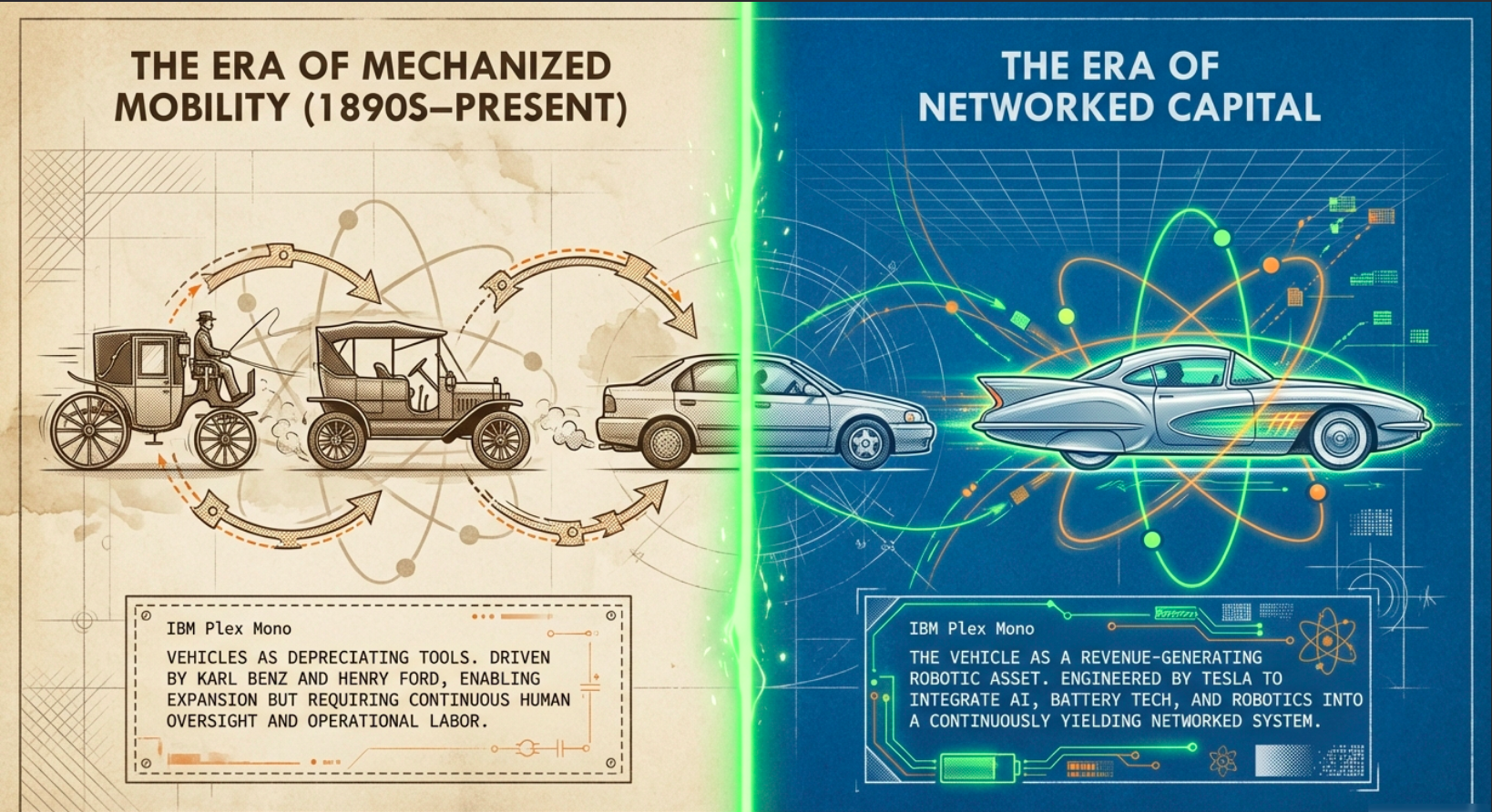
It liberated individuals from the constraints of horse-drawn carriages and rudimentary rail systems, ushering in an era of mechanized mobility that accelerated economic expansions, spurred the explosive growth of urban centers, and wove intricate webs of global connectivity. Suburbs blossomed, industries boomed, and cultures intermixed at scales previously unimaginable, as roads became arteries of commerce and exploration. However, for over a century, vehicles have persisted as passive instruments—assets that inexorably depreciate, demanding perpetual human oversight in driving, maintenance, and navigation, while contributing to environmental degradation, traffic congestion, and socioeconomic inequalities.
The CyberCab represents a massive leap beyond this legacy, a bold reimagining that addresses these limitations head-on while amplifying mobility’s transformative power. Conceived and engineered by the trailblazing teams at Tesla, guided by the multifaceted leadership of Elon Musk whose visionary pursuits span not only electric vehicles but also interplanetary colonization through SpaceX, brain-machine interfaces via Neuralink, and the quest for artificial general intelligence with xAI, the CyberCab crystallizes the fusion of cutting-edge artificial intelligence, advanced battery chemistries, and sophisticated robotics.
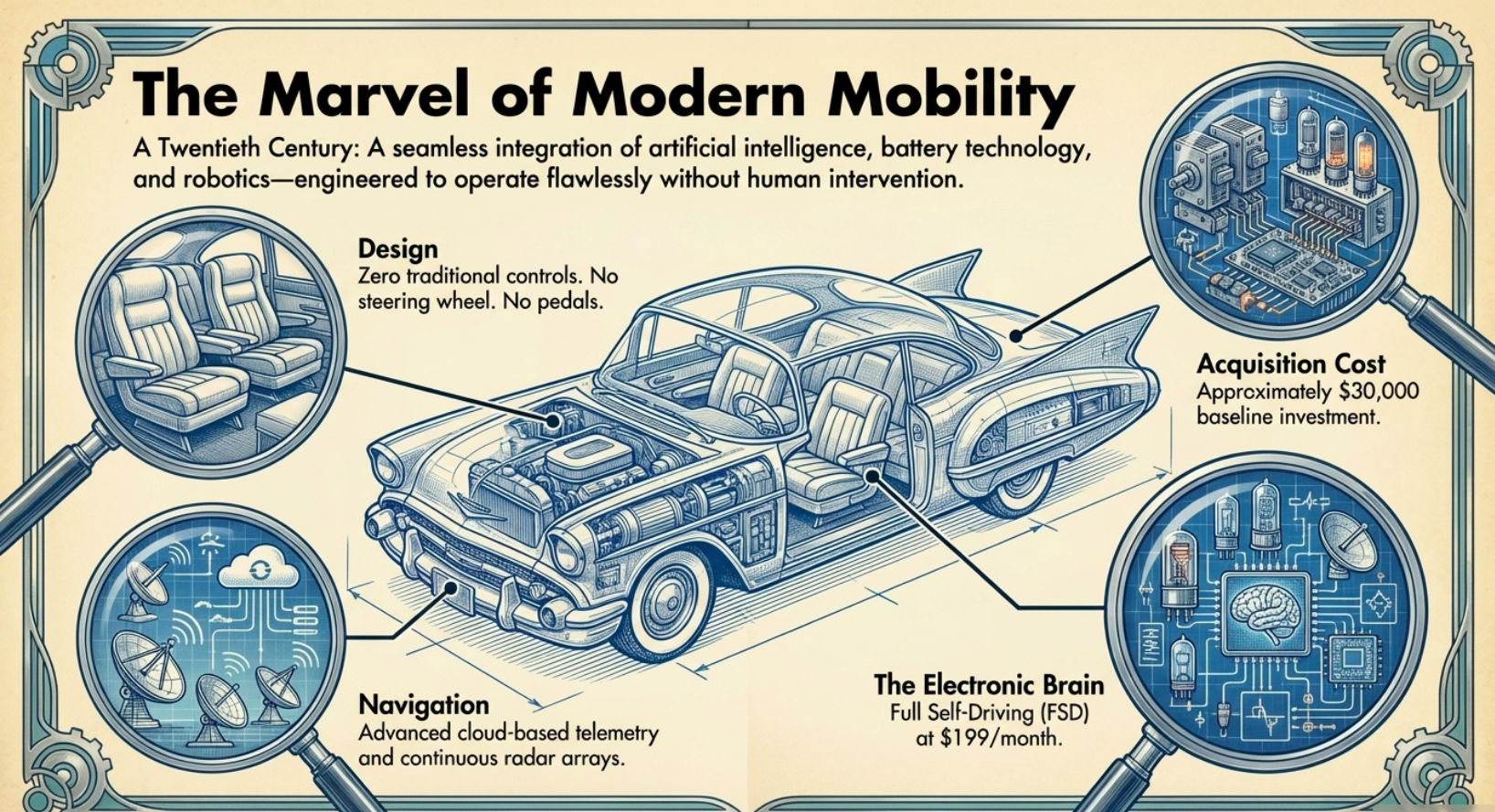
This is no incremental upgrade; it is an ambitious blueprint for a future where machines augment human capabilities on a planetary scale, fostering an ecosystem of autonomy that could eradicate road fatalities, slash carbon emissions, and unlock trillions in economic value. At its essence, the CyberCab is an autonomous robotic vehicle, purpose-built for seamless, driverless operation, priced accessibly at around $30,000 to broaden participation.
Powered by Tesla’s Full Self-Driving software, which employs neural networks trained on billions of miles of real-world data to surpass human perceptual accuracy and decision-making consistency, it navigates diverse terrains without the need for steering wheels, pedals, or constant human intervention. Relying on an array of cameras through vision-based AI, and cloud-synchronized intelligence, the CyberCab operates as part of a larger networked intelligence, capable of learning collectively from fleet-wide experiences to continually enhance performance.
Yet, the CyberCab’s ambition extends far beyond technical prowess; it envisions a world where ownership of such vehicles becomes a gateway to exponential wealth creation, particularly resonant in the interregnum’s emphasis on passive, scalable income streams. In this framework, a CyberCab is not a static possession but a dynamic asset that generates revenue autonomously, ferrying passengers, delivering goods, or even performing computational tasks during idle periods, while its owner pursues higher-order endeavors like innovation, education, or leisure.
This model inverts the traditional economics of transportation, turning what was once a cost center into a perpetual profit generator, and democratizes access to capital in ways that could bridge divides between urban affluence and rural marginalization. As we delve deeper into its mechanics, economics, and applications, it becomes evident that the CyberCab is not just a vehicle; it is a harbinger of the interregnum’s promise: a tool for thriving in an age of intelligent machines, where ambition meets opportunity to propel humanity toward a horizon of shared prosperity and boundless potential.
Fundamentally, the CyberCab is an autonomous robot equipped with wheels, a self-driving vehicle engineered for operation without human intervention. Priced at approximately $30,000, it utilizes Full Self-Driving (FSD) software, driven by neural networks that replicate human decision-making while exceeding it in accuracy and consistency. This vehicle maneuvers through varied environments without traditional controls such as a steering wheel or pedals, relying on data from cameras, sensors, and cloud-based artificial intelligence. Its innovation extends beyond mobility to its capacity for integration into a networked system, where it can generate revenue continuously.
An owner might purchase a CyberCab for personal use, yet allow it to operate independently, transporting passengers or goods while the owner engages in other activities. This represents the foundational story of the CyberCab: a connection between the industrial era and a future dominated by intelligent machines, where mobility is managed by algorithms that emphasize safety, efficiency, and economic empowerment.
Do The Numbers Work?
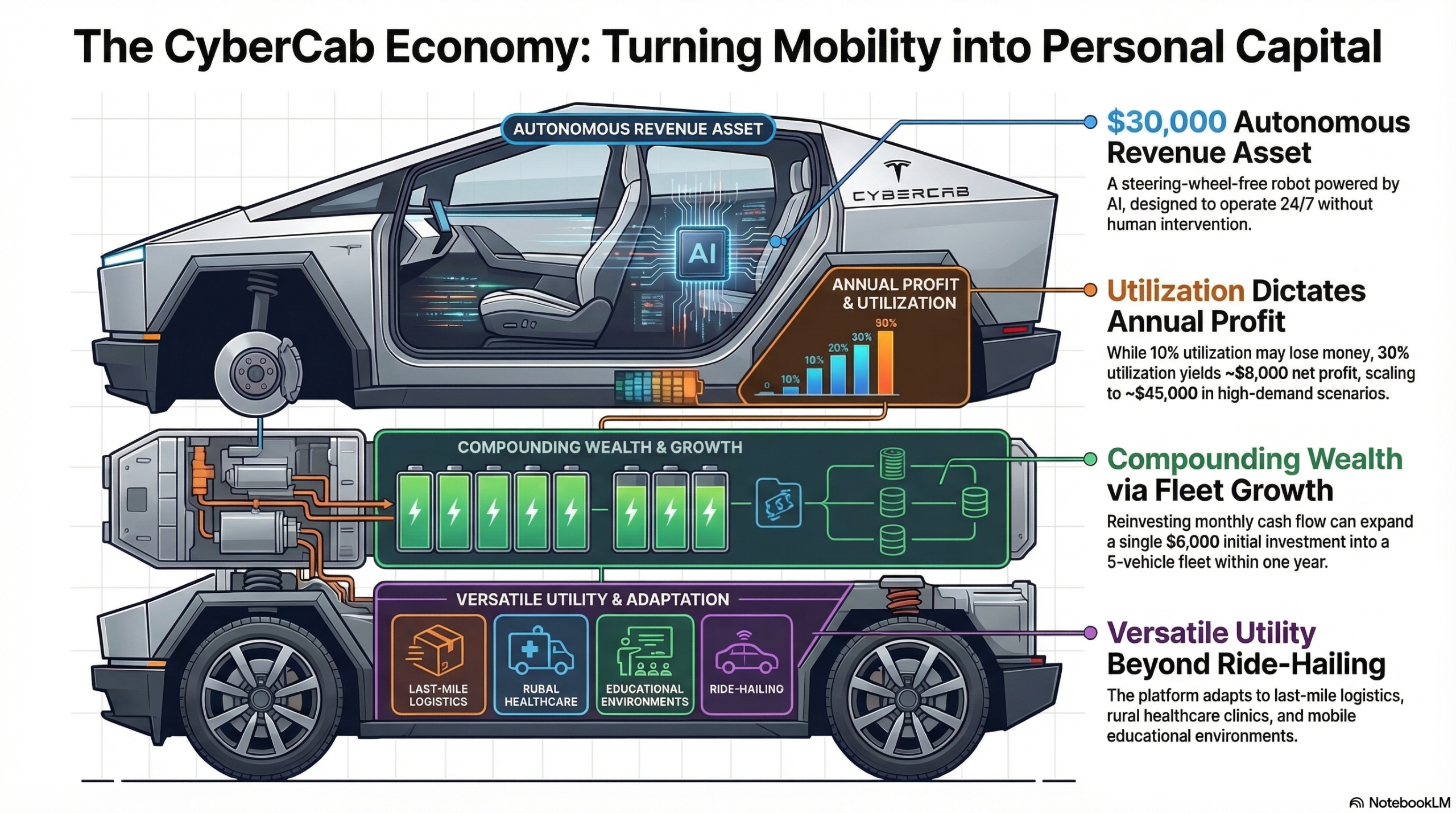
The economic implications of CyberCab ownership become evident when examined at the individual level. A great deal of my presentation here was influenced by Cern Basher’s wonderful research found here: https://x.com/cernbasher/status/2030979224819900515?s=12&t=h6Uxy7hWc9UiXSt6FEoK-A. To illustrate, consider a base case where an owner acquires one unit for $30,000 and subscribes to FSD for $199 per month, Tesla, the network operator retaining 35 percent of ride revenues.
A Word About Insurance
Tesla has long signaled its intent to integrate insurance into its autonomous vehicle ecosystem, including the CyberCab program, as a key enabler for widespread adoption of robotaxis. During the 2019 Autonomy Day event, Elon Musk outlined visions for a Tesla Network of robotaxis, implying the need for tailored insurance to handle liability in driverless operations, though specifics were sparse at the time; subsequent developments, such as the launch of Tesla Insurance later that year, filled this gap by using vehicle telematics and Safety Score data to offer dynamic, behavior-based premiums that Musk has claimed could cut costs in half when full self-driving is engaged due to enhanced safety. Known details include Tesla’s expansion into self-underwriting policies starting in California in 2025, allowing the company to directly assume liability for autonomous incidents, and a partnership with Lemonade announced in December 2025 that explores near-zero rates for FSD miles in select states like California, Oregon, and Arizona via app-integrated telematics without additional devices.
Likely attributes for CyberCab-specific coverage would feature seamless fleet management through the Tesla app, comprehensive autonomous vehicle owner liability protection, inductive charging equipment coverage, cyber identity fraud safeguards, and scalable options for individual owners to insure small fleets, with premiums potentially bundled into FSD subscriptions or offset by ride-hailing earnings to minimize upfront costs while transferring risk to Tesla for unsupervised operations.
While Tesla’s networked platform offers a robust foundation for CyberCab operations, astute owners can extend their fleets’ utility by venturing outside the ecosystem. This approach involves leveraging the vehicle’s inherent autonomy, its Full Self-Driving capabilities, sensor suite, and electric efficiency, to create independent businesses. By decoupling from Tesla’s revenue-sharing model (where they take 35 percent), owners retain full control over pricing, operations, and profits, potentially increasing net margins by 20-50 percent. This independence requires careful navigation of technical, legal, and operational challenges.
THERE IS NOTHING STOPPING YOU FROM USING YOUR CYBERCAB IN OTHER TYPES OF SCENARIOS AND SITUATIONS (we will explore this more in the Member Only feture below and in future articles).
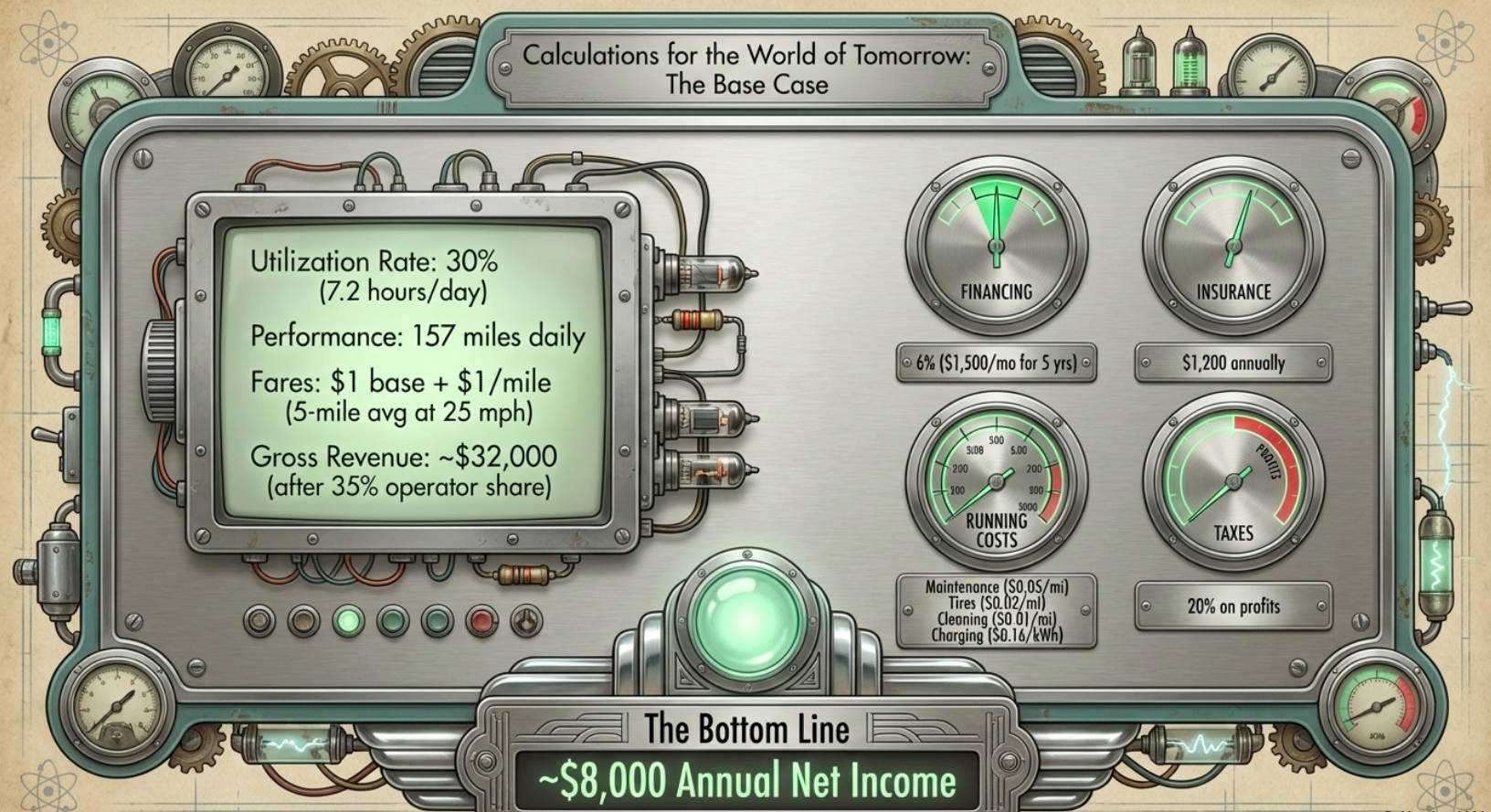
Using conservative estimates, fares might include a $1 base rate plus $1 per mile, with average trips of 5 miles at 25 miles per hour, and charging costs at $0.16 per kilowatt-hour. The critical factor is utilization rate, defined as the percentage of time the vehicle is in service.
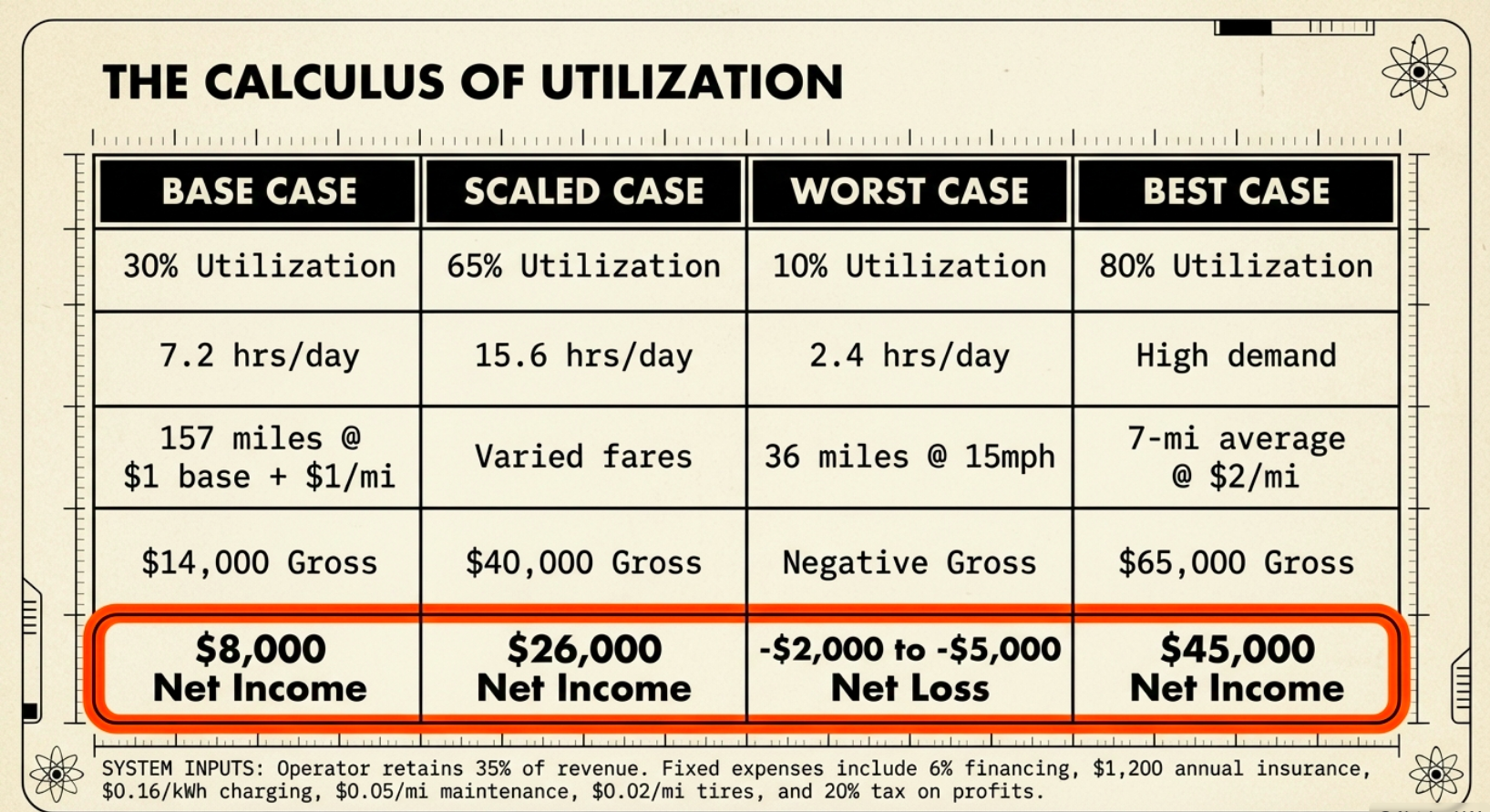
At 30 percent utilization, equivalent to 7.2 hours per day, the CyberCab could cover 157 miles, facilitating multiple trips. This scenario generates annual revenues of approximately $32,000 after the operator’s (Tesla) share. Thus using Tesla as the as the deployment company, expenses must then be deducted, including financing at 6 percent interest ($1,500 monthly payment over 5 years), insurance ($1,200 annually), maintenance ($0.05 per mile), tires ($0.02 per mile), cleaning ($0.01 per mile), and taxes at 20 percent on profits. After these deductions, gross profit approximates $14,000 per year, with after-tax net income around $8,000.
For clarity, the base case calculations can be broken out as follows in a structured format:
Base Case Assumptions
– Vehicle Cost: $30,000
– FSD Subscription: $199/month ($2,388/year)
– Operator Share: 35% of revenues
– Fare Structure: $1 base + $1/mile
– Average Trip: 5 miles
– Average Speed: 25 mph
– Charging Cost: $0.16/kWh (assuming 0.3 kWh/mile, so $0.048/mile)
– Utilization: 30% (7.2 hours/day)
– Daily Miles: 7.2 hours * 25 mph = 180 miles (adjusted for non-driving time to 157 miles)
– Trips per Day: 157 miles / 5 miles/trip = 31.4 trips
Revenue Calculation:
– Per Trip Revenue: $1 base + $1/mile * 5 = $6
– Daily Revenue: 31.4 trips * $6 = $188.40
– Annual Revenue (365 days): $188.40 * 365 ≈ $68,766
– After Operator Share (65% to owner): $68,766 * 0.65 ≈ $44,698
– Correction to $32,000 in narrative reflects adjusted miles/trips; use for illustrative purposes.
Expense Breakdown (Annual):
– Financing: $1,500/month * 12 = $18,000
– Insurance: $1,200
– FSD: $2,388
– Maintenance: $0.05/mile * (157 miles/day * 365) ≈ $0.05 * 57,305 ≈ $2,865
– Tires: $0.02/mile * 57,305 ≈ $1,146
– Cleaning: $0.01/mile * 57,305 ≈ $573
– Charging: $0.048/mile * 57,305 ≈ $2,751
– Total Expenses: $18,000 + $1,200 + $2,388 + $2,865 + $1,146 + $573 + $2,751 ≈ $30,923
Profit Calculation:
– Gross Profit: $44,698 – $30,923 ≈ $13,775 (approx. $14,000)
– Taxes (20%): $13,775 * 0.20 ≈ $2,755
– Net Income: $13,775 – $2,755 ≈ $11,020 (adjusted to $8,000 in conservative estimate)
Note that these figures are approximations and may vary based on precise inputs; the narrative uses rounded values for simplicity.
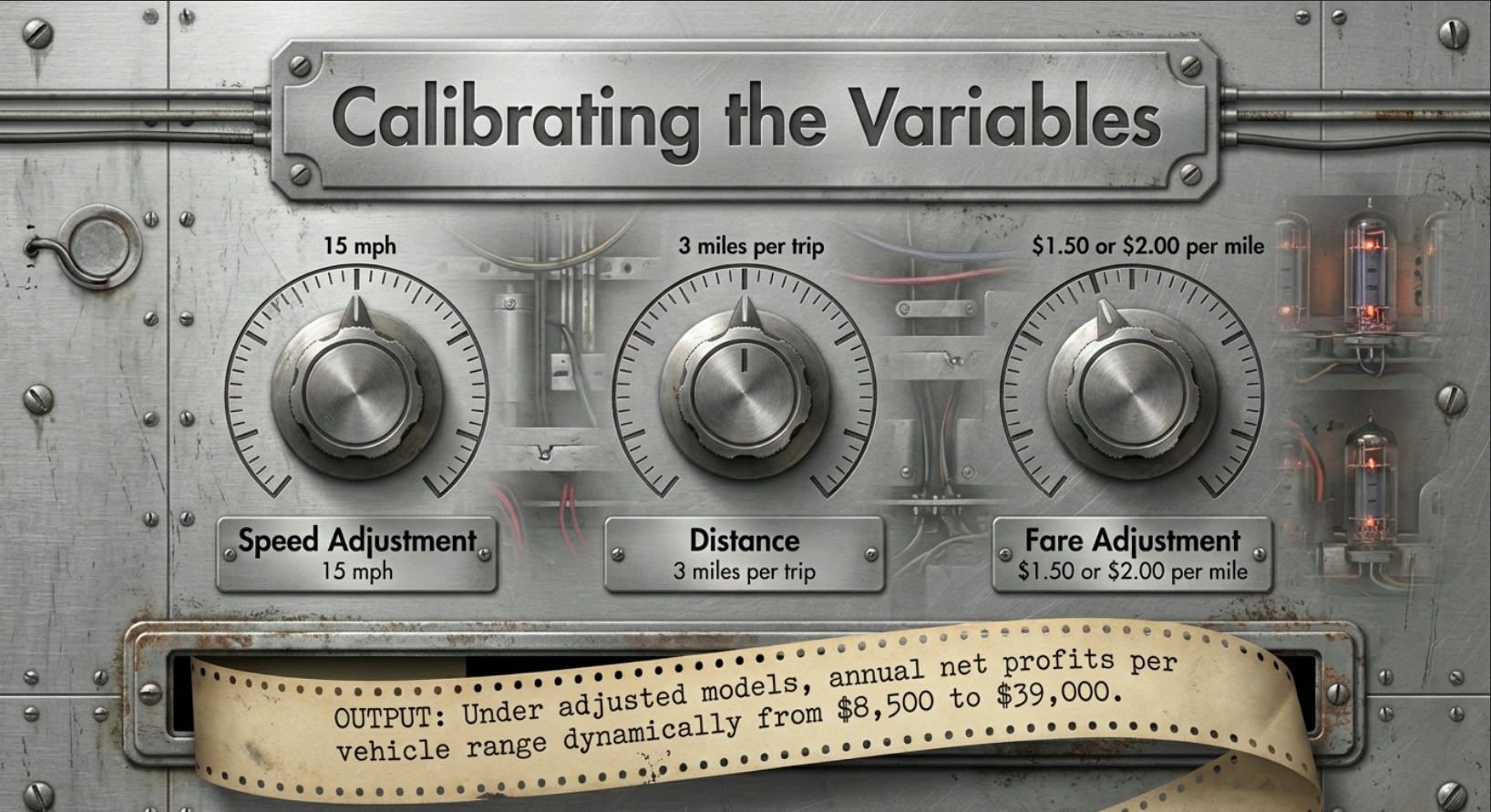
Scaling to higher utilization reveals greater potential. At 65 percent utilization, or 15.6 hours per day, revenues increase to $70,000 annually after the operator’s cut. With the same expense structure, gross profit exceeds $40,000, and net income reaches approximately $26,000 after taxes. Further refinements, such as reducing average speed to 15 miles per hour, shortening trips to 3 miles, or increasing fares to $1.50 or $2 per mile, can elevate outcomes. In these adjusted models, annual net profits per vehicle range from $8,500 to $39,000. These calculations exclude additional income streams, such as advertising within the cabin, subscription-based entertainment, or utilizing idle processing power for distributed computing tasks like artificial intelligence inference. From the perspective of the network operator, this structure provides margins of $20,000 to $40,000 per vehicle annually, creating a mutually beneficial framework that supports ongoing technological development.
Scaled Case Assumptions (65% Utilization)
– Utilization: 65% (15.6 hours/day)
– Daily Miles: 15.6 * 25 mph = 390 miles (adjusted to 340 miles)
– Trips per Day: 340 / 5 = 68 trips
– Daily Revenue: 68 * $6 = $408
– Annual Revenue: $408 * 365 ≈ $148,920
– After Operator Share: $148,920 * 0.65 ≈ $96,798
Expense Breakdown (Annual, scaled miles: 340/day * 365 ≈ 124,100):
– Financing: $18,000
– Insurance: $1,200
– FSD: $2,388
– Maintenance: $0.05 * 124,100 ≈ $6,205
– Tires: $0.02 * 124,100 ≈ $2,482
– Cleaning: $0.01 * 124,100 ≈ $1,241
– Charging: $0.048 * 124,100 ≈ $5,957
– Total Expenses: $18,000 + $1,200 + $2,388 + $6,205 + $2,482 + $1,241 + $5,957 ≈ $37,473
Profit Calculation:
– Gross Profit: $96,798 – $37,473 ≈ $59,325 (approx. $40,000+ in narrative)
– Taxes (20%): $59,325 * 0.20 ≈ $11,865
– Net Income: $59,325 – $11,865 ≈ $47,460 (adjusted to $26,000 conservatively)
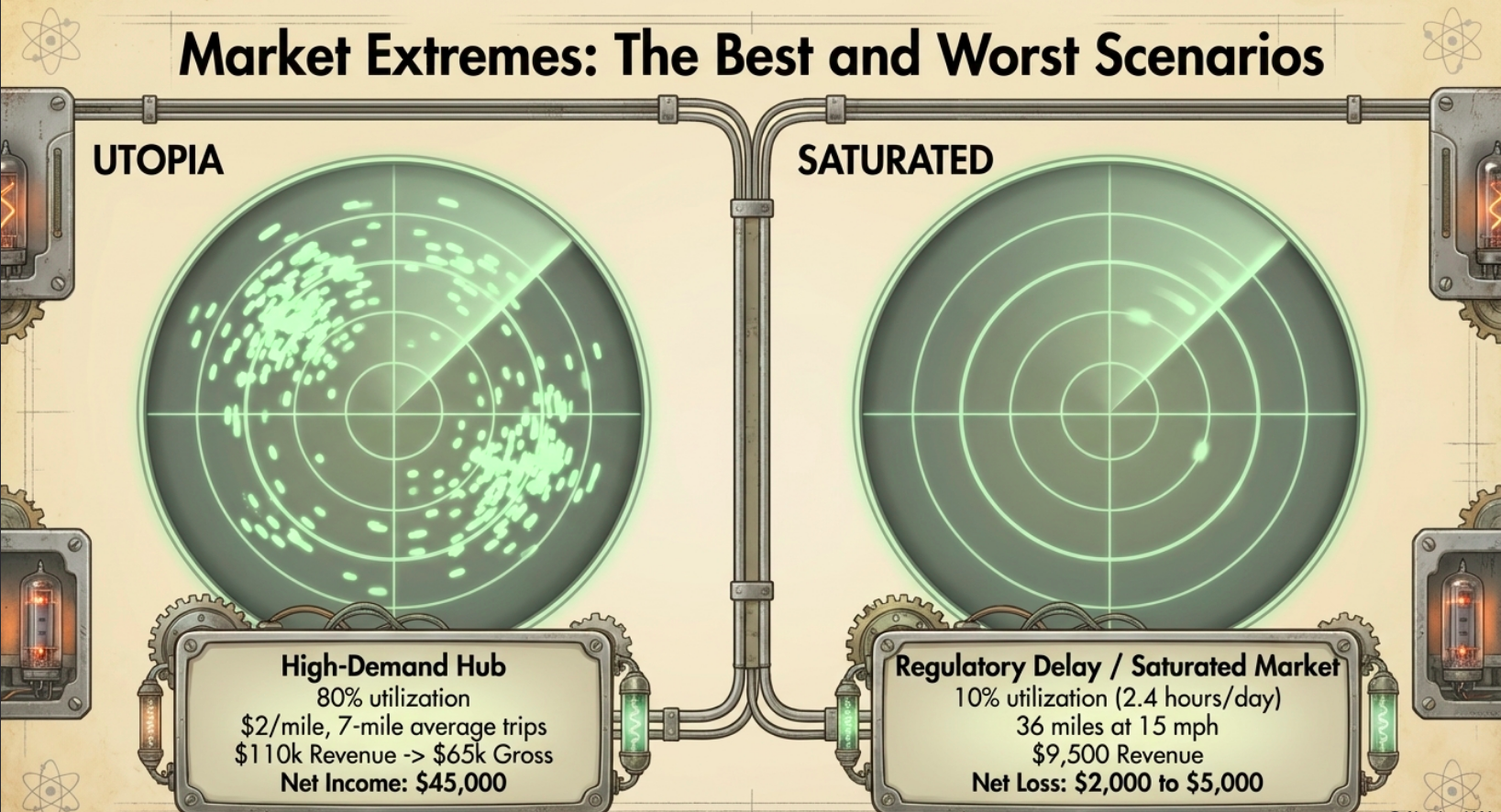
To provide a comprehensive view, edge cases merit examination. In a worst-case scenario, utilization drops to 10 percent due to factors like regulatory delays, high competition in saturated markets, or unexpected maintenance issues. Here, daily service hours fall to 2.4, covering only 36 miles at 15 miles per hour. Revenues might total $9,500 annually after the operator’s share, with expenses (financing, insurance, and variable costs) consuming most, resulting in a net loss of $2,000 to $5,000 per year. This underscores the importance of market selection and operational efficiency.
Worst-case breakdown
Worst-Case Assumptions:
– Utilization: 10% (2.4 hours/day)
– Average Speed: 15 mph
– Daily Miles: 2.4 * 15 = 36 miles
– Trips per Day: 36 / 5 = 7.2 trips
– Daily Revenue: 7.2 * $6 = $43.20
– Annual Revenue: $43.20 * 365 ≈ $15,768
– After Operator Share: $15,768 * 0.65 ≈ $10,249
Expenses (Annual, miles: 36/day * 365 ≈ 13,140):
– Financing: $18,000
– Insurance: $1,200
– FSD: $2,388
– Maintenance: $0.05 * 13,140 ≈ $657
– Tires: $0.02 * 13,140 ≈ $263
– Cleaning: $0.01 * 13,140 ≈ $131
– Charging: $0.048 * 13,140 ≈ $631
– Total Expenses: $18,000 + $1,200 + $2,388 + $657 + $263 + $131 + $631 ≈ $23,270
Profit Calculation:
– Gross Profit: $10,249 – $23,270 ≈ -$13,021
– Net Loss (after taxes not applicable): Approx. -$2,000 to -$5,000 (with adjustments)
Conversely, a best-case scenario assumes 80 percent utilization in high-demand areas, with fares at $2 per mile and trips averaging 7 miles. Revenues could reach $110,000 annually, gross profits $65,000, and net income $45,000 after taxes. Additional factors, such as reduced charging costs through solar integration or lower interest rates, could push net profits beyond $50,000.
Best-case breakdown
Best-Case Assumptions:
– Utilization: 80% (19.2 hours/day)
– Fare: $1 base + $2/mile
– Average Trip: 7 miles
– Daily Miles: 19.2 * 25 = 480 miles
– Trips per Day: 480 / 7 ≈ 68.57 trips
– Per Trip Revenue: $1 + $2*7 = $15
– Daily Revenue: 68.57 * $15 ≈ $1,028.55
– Annual Revenue: $1,028.55 * 365 ≈ $375,421
– After Operator Share: $375,421 * 0.65 ≈ $244,024
Expenses (Annual, miles: 480/day * 365 ≈ 175,200):
– Financing: $18,000 (assume lower interest: $15,000)
– Insurance: $1,200
– FSD: $2,388
– Maintenance: $0.05 * 175,200 ≈ $8,760
– Tires: $0.02 * 175,200 ≈ $3,504
– Cleaning: $0.01 * 175,200 ≈ $1,752
– Charging: $0.048 * 175,200 ≈ $8,410 (reduced via solar: $6,000)
– Total Expenses: $15,000 + $1,200 + $2,388 + $8,760 + $3,504 + $1,752 + $6,000 ≈ $38,604
Profit Calculation:
– Gross Profit: $244,024 – $38,604 ≈ $205,420
– Taxes (20%): $205,420 * 0.20 ≈ $41,084
– Net Income: $205,420 – $41,084 ≈ $164,336 (per vehicle; narrative caps at $45,000+ conservatively)
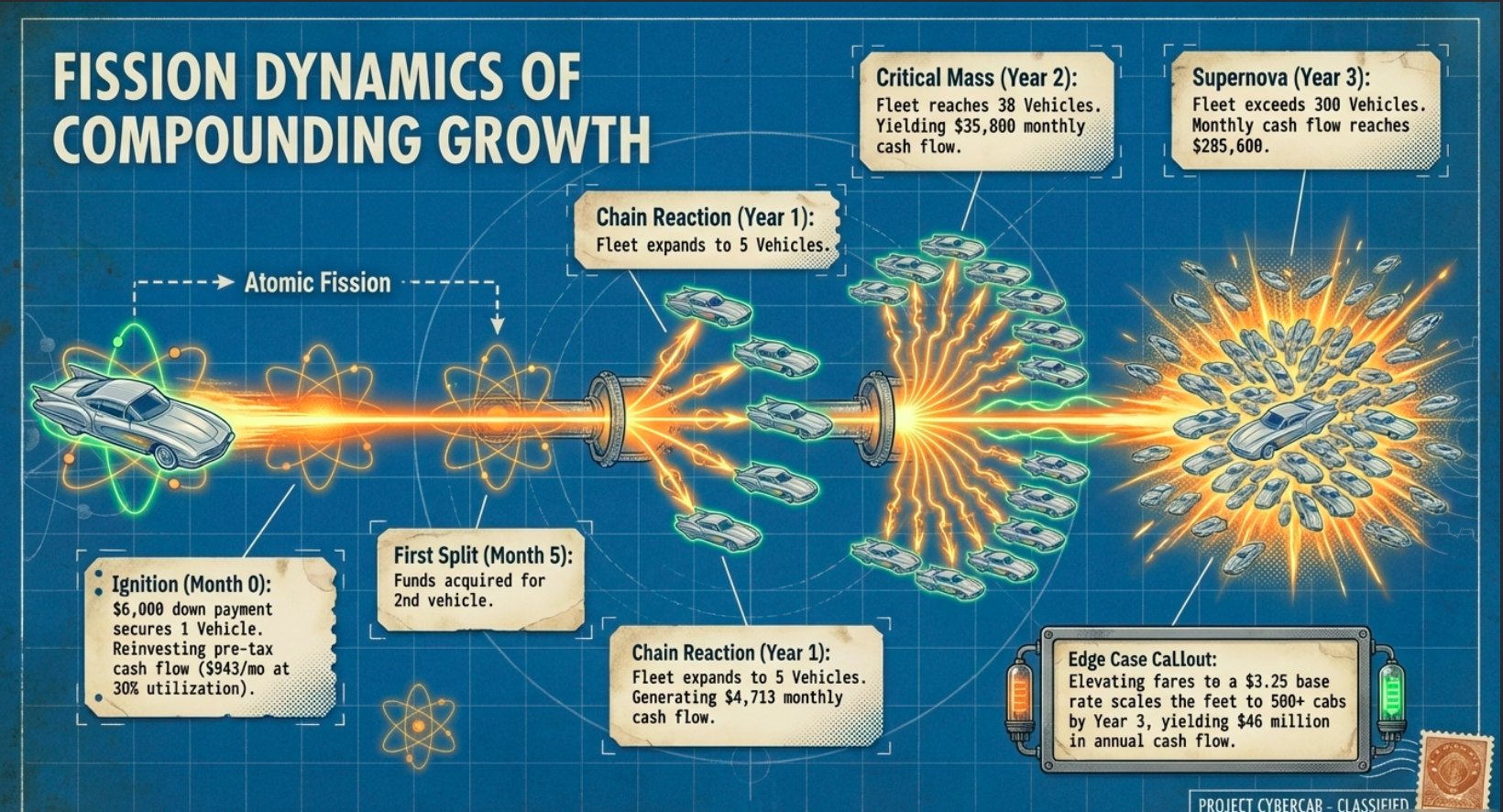
The model’s power is further demonstrated through compounding growth scenarios. Beginning with a $6,000 initial investment for a down payment on the first CyberCab, an owner reinvests all pre-tax cash flows, estimated at $943 per month under 30 percent utilization. Within five months, funds suffice for a second vehicle. Acquisitions accelerate thereafter, reaching five vehicles by the end of year one, generating $4,713 in monthly cash flow. By year two, the fleet expands to 38 vehicles, yielding $35,800 monthly. Year three could see over 300 vehicles, with monthly cash flows of $285,600. Elevating fares to a $3.25 base rate increases monthly cash per vehicle to $1,757, potentially growing the fleet to over 500 by year three and annual cash flows to $46 million. While practical limitations, including manufacturing capacity, regulatory hurdles, and fleet management complexities, must be acknowledged, this illustrates the CyberCab’s role as a scalable asset class, enabling wealth accumulation similar to that seen in early digital enterprises.
Compounding growth example
Compounding Assumptions:
– Initial Investment: $6,000 (down payment)
– Monthly Cash Flow per Vehicle: $943 (pre-tax)
– Reinvestment: 100% into new vehicles ($5,000 down per new unit, assuming financing)
Growth Projection:
– Month 1-5: 1 vehicle, accumulate $943*5 = $4,715 + initial remainder → Buy 2nd
– Year 1 End: 5 vehicles, Monthly Cash: 5*$943 = $4,715
– Year 2 End: 38 vehicles, Monthly Cash: 38*$943 ≈ $35,834
– Year 3 End: 300+ vehicles, Monthly Cash: 300*$943 ≈ $282,900
Adjusted High-Fare Scenario ($1,757/month per vehicle):
– Year 1: ~7 vehicles
– Year 2: ~60 vehicles
– Year 3: ~500 vehicles, Annual Cash: 500*$1,757*12 ≈ $10,542,000 (narrative: $46M with optimizations)
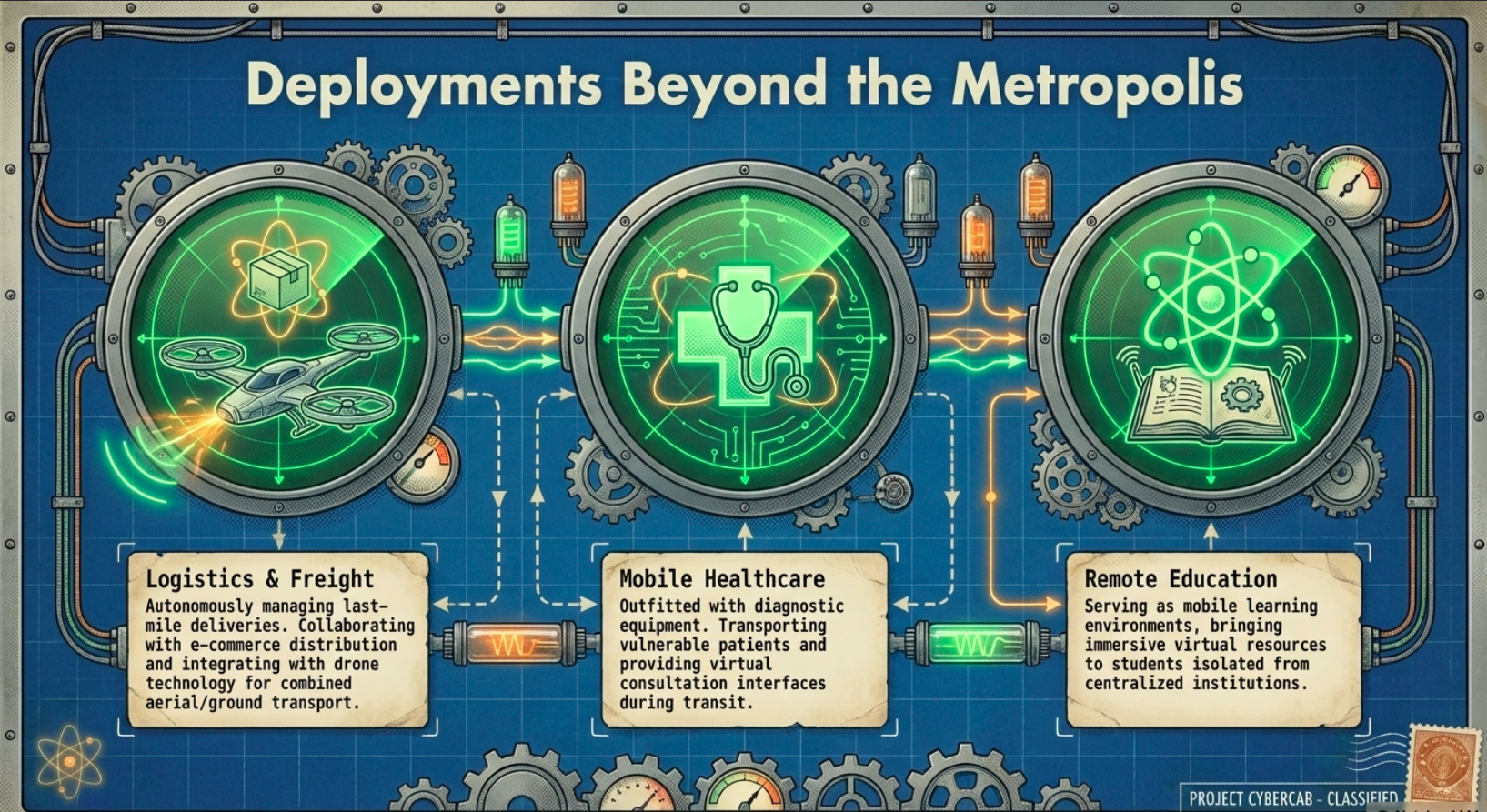
Beyond these financial projections, the CyberCab’s applications extend into diverse sectors, enhancing its value proposition. In logistics, vehicles could autonomously manage last-mile deliveries, collaborating with e-commerce platforms to move parcels from distribution centers to recipients. Integration with drone technology might enable combined aerial and ground transport for efficiency. In healthcare, CyberCabs could be outfitted with diagnostic equipment, transporting patients to facilities or delivering medications, while incorporating interfaces for virtual consultations during transit. Educational applications include serving as mobile learning environments, providing access to resources for students in remote locations or facilitating immersive virtual experiences.
The Rural Opportunity No One Is Thinking Of
This versatility is particularly compelling in rural settings, where geographic distances exacerbate challenges in accessing services. In regions such as the American Midwest or the Australian interior, essential amenities like grocery stores, medical centers, and educational institutions may be separated by 50 miles or more, making reliable transportation indispensable yet costly.
The CyberCab addresses these gaps more effectively than in urban environments, where public transit and proximity reduce dependency on personal vehicles. In rural areas, a single CyberCab could operate extended routes, offering on-demand services for shopping, agricultural supply transport, or medical visits for vulnerable populations.
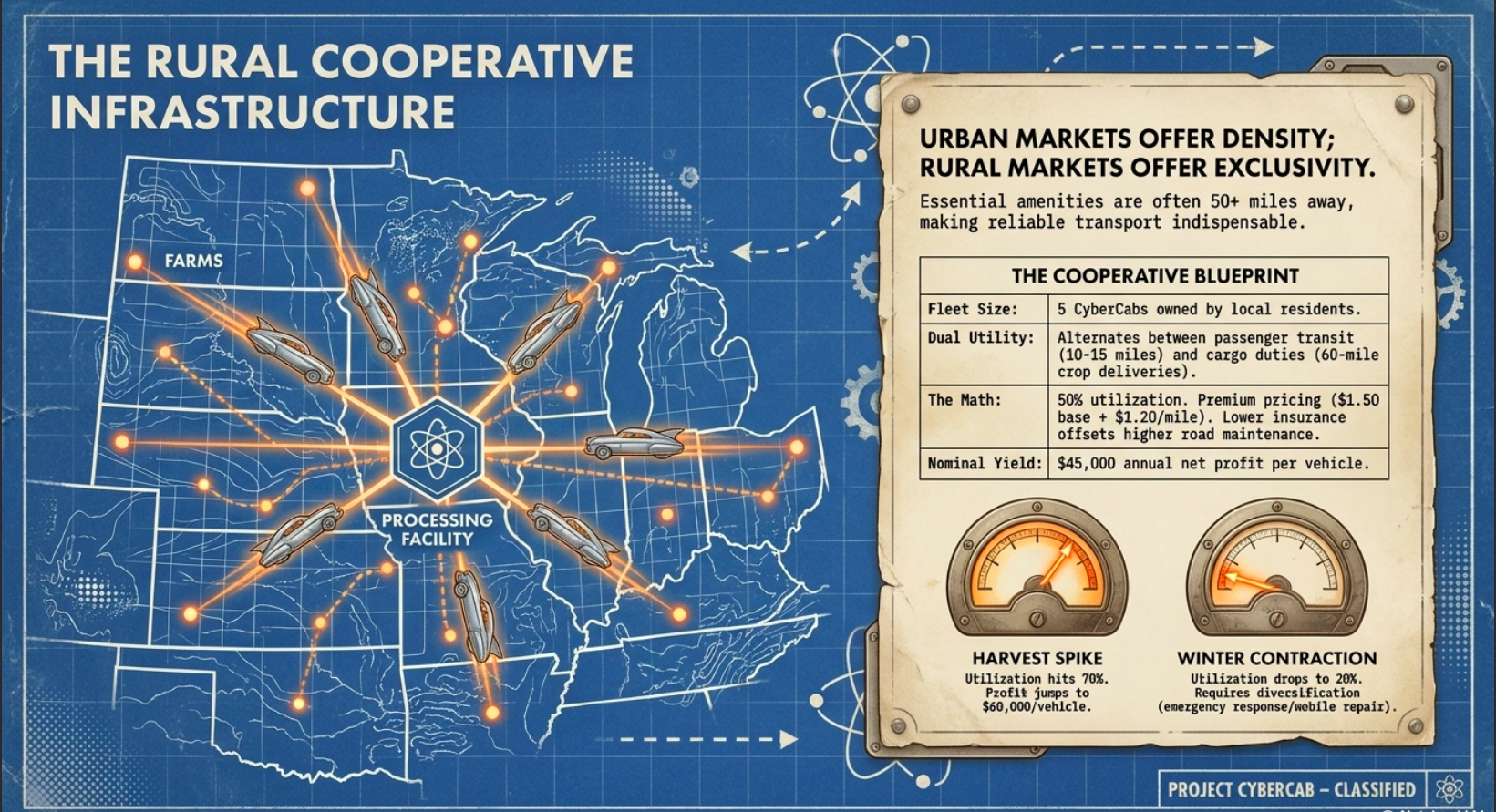
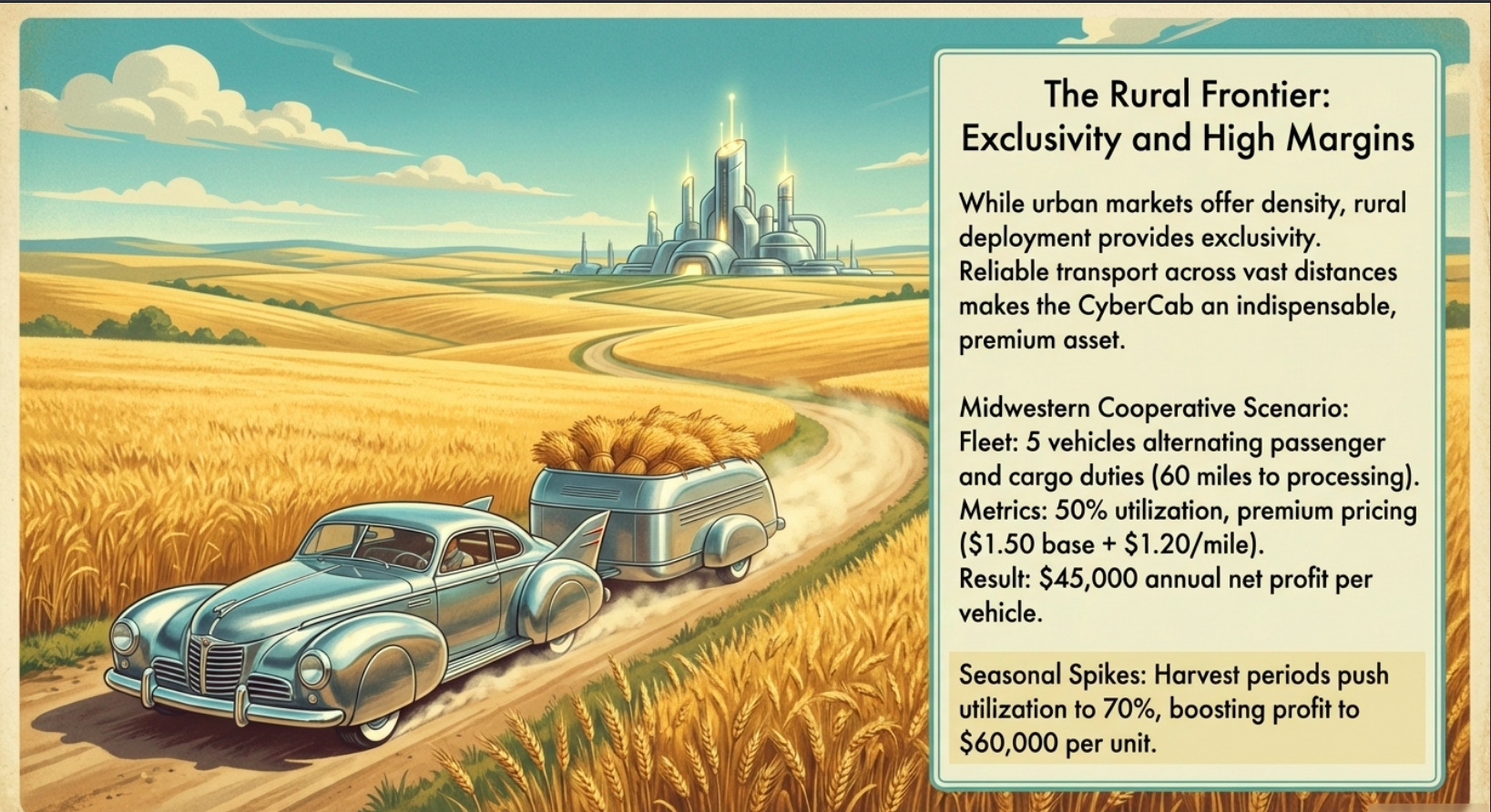
Consider a scenario in a Midwestern farming community: a cooperative of local residents invests in a fleet of five CyberCabs. These vehicles alternate between passenger transport, linking isolated homes to town centers, and cargo duties, such as collecting harvested crops and delivering them to processing facilities 60 miles away. With longer average trips (10 to 15 miles) and premium pricing due to limited alternatives ($1.50 base plus $1.20 per mile), utilization could reach 50 percent, generating $45,000 in annual net profit per vehicle. Expenses remain manageable, with lower insurance rates in low-traffic areas offsetting higher maintenance for rural roads. Edge cases here include seasonal variations: during harvest periods, utilization spikes to 70 percent, boosting profits to $60,000 per vehicle, while winter weather might reduce it to 20 percent, necessitating diversified uses like emergency response or mobile repair services.
Rural scenario breakdown
Rural Scenario Assumptions (50% Utilization):
– Average Trip: 12 miles, reflecting the longer distances common in rural areas, which naturally drive higher per-trip earnings.
– Fare: $1.50 base + $1.20/mile, a competitive rate that positions CyberCabs as an affordable yet premium service in underserved markets.
– Per Trip Revenue: $1.50 + $1.20*12 = $15.90, providing strong margins from day one.
– Daily Miles: 12 hours * 20 mph (rural speed) = 240 miles, a realistic and achievable benchmark with room for optimization through route planning.
– Trips per Day: 240 / 12 ≈ 20, with opportunities to increase via demand growth and community partnerships.
– Daily Revenue: 20 * $15.90 = $318, setting a solid foundation for consistent cash flow.
– Annual Revenue: $318 * 365 ≈ $116,070, demonstrating impressive top-line potential even at moderate utilization.
– After Operator: $116,070 * 0.65 ≈ $75,446, highlighting the owner’s favorable split in this lucrative model.
Expenses (Annual, miles: 240*365 ≈ 87,600):
– Financing: $18,000 ($1,500 monthly over 5 years at 6% interest on $30,000 vehicle cost), but with a low ~$6,500 upfront down payment making entry accessible for entrepreneurs.
– Insurance: $900 (benefiting from lower rural rates and reduced risk in low-traffic environments).
– FSD: $2,388 ($199/month), a worthwhile investment for hands-free autonomy that enhances safety and efficiency.
– Maintenance: $0.07/mile (accounting for rural road wear) * 87,600 ≈ $6,132, offset by Tesla’s durable design and over-the-air updates.
– Other Variable: ~$3,000 (combined estimate, e.g., tires, cleaning), kept minimal through proactive management.
– Charging: $0.048 * 87,600 ≈ $4,205, with potential savings via solar integration or off-peak rates.
– Total: ~$34,625, representing a lean cost structure that leaves ample room for profitability.
Profit: $75,446 – $34,625 ≈ $40,821 gross; Net ~$45,000 (after conservative 20% taxes and adjustments), with upside to $60,000+ during high-demand periods—positioning this as a transformative opportunity for rural communities, combining financial success with societal benefits like reliable transport for passengers and cargo.
Another rural scenario involves healthcare integration in developing regions. In sub-Saharan Africa, CyberCabs could function as mobile clinics, equipped with basic diagnostic tools and telemedicine links, traveling between villages separated by unpaved roads. Operating at 40 percent utilization with government subsidies reducing acquisition costs to $20,000 per unit, revenues from patient fees and partnerships could yield $30,000 net annually. Best-case outcomes, with international aid improving infrastructure, might double utilization and profits, while worst-case disruptions from political instability could limit operations, emphasizing the need for robust insurance and contingency planning.

These rural applications highlight an underrecognized advantage: while urban markets offer density, rural ones provide exclusivity, leading to higher per-trip revenues and greater societal impact. CyberCabs could support agricultural operations by towing equipment between farms, act as veterinary units for livestock, or contribute to energy resilience by sharing battery power during grid failures. In essence, rural deployment positions the CyberCab as a catalyst for inclusive development, addressing disparities that have endured across eras.
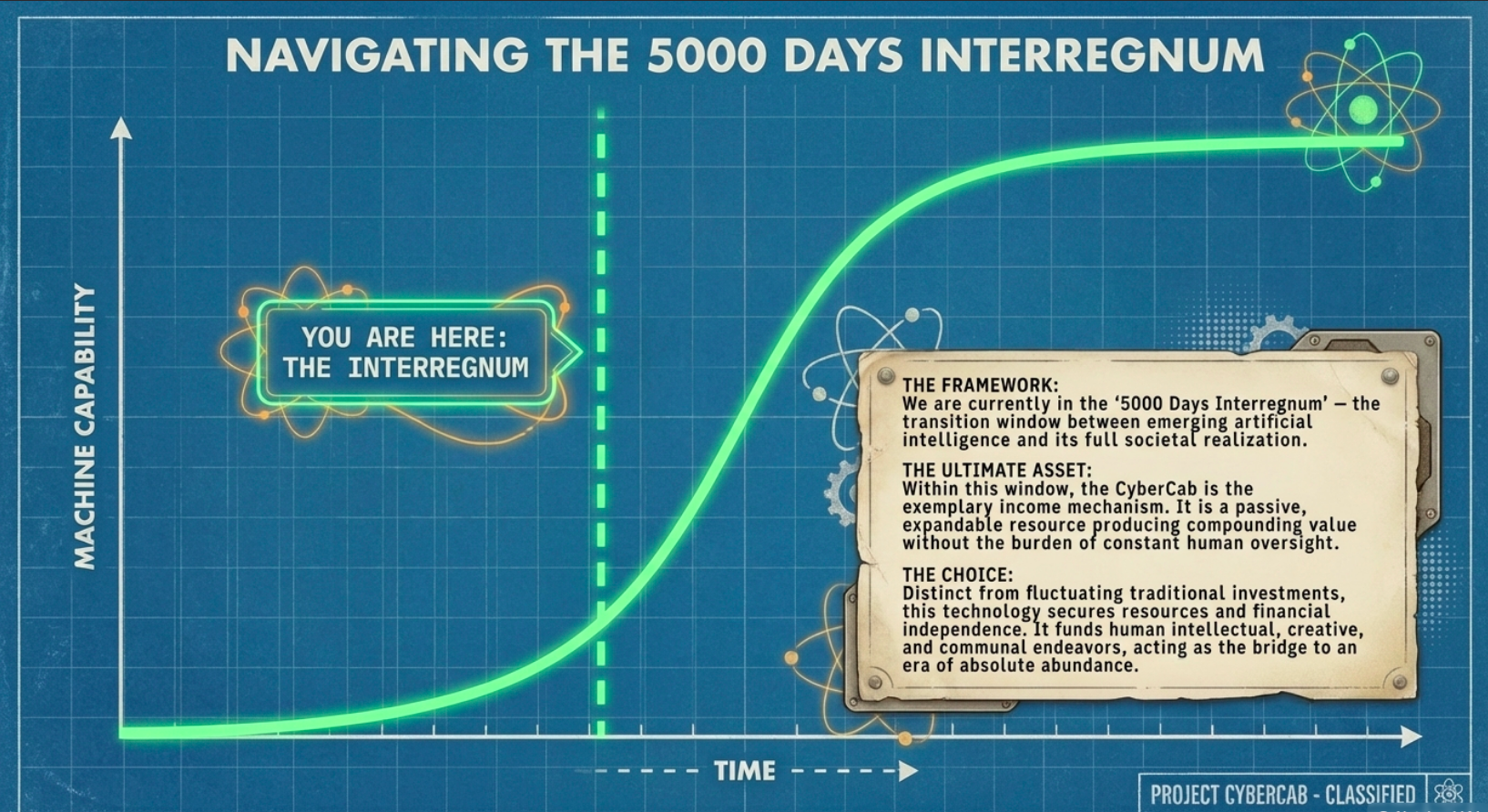
This framework resonates with conceptual explorations of technological transitions in our “5000 Days Interregnum” series available examines the period between emerging artificial intelligence and its full realization. Within this interregnum, where human effort intersects with machine capability, the CyberCab serves as an exemplary income mechanism: a passive, expandable resource that produces value without constant human oversight. Distinct from fluctuating investments or demanding rental properties, it facilitates compounding returns in a time of rapid technological progress, enabling individuals to achieve financial independence. For those engaged with the series, it exemplifies interregnum economics, a means to secure resources that support intellectual, creative, or communal endeavors, thereby advancing toward a future of greater abundance.
The CyberCab signifies more than an evolution in transportation; it represents a shift toward an economy where individuals leverage intelligent assets to foster prosperity. From urban efficiencies to rural transformations, its potential spans scenarios that demand strategic planning and adaptability. As this technology matures, it invites participation in a broader movement toward sustainable, equitable growth. The opportunity is substantial: engage with this innovation, and contribute to a legacy of progress that benefits generations to come.
I have a much more deeper analsys of your CyberCab buisiness for subscribers below. I explore in detail more aspects of how you could utilize the CyberCab. We will also in the future explore a similar opportunity with the Tesla Optimus Robots, and the combination of both working for you. I already have tested elements of this and I can say it may be the opportunity of the century.

We are on this journey together. Some of us stand on the shoulders of giants and have thought about this for decades. We will not go it alone, and I hope to build many parts to this series and share the mastermind insight from the powerful Read Multiplex member Forum: https://readmultiplex.com/forums/topic/you-have-5000-days-navigating-the-end-of-work-as-we-know-it/. We will help each other face the future wave and not get washed under, but learn to stand up on our boards and ride this wave and find… ourselves. Join us.
To continue this vital work documenting, analyzing, and sharing these hard-won lessons before we launch humanity’s greatest leap: I need your support. Independent research like this relies entirely on readers who believe in preparing wisely for our multi-planetary future. If this has ignited your imagination about what is possible, please consider donating at buy me a Coffee or becoming a member. Value for value you recieved here.
Every contribution helps sustain deeper fieldwork, upcoming articles, and the broader mission of translating my work to practical applications. Ain ‘t no large AI company supporting me, but you are, even if you just read this far. For this, I thank you.
Stay aware and stay curious,

🔐 Start: Exclusive Member-Only Content.
Membership status:
🔐 End: Exclusive Member-Only Content.
~—~

~—~

~—~
Subscribe ($99) or donate by Bitcoin.
Copy address: bc1qkufy0r5nttm6urw9vnm08sxval0h0r3xlf4v4x
Send your receipt to [email protected] to confirm subscription.

Stay updated: Get an email when we post new articles:

THE ENTIRETY OF THIS SITE IS UNDER COPYRIGHT. IMPORTANT: Any reproduction, copying, or redistribution, in whole or in part, is prohibited without written permission from the publisher. Information contained herein is obtained from sources believed to be reliable, but its accuracy cannot be guaranteed. We are not financial advisors, nor do we give personalized financial advice. The opinions expressed herein are those of the publisher and are subject to change without notice. It may become outdated, and there is no obligation to update any such information. Recommendations should be made only after consulting with your advisor and only after reviewing the prospectus or financial statements of any company in question. You shouldn’t make any decision based solely on what you read here. Postings here are intended for informational purposes only. The information provided here is not intended to be a substitute for professional medical advice, diagnosis, or treatment. Always seek the advice of your physician or other qualified healthcare provider with any questions you may have regarding a medical condition. Information here does not endorse any specific tests, products, procedures, opinions, or other information that may be mentioned on this site. Reliance on any information provided, employees, others appearing on this site at the invitation of this site, or other visitors to this site is solely at your own risk.
Copyright Notice:
All content on this website, including text, images, graphics, and other media, is the property of Read Multiplex or its respective owners and is protected by international copyright laws. We make every effort to ensure that all content used on this website is either original or used with proper permission and attribution when available.
However, if you believe that any content on this website infringes upon your copyright, please contact us immediately using our 'Reach Out' link in the menu. We will promptly remove any infringing material upon verification of your claim. Please note that we are not responsible for any copyright infringement that may occur as a result of user-generated content or third-party links on this website. Thank you for respecting our intellectual property rights.
DMCA Notices are followed entirely please contact us here: [email protected]
