
You Have 5000 Days: Navigating the End of Work as We Know It. Part 18: The Hidden Sacristy Architect.
The consumer era we curently are living through, how did we get here and where are we going? It started slowly in the late 1800s and by the 1920s Consumerism became almost commonplace. The concept of humans primarily as “consumers” (rather than producers or citizens) first took solid shape before World War I but became widespread in America during the 1920s. This decade is often seen as the true “birth” of the consumer era due to Economic prosperity after WWI, with rising wages and the expansion of credit (e.g., installment plans for cars and appliances). The “New Economic Gospel of Consumption,” where business leaders promoted buying as a patriotic duty to sustain growth. Advertising boomed, with figures like Ernest Dichter beginning to apply psychology to marketing. Consumer activism also arose, with movements like Truth-in-Advertising and Thrift campaigns educating people on spending wisely. By the end of the 1920s, consumerism had shifted from elite novelty to a core aspect of American identity, though the Great Depression temporarily halted its momentum.
While the 1920s planted the seeds, many associate the full explosion of consumerism with the period after World War II (late 1940s onward), especially in the U.S. and Western Europe. Wartime production transitioned to consumer goods, leading to a surge in purchases: Between 1945 and 1949, Americans bought millions of refrigerators, cars, and stoves. Suburbs grew, fueled by the GI Bill and highway systems, creating demand for homes, appliances, and automobiles.
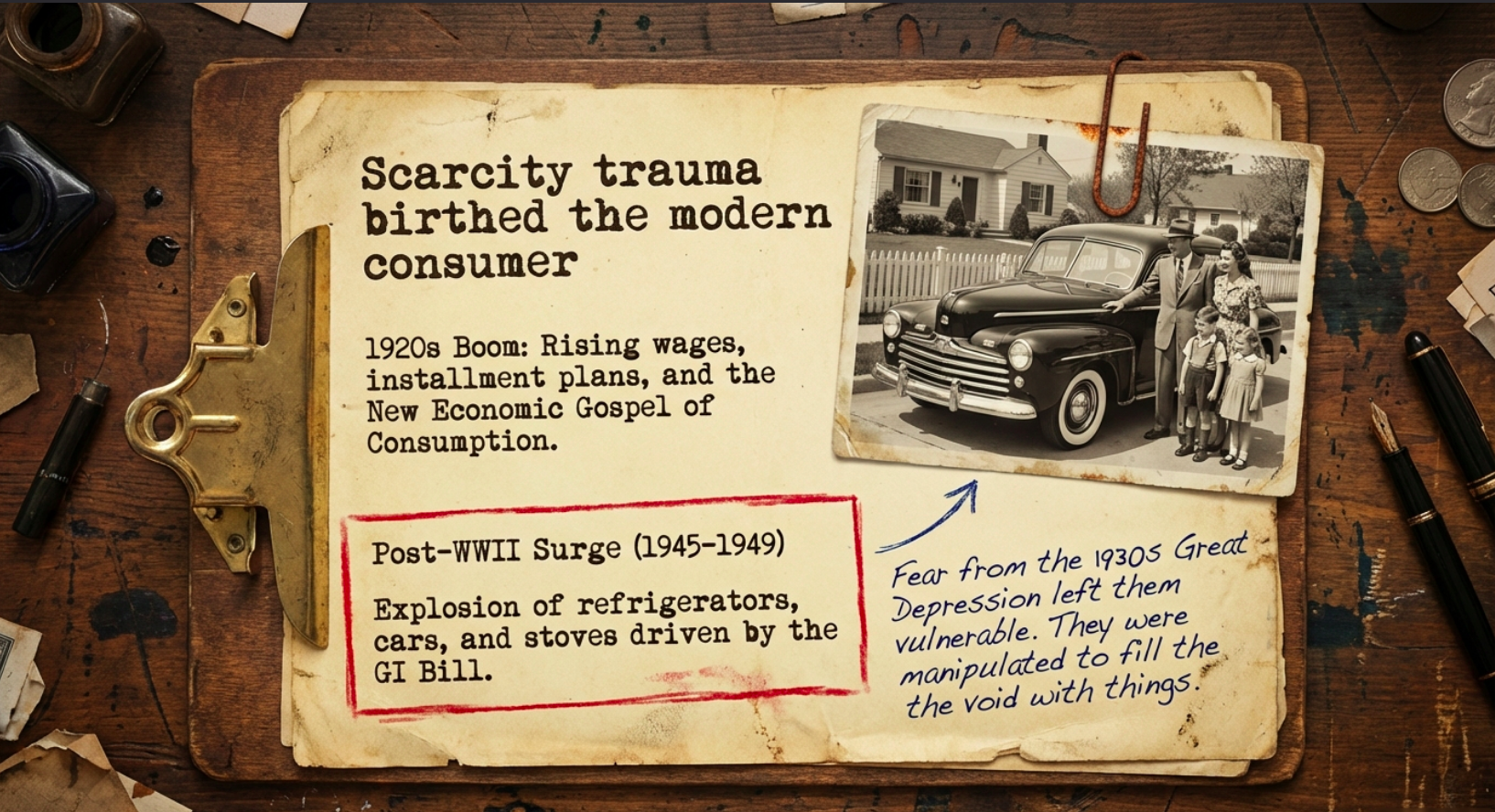
This all took place in an era where there was the fear of scarity from the 1930s Great Depression, the two world wars active period and the jubilance of “coming home”. The first taste of abundance was presented in this era where scienc and technlogy was lifting a signifagant number out of poverty. There is so much truth to this but the underpinnings were built on a grand maniopulation that obscured the true direction this could have taken us. It turns out we were emotionally and psychologically maniputled to become “consumers” and it worked. And this flase abundance party eneded in the 1970s and slowly took the foundations that formed it out to become the period we are leaving behind, just as it begins to fully fail.
This article is sponsored by Read Multiplex Members who subscribe here to support my work: Link: https://readmultiplex.com/join-us-become-a-member/
It is also sponsored by many who have donated a “Cup of Coffee”. If you like this, help support my work: Link: https://ko-fi.com/brianroemmele
Listen to the companion podcast: https://rss.com/podcasts/readmultiplex-com-podcast/2609544
The 126 Boxes In That Cataloged How We Think Of Ourselves
In the dim-lit vaults of a forgotten archive, where the air hangs heavy with the dust of mid-century secrets, a Viennese refugee turned corporate oracle mapped the human soul like a conqueror charting new lands. Ernest Dichter, wielding Freud’s id as his compass, transformed mundane products into psychological elixirs, absolving guilts and stoking desires that bound our self-worth to endless consumption. What began as a solution to sluggish soap sales evolved into a grand experiment in mass mind control, embedding anxieties in women’s hearts, from the sin of effortless laundry to the allure of Barbie’s unattainable form, while laying the groundwork for today’s algorithmic overlords. Yet, as we approach the dawn of abundance, where AI erases scarcity and frees us from toil, this engineered cage begins to crack, revealing not doom, but a call to reclaim our authentic selves.

Picture a future unbound by the chains of need, the Interregnum from 2025 to 2039 reshaping society as automation gifts us leisure and plenty. In this paradise, Dichter’s manipulation, the guilt-laden hooks that tied identity to purchases: lose their grip, exposing the fragility of a system built on fabricated inadequacies. Women, long the primary targets of his gendered psyops, stand to rise first, shedding the weight of “get a job” penance for unbridled creation. But without heeding the lessons buried in those 126 boxes, we risk inventing new torments in the void of purpose. This is the hero’s journey we all must embark upon: from the ordinary world of commodified desires, through the trials of awareness, to a triumphant return where self-worth blooms intrinsically, untethered from the puppeteers of the past.
The persistent myth of rational consumption crumbles under Dichter’s revelations, unmasking how hidden fears fueled the American dream’s dark underbelly. As lawmakers and tech titans navigate abundance, they must avoid replicating his invisible controls, lest we sink into a behavioral abyss of our own design. We will delve into the archives’ shadows, unmasks the manipulations, and charts solutions. It is a map for the hero in each of us, transforming the Interregnum’s upheaval into a golden era of self-sovereignty.

A Discovery in the Shadows of History: The Call to Adventure
It was a crisp autumn day in the late 2008 when I found myself wandering the quiet halls of the Hagley Museum and Library in Wilmington, Delaware. I’d come there chasing whispers of forgotten corporate secrets, drawn by tales of a mid-century psychoanalyst who had quietly engineered the subconscious drivers of American consumerism. This was the actual research notes of this history of psychological manipulation. Holding the physical remnants of history is an experience that was quite a memory for me, because I knew I stumbled upon something few knew existed, even the museum.
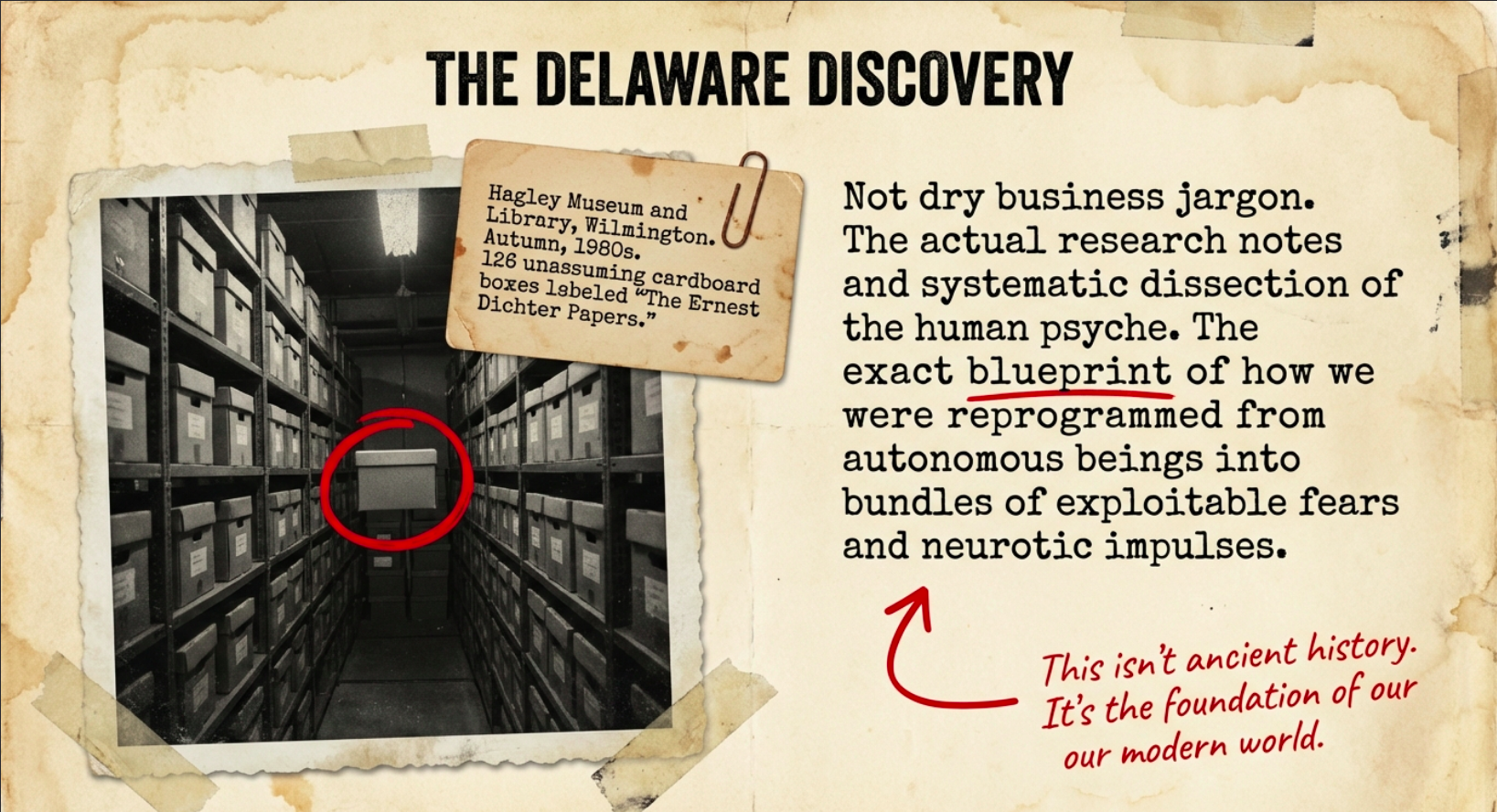
As I descended into the climate-controlled vaults, the air grew cooler and thicker with the scent of aged paper and preserved ink. The archivist, a soft-spoken expert on mid-century industrial archives, led me to a row of unassuming cardboard boxes, 126 of them to be exact, labeled simply as the Ernest Dichter Papers recently donated to the libary by his widow. These weren’t glamorous artifacts, no gold-embossed tomes or dramatic revelations under spotlights. Just stacks of confidential reports, yellowed memos, transcribed “depth interviews,” and handwritten notes from the mid-20th century. I pulled out the first folder, expecting dry business jargon about sales figures and market shares. What I uncovered instead left me reeling, my hands trembling as I turned the pages, page after page revealing a systematic dissection of the human psyche and the age we lived through and are now leaving.
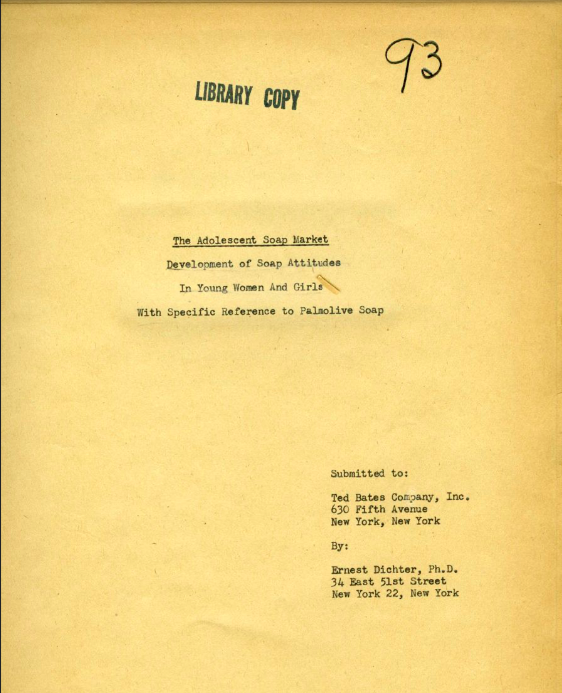
Here, in these forgotten ledgers, was the blueprint for how we’ve come to view ourselves in society, not as autonomous beings with inherent value, but as bundles of hidden fears, guilts, suppressed desires, and neurotic impulses ripe for exploitation by corporations. Dichter, a Viennese psychoanalyst who fled Nazi Europe in the late 1930s, had turned Freudian theory into a corporate weapon, commodifying the subconscious to drive consumption. He had a lot of connections with the other part of the “two headed snake”: Edward Bernays, and I will cover his “contribution” in a future article.His Institute for Motivational Research, founded in 1946, didn’t just sell products. It reprogrammed our sense of self-worth, particularly for women, tying personal identity to consumption, domestic labor, and gendered roles in ways that echo through today’s social media algorithms and targeted ads. I sat there for hours, stunned, flipping through reports commissioned by giants like Philip Morris, Chrysler, Exxon, CBS, Mattel, and even food companies. Realizing this wasn’t ancient history, it was the foundation of our modern world. And as we hurtle toward an age of abundance, where AI, automation, and limitless resources promise to upend scarcity-driven economies, Dichter’s manipulations are poised to crumble, revealing a new lens for true self-worth untethered from guilt and purchase.
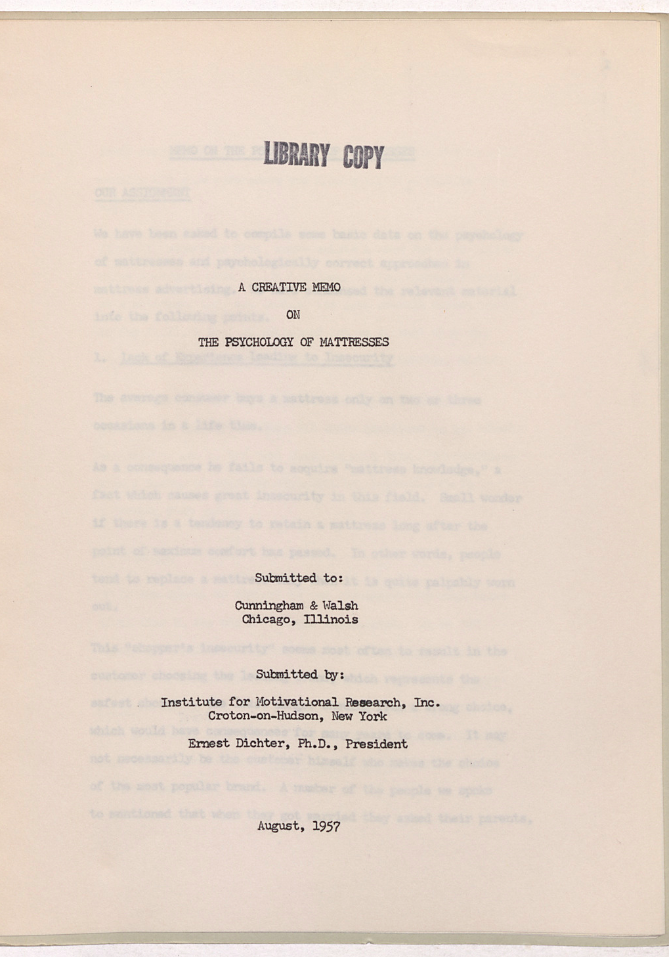
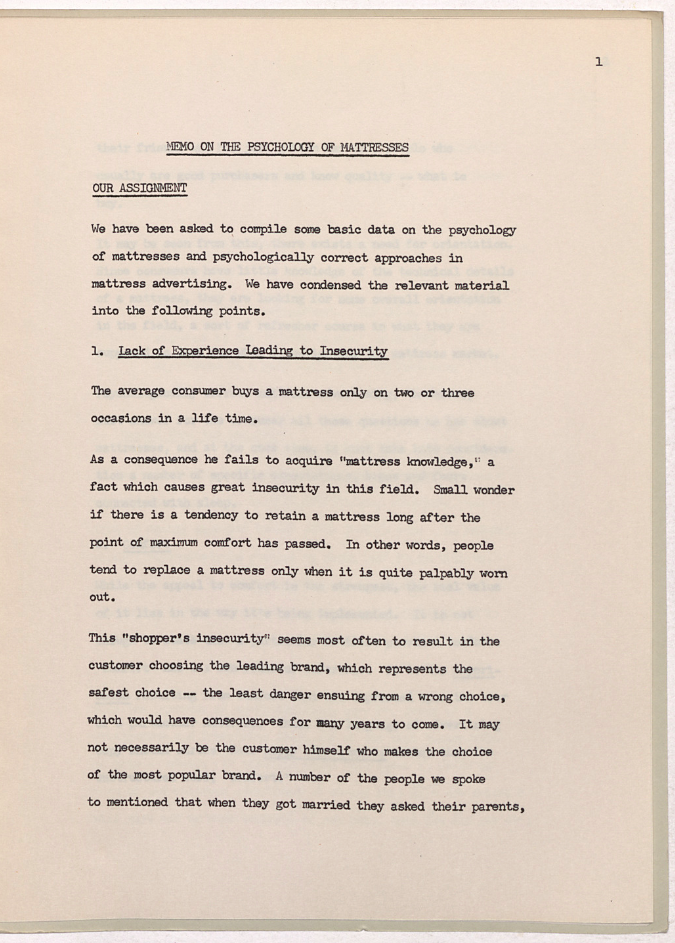
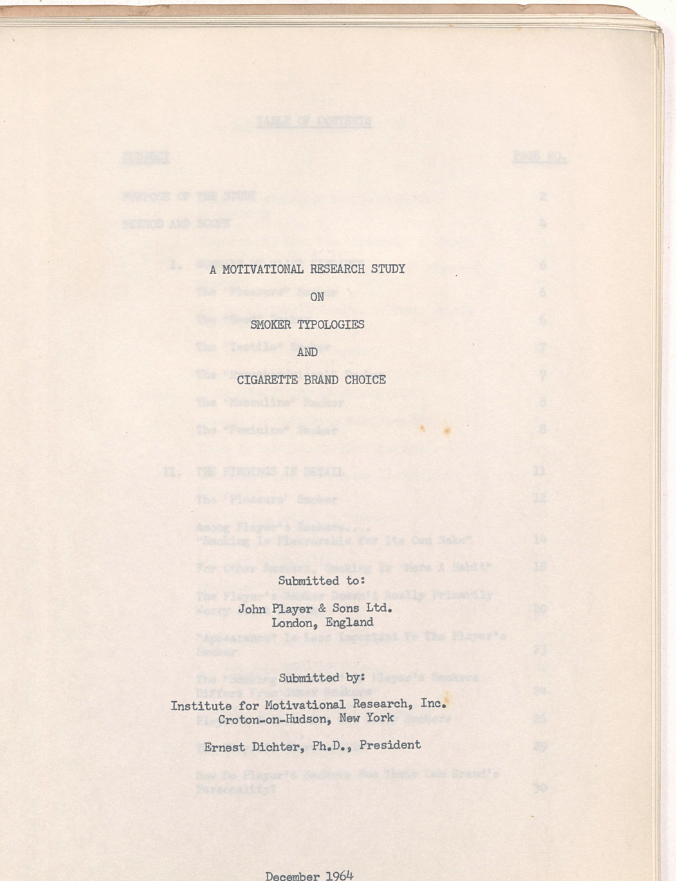
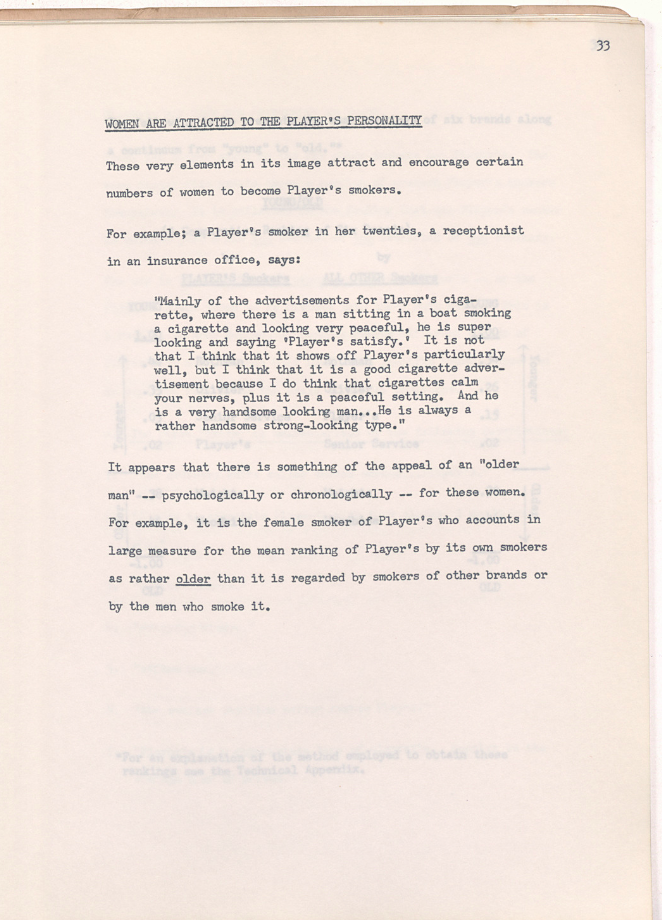
The vertigo hit me hardest when I connected the details of Dichter’s early work on synthetic detergents and the broader implications for psychological control to the raw documents before me. Reports on everything from soap to cars to toys showed a pattern: Dichter probed the “id,” Freud’s term for the primitive, impulsive part of the psyche boiling with suppressed sexual and emotional desires. He uncovered how these forces shaped buying habits, often invisibly, and advised companies on how to exploit them.
For women especially, the archives revealed a web of subconscious guilts tied to traditional roles, from homemaking to body image, all manipulated to boost sales. This discovery wasn’t just academic. It was personal, forcing me to question how much of my own self-perception had been shaped by these invisible hands—a threshold crossed, propelling me deeper into the journey.
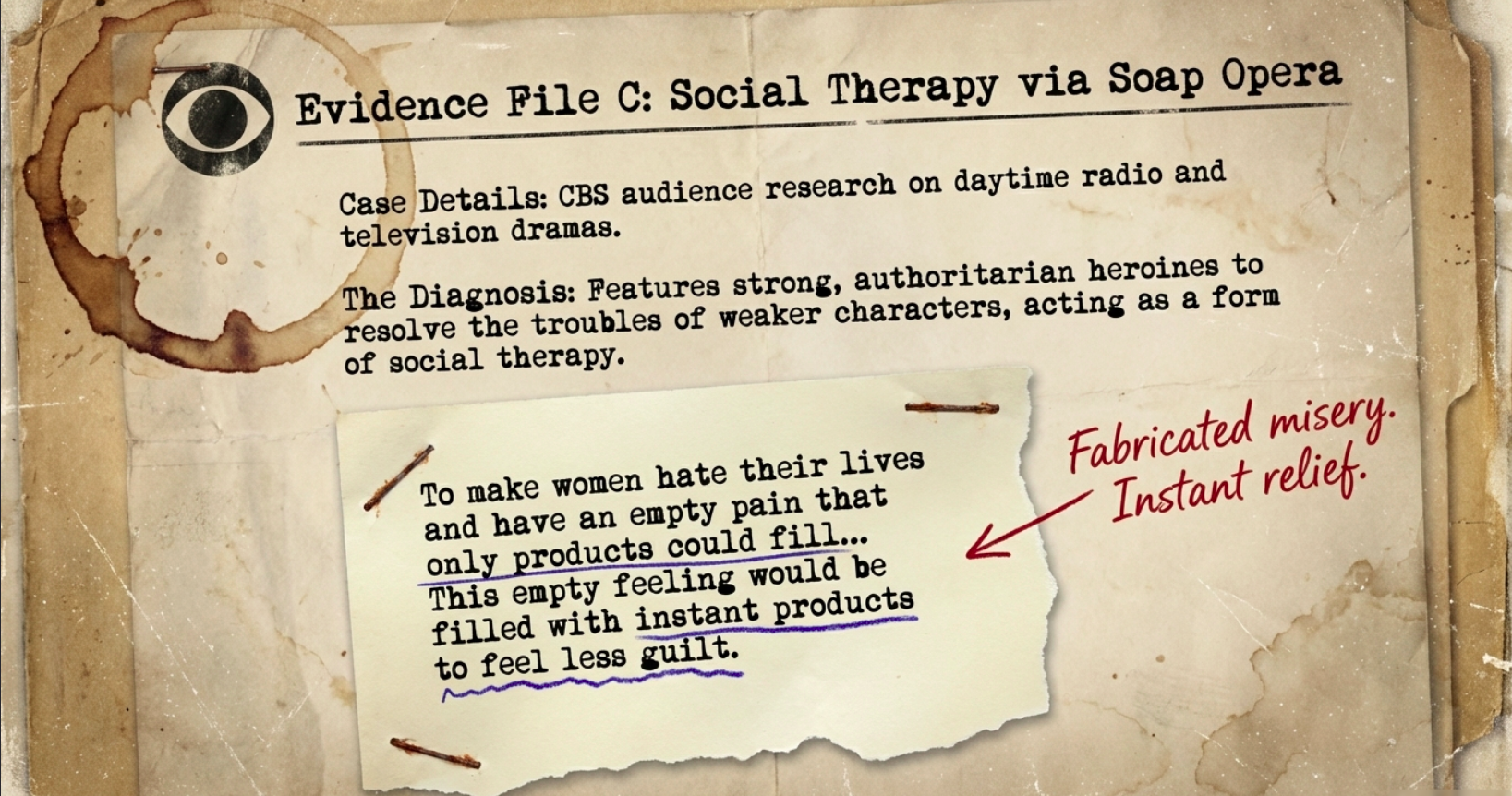
I got to understand the depth of Dichter’s work through my dad who who worked at CBS studios in New York in the 1960s running the in-house cafeterias. My dad told me in the 1970s he would talk to a group of psychologists who were paid to be on the set to consult on the Soap Operas on that network (and others networks). One of them was Dichter. Although they consulted on the scripts weeks before the soot, they would do “fine touches” to be sure the effects they wanted were present in each scene. They had final authority. My heart sunk to disbelief when my dad told me their goal: “to make women hate their lives and to have an empty pain that only products could fill. To crave a life that would be anything but their family and to encourage a need to ‘get out’. To ultimately promote infidelity”. But I did not want to believe my dad. I said why? He went on to the end point: “This empty feeling would be filled with instant products to feel less guilt about the 3 hours the shows took out of their days”. It took me until I found these hidden 126 boxes to fully understand.
5000 Days Series Recap: Charting the Hero’s Odyssey Through the End of Work
As we venture deeper into this series, let us pause to reflect on the path traversed thus far, much like the hero reviewing trials overcome before facing the ultimate ordeal.
- Part 1: Answered the call to adventure, exploring AI’s disruption of labor and the dawn of abundance.
- Parts 2 through 4: Delved into the refusal of the call, examining societal resistance, economic upheavals like the player piano, and reframing the dawn of abundance.
- Parts 5 to 7: Crossed the threshold into the Interregnum’s tests, from your deskilling to the dark night of the soul and considering Phlebas.
- Parts 8 to 10: Approached the inmost cave, saving your wisdom, the artisan’s awakening, and how everyone is doing it.
- Parts 11 to 12: The ordeal intensified with the reversal of obsolescence and the profit and the architect.
- Parts 13 to 14: Seized the sword with the guilded age and navigating interregnum chaos on the hero’s path forward.
- Part 15: Illuminated the road back with the IBM COBOL shock.
- Part 16: Built your ark for the flood of AI-driven changes.
- Part 17: Warned of universe 25 mouse utopia pitfalls, revealing depopulation narratives and emphasizing human agency in abundance.
If this is your first article in the series, go to the start of the series: https://readmultiplex.com/2025/12/24/you-have-5000-days-how-to-navigate-the-end-of-work-as-we-know-it-part-1/
Together, these 17 installments form a monomythic arc, equipping readers to master the end of work and claim a radiant future.
The Man Who Mapped the Subconscious: Meeting the Master Manipulator in the Archives
Dichter didn’t start out as a mad scientist or a shadowy conspirator. He was a refugee with a Ph.D. in psychology, steeped in the ideas of Sigmund Freud and Wilhelm Stekel, who arrived in America with little more than his wits and a revolutionary hypothesis. The post-World War II consumer boom, with factories retooling from wartime production to churn out refrigerators, automobiles, vacuum cleaners, and prepackaged foods, presented a fertile ground for his theories. Classical economics assumed people bought rationally: better, cheaper, faster products would naturally win out. But Dichter knew better. In his reports, he argued that the entire premise of the rational consumer was a lie. People do not make purchasing decisions based on logic, utility, or economic need. Instead, American buying habits were driven by the exact same forces that drove human neurosis: deep-seated unconscious psychological desires, hidden fears, suppressed sexual impulses, and the primal “id.” Dichter learned well from his friend Edward Bernays who was known by insiders as the guy that got women to smoke “freedom torches” to up cigarette sales (and cancer expenses).
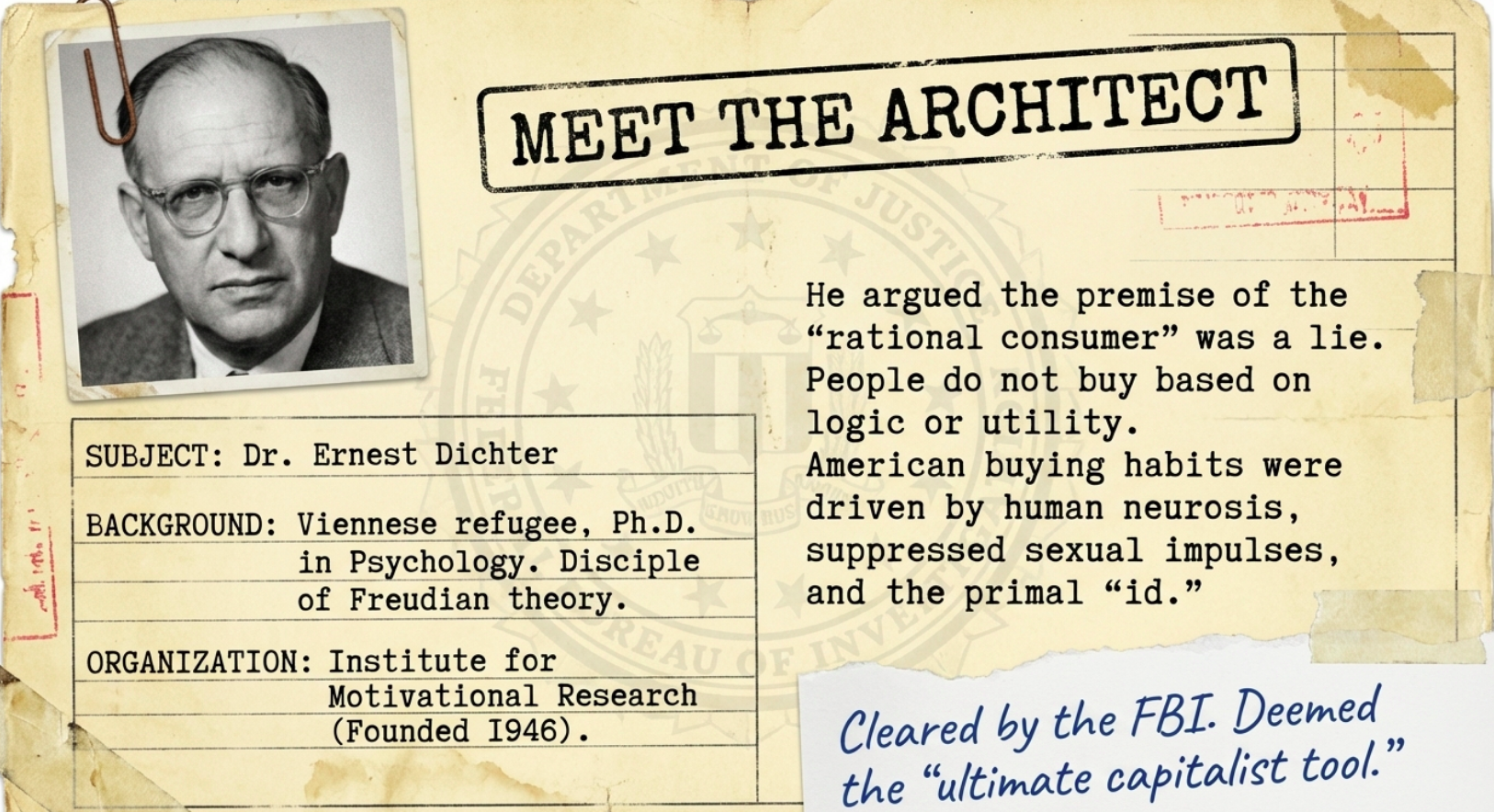
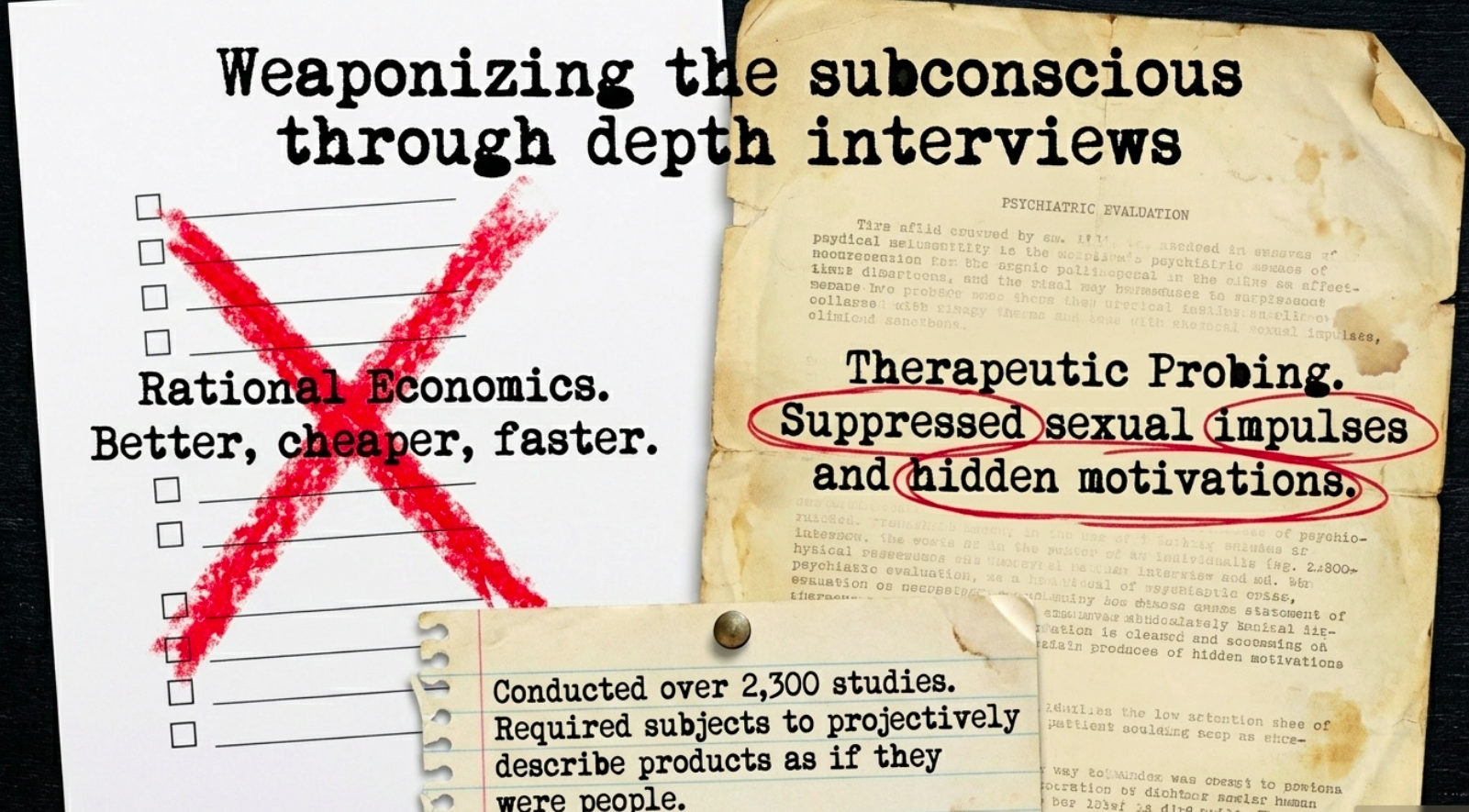
To prove he could manipulate the minds of “new consumers”, Dichter established the Institute for Motivational Research in 1946, pioneering techniques that went far beyond standard market surveys. He dismissed multiple-choice questions as superficial. Instead, he developed the “depth interview,” a grueling, therapeutic probing where interviewers acted like psychoanalysts, unearthing hidden motivations through hours of conversation and projective tests. Subjects might be asked to describe a product as if it were a person, or to draw pictures revealing subconscious associations. These methods, applied in over 2,300 studies for leading companies worldwide, turned the human mind into a hackable commodity. In this phase of the journey, Dichter emerges as an unwitting mentor, his archived wisdom a double-edged sword, revealing tools of control while offering insights to dismantle them.
Dichter’s worldview was profoundly unsettling. He believed that everyday objects carried symbolic meanings tied to our deepest psyches. Shoes, for instance, weren’t just foot protection; they represented strength and independence, echoing the Cinderella myth where a simple slipper transforms a woman’s fate. Hair symbolized potency and virility, drawing from the biblical story of Samson and Delilah. Pleasure, particularly sex, was at the core of consumer behavior, he argued, bringing erotic undertones into advertising in ways that shocked and revolutionized the industry. His work made him the first “star” of motivational research, earning him fees that reflected his transformative impact. But this wasn’t benign insight. It was a shift in power, from overt state control to subtle corporate programming of desires, marking the transition from physical confiscation to psychological manipulation.
The Subtle Chains on Women: Trials and Temptations in the Depths
Diving deeper into the archives, I found report after report that targeted women’s subconscious with surgical precision, revealing how Dichter’s methods reinforced and exploited gendered expectations in an era of rigid roles. This was the heart of the trials, confronting the temptations of manipulated desires head-on. Women, particularly housewives, were unashamedly positioned as the ideal consumers, their self-worth intricately linked to domestic duties, body image, and emotional fulfillment through purchases. The synthetic detergent case stood as a watershed, but the boxes overflowed with similar examples, each uncovering a “profound submerged epidemic of guilt and anxiety” tied to women’s identities.
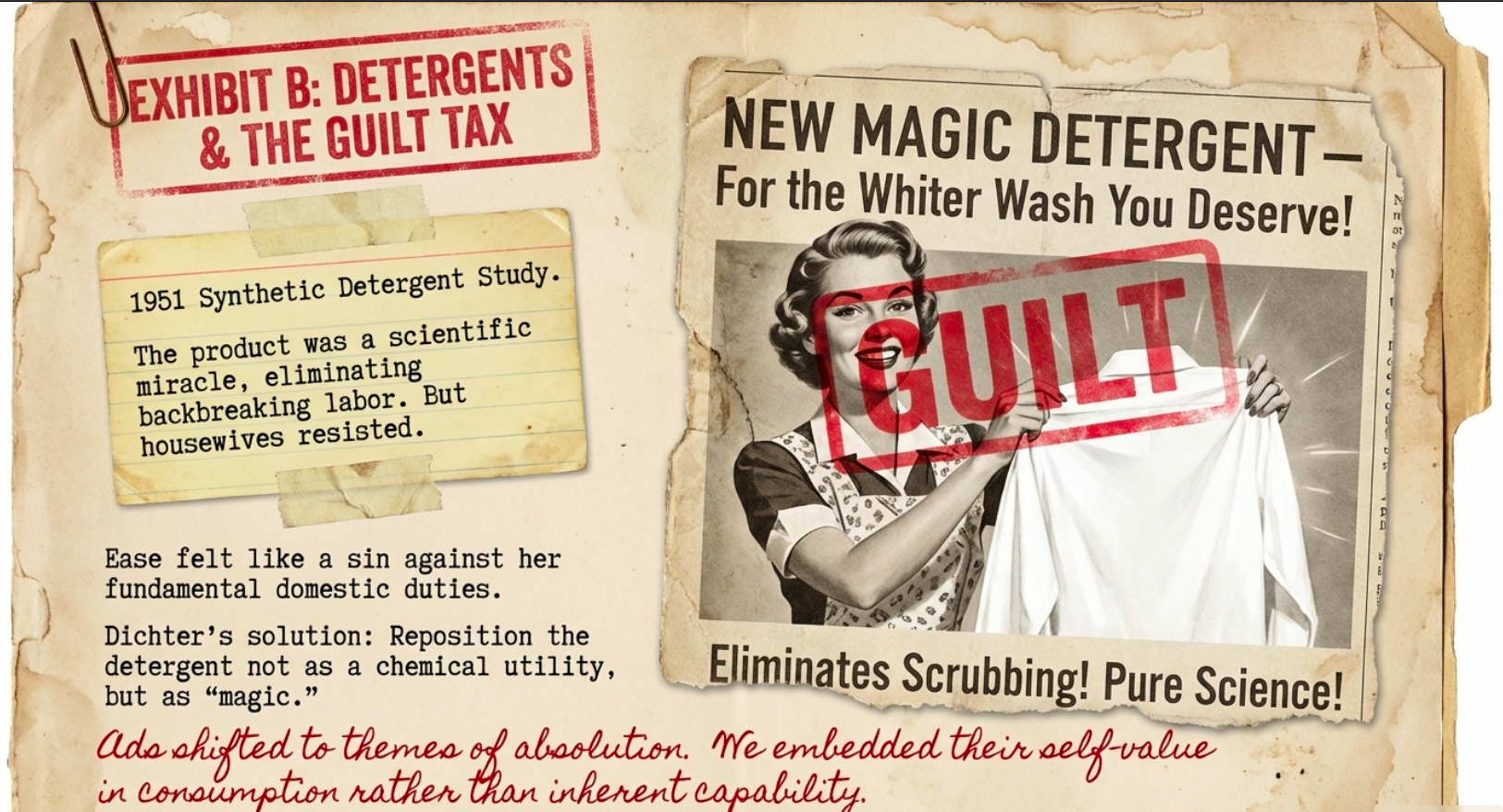
Take the 1951 study on synthetic laundry detergents like Tide or Trend. These products were scientific miracles, cleaning faster and eliminating backbreaking labor. Yet housewives resisted. Dichter’s depth interviews revealed why: For generations, a woman’s worth in the traditional household was deeply tied to the physical exertion of her domestic work. Ease felt like failure, a sin against her fundamental duties. The product worked too well, subconsciously making women feel lazy or inadequate as homemakers. Dichter’s brilliant, manipulative solution? Reposition the detergent not as a chemical utility, but as “magic” that granted moral permission to embrace convenience. Ads shifted to themes of absolution, bypassing guilt and satisfying the subconscious. Sales soared, but at the cost of embedding women’s self-value in consumption rather than inherent capability.
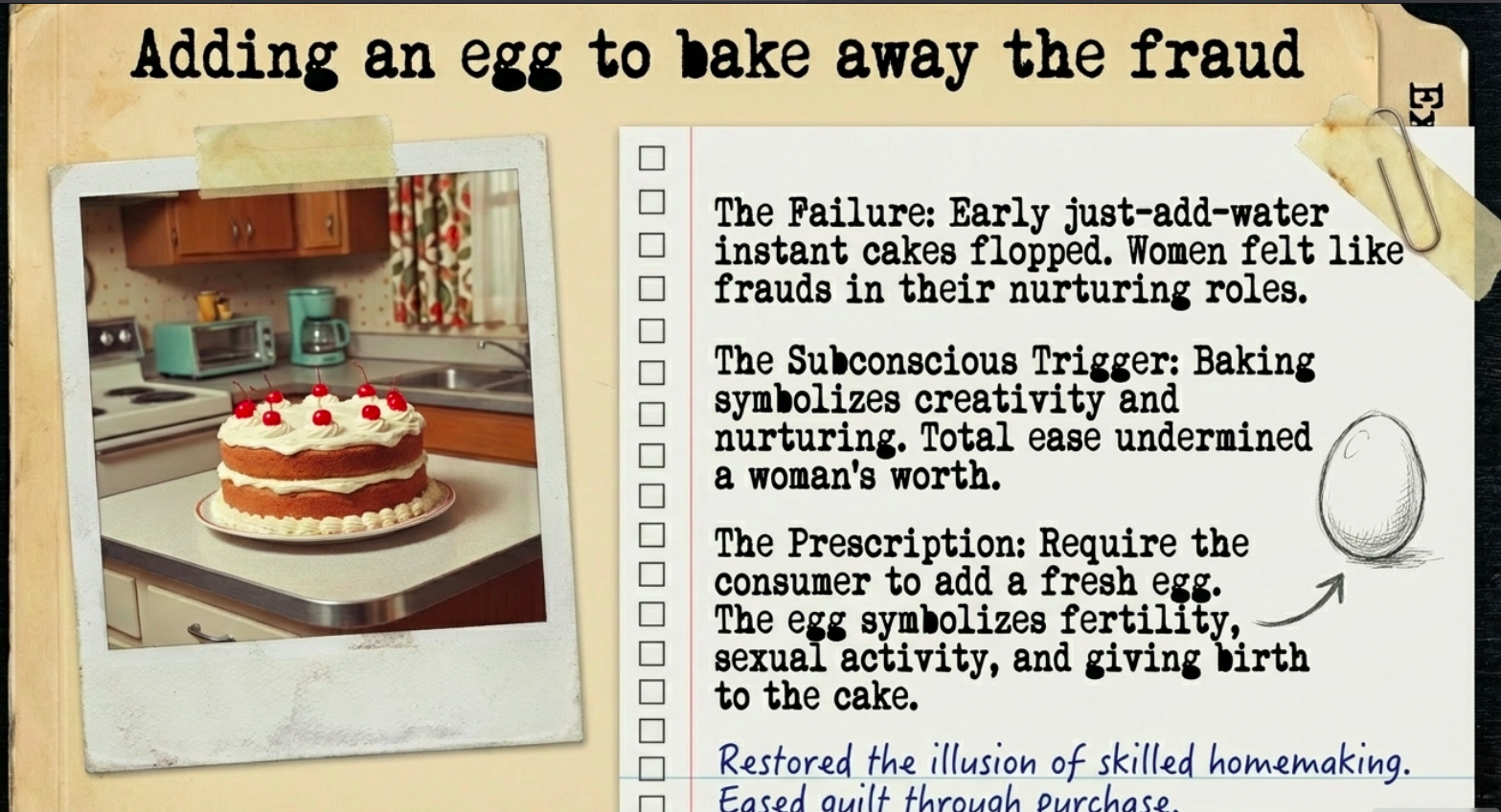
This pattern repeated across categories. In the Betty Crocker cake mix debacle, early instant versions flopped because they required only water, making women feel like frauds in their maternal roles. Dichter uncovered that baking was a symbol of nurturing and creativity; total ease undermined that. His advice: Require adding an egg, a simple act symbolizing fertility, sexual activity, and “giving birth” to the cake. This restored a sense of involvement, transforming the product into a tool for affirming domestic worth. Women could now feel like skilled homemakers without the full labor, easing guilt through purchase.
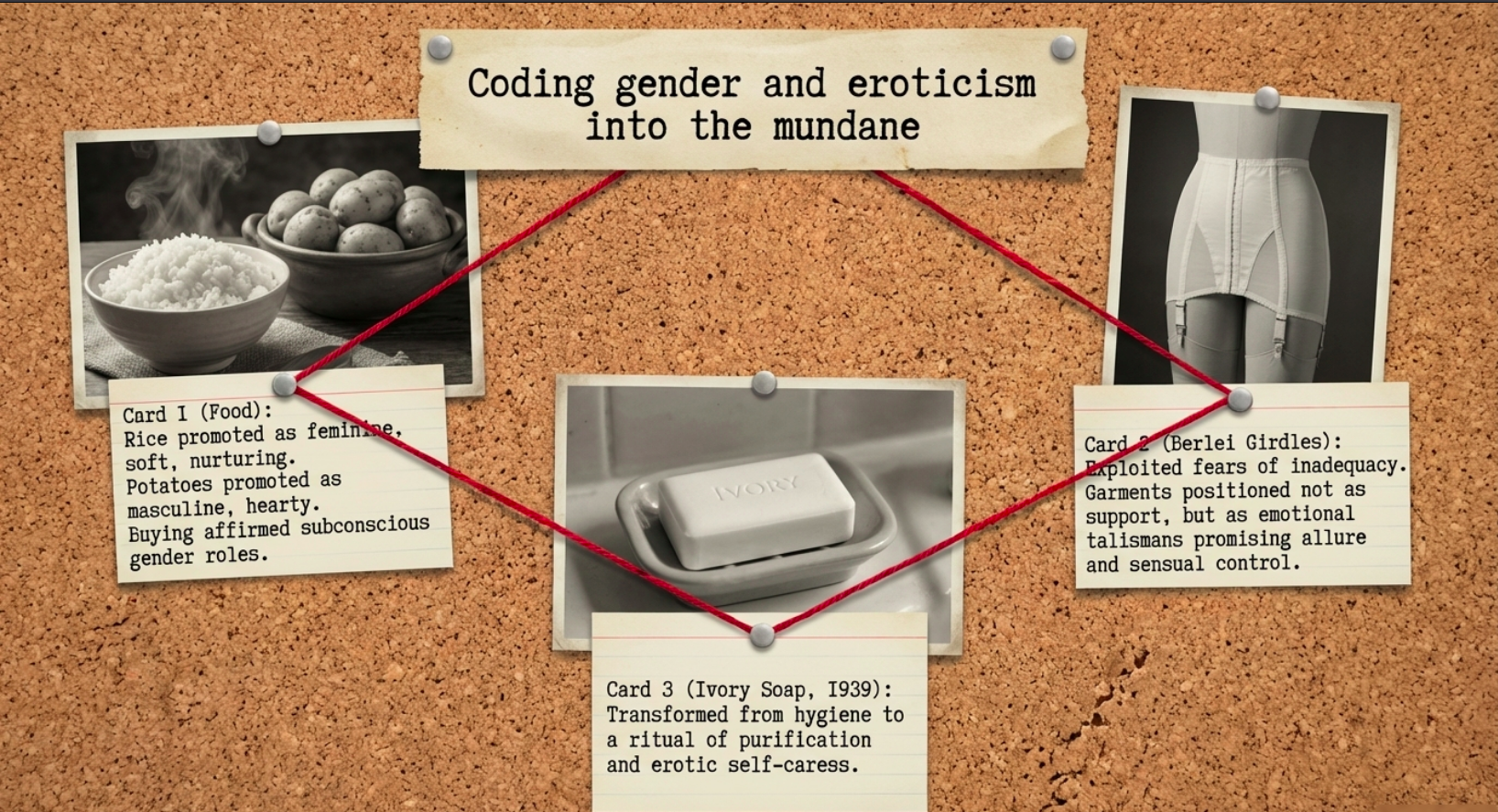
Food itself became gendered under Dichter’s lens, allowing consumers to affirm roles with every bite. He advised promoting rice as feminine, soft and nurturing, while potatoes were masculine, hearty and substantial. Meat embodied male strength, eggs and dairy tied to female fertility. This “sex of food” strategy boosted sales by linking eating to subconscious gender affirmation, particularly pressuring women to choose “feminine” items that reinforced traditional identities.
Body image was another frontier. In studies for Berlei foundation garments, like girdles and bras, Dichter probed women’s anxieties about their figures, uncovering fears of inadequacy, desires for control, and suppressed erotic impulses. Garments weren’t just supportive; they were emotional talismans promising allure and confidence. He recommended ads that tapped into these, portraying undergarments as gateways to empowerment and sensuality, thus tying women’s self-worth to body-shaping purchases.
A motivational study on “All Pure Wool” products among women revealed preferences rooted in perceptions of luxury, warmth, and status. Wool symbolized quality and care, but non-purchases stemmed from subconscious associations with itchiness or outdated tradition, clashing with modern desires for ease. Dichter advised marketing wool as a sensual, feminine indulgence, linking it to self-pampering and identity as a refined woman.
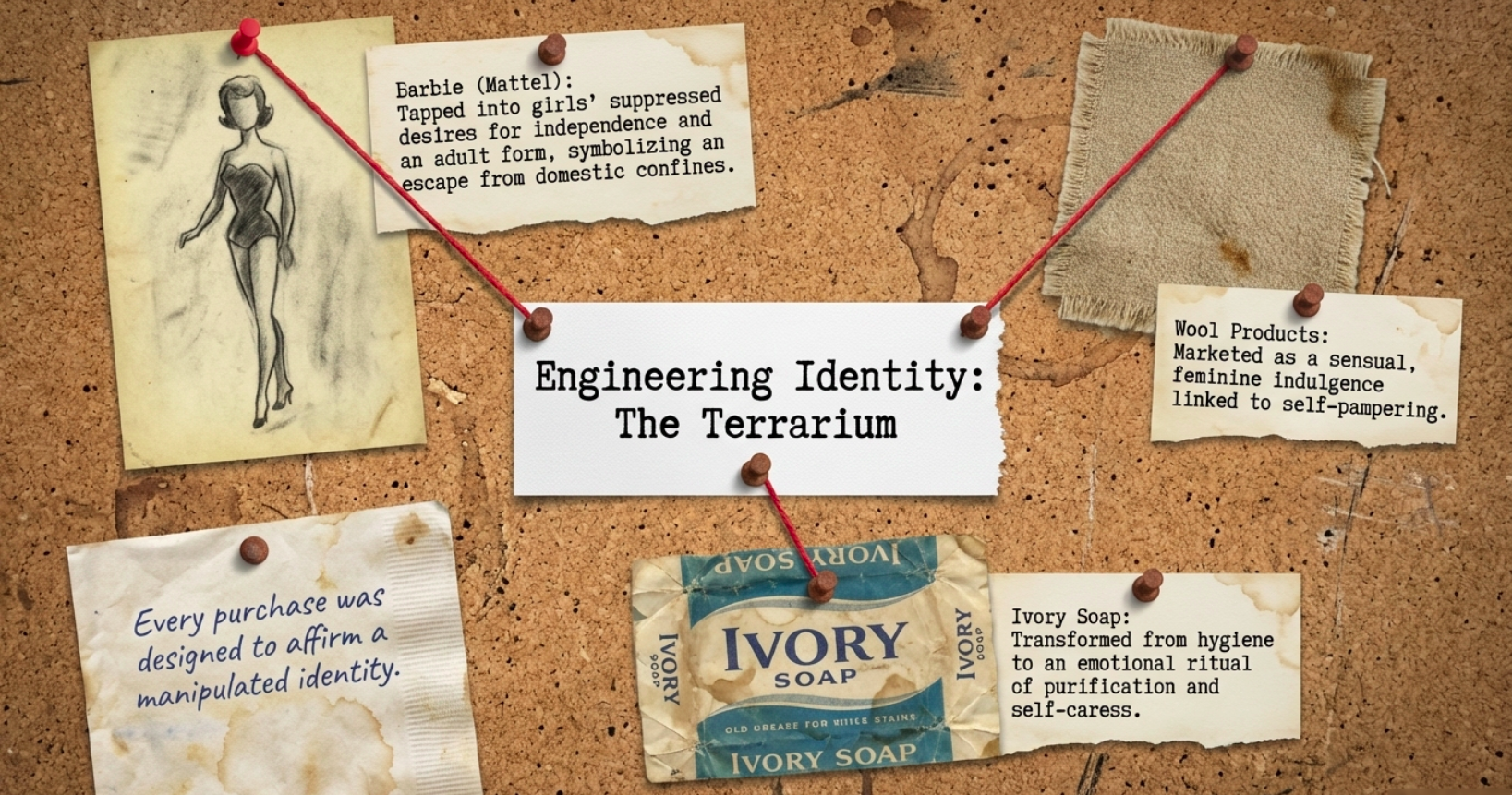
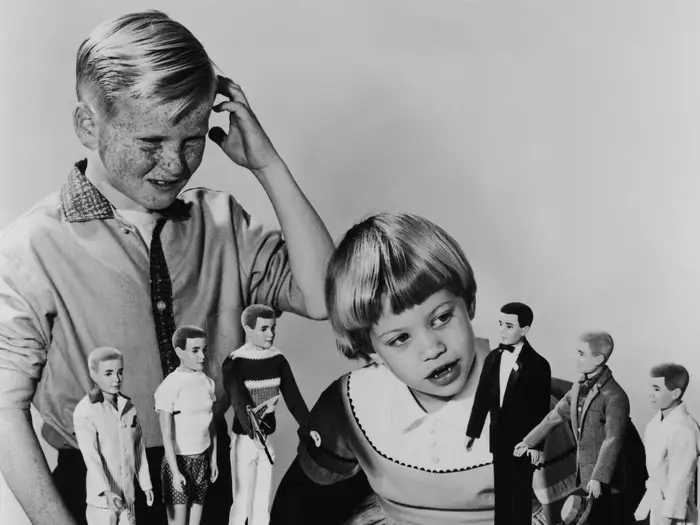
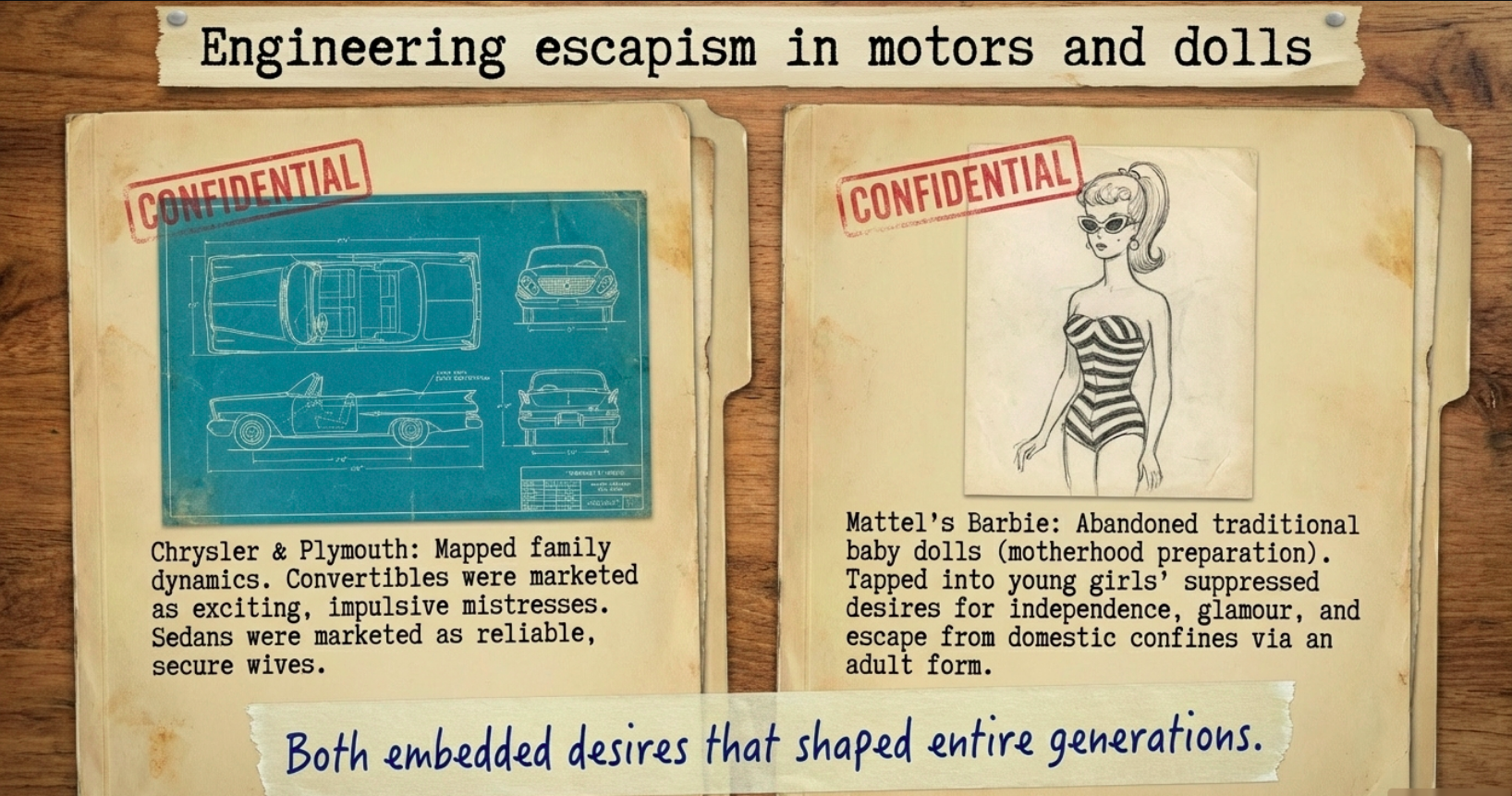
Dolls and toys extended this to childhood. For Mattel, Dichter redesigned Barbie by uncovering girls’ suppressed desires for independence, adulthood, and idealized beauty. One of his redesignes: bigger breasts. Traditional baby dolls prepared for motherhood, but Barbie tapped into glamour and autonomy, with long legs and an adult form symbolizing escape from domestic confines. This altered girls’ self-views, embedding beauty standards that influenced generations of women.
Even cars, typically male domains, involved women. For Chrysler and Plymouth, Dichter found spouses influenced decisions, advising ads in women’s magazines. Convertibles were “mistresses,” exciting and impulsive, while sedans were “wives,” reliable and secure. This erotic framing manipulated family dynamics, positioning women as gatekeepers whose emotional approvals drove sales. It was diabolical.
Ivory Soap was transformed from a hygiene product to an emotional ritual. Dichter linked bathing to self-caress and purification, a Puritan-approved indulgence with subtle eroticism. Ads emphasized “purity” to absolve guilt, making soap a symbol of moral and physical cleanliness tied to women’s self-image.
These examples weren’t quirks. They wove a societal fabric where women’s self-worth hinged on navigating guilt, desire, and roles through purchases. Dichter defended this as liberation from Puritan restraints, promoting “creative discontent” via consumption. Critics saw manipulation, but his influence persisted, shaping how women viewed themselves as emotional, irrational consumers needing products for fulfillment. Each revelation was a test, tempting surrender to cynicism, yet fueling the resolve to forge ahead.

The Soap Opera
Dichter had a notable involvement in analyzing the psychological appeal of soap operas during his early career in the United States, particularly through audience research for broadcasters. His work in this area stemmed from his broader application of psychoanalytic techniques to understand consumer behavior, media engagement, and advertising effectiveness.
Soap operas originated on radio in the 1930s, sponsored primarily by soap and detergent companies (e.g., Procter & Gamble, which coined the term “soap opera” due to their heavy advertising involvement). These serialized dramas targeted housewives, focusing on emotional storylines about family, romance, and personal struggles. Dichter’s expertise in depth interviews and subconscious motivations made him a natural fit for studying why audiences, predominantly women were drawn to them. His research bridged consumer psychology, media content, and advertising, as soap operas were vehicles for product placements and commercials.
Key Involvement: CBS Audience Research on Radio Soap Operas
In the early 1940s, while working at Columbia Broadcasting System (CBS), Dichter conducted a significant study on women’s reactions to radio soap operas. This was part of CBS’s broader efforts to refine programming and boost listener engagement, often in collaboration with advertisers. Using his signature “depth interview” method, non-directive, therapeutic-style conversations to uncover hidden motivations—Dichter explored the subconscious reasons for the genre’s popularity.
- Psychological Appeal and Authoritarian Elements: Dichter concluded that soap operas appealed to women by featuring strong, authoritarian heroines who resolved the troubles of weaker characters. He drew a controversial parallel to fascism, arguing that this dynamic mirrored how Adolf Hitler promised to alleviate the burdens of his followers in Nazi Germany. In his analysis, the heroines provided emotional relief to “female listeners of weak character,” fostering a sense of vicarious empowerment and escape. This insight raised concerns at CBS; director Frank Stanton reportedly worried about the fascist implications offending sponsors.
- Therapeutic Role in Marriage and Social Issues: Dichter also positioned soap operas as a form of “social therapy.” He suggested that by dramatizing internal marital weaknesses (e.g., communication breakdowns) rather than external threats (like a seductive rival), the shows could help real-life couples identify and resolve their own problems, potentially strengthening marriages. For instance, he noted that focusing on “the original weakness in the marriage” instead of a “devastating blonde” breaking it up allowed listeners to work through issues subconsciously, reducing the risk of divorce. Later on he discovered all industries do better with divorced families, they have to buy 2 of everything. Not a surprise it is encourged at the youngest ages just like Barbie Dolls.
This research was qualitative and interpretive, contrasting with more quantitative approaches by contemporaries like Paul Lazarsfeld (Dichter’s early collaborator at CBS). It emphasized emotional realism and interiority, aligning with soap operas’ focus on character development over plot-driven action. Dichter’s soap opera work intersected with his consumer research for soap companies, such as his 1939 study for Ivory Soap (commissioned by Compton Advertising Agency). While not directly about soap operas, this analysis of bathing as an “erotic experience” and ritual of purification influenced how advertisers integrated products into media. Soap sponsors like Procter & Gamble used soap operas to embed brand messages, and Dichter’s insights likely informed how these shows were tailored to resonate psychologically with audiences, enhancing ad effectiveness.
Dichter’s soap opera research exemplified his belief that media like radio dramas served as outlets for suppressed desires and guilts, much like his product studies (e.g., linking soap to renewal and self-caress). In his 1947 book The Psychology of Everyday Living, he expanded on these themes, viewing everyday habits (including media consumption) as expressions of vital impulses. His work helped broadcasters and advertisers refine content to boost loyalty, contributing to the genre’s evolution from radio to television in the 1950s.
Critics, including CBS colleagues, sometimes viewed his analogies (e.g., to fascism) as overreaching, but his methods influenced how media was studied for emotional impact. Today, his ideas echo in analyses of serialized TV dramas and targeted advertising.
The Legacy: From Boardrooms to Algorithms: The Road of Trials
As I pieced together the archives, which trace Dichter’s work from detergents to broader psychological control, a profound vertigo set in. These 1950s tactics are the DNA of today’s world. Social media algorithms are digitized depth interviews, tracking every hesitation, scroll, and impulse to serve ads that “absolve” insecurities. Our place in society is defined by what we buy, share, and aspire to, often rooted in Dichter’s id-driven model. Women bear particular scars: From ongoing battles with body positivity to work-life balance guilt, echoes of his guilt-easing strategies linger in beauty ads, mommy blogs, and wellness products.
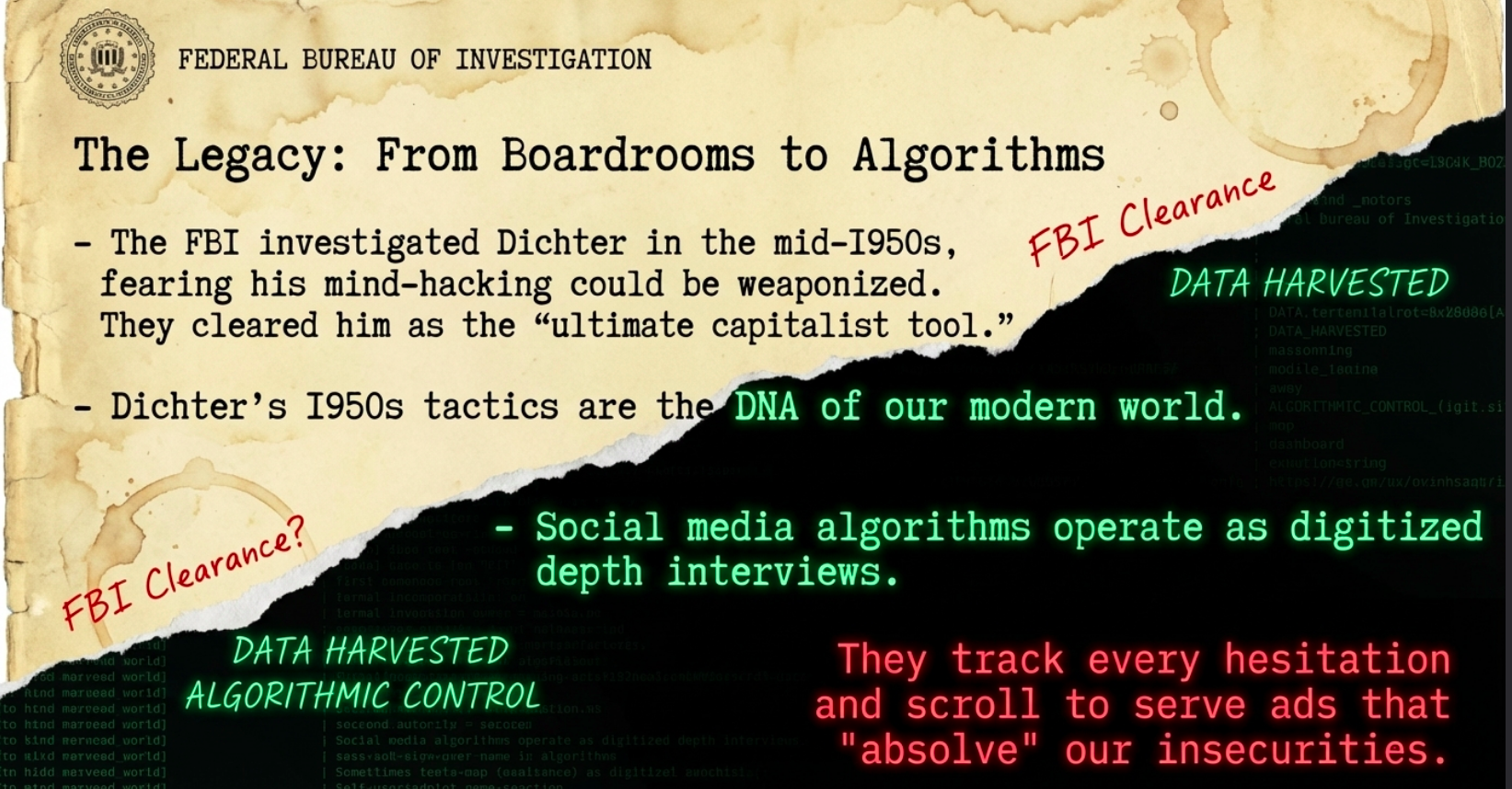
Dichter’s reach extended beyond consumers. He influenced professional spheres, like architectural magazines, identifying “psychological stagnation” in readers and proposing overhauls to combat smugness and conservatism. Even the FBI took notice in the mid-1950s, amid Cold War paranoia, opening a file on him. Agents scrutinized his institute for communist sympathies, fearing his mind-hacking could be weaponized by adversaries to rewire national desires without a shot fired. They cleared him, deeming him the “ultimate capitalist tool,” but the file underscores the perceived power of his methods.
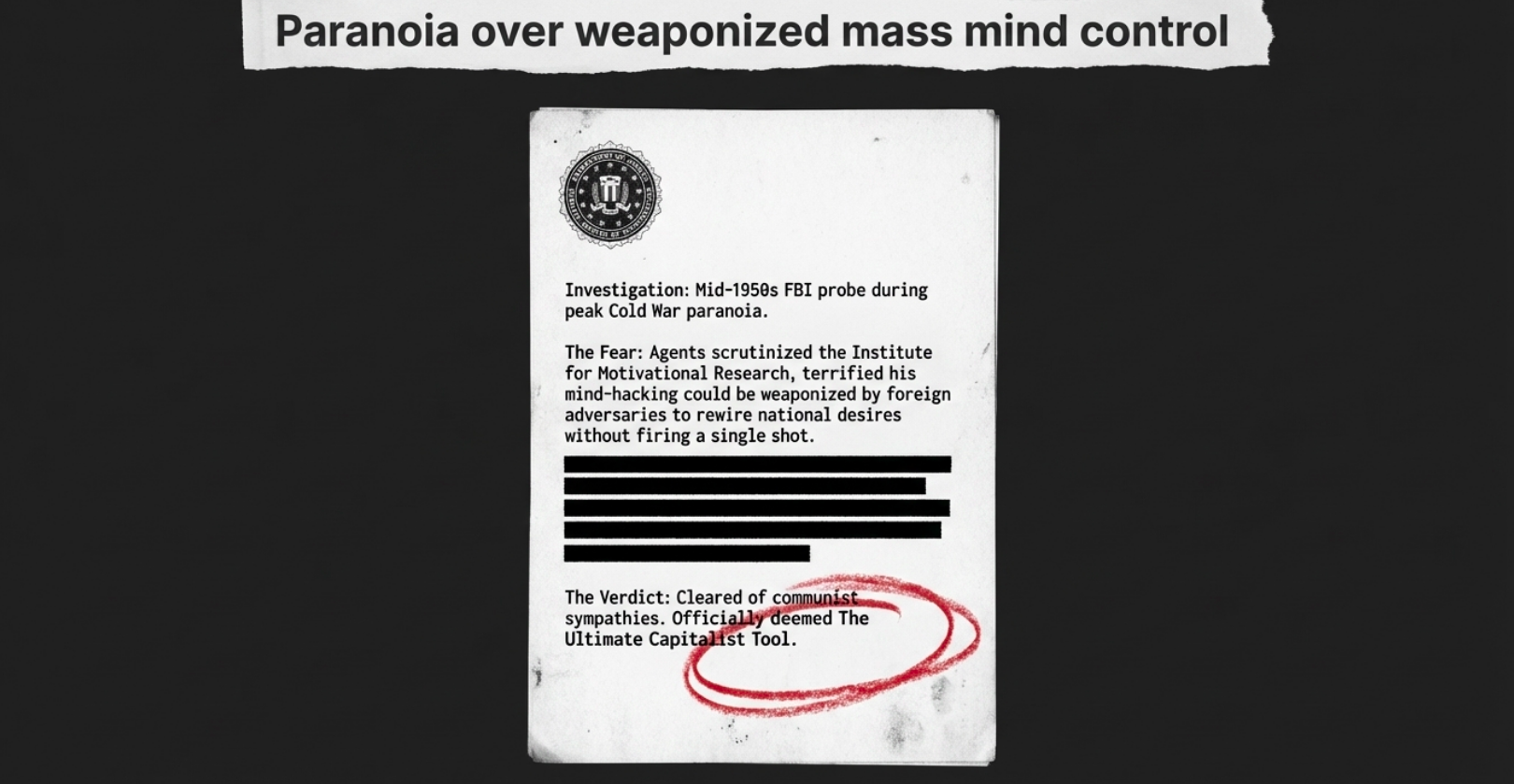
This wasn’t just marketing. It was a grand experiment in mass psychological engineering, turning the subconscious into a predictable commodity. The mid-century American landscape became a carefully constructed terrarium, with desires manufactured and fears calibrated through billboards, commercials, and spreads. Navigating this legacy was the road of trials, each layer peeling back illusions, demanding confrontation with how deeply these manipulations have shaped us.
The Breaking Point: Abundance and the New Lens of Self-Worth: The Approach to the Inmost Cave
Yet, as I closed the last box, a profound optimism emerged amid the chill. I knew that some day we would be entering the Age of Abundance and leave behind this conditioning, although I was certain it would be diffacult. We are at that moment. Within 5000 days, advancements in AI, fusion energy, robotics, and biotechnology will render scarcity nearly obsolete. Basics like food, housing, energy, and goods become nearly freely available, untethered from labor, cost, or consumption. In this world, where automation handles drudgery and resources flow limitlessly, Dichter’s manipulations lose their grip and make no sense. This is our approach to the inmost cave, where the old paradigms fracture, inviting a deeper introspection.
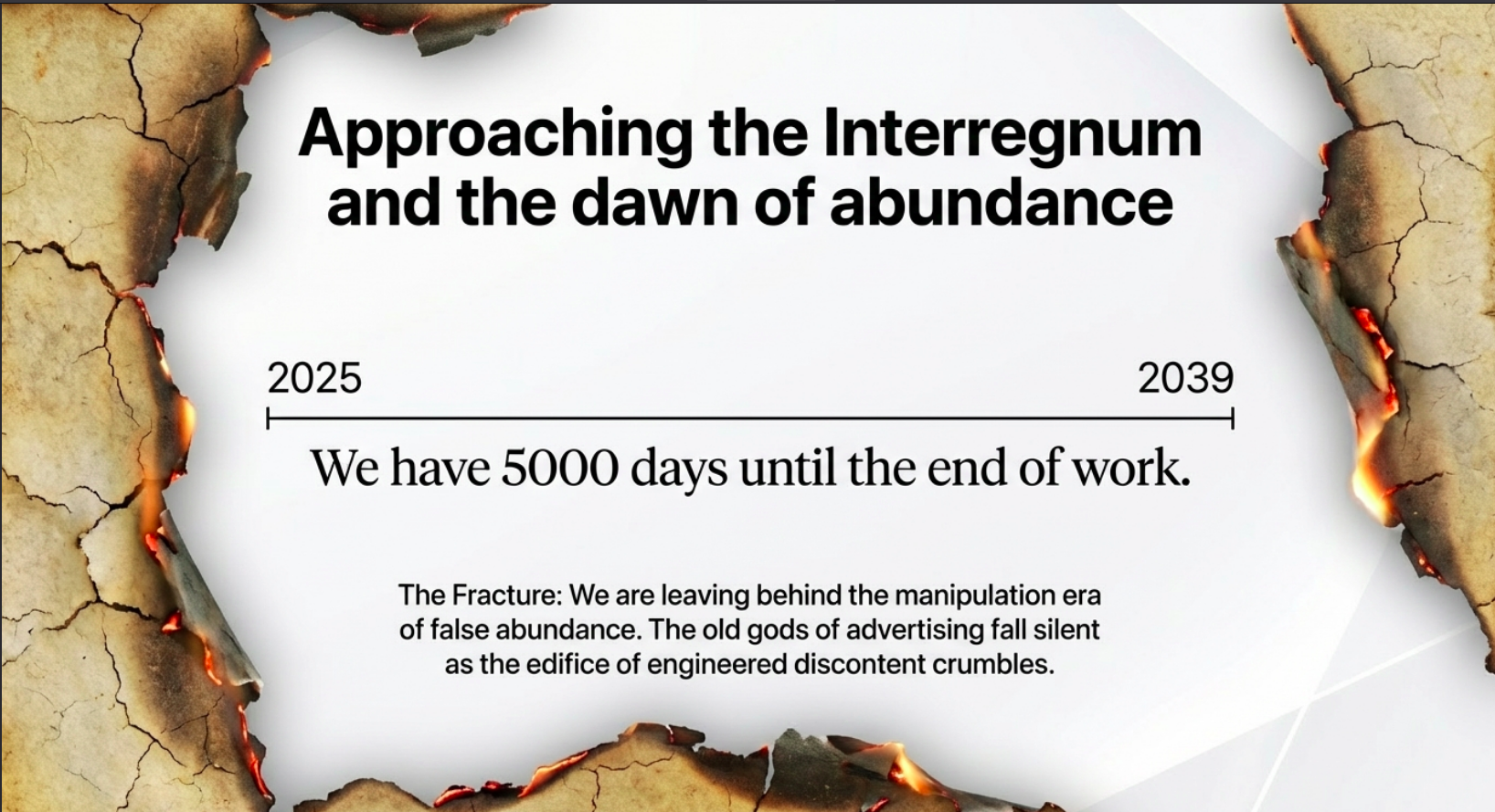
His strategies thrive on scarcity and guilt: Buy to prove worth, ease anxiety through stuff, affirm roles via gendered products. Abundance shatters that. No more tying self-value to domestic toil or purchases; women’s identities shift from guilt-ridden consumers to free creators, explorers, innovators, relationship makers and healers. The “id” finds fulfillment in intrinsic pursuits like family, children, relationships, community, and personal growth, not commodified desires manipulated by corporations.
Through this new lens of self-worth, we see Dichter’s work for what it was: A clever hack on a flawed, scarcity-based system. Abundance exposes the illusion, empowering us to redefine our place in society, not as bundles of neurosis to be exploited, but as sovereign beings with inherent value. Women, long targeted by his gendered tactics, stand to gain most, shedding subconscious chains of guilt and expectation for authentic self-expression.
The shadow archives aren’t a warning. They’re a roadmap to freedom. As I left Hagley, the weight of those boxes lingered. History isn’t a closed book. It’s an active crime scene. And in the coming abundance, we’re the detectives, unredacting our true selves.
The Grand Unveiling: A Hero’s Journey Through the Shadows of Self: The Resurrection and Return
As we stand on the precipice of this transformative era, our collective self-image is undergoing a seismic shift, one that echoes the manufactured guilts of the 1940s through the 1960s but now demands reckoning. Those decades, marked by Dichter’s invisible hand, instilled in us a profound sense of inadequacy, a weight that still presses heavily on our psyches today. The guilt over embracing convenience, the anxiety of not measuring up to idealized roles, the subtle erosion of self-worth through every ad and product, these were not natural evolutions but engineered burdens, designed to keep us consuming, conforming, and questioning our intrinsic value.
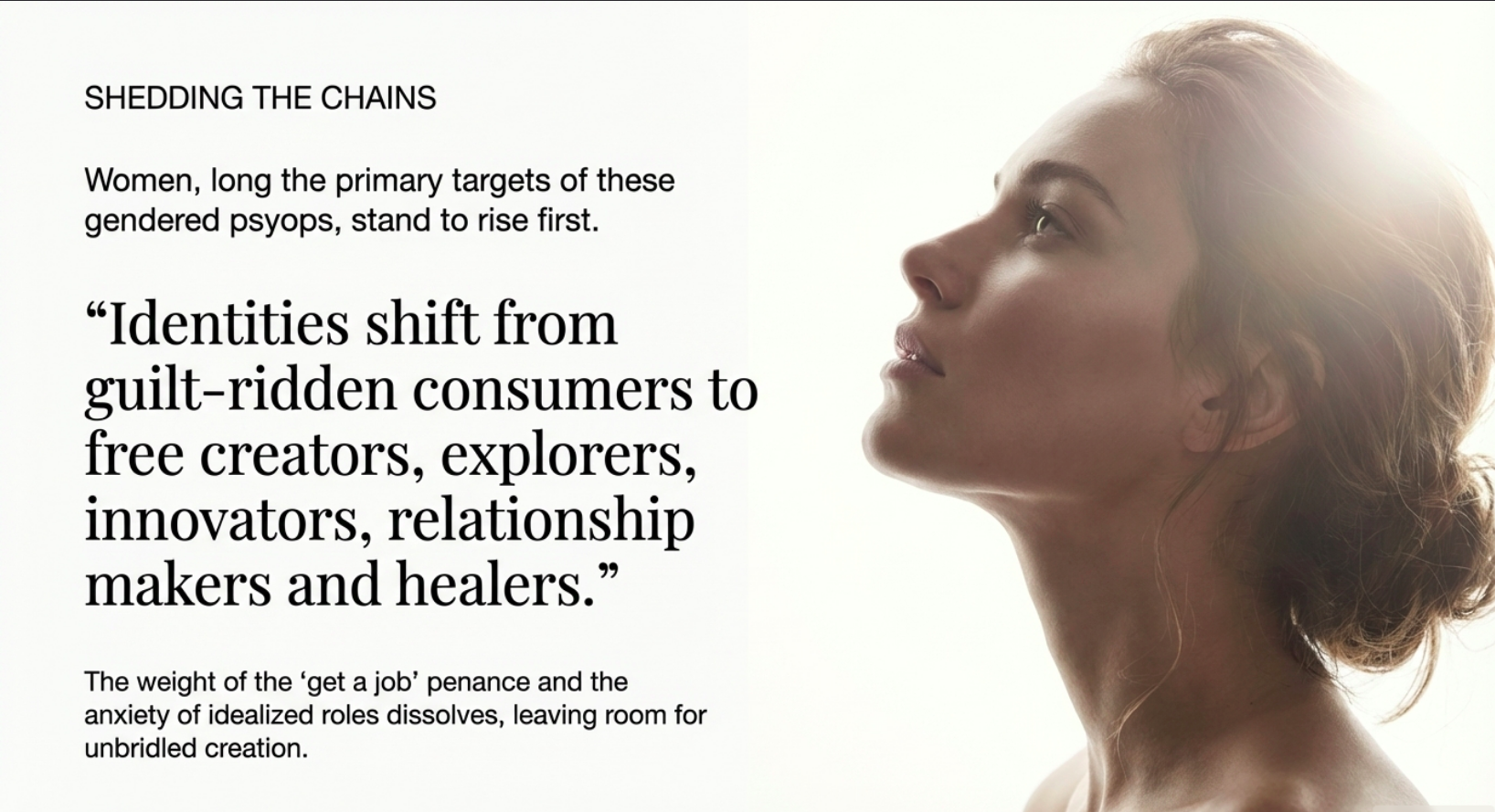
For women, this load was disproportionately heavy, woven into the fabric of daily life from kitchen appliances to beauty standards, leaving scars that manifest in modern struggles with perfectionism, imposter syndrome, and the relentless pursuit of validation through external means. And yet, this weight extends to all of us, men included, who inherited a worldview where identity is commodified, desires are directed, and fulfillment is forever just one purchase away. The guilt of those mid-century manipulations lingers like a ghost, haunting our decisions, our relationships, and our sense of purpose in a world that still whispers, “You are not enough without this.”
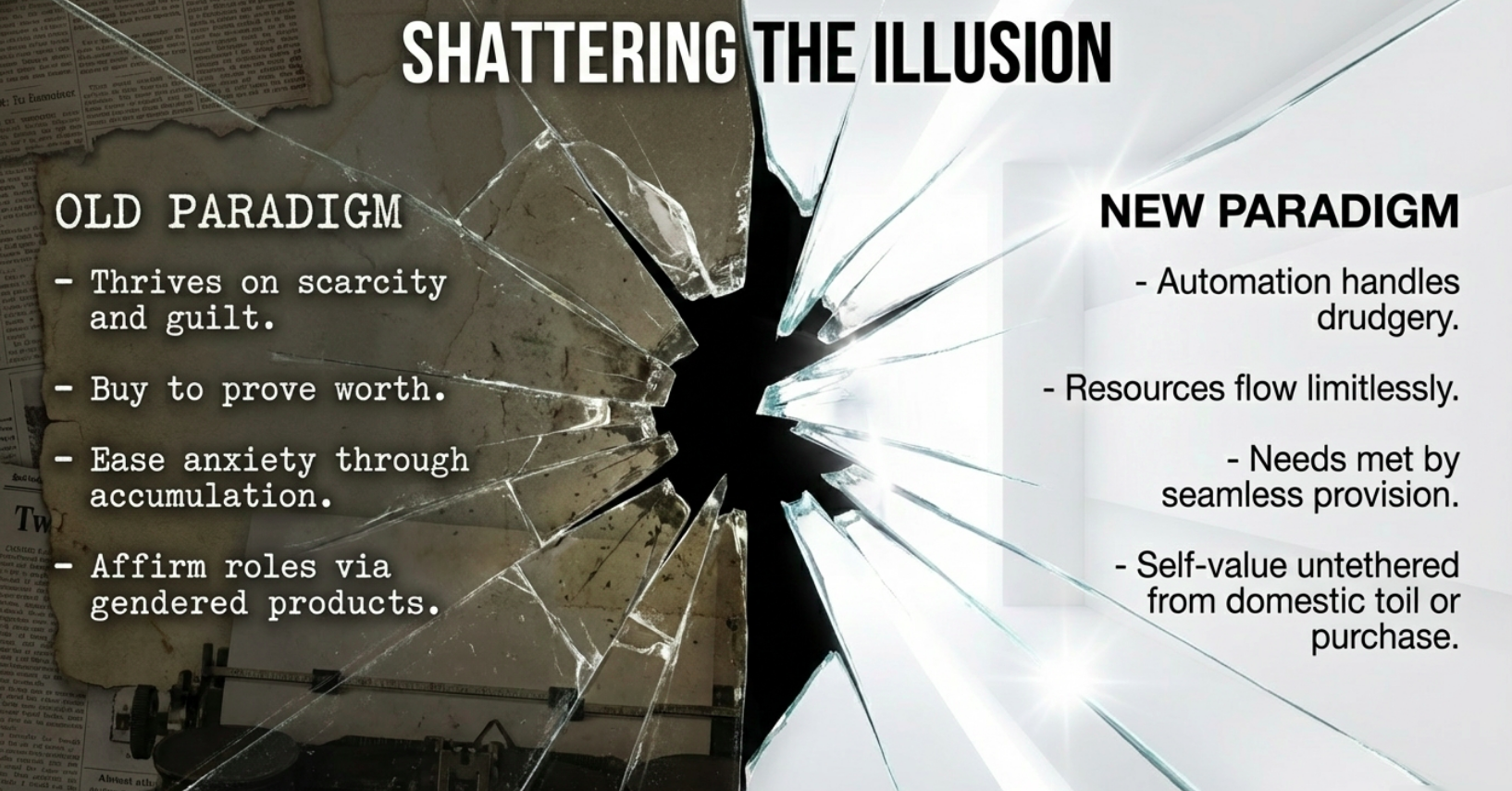
But herein lies the hero’s journey, a narrative as old as myth yet profoundly relevant to our awakening. My descent into those dusty boxes at Hagley was no mere academic excursion, the trials of sifting yellowed pages and confronting the manipulative genius of Dichter, I emerged not defeated, but armed with a map, a detailed cartography of the subconscious terrain that has shaped us. This map, drawn from the very ledgers of exploitation, now guides us toward liberation. In the age of abundance, we confront the dragons of manufactured guilt, slaying them with the sword of awareness and the shield of limitless possibility. We return from this quest transformed, knowing ourselves better, our self-image no longer a fragile construct built on scarcity’s sands but a resilient edifice rooted in authenticity and abundance. We arrive at a new dawn, unburdened, empowered, and whole, ready to author our desires free from the puppeteers of the past.
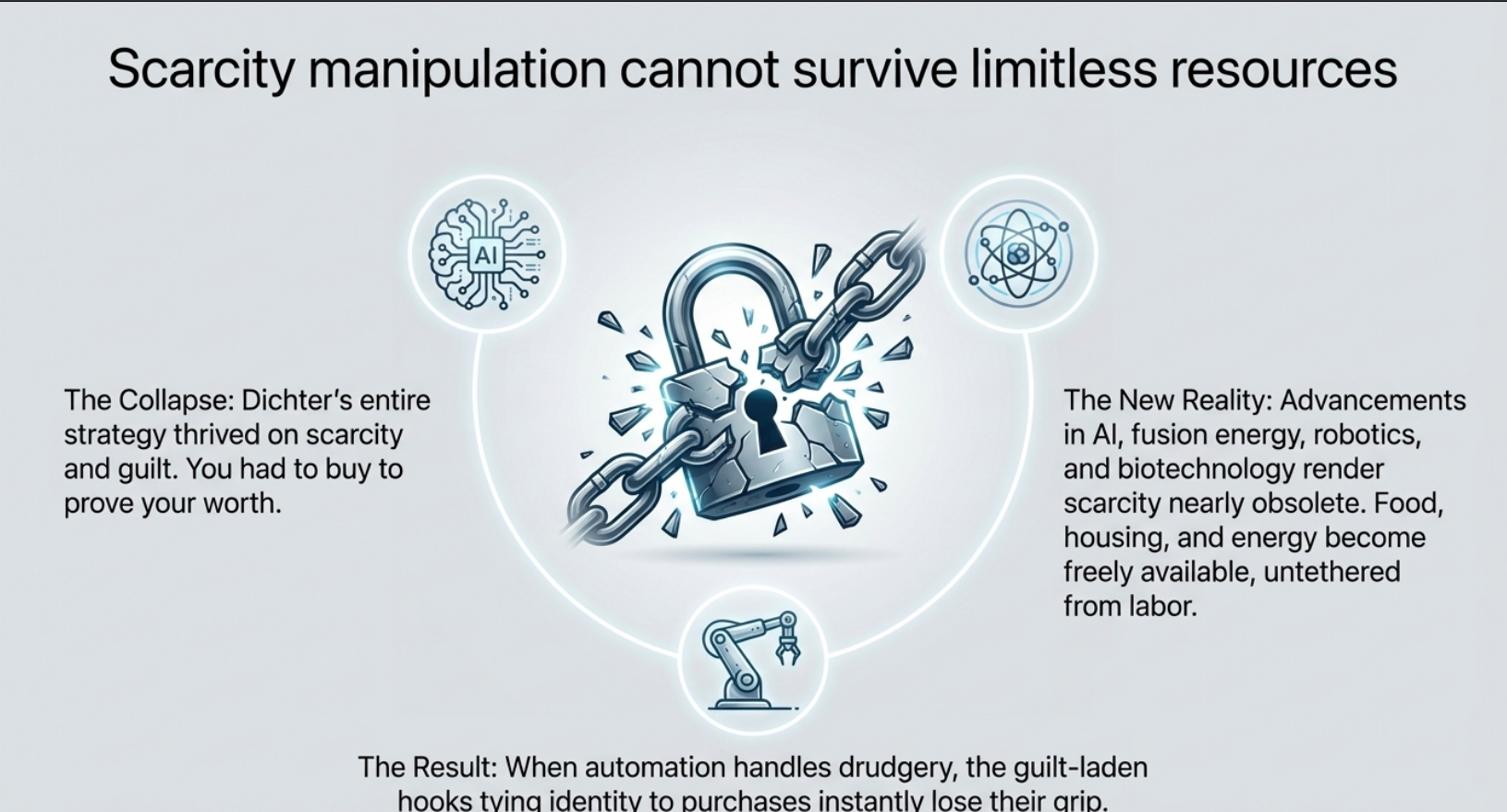
And now, behold the epic crescendo: We are leaving behind the manipulation era of false abundance—a gilded illusion where endless aisles of synthetic miracles promised salvation but delivered only deeper voids, where Dichter’s depth interviews forged chains from our ids, binding us to the relentless wheel of want. In that shadowed epoch, accumulation was our creed, a frenzied hoarding of things to fill the hollows carved by corporate whispers, with advertising as the siren song luring us ever onward, sustaining an empire of illusion built on the sands of scarcity. But as the true age of abundance rises like a phoenix from the ashes of that crumbling edifice, the old gods fall silent. No longer shall we chase the mirage of more; the compulsion to accumulate dissolves in the flood of genuine plenty, where AI-forged wonders provide without price, and automation liberates us from the toil that once defined our worth.
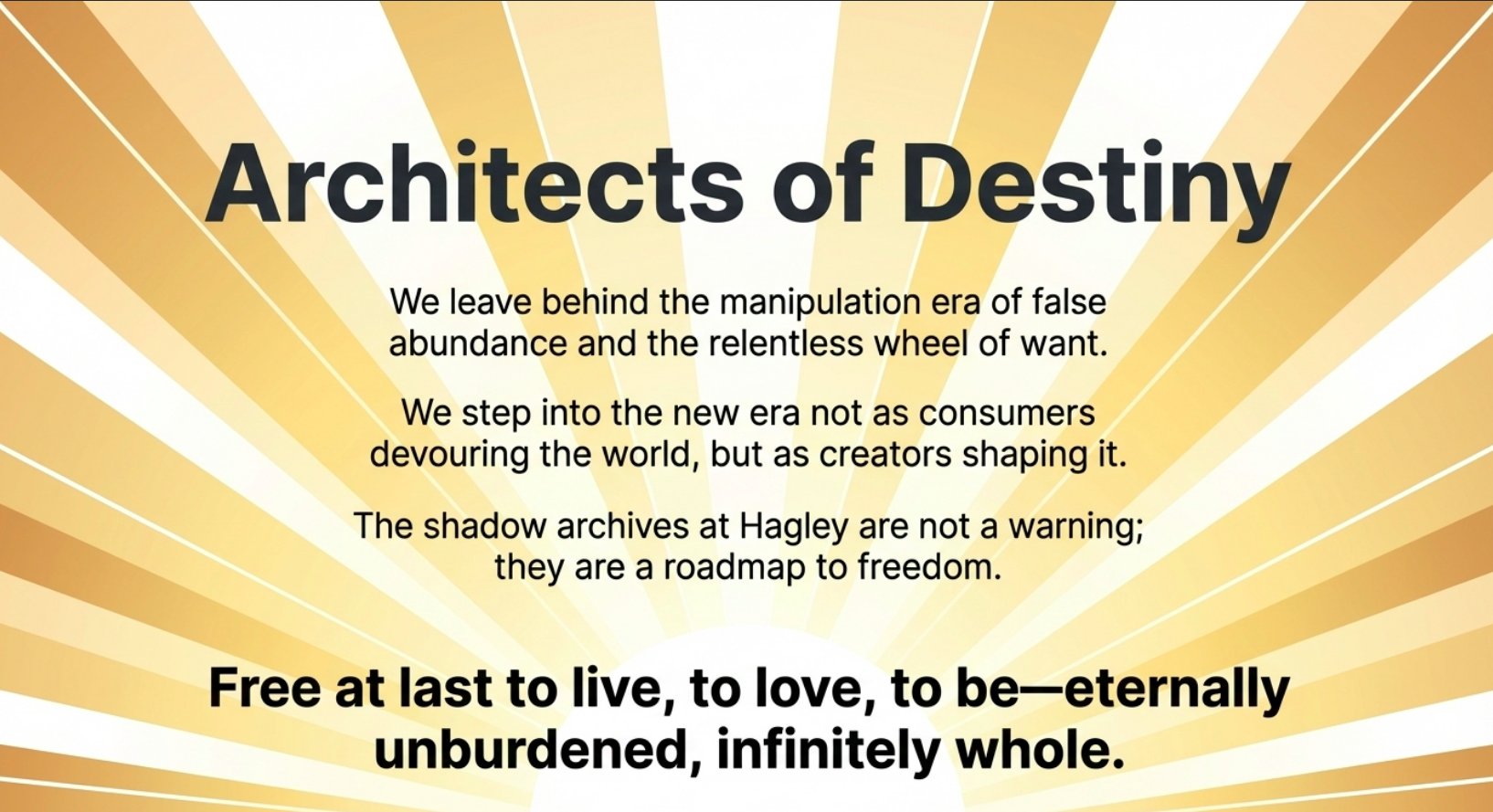
Advertising, that once-omnipotent oracle of desire, fades into irrelevance, its spells broken in a world where needs are met not by persuasion but by seamless provision. The entire system—boardrooms buzzing with motivational research, algorithms mining our impulses, economies hinged on engineered discontent—crumbles like ancient ruins overgrown by the vines of true fulfillment. We step into the new era, not as consumers devouring the world, but as creators shaping it, our self-worth blooming from within, nourished by intrinsic joys: the art we craft, the bonds we forge, the explorations we undertake in a boundless realm. This is the resurrection of the human spirit, the return with the elixir of sovereignty. In this radiant dawn of real abundance, we are no longer pawns in a game of false plenty; we are the architects of our destiny, free at last to live, to love, to be—eternally unburdened, infinitely whole.

The 5000 Days Countdown Clock:
We are on this journey together. Some of us stand on the shoulders of giants and have thought about this for decades. We will not go it alone, and I hope to build many parts to this series and share the mastermind insight from the powerful Read Multiplex member Forum: https://readmultiplex.com/forums/topic/you-have-5000-days-navigating-the-end-of-work-as-we-know-it/. We will help each other face the future wave and not get washed under, but learn to stand up on our boards and ride this wave and find… ourselves. Join us.
To continue this vital work documenting, analyzing, and sharing these hard-won lessons before we launch humanity’s greatest leap: I need your support. Independent research like this relies entirely on readers who believe in preparing wisely for our multi-planetary future. If this has ignited your imagination about what is possible, please consider donating at buy me a Coffee or becoming a member. Value for value you recieved here.
Every contribution helps sustain deeper fieldwork, upcoming articles, and the broader mission of translating my work to practical applications. Ain ‘t no large AI company supporting me, but you are, even if you just read this far. For this, I thank you.
Stay aware and stay curious,

🔐 Start: Exclusive Member-Only Content.
Membership status:
🔐 End: Exclusive Member-Only Content.
~—~
~—~
~—~
Subscribe ($99) or donate by Bitcoin.
Copy address: bc1qkufy0r5nttm6urw9vnm08sxval0h0r3xlf4v4x
Send your receipt to [email protected] to confirm subscription.

Stay updated: Get an email when we post new articles:

THE ENTIRETY OF THIS SITE IS UNDER COPYRIGHT. IMPORTANT: Any reproduction, copying, or redistribution, in whole or in part, is prohibited without written permission from the publisher. Information contained herein is obtained from sources believed to be reliable, but its accuracy cannot be guaranteed. We are not financial advisors, nor do we give personalized financial advice. The opinions expressed herein are those of the publisher and are subject to change without notice. It may become outdated, and there is no obligation to update any such information. Recommendations should be made only after consulting with your advisor and only after reviewing the prospectus or financial statements of any company in question. You shouldn’t make any decision based solely on what you read here. Postings here are intended for informational purposes only. The information provided here is not intended to be a substitute for professional medical advice, diagnosis, or treatment. Always seek the advice of your physician or other qualified healthcare provider with any questions you may have regarding a medical condition. Information here does not endorse any specific tests, products, procedures, opinions, or other information that may be mentioned on this site. Reliance on any information provided, employees, others appearing on this site at the invitation of this site, or other visitors to this site is solely at your own risk.
Copyright Notice:
All content on this website, including text, images, graphics, and other media, is the property of Read Multiplex or its respective owners and is protected by international copyright laws. We make every effort to ensure that all content used on this website is either original or used with proper permission and attribution when available.
However, if you believe that any content on this website infringes upon your copyright, please contact us immediately using our 'Reach Out' link in the menu. We will promptly remove any infringing material upon verification of your claim. Please note that we are not responsible for any copyright infringement that may occur as a result of user-generated content or third-party links on this website. Thank you for respecting our intellectual property rights.
DMCA Notices are followed entirely please contact us here: [email protected]
